Table of contents (11)
- Why the PM-Designer Relationship Makes or Breaks Products
- The 3 Modes of PM-Designer Collaboration
- When to Bring the Designer In
- The PM's Job in the Design Phase
- Running Design Reviews That Work
- Writing PRDs Designers Love
- Managing Scope
- Handoff to Engineering
- Anti-Patterns That Erode Trust
- FAQ
- Finding Designers Worth Collaborating With
How Product Managers Can Collaborate Effectively with Designers
Product managers and designers are natural collaborators, yet many teams treat their relationship as transactional: PMs hand off specs, designers execute in silence, and friction erupts at handoff. The truth is harder but better: when PM and designer move in sync from day one, product outcomes improve dramatically. This guide breaks down three collaboration modes, timing rules, and practical techniques for running design reviews, writing PRDs designers love, and maintaining trust through the entire product cycle. By the end, you'll have a framework to transform your PM-designer partnership from a source of friction into your competitive advantage. Understanding these patterns separates teams shipping incrementally from those shipping with intention and clarity.
Why the PM-Designer Relationship Makes or Breaks Products
The PM-designer dynamic is the heartbeat of good product. When it's strong, decisions move faster because both sides trust each other's judgment. When it's weak, scope creeps, rework spirals, and handoff becomes a nightmare. This relationship shapes everything from how quickly you validate ideas to how polished your shipped product feels in users' hands. For high-growth startups and enterprise teams alike, this partnership determines velocity.
A PM's job is to align the business, users, and engineers around a problem worth solving. You're the voice connecting customer pain to company strategy, translating feedback into prioritized features. A designer's job is to make that solution feel natural, delightful, and right. They're the translator turning abstract requirements into interactions that users understand intuitively without thinking. These are not opposing forces; they're complementary skill sets that must overlap.
The problem arises when one side moves without the other. A PM who writes detailed specs without designer input often creates requirements that ignore usability nuance. You might optimize for feature completeness without realizing that users need progressive disclosure, or that your information hierarchy confuses rather than clarifies. A designer who prototypes in isolation often makes beautiful work that engineering can't ship on the timeline. They might create custom interactions that require weeks of implementation when a system component would work just as well and get you to launch 30% faster.
The best products come from both sides pushing on the same block from the start. When a PM asks "why would a user do this?" and a designer responds with a flow diagram before either of you spec a single button, you're already winning. When a designer spots a business assumption that contradicts user behavior and the PM adjusts strategy accordingly, you're shipping faster and smarter. This collaborative intensity takes practice and structure, but the payoff is enormous: faster iteration, higher quality, fewer surprises at launch, and stronger team cohesion.
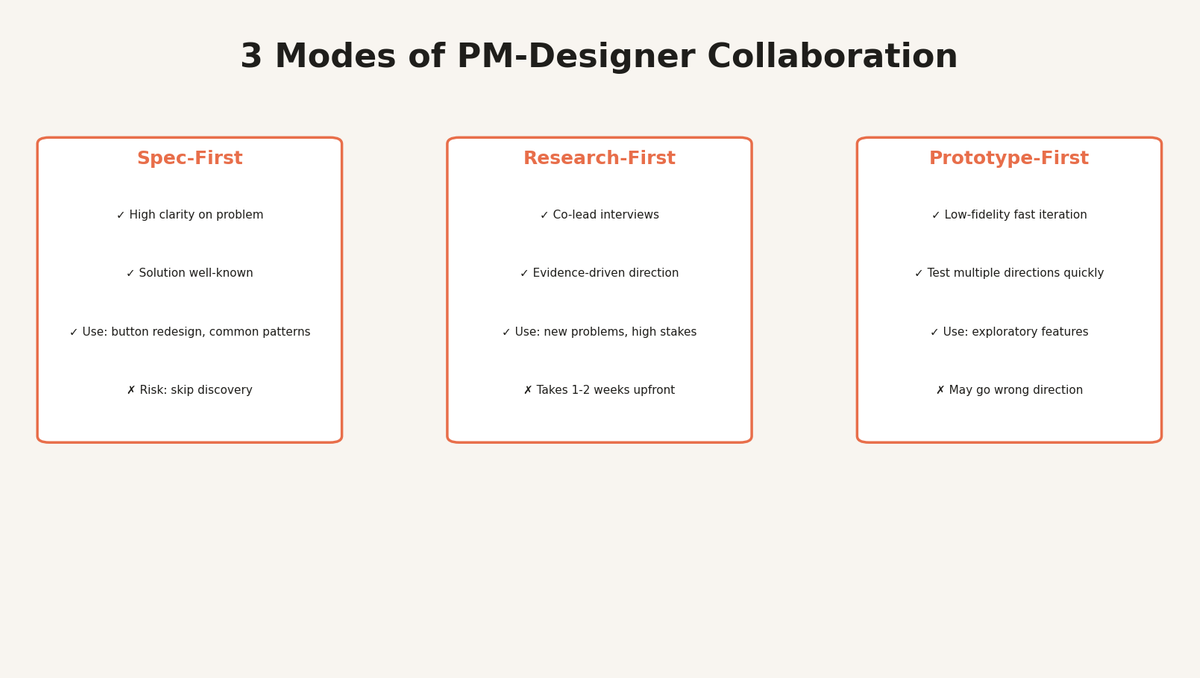
The 3 Modes of PM-Designer Collaboration (Spec-First / Research-First / Prototype-First)
Not every feature demands the same collaboration flow. Maturity of the problem space, confidence in the solution, and risk tolerance shape which mode makes sense. Understanding these three archetypes helps you pick the right collaboration rhythm for each initiative on your roadmap.
Spec-First Mode works when the PM has high clarity on the problem and the solution is well-known. Examples include a standard form redesign, a button color audit, adding a missing field to an existing flow, or implementing a common pattern you've seen work elsewhere in the industry. The PM writes a concise spec grounded in the user job and constraints, shares it with the designer, and the designer executes with guidance. This is fast but risky if assumptions are wrong. Use it only when you're 80% sure. The danger: you skip discovery and ship something polished but wrong, which wastes weeks of effort.
Research-First Mode is ideal for new problems or high-stakes decisions. User interviews, analytics deep-dives, and competitive teardowns happen together with both PM and designer leading. The PM and designer co-lead research, take notes side by side, synthesize findings in real time, and the design direction emerges from evidence, not opinion. This takes longer upfront, typically 1-2 weeks of research before a single wireframe appears, but prevents rework later. It's slower at the start and dramatically faster by launch. Choose this when the cost of being wrong is high or when you're entering unfamiliar terrain with new user segments.
Prototype-First Mode flips the order entirely: the designer builds rough, low-fidelity prototypes, the PM tests them with users, and refinement happens in tight feedback loops. This works for exploratory features where speed matters more than precision, or when you need to test multiple directions quickly. It feels messy and unprofessional compared to the other modes, but it often yields surprising insights faster than structured research. The trade-off: you might build in the wrong direction, but you'll know within days instead of weeks, minimizing wasted effort.
Most mature teams use all three modes, picking the mode that fits the problem, timeline, and team confidence level. A strong PM-designer team flexes between modes weekly, sometimes even on the same sprint. The key is deliberateness: agree upfront which mode you're in and why. Document this decision in your PRD so engineers understand how confident you are in the requirements.
When to Bring the Designer In - Timing That Matters
The biggest mistake PMs make is waiting too long to loop in design. You finish your strategy doc, lock your requirements, and send them to the designer with "Can you make this beautiful?" That often means the designer inherits assumptions instead of co-creating them. You've already made a hundred micro-decisions about how the feature works, and the designer has to implement them rather than question them or propose better alternatives.
Ideally, designers join the problem definition phase, not the execution phase. If you're running user research, the designer should be in the room taking notes and spotting patterns you miss. If you're scoping a feature, the designer should flag technical or usability constraints before you've locked the spec. This isn't about slowing you down; it's about preventing the wrong direction entirely and saving yourself from shipping in the wrong direction.
The second timing rule: design does not happen in a vacuum during a sprint. Too many teams create a design-only phase (weeks 1-2) and an engineering-only phase (weeks 3-6). Instead, have all three roles overlapping from the start. The PM scopes as the designer sketches. The designer refines as the engineer asks clarifying questions. This overlap feels inefficient (constant meetings, constant interruptions) but dramatically reduces surprises at handoff. When the engineer asks "why is this interactive?" mid-build and the designer answers from three weeks of context, you avoid massive rework and feature delays.
The third rule: design doesn't end at handoff. Too many teams treat handoff as the designer's exit ramp to the next project. In fact, the most important design work happens during engineering. Questions about spacing, interaction details, edge case UIs, and last-minute requirement changes need a designer in the room (async or sync). A designer who disappears after handoff means engineers ship 80% of your vision, 20% their own guesses about your intent.
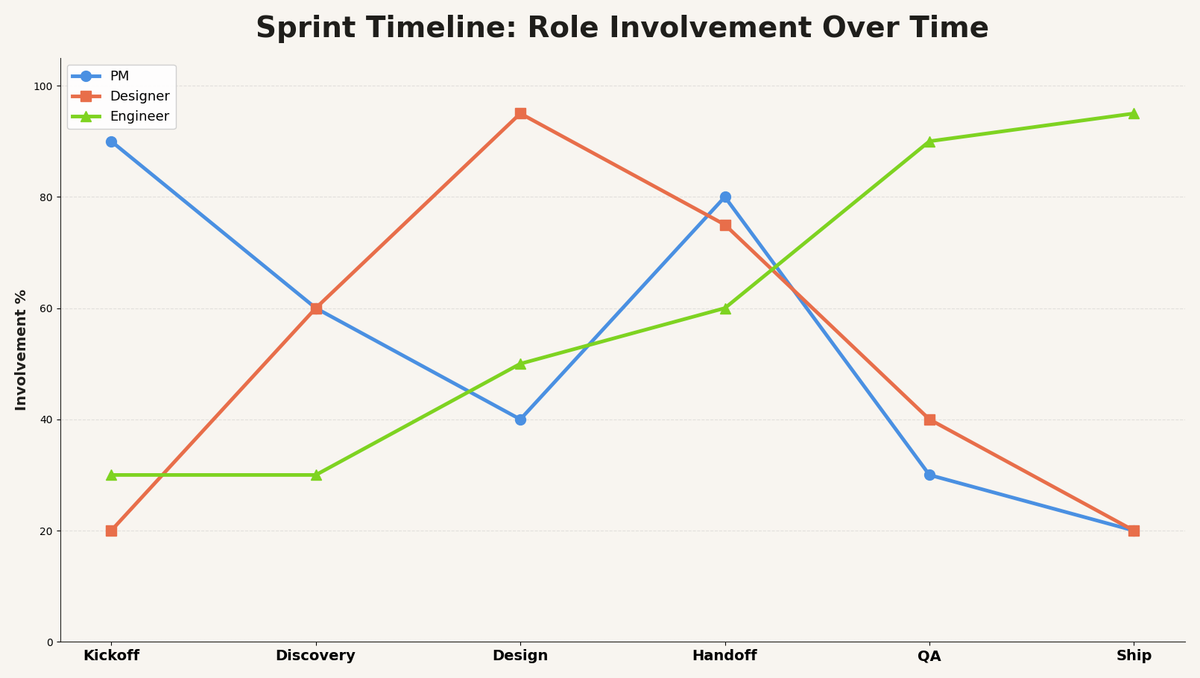
The PM's Job in the Design Phase (And What to Stop Doing)
During design, the PM's role shrinks in some ways and deepens in others. It's counterintuitive, but you're most useful when you're asking questions, not making decisions or dictating pixels.
Stop dictating pixels (don't say "make the button blue"); approving "final designs" as if you're gatekeeping aesthetics; running design criticism sessions where multiple stakeholders pile on feedback; treating design as a separate phase from strategy; or pretending design is decoration layered on top of engineering work.
Start asking "why" questions that push the designer to defend choices. "Why did you put the primary action there?" Not because you know better, but because the answer sharpens clarity for the whole team. Stress-test designs against user jobs and business metrics. "We said users need to complete this task in under 2 minutes. Does this design support that goal?" Spot scope creep early before it gets baked into the design. "We have three states for this input. Can we ship with one?" Protect the designer from competing stakeholders who want changes mid-sprint. "We're locked on the brief until Friday. I'll collect your requests and we'll evaluate them at checkpoint next week."
The PM should ask: "Will this solution solve the user job we defined?" "Where are the edge cases?" "Can we build this in the timeline?" and "What's the riskiest assumption we're making?" These questions sharpen design, not because the PM knows better, but because they force clarity and accountability. A good PM makes the designer's job easier by removing ambiguity and protecting focus from executive whims.
The designer is not a tool for executing your vision. The designer is a peer who brings pattern recognition, craft, user empathy, and systemic thinking to the table. Treat them as such. When you do, their work gets better, faster, and smarter. They'll anticipate problems you would have hit later.
Running Design Reviews That Don't Turn into Arguments
Design review is where trust breaks or builds. A bad review feels personal (the PM is nitpicking the designer's taste or second-guessing their decisions). A good review feels like collaborative problem-solving where everyone leaves aligned and energized to build.
Ground reviews in the brief. Before the designer presents, everyone reads the brief aloud. Revisit the problem statement, user personas, success metrics, and constraints. This forces alignment on what you're actually solving before anyone judges the solution. Frame the review as "Does this solution meet the brief?" not "Do I like it?" This shifts feedback from opinion to evidence. Suddenly, "the blue is wrong" becomes "our brand uses purple in this context," which is either true or false, provable or not.
Separate feedback layers. First: Does the design solve the user job? Is it clear what the user should do? Second: Are there usability issues? Will real users understand this flow? Third: Does it fit brand and system? Are we using the right components? Save style critique for last. Many reviews derail because someone says "the spacing feels off" before the functionality is even solid. You end up re-designing the same interaction five times, wasting two weeks.
Never ask a designer to defend a color in public. Discuss trade-offs in structure and interaction, not taste. Taste is learned and subjective; solving problems is a skill. Focus on the latter. If the color bothers you, discuss it one-on-one later. In group critique, keep feedback on the level of strategy and interaction design, not personal preference.
Time-box reviews to 30-45 minutes. Longer than that and people get tired, feedback becomes softer, and decisions get deferred. If you need more time, it's a sign the design isn't ready or the brief needs revisiting. Schedule a second review, don't extend the first into an exhausting marathon.
Writing PRDs Designers Actually Want to Read
A bad PRD sends the designer on a wild-goose chase. It's 40 pages of requirements, edge cases, and technical details that overwhelm rather than inform. A good one makes design obvious (or at least much more constrained) because it focuses on the user job, constraints, and success measures, not the solution.
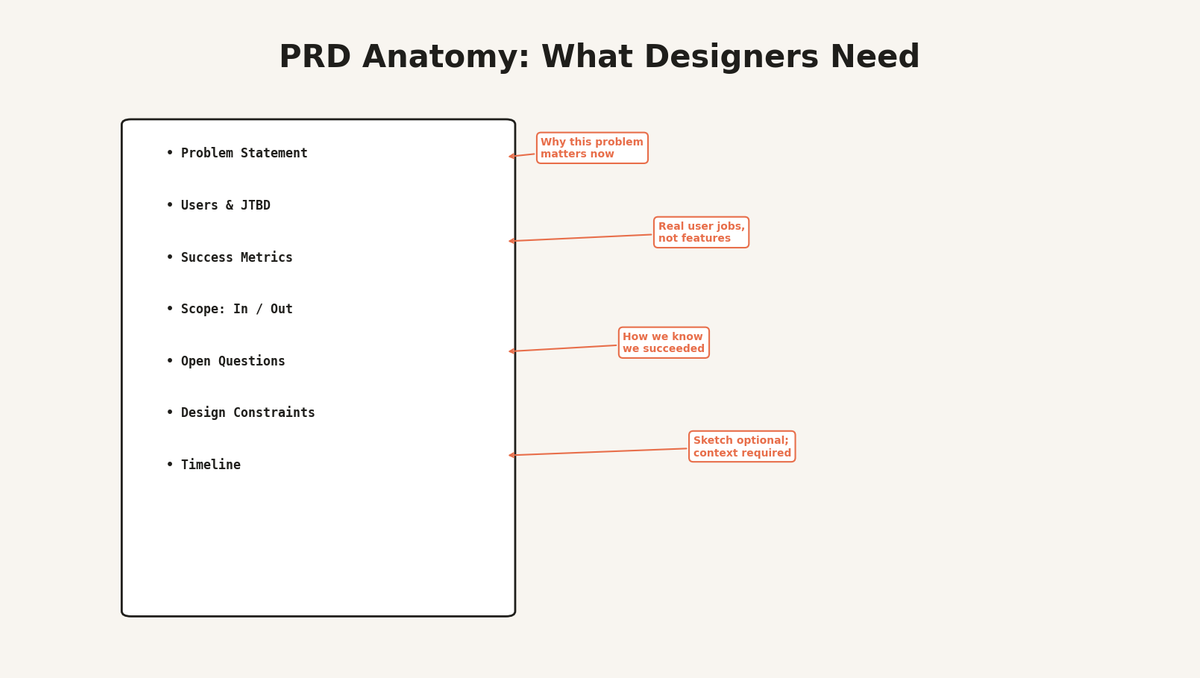
Start with the problem: Who is the user? What job do they need to do? Why now? Why is this valuable for the business? Be specific. Then metrics: How will we know this worked? What's success? Not vanity metrics like MAU; real metrics like "users can export in 2 clicks" or "90% of free users upgrade when they hit this limit." Metrics make the design testable and give designers a clear north star.
Add constraints: What's the timeline? What technical guardrails exist? What's the design budget (how many screens, how much animation, what platforms)? What business constraints matter (brand, payment flows, regulatory)? Then optional but helpful: mood boards, competitor teardowns, or design system reference if relevant. Link to Figma if you've already sketched direction. Give designers context without mandating solutions.
What not to include: Don't prescribe the solution. Don't paste wireframes as if they're gospel or unchangeable. Don't list every button label. Don't over-specify micro-interactions. The designer's job is to solve the problem, not to implement your wireframe. If your PRD reads like an engineering spec sheet, you've lost the designer's judgment. You've turned them into an order-taker instead of a thinker. That's when quality drops.
Managing Scope: What to Cut, What to Keep, What to Defer
Scope creep is the silent killer of PM-designer trust. Every "could we also..." or "let's make it perfect this time" adds weeks to design and forces engineers into crunch mode. The designer gets blamed for slowness when really, scope expanded five times between kickoff and handoff.
Set a scope boundary upfront. Define MVP, nice-to-have, and future phases explicitly in the PRD. When stakeholders ask for new features mid-sprint, say yes to future or defer to a checkpoint review. Don't let design be the sponge that absorbs all requests. A designer who feels scope is constantly shifting stops committing deeply to the work. They sketch lightly, knowing it'll change anyway. You get mediocre design as a result of unclear boundaries.
The designer should participate in scope decisions. They know what's hard to build and what's easy. They can propose lower-cost alternatives. "We can't do custom animation, but we can use system components and micro-interactions to create the same delight at 20% of the effort." If you don't trust your designer's scoping input, you've hired the wrong designer. Design and scope are linked; separate them at your peril.
One powerful tactic: show the designer the roadmap. Not the whole year, but the next two quarters. When they understand what's coming, they design for system extensibility. They propose components and patterns that work across multiple features, not just the current one. That's a signal of a designer thinking at the product level, not just the feature level. You'll ship faster as a result.
Handoff to Engineering: Making It a Non-Event
If handoff is stressful, design review failed earlier. A smooth handoff means engineers ask almost no questions because designs are clear and edge cases are documented. They can build without constant clarification asking for decisions.
Before handoff: Designer and engineer should sit together (not async comment threads). Designer walks through flows, explains why each decision was made, shows alternatives considered, and flags risky UI patterns. Engineer raises concerns about buildability. Both sides leave with alignment on approach and timeline. This meeting is non-negotiable. It saves 10 hours of async back-and-forth later.
After handoff: Designer remains available for clarifications, not for approving every pixel. A designer who stays in the room during build is worth their weight in gold. They can adjust spacing without PM approval, fix interaction bugs, make last-minute tweaks, and respond to engineering constraints. They're not a gate; they're an embedded partner in the shipping process.
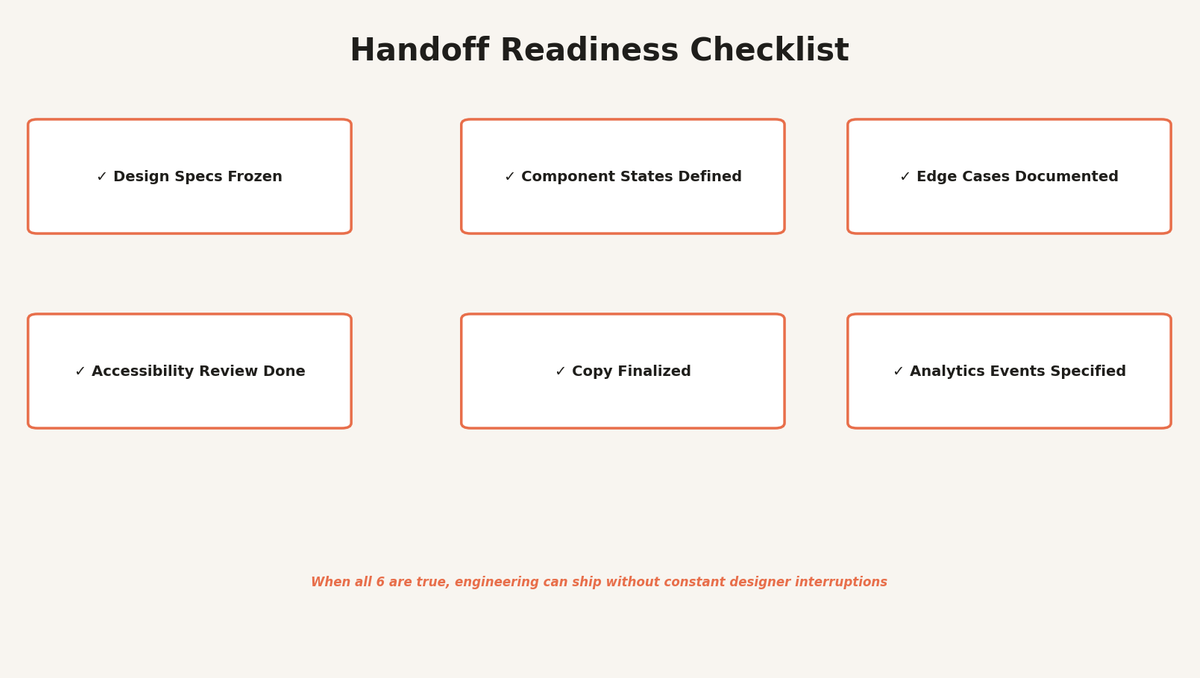
The handoff checklist: All user flows documented in Figma, not Loom videos. Edge cases and error states designed. Design tokens and spacing rules locked. Accessibility audit completed (WCAG AA minimum). Interactive specs ready (click targets, animations, transitions). Engineering review complete and no new scope identified. When all six are true, engineering can ship without constant designer interruptions.
Anti-Patterns That Erode PM-Designer Trust
Designing by committee: The PM, stakeholder, and three executives all give design feedback. Designer feels powerless and unheard. Stop. One voice for stakeholder feedback; PM routes all requests through the designer. Separate the critique from the audience. This protects the designer and focuses feedback.
Async-only reviews: Figma comments pile up. Designer re-designs three times based on partial feedback. No real-time conversation means misalignment about what's actually needed. Schedule synchronous 30-minute design critiques, not endless comment threads. Async is great for written feedback before sync; sync is great for alignment and decision-making.
Changing specs mid-design: The PM locks the brief on Monday, changes it Friday based on new feedback from executives. Designer's work is now "wrong." Protect the brief. Changes happen at checkpoints, not anytime someone has a new idea. If you change the brief, you extend the timeline. Make that trade-off explicit.
Treating design as icing: "First we'll engineer the product, then make it pretty." This assumes design is surface decoration on top of engineering. Design shapes how products work, not just how they look. Without design involvement, you build the wrong thing beautifully instead of the right thing. Involve design early or accept mediocre products that confuse users.
Ignoring designer time: "Can you just real quick redesign X?" Designers have calendars, backlogs, and focus time like engineers. Respect it. If it's truly urgent, say so explicitly. But don't treat design as interrupt-driven work. Interrupt-driven designers produce interrupt-driven designs: fragmented, inconsistent, lower quality.
No research sharing: Designer doesn't see user interviews or analytics. They're designing blind, relying on PM interpretation. Share the raw data. Let designers talk to users themselves. The patterns they see often differ from what you noticed. They spot interaction problems and terminology issues a PM might miss.
FAQ
What if the PM and designer disagree on the solution?
Go back to the brief. If you disagree on whether a design solves the user job, run a quick validation test (user interview, usability test, analytics check). Let evidence, not rank, win. If both solutions work equally well, try the one with lower implementation cost. The goal is shipping, not perfection. Most disagreements dissolve when you ground them in user behavior and test with real data.
How much should a PM know about design principles?
Enough to ask good questions (why is this button there? who does this help?), not enough to dictate solutions. Learn the design system your team uses. Read Nielsen's UX heuristics. Understand jobs-to-be-done. But don't pretend to be a designer. Your superpower is connecting user needs to business goals; stay in your lane. A PM who tries to out-design the designer creates tension and mediocre work. Stick to problem understanding and business alignment.
How do we speed up design review without sacrificing quality?
Set a time limit (30 mins, not 90). Ground feedback in the brief, not opinion. Use a feedback template (functionality first, usability second, aesthetics third). Have async written feedback before the meeting so live time is for discussion, not broadcast. If you need tweaks, group them: designer fixes 10 things in one batch, not one at a time over two weeks. Batch reduces context-switching and respects designer focus.
Should designers sit in engineering standup?
Yes, at least twice a week, especially during build phase. Designer needs to understand engineering constraints, and engineers need to ask questions about intent and trade-offs. The designer isn't a blocker; they're a clarifier. If your engineers feel interrupted by designer questions, culture is broken. Fix it. Design and engineering are partners, not gatekeepers of their own domains.
What's the right size design team for a PM?
One dedicated designer per 1-2 PMs is sustainable. A designer supporting 4+ PMs is context-switching constantly and will miss details. If you can't afford that ratio, ruthlessly prioritize features. A smaller roadmap with good design beats a bloated one shipped half-done. Versatile Club can help you find that right designer partner, especially if you're building a global team with offshore support for deeper design partnership. Quality collaboration beats quantity of features every time.
Finding Designers Worth Collaborating With
If you're scaling a team and need a designer who speaks PM language (and vice versa), the hire feels impossible. Where do you find someone who balances craft with business acumen? How do you onboard them into your design-PM workflow without wasting weeks of ramp time?
Many founders lean on an in-house hire (expensive, slow to ramp, long vesting cliff) or an agency (one-off, not embedded in culture). A third option: partner with a design-led consultant or contract designer who has PM experience. They come pre-trained in this dance. Even better if they're part of a distributed team; timezones actually become a feature (async handoff, continuous refinement). If you're hiring globally, consider an India-native Employer of Record (EOR) structure for a full-time designer who works as if they're in-house but with lower overhead and faster scaling without geographic limits.
The collaboration framework in this post works whether your designer is sitting next to you or 12 time zones away. What matters is the ritual: problem sync, research inclusion, design-first feedback, and spec clarity. Get those right, and your designer, wherever they are, becomes your product partner. They'll spot user pain you miss. They'll propose solutions you wouldn't think of. They'll push back on bad assumptions. That's the relationship worth building for long-term product success.
Ready to audit your current PM-designer workflow? Book a 30-min conversation with the Versatile Club team to workshop your design operating model and find the right talent fit for your stage.