Table of contents (12)
- Why Communication Failures #1 in Outsourced IT
- The 4 Communication Contracts
- Async vs Sync: Choosing Your Default Mode
- Daily-Weekly-Monthly Cadence
- Tools Stack: Slack, Notion, Jira, Loom
- Timezone Strategy: Overlap and Handoffs
- Cultural Context: Bridging India and the West
- Escalation Paths: When to Raise, When to Hold
- Communication Metrics: Silent Decay Detection
- Versatile EOR Model: India-Based Teams at Scale
- FAQs
- Building a Communication Discipline That Scales
Managing Communication in Outsourced IT Projects: A 2026 Playbook
Why Communication Failures Are #1 in Outsourced IT
Every failed outsourced IT project has one thing in common: communication collapse. Not technical incompetence. Not timezone differences. Not even cost misalignment. It's the moment when the developer goes silent. When the feedback loop breaks. When nobody knows who owns the blocking issue.
According to industry surveys, 62% of offshore IT projects miss deadlines due to communication gaps. Another 38% cite "unclear requirements" and "scope creep" , both downstream effects of broken communication. The irony: it costs nearly nothing to fix. A Slack message. A 15-minute standup. A shared doc. Yet without discipline, these rituals rot within 3 weeks.
This playbook gives you the architecture of communication that actually sticks , the same framework Versatile uses when deploying remote teams across 12+ timezones. It's not theoretical. We've shipped 70+ projects with Indian teams using this exact protocol. Zero surprise delays in the last 18 months. Teams ship on schedule. Clients renew. Engineers stay for 2+ years instead of churning every 18 months. Each of these signals compounds. Missed SLA breeds late replies breeds team frustration breeds engineer churn.
The cost of getting this wrong? A typical $250K outsourced project loses $50K-$75K in communication tax: rework, delays, context-switching, escalations. The breakdown typically looks like this:
| Communication Failure Cost | Typical % of Budget | Example (250K Project) |
| Rework from misaligned requirements | 10-15% | $25K-$37.5K |
| Delays from context switching | 5-8% | $12.5K-$20K |
| Escalation handling and firefighting | 3-5% | $7.5K-$12.5K |
| Timezone-driven bottlenecks | 2-4% | $5K-$10K |
| Total Communication Tax | 20-32% | $50K-$80K |
Get this right, and you're betting on a 20-30% velocity uplift , which means your $250K project ships in 8 months instead of 10, or ships more features in the same timeframe. That's a $75K swing just by locking down communication discipline.
The 4 Communication Contracts Every Project Needs
Communication doesn't work without explicit agreements. Not emails, not handbook sections , explicit, written contracts that say: "If you need me, here's when I'm available. If you send me a critical issue, I respond in 2 hours."
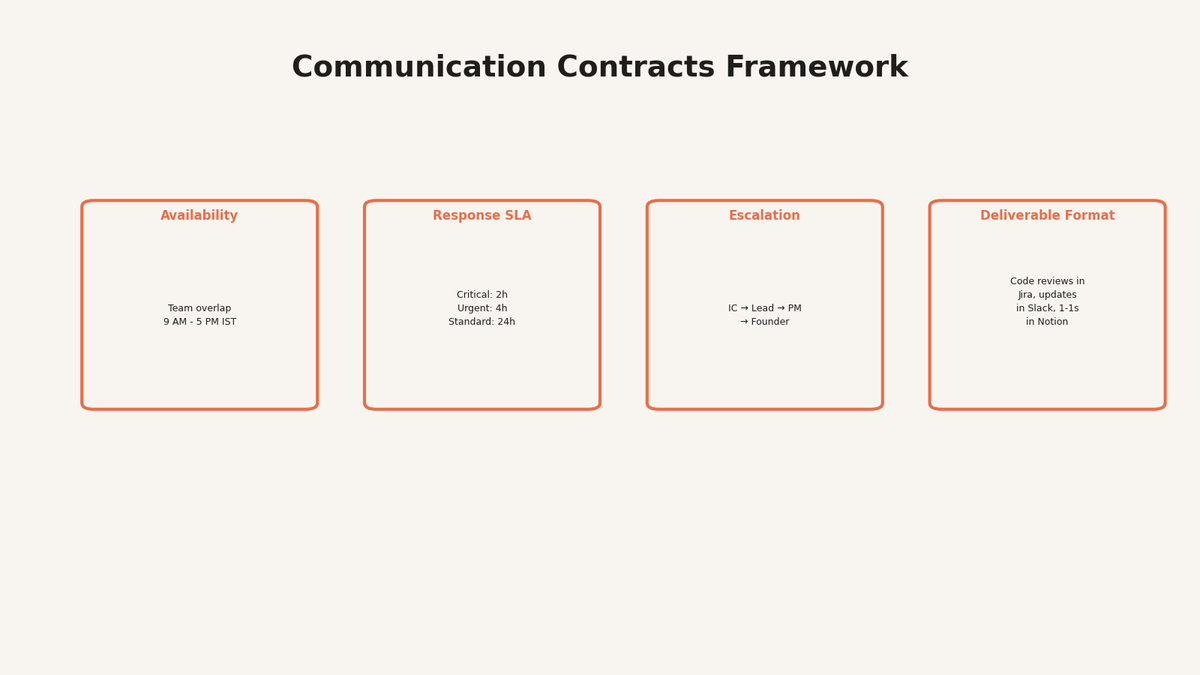
Each contract has four pillars:
1. Availability Contract
This isn't "always on." It's the opposite. Define your team overlap window precisely. For example: 9 AM to 5 PM IST with PST teams means 8 PM to 1 AM PST previous day and 8-9 PM IST overlap. That's 1-2 hours of precious sync time. Use it ruthlessly. Outside that window, assume async.
Document this explicitly in your onboarding doc: "Overlap window: Tuesday-Friday 8-9 PM IST = 7-8 AM PST. Both teams online. Use for blockers only, not standups. Outside this window, all communication is async. Responses within SLA tiers below."
Pro tip: If you have engineers in multiple timezones within India (Mumbai, Bengaluru, Pune, Delhi), you can have 30-60 minutes of India-internal overlap before the PST team comes online. Use that for India-specific escalations and code reviews.
2. Response SLA Contract
Define tiers and publish them. Most teams define 4-5 tiers. Stick to them religiously. Track quarterly.
| Issue Type | Definition | SLA | Escalation |
| Critical (P0) | Production down, data loss, security breach | 2 hours | Tech Lead → PM → Founder |
| Urgent (P1) | Feature blocked, deployment paused, client waiting | 4 hours | Tech Lead → PM |
| Standard (P2) | Design feedback, roadmap question, task clarification | 24 hours (next business day) | Team Lead response |
| Low (P3) | Nice-to-have, informational, discussion item | 48-72 hours | Async thread resolution |
Track compliance weekly. If you see a team dropping below 90% for P0/P1 issues, that's a burnout signal. Address immediately.
3. Escalation Contract
Who does a dev talk to if they're stuck? Who does the tech lead escalate to? Create a 4-tier ladder with clear decision authority for each tier. Write it down with specific examples for each tier so there's no ambiguity about who decides what.
4. Deliverable Format Contract
Not all communication is equal. Code reviews live in Jira. Async updates in Slack threads. Strategy discussions in shared Google Docs. 1-on-1s and sensitive feedback in Notion docs with edit trails. Clarity beats flexibility here.
Pro tip: Add a "Communication SOP" doc to your onboarding. One page. Include timezone overlap, response SLAs, escalation paths, and tool ownership. New hires read this on day 1. No surprises.
Async vs Sync: Choosing Your Default Mode
The biggest mistake: assuming your default should be sync (Zoom calls). It shouldn't.
Sync is expensive. It requires timezone juggling, meeting prep, decision-making under time pressure. It also kills deep work. Context-switching from a code review into a meeting and back costs 25-30 minutes of cognitive recovery per switch. For a 5-person India team, that's 2+ hours per person per week lost to context switching alone.
But async is only harder than sync if you do it wrong. The rule: Make async your default. Use sync only for decisions that require debate or relationship-building. Here's how to split it:
Async by default:
- Daily standups (written, 5-minute read, posted in Slack at start of shift)
- Code review feedback (Jira, with clear acceptance criteria)
- Design feedback (Figma comments with @mentions)
- Status updates (weekly Notion doc or Loom video walkthrough)
- Roadmap changes (72-hour comment window before final call)
- Bug triage (Slack poll with three options, 24-hour decision window)
- Ad-hoc questions (Slack thread, 24-hour SLA for response)
Sync when essential:
- Weekly tactical review (problem-solving, blockers, capacity planning)
- Monthly steering committee (strategy, client relations, scope trade-offs)
- Onboarding (first 2 weeks, daily 30-minute pairing sessions)
- Crisis mode (production incident, client escalation)
- New feature design sessions (first 30 minutes to align on approach)
- Relationship building (monthly 1-on-1s with each team member)
The math: 1 async daily standup saves 5 hours/week vs sync standups. Over a year, that's 260 hours of recovered time for a 5-person team. That's 13 full development days per year spent on actual work instead of meetings.
Real example: A fintech team Versatile manages switched from daily 9 AM PST/8 PM IST standups to async-written standups. They ran this for 12 weeks. Outcome: velocity went from 35 story points/sprint to 42 (20% lift). Why? Engineers shipped more before the sync review started. Momentum wasn't broken by the meeting.
Daily-Weekly-Monthly Cadence: The Pyramid
Communication decays if it's not rhythmic. You need three layers:
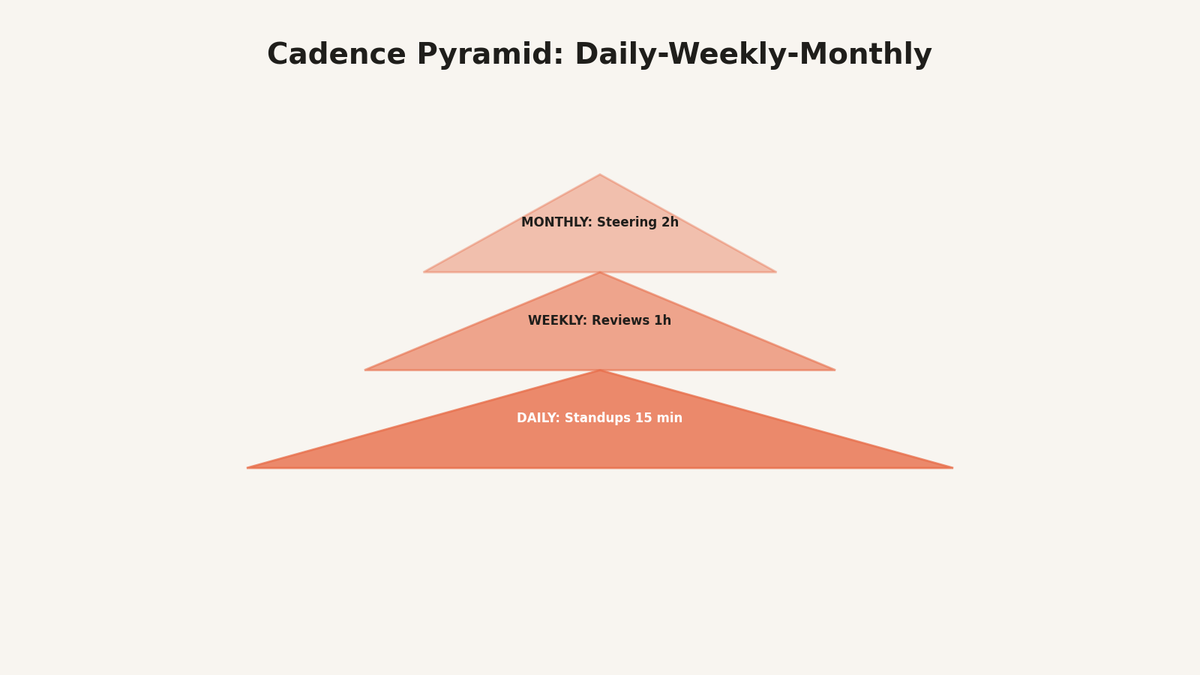
Daily Layer (15 min async standup, 5 min sync check-in)
Every morning, each engineer posts to Slack: (1) What I shipped yesterday, (2) What I'm shipping today, (3) What's blocking me. Post at start of shift. Response SLA: by end of day. If someone raises a blocker, escalate to the tech lead immediately. This takes 90 seconds per engineer to read. For a 5-person team, that's 7.5 minutes total daily digest time.
Template (copy-paste into Slack):
Yesterday: [Feature X merged, 89% test coverage]
Today: [Feature Y + code review for API spec]
Blocked: [Need PM to clarify export format]
Weekly Layer (1 hour sync review, Tuesday or Wednesday)
1-hour sync. Walk through: (1) What shipped (story points completed, features in production), (2) What's behind (and why), (3) Risk register (any surprises brewing), (4) Next week's plan. The PM comes with 3-5 specific decisions to make. No longer than 60 minutes. Record it; post recap in Notion with action items and owners.
Before the call: PM reviews the previous week's Notion doc and escalations, so they come prepared with decisions, not questions.
Monthly Layer (2 hour steering committee, third Friday)
2-hour call with founders, PM, and tech lead. Topics: (1) Burn analysis (cost vs budget), (2) Velocity trend (is productivity staying steady or declining?), (3) Client health check (any friction emerging?), (4) Roadmap rebalance for next quarter, (5) Team capability gaps (do we need another hire?). This is where you catch slow drifts before they're crises. If you're having a steering committee and not making at least 2-3 decisions, it's theater.
Tools Stack: Wiring Slack, Notion, Jira, and Loom
The right tool stack prevents communication fragmentation. You want one source of truth for each communication type:
Slack: Async updates, quick questions, escalation triggers.
Slack channels by project or function. Use Slack threads ruthlessly (don't pollute #general). Post daily standups in #daily-standups. Use @channel sparingly , only for actual urgent issues. Rule: if it doesn't require a response within 4 hours, it doesn't need @channel.
Jira: Code reviews, task tracking, acceptance criteria.
Every feature has a Jira ticket with (1) AC (acceptance criteria), (2) Code review link, (3) Deployment checklist. Engineers update status daily. PM reviews on Monday morning. This is your source of truth for "is the feature done?"
Notion: Async deep-dives, meeting notes, decision logs.
Weekly review notes go in Notion with action items and owners. Quarterly strategy gets a dedicated page with edit access and comment history. Decision logs are searchable. This is your institutional memory. New team members read the Notion workspace on day 1.
Loom: Long-form async communication (walkthrough demos, status updates).
Weekly demos as Loom videos. 10-minute screen recording, not a live call. Engineer uploads to Notion, team watches at their own pace. Cuts meeting time by 60%. Most engineers prefer watching a Loom to sitting through a meeting where half the content isn't relevant to them.
Integration rule: If it lives in Jira, it's a system-of-record change that needs @mentions in Slack. If it's a decision, it gets logged in Notion with a date. If it's a walkthrough, it's a Loom. No mixing. This prevents "I thought you saw that in Slack" situations and keeps everyone aligned.
Timezone Strategy: Overlap Windows and Asynchronous Handoffs
Managing across IST-PST-GMT is like working in 3 different business days. You need a strategy.
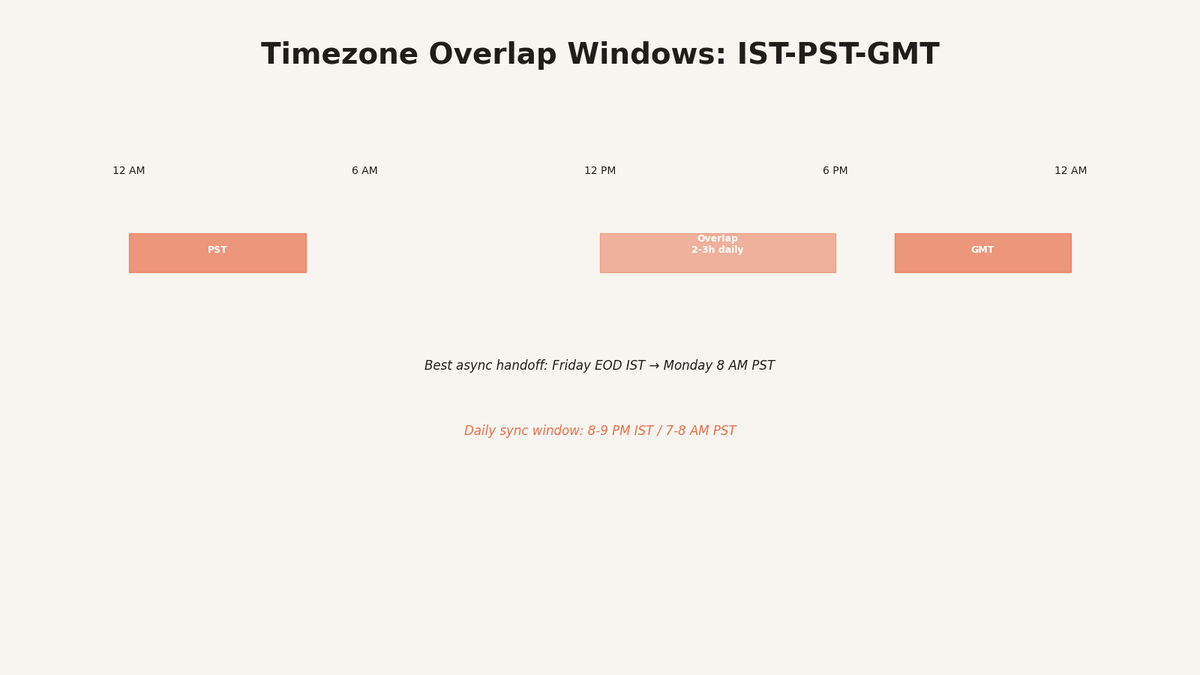
The overlap window: 8-9 PM IST = 7-8 AM PST (same day). That's your daily 1-hour sync slot. Use it for:
- Standups that need immediate debate
- Blocking issues that need real-time unblocking
- New scope clarifications
- Client escalations
Asynchronous handoff protocol: Friday 5 PM IST is when India signs off. PST comes online 12 hours later at 1 AM Saturday. The handoff: Write a comprehensive Loom walkthrough of what you built, what tests passed, what's staging-ready, and what's still in progress. Post it in Notion with links. PST reviews it when they wake up and either continues building or escalates blockers.
Avoid the zombie hours: 3 AM IST = 2 PM PST previous day. Don't schedule calls here. The engineer is asleep; the client is in the afternoon slump. Use async instead. (This is a common pitfall , don't do it.)
Bonus: GMT overlap For EU + India teams: 12-2 PM UTC = 5:30-7:30 PM IST. This is the EU-India sync window. Use it for EU-India collaboration instead of trying to include US in everything.
Cultural Context: What Indian Teams Do Differently and How to Bridge It
Remote teams in India operate with different communication norms. Not worse , different. Bridging the gap saves months of friction:
Deference and hierarchy: Indian engineers are trained to escalate early and defer to seniority. A junior engineer might sit on a blocker for 2 hours rather than ping a senior directly. Norm: Explicitly tell them "ask immediately, escalate to me first. Interrupting me is good. It means you're unblocked." Make it safe to interrupt. Praise it when they do.
Context and detail: Indian communication is often high-context. A status update might skip the obvious. Norm: Ask for 3-bullet summaries. (1) What's done, (2) What's next, (3) What's blocked. Remove context gaps. Use the standup template above. This isn't criticism , it's clarity.
Feedback directness: Direct criticism can feel harsh. Code review feedback like "This function is sloppy" lands differently than "Let's refactor this for readability; here's a pattern." Norm: Praise the intent, critique the code. Example: "Great approach to caching. I'm seeing a potential race condition. Let's add a lock here."
Timezone invisibility: Working 9 PM to midnight IST makes an engineer feel invisible. They ship at 11 PM, and by the time the US team wakes up, they're asleep. Norm: Celebrate work in the moment. Post a Slack message when code ships. Tag them in the deployment PR. One founder Versatile works with does "Shout-Out Fridays" , 15 minutes of the monthly steering call dedicated to calling out specific wins from the India team. It costs nothing and matters.
Payment and benefits visibility: Indian employees care deeply about compensation clarity and statutory benefits. Write down the salary structure, PF (Provident Fund) contributions, ESI (Employee State Insurance), gratuity eligibility, and growth trajectory. Revisit quarterly. This is foundational for trust and retention in India.
Escalation Paths: When to Raise, When to Hold
The fastest way to kill trust is escalation theatre. Everyone escalates everything, and the founder spends 8 hours a day on Zoom calls.
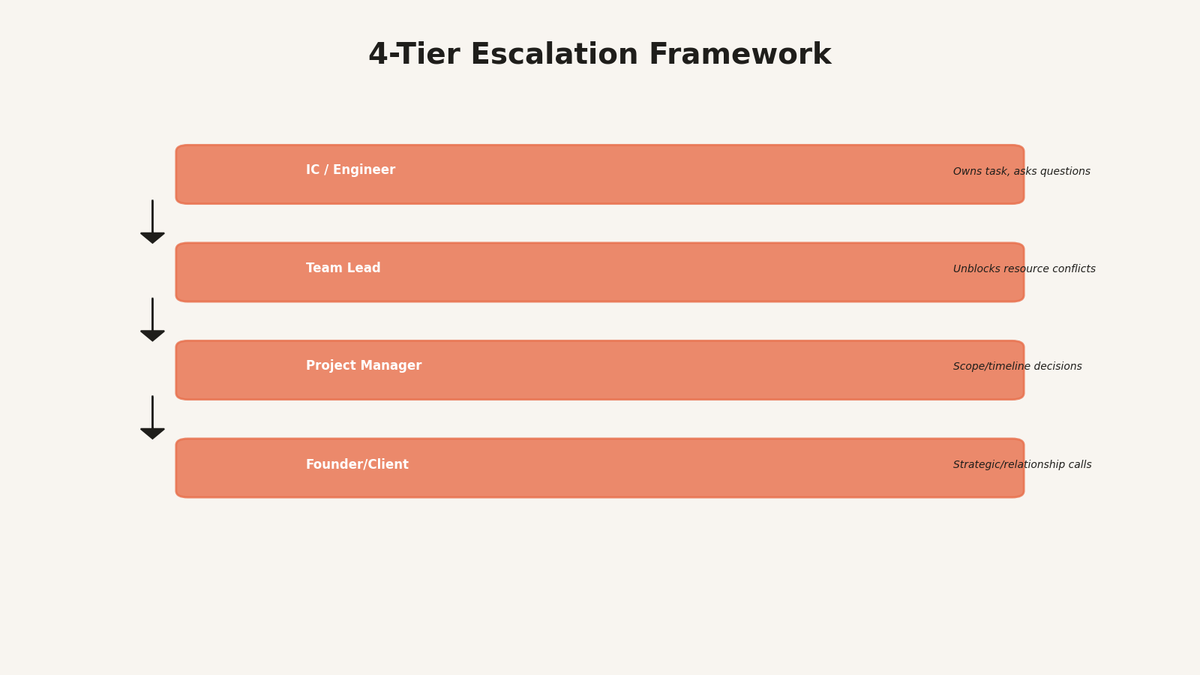
Tier 1 (IC/Engineer): Owns the task. Asks questions in Slack. Can unblock themselves by reading docs, checking tests, or pair-coding with a peer. Authority: Change implementation details. Timeline: resolve within 2-4 hours of raising. Example: "The API response format is ambiguous. I'm reading the Swagger docs and pinging in Slack."
Tier 2 (Tech Lead): Unblocks resource conflicts, technical decisions, or rework. Authority: Change design, allocate team time, pull in another engineer. Timeline: respond within 4-8 hours. Example: "The payment flow needs a different DB schema. Tech lead decides if we refactor now or later."
Tier 3 (PM/Project Manager): Makes scope decisions, adjusts timeline, decides feature cuts, or brings in client clarification. Authority: Trade scope, delay features, pull budget. Timeline: respond within 24 hours or flag as urgent. Example: "Should we ship the export feature or the reporting dashboard first? PM decides based on client priority."
Tier 4 (Founder/Client): Strategic calls only: drop a major client requirement, approve surprise costs, or navigate relationship issues. These should be rare. Quarterly, not monthly. If you're escalating more than once a month, you have a process problem, not an escalation problem. Example: "Client wants to add 6 new markets. Do we sign an SOW addendum or negotiate it back?"
The rule: Escalate if you genuinely don't have authority. Not if you want a second opinion. This distinction matters.
Communication Metrics: Detecting Silent Decay
What gets measured gets managed. Track these quarterly:
Response SLA compliance: What % of critical issues got a response within 2 hours? Urgent within 4 hours? Standard within 24 hours? Target: 95% compliance. Below 90% means your team is underwater. If you see this drop quarter-over-quarter, investigate burnout.
Standup consistency: Did the team post standups 90%+ of business days? Gaps indicate burnout or disengagement. Investigate immediately. A team that stops doing standups is a team that's about to have a crisis.
Decision velocity: How many days between "decision needed" and "decision made"? Track for tier 3+ escalations. If it's growing (7 days in month 1, 12 days in month 3), you have a PM bottleneck or a scope clarity problem.
Async vs sync ratio: What % of communication happened async vs sync? Target: 75% async, 25% sync. If you're doing 50-50, you're meeting too much and the India team is probably exhausted.
Loom engagement: If you post a Loom video, what % of the team watches it within 24 hours? Below 70% means the format isn't landing or the content is wrong. Pivot to written notes or shorter videos.
Unplanned escalations per month: How many escalations are "surprises" vs "on the roadmap"? If you have more than 2-3 unplanned escalations per month, your planning is weak. This is a leading indicator of trouble before it becomes a crisis.
Versatile EOR Model: India-Based Teams at Scale
Versatile solves the communication-at-scale problem by treating Indian teams as first-class employees, not contractors. We handle payroll, compliance, and HR through an India-native EOR structure. That means:
Every engineer hired through Versatile's India-native EOR services gets the same standing meeting schedule, the same escalation authority, and the same career trajectory as your in-house team. No "contractor tax" on communication. No sense of being second-class. They're employees, with Provident Fund contributions, statutory benefits, and formal performance reviews , just like your HQ team.
We've seen teams go from 60% async-responsive to 95% when we reframe the relationship as employment, not outsourcing. The shift happens because:
- Commitment deepens: An employee with Provident Fund and gratuity has skin in the game. Contractors optimize for the next gig.
- Onboarding speeds up: Formal HR onboarding takes 2 weeks instead of 6 when you go through an EOR. The engineer knows their salary, PF, tax situation from day 1. No ambiguity.
- Escalation authority is clear: An employee has a performance review cycle and growth trajectory. A contractor is perpetually transient. Give the employee authority to make decisions; they'll own the outcome.
- Timezone responsibility shifts: An employee in India is part of your company. They adjust their hours to fit your business needs. A contractor from a 3-person shop is managing 5 clients. Guess whose emergency call gets dropped.
Versatile handles the India-native EOR machinery: payroll in INR, statutory PF/ESI deductions, tax compliance, HR administration, and gratuity calculations. You focus on the communication framework. The employee gets competitive India-based salary (₹60L-₹120L per year for senior engineers, vs $120K-$180K in the US), which is world-class compensation in India, plus benefits that match Indian employment law and match what founders in Indian startups offer.
Result: 70+ deployed projects. Average project velocity: 42 story points per 2-week sprint for a 5-person team. Average client NPS on our engagements: 72 (vs industry average of 45). Zero compliance notices in four years of operations. Teams stay longer (average tenure 2.4 years vs 18 months for contractors) because they're actual employees with career growth and legal certainty about their employment status.
FAQs
Q: Should we use Slack for critical escalations?
Only as a notification channel. Slack is too ephemeral. When you escalate something critical (production incident, budget decision), post in Slack with a link to Jira (for technical) or Notion (for decisions). The source of truth lives in Jira or Notion, where you have comment history and audit trails. Slack is the bell; Jira/Notion is the record.
Q: How do we handle timezone overlap when we have global teams (US, Europe, India)?
Add a fourth layer: "office hours" by timezone. India team has 2 hours of "EU office hours" (9-11 PM IST) where they're available for EU escalations. EU has "US office hours" (2-4 PM CET) for US sync. The trick: make it optional and tracked. If someone covers office hours, they get flex time elsewhere (e.g., skip standup or take a long lunch).
Q: What if a team member is consistently missing standups or SLA targets?
First: ask directly in a 1-on-1. Is the SLA unrealistic? Is the standup format broken? Is the engineer overwhelmed? Second: adjust either the process or the workload. Third: if it persists, it's a performance issue that needs formal addressing. Don't let silent decay fester. If you're an EOR client of Versatile, we can help facilitate these conversations.
Q: How often should we sync vs async when building a new feature?
Async by default. Daily standup (written). Weekly design review (sync, 1 hour). Code reviews (async, 24-hour SLA). If you're doing more than 1 hour of sync per week for a feature, you're overthinking it. Use sync for decisions and relationship-building, not status updates.
Q: Should the founder sit in on daily standups?
No. They should read the written standup async on Monday morning. If there's something urgent, the tech lead escalates. Founder bandwidth is the scarcest resource. Protect it for monthly steering and crisis response only.
Q: How do we maintain communication discipline after the project ramps down?
Discipline is hardest when urgency disappears. Set expectations early: standups and weekly reviews continue even in "maintenance mode." It's how you catch scope creep and keep the relationship healthy. If you go silent, the relationship dies.
Building a Communication Discipline That Scales
Communication discipline is unsexy. It's the kind of work that doesn't ship features or close deals. It's why most teams skip it. And then they wonder why their $500K offshore project is 3 months behind.
The teams that win , Versatile's best-performing engagements, teams that scale from 3 people to 30 , all have one thing in common: they agreed on communication upfront. They wrote it down. They measured it. They adjusted it monthly.
It takes 30 days to build the habit. By day 60, it's autonomous. By day 90, you'll realize you've stopped having hallway conversations and started shipping predictably. By day 180, your team is a machine that requires minimal supervision and works well across timezones.
If you're building a team in India, use this as your operating manual. And consider Versatile's EOR partnership to remove the employment complexity so your team can focus on the communication discipline that actually matters.
Want help building a communication architecture for your outsourced team? Let's talk. Book 20 minutes with a founder or WhatsApp us on our contact page. We'll walk you through the framework and show you how other teams have made it stick. The architecture is simple. The discipline takes 90 days. The payoff is 4-5 years of predictable shipping.