Table of contents (11)
EOR vs GCC in India: Scale Economics, Transfer Pricing Reality, and the Headcount Where GCC Becomes the Strategic Move
Q1. EOR vs GCC in India: which model wins at your stage?
An EOR legally employs your India team through a provider's own Indian entity. You hire in days with zero entity, FX, or compliance overhead. A GCC is your own Indian subsidiary: full IP and control, but 6 to 18 months and $15K to $100K+ to stand up. Below roughly 30 engineers, EOR wins on cost and speed. Past that, the GCC math starts to flip.
The call I get every week
A US founder pings me on WhatsApp. They have one offer out to an engineer in Bengaluru, and they are about to register an Indian subsidiary for that single hire. I tell them to stop. You do not need a captive to make one hire. You need it when the math, the headcount, and the IP stakes all point the same way.
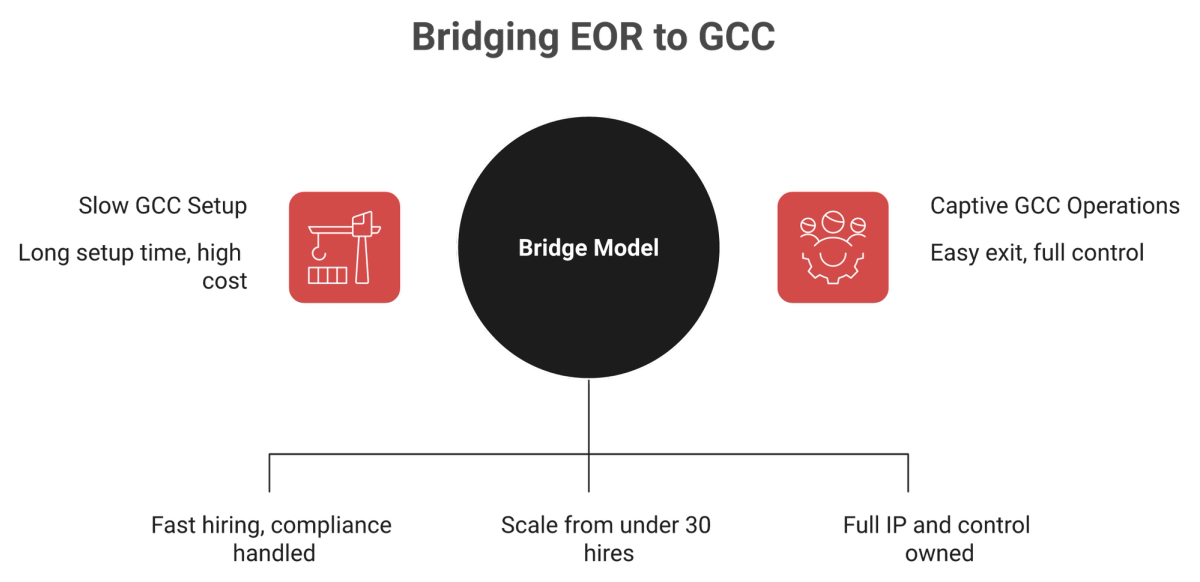
At Versatile, we are an India-only Employer of Record in India built on our own registered Indian entity, Foo Falcon Technologies Pvt Ltd. PF, ESI, TDS, and professional tax filings sit under our registrations, not a partner's. That ownership is what lets us act as the bridge: hire now via EOR, build your own GCC (Global Capability Center, your wholly owned India company) later, only when the math demands it.
The stage-based verdict in one table
Here is how the two models split across the axes that actually decide it.
| Axis | EOR | GCC (captive) |
|---|---|---|
| Your own entity | Not required | Required |
| Time to first payroll | Days (Versatile: 5-day contractual SLA) | 6 to 18 months |
| Upfront cost | $99 to $699 per employee/month | $15K to $100K setup, up to $500K to $3M full captive |
| Control and IP | Assigned to you by contract | Fully owned in-house |
| Compliance owner | The EOR | You |
| Best headcount band | Roughly under 30 | Roughly 30 to 50+ |
| Exit | Easy, no exit fees | Complex (wind-down, filings) |
The verdict reads cleanly. Seed to Series A, first 1 to 30 hires: EOR. Past 30, with IP sensitivity and a Series C or IPO on the horizon: start modeling the GCC. Our EOR vs entity calculator runs your exact numbers.
Naming the real anxiety
The unspoken fear I hear most is feeling like you are "running with scissors" without an army of compliance experts checking every clause. That fear pushes founders toward premature entity setup. It should not.
"I came in skeptical... every option I looked at first was either set up your own entity (no thanks, not for one hire) or some platform that quotes you a great price and then you find out about all the add-ons later. Versatile was the one that actually made it simple."
Angad S. Versatile G2 Verified Review
That review captures the fork exactly. The deeper question, the one most blogs dodge, is this: at what exact headcount does the entity CapEx beat a monthly EOR fee, and will my IP and transfer pricing be audit-ready for a Series C? I answer that with real numbers later. For now, hold this: the right first move is rarely the entity.
Q2. What exactly are an EOR and a GCC, and why is "cost arbitrage" a dead metric?
An EOR is the legal employer of your India staff on paper. It runs payroll, deducts TDS, files PF and ESI, and issues Form 16 under its own registrations, while your team reports to you. A GCC is your own wholly owned subsidiary. And the old framing is dead: India's GCCs are talent engines, not cost arbitrage, with USD 64.6bn in FY24 export revenue and per-capita value near USD 32,500.
EOR, defined the way it actually works
An Employer of Record carries the employment relationship legally, so you do not have to register anything. The provider becomes the name on the contract. You still pick the person, set the work, and manage the day to day.
In India, that means the EOR handles the statutory plumbing: 12% PF contribution, the 3.25% / 0.75% ESI split, monthly TDS deducted and deposited by the 7th, and professional tax across states. None of it lands on your desk, which is the core of our India payroll compliance calculation.
One hire, start to Form 16
Picture a single Bengaluru hire. Offer goes out, a compliant contract is drafted, and the person joins. First payroll runs with PF and TDS deducted correctly. By 30 May of the next financial year, they get Form 16, the annual tax statement every Indian employee expects.
"Contracts, PF, ESI, TDS, and payroll all handled in one place. Invoicing in USD meant zero exchange rate surprises... Five-day onboarding, zero late payslips."
Vedant T. Versatile G2 Verified Review
The wedge most buyers miss: owned entity vs partner shell
Here is what the category avoids saying plainly. We own the Indian entity. Deel, Remote, and most global EOR platforms route India through local partner entities, shells they do not control. We do not.
That difference is quiet until you try to migrate to your own GCC. Aggregation makes the IP transfer legally messier, because the employment sat inside someone else's company. From an owned entity, the handoff is cleaner, which is why founders weighing the EOR vs entity decision in India should look at who holds the entity. I might be cautious about absolutes, but from what surfaces when you actually run migrations, this one holds.
Why arbitrage is the wrong word
The standard read calls India a cheap labor pool. That read is backwards. GBS, the old back-office avatar, was cost arbitrage. The GCC is talent arbitrage: skill count, not head count. India's GCCs are nerve centers of global strategy now, not back offices, and the FY24 export revenue of USD 64.6bn shows it. Versatile hires for that, culture-fit first, not bodies.
Q3. Who owns control, IP, and compliance under each model?
Under an EOR, the provider owns employment compliance and statutory filings. You own the work product and day-to-day direction, with IP assigned to you by contract. Under a GCC, you own everything: IP, culture, and every compliance obligation. The cleanest IP transfer comes from an EOR that owns its own entity, not an aggregator routing you through a partner shell you have never met.
Control and direction: a clean split
People assume an EOR means handing over your team. It does not. You still set priorities, run standups, and manage performance. The EOR holds the legal employment, the contracts, payslips, and statutory filings.
A GCC collapses that split. You own the legal employment and the direction. That is real control, and also real obligation. Every filing, every audit, every renewal is now yours, which is why some teams prefer to build a team in India through an EOR first.
IP ownership and the assignment mechanics
In a well-built EOR, intellectual property created by your hire is assigned to you by contract, through the employment agreement and an IP assignment clause. That chain only holds if the entity employing the person is solid.
This is where the owned-entity point stops being theoretical. When the employment sits inside an aggregator's partner shell, an eventual transfer to your captive runs through a company you do not control. With Versatile EOR services in India, the work sits inside our own entity from day one, so the assignment chain is single and clean. If I am wrong anywhere, it is on edge cases, but the structural logic is sound.
Compliance ownership: who actually files what
The fastest way to see the difference is to ask who signs the return.
| Obligation | EOR | GCC |
|---|---|---|
| PF / ESI filing | Provider | You |
| TDS deposit and Form 16 | Provider | You |
| State professional tax | Provider | You |
| POSH committee | Provider's framework | You set it up |
| Transfer pricing, FEMA | Not triggered | You own it |
Under an EOR, those filings sit with us. Under a GCC, they shift to you, including obligations an EOR never triggers at all. We will get into transfer pricing, the 22% tax route, DPDP, and FEMA in the regulatory sections, because that is where the GCC's real cost and risk live.
Q4. How fast can you start, and what does each model's timeline look like?
An EOR can onboard your first India hire in days. Versatile commits to a contractual 5-day SLA, not an aspiration. Standing up a GCC takes 6 to 18 months for entity registration, bank accounts, and statutory registrations before payday one. Smart teams deploy hub-and-spoke: core operations in a Tier-1 city, cost-competitive talent in Tier-2/3 spokes.
Days, not quarters
When we placed our first US-client engineer in Bengaluru, the whole point was speed without cutting compliance corners. A compliant contract, the offer, and statutory setup done inside the week. That is the model working as designed.
Our 5-day SLA is written into the agreement. It is a commitment, not marketing copy. Global generalists typically quote 1 to 2 weeks for India onboarding, partly because the work routes through a local partner. If you want the mechanics, see how to hire in India without an entity.
"Versatile replied to our form in about four hours with a draft offer letter already attached. The hire was onboarded in four days. USD invoice landed clean, no FX markup, no setup fee, no surprises."
Verified User, US startup founder Versatile G2 Verified Review
For contrast, the friction buyers hit elsewhere is real and documented:
"It took three months to onboard our first 3 individuals. They didn't seem to be able to navigate Visas or variations to employment contracts."
Verified User in IT and Services Deel G2 Verified Review
The GCC timeline, stage by stage
A captive is a different clock entirely. You are looking at 6 to 18 months before the first compliant payslip. The stages stack:
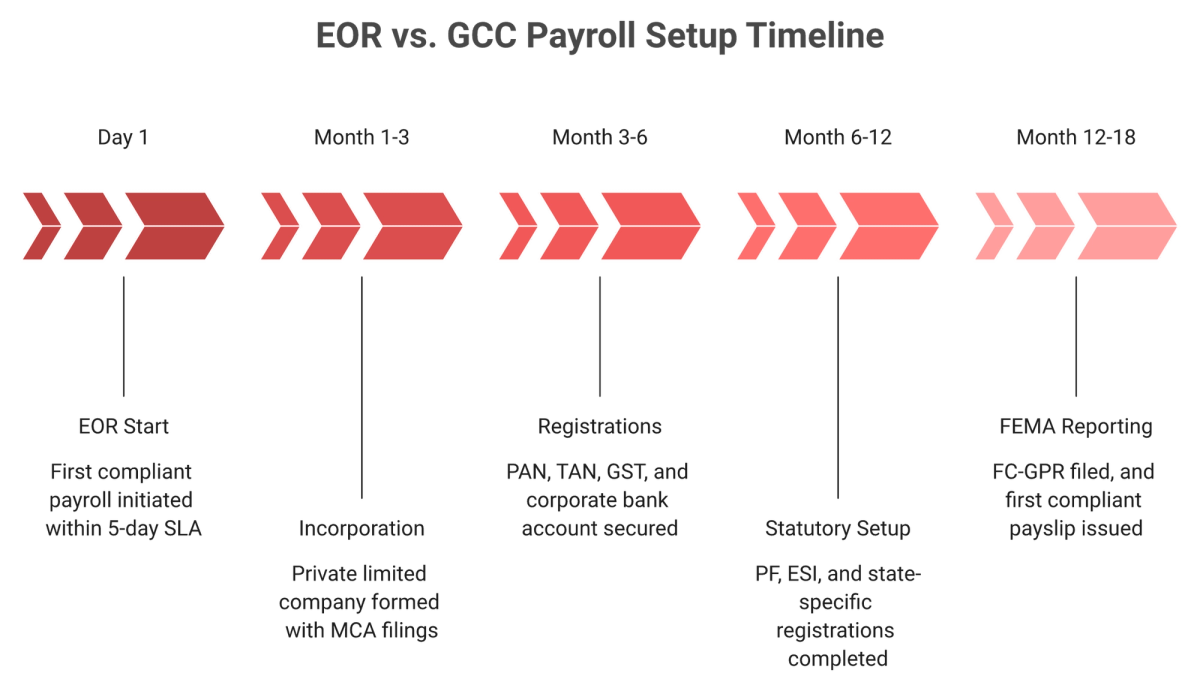
- Incorporation and MCA filings for the private limited company.
- PAN, TAN, GST, and a corporate bank account.
- PF, ESI, and Shops and Establishments registrations, often state by state.
- FEMA FC-GPR reporting on the capital you inject.
Each step gates the next. Miss a registration and payroll waits. This is the full company registration in India path, and it is why many teams defer it.
Hub-and-spoke: the deployment that buys you both
Here is a tactic worth stealing. Run a hub-and-spoke model: core operations from a Tier-1 city like Bengaluru, with spokes in Tier-2/3 cities for cost-competitive talent plus infrastructure. You compress the timeline pressure and the cost base at once.
The honest sequencing tip, which I will expand later: hire your India Head before any engineer. Governance leads the build. The entity timeline should not run your whole plan, and our cost of hiring in India breakdown shows where the savings sit.
Q5. What does each model actually cost, fully loaded?
EOR pricing runs $99 to $699 per employee per month, or a 10 to 30% premium on payroll. It is predictable opex with no setup or exit fees. A GCC carries $15K to $100K in setup plus roughly $100K to $200K in annual entity operations for a 50-person team, before statutory and transfer-pricing overhead. A senior Bengaluru engineer still saves about $162,000 a year versus San Francisco either way.
The EOR price ladder, laid out honestly
Let me put the numbers on the table, because vague pricing is how buyers get burned. Here is the monthly per-employee EOR cost across the providers I track.
| Provider | India EOR price/employee/month | Onboarding |
|---|---|---|
| Versatile | $149 | 5-day contractual SLA |
| Wisemonk | $99 to $399 | 24 to 72 hours |
| Multiplier | ~$400 | 1 to 2 weeks |
| Deel | ~$599 | 7 to 14 days |
| Remote | ~$599 | 10 to 14 days |
| G-P | ~15% of salary | 1 to 2 weeks |
Our $149 sits near the floor, and we add no setup fee, no exit fee, and a first month free. You can see the full breakdown on our India EOR pricing for 2026 page. The "great quote, surprise add-ons later" pattern is exactly what founders flag about cheaper anchors and pricier generalists alike.
The hidden line items global platforms bury
The headline fee is rarely the real cost. With global generalists, transaction and FX charges stack quietly on top.
"I find Deel to be absurdly expensive. They charge a high amount of fees for transferring money to my bank account."
Juan Camilo O. Deel G2 Verified Review
"There are hidden fees. Of course, again, also here... You will never get your net-agreed salary through Deel."
Verified User Deel G2 Verified Review
We invoice in USD direct from our Indian entity, so there is no FX markup and no exchange-rate surprise on a CFO's month-end close. If you are weighing options, our Deel alternatives in India comparison lays out the differences.
The GCC cost stack
A captive is a different animal. Setup runs $15K to $100K, and a full captive build can reach $500K to $3M depending on scale. Then annual entity operations land near $100K to $200K for a 50-person team, before you add the transfer-pricing markup I cover next.
Why the savings still hold
None of this kills the case for India. A single senior engineer in Bengaluru saves roughly $162,000 a year against San Francisco, fully loaded. That gap is why the talent math works under either model, and our employee cost calculator shows it for your roles. The question is not whether to hire in India. It is which wrapper costs you less at your headcount.
Q6. At what headcount does a GCC actually become cheaper than an EOR?
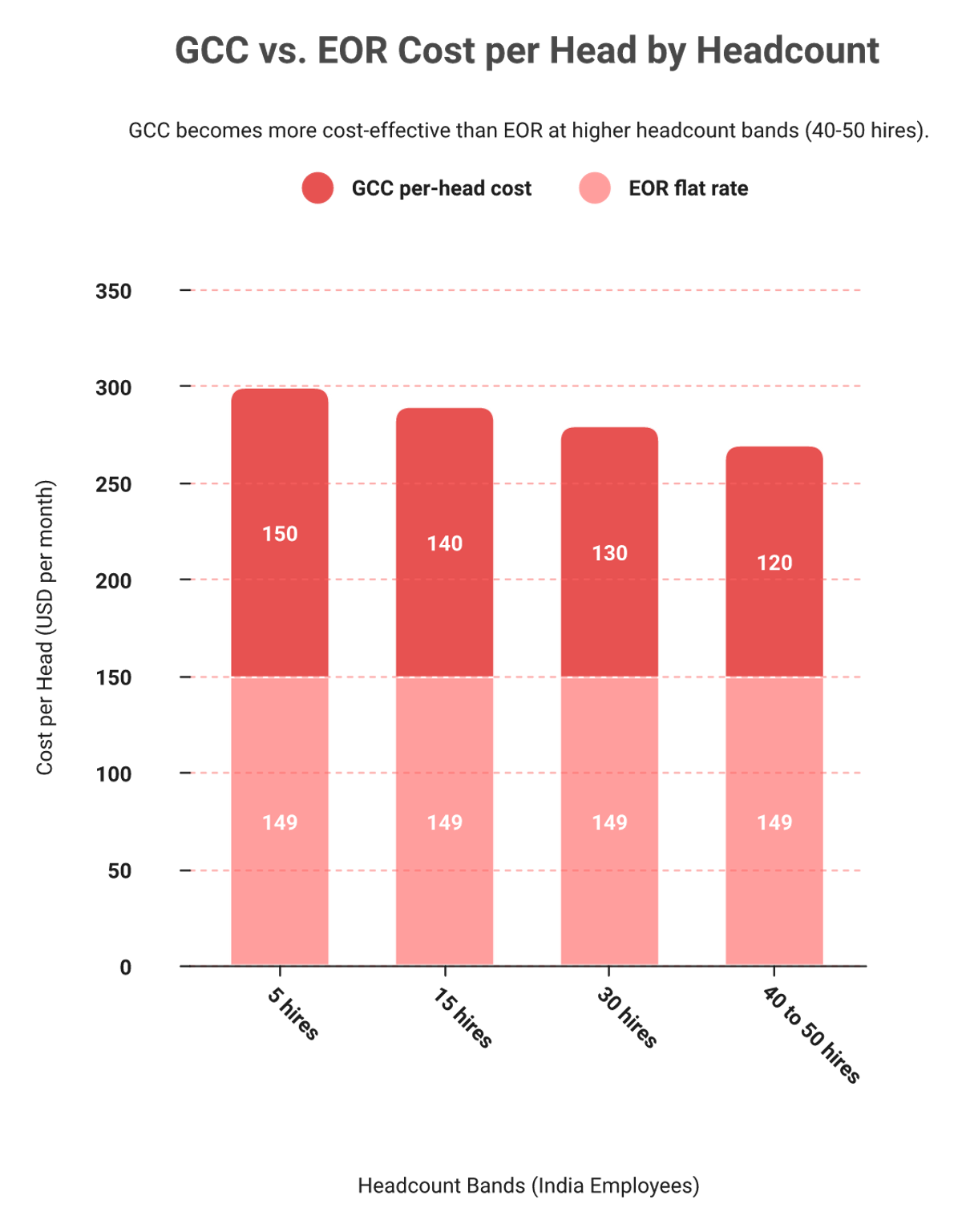
For most VC-backed teams, the crossover sits around 30 to 50 India employees, not the 12 many providers claim. Below that, EOR's per-head fee beats GCC setup plus annual ops, statutory overhead, and the cost-plus transfer-pricing markup a captive must carry. The honest answer is "it depends." Some firms tip at 10 to 12 hires. Others stay on EOR past 30 by design.
The crossover thesis, stated plainly
I have watched this play out across our placements, and the round numbers in most blogs are too low. The break-even is not just monthly fee versus monthly fee. A GCC carries fixed costs an EOR never charges you.
So the real comparison is cumulative EOR fees, against GCC setup plus annual ops plus statutory base plus the transfer-pricing markup. Stack all of that, and the crossover lands closer to 30 to 50 heads for a typical Series B team. Our EOR vs entity in India guide walks through the same math.
Building the break-even, line by line
Here is the math in plain terms, using the cost inputs from the pricing section.
- EOR side: roughly $149 per head per month, all-in, no setup or exit cost.
- GCC side: $15K to $100K setup, amortized, plus $100K to $200K annual ops.
- GCC overhead EOR avoids: the cost-plus transfer-pricing markup (next section) and multi-state statutory administration.
At 15 heads, the EOR fee total is a fraction of the captive's fixed base. At 40 to 50, the captive's per-head cost finally dips below the cumulative EOR spend. That is the flip, and our EOR vs entity calculator pins it to your inputs.
The contested ground, named honestly
I will not pretend the number is settled. Some operators tip much earlier.
"Most agencies charge overpriced retainers for work that's not deserving of a retainer."
u/low5d7k, r/SEO Reddit Thread
That instinct, paying only for what earns its keep, is exactly why some teams open a captive at 10 to 12 hires while others happily run EOR past 30. The trigger is not headcount alone.
What actually shifts the number
I could be off by a few heads in either direction, but three things move the crossover more than raw count:
- Role mix. Senior, IP-heavy engineers pull you toward a captive sooner.
- IP sensitivity. A Series C or IPO diligence horizon rewards an owned entity with clean records.
- Funding stage. Cash-tight teams should stay on EOR longer.
This is the bridge our Employer of Record in India model is built for. Our no setup and no exit fees push the rational crossover later than competitors admit, so you only build the entity when the math, not the marketing, says go.
Q7. How does the New Labour Code 2025-26 change your fully-loaded India cost?
Under the four Labour Codes effective 21 November 2025, basic pay plus DA (dearness allowance, a cost-of-living component) must equal at least 50% of total CTC. That inflates PF, gratuity, and bonus liabilities, because they compute off a larger wage base. Any allowance above the cap is added back to wages for statutory calculation. The cost hits both models equally. The difference is whether you administer it or your EOR absorbs it.
The 50% rule, in one line
The Code on Wages set a floor: your basic plus DA cannot be less than half of total pay. If you stuffed salary into allowances to shrink statutory liability, that lever is gone.
The mechanics are blunt. If allowances exceed 50% of total remuneration, the excess gets added back to wages for statutory math. Your contribution base rises whether you like it or not, which is why our India payroll compliance calculation recomputes it automatically.
What it does to a live payroll
Because PF, gratuity, and bonus all key off Basic plus DA, a higher wage base lifts each one. This is not theoretical for anyone running real payroll.
- PF: 12% employer contribution on a larger base.
- Gratuity: accrues at 4.81% of Basic plus DA.
- Bonus: computed on the raised statutory wage.
After running multi-state PF, ESI, and PT across Bengaluru, Hyderabad, and Pune, I can tell you the recalculation is fiddly. It also has hard deadlines: TDS deposited by the 7th each month, Form 16 to each employee by 30 May. Our gratuity calculator handles the 4.81% accrual for you.
Who carries the work
Here is the model-level difference. The cost rises identically under EOR and GCC, since it is statutory. What changes is who does the labor.
Under a GCC, your team owns the recompute across every state where you employ people, and the slabs differ (Maharashtra runs PTRC plus PTEC monthly, Karnataka monthly, Tamil Nadu biannual). With our payroll in India service, we run that recalculation and every filing under our own registrations, so your fully-loaded cost model stays clean and your month-end does not wobble. Compliance is the floor here, not the ceiling.
"The compliance side is the real reason I'd recommend them. PF, tax, the statutory filings, all the stuff I genuinely did not want to learn, they just handle it and keep it correct every month."
Angad S. Versatile G2 Verified Review
Q8. Transfer pricing, the 22% tax moat, DPDP, and FEMA: which obligations does a GCC inherit that an EOR avoids?
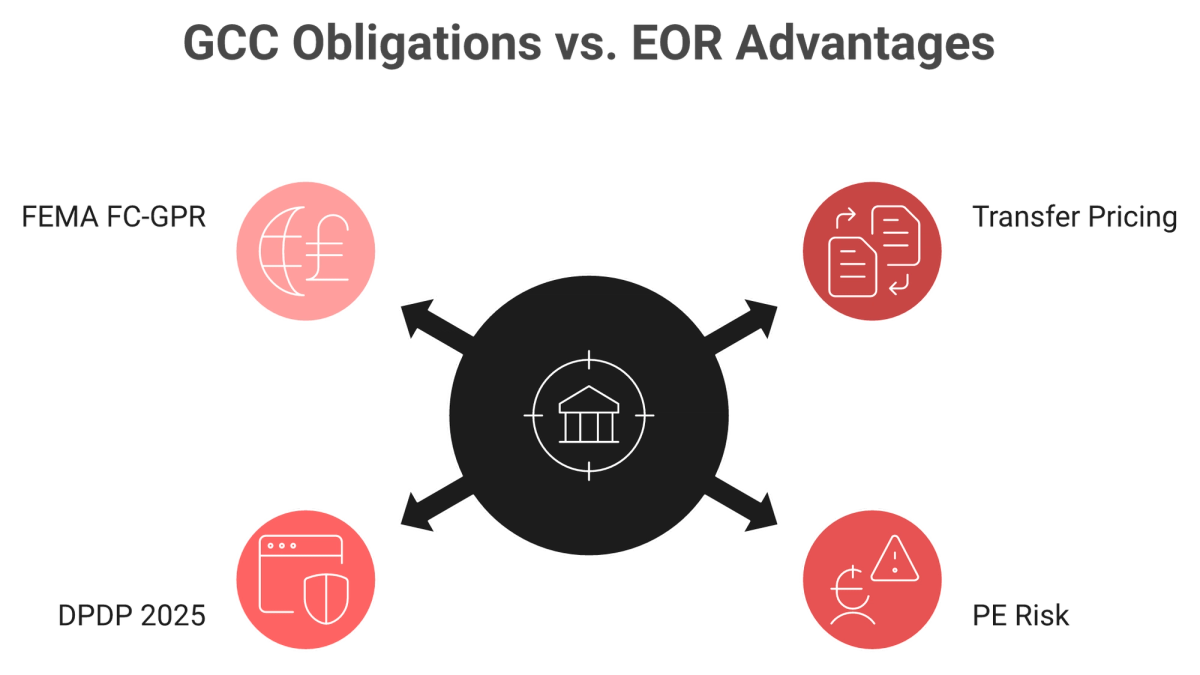
A GCC serving its foreign parent must charge a cost-plus markup, roughly 17 to 18% under CBDT safe-harbour rules (Section 92CB, Rule 10TD), and file Form 3CEB annually. In exchange, it unlocks the Section 115BAA 22% corporate rate versus 30%. But it also inherits DPDP 2025 data-fiduciary audits and FEMA FC-GPR filings. An EOR triggers none of these. No inter-company transaction, no PE exposure.
Transfer pricing is a real cost, not a footnote
Most blogs treat transfer pricing as a compliance checkbox. It is a line item. When your India captive bills its US parent, the price must be arm's-length, and the safe-harbour route sets a cost-plus markup near 17 to 18% for software development services.
That means filing Form 3CEB every year and, if you elect safe harbour, Form 3CEFA, valid for five assessment years, with an eligibility cap around INR 200 crore of international transactions. None of this exists under an EOR, because there is no parent-to-captive transaction to price. This is one reason teams compare setting up a GCC in India against staying on EOR longer.
PE risk: the exposure the EOR sidesteps
A careless GCC, or even a poorly structured contractor setup, can create a Permanent Establishment (PE), a taxable presence that exposes your parent's profits to Indian tax. Standard read gets this backwards: people fear PE with EORs and relax with captives. From what surfaces when you actually run this, the EOR insulates you, while the captive is the thing you must structure carefully. Our permanent establishment risk quiz flags your exposure in minutes.
The 22% tax moat, earned with conditions
Here is the upside that makes the captive worth it at scale. A domestic-company GCC can opt into Section 115BAA and pay 22% corporate tax instead of 30%, an effective ~25.17% with surcharge and cess. The catch: you forgo certain deductions, and the option is irrevocable once chosen.
DPDP and FEMA: obligations only the entity owns
Two more duties land squarely on a GCC and never on an EOR client.
- DPDP Act 2025: the entity owns consent architecture, and a Significant Data Fiduciary faces audits, DPIAs, and possible localisation duties under an 18-month runway.
- FEMA FC-GPR: you must report foreign capital injected into the entity.
The contrarian angle worth holding: a mature GCC can turn transfer pricing from a chore into a tax center of excellence. But you earn that only after the basics are clean. With our EOR services in India, we carry DPDP, FEMA, and statutory obligations on our own entity during the EOR phase, so a CFO's records stay audit-ready and the eventual captive transition does not trigger fundraising-diligence flags.
Q9. How do you migrate from EOR to your own GCC without breaking the team?
Yes, you can hire via EOR while your GCC entity is being set up. Run EOR for speed, then migrate people onto your own payroll once it is live, keeping the EOR active so no one falls through a gap. Two non-obvious rules: hire your India Head before any engineer, and watch the cultural dynamics that quietly stall a transition.
The client who hired a "Londoner" in Greece
One client came to us after a hiring scare. They thought they were interviewing someone based in London. By the third interview, they realized the person was actually in Greece, far outside their plan.
We employed that person through our entity while they sorted their footing. Then, once they had built out the team and stood up their own structure, we simply migrated those twelve people over. The EOR was the bridge, not the destination, which is the core of how we build a team in India for clients.
The complication nobody budgets for: hierarchy
The mechanics are the easy part. The thing that freezes a migration is culture, and it is rarely on anyone's checklist.
I have watched a transition stall because a senior US leader emailed Indian team members directly, skipping their manager. As Erin Meyer documents in The Culture Map, junior staff in steeper-hierarchy cultures can feel paralyzed when someone that senior contacts them directly, and they go quiet. Silence reads as agreement. It usually is not. Getting hiring in India right means reading these signals correctly.
Two rules that protect the build
Here is what I tell every founder before they migrate.
- Hire your India Head before any engineer. Governance leads the build. A local leader who owns context matters more than the first coding hire. The standard read, "engineers first," gets this backwards.
- Wait for the revised remark. In many India meetings, the first answer is polite, not final. Give it a few hours, and a more candid, "revised" position often follows. Act on that one.
I could be slightly off on the exact sequencing for your team. But across our placements, governance-first has aged better than headcount-first, especially when you hire employees in India at speed.
Why owned-entity migration stays clean
The handoff itself hinges on where the employment sat. When people are employed inside an aggregator's partner shell, transferring them and their IP to your captive runs through a company you do not control.
With our Employer of Record in India, the work sits inside our own Indian entity from day one. So when you are ready, the migration and the IP assignment move as one clean chain, not a tangle of third-party consents. That is the whole point of the bridge.
Q10. EOR providers compared: where does Versatile fit against Wisemonk and the global platforms?
For India-only hiring, Versatile leads: owned entity, USD invoicing direct from India, a contractual 5-day onboarding SLA, culture-fit hiring on 50 behavioral parameters, a 90-day Success Coach, a 6-month replacement guarantee, and no setup or exit fees. Wisemonk competes on India depth. Deel, Remote, and G-P cover 90 to 150 countries but spread India expertise thin through partner shells.
Breadth versus depth, the honest framing
The global platforms cover a lot of map. They treat India as one of 150 countries, often through a local partner entity. We cover one country at a depth those platforms cannot match, the way AWS regional depth beats a generic host.
That depth shows up where it counts: multi-state professional tax, the New Labour Code recompute, and a real human answering a PF query the same day. Nearly 30% of IT-sector resumes in India carry discrepancies, which is why we hire culture-fit first on 50 behavioral parameters, not just on a CV, and why our background verification in India matters.
The criteria buyers actually weigh
Here is the head-to-head across what decides an India EOR choice.
| Criterion | Versatile | Wisemonk | Global generalists |
|---|---|---|---|
| Owned Indian entity | Yes | Yes | Usually partner shell |
| India compliance depth | Deep | Deep | Thin at multi-state level |
| Invoicing | USD direct from India | India-native | Often FX markup |
| Onboarding | 5-day contractual SLA | 24 to 72 hrs | 7 to 14 days |
| Support | Founder on WhatsApp | Team support | Ticket queue / chatbot |
| Replacement guarantee | 6 months (C2H) | None published | None |
| Fees | $149, no setup/exit | $99 to $399 | $400 to $599 |
Wisemonk is a credible India-native peer with a strong G2 record. The honest gaps: no published replacement guarantee, no structured 90-day Success Coach, and no founder-direct support model. We lay out the detail on our Wisemonk vs Versatile Club page.
What real buyers report
The reviews show the pattern, good and bad.
"Founder is just a call away. Extremely helpful in resolving all our queries. The process is super smooth to setup India EOR."
surbhi m. Versatile G2 Verified Review
"It feels like working with a partner rather than just a payment or compliance vendor."
Verified User in Marketing and Advertising Wisemonk G2 Verified Review
"We had no fewer than six account managers in less than two years... our new provider is costing us 60% less."
Verified User Velocity Global G2 Verified Review
When we are the wrong call
I will say it plainly, because trust is the point. If you need to hire across five or more countries, a global generalist fits better than we do. If you are an enterprise 100+ India team that needs SOC 2 or ISO 27001 as a procurement gate, or a B2C consumer hirer, we are not your match. India-only is a deliberate design choice with our EOR services in India, not a gap, and naming it saves us both time.
Q11. EOR vs GCC in India: your decision checklist and next move
Choose EOR if you have fewer than ~30 India hires, want to start in days, or are still proving the offshore thesis. Choose a GCC once headcount, IP sensitivity, and a Series C or IPO horizon make the cost-plus run-rate and 22% tax moat worth the overhead. For most, the smart path is EOR now, GCC later, built on records clean enough to survive diligence.
The decision rule, on one page
Run your situation through this before you spend a rupee on incorporation.
- Stay on EOR if: under ~30 India hires, speed matters, cash is tight, or the offshore bet is unproven.
- Move toward a GCC if: 30 to 50+ heads, IP-heavy senior roles, and a fundraise or IPO where audit-ready records pay off.
- Either way: keep PF, ESI, gratuity, and TDS records clean from hire one, so a later captive transition does not raise diligence flags.
If you want help modeling your own crossover, our GCC in India guide and team can walk it with you.
Where my head is right now
We are on a bridge, moving from back-end support to true transformation, and the same is true for how you enter India. The smart move is rarely the entity on day one. It is EOR now, then a captive when the math earns it, on books clean enough that nobody flinches in the data room.
With our EOR vs entity in India approach, that bridge is the whole model: hire in five days, run compliant from the start, and migrate to your own GCC when you are ready, with IP that moves cleanly. What I think shifts in the next two years is that India stops being one pin on a global EOR map and becomes its own specialist category.
So tell me what you are building. I am on WhatsApp, not behind a ticket queue, and I would rather talk through your headcount math than sell you an entity you do not need yet. You can always book a consultation with us to start.
FAQs
What is the difference between an EOR and a GCC in India?
An Employer of Record (EOR) legally employs your India team through its own registered Indian entity, while you direct the day-to-day work. A Global Capability Center (GCC) is your own wholly owned Indian subsidiary that you incorporate, staff, and run.
The practical differences come down to speed, cost, and ownership:
- EOR: hire in days, no entity needed, statutory filings handled for you.
- GCC: 6 to 18 months and 15K to 100K plus to stand up, with full IP and control.
Under an EOR, PF, ESI, TDS, and professional tax sit under the provider's registrations. Under a GCC, every obligation becomes yours. For teams below roughly 30 hires, an EOR almost always wins on cost and speed, which is why we built our Employer of Record in India on our own entity. That ownership lets us act as a bridge: hire now via EOR, then migrate to your own captive when the math demands it. We walk founders through the exact tradeoff in our EOR vs entity in India guide so the first move is never a premature entity.
At what headcount does a GCC become cheaper than an EOR in India?
For most venture-backed teams, the crossover point sits around 30 to 50 India employees, not the 12 many providers cite. The comparison is not simply monthly fee versus monthly fee. A GCC carries fixed costs an EOR never charges.
The honest break-even stacks these inputs:
- EOR side: roughly 149 dollars per head per month, no setup or exit cost.
- GCC side: 15K to 100K setup amortized, plus 100K to 200K annual operations.
- GCC-only overhead: the cost-plus transfer pricing markup and multi-state statutory administration.
At 15 heads, cumulative EOR fees are a fraction of the captive's fixed base. By 40 to 50 heads, the captive's per-head cost finally dips below the running EOR spend. Three factors shift the number more than raw count: role mix, IP sensitivity, and funding stage. Because our model carries no setup or exit fees, the rational crossover lands later than competitors admit. You can pin it to your own inputs with our EOR vs entity calculator, then pressure-test the result against the framework in our GCC in India guide.
What does an EOR cost compared to a GCC in India, fully loaded?
EOR pricing in India runs from 99 to 699 dollars per employee per month, or roughly a 10 to 30 percent premium on payroll. It is predictable operating expense with no setup or exit fees. A GCC carries 15K to 100K in setup, plus roughly 100K to 200K in annual entity operations for a 50-person team, before statutory and transfer pricing overhead.
The hidden costs matter most:
- Global platforms often add FX markups and transaction fees on top of the headline rate.
- Captives absorb compliance, audit, and transfer pricing administration internally.
We invoice in USD directly from our Indian entity, so there is no exchange-rate surprise at month-end close. Either way, the talent math still works: a senior Bengaluru engineer saves around 162,000 dollars a year versus San Francisco. The question is not whether to hire in India, but which wrapper costs less at your headcount. See the full breakdown on our India EOR pricing for 2026 page, and model your own roles with our employee cost calculator.
Can you hire through an EOR while setting up your own GCC?
Yes, and for most scaling teams it is the smartest sequence. You run an EOR for immediate speed, then migrate people onto your own payroll once the GCC entity is live, keeping the EOR active so no one falls through a gap during the transition.
Two non-obvious rules protect the build:
- Hire your India Head before any engineer. Governance leads the build; a local leader who owns context matters more than the first coding hire.
- Watch cultural dynamics. In steeper-hierarchy cultures, silence often reads as agreement when it is not, which can quietly stall a migration.
The cleanliness of the handoff hinges on where the employment sat. When people are employed inside an aggregator's partner shell, transferring them and their IP runs through a company you do not control. Because our service sits inside our own Indian entity from day one, the migration and IP assignment move as one clean chain. This bridge model is exactly how we build a team in India for clients, and you can talk through your own sequence on our hiring in India resource.
What transfer pricing and tax obligations does a GCC have that an EOR avoids?
A GCC serving its foreign parent must charge an arm's-length cost-plus markup of roughly 17 to 18 percent under CBDT safe-harbour rules, and file Form 3CEB annually. In exchange, it can unlock the Section 115BAA 22 percent corporate tax rate instead of 30 percent.
But the captive also inherits obligations an EOR never triggers:
- Permanent Establishment risk: a poorly structured setup can expose your parent's profits to Indian tax.
- DPDP Act 2025: data-fiduciary audits, DPIAs, and possible localisation duties.
- FEMA FC-GPR: mandatory reporting on foreign capital injected into the entity.
An EOR triggers none of these, because there is no inter-company transaction to price and no entity to govern. Contrary to common belief, the EOR insulates you from PE exposure, while the captive is the structure you must build carefully. During the EOR phase, we carry DPDP, FEMA, and statutory obligations on our own entity, so your records stay audit-ready for a later transition. Check your exposure with our permanent establishment risk quiz, or explore the captive path through our global capability centers in India page.
How fast can you start hiring in India under each model?
The two models operate on completely different clocks. An EOR can onboard your first India hire in days. We commit to a contractual 5-day SLA, written into the agreement rather than promised as an aspiration. A GCC takes 6 to 18 months before the first compliant payslip.
The captive timeline stacks sequentially:
- Incorporation and MCA filings for the private limited company.
- PAN, TAN, GST, and a corporate bank account.
- PF, ESI, and Shops and Establishments registrations, often state by state.
- FEMA FC-GPR reporting on injected capital.
Each step gates the next, so a single missed registration delays payroll. Global generalists typically quote one to two weeks for India onboarding, partly because the work routes through a local partner. A smart deployment is hub-and-spoke: core operations in a Tier-1 city, with cost-competitive talent in Tier-2 and Tier-3 spokes. If you want the mechanics of starting without an entity, see how to hire in India without an entity, or review the captive path on our company registration in India page.
How does the New Labour Code 2025-26 change your India hiring cost?
Under the four Labour Codes effective 21 November 2025, basic pay plus dearness allowance must equal at least 50 percent of total CTC. Any allowance above that cap is added back to wages for statutory calculation, which inflates your contribution base whether you like it or not.
Because PF, gratuity, and bonus all compute off basic plus DA, a higher wage base lifts each one:
- PF: 12 percent employer contribution on a larger base.
- Gratuity: accrues at 4.81 percent of basic plus DA.
- Bonus: computed on the raised statutory wage.
The cost rises identically under both EOR and GCC, since it is statutory. What changes is who does the work. Under a GCC, your team owns the recompute across every state where you employ people, with slabs differing by region. Under an EOR, the provider absorbs it. We run that recalculation and every filing under our own registrations, so your fully-loaded cost model stays clean and your month-end does not wobble. See the mechanics on our India payroll compliance calculation page, and model accruals with our gratuity calculator.
How does Versatile Club compare to Wisemonk and global EOR platforms for India?
For India-only hiring, we compete on depth rather than breadth. We operate an owned Indian entity, invoice in USD directly from India, commit to a 5-day onboarding SLA, hire culture-fit first on 50 behavioral parameters, and back placements with a 90-day Success Coach and a 6-month replacement guarantee, all with no setup or exit fees.
Here is the honest framing:
- Wisemonk is a credible India-native peer with deep compliance, though without a published replacement guarantee or founder-direct support.
- Deel, Remote, and G-P cover 90 to 150 countries but spread India expertise thin through partner shells, often with FX markups.
We will also say plainly when we are the wrong call. If you need to hire across five or more countries, a global generalist fits better. If you are a large enterprise needing SOC 2 as a procurement gate, we are not your match. India-only is a deliberate design choice, not a gap. See the detailed head-to-head on our Wisemonk vs Versatile Club page, or explore the full scope of our EOR services in India.