Table of contents (12)
Equip Remote Employees in India: Provisioning, Stipends, MDM & Asset Recovery Guide
Q1. Why does shipping a laptop from the US or UK into India almost always backfire?
Because the device arrives late, costs more than planned, and loses you tax credit. Hardware sent from New York or London enters India as a commercial import, so it attracts basic customs duty and IGST (integrated GST charged on imports) before it reaches a courier. Buying inside India instead gives you a GST invoice against your own GSTIN, a locally serviceable brand warranty, and domestic courier reach into Tier-2 cities. Versatile Club procures inside India through its own registered Indian entity, Foo Falcon Technologies Pvt Ltd, so the invoice, the warranty, and the asset tag all sit under one legal entity.
🧳 The playbook everyone tries first
Almost every founder I talk to has the same opening plan. IT buys the MacBook in the US, ships it to Bengaluru, and the new engineer starts Monday.
I understand the instinct. You already have a reseller relationship, a standard image, and a procurement card that works. India looks like one more shipping address.
It is not a shipping address. It is a customs border with a different tax system behind it.
⏰ What the delay actually costs
Here is the part nobody budgets. A commercial import sits with the carrier until duty is assessed and paid, and that clock runs in business days, not hours.
Meanwhile your engineer has a signed offer and nothing to work on. In Versatile Club's India EOR onboarding work across Bengaluru, Hyderabad, and Pune, the first week sets the tone for the next two years.
An idle day one is not a logistics footnote. It is the most expensive day of the engagement, because you are paying salary against zero output.
💸 Three losses stacked on one box
The money leaks in three places at once, and only one of them is visible on the courier bill.
- Duty and IGST. Imported hardware is assessed at the border, so your landed cost is not the sticker price you approved.
- Warranty region. A US-purchased machine usually carries a US warranty. An engineer in Pune cannot walk that into a local service centre.
- Lost input credit. Buy locally against an Indian GSTIN and the GST on the invoice becomes claimable input credit. Ship from abroad and that credit path gets messy or disappears.
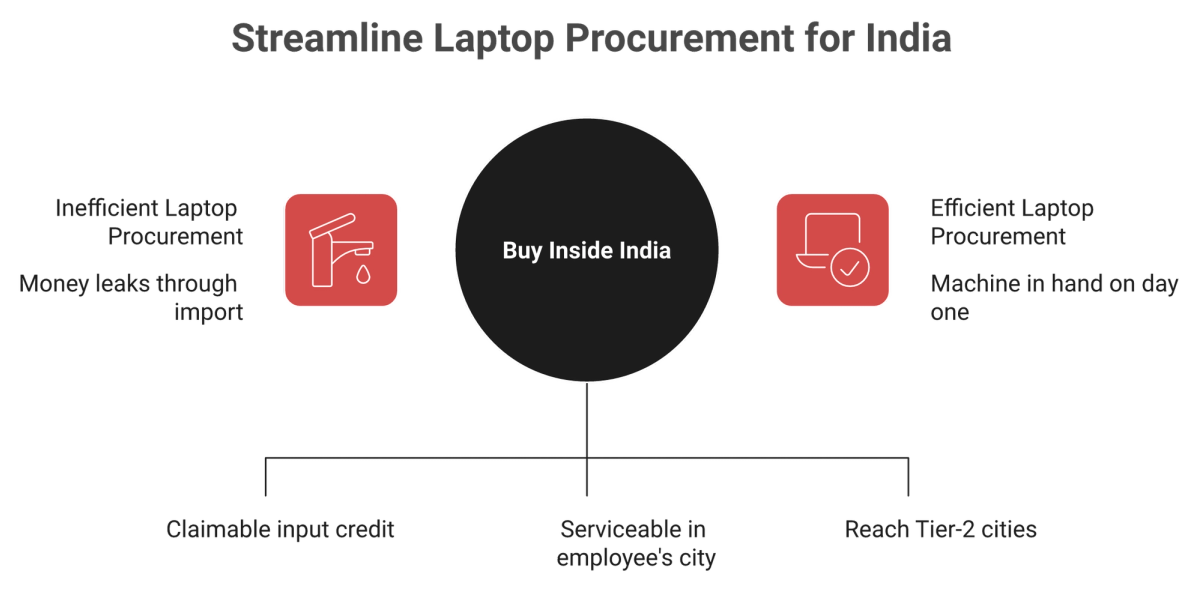
Global EOR platforms do not fix this. They subcontract India shipping to third-party partners, typically covering only the top four to six states, with FX markups reported in the 3 to 5 percent range on reimbursements. A full breakdown of that pattern sits in our Deel alternative comparison.
⭐ Where Versatile Club sits in this
Versatile Club buys on its own Indian GSTIN, which means the GST invoice, the input credit trail, and the local warranty land under a single entity rather than being reconstructed later from a partner's paperwork. Deel, Remote, G-P, and Omnipresent route India through local partner entities. We do not, and that is why we can hand a machine to a hire in Coimbatore without a customs file number ever entering the conversation. The entity, registrations, and filing stack behind that claim are documented on our India compliance page.
✅ The one rule to adopt
Buy in India, in rupees, on an Indian GSTIN, every time.
Versatile Club's read is that the standard advice gets this backwards. The industry treats procurement as a shipping problem, when it is really a tax-registration problem wearing a courier label.
I might be overweighting this, because our six years of contract-to-hire placements skew toward Tier-2 delivery edge cases. But I have not yet seen an import-first setup beat a local purchase on cost, speed, or serviceability.
Q2. What does a day-one-ready device stack for an India hire include?
Four things, not one: the machine matched to the role tier, peripherals that make a home desk workable, an India-serviceable warranty, and an asset record created at the moment of purchase. Then add three local variables the global guides skip. Use the Indian keyboard layout and the Type-C or Type-D power standard, confirm the warranty region is claimable locally, and verify the courier address against where the employee actually lives rather than what the offer letter says.
🖥️ Step 1: Pick the tier, not the laptop
Start with the role, not the catalogue. Device tiering is the step every strong provisioning guide opens with, because it removes per-hire negotiation.
Three tiers cover most India teams. Ops and generalist roles, engineering roles, and design or ML roles that need real GPU and display headroom.
| Tier | Typical role | Spec floor | Peripherals to include |
| Tier 1 | Ops, support, sales | 8 to 16 GB RAM, 256 GB SSD | Headset, mouse, laptop stand |
| Tier 2 | Backend, full-stack engineer | 16 to 32 GB RAM, 512 GB SSD | External monitor, keyboard, mouse |
| Tier 3 | Design, data, ML | 32 GB RAM or more, 1 TB SSD | Colour-accurate monitor, tablet or external GPU access |
🔌 Step 2: Fix the three India variables
Each variable maps to a specific failure, so treat this as a checklist rather than advice.
- Keyboard and power. Indian units ship with local layout and plug standards. A US unit means an adapter the employee has to buy on day one.
- Warranty region. Confirm in writing that the warranty is serviceable in the employee's city, not just in the country.
- Courier address. Engineers who move cities for a job often have an Aadhaar address in one state and a current address in another. Versatile Club verifies the delivery address against the employee directly before dispatch, because that mismatch is where day-one deliveries actually fail.
💰 Step 3: Price the lost day, not just the box
Vendors publish on-time percentages. Deel reports 99.5 percent on-time delivery across 130 plus countries in its own device lifecycle management guidance. Nobody publishes what a missed handover costs the client.
Versatile Club treats day one as a hard deadline because we have paid for the alternative. A logistics failure outside our control once cost us 24 days of refunded billing, and that refund still under-compensated the client for the engineering days they lost. The timeline we now commit to is set out in how our onboarding works.
"We used Versatile to hire our first employee in India after months of putting it off because the compliance side seemed like a mess. Sagar replied to our form in about four hours with a draft offer letter already attached. The hire was onboarded in four days."
— Verified User in Information Technology and Services, Founder, Versatile Club G2 - Verified Review, 23 June 2026
⚠️ Step 4: Run the pre-shipment check with named owners
Nothing ships until one named person signs off each line. Image applied, encryption on, enrollment confirmed, serial logged, peripherals boxed, address verified.
Slow setup is the single most common complaint in this category, and it is not limited to small vendors. We mapped the same pattern across vendors in our best EOR services in India breakdown.
"Slow and laborious initial setup. We are still waiting on answers to key questions for implementation."
— Juliette D., HR Leader, Remote - G2 Verified Review, 22 April 2026
"It took three months to onboard our first 3 individuals."
— Verified User in Information Technology and Services, People Operations, Deel - G2 Verified Review, 13 December 2024
Versatile Club gates device registration and courier confirmation inside the 5-business-day onboarding SLA written into the service agreement, so hardware readiness is a contract item rather than a best effort.
Q3. How do you set up zero-touch provisioning before the box ever ships?
Register the device to your organisation at purchase, not at unboxing. Zero-touch provisioning means the Indian reseller enters the serial number into Apple Business Manager or Windows Autopilot before dispatch, so the laptop enrolls into your MDM (mobile device management, the system that pushes policy to devices) on first boot. This only works if reseller pre-registration is written into the purchase order. Retrofitting enrollment after delivery means a manual wipe and reimage with the employee sitting on a video call.
📋 What zero-touch actually means
In plain terms: the employee opens the lid, signs in once, and the machine configures itself.
No IT ticket. No shipping the laptop to an office first. Top provisioning guides, including the Workwize pre-configuration guide for IT teams, treat this as the maturity line between ad hoc setup and real device operations.
🧾 The purchase-order clause that makes it possible in India
This is where most India setups break, and it has nothing to do with software.
Your reseller must support serial-number upload to Apple Business Manager or Autopilot. Not every Indian reseller does, and you cannot add it after the invoice is raised.
Put it in the PO as a condition of supply:
- Reseller uploads device serial numbers to the named ABM or Autopilot tenant before dispatch.
- Reseller shares the serial list, invoice number, and dispatch date in one email.
- Devices are not dispatched until enrollment is confirmed in the tenant.
Versatile Club handles reseller registration as part of procurement, so the client's MDM tenant receives the device before the courier does. Teams running this alongside payroll usually fold it into managed payroll operations.
🔐 The enrollment sequence, in order
Run these four steps in sequence. Skipping any one of them turns zero-touch back into manual setup.
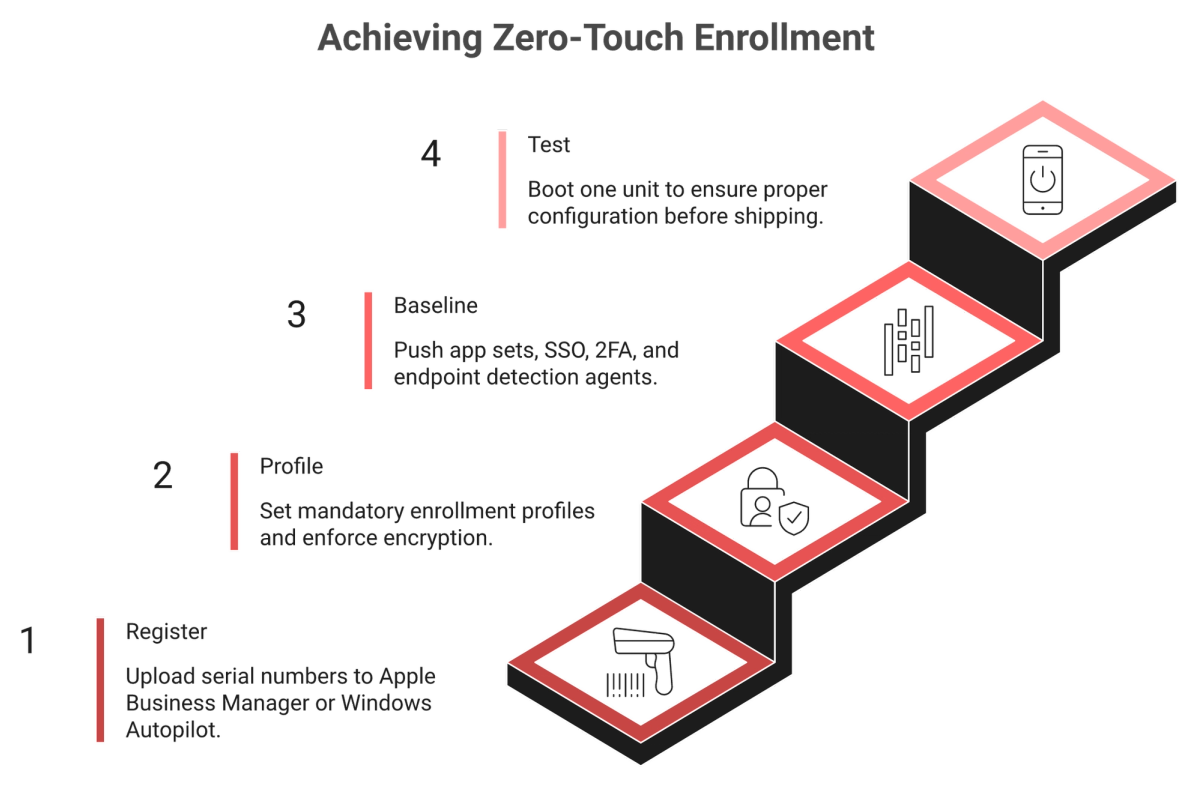
- Register. Serial number into Apple Business Manager or Windows Autopilot, assigned to your MDM.
- Profile. MDM enrollment profile set to mandatory and non-removable, with full-disk encryption (FileVault on macOS, BitLocker on Windows) enforced at first boot.
- Baseline. Push the app set, SSO, 2FA enforcement, screen lock, and EDR agent.
- Test. Boot one unit from the batch yourself before the rest ship.
That last step is the one teams skip. Versatile Club tests a single unit per batch, because a bad profile replicated across eight laptops is eight reimages, not one.
❌ What breaks when you skip it
Three predictable failures, all expensive in time rather than money.
First, the employee becomes your technician. You are walking a new hire through a recovery-mode wipe on their second day, which is a bad first impression and a worse use of their week.
Second, encryption becomes optional. If the device is not managed from first boot, nobody can prove the disk was ever encrypted. Under the Digital Personal Data Protection Rules, 2025, notified by MeitY as G.S.R. 846(E) on 13 November 2025, reasonable security safeguards become a documented obligation, with the main safeguard provisions applying from 14 May 2027.
Third, the asset record never gets created. A laptop with no serial on file is a laptop you cannot recover, depreciate, or dispose of correctly.
🗂️ Where the record should live
Versatile Club keeps equipment documents in the same admin portal as payslips, statutory filings, and payment records, so there is one place to look when an auditor asks which machine belongs to whom. The same record set underpins our India payroll compliance reporting.
My honest caveat: zero-touch depth varies by reseller relationship in India, not by software tier. Versatile Club's experience points that way strongly, though a client with an existing national reseller contract may well get there faster than we can.
Q4. Who actually owns the laptop when an EOR is the legal employer?
Ownership follows the commercial agreement, not the employment relationship. In most arrangements the client funds the hardware while the EOR or its Indian partner purchases, delivers, and recovers it, but legal title can sit with either party. Write it down: title holder, asset tag, serial number, purchase invoice, and every custody transfer. Versatile Club records all five under its own Indian entity, which is what determines who claims GST input credit, who books depreciation, and who carries the e-waste disposal duty when the machine retires.
⚖️ Why the question is not academic
Employment and asset ownership are two separate contracts. People assume the legal employer owns the laptop. That is not how it works.
Deel's own device lifecycle guidance for EOR employees frames device ownership as a commercial-agreement question rather than an employment one. The answer changes your books, your tax position, and your recovery leverage. If you are still choosing between structures, our EOR versus own entity comparison for India works through the same trade-off.
📑 The three structures, and who holds what
Define each term once and the differences become obvious. Title means legal ownership. Custody means who physically holds the device. Funding means whose money bought it.
| Structure | Title sits with | GST input credit | Depreciation booked by | E-waste duty |
| Client-owned, EOR-managed | Client's Indian entity, if it has one | Client, against its own GSTIN | Client | Client, as bulk consumer |
| EOR-owned, client-funded | EOR's Indian entity | EOR | EOR | EOR |
| Third-party logistics vendor | Vendor, often leased | Vendor | Vendor | Vendor |
If your company has no Indian entity, the first row is usually unavailable to you. That narrows the real choice to two, and both need the ownership clause stated in writing.
🗃️ The asset-register fields to log
A register with six fields survives an audit. One with two fields does not.
- Serial number, asset tag, and model
- Purchase invoice number, date, and GSTIN of the buyer
- Title holder, stated explicitly
- Employee name, employee ID, and delivery date
- Every custody transfer, with date and reason
- Disposal or re-issue record, including the erasure certificate
Versatile Club maintains this register under one entity, so title, invoice, GST credit, and custody history are a single document set rather than three vendors' partial records.
"The dashboard could be a little more self-serve. A couple of times I wanted to pull a report or a doc myself and ended up just messaging my contact instead. They always answered fast, so it wasn't a real problem, but I'd love to click around and find things on my own."
— Angad S., Founder, Versatile Club G2 - Verified Review, 21 June 2026
That is a fair hit, and it is the gap we are closing in the portal.
📝 The clause to insist on
Ask every shortlisted vendor one question: whose balance sheet does the laptop sit on?
If they cannot answer in a sentence, you will find out during an audit instead. Record-keeping also matters at end of life, since the E-Waste (Management) Rules, 2022, notified as G.S.R. 801(E) on 2 November 2022, place the channelling duty on the bulk consumer holding the asset.
"Reimbursements for equipments and other expenses are processed quickly, the company consistently keeps us informed with updates."
— Ana A., Employee, Pebl (formerly Velocity Global) - G2 Verified Review, 10 December 2024
"The initial documentation and paperwork felt quite detailed and time-consuming at the beginning."
— Verified User in Marketing and Advertising, People Operations, Wisemonk - G2 Verified Review, 12 February 2026
Versatile Club states ownership explicitly in the service agreement and holds the asset register, the employment record, and the invoice inside the same Indian entity. Clients see every device mapped to every employee, which is the view a controller needs at close and an auditor asks for later. If you want that set-up walked through against your current stack, book a 30-minute call or compare it directly with our Wisemonk alternative breakdown.
Q5. Is a company laptop or an equipment stipend taxable, and what do the Labour Codes do to it?
A company-owned laptop is a nil perquisite. Rule 3(7)(vii) of the Income-tax Rules, 1962 carves laptops and computers out of the 10 percent of cost movable-asset perquisite, so the taxable value is zero. A cash equipment stipend paid through payroll is taxable salary. India's four Labour Codes also came into force on 21 November 2025, and the wage definition pulls excess allowances into "wages" once they cross 50 percent of total remuneration. Buy the asset. Reimburse connectivity against bills.
📑 The rule, in plain English
A perquisite is a non-cash benefit taxed as part of salary. Most employer-owned assets used by an employee are valued at 10 percent of cost per year.
Laptops and computers are specifically excluded from that rule, as set out in the Income Tax Department's perquisites reference and Rule 3(7)(vii) of the Income-tax Rules, 1962. Mobile and telephone facilities are treated the same way, at nil value.
So the machine itself is free of tax for your engineer. The money you hand them instead is not.
💰 What happens if you transfer the device later
Tax only appears when ownership moves to the employee. Rule 3(7)(viii) values that transfer at actual cost less 50 percent written-down depreciation for each completed year, minus any amount the employee pays.
Work it through on a ₹1,40,000 laptop handed over after two completed years:
- Year one: ₹1,40,000 less ₹70,000 equals ₹70,000
- Year two: ₹70,000 less ₹35,000 equals ₹35,000
- Perquisite value: ₹35,000, reduced by whatever the employee pays you
Charge them a token ₹35,000 and the perquisite falls to nil. That is a five-minute decision most companies never make. If you are still modelling total employment cost, our cost of hiring in India breakdown works through the surrounding lines.
⚠️ The Labour Code trap nobody re-ran
Here is the part that bites CFOs. The Central Rules under the Codes were notified on 8 May 2026, and the wage definition caps excluded allowances at 50 percent of total remuneration.
A monthly equipment-and-internet allowance sits inside that allowance bucket. Push the bucket past half of CTC and the excess becomes wages for PF, ESI, and gratuity.
On a ₹20 lakh CTC with Basic at ₹8 lakh, adding ₹2 lakh of reclassified allowance lifts gratuity accrual at 4.81 percent from ₹38,480 to ₹48,100 per employee per year. Multiply by 20 people and the number stops being rounding. Our India payroll compliance guide sets out how that flows into monthly filings.
✅ The structure that holds up
| Item | Best structure | Statutory treatment |
| Laptop, monitor, peripherals | Company asset on company invoice | Nil perquisite under Rule 3(7)(vii) |
| Mobile and telephone | Company-provided facility | Nil perquisite |
| Internet and electricity | Reimbursement against actual bills | Taxable unless documented as business reimbursement |
| Retirement top-up | NPS under Section 80CCD(2) | Deductible, outside the allowance bucket |
Versatile Club models the Basic plus DA split before the offer letter goes out, because fixing a wage structure after twelve payroll cycles means a retrospective PF catch-up. You can sense-check a structure yourself with our India salary calculator.
"Contracts, PF, ESI, TDS, and payroll all handled in one place. Invoicing in USD meant zero exchange rate surprises."
— Vedant T., Founder, Versatile Club G2 - Verified Review, 16 June 2026
"I dislike how expensive Deel's transaction fees are, especially when moving money from the Deel account to my bank."
— Maria M., Freelance Contractor, Deel - G2 Verified Review, 26 September 2025
That second one matters here. Every rupee you route as cash instead of as an asset passes through a fee layer and a tax layer.
⭐ Where Versatile Club lands
Versatile Club files TDS and issues Form 16 under its own registrations, so the perquisite call is ours to get right rather than a client's offshore guess. We buy the device on the company invoice, accrue PF, ESI, and gratuity from month one, and share challan numbers rather than reporting that a filing happened. The registrations behind that sit on our compliance page.
Q6. What security baseline does an India device need under DPDP Rules 2025?
Full-disk encryption, enforced screen lock, two-factor authentication, managed passwords, and remote wipe. MeitY notified the Digital Personal Data Protection Rules, 2025 on 13 November 2025 under G.S.R. 846(E). Rules 1, 2, and 17 to 21 are already live. Rule 4 applies from 14 November 2026. Rules 3 and 5 to 16, covering reasonable security safeguards, breach notification, retention, and logs held for at least one year, apply from 14 May 2027. Failure of safeguards carries penalties up to ₹250 crore.
🏰 Tall walls, open drawbridge
Companies spend heavily on network security and then hand out unencrypted laptops. It is no good building the tallest castle walls if you leave the drawbridge down.
An encrypted laptop left in a Bengaluru cab is an inconvenience and an insurance claim. An unencrypted one is a notifiable incident with a personal-data trail attached.
The difference is one setting, applied before dispatch.
🔐 The eight-item baseline
Versatile Club applies this list before a device leaves the vendor, because retrofitting it later means an employee does the work on their own time.
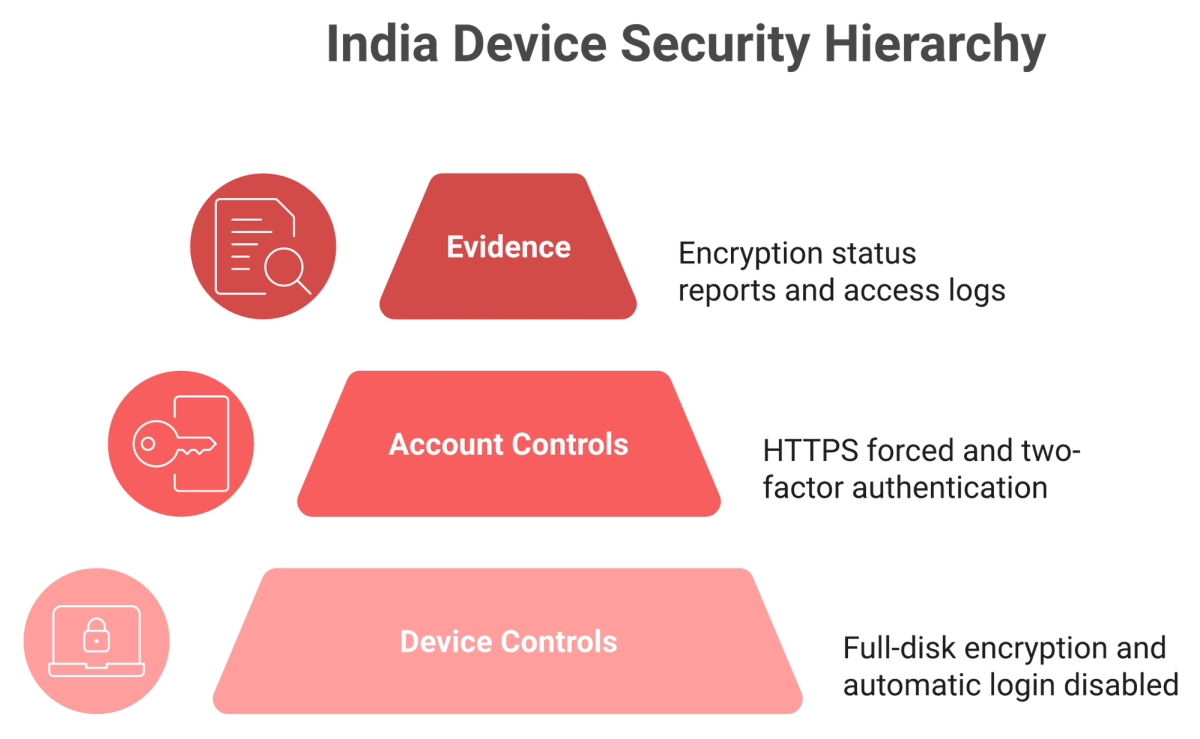
- Full-disk encryption on. FileVault on macOS, BitLocker on Windows, with the recovery key held in escrow by IT.
- Automatic login disabled. No machine should open to a desktop.
- Password required on wake. Applies to sleep and screensaver.
- Auto-lock after 10 inactive minutes. Short enough to matter, long enough to tolerate.
- HTTPS forced across browsers. No plain-text sessions.
- Two-factor authentication on email and SSO. Email is the account-recovery key to everything else.
- A password manager issued, not suggested. 1Password, Dashlane, or similar, with long unique passwords.
- Mobile devices locked and wipeable. Passcode enforced, remote wipe enabled on any phone touching company mail.
⏰ What the dates actually ask of you
The 2027 date is not permission to wait. Rules 6 and 7 of the Digital Personal Data Protection Rules, 2025 require safeguards and breach reporting to be demonstrable, which means evidence you can produce on request. The phased commencement dates and the penalty framework are set out in the Press Information Bureau note of 17 November 2025.
Start the evidence trail now, while your fleet is small. Three records do most of the work:
- An encryption status report per device, exported monthly from your MDM
- A recovery-key escrow record tied to each serial number
- An access and wipe log, retained for at least one year
Versatile Club keeps enrollment state, encryption status, and wipe capability on the asset record from the day of purchase, so the evidence is a export rather than an investigation. The same record discipline runs through our India EOR service.
🗂️ Why the India date is the one that counts
Most global EOR security pages still frame device policy around GDPR or SOC 2. Those are real frameworks. Neither one is the statute that will be enforced against your India fleet.
Versatile Club's read is that the category has this backwards. Buyers ask vendors for a SOC 2 report and never ask who holds the recovery keys for the eleven laptops sitting in Pune, Hyderabad, and Jaipur. We unpack the same gap across vendors in our best EOR in India comparison.
I could be weighting the DPDP timeline too heavily, since we are an India-only operator and it is the rulebook we live inside. But a MeitY notification with a ₹250 crore ceiling is a harder constraint than an audit badge.
⭐ How Versatile Club handles it
Versatile Club ships devices already enrolled and encrypted, and holds the asset register inside the same Indian entity that is the legal employer. Because employment and equipment records sit together, a DPDP question in 2027 pulls from one file, not three vendors' partial logs.
Q7. Where is the line between managing a device and surveilling a person?
Manage the device, never watch the human. MDM, encryption, endpoint detection, and remote wipe protect company data and survive an audit. Keystroke logging and screen capture protect nothing, damage the trust the team was hired on, and point to a hiring failure rather than a security gap. Versatile Club does not sell, resell, or recommend employee monitoring software to any client. Some offshore agencies do recommend it to reassure nervous overseas buyers, and that reassurance is paid for with retention.
🧭 The honest version of the other side
Let me make the opposing case properly, because it is not stupid.
A US founder is about to pay a salary to someone 8,000 miles away whom they have met only on Zoom. Monitoring software offers a visible answer to an invisible fear.
Agencies know this. Some openly suggest screen or keystroke tracking as a way to calm a hesitant client, and it does calm them, at first.
❌ Why it collapses on inspection
Then the second quarter arrives. Nobody has ever opened the logs, because logs do not tell you whether code shipped.
Surveillance tooling is an industry, not an edge case. InterGuard alone claims ten thousand clients, which tells you how many managers bought certainty instead of judgment.
Here is the twist that matters. If you do not trust someone to work unobserved, you also should not trust them with production credentials, customer data, or a client call. The monitoring question is a hiring question wearing an IT costume, which is why we built our culture-fit screening around it instead.
✅ What to do instead
Versatile Club replaces the monitoring instinct with three practices that cost nothing and work better.
- Ask open status questions. Not "are you on schedule," which invites yes. Ask "where are we on the schedule," or "show me what is left."
- Recap in writing. After any call about scope or deadlines, send a short email repeating the key points. Across India and US timezones, this catches more drift than any dashboard.
- Separate work and personal devices. One machine for work, one for everything else. It protects data and protects the employee from a day that never ends.
⭐ Trust as a service design, not a slogan
Versatile Club built its screening layer so that no client needs keystroke logs. Fifty behavioural parameters before an offer, a Success Coach through the first 90 days, and a 6-month replacement guarantee on contract-to-hire placements give a nervous buyer a written commitment instead of a surveillance feed.
"Founder is just a call away. Extremely helpful in resolving all our queries. The process is super smooth to setup India EOR."
— surbhi m., Founder, Versatile Club G2 - Verified Review, 15 June 2026
"I've noticed that their support/query responses can occasionally take a bit longer sometimes, likely due to a relatively small team."
— Verified User in Financial Services, Employee, Wisemonk - G2 Verified Review, 14 June 2025
Both reviews point at the same underlying thing. What actually reassures a client across a 10-hour time gap is a human who answers, not a tool that records. A side-by-side view sits in our Wisemonk alternative comparison.
⚠️ The limit I will name
Versatile Club's position here is a judgment call, and it has a boundary. Regulated workloads, client-mandated screen recording, and certain financial-services controls are real requirements that a policy preference does not override.
My view is that those are narrow, specific, and contract-driven. Applying them to a general engineering team because a founder feels uneasy is not a security control. It is a tax on the relationship.
Q8. Should you equip a hire before or after background verification clears?
Order the hardware early, gate dispatch on background verification. Nearly 30 percent of Indian IT-sector resumes contain discrepancies, and verification costs 20 to 150 dollars per candidate, with around 50 dollars buying a comprehensive package. A proper India check is multi-point: identity against Aadhaar and PAN, education, previous employment cross-checked through the EPFO UAN database, criminal record via e-Courts and police, and address verification. Versatile Club runs the EPFO UAN cross-check through its own PF registration, which is what surfaces an active contribution from another employer.
💸 The failure this prevents
A founder once told me the thing every client dreads. They hired in India and discovered one developer was quietly holding two full-time jobs.
That discovery is painful at any point. It is worse once a laptop, a welcome kit, and two weeks of onboarding have already been spent.
Dual employment leaves a trail in exactly one place. The Universal Account Number, or UAN, is the portable PF account that follows an employee between employers. Two live contributions against one UAN is the signal, which is why our India recruitment process checks it before an offer is countersigned.
📋 The five checkpoints, and what each one catches
| Check | What it verifies | Typical cost and turnaround |
| Identity | Aadhaar and PAN match the candidate | Lowest cost, 1 to 2 days |
| Education | Degree and institution are real | 3 to 7 days, slower for older records |
| Previous employment | Dates and employer, cross-checked via EPFO UAN | 2 to 5 days, catches moonlighting |
| Criminal | e-Courts and local police records | 5 to 10 days, state-dependent |
| Address | Current residence, not just Aadhaar address | 2 to 4 days, often the weakest link |
Across the package, the band runs from 20 dollars for identity-only to 150 dollars or more for a full multi-point check.
⏰ The decision rule
Run procurement and verification in parallel. Hold dispatch, not the purchase order.
- Day 0: offer issued, BGV initiated, hardware ordered.
- Day 1 to 3: device registered with the reseller, image and encryption applied.
- Day 3 to 5: UAN and identity results land. Clear results release the courier.
- Day 5: device arrives, zero-touch enrollment runs, day one happens on time.
Versatile Club gates courier release on verification inside the 5-business-day onboarding SLA, which keeps the sequence honest without pushing the start date. The full sequence is laid out in how it works.
⚠️ The address check people skip
Here is the operational detail that costs the most days. Engineers who move city for a job keep an Aadhaar address in one state and live in another.
Versatile Club confirms the delivery address directly with the employee rather than copying it from the offer letter. That one step removes the most common cause of a failed first delivery across Bengaluru, Hyderabad, and Pune, and it matters most for teams hiring in India without an entity.
"The process was straightforward, the Support team was easy to work with, and the candidates' quality met our expectations."
— Verified User in Venture Capital & Private Equity, Investor, Versatile Club G2 - Verified Review, 22 June 2026
"Everything from scheduling the interviews to the final onboarding was handled smoothly and professionally. They consistently provided timely updates after each round."
— Verified User in Financial Services, Employee, Wisemonk - G2 Verified Review, 14 June 2025
⭐ Where Versatile Club sits
Versatile Club runs the UAN cross-check as standard rather than a paid add-on, because the PF registration it queries is our own. An active contribution from another employer surfaces before the offer is countersigned, and well before a laptop worth 3,000 dollars leaves the warehouse. If you want that sequence mapped against your current provider, book a 30-minute call.
Q9. How do you get the laptop back when an India employee resigns?
Start recovery at resignation acceptance, not the last working day. Revoke access and remote-lock immediately, book a local courier pickup rather than any cross-border return, and make device clearance a named line item in the full-and-final settlement and Form 16 release checklist. Arbitrary salary deduction is not a safe recovery mechanism under Indian wage law. Versatile Club holds registrations across all 28 states and 8 union territories, which is why device clearance sits inside the same settlement we are already processing rather than a separate chase.
💸 The scene every IT lead recognises
A senior engineer resigns on a Tuesday. The notice period is 60 days. Nobody mentions the laptop.
On the last working day, the machine is still at their flat in Indiranagar. HR sends an email. Then another. Then the settlement gets processed anyway, because payroll has a deadline.
Now a MacBook worth 3,000 dollars sits in a city where your company has no legal presence. There is no local number to call and no leverage left.
⏰ The five-step sequence, with owners
Versatile Club runs recovery as a dated sequence rather than a reminder, because every day of drift reduces the odds.
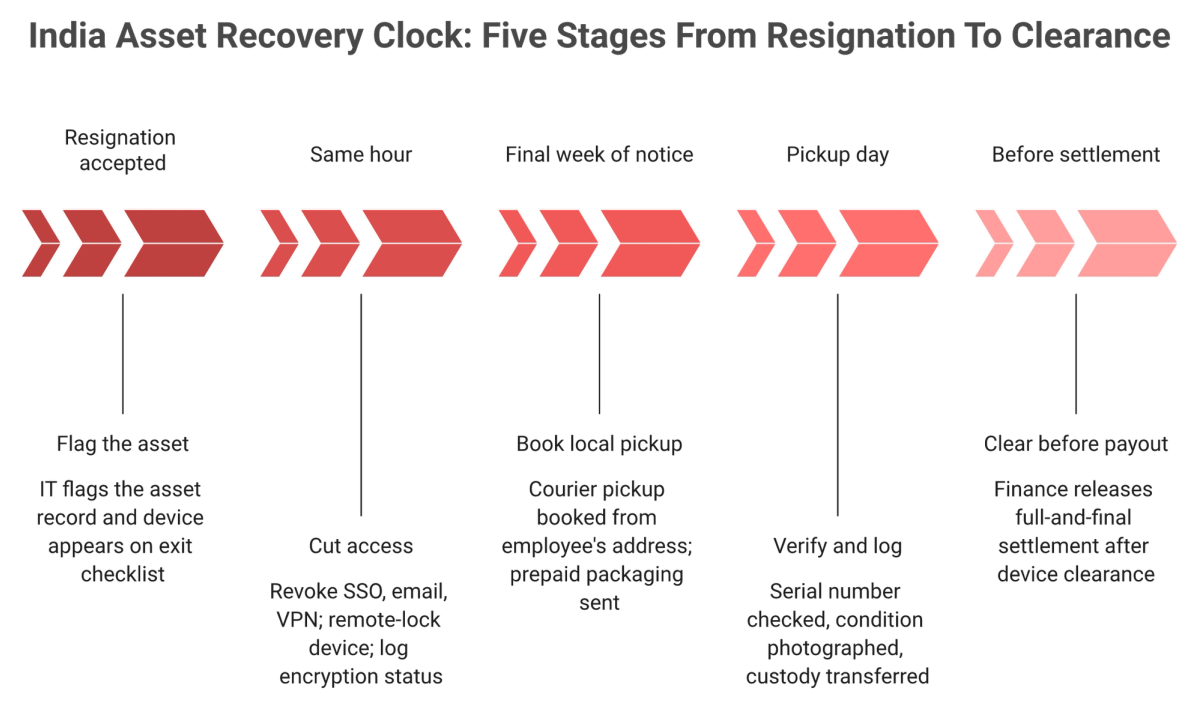
- Day 0, resignation accepted. IT flags the asset record. The device appears on the exit checklist automatically.
- Day 0, same hour. Revoke SSO, email, and VPN. Remote-lock the device and confirm the encryption status is logged.
- Last week of notice. Book a domestic courier pickup from the employee's verified address, with prepaid packaging sent to them.
- Pickup day. Serial number checked against the register. Condition photographed. Custody transfer recorded.
- Before settlement. Finance releases the full-and-final amount only after device clearance is marked.
📝 The clause that gives you leverage
Indian wage law does not let you deduct arbitrary amounts from salary. What you can do is make clearance a condition of the exit process.
Add this to your offer letter and exit policy:
- Company assets are returned before the last working day, in working condition, to the address or courier the company nominates.
- Full-and-final settlement and Form 16 issuance follow completion of asset clearance.
- Non-return is treated as a recoverable debt, documented in writing, not as a unilateral payroll deduction.
Versatile Club embeds this in the employment contract it issues as the legal employer, so the clause belongs to the entity that actually has standing in India. That is one of the practical gaps teams discover when they switch EOR provider in India.
❌ Why email escalation fails across timezones
Recovery is a phone call problem, not a ticket problem. It needs someone who can call in the right language, at the right hour, from inside the country.
Ticket-based support struggles here, and buyers say so plainly. We compare support models directly in our Deel alternative breakdown.
"Poor support. Poor communication on issues and complete ignorance of deadlines set by Deel themselves. Extremely slow speed in resolving HR and payroll issues."
— Daryna R., Employee, Deel - G2 Verified Review, 6 May 2024
"The team is really competent, but there were a few time zone misunderstandings that caused slight delays in the initial phase. That said, once things got going, the whole process was buttery smooth."
— Setu C., Operations Lead, Versatile Club G2 - Verified Review, 10 June 2026
That second review is a fair hit on us too. Timezone friction is real, and it is exactly why Versatile Club keeps escalation on WhatsApp with me rather than in a queue. You can reach that line through our contact page.
⭐ Where Versatile Club sits
Versatile Club is registered across all 28 states and 8 union territories, so in-country pickup is an operational fact rather than a coverage promise. Global platforms routing India through a partner entity typically cover the top four to six states for logistics. The engineer who moved home to Coimbatore sits outside that map, and that is where recovery quietly fails. Our full state coverage is documented on the compliance page.
Q10. What are you legally required to do with retired laptops in India?
You cannot scrap, informally gift, or resell a retired work laptop at will. Under the E-Waste (Management) Rules, 2022, notified as G.S.R. 801(E) and effective 1 April 2023, laptops fall under category ITEW3. Rule 8 requires bulk consumers to channel e-waste only to a producer, refurbisher, or recycler registered with the Central Pollution Control Board, and to maintain records of what was sent where. Versatile Club records erasure and disposal against each serial number on the same asset register that holds the purchase invoice.
📜 Who counts as a bulk consumer
A bulk consumer is any company, institution, or government body that uses electrical and electronic equipment in bulk. There is no comfortable small-company exemption for a growing India team. The CPCB FAQ on the E-Waste (Management) Rules, 2022 sets out that obligation in full.
If you employ people in India and buy laptops for them, the duty follows the person or entity holding title to the asset. That is why the ownership question in an EOR arrangement is not academic paperwork, and why it is worth reading alongside our EOR versus entity comparison for India.
🔐 The three-step disposal chain
Run these in order. Skipping the first step turns a compliance task into a data-breach risk.
- Certified erasure. Wipe each drive to a recognised standard. NIST SP 800-88 is the reference Indian IT asset lifecycle vendors now cite for media sanitisation, as documented on the ByteBack enterprise ITALM platform. Keep the per-drive certificate.
- Registered channel only. Hand the hardware to a CPCB-registered producer, refurbisher, or recycler. Verify the registration number before pickup, not after, through the CPCB E-Waste Management System.
- Record retention. Keep the serial number, erasure certificate, recycler name, registration number, quantity, and date. That is the record a regulator asks for.
Versatile Club keeps all five fields against the device record, so the disposal trail and the GST purchase trail live in one file.
♻️ The step that comes before disposal
Here is where most companies lose money. A recovered laptop is usually not end-of-life. It is a 24-month-old machine with a good battery and a clean drive.
The commercially better sequence is erase, refurbish, re-issue. A recovered Tier 2 engineering laptop becomes the next hire's day-one machine, which removes a procurement cycle and the customs question entirely.
Versatile Club treats equipment as a three-phase lifecycle: procurement and onboarding, active management, then exit recovery, refurbishment, and re-issuance. Disposal is reserved for machines that genuinely cannot serve another cycle. The same lifecycle discipline runs through our EOR services in India.
🗂️ The register fields that make re-issue possible
You cannot re-issue what you cannot find. Six fields do the work.
| Field | Why it matters at end of life |
| Serial number and model | Matches the erasure certificate to the physical unit |
| Purchase invoice and date | Establishes age, warranty status, and depreciation |
| Title holder | Determines who carries the bulk-consumer duty |
| Custody history | Shows who held the device and for how long |
| Erasure record | Proves the drive was sanitised before it left |
| Disposal or re-issue outcome | Closes the loop with a recycler certificate or a new assignee |
⚠️ What I would still flag
Versatile Club's view is that this is the most ignored obligation in India remote-work operations, and I say that with a caveat. Enforcement attention has centred on producers rather than bulk consumers so far.
I would not plan around that staying true. The record-keeping cost is low, the refurbishment saving is real, and the exposure from an unwiped drive under the Digital Personal Data Protection Rules, 2025 is far larger than any disposal fine.
⭐ How Versatile Club closes the loop
Versatile Club holds procurement, recovery, erasure, and re-issue on a single asset register inside its own Indian entity. Because one entity owns the record from invoice to recycler certificate, the compliance paper trail and the cost saving are the same workflow, not two separate projects.
Q11. Who should own equipping: your IT team, a global EOR, an India-native EOR, or a logistics vendor?
It depends on headcount and how much of the lifecycle you want to own. An India-native EOR that owns its entity is the right default at 1 to 50 India employees, because procurement, MDM, payroll, and recovery sit with one accountable party. A standalone logistics vendor fits companies that already have an Indian entity. A global EOR fits multi-country fleets where India is a minor node. Versatile Club operates in India only, through its own registered Indian entity, at a flat 149 dollars per employee per month.
💰 The four models, side by side
| Model | Entity in India | State coverage | Procurement route | Recovery | Monthly cost |
| Versatile Club (India-native EOR) | Owned, Foo Falcon Technologies Pvt Ltd | 28 states, 8 UTs | Local, own GSTIN | In-country, inside F&F | 149 dollars flat, no setup, no exit fee |
| Wisemonk (India-native EOR) | Owned | India-wide | Local | In-country | 99 to 399 dollars, slab-based |
| Global EOR (Deel, Remote, G-P, Multiplier) | Local partner entity | Typically top 4 to 6 states for logistics | Third-party shipping partner | Partner-dependent | 400 to 599 dollars, plus 299 to 500 dollars setup |
| Logistics-only vendor | None, you need your own | Varies | Local or imported | Pickup only, no payroll leverage | Per-device or per-seat |
Published global EOR rates can be checked against Deel's own pricing page and Remote's pricing page, and our own rate sits on the Versatile Club pricing page.
⚠️ Where each model breaks
Pick by failure mode, not by feature list.
- Running it from HQ fails on customs, warranty region, and recovery. You inherit every problem with none of the local standing.
- Global EOR fails on state depth. India compliance knowledge is thinner when it is one market out of 150, and support arrives as a ticket.
- Logistics-only vendor fails on leverage. A courier company cannot withhold a full-and-final settlement.
- India-native EOR fails if you need five or more countries. Versatile Club is India-only by design, and that is a real limit for a multi-country buyer.
💸 The all-in-one premium is rational
Buyers consistently choose the single accountable vendor over the cheaper point solution. In Versatile Club's own buyer conversations, a 220 dollar all-in vendor beats a 150 dollar narrow vendor, because nobody wants to coordinate three or four Indian suppliers on a payroll deadline.
Support quality is the reason, and reviews on both sides say it clearly. A fuller vendor-by-vendor read sits in our best EOR services in India guide.
"Their team was highly responsive, professional, and easy to work with throughout the process. The best part was their ability to simplify hiring in India."
— Mukul S., People Operations, Versatile Club G2 - Verified Review, 16 June 2026
"Customer support and issue ownership need serious improvement. I was redirected multiple times, asked to repeat the same information to different representatives."
— Güneş A., Contractor, Deel - G2 Verified Review, 2 October 2025
✅ Decision rule by headcount
Keep this simple and the choice makes itself.
- 1 to 10 India employees, no entity. India-native EOR. One party for employment and equipment.
- 10 to 50, no entity. Still India-native EOR, with state coverage and recovery written into the agreement.
- Any size, with your own Indian entity. Logistics vendor plus your IT team, since you already hold the leverage.
- India plus four or more other countries. Global EOR, accepting thinner India depth as the trade.
If you want to pressure-test the second and third rows against your own numbers, run them through the EOR versus entity calculator.
⭐ The honest limit
Versatile Club sits first in the India-native column for a structural reason: we own the entity, so procurement, PF, ESI, TDS filing, USD invoicing, and recovery run on the same registrations. The honest limit is that our EOR line launched in 2026 on six years of C2H infrastructure, and we do not hold SOC 2 Type II. If InfoSec hard-gates on that, a larger platform clears procurement faster. A direct comparison against the nearest India-native option sits on our Wisemonk alternative page.
Q12. What does equipping one remote employee in India actually cost?
Budget the lifecycle, not the laptop. Six lines make up the real number: machine and peripherals, background verification at 20 to 150 dollars, an MDM or UEM seat, domestic delivery and welcome kit, any recurring connectivity reimbursement, and a recovery plus refurbishment reserve. Then audit the vendor side, because setup fees, security deposits, benefits markup, exit fees, and FX markups reported in the 3 to 5 percent range are where a quoted monthly price stops being the price. Versatile Club invoices in USD from a single Indian entity with no setup fee and no exit fee.
📊 The six-line model
Versatile Club builds client budgets on these lines because the ones teams forget are the ones that arrive later.
| Cost line | Frequency | Notes |
| Laptop and peripherals | One-time per refresh cycle | Tier-dependent, bought locally on an Indian GSTIN |
| Background verification | One-time per hire | 20 to 150 dollars, around 50 dollars for a full package |
| MDM or UEM seat | Recurring per device | Priced per endpoint, not per employee |
| Delivery and welcome kit | One-time per hire | Domestic courier, Tier-2 delivery adds days not dollars |
| Connectivity reimbursement | Recurring | Reimburse against bills, not as a fixed allowance |
| Recovery and refurbishment reserve | Per exit | Pickup, certified erasure, refurbishment for re-issue |
🧾 Method and assumptions
Three assumptions drive the whole model, so state them before anyone signs off.
First, hardware is bought in India against your GSTIN, which makes the GST on the invoice claimable input credit rather than a sunk cost. Second, the device is a company asset, so its perquisite value to the employee is nil under Rule 3(7)(vii) of the Income-tax Rules, 1962, per the Income Tax Department's perquisites reference. Third, refresh happens on a 36-month cycle with one refurbishment and re-issue in between.
Change any one of those and the per-employee number moves materially. Our India EOR cost guide runs the same method across the employment side.
💸 The hidden-fee audit
Here is the single most useful thing you can do before signing anything. Ask for a live sample invoice.
Read it for five specific lines:
- Setup or implementation fee
- Security deposit or advance float
- FX markup on reimbursements and payouts
- Benefits or insurance administration markup
- Exit or offboarding fee
Reported FX markups in the 3 to 5 percent range on global platform invoices do not appear on pricing pages. Employees notice the same pattern on the payout side.
"I find Deel to be absurdly expensive. They charge a high amount of fees for transferring money to my bank account."
— Juan Camilo O., Contractor, Deel - G2 Verified Review, 27 November 2025
"First USD invoice landed clean: no FX markup, no setup fee, no surprises."
— Verified User in Information Technology and Services, Founder, Versatile Club G2 - Verified Review, 23 June 2026
✅ The vendor-call checklist
Ask these five questions on the call, and write the answers down.
- Show me a sample invoice with every line item, including FX.
- What is your contractual onboarding SLA, and what happens if you miss it?
- Which states do you actually deliver to and recover from?
- Who holds title to the hardware, and whose GSTIN is on the purchase invoice?
- Can you produce a certified erasure record and a recycler certificate at end of life?
Vendor-reported delivery and retrieval metrics exist in this category, as collated in the IT asset management vendor roundup and on the RemoAsset procurement and retrieval service page, so ask for them rather than accepting a description.
⭐ Where Versatile Club lands
Versatile Club invoices in USD from one Indian entity at a flat 149 dollars per employee per month regardless of salary band, with no setup cost, no exit cost, no salary markup, and the first month free. Equipment, statutory, and service-fee lines land on a single document a controller can tie out in one close. Ask us for a sample invoice, and ask everyone else on your shortlist for one too, or book a 30-minute call and we will walk through yours line by line.
FAQs
Is a company laptop taxable for an employee in India?
No. Under Rule 3(7)(vii) of the Income-tax Rules, 1962, the use of a laptop or computer owned or hired by the employer is specifically excluded from the movable-asset perquisite, so the taxable value in the employee's hands is nil. Mobile and telephone facilities are treated the same way.
Tax only enters the picture in two situations:
- You pay cash instead. An equipment stipend routed through payroll is taxable salary, not a tax-free benefit.
- You transfer the device later. Rule 3(7)(viii) values the transfer at actual cost less 50 percent written-down depreciation for each completed year, minus any amount the employee pays you.
On a ₹1,40,000 laptop handed over after two completed years, the perquisite works out to ₹35,000. Charge the employee that amount and it falls to nil.
Versatile Club buys the device on the company invoice and keeps it on the asset register precisely because of this, and because we file TDS and issue Form 16 under our own registrations, the perquisite treatment is ours to get right rather than a client's offshore guess. If you are modelling the surrounding employment cost, our cost of hiring in India guide works through the full build-up.
Should we ship laptops from the US or UK to India, or buy them locally?
Buy locally, almost without exception. Hardware sent from New York or London enters India as a commercial import, which means basic customs duty and IGST are assessed before the courier moves it, and that clock runs in business days.
Three losses stack on a single imported box:
- Duty and IGST. Your landed cost stops matching the price procurement approved.
- Warranty region. A US-purchased machine usually carries a US warranty, which an engineer in Pune cannot walk into a local service centre.
- Lost input credit. A local purchase against an Indian GSTIN makes the GST on the invoice claimable input credit. Shipping from abroad muddies or removes that path.
There is a fourth cost nobody budgets: the idle day. A new hire with a signed offer and no machine is the most expensive day of the engagement, because you are paying salary against zero output.
Versatile Club procures inside India on its own GSTIN through its registered Indian entity, so the invoice, the local warranty, and the asset tag sit under one legal entity rather than being reconstructed later from a partner's paperwork. Teams without a local presence usually hit this first when hiring in India without an entity.
Who owns the laptop when an Employer of Record is the legal employer in India?
Ownership follows the commercial agreement, not the employment relationship. People assume the legal employer owns the hardware; that is not how it works. In most arrangements the client funds the device while the EOR or its Indian partner purchases, delivers, and recovers it, but legal title can sit with either party.
Write five things into the service agreement and the asset register:
- Title holder, stated explicitly
- Asset tag, serial number, and model
- Purchase invoice number, date, and the GSTIN of the buyer
- Employee name and delivery date
- Every custody transfer, with date and reason
That record decides who claims GST input credit, who books depreciation, and who carries the bulk-consumer e-waste duty when the machine retires. If a vendor cannot tell you in one sentence whose balance sheet the laptop sits on, you will find out during an audit instead.
Versatile Club states ownership in the service agreement and holds the asset register, the employment record, and the purchase invoice inside the same Indian entity, so a controller sees every device mapped to every employee in one place. If you are weighing structures, our EOR versus entity comparison for India works through the trade-off.
How do you get a laptop back when an India employee resigns?
Start recovery the hour the resignation is accepted, not on the last working day. By the time payroll is processing the final settlement, your leverage is already gone.
Run it as a dated sequence:
- Day 0. Flag the asset record, revoke SSO, email, and VPN, then remote-lock the device and log its encryption status.
- Final week of notice. Book a domestic courier pickup from the employee's verified address and send prepaid packaging.
- Pickup day. Check the serial against the register, photograph condition, and record the custody transfer.
- Before settlement. Release the full-and-final amount only after device clearance is marked.
Arbitrary salary deduction is not a safe recovery mechanism under Indian wage law. What works is making clearance a documented condition of full-and-final settlement and Form 16 release, written into the employment contract from the start.
Versatile Club is registered across all 28 states and 8 union territories, so in-country pickup is an operational fact rather than a coverage promise, and device clearance sits inside the settlement we are already processing. Companies moving off a global platform often discover this gap during a migration, which we cover in our guide to switching EOR provider in India.
What does it actually cost to equip one remote employee in India?
Budget the lifecycle, not the laptop. Six lines make up the real per-employee number:
- Machine and peripherals, tier-dependent, bought locally on an Indian GSTIN
- Background verification at 20 to 150 dollars per candidate, around 50 dollars for a comprehensive multi-point package
- An MDM or UEM seat, priced per endpoint rather than per employee
- Domestic delivery and welcome kit, one-time per hire
- Connectivity reimbursement, paid against actual bills rather than as a fixed allowance
- A recovery and refurbishment reserve for the exit you have not planned yet
Then audit the vendor side, because that is where quoted prices stop being prices. Ask for a live sample invoice and read it for setup or implementation fees, security deposits, FX markup on reimbursements, benefits administration markup, and exit fees. Markups in the 3 to 5 percent range on global platform invoices are reported but rarely published.
Versatile Club invoices in USD from a single Indian entity with no setup cost, no exit cost, and no markup on the employee's salary, so equipment, statutory, and service-fee lines land on one document a controller can tie out in a single close. Our India EOR cost breakdown applies the same method to the employment side.