Table of contents (11)
GCC Setup in India 2026: A CXO's Playbook for Location, Talent, Tax & Operating Models
Q1. What is a GCC in India, and how is it different from outsourcing?
A CFO at a Series B fintech in Austin sent me her board slide last March. It said "India GCC, Phase 1, 8 FTE." Underneath, in the appendix, the same eight people were budgeted as a vendor statement of work. Two structures, one headcount, and nobody in the room had noticed the contradiction.
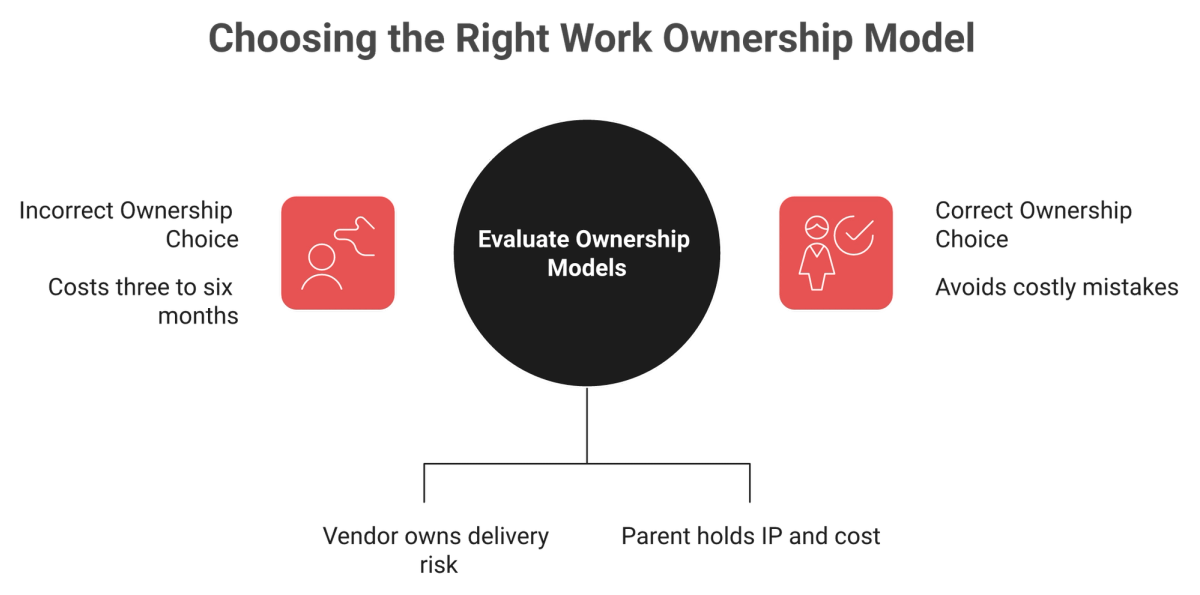
A Global Capability Center is an offshore unit the parent company owns. The people are its employees, the intellectual property sits with it, and the cost lands in its own profit and loss. Outsourcing moves delivery to a third party under a contract. The vendor owns the employment, the delivery risk, and often part of the IP. India hosted 2,117 GCCs across 3,728 units in FY2026, employing about 2.36 million people and generating $98.4 billion, according to the Zinnov and Nasscom India GCC Landscape Report 2026. Ownership, not cost, is the dividing line.
🧩 The three-question ownership test
Ask three questions before you label anything a GCC. Whose name sits on the share register? Who holds the written IP assignment from each engineer? Whose provident fund registration number appears on the payslip?
If the answer to all three is "the parent," you have a captive. If any answer is a vendor's name, you have outsourcing or an employer of record arrangement in India. Both are legitimate. Buying the wrong one costs three to six months.
📊 Why the GCC count changes depending on who you ask
You will see two very different numbers quoted in the same week. Government figures citing FY24 data report 1,700 plus centres, $64.6 billion in revenue, and about 19 lakh people employed, with a projection of $105 billion by 2030, per the Press Information Bureau backgrounder on GCCs. The Nasscom and Zinnov FY2026 dataset reports 2,117 GCCs across 3,728 delivery units.
Both are correct. One counts legal centres on older data; the other counts centres and their separate units on newer data. State the basis next to the number in your board deck. A CFO who cannot explain the gap loses the room.
⚖️ Talent arbitrage, not labour arbitrage
The older global business services model ran on labour cost. The GCC model runs on cost plus capability, which practitioners describe as talent arbitrage rather than pure labour arbitrage. That shift matters for how you write the mandate.
A centre scoped as "cheaper hands" stays stuck doing regional support forever. A centre scoped to own a product surface attracts people who could have gone anywhere. In six years of contract-to-hire enquiries, I have found most "we need a GCC" conversations at 5 to 30 headcount are capability needs, not captive needs.
✅ Where the entity question actually lands
Versatile Club operates only in India, through its own registered Indian company, Foo Falcon Technologies Pvt Ltd. Employees hired through our employer of record are employed by that entity, with provident fund, employee state insurance, tax deducted at source, and professional tax filed under our own India compliance registrations. That means we answer the ownership test from inside the Indian filing system, not from a global playbook.
Q2. Which India GCC operating model fits your headcount and maturity tier?
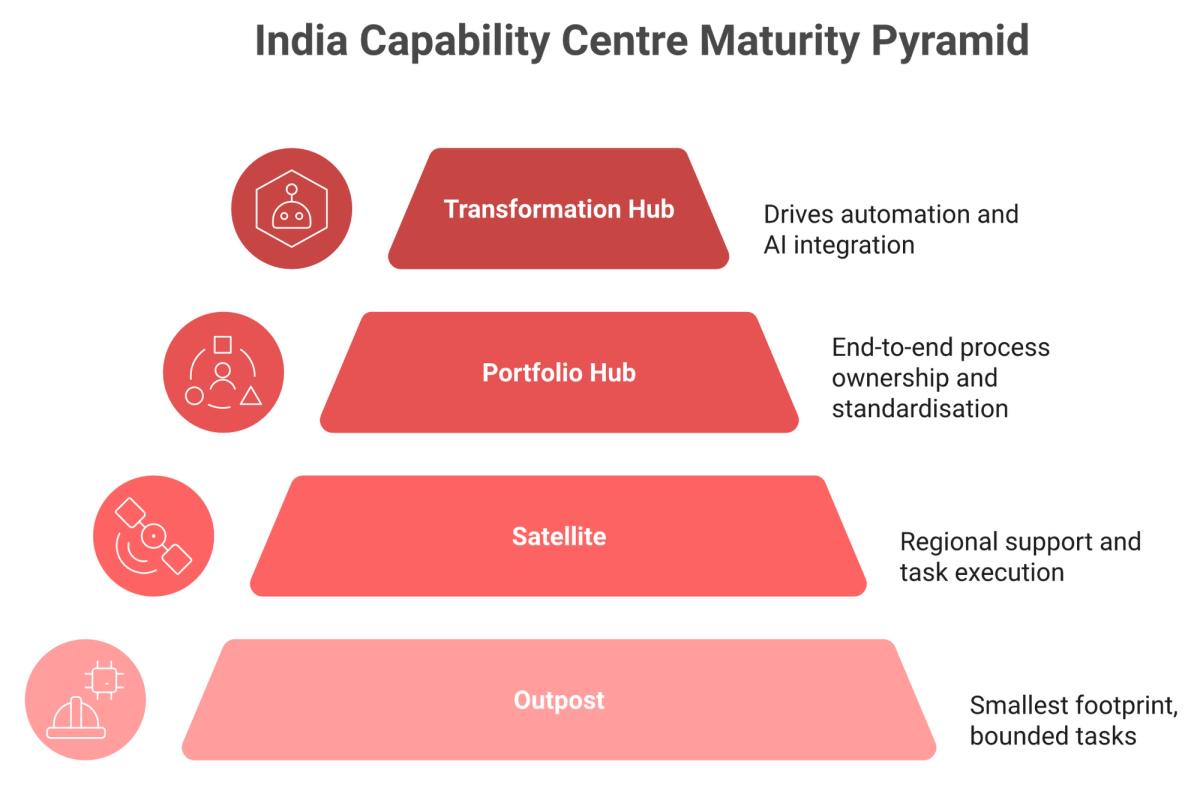
Start from maturity, not headcount. In the FY2026 India dataset, 13% of GCCs are Outposts, 43% Satellites, 39% Portfolio Hubs, and 5% Transformation Hubs. Each tier needs a different structure. Below roughly 30 employees, an employer of record led delivery centre wins, because people go live in days with no setup capital. Between 30 and 50, a build-operate-transfer deal with a written transfer window hedges both ways. Above 50, or where you need special economic zone benefits, direct IP title, or the 22% corporate rate under Section 115BAA, incorporate a private limited company.
🧭 The pain: models chosen for board optics
Most model decisions I see are made backwards. Someone wants the slide to say "wholly owned subsidiary" because it sounds committed. The entity gets incorporated, the India head has not been hired, and the office sits at 12% occupancy for two quarters.
Incorporation through the MCA's SPICe+ incorporation service clears in roughly two to four weeks. Banking, GST registration, and capitalisation take three to six months. Those are different clocks, and plans built on the first one slip. Our EOR vs entity calculator models both clocks side by side.
📋 Five models, side by side
| Model | Headcount fit | Time to first hire | Year one cost | Who owns IP | Fails if |
| EOR led delivery centre | 1 to 30 | 5 business days | Monthly fee per employee, no capital | Parent, via assignment in the EOR contract | You need SEZ benefits or a local balance sheet |
| Build operate transfer | 30 to 50 | 4 to 8 weeks | Build fee plus monthly run cost | Provider until transfer, then parent | The transfer trigger is vague or nominee held |
| Wholly owned subsidiary | 50 plus | 3 to 6 months | $500K to $3M | Parent, directly | The mandate is still unproven |
| GIFT City in-house centre | Regulated finance and tech | 3 to 6 months | Entity cost plus IFSCA process | Parent, directly | Your work is not IFSC eligible |
| Full captive with real estate | 100 plus | 12 to 18 months | $500K to $3M and up | Parent, directly | Attrition outruns your hiring plan |
GIFT City units operate under the IFSCA Global In-house Centre Regulations, 2020, which is the route finance and technology GICs use for a long tax holiday. If you are weighing the captive route against a lighter start, our breakdown of EOR vs GCC in India sets out the same trade-off in detail.
⚠️ The PEO correction nobody makes
American buyers ask for "PEO India" constantly. United States style co-employment, where two employers share statutory liability for one worker, has no basis in Indian labour law. Any vendor selling you PEO in India is selling employer of record and using the wrong word, which is why we wrote up what PEO services in India actually mean in practice.
That matters because co-employment language in a contract creates ambiguity about who files the provident fund return. There is only ever one legal employer in India, and the four Labour Codes that took effect on 21 November 2025 make that employer's obligations more explicit, not less.
"The initial documentation and paperwork felt quite detailed and time-consuming at the beginning. However, as we progressed, it became clear that this thoroughness is what ensures proper legal and compliance coverage."
— Verified User in Marketing and Advertising, Wisemonk - G2 Verified Review (3.5 stars)
"It took three months to onboard our first 3 individuals. They didn't seem to be able to navigate Visas or variations to employment contracts and this constantly created issues so we had to make a decision to change providers."
— Verified User in Information Technology and Services, Deel - G2 Verified Review (0 stars)
"The initial process took a little getting used to, but the team was quick to guide us through and it became very straightforward."
— Verified User in Venture Capital & Private Equity, Versatile Club G2 - Verified Review (4.5 stars)
🌉 The suspension bridge and the Golden Gate
Versatile Club runs the hybrid pathway with no setup fee, no exit fee, and the first month free, so the employer of record stage stays reversible rather than becoming a soft lock-in. Our onboarding service level is contractual at five business days, and we invoice in United States dollars from our own Indian entity. A suspension bridge gets you across this quarter. A Golden Gate is worth building once you know the traffic is real.
Q3. What does a GCC in India actually cost in year one?
Budget $750 to $1,500 in government and filing costs for incorporation through SPICe+, $5,000 to $15,000 for basic entity formation, and $15,000 to $100,000 or more once cross-border structuring and transfer pricing documentation enter. A 50 to 100 person captive runs $500,000 to $3 million in year one, which works out near $25,000 to $80,000 per engineer annually, roughly 40% to 60% below a comparable United States build. A senior engineer costs about $58,000 all in in Bengaluru against about $220,000 in San Francisco, a difference of $162,000 for one role.
💰 The pain: decks that model salary only
Almost every India business case I review models salary and rent, then stops. The statutory layer is where the surprise lives. Provident fund is 12% from the employer on basic plus dearness allowance, per the Employees' Provident Fund Organisation. Employee state insurance is 3.25% employer and 0.75% employee, per the Employees' State Insurance Corporation. Gratuity accrues at 4.81% of basic plus dearness allowance every month.
Those three lines add double digits to a number that looked settled. In six years of invoices, the items that surprise United States CFOs are gratuity accrual and professional tax. Never salary. We keep a running view of the full cost of hiring in India for exactly this reason.
📊 Two routes, same 10 engineers
| Cost block | Own entity route | EOR route |
| Setup and filing | $750 to $1,500 government, plus $5,000 to $15,000 legal | Nil |
| Structuring and transfer pricing | $15,000 to $100,000 plus | Not applicable at this stage |
| Time to first payroll | 3 to 6 months | 5 business days |
| Per head monthly platform cost | Nil, but secretarial and audit costs recur | Versatile Club: flat $149 per employee per month; Deel lists $599 and Remote lists $599; G-P lists 15% of salary; Multiplier lists $400 |
| Statutory load | PF 12%, ESI 3.25%, gratuity 4.81%, state professional tax | Same statutory load, filed by the provider |
| Exit cost | Strike off, final audit, employee settlements | Versatile Club: none |
Treat the per head figures as list prices, not quotes. Platform pricing moves, and India sits inside a global price card for the generalists. Our own pricing page and this comparison of employer of record cost in India show what changes once the India-only view is applied.
🔍 The live invoice audit
Ask every shortlisted provider for one live, redacted invoice before you sign. Read it for five line items: setup fee, security deposit, foreign exchange markup, exit fee, and benefits markup. Buyers report currency conversion spreads in the 3% to 5% range on dollar invoices, which is a real cost that never appears on a pricing page.
That single request has killed more bad procurement decisions for my clients than any reference call. A provider who cannot produce an invoice is telling you something.
"I dislike how expensive Deel's transaction fees are, especially when moving money from the Deel account to my bank or wherever else it needs to go."
— Maria M., Deel - G2 Verified Review (3 stars)
"I find Deel to be absurdly expensive. They charge a high amount of fees for transferring money to my bank account. Additionally, using their card incurs fees for purchases in another currency."
— Juan Camilo O., Deel - G2 Verified Review (1 star)
"First USD invoice landed clean: no FX markup, no setup fee, no surprises."
— Verified User in Information Technology and Services, Versatile Club G2 - Verified Review (5 stars)
✅ What the invoice looks like from our side
Versatile Club invoices in United States dollars from a single Indian entity, with no currency markup, no setup fee, no security deposit, and no exit fee. The figure on the proposal is the figure on the invoice. Our monthly client pack shows the statutory breakdown behind each employee, which is what a controller needs at month end close. If you want to see the mechanics, our how it works page walks through a live cycle.
Q4. Bengaluru, Hyderabad, Pune or Tier-2: how should you choose the city?
Choose Bengaluru when the mandate needs rare specialisation or a credible India head. The city holds 27% to 34% of all Indian GCCs, more than 875 units, and about 37% of GCC talent, and it sets the salary baseline. Hyderabad typically runs 10% to 15% below that baseline, Pune 15% to 20% below, and Tier-2 cities 25% to 30% below, with real estate and operating costs 20% to 40% cheaper. Tier-2 fails when the work needs frontier AI research or niche silicon skills that stay concentrated in Tier-1.
🗺️ The scorecard
| City tier | Talent depth | Cost vs Bengaluru | Attrition pressure | Incentives | Best fit mandate |
| Bengaluru | Deepest, 875 plus GCC units, 37% of talent | Baseline | Highest, heaviest counter-offer market | Karnataka GCC Policy 2024 | Platform engineering, AI research, first India head |
| Hyderabad | Strong platform, data, and R&D benches | 10% to 15% lower | Moderate | State IT policy support | Large engineering pods, 24x7 operations |
| Pune | Solid product, QA, and operations | 15% to 20% lower | Lower at mid level | Maharashtra IT policy | Mid-level ops, QA, finance operations |
| Delhi NCR | Analytics, consulting, enterprise functions | Comparable to Bengaluru | Moderate to high | NCR state schemes | Shared services, enterprise functions |
| Tier-2 (Coimbatore, Indore, Jaipur, Mysuru) | Narrow but loyal | 25% to 30% lower | Lowest | Beyond Bengaluru style schemes targeting 350,000 jobs by 2029 | Support, back office, stable process work |
Tier-2's share of India GCCs grew from about 5% in 2019 to above 7% by 2024, which is real growth from a small base. Do not read it as a mass migration. City choice also changes your payroll footprint, which is why we publish state-level guides for payroll outsourcing in Bengaluru and payroll outsourcing in Hyderabad.
⚠️ Where the Tier-2 case breaks
Tier-2 works when the role is well defined and the skill is widely available. It breaks on three things. Senior leadership rarely relocates. Specialist hiring takes two to three times longer. And your fifth hire often has nobody local to learn from.
India holds roughly 20% of the world's semiconductor chip designers, but that pool sits in a handful of Tier-1 pockets. If your mandate touches that pool, the cost saving is irrelevant, and the sharper question becomes how to hire AI and ML engineers in India at all.
📍 What placement data says that leasing reports do not
Versatile Club has placed engineers, designers, and operations professionals across Bengaluru, Hyderabad, and Pune through six years of contract-to-hire work, so our city view comes from offer-acceptance and retention outcomes rather than square footage absorbed. What surfaces in those placements is a clear pattern. Bengaluru candidates counter-offer hardest. Pune holds tenure longer at mid-level operations and quality assurance roles.
I could be reading that too strongly, since our sample skews toward teams of 5 to 30 people. Still, it has decided city for more clients than any cost index, and the India salary calculator usually settles the rest.
"WiseMonk is one of the primary reason I chose to stay with the company that I got offer from rather than jumping around for counter offers because of the friendly & informative approach."
— Verified User in Financial Services, Wisemonk - G2 Verified Review (4 stars)
"Finding the right design talent is never easy. For us, it was important to hire people who understood both craft and pace and Versatile made that process feel much simpler."
— Ibrahim A., Versatile Club G2 - Verified Review (4.5 stars)
"The team is really competent, but there were a few time zone misunderstandings that caused slight delays in the initial phase."
— Setu C., Versatile Club G2 - Verified Review (5 stars)
✅ The honest city answer
Versatile Club runs employer of record payroll across all 28 states and 8 union territories on its own registrations, which means the city decision stays a talent decision rather than a coverage decision. We will tell you when your role does not need Bengaluru. That conversation usually saves more than any incentive scheme, and you can start it on our contact page.
Q5. What is the exact filing sequence from incorporation to first payroll?
Incorporate a private limited company under the Companies Act, 2013, with at least one director resident in India, using the MCA's SPICe+ form to obtain the digital signature certificate, director identification number, PAN, TAN, and GST registration. File Form FC-GPR with the Reserve Bank of India within 30 days of allotting shares to the foreign parent, then file the annual Foreign Liabilities and Assets return. Register for employees' provident fund, employee state insurance, and Shops and Establishments in every state where you employ people. Constitute the internal committee required under the POSH Act, 2013. Then run first payroll with tax deducted at source deposited by the 7th.
🗂️ Central filings, in order
| Step | Filing | Deadline | Owner |
| 1 | SPICe+ incorporation, DSC, DIN | 2 to 4 weeks | Company secretary |
| 2 | PAN and TAN | Issued with incorporation | Company secretary |
| 3 | Bank account and foreign inward remittance | 2 to 6 weeks after PAN | Finance |
| 4 | Form FC-GPR with RBI | Within 30 days of share allotment | Finance plus authorised dealer bank |
| 5 | GST registration | Before first invoice | Finance |
| 6 | Annual FLA return | Every July, for the prior financial year | Finance |
The FC-GPR clock is the one people miss. It starts at share allotment, not at money landing. Miss it and your authorised dealer bank can hold up later remittances while you file a late submission request. If you would rather not start this clock at all yet, our note on how to hire in India without an entity covers the alternative.
🏛️ State filings, where the real work sits
| State | Professional tax | Shops and Establishments | Notes |
| Maharashtra | PTRC for employees plus PTEC for the entity, monthly slabs | Registration required | Two separate registrations, commonly treated as one |
| Karnataka | Monthly PT return | Registration with renewal inside 30 days | Highest volume state for GCC hiring |
| Telangana | PTRC enrolment | Registration required | Enrolment often missed for first hire |
| Tamil Nadu | Biannual PT filing, plus labour welfare fund | Registration required | Different rhythm from Karnataka |
| Delhi | No professional tax | Strict S and E compliance | Absence of PT confuses first-time filers |
| West Bengal | PT applies | Registration required | Rules change often, so review quarterly |
My scars here are state-level, never central. Central filings are documented and stable. West Bengal changes often enough that an annual review is not enough, so I check quarterly, which is the whole premise behind our payroll compliance in India guide.
⏰ The first payroll calendar
Three dates matter in month one. Tax deducted at source goes to the government by the 7th of the following month, per the Income Tax Department. Provident fund and employee state insurance challans follow their own monthly cycle, set by the EPFO and the ESIC. Form 16, the annual tax certificate for each employee, is due by 30 May after the financial year closes.
Auditors ask about provident fund, employee state insurance, and gratuity liabilities, and those questions arrive at the worst time. Build the calendar before hire one, not after the first notice. Teams that would rather not build it internally usually move this to managed payroll.
"Often the CS doesn't seem to have answers, which leads me to emails back and forth on my case which don't always answer the question and something I was looking for the answer to in 20 minutes becomes a 4 day process."
— Verified User in Computer Software, Deel - G2 Verified Review (3 stars)
"What I dislike about Wisemonk is that some features feel a bit limited and could use more flexibility. In particular, I'd like to see better options for customization and more detailed reporting."
— Vinay M., Wisemonk - G2 Verified Review (4 stars)
"Contracts, PF, ESI, TDS, and payroll all handled in one place. The compliance rigour is genuinely impressive every statutory filing reviewed before submission."
— Vedant T., Versatile Club G2 - Verified Review (5 stars)
✅ Coverage, state by state
Versatile Club files across all 28 states and 8 union territories on its own registrations. Deel's India footprint concentrates in roughly the top six states and Remote's in about four, because both run India through local partner entities. A hire outside that footprint becomes an exception rather than a process. We do not use partner shells in India, which is the core difference buyers compare on our Deel alternative and Remote alternative pages.
Q6. How do the 2025-26 Labour Codes change your cost per employee?
The four Labour Codes took effect on 21 November 2025, consolidating 29 central laws and resetting payroll maths, per the Ministry of Labour and Employment announcement. The specified exclusions are now capped at 50% of total remuneration, so basic plus dearness allowance must be at least half of pay. That re-bases provident fund at 12% of basic plus dearness allowance, gratuity accruing at 4.81%, and statutory bonus. Overtime allowance counts inside the 50% test. Appointment letters are mandatory for every employee, fixed-term employees earn gratuity at one year, employee state insurance applies to the ₹21,000 monthly wage ceiling, and IT and ITeS salaries must be released by the 7th.
⚖️ What actually changed in the definition
"Wages" now has one definition across the Codes. Allowances such as house rent, conveyance, and special allowance cannot exceed half of total pay. If they do, the excess is added back into wages for statutory purposes.
The Code on Wages (Central) Rules, 2026, notified as G.S.R. 343(E) on 8 May 2026, set the floor wage mechanism, an eight-hour day with a 48-hour week, and dearness allowance revision twice a year. The Ministry's own FAQs confirm the 50% test applies to gratuity from 21 November 2025.
💰 One offer, before and after
Take a ₹20,00,000 annual package for a mid-level engineer in Bengaluru. The old structure set basic at 30%, or ₹6,00,000, with the rest in allowances.
| Line | Old structure | Code compliant | Change |
| Basic plus DA | ₹6,00,000 | ₹10,00,000 | Plus ₹4,00,000 |
| Employer PF at 12% | ₹72,000 | ₹1,20,000 | Plus ₹48,000 |
| Gratuity accrual at 4.81% | ₹28,860 | ₹48,100 | Plus ₹19,240 |
| Added statutory cost | - | - | About ₹67,240 |
The package did not change. The employer's statutory load rose by roughly 3.4%. Treat this as a modelled example, since actual numbers depend on your provident fund wage ceiling policy and state professional tax slab, and run your own numbers through the India salary calculator.
⚠️ Where the surprise usually lands
Two groups get caught. Companies that kept basic artificially low to reduce provident fund now absorb the add-back. Companies hiring fixed-term contractors now owe gratuity at one year instead of five.
Neither is a disaster. Both are budget items that belong in the plan before offers go out. I have watched three clients re-issue offer letters mid-process because the first version was built on pre-Code arithmetic, and two of them used the moment to convert contractors to employees in India properly.
📝 The Monday action
Re-base your India salary template so basic plus dearness allowance clears 50% by design. Then re-run your cost per full-time employee at the new load. Issue appointment letters to everyone, including people hired before November 2025.
Versatile Club absorbed the Code transition inside its own registrations, so provident fund, employee state insurance, tax deducted at source, and professional tax filings sit under Foo Falcon Technologies Pvt Ltd. When the wage definition changed, our clients received a revised cost sheet rather than a compliance questionnaire to complete themselves. The clients who felt no disruption were already above the 50% line, which is the standard our compliance page documents.
Q7. How do you handle transfer pricing and permanent establishment risk?
Two tax exposures decide whether an India GCC actually saves money. Transfer pricing comes first. The CBDT's draft Income-tax Rules, 2026, merge software development, IT enabled services, knowledge process outsourcing, and software-linked contract research into one IT Services category at a 15.5% safe harbour margin on operating expenses, with the transaction threshold raised from ₹300 crore to ₹2,000 crore, a new 15% data centre safe harbour, and a five-year block election. Permanent establishment comes second. If the India team signs or negotiates customer contracts, parent profits become taxable in India. Keep the mandate internal, cost plus, and non-contracting.
🧾 Transfer pricing in plain English
Your India entity invoices the parent for work done. Indian tax law wants that invoice to look like an arm's length price, as if the two companies were strangers. Safe harbour is the government offering you a fixed margin so you can skip the argument.
Elect it and your India entity bills cost plus 15.5% on operating expenses. The election runs as a block, not year by year. You still file the transfer pricing report, and electing safe harbour closes the door on mutual agreement procedure relief if the other tax authority disagrees. Companies that never cross this threshold often stay on EOR services in India instead, where the question does not arise.
📆 The mechanics everyone skips
Most guides quote the 15.5% figure and stop. The usable detail is procedural. The election is made on a form, due by the filing date for the relevant year, and the block locks you in for five years.
The concessional 22% corporate rate under Section 115BAA sits alongside this, replacing the standard 30% for domestic companies that give up certain deductions. The Income-tax Act, 2025, also renumbered routine payroll forms, so the withholding statement your Indian accountant files now has a new number. Ask your chartered accountant which form applies this quarter, and weigh the whole structure against the EOR vs entity comparison for India.
⚠️ How permanent establishment actually gets triggered
Picture a concrete scene. Your Bengaluru solutions engineer joins a customer call to debug an integration. The customer asks for an extra module. She says yes, agrees a price, and emails confirmation.
That is contract negotiation. Repeat it a few times and the Indian tax authority can argue your parent company has a taxable presence in India. The fix is boring and effective. Write the mandate as internal delivery only, route all customer-facing commitments through the parent, and say so in the employment contracts.
🔍 Why the contractor shortcut makes this worse
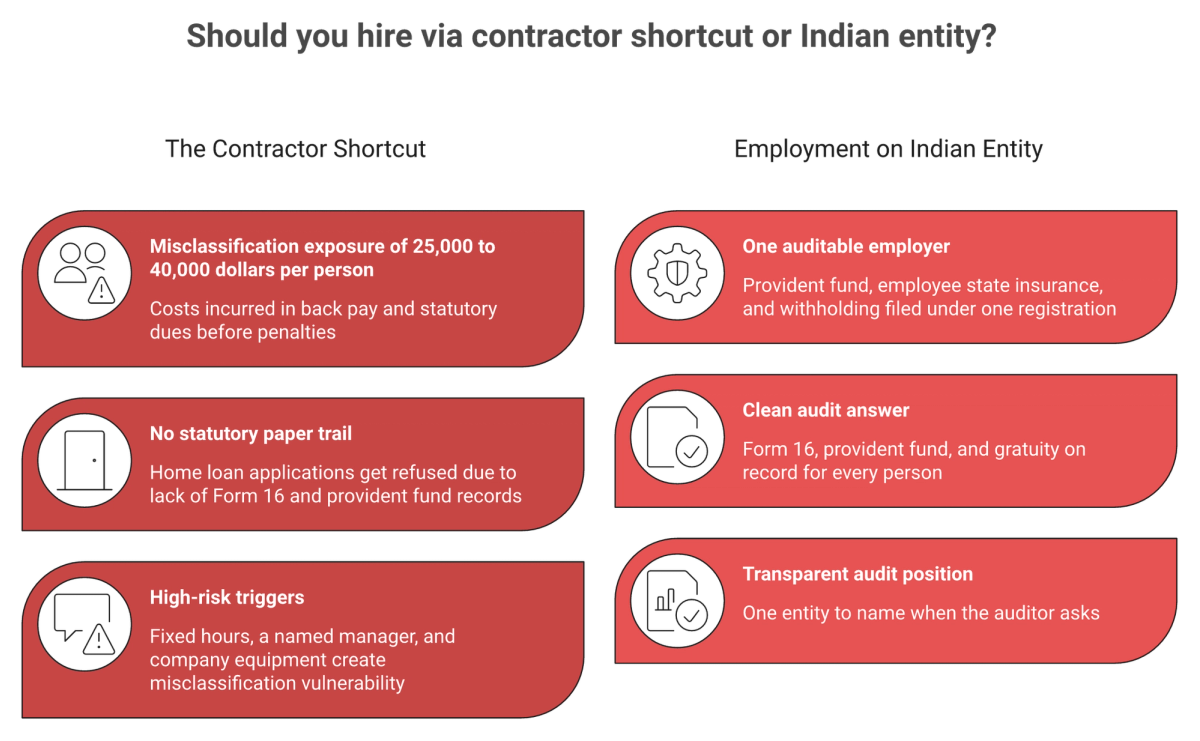
The common workaround is to skip the entity and pay people as independent contractors by wire. It looks clean for two quarters. Then the role looks exactly like employment, with fixed hours, a manager, and company equipment.
Misclassification exposure in that situation commonly runs $25,000 to $40,000 per person in back pay and statutory dues, before penalties. The human cost is quieter. A contractor with no Form 16 and no provident fund record often cannot get a home loan approved in India, which is the trade-off we lay out in independent contractor vs EOR.
✅ What proper employment changes
Versatile Club does not offer contractor payroll as a shortcut for permanent roles, because that is where the back pay exposure and the mortgage rejection both come from. Every Versatile Club hire is a full employee of our Indian entity, with Form 16, provident fund, and gratuity on record. Versatile Club's read is that the standard "start them as contractors" advice gets this backwards, since the cheap option carries the expensive tail.
Q8. When do your DPDP obligations actually begin?
You have a dated runway, not an immediate obligation. MeitY notified the Digital Personal Data Protection Rules, 2025, by Gazette Notification G.S.R. 846(E) on 13 November 2025, with a corrigendum on 16 December 2025. Rules 1, 2, and 17 to 21 are already live. Rule 4, covering Consent Managers, starts 14 November 2026. The substantive Rules 3, 5 to 16, 22, and 23 take effect on 14 May 2027. From that date you owe a 72-hour breach report to the Data Protection Board, a 90-day response to data principal requests, and localisation of certain traffic data if you are notified as a Significant Data Fiduciary. Penalties reach ₹250 crore.
🔐 What a GCC is actually processing
A capability centre is a personal data machine before it is anything else. Day one brings employee records, PAN and Aadhaar numbers, bank details, and salary history. Within a quarter, it usually brings parent-company customer data, because that is what the engineers are building against.
Under the Act, the entity deciding how that data is used is the data fiduciary. The one processing it on instructions is the data processor. Those two words decide who answers the Board when something goes wrong.
📆 The milestone table
| Date | What applies | What you should have built |
| 13 November 2025 | Rules 1, 2, and 17 to 21 live | Board constitution and procedural rules noted, nothing to build yet |
| 14 November 2026 | Rule 4, Consent Managers | Decide whether a Consent Manager sits in your consent flow |
| 14 May 2027 | Rules 3, 5 to 16, 22, and 23 | Notices, consent records, security safeguards, breach runbook, grievance channel |
The sequence is the useful part. You are not behind today. You are behind if 14 May 2027 arrives and nobody has mapped the data.
🗺️ Three artefacts worth building now
Start with a data map of every flow between the parent and the India entity. Name the system, the data type, the purpose, and the person responsible. Keep it in a spreadsheet, not a consulting deck.
Then draft the breach runbook against the 72-hour clock, with named people and phone numbers. Then write the 90-day response process for access and erasure requests. Human resources data is almost always the first flow a GCC has to map, and it is the easiest one to get right, especially if you already outsource payroll in India.
⚠️ Where I am less certain
Significant Data Fiduciary designation is the open question. The Rules allow the government to notify specific fiduciaries, with heavier obligations including traffic data localisation. Whether mid-sized GCCs get caught in that net is not yet settled.
My read is that most 10 to 50 person centres will not be designated, though I would not build a data architecture that assumes it. Design for portability and you stay cheap either way, and keep your exit path clear in case you need to switch EOR provider in India.
✅ One entity, one fiduciary
Versatile Club holds India employee data inside its own Indian entity rather than passing it through a chain of partner processors, which keeps the data map short enough to actually document. When clients ask who the fiduciary is for payroll data, there is one answer and one entity to name. If you want that walked through against your own data flows, talk to us directly.
Q9. In a BOT or managed setup, who actually holds the shares and the IP?
Ask whose name sits on the share register before signing a build-operate-transfer or managed GCC agreement. If a provider incorporates the entity using nominee shareholders, meaning people who hold shares on your behalf, your transfer right is contractual rather than proprietary. Transfer windows in these deals commonly run 18 to 36 months. The Companies Act, 2013, requires at least one director who stays in India for 182 days or more in a financial year, which is how nominee arrangements usually get justified. Separately, the Copyright Act, 1957, vests copyright in the person who created the work unless there is an express written assignment.
🔍 The common view, and why it fails
Buyers diligence two things: the monthly price and the service level. I have read dozens of India setup agreements, and almost nobody asks about the cap table.
That gap matters because price is reversible and ownership is not. A provider can discount your fee next quarter. A provider cannot easily hand over an entity whose shares sit with their founders and whose bank mandate carries their signature. The same test applies when you compare India expansion options side by side.
📄 The three clauses worth reading twice
- Shareholding and transfer trigger. Who is on the register today? What event forces transfer? Is there a price formula, or is it "to be mutually agreed," which means renegotiation at your weakest moment?
- IP assignment chain. Does every employment contract and every contractor agreement carry a written assignment to your parent? The master services agreement alone does not fix a missing clause in an engineer's offer letter.
- Exit and data handover. Who gives you the payroll history, the provident fund member IDs, and the employee files? In what format, and inside how many days?
The IP chain is the one that bites quietly. Under Indian law, an engineer who wrote your inference pipeline holds the copyright by default unless assignment language exists in her own contract. If you are weighing a captive build against a lighter structure, our note on how to set up a captive center in India covers the ownership sequence in detail.
"Contract Status says active, but there were other hidden 'status' labels somewhere which says 'Awaiting Approval'. Both parties could not figure out. Each time you log in to Deel, you have to talk to Support to understand what's wrong and what should be the next step and who should follow it. My onboarding took 28 days."
— İbrahim, Deel - G2 Verified Review (1 star, 1 November 2024)
"My contract had the wrong start date and other errors."
— Verified User in Non-Profit Organization Management, Pebl, formerly Velocity Global - G2 Verified Review (30 April 2026)
"Every option I looked at first was either 'set up your own entity' (no thanks, not for one hire) or some platform that quotes you a great price and then you find out about all the add-ons later."
— Angad S., Versatile Club G2 - Verified Review (5 stars, 21 June 2026)
⚠️ The one question that settles it
Name the legal entity on the employment contract. That is the whole diligence test in a sentence.
If the answer is a partner's name, you have a layer of statutory exposure you cannot audit. You cannot pull their provident fund challans, you cannot see their labour inspections, and you inherit their filing habits. Versatile Club's read is that the standard advice gets this backwards, because buyers negotiate price for weeks and accept the entity structure in a single sentence. Buyers who care about this usually end up on our Wisemonk alternative and Globalization Partners alternatives in India comparisons.
✅ No nominee layer, no exit fee
Versatile Club is the employer of record on its own Indian entity, Foo Falcon Technologies Pvt Ltd, and is not a reseller or aggregator. There is no nominee layer, and no partner whose cooperation you need at exit. There is also no exit fee. If you incorporate later and move employees to your own subsidiary, the handover is a process rather than a renegotiation, and our EOR services are built to be handed back that way.
Q10. Why should you hire the India head before a single engineer?
Hire the India leader first, because governance, signing authority, and cultural translation cannot be retrofitted onto a team that already exists. Centres that start leaderless stall in the first phase, which is regional support and task execution. They rarely reach the third phase, where the centre drives standardisation, automation, and AI integration for the parent. Only 5% of India GCCs have reached Transformation Hub maturity in the FY2026 dataset, per the Zinnov and Nasscom India GCC Landscape Report 2026. The leader also owns the line between internal capability work and customer-facing contracting, which is your main control against permanent establishment exposure.
🧠 What everyone does instead
The popular move is cheaper and feels faster. Hire three or four engineers, let a US engineering manager run them over Zoom, and add a leader "once there is something to lead."
I understand the logic. The problem is that the first five people set the centre's norms permanently. Who speaks in reviews, whether bad news travels upward, how estimates get given. By the time a leader arrives, she is not setting culture. She is renegotiating it. That is why we front-load fit on every recruitment mandate rather than back-load it.
📈 The three phase arc, and where leaderless centres get stuck
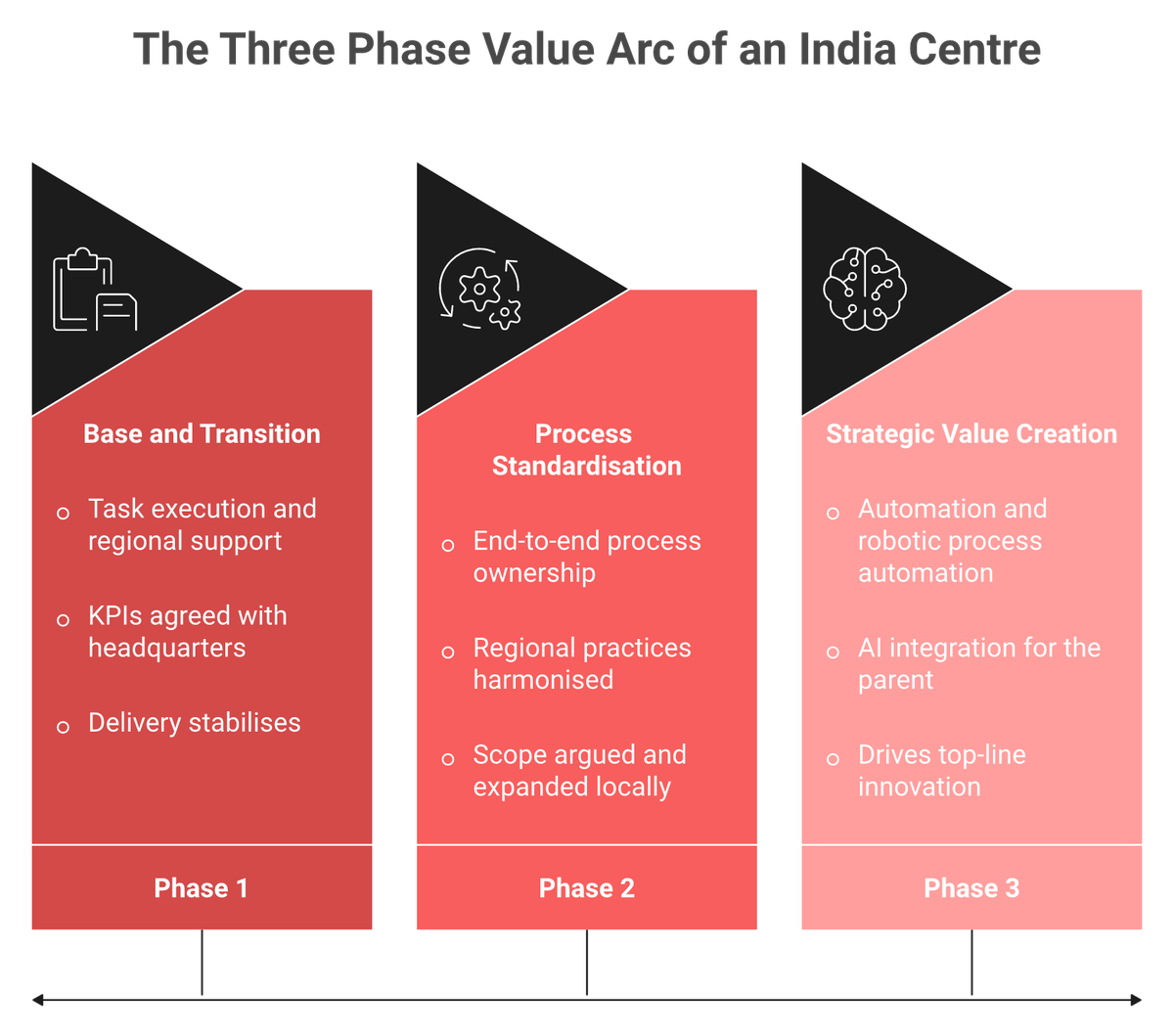
GCC leaders describe a consistent evolution. One Bengaluru shared services centre started as regional support, moved to end-to-end process standardisation, then moved again into automation and AI integration for the parent company.
That movement does not happen by itself. Each jump needs someone local who can argue with headquarters about scope. The FY2026 maturity split shows 13% Outposts, 43% Satellites, 39% Portfolio Hubs, and 5% Transformation Hubs, which tells you how few centres make the final jump. Teams making that jump on engineering depth usually need help to hire AI and ML engineers in India.
💰 How to de-risk a leadership hire
Do not hire a first India leader off three video calls. Use a paid mini-project instead, one or two weeks of real work on a real problem, compensated properly.
Practitioners who run this well pay around $1,500 for that scope, and the principle matters more than the number. Nobody works for free. You learn more from two weeks of actual output than from any reference call, which is the same logic behind contract-to-hire as a structure.
"Everything from scheduling the interviews to the final onboarding was handled smoothly and professionally. I've noticed that their support/query responses can occasionally take a bit longer sometimes, likely due to a relatively small team."
— Verified User in Financial Services, Wisemonk - G2 Verified Review (4 stars, 14 June 2025)
"I appreciated how personal the process felt, and the team took the time to understand me and my background. Communication was always clear, and I never felt left in the dark."
— Verified User, Versatile Club G2 - Verified Review (5 stars, 24 June 2026)
"Their team was highly responsive, professional, and easy to work with throughout the process. The best part was their ability to simplify hiring in India."
— Mukul S., Versatile Club G2 - Verified Review (5 stars, 16 June 2026)
⭐ Where my conviction sits
Compliance is the floor, not the ceiling. Getting provident fund right keeps you legal. It does not make the centre worth owning.
Versatile Club screens leadership and senior candidates against 50 behavioural parameters before any skills round, assigns a 90-day Success Coach after joining, and backs placements with a 6-month replacement guarantee. On a first India leader, the hire that compounds hardest, that guarantee separates a bad quarter from a lost year. You can see how we score fit through the culture fit quiz.
Q11. What does the first 90 days of a working India GCC look like?
Define the mandate and the key metrics, then choose the city and the operating model. Put the first two hires live on an employer of record so delivery starts while incorporation runs. Incorporate through SPICe+ and obtain the digital signature certificate, director identification number, PAN, TAN, and GST registration. File Form FC-GPR with the Reserve Bank of India within 30 days of share allotment. Register provident fund, employee state insurance, and Shops and Establishments in every state of employment. Hire the India head, then the first senior-weighted pod. Activate governance, service levels, and transfer pricing documentation before week one of delivery.
📅 The 90 day table
| Fortnight | Action | Artefact | Owner |
| 1 and 2 | Write the mandate as internal, cost plus, non-contracting | One page charter with metrics | Sponsor at HQ |
| 1 and 2 | First two hires live on employer of record | Signed employment contracts on the provider's entity | People Ops |
| 3 and 4 | SPICe+ incorporation filed | Certificate of incorporation, PAN, TAN | Company secretary |
| 5 and 6 | Bank account, inward remittance, FC-GPR inside 30 days of allotment | FC-GPR acknowledgement | Finance |
| 7 and 8 | PF, ESI, and state Shops and Establishments registrations | Registration numbers per state | People Ops |
| 9 and 10 | India head onboarded | Governance calendar, delegation of authority | Sponsor plus India head |
| 11 and 12 | Transfer pricing documentation and safe harbour decision modelled | Memo from your chartered accountant | Finance |
Run the employer of record track and the incorporation track in parallel. Serial execution is what turns 90 days into nine months. Our EOR vs entity calculator models both tracks against the same headcount plan.
🗣️ Two habits that prevent silent delay
Stop asking closed questions in status calls. "Are we on schedule?" invites a polite yes. Ask "Where are we on the schedule?" or "Show me what is left," and you get the truth.
Then write it down. After every headquarters to India call, send a short email repeating the decisions and the owners. High-context conversations feel complete and leave no record, which is exactly how registration deadlines slip. Founders making their first India hire can see the full sequence in our guide to hiring employees in India.
⏰ What usually breaks in week six
Banking. Incorporation finishes on time, and the account opening sits with document requests for three weeks. That delays the inward remittance, which delays share allotment, which compresses your FC-GPR window.
Plan for it. Start bank onboarding the week your certificate of incorporation arrives, not after the money is ready to move. Once payroll starts, the mechanics are set out in how to pay employees in India.
"Sometimes the email communication from the wisemonk team is delayed by a day or 2. But overall they seem to be the best for India."
— Bulbul G., Wisemonk - G2 Verified Review (4 stars, 19 February 2025)
"I was redirected multiple times, asked to repeat the same information to different representatives, and spent a considerable amount of time in meetings without reaching a clear resolution."
— Güneş A., Deel - G2 Verified Review (1.5 stars, 2 October 2025)
"Founder is just a call away. Extremely helpful in resolving all our queries. The process is super smooth to setup India EOR."
— surbhi m., Versatile Club G2 - Verified Review (5 stars, 15 June 2026)
✅ Where to start on Monday
Versatile Club's onboarding service level is contractual at five business days from signed offer, with provident fund, employee state insurance, professional tax, and tax deducted at source by the 7th all filed on our own registrations. If you want to pressure-test your first 90 days, message me on WhatsApp. You reach the founder, not a queue, and you can also book a 30 minute call or read how the model works on our startups page.
FAQs
How do you set up a GCC in India step by step?
The sequence matters more than the speed. Running the tracks in parallel is what keeps a 90 day plan from becoming a nine month plan.
- Write the mandate as internal, cost plus, and non-contracting, with metrics attached.
- Choose the city and the operating model before anyone is hired.
- Put the first two hires live on an employer of record so delivery begins while incorporation runs.
- Incorporate through SPICe+ and obtain the digital signature certificate, director identification number, PAN, TAN, and GST registration.
- File Form FC-GPR with the Reserve Bank of India within 30 days of share allotment, then the annual FLA return each July.
- Register provident fund, employee state insurance, and Shops and Establishments in every state where you employ people.
- Hire the India head, then the first senior-weighted pod.
- Activate governance, service levels, and transfer pricing documentation before week one of delivery.
Two things break most often. Bank account opening stalls for three weeks and compresses the FC-GPR window, and state professional tax enrolment gets missed for the first hire. If the mandate is still unproven, it is usually cheaper to hire in India without an entity first and incorporate once the headcount plan holds.
How much does it cost to set up a GCC in India in year one?
Budget in three layers, because the layer most business cases miss is statutory, not salary.
- Setup: $750 to $1,500 in government and filing costs through SPICe+, plus $5,000 to $15,000 for basic entity formation.
- Structuring: $15,000 to $100,000 or more once cross-border structuring and transfer pricing documentation enter.
- Run rate: $500,000 to $3 million in year one for a 50 to 100 person captive, which works out near $25,000 to $80,000 per engineer annually.
For a single role, a senior engineer costs about $58,000 all in in Bengaluru against roughly $220,000 in San Francisco, a difference of $162,000.
The statutory load is where decks go wrong. Provident fund is 12% employer on basic plus dearness allowance, employee state insurance is 3.25% employer and 0.75% employee, and gratuity accrues at 4.81% of basic plus dearness allowance every month. In six years of invoices, the items that surprise United States CFOs are gratuity accrual and professional tax, never salary.
Versatile Club invoices in United States dollars from a single Indian entity with no currency markup, no setup fee, and no exit fee. Model the full picture against the cost of hiring in India before the board sees a number.
What is the difference between a GCC, outsourcing, BOT, and an EOR in India?
All four put people in India. They differ on who employs them and who owns the output.
- GCC or captive: the parent owns the entity, the employment, and the intellectual property. Highest control, highest upfront cost.
- Outsourcing: a vendor owns delivery under a service level agreement. Lower upfront cost, with shared or contract-based IP.
- Build-operate-transfer: a provider builds and runs the centre for 12 to 24 months, then transfers it. Transfer windows commonly run 18 to 36 months, so read the trigger clause carefully.
- Employer of record: the provider is the legal employer on its own Indian entity, while you direct the work day to day. No entity needed, and it is reversible.
One correction worth making early: United States style co-employment PEO has no basis in Indian labour law. Any vendor selling PEO in India is selling employer of record with the wrong word, which matters because co-employment language creates ambiguity about who files the provident fund return.
Versatile Club is the employer of record on its own registered Indian entity rather than a partner shell, so the employment contract names one auditable company. The trade-off between structures is set out in full in our breakdown of EOR vs GCC in India.
Which Indian city is best for a GCC: Bengaluru, Hyderabad, Pune, or a Tier-2 city?
Pick the city from the mandate, not from the cost index.
- Bengaluru: holds 27% to 34% of all Indian GCCs, more than 875 units, and about 37% of GCC talent. It sets the salary baseline and carries the heaviest counter-offer pressure. Choose it for rare specialisation or a first India head.
- Hyderabad: roughly 10% to 15% below the Bengaluru baseline, with strong platform, data, and R&D benches.
- Pune: roughly 15% to 20% lower, with better tenure at mid-level operations and quality assurance.
- Tier-2 cities: 25% to 30% lower, with real estate and operating costs 20% to 40% cheaper, lower attrition, and state incentives such as Karnataka's Beyond Bengaluru programme targeting 350,000 jobs by 2029.
Tier-2 breaks on three things. Senior leadership rarely relocates, specialist hiring takes two to three times longer, and your fifth hire often has nobody local to learn from. India holds roughly 20% of the world's semiconductor chip designers, but that pool sits in a handful of Tier-1 pockets.
Versatile Club has placed engineers, designers, and operations professionals across Bengaluru, Hyderabad, and Pune, so our city view comes from offer-acceptance and retention data. City choice also changes your payroll footprint, which is why we publish a dedicated guide to payroll outsourcing in Bengaluru.
What compliance and tax risks should a CFO plan for when setting up an India GCC?
Four dated obligations drive most of the exposure, and each has a specific action behind it.
- Labour Codes: effective 21 November 2025, excluded allowances are capped at 50% of total remuneration. On an unchanged 20 lakh package, that adds roughly 3.4% in statutory cost once provident fund and gratuity re-base.
- Transfer pricing: the draft Income-tax Rules 2026 merge software development, ITeS, KPO, and software-linked contract research into one IT Services category at a 15.5% safe harbour margin, with the threshold raised from 300 crore to 2,000 crore and a five-year block election.
- Permanent establishment: if the India team negotiates or signs customer contracts, parent profits become taxable in India. Keep the mandate internal, cost plus, and non-contracting in writing.
- DPDP: substantive Rules take effect on 14 May 2027, bringing a 72 hour breach report and a 90 day response window for data principal requests.
Then there is the state layer, where most failures actually happen: Maharashtra needs dual PTRC and PTEC, Karnataka runs monthly professional tax, and Tamil Nadu files biannually. Versatile Club files across all 28 states and 8 union territories on its own registrations, which is the detail behind our approach to payroll compliance in India.