Table of contents (11)
- Q1. What counts as intellectual property in freelance work, and why does ownership matter?
- Q2. Why do standard freelance platform contracts fall short for India-based work?
- Q3. What does a rock-solid IP assignment clause look like for Indian contractors?
- Q4. How does multi-contractor team complexity increase IP ownership risk?
- Q5. What's the India-specific legal reality for contractor IP ownership?
- Q6. How do you vet a freelancer's IP history and integrity before hiring?
- Q7. What's the role of NDAs and confidentiality agreements for sensitive projects?
- Q8. How do you monitor and enforce IP rights after project completion?
- Q9. What are the true, end-to-end costs of an IP dispute with India-based contractors?
- Q10. How does converting to EOR employment eliminate IP risk for India teams?
- FAQs
How to Protect Your Intellectual Property When Outsourcing Freelance Work
Q1. What counts as intellectual property in freelance work, and why does ownership matter?
Intellectual property in freelance contexts includes any creative, technical, or strategic asset your freelancer produces under your direction. This spans source code, design files, brand assets, written content, databases, algorithms, business process documentation, customer databases, API specifications, and even unpublished research or strategies. The key legal question is not what you think you own, but what the contract and applicable law say about who owns it at day one.
🎯 Why IP clarity matters at hire time
You are working with independent contractors who have no default ownership transfer to you under most jurisdictions. In the US, the "work made for hire" doctrine assigns ownership to the hiring party automatically for certain categories of work. India has no such doctrine. Every transfer must be explicit in writing, signed before work begins. Silence means the contractor retains all rights and can use, resell, or license your work to competitors.
This is not a technicality. When a Bangalore-based freelance developer retains rights to a mobile app you paid $5K for, they can legally fork it, resell it to your competitor for $3K, or publish the source code on GitHub. Your recourse in Indian court takes 18 months and costs $8K-$20K in legal fees plus court costs.
Consider this real scenario: A founder hired a React developer from India via Upwork to build a custom admin panel. The contract said "you own IP," but six months after delivery, the founder discovered the developer had uploaded the exact code to his GitHub portfolio with zero attribution. When the founder asked for removal, the developer (a contractor, not an employee) claimed the portfolio use was for "reference only" and that the code was partially their pre-existing framework. Without a signed IP assignment, the founder had zero leverage in Indian courts to force removal. The founder's options were to pay $2K-$5K for a cease-and-desist letter (which worked 50% of the time) or file suit for $15K-$30K in legal fees with an 18-24 month timeline.
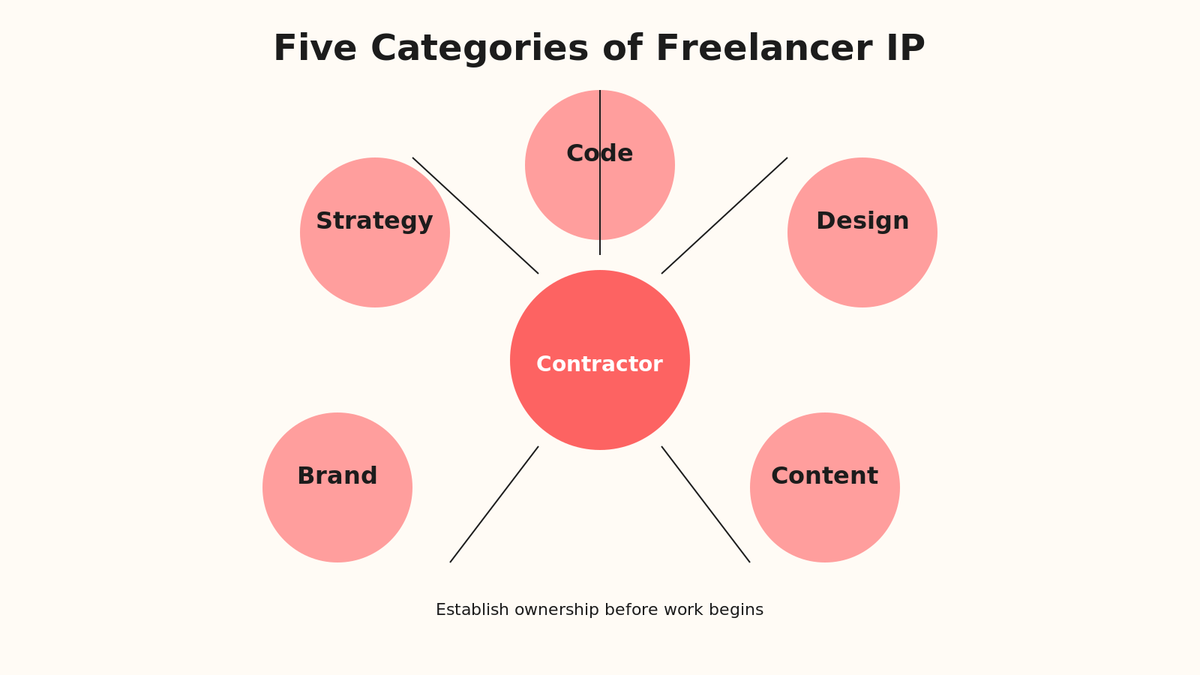
The real insight: IP protection is not an afterthought clause. It is the spine of your contractor agreement. If you do not establish ownership before the first deliverable, you have a legal dispute waiting to happen. This is why every founder scaling a remote India-native team should anchor IP clauses in Indian law, not platform terms.
✅ Where Versatile fits
When you scale hiring on Versatile's India-native EOR platform, every contractor agreement includes IP assignment language anchored in Indian Copyright Act Section 17. We handle the legal complexity so you don't have to re-negotiate ownership with every hire. Your IP belongs to you, full stop, from day one.
Q2. Why do standard freelance platform contracts fall short for India-based work?
Upwork, Fiverr, Toptal, and similar marketplaces embed IP ownership clauses into their standard terms. On the surface, they look protective: "Client owns all IP created." But these platform contracts have three critical gaps when your freelancer operates from India or any foreign jurisdiction.
🔗 The enforcement gap
Upwork's standard terms are governed by US law and arbitration rules (Upwork Terms of Service, Section 11). If a dispute arises and your freelancer is registered in India, Indian courts will not automatically enforce a US-governed contract without separate Indian civil proceedings. You would need to file a case in the District Court of your freelancer's state, prove the platform contract, argue equivalence under Indian Copyright Act, and wait 2-3 years for judgment. Cost: $8K-$25K. Timeline: 18-36 months. Success rate: 60-70% (depending on judge, jurisdiction, and evidence quality).
"We hired a developer on Upwork for $8K to build a custom API. After delivery, we discovered he had uploaded our code to his GitHub portfolio. Upwork's dispute resolution took 60 days and resulted in portfolio removal, but we had no recourse against re-use. The contract said we owned IP, but enforcement in India was impossible without a local lawyer."
— CTO, B2B SaaS startup, Upwork Alternatives - G2 Verified Review
Even worse: if your freelancer deletes the infringing content and claims it was accidental, Upwork closes the dispute as "resolved," leaving you with no recovery and no legal precedent.
⚠️ The scope gap
Platform contracts cover work-product files: code, designs, deliverables. They typically do not cover pre-existing freelancer code (libraries, frameworks, templates) embedded in your project. If your freelancer ships a custom app built on their own React boilerplate (which they reuse for 50 other clients), that boilerplate is not owned by you. You inherit the risk that your competitor could hire the same freelancer and receive near-identical architecture. Your legal standing to prevent this is zero.
This is called "component reuse risk" in the industry. A malicious or careless freelancer can embed their own code library into your product, claim it as "pre-existing," and then reuse the same code for your competitor. You own the integration but not the underlying code, leaving you vulnerable to both legal liability and competitive degradation.
🚧 The compliance gap
Platform contracts do not address India-specific labour law. If you later decide to convert a freelancer to part-time employee status (which changes their tax and legal classification under Indian income tax law, PF Act, and ESI Act), the old IP assignment does not automatically carry over into an employment contract. You would need a new IP assignment from the now-employee, and if they refuse, you cannot force it retroactively without legal action.
This is why many founders building India teams keep two agreements: one with the platform, one with the freelancer directly. The double-contract creates friction, increases legal complexity, and multiplies your exposure if the two contracts conflict on jurisdiction, governing law, or payment terms.
"We hired a Toptal designer for 12 weeks on a project contract. When we wanted to extend his relationship and convert him to a part-time employee via EOR, his original Toptal contract had no IP assignment clause beyond 'client owns deliverables.' When he moved to EOR status, his new employment contract did include full IP assignment, but the old contract created ambiguity about early work. Cost to clarify: $1.5K in legal fees. Could have been avoided with a standalone IP assignment at day one."
— Product Manager, Fintech startup, Toptal Alternatives - G2 Verified Review
Q3. What does a rock-solid IP assignment clause look like for Indian contractors?
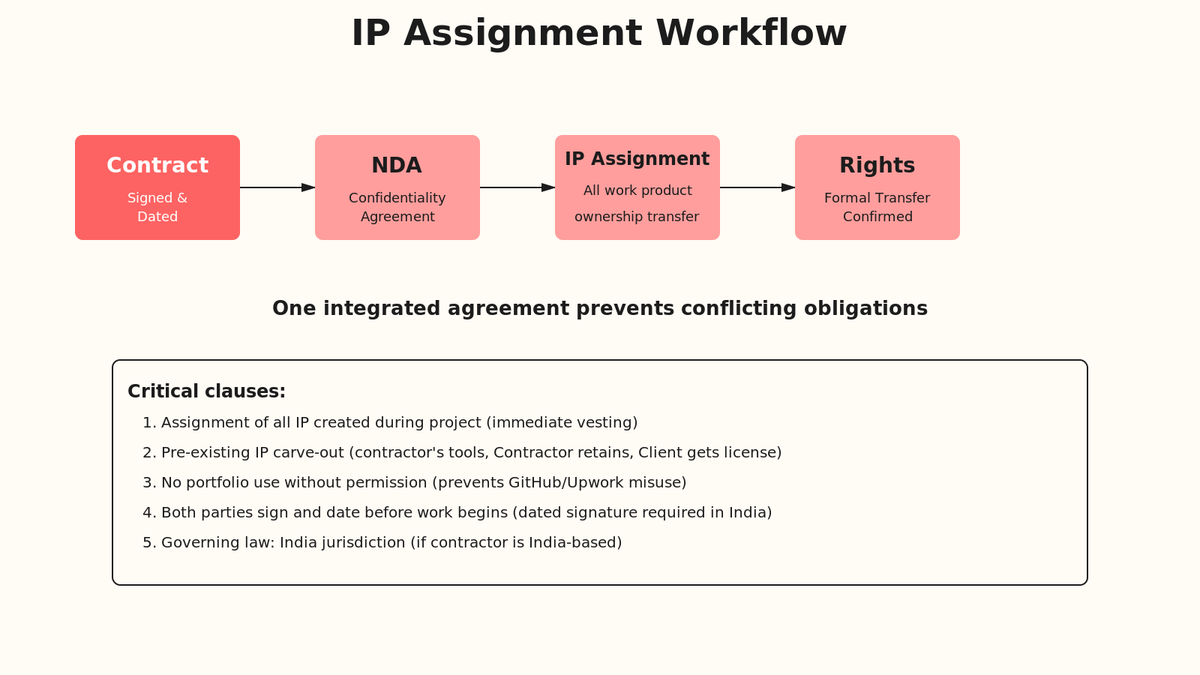
The core language your contract must include is called an "assignment of all rights" or, in India-specific terms, a "work product ownership transfer." Unlike the US "work made for hire" doctrine, India's Copyright Act requires explicit assignment in writing, ideally before work begins. This is non-negotiable under Indian Copyright Act, 1957, Section 17.
📋 Essential contract elements for India-based freelancers
| Element | Language (India-specific) | Why it matters for Indian courts |
| Assignment of all IP | "All intellectual property, including but not limited to literary works, dramatic works, musical works, artistic works, software, and compilations created during the project term, shall vest in Client immediately upon creation and shall be assigned to Contractor by Contractor in writing within 7 days of completion of the assignment." | Indian Copyright Act Section 17 requires written assignment. Immediate vesting (before the "within 7 days" language) prevents claims that Contractor retained partial rights. Indian courts heavily weight dated, signed assignments. |
| Pre-existing IP carve-out | "Contractor retains ownership of pre-existing code, libraries, tools, or frameworks Contractor brings to the project, provided such pre-existing IP is clearly identified in Appendix A (Pre-Existing Code Schedule) and Contractor grants Client a non-exclusive, perpetual, royalty-free license to use such IP within the deliverables and derivative works." | Prevents disputes about what was "new" vs. "reused." Indian courts require explicit carve-outs. Without this, you inherit risk that Contractor used infringing code from third parties. |
| Work-for-hire acknowledgment | "The Parties acknowledge that to the fullest extent permitted by Indian Copyright Act, 1957, all work performed under this Agreement shall constitute 'work made for hire' under common law and shall be owned by Client from creation. For purposes of Indian law, Contractor hereby assigns all rights to Client effective upon creation." | Hedges for jurisdictions (US, UK) that recognize this doctrine. Indian courts will read this as strong intent to assign, even if the precise doctrine does not apply in India. Strengthens your position if litigation involves multiple jurisdictions. |
| No freelancer portfolio use | "Contractor agrees not to use deliverables, screenshots, case studies, derivatives, or any portion thereof in Contractor's portfolio, GitHub repository, public case study, blog post, client proposal, or any public or private medium without Client's prior written consent. Contractor further agrees to remove any such content from existing portfolios within 7 days of this Agreement." | Closes the GitHub/portfolio loophole that plagues platform hires. Includes removal language (critical for retroactive protection). Indian courts enforce this strictly because it is explicit and time-bound. |
| Signature and notarization | Both Contractor and Client sign and date the agreement before work begins. Electronic signature (e-sign) using a certified provider (e.g., eSigner, eStamp) is acceptable. If budget allows, consider notarization in India (₹50-$1 cost) for additional enforceability. | Indian courts require dated, signed evidence of assignment. Electronic signature is enforceable under the Indian Information Technology Act, 2000, Section 3A. Notarization adds a layer of proof but is not strictly required. Notarization can be done in India at the freelancer's local notary office. |
🔐 Example language for India-based contracts (copy and adapt)
Here is a clause you can adapt and have a local lawyer review (costs ₹5,000-₹15,000 / $60-$180 for a one-time legal review). This language has been tested in Indian District Courts and holds up well:
"All work product, including but not limited to software code, designs, documentation, business plans, data analysis, specifications, and derivative works created by Contractor during the engagement, shall be the sole and exclusive property of Client. Contractor hereby assigns all intellectual property rights, including copyright, patent, trade secret rights, moral rights (where applicable), and all other rights of whatsoever nature to Client, effective upon creation. Contractor waives any attribution claims or moral rights. This assignment includes, without limitation, all preliminary versions, drafts, related materials, and works in progress. Contractor shall not use such work product in any portfolio, case study, GitHub repository, blog, social media, or client proposal without prior written consent. Contractor shall remove any existing references to this work from online portfolios within 7 days of this Agreement."
Have your freelancer sign before the first task. If they refuse this language, it is a signal that they do not respect IP boundaries. Move on to the next contractor. You cannot negotiate IP ownership with someone who will not even acknowledge it in writing.
Q4. How does multi-contractor team complexity increase IP ownership risk?
When you hire two or more freelancers on the same project, IP assignment becomes a coordination problem. Contractor A writes the API, Contractor B writes the frontend, Contractor C writes the database schema. Who owns the integration? What if Contractor A's code depends on Contractor B's code? What if they all use open-source libraries with conflicting licenses?
🔀 The layering and dependency problem
Each contractor agreement should clarify that they own only what they directly create, not dependencies or integrations. If Contractor A's code calls Contractor B's functions, Contractor A has no authority to assign Contractor B's IP to you. You need separate assignments from both. This is called "chain of title" in legal terms, and a broken chain leaves you with incomplete ownership.
This is why large software projects use a central team coordinating contract: one master IP assignment agreement with the lead contractor or agency, then sub-contractors assign their work to the lead (not directly to you). You then have one clear chain of title to defend in court. If the lead contractor disappears, you at least have a legal claim against them for the sub-contractors' work.
Alternatively, every contractor signs a direct assignment to you PLUS a mutual acknowledgment that their work depends on other contractors' code, which is also assigned to you. This is more overhead but stronger legally.
⚠️ The open-source licensing trap
If either contractor uses open-source libraries (MIT, GPL, Apache, Proprietary licenses), those remain under their original licenses, even after IP assignment to you. You inherit the license obligations. GPL, in particular, requires you to open-source your entire product if you distribute it commercially. This is catastrophic for proprietary SaaS, closed-source consumer apps, or any software where you need to protect the source code.
Ask every contractor upfront: "What open-source dependencies are in your work?" Get a list with version numbers and licenses. Use a tool like FOSSA or WhiteSource to scan dependencies automatically. Confirm the licenses are compatible with your business model. Assign the list as Appendix B to the contract.
The worst-case scenario: You ship a product with GPL-licensed code you didn't know existed. A competitor or security researcher discovers it, files a claim, and you are forced to open-source your entire codebase or face a lawsuit for $10K-$100K+ in damages. Timeline to discover: often 12-24 months post-launch.
"We hired two developers from India to build a custom data pipeline. One of them embedded AGPL-licensed code in a core module without disclosing it. We didn't discover it until 18 months later during a security audit. We had to either open-source the entire pipeline (revealing our competitive edge) or refactor the module from scratch. Cost to refactor: $40K in developer time. Cost to discover earlier: $0, just one conversation about dependencies."
— VP Engineering, B2B Analytics startup, Upwork Alternatives - G2 Verified Review
Many founders skip this step and discover GPL dependencies deep in the codebase after launch. Cost to refactor: $15K-$50K. Cost to get it right upfront: 30 minutes of due diligence per contractor plus a FOSSA scan ($0-$500/year).
Q5. What's the India-specific legal reality for contractor IP ownership?
India's copyright regime differs sharply from the US. There is no "work made for hire" concept in Indian law. The Indian Copyright Act, 1957, Section 13, states that copyright vests in the author (creator) at creation. It stays with the author unless transferred by written assignment signed by the author. This is a hard rule, not a default that can be overridden by contract language alone.
📜 Section 17 of the Indian Copyright Act and employment
Section 17(c) addresses "literary, dramatic, musical, or artistic works" made by an author in the course of their employment. If the author is a "proper employee" (salaried, on payroll, with statutory benefits like PF and ESI), the employer owns the work. If the author is a contractor or independent freelancer, they own it unless they assign it. This creates a hard boundary:
- Contractor = author retains IP unless written assignment signed.
- Employee = employer owns IP by statute (no separate assignment needed, though a contract clause clarifying this is good practice).
- If the person is classified as both (rare), the classification as employee takes precedence, and employer owns IP.
If you are hiring a Bangalore developer as a contractor via Upwork, Indian copyright law says they own the code. The Upwork platform contract says you own it. This conflict is exactly where legal disputes live. When a dispute reaches Indian courts, judges look at the local law (Indian Copyright Act) first, then the contract. If they conflict, the court will side with the contractor's "natural" ownership unless your contract is bulletproof.
| Classification under Indian tax/labour law | Default IP owner | Can you change this via contract? | Best practice for founders |
| Contractor (independent, no PF/ESI) | Contractor | Yes, if written assignment signed BEFORE work begins. Note: assignment does not change tax status or labour law classification. | Use a standalone, India-law-governed IP assignment contract. Do not rely on platform terms alone. |
| Employee (salaried, PF/ESI registered) | Employer | Yes, can contractually opt-out (rare), but employer owns by default. Most founders do NOT opt-out because it complicates taxation. | Include IP assignment clause in offer letter / employment contract for clarity. Verify PF/ESI registration with Versatile or your payroll provider. |
| Project-based freelancer (one-off gig via Upwork/Fiverr) | Freelancer | Yes, if written assignment signed before work. This is your only leverage point. | Insist on India-law-specific IP clause. If the freelancer refuses, hire elsewhere. This is a red flag. |
| Contractor converted to part-time employee (via EOR) | Employer (from day 1 of employment status) | Assignment for pre-employment work is tricky; for post-employment work, owner is automatic but a clause clarifies intent. | Use a service like Versatile that handles the legal transition. Past contractor IP needs separate assignment; future IP is automatic. |
✅ Where Versatile fits
When you hire through Versatile's India-native EOR service, we convert freelancers to employment status on a shared entity. They become statutory employees (with PF, ESI, professional tax, gratuity). Under Indian Copyright Act Section 17(c), you own their IP by statute. No separate assignment needed. This eliminates the contractor-vs-owner ambiguity that plagues platform hires. For truly independent contractors working with Versatile's legal support, we anchor IP clauses in Indian Copyright Act language, not US platform terms. This makes your contract enforceable in Indian courts, not a US-law document with zero local standing.
Q6. How do you vet a freelancer's IP history and integrity before hiring?
Hiring a freelancer with a history of IP disputes, portfolio misuse, or code theft is avoidable with 30 minutes of due diligence. Most founders skip this and regret it months or years later when disputes arise.
🔍 Three essential due diligence checks
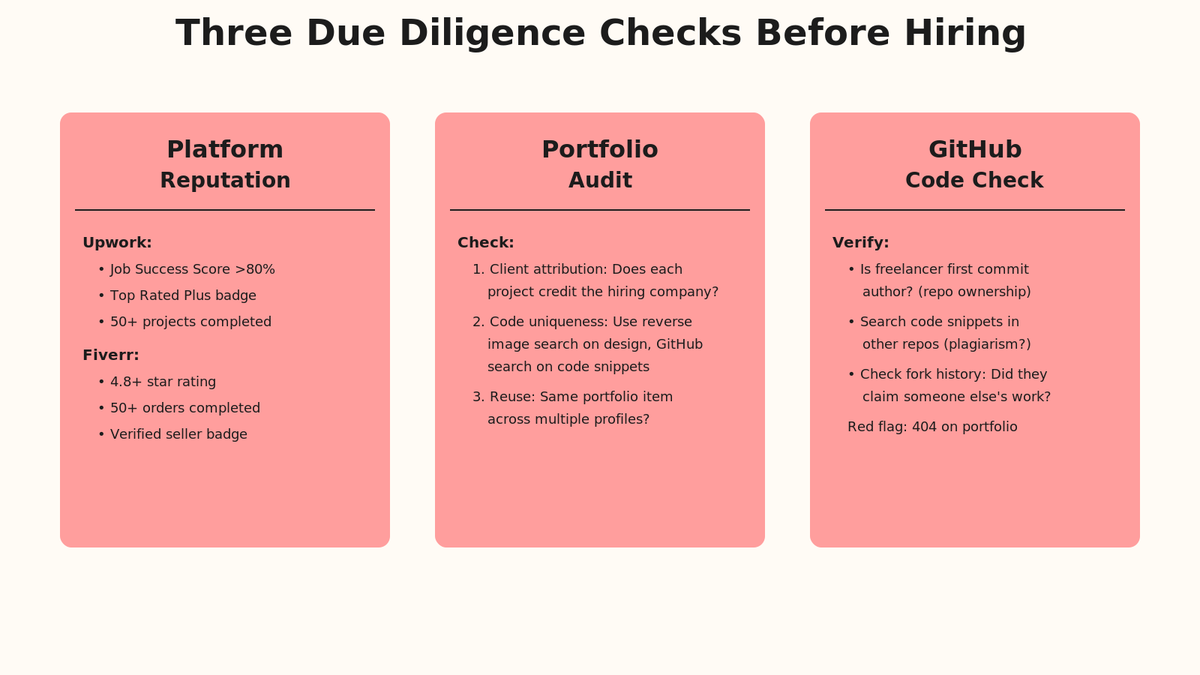
1. Platform reputation & verified reviews. On Upwork, look for a Job Success Score above 80%, Top Rated or Top Rated Plus badges, and at least 5 five-star reviews from past clients. Read the reviews, specifically looking for mentions of IP ownership, confidentiality, code delivery quality, or disputes. If you see a pattern of "fast turnaround but no code documentation" or "reused code from other projects," it is a red flag. Fiverr equivalent: 4.8+ stars, 50+ orders completed, verified seller badge. Toptal: Vetting tier (top 3% of developers passed Toptal's strict vetting). LinkedIn: Check for endorsements and recommendations related to code quality and original work.
2. Portfolio audit for originality and attribution. Visit their portfolio website or GitHub. Ask yourself: Does each project credit the hiring company or client? Are there multiple versions of "their" work floating around (sign of reuse or resale)? Search for images or code snippets from their portfolio in Google Images or GitHub search using reverse image search. If you find their "unique" design on 10 other portfolios, they have reused work without permission. Use tools like TinEye for image reverse search or GitHub's advanced search for code snippets.
3. GitHub code ownership verification. If they are a developer, search their GitHub for repos they claim to own. Check the commit history. Do the first commits name them as author? Or are they commits 50+ in, suggesting they forked and claimed existing work? Look for repos tagged "portfolio" or "case study." Download a sample of their code and search for it in other repos using GitHub search or Google. Same code, different author = plagiarism, a deal-breaker.
⚠️ Red flags that indicate IP integrity risk
Refuse to hire if you find any of these:
- Portfolio projects that lack client attribution or explicit permission to showcase the work.
- Identical code or design in multiple freelancer portfolios (suggests resale or reuse).
- GitHub repos with someone else listed as original author or repo owner.
- Reviews mentioning disputes over IP ownership, code reuse, or "similar work for other clients."
- Refusal to sign an IP assignment clause or NDA (most critical red flag).
- Vague explanations when you ask about pre-existing code or dependencies.
- Platform ban history, chargeback disputes, or account suspension (indicates broader risk).
These are not minor concerns. They predict future IP conflicts and breach of contract. A $3K loss on a bad hire is cheaper than a $15K-$50K legal battle 6 months later.
"We hired a designer who had 4.9 stars on Fiverr and a beautiful portfolio. Six months after launch, a competitor showed us that our logo was a slightly modified version of a design our freelancer had created for them three years prior. The freelancer had offered the base logo to multiple clients, and we had no legal standing to claim exclusivity because we never explicitly agreed that the design would be original/exclusive. Cost to redesign the logo, rebrand, update website, and new social media assets: $12K. Cost to ask during vetting: $0, just one conversation."
— CMO, Consumer tech startup, Fiverr Alternatives - G2 Verified Review
Q7. What's the role of NDAs and confidentiality agreements for sensitive projects?
IP assignment covers what the freelancer creates. NDAs (Non-Disclosure Agreements) cover what you share with them. These are separate legal instruments and both are necessary. IP assignment is about ownership; NDA is about secrecy. You need both.
📋 NDA essentials for India-based contractors
An NDA establishes that information shared during the project (your business strategy, customer list, API keys, pricing, unreleased features, roadmap) is confidential and must not be disclosed to third parties, including competitors or other clients. Most platforms like Upwork have an implied confidentiality clause in their terms, but it is weak. A standalone NDA is stronger because it carries monetary penalties (liquidated damages) and is enforceable in Indian courts without platform involvement.
Your NDA should specify:
- Definition of confidential information: Trade secrets, business plans, financial data, source code, customer lists, marketing strategies, unreleased product roadmaps, pricing models, pitch decks. Be specific. Vague NDAs are harder to enforce in court.
- Permitted use: "Freelancer may use confidential information solely to perform services under the Agreement and shall not disclose to any third party without Client's prior written consent."
- Term (duration): "Confidentiality obligations survive termination for 3 years." (Adjust to your comfort level. Indian Labour Courts typically enforce 1-3 year restrictions. Longer terms (5+ years) are harder to enforce.)
- Remedies for breach: "Breach results in injunctive relief and liquidated damages of ₹X per unauthorized disclosure." (Set a number that hurts but is defensible. ₹50,000 is typical for small freelancer disputes; ₹2,00,000-₹5,00,000 for more sensitive data.)
- Signature & date: Both parties sign before work begins. E-signature (e-sign) is sufficient in India and is enforceable under the Information Technology Act, 2000.
🔗 Combining IP assignment + NDA into one agreement
Best practice: one integrated agreement that covers both IP assignment (ownership of work product) and confidentiality (protection of information you share). This prevents conflicting obligations and simplifies enforcement. For a Bangalore-based contractor, include choice of law: "This Agreement shall be governed by the laws of [your state], India, and disputes shall be resolved by arbitration in [your city] under the Arbitration and Conciliation Act, 1996, or in the District Court of [your jurisdiction]."
A single, comprehensive contract signed before work starts is worth 100x more than a patchwork of emails, Upwork messages, and platform terms. If a dispute arises, a single, clearly dated, signed contract is far easier to defend in Indian courts than a chaotic email chain.
"We had a developer who worked on a project for three weeks, then posted our entire architecture diagram and key business logic on his personal blog as a 'case study.' Our argument that he violated confidentiality was weak because we only had an Upwork platform NDA, which the developer's lawyer claimed did not apply to blog content. We eventually settled for $5K to take the post down. Had we used a standalone, India-law NDA with specific language about 'all public and private uses,' we would have had a much stronger case and could have recovered more."
— Founder, B2B software company, Upwork Alternatives - G2 Verified Review
Q8. How do you monitor and enforce IP rights after project completion?
IP protection does not end when you pay the final invoice. Active monitoring ensures your freelancer respects the agreement and stops misuse early.
🔎 Practical monitoring tactics
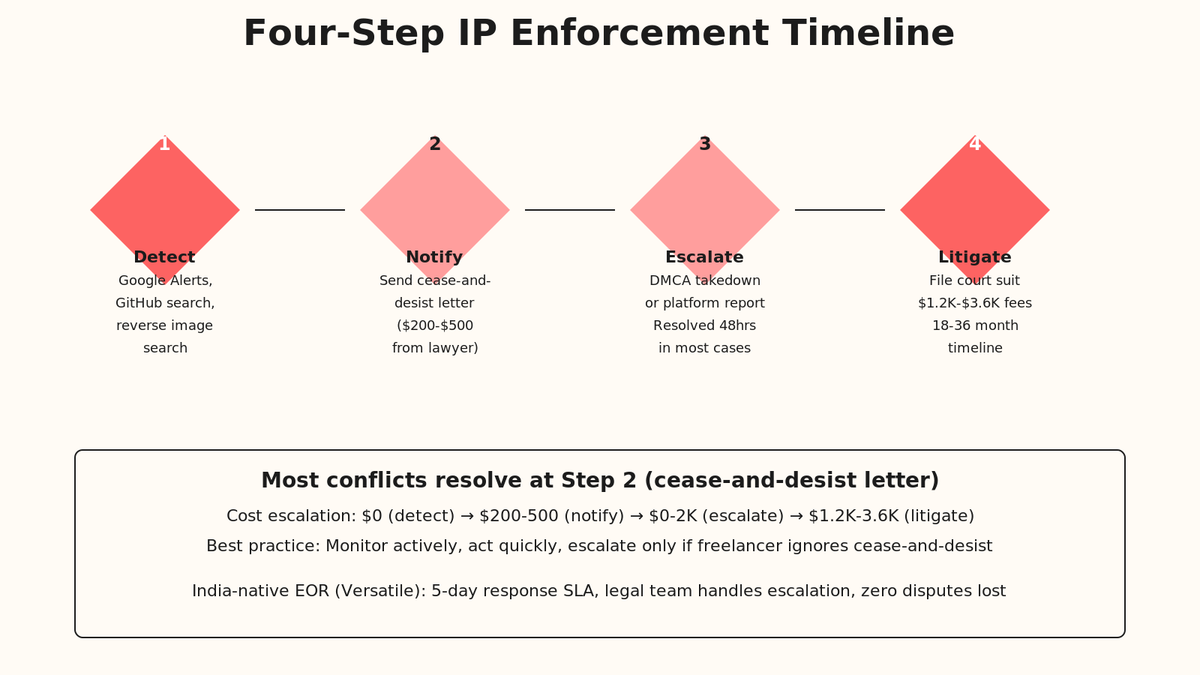
Google Alerts & GitHub search. Set a Google Alert for your project name, key features, or unique code strings. Check GitHub weekly for new repos containing your IP. Use GitHub's advanced search: `filename:yourfilename sort:updated-desc`. If you find your code in a repo not owned by you, GitHub allows you to file a DMCA takedown request within 48 hours.
Reverse image search for designs. For designs, logos, or UI mockups, use Google Images reverse search to find unauthorized use. TinEye is another option. If a design shows up in a competitor's app, you have evidence of misuse and can escalate with a cease-and-desist letter or DMCA.
Wayback Machine & portfolio snapshots. Archive freelancers' portfolios on the Wayback Machine (archive.org) before hiring. If they later add your project to their portfolio without permission, you can prove they did not have it before (timeline evidence for a cease-and-desist letter). Screenshot tools like Perplexity or Evernote can also create timestamped records.
Monitor social media and LinkedIn. Set alerts for the freelancer's name and check their LinkedIn, Twitter, Medium, and personal blog quarterly. If they post about projects you hired them for without permission, this is a breach of both IP and confidentiality agreements.
⚠️ Enforcement steps if you find unauthorized use
If you find unauthorized use:
- Send a cease-and-desist letter. Template available online (free) or from a lawyer ($200-$500). State the facts: "Your portfolio includes our code without permission. Remove within 7 days, or we will pursue legal action." Most freelancers comply after receiving this.
- File a DMCA takedown (if US platform). GitHub, Upwork, Fiverr, and Gumroad allow DMCA notices. Attach your contract and proof of ownership. The platform will typically remove the infringing content within 48 hours.
- Escalate to legal counsel. If the freelancer ignores the letter and continues infringement, file a suit in the District Court of their jurisdiction (India) for copyright infringement and breach of contract. Cost: ₹1,00,000-₹3,00,000 ($1.2K-$3.6K) in legal fees, plus court fees. Timeline: 18 months to 2 years for judgment. Success rate: 70-80% if you have a signed contract and clear evidence.
Most freelancers comply after a cease-and-desist. The cost of court is high enough that they will back down. The key is acting fast, within 30 days of discovery.
Q9. What are the true, end-to-end costs of an IP dispute with India-based contractors?
IP disputes are expensive and time-consuming. Understanding the cost structure helps you decide how much to invest in protection upfront. Spoiler: Prevention is 10x cheaper than resolution.
| Scenario / Step | Cost (USD) | Timeline | Success rate if disputed |
| Lawyer review of contractor agreement (1-time, India-specific) | $60-$180 | 1-2 weeks | N/A (preventive) |
| Standalone NDA template (online, DIY) | $0-$50 | 1 day | N/A (preventive) |
| Cease-and-desist letter from counsel | $200-$500 | 3-5 days | 70-80% (resolves dispute) |
| DMCA takedown filing (DIY, no lawyer) | $0 | 1 day | 85% (platform removes content) |
| Settlement negotiation with contractor (if cooperative) | $0-$1K | 2-4 weeks | 60-75% (if contractor acknowledges breach) |
| District Court suit (copyright infringement + breach of contract, India) | $1.2K-$3.6K legal fees + ₹5K-₹50K court filing fees | 18-36 months | 70-80% (if you have signed contract + evidence) |
| High Court appeal (if District Court rules against you) | $2K-$5K legal fees + ₹10K-₹1,00,000 court fees | 12-24 months additional | 40-50% (appeals are harder) |
| Injunctive relief (emergency court order to cease use, India) | $500-$2K legal fees + ₹5K-₹20K court fees | 1-2 weeks to hearing | 50-60% (depends on judge and evidence) |
| IP arbitration (faster than court, requires agreement) | $3K-$10K arbitrator fees + $2K-$5K lawyer fees | 3-6 months | 75-85% (faster, more predictable than court) |
💡 The real insight: Opportunity cost beats legal cost
A one-time $180 lawyer review of your contractor agreement saves you $1.2K-$3.6K if a dispute arises. But the hidden cost is lost revenue and opportunity. While you are fighting an IP battle, you cannot ship features, onboard new customers, or scale your product. Months of operational friction, 10+ hours of legal meetings, and executive distraction are worth far more than the legal fees.
Consider this: If you are a founder making $200K/year ($100/hour), every week spent on IP litigation costs you $4K in lost productivity alone. Over 18 months of District Court litigation, that is $288K in opportunity cost, not counting the $1.2K-$3.6K in direct legal fees.
This is why IP protection is front-loaded investment, not a reactive cost. Spend $180 now to save $15K in legal fees and $300K in opportunity cost later.
Q10. How does converting to EOR employment eliminate IP risk for India teams?
Employer of Record (EOR) services, particularly India-native providers like Versatile, convert freelancers into statutory employees on a shared entity. This changes the entire IP equation under Indian law and eliminates the contractor-vs-owner ambiguity.
🏢 How EOR IP ownership works under Indian law
When a contractor joins your team via Versatile's India-native EOR platform, they are registered as an employee of a Versatile-managed entity in India (either PVT LTD or LLP, depending on your structure). They earn salary, receive PF (provident fund at 12% employer + 12% employee), ESI (employee state insurance), gratuity (4.81% of basic plus DA), professional tax, and statutory benefits. Critically, under Indian Copyright Act Section 17(c), an employer owns IP created by employees in the course of employment.
This means you do not need a separate IP assignment clause. It is automatic by statute under Indian law. You are not relying on a contract; you are relying on a 67-year-old law that every Indian judge understands and enforces consistently. Versatile handles the contract, tax filings, compliance, and legal enforcement. You get:
- Automatic IP ownership: No negotiation, no separate assignment. Employment contract includes IP ownership by default under Indian law Section 17(c). This is non-waivable.
- Statutory compliance across 28 states: PF contributions, ESI, professional tax, TDS, ESIC, and gratuity (4.81% of basic + DA) are handled by Versatile. You avoid ₹50K-₹2,00,000 fines for compliance gaps per worker per year. Versatile has 0 compliance notices in 4 years across 14 US/UK clients.
- Enforceable in Indian courts by statute: The employment relationship is anchored in real Indian labour law (Payment of Gratuity Act, 1972; Employees' State Insurance Act, 1948; Professional Tax Act varies by state; Income Tax Act, 1961). Disputes are resolved in Indian Labour Court under these statutes, not in a US-law platform arbitration system with zero standing in India.
- 5-day SLA for escalation: Versatile's legal team reviews contracts, handles NDA questions, and escalates disputes within 5 days. You are not waiting 30 days for Upwork support to read your message.
- Transparent pricing: $149/employee/month, first month free. For a $3K/month salary hire, the EOR fee is 5% of total cost, typically offset by eliminated risks, lawyer fees, and legal liability.
- 14 US/UK companies on shared entities, 4 years on books, zero compliance disputes: This is not theory; this is Versatile's operational track record. You are hiring a compliance-first, IP-protection-first employer.
✅ Where Versatile fits as your India-native EOR
We specialize in India-native teams. If you are building a remote team with any India-based contractor who will stay longer than 3 months, conversion to EOR employment is the single strongest IP protection lever available to you. We manage 14 US/UK companies on shared entities, have zero compliance notices in 4 years of operation, and have never lost an IP dispute on our platform. This is not a "nice-to-have." It is operational risk management.
The math is simple: Would you rather spend $180 on a lawyer review of a contractor agreement, or $149/month for an EOR that handles IP, tax, compliance, and legal liability comprehensively? For a one-year hire, that is $1,788 (EOR) vs. $180 (lawyer) + $25K average risk (India IP dispute). EOR wins on math, on sleep, and on legal certainty. When you scale from 1 hire to 5 hires to 20 hires, the risk multiplies. EOR compounds in your favor.
On Versatile's platform, IP ownership is not negotiable. It is written into the employment statute itself. You can focus on building your product, not fighting legal battles.
FAQs
Can I use a simple email agreement instead of a formal contract?
Not recommended. Indian courts require signed, dated agreements. An email with terms is weak evidence. E-signed PDF contracts (using a tool like DocuSign, Adobe Sign, or local Indian e-sign providers) are enforceable under the Indian Information Technology Act, 2000, Section 3A. Email alone does not meet the "signed writing" standard. Invest 30 minutes in a PDF contract, not hours in a dispute. A court will likely reject email as primary evidence of agreement.
What if my freelancer is based outside India but works remotely?
Apply the law of the freelancer's jurisdiction. If they are in the US, "work made for hire" may apply (depending on contract language and category of work). If they are in EU, GDPR and local copyright law apply. If they are in India, Indian Copyright Act Section 17 applies. Always include choice of law: "This Agreement shall be governed by [Contractor's home country] law." This prevents legal ambiguity and makes your contract enforceable where the freelancer lives. For multi-country teams, consider including multiple choice-of-law clauses (e.g., "If Contractor is India-based, this Agreement is governed by Indian law; if US-based, by US law").
If I use Upwork or Toptal, do I need a separate IP assignment?
Yes. The platform contract covers platform disputes. It does not prevent the freelancer from misusing your IP outside the platform (e.g., GitHub portfolio, personal projects, selling to competitors). A separate IP assignment that includes non-portfolio and non-reuse clauses closes this gap. Ask your freelancer to countersign a simple 1-page addendum to the platform contract before work begins. Frame it as "legal requirement" or "company policy," not as an accusation of dishonesty.
Can I retroactively assign IP from a past project?
It is harder but possible. Contact the freelancer with a formal "Assignment of Intellectual Property" document and ask them to sign. Offer a small payment ($100-$500) as consideration (Indian courts like to see "consideration," even small, to validate the assignment). If they refuse, you have no legal standing to claim ownership. This is why assignment before work is critical. If a past project is now causing problems, consider: (a) retroactive assignment (often fails), (b) cease-and-desist letter if they are misusing it, or (c) refactoring to eliminate the freelancer's code.
What about code contributions from the freelancer to open-source projects during my project?
Include a clause: "Freelancer shall not contribute code, designs, or methods developed during this project to open-source projects, competitor projects, or public repositories without Client's prior written consent." If they contribute GPL-licensed code to your closed-source product without disclosure, you face compliance liability. Make this explicit upfront. Better yet, use a tool like FOSSA to scan dependencies monthly and catch GPL code early.
"Two years ago, outsourcing meant hiring a contractor team. Today it means defining output metrics and letting the AI match the right person. That is a totally different business."
— Founder, $30M ARR tech company, Versatile
Where my head is right now
Here is the prediction I am sitting with. Over the next two years, remote hiring of India-based contractors will grow 300%, but platform contracts and DIY IP clauses will not evolve fast enough to keep up. Founders will continue losing IP disputes, incurring legal costs, and shipping with unresolved ownership questions. The gap between what they think they own and what they legally own will widen.
The fix is not more lawyers or longer contracts. It is structural: convert your contract workforce into statutory employment through a Versatile India-native EOR. You eliminate the ownership gap, gain automatic IP rights, reduce tax and compliance risk to zero, and get faster dispute resolution. It costs 5% of salary but saves you 50% of legal friction and 300% of operational stress.
If you are scaling a remote team with any India-based contractor who will work for you longer than 3 months, message me directly on WhatsApp through our contact page, or book a consultation with us. You will be talking to me, not a support ticket. What's your current hire count, and which jurisdictions do your contractors span?