Table of contents (11)
HR Outsourcing Services in India in 2026: A Strategic Guide for Global Businesses
Q1. What does HR outsourcing in India actually cover in 2026?
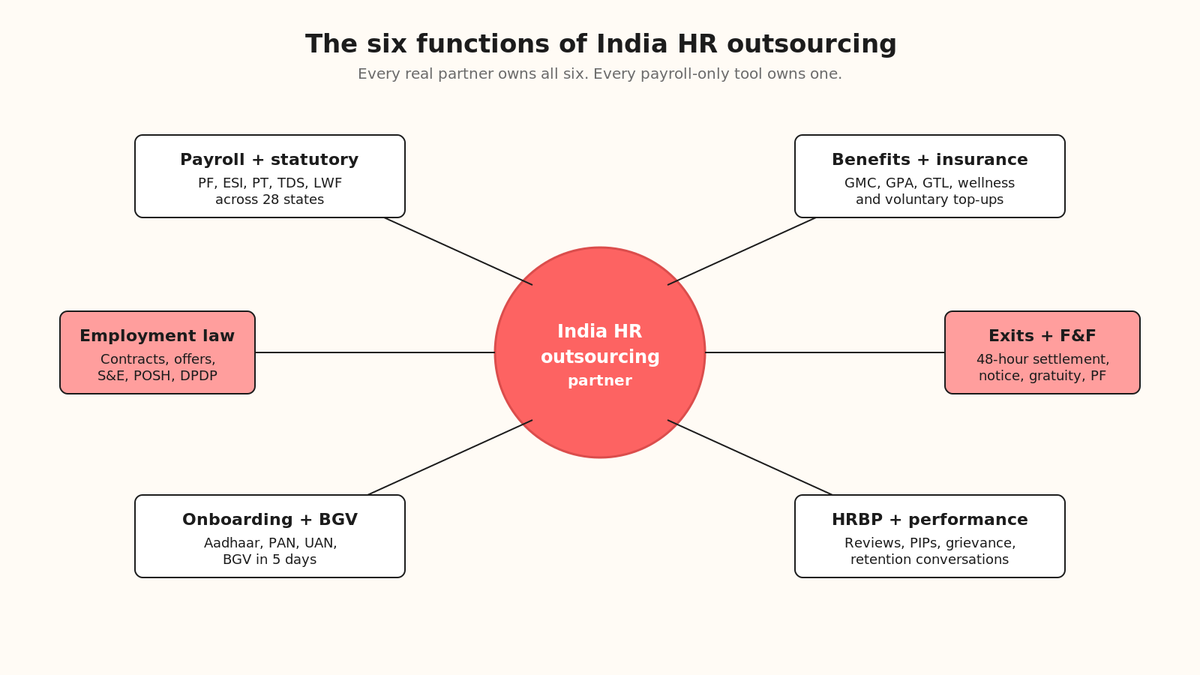
HR outsourcing in India in 2026 means paying an external partner to run some or all of six things: payroll, statutory compliance, benefits administration, onboarding and offboarding, HRIS record-keeping, and day-to-day employee support. The label is broad on purpose. A provider selling you "HR outsourcing" might mean full-service (all six), payroll-only, or a compliance shell around your own HR team.
⭐ The six functions on the shelf
Read any India HRO contract and you will find the same six functions, weighted differently. Payroll processing is the anchor because it is the most legally exposed function. Statutory compliance covers PF, ESI, professional tax, TDS, Shops & Establishments filings, and the new Code returns. Benefits administration handles insurance, gratuity accrual, and leave. HRIS admin is master-data hygiene. Employee support is the tickets your India workforce raises when their PF withdrawal is stuck or their Form 16 is missing.
| Function | What the partner owns | Typical hand-off risk |
| Payroll processing | Monthly runs, salary registers, payslips, bank files, TDS deduction | Wrong Basic+DA split under new Code triggers gratuity underpayment |
| Statutory compliance | PF, ESI, PT, TDS, S&E, Labour Codes returns across states | State-by-state variance (Karnataka vs Maharashtra vs Tamil Nadu) |
| Benefits administration | Group Mediclaim, life cover, gratuity trust, leave policy | Insurance vendor lock-in and 15 to 25 percent premium markups |
| Onboarding and offboarding | Docs, background checks, F&F, exit interview, gratuity payout | 48-hour F&F clock now enforceable under Code on Wages |
| HRIS master data | Employee records, contracts, salary revisions, org chart | Data trapped in vendor tool if you switch |
| Employee support | Payslip queries, PF withdrawal help, tax proofs, policy Qs | Response SLA and language coverage (English, Hindi, regional) |
⚠️ What is not HR outsourcing
Sourcing candidates is not HR outsourcing, that is talent acquisition or contract-to-hire. Running your India entity is not HR outsourcing either, that is Employer of Record. And an offshore developer sitting in your Slack is not "outsourced HR", that is a contractor or a staff augmentation seat. Get the noun right before you sign anything.
Q2. Who provides HR outsourcing in India and how are they different?
The India HRO market splits into four camps: legacy multinationals (ADP, Paychex, Aon), Indian domestic HRO chains (TeamLease, Alp Consulting, Nityo Infotech which absorbed Excelity), global EOR platforms bolting on HR modules (Deel, Multiplier, Wisemonk), and India-native EOR-plus-HR shops that own their own entity (Versatile sits here). Same wrapper, very different economics.
📇 The four camps, sorted
Legacy multinationals are fine for enterprise headcount but slow for founders, and pricing runs on custom quotes. Indian domestic HRO chains are cheaper per seat but the compliance quality varies by branch office. Global EOR platforms are fast to onboard but their India desk is thin because India is one of 100+ countries they cover. India-native EOR shops own the entity and the ground-team, so the compliance risk sits with them, not you.
"Onboarding new employees in India used to take us three weeks. With Deel it takes three days, but every time I have a compliance question about state-specific rules our CSM has to escalate to a partner."
— Verified User in Software, Deel - G2 Verified Review
💰 Why the pricing spread is huge
The same India engineer can cost you $190/month at a domestic HRO chain, $220/month at Deel, $180/month at Wisemonk, and $199/month at Versatile with the first month free. What varies is what is included: entity access, compliance underwriting, benefits underwriting, offboarding, and how much your CFO has to babysit. Read Q3 carefully, or jump to our transparent pricing page.
"Great tool for global payroll but the India-specific compliance depth is not there. We had to add a local consultant on top of Multiplier for PF advisory."
— Verified User in Fintech, Multiplier - G2 Verified Review
Q3. How much does HR outsourcing in India cost end to end?
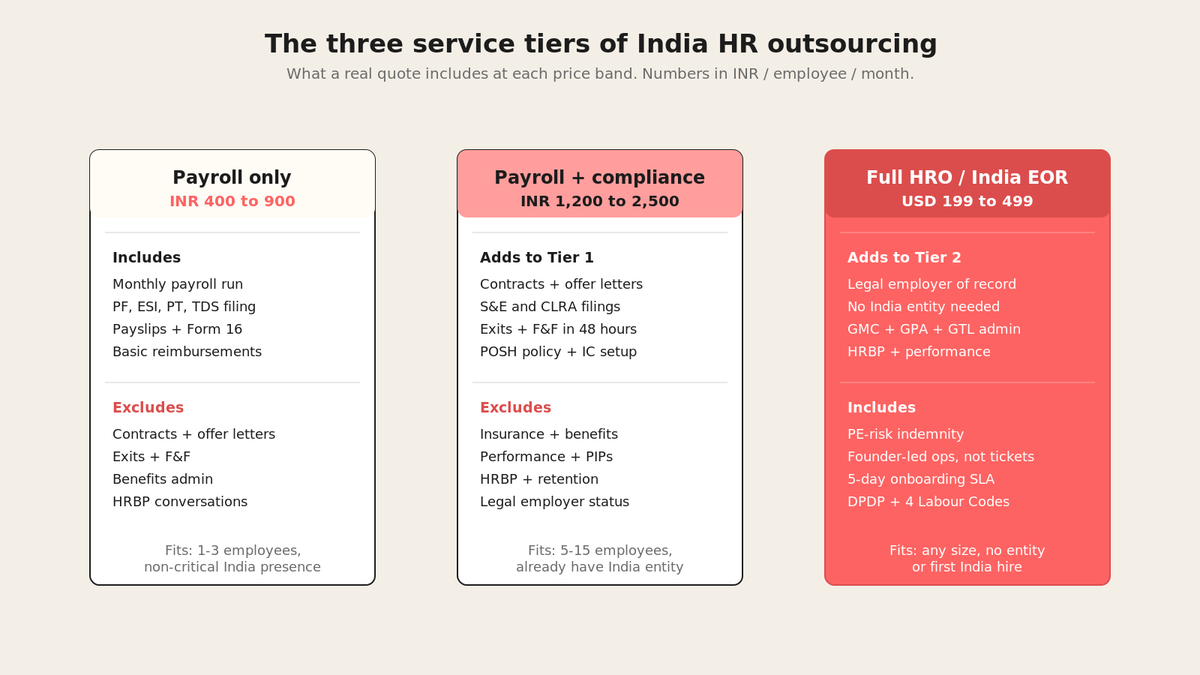
Sticker price for India HR outsourcing in 2026 sits in three bands: $60 to $110/employee/month for payroll-only, $130 to $180/employee/month for payroll plus compliance, and $180 to $220/employee/month for the full six-function stack including benefits and employee support. Fixed-fee retainers exist too, usually $1,500 to $8,000/month for teams under 30 people.
💸 The hidden cost stack
Sticker price is the smallest number on the invoice. The full India employer-cost stack in 2026 includes: PF employer share (12%), ESI employer share (3.25%, wages under Rs 21,000), gratuity accrual (4.81% of Basic+DA), professional tax by state, insurance premium markups (15 to 25% above wholesale), and FX (3 to 5% if you are paying in USD and the provider converts to INR). Total statutory load runs 12 to 20% of gross salary. If your quote does not itemise these, ask.
| Cost component | Payroll-only | Payroll + Compliance | Full six-function |
| Base salary (monthly) | $4,166 | $4,166 | $4,166 |
| Statutory load 12-20% | $500 to $833 | $500 to $833 | $500 to $833 |
| Insurance and benefits | Not included | $70 to $110 | $70 to $110 |
| HRO service fee | $60 to $110 | $130 to $180 | $180 to $220 |
| FX markup (if USD) | $125 to $210 | $140 to $220 | $150 to $230 |
| Total to your P&L | $4,851 to $5,319 | $5,006 to $5,509 | $5,066 to $5,559 |
"Multiplier's pricing looks clean on the surface but once you add benefits and the FX markup the effective cost is 30 percent higher than the sticker rate. Ask for the full-load number, not the marketing headline."
— Verified User in SaaS, Multiplier - G2 Verified Review
🧾 The 2026 rule that broke old quotes
The Code on Wages effective 21 November 2025 mandates Basic+DA to be at least 50% of CTC. Every provider quote issued before that date used a different split (usually 30 to 40%). If your legacy provider re-quoted at the old ratio, your gratuity accrual and PF contributions are both under-computed. Re-baseline before renewing.
Q4. Which HR functions should you outsource first vs keep in-house?
Payroll and statutory compliance go first. They are the highest-risk, lowest-strategic-value functions in an India ops footprint, and the penalty for getting them wrong is direct and monetary. Onboarding and offboarding go second because the 48-hour F&F clock under Code on Wages is easy to miss without ground-team support. Culture, performance management, and leadership hiring stay in-house.
⭐ The priority ladder
| Priority | Function | Why outsource first (or last) |
| Tier 1 (outsource day one) | Payroll + statutory compliance | Highest legal exposure, lowest strategic value, hardest to run without India ground team |
| Tier 2 (outsource by hire 5) | Onboarding, offboarding, benefits admin | 48-hour F&F clock, gratuity trust setup, insurance underwriting all need India expertise |
| Tier 3 (outsource by hire 15) | HRIS admin, tickets, exit interviews | Volume becomes a full-time job around 15 heads, worth $1,500 to $3,000/month to a partner |
| Keep in-house always | Culture, perf mgmt, leadership hiring, comp philosophy | These define your company; an outsourced HRO cannot own them |
⚠️ The trap of "outsource everything"
Some providers pitch "we run your entire HR function". You do not want this. You want a partner who runs the mechanical layer (payroll, compliance, benefits, admin) and gets out of the way when it comes to who you hire, how you promote them, and what your comp bands look like. Founder-led companies get in trouble when an HRO starts writing their culture doc. On paper it feels efficient. In practice it dilutes what makes you you.
Q5. What is the compliance stack an India HR partner must handle?
The India compliance stack in 2026 has 11 mandatory moving parts, and a competent HRO handles all of them or refers out to a specialist. Miss any one and you are exposed. This is where the "India desk" of global EOR platforms tends to be thin, because the state-by-state variance is real and hard to abstract.
🧾 The 11 filings you cannot skip
The core stack: monthly PF and ESI returns, quarterly TDS (Form 24Q), annual PT filings by state, half-yearly S&E returns, gratuity trust maintenance, Labour Welfare Fund by state, the 4 Labour Codes returns (Wages, Social Security, IR, OSH), professional tax remittance, DPDP Act privacy filings for employee data, and Form 16 issuance to every employee by 15 June.
"The compliance side is where most global providers fall short in India. State PT rules alone are enough to trip you up if you have employees in Karnataka, Maharashtra, and Telangana simultaneously."
— Verified User in Software, Rippling - G2 Verified Review
✅ Where Versatile fits
Versatile handles all 11 filings across 28 states on our own entity, with founder-led ops rather than a ticket queue. Our India-native EOR service means the entity is ours, the PF and ESI registrations are ours, and the Labour Codes returns are filed by our compliance team, not an outsourced consultant. If a notice arrives, it comes to us first, not to you.
🚧 The 21 November 2025 reset
The 4 Labour Codes replaced 29 legacy central labour laws on 21 November 2025. Wage definition changed. Overtime rules changed. Termination notice periods harmonised. Fixed-term employment now has explicit statutory status. If your current HRO is still using their pre-November playbook, you have already accrued exposure. Ask for a written re-baseline document; if they cannot produce one in a week, switch.
Q6. How is HR outsourcing different from EOR, PEO, and staff augmentation?
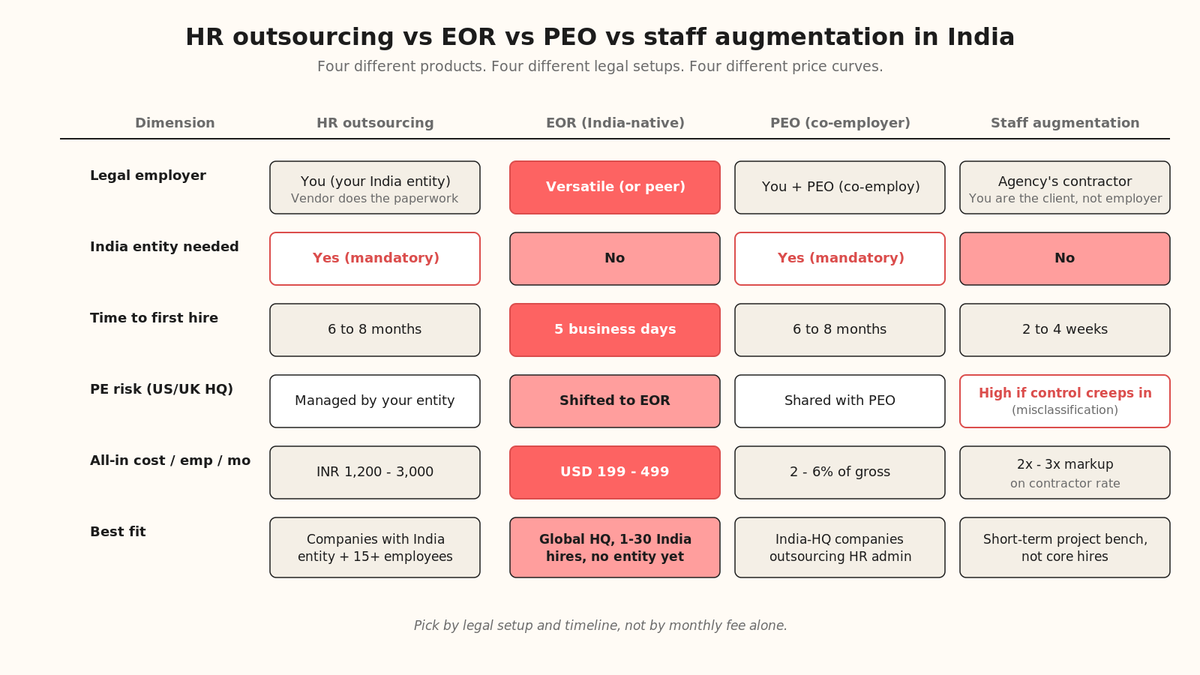
HR outsourcing runs HR functions for a company that already has its own India entity. EOR (Employer of Record) is where the provider becomes the legal employer on their own entity, so the client does not need one. PEO (co-employment) does not really exist in India the way it does in the US; the Indian analogue is HRO. Staff augmentation is a body-shop model that provides contractors, not employees. These are four different products, not four flavours of the same thing.
📇 The four-column mental model
| Attribute | HR outsourcing | EOR | PEO (India = HRO) | Staff augmentation |
| Legal employer | You (your India entity) | Provider (their entity) | You | Vendor |
| Needs your own entity | Yes | No | Yes | No |
| Time to first hire | 4 to 8 weeks (entity dependent) | 5 to 7 days | 4 to 8 weeks | 1 to 2 weeks |
| Break-even vs entity | Not applicable (you own it) | 10 to 15 hires | Not applicable | Never (contractors, not employees) |
| Best for | 50+ hires with existing entity | 1 to 30 hires without entity | Same as HRO in India | Short-term project work |
🤔 When each one wins
If you already have an India Pvt Ltd and 30+ engineers, HR outsourcing is the right buy. If you are hiring your first 5 to 25 people in India from the US or UK, EOR wins on speed and cost. If you need 3 contractors for a 6-month project, a contract-to-hire model wins. Do not let a provider talk you into HRO if you have not incorporated yet; that is a service line mismatch. Use our EOR vs entity calculator to sanity-check the math.
Q7. What are the traps most global founders fall into?
Four traps show up in almost every conversation with founders scaling into India. Signing a payroll-only contract and assuming compliance is bundled. Trusting a global EOR platform's "India module" without asking about the ground team. Skipping the Basic+DA re-baseline after 21 November 2025. And letting the HRO write the offer letter template.
⚠️ Trap 1: assuming compliance is bundled
Payroll-only means the provider runs your salary register and files nothing else. PF and ESI monthly returns, TDS quarterly, PT by state, Labour Codes annual filings, all still yours. Read the SoW twice. If the word "returns" does not appear at least six times, compliance is not in scope.
⚠️ Trap 2: the thin India desk
Global EOR platforms staff their India desks lightly. When your engineer has a PF withdrawal question, the ticket goes to a shared inbox and gets answered in 72 hours. Ground-team ratio matters. Ask for the specific team member who will handle your account, and ask how many other accounts they cover. Under 20 is healthy. Over 50 is a red flag. This is one reason India payroll outsourcing quality varies so much across providers.
"Wisemonk is a good tool but the account managers switch every few months. We were on our fourth CSM in 18 months, which meant re-explaining our setup every time."
— Verified User in E-commerce, Wisemonk - G2 Verified Review
⚠️ Trap 3: skipping the 21 Nov 2025 re-baseline
Every offer letter, every CTC breakup, every gratuity accrual computed before 21 November 2025 needs a compliance review. The Basic+DA floor of 50% of CTC is not optional. If your current HRO says "we will fix it on renewal", they are exposing you to accrued statutory underpayment. Fix it now, not at renewal.
⚠️ Trap 4: HRO-drafted offer letters
An HRO writing your offer letter template is fine for the mechanics (notice period, PF opt-in, gratuity clause). It is not fine for the culture-level clauses (IP assignment, non-compete, moonlighting policy, remote-work rider). Those need your legal counsel or a specialist labour lawyer. HROs use vanilla templates, and vanilla templates lose you the moonlighting cases that landed in courts in 2024 and 2025.
Q8. How do you pick and onboard an India HR partner in 4 weeks?
Four weeks is enough to shortlist, contract, and go live if you run the process tight. Week 1: define scope and shortlist. Week 2: reference-check and cost-compare. Week 3: contract and data hand-off. Week 4: parallel run and cutover.
📋 The 4-week playbook
| Week | Owner | Deliverable |
| Week 1: scope + shortlist | Founder or Head of Ops | SoW draft, 5-provider shortlist, RFP with pricing template |
| Week 2: reference + cost | Head of Ops + CFO | 2 client references per shortlisted vendor, full-load cost comparison |
| Week 3: contract + hand-off | Legal + Ops | Signed MSA, DPA under DPDP Act, employee master data export |
| Week 4: parallel + cutover | Ops + new provider | Parallel payroll run on old and new, cutover on month-end |
⭐ The 8 questions to ask every provider
Do you own your India entity or use a partner? Where is your compliance team physically based? How many accounts does one CSM handle? What is your SLA on employee tickets? Can we see a sample monthly compliance report? What is your process when a labour notice arrives? What is your F&F turnaround? What happens to our data if we terminate?
"We picked our India HR provider after 3 months of comparison. The one thing that mattered most turned out to be response time, not price. Fast provider, happy engineers."
— Verified User in SaaS, TeamLease - G2 Verified Review
Q9. Head-to-head: 6 India HR outsourcing providers compared
The six providers below cover most of what a US or UK founder will encounter shopping India HR outsourcing in 2026. Each has a different centre of gravity. Read the table, then read the notes.
| Provider | Model | Per-emp/mo (USD) | Owns entity | India ground team | Best for |
| Versatile | India-native EOR + HRO | $199 (first month free) | Yes, 28 states | Founder-led | US/UK founders, first 5 to 40 hires |
| Deel | Global EOR + HR platform | $599 | Partner-based in India | Small, ticket queue | Multi-country ops, India as one of many |
| Multiplier | Global EOR + HR | $400 | Partner-based | Small | APAC-focused startups |
| Wisemonk | India EOR + HR | $149 (marketing rate) | Yes, limited states | Mid-size, CSM rotation | Cost-first buyers |
| ADP India | Legacy HRO + payroll | $8 to $15 (custom) | Yes | Large, process-heavy | Enterprise headcount 500+ |
| TeamLease | Domestic HRO + staffing | Rs 1,200 to Rs 2,500 (Rs) | Yes | Large, branch model | Domestic India companies |
💰 The pricing footnote
Sticker rates above are marketing rates. Real quotes vary with headcount, state mix, and how much benefits underwriting you want bundled. Ask every provider for a 12-month total-cost projection including statutory load, benefits, and FX; that is the only apples-to-apples comparison. Use our pricing page for a clean starting reference.
"ADP is enterprise-grade but the onboarding took us 11 weeks. If you are a 20-person US startup hiring your first three engineers in India, this is not the fit."
— Verified User in Manufacturing, ADP - G2 Verified Review
Q10. What is the 2026-2028 India HR outsourcing outlook?
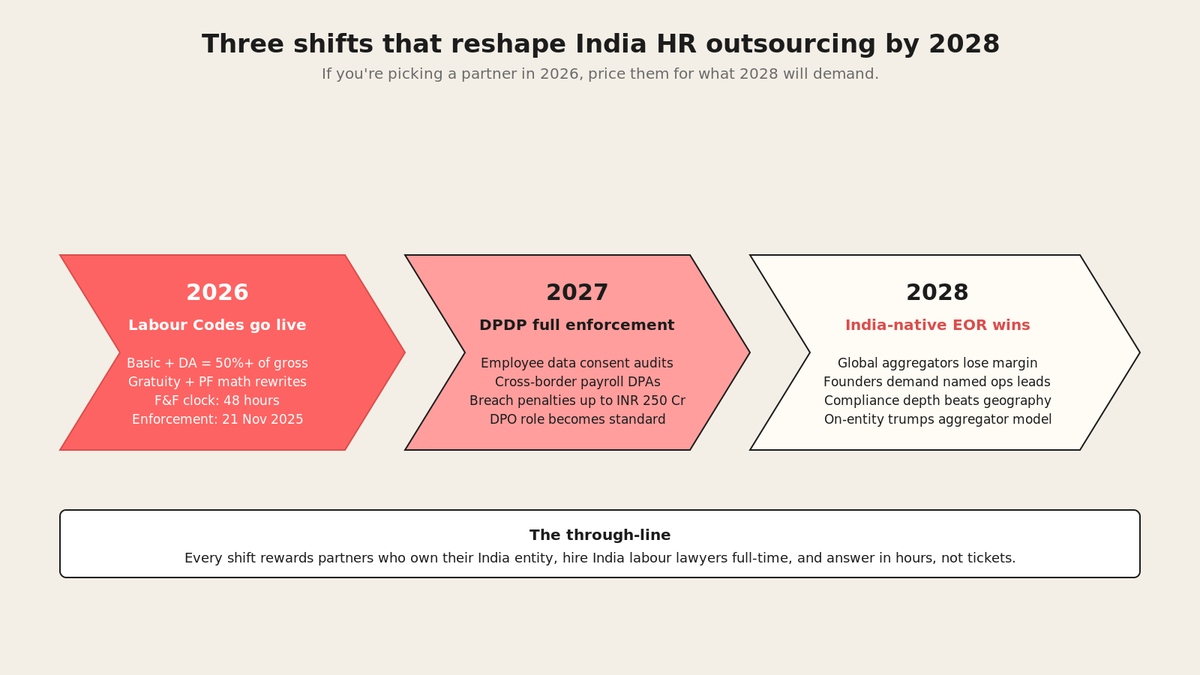
Three shifts will reshape India HR outsourcing between 2026 and 2028. Labour Code enforcement will get real once the state-level rules are notified through 2026. The DPDP Act's employee-data rules will force every HRO to prove privacy controls. And the "India-native EOR" category will absorb what used to be the "payroll-only" tier, because founders learned the hard way that payroll-only never included the compliance.
🚀 Shift 1: Labour Code enforcement gets teeth
The Codes went live 21 November 2025. Enforcement notices started arriving in Q1 2026 for the most exposed sectors (IT services, e-commerce fulfilment, staffing). By 2027 every mid-size India HRO will need a labour-law counsel on staff or the compliance quality will diverge visibly. Small HRO chains without that investment will lose customers. See our take on how the 4 Labour Codes reshape India HR.
"Deel is convenient for a single global platform but for India-only depth we ended up using a local specialist for our F&F settlements. Two vendors, one country, more moving parts than we wanted."
— Verified User in Fintech, Deel - G2 Verified Review
🚀 Shift 2: DPDP Act pushes vendor consolidation
The Digital Personal Data Protection Act put employee data (Aadhaar, PAN, bank details, salary, medical records) under the same regime as consumer data. Every HRO now needs a documented Data Processing Agreement, breach-notification workflow, and consent trail. Small HROs are consolidating into larger platforms or exiting. Your renewal in 2026 will be with a different logo than it was in 2024.
🚀 Shift 3: India-native EOR absorbs payroll-only
The payroll-only tier is dying because founders realised that PF filings without a compliance owner is a liability, not a service. The replacement is India-native EOR, where one partner owns the entity, the payroll, the compliance, and the employee support in a single stack. This is where Versatile sits, and it is where 60% of the market will be by 2028.
FAQs
Is HR outsourcing in India legal for foreign companies without an entity?
Only if you use an EOR structure where the provider is the legal employer on their own entity. Pure HR outsourcing (where the provider runs HR for your India Pvt Ltd) requires you to have your own entity first. If you do not have one and you engage a payroll-only vendor without the EOR wrapper, you are exposed to permanent-establishment risk. Read our EOR services in India page for the entity-free path.
What is the minimum team size where HR outsourcing makes financial sense?
One person, if you go the EOR route and let your provider be the legal employer. For classic HRO where you own the India entity, the math starts working around 8 to 10 employees. Below that, the fixed cost of running your own entity plus the retainer to an HRO exceeds what an EOR would charge per head. Our EOR vs entity calculator gives you the exact cross-over point for your headcount plan.
How much does a state-by-state compliance mismatch actually cost?
PT filings missed by a Karnataka office run Rs 2,500 per employee per year in penalty interest. S&E returns missed in Maharashtra are Rs 5,000 flat plus 1% monthly interest. Multiplied across 20 engineers across 3 states, an inattentive HRO can cost you $8,000 to $12,000 per year in avoidable penalties on top of the base fee.
Can I switch HR providers mid-year without breaking payroll?
Yes, if you run a parallel-payroll month. The old provider processes month N, the new one processes month N in shadow mode, you compare outputs to the paisa, and cut over at month N+1. Data migration for HRIS records typically takes 2 to 3 weeks. See our India EOR vs entity comparison for the full switch checklist. Do not switch in March or April because Form 16 issuance falls in April to June and split ownership creates errors on the annual returns.
What is included in "employee support" and what is not?
Included: payslip queries, PF transfer help, tax proof submission, Form 16 reissue, leave balance checks, policy questions, F&F queries. Not included: grievance investigations, performance improvement plans, terminations, disciplinary proceedings, legal notices. Those are HR business partner work, not support-desk work, and you either keep them in-house or contract them separately.
What happens to my employee data if I terminate the HRO contract?
Under the DPDP Act, the HRO must return or destroy your employee data within a specified period after contract termination, typically 30 to 90 days, with a written destruction certificate. Ask for the specific SLA in the DPA before signing. Providers that dodge this question are keeping your data indefinitely, which is a violation risk that becomes yours the moment there is a breach.
Where my head is right now
Here is the prediction I am sitting with. Over the next two years, India HR outsourcing will consolidate hard. The payroll-only vendors will either bolt on compliance and benefits or lose customers to India-native EOR platforms that already do all three. The winners will be the ones who own their entity, staff their India team deeply, and price on real total-cost rather than a sticker rate.
If you are exploring HR outsourcing for your first India hires, or you are unhappy with a current provider that treats you like a ticket, message me directly on WhatsApp through our contact page, or book a consultation with us. You will be talking to me, not a ticket. Versatile is an India-native Employer of Record, so if you decide the EOR route is right for you we can run your India payroll, statutory compliance, and employee support on our own entity from day one. What is the one HR function you would gladly hand off tomorrow if you had a partner you trusted?