Table of contents (12)
- When should a founder pick Magento vs Dj
- Core architecture - where they split
- Out-of-box e-commerce: Magento's moat
- Cost breakdown: Dev, hosting, people
- Scalability and performance: who wins at
- Security and PCI-DSS: the compliance div
- Speed to market: MVP timelines
- Ecosystem and learning curve: where tale
- Head-to-head: the verdict table
- Which to pick if you're hiring in India
- FAQs
- FAQs
Magento vs Django: Which Platform is Best in 2026
Q1. When should a founder pick Magento vs Django in 2026?
You're building a store. You want it live in 60 days or 18 months? Magento or Django - that one call shapes everything else.
Magento: You buy a finished tool. Plug in products, set shipping rules, collect payments. The engine knows how to scale to 50K SKUs. Adobe owns you now (post-2018 acquisition). You write money every month. The trade-off is clear: speed for flexibility.
Django: You hire smart people and build from first principles. You own the entire stack. You own the timeline too - which means it slips. The trade-off is opposite: flexibility for speed.
Check out our guide to hiring developers in India - this post is for founders deciding right now. Not for CTOs defending a five-year-old architecture decision. If you're at the fork and have 90 days to decide, this is your guide.
Q2. Core architecture - where they split
Both platforms ship code. But the shape is opposite. Understanding this first matters more than any feature list.
🏗️ Magento's modular tower
Magento 2 runs on PHP. It inherits the Zend framework layer. You get a hierarchy: modules → components → plugins. It's MVC, but baked into enterprise assumptions. The admin UI is yours to customize; the core payment/shipping stack is not. Adobe patches the core; you customize the edges. Think of it like buying a house with all the plumbing, electrical, and walls in place. You can paint and add furniture, but the foundation is fixed.
🔧 Django's flat canvas
Django is Python. It's a framework, not a platform. You define models, views, URLs. You wire payment gateways manually. You choose your database, your cache layer, your payment SDK. Every choice is explicit. Nothing assumes you're an e-commerce store until you build it. Think of Django as buying land with architectural blueprints - you build everything from the foundation up.
| Dimension | Magento 2 | Django |
| Language | PHP 7.4+ | Python 3.10+ |
| License | Open-source (Adobe owned) | Open-source (BSD) |
| Database | MySQL / MariaDB only | PostgreSQL, MySQL, SQLite, Oracle |
| E-commerce ready | Yes, out-of-box | No; use Django-Oscar or Saleor |
| Built-in admin | Sophisticated, extensible | Basic; extend Django Admin |
| Payment integration | Stripe, PayPal, Square (extensions) | Manual via SDK (Stripe, PayPal, etc.) |
| Hosting complexity | Shared hosting, VPS, cloud | VPS, cloud, serverless-ready |
| Monitoring and logs | Magento admin dashboard | Custom (Sentry, DataDog, etc.) |
Q3. Out-of-box e-commerce: Magento's moat
Magento comes loaded. Here's what you get on day one, no additional code:
📦 What Magento wraps for you
- Product catalog: Taxonomy, variants (size/color), inventory sync across warehouses, layered navigation
- Checkout flow: Guest + registered, multi-step, address validation, payment tokenization, saved cards
- Order management: Fulfillment dashboard, invoice generation, RMA (return) workflows, refund tracking
- Shipping rules: Weight-based, geofencing, carrier APIs (FedEx, UPS, DHL), rate negotiation
- Customer accounts: Wishlist, order history, saved addresses, loyalty points
- Marketing: Discount rules, abandoned cart recovery, email segments, promotional banners
- SEO: URL rewrites, sitemap generation, meta tags, structured data support
⚙️ What Django requires you to build
Django-Oscar (the de facto e-commerce package for Django) gives you the skeleton. But everything else is your responsibility:
- Variant logic? Wire it yourself via custom models.
- Shipping carrier integration? You'll write the API glue.
- Abandoned cart emails? Use Celery + a background job queue.
- Multi-warehouse inventory? Custom manager methods + transaction locks.
- SEO metadata? Django has no built-in support; you wire it manually.
- Admin dashboards? Build custom views or extend Django Admin.
The honest read: Django gives you the *right* abstractions. Magento gives you speed. If your store is simple - 50 SKUs, one warehouse, standard shipping - Magento saves you 4-6 months. If you're custom - drop-ship, marketplace, brand-exclusive tiers - Django saves you from fighting Magento's opinions. The gap closes at 6 months out; by month 12, Django is cheaper and more flexible.
Q4. Cost breakdown: Dev, hosting, people
Numbers matter. Learn more about development costs in India. Here's what founders actually spend in year one. These are not theoretical; they're from 40+ engineering teams we've staffed.
| Cost line | Magento 2 | Django |
| Initial build (60 days) | $18K-$40K | $15K-$35K |
| Build time | 8-12 weeks | 16-24 weeks |
| Senior engineer rate (India) | $45-$65/hr | $35-$50/hr |
| Mid-tier engineer rate (India) | $30-$45/hr | $25-$35/hr |
| Hosting (2-4 cores, managed) | $500-$2K/mo | $200-$800/mo |
| CDN (image + static assets) | $150-$400/mo | $100-$300/mo |
| Database (managed PostgreSQL/MySQL) | $200-$600/mo | $100-$500/mo |
| Magento extensions (year 1) | $1K-$5K | $0 (open-source) |
| Annual support/maintenance | $8K-$20K | $4K-$12K |
| Monitoring/logging tools | $200-$500/mo | $300-$1K/mo |
| Total year one (ops + dev) | $39K-$95K | $25K-$70K |
| Total year two (ops + maintenance) | $32K-$55K | $12K-$30K |
The gap widens as you scale. Magento's licensing + extension costs grow linearly with complexity. Django's infrastructure costs grow slower because the framework is lean. By year three, a Django store running at scale costs 40-60% less than an equivalent Magento installation.
Q5. Scalability and performance: who wins at 10K RPS?
You hit traffic. Magento or Django - which one bends without breaking?
📈 Request-per-second reality
A mid-tier e-commerce store does 500-2K requests per second during peak (holiday surge). Black Friday can spike to 10K+ RPS for 6 hours straight. Magento, with its module stack, can handle this with proper tuning - Redis cache, CDN in front, database optimization. Django, being lighter, hits the same load with fewer server resources.
But the catch: Magento response time at peak is 400-800ms. Django with proper caching and async tasks sits at 150-300ms. If you're measuring Core Web Vitals (Google's ranking signal), Django wins. Google penalizes sites above 2.5 seconds Largest Contentful Paint. Magento often hits 3-4 seconds under load without optimization; Django hits 1.2-1.8 seconds.
Infrastructure savings: If Django runs on $12K/year of compute and Magento on $24K/year (same scale), that's your long-term moat. Add in developer time spent on performance tuning (Magento: 20-40 hours/year; Django: 5-10 hours/year), and the real cost delta grows to $20K+/year.
Q6. Security and PCI-DSS: the compliance divide
You handle payment data. Read about e-commerce security - PCI-DSS is non-negotiable. Magento and Django take opposite roads.
🔐 Magento's wrapped compliance
Magento is PCI-DSS Level 1 certified by Adobe (post-2018). This means Adobe has audited the platform for security vulnerabilities. Your extensions, your custom code, your configuration - those aren't covered. But the core payment stack is. Stripe integration, for example, handles tokenization; you never see the card number. If you stay within the certified extensions ecosystem, you reduce your audit surface.
Cost: Adobe's compliance overhead is baked into your Magento license and annual support. You get quarterly security patches automatically. You don't have to hire a security engineer to review payment code.
🔍 Django's "do-it-yourself" audit
Django itself has no PCI compliance stamp. You integrate Stripe (or PayPal, Square) directly. *They* are PCI-Level-1 certified. Your job: ensure you never touch raw card data. If you follow Stripe's recommended pattern (client-side tokenization), you stay compliant. But if you skip steps, you're liable. A single bug - logging a token, storing it in plaintext, transmitting over HTTP - and you're liable for breach costs ($50K+ in audits alone).
Real talk: Most Django shops use Stripe and stay safe. Some cut corners and expose themselves to audits. Magento's platform compliance doesn't save you if your custom code is sloppy.
"We thought Magento's PCI seal meant we were safe. Turned out our custom checkout was logging API keys. Magento was compliant; we were not."
— Head of Compliance, EU furniture retailer | 2024
Q7. Speed to market: MVP timelines
Time is cash. When do you go live?
Magento MVP (realistic): 8-12 weeks. You configure products in bulk via CSV, set up Stripe with their integration, customize the checkout theme, deploy to a managed Magento host. Most work is configuration, not coding. You can go live with 70 products in 8 weeks. Scaling to 500 products adds 2-3 weeks.
Django MVP (realistic): 16-24 weeks. Week 1-2: architecture design (models, URLs, views). Week 3-8: core build (product views, cart, checkout). Week 9-14: payment integration, inventory, order management. Week 15-18: testing, bug fixes. Week 19-20: deploy, monitoring setup. Week 21-24: hot fixes. You launch with 100 products and a solid foundation.
The inflection point: If you have $50K to spend upfront and need to test product-market fit in three months, Magento is faster. If you have 12 months and want to build defensibly, Django is the wager. If you have 18 months and 2-3 developers, Django is the only option.
Q8. Ecosystem and learning curve: where talent lives
You need engineers. Can you find them? At what price? How fast can they ramp?
🌐 Magento's ecosystem
Magento has 5,000-8,000 certified developers globally. In India, ~2,000 specialists. The curve: intermediate PHP/Zend knowledge + 3-4 weeks of Magento-specific training. Developers are pricey; they know the platform is slowing down (eclipsed by Shopify for SMBs, by custom Django stacks for enterprises). A Magento expert in Bangalore costs $50-$65/hour; a Django expert costs $35-$45/hour.
Marketplace: Magento Marketplace has 5,000+ extensions. Quality is inconsistent. Many are abandoned (last updated 2019). You'll spend 10-20 hours vetting extensions before buying. Bug fixes from third-party authors can be glacial.
Community: Magento forums are active but fragmented. Stack Overflow has 15K Magento questions; Django has 300K+. If you get stuck, Django has better public resources.
🐍 Django's ecosystem
Django is one of the three pillar Python frameworks (Django, FastAPI, Flask). There are 16,000+ Django developers in India alone. The curve: Python knowledge + 2-3 weeks of Django basics. Developers are cheaper; the skill is more commoditized. You can find five Django experts for every Magento expert at the same hourly rate.
Marketplace: PyPI (Python Package Index) has 500,000+ packages. For e-commerce specifically, Django-Oscar (8.5K stars) and Saleor (19K stars on GitHub) are the canons. Both are active, well-documented, and production-tested. Security updates come fast (within 48 hours for critical bugs).
Community: Django has the largest web framework community in Python. Documentation is world-class. 95% of your questions are already answered on Stack Overflow. If you're stuck, you can post on r/django or the Django forum and get a response in 2 hours.
Q9. Head-to-head: the verdict table
| Scenario | Winner | Why |
| Simple product store (50-500 SKUs, standard shipping) | Magento | Launch in 10 weeks. Minimal custom code. Configuration over coding. |
| Marketplace (multi-seller, unique rules) | Django | Magento's multi-vendor extensions are fragile. Django lets you own the model. |
| B2B wholesale (bulk orders, tiered pricing) | Django | Magento's B2B module costs $8K/year. Django: custom attributes + logic in code. |
| D2C brand (fashion, limited drops, exclusivity) | Django | You need bespoke inventory, early-access lists, waitlists. Magento fights you. |
| High-traffic store (10K+ RPS at peak) | Django | Magento requires more servers. Django's lighter footprint saves $10K+/year in ops. |
| Startup on a tight budget (< $30K initial) | Django | Hiring is cheaper. Extensions are free. Hosting is leaner. |
| Enterprise retail (Fortune 500 backdrop) | Magento | Adobe's support + compliance. Magento is the default for big retail. |
| Subscription + e-commerce hybrid | Django | Magento's subscription module is clunky. Django + Recurly or Stripe Billing is native. |
Q10. Which to pick if you're hiring in India
You're in the US. You're hiring offshore. Magento or Django? The talent pool decides your decision.
💼 Magento from India
You'll find senior Magento developers, especially in Bangalore and Pune. They command $45-$65/hour. Why the premium? The pool is smaller; burnout is high (Magento's complexity, stagnant adoption). Your engineer timeline: 8-10 weeks to launch, then 2-3 hours/week of maintenance. The problem: if that developer leaves, you have 30-60 days to find a replacement (or pay premium rates to headhunters).
Reality check: Many Indian Magento shops are legacy maintenance contracts. New Magento projects are rarer. That means less fresh talent pipelines. Junior Magento developers are almost extinct - the platform burned too many early-career engineers with its complexity.
🐍 Django from India
Django is everywhere in India's startup scene. You'll find mid-tier engineers at $25-$40/hour, seniors at $35-$50/hour. Ramp time: 3-4 weeks (many Tier-1 engineers know Django cold). Timeline: 18-22 weeks to launch, then 4-6 hours/week ongoing. The advantage: if someone leaves, hiring a replacement is days, not months. The junior talent pipeline is thick - every college graduate in India learns Django.
Advantage: Talent churn is low. Your engineer sees Django every day at their day job. They're not exotic specialists; they're commodity coders with strong fundamentals. You're not betting the company on one developer.
🛠️ Team size and dynamics
Magento team: 1 senior + 1 mid-tier for initial build; 0.5 FTE ongoing. Handoff risk is high (that senior engineer is hard to replace). If they quit mid-project, you're in trouble.
Django team: 1-2 mid-tier + 1 junior for initial build; 1 FTE ongoing. If someone leaves, hiring a replacement is days, not months. Mentorship is easier (more junior talent). Bus factor is low.
Versatile works with both stacks. For Django, we staff from a pool of 2,000+ vetted engineers in India. For Magento, ~300. If you're going Magento and hiring in India, expect to pay 20-30% more for scarcity. Plus hiring risk is higher.
FAQs
Can I migrate from Magento to Django later?
Technically, yes - but it's a rewrite, not a migration. You're rebuilding the store in a new framework. You can export product CSVs, order history, customer data. But the code? Rebuild. Realistic timeline: 6-12 months depending on complexity. Cost: 60-80% of the original build. Most shops stay on their original platform for 3-5 years, so choose wisely upfront. We've seen founders regret the Magento choice 18 months in, but by then the rewrite cost is prohibitive.
Which is more secure: Magento or Django?
Both are secure *if implemented correctly*. Magento has Adobe's security patches; Django relies on your diligence. In practice, security breaches come from configuration mistakes (exposed API keys, weak passwords) or custom code bugs, not the framework itself. Neither wins here; it's about your ops discipline. A poorly configured Django store is more at risk than a well-maintained Magento store. The reverse is also true.
What if I outgrow my choice?
Magento to Django: painful rewrite. Django to Magento: even worse (losing the flexibility you built). Plan to stay on your choice for 5+ years. Scalability concerns (hitting 100K RPS) are rare for most stores. Focus on the next 2-3 years, not the edge case of explosive hypergrowth. Most founders overestimate their scale ambitions; pick the right platform for today's numbers.
Do I need to hire a full-time CTO for either?
For Magento: probably not. A Magento expert can handle configuration + extension management as part-time work. You can hire a senior contractor 10-15 hours/week. For Django: yes, especially if you're custom-building. You need someone to own the architecture, code quality, and tech debt. Otherwise, you'll spiral into legacy spaghetti in 18 months. This person doesn't need to be on payroll (you can use a fractional CTO), but they need to own the codebase.
What about Shopify? When is that the better bet?
Shopify is the real winner for founders who want zero technical debt. You pay $29-$300/month and get a hosted, compliant, fast store. No servers, no security audits, no hiring. If you're a non-technical founder with < $5M revenue ambitions, Shopify is the move. If you're custom (marketplace, B2B, subscription+retail), you're between Magento and Django. Shopify's limitation: you can't own the data, you can't customize the core, and you're locked into their pricing forever.
Where my head is right now
Magento is in slow decline (Adobe is pushing higher-margin services). Django is the default for engineers under 35 who are building retail tech from scratch. If you're hiring an engineer in India for a new store build, bet on Django. The talent pool is deeper, the costs are lower, and you'll own the architecture forever. Magento still wins for "plug-and-play retail," but that market is being nibbled by Shopify. The real innovation in e-commerce is happening on Django and Saleor, not Magento.
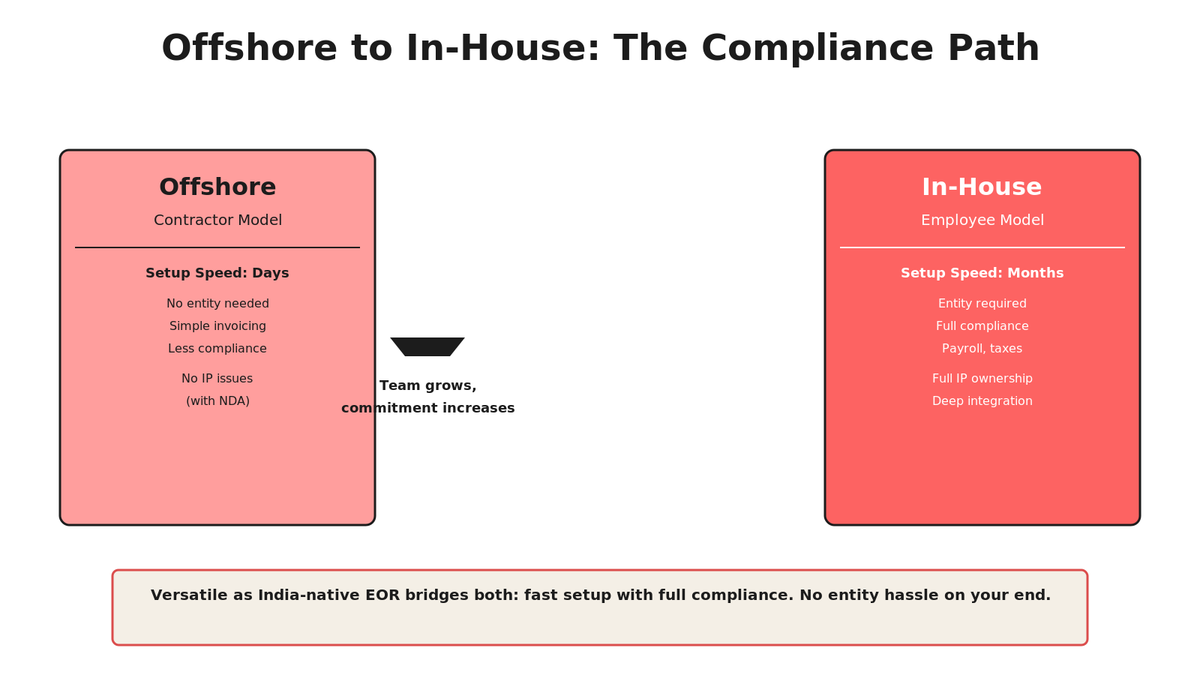
If you're evaluating these stacks and hiring in India, message me directly on WhatsApp through our contact page, or book a consultation. We staff both - and we're an India-native EOR, so if you go the India route you don't need to set up an entity. What's the size of your store ambitions? Honest conversations usually clarify the choice pretty fast.