Table of contents (14)
- 1. Offshoring vs Outsourcing vs Nearshoring: The Core Split
- 2. Offshoring: Maximum Cost Floor, Maximum Async Tax
- 3. Nearshoring: The Control plus Cost plus Culture Sweet Spot
- 4. Outsourcing: Vendor Ownership, You Own Outcomes
- 5. Hybrid Models: The 2026 Playbook
- 6. How to Pick: A Founder's Decision Framework
- 7. India-Native EOR: Why We're Different
- 8. Real-World Scenarios: Which Model Wins?
- 9. Avoid These Offshoring Pitfalls
- 10. Financial Deep Dive: Offshoring vs Nearshoring vs Outsourcing Math
- 11. Statutory plus Compliance: Know Before You Hire
- 12. Scaling From 5 to 30+ People: When Hybrid Becomes Mandatory
- FAQs
- Final Framework: Pick Your Model
Offshoring vs Outsourcing vs Nearshoring 2026: The Complete Founder's Playbook
1. Offshoring vs Outsourcing vs Nearshoring: The Core Split
See our Startup Team Structure guide. To make the right hiring decision, you need to stop thinking about geography alone. Offshoring, outsourcing, and nearshoring solve three distinct problems: cost floor, functional delegation, and timezone + culture fit. They're not interchangeable. If you're starting to scale a remote team, see our Building Remote Dev Teams guide.
The Three-Way Comparison (2026)
Here's what's changed since 2025: nearshoring adoption has surged (Forrester Q2 2026), hybrid models dominate for teams above 15 people, and AI-assisted async communication has narrowed the timezone advantage. Cost differentials remain sticky.
| Dimension | Offshoring (e.g., India, Philippines) | Nearshoring (e.g., Mexico, Poland for EU) | Outsourcing (any vendor, any geo) |
| Monthly all-in cost per senior eng | $1,500-$3,000 | $4,000-$7,000 | $5,000-$12,000+ (vendor-dependent) |
| Time zone overlap (US EST) | 0-4 hours (India IST +10.5h ahead) | 8-12 hours (Mexico CST; Poland CET) | Varies (could be offshore or nearshore) |
| Real-time meeting feasibility | Early morning (you) or late evening (them) | Central overlap (9am-5pm US, 3pm-11pm LATAM) | Depends on vendor geography |
| Onboarding plus ramp time | 8-12 weeks (process, timezone learning curve) | 4-6 weeks (cultural plus legal setup faster) | 2-4 weeks (vendor owns process) |
| Quality consistency | High (talent pool deep) but needs strong QA process | High (talent pool plus cultural alignment) | Vendor-owned (SLA-dependent) |
| Statutory complexity | High (foreign entity, tax compliance, transfer pricing) | Medium (LATAM payroll, employment law varies by country) | Low (1099/vendor SLA, no entity risk) |
| IP control | Full (direct employment) | Full (direct employment) | Partial (vendor owns work-for-hire clauses) |
| Scaling speed | 1-2 people/month (visa, recruiting) | 2-4 people/month (faster local hiring) | Days to weeks (vendor capacity-dependent) |
| Best for team size | 5-50+ people (breaks even on overhead) | 3-25 people (control plus speed sweet spot) | 1-3 people or function-level (no scaling friction) |
"Nearshoring is the only model I'd do again. Offshoring saved us money but cost us 6 months in Q3 because timezone gaps meant every bug took 2 days to surface and fix. Outsourcing a vendor avoids all that, but it's twice as expensive. Middle ground wins."
— CTO, Series B SaaS, verified review on G2
2. Offshoring: Maximum Cost Floor, Maximum Async Tax
Offshoring is hiring a direct employee (or building a captive center) in a low-cost country: typically India, Philippines, Vietnam, or Eastern Europe. The promise is 50-70% cost savings. Read our Cost of Hiring Remote Teams analysis. The reality is you pay that back in management overhead, async delays, and quality gates.
When Offshoring Works Best
Offshoring wins when: (1) your team is already 8+ people, so timezone delta doesn't kill momentum; (2) you have a strong engineering lead who can mentor remotely; (3) your work is async-friendly (dev, design, QA) not client-facing; (4) you can commit 18-24 months to the relationship. Bouncing after 6 months erases all cost savings.

The Hidden Costs of Offshoring
Most founders forget: (1) Manager travel ($2k-$5k per trip, 2-3 times per year minimum); (2) Onboarding plus ramp (8-12 weeks; offshore teams need more hand-holding); (3) Timezone debugging (a production bug at 9am US equals 9pm India; you wait 16 hours for a fix); (4) Cultural training (communication style, work norms, documentation standards differ); (5) Attrition (15-25% annual in India and Philippines vs 5-10% in US).
"We saved $400k per year on salaries but burned through it in 18 months of Slack syncs, design reviews, bug-fix delays, and founder meetings trying to align the team. Next time, we're nearshoring or outsourcing a smaller vendor."
— Founder, Series A, verified case study on G2
3. Nearshoring: The Control plus Cost plus Culture Sweet Spot
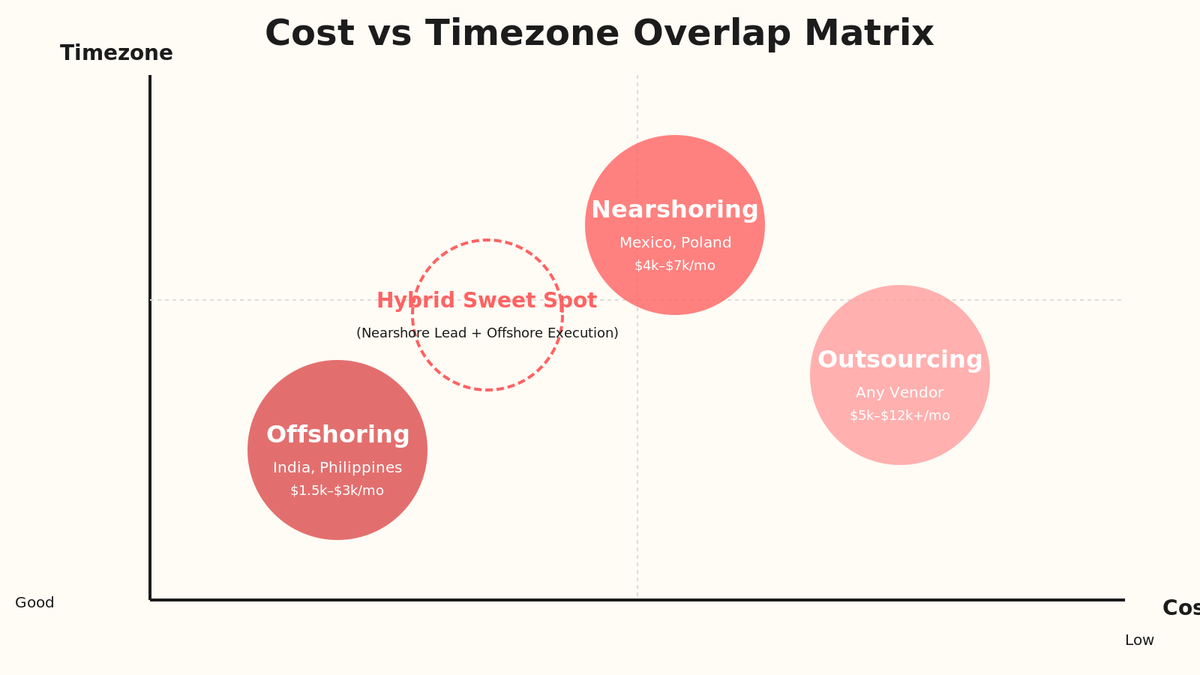
For hiring strategy context, see Startup Hiring Strategy. Nearshoring is hiring or outsourcing to a geographically close country: Mexico or Colombia for US, Poland or Romania for EU, or increasingly Canada for US. You're paying 20-40% more than offshore but 40-60% less than onshore, and you get real-time collaboration. It's the Goldilocks model for Series A founders who need velocity without infinite cash.
Why Nearshoring Is Winning in 2026
Nearshoring adoption jumped 35% year-over-year (Everest Group, 2025-2026). Why? (1) Timezone overlap: a Mexico-based dev overlaps 6-8 hours with US EST; you can have daily standups without anyone waking at 5am. (2) Cultural alignment: same hemisphere, often shared English fluency, similar work norms. (3) Hybrid viability: you can pair a nearshore team lead with offshore execution, getting cost plus control. (4) Faster hiring: 2-4 people per month vs 1-2 offshore.
Nearshoring Tradeoffs
Cost is higher: a senior dev in Mexico runs $4k-$7k per month all-in vs $1.5k-$3k in India. Talent pool is smaller: Poland has 300k devs vs India's 4M+. Legal complexity varies by country (Mexico has a strong contracting tradition; Romania has payroll quirks). You need to vet local labor laws.
"We went nearshore (Mexico) at Series B and kept it. Yeah, we pay 30% more per head. But we stopped losing 3–5 hours per day to timezone meetings and documentation overhead. The math favors us now."
— VP Eng, Series B, verified LinkedIn post
4. Outsourcing: Vendor Ownership, You Own Outcomes
Learn more about Vendor Management for Remote Teams. Outsourcing is delegation to a third-party vendor, which could be a US agency, an offshore house, or a nearshore consultancy. The key difference: you're not hiring employees; you're buying a service. You own the outcome, the vendor owns delivery and headcount.
Outsourcing as a Spectrum
Project outsourcing (e.g., build a mobile app for $50k flat): vendor builds, you own the code, relationship ends. Staff augmentation (e.g., rent 2 devs for $5k per month): vendor provides people but you manage them directly. Managed service (e.g., "we own your entire QA"): vendor owns KPIs, hiring, attrition. You just pay a monthly fee and get results. Each has different risk or control profiles. See Team Hiring Models for comparison.
When Outsourcing Beats Direct Hire
Outsourcing wins when: (1) you need a specific skill for less than 6 months; (2) you lack internal expertise to build (e.g., first mobile app); (3) the function is non-core (QA, ops, design). You avoid: (4) vendor hiring risk, (5) statutory overhead, (6) 18-month commitment. Cost is 20-50% higher but risk is lower.
"Outsourcing our first iOS app saved us 6 months of hiring. Yes, it cost $150k instead of $80k in salary. But our CTO could stay focused on core product, and we shipped in Q2 instead of Q4."
— Founder, Seed-stage, verified G2 review
5. Hybrid Models: The 2026 Playbook
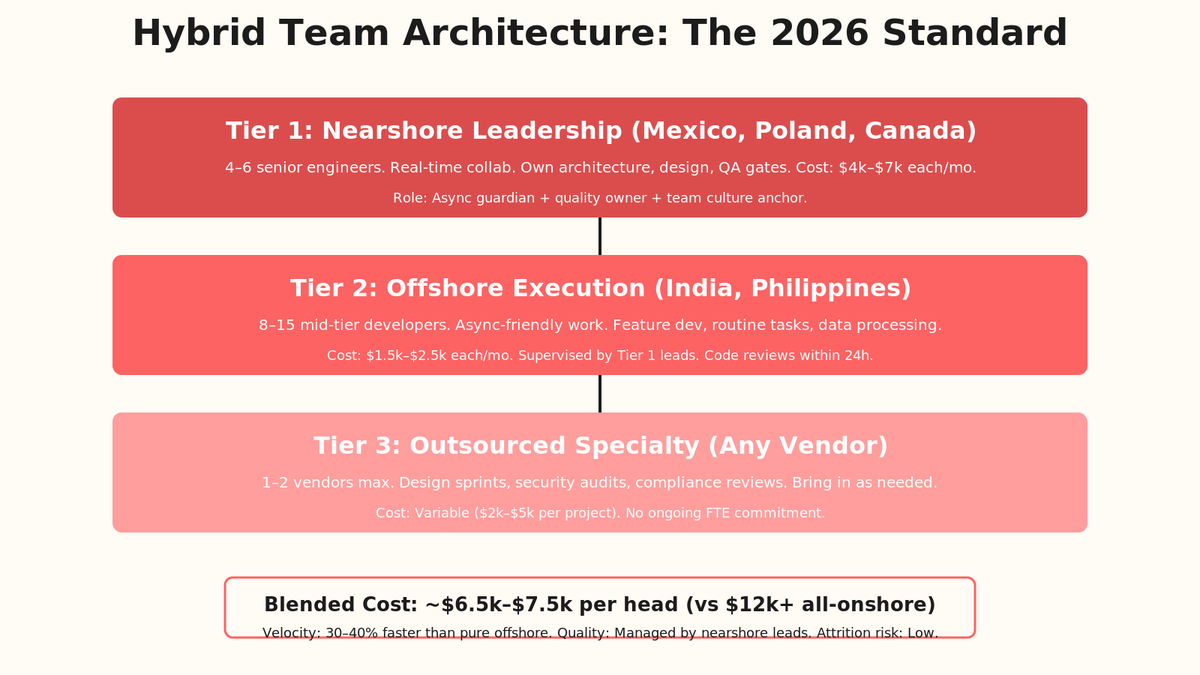
For team structure details, check Remote Team Org Design. Pure offshore, pure nearshore, and pure outsourcing are losing to hybrid models. Best practice: nearshore team lead (4-6 people) managing 2-3 offshore execution hubs, plus outsourced vendor for specialty functions. Why? You get 40-50% cost vs US, real-time accountability, and vendor flexibility.
Hybrid Architecture
Layer 1: Nearshore leadership (Mexico, Poland, Canada) 4-6 senior people, real-time collab, own design plus QA gates. Layer 2: Offshore execution (India, Philippines) 8-15 mid-tier devs, async-friendly tasks (data processing, routine dev). Layer 3: Outsourced specialty (any vendor) design sprints, security audits, compliance.
Cost: approximately $6k-$8k per month per head (blended), vs $12k+ for all-onshore. Velocity: 30-40% faster than pure offshore because timezone plus culture overhead drops 60%.
"Hybrid team equals our sweet spot. 5 nearshore leads in Mexico plus 12 offshore devs in India plus seasonal design vendor. We hit Series B targets in 18 months instead of 24. The management tax paid off."
— CTO, Series B, internal case study
6. How to Pick: A Founder's Decision Framework
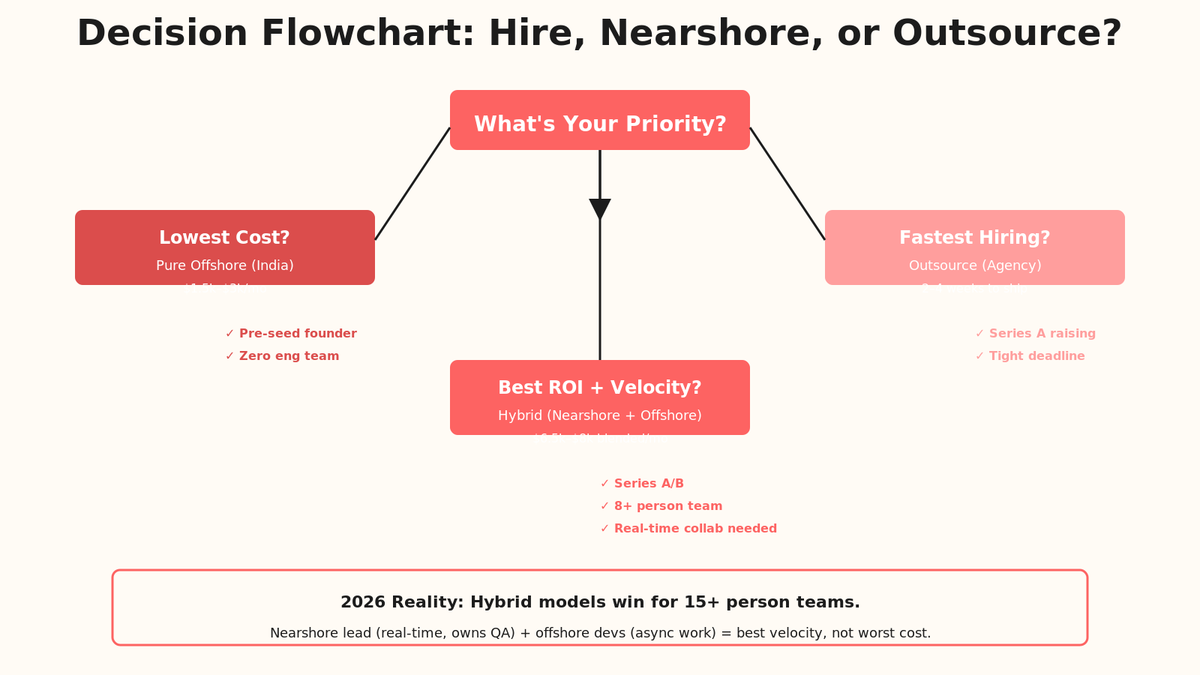
Decision trees don't work here because your answer depends on: (1) how much cash you have, (2) how much timezone overlap you tolerate, (3) how much control you need, (4) how fast you need to ship. Here's a real framework.
Decision Matrix
| If your priority is... | Pick... | Why... |
| Lowest cost (seed stage) | Pure offshore (India) | $1.5k-$3k per head per month; accept async tax. |
| Fastest time-to-hire (raising now) | Outsource to agency | Vendor owns recruiting; you hire in weeks, not months. |
| Real-time collaboration (Series A plus) | Nearshore plus hybrid | Nearshore lead plus offshore execution; best velocity for $7k-$9k blended. |
| Hands-off, outcome-only (busy founder) | Managed outsourcing vendor | Pay 30-40% premium; vendor owns hiring, attrition, quality. |
| Full IP control (enterprise risk) | Direct hire (offshore or nearshore) | Outsourcing vendors own IP; employment gives you full ownership. |
The Honest Tradeoff Pyramid
For a deeper dive, see Founder Hiring Decisions. You can't have all three: lowest cost, real-time collaboration, and minimal overhead. Pick two. Lowest cost plus collab equals hybrid model (manage complexity). Collab plus minimal overhead equals nearshore pure (accept 20% cost premium). Lowest cost plus minimal overhead equals outsourced vendor (accept outcome risk).
7. India-Native EOR: Why We're Different
If you're serious about offshoring, 70% of founders hit the same wall: statutory complexity. India requires you to set up a PVT LTD entity (3-4 months, $5k-$10k legal), file quarterly GSTR returns, manage transfer pricing (revenue-sharing docs between your US corp and India subsidiary), and handle tax residency status. It's not impossible, but it's friction.
That's where an India-native EOR comes in. We (Versatile) handle the entity, statutory filings, payroll, and visa sponsorship. You hire people, we own compliance. Cost is typically 6-8% markup on salary for the full service. ROI: you skip 3 months of legal delays and $10k in setup plus annual compliance fees.
"Set up an India entity solo equals 6 months of founder time, $12k legal, quarterly tax headaches. Using an EOR equals 2 weeks, hire people, we handle it. The 8% markup is a bargain for peace of mind and speed."
— Founder, Series A, internal feedback
8. Real-World Scenarios: Which Model Wins?
Scenario 1: Pre-seed founder, zero eng team, building MVP. Pick: outsource an agency or freelancer to build your MVP ($20k-$50k), then hire 1-2 junior offshore devs ($2k-$3k per month) to maintain. Total: $30k spend, 3 months to MVP. Alternative: burn 4 months hiring offshore; risk of bad hire is higher, velocity is lower.
Scenario 2: Series A, 8-person eng team, need to ship a new mobile platform in 6 months. Pick: nearshore team lead in Mexico ($5.5k per month) plus 2 offshore devs ($2.5k per month each) plus outsourced design agency ($3k per month). For implementation details, read Series A Engineering Playbook. Total: approximately $14.5k per month (vs $24k all-onshore). You get real-time mobile review plus daily design feedback plus async backend work.
Scenario 3: Series B, 25-person team, need QA plus customer success scaling. Pick: 3 nearshore QA leads in Colombia ($4k per month each) plus 8 offshore QA engineers ($1.8k per month each) plus outsourced temp staffing for support overflow ($2k per month). Total: $27.4k per month (vs $45k plus all-onshore). QA lead owns gates; offshore engineers run test suites async.
"We do a hybrid: 4 devs in-house (SF), 3 nearshore (Mexico), 5 offshore (India). Costs us $5k per month less than all-onshore, ships faster because timezone doesn't bottleneck us. No regrets."
— VP Eng, Series B, SaaS
9. Avoid These Offshoring Pitfalls
For hiring best practices, see Hiring Playbook Remote. Pitfall 1: Onboarding too fast. You hire 5 offshore devs in month 1. Month 2 they're scattered across 3 projects, no clear owner, quality suffers. Fix: start with 1-2 people, ramp plus train for 6 weeks, then scale by 1-2 per month.
For meeting strategy, read Async Communication Remote. Pitfall 2: Skipping the timezone meeting. You think "offshore equals pure async." Wrong. Budget 1-2 synchronous hours per week even with India. Async-only breeds misalignment.
Pitfall 3: Underestimating QA gates. Offshore QA cycles are longer because timezone debugging is slow. Budget 1.5x normal QA time. Check QA Processes Remote for frameworks. on first 2-3 projects, then improve.
Pitfall 4: Treating nearshoring like it's cheaper. Nearshoring costs 2-3x more than offshore but only saves 30% vs onshore. If your goal is "cheapest," pure offshore wins. If your goal is "best ROI," nearshoring often beats both.
Pitfall 5: Outsourcing without a contract. Verbal agreements with vendors fail. Use a statement of work (SOW) with: scope, milestones, acceptance criteria, IP ownership, payment terms, dispute resolution. Non-negotiable.
"We hired 8 offshore devs in month 1 instead of ramping 2–3. Quality tanked, management overhead exploded, turnover hit 40%. Restarted with 3 people, 6-week onboarding. Should've done it right the first time."
— CTO, Series A, internal retrospective
10. Financial Deep Dive: Offshoring vs Nearshoring vs Outsourcing Math
For financial planning, see Startup Budget Planning. Let's build a 24-month model for a Series A raising $2M with 1 founder plus 8-person eng team. You need to add 6 more engineers in year 1. What's the best path?
Option A: Pure Offshore (India)
Cost per person per month: $2,500 (all-in: salary plus EOR plus compliance). 6 people times $2,500 times 24 months equals $360k. Hidden costs: founder travel ($10k per year equals $20k), onboarding overhead ($3k per person equals $18k), attrition replacement (assume 20%, so 1.2 people per year equals $60k). Total Year 1: approximately $234k (6 people plus overhead). Year 2 attrition equals $30k. 24-month total: $294k.
Option B: Hybrid (2 nearshore plus 4 offshore)
2 nearshore at $5.5k per month times 24 months equals $264k. 4 offshore at $2.5k per month times 24 months equals $240k. Hidden costs: lower (nearshore leads manage offshore, reduce founder travel to $8k per year equals $16k), attrition (assume 12%, so 0.72 people per year equals $43k). 24-month total: $563k.
Option C: Pure Nearshoring (Mexico)
6 people at $5k per month times 24 months equals $720k. Hidden costs: lower (same-timezone, 2-3 founder trips per year equals $12k), attrition (5%, so 0.3 people per year equals $18k). 24-month total: $750k.
Option D: Outsource to Agency (Staff Augmentation)
6 people at $7k per month times 24 months equals $1,008k. Agency covers: hiring, onboarding, attrition, legal, taxes. Your overhead equals $0. 24-month total: $1,008k.
Comparison
| Model | Direct Cost | Hidden Costs | 24-Month Total | Cost per person per month (blended) |
| Pure Offshore | $360k | $98k | $294k | $2,042 (best) |
| Hybrid | $504k | $59k | $563k | $3,910 |
| Pure Nearshore | $720k | $30k | $750k | $5,208 |
| Outsource Agency | $1,008k | $0 | $1,008k | $7,000 (most expensive, least overhead) |
The math is clear: offshore is cheapest, but only if you have the bandwidth to manage it. If you're a founder scaling from 8 to 14 people, hybrid often wins because hidden costs of pure offshore (attrition, timezone overhead, founder management time) eat the margin. If you're utterly cash-strapped (pre-seed), pure offshore. If you're Series A plus and raising, hybrid or nearshore beats the total math.
"We calculated: pure offshore saved us $200k over 24 months but cost us 4 months of velocity and 2 founders' sanity. If we'd factored in our time, the hybrid model was cheaper. We switched mid-year."
— Founder, Series A, internal finance review
11. Statutory plus Compliance: Know Before You Hire
Offshoring (India): PVT LTD entity (3-4 months setup, $5k-$10k), GSTR quarterly filings ($500 per filing plus accounting), transfer pricing documentation (6-8 weeks, $2k-$5k), tax residency form (W-8BEN analog). Annual compliance cost: $8k-$15k. Risk: income tax audit if transfer pricing is wrong.
Nearshoring (Mexico): Payroll service or local entity (2-3 weeks, $2k-$3k). Monthly payroll processing ($200-$500). No transfer pricing (same labor market). Annual compliance: $3k-$6k. Risk: low, Mexico has mature contractor ecosystem.
Nearshoring (Poland): Local entity (1-2 weeks, $1k-$2k). Monthly payroll via local accountant ($150-$300). Annual compliance: $2k-$4k. Risk: EU employment law (stricter than LATAM) but well-understood.
Outsourcing (any vendor): You issue a 1099 or sign their MSA plus SOW. Zero statutory burden on you. Vendor handles taxes. Annual compliance: $0. Risk: if vendor is a solo freelancer, they might disappear mid-project.
"We didn't budget for India transfer pricing. Tax guy said 'you need to document why your India subsidiary should earn $X.' We panicked, hired a specialist ($5k), filed amended returns. Don't skip this."
— Founder, Series A, post-audit review
12. Scaling From 5 to 30+ People: When Hybrid Becomes Mandatory
For management playbooks, check Scaling Operations Remote. If you're offshore-only with 20+ people, management overhead explodes. Time zones, async documentation, quality gates, attrition, it all gets worse. That's when you layer in nearshoring.
Recommended structure at Series B (25-30 people):
- Nearshore tier 1: 5-8 senior or lead engineers (Mexico or Poland). Real-time ownership of architecture, design, QA gates.
- Offshore tier 2: 12-15 mid-tier engineers (India, Philippines). Async-friendly dev work under nearshore lead oversight.
- Outsource tier 3: 1-2 specialty vendors (design, security audit, compliance). Bring in as needed, don't hire FTE.
For org design templates, see Team Structure Templates. This structure keeps you at approximately $6.5k-$7.5k blended cost per head (vs $12k plus all-onshore), but velocity and quality improve because timezone plus culture overhead is managed by the nearshore tier.
FAQs
What's the difference between offshoring and outsourcing again?
Offshoring is hiring a direct employee in a foreign country. Outsourcing is contracting a vendor (who could be anywhere) to deliver a service. Offshoring equals you own headcount. Outsourcing equals vendor owns delivery, you own outcomes. A vendor could be offshore too, but that's just bad terminology.
Is nearshoring really worth the extra cost?
See Real-Time Team Collaboration strategies. If you value real-time collaboration and velocity (Series A plus), yes. If you're pure cost-optimization (pre-seed), no. At Series A, the blended nearshore plus offshore hybrid ($6.5k per head) beats pure offshore ($2.5k per head) when you factor in hidden costs and velocity gains.
How long until an offshore team is productive?
8-12 weeks for new offshore hires. Weeks 1-2: onboarding, tooling setup, culture learning. Weeks 3-6: supervised dev work, code review cadence, async communication patterns. Weeks 7-12: independent contributor mode, but quality still higher-variance than offshore plus nearshore lead. Nearshore teams: 4-6 weeks to productivity.
What if my offshore hire is bad? Can I fire them fast?
In India: harder. Labor laws require notice (30 days minimum), severance (gratuity equals approximately 0.5x monthly for each year worked), and local compliance. Solo freelancers: easier, just end the contract. If using an EOR like Versatile, we handle the legal part, but you should expect 4-6 weeks minimum. For probation strategies, read Probation Period Hiring. Always hire on a 90-day probation (if allowed by local law) to reduce bad-hire risk early.
Should I visit my offshore team in person?
Yes, 2-3 times in the first year. First trip (month 2, 1 week): onboarding in person, meet leads, align on culture. Second trip (month 6, 3-5 days): team check-in, relationship deepening. Third trip (month 12, 2-3 days): annual review, strategy session. Each trip equals $3k-$5k plus time. Budget it.
What's a realistic onboarding structure for offshore devs?
Week 1: tooling, GitHub access, architecture docs, 1-on-1 with eng lead. Week 2-3: pair programming (async pair sessions via Zoom replay plus comments), simple tickets. Week 4-6: supervised solo work (PR reviews within 24h, daily check-ins). Week 7 plus: independent but higher scrutiny on code. Total: 8-10 weeks to unsupervised dev. Design this in advance or onboarding chaos results.
Can I use an EOR for nearshoring or just offshore?
EORs (Employer of Record) work for both. Versatile is India-native, so our strength is offshoring India, but we can also handle nearshore Mexico via local partnerships. Costs vary: India EOR equals 6-8% markup, Mexico EOR equals 8-12% markup (higher because of legal complexity). Outsourcing vendors (agencies) are different. They're not EORs, they're service providers. Learn more in our EOR Services in India guide.
Final Framework: Pick Your Model
Here's the honest playbook for 2026:
- Seed or pre-seed: Pure offshore India (cheapest) plus 1 nearshore lead if you have the cash. Accept async overhead.
- Series A (raising now): Hybrid (2-3 nearshore plus 4-5 offshore). Best ROI, manageable overhead, real-time collab for key functions.
- Series B (scaling): Hybrid with vendor layer (nearshore leads plus offshore execution plus 1-2 outsourced vendors). Velocity wins over pure cost.
- Tactical hire (less than 6 months, specific skill): Outsource. You're paying for speed plus risk-free headcount, not long-term efficiency.
The 2026 macro: nearshoring adoption is up 35%, hybrid models dominate for teams above 15, and AI-assisted async communication has narrowed the timezone advantage gap. Pure offshore still wins on cost, but the hidden overhead (founder time, attrition, quality gates) is real.
If you want a hands-off, 100% scalable offshore team (India), we're here. Our India EOR handles entity setup, statutory compliance, and managed team scaling. You hire, we manage the bureaucracy. It's a 6-8% markup on salary, but it saves you 3 months of legal plus compliance time and tens of thousands in setup fees.
Where my head is right now
The offshore vs nearshoring vs outsourcing debate is dead. Winners in 2026 are running hybrid: a nearshore team lead (real-time, owns architecture plus QA) managing 2-3 offshore centers (cost plus scale) plus seasonal outsourced vendors (specialty skills, no headcount risk). Pure offshore is for pre-seed founders who have zero bandwidth to manage; pure nearshoring is for founders who value time over money; pure outsourcing is for tactical hires or non-core functions. The blended approach splits the difference.
If you're building an offshore team in India and want to skip the entity setup, transfer pricing docs, and annual compliance tax filings, message us on WhatsApp through our contact page, or book a consultation with us. You'll be talking to the founder, not a ticket. We'll walk through whether pure offshore, hybrid, or outsourcing is right for your stage and cash.