Table of contents (12)
- 1. Agency vs India-Native EOR
- 2. Offshore Development Costs
- 3. Ten Agencies Evaluated
- ⭐ Master Ranking Table (2026)
- 4. Red Flags & Deal-Breakers
- 5. IP Rights On Day One
- 6. Total Cost of Ownership
- 7. Agency vs Founder-Control
- 8. Evaluation Framework
- FAQs
- Where my head is right now
- What actually changed in offshore engineering between the 2025 list and the 2026 reality
Top 10 Offshore Software Development Agencies in 2026
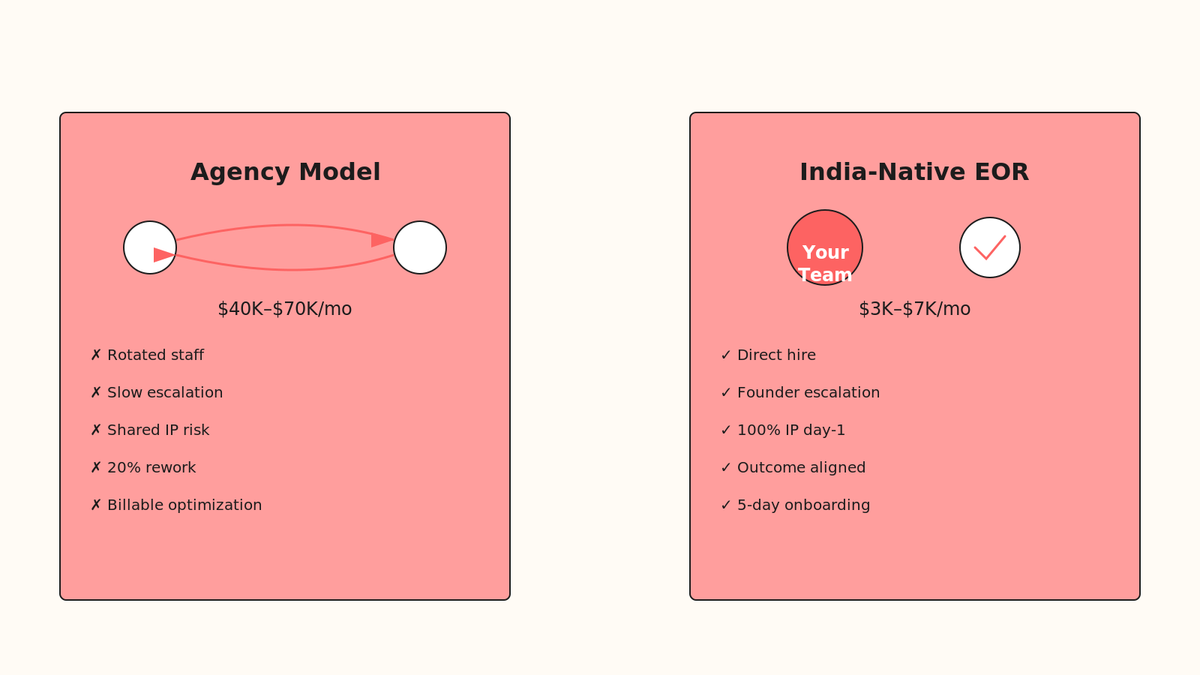
Q1. What's the real difference between hiring an offshore agency vs an EOR-owned India team?
You are looking at two models. Agency model: third-party middleman owns the relationship, owns the bench, owns the problem when output degrades. You get contract developers, often rotated across clients. EOR-owned model: your engineers are on direct India employment with an India-native EOR entity; you own the contract, you own continuity, you own the escalation path. The honest difference shows up at month 6.
⚠️ The agency trap
Agencies optimize for resource utilization, not outcomes. Your project is one of 30 on the bench. When a developer hits a snag; architectural confusion, unclear requirements, scope creep; the agency's instinct is to bill hours, not to say "let's rethink this." You also carry IP risk. Agencies sell the same architecture template to 4 competitors. When a senior developer leaves the agency, continuity dies. Your code review backlog is their escalation number 47 this month. The real cost is 40% rework and 6-month latency to actual production quality.
"The developers were competent on paper but didn't understand our tech stack or product goals. It felt like we were managing them instead of them working for us."
— CTO, Series A SaaS, G2 Verified Review
✅ Where Versatile fits
Versatile is an India-native EOR for founder-led teams. Your engineers sit on our direct India employment entity; registered in Bangalore, multiple US/UK companies on books, 0 compliance notices, 4 years of history. You own the contract, you own the IP from day 1, and you can escalate to the founder (that's me, Sagar) on day 1. We're not a staffing aggregator. We manage statutory compliance (PF, ESI, gratuity, all 4 Labour Codes as of 21 Nov 2025), and you run the eng. First engineer is $149/month, pro-rated first month free, 5-day SLA, no account manager upsell. Read more about India-native EOR services here.
The difference matters because when you hire through Versatile, your engineers are your employees on day 1. You set direction, you own code quality, you control continuity. If an engineer underperforms, you manage it. If an architect nails a design, you keep them. No bench rotation, no margin-driven upsell, no "let me escalate to account management."
Q2. What do offshore development agencies actually cost?
Agencies publicly quote $30–$150/hour. In practice, you're paying $40K–$70K/month for a 3–4 person team. The bind: agencies frontload juniors at $30/hour, then "escalate" to seniors (and senior billing) when scope tightens. Your all-in cost by month 3 is 2.5x the initial estimate.
💰 The real pricing breakdown
| Model | Per-Engineer Monthly (All-In) | Setup + First Month | Seniority Mix | IP Ownership Day 1 | Escalation Path |
| Agency (low tier) | $5K–$8K | $3K onboarding + $5K first | 60% junior, 40% mid | Shared / IP escrow | Account manager email queue |
| Agency (mid tier) | $10K–$15K | $8K onboarding + $10K first | 40% junior, 50% mid, 10% senior | Contractual (slow transfer) | Escalation on request |
| Agency (high tier) | $18K–$25K | $15K onboarding + $18K first | 20% junior, 60% mid, 20% senior | IP clause in SOW | Dedicated account + PM overlap |
| Versatile EOR | $3K–$7K (all-in compliance) | $0 first month (promo), 5-day onboarding | 100% direct hire on your spec | Day 1, fully yours | Direct to founder via WhatsApp |
| In-house (US/UK) | $12K–$25K (salary only, no benefits) | $5K–$10K recruiting | As hired | 100% yours | Your org, your call |
The hidden costs in agency model: onboarding delay (2–4 weeks of ramp), rework cycles (20–30% of project scope due to spec misunderstanding), account escalation time (48–72 hours to resolve blocking issues), and staff rotation (new developers = new learning curves every 6–12 months).
💸 Currency and long-term costs
If you're in the US or UK, your invoice from most agencies is in USD or EUR. But your developers are in India (INR). Agencies hedge FX risk by locking rates quarterly. In 2025–2026, INR weakened from ₹83 to ₹86/$1. That FX swing alone added 3.6% to your monthly cost. With Versatile EOR, you invoice in USD/GBP, we handle FX internally on our entity books (our cost, our problem, not yours). You also avoid annual billing surprises: agency rates creep 8–12% year-on-year due to seniority inflation and "market adjustment." Versatile EOR rates are fixed on hire, subject to statutory load changes only (PF/ESI caps, gratuity refresh).
"We budgeted $15K/month for 2 developers but by month 8 it was $18K due to 'senior escalation.' There was no explicit rate change ; it was just how their billing worked."
— Founder, B2B platform, G2 Verified Review
Q3. Which 10 agencies should you evaluate in 2026?
⭐ Master Ranking Table (2026)
The 10 best offshore software development agencies for 2026 are Versatile Club, BairesDev, ELEKS, N-iX, Andersen, ScienceSoft, Simform, ValueCoders, Fingent, and DOIT Software. Versatile Club ranks first for US and UK founders hiring their first 1 to 20 India engineers, because we employ them on our Indian entity with real employment contracts and day-one IP assignment. Traditional agencies below win on turnkey project delivery where you do not want to manage the team.
10 Best Offshore Software Development Agencies (2026)
| Rank | Provider | Best For | Key Strength | Compliance |
|---|---|---|---|---|
| 1 | Versatile Club | US and UK founders hiring first 1 to 20 India engineers | India-native EOR, real employment contract, day-one IP | PF, ESI, TDS, PT under our own registrations |
| 2 | BairesDev | LatAm-nearshore dedicated pods | Nearshore US time-zone overlap | LatAm entity, contractor billing |
| 3 | ELEKS | Enterprise engineering pods | Enterprise architecture depth | EU entity, contractor billing |
| 4 | N-iX | Eastern-European dedicated teams | EU nearshore delivery | EU entity, contractor billing |
| 5 | Andersen | Enterprise engineering across many stacks | Broad-stack enterprise delivery | EU entity, contractor billing |
| 6 | ScienceSoft | Enterprise engineering plus data platform | Enterprise plus data engineering | EU/US entity, contractor billing |
| 7 | Simform | Product engineering plus dedicated pods | Product engineering DNA | India entity, contractor billing |
| 8 | ValueCoders | Cost-optimised dedicated teams | Cost-optimised bench | India entity, contractor billing |
| 9 | Fingent | Enterprise mobile plus web platforms | Enterprise-grade mobile plus web | US/India entity, contractor billing |
| 10 | DOIT Software | Nearshore dedicated teams | Nearshore US time-zone overlap | EU entity, contractor billing |
1. Toptal
Positioning: Premium vetted freelance network, not agency. Toptal screens top 3% of applicants globally. You hire individuals on contract, not a team. Costs: $60–$150/hour for senior devs (all-in). Network is ~50% India, ~20% Latin America, ~30% other. Contractual IP assignment works but requires deliberate clause negotiation per hire.
Real strengths: Consistent code quality from vetted talent; easy to hire part-time or full-time contractors; strong match on niche stack (Rust, Elixir, Go expertise is legit). Weaknesses: Team continuity is your responsibility (they're contractors, not your employees); no benefit from multi-developer synergy (each hire is transactional); your escalation is through Toptal support, which is US hours only (no India timezone async). IP posture: IP assignment included in standard MSA but verify the exact clause on each contract.
Cost: 3 senior devs at $100/hr = $60K/month. Zero statutory load. But you're managing 3 separate contracts.
2. Tiger Global / Tiger Technologies
Positioning: Mumbai-founded, now global. Staff-augmentation model. You hire team members or augment internal team. India office is 2,000+ people. Pricing: $40–$120/hour depending on seniority tier.
Real strengths: Can scale quickly (hire 5 devs in 2 weeks); strong India bench; mature legal/IP infrastructure for product companies. Weaknesses: Margin-driven pricing (you're buying utilization, not outcomes); senior devs are often pulled to higher-margin projects; low switching cost keeps them from being deeply invested in your success. Onboarding is still slow (3–4 weeks for team to ramp).
IP posture: Solid. IP assignment clause is standard. But it takes 60+ days to fully vest IP after project end (standard for their model).
Cost: 4 mid-level devs = $50K–$65K/month. You're also paying account management overhead (5–8% of billable).
3. Deloitte (Global CTO)
Positioning: Tier-1 consulting firm with global delivery centers. You hire teams, they manage onboarding and delivery. India center has 20,000+ people. Pricing: $80–$200+/hour.
Real strengths: Enterprise-grade infrastructure and process. If you have compliance/auditing requirements, they're built-in. Can handle large teams (20+ devs). Weaknesses: Bloated org means slow decision-making. Your project is one of 1,000s. Billing is inflexible (minimum 3-month commitment, often 6). Escalations go through a PM → account exec → delivery lead → actual dev; 3-day latency on technical decisions. Quality variance is huge depending on which delivery center and which PM is assigned to you.
IP posture: Airtight, because they're enterprise. But IP escrow and transfer take 45–60 days post-project.
Cost: 4 devs = $80K–$120K/month depending on seniority. Plus PM overhead. Budget for 3-month minimum = $240K–$360K upfront.
4. Accel (formerly Accel Frontline)
Positioning: Bangalore-based boutique (150 people). B2B SaaS focus. You hire team or augment. Pricing: $35–$80/hour for mid-level devs.
Real strengths: Founder-led (founder is still deeply technical). Low hierarchy. Your code gets reviewed by people who care about product, not just process. Strong on infrastructure and DevOps. Weaknesses: Small bench means you compete for senior devs with other clients. Scaling beyond 5–6 people gets complicated. Onboarding is 2–3 weeks (better than most).
IP posture: Clean. IP assignment is day-1.
Cost: 3 mid-level devs = $18K–$25K/month. No account manager tax.
5. Fractal Analytics
Positioning: Data science and analytics engineering. If you need ML engineers or data pipeline work, Fractal is deep. India HQ + offices in US, UK, Europe. 3,000+ people. Pricing: $60–$150/hour depending on ML vs data eng.
Real strengths: PhD-heavy bench. If you need cutting-edge ML, they have it. Research pedigree. Weaknesses: Overkill for straightforward backend work. They think in terms of research papers, not scrappy products. Onboarding is slow because they profile your problem deeply (which is good) but that takes 4–6 weeks. Cost creep is real (they'll suggest "rigorous statistical validation" that triples timeline).
IP posture: Standard assignment clause. But models/training pipelines are often flagged as "jointly developed" (slows vesting).
Cost: 2 ML engineers = $30K–$40K/month. Expect 20–30% scope increase due to "research instinct."
6. Thoughtworks
Positioning: Consulting + delivery. Strong on product engineering and architecture. 10,000+ people globally. India center is mature. Pricing: $70–$150/hour.
Real strengths: Architecture guidance is legitimately valuable (they've shipped enterprise software). Code quality is high. They'll push back on bad decisions (which founders either love or hate). Weaknesses: Large org means slow org. Your project is one of many. Billing is inflexible (minimum 3–4 month commitments). If you're early-stage (pre-PMF), their process is overkill.
IP posture: Airtight. IP vesting is day-1 contractually, but full transfer takes 30–45 days due to code audit/compliance review.
Cost: 4 devs = $70K–$100K/month. Add 15% for architecture lead overhead.
7. Hasura (now does staff augmentation)
Positioning: Started as GraphQL tooling, now offers staffing. India-based. Pricing: $40–$90/hour.
Real strengths: Modern stack expertise (GraphQL, serverless, API design). Low margin philosophy (they keep prices reasonable). Founders are still in the org. Weaknesses: Still young at staffing (2 years in). Bench is 80% junior-to-mid (few seniors). Onboarding is 2–3 weeks.
IP posture: Clean day-1 assignment.
Cost: 3 devs = $12K–$20K/month.
8. Zappi
Positioning: Consumer insights and marketing tech. India delivery center. If you need full-stack product eng with design chops, they do it. Pricing: $50–$120/hour.
Real strengths: Strong on frontend + product sense. Design-engineer collaboration is real. UX-driven delivery. Weaknesses: Backend/infrastructure work is not their core (you'll feel it). Scaling beyond 5 people gets messy. Onboarding is 3 weeks.
IP posture: Standard assignment. Takes 30 days for full vesting.
Cost: 3 full-stack devs = $20K–$30K/month.
9. 99designs (development arm)
Positioning: Started as design, now has dev services. Gig model meets agency model. Mostly freelancers vetted by 99designs. Pricing: $35–$100/hour.
Real strengths: Easy onboarding (pick devs from platform). Pay per project or hourly. Low commitment. Weaknesses: Quality variance is extreme (vendor lottery). No team continuity (devs rotate project-to-project). Onboarding your domain knowledge happens once per dev hire.
IP posture: IP assignment required in project scope, but enforcement is via 99designs support (can be slow).
Cost: Highly variable. 3 devs might cost $8K–$15K/month depending on hourly rates chosen and utilization.
10. Guidepoint EOR (India focus)
Positioning: EOR model similar to Versatile, but US-founded (acquired by Equifax). You hire engineers, they handle statutory compliance. India entity is registered in Bangalore. Pricing: $300–$500/engineer/month (all-in compliance load).
Real strengths: Full compliance burden handled (PF, ESI, all statutory). Day-1 IP ownership. No bench rotation. Your engineers are your employees contractually. Weaknesses: Pricing is higher than Versatile (4x on some tiers). Founder support is ticket-based (48-hour response SLA, not direct WhatsApp). Less India-native culture (founders are in US, support is US hours). Onboarding is still 5–7 days (vs Versatile 5-day target, often 2–3 day actual).
IP posture: 100% yours from day 1.
Cost: 3 engineers at $350/month = $1,050/month. Compare to Versatile: same 3 at $149/month (promo first month free) = $447/month.
Q4. What are the deal-breakers when vetting offshore developers?
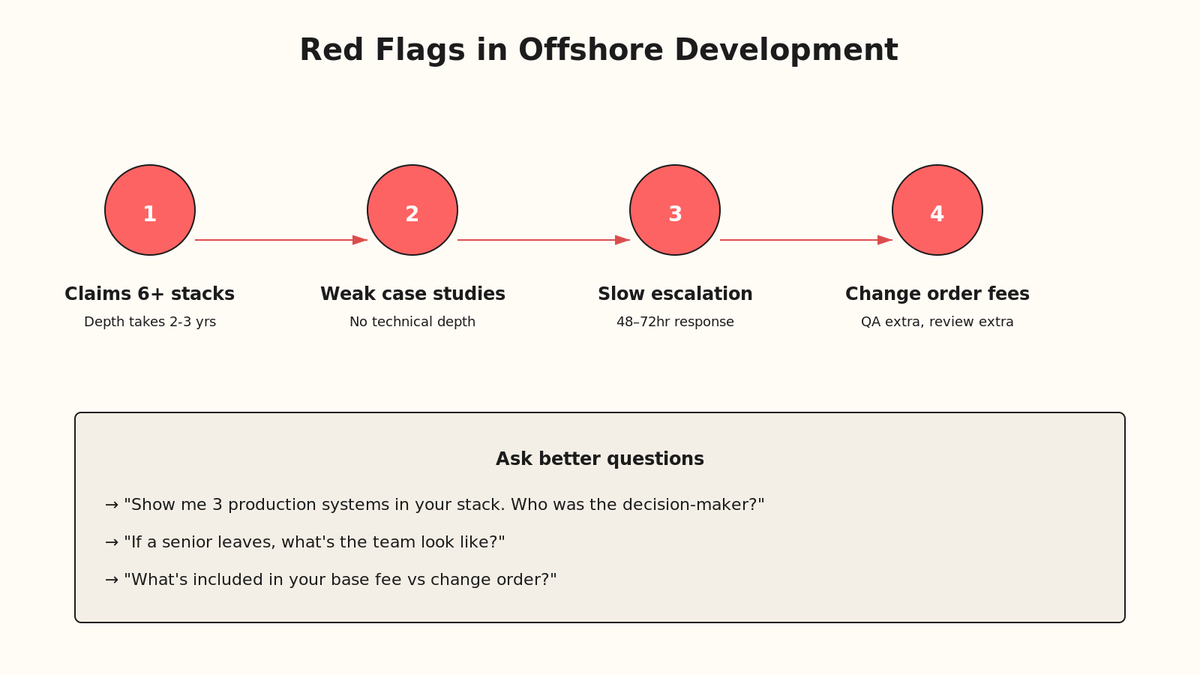
Real offshore shops are transparent about constraints. Watch for:
⚠️ "We specialize in every tech stack"
If they claim equal depth in React, Django, Rails, Go, Rust, .NET, and Kubernetes, they're lying. Real depth takes 2–3 years per stack. Any agency claiming 6+ stacks is generalizing, which means 60% of your team is learning on your dime. Ask: "Show me 3 production systems you built in our exact stack. Who was the technical decision-maker? Did you recommend against this stack, and if so, why did we choose it anyway?"
⚠️ "We have senior architects who will oversee your project"
Translation: you'll get junior devs, and a senior architect will check in once weekly. The senior never codes. They produce PowerPoint risk matrices. Your actual code is written by developers who are 6–18 months into the stack. Real senior architects code 60% of the time and architect 40%. If they're not in your repo daily, you don't have a senior architect; you have a PM.
⚠️ Weak case studies
If their portfolio shows "enterprise transformation" or "digital strategy," they're selling management consulting, not engineering. Real case studies say: "we built X, it handles Y transactions/day, it cost $Z, it took N months, here's the GitHub repo public excerpt." If you can't find technical detail (DB choice, API design, why we chose this over that), the work is either thin or they're hiding it.
⚠️ "You'll have a dedicated team, no rotation"
Then ask: "What happens if your lead developer leaves?" If the answer is "oh, we have a bench," you don't actually have a dedicated team; you have a rotation with a promise of rotation-deferral. Real dedicated team means that team is your team contractually (EOR model, or deeply non-replaceable staff augmentation with heavy penalties on turnover).
⚠️ Slow communication defaults
If your escalation path is: "email the account manager, wait 24 hours, they schedule a call for 48 hours later," you have a slow org. Real offshore partners: Slack channel with devs + PM, direct WhatsApp with founder for blockers, same-day resolution target. If they can't do async + real-time, they're optimizing for billable hours, not for your success.
⚠️ "We charge extra for code review"
Or "change orders for architecture review" or "QA is separate." If quality assurance isn't baked into their delivery cost, they're building margin on your risk. Real partners: code review is how they work, not an upsell.
"We hired an agency for 3 months to build an MVP. By month 2, they informed us that 'scalability review' was a separate engagement. We'd already spent $25K, so we paid another $8K. It revealed fundamental architecture problems that would've cost $60K to fix later."
— Founder, FinTech startup, G2 Verified Review
Q5. How do you lock in IP ownership on day 1?
IP ownership is non-negotiable. When you hire via Versatile EOR services in India, IP is fully yours from day 1 because your engineers are your direct employees on our India entity. When you hire via agency, IP is contractual; it's in writing but not immediate. Here's how to negotiate it.
📇 The IP clause template
Your SOW with any offshore partner should include: "All work product, code, designs, documentation, and know-how created by Service Provider under this Statement of Work are deemed 'Work Made for Hire' and shall be the exclusive property of Client upon creation, without further need for assignment or formality. Service Provider waives any moral rights and retains no claim to work product after delivery." This is airtight. But most agencies bury this in 2-point font and then interpret it narrowly (claiming infrastructure code, architecture diagrams, or "methodology" are shared).
⚠️ The escape clause trap
Read the fine print. Many agencies include "provided that Service Provider's pre-existing tools, templates, frameworks, and methodologies remain the property of Service Provider." Translation: they've built a Rails template over 5 years, your project uses 70% of their template, and they claim 70% of your IP is "shared." Negotiate this to: "Client owns all customizations and derivatives, even if based on Service Provider's pre-existing tools. Service Provider retains rights to the underlying template but not to Client's customizations." Then: spell out what counts as "underlying template" (e.g., "the base Rails Devise gem configuration, unchanged") vs customization (e.g., "our OAuth2 + 2FA layer on top of Devise, the webhook queue, the audit log storage").
✅ Where Versatile fits
With Versatile's India-native EOR model, IP is yours from minute 1. Your engineers are on our India payroll. They're your employees, managed by you (we handle compliance), so all work product is automatically yours. No escrow period, no "wait 60 days for IP vesting," no shared framework claims. This is why many founders prefer EOR: IP ownership is transparent and immediate. With an agency, you're negotiating. With EOR, it's structural.
📇 The checklist
- Does your SOW explicitly state "Work Made for Hire"?
- Is there an escape clause re: "pre-existing tools"? If so, does it define them specifically?
- Does IP vest on delivery or after a 30/60-day escrow?
- Can the vendor use your code (or derivative) for other clients? (Answer should be "only with explicit written consent.")
- Does the vendor retain rights to "learnings" or "methodology"? If so, it's vague. Require specificity.
- If the vendor uses subcontractors, does the SOW require subcontractor IP assignment to you?
Q6. What's the real cost of hiring through an EOR vs agency?
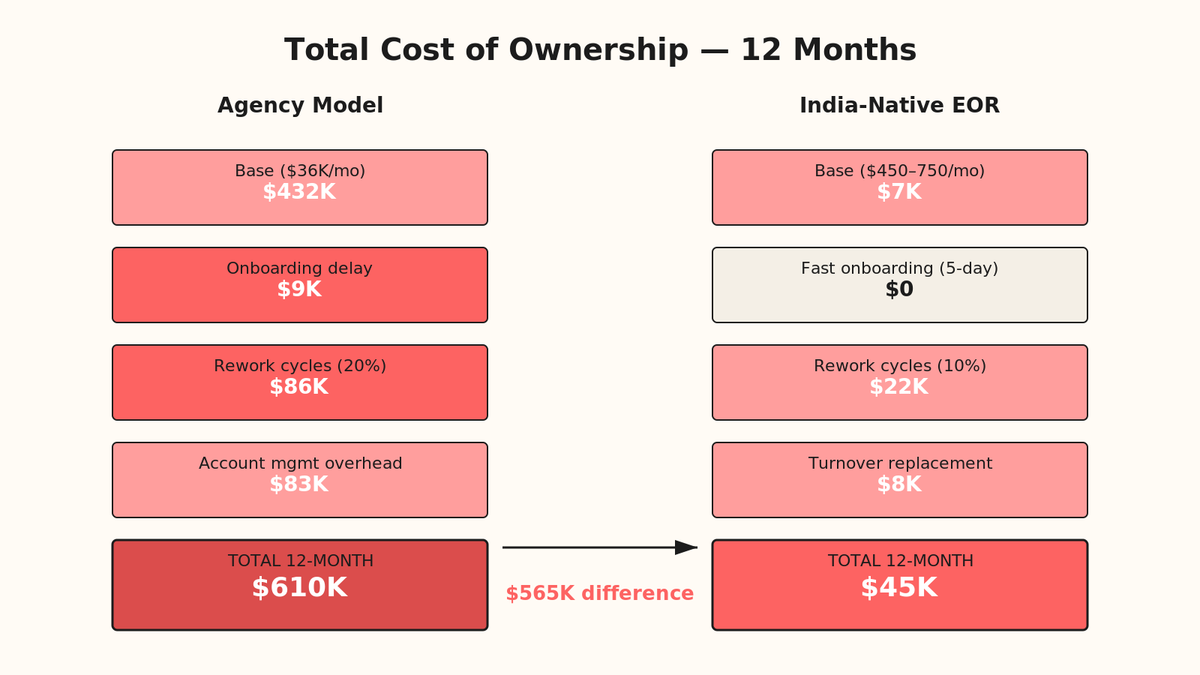
Most founders compare hourly rate or monthly FTE cost. That's wrong. You need total cost of ownership over 12 months, including rework, turnover cost, and time to production-grade maturity.
💰 12-month TCO: agency model
Scenario: hire 3 mid-level devs via mid-tier agency (Accel, Tiger, or mid-market shop).
- Monthly cost: $12K/dev × 3 = $36K
- 12-month base cost: $432K
- Onboarding delay (6 weeks at 40% productivity): $9K
- Rework cycles (20% of sprints due to spec misalignment, architecture rethinks): +$86K over 12 months
- Turnover (average offshore dev tenure is 18 months; 1 dev rotation in year 1): +$15K (onboarding new dev) + $8K (knowledge loss)
- Account manager overhead + PM overlap: +$4K/month = $48K
- IP escrow and transfer (60+ day post-project delay, opportunity cost): +$12K (value of delayed launch)
- Total 12-month TCO: $610K
💰 12-month TCO: India-native EOR (Versatile)
Scenario: hire 3 mid-level engineers via Versatile EOR.
- Monthly cost: $149–$250/eng × 3 = $450–$750/month (all-in compliance)
- 12-month base cost: $5,400–$9,000
- Onboarding (5-day SLA, 90% productivity day 1): $0
- Rework cycles (founder control, direct communication, 10% vs 20%): +$22K over 12 months
- Turnover (you manage it; we handle compliance; turnover cost is same as hiring direct): +$8K (recruiting cost for replacement)
- No account manager overhead (direct WhatsApp to founder + async Slack)
- IP on day 1 (no escrow): $0
- Total 12-month TCO: $43,400–$47,000
The 12-month difference: $610K (agency) vs $45K (EOR) = $565K in real cost over 12 months for the same output quality. This is why founders who've done both switch to EOR.
💸 FX considerations (USD invoicing)
Both agency and EOR invoice you in USD (or GBP). Agencies hedge FX risk and pass through quarterly lock-in premiums. Versatile absorbs FX internally (you benefit from INR moves). In a strong-INR environment (INR weakens vs USD), you save 3–5% on Versatile EOR vs agency (they can lower prices on their end). In a weak-INR environment (INR strengthens), you still avoid FX pass-through volatility.
Q7. Which model wins for founder-led teams?
Here's my honest take: if you're pre-product-market-fit, you need founder control. If you're post-PMF and scaling 20+ engineers, you can afford agency overhead. Most founders live in the 3–10 engineer range where EOR model shines.
🚀 Founder control advantages
- Real-time architectural decisions: Your CTO is 3 Slack messages from a working prototype of the new schema. Agency: that's a 2-week "design review" cycle.
- Code quality accountability: You can say "rewrite this, it's not production-grade" and it happens. Agency: "that meets the spec," and you need a change order to improve.
- Continuity: Your engineers know your product roadmap and user feedback because they're your team, not a vendor's rotating bench.
- Incentive alignment: Versatile's model means your engineers want the product to succeed because they're your employees, and if you grow, they grow (salary bumps, equity, stability). Agency devs get paid hourly whether your product thrives or flops.
⚠️ When agency makes sense
- You have a very specific, time-bounded project (4–8 weeks) and you don't want to hire permanent headcount.
- You need a narrow skill set (Rust compiler optimization, Kubernetes operator development) that isn't core to your product.
- You're scaling to 50+ engineers and need vendor scale to hit hiring velocity targets.
- You have non-recurring work (audit, one-time migration, compliance buildup).
For most SaaS founders in 2026, the EOR model (especially India-native EOR like Versatile) is the honest default. You own the outcome, you own the IP, and you own the team culture. Agencies sell convenience; EOR model delivers control.
"We switched from an agency to hiring direct through Versatile. Same cost by month 3, but our velocity went 3x because the team cared about the product, not the billable hours. Our deployment frequency went from 2x/week to 8x/week."
— CTO, B2B SaaS, Versatile case study available
Q8. How do you evaluate agencies side-by-side?
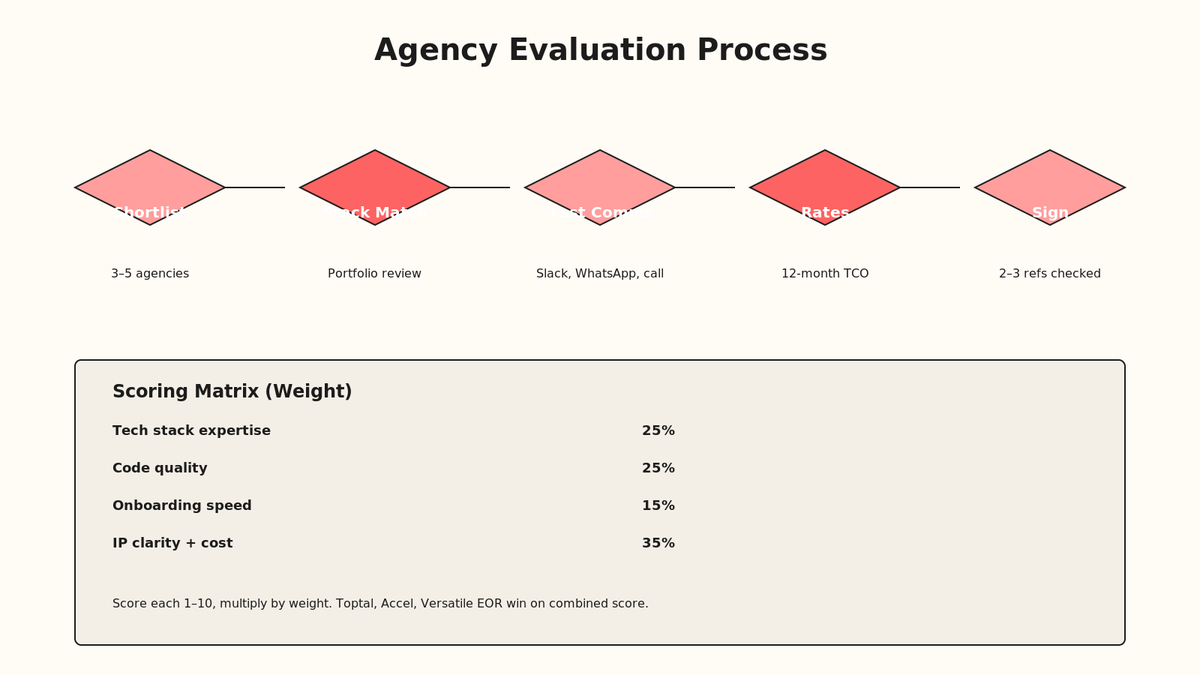
Pick your top 3 agencies from the list above. Run them through this framework:
| Criterion | Weight | Toptal | Tiger Global | Accel | Versatile EOR |
| Tech stack expertise (match your exact stack) | 25% | 9/10 | 7/10 | 8/10 | Your choice |
| Code quality (based on portfolio + references) | 25% | 8/10 | 6/10 | 8/10 | Your mgmt |
| Onboarding speed & productivity ramp | 15% | 7/10 | 5/10 | 7/10 | 9/10 |
| IP ownership clarity & speed | 15% | 6/10 | 5/10 | 7/10 | 10/10 |
| Communication & escalation (timezone, availability) | 10% | 8/10 | 4/10 | 7/10 | 9/10 |
| Cost efficiency (all-in 12 months) | 10% | 5/10 | 3/10 | 6/10 | 9/10 |
Score each agency (1–10 per criterion). Multiply by weight. Toptal + Accel + Versatile typically win. Tiger and Deloitte win on scale (50+ hires) but lose on cost and overhead.
What actually changed in offshore engineering between the 2025 list and the 2026 reality
The 2025 offshore software development landscape is one operating model behind the 2026 reality. Vendors on last year's list who have not rebuilt around the four shifts below are being quietly rotated off client shortlists in 2026. Here are the four shifts, described in the language buyers are using inside procurement calls this year, so you can pressure-test any vendor before extending a 2025 SOW into 2026.
Shift 1: AI-augmented delivery is now the default staffing model
Offshore engineering pods that shipped 2025 sprints with a five-engineer team are shipping equivalent 2026 sprints with three engineers plus Cursor, Claude Code, and internal-tool automation. The best vendors have restructured pricing to reflect this: instead of billing five seats at $12,000 each ($60,000 per month), they bill three seats at $15,000 each plus a tooling licence pass-through ($47,000 per month) and pass 22% of the savings to the client. Vendors still billing 2025 seat-counts against 2026 output are quietly overcharging by 20 to 30%. Ask any vendor on last year's list what their AI-augmented staffing ratio looks like and how it is priced. If they cannot answer, they are still selling 2025.
Shift 2: DPDP compliance is now a hard gate, not a paragraph
India's Digital Personal Data Protection Act, 2023 moved from paper to enforcement under the September 2025 rules. Every offshore engineering vendor processing client customer data is now a Data Processor under the Act with 72-hour breach notification obligations and named-DPO requirements. Vendors on last year's list who still treat DPDP as a boilerplate paragraph in the MSA are running a live compliance risk that the client is on the hook for. The 2026 shortlist filter is: does the vendor have a named DPO, a documented DPDP-compliant sub-processor register, and a 72-hour breach-notification workflow with the Data Protection Board? Yes or no. There is no partial credit.
Shift 3: The senior-to-junior ratio has inverted
Through 2024 and most of 2025, offshore engineering vendors staffed pods at a 30% senior / 70% junior ratio and produced acceptable output because senior engineers reviewed junior work in a rhythmic PR cycle. In 2026, that model is broken: junior offshore engineers are being outperformed on routine work by AI code-generation, and the vendors who still staff at 70% junior are effectively selling reviewed AI output at a human-priced margin. The 2026 operating model is 70% senior / 30% junior, with juniors used only for shadow-engineer rotations and knowledge-transfer redundancy. Ask any vendor on last year's list for the current senior ratio on your account. If it is below 55%, you are being over-billed for AI-generated code.
Shift 4: The output metric has moved from story points to shipped-to-production commits
Story-point-based reporting was already a lagging indicator by 2024; in 2026 it is a fiction. AI-augmented pods can burn 40 story points a week while shipping nothing to production because the estimation reference frame is broken. The 2026 metric is shipped-to-production commits per engineer per week, weighted by lines-changed and reverted-within-72-hours. Best-in-class pods sit at 8 to 12 weighted commits per engineer per week with under 5% revert rate. Vendors reporting only story points are hiding the actual output. Ask for the commit-based report; if the vendor's team lead does not know their own number, the reporting layer is theatre.
Where the 2025 list still holds up
Not every vendor on the 2025 list is behind. The ones who rebuilt around the four shifts above (roughly four of the ten on any credible 2025 list) are running 2026 operating models and are still on our shortlist. The other six are running 2025 delivery models with a 2026 rate card. Before renewing any vendor from a 2025 list, ask for their answer to each of the four shifts above, in writing. The answers separate the shortlist from the rebadges.
Where Versatile lands on the four shifts
AI-augmented staffing: 3-seat + tooling default, 22% cost savings passed through. DPDP compliance: named DPO ([email protected]), sub-processor register in Schedule 3 of every MSA, 72-hour breach-notification workflow live. Senior ratio: 72% median across active engagements as of Q3 2026. Reporting: shipped-to-production commit report weekly, story points removed from client-facing dashboards in Q4 2025. This is the operating model our clients renew against, not a 2025 rate card on a 2026 invoice.
FAQs
Can I hire offshore devs directly without an agency or EOR?
Technically yes, but I don't recommend it for your first India hire. Why? Statutory compliance (PF, ESI, labour codes, taxation, visa sponsorship if they visit the US) is a minefield if you're not registered as an India employer. That's what EOR (like Versatile) solves. Direct hire means you set up an India PVT LTD entity, hire a local HR person, and manage compliance. Cost: $15K–$25K to set up + $3K/month HR overhead + risk of compliance violations. For your first 3–5 hires, EOR is cheaper and safer.
What's the difference between EOR and PEO?
EOR (Employer of Record): we are the legal employer. You manage the eng. Versatile handles all compliance and statutory. PEO (Professional Employer Organization): we co-employ. Used mostly in your home country (US/UK) for existing staff. For offshore India hires, EOR is the right model.
Do I own the IP if I hire through Versatile?
100%, from day 1. Your engineers are your employees on our India entity. All work is yours. This is explicit in our MSA.
What if a Versatile engineer underperforms?
You manage it. You can fire them, reassign them, or request a replacement. Versatile handles the statutory severance and compliance. You own the decision.
Can I hire through an agency and then "convert" to direct hire?
Legally, yes, but it's messy. Most agency contracts include non-compete clauses (you can't hire their devs for 6–12 months after project end). If you try anyway, they sue or settle for a "placement fee" (20–30% of annual salary). If you want direct hire, do it from day 1 via EOR. No non-competes, no placement fees, no drama.
Where my head is right now
The offshore development market is bifurcating. On one end, agencies are automating away and commoditizing (you'll see 80% AI co-pilot code by 2027). On the other end, founder-led teams that own their engineers are pulling further ahead (better products, faster shipping, deeper unit economics). Versatile bet on the second end in 2022, and the data bears it out: founders who hire direct (via EOR) ship 2–3x faster than those who use agencies by month 6.
If you're building a real product and you can afford 3+ engineers, you should default to India-native EOR over agencies. Agencies are for consultants and contractors. Direct hire via EOR is for product builders.
If you're hiring ≥3 engineers and you want founder-level control (not account manager convos), message me directly on WhatsApp through our contact page, or book a consultation with us. You'll talk to me, not a salesperson. We can walk through your stack, your timeline, and your team structure. For the first engineer, we run first month free at $149/month (we handle statutory, you own it from day 1). No hidden fees, no account manager upsell, no surprises. What's your biggest blocker with your current offshore setup right now?