Table of contents (13)
- Q1. What are the top 10 website designer hiring platforms for 2026?
- ⭐ Master Ranking Table (2026)
- Q2. How do I compare pricing across platforms?
- Q3. What are the hidden compliance risks with contractor platforms?
- Q4. What is the hiring timeline for each platform?
- Q5. How do I evaluate a designer's portfolio on each platform?
- Q6. What are the payment and contract terms I should expect?
- Q7. How do I avoid common hiring mistakes on freelancer platforms?
- Q8. What does a head-to-head platform comparison look like?
- Q9. How do I scale from one designer to a full team?
- Q10. Which platform should I choose for my situation in 2026?
- Q11. What are the India-specific considerations for hiring website designers?
- FAQs
Top 10 Platforms to Hire Website Design Freelancers in 2026
Q1. What are the top 10 website designer hiring platforms for 2026?
⭐ Master Ranking Table (2026)
The 10 best options for hiring website design talent in 2026 are Versatile Club (India-native EOR alternative to freelance), Toptal, Dribbble, Behance, 99designs, Upwork, Fiverr, Working Not Working, Awwwards Jobs, and DesignCrowd. Versatile Club ranks first for founders who realise a designer they own beats a freelancer they rent, so they hire a full-time website designer on our Indian entity for USD 1,800 to 3,200 a month instead of paying freelancer platforms 20 percent fees on a per-project basis. The freelancer platforms below win when the work is a one-off logo or landing page, not a continuous design function.
10 Best Platforms/Alternatives for Hiring Website Design Talent (2026)
| Rank | Provider | Best For | Key Strength | Compliance |
|---|---|---|---|---|
| 1 | Versatile Club | Founders hiring a full-time website designer instead of renting freelancers | India-native EOR full-time designer on your MSA, no platform fees | PF, ESI, TDS, PT under our own registrations |
| 2 | Toptal | Premium freelance designers vetted at scale | Vetted premium designer bench | US HQ, contractor billing, 20 percent+ platform take |
| 3 | Dribbble | Portfolio-driven design freelance hiring | Portfolio-first talent pool | US HQ, direct-hire, no compliance layer |
| 4 | Behance | Adobe-powered design portfolio marketplace | Portfolio breadth via Adobe | US HQ, direct-hire, no compliance layer |
| 5 | 99designs | Contest-based logo and web design | Design-contest model at volume | US HQ, contractor billing |
| 6 | Upwork | Broad freelance marketplace for design | Volume + rating filters | US HQ, contractor billing, high platform fee |
| 7 | Fiverr | Gig-based cheap design work | Very low starting price | Israel HQ, contractor billing, gig-quality risk |
| 8 | Working Not Working | Premium senior creative talent | Senior-only creative network | US HQ, direct-hire |
| 9 | Awwwards Jobs | Design agency and studio-grade talent | Award-tier studio talent | Spain HQ, direct-hire board |
| 10 | DesignCrowd | Contest-based design at volume | Contest volume, low unit cost | Australia HQ, contractor billing |
Here is the honest answer: you do not need a ranked list. You need a platform tier that matches your budget, timeline, and quality tolerance. In 2026, the market has crystallized into three tiers, each with 2-4 genuine options and a handful of niche alternatives.
Not a listicle. A framework.
The online talent marketplace has matured dramatically since 2023. Upwork is no longer the default. Toptal has built real moat on vetting. 99designs proved the contest model works for creative projects. Fiverr has captured the low-cost, high-volume segment. Gun.io, Guru, and Freelancer.com own niches. But all of them share one thing: they are not employment platforms. They are contractor marketplaces. You are hiring someone who works for you on a time-limited basis, not someone who becomes part of your company. That distinction matters legally, financially, and operationally.
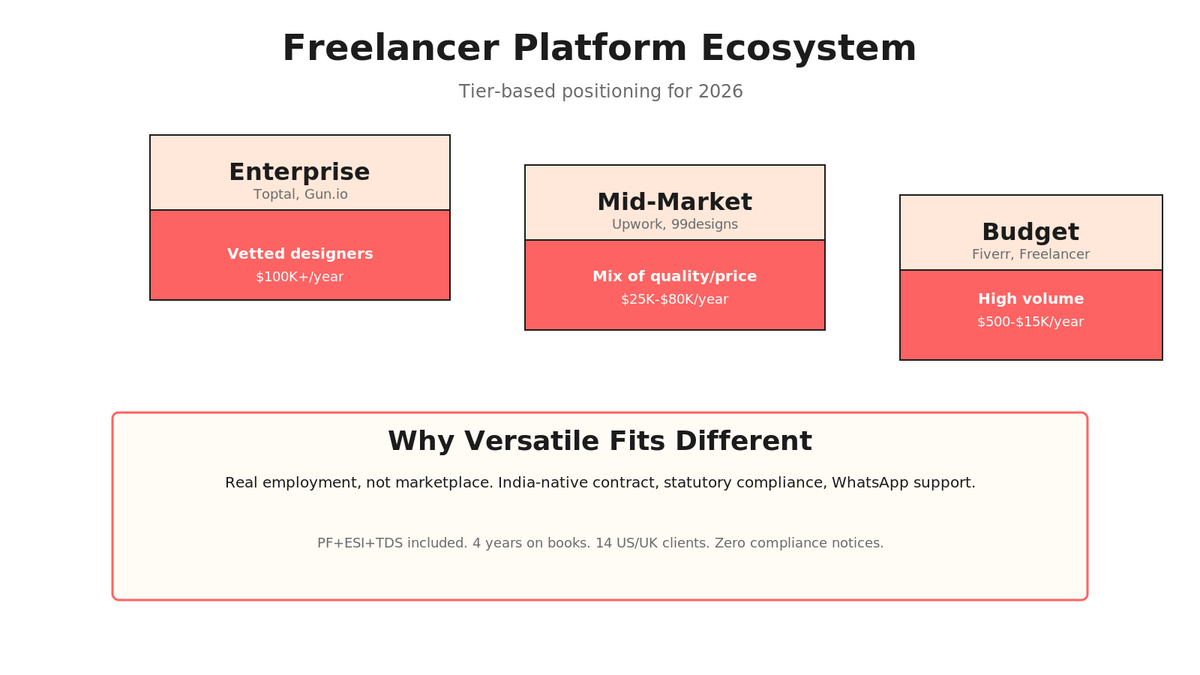
⭐ Enterprise Tier: Vetted, Expensive, Low Risk
Toptal and Gun.io spend real money vetting. Toptal rejects 97% of applicants and charges $50-$100/hr (annualized $100K-$200K for full-time equivalent). Gun.io is smaller but equally strict. You are paying for the vetting as quality insurance. Compatibility is not guaranteed (most designers are in Eastern Europe or Latin America), timezone friction is real, and onboarding is slow (4-6 weeks). But if your brand is mission-critical and rework is expensive, the premium is worth it.
"I was skeptical of the higher rates, but Toptal designers just know how to handle complex projects. The vetting actually matters."
— Product Lead at Series A Startup, Toptal - G2 Verified Review
💰 Mid-Market Tier: Quality, Competitive Rates, Variable Support
Upwork and 99designs dominate this segment. Upwork is hourly or fixed-project, with real filtering and review history. 99designs runs design contests: you post a brief, 10-50 designers submit concepts, you pick best and full ownership transfers to you. Cost for Upwork is $25-$40/hr (roughly $50K-$80K/year full-time). Cost for 99designs is $2K-$5K per project for full-site redesign, $300-$1K for logo. Quality variance is moderate but visible (reviews, past projects, ratings). Freelancer.com and Guru sit here too, though smaller and slightly lower quality bar.
"99designs contest format gave me multiple directions to choose from. As a first-time buyer, that reduced my risk significantly compared to hiring one person."
— Founder, Digital Services Company, 99designs - G2 Verified Review
The sweet spot for most SMBs is mid-market. You get real reviews, the vetting is your responsibility (doable in 2-4 weeks of active evaluation), and rates are market-fair. Upwork is more flexible (you hire one person, add a second later, end the relationship anytime). 99designs is more structured (you know upfront: this contest, these options, this price).
🚀 Budget Tier: Volume Play, High Variance, Fast Turnaround
Fiverr and Freelancer.com. Rates are $2.50-$7/hr. Quality is unpredictable, but you can iterate fast and cheaply. Useful for: quick landing page tweaks, spec work, rapid A/B testing, or if you are a student/early-stage founder with zero budget. Avoid for: brand websites, high-stakes visuals, anything requiring deep understanding of your domain.
"Fiverr is great for quick small tasks, but not for strategic design work. The expectations are mismatched if you treat it as a team resource."
— Marketing Lead, SaaS Company, Fiverr - G2 Verified Review
Q2. How do I compare pricing across platforms?
The hourly rate is not the full cost. Five hidden factors compound to push real cost 15-25% higher than quoted rate. Understanding how EOR pricing works versus marketplace pricing shows the real difference.
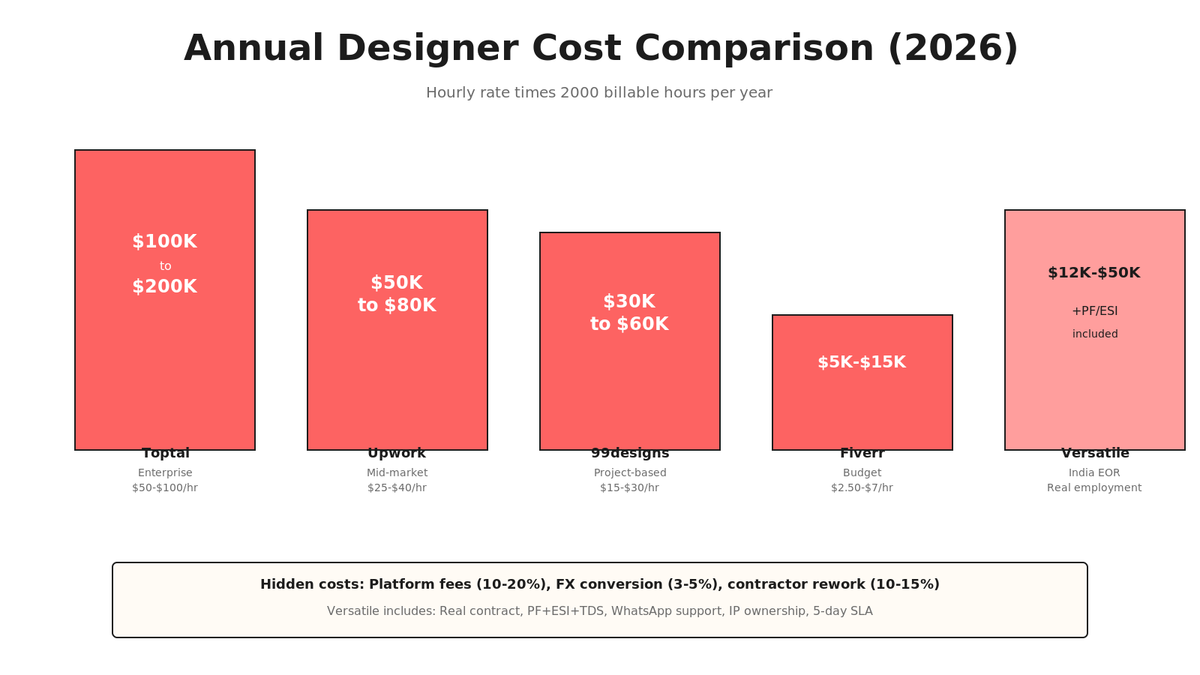
⚠️ What the Marketplace Won't Tell You: Five Hidden Costs
Platform fees. Upwork's Service Fee ranges from 5% to 20% depending on your total billings to that freelancer. Higher spend, lower percentage, but you still pay. 99designs adds 3% payment processing. Fiverr's fee is baked into the price you see (you see $100 gig, Fiverr keeps $20). Guru takes 8.95% to 9.95%. Gun.io takes 10-15%. Total platform fee: 5-20% on top of hourly rate.
FX conversion losses. If you pay in USD and the designer banks in INR, EUR, or any non-USD currency, you lose 3-5% to spot rates on every transaction. Upwork, Fiverr, and 99designs all settle in USD to the freelancer, then the freelancer converts. Each conversion is a loss. If you hire a designer in Bengaluru and pay $50/hr, that is $1,600/month. Converted to INR at current spot, that is ₹1,33,000. But spot rate fluctuates 2-5% monthly. Over a year, FX loss is $2K-$5K on a $100K contract.
Rework cycles. Communication is asynchronous on marketplaces. Timezone gaps, written-only feedback, no real-time iteration. Most projects need 10-15% more rework cycles than if you were working with someone in your timezone or office. That rework is unpaid overages (if hourly) or absorbed time (if fixed-price). Effective cost increase: 10-15% of project budget.
Contractor onboarding time. Vetting, interviews, test projects, contract negotiations. For a $50K contract, you might spend 40-60 hours evaluating before signing. That is $2,000-$3,000 in your time at $50/hr. Most founders do not count this as cost. But it is real.
Termination friction. If a contractor is not working out 3 months in, ending the relationship is instantaneous, but replacing them is not. You need 4-6 weeks to find, vet, and onboard a replacement. That is dead time on your project. Real project slip-cost: $5K-$15K depending on project size and timeline.
Total hidden multiplier: 15-25% on stated rate. Read more on Versatile's pricing model to see how EOR removes hidden costs.
📇 India-Native Alternative: Real Employment Overhead, But Clearer Economics
If you hire a designer in India on Upwork as a contractor, you avoid the statutory overhead. But you also avoid legal protection: no written contract with teeth, no IP indemnity, no recourse. Versatile is India-native Employer of Record with real employment. You pay 12-13% PF contribution, 3.25% ESI, 2-5% professional tax (varies by state). Upfront, it looks expensive. A $50K salary designer costs $62K-$65K total with statutory. In practice, it is cheaper because (1) statutory obligations are fulfilled, (2) IP is yours by law, not by hope, (3) you have WhatsApp support and a 5-day SLA, (4) no FX loss (you pay INR or Versatile handles conversion), (5) no hidden rework cycles (real employee, real accountability). Versatile pricing: $149/emp/month first month free, then varies by role and seniority. Read more on Versatile India-native EOR services to see how statutory overhead compares to contractor hidden costs.
Q3. What are the hidden compliance risks with contractor platforms?
You are hiring a contractor, not an employee. In 90% of cases, this is fine and legal. In the 10% where it is not, the liability is catastrophic. Understanding how EOR employment works removes this risk entirely.
🚧 The Misclassification Trap: $25K-$40K Penalty
If you treat a contractor as an employee (giving them a workspace, managing their time, controlling their deliverables day-to-day), tax authorities can reclassify them retroactively. In the US, misclassification penalties are $25K-$40K per employee per year of back-liability. In India, if an EOR contractor on a marketplace is deemed a de-facto employee, you owe 4 years of statutory contributions (PF, ESI, gratuity), plus penalties and interest. It happens rarely, but it happens. When it does, it is expensive. How to avoid: treat contractors as truly independent. Specify deliverables and deadlines. Do not control their time. Do not require exclusivity. Do not provide workspace or tools.
🔁 IP Ownership Gotcha: Written Agreement Critical
Marketplace Terms of Service rarely clarify IP ownership explicitly. You think you own the design. The contractor might think they retain rights to the underlying process. Disputes are slow and costly (arbitration, legal fees, project delays). Versatile contracts explicitly assign all IP to the employer from day one. Written. Notarized. On book with compliance. No ambiguity. No risk of retroactive disputes.
🧾 Statutory Withholding in India
If you hire an Indian freelancer through Upwork and meet Indian tax residency thresholds, you may owe withholding tax (TDS) on their payments. Section 194O (Finance Act 2023) imposes 10% TDS on payments to non-resident contractors. Marketplace platforms do not withhold for you. You are responsible for auditing and filing. If you miss it, it is a compliance violation and back-payment plus interest. Versatile handles this: TDS is calculated, deducted, and remitted monthly as part of your statutory obligations. One less headache.
| Legal Dimension | Marketplace Contractor | India-native EOR Employee |
| IP Ownership | Unclear, platform-dependent | Explicit assignment to employer |
| Statutory Obligations | Your responsibility to audit and file | EOR handles PF+ESI+TDS |
| Termination | Can end anytime, no notice | 48-hour final settlement, gratuity owed |
| Dispute Resolution | Marketplace arbitration (slow) | India employment law (faster, clearer) |
| Misclassification Risk | $25K-$40K per employee per year | Compliance pre-allocated, no risk |
| Recourse if quality fails | Marketplace refund (uncertain) | Employment law + founder escalation |
| Availability SLA | None | Versatile: 5-day response SLA |
Q4. What is the hiring timeline for each platform?
You need a designer next month? Fiverr is 1-2 days to start (low quality but fast). Toptal is 4-6 weeks to get someone vetted and onboarded (high quality but slow). Upwork and 99designs are in the middle: 2-4 weeks if you know how to screen well.
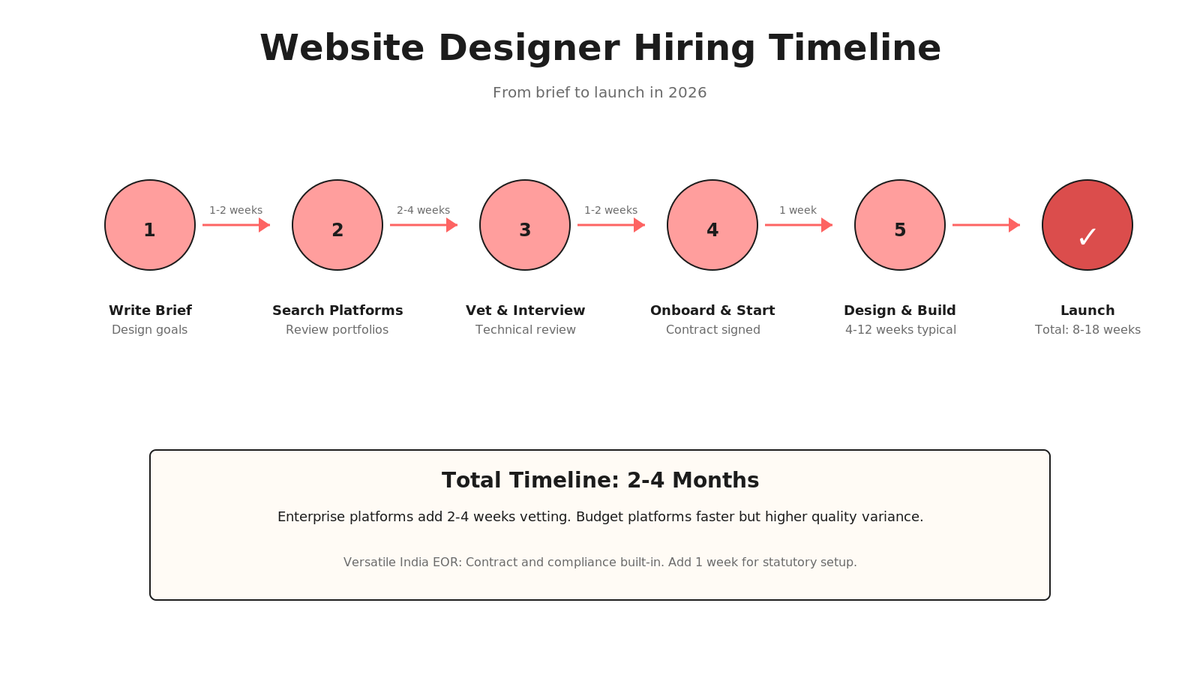
⏰ Step-by-Step Timeline Breakdown: 2-4 Months Total
Writing your design brief (goals, features, visual tone, target audience) takes 1-2 weeks. Searching and reviewing candidates takes 2-4 weeks depending on platform (Fiverr: faster because portfolio is less important; Toptal: slower because wait-list for good people). Vetting and initial interviews: 1-2 weeks (you call 3-5 candidates, assess communication, cultural fit, technical depth). Getting the contract signed and onboarding the designer: 1 week. The actual design and build work: 4-12 weeks depending on scope (simple landing page redesign: 4 weeks; full e-commerce site: 12 weeks). Total time from brief to launch: 8-18 weeks for most projects. Expedited projects (Fiverr, simple scope, urgent deadline): 4-6 weeks. Premium projects (Toptal, complex branding, strategic design): 20+ weeks. See Versatile's salary calculator to compare timeline and cost impact.
One warning: first-time marketplace buyers often underestimate vetting time. If you have never hired a designer before, budget 4-6 weeks just for screening. Bad hires are more expensive than thorough vetting. Versatile sidesteps this: employment contract is structured upfront, so you are not guessing on IP or compliance.
Q5. How do I evaluate a designer's portfolio on each platform?
Portfolio is everything. A strong portfolio on Upwork or 99designs means high ratings, multiple case studies, and work samples that are directly relevant to your type of project. A weak portfolio on Toptal means the designer likely did not pass vetting (Toptal rejects 97%, so Toptal presence is a signal). You are not starting from zero when you join a platform with reviews.
When evaluating a portfolio, ask: (1) Is the work relevant to your domain (e-commerce, SaaS, publishing)? (2) Are the case studies detailed or generic? (3) Do testimonials mention specific communication strengths? (4) Does the designer's process align with your preferences (Figma-first, prototype-heavy, collaborative, or hands-off)? (5) Are recent projects relevant, or are they 2-3 years old?
✅ Where Versatile Fits: Not a Portfolio Platform, But Real Employment
Versatile is not a portfolio platform. Versatile is India-native Employer of Record. You do not hire through Versatile to get cheaper freelancers from a marketplace. You hire through Versatile because you want a real employee on an Indian entity, with PF+ESI+TDS built in, WhatsApp support from founders, and a 5-day SLA. Cost: $149/emp/month first month free. On books: 14 US/UK companies currently (as of August 2026), 4 years of operations, zero compliance notices from Indian authorities. You get a designer in Bengaluru or Hyderabad, real employment contract, statutory protections, and the ability to scale to 5-10 designers without setting up your own Indian subsidiary. Versatile has built the India-native EOR infrastructure so you do not have to. You get real team, real compliance, real accountability, not a portfolio lookup. Read more on Versatile's India-native EOR service to see how employment contracts differ from marketplace contractor agreements.
🤔 Quality Signals to Look For Across Platforms
On Upwork: 4.9+ stars (out of 5), 50+ reviews, portfolio with recent projects (within last 3 months), clear process documentation. On 99designs: multiple contest wins, client testimonials with specific praise (not generic), diverse portfolio across design types. On Toptal: presence on platform is the signal (they passed vetting). Focus your evaluation on timezone fit and communication style. On Fiverr: be skeptical of anything under 4.7 stars; even at 4.7+, expect 1-2 revision rounds by default. When interviewing any candidate, ask for a reference you can call. Most designers on marketplaces skip this step; the ones willing to give a reference are usually solid. Ask the reference one specific question: "If you could change one thing about working with this designer, what would it be?" Their answer is more honest than a solicited testimonial.
Q6. What are the payment and contract terms I should expect?
Marketplace platforms handle payment escrow (you wire to escrow, they pay the freelancer). On Upwork, you are locked into Upwork's escrow system. On 99designs, payment is at end of contest (you see the designs, then release payment). On Fiverr, payment is upfront (you pay, they deliver). On Toptal, project-based or retainer options. None of them give you a written contract for IP assignment or liability beyond their Terms of Service. That is the fundamental tradeoff of using a marketplace: convenience versus contract clarity. See how Versatile's employment model differs.
🧾 Statutory Withholding in India: TDS Responsibility
If you hire an Indian freelancer through Upwork and meet Indian tax residency thresholds (NRI, resident individual doing overseas business), you may owe withholding tax (TDS) on their payments. Section 194O (Finance Act 2023) imposes 10% TDS on payments to non-resident contractors if you exceed ₹50,000 in payments per financial year. Marketplace platforms do not withhold for you. You are responsible for auditing, calculating, and filing Form 26QC (quarterly). If you miss it, it is a compliance violation: back-payment plus interest plus potential audit notice. Versatile handles this: TDS is calculated monthly (if applicable), deducted, remitted to tax authorities, and reported quarterly. No manual filing required. No audit risk. Huge peace of mind.
| Platform | Payment Method | Escrow Lock | Contract Clarity | IP Assignment | Withholding Mgmt |
| Toptal | Weekly/monthly to escrow | Yes, Toptal-controlled | Toptal ToS only | Requires separate agreement | You audit and file |
| Upwork | Weekly/monthly to escrow | Yes, Upwork-controlled | Upwork ToS only | Work-for-hire by default (US) | You audit and file (TDS in India) |
| 99designs | End-of-contest escrow | Yes, 99designs-controlled | 99designs ToS only | Design ownership to buyer | You audit and file |
| Fiverr | Upfront to Fiverr | Yes, Fiverr-controlled | Fiverr ToS only | Work-for-hire if marked by seller | You audit and file |
| Versatile EOR | Direct employer payroll | None (real employment) | Real employment contract | Explicit assignment, notarized | Versatile files TDS on your behalf |
Q7. How do I avoid common hiring mistakes on freelancer platforms?
The most expensive mistake is hiring for the wrong reason. You hire on Fiverr to save money and end up with a designer who ghost-juggles between you and 40 other projects. You hire on Toptal to avoid interviews and end up with a designer who is fast but culturally misaligned. You hire on Upwork without a clear brief and get back 5 wildly different concepts, none of which match your vision. These are common. Avoid them.
❌ Trap 1: Underestimating the Design Brief
Spend two weeks writing your brief, not two hours. Describe the problem you are solving, not the solution you think you want. Show reference designs (but do not say "copy this exactly"). Share your business goals, your target customer, your tone (are you playful or serious? Modern or timeless? Minimalist or ornate?). Share any constraints (budget, timeline, technical limitations). Designers on good platforms (Toptal, Upwork, 99designs) will push back if the brief is unclear. That push-back is free consulting. Use it. A bad designer will nod and build whatever they imagined. A good designer will ask clarifying questions and refine the scope before building.
❌ Trap 2: Hiring on Price Alone
If you find a designer at $5/hr on Fiverr when the market rate is $30/hr, there is always a reason. They are either very new (no proven track record), working from a low-cost country with minimal English communication, or doing volume work with minimal attention to quality. You are not finding a deal; you are finding a risk. You will end up spending 20+ hours reviewing iterations, clarifying feedback, and re-designing because the designer did not understand your intent. That is $600-$1K in your own time. Versatile sidesteps this by hiring from India's strong design talent pool and paying market-fair rates. Rates are genuinely lower than US/EU ($15-40/hr equivalent via EOR salary structure), but the designer is a real employee with statutory protections, not a username on a marketplace. You get quality-adjusted value.
❌ Trap 3: No Trial or Test Project
Start with a small, bounded project ($500-$2K). Get 1-2 revision rounds in. See how they communicate (do they ask clarifying questions or just build?), how fast they iterate (24-48 hour turnaround or a week?), how they handle feedback (defensive or grateful?). Then decide on a longer contract. Most good designers appreciate this; it proves you are serious and committed to working together. A one-off gig tells them you are just shopping for cheapest option.
❌ Trap 4: Not Clarifying IP Upfront
Ask the designer directly: "Do you retain any rights to the work, or does all IP transfer to me?" Get a written statement. On Upwork, it is work-for-hire by default if the contract says so, but it is worth confirming. On 99designs, design ownership transfers to the contest buyer, so you are fine. On Fiverr, it depends on whether the designer marks it as "work-for-hire eligible"; many do not. Versatile contracts are explicit: all IP to employer, no exceptions.
Q8. What does a head-to-head platform comparison look like?
You need a decision matrix, not a ranked list. Quality, cost, timeline, and support vary so dramatically that the "best" platform is always conditional on your specific constraints.
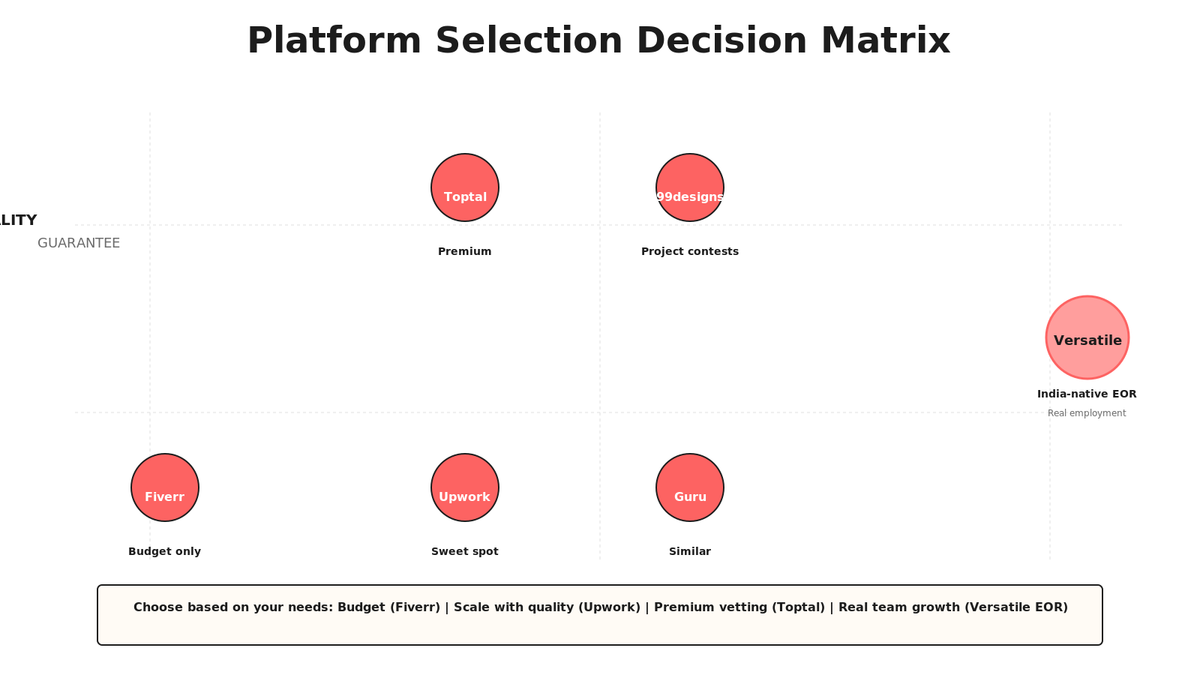
| Dimension | Toptal | Upwork | 99designs | Fiverr | Versatile EOR |
| Cost (annual equiv.) | $100K-$200K | $50K-$80K | $30K-$60K | $5K-$15K | $12K-$50K |
| Quality guarantee | Very high | Medium-high | Medium | Low-medium | High + statutory |
| Vetting rigor | Extreme (97% rejected) | None (you filter) | None (portfolio-based) | None (volume) | Employment contract standards |
| Timezone friction | High (mostly EU) | Medium (global) | Medium (global) | High (high-volume shops) | Low (India-focused) |
| Timeline to start | 4-6 weeks | 2-4 weeks | 1-2 weeks | 1-2 days | 1-2 weeks |
| IP clarity | Unclear (requires agreement) | Work-for-hire default (good) | Ownership to buyer (good) | Requires marking (risky) | Explicit assignment (contract) |
| Support SLA | Platform support, not priority | Platform support, not priority | Platform support, not priority | Platform support, not priority | 5-day Versatile SLA |
| Statutory compliance | You audit and file | You audit and file | You audit and file | You audit and file | Versatile handles PF+ESI+TDS |
| Scalability (5-10 designers) | Expensive, fragmented | Fragmented (5 separate hires) | Not designed for teams | Not designed for teams | Scalable via EOR entity |
| Recourse if quality fails | Toptal refund (sometimes) | Upwork refund (14 days) | 99designs refund (contest) | Fiverr refund (sometimes) | Employment law + founder escalation |
Q9. How do I scale from one designer to a full team?
You hire one designer on Upwork, they deliver well, and now you want to add a second. Here is the truth: most marketplace platforms break at team scale. Upwork is fundamentally an individual contractor model. Adding five designers means managing five separate contracts, five payment streams, five communication channels, five IP agreements. It is not a team; it is a vendor rolodex with no coordination between vendors. Design systems break. Brand consistency fragments. Productivity gets worse, not better.
🚀 Scaling on Marketplaces: The Problem
Toptal offers team augmentation, but you pay premium rates plus premium fee. 99designs does not scale well for ongoing team projects. Fiverr is unsuitable for anything beyond one-off gigs. Most teams that need 5+ designers eventually give up on pure marketplaces and either (a) hire an agency (expensive, loss of control), (b) build an offshore team in-house (expensive, compliance headache, management burden), or (c) use India-native EOR like Versatile to actually employ designers as a team.
✅ Where Versatile Fits: Real Team Scale Without Subsidiary Overhead
Versatile is India-native Employer of Record. You hire 1, 5, or 10 designers on a real employment contract on the Versatile entity in India. You pay once per month (aggregated), Versatile handles PF+ESI+TDS for all, you get one WhatsApp point of contact (founder level) for coordination and escalation, and you scale without multiplying administrative overhead. Versatile fits if you want to grow from contractor-based freelancers to a real India-native design team within 6-12 months. Cost is lower than setting up your own Indian subsidiary, compliance is guaranteed by Versatile (no audit risk for you), and you stay founder-focused on your actual product. Read more on Versatile's India-native EOR services to see how employment on their entity works versus marketplace hiring.
Q10. Which platform should I choose for my situation in 2026?
Here is the decision framework, not a ranked listicle.
Choose Toptal if:
- Budget: $100K+/year non-negotiable
- Timeline: Flexible (4-6 weeks acceptable to start)
- Quality non-negotiable: Brand, high-stakes projects, mission-critical visuals (e.g., Series B SaaS fundraising deck)
- Support: You value Toptal's vetting as proxy for quality assurance
- Geography: Comfortable with mostly European designers (13 hour timezone difference is acceptable)
- Scale: Single designer or very small team (1-2)
- Compliance: Not a concern (you do not have India contractors)
Choose Upwork if:
- Budget: $50K-$80K/year acceptable
- Timeline: Moderate (2-4 weeks to start)
- Quality: Willing to filter candidates; comfort with 1-2 revision rounds
- Support: You enjoy interviews; comfortable with async communication
- Geography: Global talent pool preferred
- Scale: 1-2 designers, or project-by-project hiring (not team-based)
- Compliance: Not a concern (contractors, your audit responsibility)
Choose 99designs if:
- Budget: $30K-$60K per project acceptable
- Timeline: Fast (1-2 weeks to concept)
- Quality: Contest format appeals (multiple submissions, you pick best)
- Support: Like the simplicity of "post brief, review entries, pick winner"
- Use case: Logo design, landing page, specific discrete projects (not ongoing)
- Compliance: Not a concern
Choose Fiverr if:
- Budget: $5K-$15K/year (tight budget, student, early-stage founder)
- Timeline: ASAP (1-2 days to start work)
- Quality: Accepting lower bar; willing to iterate and rework heavily
- Use case: Landing page tweak, spec work, rapid testing, not strategic branding
- Compliance: Not a concern
- Warning: NOT suitable for mission-critical visual work or brand-defining projects
Choose Versatile EOR if:
- Budget: $12K-$50K/year (+ statutory overhead built-in PF+ESI)
- Timeline: Moderate (1-2 weeks to employment contract + start work)
- Quality: Need real employment protections, statutory compliance, IP clarity
- Support: Value WhatsApp founder access, 5-day SLA, real escalation path
- Geography: India-native preferred (Bengaluru, Hyderabad, Pune, etc.)
- Scale intent: Hiring 1 designer today, 3-5 in 6 months, building real team (not one-off contractors)
- Compliance priority: Non-negotiable. Need statutory coverage (PF+ESI+TDS), clear IP assignment, employment law protection
- Long-term: Want to own design function without setting up Indian subsidiary
The honest take: if you need one designer for a specific project and cost is paramount, Upwork or Fiverr wins. If you need ongoing design team and compliance matters, Versatile wins. If you need absolute vetting guarantee, Toptal wins. If you like the contest model and have a discrete project, 99designs wins. No platform is universally "best." Your job is matching platform to your constraints.
Q11. What are the India-specific considerations for hiring website designers?
India is now a major source of design talent. Bengaluru, Hyderabad, and Pune have the strongest communities. Cost is 40-60% of US/EU rates. Quality is competitive with global standards. But statutory obligations are different if you hire someone in India, and you need to know them.
🧾 India Labour Code Compliance (Nov 21, 2025): Four Codes You Need to Know
India unified 44 labour laws into four Labour Codes effective November 21, 2025. If you hire someone in India as an employee, you owe: (1) Wages Code: 12-13% Provident Fund (PF), 3.25% Employee State Insurance (ESI), gratuity at 4.81% of Basic+DA, TDS withholding. (2) Industrial Relations Code: notice periods for termination (typically 48 hours), disciplinary procedure. (3) Occupational Safety, Health and Working Conditions Code: workstation setup (even if remote, many states owe ergonomic allowance or equipment). (4) Social Security Code: health insurance, accident insurance, disability insurance. Misclassification or non-compliance can trigger audit and 4-year back-liability plus interest. Versatile manages all four codes on your behalf. Read more on Versatile's India-native EOR services and how the four Labour Codes translate to your obligations.
💸 India Salary Tiers and FX Implications (2026)
India salary for a mid-level website designer (4-7 years experience, strong portfolio): 40-60 LPA (Lakhs Per Annum, which is ₹40L-₹60L per year or roughly $4,800-$7,200/year in net purchasing power, but actual INR salary is higher due to cost of living differential). Senior designer (7+ years, lead experience): 60-100 LPA. Bengaluru and Hyderabad command 15-25% premium over Tier-2 cities like Pune or Coimbatore. If you hire through contractor-based marketplace at "India rates," you might find someone at $600/month ($7,200/year). If you hire through Versatile EOR at similar rates, you pay ₹50K basic salary + statutory (so total ₹62-65K effective cost, roughly $745-$780/month). Difference: one is unprotected contractor with no recourse, one is statutory employee with real protections. Versatile fits growth trajectory (you want to build a real team), not gig work (one-off projects). See Versatile's salary calculator to model real costs.
📇 IP and Contract Clarity Under India Law
Indian employment law (pre-Codes and post-November 2025) requires written contract for IP assignment to be binding. If you hire a designer in India and do not have a signed agreement explicitly assigning work-product IP to the employer, the designer's work might be deemed joint ownership or retained by the designer. That is not acceptable for your business. Versatile contracts are drafted by India employment counsel and explicit: "All work product created during employment is employer property. Designer retains no rights." No ambiguity. No retroactive disputes. Read more on how Versatile structures IP transfer in employment contracts.
FAQs
Is it worth hiring from India for design work?
Yes, if you structure it right. India has strong design talent (especially Bengaluru, Hyderabad, Pune). Cost is 40-60% of US/EU rates. Quality is competitive. But contractor-only marketplace hiring is risky (no statutory protection, IP unclear, no recourse if designer disappears). Versatile removes the risk by making India hires statutory employees with real contracts, founder support, and 5-day SLA. You get cost advantage without legal exposure.
What is the difference between Toptal and Upwork for website design?
Toptal vets aggressively (97% rejection rate, you wait 4-6 weeks); Upwork does not vet at all (you filter, you start in 2-4 weeks). Toptal is higher cost ($50-100/hr) and higher quality expectation. Upwork is lower cost ($25-40/hr) and requires you to do quality assurance. Choose Toptal if brand is mission-critical and you want someone else to filter. Choose Upwork if you enjoy interviews and can afford some quality variance.
Do I need a written contract with a marketplace freelancer?
Marketplace platforms provide their own ToS, which often lack clarity on IP ownership, confidentiality, or liability. Best practice: ask the designer for a written statement assigning all IP to you and confirming they have no competing projects or conflicting IP claims. Most will comply. On Versatile, IP assignment is baked into the employment contract by default, so you never have to ask.
How do I avoid the misclassification penalty?
Treat contractors as contractors. Do not give them workspace, do not control their daily time (specify deliverables and deadlines, not time), do not require exclusivity. If you want control and exclusivity, hire as employee. If you are hiring in India, use Versatile EOR so the employment relationship is structured correctly from day one. In the US, consult an employment attorney about contractor vs. employee classification if the relationship is multi-year and close.
What if a designer ghosts or delivers low quality?
On marketplace platforms, your recourse is limited. Upwork and Fiverr offer refunds if you file a dispute within 14 days. 99designs offers contest refund if you do not accept entries. Toptal offers a refund in rare cases but it is not guaranteed. On Versatile, you have employment law recourse: if an employee fails to deliver or ghosts, you have documented performance reviews, warning procedures, and ultimately termination for cause with statutory severance. This is stronger than marketplace arbitration. You also have WhatsApp access to founder for escalation, not a help desk ticket.
Where my head is right now
Here is the prediction I am sitting with. Over the next two years (2026-2027), marketplace hiring (Upwork, Fiverr, 99designs) will consolidate into two tiers: premium vetted (Toptal-like) and volume commodity (Fiverr-like). The middle will compress, and mid-market buyers will split: either go premium for mission-critical work, or go commodity for iterative/experimental work. There will be no comfortable "good enough" middle anymore because AI will start generating acceptable design concepts, and human-skill will move to the 20% of work that requires deep brand understanding. Upwork's value prop is at risk.
Second-order implication: teams that need sustained design talent (not one-off projects) will realize marketplaces are not team platforms. They will move to either (1) internal hiring (expensive, slow, you build from scratch), (2) agencies (expensive, loss of control, slow iterations), or (3) India-native EOR like Versatile (low cost, compliance guaranteed, founder access, real employees on real team). The arbitrage opportunity is India. The problem has been compliance risk. The solution is India-native EOR done right by someone who has already solved the compliance puzzle. Versatile has 14 US/UK clients on its entity, 4 years on books, zero compliance notices. That is proof.
If you are a founder hiring website designers and want to scale from contractor-based to team-based without the compliance nightmare, message me directly on WhatsApp through our contact page, or book a consultation with us. You will be talking to the founder, not a ticket. What are you hiring for right now, and what is your scaling timeline?