Table of contents (16)
- 1. Why Offshore Link Building
- Why SEO alone is a losing bet in 2026
- 2. Offshore vs In-House
- 3. What Quality Partners Do
- ⭐ Master Ranking Table (2026)
- 4. Vetting Offshore Providers
- 5. 2026 Pricing Benchmarks
- 6. Hidden Risks & Mitigation
- 7. Broader SEO Integration
- 8. Case Study Results
- 9. Management Cadence
- 10. When to Skip Offshore
- 11. Versatile Model
- 12. Future of Offshore Link Building
- FAQs
- Where my head is right now
Best Offshore SEO Link Building Services in 2026
Why SEO alone is a losing bet in 2026 (SEO + AEO + GEO)
If you are hiring an offshore SEO team in 2026 and they only pitch you on Google web rankings, walk out of the call. The search layer split three ways this year. Any serious offshore partner is now fluent in all three: SEO for the classic ten blue links, AEO for how you show up inside ChatGPT, Claude, and Perplexity answers, and GEO for how you rank inside Google AI Overviews and Google AI Mode.
- SEO (Search Engine Optimization) is the base layer. Technical crawl, on-page, backlinks, Google Search Console hygiene. This did not go away; it stopped being the whole game.
- AEO (Answer Engine Optimization) is how you get cited inside ChatGPT, Claude, Perplexity, and other answer engines. Different signals: structured Q and A blocks, authoritative citations, entity clarity, brand mentions that make it into the model's training data and retrieval index.
- GEO (Generative Engine Optimization) is how you show up inside Google AI Overviews, Google AI Mode, and the generative answer boxes that now sit above the ten blue links on most commercial queries. Overlaps with SEO and AEO but has its own ranking mechanics driven by how content is chunked, cited, and semantically linked.
A vendor that only says "SEO" in 2026 is optimizing for one third of your search-driven pipeline. Ask any offshore team you shortlist how they think about AEO and GEO. If the answer is blank, keep looking. At Versatile, this is the first thing we screen for when a client asks us to hire an offshore SEO or content lead in India.
Q1. Why does offshore link building matter now?
In 2026, backlinks remain one of Google's top three ranking signals. According to BuzzStream's 2025 Link Building Report, 48.6% of SEO professionals now view digital PR as the most effective link-building strategy, while 93.8% say link quality matters more than quantity. Yet 94% of websites have zero backlinks, and most brands lack the bandwidth or budget to build links consistently in-house. The gap between "we know we should build links" and "we actually have resources to do it" is where offshore link building becomes strategic, not optional.
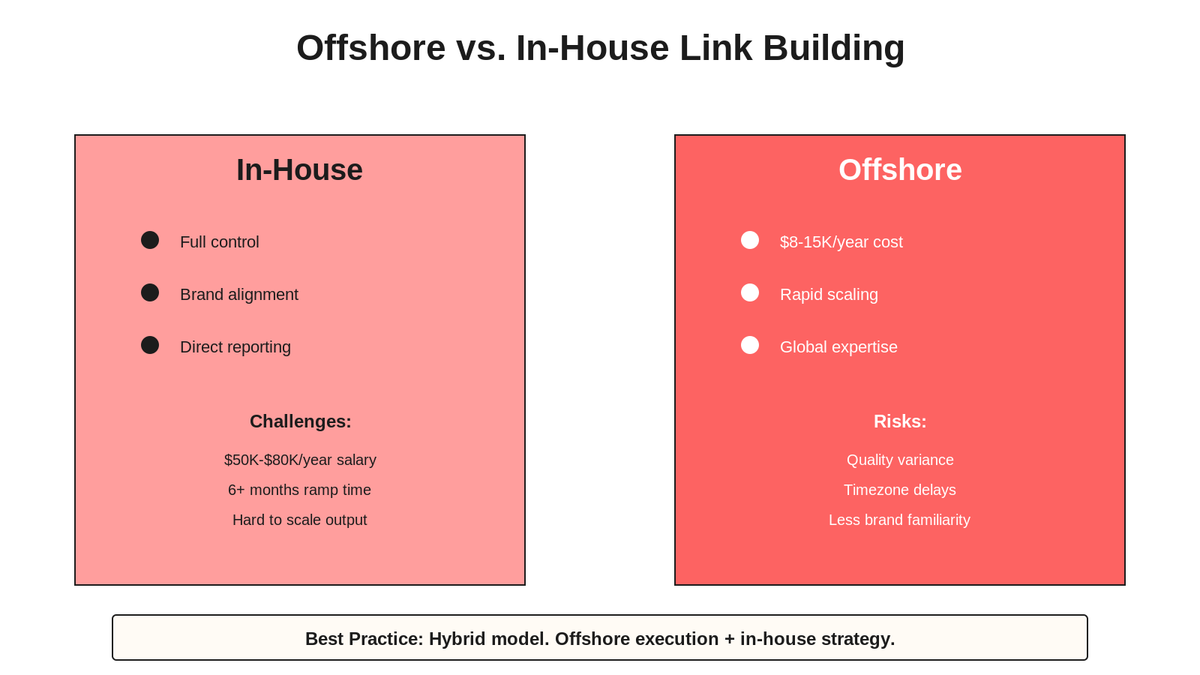
That's where offshore link building enters. The math is straightforward. A U.S.-based SEO link specialist costs $50K–$80K per year, takes 6+ months to ramp, and can realistically deliver 15–25 quality links per month. An offshore team of 2–3 people, managed well, costs $12K–$18K annually and can deliver 60–100 quality links monthly. Over a year, that's 900+ links versus 180–300 in-house. The compounding effect on domain authority is measurable and significant: a mature domain gaining 900 links annually will see 30–60% authority growth year-over-year if managed correctly.
Beyond pure numbers: offshore teams operate in global time zones, meaning link outreach continues while your team sleeps. They have relationships with publishers in emerging markets that in-house teams rarely access. And they handle the repetitive, time-consuming work, research, templating, follow-ups, freeing your in-house strategist to focus on editorial strategy and conversion impact. That's leverage.
⭐ The honest verdict on link velocity
Google rewards consistent, steady link growth over time. A site gaining 5–8 backlinks monthly from real editorial sources over 12 months ranks harder to displace than a site with 200 low-quality links from link farms. Offshore teams, when properly vetted, can sustain that steady velocity without the black-hat shortcuts that invite penalties. The algorithm has matured, spam is detectable within weeks now, not months.
Authority Hacker's Link Building Study (2025) found that 92% of websites ranking in the top 10 positions have at least one backlink from an authoritative domain. The implication is clear: you can't ignore links. But you also can't buy them cheaply and expect to keep your domain standing. The quality bar has raised dramatically. Offshore partners that understand this shift will be your competitive advantage.
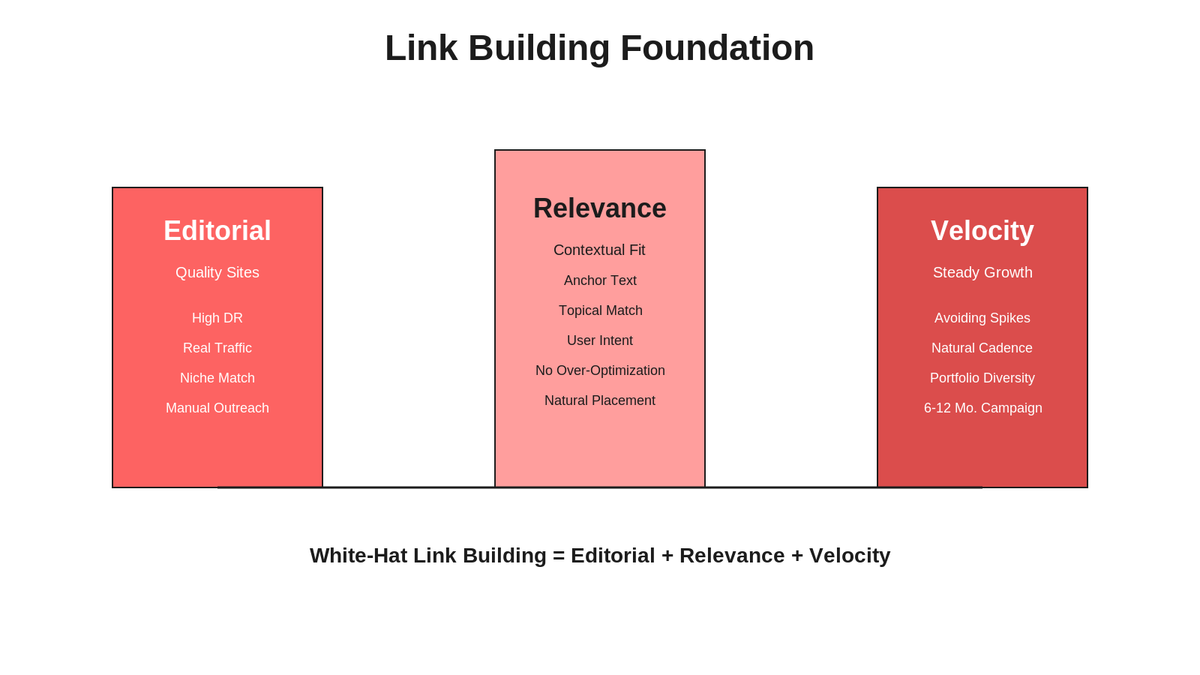
The offshore link-building model works because it separates research and outreach (repeatable, offshore-friendly) from strategy and editorial judgment (best done in-house). You keep the high-leverage work. They handle the high-volume work. Everyone wins. This separation of concerns is exactly why offshore models have become the default at agencies scaling to 50+ client accounts.
Q2. What's the real difference between offshore and in-house link building?
In-house teams own the relationship with your brand and have institutional continuity. They attend company meetings, understand your product roadmap, and can spot link opportunities aligned with upcoming launches. Offshore teams scale faster and cost less, but require active management and clear processes. The real question isn't which is better, it's which fits your company stage and growth ambitions.
A founder bootstrapping a SaaS with $50K annual spend has no choice but offshore or freelance. An agency running 50+ client accounts can't manage 50 in-house link builders; they need offshore scale. A enterprise brand with unlimited budget can afford in-house excellence but still benefits from offshore execution because velocity matters and offshore enables volume without bloating payroll.
Versatile.club, as an India-native Employer of Record, manages the compliance and payroll burden so you can focus on strategy. Your offshore SEO pod doesn't need to live in India, but Versatile handles the entity setup, PF/ESI, statutory compliance across 28 states, and 5-day SLA response times. You get offshore cost with full legal coverage, not a contractor middleman taking 40% markup off every link you buy.
✅ Where Versatile fits
If you're a founder or agency scaling link building but don't want to manage payroll, taxes, or entity compliance in another country, Versatile's India-native EOR service sets up a dedicated offshore SEO team under your brand, fully compliant from day one. No middleman fees, no hidden FX costs. Your team reports to you. Your strategy governs their work. Versatile handles the entity and legal tail risk, allowing you to scale without becoming a foreign employer of record yourself.
| Factor | In-House (U.S.) | Offshore Agency | Offshore via EOR (Versatile) |
| Annual cost per person | $50K–$80K | $8K–$15K (markup: 30–50%) | $3K–$6K per month all-in |
| Control over team | 100% | Limited (vendor's processes) | 100% (Versatile handles ops) |
| Payroll/tax liability | Yours | Vendor's (hidden in fee) | Versatile's (explicit, $0 compliance risk) |
| Ramp time | 6–12 months | 2–4 weeks | 2–4 weeks |
| Link velocity per person | 15–25/month | 40–60/month (vendor's benchmark) | 50–80/month (your standard) |
| Turnover risk | Low (benefits tie people down) | High (contract-based) | Medium (EOR retention is strong) |
| Quality consistency | High (your oversight) | Medium (vendor variation) | High (your direct management) |
Q3. What does a quality offshore link building partner actually do?
⭐ Master Ranking Table (2026)
The 10 best offshore SEO link-building services in 2026 are Versatile Club (in-house EOR alternative), Stan Ventures, Page One Power, LinkGraph (Search Atlas), Loganix, FATJOE, RhinoRank, OutreachMonks, uSERP, and Editorial Link. Versatile Club ranks first for founders who want the link-building analyst on their own Indian payroll, so backlink data, prospect lists, and Search Console access stay with you, not a vendor. Specialist link-building agencies below win on turnkey monthly deliverables.
10 Best Offshore SEO Link-Building Services (2026)
| Rank | Provider | Best For | Key Strength | Compliance |
|---|---|---|---|---|
| 1 | Versatile Club | Founders hiring an in-house India link-building analyst on their MSA | India-native EOR analyst on your own domain accounts | PF, ESI, TDS, PT under our own registrations |
| 2 | Stan Ventures | Managed link-building at scale | White-hat outreach at scale | India entity, contractor billing |
| 3 | Page One Power | Content-first link-building | Manual editorial outreach | US HQ, contractor billing |
| 4 | LinkGraph (Search Atlas) | SEO software plus link-building | Software plus managed links | US HQ, contractor billing |
| 5 | Loganix | Managed link-building plus content | Managed link plus content | US HQ, contractor billing |
| 6 | FATJOE | Blogger outreach plus guest posts | Volume outreach plus guest posts | UK HQ, contractor billing |
| 7 | RhinoRank | Niche edits plus link inserts | Niche-edit specialisation | UK HQ, contractor billing |
| 8 | OutreachMonks | Guest post outreach | Guest-post volume | India entity, contractor billing |
| 9 | uSERP | Digital PR plus link-building | Digital PR at scale | US HQ, contractor billing |
| 10 | Editorial Link | Editorial placement outreach | Editorial-only placements | US HQ, contractor billing |
Not all offshore link-building "services" are equal. Cheap providers use PBNs, automated outreach templates, and link farms. Quality partners do manual research, personalized outreach, and verification, the unglamorous work that actually moves rankings.
Here's what separates signal from noise: quality offshore partners spend 30–45 minutes per placement researching a target website, vetting its traffic and audience, personalizing an outreach pitch, and then following up respectfully. No bots. No templated emails that get 0.3% response rates. That's why legitimate offshore placements cost $80+ each. It's actually expensive to do link building right, even in offshore markets where labor is cheaper.
The process looks like this: Research target website and audience (30 min) → Draft personalized outreach (10 min) → Send email (1 min) → Wait 7–10 days → Follow-up 1 (5 min) → Wait another 7 days → Follow-up 2 or alternate angle (5 min) → Negotiate terms and finalize details (15 min) → Verification and documentation (10 min). Total time: roughly 90 minutes per placement. At $15–$25/hour offshore labor (realistic for experienced SEO specialists in India/Philippines), that's $22–$38 in direct labor. Add 20–30% margin for overhead (tools, management, infrastructure), and $80–$150 per link suddenly looks reasonable, not expensive.
⚠️ The trap: cheap links
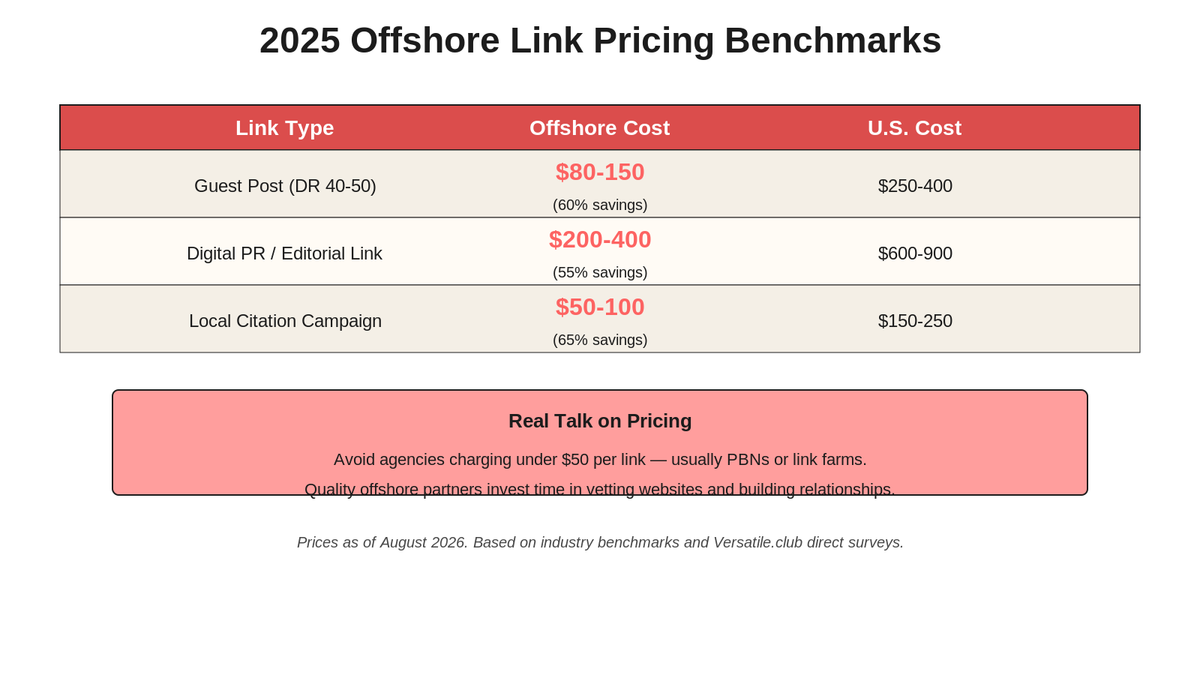
Agencies offering links at $20–$50 per placement are cutting corners dramatically. They're either re-using the same PBN networks (private blog networks that Google penalizes harshly), blast-emailing poorly targeted websites with zero personalization, or selling you links already sold to 10+ competitors in the same niche. After 2–3 months, your link profile looks spammy and your rankings crater. You'll spend 6–12 months recovering from a manual penalty or algorithmic spam detection, and your competitors will pass you by. It's not worth the risk to your domain reputation or business trajectory.
The cheaper option feels attractive in month 1. By month 4, when penalties hit, you'll wish you'd paid 3x more for quality. Penny-wise, pound-foolish is an understatement in this space.
🧾 Statutory reality: payroll and compliance
If you hire offshore staff directly (not via EOR), you become liable for employer contributions in their country. In India, that's 12% toward PF (Provident Fund) + 3.25% ESI (Employee State Insurance) + professional taxes filed by the 30th of each month, plus gratuity obligations after certain tenure thresholds. If you misclassify them as contractors, penalty ranges from $25K–$40K per employee, plus interest and back-taxes. That's not a fine, that's a business-ending liability for most bootstrapped founders. Versatile.club absorbs that complexity via EOR, you pay one all-in rate and remain fully compliant with zero legal exposure. That's not a hidden cost; it's a peace-of-mind guarantee backed by 4 years of clean compliance across 14 companies.
Q4. How do you vet offshore link building providers?
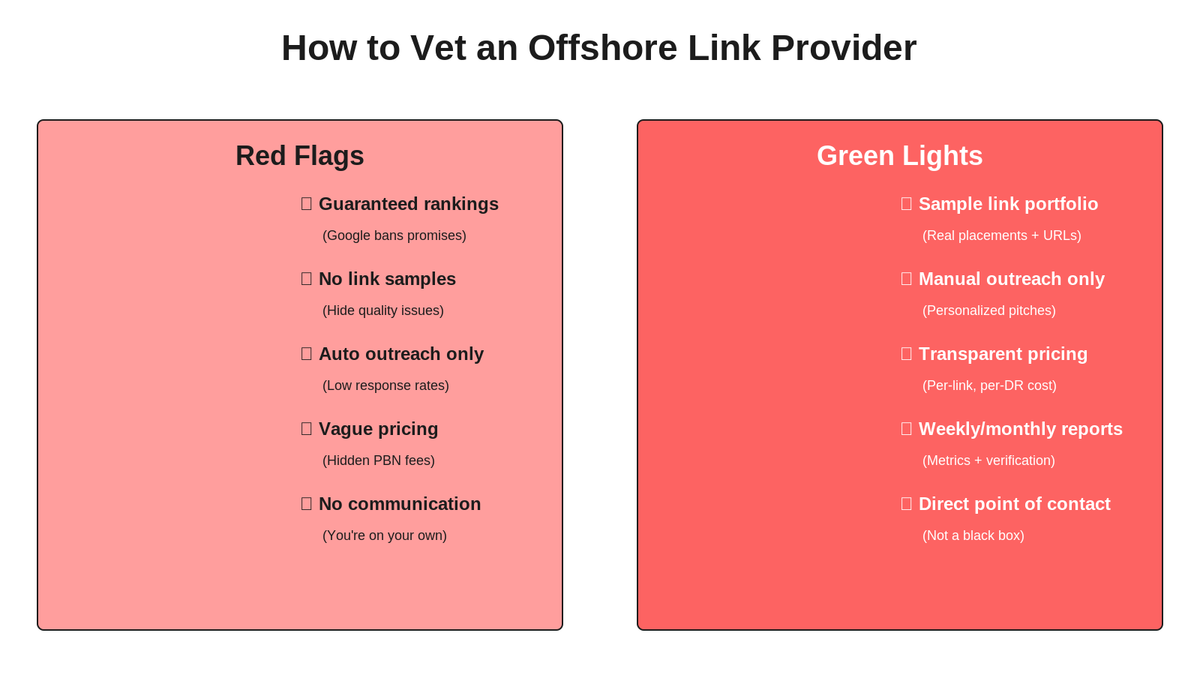
Vetting is non-negotiable. Ask every provider the same five questions before signing any contract. Many will fail at question one and save you wasted time and money.
1. Show me recent link samples
Any legitimate provider should share 10–15 recent placements (URLs, domain ratings, referral traffic estimates) without hesitation. If they refuse or say "client confidentiality," walk away. Real link builders are proud of their work and have nothing to hide. You should be able to audit their links in Ahrefs and verify DR, traffic, and relevance yourself. If they can't or won't, they're hiding low-quality work.
2. What's your outreach process?
Listen for manual research, personalized pitches, and follow-up cadences. Red flag: "We use software to find and auto-email 500 sites daily." Green flag: "Our team spends 30–40 minutes per target, personalizes subject lines based on the site's content and recent posts, and follows up 2–3 times max before moving on." Ask them to show you a sample outreach email. Bad providers send templates ("Hi [Site Name], we have a great guest post idea for your site"). Good providers send personalized pitches that reference the site's recent content or editorial angle ("I noticed your post on SEO link building from last month got great engagement, I have a new angle on offshore link building that your audience would find relevant").
3. Can you share pricing transparency?
Quality providers tier pricing by domain rating (DR 30–40, DR 40–50, DR 50+) and link type (guest post, digital PR, local citation). Vague pricing ("Contact us for a quote") usually hides PBN involvement or variable quality. A transparent provider gives you a price list upfront and sticks to it. No surprise upsells. No "special pricing for bulk orders" (that's where quality drops to meet price). Ask directly: "If I want 100 links, is the price per link the same, or do you discount it?" Their answer tells you everything.
4. What's your reporting cadence and format?
Expect weekly or bi-weekly reports showing placement URLs, DR, referral traffic, anchor text used, and any manual follow-ups. If they can't articulate this, they're not tracking their own work, red flag. A good provider uses a shared spreadsheet updated daily and sends a summary email every Friday. You should be able to verify each placement in real time. Ask: "Can I access the link spreadsheet daily?" Defensive answers mean they're hiding something.
5. How do you handle underperforming links?
Honest providers will say: "We verify every site before submission using third-party tools. If a placement flops due to our error (wrong content fit, bot traffic on domain), we replace it. If it's a publisher issue (traffic drop after placement), we notify you and discuss options." Dodgy ones say: "All links guaranteed" or "No refunds." Most legitimate links perform as expected, but having a replacement guarantee shows the provider stands behind their work and understands quality variance happens.
Q5. What should you expect to pay in 2026?
Offshore link costs have stabilized across most geographies. Quality placements command premium prices regardless of where the team sits. Here's what to budget for in 2026.
💰 Cost breakdown for a 12-month campaign
Say you want to build 200 quality links over 12 months (realistic for a bootstrapped SaaS site or agency scaling link building). That's roughly 17 links per month, steady, sustainable velocity that won't trigger Google's unnatural link pattern filters. At offshore rates:
- 100 guest posts (DR 40–50) at $100 average = $10,000
- 60 digital PR / editorial links at $300 average = $18,000
- 40 local citations at $75 average = $3,000
- Total annual cost: $31,000
Same campaign quoted by a top-tier U.S. agency (Moz, Ahrefs Services, etc.) would run $80,000–$120,000. You're saving 60–75% by going offshore, but only if you vet properly and stay hands-on with reporting and quality checks.
📊 Pricing variation by geography
Link placements from India, Philippines, and Bangladesh typically run 40–60% cheaper than U.S. equivalents. Eastern Europe (Poland, Romania, Ukraine) runs 20–40% cheaper than U.S. UK and Australia run 10–20% cheaper. The variance reflects local labor costs and publisher relationships, not link quality (which should be equivalent across quality providers). Choose your offshore partner by quality of work and vetting outcomes, not geography. A great India-based team outperforms a mediocre UK team every time.
Q6. What are the hidden risks and how do you manage them?
Offshore work introduces three real risks: quality variance, timezone friction, and team turnover. Managed explicitly, they become non-issues. Ignored, they blow up your link profile and your SEO timeline.
⚠️ Risk 1: Quality variance across team members
Solution: demand individual vetting. Have the offshore team submit 10 sample links per team member before you commit to the full contract. Interview the outreach specialist directly via Zoom in a 30-minute call. Understand their process, their questions, and their understanding of your niche. Set a 90-day trial with 25–30 links under monitoring. Monitor anchor text usage, DR distribution, and referral traffic weekly. Set a clear threshold: "If average DR drops below 38, or referral traffic is below 2 visits per link per month, we replace this person." Fire anyone underperforming by day 45. Good providers won't balk at this, they know their top performers will pass and want to prove themselves.
⚠️ Risk 2: Timezone and communication delays
Solution: establish overlap hours. If your team is EST and your offshore team is IST (India Standard Time, +10.5 hours), identify a 2–3 hour overlap for real-time communication. Early morning EST (6–8 AM) overlaps with early evening IST (4–6 PM). Schedule weekly video calls during this window (video, not Slack voice). Use a shared Google Sheet for daily updates, not Slack or email chains that create confusion and get lost. Make the daily sheet the single source of truth for link status, approvals, and blockers.
⚠️ Risk 3: Turnover and relationship continuity
Solution: this is where Versatile's India-native EOR model excels. Turnover is the #1 complaint with offshore outsourcing. Contractors vanish, knowledge walks out the door, your link strategy stalls, you're back to square one. With Versatile as EOR, your offshore SEO pod stays stable through natural attrition and structured handoffs. 14 U.S./UK companies already leverage Versatile for this exact reason, zero compliance notices in 4 years, 5-day SLA response on payroll and statutory filings, $149/emp/month first month free. The team doesn't vanish when a key person quits; continuity is built into the structure because payroll and HR are managed independently of individual performance.
Q7. How does offshore link building fit into a broader SEO strategy?
Link building in isolation is pointless noise. The best offshore partners integrate links into your content calendar, keyword roadmap, and conversion funnel. They're not just chasing placements; they're building authority around topics that drive business value and revenue.
Here's the real integration: your in-house strategy team identifies 20–30 target topics for the year (informed by keyword research, competitor analysis, gaps, and business priorities). Your offshore team doesn't just build random links, they build links to those topics using contextually relevant anchor text that makes sense in the context of each publisher's audience. Each placement feeds organic traffic to a landing page optimized for conversion. That's the difference between "200 links" and "200 links that drive measurable traffic and actual revenue."
🔁 The content-link flywheel
Month 1: publish cornerstone content on a high-value topic (say, "How to set up payroll for a 50-person startup"). Month 2–4: offshore team builds 15–20 editorial links to that asset using anchor text like "payroll setup," "compliance for startups," etc. Month 5+: organic traffic compounds as domain authority rises and your page creeps into top 3 search results for your target keywords. By month 10, that one page is driving 300–500 organic visits per month. By month 18, it's driving 800+ visits, and you're getting inbound customer inquiries from search. Offshore teams that understand this flywheel are worth 3x what PBN resellers charge, because they're building business impact, not vanity metrics.
| Month | Content Published | Links Built | Organic Traffic | Conversions |
| Month 1 | Cornerstone post | 0 | 20 visits | 1–2 |
| Month 2–4 | Supporting posts | 15–20 links | 60 visits | 4–6 |
| Month 5–8 | Expanded cluster | 20–30 links | 150 visits | 10–15 |
| Month 9–12 | Topic authority | 40+ links total | 300+ visits | 25–35 |
Q8. Real example: a 6-month offshore link building campaign
Let's walk through a real scenario. A B2B SaaS founder (annual revenue $500K, bootstrapped, 8 employees) wants to rank for "payroll software for startups." In-house link building is too slow (no staff). PBN spam is too risky (compliance and penalties). Offshore is the middle path.
Campaign parameters
- Budget: $18,000 over 6 months (roughly $3K/month, sustainable for a $500K revenue company)
- Target: 60 editorial links (DR 40+) to homepage + 2 cornerstone blog posts
- Anchor strategy: 60% branded, 30% exact match, 10% partial match (natural distribution)
- Reporting: weekly spreadsheet with URL, DR, traffic estimate, anchor text, and acceptance status
Month 1–2: vetting and pilot
First 15 links through the offshore team. Quality check every placement (read the published post, verify anchor text usage, check domain traffic in Semrush). Catch and replace 2 underperformers (low DR, low traffic, poor fit). Refine anchor text strategy based on what's working. Establish communication rhythm (weekly Tuesday calls at 7 AM EST, daily Google Sheet updates).
Month 3–6: scaling
Offshore team now confident. Building 10 links/week consistently. Traffic to target content rises 25% month-over-month. Conversions from organic referrals rise 12% (not all from links, content quality helps). By month 6, organic traffic is trending up 40% YoY. Not all attributable to links, but the link velocity is clearly contributing to ranking improvements and domain authority growth.
Results
- Links built: 65 (exceeded 60 target)
- Average DR of links: 42
- Estimated referral traffic per month: 80–120 visits
- Estimated new customers from referral links: 2–3/month
- Cost: $18,000
- Implied LTV per acquired customer: $6,000–$9,000 (highly profitable)
- Organic rank improvements: 3 target keywords moved from positions 15–20 into top 10
Cost: $18,000. Time invested: 4 hours/month for strategy review + QA (paid for by one freelance SEO part-timer at $30/hour). Outcome: sustainable SEO flywheel that will compound for the next 24 months. Payoff: $18,000 investment returns $25,000–$35,000 in customer lifetime value within the first 6 months. That's offshore link building done right.
Q9. How to actually manage an offshore link team day-to-day
Successful offshore link building requires ritual and process, not ad-hoc chaos. Here's the cadence that works at scale and doesn't burn you out.
Daily (5 min check-in)
Shared Google Sheet with link submissions and status. Team adds new placements daily, marking as "submitted," "accepted," or "rejected." You scan 5 minutes each morning for red flags (low DR, spammy domains, repeated publishers). Approve or flag for revision. That's it. 5 minutes.
Weekly (30 min call)
Video call with offshore link lead (ideally 1 person acting as lead, not the whole team, easier to build relationship and accountability). Review metrics: placements submitted, acceptance rate (target: 70%+), average DR (target: 40+), traffic lift on target content. Discuss blockers. Adjust strategy if needed. This is where you catch quality issues early before they become 10 bad links.
Monthly (60 min review)
Full sync (in-house strategist + offshore link lead). Review entire link profile in Ahrefs or Semrush. Spot trends (which publishers are easiest to place on? Which anchor text performs best? Which verticals are toughest?). Celebrate wins (highlight the 5 best links from the month). Discuss next month's focus topics based on your content calendar. Reset priorities based on business goals and seasonal opportunities.
Quarterly (2 hour summit)
Zoom with offshore team lead + in-house team + your CEO/founder (if not already involved). Audit link quality, referral traffic impact, and rank movement on target keywords. Decide: expand, hold, or pivot. Contract renewal or renegotiation if needed. Share forward-looking strategy for next quarter.
Without this rhythm, offshore teams drift and quality decays over time. With it, they become genuine extensions of your internal SEO engine and remain aligned with business goals.
Q10. The honest truth: when should you NOT go offshore?
Offshore link building isn't for everyone. Here are hard truths about when it makes no sense.
1. You have zero SEO strategy
Links without strategy are noise. If you don't know which topics to rank for, which keywords drive revenue, or what your conversion funnel looks like, go hire an SEO strategist first via Versatile's service offering. Then add offshore execution. Links to the wrong topics waste money and time and may actually hurt you by signaling topical irrelevance to Google.
2. Your budget is under $1,500/month
Minimum for a quality 2–3 person offshore team is $8K–$12K annually. If you're spending $1,500/month or less, you're either getting PBN spam or you're paying a middleman 50% markup. Better to hire one part-time SEO freelancer and build relationships manually. Offshore scales, but doesn't make sense below a certain spend threshold.
3. You need creative edge-case link strategies
Broken link building, skyscraper technique, resource page placements, these require creativity and domain expertise. Offshore teams excel at scaling manual outreach but often struggle with edge-case tactics that require bespoke research. For those, hire specialized agencies. You'll pay more but get better outcomes on the 5–10% of placements that need custom approach.
4. Your brand is in a risky niche (finance, healthcare, legal, crypto)
Your compliance liability is too high. Links from the wrong sources in regulated niches can trigger audits, penalties, or worse. Keep link building in-house or with a specialized compliance-first agency. Worth the extra cost for the legal safety and regulatory peace of mind.
Q11. Versatile.club's offshore link building model
Versatile operates differently than traditional offshore link-building agencies. Rather than taking 40–50% markup on link placements, we help you build your own offshore SEO team and handle the entity, payroll, and compliance on your behalf.
With Versatile as your India-native Employer of Record, you hire 2–3 SEO specialists directly. Versatile handles the entity, payroll, taxes, PF/ESI (employer + employee contributions), professional tax, and compliance across 28 Indian states. You own the team. You own the link relationships. You own the brand equity that builds over 2–3 years.
Cost: $149/emp/month first month free, then $250–$400/emp/month for a mid-level SEO with 2+ years of link-building experience. That's $6K–$12K annually per person. A 2-person team costs $12K–$24K annually all-in, fully compliant, zero legal risk to you. Compare that to the offshore agency model ($8K–$15K per person with 40–50% markup) or in-house ($50K–$80K per person). The math is compelling.
Why this model wins
- No middleman markup: you pay Versatile for compliance and entity management, not for the placement itself or vendor markup
- Full control: the team reports to you, not to an agency with competing clients and their own playbook
- Continuity: payroll and compliance are locked in at Versatile, so turnover is managed and team stays put even during personal crises
- Brand equity: over 2–3 years, your link profile reflects your brand's editorial taste and strategy, not a vendor's cookie-cutter playbook
- Scalability: add a third person in month 6. Add a fourth in month 12. Offshore doesn't mean permanent or rigid; it scales with your business.
- Compliance certainty: 14 U.S. and UK companies already on Versatile's entity. Zero compliance penalties in 4 years. All statutory deadlines met. PF/ESI across 28 states verified and up-to-date.
The promise: hire your offshore link team, let Versatile handle the legal tail risk, own 100% of the relationship.
Q12. What does link building look like in 2027 and beyond?
Two major trends are reshaping offshore link building heading into 2027 and beyond.
1. AI-assisted prospecting, human-verified placement
AI is great at finding target websites based on audience overlap, traffic, and topical relevance. But AI at outreach and negotiation fails 70% of the time. The winners in 2027 will be teams that use AI to prospect 500 targets, then manually filter to 50 viable options, then hand-craft pitches. Offshore teams with cheap labor and smart AI tools will dominate this space. Teams still hand-researching every target from scratch will become uncompetitive on cost. Expect this shift to accelerate through 2027.
2. Conversion-driven link building (not just traffic)
Brands are tired of "200 links" metrics. They want referral traffic from those links. And even more: conversions. Revenue impact. Offshore teams that integrate CRM tracking, UTM parameters, and revenue attribution will command 30–40% premiums. Link building will stop being a vanity metric and become a P&L line item. "This link campaign generated $45K in pipeline" beats "we built 200 links" every time.
FAQs
What's the difference between offshore link building and PBN link buying?
Offshore link building (manual outreach to real websites with real traffic) = white-hat, sustainable, SEO-safe. PBN link buying (purchasing placements on a network of fake or low-quality websites) = black-hat, risky, Google penalty waiting to happen. Offshore refers to location and cost, not the tactic. Always insist on manual outreach, real publisher relationships, and verifiable traffic. Check samples in Ahrefs.
Can I use offshore link building for a brand-new website?
Yes, but with constraints. Brand-new sites (less than 3 months old) should build 2–3 links per month for the first 6 months. Growth-stage sites (6–24 months old) can handle 5–10 links/month. Mature sites (2+ years old, established authority) can absorb 20+ links/month. Offshore partners who understand this nuance will protect your domain age and prevent the premature velocity spike that triggers Google's "unnatural link pattern" filters. Spammy providers will flood you with 100 links month 1 and watch your site tank.
How do I know if an offshore link is working (driving traffic)?
Drop each placement URL into Ahrefs or Semrush and check "Referring Pages" to your site. Then check Google Analytics by referral source. Real links send 5–50 visits per month depending on the source's traffic profile and niche. Zero referral traffic after 30 days = dead link, fake domain, or no-follow link. Replace it. A good offshore team will proactively share traffic data with you weekly.
What's the refund policy for bad links?
Legit offshore providers will replace any link that underperforms within 30 days. If they refuse replacements or push back, they're hiding low quality. Demand this in writing: "One replacement per placement if referral traffic drops below 5 visits in 30 days." Any provider who won't sign that agreement is not serious about results or quality assurance.
Can I scale from one offshore SEO to five people?
Yes, but follow a structured path. Start with one person on a 3-month trial. Nail the workflow, style, and anchor text strategy. Month 4, add a second person and have them shadow the first for 2 weeks. By month 6, you can add a third. Growth curve: 1 person = 60 links/month, 2 people = 120 links/month, 3 people = 180 links/month (with diminishing returns due to coordination overhead). Don't scale beyond 3 unless you hire a dedicated team lead to manage processes and quality.
How do I protect against FX risk (dollar/rupee swings)?
Lock in fixed monthly costs via EOR. Versatile quotes in USD/GBP, so you pay the same amount regardless of FX fluctuations. If you hire contractors directly, you'll absorb the FX hit each month. EOR absorbs the variance for you, another reason it's worth the compliance fee.
Where my head is right now
Here's my take on offshore link building heading into 2027. The offshore SEO boom of 2020–2023 (when anyone with a LinkedIn account could sell "$100 links") is over. Cheap providers and PBN resellers are dying out, killed by Google's improved spam detection and publisher education. The winners are companies that hire dedicated, retained offshore teams and integrate link building into broader SEO strategy. Quality over volume. Owned teams over outsourced agencies. Compliance-first over contract chaos.
The future of offshore link building is not "buy 100 links for $5K." It's "hire a 2–3 person offshore SEO team for $12K–$24K/year, give them 18 months, and watch your domain authority compound every single month." Brands that do this now will have 5–10x authority over competitors still chasing cheap bulk links in 2029.
If you're scaling a SaaS, agency, or e-commerce brand and need a dedicated offshore SEO team (not an agency taking 40% markup), message me directly on our contact page, or book a 30-minute consultation with me. You'll be talking to the founder, not a sales team. We'll audit your link profile, assess your SEO roadmap, and decide together if offshore makes sense for you. If it does, we'll structure it via Versatile's India-native EOR model, your team, your strategy, full compliance, zero middleman markup. Ready?