Table of contents (11)
Rippling Features Explained: HR, IT, and Finance in One
Q1. What does Rippling actually do across HR, IT, and Finance?
Rippling is a workforce platform that runs HR, IT, and Finance off one employee record, organised into five clouds. The HR Cloud holds the HRIS, onboarding, benefits administration, time and attendance, PTO, performance, applicant tracking, and learning management. The Payroll Cloud holds domestic payroll, global payroll, contractor payments, Employer of Record (EOR), and US PEO. The IT Cloud holds device procurement, mobile device management, inventory, identity, and app provisioning. The Spend Cloud holds corporate cards, expenses, bill pay, procurement, and travel. An automation layer sits across all five with Workflow Studio, formula fields, permissions, reporting, and embedded AI. Only the HRIS core is foundational. Almost every cloud above it is priced separately, per Rippling's own product ecosystem page and its published HRIS review.
🧰 The six-tool stack most India teams arrive with
A People Ops lead at a Series A company sent me her actual stack last quarter. Keka for HR records. RazorpayX Payroll for salary runs. A spreadsheet for professional tax states. A separate MDM tool for laptops. Google Workspace admin for access. Email for everything else.
Nothing in that list was broken. The problem was that one hire touched six systems, and each system knew a slightly different version of the same person. That mismatch is the real pain Rippling sells against, and it is the same mismatch that pushes teams toward outsourced India payroll.
🗂️ The five clouds, and what is actually included
| Cloud | What sits inside it | Included in base? |
| HR | HRIS, onboarding, benefits admin, time and attendance, PTO, performance, ATS, LMS | HRIS core only |
| Payroll | Domestic payroll, global payroll, contractor payments, EOR, US PEO | No, priced per module |
| IT | Device procurement and shipping, MDM, inventory, identity, app provisioning | No, priced per module |
| Spend | Corporate cards, expenses, bill pay, procurement, travel | No, priced per module |
| Automation | Workflow Studio, formula fields, permissions, reporting, AI | Partly, depth varies by plan |
Read that third column twice. The demo shows all five clouds working together. The quote shows which ones you are buying.
🏗️ What a 20-person India team actually switches on
In the India engagements I see, activation clusters in three places. HRIS and employee records. Payroll. Device and app provisioning.
Spend Cloud, LMS, and applicant tracking get quoted often and used rarely. That is not a knock on the software. It is what happens when a 20-person team buys architecture built for a 500-person one.
🌉 The bridge, not the building
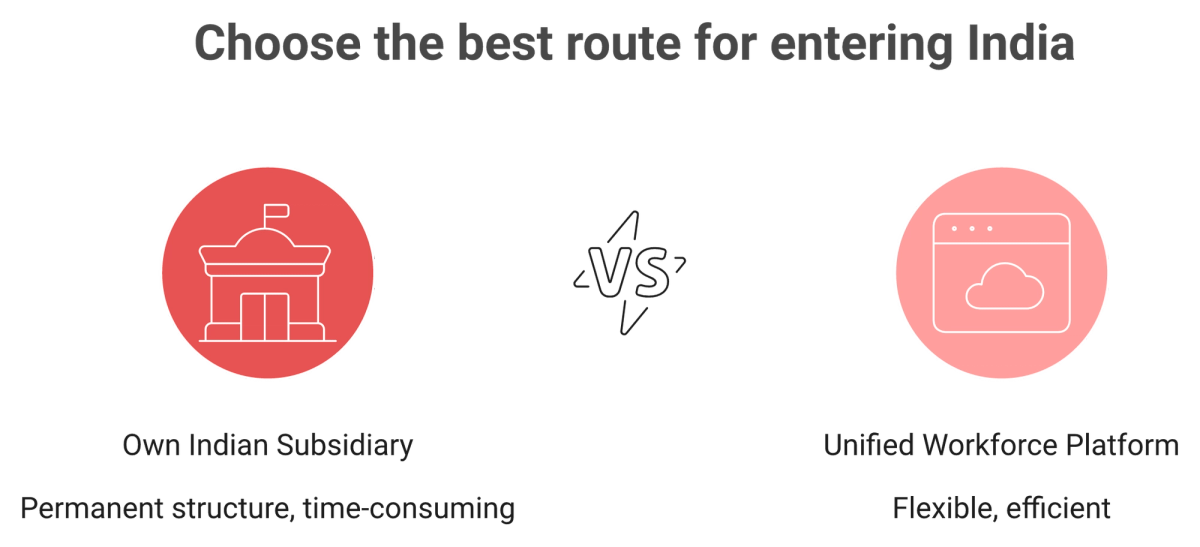
Here is the frame I use with founders on WhatsApp. An EOR or a unified platform is a suspension bridge. It is light, fast, and gets you across without owning the riverbed.
Building your own Indian subsidiary is the Golden Gate. It is permanent, and it costs 12 to 18 months and real capital before your first hire starts. Most founders making hire number one do not need the Golden Gate, which is the whole point of running an EOR versus entity comparison before you incorporate.
⚠️ Where unification stops
Unification solves data entry. It does not solve jurisdiction. One record can carry an employee's salary, laptop serial number, and Slack access cleanly, and still have no opinion about which Indian state registration that employee triggers.
That distinction runs through the rest of this article. Breadth of modules and depth of statutory knowledge are two different products, and they are priced as if they were the same one.
Q2. How does the Employee Graph change a Monday-morning onboarding?
The Employee Graph is Rippling's single employee record shared by every module, so one change propagates instead of being re-keyed. A promotion updates pay, benefit deductions, approval limits, and app permissions at once, collapsing a 14-step onboarding across five tools into one form plus exception handling, as described in Rippling's own HRIS documentation. What it cannot infer is jurisdiction. It will not flag that a Karnataka hire needs Shops and Establishments enrolment within 30 days, or that a Maharashtra hire needs both PTRC and PTEC registrations. Automation moves data. It does not interpret state law.
📋 The 14-step version, written out
This is what onboarding one Bengaluru engineer looks like without a shared record. I have run it manually more times than I would like.
- Create the HR record.
- Re-enter the same details in payroll.
- Set up salary structure and deductions.
- Enrol for provident fund and generate the UAN.
- Enrol for ESI where wages qualify.
- Register for professional tax in the correct state.
- Raise the laptop purchase order.
- Ship or hand over the device.
- Enrol the device in management software.
- Create email and directory accounts.
- Grant application access role by role.
- Load the offer letter and signed contract.
- Set the probation and review dates.
- Tell finance the headcount changed.
⚡ What the Graph collapses
With a shared record, steps 1, 2, 3, 10, 11, 12, 13, and 14 fold into one form and a workflow trigger. Approve the hire, and payroll enrolment, deductions, device assignment, and app access fire together.
That is a real reduction in keystrokes and in the small errors that come from re-typing a PAN or a start date. I am not going to pretend otherwise.
🧾 The three India exceptions that still need a person
Steps 4, 5, and 6 are where automation runs out of road. Each one is a state or statute decision, not a data decision, and each one sits inside India payroll compliance rather than inside software.
- Karnataka requires Shops and Establishments registration within 30 days of commencing business at a location, and professional tax runs monthly.
- Maharashtra requires two separate professional tax registrations, PTRC for deducting from employees and PTEC for the entity itself, with monthly slab filing.
- Telangana requires PTRC enrolment with its own monthly remittance deadlines.
A workflow engine will happily onboard a Pune hire and a Hyderabad hire identically. The two states do not agree that they are identical.
🏢 Who holds the registration matters more than who holds the record
Versatile Club runs the same one-form onboarding intent with a 5-day contractual onboarding SLA behind it. Because Foo Falcon Technologies Pvt Ltd is our own Indian entity, the state registrations that stall template workflows are registrations we already hold, not tickets we file with a partner.
🤔 Where my head is on this
Versatile Club's read is that the standard advice gets the sequencing backwards. Buyers evaluate the onboarding form and assume the filings follow. In our client engagements, the filings decide whether the form was worth anything.
I could be weighting this too heavily because India is the only country I operate in. But an elegant record that produces a late PF challan is still a late PF challan.
Q3. How far do Rippling's global payroll and 600+ integrations actually reach?
Rippling supports payroll and contractor payments across roughly 90 to 140 countries depending on product mode, with EOR available where it holds or partners with a local entity, plus 600 to 650 or more prebuilt integrations and an API for the rest. Coverage is not uniform. A country can appear as contractor-payments-only, partner-EOR, or owned-entity, and each tier carries different filing accountability. Before you treat a country as covered, ask which of the three tiers applies, and which legal entity signs the employment contract.
🔌 The integration catalogue is real
This is Rippling's strongest claim, and it holds up. The catalogue spans identity, engineering, finance, and productivity tools, and the API covers what the catalogue misses.
For a company already running Okta, NetSuite, and GitHub, that matters. Unified access provisioning is a genuine time saver, and the reviews reflect it.
🗺️ The three coverage tiers nobody puts on a pricing page
| Coverage tier | What it means | Who carries the filing risk |
| Contractor payments only | The platform pays an invoice. No employment relationship exists. | You do, including misclassification exposure |
| Partner EOR | A third-party local entity is the legal employer. | The partner, with the platform as intermediary |
| Owned entity EOR | The platform's own registered entity employs the person. | The platform directly |
Rippling operates a wholly owned entity in India, which puts it in the third tier here. That is worth saying plainly, because most global platforms in this comparison route India through a partner shell, a pattern covered in our Rippling alternatives for India breakdown.
🏳️ The question to ask per country
Do not ask "do you cover India." Ask which tier India sits in, which entity name appears on the employment agreement, and who signs the statutory returns.
Versatile Club sits in one row of that table by design. India, owned entity, our filings, our name on the contract. One country, one tier, no ambiguity.
💬 What buyers report about coverage depth
"The global benefits setup was delayed by two months beyond the go-live date because they were building out the function live without informing us, making us think there were just bugs to fix."
— Jenny F., HR Leader, Rippling - G2 Verified Review, 2 April 2026
"Rippling simplifies payroll by integrating with the general ledger for easy reconciliation. It lets employees see PTO balances and fill out timecards independently."
— Patrick W., Finance Lead, Rippling - G2 Verified Review, 9 April 2026
Both things are true at once. Rippling holds 4.8 out of 5 across 16,541 G2 reviews and 4.9 out of 5 across 4,881 Capterra reviews, so the core product clearly works for most buyers.
📐 Breadth and depth are different purchases
Global platforms cover 90 to 150 countries, and they spread India expertise across all of them. That is arithmetic, not criticism.
What I think shifts in the next two years is that India stops being one country on a global map. It becomes a specialist category, and owned-entity operators in a single country take the India revenue, which is why the best EOR in India shortlist now reads differently from the global one.
Q4. What does Rippling cost once you add the modules you actually need?
Rippling starts near $8 per employee per month plus a base platform fee of roughly $35 to $40, but that buys the HRIS core only. Payroll, benefits administration, time tracking, device management, and Spend each add roughly $4 to $12 per employee per month, and India EOR seats are reported at $500 to $600 per employee per month on top. A 10-person India team therefore lands around $5,000 to $6,000 monthly before add-ons, with full pricing gated behind a sales call on Rippling's product pages. Versatile Club prices India EOR at a flat $149 per employee per month with no platform fee underneath. Model the stack over 12 months, not the headline rate.
💰 Published rate versus quoted invoice
The published figure is a starting point, not a price. Independent 2026 pricing breakdowns put the base platform at roughly $35 to $40 per month plus about $8 per employee, then stack modules on top.
Beyond that, pricing sits behind a sales conversation, and there is no free trial. For a CFO closing month-end, that means you cannot model total cost of ownership before a call, which is exactly why we publish India EOR cost benchmarks openly.
🧮 A worked 10-seat India stack
Here is the arithmetic for 10 India employees on EOR, using published and reported figures.
| Line item | Reported rate | 10 seats, monthly |
| Base platform fee | $35 to $40 | $35 to $40 |
| Platform per employee | About $8 | About $80 |
| India EOR seats | $500 to $600 each | $5,000 to $6,000 |
| Optional modules (time, benefits, device) | $4 to $12 each | $40 to $120 per module |
| Indicative monthly total | - | $5,155 to $6,240 |
Annualised, that is roughly $62,000 to $75,000 for 10 people before add-ons.
💸 The line item that never appears
FX spread is the cost nobody quotes. When a platform invoices you in USD and pays salaries in INR, the conversion margin sits inside the payroll run, and reported markups across global platforms run 3 to 5 percent.
On a $60,000 annual India payroll, 4 percent is $2,400. That is a line item you will never find on a pricing page.
💬 What buyers say about module creep
"The only thing I have enjoyed about Rippling is the HR Ticketing app I was able to customize. Of course, we only get one with our plan, and it's probably going to cost a ridiculous amount of money for more."
— Erika D., HR Manager, Rippling - G2 Verified Review, 22 May 2026
"The implementation process for Rippling Spend has been a truly terrible experience. No one can diagnose the issue, and they told me that it could take the engineers up to 21 days to diagnose the problem."
— Patrick W., Finance Lead, Rippling - G2 Verified Review, 9 April 2026
These are two of the harsher reviews on the platform, and the aggregate score of 4.8 out of 5 across 16,541 reviews tells the other half of the story. Read both halves before you sign.
🏦 One number, one entity, one invoice
Versatile Club prices India EOR as one flat monthly figure of $149 per employee, with no platform fee underneath, no setup fee, no exit fee, and the first month free. We invoice in USD directly from our Indian entity, which removes the 3 to 5 percent FX spread global platforms bury inside a converted INR payroll run.
🎯 Where this comparison stops being fair
Versatile Club operates only in India, so this cost model does not transfer if you need five countries next quarter. If your hiring plan spans Ireland, Brazil, and Poland, Rippling's stack is the more honest buy, and I will tell you that on the call.
Q5. Do Rippling's compliance features hold up under India's 2025-26 statutory changes?
Rippling runs India payroll through an owned India entity covering EPF, ESI, TDS under section 192, and professional tax, and independent teardowns confirm provident fund at 12 percent and ESI at 3.25 percent employer share, as documented on Rippling's India hiring page. Three 2025-26 changes test that depth. The four Labour Codes took effect on 21 November 2025, requiring Basic plus DA to be at least 50 percent of remuneration, with excess allowances added back for PF, gratuity, and bonus, per the Ministry of Labour and Employment FAQs on the Labour Codes. MoLE notification S.O. 5109(E) raised the EPFO wage ceiling from Rs.15,000 to Rs.25,000 effective 17 September 2026. Form 130 has replaced Form 16 under the Income-tax Act 2025. Versatile Club re-ran client contribution schedules the week the Rs.25,000 ceiling was notified.
✅ What the payroll module genuinely does
Credit where it is due. Rippling's India payroll handles the core mechanics: salary processing in INR, PF and ESI deductions, TDS withholding, and professional tax in the major states.
For a US founder with two Bengaluru engineers, that covers the visible 80 percent. The invisible 20 percent is where the money sits, and it is the part that decides your real India payroll compliance exposure.
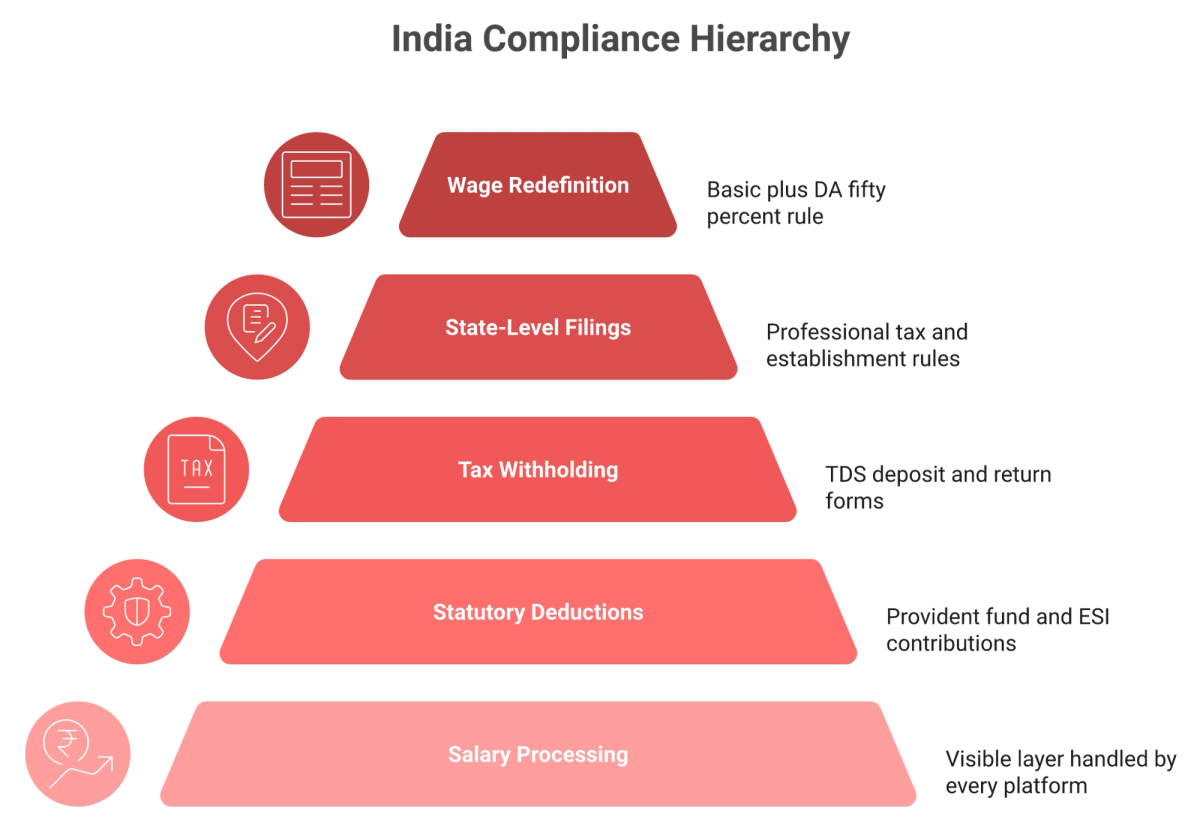
⚠️ The 50 percent wage rule changes your cost, not just your template
Under the Labour Codes, "wages" means Basic plus dearness allowance plus retaining allowance. If your other allowances exceed 50 percent of total pay, the excess gets added back into wages for PF, gratuity, and bonus.
That kills the low-basic CTC structure most India offer letters used for years. Gratuity accrues from month one at 4.81 percent of Basic plus DA, so a higher Basic raises your provision immediately. Run the numbers on our India salary calculator before you re-issue a single offer letter.
Versatile Club rebuilt client salary structures against this rule before 21 November 2025, not after. Re-modelling FY27 cost early meant no client got a surprise contribution jump in their first post-code payroll.
⏰ The Rs.25,000 ceiling, and the mid-month problem
The EPFO wage ceiling for mandatory coverage moved from Rs.15,000 to Rs.25,000 per month, effective 17 September 2026, and the EPFO's own FAQ document sets out the coverage mechanics.
Effective dates mid-month are where automation breaks. September 2026 payroll needed pro-ration across two rules. Versatile Club's method here is simple: pull every employee with Basic plus DA between Rs.15,001 and Rs.25,000, then confirm enrolment and back-dated contributions line by line.
🧾 Ask for the artefact, not the answer
| What you need | The governing rule | The artefact to demand |
| Annual salary certificate | Form 130 replaced Form 16, due 15 June after the tax year | A sample Form 130 from the sandbox |
| Quarterly TDS return | Form 138 replaced Form 24Q | A Form 138 export |
| Monthly TDS deposit | Due by the 7th of the following month | A challan with date stamp |
| PF contributions | Rs.25,000 ceiling from 17 September 2026 | September 2026 ECR |
| Gratuity provision | 4.81 percent of Basic plus DA, from month one | The provisioning schedule |
If a vendor demo still says "Form 16," the India module has not been updated for the Income-tax Act 2025.
💬 What a buyer learned about compliance promises
"Our sales rep told us Rippling could handle a state-level tax registration for us. We signed based partly on that promise. It wasn't until we were already deep in implementation that we found out it wasn't true."
— Erika D., HR Manager, Rippling - G2 Verified Review, 22 May 2026
"I find the entire integrated payroll system very easy to use, even for our most 'tech-phobic' employees who have been able to utilize it with very little issue."
— Patrick W., Finance Lead, Rippling - G2 Verified Review, 9 April 2026
Both reviewers are describing the same platform. The interface works. The registration promise did not.
🏢 Whose registration number appears on the challan
Versatile Club files under its own registrations. PF, ESI, TDS, and professional tax for every employee sit with Foo Falcon Technologies Pvt Ltd, not a partner shell, and our India compliance coverage sets out exactly which registrations those are. One country means a statutory change is a single migration for us, not item 47 on a 90-jurisdiction backlog.
🤔 Where I hold this loosely
Versatile Club's competitor assessment rates Rippling's India compliance depth at three out of five. I might be reading that too harshly, because I only look at India, and India is where the exceptions live.
Q6. Is Rippling an EOR, a PEO, or a payroll platform in India?
In India, Rippling operates as an Employer of Record (EOR). It becomes the legal employer through its own Indian entity, running payroll, statutory contributions, and benefits, as described on Rippling's EOR product page. Its PEO product is US-only co-employment. Traditional US-style co-employment PEO does not legally exist under Indian labour law, so any vendor pitching "PEO India" is mislabelling an EOR. If you already hold an Indian entity, you want global payroll, not EOR. Versatile Club operates only as an India EOR and Contract-to-Hire provider through its own registered Indian entity. Choosing the wrong mode is how founders pay EOR margins on people they already legally employ.
📚 Three modes, in plain English
An EOR is a company that legally employs someone on your behalf. The employment contract carries the EOR's name, and the statutory filings carry its registration numbers.
Global payroll is different. You already own the Indian entity, and the platform just processes salary and filings for you, which is the managed payroll model. Contractor payments are a third thing entirely, with no employment relationship at all.
🧭 The decision rule that takes 30 seconds
| Your situation | The right mode | What you are paying for |
| No Indian entity, want employees | EOR | Legal employment plus compliance |
| Own an Indian entity already | Global payroll | Processing and filings only |
| Genuinely independent vendors | Contractor payments | Invoice processing |
| Want to convert to your own payroll later | Contract-to-Hire | Employment now, conversion path later |
Versatile Club sits in rows one and four of that table, and nowhere else, which is a deliberate choice rather than a gap.
❌ Why PEO does not cross the border
In the US, a PEO shares employer liability with you. Two entities co-employ one person, and both carry obligations.
Indian labour law has no equivalent construct. There is no statutory co-employment. So when a US buyer asks for "PEO in India," what exists is an EOR, and the label matters because the liability sits in a different place, a distinction we unpack in our EOR versus PEO comparison.
⚠️ The misclassification trap underneath all this
The cheapest-looking option is usually a contractor agreement. It is also the one that unravels first.
An HR leader I spoke with put the pattern plainly. A People Ops hire arrives, reviews the arrangement, and realises the person doing fixed hours under direction should never have been a contractor in the first place. That realisation usually arrives during diligence, at the worst possible moment.
Versatile Club sees this most often with engineers who have been on contractor invoices for 18 months while sitting in daily standups. Converting them cleanly is easier than defending the arrangement later.
🔄 The mode most platforms do not offer
Versatile Club offers a third mode: Contract-to-Hire. Engage an engineer through our entity, work together for six to twelve months, then convert them to your own payroll once your India entity is ready. C2H pricing runs 20 to 30 percent of annual salary, charged only after the hire completes day 90, with a 6-month replacement guarantee.
💡 Why that history matters
Contract-to-Hire was Versatile Club's business for six years before we became the legal employer ourselves. We have handled conversions, not just onboardings, and our contracts are written by the people who ran them.
Versatile Club's read is that the category gets this backwards. Most platforms sell EOR as a destination. In our client engagements, EOR is a stage, and the exit path deserves as much contract attention as the entry.
Q7. What do Rippling's IT features deliver for an India-based hire?
Rippling's IT Cloud procures, ships, enrols, and wipes devices, tracks inventory, and provisions or revokes app access through identity management, with equipment provisioning included in its EOR offering, per Rippling's product ecosystem documentation. For India, the constraints are physical rather than software. Import duty and customs clearance apply to internationally shipped hardware, courier coverage thins outside metros, warranty and repair need a local service network, and asset recovery on exit needs a person. Versatile Club procures hardware locally in India instead of shipping it across a customs border. The dashboard tracks the asset correctly. Someone still has to be in Bengaluru when a laptop fails in week three.
✅ What the software genuinely automates
This is real capability, and I do not want to undersell it. Device enrolment, mobile device management (software that controls and secures company laptops), inventory tracking, and app access provisioning all work from one record.
Offboarding is where it shines most. One click revokes email, Slack, GitHub, and directory access at the same moment. Doing that manually across eight tools is how ex-employees keep access for three weeks.
⚠️ The four India constraints software cannot solve
- Customs and duty. A laptop shipped from the US into India clears customs, attracts duty, and can sit for days.
- Courier reach. Metro delivery is reliable. A hire in a tier-two city is a different conversation.
- Warranty and repair. An internationally purchased machine often has no valid local service claim.
- Asset recovery. Getting the laptop back on exit needs a person with a relationship, not a ticket.
Versatile Club measures this by tracking days from offer acceptance to a working machine on the employee's desk. Local procurement removes the customs variable from that number entirely, which is the practical case for equipping remote employees in India locally.
💬 What buyers report about the IT layer
"Our tech team invested significant work integrating Rippling as our identity provider, and unwinding that is non-trivial."
— Erika D., HR Manager, Rippling - G2 Verified Review, 22 May 2026
"The only good thing about Rippling is the slightly better employee experience and reporting."
— Jenny F., HR Leader, Rippling - G2 Verified Review, 2 April 2026
The first quote is the strongest endorsement of the IT Cloud in the entire review set, and it appears inside a negative review. Identity provisioning is sticky because it works.
💰 Verify the person before you ship the hardware
Nearly 30 percent of IT sector resumes in India contain discrepancies. That is not a reason to distrust candidates. It is a reason to sequence spending properly.
A paid mini-project of one or two weeks, priced around $1,500, filters competence before you trigger device purchase and onboarding cost. Versatile Club layers this on top of culture-fit screening across 50 behavioural parameters, because a returned laptop in month two costs more than the screening did.
🏢 Who is standing there when it breaks
Versatile Club procures hardware locally in India rather than shipping across a customs border, which removes duty exposure and keeps warranty and repair in the same market as the employee. Asset recovery happens during full-and-final settlement, because the person collecting the laptop and the person releasing the final payment work for the same entity.
📋 The line to put in your contract
Ask one question before you count device management as a feature. Who physically receives, replaces, and recovers the machine in India, and is that written into the agreement?
Versatile Club puts asset custody and recovery in the contract. If a vendor cannot name the responsible party, the dashboard is tracking an asset nobody is holding.
Q8. How do Rippling's data and security features map to India's DPDP regime?
Rippling's data features include role-based permissions, audit logs, single sign-on, and policy enforcement, built primarily around US and EU frameworks. India's Digital Personal Data Protection Rules 2025 were notified as G.S.R. 846(E) on 13 November 2025, with consent-manager obligations at 12 months and substantive data-fiduciary duties under Rules 3 and 5 to 16 taking effect around May 2027. Versatile Club holds employee records inside its own Indian entity, which keeps consent, retention, and erasure obligations in a single jurisdiction. Ask any vendor for its written position on consent notices, breach notification, retention limits, and erasure requests, not a generic certification badge.
📅 The dates that actually matter
The DPDP Act received assent in August 2023, but the Rules are what make it operational. G.S.R. 846(E) was notified on 13 November 2025 and published the following day.
Implementation is phased, and the Press Information Bureau explainer sets out the schedule. Consent manager registration obligations land at the 12-month mark. The substantive duties for data fiduciaries, meaning organisations that decide how personal data is processed, arrive around May 2027.
🗄️ Your HRIS is your largest personal-data store
Think about what sits in an HR system for one Indian employee. PAN, Aadhaar-linked UAN, bank account, salary, address, medical insurance nominee, and family details.
That is not "HR data." Under DPDP, it is digital personal data with a named accountable party. Versatile Club treats the employee file as the highest-risk dataset we hold, above anything in our own CRM.
⚠️ Four duties that become feature requirements
- Consent notice. Employees need a clear notice of what is collected and why, in plain language.
- Breach notification. Reportable incidents go to the Data Protection Board and to affected employees.
- Retention limits. Data cannot sit forever after employment ends, absent a legal reason to keep it.
- Erasure on request. Employees can ask for deletion, and someone must action it.
Versatile Club's read is that most vendor security pages answer a different exam. A SOC 2 report tells you about controls. It does not tell you who files the breach report to an Indian regulator.
🏢 One jurisdiction, one accountable party
Versatile Club holds employee records inside an Indian entity governed by Indian law, which keeps consent, retention, and erasure obligations in one place with one accountable party. We will put our DPDP handling position in writing before you sign, including who responds if the Data Protection Board asks a question.
✅ What to do on Monday
Send your shortlisted vendors one email with four questions. Where is employee data stored? Who is the data fiduciary of record for Indian employees? What is your retention schedule after exit? Who notifies the Board on a breach?
Versatile Club answers those four in writing as part of the contract pack, and you can raise them directly with us through our team. A vendor who answers with a certification logo has not answered the question.
🤔 Where I am genuinely unsure
May 2027 is close, and enforcement practice does not exist yet. Versatile Club is preparing for a strict reading, and I could be over-preparing.
I would rather over-prepare here. Payroll errors get corrected in a cycle, and data errors get corrected in a notice.
Q9. What do verified users say Rippling gets right and wrong?
Rippling holds 4.8 out of 5 from 16,541 verified G2 reviews, and it ranks first in 29 G2 categories. It also holds 4.9 out of 5 from 4,881 Capterra reviews. The recurring criticisms are consistent across platforms: modular pricing that escalates as features are added, quote-gated pricing with no free trial, support quality that thins as accounts scale, and limited depth outside primary jurisdictions. Onboarding is committed at roughly two to five days, though self-serve workflows can stall on custom state-level registrations. Filter reviews to India-based reviewers at your headcount band before trusting the aggregate. The 4.8 is earned largely in US deployments.
🔍 How I read a review page
Sorting by "most helpful" shows you marketing. Sorting by lowest rating shows you the failure modes.
My method is three filters, in order. Sort lowest first. Filter by company size closest to yours. Then read only the 2-star and 3-star reviews, because 1-star reviews are often billing disputes, and 5-star reviews are often written during the honeymoon. The same method applies when you compare the best EOR services in India.
⭐ What the praise clusters around
The core payroll and HR experience gets consistent credit, including from reviewers who otherwise dislike the platform.
"I find the entire integrated payroll system very easy to use, even for our most 'tech-phobic' employees who have been able to utilize it with very little issue."
— Patrick W., Finance Lead, Rippling - G2 Verified Review, 9 April 2026
That is the pattern worth noticing. Day-to-day payroll and self-service work well. The friction sits in implementation and in edge cases.
❌ What the complaints cluster around
| Complaint theme | What reviewers describe |
| Support access | Chatbot or email only, slow escalation to product experts |
| Implementation | Multiple handovers, delayed module go-live |
| Module cost | Add-ons priced separately, unclear until quoted |
| Jurisdiction gaps | Registration and regional setup promises not met |
"Support is the single biggest failure. There is no direct phone line. You either email or use a chatbot, and you can ask both the same question and get two different wrong answers."
— Erika D., HR Manager, Rippling - G2 Verified Review, 22 May 2026
"The implementation was terrible; we had two implementation managers and spent the first two months going back and forth just trying to add people into the system correctly."
— Jenny F., HR Leader, Rippling - G2 Verified Review, 2 April 2026
⚠️ Two things to hold in mind at once
These are among the harshest reviews on the platform, and they sit inside an aggregate of 4.8 out of 5 across more than 16,000 reviews. Most customers are satisfied.
Volume matters too. A platform with 16,541 reviews will surface worse stories than one with 200, simply because more people have written. Do not mistake sample size for quality.
🌏 The filter almost nobody applies
Here is the gap I care about. Filter that review set to India-based reviewers at 10 to 50 employees, and the sample gets thin fast.
That is not a criticism of Rippling. It is a sampling reality. A 4.8 built mostly on US payroll deployments tells you little about how the platform handles a Tamil Nadu biannual professional tax filing, which is squarely an India payroll outsourcing problem.
⏰ The onboarding number to test
The published commitment sits around two to five days for setup. Independent comparisons note that template workflows can stall when a custom state registration is required.
Ask any vendor, including this one, what happens on day six when a registration is pending. The answer reveals whether the timeline is a target or a contract term, and our onboarding process sets ours out in writing.
Q10. When is Rippling the right call, and when is an India-native EOR better?
Choose Rippling when your team spans multiple countries, when IT provisioning and spend management are real pain points, and when you want one vendor across HR, devices, and finance, as set out on its product ecosystem page. Its unified architecture is strongest for concentrated Western teams with standardised provisioning. Choose an India-native Employer of Record when India is your only or dominant hiring market, when multi-state professional tax, labour-code restructuring, and full-and-final settlement depth decide your risk, and when you need one accountable operator instead of a regional support queue. Versatile Club operates only in India, at a flat $149 per employee per month, with a 5-day contractual onboarding SLA. Breadth and depth are a genuine trade-off.
✅ Three scenarios where Rippling is the better buy
- You employ people in four or more countries and want one dashboard across all of them.
- Device logistics and app provisioning are your actual bottleneck, not statutory filings.
- Your finance team wants corporate cards, expenses, and bill pay inside the same system as payroll.
If two of those three describe you, stop reading comparison posts and buy the platform.
✅ Three scenarios where India-native wins
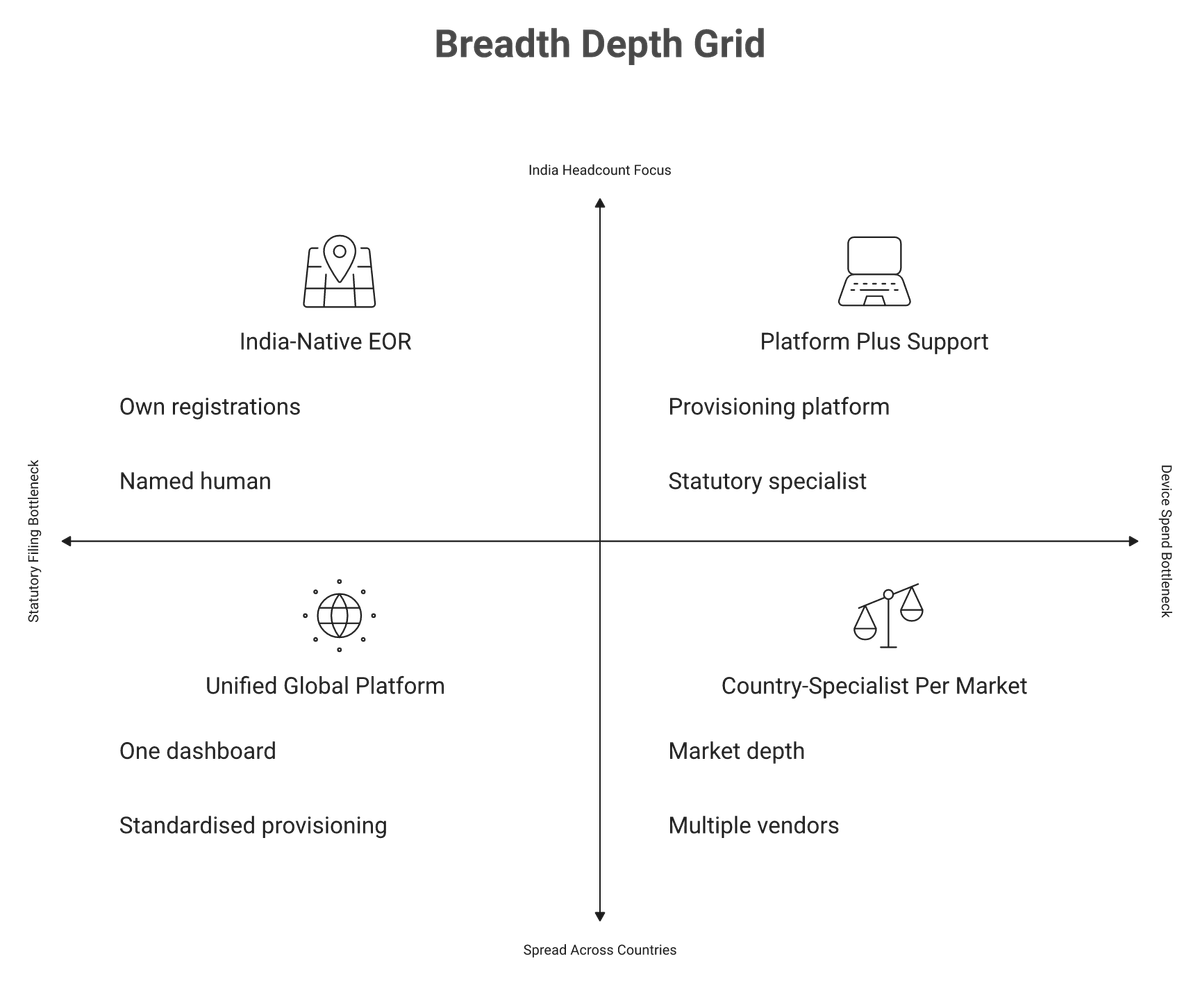
- India is your only hiring market, or more than 70 percent of your offshore headcount.
- Your hires sit across multiple Indian states, so professional tax and Shops and Establishments rules differ per person.
- You need a named human who answers before payroll cutoff, not a ticket queue.
Versatile Club holds PF, ESIC, and Shops and Establishments registrations across all 28 Indian states and 8 union territories, which is what makes the second scenario routine rather than exceptional. Our India EOR service is built around that single-country depth.
📊 The honest three-way comparison
| Criterion | Rippling | Global generalists (Deel, Remote, G-P) | Versatile Club |
| India EOR price per employee | $500 to $600 monthly | $400 to $599 monthly, G-P at 15 percent of salary | $149 monthly flat |
| Countries covered | Roughly 90 to 140 | 90 to 185 | India only |
| India entity | Owned | Usually local-partner entities | Owned (Foo Falcon Technologies Pvt Ltd) |
| Onboarding commitment | 2 to 5 days | 7 to 14 days | 5-day contractual SLA |
| Support model | Chatbot and email, account managers | Ticket queue or chatbot first | Founder on WhatsApp |
| Setup and exit fees | Quote-based | Varies | None, first month free |
If Deel or Remote sits on your shortlist, our Deel alternatives in India breakdown runs the same criteria across those platforms.
💬 What buyers say about the generalist experience
"The global benefits setup was delayed by two months beyond the go-live date because they were building out the function live without informing us."
— Jenny F., HR Leader, Rippling - G2 Verified Review, 2 April 2026
"The implementation process for Rippling Spend has been a truly terrible experience. No one can diagnose the issue, and they told me that it could take the engineers up to 21 days to diagnose the problem."
— Patrick W., Finance Lead, Rippling - G2 Verified Review, 9 April 2026
Both experiences are common. Global platforms handle the standard path well and struggle when a single country needs something unusual.
💰 Why the cost gap is not the main argument
A senior software engineer costs roughly $58,000 a year in Bengaluru against $220,000 in San Francisco. That is a $162,000 annual difference per role, and our cost of hiring in India guide breaks that down role by role.
I do not sell that as the reason to hire in India. The reason is access to academically strong engineers who have limited places to apply that training. Cost is a side effect, not the thesis.
🏢 One country, by choice
Versatile Club operates in exactly one country, which is the whole argument. Filings run under our own registrations, hiring is culture-fit-first against 50 behavioural parameters, and every placement gets a 90-day Success Coach plus a 6-month replacement guarantee. I am on WhatsApp directly, not a CSM rotation.
❌ Where Versatile Club is the wrong choice
Versatile Club is not the right fit if you need five or more countries, if procurement requires SOC 2 or ISO 27001 as a gate, or if you run B2C consumer hiring at volume. Enterprise customisation also takes longer than our 5-day SLA. If Ireland is next quarter, buy Rippling.
Q11. What should you verify in a demo before signing any India EOR contract?
Ask for artefacts, not assurances. Request a sample Form 130, which replaced Form 16 under the Income-tax Act 2025, and a Form 138 export. Request a September 2026 payslip showing the Rs.25,000 EPFO ceiling correctly pro-rated. Request a salary structure proving Basic plus DA at 50 percent or more, professional tax registrations for your specific hiring states, and a gratuity provisioning schedule at 4.81 percent of Basic plus DA. Request the written DPDP handling position ahead of May 2027, and the legal entity name on the employment contract. Versatile Club answers all seven in writing before signature. If a vendor still says "Form 16," the India module is stale.
📋 The seven artefacts, and what each one tests
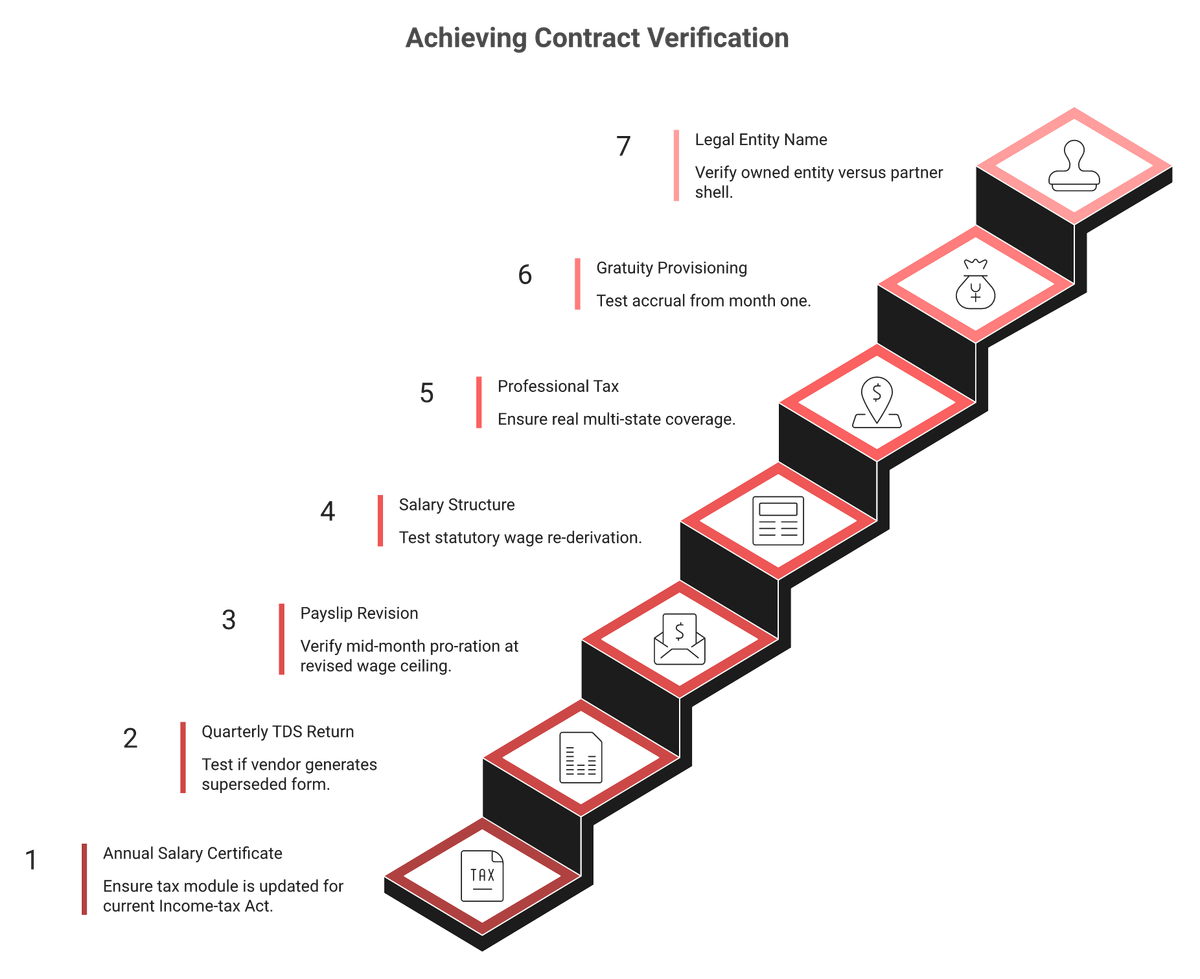
- Sample Form 130. Tests whether the tax module was updated for the Income-tax Act 2025. Form 130 replaced Form 16 and is due by 15 June after the tax year.
- Form 138 export. Form 138 replaced Form 24Q for quarterly TDS returns. A vendor still generating 24Q is behind.
- September 2026 payslip. The EPFO ceiling moved to Rs.25,000 on 17 September 2026, so that month needs mid-month pro-ration.
- Salary structure with Basic plus DA at 50 percent or more. Tests whether the platform re-derives statutory wage under the Labour Codes, or just stores components.
- Professional tax registrations for your states. Karnataka files monthly. Maharashtra needs PTRC and PTEC. Tamil Nadu files twice a year. Delhi has no professional tax but enforces Shops and Establishments rules strictly.
- Gratuity provisioning schedule. Should show accrual from month one at 4.81 percent of Basic plus DA.
- Entity name on the employment agreement. Tells you whether you are buying an owned entity or a partner shell.
⚠️ Why the artefact beats the answer
A salesperson can say yes to all seven in a 30-minute call. A sandbox export cannot.
The most expensive failure I see starts as a verbal promise about a registration. One G2 reviewer signed partly on that kind of promise, then found out during implementation that it was not true. By then the leverage had moved. If you are already mid-contract with the wrong provider, our guide on switching EOR providers in India covers the exit mechanics.
⏰ The two questions to ask about timelines
Ask what the onboarding commitment is, and ask what happens when it slips. Those are different questions.
Versatile Club runs a 5-day contractual onboarding SLA, which means it sits in the agreement rather than in a marketing page. Ask every vendor on your list whether their number is contractual or aspirational.
🗄️ The data question nobody asks in a demo
Add one more to the list if you have 30 seconds left. Who is the data fiduciary of record for your Indian employees under the DPDP Rules 2025?
Versatile Club holds employee records inside its own Indian entity, so the answer is a single named party in a single jurisdiction. A vendor who responds with a certification logo has answered a different question.
🏢 The entity name is the whole test
Versatile Club answers every item on this list in writing before a contract is signed, including the entity name on the employment agreement: Foo Falcon Technologies Pvt Ltd, our own company, not a partner shell. The registrations behind it are listed on our compliance page.
💬 Use this against me too
Send the checklist to every vendor on your shortlist, including Versatile Club. Fill in your hiring states, message me on WhatsApp, and I will return the artefacts rather than a deck.
If one of the seven items comes back weak from us, I would rather you find it now than in month four.
FAQs
What are Rippling's five product clouds, and what is included in the base plan?
Rippling groups its features into five clouds that share a single employee record.
- HR Cloud: HRIS, onboarding, benefits administration, time and attendance, PTO, performance, applicant tracking, and learning management.
- Payroll Cloud: domestic payroll, global payroll, contractor payments, Employer of Record, and US PEO.
- IT Cloud: device procurement and shipping, mobile device management, inventory, identity, and app provisioning.
- Spend Cloud: corporate cards, expenses, bill pay, procurement, and travel.
- Automation layer: Workflow Studio, formula fields, permissions, reporting, and embedded AI.
The detail that decides your invoice is inclusion. Only the HRIS core is foundational. Nearly every cloud above it is quoted separately, which is why the demo and the contract look different.
In the India engagements we see, activation clusters in three places: employee records, payroll, and device plus app provisioning. Spend Cloud, learning management, and applicant tracking get quoted often and used rarely, because a 20-person team rarely needs architecture designed for 500 people.
Versatile Club takes the opposite approach and sells one scope rather than five clouds, covering India EOR and employment compliance only. If your bottleneck is device logistics across four countries, the broad platform wins. If it is Indian statutory filing depth, scope breadth is not the variable that matters.
How much does Rippling actually cost per employee once you add the modules you need?
Rippling starts near $8 per employee per month plus a base platform fee of roughly $35 to $40, but that buys the HRIS core only.
- Payroll, benefits administration, time tracking, device management, and Spend each add roughly $4 to $12 per employee per month.
- India EOR seats are reported at $500 to $600 per employee per month on top of the platform fee.
- Full pricing sits behind a sales call, and there is no free trial.
Run the arithmetic for 10 India employees. The base fee, the per-employee platform charge, and EOR seats put you around $5,000 to $6,000 monthly before add-ons, or roughly $62,000 to $75,000 annually.
One line item never appears on any pricing page: foreign exchange spread. When a platform invoices in USD and pays salaries in INR, the conversion margin sits inside the payroll run, and reported markups across global platforms run 3 to 5 percent. On a $60,000 annual India payroll, 4 percent is $2,400.
Versatile Club prices India EOR at a flat $149 per employee per month with no platform fee underneath, no setup fee, no exit fee, and the first month free, published openly on our pricing page. We invoice in USD directly from our Indian entity, which removes that FX spread entirely.
Does Rippling handle Indian payroll compliance, including PF, ESI, TDS, and professional tax?
Rippling runs India payroll through an owned India entity, covering EPF, ESI, TDS under section 192, and professional tax in the major states. Independent teardowns confirm provident fund at 12 percent and ESI at 3.25 percent employer share.
That covers the visible 80 percent. The invisible 20 percent is where the exposure sits, and three 2025-26 changes test it.
- The four Labour Codes took effect on 21 November 2025, requiring Basic plus DA to be at least 50 percent of remuneration, with excess allowances added back for PF, gratuity, and bonus.
- The EPFO wage ceiling rose from Rs.15,000 to Rs.25,000 effective 17 September 2026, which forces mid-month pro-ration in that payroll cycle.
- Form 130 has replaced Form 16 under the Income-tax Act 2025, and Form 138 has replaced Form 24Q.
Ask for artefacts rather than assurances: a sample Form 130, a September 2026 Electronic Challan cum Return, and a gratuity schedule accruing at 4.81 percent of Basic plus DA.
Versatile Club files under its own registrations across all 28 Indian states and 8 union territories, listed on our compliance page. Because India is the only country we operate in, a statutory change is one migration rather than item 47 on a global backlog.
Is Rippling an EOR or a PEO in India, and what is the difference?
In India, Rippling operates as an Employer of Record. It becomes the legal employer through its own Indian entity and runs payroll, statutory contributions, and benefits on your behalf. Its PEO product is US-only co-employment.
The distinction matters because traditional US-style co-employment PEO does not legally exist under Indian labour law. There is no statutory construct where two entities share employer liability for one Indian employee. Any vendor pitching "PEO India" is describing an EOR with the wrong label.
Picking the wrong mode is expensive in a specific way:
- No Indian entity, want employees: you need EOR.
- You already own an Indian entity: you need global payroll, not EOR, and paying EOR margins on people you already legally employ is pure waste.
- Genuinely independent vendors: contractor payments, though fixed hours under direction usually signals misclassification.
We see that last trap most often with engineers who have sat on contractor invoices for 18 months while attending daily standups. Converting them cleanly beats defending the arrangement during diligence, and our guide on EOR versus PEO in India walks through the legal reasoning.
Versatile Club also offers Contract-to-Hire, which most platforms do not: employ through our entity now, convert to your own payroll later.
When should you choose an India-native EOR instead of Rippling?
Rippling is the stronger buy when your team spans four or more countries, when device logistics and app provisioning are the real bottleneck, and when finance wants cards, expenses, and bill pay inside the same system as payroll. Its unified architecture is genuinely strong there, reflected in a 4.8 out of 5 aggregate across more than 16,000 verified G2 reviews.
An India-native provider wins on a different set of conditions:
- India is your only hiring market, or more than 70 percent of your offshore headcount.
- Hires sit across multiple Indian states, so professional tax and Shops and Establishments rules differ per person.
- You need a named human who answers before payroll cutoff, not a ticket queue or chatbot.
- Full-and-final settlement, gratuity provisioning, and labour-code restructuring decide your risk profile.
Versatile Club operates in exactly one country at $149 per employee per month, with a 5-day contractual onboarding SLA, culture-fit screening across 50 behavioural parameters, a 90-day Success Coach, and a 6-month replacement guarantee. Our Rippling alternatives for India comparison runs the same criteria across every platform on your shortlist.
Where we are the wrong fit, honestly: five or more countries, SOC 2 or ISO 27001 as a procurement gate, or high-volume consumer hiring.