Table of contents (11)
Multiplier vs Deel 2026: Pricing, Coverage, and Features Compared
Q1. Multiplier vs Deel pricing 2026: which is cheaper on published rates?
On rates checked September 2026, Multiplier is cheaper. Deel publishes one EOR price of $599 per employee per month. Multiplier publishes $459 on annual billing and $499 month to month. Contractor management runs $40 against $49. Deel also sells Contractor of Record at $325, US PEO at $125, and ATS at $14 per worker. The EOR gap is $100 to $140 a month, roughly $1,200 to $1,680 a year per employee.
The verdict before the nuance
Multiplier wins the headline number. It does not win it by as much as the internet says.
I have quoted India deals for six years. Buyers almost always argue about the platform fee, which is the smallest line on the invoice. The fee is the part vendors publish because it is the part they control. Our own India EOR pricing page exists for exactly that reason.
💰 The full SKU ladder, side by side
| Line item | Deel | Multiplier | Versatile Club |
| EOR, per employee, per month | $599 | $459 annual, $499 monthly | $149, India only |
| Contractor management | $49 | $40 | Included in C2H scope |
| Contractor of Record | $325 | Not published | Not offered |
| Setup fee | $500 | $0 | $0 |
| Exit notice | 1 month | 2 weeks | None |
| First month | Charged | Charged | Free |
Multiplier splits its plans into Core and Growth tiers, with Growth at $519 annual and $559 monthly. Ask which tier your quote sits in. The features that matter, such as equity administration, often live one tier up.
⚠️ The stale $400 problem
Several 2026 comparison pages, including Deel's own competitor page, still quote Multiplier at $400 per employee per month. That figure is closer to Multiplier's older contractor-era rate than to its current EOR list price. If your board model uses it, your savings case is overstated by roughly $60 to $100 per employee per month.
Date-stamp every number you pull. I re-check both pricing pages before any client call, because both vendors have moved rates inside a single quarter. If you want the working comparison set instead, start with our Multiplier alternatives for India breakdown.
⭐ What buyers say about paying for it
"I find Deel to be absurdly expensive. They charge a high amount of fees for transferring money to my bank account."
— Juan Camilo O., Verified Reviewer, 1/5 rating, 27 November 2025, Deel - G2 Verified Review
"I appreciate that Multiplier offered competitive pricing for its employer of record services, which played a significant role in my decision to use it."
— Micah P., Verified Reviewer, 1/5 overall rating, 3 November 2025, Multiplier Employer of Record - G2 Verified Review
"They also introduced some new deposits and fees that weren't originally in our contract and ultimately ended up increasing our EOR costs."
— Verified User in Information Technology and Services, 0/5 rating, 9 December 2025, Multiplier Employer of Record - G2 Verified Review
That last quote is the one I would read twice. A cheaper list price that gains deposits later is not a cheaper price.
Versatile Club prices India EOR at a flat $149 per employee per month, with no setup fee, no exit fee, and the first month free. We are not spreading the cost of entities in 150 countries across your India invoice. One country, one rate, published.
Q2. What does one India hire actually cost once statutory burden is added?
Your India cost has three lines. Gross CTC, meaning cost to company, the full salary package. Then statutory employer burden: EPF at 12% of basic (or capped on Rs 15,000), EPF admin charges at 0.5%, EDLI at Rs 75, and labour welfare cess near 0.60%, plus professional tax capped at Rs 2,500 a year. That lands around 13.1% of basic plus Rs 75. Then the platform fee. Setup fees, salary deposits, and FX spread sit outside all of it.
Build the model in three lines, not one
Most cost models I see from US founders have one line called "EOR cost." That is the line that breaks in month three.
📊 The statutory stack, as filed
| Contribution | Rate | Basis |
| EPF (provident fund) | 12% | Basic, or Rs 15,000 cap |
| EPF admin charges | 0.5% | Basic |
| EDLI (life insurance) | Rs 75 | Flat, monthly |
| Labour welfare cess | 0.60% | Basic |
| Professional tax | Up to Rs 2,500 | Per year, state set |
| Gratuity accrual | 4.81% | Basic plus DA |
ESI applies where gross wages are Rs 21,000 or below, split 3.25% employer and 0.75% employee. Most engineers sit above that line, so ESI rarely shows up in a Bengaluru senior developer's cost sheet. Our India EOR cost guide works through the full stack.
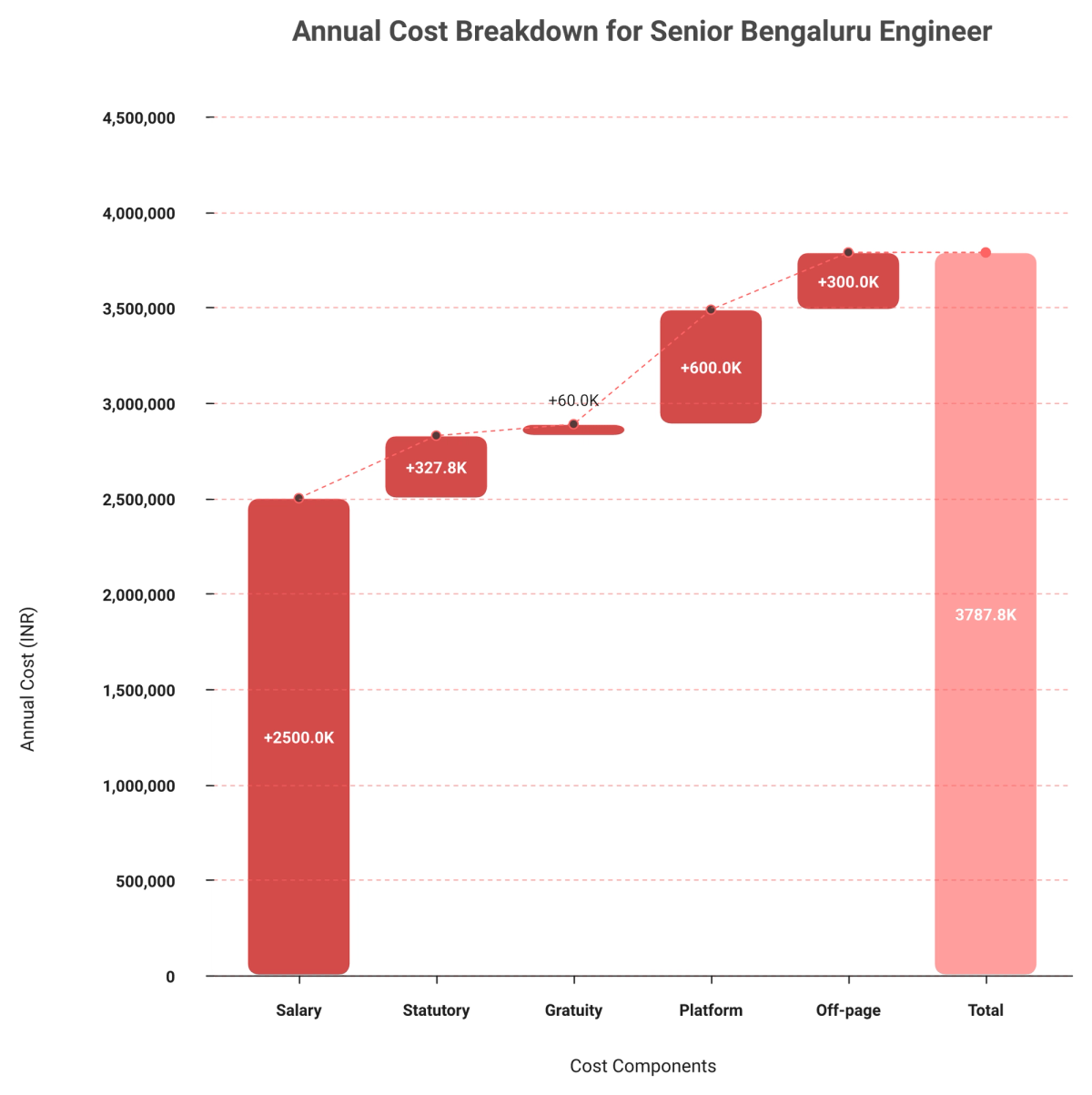
🧮 A Bengaluru engineer at Rs 25 lakh
Take a Rs 25 lakh package. Say basic is Rs 12.5 lakh, which the 2025 to 2026 Labour Codes now effectively require, since basic plus dearness allowance must be at least half of remuneration.
- Statutory employer burden: roughly Rs 1.64 lakh a year on that basic, plus gratuity accrual of about Rs 60,000.
- Platform fee at Deel: $7,188 a year. At Multiplier on annual billing: $5,508.
- At ten engineers: $71,880 against $55,080, a $16,800 annual gap on the fee line alone.
The statutory line does not change between vendors. It is set by EPFO and state rules, not by the platform. So the only real variables are the fee, the spread, and the deposits. Run your own numbers in the EOR vs entity calculator before you commit.
💸 The costs that never reach a pricing page
Four items show up on the invoice and nowhere on the website: a setup fee of around $500 on Deel, a security deposit often equal to one month of salary, a one month exit notice, and the currency conversion spread. On a Rs 25 lakh salary, a 3% spread is more money than the monthly fee, as our Deel pricing teardown sets out line by line.
Ask for a live sample invoice during procurement. Not a quote. An actual invoice from a live client, with the client name redacted and every line item intact. Vendors who send it within a day are usually the ones whose pricing pages hold up.
⏰ What your controller needs by the 7th
TDS, meaning tax deducted at source, must be deposited by the 7th of the following month. Form 16, the annual tax certificate for the employee, is due by 30 May. If your vendor cannot produce the challan, the payment receipt, on request, your audit trail has a hole in it.
Versatile Club itemises the statutory line against our own PF, ESI, TDS, and professional tax registrations, so your controller ties every rupee to a filing acknowledgement rather than a partner's summary total. We send the challans with the invoice, not after an audit asks. Our managed payroll service runs the same cycle.
Q3. USD or INR invoicing: which model quietly costs your finance team more?
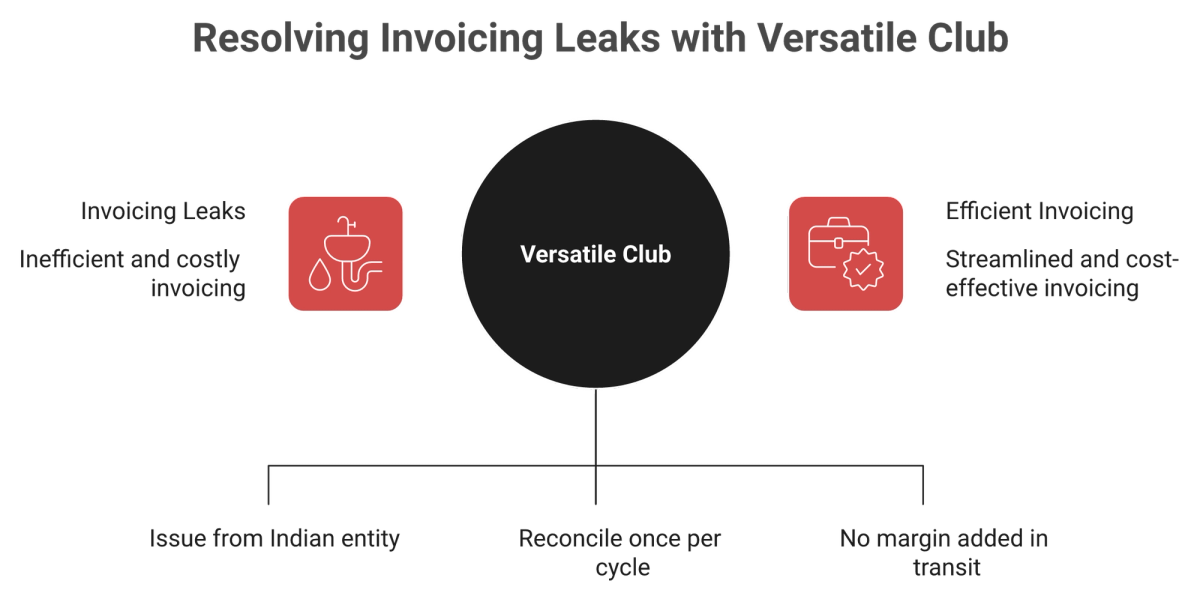
Neither model is free. Deel invoices in USD, which keeps month end close simple, but reported FX conversion markups of 3% to 5% ride inside the remittance. Multiplier defaults to INR invoicing, which avoids that markup but transfers rate risk and reconciliation work to your US accounting team. Versatile Club invoices in USD from its own Indian entity at a disclosed rate, with no conversion margin taken in transit.
The currency line nobody budgets for
A US founder once messaged me on WhatsApp at 11pm her time, three days before payroll. Her question was not about compliance. It was why two invoices for the same salary differed by $340.
That was the spread. It had been there every month.
💸 Where each model leaks
- USD invoicing with an embedded spread. Your close is clean. The cost is hidden inside the conversion rate, so it never appears as a fee you can challenge.
- INR invoicing. No markup taken by the vendor. Your team now owns the conversion, the rate date, and the variance explanation at month end.
- The middle case. Multiple India vendors sending non consolidated invoices in different currencies. Reconciliation stops being a task and becomes a monthly project.
Multiplier's INR default works if you hold an Indian bank account or hedge currency. Most Series A companies do neither, which is why our guide to paying employees in India starts with the invoicing structure rather than the payroll run.
⭐ What reviewers report on billing
"I'm required to pay a monthly fee, which I don't like at all. The initial setup process was also very challenging; it took several days and involved a lot of emails."
— Verified User in Translation and Localization, 0.5/5 rating, 31 July 2025, Deel - G2 Verified Review
"I experienced several invoice errors, which added confusion to management and required my initiation for them to be addressed, eroding my confidence in their system."
— Micah P., Verified Reviewer, 1/5 rating, 3 November 2025, Multiplier Employer of Record - G2 Verified Review
"We were charged incorrect and extremely high pre-payment invoices, on top of the already large deposit required."
— Kenneth P., Verified Reviewer, 0.5/5 rating, 9 September 2025, Multiplier Employer of Record - G2 Verified Review
✅ Three questions to send before you sign
- Which rate do you convert at, and which published source is it drawn from?
- What spread is applied above that rate, stated as a percentage?
- What is the value date used, the day the rate is fixed?
A vendor that answers all three in writing has nothing hidden in the conversion. A vendor that answers "we use market rates" has told you nothing.
Versatile Club's read is that the standard advice gets this backwards. The industry argues about monthly fees and treats currency as plumbing. In our client engagements, the spread is frequently the larger number. I might be over weighting it because India is all we see, but the arithmetic holds at every salary band we quote.
Versatile Club sends one USD invoice from a single Indian entity, at a rate stated on the invoice, with no margin added on the way through. One currency, one entity, reconciled once. You can see the mechanics in how it works.
Q4. How many countries do they really cover, and do they own the India entity?
Published coverage claims conflict. Deel appears as 130 to 153 countries and Multiplier as 160 to 171, depending on the source, because vendors count partner served markets alongside owned entities. Multiplier markets a largely owned network and is reported to hold owned entities including India. Deel runs a mixed owned and partner model. Versatile Club operates one owned Indian entity, and its CIN appears on every appointment letter it issues.
Country count is the wrong metric
Everyone compares the number. The number is marketing arithmetic.
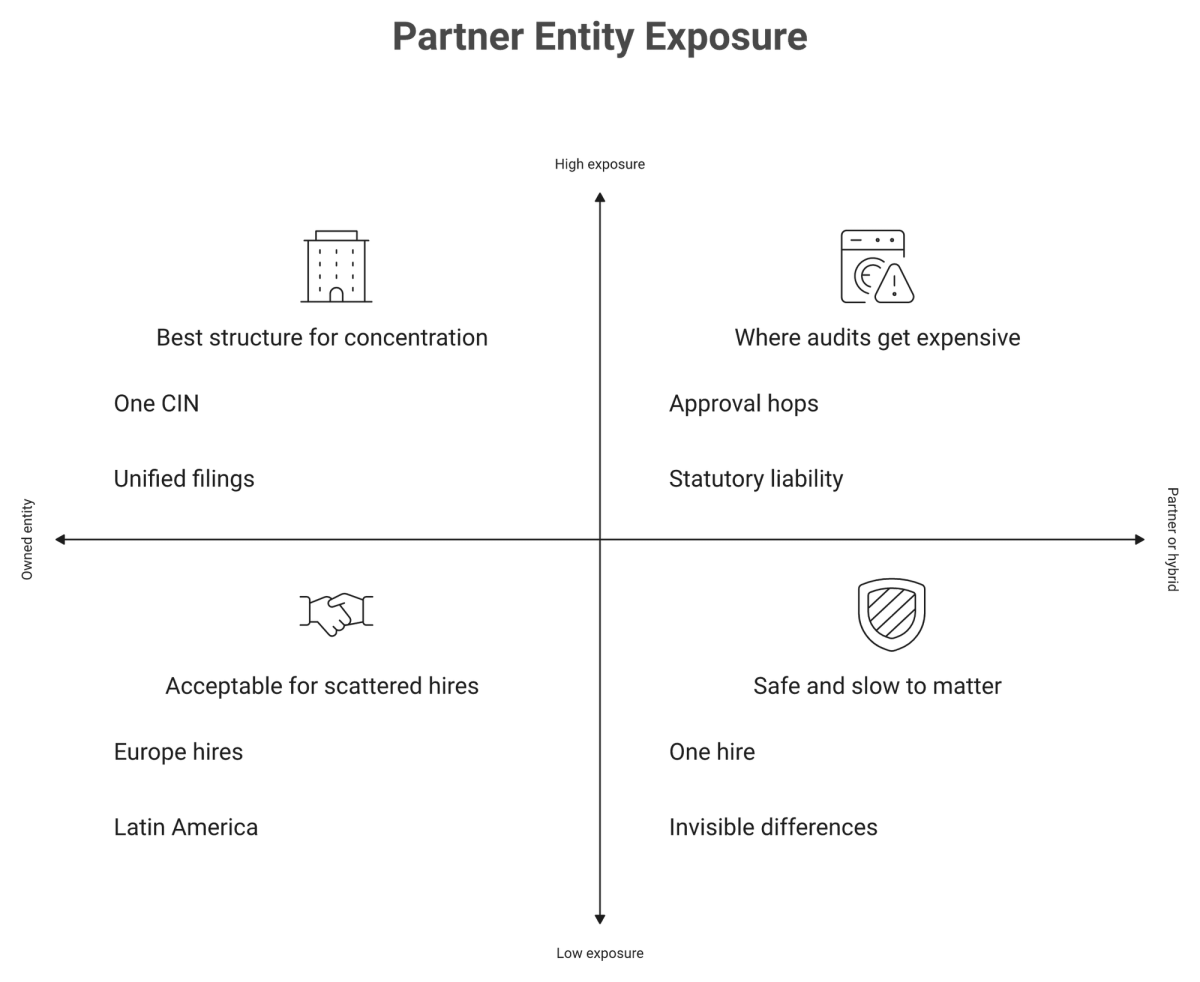
An owned entity means the vendor's own company employs your person. A partner entity means a third party does, under a contract you never see. Both get counted the same way on a pricing page.
❌ What a partner shell costs you at ten hires
At one hire, the difference is invisible. Past five to ten in one country, it shows up in three places.
- Speed. Every contract change, salary revision, or exit adds an approval hop through the partner.
- Liability. Your statutory exposure sits with a company you have no agreement with.
- Audit. When an EPFO or income tax officer asks who the employer is, the answer travels through two companies instead of one.
There is a version of global hiring that is genuinely fine on partner entities. One or two scattered hires in Portugal or Poland, no concentration, low stakes. India with fifteen engineers is not that version, and our EOR vs entity comparison for India walks through where the line sits.
✅ The five minute verification
You do not need to trust a sales answer. Ask for two things, then check them yourself.
- The legal entity name and CIN, the Corporate Identity Number, that will appear on the appointment letter.
- The PF and ESIC registration numbers under which contributions will be filed.
Then look the entity up on the MCA portal, the Ministry of Corporate Affairs company register. Incorporation date, registered office, and directors take five minutes to confirm. If the entity was registered last quarter, or if the name on the appointment letter differs from the name on your master service agreement, you are on a partner structure. Our compliance page lists the registrations we file under.
⚖️ How the three models compare
| Factor | Deel | Multiplier | Versatile Club |
| Model | Mixed owned and partner | Largely owned, partner in some markets | Single owned Indian entity |
| Countries | 130 to 153 | 160 to 171 | India only, by design |
| India state depth | Concentrated in major states | Claims all 28 states | 28 states and 8 union territories |
| Filings under | Entity or partner, varies | Entity or partner, varies | Own PF, ESI, TDS, PT registrations |
Both platforms were positioned as Leaders in Everest Group's 2025 Employer of Record PEAK Matrix assessment, so the analyst badge does not separate them on this question. Ask for the excerpt and check its publication year before you quote it internally.
Where my head is right now: India stops being a row on a 150 country map within two years, and owned entity specialists take that revenue. I could be reading my own position into the trend. If you are already on a generalist, our guide to switching EOR providers in India covers the mechanics.
Versatile Club owns its Indian entity outright, not a partner shell. Every appointment letter carries our CIN, every PF and ESI challan carries our registration number, and you can verify both on the MCA portal before you sign anything. Book a 30 minute call and I will send the CIN before we talk.
Q5. Feature by feature, where does each platform actually win?
Deel wins on software surface: self-serve onboarding, the widest integration catalogue, global contractor tooling, and adjacent products like Contractor of Record and US PEO. Multiplier wins on APAC depth, notably native ESOP and equity administration. The sharper split is service architecture. Deel routes support chatbot-first, Multiplier assigns a customer success manager over email. Versatile Club writes a five-day onboarding SLA into the contract, with a 90-day Success Coach on every placement.
Two different products wearing the same category name
Deel is a software company that sells employment. Multiplier is an employment company that sells software. That sounds like a slogan. It shows up in every support ticket.
⚖️ The capability matrix
| Capability | Deel | Multiplier | Versatile Club |
| Integrations | Widest catalogue | Core HRIS and accounting | India payroll stacks (Keka, Zoho, greytHR) |
| ESOP administration | Handled indirectly | Native equity support | Supported, India tax treatment |
| Adjacent SKUs | CoR, US PEO, ATS | EOR, contractors, payroll | India EOR and C2H only |
| Support routing | Chatbot first | CSM over email | Founder on WhatsApp |
| Onboarding | 7 to 14 days, claimed | 7 days, claimed | 5 days, contractual |
| Countries | 130 to 153 | 160 to 171 | India only, by design |
Read the last row honestly. If you need employees in five countries next quarter, Versatile Club is the wrong vendor, and I will say that on the first call. Our EOR services are built for one country only.
⏰ Why a range is not an SLA
Both platforms publish onboarding as a range. A range has no consequence attached. Nobody owes you anything when day twelve arrives and the appointment letter has not.
Versatile Club puts the five-day commitment in the contract, which is the only version of an SLA that means something. I will name the trade-off: heavy enterprise procurement workflows, with security questionnaires and custom redlines, run longer than five days. That is honest, not a caveat buried in a footnote. You can see the sequence on our how it works page.
⭐ What service actually feels like
"Every issue, no matter how urgent, takes 3 to 10 business days to resolve. Account managers are polite but powerless to actually fix core problems."
— Kenneth P., Verified Reviewer, 0.5/5 rating, 9 September 2025, Multiplier Employer of Record - G2 Verified Review
"They consistently failed to meet committed deadlines, had terrible communication, and frequently cancelled meetings at the last minute."
— Verified User in Computer Software, 0/5 rating, 13 December 2025, Deel - G2 Verified Review
"The product user interface is relatively easy to navigate and use, and meets basic EOR workflow needs."
— Verified User in Information Technology and Services, 0/5 overall rating, 9 December 2025, Multiplier Employer of Record - G2 Verified Review
Notice the pattern. The interface is fine in almost every review. The escalation path is where the rating drops. If that pattern is why you are shopping, our Multiplier alternatives for India comparison starts there.
✅ Score the two axes that hurt later
Ignore the feature grid for a moment. Ask two questions instead.
- Who answers at 9pm on the 28th when a PF challan is missing?
- How many days does a salary revision take to reach a signed amendment?
Versatile Club's read is that the category benchmarks the wrong things. Demo polish is easy to buy. A named human who owns your payroll cycle is not. I hold that view with one caveat: founder-direct support works at our current scale, and at some point it has to change.
Versatile Club backs C2H placements with a six-month replacement guarantee and a 90-day Success Coach on every hire. Commitments with consequences, not ranges in a sales deck.
Q6. Can either platform handle all 28 Indian states, or only the metros?
Country count tells you nothing about India. Professional tax, Shops and Establishments registration, and labour welfare fund rules are set state by state. Maharashtra needs dual PTRC and PTEC registration with monthly slab filing. Karnataka runs a monthly PT cycle with enrolment within 30 days of joining. Tamil Nadu files twice a year. Multiplier claims all 28 states. Versatile Club holds PF, ESIC, and Shops and Establishments registrations across 28 states and 8 union territories.
The unit of India compliance is the state
Professional tax, or PT, is a small state levy on salaried income, capped at Rs 2,500 a year. The amount is trivial. The registration is not.
📋 Four states, four different calendars
| State | What it requires | Cadence |
| Maharashtra | PTRC and PTEC, both | Monthly slab filing, annual return |
| Karnataka | PT plus S&E renewal | Monthly, enrolment in 30 days |
| Tamil Nadu | PT plus labour welfare fund | Half yearly |
| Telangana | PTRC enrolment | Monthly remittance |
| Delhi | No PT, strict S&E | Registration and display rules |
West Bengal belongs in a separate mental bucket. Rules there change often enough that I re-check before every filing cycle rather than trusting last quarter's process. Our India payroll compliance guide keeps the state calendar in one place.
❌ What a missing registration actually breaks
A missing state registration does not produce a fine on day one. It produces a delay.
- The appointment letter cannot issue with a compliant PT deduction line.
- The first payroll runs with a deduction the vendor cannot remit.
- The correction lands three months later, as arrears, in the employee's payslip.
That third item is the one that costs you trust. Your new engineer in Indore now thinks the US company underpaid them.
⚠️ The question that separates vendors
Do not ask "do you cover all states." Everyone says yes. Ask this instead: which state registrations do you already hold, under which registration number, and can you send the certificate?
Versatile Club answers that with a certificate, because India is the only country we operate in. A global platform covering 150 countries will usually route a non-metro hire through a partner, then obtain the registration after you sign. Our compliance page lists what we file and where.
🏙️ Metro depth is not India depth
Bengaluru, Hyderabad, Mumbai, Pune, Delhi, and Chennai are straightforward. Almost every vendor is competent there. The test case is a designer in Kochi, a QA lead in Jaipur, or a support hire in Bhubaneswar.
Versatile Club has run multi-state PF, ESI, and PT compliance across Bengaluru, Hyderabad, and Pune through C2H placements for six years. What surfaces in our client engagements is that the second non-metro hire, not the first, is where a generalist's India process visibly strains. City-level detail sits in our Bengaluru payroll outsourcing guide.
⏰ One more calendar item
Under the 2025 to 2026 Labour Codes, state rules are still being notified in stages. So your vendor's state playbook needs updating this year, not in 2027. Ask when they last revised it.
I could be reading too much into the timing. State notifications have slipped before. Versatile Club's approach is to treat every state rule as current only until the next gazette lands.
Versatile Club has filed in these states as the legal employer, which is why our five-day onboarding SLA is contractual. We already hold the registration your hire's state needs, so there is nothing to obtain after you sign. That is the basis of our India EOR service.
Q7. What do the 2025-26 Labour Codes and DPDP Rules change in your EOR contract?
Two changes reprice and re-paper every India EOR deal. The four Labour Codes took effect on 21 November 2025, consolidating 29 central laws, and the unified wage definition requires basic plus dearness allowance to be at least 50% of remuneration. The DPDP Rules 2025 were notified on 13 November 2025 as G.S.R. 846(E), with most substantive duties commencing 14 May 2027. Versatile Club restructures offer letters to the wage floor before the first payroll runs.
The wage floor is a cost change, not a paperwork change
Dearness allowance, or DA, is a cost-of-living component of Indian salary. Basic plus DA now has to be half of total remuneration.
That matters because PF, gratuity, and statutory bonus are calculated on that base.
💰 What it does to a Rs 25 lakh package
Take an old structure with basic at 30%, so Rs 7.5 lakh. Move it to 50%, or Rs 12.5 lakh.
- PF liability rises with the base, at 12% employer contribution.
- Gratuity accrual rises too, at 4.81% of basic plus DA.
- Statutory bonus eligibility shifts for lower salary bands.
The employee's take-home can fall even though nothing about the offer changed. Versatile Club rebuilds the CTC breakup before the offer goes out, so the candidate sees the final number once instead of twice. Model it yourself with our India salary calculator.
⚠️ DPDP is your contract problem, not your 2027 problem
The Digital Personal Data Protection Rules were notified in the official gazette on 13 November 2025, with a staged commencement notification issued the same day. Government confirmed full operationalisation of the Act shortly after, following 6,915 stakeholder inputs.
Your EOR handles Aadhaar numbers, PAN details, bank accounts, and salary data. Under the Act, that makes it a processor acting on your instructions.
Three clauses belong in the master service agreement now:
- A consent notice standard for employee data collection.
- Security safeguards, stated specifically, not as "industry standard."
- Breach notification timelines that run to you, not just to the regulator.
⏰ The dates to put in your compliance calendar
| Date | What happens |
| 21 Nov 2025 | Four Labour Codes in force |
| 13 Nov 2025 | DPDP Rules notified, G.S.R. 846(E) |
| 14 Nov 2026 | Consent-manager registration duties begin |
| 14 May 2027 | Most substantive DPDP obligations commence |
Neither Multiplier nor Deel documents this staging publicly on its India pages. That is not a scandal. It is what happens when one country is one row in a 150-country content operation. Our India EOR 2026 playbook tracks it as a calendar, not a footnote.
📄 The form changes nobody mentions
Under the Income Tax Act 2025, TDS reporting forms are being renumbered, with Form 138 replacing the legacy quarterly return. TDS still deposits by the 7th of the following month. Form 16, the annual tax certificate, still issues by 30 May, per the Income Tax Department.
Versatile Club files these under our own TDS registration, so the acknowledgement number comes back to us and then to you. That is how our India payroll outsourcing cycle closes each month.
Where my head is right now: most India EOR contracts signed in 2024 are now partly out of date, and almost nobody has reopened them. Versatile Club's client agreements point one way on this, though my sample is India-only and small.
Versatile Club restructures offer letters to the basic plus DA floor before payroll one, and writes DPDP processor obligations into the MSA today rather than deferring them to the 2027 commencement date.
Q8. What does misclassification cost, and why does conversion pressure start internally?
Misclassification in India typically costs $25,000 to $40,000 per person in back-dated PF, ESI, gratuity, TDS, and penalties. Conversion pressure rarely starts with the worker. It starts the week a real HR leader reads the contracts. US-style PEO co-employment does not legally exist under Indian labour law, so there is no middle path. Versatile Club runs C2H and EOR on the same owned Indian entity, so conversion keeps the same PF account and service record.
The situation: two years of clean invoices
A US company hires three engineers in Bengaluru as contractors. Invoices arrive monthly. Everyone is happy for two years.
Then the company hires its first Head of People.
❌ The complication is internal, not external
She reads the contracts in week two. Fixed hours, company laptops, a direct manager, a Slack workspace, no other clients. Every marker of employment, on a contractor agreement.
An EOR operator I spoke with described exactly this trigger: HR arrives, reviews the arrangement, and realises the contractor should have been an employee, with backdated taxes and fines in the picture. Nobody was being cynical. The structure simply outgrew itself. Our independent contractor versus EOR comparison sets out the markers.
💸 What the exposure is built from
The number is not a fine. It is arrears plus interest plus penalty.
- Employer PF at 12%, backdated, plus damages, per EPFO rules.
- ESI at 3.25% employer share where wages qualify.
- Gratuity accrual at 4.81% of basic plus DA.
- TDS shortfall, interest, and late filing penalties.
Across the conversions Versatile Club has run, the arrears themselves are rarely the painful part. The painful part is reconstructing two years of payroll records that were never kept.
⭐ What the platform experience looks like from inside
"Deel treats all users as if they were individual freelancers, even when you're clearly operating as a registered company."
— Verified User in Translation and Localization, 0.5/5 rating, 5 May 2025, Deel - G2 Verified Review
"Using an EOR like Multiplier can help reduce administrative burden for employees that work in another state for a company that does not wish to register as an employer in multiple states."
— Kenneth P., Verified Reviewer, 0.5/5 overall rating, 9 September 2025, Multiplier Employer of Record - G2 Verified Review
Kenneth's reason for moving to an EOR is the right reason. His experience after moving is why the vendor choice matters as much as the structure.
✅ Why conversion helps the employee too
There is a version of this argument that only serves the company. That version is incomplete.
Employment status in India unlocks things contracting does not. A salary slip and Form 16 are what banks want for a home loan. Provident fund balance builds. Gratuity accrues after five years of service.
I have watched candidates accept slightly lower cash for employed status, purely because a mortgage application was coming. Versatile Club has seen the same pattern in C2H conversions, though I would not claim it holds for every senior hire.
📄 The conversion checklist
- Date the employment start and decide whether to backdate.
- Fix the CTC structure to the basic plus DA floor.
- Open PF and ESI under the employing entity, then file.
- Close the contractor agreement formally, with a final invoice.
Versatile Club runs C2H and EOR on one owned Indian entity, so a conversion is a document change and a payroll switch. Same PF account, same employee ID, no break in service for gratuity, no vendor migration. Our step-by-step contractor to employee conversion guide covers the paperwork, and you can book a 30 minute call to run your own case.
Q9. What do reviewers and analysts say about each platform?
Deel wins on volume, Multiplier on sentiment. Deel carries roughly 2,150 public reviews to Multiplier's 450, with a 4.8 G2 average against Multiplier's 4.7, while Multiplier scores higher on Trustpilot. Both were positioned as Leaders in Everest Group's 2025 Employer of Record PEAK Matrix. Versatile Club has a smaller review base than either platform, which is a real trade and worth naming.
Method before verdict
Averages hide everything useful. A 4.8 across 2,150 reviews and a 4.7 across 450 are not comparable signals.
Versatile Club reads these profiles the same way every month: two-star and below, sorted by most recent, on G2 and Trustpilot only. Recency matters more than rating, because both vendors have changed pricing and support structure inside the last year. Our best EOR services in India roundup applies the same filter.
📊 What the numbers actually say
| Signal | Deel | Multiplier | Versatile Club |
| G2 average | 4.8 | 4.7 | Smaller sample |
| Public review count | ~2,150 | ~450 | Early-stage base |
| Everest PEAK Matrix 2025 | Leader | Leader | Not assessed |
| Support model in reviews | Chatbot, then ticket | CSM, then ticket | Founder on WhatsApp |
Read the last column honestly. Versatile Club cannot match either review base, and I will not pretend otherwise on a sales call. What we publish instead sits on our about page.
❌ The three complaint clusters
Across the negative reviews I read, the same three themes repeat regardless of vendor.
- Escalation stalls once an issue leaves the first support layer.
- Invoice lines appear that were never discussed in the sales cycle.
- Onboarding slips past the quoted range in non-metro locations.
None of these show up in a demo. All three show up by month three.
⭐ Reviews worth reading twice
"I believe those platforms have two major tasks to do: contracts and payments. Both lacks at Deel."
— İbrahim, Verified Reviewer, 1/5 rating, 1 November 2024, Deel - G2 Verified Review
"We've found them very difficult to work with as a partner, their communications are inconsistent."
— Verified User in Information Technology and Services, 0/5 rating, 9 December 2025, Multiplier Employer of Record - G2 Verified Review
"Sometimes the email communication from the wisemonk team is delayed by a day or 2. But overall they seem to be the best for India."
— Verified reviewer, 4/5 rating, Wisemonk - G2 Verified Review
That third quote is from an India-native competitor, and it is a fair review. Even the strong India specialists get flagged on response time, which is why we publish a Wisemonk alternative comparison rather than a takedown.
⚠️ Handle the analyst badge carefully
Both vendors cite Leader placement in Everest Group's 2025 EoR PEAK Matrix. When both sides hold the same badge, it stops being a differentiator.
Ask for the excerpt itself, and check the publication year before you put it in a board deck. Versatile Club's read is that the category over-indexes on analyst badges and under-reads recent two-star reviews, where the operational truth sits.
Versatile Club trades review volume for something else: fewer public reviews, and the founder answering on WhatsApp when payroll is wrong on the 28th. That is the honest version of the comparison, and our contact page routes to the same number.
Q10. Which platform fits your situation, and when should you choose neither?
Choose Deel if headcount is scattered across eight or more countries and procurement wants the largest brand and integration catalogue. Choose Multiplier if APAC is your centre of gravity, you need native ESOP administration, and you can absorb INR invoicing. Choose neither if 80% of hires sit in one country. Versatile Club operates in India only, at $149 per employee per month, with the first month free.
The problem with buying breadth you never use
A Series A CTO once told me he had picked a 150-country platform for three engineers, all in Bengaluru. He was paying for entity infrastructure in 149 countries he would never touch.
That is the most common overspend I see in global hiring. Our India expansion options guide lays out the alternatives side by side.
✅ The three-way verdict
| Your situation | Best fit | Why |
| 8+ countries, scattered | Deel | Widest catalogue, one contract |
| APAC concentrated, needs ESOP | Multiplier | Native equity support, lower fee |
| 80%+ hires in India | India-native EOR | Owned entity, state depth, lower cost |
For the third row, an India-native shortlist starts with Versatile Club at $149 per employee per month, then Wisemonk in the $99 to $399 band. Both operate India-first. Neither is the answer if you need five countries.
💰 The split-vendor arithmetic
You do not have to pick one vendor for the whole map. The cleanest structure I have seen clients run is two.
- Keep a generalist for one or two scattered hires in Europe or Latin America.
- Move the concentrated India team to an India-native EOR on an owned entity.
- At ten India engineers, the fee difference alone runs roughly $24,000 to $54,000 a year.
Versatile Club sits on the India side of that split, and I have never argued a client out of keeping Deel for their Portugal hire. If you are running that comparison now, our Deel alternative page shows the India-only math.
❌ When Versatile Club is the wrong call
Naming this matters more than another feature claim.
- You need employees in five or more countries next quarter.
- You are an enterprise with 100-plus India staff and SOC 2 or ISO 27001 as a procurement gate.
- You are a B2C consumer company hiring at volume.
In all three cases, buy a generalist or a certified India platform. Versatile Club will lose that deal, correctly. Companies in the middle band usually land on our startup offering instead.
⭐ What buyers say about picking for the right reason
"Working with Skuad has allowed us to expand our company into international grounds without having to manage some critical local HR components."
— Verified User in Information Technology and Services, 4/5 rating, Payoneer Workforce Management (formerly Skuad) - G2 Verified Review
"Initially the problem I faced while working as a contractor for an international company was the money transfer problems but from when my company started using wisemonk I receive my salary in INR in my bank account."
— Verified reviewer, 4/5 rating, Wisemonk - G2 Verified Review
"Multiplier has fairly competitive EOR pricing, although it's also a bit of a 'you get what you pay for.'"
— Verified User in Information Technology and Services, 0/5 rating, 9 December 2025, Multiplier Employer of Record - G2 Verified Review
One more framing, and it is not about price. Companies hire in India for the depth of the engineering talent pool, not for cheap labour. Vendor choice should follow where that talent sits, which is the premise of our guide to hiring AI and ML engineers in India.
Versatile Club exists for the third scenario only. India is the one country we operate in, we bill $149 per employee per month with the first month free, and we do not ask you to fund entities you will never use.
Q11. What should you ask both vendors before you sign?
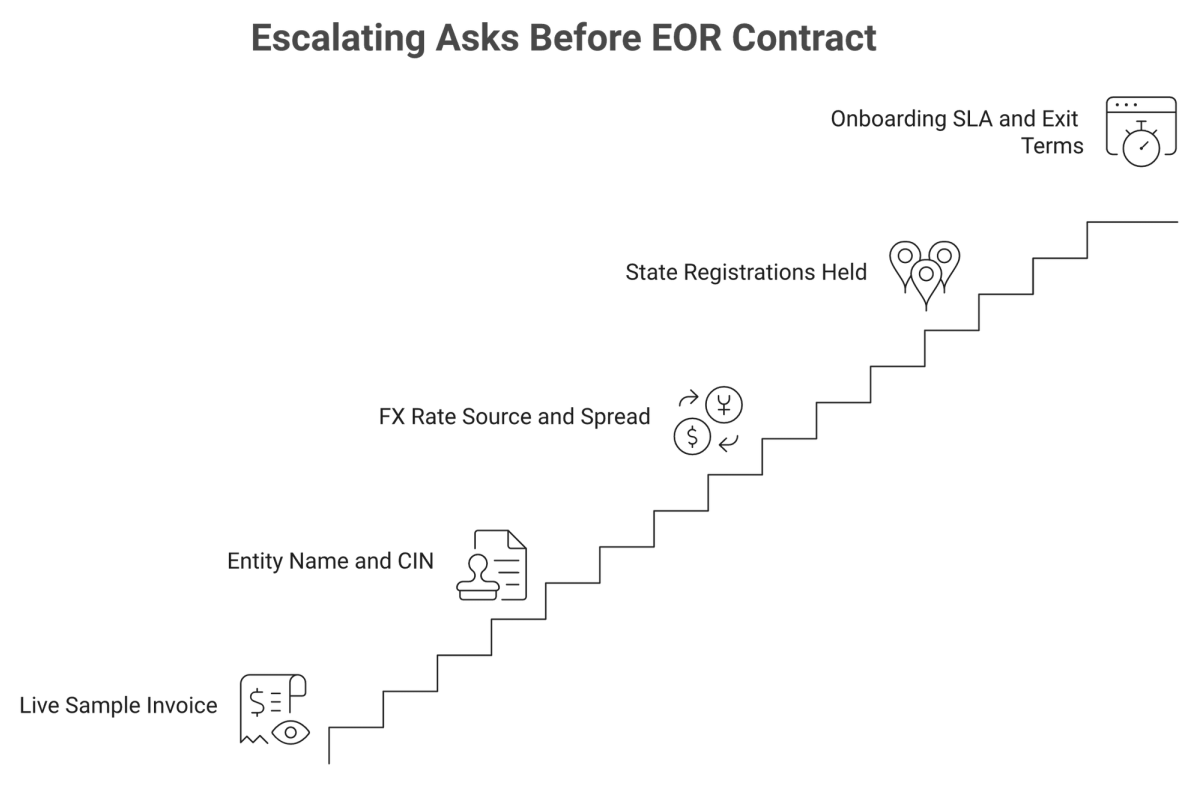
Send one email asking for seven things: a live sample invoice with every line item, the legal entity name and CIN on the appointment letter, the FX rate source and spread applied, setup fee and security deposit in writing, the exit notice period, the state registrations already held for your hire's location, and the onboarding SLA as a contractual term. Versatile Club answers all seven in writing before a contract is signed.
Ask for the artefact, not the assurance
"Are there hidden fees?" gets you a no. Every time.
"Send me a live sample invoice, client name redacted, all line items intact" gets you the truth. Versatile Club sends one on request, because a real invoice is faster than a paragraph of reassurance. The same discipline runs through our EOR switching guide.
✅ The seven questions, and what a good answer looks like
- Live sample invoice. A real invoice, not a quote. Good answer: it arrives within a day.
- Entity name and CIN. The Corporate Identity Number on the appointment letter. Good answer: you can verify it on the MCA portal.
- FX rate source and spread. Good answer: a named rate source, a stated percentage, a value date.
- Setup fee and deposit. Good answer: both numbers in writing, including whether the deposit is refundable.
- Exit notice. Good answer: a stated number of days, plus what is billed during it.
- State registrations held. Good answer: registration numbers and certificates for your hire's state.
- Onboarding SLA. Good answer: a contractual day count with a consequence, not a range.
Versatile Club answers seven of seven in one reply. That is not a boast; it is the minimum bar I would want as a buyer. Our how it works page carries the same seven answers in public.
⚠️ Why question four keeps coming back
The fee items that surprise clients are almost never on the pricing page.
"They also introduced some new deposits and fees that weren't originally in our contract and ultimately ended up increasing our EOR costs."
— Verified User in Information Technology and Services, 0/5 rating, 9 December 2025, Multiplier Employer of Record - G2 Verified Review
"An uncommunicated change in their pricing model clashed with our existing master service agreement. This change, communicated via an automated email, left insufficient time for me to consider my options."
— Micah P., Verified Reviewer, 1/5 rating, 3 November 2025, Multiplier Employer of Record - G2 Verified Review
"The initial setup process was also very challenging; it took several days and involved a lot of emails, with issues arising at every step."
— Verified User in Translation and Localization, 0.5/5 rating, 31 July 2025, Deel - G2 Verified Review
📄 Add one clause while you are there
Ask for a pricing-change notice period written into the master service agreement. Thirty days minimum, in writing, not by automated email.
Versatile Club includes that term because the reviews above describe exactly what happens without it. I might be over-correcting for one failure mode, but it costs nothing to fix upfront. Compare it against list rates in our employer of record cost breakdown.
Versatile Club's answers on all seven are fixed: owned Indian entity with our CIN on the appointment letter, USD invoice from India with no conversion margin, zero setup and exit fees, first month free, a five-day contractual onboarding SLA, a 90-day Success Coach, and a six-month replacement guarantee on C2H placements. Send me the same seven questions on WhatsApp and see how the replies compare, or book a 30 minute call and I will walk through them live.
FAQs
Is Multiplier actually cheaper than Deel in 2026?
Yes, on published rates. Deel lists one employer of record price of $599 per employee per month. Multiplier lists $459 on annual billing and $499 month to month. Contractor management runs $40 at Multiplier against $49 at Deel.
The gap is $100 to $140 per employee monthly, or roughly $1,200 to $1,680 a year. At ten India engineers, that is about $16,800 on the fee line alone.
Three things narrow the gap in practice:
- Setup cost. Deel charges around $500 upfront. Multiplier charges nothing.
- Exit notice. Deel requires one month. Multiplier requires two weeks.
- Deposits and FX. Reviewers report deposits and pre-payment invoices that were never in the original contract, plus conversion spread inside the remittance.
Ignore any page quoting Multiplier at $400. That figure predates the current Core tier and sits closer to contractor pricing. Versatile Club prices India employer of record at a flat $149 per employee per month, with no setup fee, no exit fee, and the first month free. You can see the full ladder on our India EOR pricing page and compare it against both vendors before you sign anything.
What does one India hire really cost once statutory contributions are added?
Your India cost has three separate lines, and the platform fee is the smallest of them.
- Gross CTC. Cost to company, the full salary package agreed with the candidate.
- Statutory employer burden. EPF at 12% of basic (or capped on Rs 15,000), EPF admin charges at 0.5%, EDLI at Rs 75, labour welfare cess near 0.60%, and professional tax capped at Rs 2,500 a year. That lands around 13.1% of basic plus Rs 75. Gratuity accrues at 4.81% of basic plus dearness allowance.
- Platform fee. $599 at Deel, $459 to $499 at Multiplier, $149 at Versatile Club.
On a Rs 25 lakh Bengaluru engineer with basic at Rs 12.5 lakh, statutory burden runs roughly Rs 1.64 lakh a year plus about Rs 60,000 of gratuity accrual. The statutory line does not change between vendors because EPFO and state rules set it, not the platform.
Four costs never reach a pricing page: setup fees, a security deposit often equal to one month of salary, exit notice, and the currency conversion spread. Run your own numbers in our EOR versus entity calculator before you build a board model on a single monthly figure.
Does Multiplier or Deel own its India entity, or use a local partner?
Both run mixed models. Multiplier markets a largely owned entity network and is reported to hold owned entities including India. Deel operates a blend of owned and partner entities across its footprint. Published country counts conflict, with Deel appearing as 130 to 153 countries and Multiplier as 160 to 171, because vendors count partner-served markets alongside entities they own.
The distinction is invisible at one hire and expensive at ten:
- Speed. Every contract change, salary revision, or exit adds an approval hop through the partner.
- Liability. Your statutory exposure sits with a company you never signed an agreement with.
- Audit. When an EPFO or income tax officer asks who the employer is, the answer travels through two companies.
There is a five minute verification. Ask for the legal entity name and CIN, the Corporate Identity Number, that will appear on the appointment letter, plus the PF and ESIC registration numbers. Then look the entity up on the MCA portal and check the incorporation date and registered office.
Versatile Club owns its Indian entity outright and files under its own PF, ESI, TDS, and professional tax registrations. The registrations we hold are listed on our compliance page.
USD or INR invoicing: which model costs a US finance team more?
Neither model is free, and the difference is usually larger than the monthly fee.
- Deel invoices in USD. Month-end close stays simple, but reported FX conversion markups of 3% to 5% ride inside the remittance, where they never appear as a line item you can challenge.
- Multiplier defaults to INR. No vendor markup is taken, but rate risk, the conversion itself, and the month-end variance explanation move to your US accounting team. That works if you hold an Indian bank account or hedge. Most Series A companies do neither.
Send three questions before you sign. Which rate do you convert at, and from which published source? What spread is applied above it, as a percentage? What value date fixes the rate? A vendor answering "we use market rates" has told you nothing.
Versatile Club sends one USD invoice from a single Indian entity, at a rate stated on the invoice, with no conversion margin taken in transit. One currency, one entity, reconciled once. The mechanics are documented on our how it works page, and a live sample invoice is available on request during procurement.
When should you choose neither Multiplier nor Deel?
Choose Deel when headcount is scattered across eight or more countries and procurement wants the largest brand and the widest integration catalogue. Choose Multiplier when APAC is your centre of gravity, you need native ESOP administration, and your finance team can absorb INR invoicing.
Choose neither when 80% of your hires sit in one country. Paying $459 to $599 per employee for infrastructure in 150 countries you will never use is the most common overspend in global hiring.
A split-vendor structure usually works better:
- Keep a generalist for one or two scattered hires in Europe or Latin America.
- Move the concentrated India team to an India-native provider on an owned entity.
- At ten India engineers, the fee difference alone runs roughly $24,000 to $54,000 a year.
Versatile Club is deliberately wrong for three cases: teams needing five or more countries next quarter, enterprises with 100-plus India staff gating procurement on SOC 2 or ISO 27001, and B2C companies hiring at volume. For an India-concentrated engineering team, our India EOR service runs at $149 per employee per month with the first month free.