Table of contents (11)
Globalization Partners vs Deel 2026: Pricing, Coverage, and Support Compared
Q1. Globalization Partners vs Deel: what is the actual structural difference in 2026?
Globalization Partners and Deel do not compete on features. They compete on pricing architecture. G-P charges roughly 15% of salary with a $1,500 per employee per month floor, sells through procurement, and spans 180+ countries with named legal counsel. Deel publishes $599 per employee per month plus a $500 setup fee across 150+ countries with self-serve onboarding. One model taxes your compensation decisions. The other meters your headcount.
🧾 The moment the feature table stops helping
A People Ops lead at a Series B company sent me her vendor spreadsheet last year. Twenty-two rows, two columns, every box ticked in both.
She still could not answer the only question her CFO had asked: what does one Bengaluru engineer cost us next April? The spreadsheet compared products. Her problem was a contract.
⚠️ Why India-only buyers get misled by these comparisons
Most G-P versus Deel comparisons are written by vendors or by marketplaces that earn a referral. They optimise for country counts and dashboard screenshots.
Six years of placing engineers, designers, and ops people across Bengaluru, Hyderabad, and Pune has taught me something blunt. No founder's India decision has ever turned on country count. It turns on who files Provident Fund (PF, India's mandatory retirement contribution) next month, which is exactly what our EOR services in India are built around.
💰 The structural comparison, three ways
Here is the same decision with an India-only specialist added as the third column, because that is the option neither vendor will put in their own table.
| Dimension | Globalization Partners | Deel | Versatile Club |
| EOR pricing | ~15% of salary, $1,500/mo minimum | $599/employee/month published | $149/employee/month flat |
| Countries | 180+ | 150+ served | India only, by design |
| Setup fee | Yes, substantial | $500 upfront | None, first month free |
| Onboarding | 5 to 10 days | 2 to 5 days quoted, longer in practice | 5-day contractual SLA |
| Contractor product | Not a native offering | $49/contractor/month | C2H at 20% to 30% of annual salary |
| Support model | Named account management | Chatbot-first routing, then tickets | Founder on WhatsApp |
| Exit terms | Termination fees apply | One month notice | No exit fee |
Versatile Club sits in that third column as a scoped alternative, not a replacement for either. If you are hiring across eight countries, the third column is wrong for you.
⭐ What each architecture is genuinely good at
G-P's percentage model funds high-touch legal work. Enterprises entering twelve jurisdictions at once often want exactly that, and Versatile Club loses those deals fairly.
Deel's flat $599 buys predictability plus a genuinely good product surface. What it does not buy is depth in any single market, because that fee spreads across 150 countries of compliance engineering, a trade-off we break down in our Deel alternatives in India analysis.
📋 What the headline number hides
Neither $599 nor 15% is what lands on your invoice. Setup fees, contractor tiers, foreign-exchange spread, and India statutory changes all sit outside the headline, which is why we publish a full employer of record India cost breakdown.
Two of those changes are recent and material. The four Labour Codes took effect on 21 November 2025, forcing Basic plus Dearness Allowance to at least 50% of total cost to company. The PF mandatory-coverage wage ceiling rose from ₹15,000 to ₹25,000 on 17 September 2026. Both raise employer cost on the same gross salary, and neither vendor's rate card mentions them.
Versatile Club operates in one country. We own the Indian entity, so PF, Employees' State Insurance (ESI), Tax Deducted at Source (TDS), and state professional tax filings sit under Versatile Club's own registrations. Flat $149, no setup fee, no exit fee, invoiced in USD from India.
Q2. Does G-P publish EOR pricing, and what does one senior India engineer actually cost?
No. Globalization Partners publishes no EOR rate card, so pricing arrives only after a sales cycle and you cannot model headcount before a call. Documented third-party rates sit near 15% of salary with a $1,500 per month floor. That is $18,000 a year for a $120,000 engineer, and the same $18,000 for a $60,000 one, because the floor catches juniors and the percentage catches seniors.
🔍 What "custom quote" actually costs you
The 2026 rubric comparisons say it plainly: G-P fees are on application, so you cannot model EOR cost in a headcount plan without a sales call, a pattern we also map in our Globalization Partners alternatives in India guide.
That is not a minor inconvenience for a CFO. It means your FY27 India budget line is a placeholder until a vendor decides to tell you.
💸 The trap works at both ends of the salary band
A percentage model with a floor squeezes from two directions. Hire a junior analyst at ₹8L and the $1,500 floor applies anyway. Hire a staff engineer at ₹1.2Cr and 15% compounds against your best compensation decision.
I have watched founders quietly cap an offer to protect an EOR line item. That is a vendor setting your compensation band, which is backwards.
📊 Three salary points, modelled honestly
| Annual CTC | G-P at ~15% (floor applied) | Deel at $599/mo | Versatile Club at $149/mo |
| $60,000 | $18,000 (floor binds) | $7,188 + $500 setup | $1,788 |
| $90,000 | $18,000 (floor binds) | $7,188 + $500 setup | $1,788 |
| $150,000 | $22,500 | $7,188 + $500 setup | $1,788 |
Versatile Club charges $149 per employee per month regardless of salary, which is $1,788 a year per head. A ₹25L engineer and a ₹60L engineering lead cost the same to employ through us, because the fee is decoupled from pay.
💬 What buyers say about quote-only pricing
Review corpora do not carry G-P pricing complaints at volume, partly because procurement-led deals rarely end up on G2. What buyers do describe, repeatedly, is the pattern of a headline number followed by add-ons.
"every option I looked at first was either 'set up your own entity' (no thanks, not for one hire) or some platform that quotes you a great price and then you find out about all the add-ons later."
Angad S., Founder, Versatile Club G2 - Verified Review, 21 June 2026
"First USD invoice landed clean: no FX markup, no setup fee, no surprises."
Verified User in Information Technology and Services, Versatile Club G2 - Verified Review, 23 June 2026
⚖️ Where my confidence stops
Versatile Club's read is that percentage-of-salary pricing is structurally wrong for engineering hires, though I hold that with one caveat. For a company placing two senior people in eleven countries, G-P's legal bench may genuinely be worth the premium. I could be underweighting that.
What I will not soften is the modelling problem. Ask G-P for the rate card, the floor, the setup fee, and the termination fee in one email before the demo. If those four numbers do not arrive together, your budget is not a budget, and our EOR vs entity calculator will at least give you a defensible baseline.
Versatile Club publishes the fee because our revenue should not improve when you underpay your team. Flat $149, no setup cost, no exit cost, first month free, and the number does not move when you promote someone.
Q3. What does Deel cost once you add setup, contractor tiers, and FX?
Deel's $599 per employee per month is $7,188 a year, plus a $500 setup fee, plus adjacent tiers (contractors at $49 per month, Contractor of Record at $325, US PEO at $125), plus a reported 3% to 5% foreign-exchange markup that does not appear as a line item. G-P's contractor product lists at $39. On a $200,000 India payroll, a 4% spread is $8,000, which is more than the platform fee on one employee.
💰 The tier ladder nobody models
Buyers price the EOR seat and forget the rest. Then contractors, a Contractor of Record conversion, and a US PEO seat land on the same invoice.
| Line item | Deel published | G-P | Versatile Club |
| EOR seat | $599/employee/month | Quote only | $149/employee/month |
| Setup | $500 | Substantial | None |
| Contractor | $49/month | $39/month | C2H, 20% to 30% of annual salary |
| Contractor of Record | $325/month | Not offered natively | Not offered |
| FX treatment | 3% to 5% spread reported | Not disclosed | USD invoice from India, no markup |
🧮 Why month-end close is where this hurts
The real complaint I hear from controllers is not the fee. It is reconciliation.
Non-consolidated invoices arrive from multiple India vendors and nothing ties back to a challan. Then an auditor asks about PF, ESI, and gratuity liabilities, and somebody spends a Friday rebuilding the trail, which is the exact problem our managed payroll workflow is designed to prevent.
💬 What Deel users say about the fee stack
"I find Deel easy to use, which is an important aspect as it enables me to navigate the platform without any hassle... I find Deel to be absurdly expensive. They charge a high amount of fees for transferring money to my bank account."
Juan Camilo O., Deel Hire user, Deel G2 Verified Review, 27 November 2025
"There are hidden fees. Of course, again, also here... Even your contract says payment processing/transactions will be paid by your client, they do not care."
İbrahim ., Deel Hire user, Deel G2 Verified Review, 1 November 2024
"We had to carefully manage our agreement and had to constantly remind them of the fees agreed so that we weren't over charged."
Verified User in Information Technology and Services, Deel G2 Verified Review, 13 December 2024
That third quote matters more than the first two. It is a company, not a contractor, describing fee drift inside an agreed contract.
⏰ The procurement move I would make on Monday
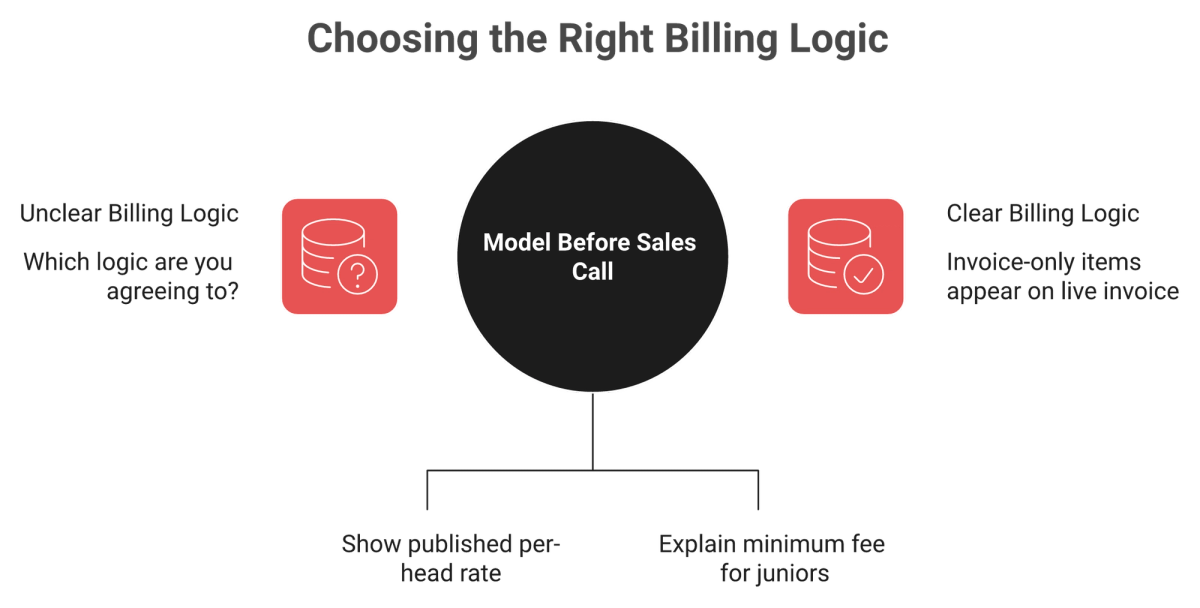
Ask for a live sample invoice before signing, not a pricing page. Then check five things: setup fees, security deposits, FX markup, exit fees, and benefits markup.
Ask one more question, and listen to the pause. Which exchange rate do you book at, and will you show me the Reserve Bank of India reference rate for that same date? Silence is the answer.
⚖️ Where I will give Deel credit
Deel's product is better than most India specialists' software, including ours. Buyers who need a polished self-serve dashboard across many countries are not wrong to pick it, and our Deel alternative page says so plainly.
Versatile Club's own G2 reviewers name the gap honestly, which I would rather surface than hide.
"The dashboard could be a little more self-serve, a couple of times I wanted to pull a report or a doc myself and ended up just messaging my contact instead."
Angad S., Founder, Versatile Club G2 - Verified Review, 21 June 2026
Versatile Club invoices in USD directly from our Indian entity, so there is no FX markup to disclose. One consolidated monthly invoice, itemised per employee, with statutory components shown separately so a controller can tie PF and TDS to the challan without emailing anyone.
Q4. Does 180-country coverage help you, and who actually owns the Indian entity?
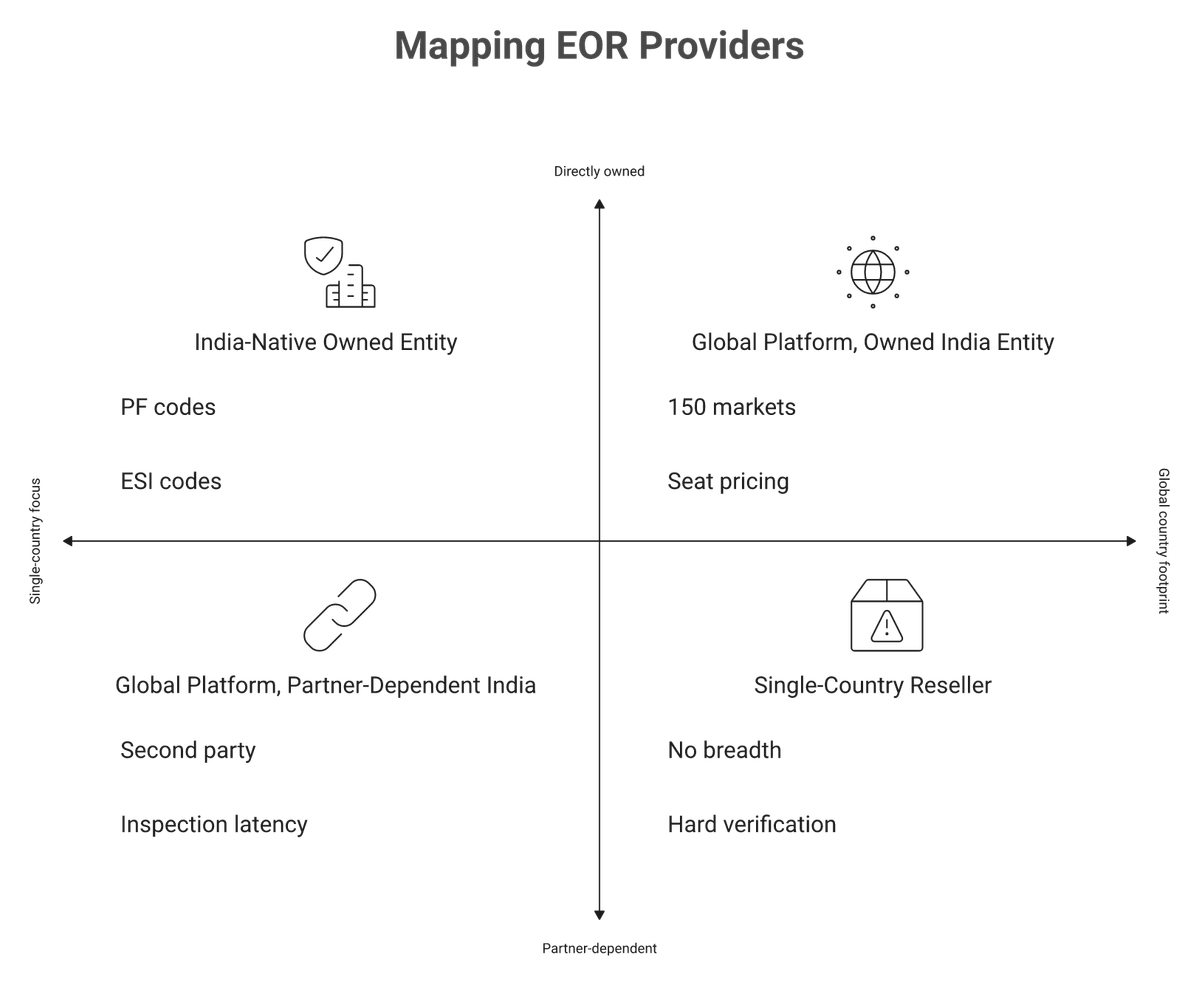
Coverage breadth is priced into every invoice whether it gets used or not. G-P sells 180+ countries, Deel serves 150+ on 110+ owned entities, while a buyer's team may sit entirely in three Indian cities. Ownership matters more than count, and here public sources conflict: G-P is documented as running a wholly-owned India entity, Deel as partner-dependent, with some India operators grouping both as partner-dependent. Versatile Club employs its India staff on its own PF, ESI, and Shops and Establishments registrations.
🌍 When breadth genuinely earns its fee
A financial services client of an EOR operator I know interviewed a candidate three times, believing he sat in London. On call three, it turned out he was in Greece.
They wanted him anyway. Broad coverage solved that in days. That is a real use case, and no India specialist can serve it.
⚠️ The contradiction buyers should know about
Competitive matrices list G-P as owning its Indian entity and Deel as using a local partner. Versatile Club's own company profile takes a harder line and groups the global platforms together as partner-dependent in India.
Both claims cannot be fully right. I am flagging the conflict rather than resolving it, because the resolution is not mine to assert. It is a question you can settle in one email.
📋 Three questions that settle it in writing
- What is the legal name and Corporate Identity Number (CIN) of the entity that will employ my hire?
- What is that entity's PF establishment code?
- Whose registration will appear on my employee's Universal Account Number (UAN) passbook?
Verify the CIN on the Ministry of Corporate Affairs portal yourself. If the answers route to legal, you have learned something useful.
🧾 Why ownership decides liability, not convenience
A partner shell adds latency and a second party to every statutory action. During a state labour inspection, the registration holder is the one summoned, which is why our compliance stack sits on registrations we hold ourselves.
India is not one country for compliance purposes. It is 28 state professional tax regimes plus 8 union territories, each with its own rhythm, flattened into a single row on a 180-country map.
| Filing reality | What the global map shows | What operators actually handle |
| Maharashtra | "India" | Dual PTRC and PTEC registration, monthly slab filing |
| Karnataka | "India" | Monthly PT, S&E renewal, enrolment within 30 days of joining |
| Tamil Nadu | "India" | Biannual PT filing plus Labour Welfare Fund |
| Telangana | "India" | PTRC enrolment, monthly remittance deadlines |
💬 What buyers say about who employs whom
"I was employed by a Singapore entity that is yet to established in India. So, Wisemonk is the legal entity which I'm currently working under."
Verified User in Financial Services, Wisemonk G2 Verified Review, 16 June 2025
"Everything was VERY time consuming. It took three months to onboard our first 3 individuals... so we had to make a decision to change providers."
Verified User in Information Technology and Services, Deel G2 Verified Review, 13 December 2024
"They acted as the Employer of Record in India so we didn't have to register anything ourselves, they were the legal employer on paper, we just managed the person day to day."
Angad S., Founder, Versatile Club G2 - Verified Review, 21 June 2026
Versatile Club is the legal employer. Contracts, PF and ESI registrations, TDS deposits, and state professional tax filings sit under Versatile Club's own registrations, with no intermediary between us and EPFO or ESIC. If your second country is Brazil, use a global platform there and use us for India, and if you are weighing the switch, our guide on how to switch EOR provider in India walks through the sequence.
Q5. What happens when payroll breaks on the 28th, and what do reviews say?
Deel wins the public review contest decisively, at 4.7 out of 5 across roughly 6,900 G2 reviews and first place in PeerSpot's global payroll mindshare at 6.8%. Globalization Partners sits near 4.4 out of 5 and tenth place at 3.0% mindshare. Reviewers rate Deel higher on value and return on investment. Complaints cluster in one place, which is escalation speed when something breaks locally. Versatile Club runs client support through a direct founder WhatsApp line and a 5-day contractual onboarding SLA.
⏰ The 28th is the only day that tests a vendor
A US founder once messaged me at 11pm her time, three days before payroll. Her Bengaluru engineer's Provident Fund (PF) challan, the monthly deposit receipt, had not landed in her inbox.
The fix took twenty minutes because I could call our payroll lead directly. In a ticket queue, that same question waits for a timezone to wake up, which is why our how it works page puts a named human on every account.
⚠️ What actually goes wrong in India onboarding
The most common break I see is a missed PF enrolment cutoff. The employee joins, payroll runs, and the Universal Account Number (UAN) passbook shows nothing.
Nobody notices for six weeks. Then the employee applies for a home loan and discovers a gap in their service record, a failure mode we document in our guide to payroll compliance in India.
📊 Support and speed, three ways
| Support dimension | Globalization Partners | Deel | Versatile Club |
| First contact | Named account management | Chatbot-first, then tickets | Founder on WhatsApp |
| Onboarding | 5 to 10 days | 2 to 5 days quoted | 5-day contractual SLA |
| Post-join ownership | Account manager | Support queue | 90-day Success Coach |
| Public review volume | ~4.4/5, lower volume | ~4.7/5, ~6,900 reviews | Small, recent corpus |
Versatile Club's review corpus is small and new. I would rather state that than imply parity with a platform carrying thousands of reviews.
💬 What users actually report
"Poor support. Poor communication on issues and complete ignorance of deadlines set by Deel themselves... On top of that, my salary was not paid on time this month."
Daryna R., employee, Deel G2 Verified Review, 6 May 2024
"The majority of their support team is helpful, but are often constrained by internal limitations (internal knowledge and support when navigating complexity)."
Verified User in Information Technology and Services, Deel G2 Verified Review, 13 December 2024
"I've noticed that their support/query responses can occasionally take a bit longer sometimes, likely due to a relatively small team."
Verified User in Financial Services, Wisemonk G2 Verified Review, 14 June 2025
That last one is the honest risk with any specialist, including Versatile Club. Small teams move fast until they do not, which is one reason buyers compare us on our Wisemonk alternative page rather than on headcount.
⭐ Read the dates, not the scores
Versatile Club's read is that review scores are less useful than review dates in this category. A 2023 review of a global platform's India desk predates every statutory change discussed in this article.
Two of our own reviewers named real friction, which I find more useful than the five stars.
"The team is really competent, but there were a few time zone misunderstandings that caused slight delays in the initial phase."
Setu C., Versatile Club G2 - Verified Review, 10 June 2026
Versatile Club's support model is a phone number that belongs to me. I am on WhatsApp for client communication, not a CSM rotation, and not a ticketing system. That is sustainable at our current scale and will change as we grow, and until then you can talk to us directly.
Q6. How do India's 2026 statutory changes move your real cost per head?
Two changes moved India cost of employment inside one year. The four Labour Codes took effect on 21 November 2025, with central rules notified in May 2026, requiring Basic plus Dearness Allowance to reach at least 50% of total cost to company. The Employees' Provident Fund mandatory-coverage wage ceiling then rose from ₹15,000 to ₹25,000 per month, effective 17 September 2026. Both raise employer PF and gratuity exposure on the same gross salary. Versatile Club re-cuts salary structures to the 50% rule during onboarding.
📜 What the Labour Codes actually changed
The Codes redefined "wages" for statutory purposes. Companies previously kept Basic low and loaded allowances, which shrank PF, gratuity, and bonus liability.
That route is closed. Basic plus Dearness Allowance now has to reach half of total cost to company, and every statutory calculation follows from that base, as the Ministry of Labour and Employment sets out.
💰 What the PF ceiling change does to your invoice
PF is India's mandatory retirement contribution, at 12% from the employer and 12% from the employee. The mandatory-coverage wage ceiling is the salary level below which coverage is compulsory, as published by EPFO.
Raising it from ₹15,000 to ₹25,000 pulls a much larger population into mandatory coverage. For employers already contributing on full wages, the bigger effect is the Labour Code wage definition, which lifts the base itself.
📊 One engineer, before and after
Here is a ₹25L cost-to-company engineer, modelled on a pre-Code structure versus a compliant one.
| Component | Old structure | Post-Code structure |
| Basic plus DA | ₹8,00,000 (32% of CTC) | ₹12,50,000 (50% of CTC) |
| Employer PF at 12% | ₹96,000 | ₹1,50,000 |
| Gratuity accrual at 4.81% | ₹38,480 | ₹60,125 |
| Statutory cost shift | Baseline | About ₹75,600 higher per year |
Numbers are illustrative and vary by state and salary design. The direction does not vary, and you can model your own bands with our salary calculator.
⚠️ Why neither vendor's rate card mentions this
Vendor pricing pages sell platform fees. Statutory cost of employment sits outside the fee, so it never appears in a comparison table.
That gap is where CFO budgets break. Your EOR fee stayed flat at $599 while your actual cost per head moved, which is the whole argument in our breakdown of the cost of hiring in India.
⏰ Three things to do this week
- Pull every India offer letter and check whether Basic plus Dearness Allowance clears 50% of cost to company.
- Rerun your FY27 India budget with employer PF calculated on the higher base.
- Email your EOR and ask, in writing, which of these two changes they have already applied to your employees.
Versatile Club measures this by rebuilding the salary breakup for every hire at onboarding, then reconciling employer PF against the current ceiling each payroll cycle. Where I stay cautious is state rules, since several states notified their own Code rules on different dates. I would rather flag that unevenness than pretend India moved as one block.
🧾 Where the take-home conversation gets uncomfortable
The 50% rule is not a payroll setting. It is an offer-letter rewrite, and somebody has to explain a changed take-home figure to existing employees.
That conversation lands on your People Ops lead, not on your vendor's dashboard. Scripting it properly is part of the work, and it is the kind of thing our HR consulting services exist to carry.
Versatile Club restructures salary breakups to the 50% rule as part of onboarding and reruns cost-of-employment models at the ₹25,000 ceiling without being asked. We track this because India is the only jurisdiction we have to track, while a global platform is implementing 150 countries' 2026 changes at once.
Q7. Who actually files PF, ESI, professional tax, POSH, and issues Form 130?
From 1 April 2026, Form 16 became Form 130 and Form 16A became Form 131 under the Income-tax Act 2025 and the Income-tax Rules 2026. Buyers should ask both vendors, in writing, who generates Form 130 from the TRACES portal and by what date. The same question applies to monthly PF and ESI returns, state professional tax, gratuity provisioning, POSH committee constitution, and DPDP Rules 2025 duties. Versatile Club files PF and ESI returns and deposits TDS by the 7th under its own registrations.
📋 The compliance ownership matrix
Every row below has a statutory deadline and exactly one legal owner. Ambiguity in a Master Services Agreement is how audit scrambles start.
| Obligation | What it is | Deadline | Who should own it |
| PF return and challan | Retirement contribution filing | Monthly, by the 15th | EOR, on its own establishment code |
| ESI contribution | Health insurance at 3.25% employer, 0.75% employee | Monthly, by the 15th | EOR |
| TDS deposit | Tax Deducted at Source on salary | Monthly, by the 7th | EOR |
| Form 130 | Annual salary certificate, replaces Form 16 | Post year-end, from TRACES | EOR, named in the contract |
| Professional tax | State-level employment tax | Varies by state | EOR, per state registration |
| POSH Internal Committee | Workplace harassment committee | At establishment level | EOR for its employees |
| DPDP obligations | Data processing and breach notice | Ongoing | Shared, in writing |
⚠️ Where the state layer breaks global playbooks
Professional tax is not one filing. Maharashtra needs dual PTRC and PTEC registration with monthly slab filing and annual returns.
Karnataka runs a monthly cycle plus Shops and Establishments renewal, with enrolment inside 30 days of joining. Tamil Nadu files biannually and adds Labour Welfare Fund. Telangana requires PTRC enrolment with its own monthly remittance dates, and our outsource payroll India guide maps each cycle.
✅ Two clauses to add before you sign
- A named responsibility for Form 130 generation and issuance, with the delivery date written in.
- A DPDP data-processing clause covering breach notification duties, since SOC 2 attestation is a security audit, not Indian statutory compliance under the Digital Personal Data Protection Rules 2025.
Ask for both in the MSA, not in an email thread. Versatile Club puts filing responsibilities and dates in the contract, which is possible only because no partner sits between us and EPFO or ESIC.
🧾 The question that exposes a partner chain
Ask a simple one: which establishment code will my employee's PF be filed under, and can you show me last month's challan for it?
A direct employer answers in a day. A partner-dependent provider forwards the question and waits, a pattern worth testing before you shortlist any of the best EOR services in India.
⏰ What surfaces in real audits
What surfaces in Versatile Club's client engagements is that almost every audit scramble traces to one unwritten assumption about who files. Nobody disputed the rule. Nobody owned the date.
I have seen this most with gratuity provisioning, which accrues at 4.81% of Basic plus Dearness Allowance and quietly builds a liability nobody booked. It is boring until an auditor asks for the schedule.
Versatile Club files all of it under our own registrations: PF and ESI returns, state professional tax in each jurisdiction where we employ, TDS by the 7th, the annual salary certificate, and POSH committee constitution for our employed population. No partner sits in the chain, which is why dates go in a contract rather than a process description.
Q8. Does either platform remove your misclassification and PE risk?
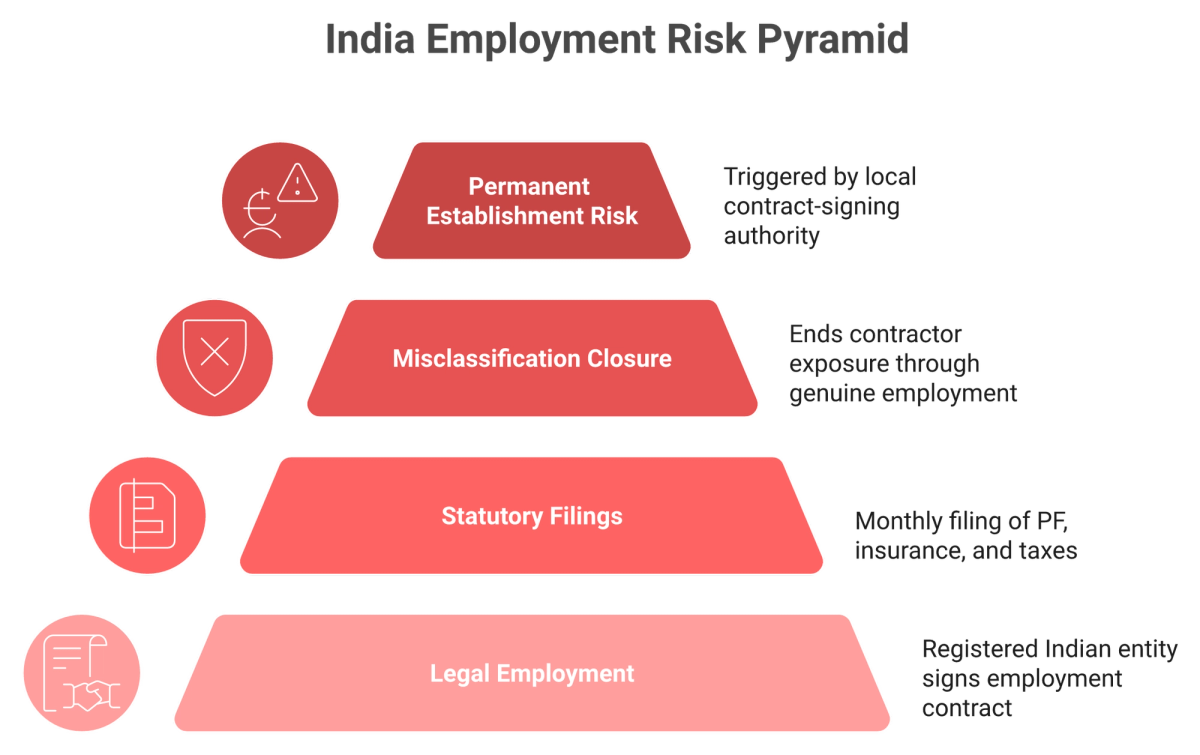
Both platforms remove misclassification risk for anyone they legally employ through an entity. Neither removes permanent establishment (PE) risk created by what an India team actually does. Misclassifying one engineer as a contractor carries roughly $25,000 to $40,000 in back-pay exposure per head. US-style co-employment PEO does not legally exist under Indian labour law, so "PEO India" offers should be read as Employer of Record or set aside. Versatile Club becomes the direct legal employer, which closes misclassification exposure for its employed population.
🧾 Misclassification, in plain English
Misclassification means treating someone as an independent contractor when the working relationship is employment. Fixed hours, a manager, company equipment, and exclusive work all point to employment, a distinction we unpack in independent contractor vs EOR.
Under the Code on Social Security 2020 and the Code on Wages 2019, both in force since 21 November 2025, statutory benefits attach to employment status, not to the label on the invoice. Backdated PF, ESI, and gratuity follow.
⚠️ Permanent establishment is a different animal
PE means your foreign company is treated as having a taxable business presence in India. It is triggered by activity, not by payroll routing.
The classic trigger is authority. Give an India-based person power to negotiate and sign contracts binding your US parent, and no EOR structure protects you. Versatile Club's read is that the category oversells this point, and buyers deserve the limit stated plainly.
❌ Why "PEO India" is the wrong search
A Professional Employer Organisation shares employer liability with the client, which is a US legal construct. Indian labour law has no co-employment equivalent, as our EOR vs PEO comparison sets out.
If a vendor sells you PEO for India, ask which Indian statute creates it. The answer is that none does.
💬 What the risk feels like from the worker's side
Employment status is not just your exposure. It decides whether your engineer can get a mortgage.
"Deel treats all users as if they were individual freelancers, even when you're clearly operating as a registered company. I was required to provide personal identity documents (like a passport), despite offering full corporate documentation."
Verified User in Translation and Localization, Deel G2 Verified Review, 5 May 2025
"I was employed by a Singapore entity that is yet to established in India. So, Wisemonk is the legal entity which I'm currently working under. It removes barriers and helps us work for companies without which it won't be possible."
Verified User in Financial Services, Wisemonk G2 Verified Review, 16 June 2025
"Versatile's Employer of Record India service made this seamless contracts, PF, ESI, TDS, and payroll all handled in one place."
Vedant T., Founder, Versatile Club G2 - Verified Review, 16 June 2026
⭐ Who actually starts the conversion conversation
Contractor-to-employee conversion is almost never candidate-driven in my experience. It is driven by the first real HR hire reading the contracts and going pale, and the mechanics of that switch are covered in convert contractor to employee India.
That person is right to worry. The exposure is backdated, which means it grows quietly while nobody is looking.
⚖️ The honest limit, and when to call counsel
Versatile Club insulates the employment relationship, not your corporate tax position. If your India lead signs customer contracts, you need a tax adviser, not a vendor.
I would rather lose that deal than imply coverage we do not provide. Treat this section as operator guidance, not legal advice, and get Indian counsel on structure before you scale past a handful of people.
Versatile Club becomes the legal employer directly, which is what closes misclassification exposure. No EOR, ours included, can close PE risk created by contract-signing authority in India. Compliance is the floor we operate on, not the ceiling we sell.
Q9. When is a split-vendor setup cheaper than standardising on one platform?
Split vendors when India headcount concentrates. Keep Globalization Partners or Deel for scattered one-off hires where country breadth genuinely earns its fee, and move the concentrated India team to an India-native provider. Ten India employees at $599 per month costs $71,880 a year. The same ten at Versatile Club's $149 per month costs $17,880 a year, a gap of $54,000. Versatile Club runs these migrations as the receiving employer, handling Provident Fund service continuity and Universal Account Number transfer-in.
💰 The arithmetic nobody runs
Most buyers compare per-seat prices. Almost nobody multiplies by headcount and adds twelve months.
| India headcount | At $599/mo | At 15% of a $90K salary | At Versatile Club's $149/mo |
| 3 employees | $21,564 | $54,000 | $5,364 |
| 10 employees | $71,880 | $180,000 | $17,880 |
| 20 employees | $143,760 | $360,000 | $35,760 |
The $54,000 gap at ten heads funds another mid-level engineer. That is the real trade, not a software preference, and our pricing page holds the flat number that produces it.
⚠️ Where splitting is the wrong call
Splitting adds a second vendor relationship, a second invoice, and a second compliance conversation. Below three India employees, that overhead is not worth it.
Versatile Club's read is that the split works best when India is 60% or more of your offshore headcount. I hold that loosely, since I have seen a five-person India team justify it and a nine-person one not.
⏰ The five-step migration sequence
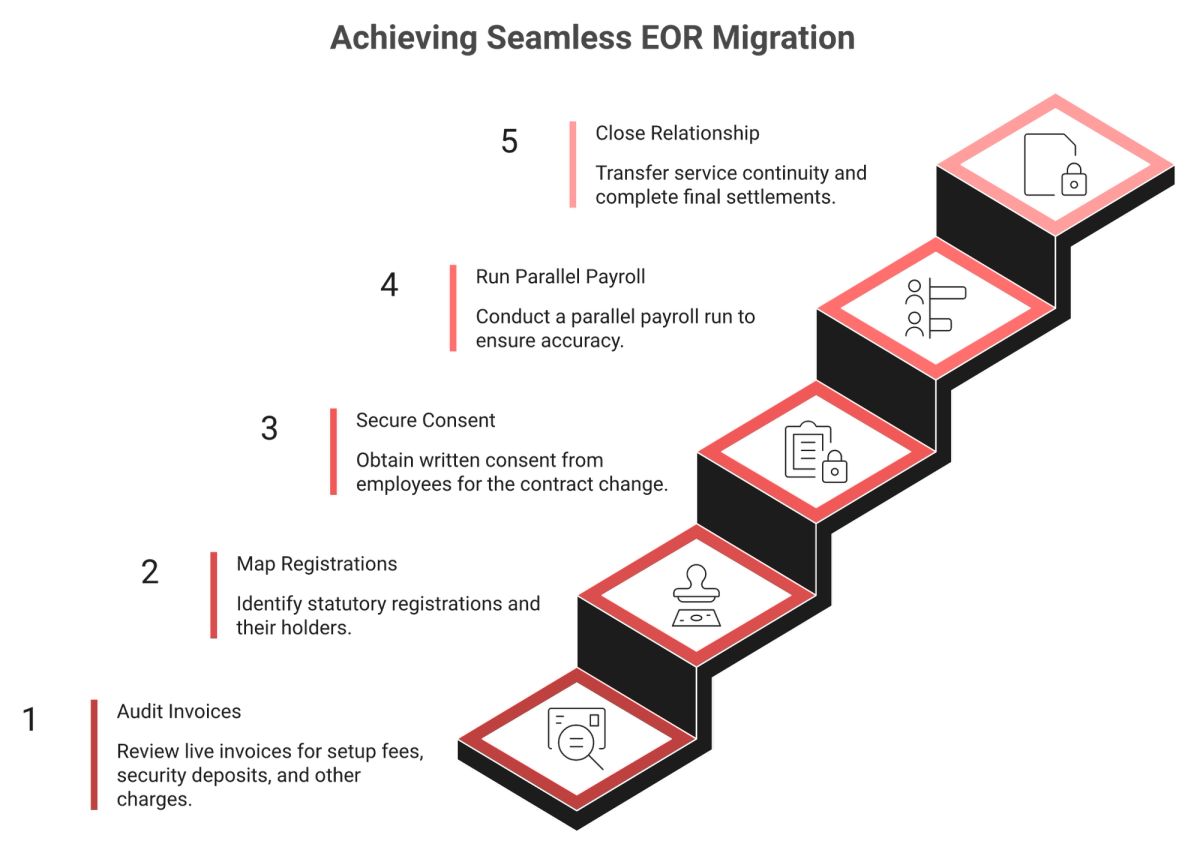
- Audit live invoices from the incumbent. Request a real invoice, not a rate card, and look for setup fees, security deposits, foreign-exchange markup, exit fees, and benefits markup.
- Map statutory registrations. Confirm which entity holds the Provident Fund establishment code and the state professional tax registrations your employees sit under.
- Secure employee consent in writing. The employment contract changes hands, so this is a conversation, not a back-office switch.
- Run one parallel month. Both providers compute payroll, and you reconcile line by line before cutting over.
- Close the old relationship properly. Transfer Universal Account Number continuity, collect the final PF challan, and complete full and final settlement with the outgoing employer.
Ask Versatile Club to own steps two, four, and five. As the receiving employer, that paperwork is ours to file, and the full runbook sits in our guide on switching EOR provider in India.
🧾 The question that predicts a bad migration
Migration anxiety is almost never about contracts. It is about whether an engineer's Provident Fund service history survives the move.
Ask how the vendor handles UAN transfer-in before you ask about price. A provider filing on its own establishment code can answer immediately. A partner-dependent one forwards the question.
⭐ What buyers actually gain besides money
Depth improves, not just cost. A provider handling one country tracks Maharashtra's dual PTRC and PTEC filing, Karnataka's monthly professional tax cycle, and Tamil Nadu's biannual returns as core work, which is the standard we hold across our EOR services.
Versatile Club measures migration success by one number: whether the first payroll cycle after cutover runs without a correction. That is a harsher test than a signed contract, and it is the one clients remember.
❌ The exit clause that tells you everything
Before signing anywhere, read the termination clause. One month notice is normal, and termination fees on an EOR seat are not.
Versatile Club runs migrations as the receiving employer, so PF service continuity, UAN transfer-in, and full and final settlement from the outgoing entity are our paperwork. No setup fee, first month free, no exit fee when you eventually leave. A contract that penalises leaving is a confession about the product.
Q10. At what headcount should you leave EOR and open your own India entity?
Around 25 to 40 India employees, the arithmetic flips. A private limited company costs roughly $15,000 to $100,000 to set up and takes three to six months, but it replaces a recurring per-head fee. India now hosts 2,117 Global Capability Centres employing 2.36 million people inside a technology sector projected at $315 billion in FY26. Versatile Club charges no exit fee, which is what makes the transition conversation with a client honest rather than defensive.
🌉 The bridge framing that actually holds
Think of an Employer of Record as a temporary crossing. It gets people to the other side in days, with no capital outlay.
Your own Indian subsidiary is permanent infrastructure. It costs more upfront, takes months, and then carries traffic for years at lower marginal cost, a trade we model in EOR vs entity India.
💰 Where the crossover sits
| India headcount | EOR at $149/mo | EOR at $599/mo | Owned entity (illustrative run cost) |
| 10 employees | $17,880/yr | $71,880/yr | $40,000 to $60,000/yr plus setup |
| 30 employees | $53,640/yr | $215,640/yr | $50,000 to $80,000/yr plus setup |
| 60 employees | $107,280/yr | $431,280/yr | $60,000 to $100,000/yr plus setup |
Entity run cost covers company secretary, audit, payroll software, and a compliance resource. At $599 per seat, the crossover arrives near ten heads. At Versatile Club's $149, it arrives closer to thirty, and you can test your own inputs in the EOR vs entity calculator.
⚠️ What the entity route really costs you
The invoice is the easy part. The harder cost is attention.
You inherit Registrar of Companies filings, annual audits, Foreign Exchange Management Act reporting on capital infusion including FC-GPR, and direct liability in a state labour inspection. Someone on your team now owns that calendar.
📊 Why the market context matters
The GCC data is not decoration. It tells you that professional services, payroll infrastructure, and compliance talent in India are mature enough to run your own entity well, as the NASSCOM and Zinnov GCC Landscape Report 2026 sets out.
Versatile Club's read is that the "always stay on EOR" advice is self-serving, and the "always build an entity" advice ignores payback periods. Both camps are selling something, which is why we publish the full set of India expansion options rather than one.
⏰ The question to ask before you sign anywhere
Ask both vendors for their written entity-transition path. Who transfers the employees, who handles PF continuity, and what happens to accrued gratuity at 4.81% of Basic plus Dearness Allowance.
Vendors who resist that conversation are usually the ones whose contracts make leaving expensive. Ask early, because the answer describes the relationship you are about to enter.
✅ What a clean graduation looks like
In practice, the transition runs over one quarter. New entity registered, PF and ESI establishment codes obtained, employees transferred with service continuity intact, and one parallel payroll month before cutover, which is the same sequence we describe in GCC setup in India.
Versatile Club plans that sequence with clients rather than defending against it. I would rather be the bridge that got you across than the toll booth you resent.
🧾 Where I will stay honest about the limit
Versatile Club's economics improve when clients stay, so treat my threshold with appropriate suspicion. Run your own model with your own salary bands.
What I am confident about is the shape of the curve, not the exact crossing point. Past roughly thirty India employees, an owned entity usually wins on cost.
Versatile Club will tell you when to leave us. Employee transfers, PF continuity, and registration handover are work we will help plan, because there is no exit fee to protect.
Q11. So which should you choose, G-P, Deel, or neither?
Choose Globalization Partners if you are an enterprise hiring across a dozen countries and value named legal counsel over budget predictability. Choose Deel if you want self-serve tooling, contractor payments, and published pricing across many markets. Choose neither if India is your only offshore country and your team is concentrated, since you are then paying global overhead for single-country work. Versatile Club serves that third case at $149 per employee per month on its own Indian entity, with a 5-day contractual onboarding SLA.
📊 The decision by who you are
| Your situation | Best fit | What disqualifies the others |
| First India hire, Seed to Series B founder | India specialist | $599 plus $500 setup is high for one seat, and G-P's floor is higher still |
| 10 to 100 India employees, VP People | India specialist, or G-P above 100 | Global platforms thin out at the multi-state filing layer |
| 5 to 30 India employees, CFO at $5M to $50M ARR | India specialist | Percentage pricing and undisclosed FX spread break budget models |
| Hiring in 6+ countries at once | Deel or G-P | An India-only provider cannot serve your other countries, including Versatile Club |
| Enterprise requiring SOC 2 and ISO 27001 in procurement | Deel or G-P | Versatile Club does not clear that gate today |
That last row costs us deals. I would rather publish it than waste a procurement team's quarter, and buyers who need that gate should read our enterprises page before booking a call.
⭐ Why I built this in the first place
The same pattern kept repeating with US founders on their first India hire. Slow contracts, mystery foreign-exchange charges, and compliance surprises that surfaced months later, which is why our for startups offer is scoped the way it is.
The global platforms were not incompetent. They were treating India as one country among 150, which is a reasonable choice for them and a bad outcome for a founder with eight people in Bengaluru.
💬 What buyers say about each path
"I find Deel easy to use, which is an important aspect as it enables me to navigate the platform without any hassle... I find Deel to be absurdly expensive."
Juan Camilo O., Deel Hire user, Deel G2 Verified Review, 27 November 2025
"Founder is just a call away. Extremely helpful in resolving all our queries. The process is super smooth to setup India EOR."
surbhi m., Versatile Club G2 - Verified Review, 15 June 2026
"Sagar replied to our form in about four hours with a draft offer letter already attached. The hire was onboarded in four days. First USD invoice landed clean: no FX markup, no setup fee, no surprises."
Verified User in Information Technology and Services, Versatile Club G2 - Verified Review, 23 June 2026
⚖️ Where I lose, fairly
I lose deals to Deel when a company has two people in India and eight in Brazil. That is the correct outcome, and I say so on the first call.
What I think changes over the next two years is that India stops being a row on a 150-country map. Owned-entity specialists take the India line item, and global platforms keep everything else, a shift we track across our best EOR in India research.
Versatile Club exists for the third case: India-only Employer of Record plus contract-to-hire on our own Indian entity, $149 per employee per month, USD invoicing from India, a 5-day contractual onboarding SLA, screening on 50 behavioural parameters, a 90-day Success Coach, a 6-month replacement guarantee, and no setup or exit fees. Message me on WhatsApp and tell me what you are building. I will say honestly if a global platform suits you better.
FAQs
Which is cheaper for one India engineer, Globalization Partners or Deel?
For almost every India engineering salary band, Deel's published rate is cheaper than G-P's documented model. Deel lists $599 per employee per month, which is $7,188 a year, plus a $500 setup fee. G-P does not publish a rate card at all, and third-party 2026 comparisons place it near 15% of salary with a $1,500 per month floor.
That floor is the part buyers miss. It applies whether the salary is small or large:
- A $60,000 hire still costs roughly $18,000 a year, because the floor binds.
- A $120,000 hire also costs roughly $18,000 a year, because 15% lands at the same place.
- A $150,000 hire climbs to roughly $22,500 a year.
Neither number is the full picture. Deel adds contractor tiers and a reported 3% to 5% foreign-exchange spread, while G-P adds setup and termination fees that only surface in procurement.
Versatile Club charges $149 per employee per month flat, which is $1,788 a year per head regardless of salary, and we publish that number on our pricing page so a CFO can model FY27 before booking any call.
Does Globalization Partners publish its EOR pricing?
No. G-P publishes no public EOR rate card. Pricing is released only after a sales and procurement cycle, which means you cannot model India headcount cost before a call. Deel's $599 per employee per month can be modelled immediately, and that single difference shapes how the two vendors get evaluated.
For a finance leader, quote-only pricing creates three practical problems:
- Your India budget line stays a placeholder until a vendor decides to share numbers.
- You cannot benchmark the quote, because there is no published anchor to compare it against.
- Setup fees and termination fees often arrive later in the paperwork, after the headline is agreed.
The practical move is to ask for four numbers in one email before the demo: the per-head rate, the monthly floor, the setup fee, and the termination fee. If those arrive separately or late, treat that as information about how the relationship will run.
Versatile Club takes the opposite approach and publishes a flat $149 per employee per month with no setup or exit fee, and anyone comparing quote-led vendors can sanity-check their own numbers using our EOR vs entity calculator.
Does G-P or Deel own the Indian entity that employs your team?
Public sources conflict, which is why this should be settled in writing rather than from a comparison page. G-P is generally documented as operating a wholly-owned India entity. Deel is widely described as partner-dependent for India, and some India-native operators group both platforms together as partner-dependent.
Ownership matters more than country count, because the registration holder is the party a labour inspector summons and the party whose filing delays become your exposure. Three questions settle it:
- What is the legal name and Corporate Identity Number of the entity that will employ my hire?
- What is that entity's Provident Fund establishment code?
- Whose registration will appear on my employee's Universal Account Number passbook?
A direct employer answers all three in a day and can show last month's PF challan. A partner-dependent provider forwards the question and waits, which is exactly the latency that hurts during an audit.
Versatile Club is the legal employer on its own PF, ESI, and Shops and Establishments registrations, with no intermediary in the chain, and the filing scope is set out on our compliance page.
How do India's 2026 statutory changes affect what an EOR employee really costs?
Two changes moved India cost of employment inside a single year, and neither appears on any vendor rate card.
- The four Labour Codes took effect on 21 November 2025, requiring Basic plus Dearness Allowance to reach at least 50% of total cost to company.
- The Provident Fund mandatory-coverage wage ceiling rose from Rs 15,000 to Rs 25,000 per month, effective 17 September 2026.
- From 1 April 2026, Form 16 became Form 130 and Form 16A became Form 131 under the Income-tax Act 2025.
The wage-definition change matters most. Lifting Basic plus DA to half of CTC raises the base for employer PF at 12% and gratuity accrual at 4.81%. On a Rs 25L engineer, that is roughly Rs 75,600 more per year in statutory cost, even though the platform fee did not move.
The practical action is to re-cut offer letters to the 50% rule, rerun budgets on the higher PF base, and ask each vendor in writing which changes they have already applied.
Versatile Club rebuilds the salary breakup for every hire at onboarding, and the mechanics are documented in our guide to payroll compliance in India.
Should you pick an India-only EOR instead of G-P or Deel?
It depends entirely on how concentrated your offshore team is. Choose G-P if you are an enterprise hiring across a dozen countries and value named legal counsel over budget predictability. Choose Deel if you want self-serve tooling, contractor payments, and published pricing across many markets.
Choose an India-only specialist when India is your only offshore country and the team is concentrated, because you are otherwise paying global overhead for single-country work:
- Ten India employees at $599 per month is $71,880 a year.
- The same ten at $149 per month is $17,880 a year.
- That $54,000 gap funds an additional mid-level engineer.
Some buyers should not pick a specialist at all. If you need six or more countries, a 100-plus India team, or SOC 2 and ISO 27001 as a procurement gate, the global platforms are the right answer.
Versatile Club serves the concentrated-India case with India-only Employer of Record plus contract-to-hire on its own Indian entity, a 5-day contractual onboarding SLA, a 90-day Success Coach, and a 6-month replacement guarantee on sourced hires.