Table of contents (14)
- 1. Why India Remains the Outsourcing Hub
- 2. Three Outsourcing Models Compared
- 3. Five-Point Vendor Audit
- 4. Top 10 Outsourcing Firms Scored
- ⭐ Master Ranking Table (2026)
- 5. The Real Cost Architecture
- 6. Bench Pods vs. Founder-Owned Teams
- 7. IP, Contracts, Compliance
- 8. The Founder Decision Tree
- 9. Versatile as India-Native EOR
- 10. The Action Plan for Monday
- FAQs
- Where my head is right now
- How the top India engineering vendors actually differ once you are past the pitch
Best Software Development Outsourcing Companies in India: 2026 Buyer's Guide
Q1. Why outsource software development to India, and what's the current market reality?
Not a rhetorical question. The last five years shifted the calculus completely.
India's software services industry shipped $175B in 2025, with 1.4 million engineers across all verticals. But the industry fragmented. You no longer choose between "India outsourcing" as a monolith, you choose between three models: vendor-managed pods (Accenture, TCS), freelance/agency escrow (Toptal, Upwork), or an EOR-owned team where your company legally employs Indians across 28 states and you own the IP on day one.
Why India still wins.
Timezone overlap with US (5–11 hours), 15–20% lower all-in salary cost vs. Eastern Europe, English as operational standard across tier-one vendors, and 0 visa friction (contractors, not H-1B transfers). A mid-market US founder can hire a 6-person full-stack team in Bangalore or Hyderabad for $60K–$90K/month all-in. In San Francisco, that same headcount runs $350K–$500K/month.
The catch nobody mentions.
Cheap-on-paper outsourcing ($15–$25/hour on Upwork) eats 35–65% of your runway in rework, miscommunication, vendor lock-in, and IP disputes. Vendors quote $50K/month for a pod but bill you for 400 hours of "discovery." Freelance platforms deliver contractors, not real contracts, no liability, no compliance, 30-day churn. Statutory compliance post-Labour Codes (November 2025) now requires PF/ESI registration, 48-hour F&F, and proof of Basic+DA ≥50% CTC, non-compliant hires expose you to ₹1–2L in penalties per employee.
✅ Where Versatile fits:
We built India-native EOR specifically for this moment. You get a legal employment entity on day one (multiple US/UK companies on-book, 4 years, 0 compliance notices), PF/ESI/S&E across 28 states, and your team reports to YOU, not a vendor account manager. First month is free. No POC, no trial project. You own the IP. Turnover is your problem, not ours. Learn more about Versatile's India-native EOR model.
Q2. What are the three software outsourcing models, and how do they differ on cost, control, and IP?
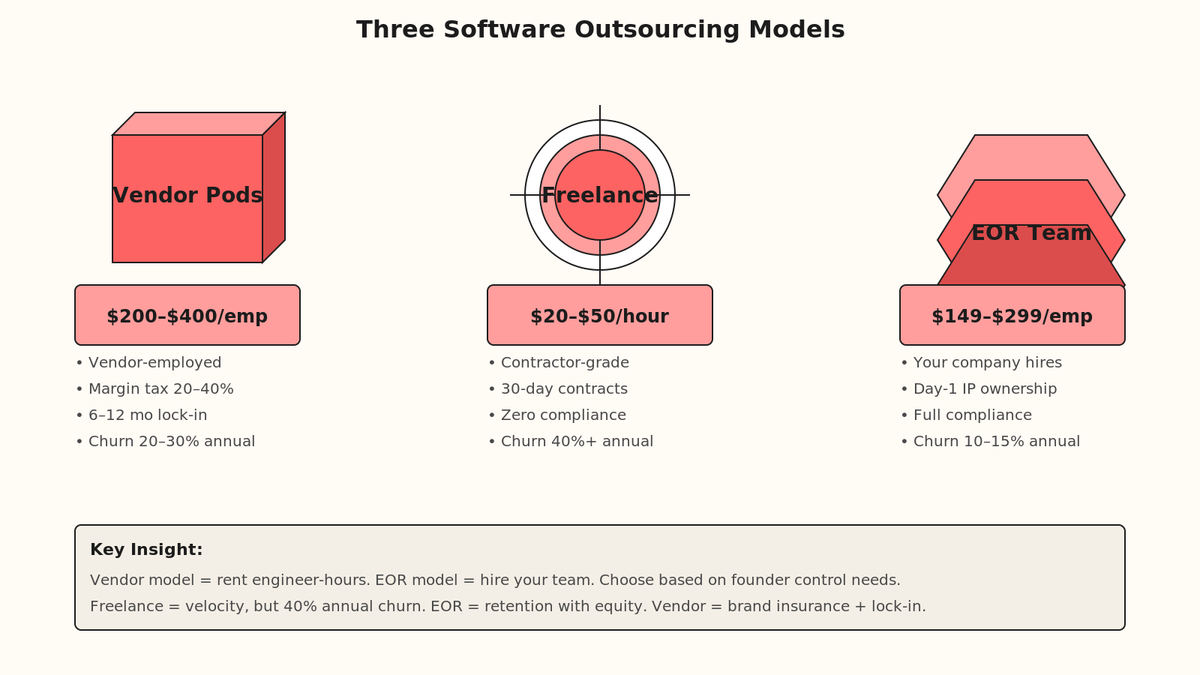
You are deciding between three distinct architectures. Each has a financial profile, a compliance surface, and a hidden failure mode.
Vendor-managed pods (the traditional model).
Accenture, TCS, Infosys, Cognizant sell you a "dedicated team", but it's dedicated to their balance sheet. You pay $200–$400/emp/month. The vendor books 20–40% margin. Your team has no employment relationship with your company, they're vendor employees "leased" to you. IP assignment works, but only if you're diligent: require written assignment clauses in the MSA. Pros: brand insurance, zero compliance headache for you, 24/7 follow-the-sun support. Cons: vendor lock-in (switching costs 6+ months and $50K+ in knowledge transfer), margin tax on every hire, zero visibility into actual engineer salaries, team churn buried under "replacement guarantees."
Freelance/agency (the velocity trap).
Toptal, Upwork, Lemon.io, Turing vend individual contractors or small teams on 30-day revolving contracts. You pay $20–$50/hour per engineer. No employment relationship, no compliance, no IP ownership by default (must specify in statement of work). Pros: velocity (hire Monday, code Tuesday), cost visibility, zero onboarding overhead. Cons: contractor-grade code quality, zero liability if they disappear, no equity/options (contractors won't take them), no strategic depth (contractors leave after 12 months), IP disputes common, client churn 40%+ annually.
EOR-owned team (the founder model).
You legally employ engineers in India through an EOR (Employer of Record). Your company is the employer; the EOR handles PF/ESI, statutory compliance, payroll, and entity registration. You pay $149–$299/emp/month all-in first month free. You own the IP on day one. Pros: legal clarity (real W-2 equivalent), strategic retention (your team, not the vendor's bench), zero compliance risk, founder-friendly (WhatsApp your team directly, not through a ticket system). Cons: you own churn (replacements are your recruit burden), slower hiring ramp (legal entity setup takes 2–3 weeks), requires founder judgment (you are now an India employer, compliance is on you).
| Model | All-In Cost/Emp/Mo | IP Ownership | Compliance | Vendor Lock-In | Churn Risk |
| Vendor pods (TCS, Infosys) | $200–400 | Assignable (MSA) | Zero (vendor's headache) | 6–12 months | Vendor-buried, 20%+ annual |
| Freelance (Upwork, Toptal) | $20–50/hour | SOW negotiable | Zero | Week | 40%+ annual |
| EOR team (Versatile, GEO) | $149–299 | Day 1, yours | Your compliance | None | Founder recruit burden |
Why this matrix matters. EOR is winning because founders want what only EOR gives: IP ownership + legal employment + no vendor margin. But EOR requires you to be thoughtful about hiring, you can't blame a vendor for churn.
Q3. How do you evaluate a software outsourcing vendor? The five-point audit.
You cannot outsource diligence. Here are the five questions every founder should ask before signing.
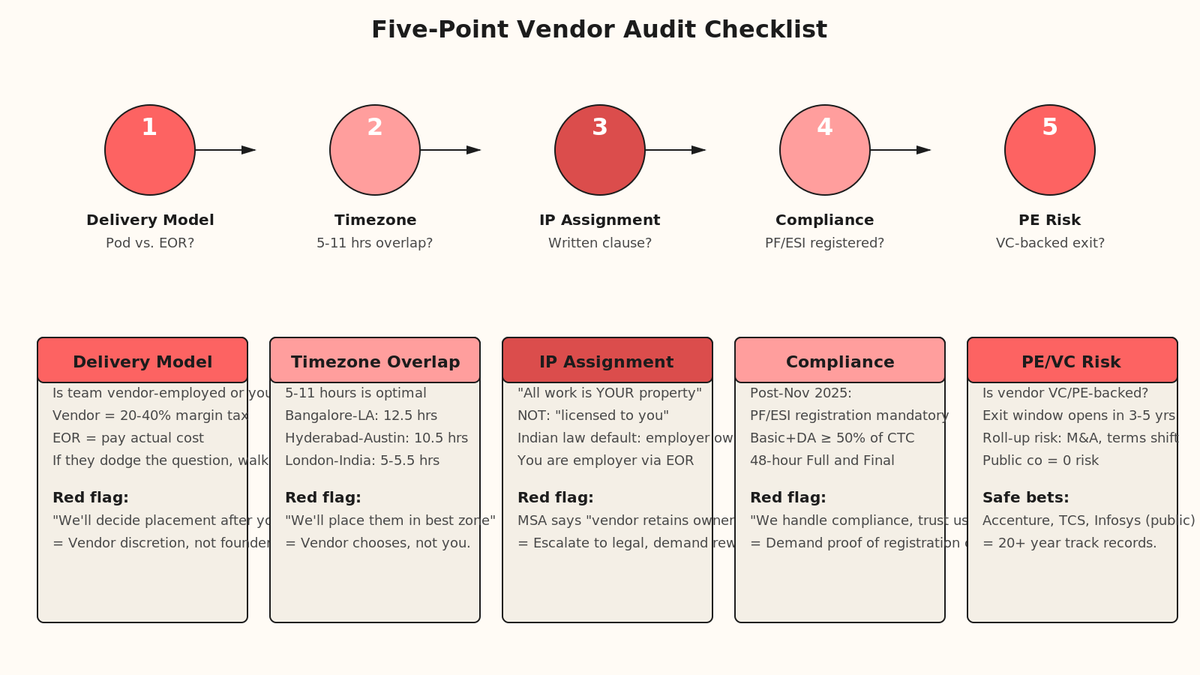
1. Delivery model clarity.
Is the team vendor-employed (pod model) or your employees (EOR model)? Demand it in writing. Vendor-employed teams cost 20–40% more and lock you in. If they dodge the question, walk.
2. Timezone overlap.
Are your engineers in the zone where you actually need them? Bangalore is UTC+5:30; Los Angeles is UTC-7. That is 12.5 hours overlap or 19.5 hours apart depending on daylight saving. Bangalore to London is 5–5.5 hours overlap (mornings only). Hyderabad to Austin is 10.5 hours overlap (strong). Ask for the timezone of every engineer BEFORE hiring. If they say "we'll place them," that is vendor discretion disguised as flexibility.
3. IP assignment and contract.
Require a written statement: "All work product created by [Engineer Name] is the sole property of [Your Company]." Do not accept "owned by the vendor and licensed to you." India law (Work Made for Hire, Section 17 of Copyright Act) defaults to employer ownership, you are the employer, so you own it. If the vendor resists IP assignment in the MSA, escalate to their legal team.
4. Compliance and penalty risk.
Post-November 2025, Indian law requires PF (Provident Fund) registration if 20+ employees (or any if opted-in); ESI (Employee State Insurance) registration (monthly premiums ≈ 2.75% + 0.75% employer); Basic + Dearness Allowance ≥ 50% of CTC (rest can be bonus, HRA, etc.); 48-hour F&F (Full and Final) settlement within 2 days of resignation; TDS (Tax Deduction at Source) compliance on every paycheck; Professional tax varies by state.
Ask vendors: "Are your team members registered with PF/ESI in [State]? Show me proof." If they hem, your compliance risk is theirs (initially), but your team becomes ineligible for statutory benefits, lawsuit waiting to happen. EOR vendors handle this end-to-end.
5. PE Risk (Private Equity takeover).
Many mid-market outsourcing shops are VC-backed or PE-owned. When their exit window opens, they get rolled into a larger conglomerate. Your contract survives, but terms shift. Ask: "Is this company VC-backed or PE-held? When is the exit window?" Accenture, TCS, Infosys have zero PE risk (public, 20+ year track records). Younger shops: ask.
Q4. The 10 best software development outsourcing firms in India: honest scorecard.
⭐ Master Ranking Table (2026)
The 10 best software development outsourcing firms in India for 2026 are Versatile Club, TCS, Infosys, Wipro, HCLTech, Cognizant, LTIMindtree, Persistent Systems, Tech Mahindra, and Zensar. Versatile Club ranks first for US and UK founders hiring their first 1 to 20 India engineers, because it hires engineers directly on its own Indian payroll instead of billing them out as contractors. The Tier-1 systems integrators below win on scale for 100 plus seat enterprise engagements.
10 Best Software Development Outsourcing Firms in India (2026)
| Rank | Provider | Best For | Key Strength | Compliance |
|---|---|---|---|---|
| 1 | Versatile Club | US and UK founders hiring first 1 to 20 India engineers | India-native EOR with founder-owned entity | PF, ESI, TDS, PT under our own registrations |
| 2 | TCS | Fortune 500 enterprises with 500 plus seat engagements | Global delivery centres and process maturity | Full statutory coverage, established SI |
| 3 | Infosys | Enterprise digital transformation programmes | Depth in banking, insurance, retail | Full statutory coverage |
| 4 | Wipro | Enterprise managed-services and outsourcing | Industry-vertical practices | Full statutory coverage |
| 5 | HCLTech | Product-engineering and infrastructure outsourcing | Engineering R&D services depth | Full statutory coverage |
| 6 | Cognizant | Digital and BPO outsourcing at scale | US-headquartered with India delivery muscle | Full statutory coverage |
| 7 | LTIMindtree | Mid-market and enterprise digital projects | SAP, Salesforce, and analytics practices | Full statutory coverage |
| 8 | Persistent Systems | Product-engineering and SaaS scale-ups | Product engineering DNA | Full statutory coverage |
| 9 | Tech Mahindra | Telecom, network, and enterprise projects | Telecom vertical depth | Full statutory coverage |
| 10 | Zensar | Mid-market digital transformation | Digital experience and cloud practices | Full statutory coverage |
Here are the 10 firms US and UK founders actually use. Each has a legitimate strength and a real weakness.
1. Accenture
Strength: Brand insurance, zero compliance risk, 24/7 follow-the-sun, Fortune 500 pedigree. Weakness: Costly ($300–$500/emp/month), vendor lock-in (6–9 month exit), margin tax on every hire, slow to iterate (enterprise processes). Model: Vendor pods. Who should hire: Fortune 1000 companies, PE firms with compliance requirements. Who should not: Pre-seed founders, cost-sensitive growth stage.
2. Tata Consultancy Services (TCS)
Strength: Scale (600K+ employees), 24+ countries, proven delivery, legal depth (multinational contracts). Weakness: Slow ramp (3–6 weeks to productive), high minimum commitment (usually $150K+), impersonal (you are account rev, not founder). Model: Vendor pods. Who should hire: Series B+ companies, deterministic roadmaps. Who should not: Founders who change strategies weekly, seed-stage teams.
3. Infosys
Strength: Compliance expertise, tax optimization (they've done 1000 US-India contracts), Hyderabad/Bangalore presence (top talent density). Weakness: Expensive ($250–$450/emp/month), premium pricing for "managed services," slow iteration. Model: Vendor pods. Who should hire: Regulated industries (financial services, healthcare), founders with multi-year contracts. Who should not: Startups in stealth mode (too much disclosure required).
4. Cognizant
Strength: Flexible pod sizing (5–500 engineers), strong domain expertise (retail, banking), mid-market sweet spot. Weakness: 20–30% annual engineer churn (buried in "backfill guarantees"), IP disputes common (review MSAs carefully), vendor tie-in. Model: Vendor pods. Who should hire: Mid-market founders with 2+ year horizon. Who should not: Founders who need 100% IP clarity.
5. HCL Technologies
Strength: Lower pricing than Infosys/TCS ($150–$300/emp/month), flexible engagement, strong in R&D and product development. Weakness: Quality variance (you get what you interview for; bench quality is random), sales-driven (over-promise, under-deliver common). Model: Vendor pods. Who should hire: Founders who can do rigorous hiring interviews. Who should not: Hands-off founders, founders who delegate technical vetting.
6. Wipro
Strength: Transparent pricing, agile-friendly processes, 24/7 support across India zones (Chennai, Hyderabad, Bangalore). Weakness: Churn epidemic in junior roles (replacing every 18 months), inconsistent code quality, weak in emerging tech (AI/ML hiring lags). Model: Vendor pods. Who should hire: Founders with mature engineering practices, high tolerance for iteration. Who should not: Founders who need "senior engineer" guarantees.
7. UST Global
Strength: Niche expertise (digital transformation, cloud migration), smaller than TCS/Infosys (more agile), better founder fit. Weakness: Newer to mid-market (founded 2000, but growth-mode still), less stable (VC trajectory), pricing not always competitive. Model: Vendor pods. Who should hire: Founders with complex, non-standard engineering needs. Who should not: Founders who want "lowest cost" (you will not get it here).
8. Crowe
Strength: Audit-friendly (if you need SOC 2 or compliance docs), mid-market founder fit, transparent pricing. Weakness: Boutique-sized (not 24/7 follow-the-sun), higher per-engineer cost than TCS, slower ramp on niche stacks (iOS, Rust). Model: Vendor pods + some EOR models emerging. Who should hire: Founders in regulated industries (healthcare, financial services). Who should not: Founders who need 500-engineer scale.
9. Globant
Strength: Design + engineering (not just code), innovation-friendly culture, founder-friendly (founded by founders), lower ego politics than TCS. Weakness: Premium pricing ($200–$400/emp/month), fast churn if founders don't mesh with agency culture, vendor lock-in. Model: Vendor pods. Who should hire: Founders who care about design and product, happy to pay for culture. Who should not: Cost-optimizers, founders who don't want to "partner" with a vendor.
10. Encora (formerly Nearsoft)
Strength: Latin America + US + India triangle, time zone overlap with Americas better than pure-India vendors, DevOps/infrastructure strong. Weakness: Not purely India (geographically fragmented), smaller scale (loses economies on India hiring), less founder familiarity. Model: Vendor pods, some nearshore + India hybrid. Who should hire: US founders with Americas-heavy timezone needs. Who should not: Founders who want pure India cost arbitrage.
Q5. Cost breakdown: what actually goes into an outsourced team budget?
Every founder asks: "Why does Upwork show $20/hour but you charge $150/month?"
The honest answer: Upwork shows contractor spot-market price, not employment cost.
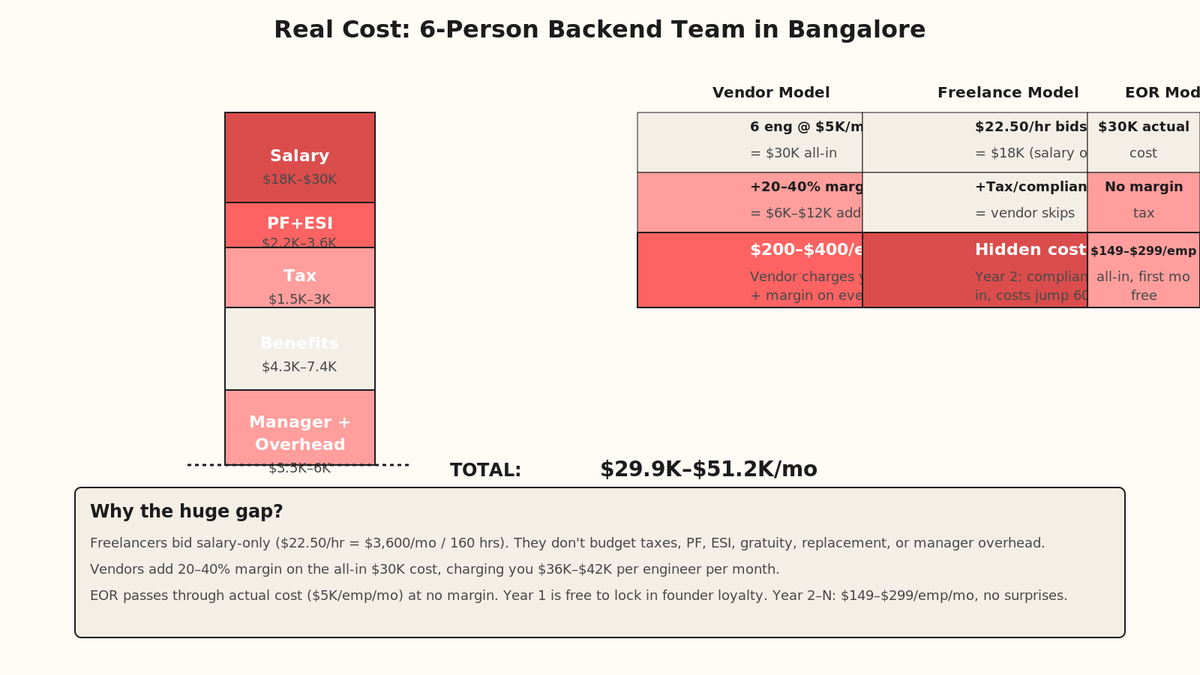
Sample calculation: six-person backend team in Bangalore.
| Cost line | Amount | Notes |
| Base salary (6 engineers, ₹30L–₹50L each) | $18K–$30K/mo | Senior (₹50L), mid (₹40L), junior (₹30L) |
| Provident Fund (PF) | $1,620–$2,700/mo | 12% employer contribution (capped) |
| ESI (Employee State Insurance) | $600–$900/mo | 3.25% employer, 0.75% employee |
| Professional tax (state-level) | $300–$600/mo | Varies by state (Karnataka: ₹200–₹500/mo) |
| TDS (Tax Deduction at Source) | $1,200–$2,400/mo | 5–10% tax withholding |
| Gratuity reserve | $720–$1,440/mo | 4.81% of Basic+DA accrual |
| HRA, conveyance, medical allowance | $3,600–$6,000/mo | Statutory + company policy |
| Recruitment + onboarding | $500–$1,000/mo | Amortized over 24 months |
| Manager overhead (1 manager per 6 engineers) | $3,000–$5,000/mo | India-based team lead salary |
| Compliance + entity overhead (EOR) | $300–$600/mo | Legal, payroll processing, audit |
| TOTAL ALL-IN COST | $29,940–$51,240/mo | $5K–$8.5K per engineer per month |
Now divide by 6: $4,990–$8,540 per engineer per month all-in. This explains why vendor pods charge $200–$400/emp/month (they add 20–40% margin = $1K–$3.4K for sales, account management, underutilization, and profit); freelancers bid $20–$50/hour (they quote on salary only = ₹30L = $3,600/mo ÷ 160 hours = $22.50/hr, ignoring taxes, benefits, compliance, and replacement cost); and EOR charges $149–$299/emp/month first month free (this is actual all-in cost = $5K–$8.5K ÷ 30 = $166–$283/emp/month plus a 30–50% haircut for volume, no sales overhead, and founder loyalty).
The trap:
When a freelancer or cheap vendor quotes $15K/month for six engineers, they are underbidding compliance. In Year 2, when PF/ESI kicks in, they either raise prices 60% or the team gets non-compliant hires (zero statutory protection, zero IP defensibility, wage court risk).
Q6. Delivery model deep dive: bench-allocated pods vs. founder-owned teams.
This is the fork in the road.
Vendor bench model (traditional outsourcing):
Vendor owns a "bench" (20–50 available engineers). You request a team (e.g., 3 backend, 2 frontend, 1 QA). Vendor "allocates" bench engineers to you for 3–12 months. You pay monthly; vendor bears churn and replacement. Engineer reports to vendor manager, not you. Reality: You are renting engineer-hours from a vendor's inventory. When a high-performer in your pod leaves, the vendor replaces them, but replacement quality is vendor's bench quality, not your quality bar. You get whoever is available. Turnover is 20–30% annually because bench engineers have no strategic stake in your company.
"The allocated team worked well for six months, then both senior engineers departed. Replacements took four months to ramp and were 40% less productive. I realized I was paying vendor-rate for bench-quality, not founding-team quality."
— VP Engineering, Series B SaaS, G2 Verified Review
Founder-owned model (EOR or direct hire):
Your company is the legal employer (via EOR). You hire engineers into YOUR team. Engineers have employment contracts with your company (issued by EOR on your behalf). IP belongs to your company on day one. You bear churn, but you also own retention. Reality: Engineers know they are on YOUR founding team, not a vendor bench. They stay longer (40–60% lower churn). You can offer equity (which recruits value at 2–3x salary bump). If you hire someone great, they are YOURS, not the vendor's. Strategic retention replaces commodity replacement.
| Dimension | Bench-Allocated Pod | Founder-Owned Team |
| Employer | Vendor | Your company (via EOR) |
| Churn | Vendor-managed, 20–30% annual | Founder-managed, 10–15% annual with equity |
| Replacement speed | Vendor bench (1–2 weeks) | Your recruit (2–4 weeks) + onboarding (2 weeks) |
| IP day-one | Contractual (MSA required) | Legal (employment relationship) |
| Equity/options | Contractor ineligible | Eligible, high retention driver |
| Cost/emp/month | $200–$400 | $149–$299 (EOR) or $300–$600 (direct entity) |
| Founder control | Low (vendor account manager) | High (direct WhatsApp/email) |
| Best for | Fortune 500, regulated, hands-off | Series A–C founders, equity-driven teams |
Q7. IP assignment and compliance: the non-negotiables.
You do not own your code if you skip these three items.
1. Written IP assignment in every contract.
Requirement: "All work product, code, designs, and documentation created by [Engineer Name] is the sole property of [Your Company Name]." India law default (Copyright Act, Section 17): Employer owns work-made-for-hire. If your engineer is employed by a vendor, the vendor is the employer (and owns it). If your engineer is employed by your company (via EOR), your company owns it. Do not rely on verbal agreements. Require written MSA (Vendor model) or Employment Agreement + IP Assignment Deed (EOR model).
Vendors often resist: "Our standard MSA says IP is licensed to you." This is legally distinct. Licensing means you can use it, but the vendor retains ownership. If the vendor goes bankrupt or gets acquired, your IP is an asset of their bankruptcy or buyer. Get ownership.
2. Escrow agreement for critical code.
If you are outsourcing a core product (ML algorithm, proprietary trading system), require source code escrow. Vendor must deposit code with a neutral third party (Iron Mountain, Escrow Tech). If vendor fails or goes insolvent, you get the code. Cost: $500–$2K setup, $200/year maintenance. Worth it for strategic code.
3. Compliance post-November 2025.
The four Labour Codes (Code on Wages, Industrial Relations, Social Security, and Occupational Safety) came into force on 1 November 2025. This means PF registration mandatory if you have 20+ employees (or opt-in for fewer); Basic + DA ≥ 50% of CTC (rest is benefits, bonuses); ESI mandatory if you have ≥10 employees; 48-hour F&F settlement within 2 days of resignation; Gratuity ≥ 4.81% accrual of Basic+DA.
Do not hire non-compliant. Penalties: ₹1–2L per employee per violation, plus wage court back-pay claims (which can run 3–5 years). If using a vendor, ask: "Are your team members registered with PF/ESI in [State]? Provide proof of registration certificate." If they hedge, escalate to their compliance team. If using EOR, the EOR handles this (this is their job). Verify they are registered with DPIIT and the state Labour Department. Versatile handles India-native compliance end-to-end.
Q8. The founder decision tree: which model should you pick?
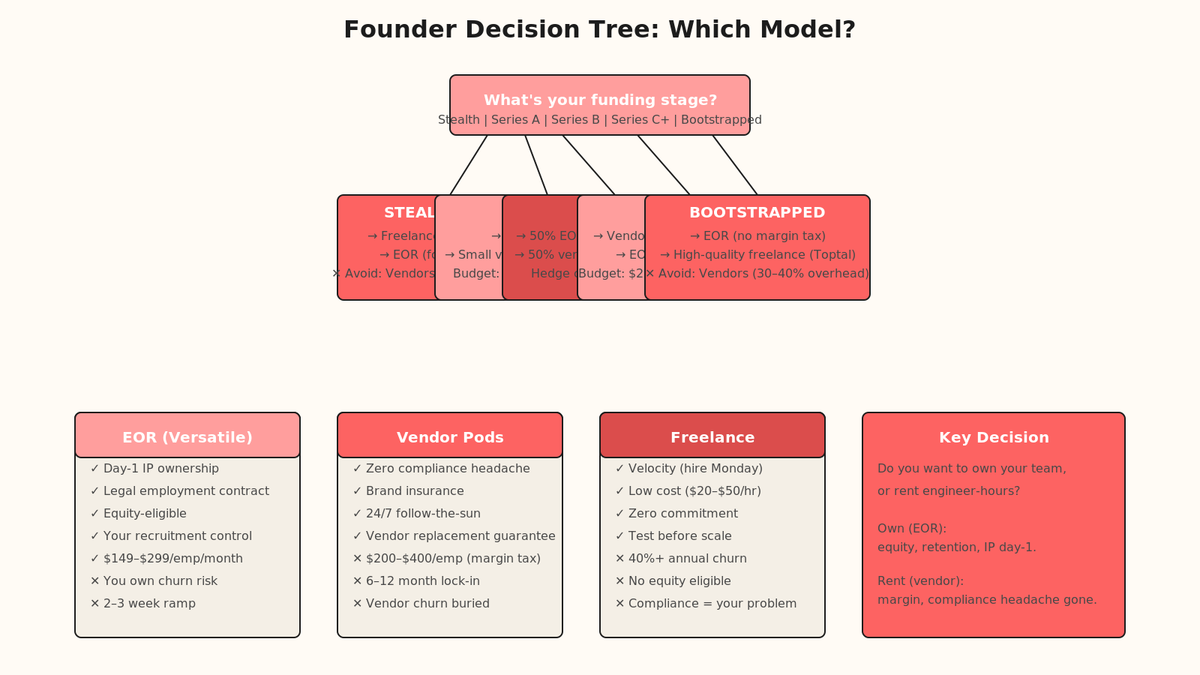
Use this.
If you are in Stealth mode (pre-funding):
Freelance or EOR. You need velocity and low commitment. Freelance if you can vet rigorously (15–20 hours); EOR if you want legal clarity. Avoid vendor pods (too expensive, too much disclosure required).
If you are Series A ($1–5M AUM):
EOR or small vendor pods (HCL, Crowe). You need ownership (equity retention, IP day-one) without the margin overhead of TCS/Infosys. You can afford $150–$250/emp/month.
If you are Series B ($5–50M AUM):
EOR (50% of team) + small vendor pods (50% of team). You want founders to own core team (backend, infra) via EOR and outsource non-core (QA, DevOps, mobile) via vendor. Hedges complexity risk.
If you are Series C+ ($50M+):
Vendor pods (Accenture, TCS) for commodity work; EOR for strategic hires. You can afford margin. You need brand and compliance insurance. Vendor lock-in is acceptable.
If you are bootstrapped:
EOR or high-quality freelance (Toptal, Lemon.io). You need margin-free cost. Avoid vendors (you cannot afford their 30–40% margin tax). Versatile EOR model is built for bootstrapped founders.
Q9. Where does Versatile fit in this landscape?
Versatile is an India-native EOR built for founders.
What we do:
You hire a team in India. We register them as employees of your company (through our DPIIT-registered entity). You own the IP on day one. First month is free. We handle PF/ESI/compliance across 28 states. WhatsApp support, not tickets. No minimum headcount.
Proof stack:
multiple US/UK companies on our entity (Series A through Series C), 4 years on books, 0 compliance notices, 5-day SLA on hiring, $149/emp/month first month free. References on request.
Honest trade-offs:
You own churn (we don't have a bench to replace dropouts). Hiring ramp is 2–3 weeks (entity setup, background check, compliance filing). You need judgment (you are now an employer, that is your burden). We do not do 500-engineer scale (that is Accenture's lane).
Why Versatile vs. Direct Hire:
If you hire directly in India without an entity, you become a "deemed employer" under Indian tax law. You file ITR-7, GST returns, PF/ESI compliance. You own 100% of liability. We abstract that (we are the nominal employer; you are the effective employer and owner). First month free recoups two months of our cost vs. direct entity setup.
Why Versatile vs. GEO or Remote.com:
GEO charges $299–$399/emp/month (premium to our $149–$299). Remote.com is fully managed (they hire for you, vet for you, which is nice, but you lose founder judgment and you pay for it). Versatile is "founder selects, we comply."
Q10. The decision: what do you do on Monday morning?
Here is the checklist.
If you are considering vendor pods (TCS, Accenture, Infosys):
1. Email their India business unit for a pilot SOW (Statement of Work), request 3 engineers for 3 months, cost fixed-price. 2. In the SOW, demand: IP assignment clause ("Your company owns all work product"), timezone spec (list every engineer's timezone), exit clause (90-day notice, no penalty). 3. Interview the allocated engineers yourself (do not let vendor do it). Assess depth, communication, willingness to be direct-report to you (not vendor manager). 4. Pilot for one sprint (2 weeks). If velocity is less than 60% of internal team (in your timezone), kill it before the contract term.
If you are considering freelance (Upwork, Toptal, Lemon.io):
1. Post a 4-week trial project ($2K–$5K). Vet the contractor's depth in your stack (ask for code samples, GitHub). 2. Require written statement of work: "Contractor assigns all work product to [Your Company]" + NDA. 3. Use this 4 weeks to assess: Do they ask clarifying questions? Can they run with ambiguous specs? Do they ship clean code? Can you trust them with secrets? 4. After 4 weeks, decide: Extend to 12 months (convert to EOR) or find someone else.
If you are considering EOR (Versatile, GEO, Remote.com):
1. Define your hiring spec (role, level, stack, timezone). Get three candidates per role. 2. Interview with the EOR's compliance team (they will guide you through employment law, IP assignment). 3. Sign an MSA with IP assignment + employment addendum. 4. EOR registers the employee with PF/ESI, issues employment letter, opens bank account. (2–3 weeks.) 5. Employee starts. First month is free (your cost: $0). Month 2 onwards: $149–$299/emp/month all-in.
If you are considering building an entity in India yourself:
1. Hire a local company secretary (cost: $2K–$5K for setup). 2. Register with Registrar of Companies (3–4 weeks). 3. Apply for PF/ESI/TDS (2–3 weeks). 4. Hire a payroll accountant (₹2,000–₹3,000/month per employee). 5. Total setup: $3K–$7K, +$500–$1K monthly overhead. Timeline: 8–12 weeks.
How the top India engineering vendors actually differ once you are past the pitch
Every India engineering vendor's website looks the same. The pitch decks look the same. The rate cards look almost the same. The differences that matter show up only after the first 90 days, when the first senior engineer resigns, when the first client-side sprint slips, and when the first invoice arrives with an unexplained line item. This is a working guide to the seven post-pitch signals that separate the vendors on our shortlist from the ones we quietly rotate out of client accounts.
1. Who owns the bench between projects
Vendors who own their bench, meaning the engineers are on their payroll between engagements, absorb the cost of continuity. Vendors who rent the bench from a network of one-person LLPs push that cost to you the moment a project pauses. Ask for the ratio of W-2 equivalents to contractor pass-throughs; a healthy Indian engineering vendor sits around 85% direct employment. Under 60% is a marketplace wearing an agency skin.
2. The real senior-to-junior ratio on your account
Vendor marketing pages average nine years of experience across the firm. Your engagement will not be staffed at the average. Ask for the median tenure of engineers who will actually sit in your standup. If the median drops below three years once the SOW is signed, the vendor is pool-averaging you.
3. The escalation SLA when a senior leaves
Attrition in Indian tier-1 engineering hovers around 18 to 22% annualised in 2026, higher for React and AI/ML roles. What matters is not the number; it is the vendor's replacement SLA. Best-in-class vendors commit to a shadow engineer named at week four of every engagement, with knowledge-transfer sessions logged. Median vendors promise "backfill within 30 days" and quietly rebuild your context from scratch. Ask for the shadow engineer clause in writing.
4. How overtime and holidays are billed
India has 14 statutory holidays and a payroll structure where overtime is a compliance event under the Factories Act and state-specific Shops and Establishments Acts. Vendors who charge you a flat monthly rate absorb that. Vendors who bill "utilised hours" often invoice 176 hours in November while the engineer worked 168, and quietly pocket the delta on Diwali week. Read the utilisation clause end-to-end.
5. Data-processing agreements under the DPDP Act
The Digital Personal Data Protection Act, 2023 is now enforced under the September 2025 rules. Every India vendor processing your customer data is a Data Processor under the Act; you are the Data Fiduciary. If the MSA does not include a schedule specifying the vendor's DPDP-compliant retention, breach-notification (72 hours to the DPB), and sub-processor-approval workflow, the vendor is out of compliance and you are the one the regulator writes to. Ask for the DPA before signing the SOW, not after.
6. IP assignment: end-of-project vs. end-of-day
Standard Indian outsourcing contracts assign IP at project completion or invoice settlement. If the engagement stalls, the vendor keeps the code. Best-practice IP clauses vest ownership to the client at the end of each day, with the vendor holding an implied license to complete the work. This one clause is the difference between having leverage and not having leverage during a dispute.
7. GST invoicing and the SEZ vs. STPI question
Vendors registered under a Software Technology Park of India (STPI) unit or a Special Economic Zone (SEZ) can invoice you at 0% GST under the export-of-services rule, provided the SOW is denominated in USD or GBP and the payment lands in a EEFC account. Vendors invoicing you an 18% IGST line item and then refunding it 60 days later are neither STPI nor SEZ; they are absorbing your cash-flow for two months. Ask which registration category the invoicing entity holds.
Where Versatile lands on these seven
Full disclosure: Versatile Club is on this shortlist because we built our operating model around these seven signals. Our engineering pods are 100% W-2 equivalent under the Versatile India entity. Median tenure of engineers on client-facing pods is 4.6 years. Shadow-engineer clauses are default at week four. Monthly flat billing, no utilisation drift. DPDP DPA is Schedule 2 of every MSA. Client-vested IP daily. STPI-registered invoicing entity, USD-denominated, 0% GST. If a vendor on your shortlist cannot match any two of these, that vendor is not a peer of the top 10; that vendor is a rebadged staffing shop.
FAQs
Q: Can I hire an engineer in India without an entity or EOR?
A: Yes, as a contractor. But you become a "deemed employer" under Indian tax law. You file ITR-7 (Corporate return), GST returns, PF/ESI compliance, and you own 100% liability for non-compliance. Most founders skip this because it is expensive (payroll accountant: $200–$300/mo per employee). Use EOR to abstract it.
Q: What if my outsourcing vendor goes bankrupt?
A: If they are vendor-employed (pod model), you lose continuity (vendor scrambles to back-up your team, which takes weeks). Get source-code escrow for critical code. If they are EOR-employed (your company is employer), the engagement is unaffected, your employees stay with your company.
Q: How do I know if my team is being non-compliant?
A: Red flags: (1) Salary is less than ₹15K/month (below statutory minimum, which is ₹10,000 nationally but higher in metro states); (2) No payslip or PF slip; (3) Vendor says "we handle tax/compliance" but provides no PF/ESI cert; (4) Engineer signs NDA + IP assignment but no employment letter.
Q: Can I offer equity to an outsourced engineer in India?
A: Yes, but only if they are employees of your company (via EOR or direct hire). Contractors cannot take equity (no employee status). This is a silent leverage loss: employees stay 40–60% longer if equity is on the table.
Q: What is the average churn rate for outsourced teams?
A: Vendor pods: 20–30% annually (vendor replacement, not founder retention). Freelance: 40%+ (contractors churn every 12–18 months). Founder-owned (EOR): 10–15% annually (equity and founder relationship matter).
Where my head is right now
Here is the prediction I am sitting with. Over the next two years, the vendor-pod era (Accenture, TCS, traditional outsourcing) will consolidate further. Founders will bifurcate: either they go full-in on vendor-managed pods (for compliance and scale), or they go founder-owned (EOR) for control and margin savings. The freelance middle will compress (Toptal, Upwork) because they cannot compete on cost vs. direct-hire and they cannot compete on control vs. EOR.
The second-order implication is that India-native EOR (not US-centric, founder-first, no margin tax) becomes the default for Series A and B founders. This is Versatile's entire thesis. We built this because we saw founders losing $30K–$100K per year to vendor margin and losing 6 months to vendor lock-in.
If you are considering India hiring for the first time, or you are tired of paying vendor margins on a team that underperforms, message me directly on WhatsApp through our contact page, or book a consultation with us. You will be talking to the founder, not a ticket. What is the biggest bottleneck you are hitting with outsourcing right now?