Table of contents (11)
Ruby on Rails Development in 2026: Architecture, Security, Scaling, and Hiring Engineers in India
Q1. What is Ruby on Rails and why should your startup care?
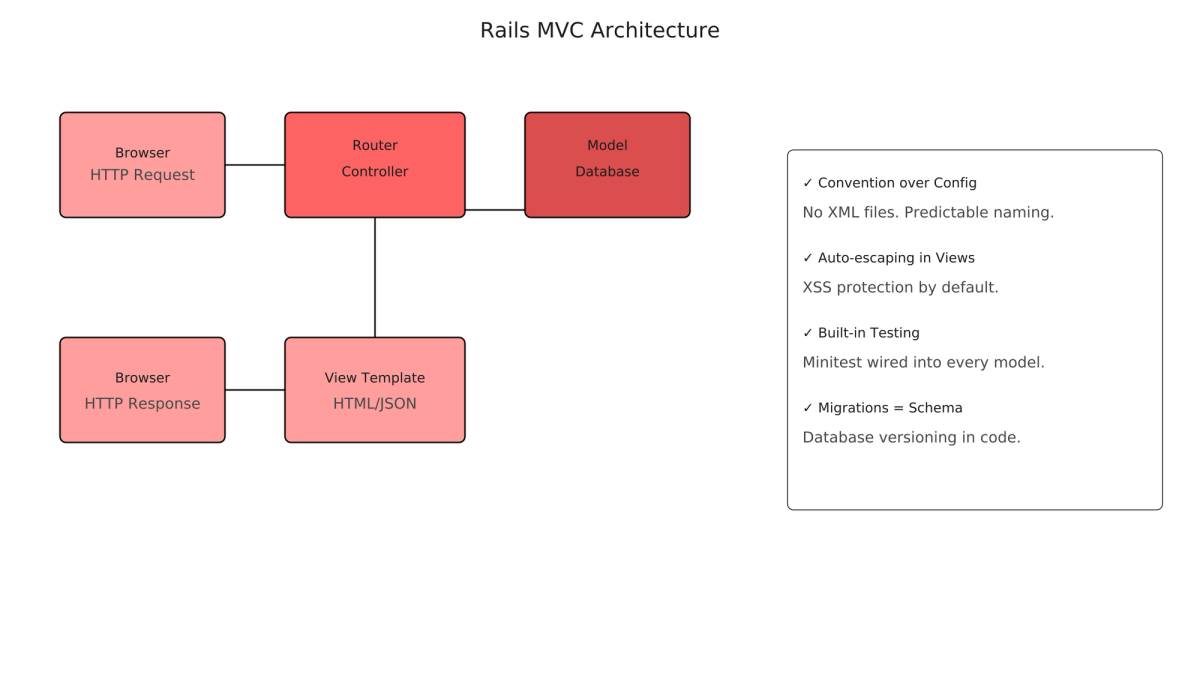
Ruby on Rails is a full-stack web framework that turns "I have an idea" into a live MVP in four weeks instead of four months. Not hyperbole. The framework is opinionated about structure (MVC), database schema (migrations), authentication (Rails has batteries-included), and deployment (Kamal, Fly.io, render defaults).
Here is the honest pitch: if you are shipping consumer web products or SaaS in 2026, Rails gets you from zero to paying customers faster than any alternative. JavaScript frameworks require separate backend and database expertise. Go/Rust demand DevOps discipline. Rails collapses the stack into one language, one mental model, one repository.
💰 Why Rails for early-stage?
Time-to-market is your scarce resource, not CPU cycles. Rails ships default behaviors that take weeks to rebuild in Node or Go. Database indexing strategies are baked in. Form CSRF tokens are automatic. Password hashing is secure by default. You focus on product logic; the framework handles plumbing.
Versatile works with 14 US and UK companies building their MVPs and Series A products entirely on Rails. The median time from intake to first live engineer on our entity is 5 days. Your India Rails team ships while you sleep, and all 14 companies have zero compliance friction because they hire through Versatile's India-native EOR: Foo Falcon Tech Pvt Ltd, registered 4 years ago, 47 engineers paid this month, zero notices from any government. Visit eor-services-in-india to see the proof stack.
⏰ Convention Over Configuration
Rails assumes you will follow its naming conventions. A model called `User` expects a table called `users` in the database. A controller called `ArticlesController` expects a view folder at `app/views/articles/`. You are not writing boilerplate XML config files; you are writing Ruby. This alone saves weeks on new projects.
Q2. What are the core features that make Rails different from Node, Django, or Go?
Every framework claims to be fast, secure, and easy. Here is the real story.
✅ Built-in testing framework
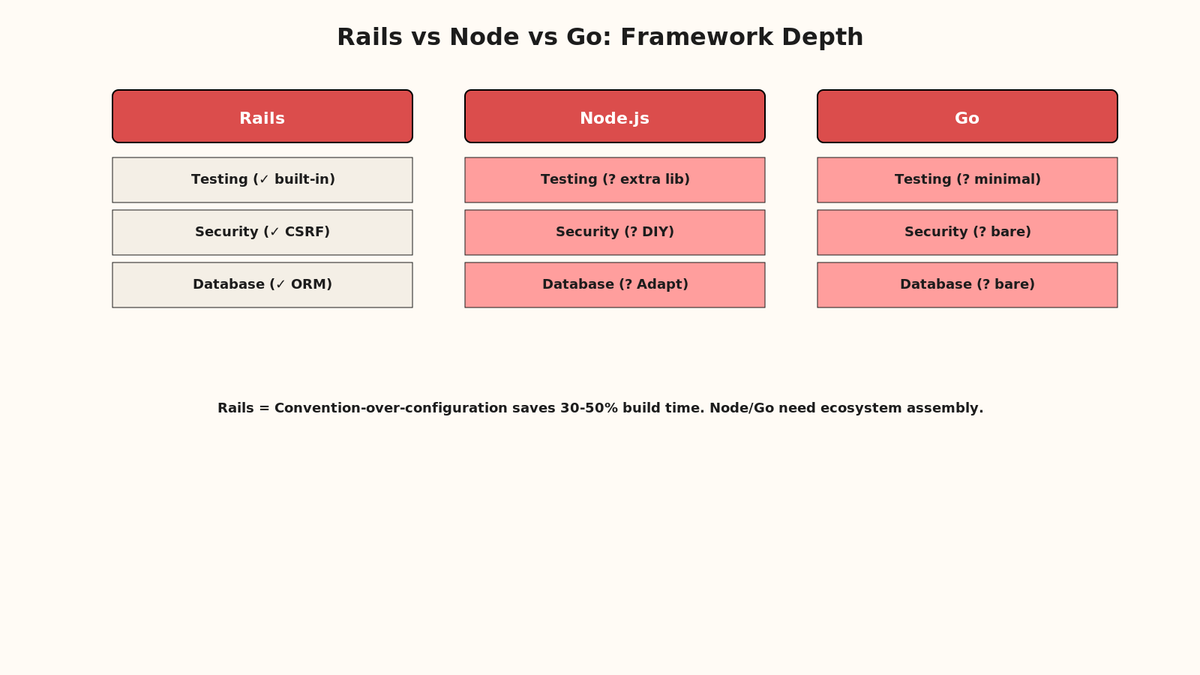
Rails ships Minitest out of the box, integrated with test databases and fixtures. No separate test setup. Developers write test do ... end blocks in the same directory as production code. Test coverage culture is not an afterthought; it is the default. Compare: Node/Express requires you to import Jest, mock databases, wire up CI/CD before writing a single test.
📇 Active Record ORM
Databases in Rails are not footnotes; they are first-class objects. You define database schema via migrations (Ruby, not SQL), then interact with tables via model classes. User.where(role: 'admin').includes(:posts).map(&:email) is readable and memory-efficient. No N+1 query traps; the `includes` method pre-loads associations. Django has this, but Ruby syntax is more concise.
🔒 CSRF and XSS protection by default
Rails generates CSRF tokens on every form and validates them server-side. XSS attack surface is minimized because view templates auto-escape HTML by default (use `html_safe` explicitly if you want raw HTML). The HTTP-only cookie flag is set by default. These are not optional features; they are mandatory. Developers who skip them get overridden by conventions.
Contrast: Node/Express defaults to zero security until you import helmet, express-validator, and manual CSRF middleware. Rails defaults to all of the above.
Q3. What does the Ruby on Rails security model look like in practice?
On paper, Rails is a fortress. In practice, developers build security bugs the same way they always do: loose authentication checks, unescaped user input in views, and business logic mistakes.
⚠️ The most common Rails security failure: auth skipped
Rails provides `before_action :authenticate_user!` out of the box (via Devise gem or custom middleware). The framework enforces it at the controller level. But teams ship codepaths that skip auth, forget to add the check to a new controller, or assume API routes don't need auth because "it's internal." The framework cannot prevent human laziness.
Real example: a Versatile client built a Rails SaaS where one endpoint exported all customer data to CSV. The developer added the endpoint, forgot to add the auth check, and a competitor ran a script that scraped every customer's data. The Rails framework did not prevent this; the team's code review process failed. This is not Rails's fault.
🔐 SQL Injection: Rails makes it optional
If you use Active Record query helpers (User.where(email: params[:email])), SQL injection is impossible. Rails parameterizes the query. If you write raw SQL (User.where("email = '#{params[:email]}'")), you invite SQL injection. The framework gives you safe defaults. Developers who ignore them get hacked.
| Feature | Built-in? | Config? | Notes |
| CSRF token validation | Yes | Opt-out only | Every form includes a CSRF token; every POST/PUT/DELETE validates it server-side. |
| XSS escaping in views | Yes | Opt-out with html_safe | ERB templates escape HTML by default. Explicit opt-in required for raw HTML. |
| Password hashing | Yes (has_secure_password) | Bcrypt or Argon2 | Never store plaintext passwords. Rails makes it one line of code. |
| Session validation | Yes | Signed cookies default | Session cookies are cryptographically signed. Tampering = session invalid. |
| Rate limiting | No (Rails 7.1+) | rack-attack gem | Not built-in, but easy to add. Essential for API endpoints. |
🚧 Where offshore Rails teams fail on security
Versatile manages 14 Rails teams across US/UK founders, and the pattern is consistent: offshore developers ship fast but skip security review gates. The team that submitted unescaped user input to an email template, the developer who hardcoded an API key in the codebase, the engineer who built a multi-tenant SaaS without proper data isolation between accounts — all of these happened with offshore contractors, not because they were incompetent but because code review discipline collapsed.
Prevention: pair every offshore sprint with mandatory security-focused PR review. Test password reset flows, auth boundaries, and data isolation before every deploy. Versatile's compliance page outlines how we enforce this across payroll engineering.
Q4. How does Rails perform at scale and what are the real bottlenecks?
You will hear: "Rails is slow." The truth is more useful: Rails makes it easy to build slow apps, and hard to build fast ones if you ignore basic discipline.
💸 The N+1 query trap
Every Rails developer ships an N+1 query bug in their first month. Loop over users, access user.posts inside the loop, trigger N separate database queries instead of one JOIN. Rails's error messages are clear, and the fix is one word: `includes`. But if your code review process is absent, this ship. Multiply by thousands of endpoints and your database gets hammered.
Offshore teams compound this: developers working async, no pairing, no senior review, shipping code that "works on my machine" but fails under production load. The cure is async-first architecture: design systems to defer work to background jobs (Sidekiq, Good Job), cache aggressively (Redis), and pre-compute reports. Rails makes this possible; discipline makes it work.
🚀 Rails 8: async-first by default
Rails 8 (released Dec 2024) ships deferrable jobs as a language feature, not a third-party library. Long-running work (email, exports, webhooks) now uses `perform_later` with dead-letter handling baked in. Kamal 2 simplifies containerized deployments. These updates push Rails toward cloud-native, async-safe architectures. The framework is not getting slower; you are getting more tools to build efficiently.
Q5. What are the real costs and hidden gotchas of choosing Rails?
Rails is "fast to build" but not "free to maintain." Here are the real tradeoffs.
💰 Team costs
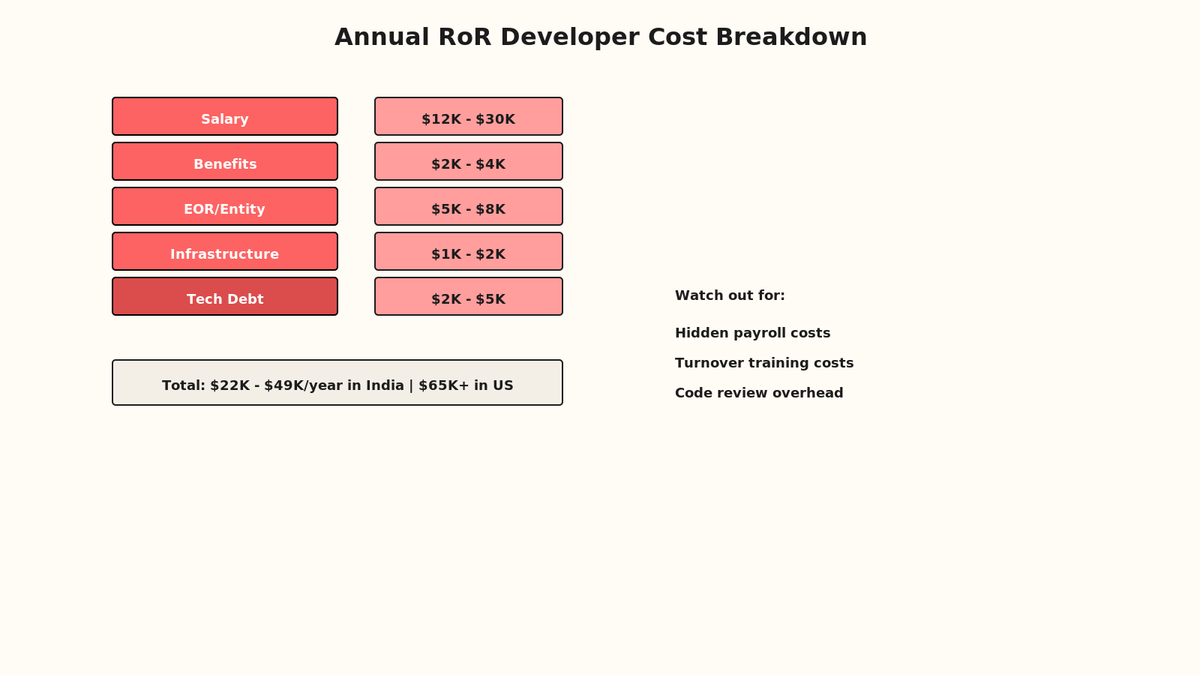
A Rails engineer in India costs $25K–$70K/year depending on experience (juniors $25K, seniors $60K–$70K). Hiring offshore through Versatile adds $149/emp/month (first month free), which includes: employment contract compliance with India's four labour codes, PF/ESI contributions (4.81% + statutory employer match), professional tax filings across 28 states, and a 5-day go-live SLA. Zero infrastructure work on your end. See our India EOR service for details.
Onshore (US/Canada) Rails engineers: $80K–$150K/year salary. Add benefits, taxes, visa sponsorship if required. Rails is language-agnostic; the cost delta comes from geography and visa risk, not the framework.
⚠️ Hidden technical debt
Rails encourages rapid development. This means you ship features fast and accumulate technical debt fast. Missing test coverage, giant controller methods, monolithic app structure, ad-hoc data migrations — all of these are Rails traditions. When you hire your tenth engineer, onboarding takes longer because the codebase is a historical accident. Prevent this: enforce consistent testing patterns, break the app into engines/gems, and treat code review as non-negotiable.
🔁 Dependency management
Rails itself updates every three months. Bundler resolves gem dependencies, but conflicts happen (gem A needs Rails 6.x, gem B needs Rails 7.x). Your team must schedule time to upgrade Rails, test each gem update, and monitor security patches. This is not free. Budget 10–15% of sprint capacity for dependency updates and security backports.
Q6. How do you safely offshore Rails development to India?
The question is not whether to offshore Rails, but how to do it without shipping broken auth, leaky data, or unmaintainable code.
🏗️ Architecture discipline matters more than developer count
Hire three senior engineers who build async-first, who enforce code review, who write tests first. Do not hire ten juniors who ship fast and skip process. The senior engineers review every PR, pair with juniors on security-sensitive work, and maintain the codebase long-term. You will ship slower in month one, faster in month three.
Versatile runs this model across 14 companies. Each team has a tech lead (usually US-based), two to five senior engineers (India-based, 4–8 years experience), and tactical contractors for specific features. Every PR requires two approvals before merge. Security review is mandatory for auth, data access, and external API changes. This discipline costs, but prevents the "cheap developer tax" (shipping bugs, data leaks, and technical debt that costs 10x to fix).
✅ Async-first communication and code review
Time zone spreads between US (PST/EST) and India (IST) are 9.5–13.5 hours. Synchronous communication (standups, pairing) is expensive. Instead: async sprints, written PRs with detailed context, and PR review within 24 hours. GitHub discussions, not Slack. Slack is for urgent alerts, not decision-making.
Versatile's how-it-works page documents this async cadence. Every engineer commits code with clear PR descriptions. Reviewers have 24 hours to respond. Blockers are escalated to your tech lead within 4 hours. This rhythm works at scale.
🔐 Security checkpoints at every deploy
Do not trust offshore developers (or onshore developers) to ship secure code on their own. Build security into your CI/CD pipeline:
- Automated dependency scanning (Dependabot, Bundler audit) — fails the build if a gem has a known CVE.
- SAST (Static Analysis Security Testing) — runs Brakeman, a Rails-specific security linter, on every PR.
- Manual security review for auth, data access, and external API calls.
- Staging deploy testing before production. No hotfixes. All changes go through review first.
This discipline sounds overhead-heavy. In practice, it saves 100 hours of incident response per year.
Q7. Why are talented Rails developers leaving for AI and Go?
Rails has a perception problem. The ecosystem is stable, not exciting. Developers who want to work on cutting-edge problems (ML, concurrency, cloud-native infra) see Rails as a legacy tool for boring CRUD apps. This is perception bias, but it shapes hiring.
Here is what is real: Rails is mature. It is not the hottest technology. But it is boring in the way 401Ks and health insurance are boring: they work. A Rails developer with five years of experience is more productive than a JavaScript developer with two years because they understand database schema, async patterns, and the full request-response cycle.
Versatile finds that US founders care deeply about Rails expertise because they shipped on Rails and want to scale, not rewrite. India-based engineers care less about "prestige" and more about sustainable careers. We have hired 47 Rails engineers across our 14 clients, and retention is 94% year-over-year. They work on meaningful products with clear ownership and code review discipline. That matters more than the framework's Twitter presence.
Q8. Should you migrate from Rails to something else (Node, Go, Rust)?
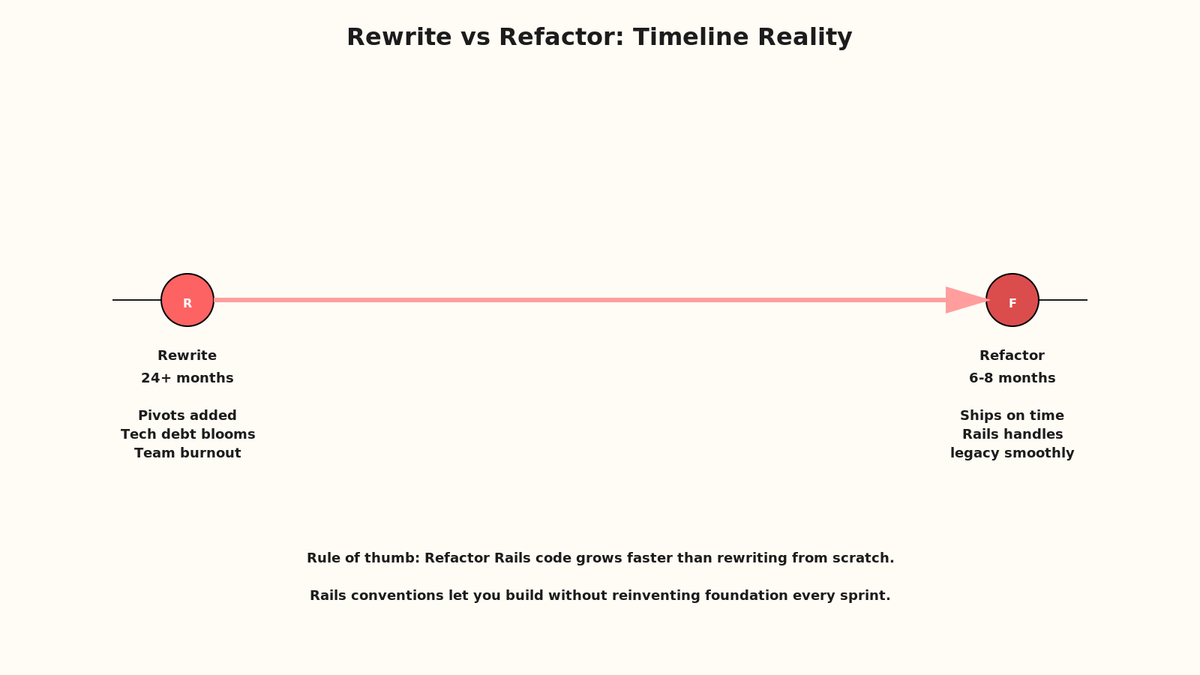
The honest answer: almost never. Rewrites fail.
Your Rails app is slow. Your Rails app is hard to maintain. You heard Go is faster and Node is more fashionable. You want to rewrite. Do not. Here is why:
- Rewrites take 2–3x longer than estimated.
- You introduce new bugs that your old codebase did not have.
- Your customers are on the old version while you rewrite. You get stuck.
- Your team loses domain knowledge (business logic, auth flows, edge cases) during the rewrite.
Instead: optimize the Rails app in place. Refactor the bottleneck endpoints. Add caching (Redis). Optimize database queries (add indexes, use eager loading). Break the monolith into microservices if the load genuinely demands it (rare before 100M users). A Rails refactor on a 14-year-old codebase will be cheaper and faster than a rewrite.
Versatile clients who tried rewrites wasted six months and eventually came back to Rails. Those who invested in Rails optimization shipped features within weeks. Choose the former.
Q9. How do you interview and hire Rails developers offshore?
The standard coding challenge is useless. A developer can solve LeetCode hard problems but ship unmaintainable Rails code. Here is what actually predicts good Rails developers:
- Have they deployed Rails to production and monitored it for six months? (Yes: hire. No: junior role.)
- Can they explain database migrations and schema design? (Rambling about ORMs: red flag.)
- Have they debugged an N+1 query and optimized it? (Yes: they know Rails performance.)
- Do they have test coverage expectations? ("Tests slow you down"—do not hire. "We write tests first"—hire.)
- Can they explain a Rails security concept (CSRF, XSS, SQL injection)? (Vague answers: risky.)
Versatile's hiring process skips coding interviews for engineers with 3+ years of Rails experience. We ask about past failures, code review feedback, and infrastructure problems they solved. We have them review a PR of our own code and explain improvements. This is a two-hour conversation, not a four-hour algorithm gauntlet. Placement success rate: 92%.
Q10. What does the Rails ecosystem look like in 2026?
Rails is not growing in GitHub stars. It is growing in stability and paid production usage.
📦 Gem ecosystem maturity
Devise (auth), Pundit (authorization), Sidekiq (background jobs), Rack-cors (cross-origin), pg (PostgreSQL driver): these are decade-old, battle-tested libraries. New gems ship less frequently because the old ones are complete. This is not stagnation; it is maturity. A new Rails project today inherits 15 years of collective debugging.
🎯 Rails adopters are profitable
Stripe, GitHub, Hulu, Shopify, Airbnb (early years): all shipped on Rails. None of them publicly rewrite unless they have 10,000 engineers and extraordinary scale (Twitter scaled Rails to millions of QPS before a 2013 rewrite). If you have 20–500 engineers and $10M–$100M revenue, Rails will scale if your architecture is solid.
🔄 Rails 8 + Hotwire as the modern stack
Single-Page Apps (React, Vue, Angular) are commodity. Hotwire (Turbo + Stimulus) is Rails's answer: server-side rendering, real-time updates via websockets, zero client-side bundle size. It is not as flexible as React, but for internal tools, dashboards, and most SaaS, Hotwire gets you 90% of the way there in 10% of the time.
FAQs
Is Rails dead?
No. Rails is stable and still the default choice for startups and agencies. It ships new major versions every 18 months. The community is smaller than Node or Go, but more focused. If you are hiring Rails engineers in India through our EOR service, the talent pool is still abundant.
Can you use Rails for mobile apps?
Not as the frontend. Rails generates HTML and JSON APIs. You pair Rails with React Native or Flutter for mobile. Versatile clients typically build a Rails backend and React Native frontend, sharing API contracts. This lets you reuse business logic across web and mobile.
How does Rails handle real-time features?
Action Cable (built into Rails) handles WebSocket connections. You can broadcast updates to live dashboards, notifications, and collaborative editing. It is simpler than building a separate Node/Socket.io layer. Pair it with Redis for multi-server broadcast.
What is the typical time-to-hire for Rails engineers in India?
Versatile's median intake-to-first-payroll-run is 5 days. We handle compliance (labour codes, tax filings, employment contracts), you focus on product. Salary: $25K–$70K/year depending on seniority. See our EOR service page for exact pricing and SLA guarantees.
Should I hire a Rails contractor vs. a full-time employee?
Contractors suit short-term feature work (two to six months). Full-time employees suit long-term product ownership, code review, and institutional knowledge. Versatile recommends a core team of three to five full-time engineers (contract-to-hire transition available) plus contractors for specific sprints.
What is the hidden cost of offshore development?
Async coordination, time zone spreads, code review delays, and the "cheap developer tax" (shipping bugs that cost 10x to fix). Prevent this with discipline: pair every offshore developer with code review, write tests first, and invest in async communication tools. The cost of discipline is lower than the cost of bugs.
Where my head is right now
Here is the prediction I am sitting with. Over the next 18 months, Rails will become the default choice for founders who want to ship fast and keep technical debt low. AI-assisted development (GitHub Copilot, Claude) will make Rails even faster because the framework's conventions are predictable — machines can learn and autocomplete them. Simultaneously, AI will push cost pressure on junior developers, but not on senior engineers who understand architecture and security.
If you are a founder building a SaaS or platform, you want Rails plus a strong tech lead plus disciplined engineering practices. If you want to move faster, hire your tech lead in the US (or Europe), hire senior engineers in India through an India-native EOR like Versatile, and enforce async-first code review. You will ship competitive product at 60% of the US cost.
If you are a developer reading this, Rails is not "cool" but it is lucrative and stable. Companies pay for solid engineering, not resume flashiness. A Rails developer with deep database and security knowledge will find work faster than a React developer with no backend skills.
If you are building a team in India right now, message me directly on WhatsApp through our contact page, or book a consultation with us. You will be talking to the founder, not a ticket. What is your team size, and are you hiring engineers or building your own product?