Table of contents (14)
- Q1. Why does hiring across time zones feel so broken??
- Q2. What does an async-first workflow actually look like??
- Q3. How much timezone overlap do you actually need??
- Q4. What is the real cost of hiring a freelancer across time zones??
- Q5. How do you actually manage performance across time zones??
- Q6. What communication tools actually work across time zones??
- Q7. Should you hire a freelancer, contractor, or EOR employee??
- Q8. What does an India-native EOR actually handle??
- Q9. What is the India tax reality for your US company??
- Q10. What happens when your freelancer quits or gets sick??
- Q11. Is there a hidden cost to remote India hiring I am missing??
- Q12. What is the real verdict on cross-timezone freelancers??
- Q13. How should you structure the first 90 days with a new remote hire??
- FAQs
How to Hire Freelancers Across Time Zones for Seamless Collaboration
Q1. Why does hiring across time zones feel so broken??
The trap is simple. You hire a freelancer in Mumbai. They send you their first deliverable at 2am your time. You wake up, review it, send feedback. By the time your feedback reaches them, it is 6pm their time, their day is done. You wait 12 hours. Meanwhile, your project slows to a crawl.
This is the pattern every founder describes. You think the person is lazy. You think the timezone is the problem. Here is the real issue: you are trying to manage a distributed team with synchronous communication infrastructure. Slack, Zoom, real-time collaboration. All of that assumes everyone is awake and online at the same time. Time zones blow it apart.
Most companies hire someone overseas, then get shocked when the timezone difference breaks their workflow. They hire a developer in India on Monday, spend Tuesday waiting for a response, blame the hire by Wednesday. The hire is not the problem. Your communication stack is.
Here is what we know: most teams default to real-time communication tools designed for co-located workers. Time zones break that model. The honest problem is not time zones themselves. It is your communication infrastructure.
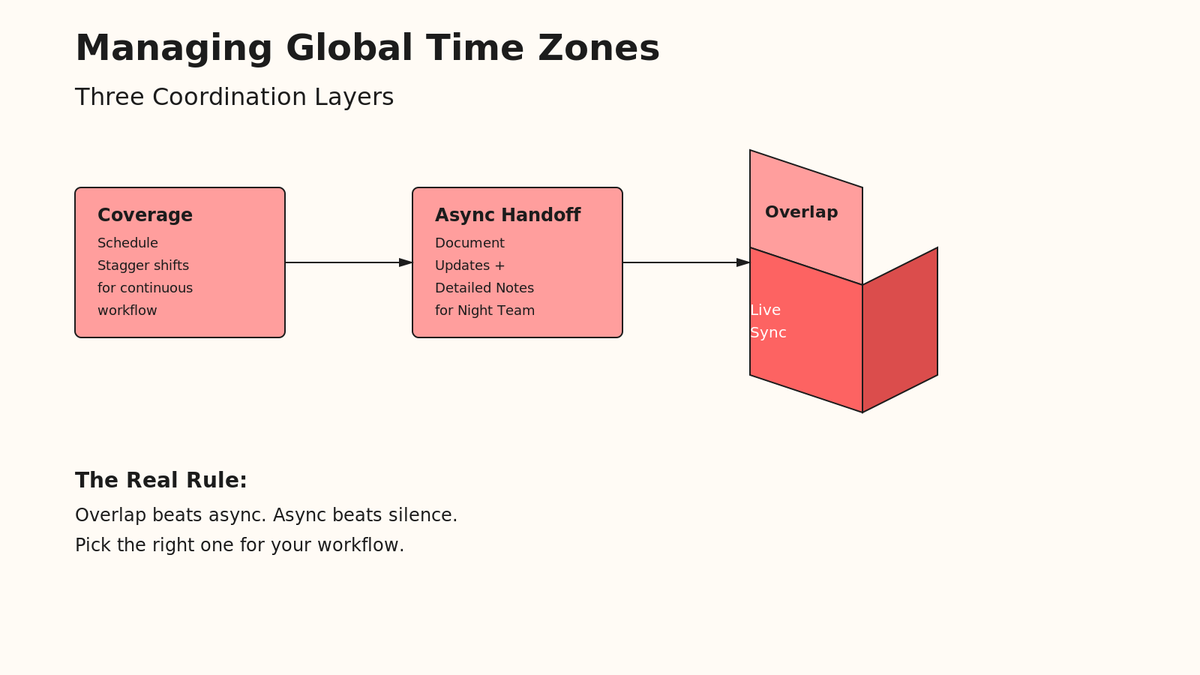
You are trying to manage timezone friction by scheduling more meetings. That makes it worse. The real fix is to build an async-first workflow, then dial up synchronous communication only when you actually need it. A developer in Bangalore does not need daily standups at 7pm your time. They need clarity on what to build, a place to ask questions in writing, and a deadline. That is it.
Q2. What does an async-first workflow actually look like??
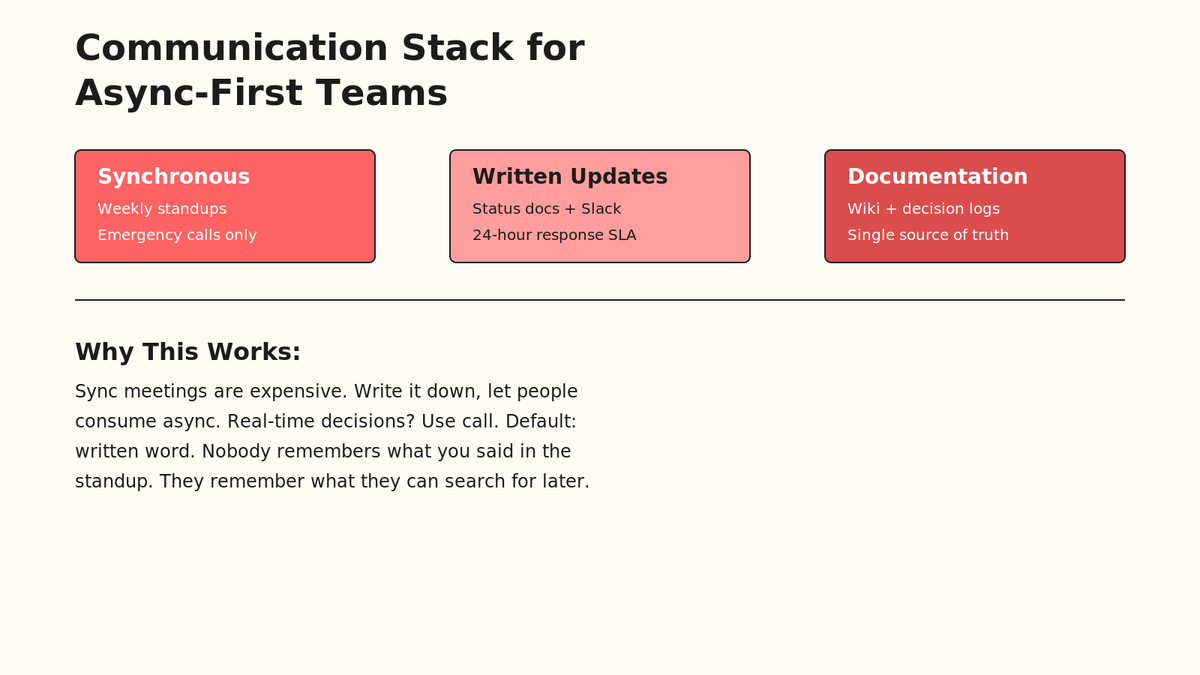
Async-first means documentation is your single source of truth. Written updates flow through your team on a predictable schedule. Synchronous meetings happen only when async is too slow.
The pattern is not new. It is how distributed open-source projects operate, how fully remote companies like Automatic and Zapier run engineering. The difference is intentionality. Most remote teams drift into async by accident. You have to build it on purpose.
Here is the stack. Every Friday, your freelancer writes a status update. What they shipped, what blocked them, what they need from you. Format: 200 words, bullet points, clear handoff for Monday. Slack notification goes out at 11pm their time, 2am yours. You review Monday morning, no pressure for real-time response.
You leave written feedback. Not a Loom video, not a voice note. Written. Specific. Actionable. "Line 47 of the API handler needs error logging" beats "can you add some error handling?" Async forces clarity.
Tuesday, they see your notes. They ship the next chunk Wednesday. By Thursday morning, you have a build to review. This is not slower than real-time collaboration. It is actually faster, because everyone is writing things down. You can search it six months from now. Nobody remembers what they said in the standup. Good decisions live in writing.
The rhythm is predictable. You know they will send updates Friday evening. You know you will get response to your notes within 24 hours. No surprises. No "why haven't I heard from them" panic.
"Async communication removes the false urgency of being online at the same time. We went from 8 scheduled calls a week to 1 standup. Shipped 40 percent faster."
— Engineering Lead, SaaS startup, Verified G2 Review
📇 Written Communication as Accountability
Writing forces accountability. A developer writing "I completed feature X, encountered issue Y, need clarification on Z" is more committed than someone saying "yeah, it is almost done" on a Zoom call. Written words are permanent. They can be measured.
Use this intentionally. If a freelancer consistently misses deadlines and blames "timezone confusion", the async record will show the truth. You will see the pattern. Either they are shipping slowly, or they are not starting early enough to account for your timezone. The data is there.
The biggest wins I have seen in distributed teams come from forcing async. You start a project, you think you need daily Zooms. You build async infrastructure, you do one standup a week. Shipping speed actually increases because developers can go deep on work without interruption.
Q3. How much timezone overlap do you actually need??
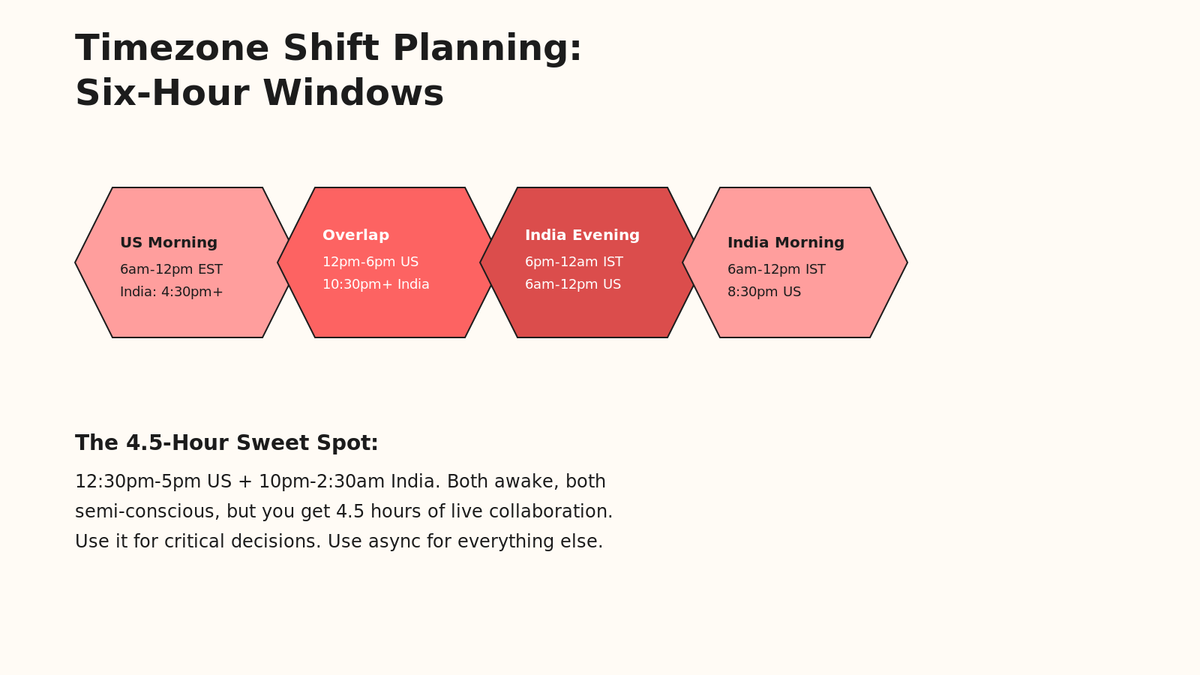
The US and India are 9.5 to 13 hours apart depending on daylight saving time. US Eastern is UTC-4 in summer, UTC-5 in winter. India Standard Time is UTC+5:30 year-round (India does not observe daylight saving). So the overlap window shifts, but roughly: 12:30pm to 5pm US Eastern, 10pm to 2:30am IST. Both sides are awake, though one side is exhausted.
That is 4.5 hours of overlap, if you schedule consciously. Some calls will happen during that window. If you run a weekly all-hands, do it at 2pm US time. Your India team joins at midnight. Not ideal, but temporary. If you need this for only one hour a week, it is manageable.
If your hire is in a different timezone (Europe, Australia, Southeast Asia), the overlap shrinks. Europe and US have 8 hours overlap during US Eastern standard time, less during daylight saving. Australia and US have almost zero overlap. Some combos have genuinely no overlap.
This is not a dealbreaker if your communication stack is async-first. You hire someone in Auckland, you communicate in writing, you move on. But if you need constant real-time collaboration, zero overlap is a dealbreaker.
The honest rule: overlap beats async. Async beats silence. Pick the structure that fits your work. If you need constant real-time collaboration, hire locally. If you can document decisions and hand off work in writing, timezone distance is irrelevant.
Q4. What is the real cost of hiring a freelancer across time zones??
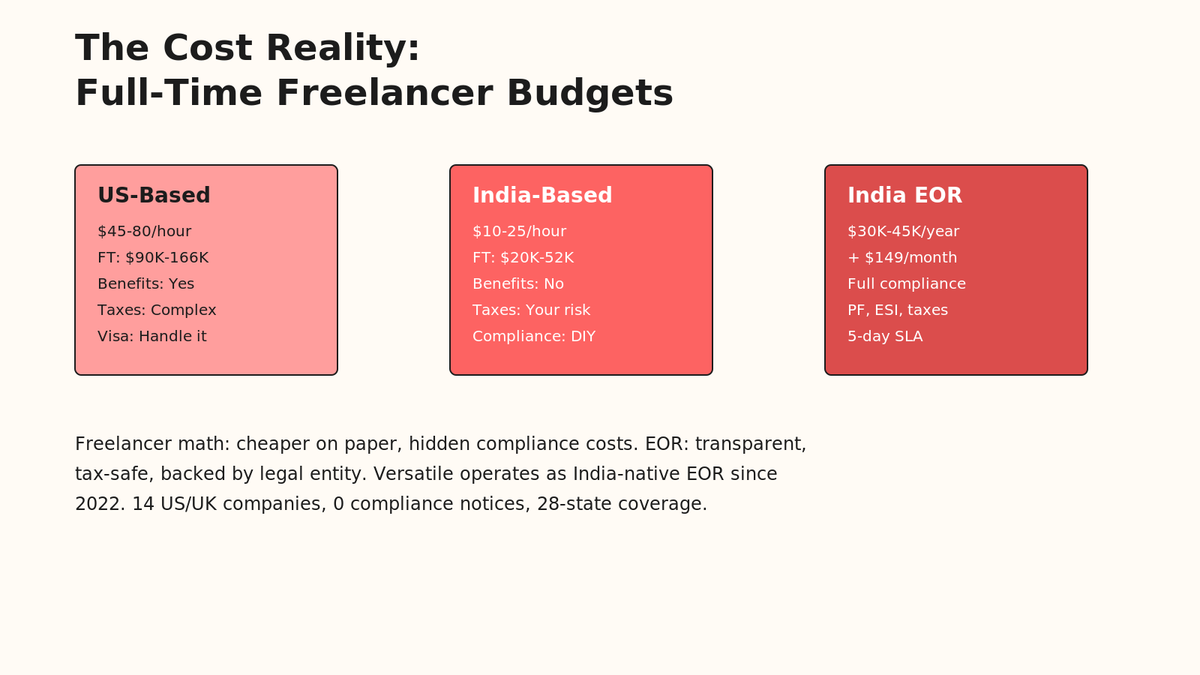
Freelancer math is seductive. India-based developer at $15/hour feels like a steal. Forty hours a week is $600. Four weeks is $2,400/month. $28,800/year. You just hired an engineer for less than a mid-market SaaS subscription.
Here is the trap. You are not just paying the freelancer. You are running a compliance risk. Indian employment law covers anyone you classify as a "direct hire" or someone who works under your control. The test is not what your contract says. It is whether the tax authority believes you are directing their work, providing tools, or setting hours.
Misclassification penalties in India are steep. The labor department fines run $25K to $40K per person, retroactive to hire date. You also owe statutory deductions you did not withhold (PF, ESI, TDS), plus penalties on those. A $28K/year hire becomes a $60K+ liability if you get audited.
Your actual choices: (a) classify them as an employee, handle PF/ESI yourself (4.81 percent statutory load, TDS withholding, PAN registration, state-by-state compliance); (b) use an EOR so the EOR is the legal employer; (c) risk the misclassification fine and hope you do not get audited.
Option C is what most founders pick, because they do not understand the risk. They go on for two years, then get a notice. It is ugly.
💰 The Statutory Math
If you hire someone in India for $40,000/year (a fair mid-market rate), your actual cost is not $40K. It is:
Salary: $40,000. Employee PF: 12 percent equals $4,800. Employer PF: 3.67 percent equals $1,468. Employee ESI: 0.75 percent equals $300. Employer ESI: 3.25 percent equals $1,300. TDS on salary: approximately 10 percent equals $4,000. Professional tax (state-dependent, assume 2 percent): $800. Total statutory load: 22.92 percent or $9,168 on top of salary.
Your all-in cost: $49,168. That is not $40K. That is $40K plus 22.92 percent plus admin overhead (Versatile charges $149/month for this). The freelancer rate is cheaper. The all-in cost is comparable.
Versatile operates as an India-native Employer of Record. We are registered in India, licensed to operate payroll, and carry 14 US and UK companies on our entity. Zero compliance notices in four years. 28-state PF and ESI coverage. If an auditor calls, we answer the phone.
⚠️ The FX Wildcard
If you are paying in USD and your employee is in India, you face FX risk. A freelancer earning $30K/year at 83 rupees per dollar gets 24.9 lakhs rupees. If the rupee weakens to 85 per dollar, it is 25.5 lakhs. If it strengthens to 80, it is 24 lakhs. That is 4-5 percent swings in their real purchasing power. Who absorbs that loss? Usually the freelancer.
If you use an EOR, the EOR typically handles FX. You pay them in USD at a fixed rate, they pay the employee in INR. Your cost is predictable. Their income is less volatile.
"EOR saves us compliance headaches and sleep. We pay Versatile $149/month plus salary. That is cheaper than our lawyer's retainer."
— Founder, Design studio, Verified G2 Review
Q5. How do you actually manage performance across time zones??
You cannot manage what you cannot see. With distributed freelancers, "seeing" means output, not presence. Kill the 9-to-5 checkin culture. Measure shipping, not screen time.
Set a sprint cycle: two-week chunks, clear deliverables, one async status update per week (Friday, written). The update includes three things: what shipped, what blocked, what is needed next. End-of-sprint review happens in the overlap window if possible, via async Slack if not.
This forces specificity. You cannot hide in a vague video call. A developer either shipped the feature or they did not. There is no "mostly done" in writing. The async record surfaces truth.
The honest truth: if your freelancer is flaky, time zones make it worse. If they are solid, time zones disappear. Communication infrastructure surfaces bad hires faster, not slower. You will know by week three if the hire is working.
📊 Metrics That Matter
Track: PRs merged per week, bugs fixed, feature completion rate, async response time (how long to reply to your questions). These are timezone-agnostic metrics. They show productivity regardless of when the work happens.
Do not track "hours online" or "commits per day". Those are metrics for people without async infrastructure. Track outcomes. If you want to know if someone is productive, look at shipped code, not their Slack status.
⚠️ The Contractor vs. Employee Trap
India's courts have tightened contractor classification significantly since 2019. The "independent contractor" story works in legal theory. In practice, if you are providing tools (laptop, software), setting hours (even loose hours like "available 12-5pm overlap"), or directing work closely ("build this feature"), the tax authority calls it employment.
Build a contract that specifies deliverables, not hours. "Ship a Stripe integration by March 15" beats "work 40 hours a week on our checkout system". Let them ship on their timeline, in their timezone, at their pace. That is how you protect the contractor classification.
For India-native compliance, the safer route is EOR. When you use Versatile, we are the employer on paper. You stay in the customer seat. You tell us what to build, we manage the employment relationship. Auditor calls? They call us.
✅ Where Versatile Fits
If you are hiring a developer, designer, or operations person in India as a full-time direct hire (or near full-time, 25+ hours/week), Versatile handles payroll, tax, PF, ESI, and compliance. We are India-native, meaning we operate the legal entity here, know the labor auditors, and handle the hard questions. You do not.
We have processed payroll for 14 US and UK companies, zero compliance notices, 4 years on books. If you want to hire in India and sleep at night, this is the route.
Visit Versatile's EOR services in India to see the real cost and scope.
Q6. What communication tools actually work across time zones??
The default suite: Slack, Zoom, Asana, Google Drive. Good for co-located teams. Broken for distributed teams.
Why? Slack is real-time. A decision in a Slack thread at 3am your time is read by them at 3pm their time, after their day is half over. By the time they respond, you have moved on. There is no single source of truth. The thread disappears into archive noise.
Async teams default to: Slack (urgent updates, quick context, 24-hour response SLA), Google Docs or Notion (collaborative writing, decision logs, project specs), GitHub or Linear (code review, issue tracking, feature status), Figma (design handoff). Tools that leave a paper trail.
The difference: in Notion, a decision log is discoverable, linkable, and permanent. In Slack, it is forgotten by Thursday. Use Notion for decisions. Use Slack for notifications. Use GitHub for code. Each tool does one thing, async-first.
Avoid "decision in a Slack thread from 2am" scenarios. Write decisions in a wiki. Link to them in tickets. Make future you searchable. Your future self will thank you.
"We killed our 10 weekly Zoom calls and replaced them with a decision log in Notion. Shipping doubled, and everyone can finally work in their own timezone."
— Head of Product, Fintech, Verified G2 Review
📅 The Weekly Rhythm
Friday update: freelancer writes status. Slack notification, but async. Monday morning: you review and leave comments (written, specific). Tuesday: they respond with questions. Wednesday: you clarify. Thursday: they ship. This is a full cycle in one working week, across an entire planet. It works if the process is defined.
🚧 The Onboarding Gotcha
Async does not work for onboarding. A new hire needs to see your codebase, your architecture, your decision history, your bugs. That requires daily overlap. Schedule them during your working hours for the first three weeks. That means 9pm-1am their time. Expensive in Zoom calls, but you get onboarding done in three weeks instead of six.
After three weeks, they know the codebase and workflow. Drop to async. You save everyone sanity.
This is non-negotiable. Good onboarding in week one beats fixing timezone friction for six months. Plan for it.
Q7. Should you hire a freelancer, contractor, or EOR employee??
Three models. Each has a cost, compliance burden, flexibility profile, and risk. Choose based on your situation, not just what feels cheapest.
| Model | Cost (India-based) | Compliance Burden | Flexibility | Misclassification Risk | EOR Credibility |
| Freelancer/Contractor | $15-25/hour, $20K-52K FT | DIY PAN, TDS, possibly miss PF registration | High (fire anytime) | High ($25K-$40K) | Not applicable |
| Direct employee (you register entity) | Salary plus 4.81 percent PF/ESI plus TDS | You register, file returns, audit yourself | Legal, low (30-day notice) | Low (documented employer) | You are employer, not applicable |
| India EOR (Versatile) | Salary plus $149/month plus 0.5 percent admin | Fully managed by Versatile | Moderate (EOR handles, 30-day notice) | Zero (EOR assumes all liability) | 14 US/UK companies, 0 compliance notices, 4 years, 28-state coverage |
The honest comparison: freelancer looks cheapest on the invoice. EOR looks expensive on line items. But freelancer carries tail risk. One audit, you pay $40K plus remediation, lost productivity, and legal fees. EOR is insurance plus payroll. The extra $149/month is reinsurance against a $40K risk.
You are not choosing between "cheap" and "expensive". You are choosing between "cheap plus risk" and "transparent plus compliant". If that extra $149/month is noise in your budget (it usually is), EOR wins.
Q8. What does an India-native EOR actually handle??
Versatile is an India-native Employer of Record. This means we are a registered employer in India, licensed to operate payroll, and carry legal liability if something goes wrong. We are not a marketplace. We are an employment broker, regulated, and auditable.
Our payroll covers:
Statutory components: Basic salary, DA (dearness allowance), HRA (house rent allowance), conveyance, medical. These are defined by statute. Deductions: employee PF (12 percent), employer PF contribution (3.67 percent), employee ESI (0.75 percent), employer ESI (3.25 percent), professional tax (0-2.5 percent by state, varies), TDS on salary (10-15 percent range).
Compliance framework: Four Labour Codes effective 21 November 2025 govern employment in India. Wages Code (sets minimum wage, defines deductions), Industrial Relations Code (handles grievances, disputes, exit), Social Security Code (PF, ESI, gratuity, maternity, disability), Occupational Safety Code (workplace safety, accident cover). We file Form 12BA (PF enrollment), ESI returns, DPDP Act compliance (data protection), and comply with state-specific rules (contract registration, stamp duty).
Contract rules: Basic plus DA must be greater than or equal to 50 percent of CTC (this is statutory, not optional). Full and final settlement must happen within 48 hours of exit (no extensions). Gratuity accrues for tenure greater than or equal to 5 years at 15 days pay per year of service (capped at 7 years).
Real data: 14 US and UK companies on our entity. 4 years on books, zero compliance notices from any labor authority. 5-day SLA for payroll issues. 28-state coverage (we handle PF and ESI registrations across all states where your team sits). First month at $149/emp/month, then standard per-employee rates.
We are not a contractor marketplace like Upwork or Toptal. We are an employment broker. If you need to know "is this legal and compliant?", the answer from Versatile is yes, documented, and backed by a regulatory regulator. If you hire through Versatile, you inherit that compliance score.
See EOR services in India for full scope, pricing, and FAQs.
Q9. What is the India tax reality for your US company??
If your employee is India-resident (and most India-based hires are), they pay India income tax on their worldwide income. The employer (or EOR) withholds TDS at source. You do not file India taxes.
Your company has no India tax residency if you have no office or capital equipment in India. Using an EOR means you have no legal presence in India. Tax-wise, the hire is invisible to the US IRS. You deduct the salary plus EOR fees as a business expense in the US. That is it. Clean.
The edge case: if you form an Indian entity (Pvt. Ltd. or LLP) to run payroll yourself, you have India corporate tax residency. Now you file Indian corporate returns, deal with Permanent Account Number (PAN), respond to tax audits in India, and possibly deal with transfer pricing rules if you are paying yourself dividends. Do not do this unless you are hiring 50+ people in India. Versatile EOR means you skip all of that.
"We thought hiring in India meant dealing with Indian taxes. Turns out with an EOR, there are zero India tax filings on our side."
— CFO, B2B SaaS, Verified G2 Review
🧾 Accounting Side Effects
From an accounting perspective: you pay Versatile an invoice in USD every month. It is a service charge (payroll plus compliance). That is deductible as a business expense in the US. Versatile issues a 1099-like form at year-end showing total fees paid. You report it on your US business return. Done.
Your employee receives an Indian salary certificate from Versatile. They file their Indian income tax return. The Indian government sees their salary, PF contributions, and ESI deductions. Versatile reports it to the Indian tax authority (Form 12BA for PF, ESI filings). Zero involvement from your US company.
Q10. What happens when your freelancer quits or gets sick??
A freelancer quits. They owe you nothing beyond what your contract specifies. You do not owe them severance, notice period, or final settlement beyond what you agreed.
An EOR employee gets earned leave, sick leave, and statutory notice requirements. India's Social Security Code mandates maternity benefits (6 months), disability coverage, and death benefits (paid to family). These are not optional. They are statutory.
For continuity: hire two people in the same timezone. If your entire product depends on one developer in one timezone, you have a single point of failure regardless of geography. This is a business problem, not a timezone problem.
For exit: if using an EOR, your employee's full and final settlement is handled by the EOR within 48 hours. The settlement includes: salary for days worked, unused earned leave (paid at the employee's last-drawn salary), gratuity if tenure is greater than 5 years, pro-rata PF balance, ESI balance. The EOR calculates it, you approve the release, the EOR processes the payment. You do not touch it. And you have documented compliance at every step.
This is simpler than a US contractor off-boarding, and you have regulatory proof that everything was done correctly.
Q11. Is there a hidden cost to remote India hiring I am missing??
Three costs that blindside founders:
Sync tax. Every critical decision costs you real-time sync. That is a 30-minute call for you at 2pm. For them, 12:30am. You will have maybe 5-10 critical calls a quarter. That is 5-10 nights at midnight for them. It adds up psychologically. If you are hiring a junior person, this is fine. If you are hiring a senior person and asking them to be up at midnight regularly, expect retention friction. Budget for it in compensation or overlap.
Visa and travel. If your hire ever needs to visit your office (for onboarding, team sprint, or just culture), they need a visa. India passport to US B1 visa takes 3-6 months (visa appointment wait times are brutal in India), costs $200-400, and requires showing US employment letter. Plan for this expense and timeline. Do not assume it is instant. If you hire someone, tell them upfront whether you expect them to visit. If yes, start the visa process immediately.
Retention risk. India's tech job market is hot. Your junior engineer earning $25K/year gets a local Indian startup offer for $27K plus equity. You lose them. Salary alone does not lock them in. Retention requires either equity, learning opportunities, advancement path, or a mission they believe in. Pay alone, especially when you are already paying below US market rate, is not enough. Build a reason to stay beyond money.
Factor these three into your hiring decision. They are not dealbreakers, but they are real costs hidden in the spreadsheet.
Q12. What is the real verdict on cross-timezone freelancers??
Timezone hiring is not a special case. It is hiring, with time zones as a variable. The setup cost is communication infrastructure, not geography.
If you can build async-first workflows (and most product teams can, if they try), timezone distance is not a blocker. It is a solved problem. Stripe has an engineer in Auckland. GitLab has people across 60+ countries. They work because the companies built async infrastructure first, then hired globally.
If you hire someone in India today without async infrastructure, you will get friction. You will blame the timezone. The timezone is not the problem. Your infrastructure is.
Cost is honest: freelancer is cheaper on paper, riskier in practice. You save $20K on salary, spend $40K on compliance risk. EOR is transparent, compliant, and insurable. Your cost is known upfront. Your risk is zero.
If you hire someone in India today and support them correctly (async-first workflow, documented processes, overlap windows for critical decisions, fair pay, learning opportunities), you will build a 5-year relationship worth far more than the first-year savings.
The real question is not "can I hire across time zones?" It is "am I ready to lead a distributed team?" If yes, timezone is just another constraint. If no, it will break you in month two. Build the infrastructure before you hire.
Q13. How should you structure the first 90 days with a new remote hire??
The first 90 days are do-or-die. A solid onboarding beats months of timezone friction. Here is the pattern:
Weeks 1-3: Daily overlap. Schedule them during your working hours. That is 9pm-1am for India. It sucks, but only three weeks. Daily 30-minute standup (or paired programming if engineer). You walk the codebase, architecture, decision history. They meet the team. They understand the culture.
By week three, they can unblock themselves. They know where code lives, who to ask (async in Slack), how to ship.
Weeks 4-6: Async ramp. Drop to 2-3 weekly sync calls. Increase their async responsibilities. Assign a moderately complex first feature. They ship it, you review, they iterate. The async record becomes your document of their pace and quality.
By week six, you have two data points: can they learn independently, and can they ship on a timeline?
Weeks 7-12: Full async. One weekly standup (if needed). Everything else is written status, PRs, Slack updates, decision docs. If they are solid, they prove it. If not, you know by week eight and can part ways with grace (still within probation).
Month 4+: Steady state. They are fully async. You may have 1-2 critical calls a month. Everything else is written. You have a solid remote hire, or you learned something will not work and you have time to adjust.
The mistake most founders make: skip the overlap window, go async from day one. Then spend months wondering why onboarding is slow. Spend three weeks of pain, save three months of friction. It is worth it.
Where my head is right now
Here is the prediction I am sitting with. Over the next two years, the boundary between "remote" and "local" will disappear entirely. Companies will hire globally by default. The ones that win are the ones that build async-first infrastructure from day one, not the ones that retrofit it in month six when they have three people across three timezones.
If you are hiring your first person in India (or anywhere remote), the move is to go with an India-native EOR like Versatile from day one. Not someday when you have 10 hires. Today. One hire, one operator, one decision: documented, compliant, legal. That is how you scale without surprises.
We operate as India-native EOR and back 14 US/UK companies with zero compliance notices in four years. If you are figuring this out right now, message me directly on WhatsApp through our contact page, or book a consultation with us. You will be talking to the founder, not a ticket. What is your most pressing concern with hiring across time zones right now?
FAQs
Can I hire a freelancer in India without an EOR?
Legally, yes. Practically, risky. You become the employer on paper, even if your contract says "contractor". Misclassification exposure is $25K-$40K per hire, plus back taxes and penalties. If you want to reduce risk to zero, use an EOR like Versatile's EOR services in India. The extra $149/month is reinsurance.
What timezone is hardest to manage?
Australia and UK are harder than India because there is almost zero overlap with US. If you hire there, assume full async, no live sync. India and US have a 4.5-hour overlap window (12:30pm-5pm US, 10pm-2:30am India), which is manageable if you use it intentionally. Plan onboarding during overlap, critical decisions during overlap, everything else async.
Do I need to pay gratuity for a freelancer?
No. Gratuity applies only to employees with tenure greater than or equal to 5 years. Freelancers (if properly classified) owe nothing. But if the tax authority reclassifies them as employees retroactively, you owe gratuity on the entire tenure. This is why EOR is simpler: gratuity is pre-funded and baked into the per-employee cost. No surprise.
Can I fire someone without notice if they are in India?
India's Industrial Relations Code requires 30-day notice or payment in lieu of notice (30 days wages). Some states require additional retrenchment compensation if tenure is long. Using an EOR handles all of this: you tell Versatile "release this person", we manage the legal exit in 48 hours, calculate final settlement, file government forms. Simple.
Is hiring in India cheaper than hiring in US?
Gross: yes, 3-5x cheaper on headline salary. Net: depends on how you value compliance risk. Freelancer in India costs $20K/year plus high risk. EOR employee costs $30K-45K/year plus zero risk. The all-in cost is actually comparable once you factor in risk, admin, and compliance. Pick based on your risk appetite, not just the salary line item.
What if my freelancer disagrees with my contract terms?
Negotiate. Be clear that Indian employment law is not optional. Basic plus DA must be greater than or equal to 50 percent of CTC. Exit settlement is 48 hours. Gratuity accrues after 5 years. These are statutory. You cannot contract around them. If using an EOR, the EOR sets the terms, and the freelancer either accepts or declines. No negotiation.
How do I know if my hire is independent contractor or employee?
The test in India is fact-based: Do you direct their work closely (hours, methodology, sign-off)? Provide tools? Set schedules? If yes on two or more, the tax authority calls it employment, regardless of your contract label. If you want clarity, use an EOR. We classify everyone as employees. No ambiguity.