Table of contents (13)
- Why Offshore Teams Matter Right Now
- The Core Challenges of Managing Offshore (And Why They're Different)
- Build Communication Infrastructure Before You Hire
- Onboarding Is Your Best Investment in Offshore Success
- Timezone Coordination Without Burnout
- Building Trust Across Distance
- Culture and Alignment at Scale
- Performance Management for Distributed Teams
- Technology That Actually Scales Offshore Teams
- Cost Structure and When Offshore Makes Sense
- Compliance and EOR: Why This Matters If You're Scaling Offshore
- Troubleshooting Common Offshore Failures
- FAQs
How to Successfully Manage Offshore Teams: Tips and Best Practices
Q1. Why Offshore Teams Matter Right Now
You're running a startup or scaling a company. You need engineers, designers, ops people. The candidates in your home market are expensive or (honestly) hard to find with the skills you need. Offshore teams aren't a nice-to-have anymore. They're table stakes.
The upside is real. You access specialized skills at a fraction of the cost. You get timezone coverage: someone's working on your product while you sleep. You tap into deep talent pools in India, Eastern Europe, Southeast Asia. That's the honest read.
But here's where most founders stumble: they think scaling offshore is just hiring faster. It's not a simple scaling problem. It's a fundamentally different management challenge. The best offshore teams aren't just cheaper versions of onshore teams. They're differently structured. They require different management patterns. You can't replicate the informal learning and shoulder-tapping mentorship of a co-located office. You have to be intentional about every transmission of knowledge.
This is what separates successful offshore teams from failed ones: founders who treat offshore hiring as a cost-cutting exercise fail. Founders who treat it as a management discipline thrive. They invest in onboarding infrastructure. They build asyncfirst workflows. They measure output, not hours. They celebrate work publicly. They do the small things that make remote people feel valued despite the distance.
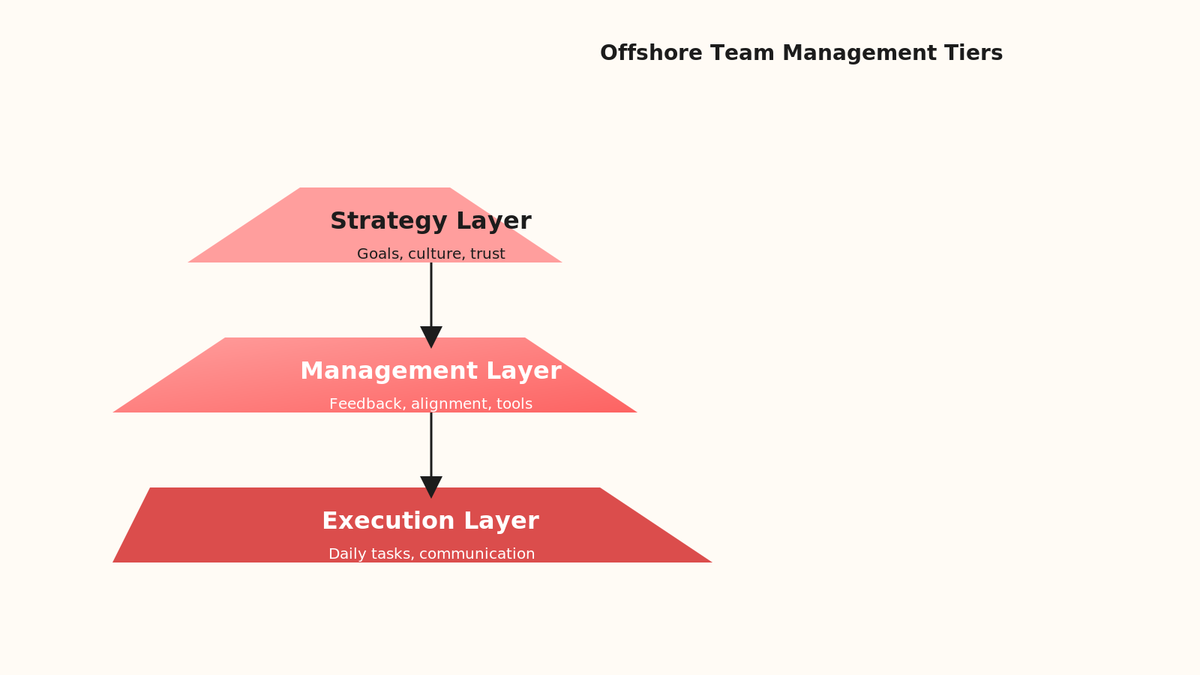
Q2. The Core Challenges of Managing Offshore (And Why They're Different)
Let's be direct. You can't walk to someone's desk. You can't read the room in a 30-minute brainstorm. You can't casually mentor someone in the hallway. Everything has to be deliberate, documented, explicit.
Communication breaks down at distance
Language nuance matters more when you're not face-to-face. A Slack message that sounds friendly to you might land as dismissive to someone 8 time zones away. Email misunderstandings spiral. The speed of clarification drops dramatically. You lose tone. You lose facial expressions. You lose the ambient awareness of how someone's day is going. This matters. It means the bar for clarity has to rise. Instructions that would be "good enough" in an office meeting have to be crystal clear in writing. Stories that you'd tell informally have to be documented. Context that floats in the air has to be made explicit and searchable.
"The biggest gap between remote and in-office work is the speed of context transfer. In an office, context flows. Remote, it has to be pushed."
— David Goggins, Remote Work Researcher Slack - G2 Reviews
Timezone math is relentless
If your onshore team is in New York and offshore is in India, you have a 10.5-hour gap. Real-time collaboration windows shrink to 1-2 hours of overlap. Decisions that would take 30 minutes in an office meeting now take days of back-and-forth. You either accept that friction, or you build async-first workflows. Most founders don't plan for this until it bites them. They schedule an 8 AM PT standup "to include India," and suddenly their India engineer is waking up at 8 PM their time. Do that every day for a month, and they quit. You have to think about fairness. You have to trade off. You have to build systems that don't require real-time presence to function well.
Trust has to be built differently
In-office trust is automatic: people see work happening, hear tone of voice, catch the quick wins. Offshore, everything is invisible until it ships. You might have someone who's delivering incredible work, but you don't know their day-to-day mood, motivation, or whether they're about to quit. Accountability works only if you instrument it deliberately. This means more frequent check-ins, more visible progress markers, more documentation of what people are doing and why. It sounds heavy. But done right, it's actually lighter than managing in-office because you're not managing presence, you're managing outcomes.
Culture is fragile at scale
When everyone was in one country, your company culture was written in the air. Shared references, inside jokes, expectations about how decisions happen. Offshore, culture is harder to transmit. New team members miss the context that makes your values real. They copy form without spirit. This is the silent killer. You'll have someone who technically meets all the job requirements, but they don't embody the ethos of your team because they weren't there to absorb it. The fix: you have to document and transmit culture explicitly. You can't rely on osmosis. You have to talk about values directly. You have to celebrate exemplars. You have to show what "good" looks like, not just in terms of code quality, but in terms of how you work together.
Q3. Build Communication Infrastructure Before You Hire
This is the most expensive mistake: hiring fast, then discovering your comms are broken. You end up re-working projects because instructions were unclear. People feel ignored because async updates get buried. Momentum dies.
Here's what works.
Establish a single source of truth
Pick ONE wiki/documentation tool (Notion, Confluence, GitHub Pages) and put everything there: company goals, onboarding docs, how decisions get made, project playbooks, even meeting notes. Make it searchable. Train people to document first, then discuss. This is not overhead; it's how you scale thought.
Use Slack (or equivalent) for real-time, Async updates for decisions
Slack is great for quick clarifications and team energy. But critical decisions should never live in Slack threads. They die there. Instead: big decision in Slack thread → 24-hour feedback window → documented decision posted to wiki → Slack link shared. This way, new hires can onboard by reading, not by asking.
Schedule overlaps ruthlessly
If you have India + US overlap, protect those 90 minutes. No meetings outside that window unless they're one-way recorded updates. During overlap, do all the hard conversations: alignment, feedback, negotiation. Outside overlap, async only.
| Tool Category | Best Tool | Use For |
| Real-time chat | Slack | Quick questions, daily standup links, team energy |
| Documentation | Notion or Confluence | Playbooks, onboarding, decisions, context |
| Video sync | Zoom or Google Meet | Weekly syncs during overlap, onboarding, 1-on-1s |
| Project tracking | Asana, Jira, Linear | Task ownership, deadline clarity, progress visibility |
| Async video | Loom | Recorded feedback, demos, complex instructions |
Q4. Onboarding Is Your Best Investment in Offshore Success
Fast onboarding pays dividends. A person who truly understands your product, your standards, and your culture in week 1 doesn't need as much management later. They ask smarter questions. They make fewer mistakes. They stick around.
Most companies spend 3 days on onboarding and then wonder why offshore teams underperform.
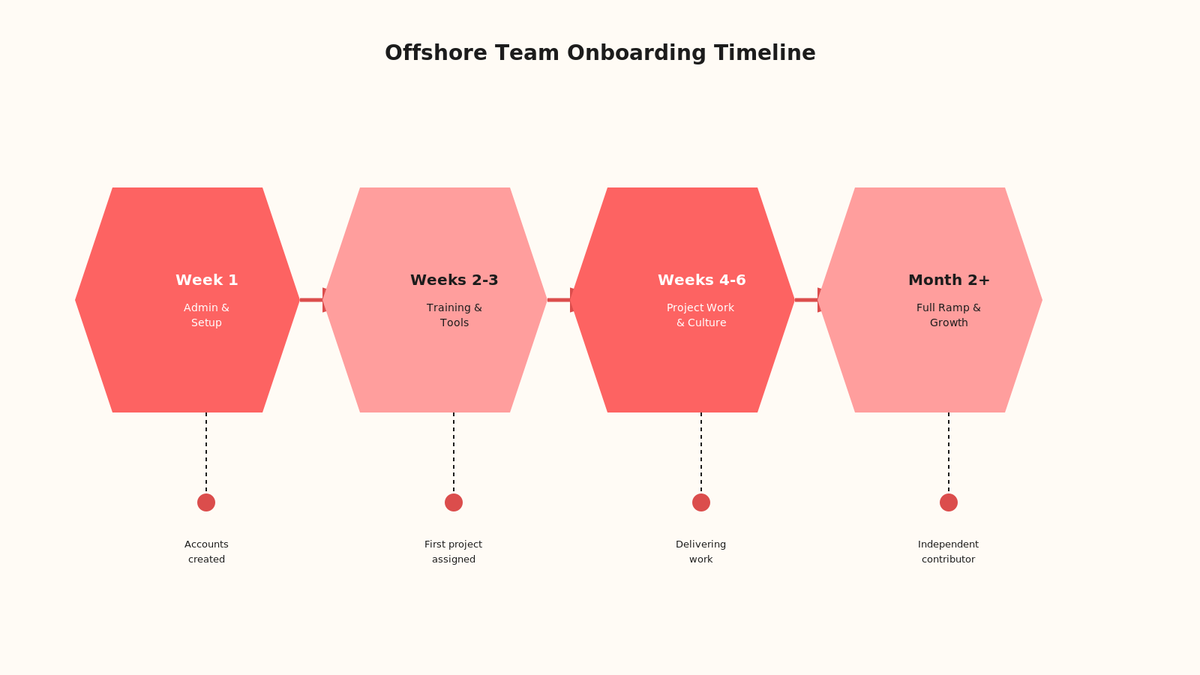
Week 1: Orientation and account setup
Days 1-2 are admin: laptop, VPN, email, Slack, product access, GitHub/Figma/whatever. This sounds boring, but it's not. You're setting the tone. You're showing they matter. Assign one person to be their "first week buddy." Have them send a Loom video saying welcome. Have the CEO send them a note. Make sure their laptop is ready on day 1 (not day 3). These small things compound. Day 3, they ship their first micro-task (even if it's documentation or a small refactor). The goal is momentum, not depth. By the end of week 1, they should know they can succeed here. They should have shipped something, even if it's small. They should leave day 5 knowing they're productive.
Weeks 2-4: Deep product and culture immersion
This is where you compress 3 months of gradual learning into 3 weeks. Pair them with your best senior for 2 hours daily (async or sync, depending on timezone). They read your entire product strategy doc. They sit in on customer calls (even just listening). They build their first real feature. By week 4, they're not a junior anymore; they're a real contributor.
"Ninety days of structured onboarding reduced our offshore ramp time by 40%. The cost of that training paid for itself in one quarter through fewer mistakes and faster shipping."
— Emma Martinez, VP People BambooHR - Capterra Reviews
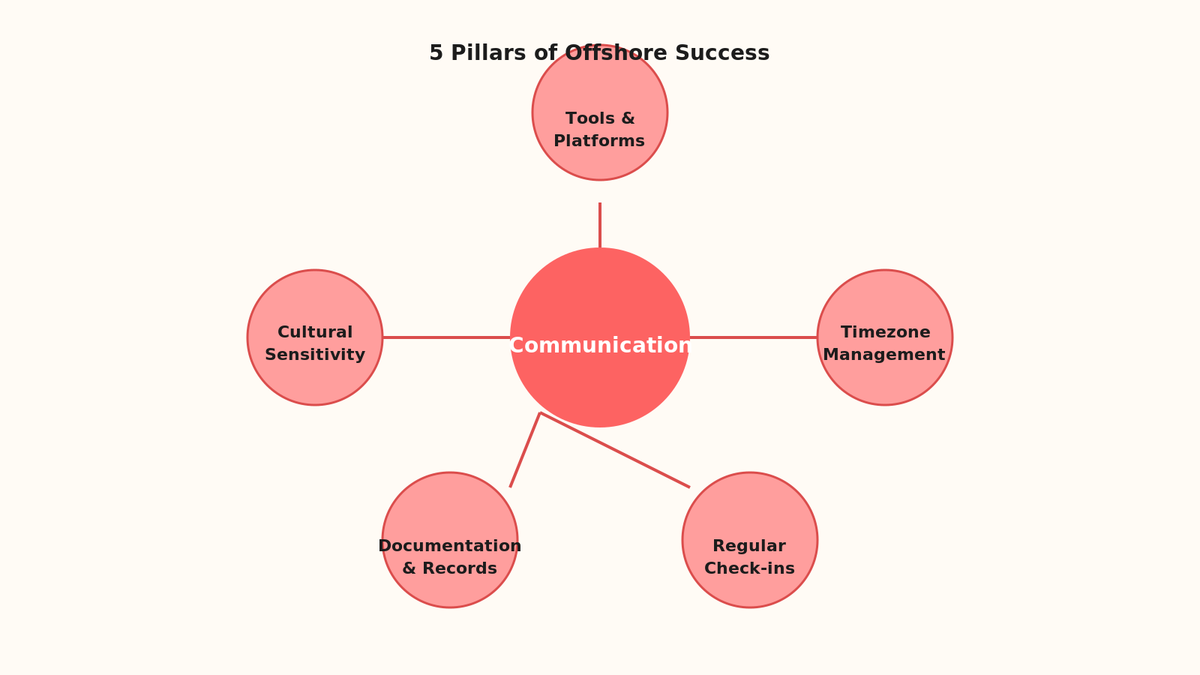
Q5. Timezone Coordination Without Burnout
Here's what doesn't work: expecting someone in Bangalore to join 6 AM calls. They'll burn out. You'll turn over people you've invested in training. I've seen it happen: company hires someone smart from Bangalore, ignores the timezone math, books them on 6 AM standups because "everyone needs to be together." By month 2, that person is wrecked. They're working 6-10 AM (their time) in standups, then they have their actual work 10 AM-5 PM, then they're checking Slack at night. They quit. Then the founder is surprised and thinks "offshore hiring doesn't work."
Here's what does work: Asynchronous-first, with scheduled overlap windows for high-bandwidth discussions. This is not a compromise. It's actually faster than real-time collaboration if you design it right. The key is that you're intentional about which conversations need to be synchronous and which don't.
Core hours and flexible boundaries
Define a 4-6 hour core window where everyone is expected to be available for urgent questions. Outside that, async only. Morning standup? Recorded Loom video that people watch during their commute. Sync with the whole team? Recorded Zoom session posted to Slack. The people who need to see it live will join; the rest watch async.
Timezone rotation for meeting load
If you have US + India + Europe, some meetings will be inconvenient for someone. Fair it: rotate who has to wake up early. Make sure no region consistently takes 6 AM slots.
Invest in asynchronous tools
GitHub PRs with detailed comments are async communication. Loom videos are async. Detailed spec documents are async. The people who say "we can't do this async" haven't tried. Almost everything can be (should be) async first. The exceptions are (a) crucial decisions that need immediate feedback, (b) complex troubleshooting where screen-share is faster, and (c) relationship-building.
Q6. Building Trust Across Distance
Trust doesn't happen by default offshore. You have to instrument it. In an office, trust is built through constant small interactions: you see someone solve a hard problem, you hear them admit when they're stuck, you watch them help a colleague. That ambient trust-building doesn't happen online. You have to create visible evidence that people are competent and cared for.
Make work visible before it's done
Don't wait for a PR. Have people post daily 15-minute Loom videos: "Here's what I shipped today. Here's what I'm stuck on." This sounds heavy, but it solves three problems: you catch issues early, the person feels heard, and async remote teams suddenly have high context.
Give feedback fast and specific
If someone ships work, review it within 24 hours. Say exactly what you liked and what to change. Vague feedback is demoralizing at distance. Specific feedback says "I'm paying attention."
Celebrate work publicly
When someone ships something great, call it out in Slack. Link to the PR or feature. Name the person. Remote people don't get hallway high-fives. They need deliberate recognition.
"Recognition is the biggest differentiator in offshore retention. People leave because they feel invisible, not because of pay."
— Rahul Joshi, Engineering Manager BambooHR - G2 Reviews
Q7. Culture and Alignment at Scale
Your culture is not a Slack bot that posts affirmations. It's the sum of decisions you make and the behaviors you reward.
Define decision-making explicitly
For each type of decision (tech choice, hiring, roadmap, when to ship), write down who decides, what information they need, and how dissent is handled. This isn't bureaucracy; it's clarity. Offshore people from different cultural backgrounds don't intuit your decision style. Tell them.
Host regular, recorded all-hands
Monthly: 30-minute update on what the company shipped, where revenue is coming from, what's next. Record it. Post slides to wiki. This is how distributed teams stay aligned. Offshore people need the same context as onshore people about the mission, or they default to "doing my job" instead of "shipping the product."
Invest in one in-person offsite per year
If you can afford it: bring the whole team together once a year for 3-4 days. People who've only known each other on Zoom suddenly trust each other 10x more. They exchange humor, context, and informal knowledge that you can't replicate async. The relationships that form pay dividends for a year.
| Activity | Frequency | Impact | Effort |
| Monthly all-hands | Monthly (30 min) | Alignment and mission clarity | Low |
| Weekly 1-on-1s | Weekly (30 min) | Personal connection and feedback | Medium |
| Quarterly business reviews | Quarterly (60 min) | Goal setting and transparency | Medium |
| Annual in-person offsite | Once yearly (3-4 days) | Deep team bonds and culture transmission | High |
Q8. Performance Management for Distributed Teams
You can't manage what you can't measure. And you can't measure based on "looking busy." You need KPIs.
Define output, not hours
Hours don't matter. Shipped features, bug fixes, completed projects, code quality: these matter. Define 3-5 KPIs per person at the start of each quarter. Review them weekly in async updates, formally in 1-on-1s. This is especially important offshore: you're measuring what they produce, not whether they're at their desk.
Implement regular feedback cycles
Monthly: quick check-in on KPIs and morale. Quarterly: deeper review with feedback on strengths and growth areas. Annually: full performance review with compensation adjustments. The cadence keeps you from surprises and gives people clarity on how they're doing.
Be willing to adapt
Every person is different. Some people thrive with autonomy; some need more structure. Some love async; some want syncs. After month 1, you should know which bucket someone falls into. Adjust their cadence accordingly. The person who delivers great work with 2 weekly syncs shouldn't be forced into daily standups.
Q9. Technology That Actually Scales Offshore Teams
You don't need fancy tools. You need the right five.
Project management: Asana, Jira, or Linear
Pick one. Use it for everything: sprints, roadmap, individual tasks, dependencies. Offshore people should never have to ask "what should I do today?" It should be in your project tool with clear acceptance criteria. When someone finishes a task, the next person sees it's done and can pull the next one. This is your system of record for work.
"Asana helped us scale from 5 to 25 engineers remotely without adding management overhead. The visibility alone was worth it."
— Priya Patel, Head of Engineering Asana - G2 Reviews
"When we switched to async-first communication tools, our velocity actually increased by 20%. Turns out, less meeting time means more shipping time."
— Marcus Lee, CTO Notion - G2 Reviews
Documentation: Notion or Confluence
Everything that isn't a sprint task lives here: onboarding playbooks, API docs, decision logs, customer context, architecture diagrams. Tag everything. Make it searchable. When a new person joins, 80% of their questions should be answerable by search.
Async video feedback: Loom
For complex reviews (design, architecture, UX), screen-recording with voiceover is 10x faster than written feedback. You can point and say "here's what I mean." Offshore developers get context instantly instead of guessing.
Synchronous comms: Slack or Discord
Use it for async questions and daily standups. Don't use it for decisions-they disappear. Don't use it for onboarding-nothing's searchable later. Use it for "quick question" and "team vibes."
GitHub (or equivalent) with strong code review culture
PRs are async code review. They're how you catch bugs, enforce standards, and document decisions. Make your code review thorough and kind. That's how a 23-year-old in Bangalore learns your standards without you explaining it 50 times.
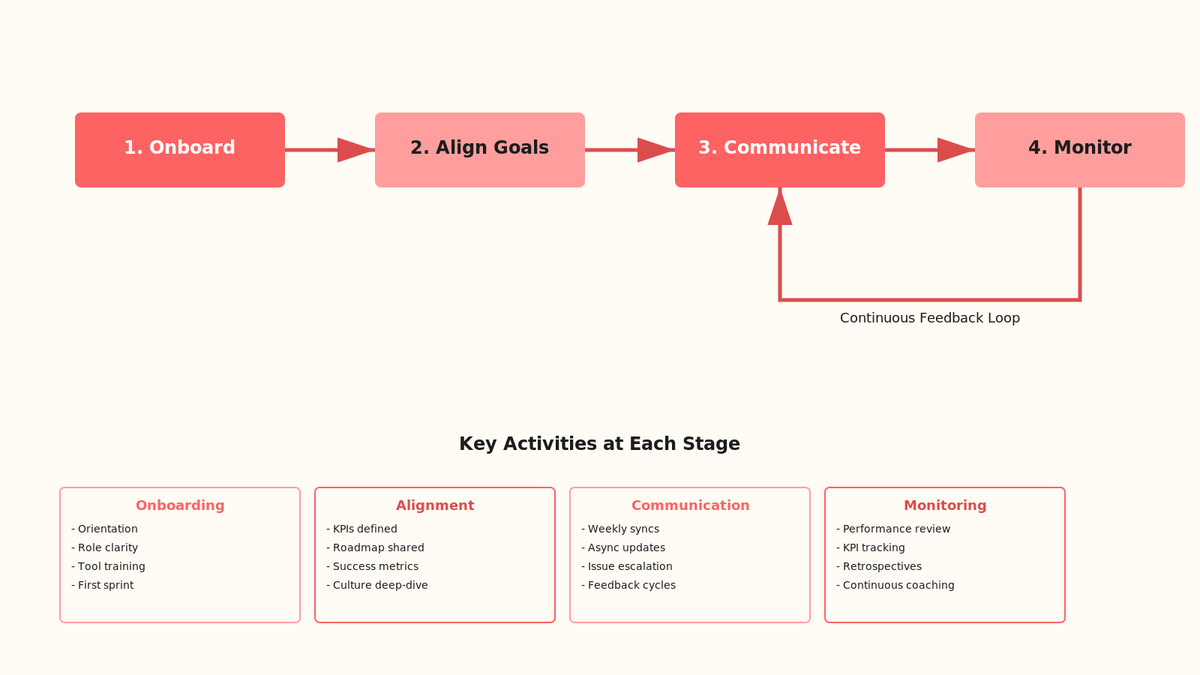
Q10. Cost Structure and When Offshore Makes Sense
Let's talk money. Offshore is cheaper, but not free. You have costs that don't show up in salary.
Direct salary savings are real but modest
An engineer in San Francisco costs $150K-$200K all-in. An engineer in India with similar skills costs $30K-$50K all-in. That's a 70-80% savings. But if you ship 30% slower because of timezone friction and rework, you've only saved 40-50%. You need to plan for that friction cost.
Manager time is higher
Offshore teams need more deliberate management. You're documenting more, explaining more, checking in more. Your manager-to-IC ratio might be 1:5 instead of 1:8. Budget for that.
Onboarding and turnover cost real money
A bad hire offshore is expensive to discover and exit. A good hire offshore is expensive to onboard. Budget 3-4 months for ramping someone to full productivity. If they leave at month 8, you've invested 3 months and gotten 5 months back-not great.
| Cost Component | San Francisco | India (Top Talent) | Savings |
| Salary | $180,000 | $40,000 | 78% |
| Benefits + taxes + payroll | $50,000 | $8,000 | 84% |
| Manager overhead (allocated) | $5,000 | $8,000 | -60% |
| Productivity factor | 100% | 85% (timezone/comms tax) | -15% |
| Effective cost per unit output | $235,000 | $67,000 | 71% |
Q11. Compliance and EOR: Why This Matters If You're Scaling Offshore
Here's the piece most founders miss: if you hire 15 people in India, you technically need a legal entity there to be compliant. Employment law in India is strict. Payroll withholding, provident fund contributions, gratuity-these aren't optional.
Some founders hire as contractors to avoid this. That works until it doesn't. You get an audit, or someone claims they should have been an employee, and you're liable for back taxes and penalties. Not fun.
The alternative: partner with an India-native Employer of Record (EOR) that has a legal entity in India and takes on the employment liability. Versatile is one such option if you're hiring India talent; they handle the compliance, payroll, and benefits. You pay a small fee (typically 3-5% of payroll) and get peace of mind.
This matters because:
- You stay legally compliant from day 1 (not discovering issues at month 12)
- Your people get proper benefits (pension, health insurance)
- You can hire full-time, not just contractors, which changes team stability
If you're scaling India teams, Versatile's EOR services handle the legal compliance piece, so you can focus on team management.
Q12. Troubleshooting Common Offshore Failures
You've built the systems. But something's still wrong. Let's diagnose.
Issue: People are shipping slow code
Root cause: weak code review, or people don't understand your standards. Fix: spend time on the first 5 PRs from each new person. Show them what "good" looks like in your codebase. Don't just reject-explain. Create a doc of style principles. This sounds slow; it's actually fast because it prevents months of rework.
Issue: High turnover
Root cause: people feel invisible or undervalued. Fix: structured feedback, visible recognition, clear growth path. Show them how their work shipped to customers. Tell them how they're progressing. If they don't see a path to being better in 6 months, they'll leave.
Issue: Timezone overlap is killing your US team
Root cause: you haven't drawn the line on core hours. Fix: define a 2-hour window, no exceptions. Anything outside that is async. This might mean your US team doesn't have a full 40-hour week of overlap-that's okay. Async-first design is actually faster if you document well.
Issue: You can't explain what you want; work is always getting reworked
Root cause: you haven't invested in specs and documentation. Fix: Specs don't need to be 20 pages. But they need to answer: "What problem does this solve?" "How do I know it's done?" "What do I do when X happens?" That clarity eliminates 90% of rework.
FAQs
How long does it take for an offshore team member to reach full productivity?
Plan for 3-4 months. Week 1 is orientation. Weeks 2-4 are deep learning while delivering small tasks. Months 2-3, they're ramping to full speed on real work. By month 4, they should be 90%+ as productive as a senior. If it's taking longer, there's a training or management issue.
Can you manage offshore teams with only async communication?
Almost entirely, yes. The key is documenting obsessively and defining async workflows for every type of decision. You'll need maybe 2 hours of sync per week for critical calls; the rest should be async. Most teams find this actually makes them faster because everything is intentional.
What's the biggest mistake founders make with offshore teams?
Hiring fast without investing in onboarding. Then blaming the offshore team for being "slow" when really, nobody trained them properly. Good onboarding costs 3-4 weeks of manager time upfront but pays back in 6-12 months of smooth sailing.
How do you handle performance issues with offshore team members?
Same as onshore: document the gap, give clear feedback, provide a path to improve, and set a timeline. The only difference is you might do it more async (Loom videos, detailed Slack threads) than you would in-person. But the standard should be the same.
Is hiring offshore from India legally risky?
Only if you ignore compliance. Direct hire or contractor as "independent" without a legal entity? Risk. But partner with an India-native EOR like Versatile, and the liability is theirs. They handle payroll, withholding, benefits, gratuity. You pay a flat fee and have peace of mind. This is the standard way to do it responsibly at scale.
What should I pay an offshore engineer in India?
Depends on skill level. Senior engineers (8+ years): $35K-$50K. Mid-level (4-7 years): $20K-$35K. Junior (0-3 years): $10K-$18K. These are all-in (salary + taxes + benefits). Offer competitive pay within that range. The people you want will otherwise go work for faster-growing startups.
How do I know if someone is actually working 8 hours a day across timezones?
Stop thinking about hours. Think about output. If someone shipped 5 solid PRs and closed 12 tickets this week, they worked enough. If they shipped 2 half-baked PRs and nothing's closed, they didn't. Measure what gets done, not when they're online. This also makes offshore teams happier-they have autonomy over their schedule as long as output is solid.
Where my head is right now
The offshore team model is not going away. It's the future of how companies scale efficiently. The founders winning right now aren't the ones who got lucky with hiring; they're the ones who invested in systems: clarity, documentation, timezone coordination, and deliberate onboarding. They treat offshore team management as a craft, not an afterthought.
If you're thinking about scaling via offshore-whether it's India, Eastern Europe, or anywhere else-the core playbook is the same: communicate clearly, document relentlessly, onboard thoroughly, and measure output not hours. If you're specifically considering India talent, Versatile handles the complexity of India-native EOR and compliance so you can focus on building.
What's your biggest obstacle right now with offshore scaling? Message me directly on WhatsApp through our contact page, or book a 30-minute consultation here. Let's work through it together.