Table of contents (11)
How to Hire in India Without Setting Up an Entity: Paths, Costs, and Trade-Offs
Q1. Can you legally hire in India without setting up an entity, and how does it actually work?
Yes, but not directly. A foreign company cannot legally put an Indian employee on its own payroll without a local presence. The two compliant routes are an Employer of Record (a licensed Indian entity that becomes the legal employer, runs INR payroll, and files PF, ESI, and TDS under its own registrations) or engaging genuine independent contractors. The EOR carries the statutory liability. You choose the person and direct the work.
🎯 The 30-day scramble I see every month
A US founder pings me on WhatsApp. She just closed her Series A. She needs three backend engineers in Bengaluru live in 30 days. Her lawyer quoted 12 to 18 months and heavy capital to open an Indian subsidiary.
She asks the real question underneath: "Am I kinda running with scissors here?" She has heard she can just pay someone as a contractor. She is right to be nervous. That path carries roughly $25,000 to $40,000 in back-pay exposure per head if the person is really an employee.
🧩 What an Employer of Record actually does
An Employer of Record (EOR) is a company that already holds Indian employment registrations and becomes the legal, on-paper employer of your hire. Think of it as a suspension bridge across the river. You do not always need to build the Golden Gate, which is your own entity, when a simpler bridge gets you across. Our EOR services in India are built exactly for this crossing.
The EOR signs the compliant contract, pays salary in Indian rupees, deposits Provident Fund (PF, India's retirement contribution) and Employees' State Insurance (ESI, India's health cover), and files Tax Deducted at Source (TDS, India's payroll withholding). You still pick the person, set their work, and manage them daily. The EOR holds the statutory liability. You hold the relationship. If you prefer autonomous project work instead, a Contractor of Record arrangement is the other compliant option.
✅ One real hire, start to finish
Say you want a senior engineer in Bengaluru. We sign her under our registered Indian entity. Her salary lands in INR. Her PF and ESI file under our numbers, not yours. From your side, you gave an offer and got a working teammate. No subsidiary. No 18-month wait. You can see the full sequence on our how it works page.
At Versatile, we own that Indian entity outright. Foo Falcon Technologies Pvt Ltd is a real registered company, not a reseller or an aggregator shell. Your employee's PF, ESI, TDS, and professional tax filings sit under our own registrations. That is the part most buyers skip past, and it is the part that decides who holds the bag in an audit. Where this gets expensive, and how misclassification quietly bites, is what I will unpack next.
Q2. What are your real paths to hire in India, EOR, contractor, or entity?
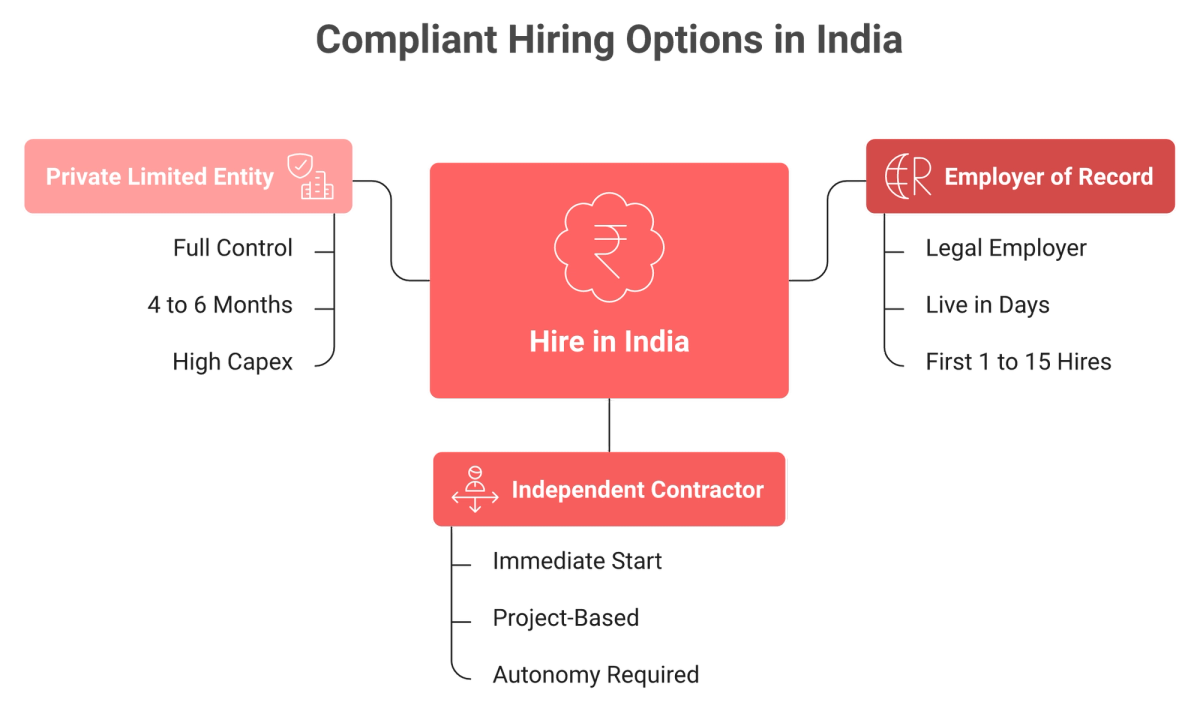
You have three paths. An Employer of Record makes a licensed Indian company the legal employer while the person works for you, live in days, no entity needed. Independent contractors suit genuinely project-based, autonomous work only. A private limited entity gives full control but takes 4 to 6 months and heavy capex. Note that US-style co-employment PEO does not legally exist in India. If you lack a subsidiary, you legally need an EOR, not a PEO.
🗺️ The three doors, side by side
Most founders think there are five options. There are three. Here is how they actually compare. If you want to model the numbers yourself, our EOR vs Entity Calculator runs the math for you.
| Path | Setup time | Setup cost | Best for | Key risk |
|---|---|---|---|---|
| Employer of Record | Days to a week | None | First 1 to 15 hires, fast | Vendor quality varies |
| Independent contractor | Immediate | None | True project work, autonomy | Misclassification back-pay |
| Private limited entity | 4 to 6 months | High capex | 15+ hires, long horizon | Slow, cash-heavy |
⚠️ The contractor trap and the PEO myth
The contractor route looks free. It is not. If your "contractor" works fixed hours, uses your tools, and reports to your manager, Indian law treats them as an employee. That is misclassification, and the exposure runs $25,000 to $40,000 per head.
Here is a myth I correct weekly. US-style co-employment PEO does not legally exist under Indian labor law. Buyers search "PEO India" and assume it maps to what they used back home. It does not. A PEO model in India only works once you already own a registered subsidiary. Without one, you legally need an EOR.
📈 The 10-to-12 hire tipping point
I could be off on the exact number for your business, but from what surfaces across the placements we have run, the switch happens around 10 to 12 hires. Below that, an EOR wins on speed and cash. Above it, your own entity starts to pencil out. For a deeper breakdown, see our guide on EOR vs entity in India.
The smart move is not picking one door forever. It is picking a partner who walks you through all three. At Versatile, we started as a Contract-to-Hire business, so we can carry you from your first EOR hire through to migrating your team into your own entity later, without switching vendors mid-flight. What that costs, in real rupees and dollars, is next.
Q3. What does it really cost to hire in India without an entity?
Budget three layers: the EOR fee (roughly $99 to $399 a month with India-native providers, $499 to $699 with global platforms), the employee's base salary in INR, and a statutory loading of about 20 to 25% on top (PF at 12%, ESI, gratuity at 4.81% of Basic+DA, professional tax). There is no entity setup cost and no 4-to-6 month wait. Even fully loaded, a senior Bengaluru engineer runs far below a San Francisco equivalent, but cheap should never be your reason.
💰 The three-layer cost stack
CFOs ask me one thing first: what is the all-in number? Here is the honest breakdown. Our pricing page lays out every layer without a "from" asterisk.
| Cost layer | What it is | Typical range |
|---|---|---|
| EOR fee | Monthly service charge | $99 to $399 India-native; $499 to $699 global |
| Base salary | Paid in INR | Role-dependent |
| Statutory loading | PF, ESI, gratuity, PT | ~20 to 25% of salary |
Provident Fund runs 12% of Basic+DA. Gratuity accrues from month one at 4.81% of Basic+DA. ESI and professional tax add smaller slices. These are not optional add-ons. They are law. Our Employer of Record India cost guide breaks each line down.
📊 The savings are real, but read the fine print
A senior software engineer runs about $58,000 all-in in Bengaluru versus roughly $220,000 in San Francisco. That is around $162,000 saved per role, per year. Big number. But watch the leaks.
Global platforms often add a 3 to 5% FX markup on every payroll, which quietly drags your true cost up. Employees feel it too.
"I find Deel to be absurdly expensive. They charge a high amount of fees for transferring money to my bank account."
Juan Camilo O. Deel G2 Verified Review
"There are hidden fees. Of course, again, also here. You will never get your net-agreed salary through Deel."
İbrahim Deel G2 Verified Review
🧭 Cheap is not the pitch
I will say the quiet part out loud. We never advocate going to India because it is cheap. That is not what we promote, in any way, shape, or form. You go to India for highly academically intelligent people who ship. The savings are a byproduct, not the reason.
At Versatile, we invoice you in USD directly from our single Indian entity, with no FX markup, no setup fees, no exit fees, and the first month free. Compare that to a competitor whose pricing is published only as a "from $99" range, where actual per-tier pricing for different salary bands is not fully transparent. Transparency is cheaper than a surprise. If you are weighing platforms, our Deel alternative page shows the difference side by side. The rules behind these numbers, and the 2026 changes most blogs missed, come next.
Q4. Which statutory contributions and 2026 rule changes will trip you up?
The rules changed recently, and most content is stale. Under the Labour Codes (in force since 21 November 2025), Basic + DA must be at least 50% of total CTC, which reshapes salary stacks legacy payroll gets wrong. From FY 2026-27, Form 16 is replaced by Form 130 under the Income-tax Act, 2025. TDS is due by the 7th monthly, professional tax varies by state, and employee PII is now regulated under the DPDP Rules 2025.
⚠️ Why most India hiring blogs are now wrong
India's four Labour Codes came into force on 21 November 2025. A lot of content still describes the old system. If you are reading a 2024 guide, assume parts of it are stale. Our compliance hub tracks each change as it lands.
I could be wrong on how fast every state catches up, but the core federal shift is live now. Here is what changed that touches your payroll directly.
💰 The 50% wage rule, with the math
Under the new wage definition, Basic + DA must be at least 50% of total CTC. Legacy payroll systems get this wrong, because old Indian salary stacks loaded pay into allowances to cut PF cost.
Here is the worked effect. On a ₹20,00,000 CTC, at least ₹10,00,000 must count as wages. That larger wage base lifts PF, gratuity, and ESI accruals. Your true cost per hire goes up if your provider does not restructure the offer correctly. Our payroll compliance in India guide shows a full worked example.
⏰ Rates and deadlines you cannot miss
| Item | Rate / rule | Deadline |
|---|---|---|
| Provident Fund | 12% of Basic+DA | Monthly |
| ESI | 3.25% employer, 0.75% employee | Monthly |
| Gratuity | 4.81% of Basic+DA, accrues month one | On accrual |
| TDS | Per income slab | Deposited by 7th monthly |
From FY 2026-27, the old Form 16 is replaced by Form 130 under the Income-tax Act, 2025, which came into force on 1 April 2026. If your provider still says "Form 16," that is a freshness flag. Our managed payroll service issues the current forms by default.
🗺️ State rules do not match each other
Professional tax is not one national rule. Maharashtra needs dual registration, PTRC plus PTEC, with monthly slab filing. Telangana needs PTRC enrollment with its own remittance deadlines. Delhi levies no professional tax at all, but enforces its Shops and Establishments Act strictly.
There is one more 2026 layer. Employee personal data is now regulated under the Digital Personal Data Protection Rules, 2025, notified on 13 November 2025. Handling your Bengaluru engineer's PII now carries real obligations.
"The initial documentation and paperwork felt quite detailed. This thoroughness is what ensures proper legal and compliance coverage."
Verified User in Marketing and Advertising Wisemonk G2 Verified Review
At Versatile, we carry PF, ESIC, and Shops and Establishments registrations across all 28 states and 8 union territories, and we file these under our own registrations, not a partner's. The honest question to ask any global platform covering 150 countries is simple: can they keep pace with a mid-year Indian rule change, or does India sit thin on a very wide map? For teams that need this depth from day one, our startup EOR service handles every state filing. Whether the hire actually stays, beyond the paperwork, is where I will go next.
Q5. How do you pay employees and part ways compliantly in India?
Two rules surprise most foreign employers. First, salaries must be paid in INR, so you cannot run USD payroll for an Indian employee, which means FX and the currency spread matter. Second, India is not at-will. Termination requires notice (typically 30 to 90 days or pay in lieu), documented cause, and a full-and-final settlement covering dues and gratuity, with new codes tightening settlement timelines. An EOR handles both under its own registrations.
💸 You pay in dollars, they get paid in rupees
Here is the rule that trips up almost every first-time founder. Your Indian employee must be paid in Indian rupees, into an Indian bank account, under FEMA (Foreign Exchange Management Act, India's cross-border money law). Our guide on how to pay employees in India walks through the mechanics.
You cannot wire USD to their personal account and call it salary. So somewhere, dollars become rupees, and someone takes a cut on that conversion. Global platforms often bake in a 3 to 5% FX markup on every cycle. Employees notice.
"I find Deel to be absurdly expensive. They charge a high amount of fees for transferring money to my bank account."
Juan Camilo O. Deel G2 Verified Review
⚠️ India is not at-will, so you cannot just fire
In the US, at-will means you can end most jobs any day. India does not work that way. Termination needs a documented reason, a notice period (usually 30 to 90 days) or pay in lieu, and a proper exit.
Then comes full-and-final settlement (F&F), the closing payout of pending salary, leave, and gratuity. Gratuity is a legal end-of-service benefit accruing at 4.81% of Basic+DA from month one. The 2025 Labour Codes tightened how fast you must clear these dues. Our managed payroll team runs every exit to the letter.
✅ Why this feels non-negotiable to your hire
I have a phrase I keep coming back to. Your engineer may go to work in a facsimile of the West, but she goes home every night to India. Her PF and gratuity are not perks to her. They are her family's safety net.
Get the exit wrong, and word travels fast in Bengaluru's engineering circles. At Versatile, we invoice you in USD from our own Indian entity, pay your employee in INR with no FX markup, and run compliant exits and F&F under our registrations, part of our end-to-end EOR services in India. You see one clean dollar number. Your teammate sees a fair, on-time rupee payout. Next, the risk hiding underneath all of this: Permanent Establishment.
Q6. What is Permanent Establishment risk, and how does an EOR shield you?
Permanent Establishment risk is when your India activity, especially staff who can conclude contracts for your foreign parent, creates a taxable presence subject to Indian corporate tax. Misclassification is the sibling risk: treating a de facto employee as a contractor, which can trigger $25,000 to $40,000 in back-pay exposure per head. A correctly structured EOR, where the EOR is the legal employer and your staff hold no contract-signing authority, mitigates both.
🎯 The two words that scare CFOs
Let me define the fear plainly. Permanent Establishment (PE) is when your activity in India looks enough like a real business presence that India can tax your foreign company there.
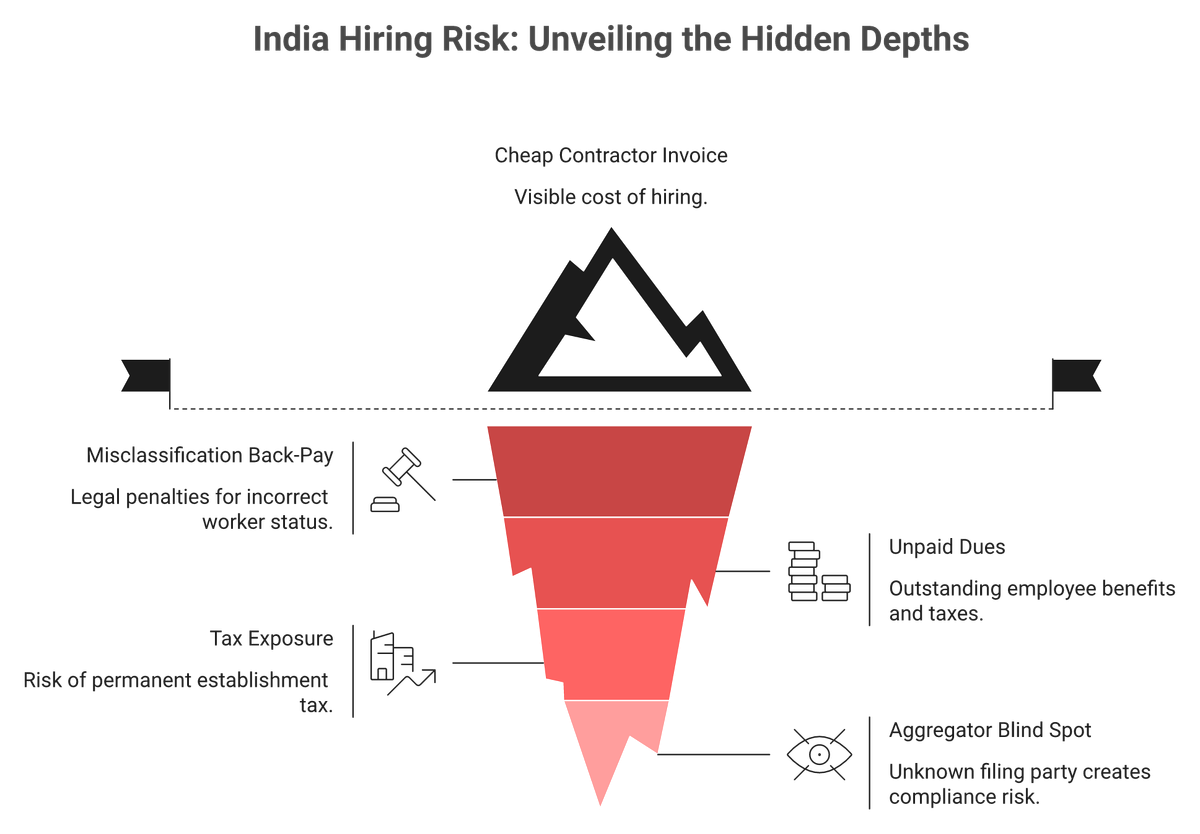
The trigger most people miss is contract authority. If your India-based lead can sign deals for your US parent, you may have created a taxable footprint you never intended. That is a corporate tax problem, not just a payroll one. Our compliance team structures around exactly this.
💸 The misclassification trap and who holds the bag
Its sibling is misclassification. You hire a "contractor," but they work full-time hours, use your systems, and report to your manager. Indian law calls that an employee, and the back-pay exposure runs $25,000 to $40,000 per head. Our breakdown of independent contractor vs EOR shows where the line sits.
This is where the "global" shortcut bites. Many platforms route India through an anonymous local partner entity you never see. If something breaks, you are the one running with scissors, holding a liability you did not know you signed up for.
✅ How an owned-entity EOR shields you
A properly structured EOR fixes both risks at the root. The EOR becomes the legal employer, so the employment relationship sits with it, not your parent. Your India staff hold no contract-signing power for your foreign company, which keeps PE risk contained.
The word "structured" is doing heavy lifting there, and I want to be honest about it. An aggregator model adds a mystery layer between you and the filings. At Versatile, we own the Indian entity, and PF, ESI, TDS, and professional tax file under our own registrations, which is the audit-ready control CFOs actually ask me for. You can see the full mechanism on our how it works page.
⭐ One small signal that changes everything
A US manager once told me her Indian teammate messaged her before taking his dinner break, asking if it was okay. She said it was not necessary. He insisted, "because I'm your subordinate."
That instinct is a tell. That is an employment relationship, not a vendor one. Ignore the signal, call him a contractor, and you have quietly built the exact exposure this whole section warns about. Now, how does an India-only EOR stack up against the global giants?
Q7. EOR vs global platforms, is India-deep better than 150-country wide?
It depends on what you are optimizing for. Global platforms (Deel, Remote, G-P) win when you are hiring across 20+ countries and want one dashboard, but most run India through local partner entities, spread India expertise thin, and add a 3 to 5% FX markup. India-native EORs own their entity, file under their own registrations, and go deeper on state-level compliance. If India is your only or primary market, depth beats breadth.
🗺️ Breadth versus depth, decided honestly
Think of it like cloud regions. A global provider covers everywhere, but no single region gets full attention. An India-only EOR is like a provider that runs one region with obsessive depth. Our best EOR in India guide compares the field.
Global platforms cover 90 to 150 countries and spread their India expertise thin. Most use local partner entities in India. We do not. India is the only country we operate in.
📊 The side-by-side
| Factor | Versatile | Wisemonk | Deel | Remote |
|---|---|---|---|---|
| Owns India entity | ✅ Yes | ✅ Yes | ❌ Partner-routed | ❌ Partner-routed |
| India compliance depth | ✅ Multi-state, own filings | ✅ India-native | ❌ Thin at state level | ❌ Thin at state level |
| FX markup | ✅ None | ✅ Low | ❌ 3 to 5% | ❌ Reported markup |
| Pricing transparency | ✅ Flat, published | ❌ "from $99" only | ✅ Published, high | ✅ Published, high |
| Support model | ✅ Founder on WhatsApp | ❌ No founder-direct | ❌ Chatbot-first | ❌ Ticket queue |
The support gap is not theoretical. It shows up in reviews.
"Support is the single biggest failure. There is no direct phone line. You either email or use a chatbot, and you can ask both the same question and get two different wrong answers."
Erika D. Rippling G2 Verified Review
"Often the CS doesn't seem to have answers, something I was looking for the answer to in 20 minutes becomes a 4 day process."
Verified User in Computer Software Deel G2 Verified Review
⚠️ When the global player is the right call
I will argue against myself here, because it matters. If you are hiring across 20-plus countries and want one dashboard, a global platform genuinely wins. Same if you are an enterprise 100-plus India team that needs SOC 2 or ISO 27001 as a hard procurement gate.
That is our documented Anti-ICP, and I would rather tell you than sell you. But if India is your only or primary market, depth wins. At Versatile, that depth is the product: owned entity, own registrations, transparent USD, and me on WhatsApp. If you are weighing us against the incumbents, our Deel alternative and Wisemonk alternative pages lay it out. What that gets you on day one is speed, which is next.
Q8. How fast can you actually onboard your first India hire?
With an EOR you can go from signed agreement to a live, paid employee in days, not the 4 to 6 months an entity demands. A credible provider commits to this contractually. Versatile runs a 5-day onboarding SLA, meaning payroll-live within five business days of a signed agreement, not a vague "fast onboarding" promise. The bottleneck is rarely compliance. It is usually document collection and offer alignment.
⏰ Days, not months, and the word that matters
Speed is the whole reason founders skip the entity route. But "fast" is a slippery word. A service-level agreement (SLA, a written, binding commitment) is different from a hopeful estimate. Our EOR services put that commitment in writing.
Many global platforms quote 7 to 14 days, and reality often runs longer. One buyer reported three months to onboard just three people.
"It took three months to onboard our first 3 individuals. They didn't seem to be able to navigate Visas or variations to employment contracts."
Verified User in IT and Services Deel G2 Verified Review
✅ The five-day path, step by step
Here is how a clean onboarding actually runs:
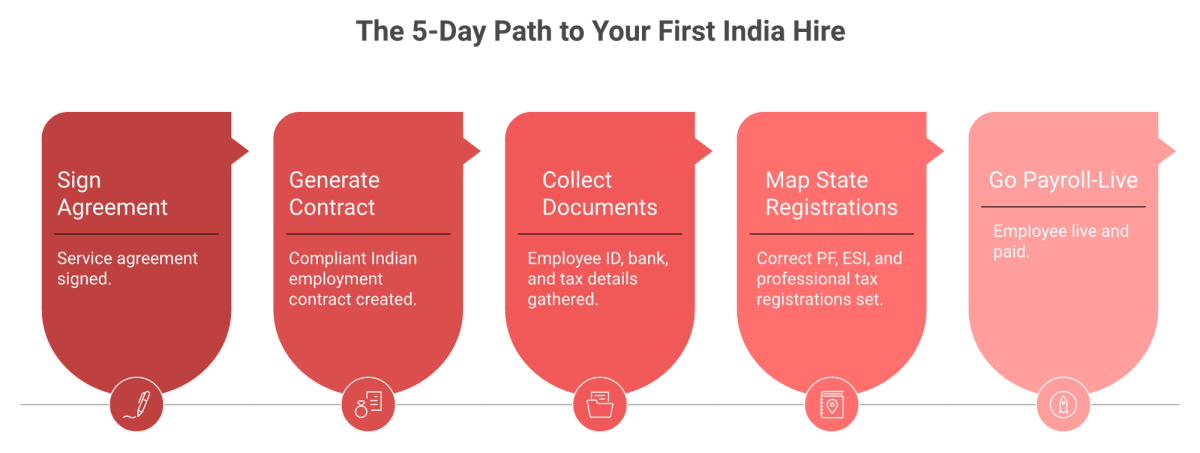
- Sign the service agreement.
- Generate a compliant Indian employment contract.
- Collect employee documents (ID, bank, tax).
- Map the correct state registrations (PF, ESI, PT).
- Go payroll-live.
The compliance rarely stalls this. Document collection and offer alignment do. So chase those early. If you already have a candidate in mind, our startup hiring service moves fast.
💬 What a contractual SLA really protects
At Versatile, the 5-day SLA is contractual, not aspirational, so a slow week is our problem to fix, not yours to absorb. And when something wobbles, you WhatsApp me directly, not a ticket queue that answers in four days. You can start that conversation on our contact page.
One practical tip from running this across Bengaluru, Hyderabad, and Pune: at the end of every onboarding call, recap the key points in writing, and ask open questions like "where are we on documents?" instead of "are we on track?" It surfaces silent delays before they eat your start date. Next, the part paperwork cannot fix: making the hire actually stay.
Q9. Beyond compliance, how do you make sure the hire actually stays?
Compliance is the floor, not the ceiling. A legally-perfect hire who quits in month three still costs you the roadmap. In India, nearly 30% of IT-sector resumes contain discrepancies, so vetting and culture-fit matter as much as payroll. Providers who solve the "good hire who stays" problem screen for behavior, coach through the first 90 days, and stand behind the placement with a replacement guarantee, not just a compliant contract.
🎯 Most EOR buyers optimize for the wrong thing
The standard read gets this backwards. Everyone shops for the cleanest compliance and the lowest fee. Then they act shocked when a legally perfect hire ghosts them in month three.
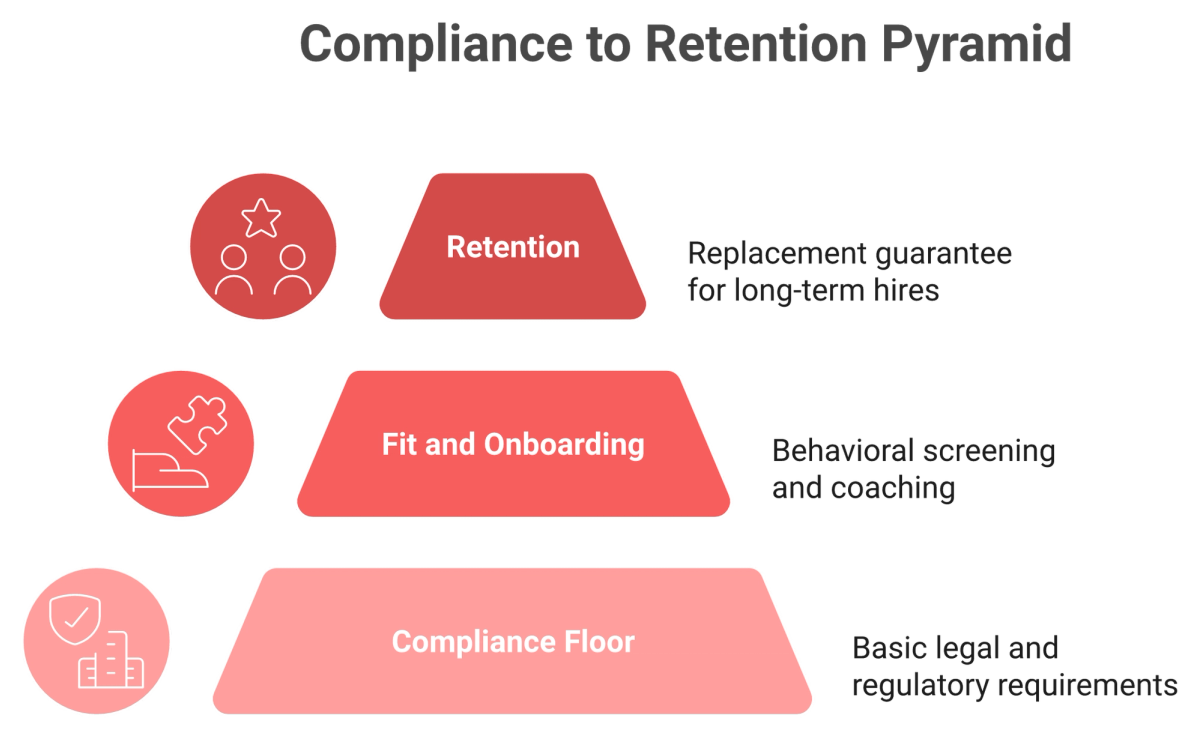
A compliant contract is table stakes. It does not keep anyone. What you actually want is a good hire who stays, not a legal hire on paper. Our recruitment process screens for exactly that.
⚠️ Why the risk is higher than you think
Here is a number that should change how you vet. Nearly 30% of IT-sector resumes in India contain discrepancies. From what surfaces when you actually run placements, the gap is rarely outright lying. It is inflated scope and borrowed credit.
Compliance-first EORs do nothing about this. They file your PF and ESI perfectly, then hand you a stranger. The payroll is right. The person may be wrong. Our culture-fit quiz is one way we catch that mismatch early.
✅ What a retention-first model looks like
This is the wedge I care most about. At Versatile, we screen for culture-fit using 50 behavioral parameters, run a 90-day Success Coach for every placement, and back it with a 6-month replacement guarantee. On our Contract-to-Hire work, you pay only after the hire completes day 90.
Compare that to the direct India-native alternatives. Wisemonk runs a solid, India-native EOR, yet publishes no replacement guarantee, no structured 90-day coaching, and no founder-direct support model. Support-team size can also stretch response times, which is worth weighing against our Wisemonk alternative model.
"I've noticed that their support/query responses can occasionally take a bit longer sometimes, likely due to a relatively small team."
Verified User in Financial Services Wisemonk G2 Verified Review
⭐ The signal paperwork never catches
A US founder once told me her Bengaluru team went silent when a senior colleague emailed them directly. They froze, unsure why someone that senior would reach past their manager. India scores 77 on Power Distance versus 40 for the US, so hierarchy lands differently.
That freeze is not a compliance failure. It is a fit-and-management failure, and it quietly drives attrition. The question I am sitting with lately is simple: what if retention, not compliance, becomes the real EOR moat? Tell me where your last India hire wobbled, and I will tell you what I would screen for. Our HR consulting services exist for exactly these conversations.
Q10. When should you switch from an EOR to your own Indian entity?
Stay on an EOR while proving the market or hiring your first 1 to 12 people. Consider your own entity once you cross roughly 10 to 12 India hires, when monthly EOR fees start to rival the fixed cost of a subsidiary. The smart move is choosing an EOR that can migrate your team into your own entity later, so growing does not mean re-papering everyone or switching vendors mid-flight.
📊 The break-even, stated plainly
Let me give you the threshold first, because CFOs want the number. The tipping point sits around 10 to 12 hires. Some benchmarks push the pure cost break-even higher, toward 30 to 40 employees. Run your own numbers on our EOR vs Entity Calculator.
Below that band, an EOR wins on speed and cash. Above it, a private limited entity (your own registered Indian subsidiary) starts to pencil out. Here is the rough logic, expanded in our EOR vs entity in India guide.
| Stage | Better fit | Why |
|---|---|---|
| 1 to 12 hires | EOR | Speed, no capex, no 4 to 6 month wait |
| 10 to 12 hires | Decision zone | Fees start rivaling entity fixed cost |
| 15+ hires, long horizon | Own entity | Fixed cost amortizes, full control |
🔄 Migration is a feature, not a rip-and-replace
The mistake I see is treating this as a hard switch. You do not fire your EOR and start over. A good one migrates your team into your new entity when you are ready. If a captive setup is your endgame, see our guide on how to set up a captive center in India.
I watched one client interview a candidate they thought was in London. Three interviews in, they realized he was in Greece. We employed him there, then later migrated all twelve people cleanly once their own setup was ready.
✅ Pick a partner who spans the whole arc
That story is the point. Growth should not punish you with a vendor change at the worst moment. At Versatile, we started as a Contract-to-Hire business, so our compliance muscle, payroll operations, and state-level registrations are already in place to carry you from your first hire through migration, whether you scale as a startup or grow into our enterprise service.
Where my head is right now is that migration readiness will become a top buying criterion, not an afterthought. If you can see your own entity 12 months out, tell me your headcount plan, and I will map the switch point with you. Our full EOR services are built for that arc.
Q11. How do you choose the right way to hire in India for your stage?
Match the path to your stage. First 1 to 3 hires and moving fast: an EOR is almost always right. Scaling to 10 to 100 India employees: an EOR with real state-level depth and retention support. Profitable SMB watching month-end close: prioritize transparent USD invoicing and audit-ready owned-entity filings. Whatever your stage, the question is not just "is this legal?" It is "will this hire be a good one, and can I reach a human when it isn't?"
🧭 Find yourself on the map
You do not need every option. You need the one that fits where you are today.
- First 1 to 3 hires, moving fast: an EOR is almost always right.
- Scaling to 10 to 100 in India: an EOR with real state-level depth and retention support.
- Profitable SMB closing month-end: transparent USD invoicing and audit-ready, owned-entity filings.
Founders can start on our startup EOR service, while People Ops and CFO teams can price the full picture on our pricing page.
✅ The risk-reversal that lets you start
Cash is real, and I respect that. So the offer is built to lower your risk, not lock you in. At Versatile, there are no setup fees, no exit fees, and the first month is free, plus a 6-month replacement guarantee on placements.
That is deliberately different from platforms where employees report surprise costs and stalled support.
"There are hidden fees. Of course, again, also here. You will never get your net-agreed salary through Deel."
İbrahim Deel G2 Verified Review
💬 Talk to the person who built this
Here is my honest close. What I think shifts in the next two years is that India stops being one country on a global map and becomes its own specialist category, where owned-entity operators go deeper than any generalist can.
When you work with us, you talk to me on WhatsApp, not a ticket queue or a CSM rotation. So do not book a demo. Just tell me what you are building in India, and I will tell you the honest path, even if that path is not us. If you would still like a walkthrough, our how it works page shows the full journey.
FAQs
Do I need a registered Indian company to run payroll for one employee?
No. You do not need your own registered Indian company to run payroll for a single hire, and setting one up for one person rarely makes sense.
A private limited entity takes 4 to 6 months and heavy capital before your first employee is paid. For one hire, that is a poor trade.
The compliant shortcut is an Employer of Record. The EOR already holds Indian registrations and runs payroll under its own numbers:
- It deposits Provident Fund and Employees' State Insurance.
- It files Tax Deducted at Source monthly.
- It issues a compliant Indian employment contract.
You still choose the person and direct their daily work. The EOR carries the statutory liability. Our EOR services in India are built for exactly this one-hire scenario, with no setup fee and the first month free.
If the work is genuinely project-based and autonomous, a contractor arrangement can also work. But if the person keeps fixed hours and reports to your manager, treat them as an employee to avoid misclassification exposure.
Can I pay my Indian employee in US dollars instead of rupees?
No, you cannot pay an Indian employee's salary in US dollars. Under FEMA, the Foreign Exchange Management Act, salaries must be paid in Indian rupees into an Indian bank account.
This means dollars must convert to rupees somewhere, and the conversion is where hidden cost creeps in:
- Many global platforms add a 3 to 5% FX markup on every payroll cycle.
- That markup compounds monthly and quietly inflates your true cost per head.
- Employees sometimes absorb transfer fees too, which hurts retention.
The clean model is USD in, INR out. You pay one transparent dollar invoice, and your employee receives a fair rupee salary on time. We invoice in USD directly from our own Indian entity with no FX markup, which you can review on our pricing page.
Getting this right matters beyond cost. Provident Fund and gratuity are a family safety net for Indian employees, so on-time, correct INR payment is both a legal and a trust obligation. A misstep here travels fast through local talent networks.
What happens if I misclassify an Indian employee as a contractor?
Misclassification is one of the most expensive mistakes foreign companies make in India. If you treat a de facto employee as a contractor, the back-pay exposure can run $25,000 to $40,000 per head.
Indian authorities look at the substance of the relationship, not the label on the contract. You likely have an employee, not a contractor, if:
- The person works fixed hours you set.
- They use your systems and equipment.
- They report to your manager and cannot subcontract the work.
The exposure includes unpaid Provident Fund, gratuity, and other statutory dues, plus potential penalties. It also feeds Permanent Establishment risk if that person can conclude contracts for your foreign parent.
A correctly structured Employer of Record removes this risk because the EOR becomes the legal employer and files everything under its own registrations. Our breakdown of independent contractor vs EOR shows where the line sits and how to stay on the safe side.
How quickly can I actually get my first India hire onto payroll?
With an Employer of Record, you can go from a signed agreement to a live, paid employee in days, not the 4 to 6 months an entity demands.
The typical path runs like this:
- Sign the service agreement.
- Generate a compliant Indian employment contract.
- Collect employee documents such as ID, bank, and tax details.
- Map the correct state registrations for PF, ESI, and professional tax.
- Go payroll-live.
The bottleneck is rarely compliance. It is usually document collection and offer alignment, so chase those early.
Watch for the difference between a contractual commitment and a hopeful estimate. Some global platforms quote 7 to 14 days, and reality often runs longer. We run a 5-day onboarding SLA that is contractual, not aspirational, meaning payroll-live within five business days of signing. You can see the full sequence on our how it works page, and when something stalls you reach the founder directly rather than a ticket queue.
At what headcount should I move from an EOR to my own Indian entity?
The decision is a math problem, and the tipping point usually sits around 10 to 12 India hires. Some pure cost break-even benchmarks push higher, toward 30 to 40 employees.
Here is the rough logic:
- 1 to 12 hires: an EOR wins on speed and cash, with no capex and no 4 to 6 month wait.
- 10 to 12 hires: the decision zone, where monthly EOR fees start rivaling a subsidiary's fixed cost.
- 15-plus hires on a long horizon: your own entity amortizes its fixed cost and gives full control.
The smart move is choosing a partner who can migrate your team into your own entity later, so growth does not mean re-papering everyone or switching vendors mid-flight.
We started as a Contract-to-Hire business, so our state-level registrations and payroll operations are already in place to carry you from your first hire through migration. Model your own threshold with our EOR vs Entity Calculator.
Is an India-native EOR better than a global platform like Deel or Remote?
It depends on what you are optimizing for. Neither option is universally better, so match the tool to your footprint.
Global platforms such as Deel, Remote, and G-P make sense when:
- You are hiring across 20-plus countries and want one dashboard.
- You need SOC 2 or ISO 27001 as a hard procurement gate.
India-native EORs make sense when India is your only or primary market. Most global platforms route India through local partner entities, spread India expertise thin, and add a 3 to 5% FX markup.
An owned-entity India specialist instead files under its own registrations and goes deeper on state-level rules like Maharashtra's dual professional-tax registration. If depth and support matter more than breadth, the specialist wins.
We operate only in India by design, invoice in transparent USD, and put the founder on WhatsApp rather than a chatbot. If you are weighing options, our Deel alternative page lays out the differences honestly, including where a global player is the better fit.
Which 2026 India compliance changes affect hiring the most?
Several 2026 changes reshape India payroll, and most older guides are now stale. The four that matter most for foreign employers are below.
- Labour Codes, in force since 21 November 2025: Basic plus DA must be at least 50% of total CTC, which lifts PF, gratuity, and ESI accruals.
- Income-tax Act 2025, effective 1 April 2026: Form 16 is replaced by Form 130, so payroll must issue the current form.
- DPDP Rules 2025: employee personal data now carries formal consent and processing obligations.
- State professional tax: rules diverge, with Maharashtra requiring dual registration and Delhi levying none.
The 50% wage rule is the sneakiest, because legacy payroll stacks loaded pay into allowances to cut PF cost. On a large CTC, the higher wage base can raise your true cost per hire if the offer is not restructured correctly.
We carry registrations across all 28 states and 8 union territories and file under our own numbers, tracked on our compliance hub. This is the freshness edge most 150-country generalists struggle to match mid-year.
How do I make sure my India hire actually stays, not just onboards legally?
Compliance is the floor, not the ceiling. A legally perfect hire who quits in month three still costs you the roadmap, so vetting and fit matter as much as payroll.
The risk is real: nearly 30% of IT-sector resumes in India contain discrepancies, usually inflated scope rather than outright fabrication. Compliance-first providers file your PF and ESI perfectly, then hand you a stranger.
A retention-first model looks different:
- Behavioral screening beyond the resume.
- Structured coaching through the first 90 days.
- A replacement guarantee that backs the placement.
Cultural context matters too. India scores high on Power Distance, so a hire may hesitate to challenge a senior directly, which can read as disengagement when it is really deference. Naming that gap early prevents avoidable attrition.
We screen for culture-fit across 50 behavioral parameters, run a 90-day Success Coach, and back placements with a 6-month replacement guarantee. Explore how this works through our recruitment approach before you commit to a first hire.