Table of contents (11)
- Q1. What actually counts as offshore digital marketing in 2026?
- Q2. The real cost stack: freelancer vs retainer vs embedded
- Q3. Where offshore breaks: the honest gaps
- Q4. Which channels ship well offshore, which don't
- Q5. India, Philippines, Eastern Europe, LATAM: the 2026 honest map
- Q6. How to structure the engagement: retainer vs project vs embedded
- Q7. The tooling gap and how to close it
- Q8. Onboarding checklist: what to hand over in week 1
- Q9. What a founder should actually track monthly
- Q10. When offshore scales to in-house: the compliance moment
- FAQs
Offshore Digital Marketing: Hiring, Scaling & Compliance Guide
Q1. What actually counts as offshore digital marketing in 2026?
Offshore digital marketing means hiring or partnering with marketing teams outside your home country to own functions like SEO, content strategy, PPC, social media, analytics, or email campaigns. You're not outsourcing to a black-box agency. You're building a specific team - either individual contributors or a small squad - that sits in your workflow and reports directly to you.
The market is split geographically. India dominates for SEO and content (cost + deep expertise). The Philippines excels at social media management and customer support. Eastern Europe (Romania, Ukraine, Poland) brings developer-adjacent skills: conversion tracking, GA4 setup, marketing automation. Latin America (Mexico, Argentina) combines overlap with US time zones plus lower costs than US hiring.
The three engagement models you'll actually encounter
Most founders pick one of these:
| Model | Setup Speed | Control | Best For |
| Freelancer / Contractor | Days | Low (you manage the person) | One-off projects, trial runs, temporary spikes |
| Retainer Team | 2-4 weeks | Medium (you set strategy, they execute) | Consistent monthly output, 2-3 person squads |
| Embedded Full-Time | 4-8 weeks | High (they integrate with your team) | Long-term commitment, scaling marketing ops |
The freelancer model is quick but fragile: high turnover, thin context retention. The retainer team gives you accountability with flexibility. Embedded is the "hire the team" moment - it feels like an in-house hire, just cheaper and faster to onboard.
Why offshore timing matters
Don't hire offshore in panic mode. Best use case: you've proven product-market fit, have marketing baseline data, and need to scale execution without growing headcount. If you're pre-PMF and still figuring out messaging, keep that work in-house first. The offshore team amplifies clarity, not creates it.
Also know your seasons. If you're in a pre-launch 8-week sprint, project-based freelancers make sense. If you're 18 months into consistent marketing, retainer or embedded is better ROI.
Q2. The real cost stack: freelancer vs retainer vs embedded
On paper, offshore looks dirt-cheap. In practice, you need to account for management overhead, tool costs, and quality auditing. Here's what founders actually spend.
| Role / Model | US/UK (Annual) | Offshore (Annual) | Savings | Overhead |
| SEO Specialist | $70,000 | $18,000-$24,000 | 65-75% | $2-3K tools, 5h/month management |
| Content Writer (4 posts/month) | $65,000 | $16,000-$20,000 | 70% | $1-2K tools, 3h/month QA |
| PPC Manager | $85,000 | $22,000-$28,000 | 65-75% | $3-5K tools, 10h/month sync |
| Full 3-person team (retainer) | $220,000 | $60,000-$75,000 | 65-73% | $8-12K/year all tools, 20h/month coord |
The magic number: a $5K/month offshore team (seasoned, vetted, on retainer) delivers what costs $12-15K in-house. That's your unit economics. If you can manage the timezone and communication overhead, you're printing money on marketing ROI.
Sample offshore marketing budget (real founder example)
Founder scaling from $100K/month to $500K/month revenue, needs to triple marketing output.
- Existing: 1 in-house content strategist ($80K/yr)
- Add offshore: 1 SEO specialist ($20K/yr) + 1 content writer ($18K/yr) + 1 social manager ($19K/yr) = $57K/yr
- Tools: Ahrefs seat (+$200/yr), Asana/ClickUp (+$600/yr), Slack premium (+$400/yr) = $1,200/yr
- Management overhead: ~4 hours/week at $150/hr = $32K/yr (for yourself or a coordinator)
- Total all-in: $170K/yr for 4-person team (in-house lead + 3 offshore)
- Equivalent in-house: same 4 people = $280-320K/yr in US costs
- Savings: ~$110-150K annually = 45-50% reduction in fully loaded cost
This assumes you're doing the management well. Hands-off management or poor vetting can collapse ROI fast.
Q3. Where offshore breaks: the honest gaps
Offshore isn't a panacea. There are four real failure modes.
Communication delays kill momentum
If you're in US/UK and your team is in India, you have 9-13 hour gaps. Async tools help (Asana, Slack, Loom). But paid social campaign tweaks, urgent landing page copy fixes, and fire-drill client revisions get stuck waiting for morning. SEO work? No problem. Time-sensitive creative? Brutal.
Cultural tone misses compound
An Indian copywriter writing for US startup founders often hits a pitch-perfect product description but misses the founder's raw, irreverent voice. Philippines-based social managers nail community management but occasionally misjudge US political/cultural sensitivities. Eastern European teams crush technical marketing but may not nail B2C lifestyle copy. Document your voice ruthlessly. Provide 3-5 examples before they ship work.
Campaign taste diverges
PPC creatives, social thumbnails, landing page layouts - these have judgment calls baked in. Your offshore team may default to conventions that work in their market, not yours. Solution: templates, design systems, and weekly sync reviews for the first 60 days.
Tool access and compliance overhead
Adding someone from another country to your GA4, Ahrefs, Semrush, Google Ads accounts requires security reviews, IP whitelisting, and sometimes SOC2 compliance checks. It's doable but not frictionless. Plan for 2-3 days of setup per new hire.
Q4. Which channels ship well offshore, which don't
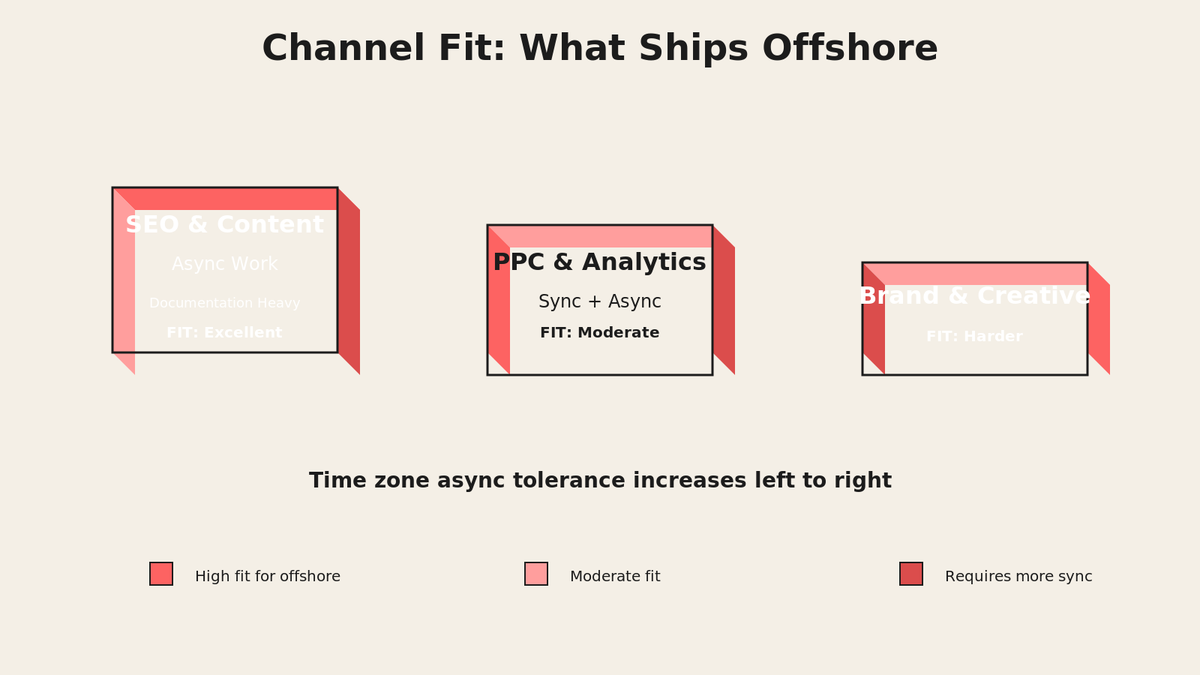
This is the key mental model. Async-friendly channels = offshore gold. Sync-heavy channels = harder.
Excellent offshore fit
SEO and content: You define the strategy and keyword targets. They research, write, and optimize. Feedback loops happen in 24h cycles. Zero real-time handshake needed. Blog writers and technical writers are especially strong from India and Philippines.
Email campaigns: Set the sequence template and audience rules. They write copy, QA, schedule. Async-native work.
Analytics and dashboards: Setup is sync-heavy. Maintenance and reporting are pure async. Once GA4 is configured, pulling insights and building dashboards is offshore-perfect.
Moderate fit (needs more sync)
PPC management: Account setup requires sync. Daily optimization? That's async and works offshore. But bid strategy pivots, landing page correlation analysis, and client pitch prep often need morning sync to avoid lag.
Social media posting: Scheduling is async. Community management and rapid-response engagement need timezone overlap or pre-written playbooks.
Harder fit (probably keep in-house or nearshore)
Brand strategy: Requires deep founder context and taste. Not a "hire it offshore" job. Consider brand strategy consultants only if you provide heavy mentorship.
Campaign creative (design, video, copy tone): Your voice can be documented, but it's craft. A 3-month learning curve is reasonable, but expect 2-3 rounds of revision early on.
Paid social ads: Cultural nuance and fast iteration matter. You can offshore 50% of the work (copy testing, audience builds), but keep the creative direction and performance analysis in-house or nearshore.
Q5. India, Philippines, Eastern Europe, LATAM: the 2026 honest map
| Region | Typical Cost | Best Fit | Timezone vs US | Notes |
| India | $15-25K/yr per person | SEO, content, analytics, email | 9-13h ahead | Largest talent pool, deepest digital expertise, reliability strong. Communication can feel transactional vs collaborative. |
| Philippines | $16-22K/yr per person | Social media, community, customer support hybrid | 12-15h ahead | Best communication skills, warm cultural fit, strong English. Slightly less technical depth on analytics. |
| Eastern Europe | $20-32K/yr per person | PPC, analytics, automation, marketing ops | 6-10h ahead | Stronger technical chops, better timezone overlap. Smaller talent pool, higher attrition to Western EU jobs. |
| Latin America | $22-28K/yr per person | Social, copywriting, customer marketing | 5-9h behind | Best timezone overlap with US, strong cultural fit. Smaller pool, higher costs as demand grows. |
Most founders mix. You might hire an SEO person from India (expertise at cost), a social manager from Philippines (communication + value), and a PPC specialist from LATAM (timezone + technical). Portfolio > region.
Vetting offshore talent: what actually matters
Skip the "years of experience" claim. Instead, ask:
- Case studies: "Show me 3 projects you've shipped and the metrics." Real work beats buzzwords.
- Communication test: Have them write a sample article or email for your brand. Don't just look at grammar - does the tone fit? Can they take direction and iterate?
- Timezone reliability: Ask their actual hours. "9 AM - 6 PM India time" is 11:30 PM - 8:30 AM US Eastern. That's not overlap. Make sure you're OK with async.
- Reference calls: Call 2-3 previous founders they worked for. Ask: "Did they overcommit? Miss deadlines? Miss tone? Did quality improve over time?" Ignore the fluffy stuff, listen for patterns.
- Trial project first: Offer a 2-week paid trial ($500-1K) on a small, defined task before committing to retainer. You both get low-risk validation.
Cheap is not cheap if you spend 40 hours revising work that should have taken 10. Spend time on vetting. It's the best ROI multiplier. Use a vetted hiring platform if you want the vetting done for you.
Q6. How to structure the engagement: retainer vs project vs embedded
Choice here shapes your success. Wrong structure = painful scaling later.
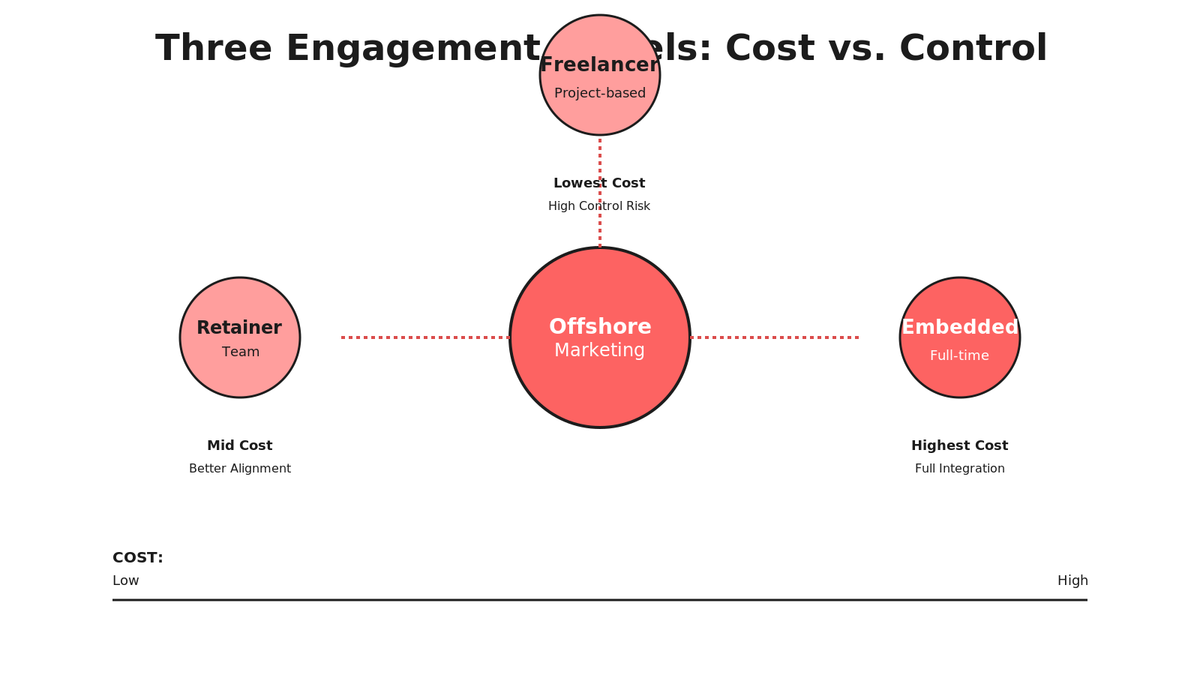
Project-based (one-off or campaign)
Use when: You have a defined sprint (rebrand landing page, launch content hub, run a 3-month PPC pilot).
Cost: Usually 20-40% cheaper than monthly retainer because there's an exit date. Payment on deliverables.
Risk: Whip-saw effect. Team lacks context. Knowledge walks out when project ends.
Example: "Write and publish 12 SEO articles on product integration" (60-90 day sprint, $3-5K flat).
Retainer team (monthly commitment)
Use when: You want consistent output and some flexibility (scale up or down monthly, exit with 30 days notice).
Cost: $3-8K/month for a person, $7-15K/month for a 2-3 person squad.
Benefit: Context compounds. They learn your brand, your customers, your playbook. Quality improves month 2 onward.
Trade-off: You're paying for capacity even if you don't use all 40 hours. Most retainers work at 70-80% utilization (20-30% buffer for ramp, knowledge work, admin).
Example: "$6K/month for dedicated SEO person, 30 hours/week, 90-day minimum commitment."
Embedded full-time (45h/week employee feel)
Use when: You're scaling marketing from $50-200K/month spend and need someone integrated into daily standups, Slack, sprints.
Cost: $30-50K/year all-in (salary + tools + management). Yes, cheaper than US hire at $70-90K, and no benefits/payroll headache IF you're using an EOR.
Benefit: Deepest context. They own a function, propose strategy, run experiments, mentor junior contractors.
Trade-off: Setup takes 6-8 weeks. You're investing. Exit costs (knowledge transfer, replacement hire) are real.
Q7. The tooling gap and how to close it
Offshore teams need access to your entire tech stack. This is the single biggest friction point founders underestimate.
| Tool Category | Essential Access | Setup Friction | Cost Impact |
| SEO (Ahrefs, Semrush) | Seat per person | Low (API key or login) | +$200-400/yr |
| Analytics (GA4, Looker) | Editor role in GA4, viewer in Looker | Medium (permissions, IP whitelist) | Bundled with your subscription |
| Ads (Google, Meta, TikTok) | Business account admin or specific campaign access | Medium (2FA, manager permissions) | None (just access) |
| CMS / Content (WordPress, Contentful) | Editor or contributor role | Low | Usually free |
| Collaboration (Slack, Asana, ClickUp) | Full member | Low | $150-300/yr per person |
| Email (HubSpot, Klaviyo) | Campaign manager role | Low | Included in platform |
Budget $150-200/month for tool seats. Set up IP whitelisting and 2FA for sensitive accounts. Use tool provisioning templates to speed onboarding. Many founders waste 10-15 hours in week 1 just granting access.
When NOT to give offshore access (security red flags)
Some tool access is risky. For contractors in year 1:
- Don't grant CRM access if it contains customer credit card data or PII without SOC2 verification.
- Don't share API keys directly - use read-only tokens or invite them via the app's user management.
- Don't grant Stripe/payment processor access. Have them export reports via your secure drive instead.
- Don't add them to your domain admin account. Create a separate email with only the necessary permissions.
- Do use a password manager (1Password, Dashlane) with shared vaults so you can revoke access instantly if they leave.
Paranoia saves you later. Security friction upfront is 100x cheaper than a data breach.
Q8. Onboarding checklist: what to hand over in week 1
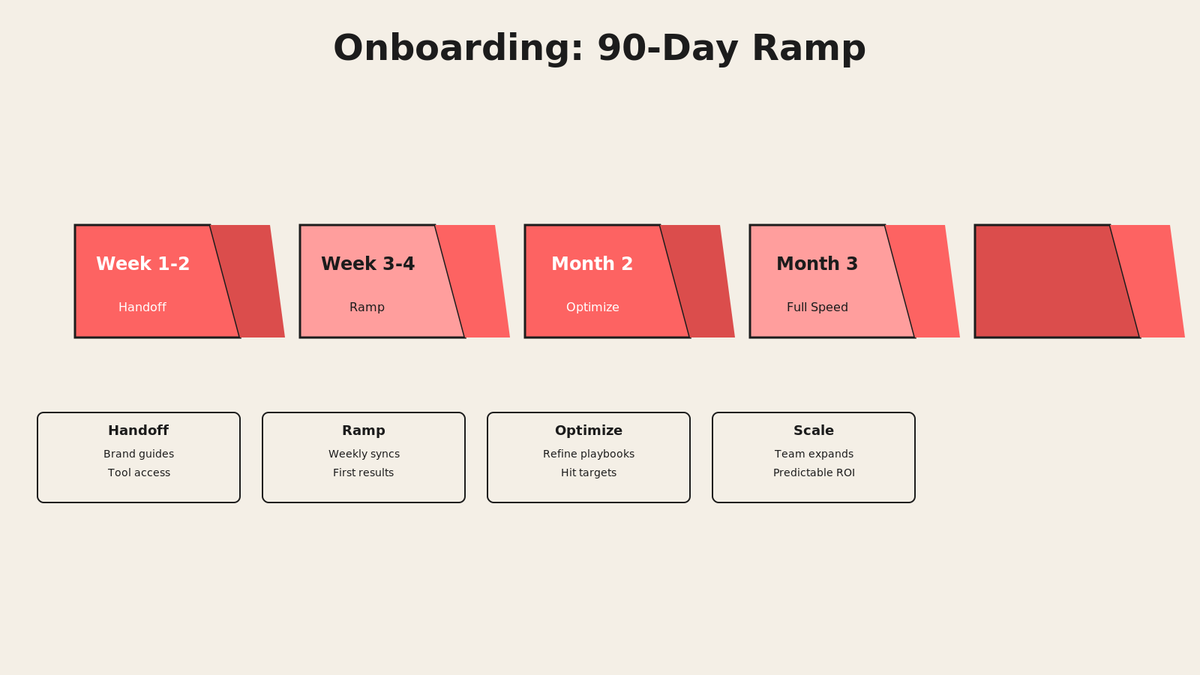
Days 1-3: Foundations
- Brand guidelines (voice, tone, style, audience personas)
- Current marketing strategy and OKRs
- Tool access (GA4, Ahrefs, Semrush, CMS, email, ads accounts)
- Slack, Asana, or ClickUp login
- Last 3 months of deliverables (sample articles, campaigns, emails) to establish taste
Days 4-7: Context
- 1x 1-hour sync: founder + new hire + (if relevant) existing marketing person. Share the "why" behind strategy choices.
- Product demo: 30 minutes on what you sell, who buys it, why they buy it.
- Customer call recording or case study to hear real voice.
- Competitive analysis doc: your top 5 competitors and what they're doing differently.
- KPI dashboard: what metrics matter, where you stand today, 90-day targets.
Week 2: First output (expect rough drafts)
- SEO roles: draft 2-3 articles on assigned keywords. Expect 40-60% quality; iterate heavily.
- Content roles: write 1-2 social posts, 1 email, 1 blog outline. Same: iterate fast.
- Analytics roles: set up initial dashboards, audit GA4 config, identify 3 quick wins.
- PPC roles: audit active campaigns, propose keyword additions, draft updated landing page copy.
Weeks 3-4: Ramped output (60-70% quality)
- Volume increases. Feedback turnaround should be 24h.
- You review daily output and give specific revision notes in Loom (async video feedback is faster than Slack threads).
- Weekly 30-min sync to align on strategy pivots.
Month 2: Optimization (80%+ quality)
- Workflows stabilize. They know your taste.
- Move from "here's the revision" to "here are the principles, go experiment."
- Introduce A/B testing mindset: propose, run, measure.
Month 3: Full speed (90%+ quality, ownership mode)
- They're proposing ideas, not just executing yours.
- Reduce sync to every 2 weeks (or less).
- Evaluate: do they stay? Recommend them to peers? Scale the team?
Q9. What a founder should actually track monthly
Don't just measure marketing outputs. Measure the offshore relationship itself.
Marketing KPIs (standard)
- Traffic, leads, conversions, cost-per-acquisition
- Monthly recurring revenue influenced by marketing (if you can track it)
- Organic search rankings on target keywords
- Email open rate, click rate, unsubscribe rate
Offshore-specific signals (the real stuff)
- Iteration speed: Time from feedback to revision. Should drop from 48h (week 1) to 12h (week 8).
- Quality by revision: Track % of first-draft work you accept vs reject. Target: 80% accept on first draft by month 3. Use performance management systems to track this systematically.
- Sync efficiency: Are you drowning in meetings or is async working? Log hours spent in syncs vs async work. Target: 80% async, 20% sync by month 2.
- Cost per result: Divide marketing spend + contractor cost by leads generated. Compare to your historical in-house cost per lead. You should see 30-40% reduction.
- Turnover risk: Do they seem engaged? Are they proposing ideas? Or just executing? High disengagement = they'll quit in month 4.
Set monthly review cadence. 30 minutes with the person, same time each month. Simple: "What worked, what didn't, what should we change?"
Red flags that your offshore hire is about to leave
Turnover happens. Watch for:
- Sudden slower output or missed deadlines with no explanation.
- Less engagement in Slack - shorter responses, less proactive.
- Asking a lot of questions about benefits, health insurance, or employment status.
- Disappearing during sync calls or rescheduling constantly.
- Low-effort work ("done" but clearly rushed) after months of good quality.
If you see 3+ of these, have a direct conversation: "I've noticed X. What's going on? Is there something you need?" Often it's simple: they found another job, family emergency, or burnout. Sometimes you can fix it (more autonomy, better pay, flexible hours). Sometimes they're gone. Plan for replacement within 2-3 weeks of sensing the shift.
Q10. When offshore scales to in-house: the compliance moment
Here's the inflection point 60% of founders miss.
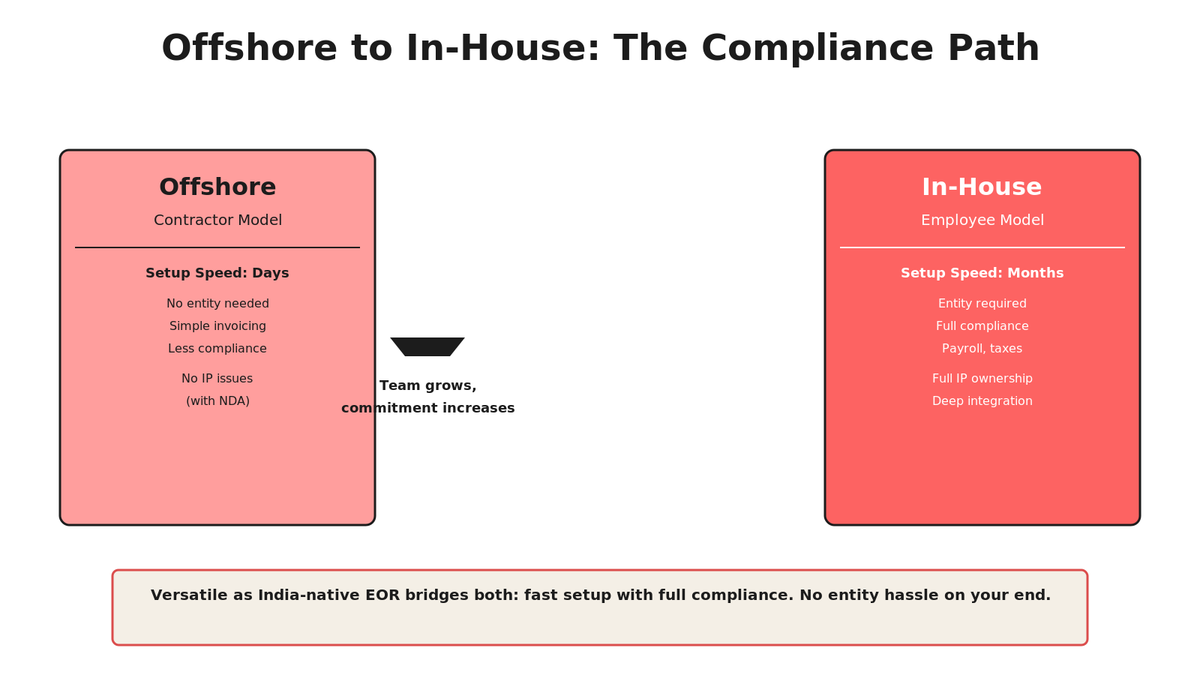
Start with a contractor. Pay via invoices. No tax withholding, no benefits, clean. That works for 6-12 months. But then something shifts:
- You want to promote them to team lead.
- They need health insurance (or ask for it as part of package).
- You want them on your payroll, reporting to your HR system.
- You're getting audited and need clear employment classification.
Now you hit the compliance wall. You can't just make them an "employee" on your US/UK payroll. They live in India/Philippines/Mexico. You need to either set up operations abroad or use an EOR:
- Set up a local entity (India subsidiary, Philippines branch). Costs $5-15K upfront, $3-5K/year compliance overhead.
- Use an Employer of Record (EOR) that already has a local entity and handles payroll, taxes, benefits on your behalf.
Where Versatile comes in as an India compliance partner
If you've hired an offshore marketing team through contractors and want to convert someone to full-time without setting up an India entity, you use an India employer like Versatile. You stay the employer conceptually (they report to you, you manage them), but Versatile handles payroll, tax compliance, benefits, and India labor law. Setup takes 1-2 weeks. Cost: usually 8-15% of salary for the compliance layer. Example: a $24K/year hire costs you $26-27K all-in with EOR overhead. Way cheaper and faster than setting up your own entity.
This matters because it lets you scale from offshore contractor to proper employee without international legal risk. You get the best of both: cost savings + compliance safety.
FAQs
Is it really 40-60% cheaper to hire offshore vs in-house?
Salary is cheaper. A $70K US SEO role costs $18-24K offshore, so yes, 65-75% cheaper at salary. But add tool costs, management overhead, and quality review cycles, and you're looking at 40-50% net savings on fully loaded cost. Offshore is still dramatically cheaper, but not a magic cost-cutting machine. You're paying for agility and scale, not just wage arbitrage.
How do I know if someone is actually working and not just ghosting?
Use time-tracking tools like Toggl or Clockify for the first 60 days, not to spy but to get baseline velocity metrics. Set clear deliverables with deadlines. Daily standups (async: Slack update at start of their day). Weekly video sync. Check git commits, CMS edits, or whatever tracks their work artifact. If they're delivering on-time and on-spec, timezone doesn't matter. If they're vague, missing deadlines, or producing low quality, you'll know in week 2.
What's the actual failure rate for offshore marketing hires?
High first 30 days (communication mismatches, context gaps). Improves dramatically by day 60 if they're vetting right and you're onboarding well. By month 3, performance usually settles. Turnover risk is real: offshore team members often see the role as a stepping stone. Plan for 15-20% attrition yearly. Budget for backfill onboarding cost (2-3 weeks productivity ramp per hire).
Can I offshore PPC management or is that too risky?
You can. PPC specialists from India, Eastern Europe, and LATAM are strong. But: daily optimization and bid strategy need founder/CMO review, especially first 60 days. They can handle testing, audience builds, copy variations, landing page correlation analysis. Keep performance analysis and scaling decisions in-house or nearshore (someone in your timezone). Hybrid is the play: they execute, you decide.
What's the difference between hiring offshore directly vs using an agency?
Direct hire: faster, cheaper, more control, but you manage and carry turnover risk. You get exactly the person you want. Agency: turnover handled by them, you get a team, but less control over individual people and higher cost (they take margin). For most founders building a long-term offshore team, direct hire through a vetted platform or EOR beats agencies. Versatile can help hire and manage offshore teams directly while handling compliance.
How do I start if I've never managed someone overseas?
Start small. One project-based hire for 30 days. Pick the easiest channel (SEO writing or email copywriting). Give ultra-clear specs, daily standup updates, and 48h feedback loops. Treat it as a learning sprint, not a commitment. You'll build confidence and see whether async work rhythms work for your brain. Then scale to retainer if it clicks. Content marketing teams are the easiest entry point to offshore work because documentation is heavy and timezones matter less.
Where my head is right now
Offshore marketing is no longer a cost-cutting hack. It's how founders scale from $50K to $5M in revenue without inflating headcount. The best 2026 founders will be the ones who treat offshore hiring as strategic (which channels, which people, how to integrate them) instead of transactional (lowest price, fastest turnaround). The real skill is building a 60-30-10 team: 60% in-house (strategy, brand voice, big decisions), 30% offshore (execution, high-volume production), 10% freelance (specialized spikes, one-off projects). That mix lets you scale marketing without the overhead of full US/UK salaries.
If you're scaling an offshore team and hit the "should this be a full-time employee?" moment, message me directly on WhatsApp through our contact page, or book a consultation. We built Versatile as an compliant Indian entity specifically for founders so you don't have to choose between speed and compliance. What's your biggest hesitation about offshore marketing right now?