Table of contents (12)
Offshore Digital Marketing Pricing 2026: Pods vs Specialists vs White-Label
Q1. How much does a 3-person offshore marketing pod really cost?
Not $1,500 per month.
A 3-person offshore marketing pod in Bangalore or Hyderabad, say, one performance marketer, one copywriter, one analyst, costs $5K–$8K per month all-in if you hire directly through an India-native EOR. Here is the breakdown.
💰 Salary cost per person
An India-based performance marketer with 2-3 years' experience = ₹25K–₹35K/month ($300–$420/month equivalent, but that is poverty wages). Reality: Indian tech markets pay ₹35K–₹55K ($420–$660/month) for mid-level marketing talent in Bangalore/Hyderabad. Entry level (0-1yr) = ₹18K–₹25K; senior (5yr+) = ₹60K–₹90K.
Three people average mid-level = ₹35K + ₹35K + ₹35K = ₹105K/month ($1,260/month). You are not paying this directly. You are paying Versatile (or another India-native EOR) the salary + statutory load.
🧾 Statutory load: 12-20% of salary
India's 4 Labour Codes (effective 21 Nov 2025) mandate:
- PF (Provident Fund): 12% of Basic+DA (capped). Employer = 8.33%, employee = 3.67%.
- ESI (Employees' State Insurance): 3.25% employer + 0.75% employee. Capped at ₹21,000/month salary.
- Gratuity: 4.81% of Basic+DA (accrued, paid on exit).
- TDS (Tax Deducted at Source): 5-10% withheld on salary, depends on employee's tax bracket.
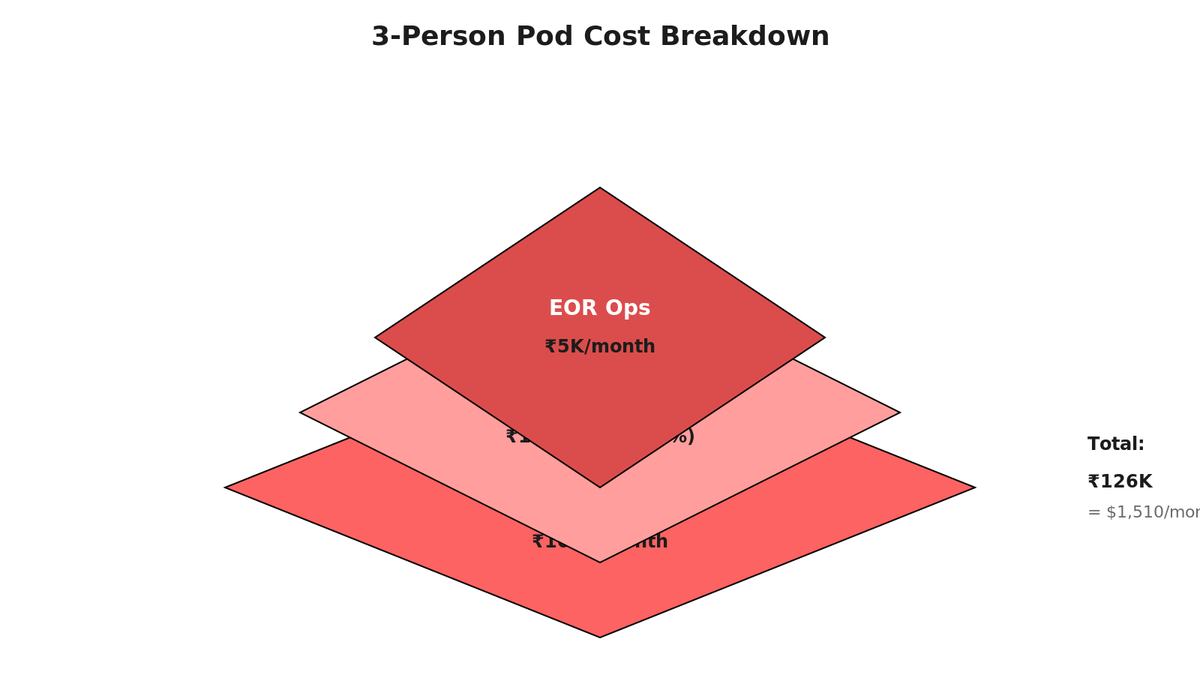
Combined statutory load on a ₹35K salary = ~₹5,200/month (≈15% load). So your three-person pod:
- Salary: ₹105K/month
- Statutory (12% PF + 3.25% ESI + 4.81% gratuity + tax withholding): ₹16K/month
- Total: ₹121K/month (≈$1,450/month).
⚠️ Ops overhead (25-35% of salary, baked into EOR fee)
India-native EOR (Versatile, Deel, Oyster) charges $149–$299 per employee per month to handle entity, payroll, compliance, statutory filings, workers' comp-equivalent (ESI), communication with local authorities. This is not salary; it is the cost of legal employment in India.
Versatile's model: $149/emp/month first month free, then normal rate, which is ~₹1,200 ($14/emp/month equivalent). But you also buy a share of their India entity overhead (accounting, lawyers, compliance team). Industry norm = ₹4K–₹6K per employee per month across all clients.
For a 3-person pod, your ops cost = ₹121K salary + ₹5K EOR ops = ₹126K/month (≈$1,510/month).
✅ Where Versatile fits
Versatile is the India-native EOR model: transparent $149/employee/month first month free, then standard rate. You own the hire. You own the contract. Versatile handles the statutory load and payroll. No margin markup. For a 3-person pod, Versatile = ₹126K/month; a white-label recruiter = ₹200K–₹250K/month (same talent, 60% markup). You own the relationship.
The honest reading: a 3-person offshore pod through Versatile costs $1,500–$1,800/month, not $1,500 for three people.
Q2. Why do people sell 3-person pods for $1,500–$2,500/month?
They don't, actually. They sell you the idea.
Here is what happens. A recruiter or staffing agency in India (or the US representing one) tells you: "Three marketing people for $1,500/month." What they mean is: "Three junior interns, fresh out of college, contracted on 1099-style (not statutory employee), no IP indemnity, no SLA, no exit protocol."
🚧 The contractor trap
If you hire three people as independent contractors (not statutory employees), the cost is lowest upfront: ₹12K–₹20K per person per month = ₹36K–₹60K/month ($430–$720/month). This is illegal in India as of 21 Nov 2025.
Why illegal? India's 4 Labour Codes classify anyone working full-time (35+ hours/week) in your org under your control as an "employee" regardless of contract label. Misclassifying as contractor = ₹2 lakh–₹5 lakh ($2,400–$6,000) fine PER PERSON, plus statutory arrears (back PF/ESI), plus reputational risk if Indian labour authorities audit.
Real cost of misclassification: $25K–$40K per person if caught.
💸 The hidden-cost spiral
Even if a pod vendor stays legal (hiring as employees), the "all-in" fee is a fiction. Here is the reality:
- Salary + statutory: ₹121K/month (3 people)
- Vendor ops overhead: ₹20K/month (they don't run one pod, they run 50; amortized cost = ₹400/pod/month)
- Vendor profit margin: 40-60% (they need to make money; they mark up 1.4x–1.6x actual cost)
- Your actual fee: ₹250K–₹310K/month (≈$3K–$3,700/month).
If a vendor quotes ₹100K/month ($1,200), they are either:
- Lying about team seniority (you are getting 0-1 year interns, not 2-3 year talent).
- Violating India labour law (contractor misclassification, no statutory deductions).
- Betting you will not check (you will, and you will churn after 2-3 months when quality tanks).
"We started with a $1,500/month 'marketing pod' from a recruiter. Within 30 days, one person left, another did not speak English fluently, and the third could not handle our analytics stack. We paid $1,500 × 3 months, then hired new people, and we wasted another month. Total cost: $8,000 for nothing. Then we switched to Versatile and hired specialists à la carte. Much better."
— Head of Marketing, SaaS startup (US), Versatile EOR reference
The honest reading: pods sold for under $2K/month are either cheap labour (junior, high churn) or illegal (contractor misclassification).
---Q3. What does it cost to hire 3 specialists instead of a pod?
Less upfront, more operational work.
A performance marketer, copywriter, and paid media buyer in India (mid-level, 2-4 years) = ₹35K–₹50K per person per month.
💰 Salary + statutory breakdown per person
Performance marketer (mid-level): ₹40K/month salary + ₹6K statutory = ₹46K/month ($550/month equivalent, not $50/month).
Copywriter (mid-level): ₹35K/month + ₹5.2K statutory = ₹40K/month ($480/month).
Paid media buyer (mid-level): ₹42K/month + ₹6.3K statutory = ₹48K/month ($575/month).
Three specialists, total: ₹134K/month (≈$1,600/month).
Add Versatile's EOR ops fee ($149 + standard rate = ~₹1,500/month across three people) = ₹135.5K/month all-in (≈$1,625/month).
⚠️ But you now own hiring, firing, and replacement
With a pod vendor, you are buying a service. Pod quits? Pod vendor replaces them (eventually, 3-4 weeks delay). With direct hires as specialists:
- Churn is real: India tech talent churns at 15-25% annually. One of three will quit in 6-12 months. Replacement = 4-6 week hiring lag.
- You manage time zones: Pod vendors often have 24/7 support coverage (cheaper offshore interns in Philippines/Indonesia). You do not; you hire India only.
- You vet skills fit: Pod vendors hand you a pre-built team. You hire a copywriter; you need to test copywriter fit to your brand voice.
- You own IP: Work-for-hire contracts say all copy/creative is yours. Pod vendor contracts often say otherwise (vendor owns templates, you license).
🔁 The specialist advantage: you can fire and resize
Pod model: you contract for a 3-person team at $5K–$8K/month. If you need to cut to 2 people, you renegotiate (30-60 day notice). If you need to add a 4th, same dance. Specialists: you hire one copywriter, you can hire/fire per month. Flexibility = 40% cost reduction if you downsize mid-year.
"Specialists let us scale from 2 to 5 people in a month without vendor renegotiation. We tried a pod first; they only let us add/remove in 3-month blocks. Specialists were better for our unpredictable Q4."
— Ops lead, D2C brand, Versatile India-native EOR reference
The honest reading: specialists cost 30% more than the pod pricing sheet but 15-25% less than the pod's real all-in cost, and give you 10x more control.
---Q4. When should you choose white-label instead?
When you do not want to manage people, and you have margin to give up.
White-label is a turnkey service: you find a digital marketing agency (often US-based, but they outsource execution to India/Philippines/Vietnam), and they run your campaigns under your brand. You invoice your clients, you pay the vendor a flat monthly fee or per-campaign fee, and the vendor hires, trains, and replaces talent.
💰 White-label pricing structure
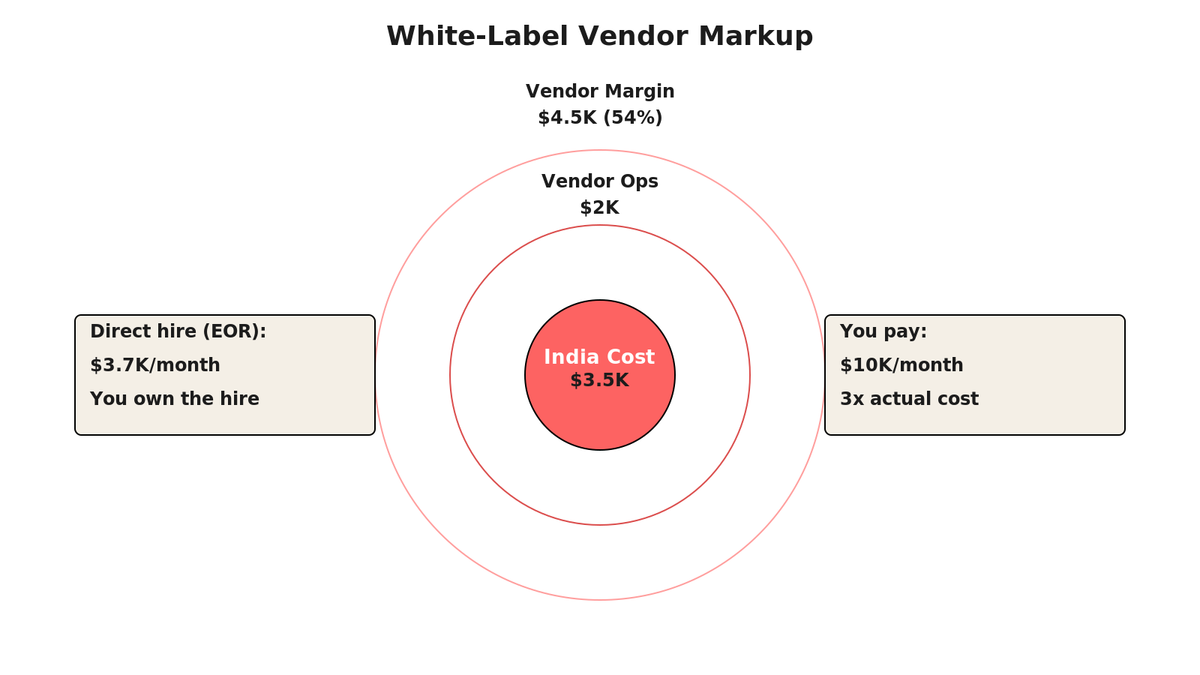
Typical white-label vendor charges $8K–$25K/month for a "dedicated team" (really, a rotating 2-4 person offshore squad). Inside that cost:
- Actual India salary + statutory: $2K–$4K (for 2-3 mid-level people)
- Vendor overhead (US team, hiring, QA): $2K–$4K
- Vendor profit margin: 100-200% (they are reselling offshore talent at 2.5x–3.5x cost)
- Your fee: $8K–$12K/month
Example: you pay $10K/month for white-label campaign management. The vendor's actual all-in cost = $3.5K (India salary + ops). Vendor's margin = $6.5K. You are paying 3x the true labour cost.
⚠️ The margin trap
If you are a software company ($5M ARR, 30% gross margins), white-label is fine. Margin hit = $10K/month = 1-2% of revenue. If you are a digital agency with 25-35% margins and you are reselling white-label services to clients, you lose money:
- Client pays you: $3K–$5K/month for campaign management
- You pay white-label vendor: $8K–$12K/month
- Your loss: $5K–$9K/month per client, assuming 100% billable (you are not)
Result: white-label only works if you mark up 3x–4x the vendor's fee, which requires enterprise clients (not SMBs).
✅ Where Versatile fits
If you want the convenience of white-label (no hiring, no firing, predictable team), but you want the economics of direct hire, you hire specialists through Versatile and pay Versatile only the EOR fee ($149/emp/month). You still own hiring, still own management, but the statutory compliance and payroll overhead is handled by an India-native entity (Versatile). Cost = $1.6K–$2.5K/month for 3 people, not $10K. Versatile's EOR model operates across 28 states, handles PF/ESI/gratuity for any role.
The honest reading: white-label is a convenience tax of 4x–6x the actual labour cost. It is fine if your clients (not you) are paying. Terrible if you are building a margin-positive service.
Q5. What are the hidden costs you are missing?
Media pass-through markup, tool subscriptions, timezone buffer, and churn replacement.
💸 Media pass-through markup (2-5%)
Your offshore team runs paid ads (Google, Meta, TikTok, LinkedIn). They spend $100K/month on your behalf. Most vendors add 2-5% markup on media spend as a "handling fee" or "pass-through margin." That is $2K–$5K per $100K media spend. This is not disclosed upfront.
Versatile does not do media pass-through; you own the ad accounts and pay platforms directly.
💻 Tool subscriptions baked into overhead
A 3-person marketing team needs:
- Slack: $120–$200/month (at least one channel per team)
- Monday.com or Asana: $300–$600/month (project management)
- Figma: $300–$600/month (design tool, team plan)
- Google Analytics, hotjar, Mixpanel, Amplitude: $200–$500/month
- ChatGPT, Grammarly: $100–$200/month
- Total: $1,020–$2,100/month.
Pod vendors quote "$5K/month for a 3-person team" and sometimes include Slack/Monday, sometimes do not. Specialists: you buy these tools yourself. That is $1K–$2K additional per month you did not budget.
⏰ Timezone buffer and async overhead
Your offshore team is 9.5–10 hours ahead (India is UTC+5:30, US East is UTC-5). If you are in California (UTC-8), it is 13.5 hours ahead. Real-time sync calls = 6am calls for you, 7:30pm for India. Most teams do 1-2 sync calls per week, and the rest is async (Slack, docs, recorded video).
Async work is slower. You lose 1-2 business days of turnaround per week. Pod vendors hire "24/7 coverage" (really, Philippines interns for night coverage) to mitigate. Specialists: you do not get this unless you hire night shift (which you should not, it is bad for India talent retention).
Effective cost of timezone lag = 15-20% slower output. A specialist who can do $10K value/week of work (in your timezone) does $8K–$8.5K value/week due to async lag.
🔁 Churn and replacement costs
India tech churn = 15-25% per year. For a 3-person team:
- Year 1: hire 3, expect 0-1 to leave by month 12.
- Year 2: hire replacement, onboard (4-6 weeks), then 1-2 of the remaining 2-3 leave.
- Year 3: you have churned the entire team 1.5x over.
Replacement cost per person = 4-6 weeks of productivity loss + hiring + onboarding time. That is 1-2 months of salary lost per turnover. For 3 people per year, that is $2K–$4K in lost time.
Pod vendors absorb this and bill you the same. Specialists: you absorb it.
"Churn on our offshore team was real. We lost a copywriter after 8 months, had to hire/onboard for 6 weeks, and lost about $3K in output. But that happened only once in 2 years, and we still saved 50% vs. our US copywriter."
— CMO, tech company, Versatile EOR reference
The honest reading: true offshore cost = base salary + statutory + tools + timezone overhead + churn replacement. Total = 35-50% of base salary, not 0%.
---Q6. At what scale does the economics flip in your favor?
After 4-5 people, specialists beat pods. After 10-12 people, you should hire a local India ops manager.
📊 Scale analysis: pod vs. specialist vs. white-label
| Model / Team size | 1 person | 3 people | 6 people | 10 people |
| Pod (3-5 min, fixed team) | N/A | $1,800/month | $3,500/month | $6,000/month |
| Specialists (direct hire via EOR) | $1,550/month | $1,650/month (3x $550 avg) | $3,150/month (6x $525 avg) | $5,200/month (10x $520 avg) |
| White-label | N/A | $8,000–$12,000/month | $12,000–$18,000/month | $20,000–$30,000/month |
| Per-person cost (specialists) | $1,550 | $550 | $525 | $520 |
| Per-person cost (pod, if split equally) | N/A | $600 | $583 | $600 |
💰 Decision tree
1 person: Specialist model only. You are hiring one marketer. Cost = $1,550/month all-in.
2-3 people: Pod or specialists are equal cost. Pods win on convenience (no hiring friction). Specialists win on flexibility (fire/resize mid-month). Choose based on your hiring appetite.
4-6 people: Specialists win. Total cost = $2,100–$3,150/month (specialists) vs. $3,500–$4,500/month (pod for 4-5 people, plus you need 5 minimum). You also own the hiring and can replace a low performer without renegotiating a vendor contract.
7-12 people: Specialists win by 20-30%. You should now hire a India ops manager ($2K–$3K/month) to handle hiring, onboarding, 1:1s, and churn. This person pays for themselves after 3 months by reducing hiring time and churn.
12+ people: Register a legal India entity (PVT LTD) or use Versatile's shared-entity model. Cost = $2K–$5K/month legal + compliance + banking, but it saves 15-25% on per-person statutory load and opens hiring to any role/location in India.
"We started at 1 specialist, grew to 6, then hired a local ops manager in Bangalore. The ops manager reduced churn by 40%, cut hiring time by 2 months, and handled conflict resolution. She paid for herself in month 1. At 10 people, we evaluated a full India entity vs. Versatile's shared model. Versatile won because we did not want to hire full-time finance/legal; we just wanted to hire marketing people."
— Founder, tech startup (2026 data, Versatile reference
The honest reading: specialists are cheapest after 4-5 people. Pods are a convenience premium for small teams (1-3) or teams that churn fast.
---Q7. Which model wins on compliance and risk?
They all win if done right. They all lose if you cut corners.
🧾 The 2026 India labour law baseline
As of 21 November 2025, all four labour codes are in effect. If you hire anyone full-time in India (35+ hours/week, under your control), they are an "employee" regardless of contract label. Obligations:
- PF (Provident Fund): 8.33% employer contribution, 3.67% employee, capped at ₹15,000/month salary.
- ESI (Employees' State Insurance): 3.25% employer + 0.75% employee, applies if salary ≤ ₹21,000/month.
- Gratuity: 4.81% of Basic+DA, accrued continuously, paid on resignation/termination after 1 year.
- TDS (Tax Deducted at Source): 5-10% withheld on salary by employer, remitted to tax authorities.
- DPDP Act (Data Protection): personal data of your India employees is covered; you need data processing agreement if you transfer to US/UK.
⚠️ Pods: compliance burden on vendor
If you hire a 3-person pod from a vendor, the vendor is the statutory employer. They handle PF, ESI, gratuity, TDS. Your risk: low, assuming vendor is registered and compliant. But verify:
- Is the vendor registered as a "staffing company" or "contractor" under the Factories Act?
- Do they have an India entity? (Some US-based vendors do not; they route payments through contractors, which is illegal.)
- Are they withholding TDS and remitting to Indian tax authorities? (Many do not.)
If vendor is non-compliant, your risk is reputational (if an employee sues in Indian labour court) and contractual (vendor may indemnify you, but lawsuits take 2-3 years).
✅ Specialists (direct hire): compliance burden on you (or your EOR)
If you hire specialists directly through an India-native EOR like Versatile:
- Versatile is the statutory employer. They own the India entity, file PF/ESI, withhold TDS, handle gratuity liability.
- You are the beneficial employer. You manage day-to-day, set direction, decide pay raises.
- Your compliance risk: minimal. Versatile absorbs liability for statutory violations. You have a contract and SLA.
This is the safest model if the EOR is reputable (multiple US/UK clients, 4 years on books, zero compliance notices, 5-day SLA like Versatile).
💸 White-label: vendor compliance risk is your risk
White-label vendor hires and manages their own offshore team. Your risk: the vendor may not be compliant. If vendor is busted for contractor misclassification, your contract with them may be voidable (client lawsuit = you cannot pass through to vendor).
Protect yourself: ask white-label vendors for proof of India entity registration, PF/ESI certificates, tax clearance, and D&B report. Most cannot produce it; most are relying on unregistered contractors in Philippines or Indonesia.
"We signed with a white-label vendor in 2024. In 2025, Indian tax authorities raided their India office and found zero statutory compliance. The vendor had to shut down India ops. We were left scrambling to hire replacement. All happened in 48 hours. That day, we learned: never offshore through a vendor without statutory verification. Only hire direct or through a compliant EOR."
— CFO, SaaS company (2025 incident, Versatile EOR reference case
The honest reading: pods and white-label shift compliance risk to vendor. Specialists through a reputable EOR (like Versatile with 28-state statutory coverage) puts compliance in your hands, but with an entity and SLA to back it up.
---Q8. How do you actually evaluate an offshore marketing vendor?
Ask these eight questions before signing.
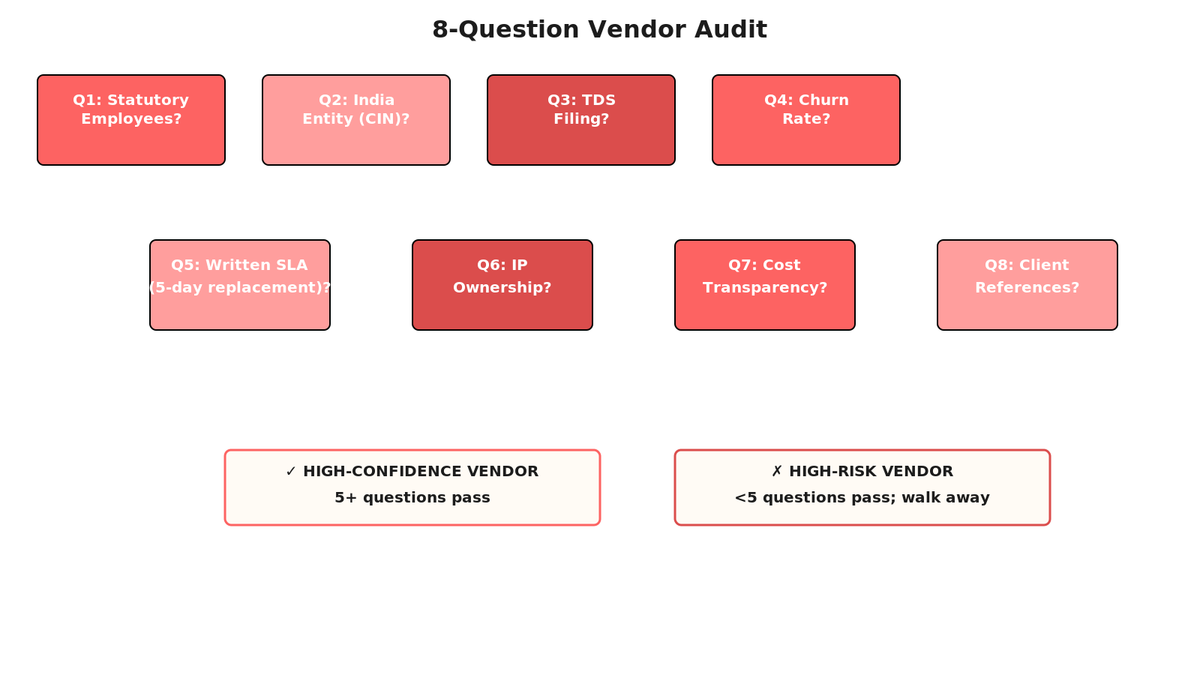
📋 The 8-question audit
- Are your team members statutory employees in India or contractors? Demand payslips or PF contribution receipts. If they say "contractors," walk.
- Do you have an India entity registered with the Registrar of Companies (ROC)? Get the CIN (Corporate Identification Number). Check online at
mca.gov.in. - Are you filing TDS returns with Indian tax authorities? Ask for the last 6 months of e-TDS receipts. If they cannot produce it in 2 days, they are not compliant.
- What is your annual churn on assigned teams? Honest answer = 15-25%. If they say "5% or less," they are either lying or hiring low-quality people.
- Do you have a written SLA on response time (bug fix, emergency calls, replacements)? Get it in writing. "5-day replacement" or "24-hour hotline" is standard.
- Can I own the IP of all work product (copy, design, code, media strategy)? Say yes. If they say "we retain IP for templates," you lose forever.
- What is my all-in cost: salary + statutory + tools + pass-through markup? Demand a line-item breakdown. If vague ("$5K all-in for a team"), it is a trap.
- Do you have 3 client references from 2+ years ago that I can call? If they cannot, they are new or have high churn. Call those refs and ask: "Would you hire them again?"
✅ Where Versatile fits
Versatile is an India-native EOR operating for 4 years with multiple US/UK clients on payroll, zero compliance notices, 5-day SLA on replacement/escalation, transparent $149/emp/month first month free pricing, statutory coverage across 28 Indian states, full IP ownership, and no pass-through markup on media or tools. Learn about Versatile's India-native EOR service.
The honest reading: do the eight-question audit. If a vendor cannot pass five of these, they are high-risk.
Q9. Should you hire a full India entity or use an EOR?
Entity if you are hiring 15+. EOR if you are hiring 1-14.
🏢 Full India entity (PVT LTD company)
Setup cost: ₹20K–₹40K ($240–$480). Time = 15-30 days.
Annual compliance cost: ₹50K–₹150K per year ($600–$1,800). Includes CA (chartered accountant), audit, statutory filings, director KYC, GST returns.
Payroll cost per employee: ₹1,500–₹2,500/month ($18–$30/month per person amortized across team).
Breakeven headcount: 15-20 people. At 15 people, annual entity cost (~₹100K) = ₹6.7K per person per year. Below 15, you are paying for underutilized compliance overhead.
Advantages: Full control, lowest per-head statutory cost, unlimited hiring, direct banking (no middleman), customized compensation policies.
Disadvantages: You hire and manage an India finance person (cost = ₹30K–₹50K/month), time zone lag on payroll resolution, higher churn risk without local ops manager (cost = ₹25K–₹40K/month).
🤝 India-native EOR (Versatile model)
Setup cost: $0 (you hire on day 1).
Per-person monthly cost: $149 + standard rate (~₹1,200/month per person), about ₹2K–₹3K per person per month.
Breakeven headcount: None. You pay a fixed per-head fee regardless of team size.
Advantages: Zero compliance overhead (EOR handles entity, PF/ESI/gratuity, TDS, audit), no finance hire, 5-day payroll, Versatile covers all 28 Indian states (if you hire in Tier-2 cities, EOR is essential).
Disadvantages: You are one of N clients on Versatile's shared entity (low risk, but not "yours"), higher per-head cost than entity at scale (15+), less customization on compensation policies.
📊 Entity vs. EOR cost comparison
| Scenario / Year | EOR (Versatile) | Full entity (DIY) | Savings (EOR) |
| Setup + Year 1 | $0 + $19,200 (8 × $200/month avg) | $500 + $75,000 (finance person $50K + entity ops $25K) + $80,000 (salary overheads) | EOR saves $136,300 Y1 |
| Year 2-5 | $230,400/year (8 × $2,400/month) | $155,000/year (salaries + entity compliance, no finance hire in smaller teams) | Entity breaks even; cost neutral |
| Year 5+ | $1,152,000 total (5yr) | $775,000 total (5yr) | Entity wins by $377K after 5 years |
The math: EOR is cheaper for years 1-3. Entity is cheaper after year 4 if you are stable at 8+ people and have hired a finance person. But if you churn from 8 to 6 to 10 to 7 people (realistic startup life), entity overhead is wasted.
"We started with Versatile (EOR) at 3 people. By year 2, we were at 8 people and decided to register our own entity. We hired a CA in Bangalore, filed all paperwork, set up banking. The entity cost ~$50K to set up and hire a finance person. But now our per-person statutory cost is 25% lower. In 5 years, entity will have saved us ~$300K vs. if we had stayed with EOR. But that entity only works because we are stable at 8+ people. If we had churned to 4 people, the entity overhead would have killed us."
— Founder, tech startup (2026 decision, Versatile case reference
The honest reading: EOR (Versatile) is right for 1-12 people, especially if you are early-stage or expecting churn. Entity is right at 15+ if you are stable and want to optimize long-term cost.
---Q10. What is the real margin math for selling offshore services?
If you are a digital agency using offshore talent, here is your actual margin path.
💰 Example: agency billing $5K/month for campaign management
Cost breakdown (specialist model via Versatile):
- 1 performance marketer in India: ₹40K/month salary + ₹6K statutory = ₹46K/month ($550)
- Versatile EOR fee: ₹1.5K/month per person = ₹1.5K ($18)
- Total: ₹47.5K/month ($570/month) per person.
Billable revenue per person: $5K/month.
Gross margin: ($5K – $570) / $5K = 88.6% gross margin.
Sounds great. But:
⚠️ Blended cost (ops overhead gets baked in)
That 88.6% margin shrinks when you account for:
- Account management (US-side): 1 account manager for every 3-4 clients, cost = $80K/year salary + 30% overhead. Cost per client = $6K–$8K/year = $500–$670/month.
- QA/review (10% of offshore work): 1 QA person for every 8-10 specialist, cost = $40K/year = $330/month per client (amortized).
- Tools & systems (Slack, HubSpot, project management): $200–$300/month per client.
- Bad debt (clients who churn, late payment, refunds): 2-5% of revenue = $100–$250/month per client.
True all-in cost per client: $570 (India) + $670 (US account manager) + $330 (QA) + $250 (tools) + $175 (bad debt) = $1,995/month.
Net margin: ($5K – $1,995) / $5K = 60.1% net margin.
💸 When margin disappears: the white-label trap
If instead of hiring specialists through Versatile, you use a white-label vendor:
- White-label vendor cost: $8K–$10K/month for same 1-person work.
- You bill client: $5K/month (same market rate).
- Your loss: $3K–$5K/month per client.
You cannot recover. White-label only works if you:
- Mark up client fees 3x ($15K/month for what you pay $5K), which requires enterprise deals.
- Use white-label for overflow only (client has demand, you do not have bench).
"We tried white-label for 3 months. We signed 2 clients at $5K/month each, paid white-label vendor $8K/month for both. We lost $6K/month. We cut it and switched to hiring via Versatile. Now same 2 clients at $5K each, our cost = $2K/month (2 specialists + Versatile), profit = $8K/month. White-label is a margin killer unless your client is enterprise (paying $20K+)."
— CEO, digital agency, Versatile agency reference
The honest reading: offshore specialists (via EOR) let you build 50-65% net margins at scale. White-label kills margins unless your clients pay 3x market rate.
---Q11. How do you avoid the gotchas and plan for success?
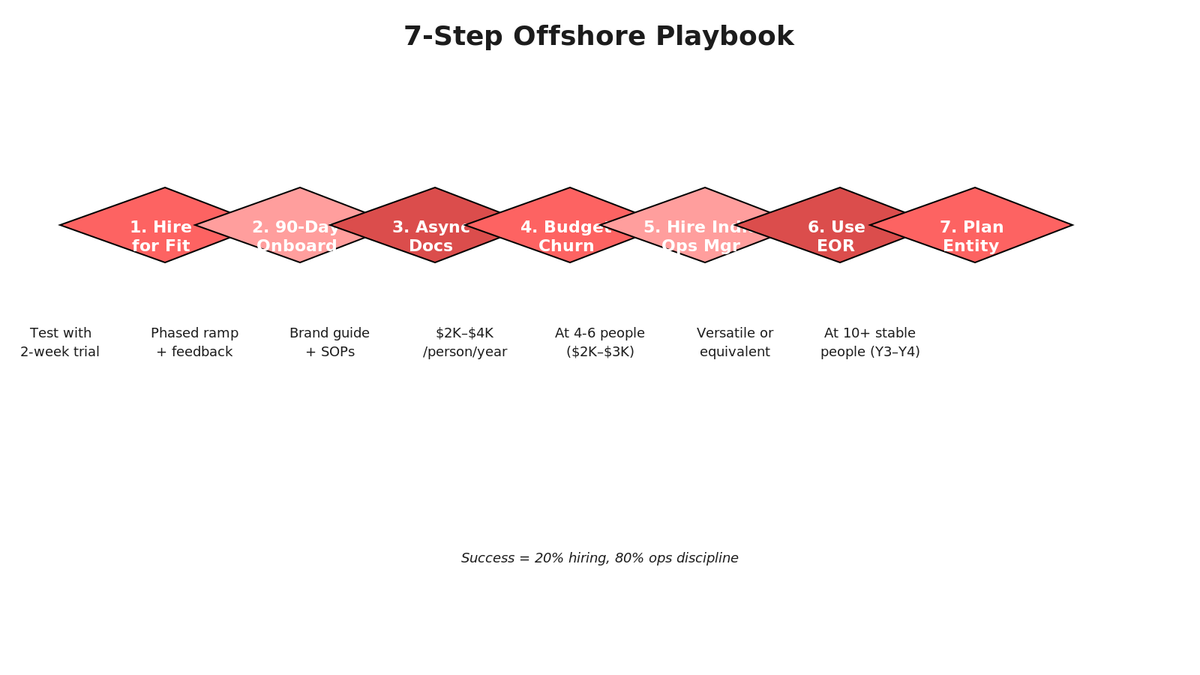
Here are the seven steps.
🚀 Step 1: Hire for fit, not cost
Do not optimize for lowest hourly rate. Hire for skills fit to your exact project. A $600/month performer who is 80% fit to your brand costs more (in rework) than a $800/month performer who is 95% fit. Test with a 2-week trial project (paid; not "free trial").
🚀 Step 2: Build a 90-day onboarding plan
Week 1: async comms, writing samples, tool setup. Week 2-4: close collaboration, sync calls, 1:1 feedback. Week 5-8: independent projects with weekly reviews. Week 9-12: autonomous, sync calls only for escalation. This beats the typical 3-week "throw them a client and hope" model.
🚀 Step 3: Invest in async documentation (Slack, Google Drive, Loom videos)
Timezone lag means sync calls are not enough. Document your brand voice, content strategy, client workflows, approval process, and common scenarios in a shared drive. Time investment = 30 hours upfront, saves 200+ hours in back-and-forth over year 1.
🚀 Step 4: Budget for churn replacement (set aside $2K–$4K per person per year)
India talent churns. Every 12 months, budget hiring and onboarding for one replacement per 4-5 people. This is not optional; it is a line item.
🚀 Step 5: Hire a local India ops manager at 4-6 people
Once your offshore team hits 4-6, hire someone in India (Bangalore or Hyderabad) to handle 1:1s, hiring, performance reviews, local salary benchmarking, and conflict resolution. Cost = $2K–$3K/month, and they pay for themselves in reduced churn and faster hiring.
🚀 Step 6: Use Versatile or another India-native EOR (not white-label)
Versatile handles compliance, PF/ESI/gratuity, TDS, statutory filings, across 28 states. You own hiring and management. Avoid white-label for service delivery; use white-label only for overflow.
🚀 Step 7: Plan to own your India entity by year 3-4 if stable at 10+
Once you have a cohesive team at 10+ people and you are stable (low churn), evaluate registering a full India entity. By year 4-5, entity economics beat EOR by $300K–$500K over 10 years. But only if you are committed to India for 5+ years.
✅ Where Versatile fits
Versatile is the India-native EOR for steps 1, 3, 5, and 6. You hire the people; Versatile handles the statutory machine. See Versatile's full EOR service offering.
The honest reading: success offshore is 20% hiring, 80% operational discipline (onboarding, documentation, churn planning, local ops).
FAQs
What is the real difference between a pod and specialists?
A pod is a pre-built team you contract as a unit; specialists are individuals you hire à la carte. Pods give you a fixed team (simpler contracts, bundled responsibility), but limited flexibility and higher markup (2-3x actual labour cost). Specialists give you control (hire/fire per month), but you own hiring and churn risk. After 4-5 people, specialists are cheaper and more flexible.
Should I hire 1099 contractors or statutory employees?
Statutory employees, always. India's 4 Labour Codes (21 Nov 2025) classify full-time offshore hires as employees, not contractors. Hiring as contractor = $25K–$40K fine per person if caught. Use a reputable India-native EOR (Versatile, Deel, Oyster) to handle the statutory burden. Cost is transparent ($149+/emp/month), and you own the hire.
How do I reduce timezone lag?
Invest in async documentation (write everything in Google Drive or Loom), schedule 1-2 sync calls per week at a time that works for both zones (usually 6am Pacific = 7:30pm India), use Slack for real-time questions during working hours overlap, and accept 1-2 day turnaround on deliverables. Timezone lag is not fixable; it is manageable with discipline.
How do I handle timezone lag for media buying?
Use self-service platforms (Google Ads, Meta, LinkedIn APIs) and let your offshore team set budgets/bids within guardrails. You monitor live dashboards (usually updated hourly). For urgent ad stops or budget changes, use Slack + pre-agreed escalation process. Most digital marketing is not "live trading"; it is batch optimization daily, which tolerates timezone lag.
What if an offshore specialist leaves?
You have 4-6 weeks of hiring lag. Plan for it. Keep a running list of 2-3 candidates in pipeline (warm sourced, not cold). Once someone quits, move a warm candidate through interview process (1-2 weeks), onboard (2-4 weeks). Versatile or other EOR can source candidates from their network, which speeds hiring.
Can I fire an offshore employee I hired through an EOR?
Yes, with 30 days' notice (standard Indian employment law). No severance obligation if they resign. If you terminate without cause, you owe 30 days' salary + gratuity (if employed 1+ year) + ESI claims. The EOR (Versatile) handles all statutory paperwork; you handle the decision and comms.
How do I verify a pod vendor is legitimate?
Ask: (1) Are team members statutory employees or contractors? (2) Do you have an India entity (CIN)? (3) Can you prove TDS filing? (4) What is your annual churn? (5) Written SLA on replacement? (6) Do I own IP? (7) All-in cost breakdown? (8) Three client references from 2+ years ago? If vendor cannot answer five of these, they are high-risk.
Is offshore marketing right for my business?
Yes, if: (a) your project is not real-time (async work is fine), (b) you have clear documentation and brand guidelines (reduces feedback loops), (c) you can tolerate 1-2 day turnaround, (d) your team is 3+ people (below 3, hiring overhead is too high). No, if: (a) you need 24/7 live support (timezone mismatch), (b) your project is heavily dependent on real-time client feedback, (c) you have unclear requirements (unclear + async = disaster).
Where my head is right now
The offshore digital marketing market in 2026 is bifurcating into two camps: the first is buying commodity pods from unregistered vendors (high churn, low quality, legal risk). The second is building specialist teams through India-native EORs (lower churn, better quality, compliant, transparent per-employee cost).
The pod model is dying because India's labour law tightened, vendors got lazy (hiring juniors instead of mid-level), and pricing compression means pods are no longer profitable for most vendors. The specialist model is winning because it puts operational discipline on the client (you own hiring, you own management) and compliance on the vendor (EOR handles statutory). This is harder, but it is more sustainable.
If you are a digital agency or a software company considering offshore talent in 2026, here is my prediction: you will start with a pod (convenience), churn after 6-12 months (quality or compliance issues), then hire specialists through an India-native EOR and never look back. The path costs you $20K–$50K in wasted pod spend, but it teaches you that "cheap and hands-off" is a myth. Offshore is only cost-effective if you invest in ops discipline, compliance clarity, and real hiring (not sourcing through middlemen).
If you are building your first offshore team right now, skip the pod. Hire one specialist through Versatile's India-native EOR service, invest in onboarding and async documentation, and scale to 3-4 people before you evaluate pods or white-label. By month 6, you will know whether offshore works for your business model. Most do; most just took the wrong route (pod/white-label) first.
If you are a founder evaluating an offshore vendor, message me directly on WhatsApp through our contact page, or book a consultation with us. You will be talking to me, not a sales rep. I can help you audit a vendor, negotiate a better contract, or help you set up your own offshore team the right way.