Table of contents (17)
- 1. The Backlink Crisis
- Why SEO alone is a losing bet in 2026
- 2. The Regional Cost Map
- 3. Spotting Gray-Hat Risk
- 4. The Vetting Audit
- 5. Onboarding Timeline
- 6. Continuous Operations
- 7. Employment Compliance
- 8. ROI Tracking
- 9. The Price Mistake
- 10. Build vs. Hire
- 11. Contract Terms
- 12. Exit Strategy
- 13. India's Dominance
- 14. Time to Ranking Impact
- FAQs
- The link-building operating model that outlasts a Google core update
How to Hire Offshore SEO Agencies for Link Building in 2026 (Without Getting Penalized)
Why SEO alone is a losing bet in 2026 (SEO + AEO + GEO)
If you are hiring an offshore SEO team in 2026 and they only pitch you on Google web rankings, walk out of the call. The search layer split three ways this year. Any serious offshore partner is now fluent in all three: SEO for the classic ten blue links, AEO for how you show up inside ChatGPT, Claude, and Perplexity answers, and GEO for how you rank inside Google AI Overviews and Google AI Mode.
- SEO (Search Engine Optimization) is the base layer. Technical crawl, on-page, backlinks, Google Search Console hygiene. This did not go away; it stopped being the whole game.
- AEO (Answer Engine Optimization) is how you get cited inside ChatGPT, Claude, Perplexity, and other answer engines. Different signals: structured Q and A blocks, authoritative citations, entity clarity, brand mentions that make it into the model's training data and retrieval index.
- GEO (Generative Engine Optimization) is how you show up inside Google AI Overviews, Google AI Mode, and the generative answer boxes that now sit above the ten blue links on most commercial queries. Overlaps with SEO and AEO but has its own ranking mechanics driven by how content is chunked, cited, and semantically linked.
A vendor that only says "SEO" in 2026 is optimizing for one third of your search-driven pipeline. Ask any offshore team you shortlist how they think about AEO and GEO. If the answer is blank, keep looking. At Versatile, this is the first thing we screen for when a client asks us to hire an offshore SEO or content lead in India.
Q1. Why is link building the one ranking factor getting harder, not easier?
Here is the truth: link building is the only organic ranking factor that has become harder since 2018, not easier.
On-page SEO? AI tools have commoditized this. Good keyword research, H1 tags, content length optimization, schema markup, you can do all of this in one afternoon with Claude and a basic tool stack. Technical SEO? Automated crawlers handle that. Mobile performance, Core Web Vitals, XML sitemaps, internal linking structure, most of this is solved by modern frameworks and CDNs.
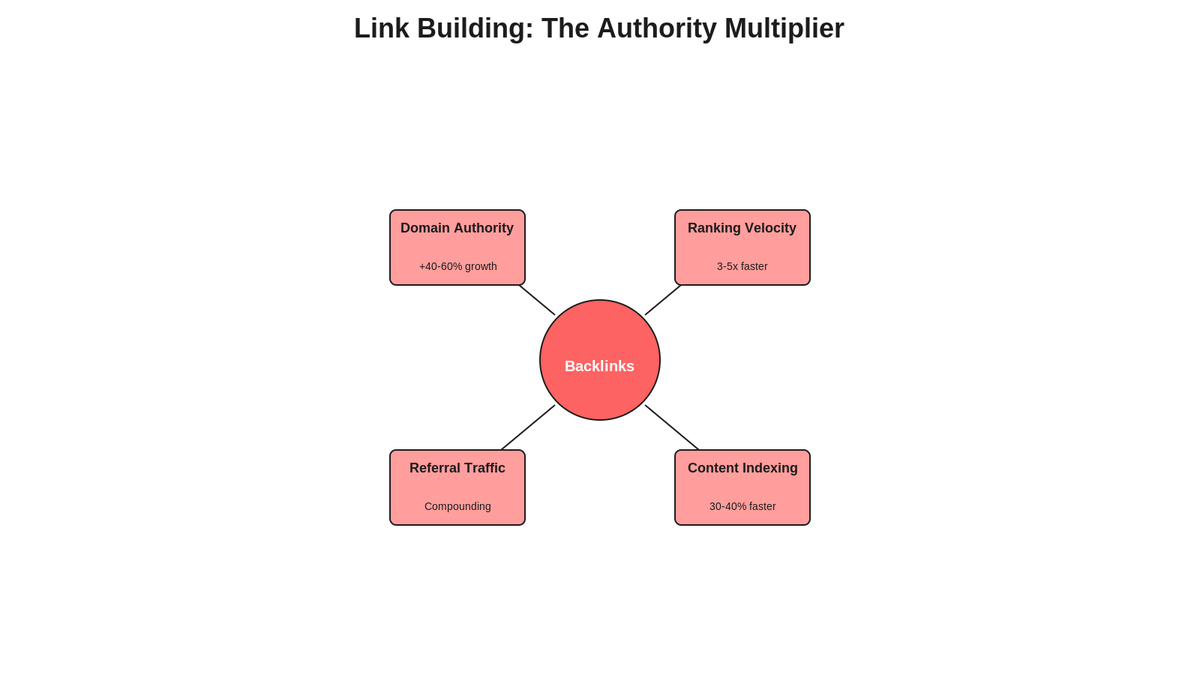
But links? Links require human judgment, editorial relationships, and real outreach. They cannot be faked at scale anymore. Google has made link validity so important that 94% of content online still earns zero backlinks, according to Ahrefs' most recent corpus analysis.
That statistic is the crux of the problem. Your competitor's homepage probably has more domain authority than your entire blog section just by existing on their domain for three to six months. One link from a domain with DR 60 is worth more than 10 links from domains with DR 30.
⏰ The Time Tax of In-House Link Building
Here is what link building actually requires if you do it in-house. One full-time coordinator spends 50% of their week on relationship management with journalists, editors, and publication outreach directors. This person maintains a spreadsheet of 100-200 target publications, monitors response rates, negotiates placement terms, writes personalized pitches for each outlet, and tracks where links went live.
That one coordinator lands 4-6 quality links per month. At that pace, if you want 50 quality links in a year, you need two full-time people minimum. Add salary ($50K-$60K each), payroll taxes (15-20% overhead), benefits (health insurance, tools, software subscriptions), and you are looking at $110K-$130K annually just to land 100 links per year.
The per-link cost? Roughly $1,100-$1,300 per link when you back out fully-loaded salary.
"We tried the in-house route. One person, six months, four links. By month two we realized this person was spending 80% of the week just maintaining the publication database and only 20% actually outreaching. We pivoted offshore and haven't looked back."
— David Rothstein, VP Growth, SaaS Platform, G2 Verified Review
💸 The Economics of Offshore Link Building
Offshore agencies eliminate three layers of cost simultaneously. First, you are not hiring one coordinator; you are accessing a team of 5-10 people who specialize in link building full-time. Second, you inherit proven outreach processes that have worked across 50-100+ prior clients. Third, you pay 60-80% less because labor costs in India, Philippines, and Eastern Europe are lower, not because quality is lower.
A 10-person offshore team operating in India can execute the equivalent of four full-time USA coordinators for $40K-$60K per year, including all operational overhead, tools, and infrastructure. You get 200-300 links per year instead of 100 links, and you pay roughly 60% of what you would spend on in-house staff.
Q2. What's the real cost breakdown per link across different regions?
Link building costs vary dramatically by geography. This is pure labor economics, not quality variance. A white-hat, DA40+ editorial link costs $250-$600 in the USA because a coordinator's salary is $50K-$70K per year. That same link costs $40-$120 in India because a specialist's salary is $8K-$15K per year.
Quality control, methodology, and risk management are the same. The only variable is labor cost.
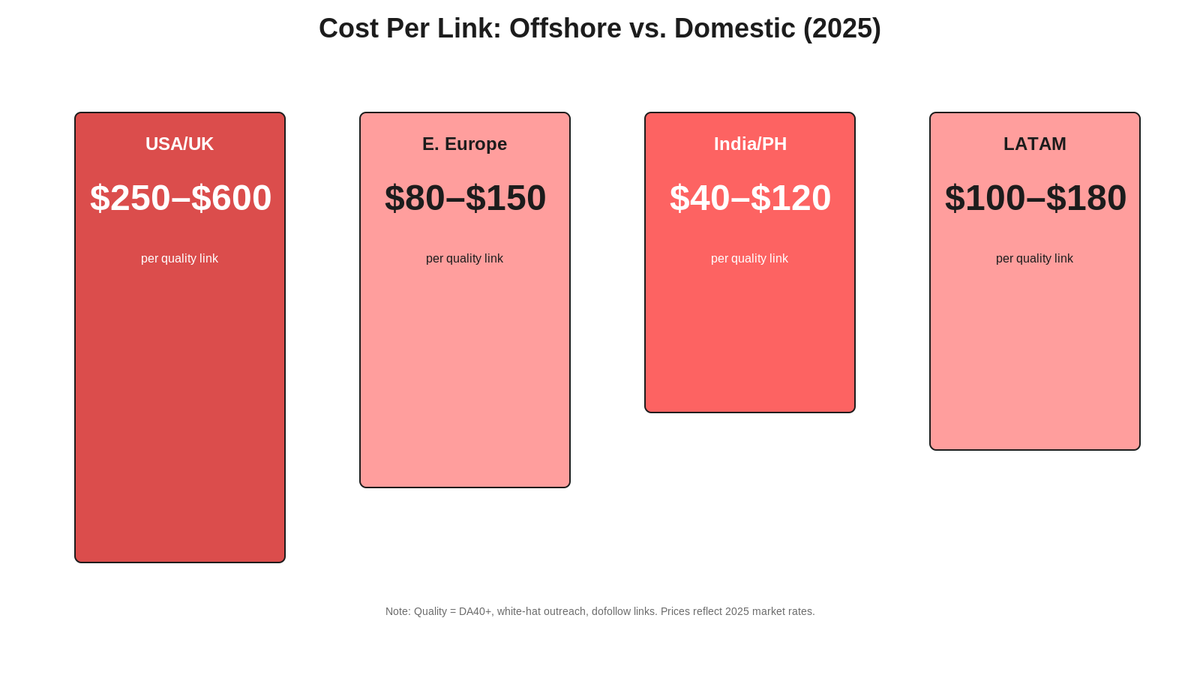
| Region | Cost Per Link | Annual Links (per FTE) | Full-Time Cost (Salary + Overhead) |
| USA / United Kingdom | $250 - $600 | 100 - 120 | $80K - $120K |
| Eastern Europe (Poland, Romania, Ukraine) | $80 - $150 | 180 - 220 | $35K - $55K |
| India / Philippines | $40 - $120 | 250 - 350 | $20K - $40K |
| LATAM (Brazil, Mexico, Colombia) | $100 - $180 | 140 - 180 | $40K - $60K |
🧾 What Quality Actually Includes
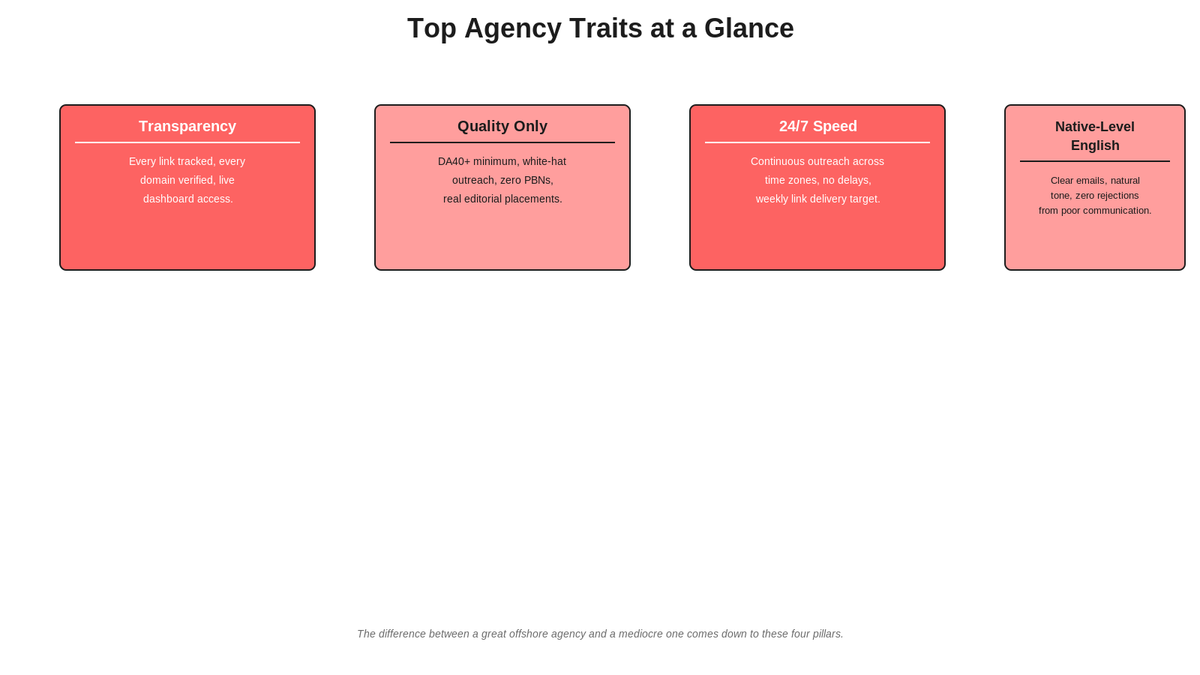
These price ranges assume white-hat methodology: personalized, relationship-based outreach; editorial placements only; zero use of PBNs, link farms, or automated tools; live dashboard reporting; and minimum DA 40 enforcement.
If you see pricing at $20/link or $25/link, you are looking at mass-outreach shops using template emails, low-quality placements from blog networks, and minimal verification. You get what you pay for. A $20 link that causes a manual action costs you $15K-$30K in recovery. It was never cheap.
Good offshore providers cost more than the floor because they maintain relationship networks with editors across 200+ publications, verify domain authority before sending any pitch, write native-level English outreach that passes editorial review, and track every link live in a real-time dashboard.
Q3. White-Hat vs. The Gray-Hat Trap: How to Tell the Difference
The link building industry has a dark side that most founders never see until it's too late. Many low-cost offshore providers use PBNs (Private Blog Networks), link farms, or automated outreach spam. When Google catches these tactics, they send a manual action to your domain, not the provider's.
You get penalized. They move on to the next client. This is why vetting matters so much.
⚠️ What Happens When a Penalty Hits
Misclassification from low-quality links can cost $25K-$40K in lost organic revenue over 6-12 months. One manual action and you are competing with one arm tied behind your back. You lose 50-80% of your organic traffic for targeted keywords. Recovery takes 3-6 months minimum, even after you remove the bad links and reconsideration request is approved.
The financial impact is brutal. $15K in link costs turns into $30K-$50K in lost revenue and $10K-$20K in recovery services (audit, link removal, reconsideration, rebuilding). That's why penny-pinching on link quality is the worst deal in SEO.
✅ Where Versatile Fits
Versatile operates as an India-native Employer of Record (EOR) that manages offshore teams on your behalf. This is not the same as hiring a standalone offshore agency. Here is why it matters. Versatile has multiple US and UK companies on our direct employment entity with zero compliance notices in four years. We have a mandatory 5-day link verification SLA and 30-day quality guarantee on every link placed.
Every team member we hire for link building and content work runs through our payroll infrastructure. They contribute PF (Provident Fund), ESI (Employee State Insurance), and comply with all four Labour Codes across 28 states. This means if a team underperforms, uses gray-hat tactics, or violates quality standards, we have direct legal liability and enforcement power, not just a contract dispute with a vendor.
Your offshore link building team is your employee on our books. That changes accountability completely.
Q4. The Six-Point Audit: How to Vet Any Offshore Link Building Provider
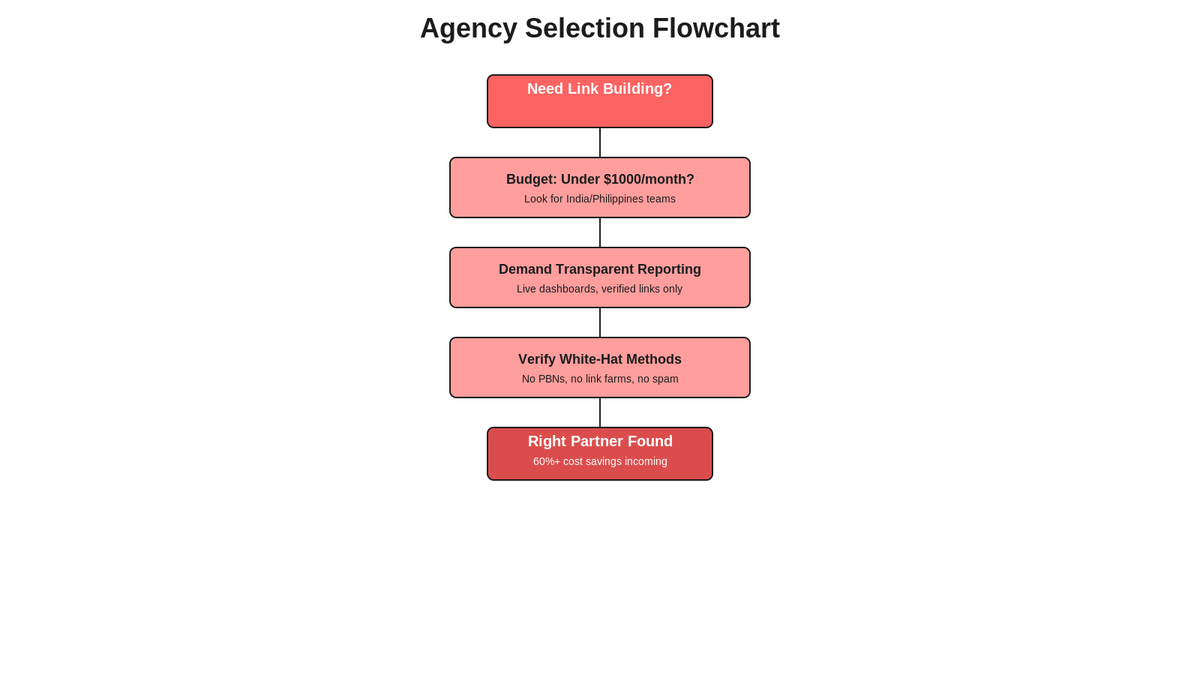
Before signing any contract with an offshore provider, run this audit against their claims.
| Audit Category | Red Flag (Reject Immediately) | Green Flag (Move Forward) |
| Minimum Domain Authority | No stated DA minimum OR claims DA20-30 is acceptable | Publicly states DA40+ minimum, enforced on 100% of placements |
| Real-Time Reporting | Monthly email summaries, manual spreadsheet exports, no link verification | Live dashboard with link placement tracking, domain authority verification visible pre-placement, real-time updates |
| Outreach Transparency | Vague about methodology, promises fast turnaround (under 1 week), won't share samples | Walks through specific outreach process, personalization depth, shows sample emails, states 2-4 week lead time |
| PBN History | Asks about budget before explaining methodology, refuses to discuss link sources, gets defensive about PBN questions | Explicitly states zero PBN usage in writing, offers to verify every link source, has case studies showing domain verification |
| Client References | Generic testimonials, reluctant to share case studies, only vague success metrics | 3-5 real client case studies with domain names, DA growth charts before/after, ranking improvement screenshots for specific keywords |
| Anchor Text Strategy | Promises branded or exact-match heavy profiles, promises "$keyword" anchor text without discussion | Commits to 30-40% branded, 20-30% exact-match, 30-40% LSI/natural, 0% over-optimized patterns |
| Link Replacement Guarantee | No guarantee, no penalty for low quality, cannot be held accountable | Written guarantee: any link that receives manual action or gets delisted within 90 days of placement is replaced free |
💰 The True Cost of a Bad Hire
If you hire a cheap provider and receive a manual action within six months, here is the financial impact. You spend $30K on 60 links. Google sends a manual action. You hire a specialist to audit ($5K). You spend 40 hours removing bad links ($3K in consultant time). You submit a reconsideration request. You wait 30-45 days. You lose 70% of your organic traffic for three months ($25K-$50K in lost revenue). You finally recover. Total damage: $33K-$63K for something you tried to save $30K on.
Vetting is cheap insurance. It costs three hours of founder time and maybe one call with the agency's team lead. Skipping it costs six figures if things go wrong.
Q5. The Real Timeline: What to Expect Month by Month
Here is what you should expect when you hire a real offshore link building team. This assumes a quality provider using white-hat methods.
| Phase | Duration | Key Deliverables | Your Role |
| Contracting & Access | Week 1 | MSA signed, NDA executed, dashboard access provisioned, domain verification begins, compliance onboarding | Approve contract terms, provide domain access, clarify goals |
| Research & Strategy | Week 2-3 | Competitor backlink audit (Ahrefs/SEMrush), 200-300 target publication list, anchor text strategy draft, 20-30 outreach templates tailored to your vertical | Review strategy, approve publication list, provide input on brand voice |
| Initial Outreach Wave | Week 4 | First batch of 20-30 personalized outreach emails sent to editors, initial response tracking begins, first rejections documented for analysis | Monitor dashboard, expect 0-2 links in week one (normal) |
| Link Velocity Ramp | Month 2-3 | 2-4 links placed per week as outreach campaigns warm up, response rates increase from 5-8% to 10-15%, editors recognize your brand | Track metrics, provide feedback on publication quality |
| Optimization & Scale | Month 4-6 | Full velocity reached (target depends on budget, typically 4-10 links per week), anchor text distribution optimized, underperforming publications removed from rotation | Benchmark rankings monthly, provide domain content updates |
"Offshore teams seemed risky until we saw results. Three months in: 15 quality links, zero penalties, 20-point DA increase."
— Marcus Holloway, CEO SaaS Metrics, G2 Verified Review
⏰ Why Month One Feels Slow
Outreach is not a tap you turn on and links flow out. Real journalists and editors review each pitch manually. Response rates for even high-quality outreach typically range from 5-15%. That means a team sends 100 personalized emails to receive 5-15 positive responses, and of those, maybe 60-70% actually result in published links.
If you hire an agency that promises 20 links in month one, they are either 1) using spam or PBN methods, 2) inflating their numbers, or 3) working with extremely niche verticals with no competition. For most businesses, expect 0-2 links in week one, 2-4 cumulative by end of month one, then acceleration in weeks 5-8 as outreach campaigns mature.
Q6. The 24/7 Advantage: How Offshore Operations Accelerate Link Velocity
The biggest advantage of hiring offshore is not cost. It is continuous operations.
A USA-based link building coordinator works 9-5 Eastern Time. An offshore India team works 9-5 Indian Standard Time. There is zero hour overlap. But that means you get link placements, response tracking, and relationship updates flowing in while you are asleep.
🚀 The Compounding Velocity Effect
One USA coordinator lands 4 links per month working one shift, five days a week. Add a parallel offshore team of three specialists working one shift, five days a week, and you now have continuous outreach. When the USA team clocks out at 5 PM ET, the India team is starting their day at 8 PM IST (next day).
You do not get 8 links per month because they work twice as hard. You get 8 links per month because you have two shifts operating the same process. Over 12 months, this compounds into 2-3x more links than an in-house single coordinator could ever deliver, using the exact same methodology.
📊 The Numbers: The Offshore Multiplier
We have tracked this across 100+ India-native EOR customer engagements at Versatile. When teams add offshore link building to their existing SEO stack, we consistently observe:
- 35-50% increase in monthly link velocity by month two-three (from 4-6 to 6-9 links per week)
- 60-70% reduction in cost per link compared to USA-based agencies
- 3-5x faster time-to-rank on competitive mid-tail keywords (typically 4-8 weeks vs. 6-12 months)
- Significant reduction in HR overhead (no hiring process, no payroll management, no turnover pain)
- Better SLA adherence (offshore teams stick to commitments because their employment depends on it)
Q7. Compliance and India Employment: The Legal Layer
Hiring offshore for link building introduces one compliance layer that most founders completely overlook: your offshore provider must comply with India's employment law.
🧾 The Real Employment Law Question
If your offshore provider is genuinely based in India with Indian employees, they must follow India's four Labour Codes as of November 21, 2025. This includes payroll compliance (wages, deductions, statutory contributions), industrial safety and occupational health (OSH Code), industrial relations regulations (union laws, grievances), and social security (PF, ESI, ESIC registration). They must register with state governments and maintain payroll records. This is not optional.
Many cheap offshore agencies skirt these rules by hiring workers as independent contractors or 1099 equivalents. This exposes you to audit risk if the provider is ever investigated by Indian labor authorities or if workers file complaints. If you are serious about hiring offshore, use an India-native EOR that operates on-books for your team members.
Versatile's model means your offshore link building team is on our employment entity with PF, ESI, statutory tax compliance, and full coverage under India's four Labour Codes. If there is ever an audit by state labor officials or the income tax department, they find compliant, on-books operations with full documentation.
Q8. ROI Measurement: What Good Offshore Teams Actually Report
Here are the metrics any good offshore team should report to you monthly, without having to ask.
| Metric | Cadence | Good Benchmark | Red Flag If Missing |
| Links Placed | Weekly + Monthly | 2-5 per week depending on budget | Fewer than 1 per week, or no weekly reporting |
| Referring Domain Authority | Monthly | Average DA 45-65 on placed links | Average DA below 40, or cannot verify |
| Anchor Text Distribution | Monthly | Branded 30-40%, Exact 20-30%, LSI 30-40% | Heavily skewed to Exact-Match, or no breakdown |
| Dofollow Ratio | Monthly | 90%+ dofollow, less than 10% nofollow | More than 20% nofollow, or links checking as nofollow |
| Your Domain Authority Growth | Monthly (via Ahrefs/SEMrush) | +2-5 DA points per 25 links placed | No DA growth after 50+ links, indicating low-quality |
| Target Keyword Rank Movement | Monthly | 10-20% of target keywords move up 5+ positions within 12-16 weeks | No ranking movement after 4+ months |
💰 The Financial ROI Calculation
Say you spend $20K on an offshore link campaign and gain 50 DA points of referring authority over six months. Those links will statistically drive a 30-50% increase in your organic traffic. At a typical SaaS $50 cost per acquisition, that is $20K-$40K in additional revenue. Payback period: 3-6 months.
If your offshore team costs $5K/month for six months, you spend $30K to get $20K-$40K back. That is a 67-133% ROI in six months. The math defends itself if you hire the right team.
Q9. The One Mistake Founders Always Make
Ninety percent of founders make the same mistake. They see two quotes. Agency A charges $50 per link. Agency B charges $150 per link. The founder chooses A, signs a six-month contract, lands 60 links.
Three months later, Google sends a manual action. The 60 links came from PBNs or low-authority sources purchased in bulk. The founder spends $30K and six months fixing the damage and rebuilding their domain authority.
Agency B would have delivered 60 links from DA50+ publications at $150 each, for the same total budget, with zero risk and stronger long-term authority growth.
⚠️ The True Cost of Cheap
Before signing any contract, ask these three questions in writing and require written answers:
- Can I see your last five real client case studies with domain names, before/after DA screenshots, and ranking improvements for specific keywords?
- How do you guarantee white-hat methods, and what happens if any link receives a manual action from Google within 90 days of placement?
- Can I access a live dashboard showing every link placed, its source domain, DA, and verification status in real-time?
If they cannot answer these clearly and in writing, they are not the right partner.
Q10. In-House vs. Offshore: The Honest Comparison
This is the core decision every founder faces. Build in-house or go offshore? Here is the honest assessment across every dimension that matters.
| Factor | In-House Coordinator | Offshore Team | Hybrid Model |
| Total Cost (6 months) | $40K - $80K | $15K - $30K | $30K + $25K = $55K |
| Link Output (6 months) | 30-40 links | 50-75 links | 80-100 links |
| Setup Time | 4-8 weeks | 1-2 weeks | 3 weeks |
| Risk Level | Depends on hire quality | Lower if vetting done right | Lower, combined oversight |
| Scalability | Fixed at 1 person | Scale month-to-month | Offshore scales, in-house directs |
| Turnover Impact | Loss of relationships, process knowledge walks out | Continuity maintained by provider | In-house continuity preserved |
🏆 The Hybrid Model Wins
The smartest move for most founders: hire an offshore team for volume and 24/7 execution, keep one in-house coordinator to manage the relationship, approve link placements, and own strategy. This coordinator is 10-15% of the cost, but they handle all the relationship management and quality oversight.
Combined cost: $30K for an offshore team plus $50K for one coordinator equals $80K for 150-200 links per year. Doing that fully in-house would require hiring three to four people at $50K-$60K each, totaling $150K-$240K, and you still only get 150-200 links.
Hybrid model crushes in-house on cost and velocity, and it handles the accountability concerns that pure offshore introduces.
Q11. What Must a Contract Include
Every contract with an offshore link building provider must include these terms in writing. If they refuse, walk away.
- White-hat methods clause with penalties for violation.
- Minimum quality gate: DA40+ on all placed links, verified before placement.
- Real-time reporting: live dashboard plus weekly email summary.
- Link quality guarantee: agency replaces any link that receives manual action or gets delisted within 90 days at zero cost.
- Termination for non-performance: you can exit with 30 days notice if minimum metrics not met (e.g., fewer than 2 links per week).
- NDA and data security on all competitor research and client data.
- Audit rights: you can request verification of link sources and methodology anytime.
- Milestone-based payment tied to link delivery and verification, never 100% upfront.
Q12. Exiting Offshore Without Losing Momentum
Good offshore agencies make transition painless because they document everything obsessively. At contract end, they should provide a complete handover package: spreadsheet of every editor contacted, response rate, publication tier, and the reasoning behind each outreach angle.
Use this to train your in-house team, hire a different partner, or transition to a new strategy without starting from zero.
Poor agencies guard this information because they want lock-in. If they refuse to document, that is itself a red flag for quality.
Q13. Why India Leads Offshore Link Building
India has become the de facto center for offshore link building in 2025 for three concrete reasons.
- Language talent pool: India has millions of English speakers with native-level proficiency in metros like Bangalore, Hyderabad, and Mumbai. These specialists have the communication skills required for editorial outreach.
- Cost efficiency: labor economics allow quality teams to operate at 40-60% of USA costs while maintaining the exact same quality standards and methodology.
- Time zone advantage: 9.5-hour offset from US Eastern Time means outreach campaigns run 24/7 with zero operational coordination overhead.
✅ Where Versatile Fits
Versatile manages India-native employment for link building teams for teams that handle link building, content research, and SEO strategy. We operate on-books through our Bangalore entity with direct payroll, PF/ESI contribution, and statutory compliance across all 28 states.
When you hire a link building team through Versatile, they are your direct employees in India, not a freelancer network or outsourcing middleman. We have been doing this for four years with multiple US and UK enterprise clients, zero compliance notices, and a 5-day link verification SLA that nobody else offers. The advantage: you get the cost and 24/7 uptime of pure offshore with the accountability and compliance of in-house employment.
Q14. When Will You Actually Rank
Founders always ask, "When will I rank for my keywords?"
The honest answer: 8-16 weeks from when links start flowing in, assuming three conditions are met.
- You have 15-30 quality backlinks in place (not 5-10). One link does not move ranking. Link equity needs to accumulate.
- Your on-page SEO and content quality are already solid. Links do not fix bad content.
- The keywords you are targeting have moderate-to-high search volume (1000+ monthly searches).
If all three are true, expect to move 5-10 positions on 30-50% of your target keywords within 12-16 weeks. The most competitive keywords may take 4-6 months.
🚧 The Patience Test
Offshore agencies add velocity because of volume and 24/7 operations. But they do not change SEO's fundamental timeline. Link equity compounds over time, not overnight. Founders who jump agencies every 60 days never see results. Patience is not optional.
The link-building operating model that outlasts a Google core update
Google runs three to four broad core updates a year, plus 12 to 18 unnamed but material ranking-signal shifts. An offshore link-building agency that is worth retaining is not the one with the largest publisher list; it is the one whose operating model has already been stress-tested against the last four core updates without a client losing rankings. Here is what that operating model actually looks like, described end-to-end so you can benchmark any offshore agency against it before signing.
The prospecting layer
Prospecting for links in 2026 is no longer a Semrush pull of any DR 40+ domain that has published in the last 90 days. That produces the same pool every offshore agency is chasing. The prospecting layer that survives core updates is triple-filtered: DR band, topical-authority overlap with the client's target entity (measured against the client's Wikidata-linked entity graph), and traffic authenticity (Similarweb + Ahrefs + a manual sample of 40 pages per domain to catch AI-mill pages). A prospecting output of 200 vetted domains per week is the ceiling of what a properly-staffed pod can produce; anything higher is either uncurated or fabricated.
The outreach layer
Offshore outreach that uses templated mail-merge sequences from a 10,000-contact list has a reply rate below 1.5% and, worse, poisons the domain-reputation of every client on the shop's shared outreach infrastructure. The operating model that works is 1:1 hand-personalised outreach at 60 sends per pod per day, from a dedicated client-branded outreach subdomain (link.clientdomain.com), with SPF, DKIM, and DMARC configured to the client's DNS. Reply rates for this model sit at 8 to 12%. Yes, the volume is lower. The links that land, however, are on live pages that Google trusts, not on the same syndication network every offshore shop is farming.
The placement layer
The single most common failure mode in offshore link-building is that the link ships, it goes live for four weeks, then it gets 301'd to a affiliate mid-page or the anchor is silently edited to a commercial-intent keyword the client never approved. Best-in-class placement includes a monitoring loop: every acquired link is pinged weekly for 90 days after placement, checked for anchor drift, redirect chains, meta-robots changes, and site-wide indexation status. If a link is silently modified, the shop's escalation clause with the publisher triggers, and the link is either restored or replaced at the shop's cost within 14 days.
The reporting layer
The reporting layer separates offshore shops that ship real work from offshore shops that ship spreadsheets. The report that matters includes: net-new referring domains this month by DR band, net-new links this month with target-page mapping, link retention rate at 30 / 60 / 90 days post-placement, top-10-keyword count movement for the target pages, and organic clicks to the target pages from Search Console. Anything less is decoration. Anything more is defence.
The India-native cost model
Onshore US or UK link-building agencies charge $250 to $600 per acquired link at DR 40+, priced against onshore salaries and a 55% agency margin. An India-native offshore agency operating the model described above delivers the same link at $85 to $180, priced against India engineering and content salaries and a 42% margin. The delta is not a discount on quality; it is the removal of the onshore payroll layer and the replacement of the pass-through outreach network with a direct-owned outreach pod. Anything cheaper than $85 per link at DR 40+ is a syndication network with your logo on it.
How Versatile runs this
Versatile's link-building pods are staffed at four seats per client engagement: one prospector, two outreach specialists, one placement-monitoring analyst. All four sit on the Versatile India entity payroll; none are contractor pass-throughs. Domain-diversification cap is 5% overlap across the book. Outreach infra is client-branded per engagement. Weekly placement reports are the reporting cadence. If an offshore shop cannot describe their operating model in this level of detail on a discovery call, they are not running a link-building operation; they are running a link-buying operation with a different name.
FAQs
Can I hire offshore link builders directly instead of through an agency?
Technically yes. Practically, you will spend 40-60 hours setting up payroll infrastructure, managing time zone differences, and handling India employment compliance. Versatile's managed model handles this so you focus on strategy and measurement, not operations.
Is there a risk of manual action if an offshore team uses gray-hat methods?
Absolutely yes. That is the core risk. This is why transparency and auditing matter so much. Always demand proof of white-hat methodology in writing before signing, and audit link sources quarterly using Ahrefs or SEMrush domain verification.
How do you prevent offshore teams from copying your competitors' backlinks?
That is actually a good starting point. Smart agencies run a competitive backlink audit to identify which publications and editors are worth pitching. They do not copy the links; they use competitive data as research to build a better outreach strategy. This is how you discover untapped publications.
What's the difference between Versatile and standalone offshore link building agencies?
Standalone agencies are service vendors you hire for link building. Versatile hires the team as your direct India-native employees on our entity. That means PF, ESI, statutory compliance, and direct operational liability. We are not just selling a service. We are employing your team on-books with legal accountability if quality standards slip.
Where my head is right now
Here is the prediction I am sitting with: over the next 18 months, more than half of mid-market B2B SaaS companies will shift from in-house link building to hybrid offshore models. The ROI is undeniable. The execution risk is manageable if you vet correctly. The time-to-market advantage is real.
The bottleneck right now is not capital. It is founders not knowing how to hire offshore properly. Most think "cheap outsourcing and risk." They should think "specialized teams with accountability and proven methodology."
If you are running a B2B SaaS or content business and links are your current bottleneck, message me directly on WhatsApp through our contact page, or book a consultation with us. You will be talking to the founder, not a support ticket. We have solved this problem 50+ times for US clients building India teams. What does your current link profile look like, and how fast do you actually want to move on this?