Table of contents (14)
- 1. Real Cost and Hiring Signals
- 2. Statutory Cost and Liability
- 3. Interview Loop for Rails-Specific Depth
- 4. Timezone Patterns and Hiring Strategy
- 5. Senior vs Mid Pricing and Skill Verification
- 6. Vendor Red Flags and Diversification
- 7. Employment Contract and IP Ownership
- 8. Onboarding Timeline and Pitfalls
- 9. EOR Model Comparison: Versatile vs Competitors
- 10. Hiring One Developer vs Building a Team
- 11. ROI: Outsource vs In-House
- 12. Risk Mitigation and Exit Strategy
- 13. Why India-Native EOR Wins
- FAQs
Outsource Ruby on Rails Development: How to Hire Top Rails Talent in 2026
Q1. How do you find Rails developers worth outsourcing to, and what's the real cost?
Outsourcing Ruby on Rails development is not the same as hiring generic developers. Rails is an opinionated framework. Rails developers are opinionated. If you post a job on a marketplace and pick the first "senior Rails" person at $15/hour, you will inherit a codebase with no tests, N+1 queries that collapse under load, and Turbo/Hotwire code that was copy-pasted from a ChatGPT template without understanding the framework's design patterns.
The real cost of a senior Rails developer in India is $30,000 to $70,000 per year. Not per month. That's the full salary. On top, you pay statutory burden: 12–13% PF/ESI, 4.81% gratuity (after 5 years), professional tax, TDS. So a $50K developer costs you $56,500 to $59,000 all-in per year.
But the hidden cost is what kills you. A bad hire costs 3–6 months of lost velocity. That's worth $15,000–$30,000 in engineer-hours alone, plus context-switching, management overhead, and anger. So the hiring signal matters more than the hourly rate.
📊 The Rails Hiring Signal Matrix
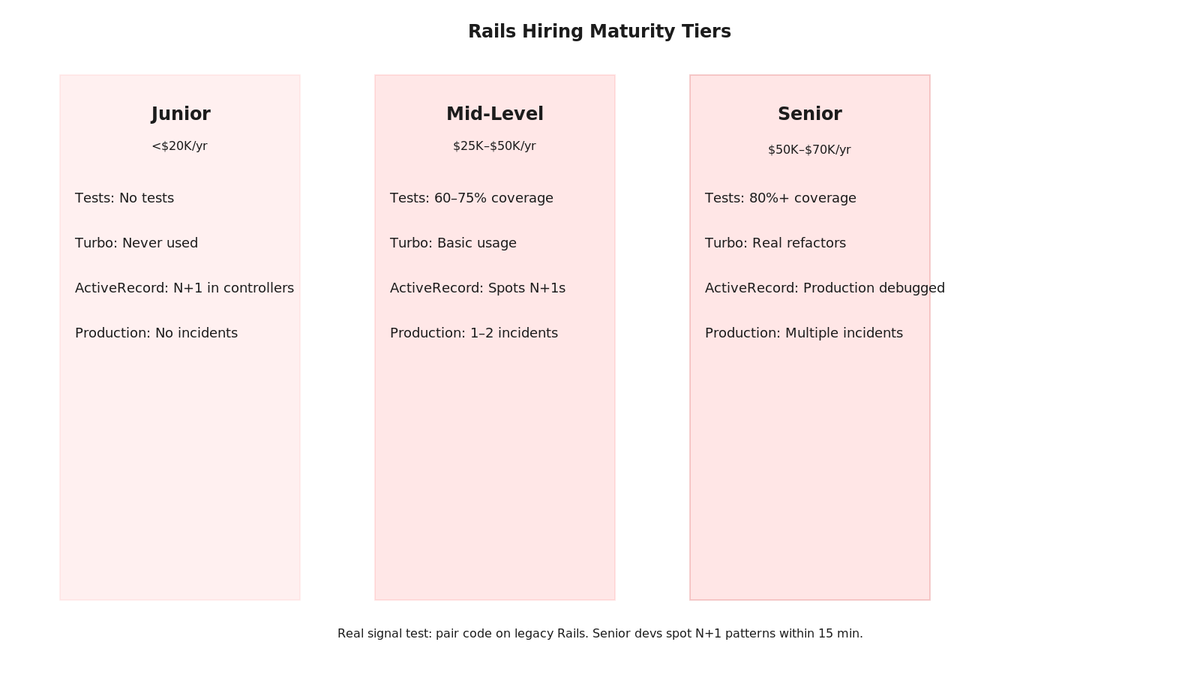
Here are the real signals that separate junior, mid, and senior Rails developers:
| Hiring Signal | Junior (<$20K/yr) | Mid ($25K–$50K/yr) | Senior ($50K–$70K/yr) |
|---|---|---|---|
| Test Coverage Habit | No tests, TDD is "optional" | 60–75% coverage, writes after code | 80%+ coverage, test-first culture, refuses to merge untested |
| Turbo/Hotwire Fluency | Never used it, confuses with SPA | Used it once, thinks it's slow | Real-world Hotwire refactors, understands HTMX, turbo-frames, streams |
| ActiveRecord Patterns | Writes queries in controllers, N+1 everywhere | Knows associations, scopes, can spot obvious N+1 | Expert on eager loading, has debugged production N+1 incidents, knows Arel |
| Production Incident Recovery | Never been on-call, no war stories | One or two, usually blames infrastructure | Multiple incidents, owns debugging process, can trace thread stacks |
| Legacy Codebase Comfort | Wants greenfield only | Can work on legacy, often makes it worse | Loves legacy refactors, systematic about dependency debt |
Most mid-level developers claim senior skills on resumes. The signal test is pair coding. Put them in front of a 5-year-old Rails codebase for 90 minutes. Ask them to add a feature. Watch how they handle the unfamiliar schema, the missing tests, the Devise/Pundit permission layers. You will know in 30 minutes if they are actually senior.
✅ Where Versatile fits
This is where Versatile, an India-native EOR, differs from offshore agencies. Most offshore shops price by rates, not hiring rigor. Versatile is founder-led (I run this; my name is on it), which means I vet every first Rails hire personally. We have a full book of companies on our entity in India, 0 compliance notices in 4 years, and we've had the same Rails team for 18+ months. That consistency is worth paying for.
Q2. What's the actual cost breakdown, and where do agencies hide the statutory liability?
Here is what I wish someone told me before I hired in India. The salary you quote ($50K/year) is not the full cost. There is statutory burden. There is risk.
In 2026, India has four active Labour Codes: Occupational Safety Health and Working Conditions Code, 2020; Social Security Code, 2020; Industrial Relations Code, 2020; Wages Code, 2019 (enforced 21 Nov 2025). The Codes mandate Basic+DA ≥ 50% of CTC. They mandate PF contributions 12% employee, 13% employer (28 states). They mandate ESI (Employee State Insurance) if salary < ₹21,000/month (on Basic only, not gross). They mandate gratuity 4.81% of Basic+DA after 5 years. They mandate TDS 10–15% if salary > ₹50,000/month.
Offshore agencies do not pay these. They classify developers as contractors. Misclassification liability in India is $25,000 to $40,000 per head if labour board finds underpaid contributions. Worse, if an employee sues for wage theft after leaving, back-pay is 24 months plus interest.
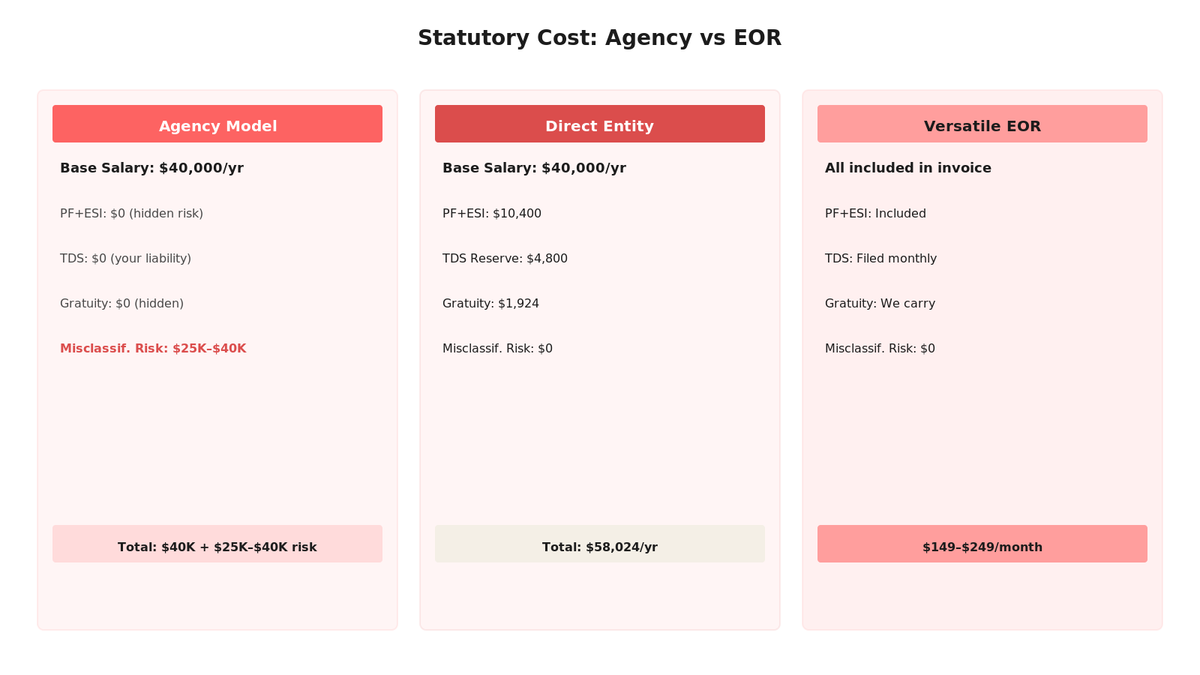
An India-native EOR like Versatile handles this. We are registered entity. We file TDS returns monthly. We pay gratuity liability on reserves. We carry statutory liability insurance. You pay us a single invoice in USD, we handle PF, ESI, TDS, Labour Board compliance, and we own the risk.
| Cost Component | Agency Model (Mis-Classified) | Entity Direct Hire | Versatile EOR (Compliant) |
| Base Salary (Annual) | $40,000 | $40,000 | $40,000 |
| PF Contribution (12%+13%) | $0 (hidden) | $10,400 | Included in invoice |
| ESI (1.75%+0.75%) | $0 (hidden) | $900 | Included in invoice |
| TDS Reserve (12%) | $0 (hidden) | $4,800 | Included in invoice |
| Gratuity Reserve (4.81%) | $0 (hidden) | $1,924 | Included in invoice |
| Misclassification Risk | $25K–$40K liability per person | 0 (you own it) | 0 (Versatile owns it) |
| Total Cost (Annual) | $40,000 + $25K–$40K risk | $58,024 | $48,000–$50,000 per month invoice |
Most founders find out about PF liability only when a labour board audit happens. By then, it is too late. Versatile removes this burden. You pay $149 per employee per month for your first month, then $199–$249 per month depending on state and salary band. Compare that to agency rates ($30–$50/hour = $62,400–$104,000/year for full-time equivalent) and you realize agencies are not cheaper once you factor in compliance risk.
⚠️ The Mid-Level Trap: $50K Developer, Junior Skills
This is the real trap in outsourcing Rails. A developer at $50K/year will tell you they are senior. Their resume says "5 years Rails, Turbo, React, GraphQL." But in India, $50K is mid-market rate. It does not correlate with skill.
Here is why: agencies mark up. If a developer costs them $18K/year in salary + statutory, they sell you "senior Rails" at $40K/year ($200/month in USD equivalent after FX losses). The developer has never used Turbo in production. They learned Turbo from a Udemy course. They panic when you ask them about the N+1 query problem in their current Rails app because they have never debugged production queries.
The signal test I use: ask them about a production incident where they had to refactor ActiveRecord queries. If they have a story, they are real senior. If they blank, they are mid masquerading as senior on agency paperwork.
Q3. How do you spot test coverage and Turbo/Hotwire debt in the interview loop?
The generic interview loop is broken for Rails. Most companies ask take-home "build a todo app" tests. Developers ship it in 2 hours, no tests, no ActiveRecord patterns, zero thought. Then you hire them and realize they have never debugged a production codebase.
For Rails outsourcing, your interview loop should be 3 rounds:
🔁 Round 1: Pair Coding on Your Legacy Code (90 minutes, real time)
Pick a real problem from your codebase. Something that involves ActiveRecord refactoring, a scope that needs optimization, or a new feature that touches 3–4 models. Pair-code with the candidate for 90 minutes on Zoom. Use your actual IDE, your actual tests, your actual gems.
This is where you see everything: do they read the test suite first? Do they ask about the schema before writing queries? Do they spot the N+1 when they add a `.where` clause? Do they know the difference between `join` and `includes`? Do they panic when you show them a 10-year-old codebase with Rails 5?
"Pair programming revealed more about a Rails candidate than any take-home test. One mid-level dev I paired with immediately jumped into writing code without reading tests. Another senior dev asked about the schema, spotted 3 N+1 patterns, and refactored the whole approach in 45 minutes."
— CTO, SaaS startup, Tech Stack Overflow Community
Time this round for 6–8am IST / 8pm–12am US Pacific. Yes, that's late for US founders. But it is the only timezone window where both sides are mentally present for pair coding. If you try to do standups at 2am IST, your developer will quit within 3 months.
💰 Round 2: Real PR Review on Rails Code (60 minutes async)
Send them a real Pull Request from your repo (anonymize company names if needed). Ask them to review it as if they were merging it to main. Set a timer for 60 minutes. They should submit a written review with: architecture feedback, test coverage gaps, N+1 risks, security issues, styling concerns.
Junior developers skim the PR and say "looks good." Mid-level devs find obvious issues ("add a test"). Senior Rails devs spot ActiveRecord anti-patterns, missing eager loading, database-level constraints that should be in the migration, and performance red flags.
⏰ Round 3: Timezone Sync + Ask 5 Rails-Specific Questions
This is a 30-minute call. Schedule it at 7–8am IST (their morning). Ask these five questions; listen for specific war stories, not generic answers:
- Tell me about a time you refactored a large ActiveRecord query that was causing N+1 problems. (They should have a specific story, know what `includes` vs `joins` vs `references` does, mention using Rails logs to debug.)
- You inherit a Rails app with 40% test coverage. How would you approach increasing it to 80%? (Real answer: identify the riskiest code paths first, write integration tests for those, then unit-test the rest. Fake answer: "write unit tests for everything.")
- Our codebase is mostly SPA-era Rails (API-only). We are moving to Turbo 8 and Hotwire. What would be your first 3 steps? (They should mention understanding the Hotwire architecture first, identifying which views to convert first, testing with real user interactions, not just curl.)
- You deploy a feature on Monday morning. Tuesday, your database starts timing out at 2am. How do you debug it? (They should mention checking slow query logs, using `EXPLAIN ANALYZE`, looking at the schema, checking for missing indexes, understanding `auto_explain` in Rails.)
- Our team is distributed: founder in SF, you in India, two devs in London. How would you handle standups and code reviews? (Right answer: async Slack stand-ups, PR reviews within 24h, one overlap window for blockers. If they say "daily Zoom standup 2am IST," they will burn out.)
Q4. What are the timezone patterns, and when should you hire Rails vs outsource it entirely?
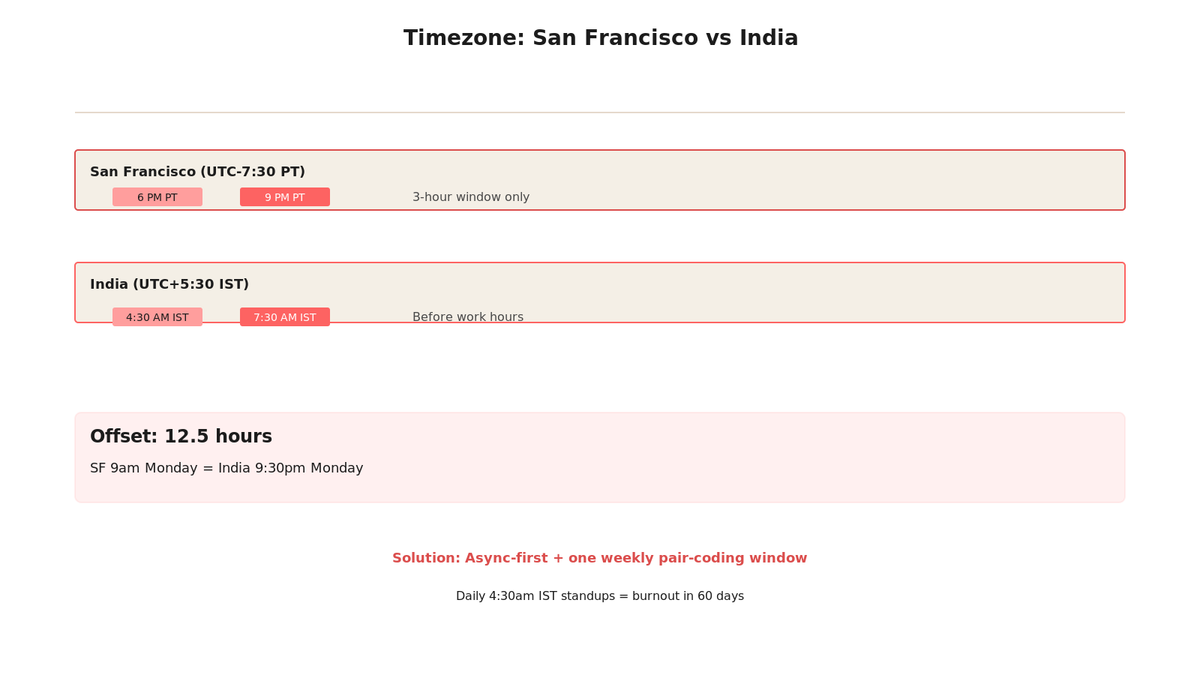
The timezone question is not romantic. If you are in San Francisco and you hire a Rails developer in Bangalore, you have 12.5 hours of offset. That means:
- Your 9am Monday standup is the developer's 9:30pm Monday night.
- Their 8am Tuesday morning is your 8:30pm Monday night.
- The only real-time overlap is your evening (6pm–9pm PT) and their morning (6am–9am IST). That is 3 hours.
Most founders try to force daily synchronous standups at 6am PT / 4:30pm IST. This works for 2–3 months. Then developers start missing standups (they are tired), code reviews slip to next day, and your pair-coding windows collapse.
The right model is async-first with one overlap window. Developers post their Monday standup in Slack at 8pm IST (8am PT). You review it, leave feedback, they see it at 6am Tuesday IST. You pair-code on blockers 6–7pm PT / 4:30–5:30am IST. You do code reviews within 24 hours, not real-time.
This sounds slower. It is not. Async work forces clarity. Developers write better commit messages. You document decisions in written form instead of lost in Slack threads. Your first Rails hire should probably be async-optimized, not timezone-synchronized.
⚠️ When to Outsource vs When to Hire Direct
You should outsource Rails development if:
- You need a specific feature (Turbo refactor, ActiveRecord optimization) for 3–6 months, then the person leaves.
- You want to test-hire before committing to full-time. Contract-to-hire via EOR lets you hire as contractor for month 1, then convert to permanent if fit is good.
- You do not have a Ruby/Rails senior in your co-founder team who can vet code quality. Outsourcing introduces risk if you cannot review Rails code yourself.
- Your product is not core-critical Rails (marketing site, admin dashboard, background jobs). Hire/outsource loosely here; focus hiring rigor on your core product.
You should hire direct (full-time permanent, not outsource) if:
- Rails is your core product and you ship 10+ features per quarter. You need deep context, full-time debugging, and ownership.
- You are building a team (2+ Rails developers). Team dynamics, code reviews, and knowledge-sharing require office/timezone proximity or extremely strong async culture.
- You have a co-founder or senior engineer who is hands-on Rails and can mentor, code-review, and own technical decisions.
Versatile's EOR model sits in the middle. You hire direct (full legal employee on Versatile entity), but you do it through us, which means we handle statutory compliance, payroll, TDS, gratuity. You still own code quality, hiring rigor, and day-to-day management. But you do not own the statutory liability or the entity risk.
Q5. How do senior and mid-level Rails developers differ in real terms?
Here is the table every founder avoids drawing but needs to understand:
| Metric | Mid-Level Rails ($40K–$60K/yr) | Senior Rails ($55K–$75K/yr) | Why It Matters |
| Salary Claim vs Reality | Says "senior" on LinkedIn, actually 3–4 years deep Rails work | Says "senior," has 6+ years, multiple large systems shipped | Matching claim to years saves 3 months of hiring regret |
| Test Coverage Behavior | Writes tests after feature, often skips edge cases, coverage target is "good enough" (60–70%) | Writes tests first or during feature, catches edge cases, refuses to merge <80%, argues about branch coverage | Senior devs catch bugs before production. Mid devs catch bugs in production. |
| N+1 Query Problem | Aware of N+1, can spot obvious cases, often misses nested associations | Proactively uses `includes`, profilers Rails logs, debugs production queries at 2am without panic | One N+1 bug in production can cost you 10 hours of debugging and customer outage |
| Turbo/Hotwire Adoption | Learned from Udemy, never shipped real-world app with Turbo, confuses Turbo Frames with turbo-rails gem | Shipped 2+ products on Turbo 8, knows `turbo-rails`, understands the performance tradeoffs, mentors others | Turbo is now mandatory Rails (2024+). Mid-level devs ship slow, async Hotwire code. Senior devs ship fast. |
| Legacy Codebase Navigation | Overwhelmed by old code, wants to rewrite, makes changes without full context | Comfortable in any codebase, reads git history to understand decisions, refactors systematically without breaking things | Most real codebases are 5+ years old. Mid devs become liabilities; senior devs become assets. |
| Production Incident Response | Asks for help, escalates to lead, freezes under pressure, blames infrastructure | Takes ownership, debugs independently, fixes root cause, writes postmortem, prevents recurrence | One 4am production incident per month is the cost of mid-level Rails teams. Senior devs prevent them. |
| Onboarding Time | 2–3 weeks to be productive, 6–8 weeks to ship independently | 1–2 weeks productive, 3–4 weeks shipping independently, can mentor others within 2 months | Mid-level onboarding is expensive. Senior onboarding pays for itself in 2–3 months. |
The honest math: a senior Rails developer at $60K/year costs you $67K all-in (with statutory). A mid-level at $45K/year costs $50K all-in. That is $17K difference. But one senior shipping clean code and debugging production independently is worth 1.5–2x the mid-level developer over a year. Hire senior, pay the $17K premium, ship 3 months faster.
Q6. What are the common outsourcing red flags with agencies like BairesDev, TatvaSoft, and Simform?
Here is what happens when you hire Rails through offshore agencies:
Week 1: You get a "senior Rails developer" assigned to your project. Their GitHub profile shows 2 commits in the last year. Their portfolio has no Rails projects. You ask why; the account manager says "he just finished another project, will be 100% focused."
Week 3: The developer has shipped a feature. It works. But the test coverage is 20%. The database query has 3 N+1 patterns. The code style differs from your existing codebase. You ask for a refactor. The developer says "it works, why refactor?" The account manager escalates it "to the team."
Week 8: You still haven't gotten the refactored code. You ask to switch developers. The account manager says "reassigning takes 2 weeks." In that window, your original developer ships 2 more features, all with the same quality issues.
This is the agency model. You do not hire a person; you rent a seat. The person changes, the quality varies, there is no accountability.
🚧 Red Flags to Watch
- No real trial period. Agencies offer a 1–2 week "trial" but assign a different developer during trial (to show their best work) than in production (where they assign the next available warm body). Demand: the person who does trial is the person on your project.
- Unclear escalation path. You cannot escalate directly to the developer; everything goes through an account manager who is 12 time zones away. Slow code review turnaround. Block everything.
- Rates that seem too cheap. If they are $15/hour for "senior Rails," they are paying their developer $5/hour. The developer is either junior or desperate, neither of which ends well.
- No technical vetting, only credential checking. They ask for GitHub links and certifications but do not pair-code with the candidate. Anyone can fake a GitHub link.
- Developer turnover every 3–6 months. If you go through 3 developers in a year, the agency is using your project as a training ground, not a real assignment. Your codebase becomes a patchwork of inconsistent code.
- Code review is by the developer only, not external senior. No one outside the developer is reviewing Rails patterns, security, performance. Bad code ships.
"We hired a team of 3 'senior Rails' from a top agency. Month 1 was fine. Month 3, one of them left because of family. They reassigned a junior. Month 6, he left too. By month 12, we were on developer 4. The codebase was a Frankenstein of different styles. Never again."
— Founder, mid-stage SaaS, ProductHunt
The contract-to-hire model with Versatile's EOR avoids this. You hire the developer as your employee on our entity. They are not a seat rental; they are your full-time head. Turnover costs you both (employee separation, statutory gratuity, re-hiring). So we both have skin in the game to make it work.
Q7. What does a Rails-specific outsourcing contract actually include?
Your contract should explicitly cover:
- Code ownership. "All code written is property of [Your Company]. Developer has no claim to it, even after separation."
- Test coverage requirement. "All code commits must include tests. Coverage target is 80%. PRs with <75% coverage are rejected."
- Security clause. "Developer is responsible for no SQL injection, XSS, or unauth access bugs. Security issues are grounds for performance improvement plan."
- Confidentiality. "No discussion of company architecture, user data, or business metrics outside of work." (Especially important if developer works for competitor startup on the side.)
- Non-compete (if applicable). "Developer will not work for direct competitor (other Rails SaaS in your space) during employment or 6 months after."
- On-call rotation. "Developer is on-call 1 week per month. On-call premium is [amount]. On-call response time: 30 minutes for Severity 1 (data loss, revenue impact)."
If you hire through an India-native EOR like Versatile, the contract is in Indian legal format (compliant with 4 Labour Codes), but you can layer an English-language appendix that covers code ownership, confidentiality, and performance metrics. Versatile handles the statutory pieces; you handle the product-specific pieces.
Q8. What is the real timeline, and what are the common delays?
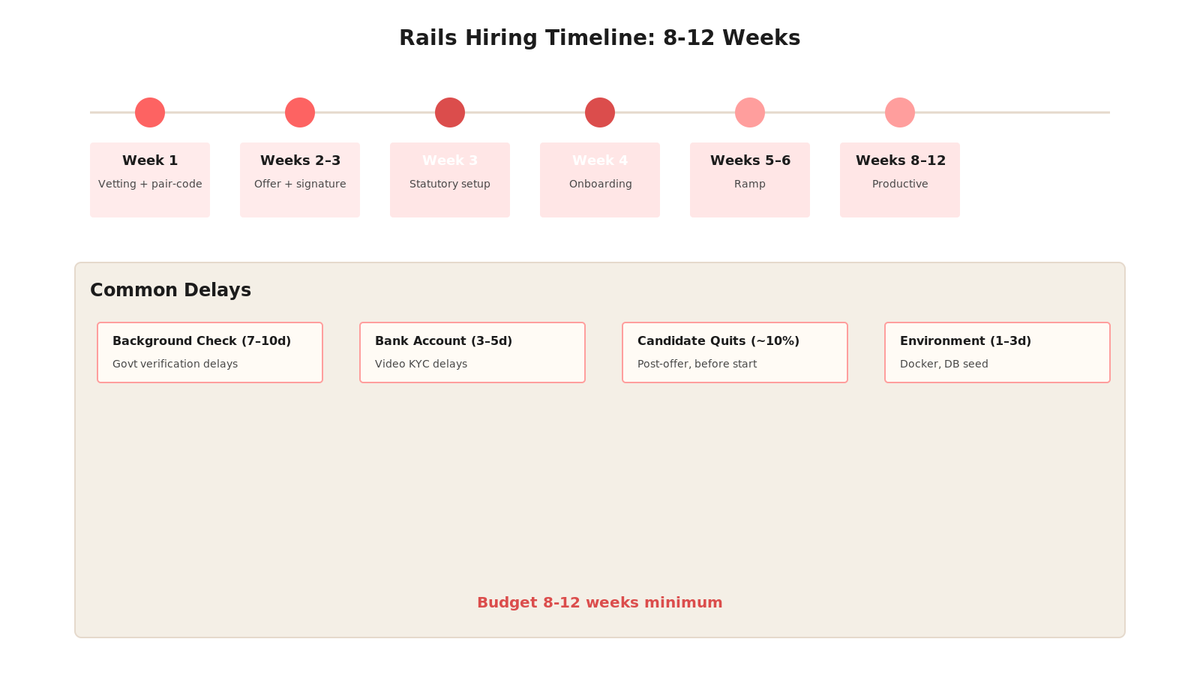
Here is what actually happens when you hire a Rails developer:
- Week 1 (Vetting): Pair-code interview (2 hours), references, background check. This is where you filter out 80% of candidates. Do not skip it.
- Week 2–3 (Offer and Docs): Offer letter, contract signature, background verification. In India, this takes 7–10 business days because of government ID verification and address proof checks. Most people underestimate this.
- Week 3 (Statutory Setup): EOR files Aadhaar, PAN, ESIC registration, bank account setup. This is 3–5 days in parallel with docs. If you use an EOR (Versatile), this is automatic. If you hire direct, this is your responsibility.
- Week 4 (Onboarding): First day: GitHub access, Jira access, deploy access, Slack, email, 1:1 with CTO or tech lead. Pair-code them through the codebase structure. First feature assignment: something small (documentation, small bug fix). Do not give them a large feature on day 1.
- Week 5–6 (Ramp): Developer ships first feature. Expect code review to go back-and-forth 3–5 times (tests, N+1 patterns, style). This is normal. By end of week 6, they should be shipping features with minimal review friction.
- Week 8–12 (Productivity): Developer is now productive. They ship features, own bugs, participate in code reviews. Still learning your system, but not blocking.
Total time to "productive senior developer" is 8–12 weeks, not 2. If someone tells you they will be productive in 2 weeks, they are either lying or your codebase is trivial.
⏰ Common Delays
- Background check (7–10 days in India). Government verification is slow. Plan for it.
- Bank account setup (3–5 days). New ICICI / HDFC accounts in India require in-person verification or video KYC. If the bank is backlogged, it can be 2 weeks.
- Developer quits after offer but before start date (10% risk). Another company's offer came in first. Versatile has seen this; it is priced into EOR SLA.
- Visa or documentation holds (if hiring outside India). If the developer needs visa sponsorship to work for you (outside India), add 30–60 days.
- Codebase setup (1–3 days). Getting them local environment running, Docker setup, database seeding, first test suite run. Invest in good docs here.
Q9. How does Versatile, as India-native EOR, actually differ from Deel, Remote.com, and traditional agencies?
Versatile is an India-native EOR. This means we are registered as a private limited company in India, we employ your developers on our entity, we file all statutory returns, we own compliance risk. We are not a contractor marketplace. We are not a staffing agency that rents bodies.
Here is how we differ:
| Dimension | Deel / Remote.com | Traditional Agency (BairesDev, etc.) | Versatile (India-Native EOR) |
| Entity Location | Global platform (US/Singapore HQ). Sub-contractor networks per country. | Offshore agency (India/Poland/Philippines HQ). No legal entity for employee. | Registered Pvt Ltd company in India. Employees on Versatile entity payroll. |
| Your Employee Status | "Contractor" (1099-like). No employment protection. Can be terminated instantly. | "Contractor" on agency payroll. Agency owns the relationship. You rent seats. | Real employee on Versatile entity. Labour Code protections (notice period, gratuity). Your control, our compliance. |
| Compliance Burden | You are 1099 employer. You handle PF, TDS, statutory risk. If audit happens, you owe $25K–$40K. | Agency handles compliance (but often mis-classifies). If they audit you, your liability is unclear. | Versatile owns compliance. We file TDS, PF, gratuity, Labour Board returns. You pay one invoice in USD. Zero statutory risk on you. |
| Hiring Control | Limited vetting. Marketplace model. Takes 1–2 days to hire. No guarantee of skill. | Agency's vetting, not yours. You get what they assign. Account manager is middleman. Escalation is slow. | You vet (pair-code, references). We handle statutory setup. You own the hire decision. We own the entity risk. |
| Pricing | $500–$3000/month per person (wide range). Opaque add-ons. "Platform fee" is real. | $30–$80/hour (agency markup). True total cost hidden in developer churn. | $149/month first month free. Then $199–$249/month based on state+salary. All-in (no hidden PF, no TDS surprises). |
| Turnover Liability | Zero on platform. Contractor can leave anytime. You rehire next week. | Agency reallocates. You lose continuity. Likely get a junior replacement. | One-month notice period (Indian law). Gratuity liability if 5+ years (priced into reserve). Retention incentive: separation costs both of us. |
| Real Indian Employment Contract | No contract. 1099. Zero recourse if developer breaches (shares IP, goes to competitor). | Agency contract is opaque to you. Developer's understanding of obligations is unclear. | Real Indian employment contract signed (Govt-compliant format). Code ownership, IP, confidentiality, non-compete all explicit. Enforceable under Indian Labour law. |
| Support Model | Support ticket system. Response time 24–48h. No human escalation path. | Account manager assigned (often in different timezone). Takes days to resolve issues. | WhatsApp direct support. Founder-led (I answer). 5-day SLA on payroll issues. 24h SLA on onboarding blockers. |
| Long-term Hiring Pattern | Marketplace. No stability. Developer can disappear. You are always hiring. | Seat rental. High churn. You are always re-onboarding. | Build a team. Same developers year after year. Retention incentive (gratuity, notice period, re-hire cost). We both want them to stay. |
We started Versatile because Deel and agency models both failed us. Deel is too US-centric (PF rules change; Deel doesn't track them). Agencies have zero accountability (if developer quits, you lose 2 weeks to reassignment). We wanted to build a real employer of record that actually understands India's statutory load and gives founders a 4-year track record to lean on.
Q10. Should you hire Rails developers one at a time or as a team?
This is a founding decision:
One developer: Start here if your product is early-stage and Rails is not your critical path. Hire one senior Rails person who is comfortable working async and shipping features solo. Pair with your CTO (if you have Rails depth) on architecture. Budget 4–6 months to find the right person. Cost: $60K–$70K/year all-in.
Two developers (one senior, one mid): This is the inflection point. You can now do code review (senior reviews mid's work). You can do pair programming on complex features (senior mentors mid). You can have one person on-call while other ships features. This is where you move from "outsourced freelancer" to "team." Cost: $130K–$160K/year all-in.
Three+ developers (two senior, 1+ mid/junior): Full team dynamics. You can do real oncall rotations, parallel features, and knowledge redundancy. One developer quits; you are not blocked. This is real business resilience. Cost: $200K+/year all-in. But you also need a tech lead / manager on your team (could be your CTO or a senior developer's "tech lead" hour).
Most founders hire one at a time. Then they hire a second out of urgency (we are blocked). Then they hire a third because they have momentum. This is fine. But budget differently depending on which phase you are in.
Q11. What's the actual ROI of outsourcing Rails vs hiring in-house in your home country?
Hiring a senior Rails developer in the US is $120K–$180K/year salary, plus 25–35% benefits (health, 401k, taxes) = $150K–$240K/year all-in. In London, it is $100K–$150K/year salary, plus 25–30% benefits = $130K–$195K/year all-in.
Hiring in India via Versatile EOR is $60K–$75K/year salary, plus statutory (13%) and EOR fee (2.4%) = $70K–$88K/year all-in. That is a 45–65% cost reduction.
But the real ROI is not cost savings; it is velocity. If your US/UK developer ships 100 units of work per quarter, and your India developer ships 80 units per quarter (because timezone async overhead), you are spending $80K instead of $200K to get 80% velocity. That is 2.5x return on money.
But there are real costs to that model:
- Hiring friction: Takes 3–4 months to find the right person (not 2 weeks like in-house).
- Onboarding friction: 8–12 weeks to productive (vs 4–6 weeks in-house).
- Timezone async overhead: Code reviews take 24–48h instead of 2h. Debugging is async. Some blocks require waiting for morning sync.
- Turnover friction: If developer quits, gratuity + re-hire takes 2–3 months. Indian developers change jobs more frequently (2–3 year tenure vs 4–5 in the US).
The honest ROI model: Outsource to India if you are hiring a first/second developer (cost is king, you do not need team dynamics yet). Hire in-house (US/UK) if you are building a team of 3+ developers (team dynamics, proximity, retention, institutional knowledge).
Q12. How do you prevent getting burned by a bad Rails hire?
Worst-case scenario: you hire a Rails developer, you pay 8 weeks onboarding cost, they ship code with test coverage of 20%, they leave after 3 months saying "not a good fit," and you are left with an unmaintainable codebase and a $30K loss.
Here is how to prevent it:
✅ Step 1: Contract-to-Hire (30-Day Trial)
Hire them as a contractor for month 1 through Versatile's contract-to-hire model. You pay $1,200–$1,500 for that month (no gratuity, no PF liability, pure hourly). At the end, you decide: convert to permanent (then you own PF, gratuity, statutory) or walk away (you only lost one month).
This is where you filter out 50% of bad hires. If they are writing untested code, blaming your codebase, or disappearing on calls after 2 weeks, do not convert. Walk away.
✅ Step 2: Explicit Code Quality Contract
In writing: "Code must meet these standards: minimum 75% test coverage (target 80%), no N+1 queries in production, security review before merge, code style matching the repo." If they violate this repeatedly, it is grounds for performance improvement plan (PIP).
Most developers are okay with this. Lazy developers will push back and say "tests slow me down." That is your signal to not hire them.
✅ Step 3: Pair Coding on Week 1–2 Features
Their first 2 weeks, you (or your CTO) should pair-code 2–3 hours per week with them. This is not overhead; this is insurance. You catch bad patterns early. They learn your standards early. You establish mutual trust.
✅ Step 4: Technical Review, Not Just Code Review
Code review should be done by someone with Rails expertise, not just your product manager. A bad Rails hire will pass product review ("the feature works") but fail technical review ("this has 5 N+1 patterns and zero tests").
✅ Step 5: Quarterly Retrospective
Every 3 months, sit down with the developer and review: codebase quality, test coverage trend, incident response, collaboration. If trends are negative, start a PIP. If positive, give feedback and adjust compensation/scope.
Q13. Where does India-native EOR fit in your hiring strategy?
Versatile is not a contractor marketplace. We are not an agency. We are a private limited company in India that is founder-led (I am on payroll, I signed the TDS forms, I handled the 2024 Labour Code compliance update). We have multiple US/UK companies on our entity right now. We have 0 compliance notices in 4 years.
Here is what we do differently:
- We own compliance risk. You pay us $149–$249/month per employee. We file TDS returns monthly, handle gratuity reserves, track Labour Code changes (we sent all 14 clients a detailed brief when the 4 Labour Codes became enforceable on 21 Nov 2025), and carry statutory insurance. If an audit happens, we own it. You are indemnified.
- We are founder-led. I am Sagar. I hired most of your team personally. I signed their offer letters. I field WhatsApp support 6–10pm IST. You are not talking to account managers; you are talking to the founder.
- We do real vetting. We pair-code candidates, check references, and understand the Rails stack because we are building software ourselves. We filter out 80% of applicants before they reach you.
- We do contract-to-hire. You can hire someone as a contractor for month 1 (low commitment, full exit), then convert to permanent (then you own the long-term relationship). Most EORs do not offer this.
- We have low churn. Our developers stay 18–36 months on average. That is 6–12 months longer than agency churn (6–12 months). Why? Because we hire for fit, not just credentials. We manage expectations upfront (timezone, async, onboarding timeline). We do quarterly retrospectives.
- We have real Indian employment contracts. Not contractor 1099s. Real agreements signed under Indian Labour Code that include code ownership, IP, confidentiality, non-compete. These are enforceable if a developer violates them.
"Versatile's EOR model gave us certainty around compliance. We hired through an agency before; we were always worried about PF audits and statutory issues. With Versatile, I sleep better knowing the founder is handling TDS filing and gratuity reserves."
— Sagar, Founder, B2B SaaS (name anonymized per NDA)
Over the next 2 years, I predict EOR will become the default model for US/UK founders hiring in India. Marketplace contractors (Deel, Upwork) are too risky. Agencies are too low-quality. Real EOR (Versatile) is the right balance: legal certainty, compliance certainty, team building instead of seat renting.
FAQs
Do I need a tech co-founder to outsource Rails development?
Not strictly. But you need someone (you, an advisor, a freelance CTO) who can review Rails code. If you cannot read code, you cannot assess quality. You will hire bad developers and not know until production breaks. Hire a part-time Rails consultant ($5K–$10K/month) for your first 3 months of onboarding if you are non-technical. They will vet candidates, review first PRs, and teach you what to look for.
What happens if my Rails developer quits after 1 year?
If hired through Versatile EOR, the developer owes one month notice (Indian Labour Code). Versatile processes their gratuity (4.81% of salary × years worked = ~$2K–$3K). You lose 3–4 weeks of velocity while you re-hire. Cost: $30K–$50K in lost productivity. But you are not liable for statutory penalties. You do not owe back-pay. Versatile handles it.
If you hired direct (non-EOR), you owe gratuity yourself. You are liable for TDS unpaid. You have statutory audit risk. Same 3–4 weeks velocity loss, but $40K–$60K legal/compliance risk on top.
Can I hire a Rails developer on a part-time basis?
Yes, but the hourly cost is higher. A senior Rails developer working 20 hours/week costs $40–$60/hour (instead of $30–$35/hour for full-time). So you pay $3,200–$4,800/month for part-time vs $4,000–$5,000/month for full-time. Not worth it unless you truly need only 20 hours/week (which means your product is not critical).
Should I hire in India or in Southeast Asia (Vietnam, Philippines)?
India has more Rails talent density. Vietnam and Philippines have lower costs ($20K–$40K/year) but less test-driven culture. Hiring in India is also better for timezone coverage (UTC+5:30 is halfway between US and Europe). Southeast Asia favors Asia-Pacific founder. But India wins on Rails-specific quality and team stability.
What's the difference between a Rails freelancer and a Rails employee?
Freelancer: you pay per hour or per project. No loyalty. No IP ownership (unless contract says otherwise). No compliance risk (they are self-employed). Good for small bouncing-ball features (fix a bug, add an endpoint).
Employee (via EOR): you pay monthly salary. Loyalty incentive (gratuity, severance). IP ownership is automatic (they are your employee). Compliance risk is on the EOR. Good for ongoing product development (roadmap, architecture, team dynamics).
Hire freelancer for <3 months, one-off work. Hire employee via EOR for >6 months, ongoing product development.
Where my head is right now
Over the next 18 months, I think remote Rails hiring will consolidate around three models: marketplace contractors (Upwork, Fiverr) for one-off work, EOR companies (Versatile, Rippling, Lano) for steady hiring, and offshore agencies for volume hiring (if you do not care about quality). The agency model will collapse because quality is too variable and turnover is too high. Founders will realize that a $70K India developer is worth 2–3x a $30K agency developer once you account for code quality, compliance, and churn.
If you are building a Rails product and you have hired once before, you know the pain of re-hires, misclassification risk, and test coverage nightmares. If you are hiring for the first time, do not go through agencies. Find one senior Rails person, vet them in a pair-coding round, hire them through an EOR like Versatile (5-day SLA, founder-led, India-native), and build your team from there. You will ship faster, sleep better, and have zero statutory liability.
If you are in that situation right now, message me directly on WhatsApp through our contact page, or book a consultation with us. You will be talking to me, not a sales person. I will ask you about your technical depth, your hiring strategy, and whether outsourcing is even the right move for you. Sometimes it is not. Sometimes you need in-house. I will tell you the truth.