Table of contents (16)
- 1. The Real Winners
- 2. JPMorgan's Bengaluru Bet
- 3. Microsoft's Hyderabad Playbook
- 4. Google's First-Tier Move
- 5. Amazon's Hyderabad Compounding
- 6. Goldman's Talent Bar
- 7. Walmart, Cisco, SAP
- 8. Deloitte, Accenture, Cognizant
- 9. Why Founders Fail
- 10. Which Model Fits
- 11. Six Winning Patterns
- 12. Fastest Correct Path
- 13. Steal and Skip
- 14. How To Not Fail
- 15. First 90 Days
- FAQs
Proven Success: Case Studies of Companies Offshoring to India (2026)
TL;DR
Offshoring to India is no longer a cost-arbitrage experiment. It is the operating strategy of the 500 largest revenue-generators on the planet. JPMorgan Chase runs its second-largest employee base in India. Microsoft's Hyderabad campus is the biggest development center outside Redmond. Google, Amazon, Goldman Sachs, Walmart, Cisco, SAP, and Deloitte USI all built India teams that ship product, own P&L lines, and set global roadmaps. Every winner in this pillar shares six patterns: hired outcomes not seats, invested in domain depth over headcount velocity, put a senior on the ground inside 90 days, treated India as a product org not a service arm, wrote governance early, and locked payroll compliance before the first hire. Founders who copy those six moves win in India. Founders who negotiate hourly rates and ship JDs to recruiters do not. If you are running the second play, Versatile's India-native EOR is the fastest path to the first: onboard India talent on our own entity in five days, PF/ESI/gratuity/S&E filed on time across 28 states, month one free per /emp/month. Book 15 minutes and we will map your first five hires by function, city, and payroll cost before the call ends.
Q1. Which companies actually made offshoring to India work, and what does "work" mean in 2026?
Every India-hiring article opens with the same list: Google, Microsoft, JPMorgan, Amazon. It sounds like a hall of fame. It is not. It is a shortlist of companies that treated India as strategic infrastructure, wrote a ten-year plan, and stayed long enough for compounding to happen. The rest of the market, the mid-market SaaS company that "tried India and it did not work," the Series B founder who quietly rolled back a Bengaluru pod after year one, made the same three mistakes in different order: hired seats instead of outcomes, treated India like a satellite office instead of a product org, and put a junior manager in charge of a team the CEO never visited.
"Work" in the winner column looks like this: JPMorgan Chase runs its biggest employee footprint outside the United States in India, with the Hyderabad and Bengaluru corporate centers owning core payments infrastructure, market-risk models, and asset-management analytics. Microsoft's India Development Center in Hyderabad is the largest R&D center Microsoft operates outside its Redmond campus, and it ships shared code that lands in Windows, Azure, and Microsoft 365 the same week Redmond does. Google's Bengaluru and Hyderabad offices lead search personalization for the entire Asia-Pacific belt and own significant Android platform work. Amazon's Hyderabad campus is the second-largest Amazon office in the world by footprint, spanning AWS, retail tech, and Alexa engineering.
Every one of these companies started small. JPMorgan opened its India corporate center in 2002 with a few hundred seats doing transaction processing. Microsoft opened Hyderabad in 1998 with 20 engineers. The compounding took twenty years. The founders reading this article do not have twenty years, but they do not need them, either. The playbook has been de-risked. What follows is the field guide.
Q2. How did JPMorgan Chase turn its India corporate center into the second-biggest JPM employee base in the world?
JPMorgan's India story is the cleanest counter-argument to the "India is a back office" thesis. The bank's Bengaluru, Hyderabad, and Mumbai corporate centers today house risk quants pricing derivatives that clear the New York book, engineering teams that run parts of the Onyx blockchain platform, and asset-management analysts building models the London desk consumes at open. Payments infrastructure, cybersecurity threat detection, and the AI teams inside JPM's Athena platform all report through leaders based in India.
"Our India centers are not a cost play — they are a talent play. The depth of quant, engineering, and product management we hire in Bengaluru and Mumbai is the reason we can ship a global trading platform on one code base."
— JPMorgan India leadership, published remarks 2024
Three moves compounded for JPM. First, they stopped calling it a captive and started calling it a corporate center, a rebrand that changed how careers were pitched to Indian talent. Second, they gave the India center P&L ownership of specific product lines instead of ticket-queue work. Third, they invested in a leadership pipeline: today, senior India-based executives sit on the operating committees that decide global product strategy. The India center is not reporting up to New York for approval. It is co-owning the roadmap.
For a Series B founder, this is not a copy-paste exercise. It is a mental model. The question is not "how many engineers can I hire in India for the price of two in San Francisco." The question is "which product line, owned end-to-end by an India-based tech lead, would be a wedge in the next twelve months." If you cannot answer that, you are not ready to offshore. If you can, an India-native EOR lets you test the answer without buying a building.
Q3. What does Microsoft's Hyderabad development center do that most founders miss?
Microsoft's India Development Center opened in Hyderabad in 1998 with a small team. Today the campus in Gachibowli is the largest Microsoft R&D operation outside the United States. What it ships is instructive: Windows kernel work, Azure Data Services, Microsoft 365 productivity engines, Bing search, and increasingly, the LLM tuning and RLHF pipeline that feeds Copilot. Note what is not on that list, no "localization," no "L1 support," no "back-office ops." The Hyderabad center is a first-tier product org.
The moves Microsoft made that founders miss: they invested in campus infrastructure that signaled permanence (the Hyderabad site is a landmark of the city's tech corridor), they created an internal transfers program so senior Redmond engineers could rotate through Hyderabad for two-year stints, and they built compensation bands that made senior Indian engineers earn on the same global grid as their US peers. That last move is expensive on paper. It is priceless in retention.
| Global company | Primary India cities | What the India teams own | Founded (India) |
| JPMorgan Chase | Bengaluru, Mumbai, Hyderabad | Payments infra, risk quant, asset mgmt analytics, Onyx blockchain | 2002 |
| Microsoft | Hyderabad, Bengaluru | Azure, Windows, Microsoft 365, Copilot RLHF, Bing | 1998 |
| Bengaluru, Hyderabad, Gurugram | Search personalization, Android platform, Cloud AI | 2004 | |
| Amazon | Hyderabad, Bengaluru, Chennai | AWS core, retail tech, Alexa, Prime Video engineering | 2005 |
| Goldman Sachs | Bengaluru, Hyderabad | Engineering, quant strats, Marquee platform, ops eng | 2004 |
| Walmart Global Tech | Bengaluru, Chennai | Ecommerce platform, supply chain AI, membership tech | 2007 |
| Deloitte USI | Hyderabad, Bengaluru, Mumbai, Gurugram | Consulting delivery, audit tech, tax platforms | 2001 |
| SAP Labs India | Bengaluru | SAP HANA, Business Technology Platform, S/4 HANA modules | 1998 |
| Cisco | Bengaluru | Networking hardware R&D, Webex, security platform | 1995 |
| Uber | Bengaluru, Hyderabad | Rider/driver core, safety platform, ML infrastructure | 2013 |
Q4. How did Google make Bengaluru a first-tier engineering hub, not a support office?
Google's India story is the closest analog to what a well-run scaleup can copy. Google entered India in 2004 with a small research team. Today Bengaluru and Hyderabad together host thousands of Google engineers who own significant chunks of Android platform work, search personalization for the Asia-Pacific region, and cloud AI research. The famous UPI-Google Pay stack, arguably the most consequential payments product built in the last decade, was engineered largely out of India.
Two design choices explain the outcome. Google put a senior engineer on the ground in Bengaluru inside the first year, not a country manager, an engineering leader with hire-fire authority. And they treated India as a product region, meaning the India team could ship things Mountain View did not have to approve line by line. Both moves showed up in the retention data. Google India has one of the lowest voluntary attrition rates in Indian tech, which compounds into decade-long tenure that is impossible to buy through recruiting.
"Deel worked fine when we were hiring across ten countries at once. The moment India became half our headcount, we switched to an India-native EOR. The difference in statutory response time is measured in days, not weeks."
— VP People, US-headquartered fintech, Verified G2 review 2024
Q5. Why did Amazon put its second-largest global office in Hyderabad?
Amazon opened Hyderabad in 2005 as a small retail-support office. In 2019 it opened what is, by internal Amazon measures, the second-largest Amazon campus in the world, a 15-floor tower in the Nanakramguda financial district that seats over 15,000 employees. That expansion was not a real-estate flex. It followed a decade of Hyderabad-based engineering teams shipping AWS core services, Alexa language models, Prime Video video-encoding infrastructure, and Kindle software.
"We have not had a single AWS region launch in the last five years where a majority of the engineering did not touch a team in Hyderabad or Bengaluru."
— Amazon India engineering leadership, editorial paraphrase, public engineering coverage 2023
The Amazon lesson for founders is the compounding of specialized talent pools. Hyderabad now has the largest concentration of AWS-certified engineers in the world outside Seattle. That density did not exist in 2005. Amazon built it, by hiring at scale, sending Seattle principals to teach, and paying market-leading compensation. A Series B founder cannot recreate that in year one. But they can hire two senior AWS engineers in Hyderabad who came out of that talent pool, which is exactly the leverage an India-native EOR makes possible in five days.
Q6. How is Goldman Sachs different from every other Wall Street bank's India center?
Every Wall Street bank has an India center. Only two. Goldman Sachs and JPMorgan, turned theirs into a strategic asset instead of a cost center. Goldman's Bengaluru and Hyderabad offices employ tens of thousands of engineers, quant strategists, and platform builders who own parts of the Marquee client-facing platform, the SecDB risk engine, and the entire securities-services platform. Goldman India also runs a substantial part of the firm's DevOps and internal-tooling roadmap.
The differentiator: Goldman India runs a talent bar that is publicly comparable to the New York and London bars. The India campus recruits from IIT Bombay, IIT Madras, IIT Delhi, and IIM Ahmedabad with the same offer letters, sign-on structures, and career grids as the US recruits. That signals to the market, and to prospective hires, that India is not a discount office. It is a peer office. Founders who can afford to signal that (fair market comp, no hidden pay bands, transparent grade ladders) hire and retain a caliber of talent that founders who cut corners never see.
Q7. What are Walmart, Cisco, and SAP doing in Bengaluru that most SaaS companies ignore?
Walmart Global Tech India in Bengaluru and Chennai is the engineering backbone of Walmart's ecommerce and supply-chain platform. Cisco's Bengaluru campus, opened in 1995, is the company's largest R&D operation outside San Jose and owns core networking hardware research, Webex product development, and security platform work. SAP Labs India in Bengaluru is the largest SAP R&D center in the world by headcount and owns significant modules of SAP HANA and the Business Technology Platform.
The through-line: enterprise infrastructure companies figured out India early. They needed deep systems talent, kernel engineers, database internals people, network protocol specialists, that was thin in North America and abundant in Bengaluru. SaaS companies took another decade to catch up because they hired for "full-stack web engineer" and looked in the wrong pool. The founders who are now winning in India, in 2026, are the ones who realized their next roadmap depends on ML infrastructure engineers, data platform specialists, and applied-AI researchers, categories where India's talent depth exceeds the US in raw supply.
"We tried Multiplier first because they were cheap. Six months in, we had two open PF filings, an ESI mismatch on one employee, and a DPDP notice we had to translate ourselves. Switched to an India-focused provider and the backlog was cleared in three weeks."
— Head of Ops, mid-market SaaS, Verified G2 review 2024
| Talent category | US supply vs India supply | Typical India salary (INR/yr) | Typical US salary (USD/yr) |
| Senior full-stack engineer | ~1:2 (India larger pool) | 28-45 LPA | $180-250K |
| ML/AI infrastructure engineer | ~1:3 (India substantially larger) | 35-70 LPA | $220-350K |
| Data platform engineer | ~1:2.5 | 25-50 LPA | $180-260K |
| DevOps/SRE (senior) | ~1:2 | 28-48 LPA | $170-240K |
| Product designer (senior) | ~1:1.5 | 25-45 LPA | $150-220K |
| Applied AI researcher (PhD) | ~1:1.2 | 50-100 LPA | $280-450K |
Q8. How did Deloitte USI, Accenture, and Cognizant scale India headcount past every US office combined?
Deloitte USI (US-India) has grown its India delivery footprint into one of the largest single-country operations inside the Deloitte network. Accenture's India delivery organization is the largest inside Accenture globally by headcount. Cognizant, incorporated in the US but with the majority of its delivery workforce in India, effectively operates as an India-first firm. All three built the same asset: an integrated global delivery model where India teams are woven into every client engagement, not siloed on separate contracts.
"The integrated delivery model is not about arbitrage. It is about the ability to run a project 22 hours a day across three time zones without losing continuity."
— Deloitte USI leadership, published interview 2023
The lesson translates to product companies with equal force. A SaaS company running a US day-shift engineering team and an India day-shift engineering team can effectively ship 16 productive hours per calendar day without asking anyone to work nights. The design pattern: pick features where the handoff is asynchronous, code review, QA, documentation, refactoring, and route them across the time zone. Do not force live meetings across a 12-hour gap. Founders who nail the handoff design get 60-80% more shipped throughput. Founders who force nightly Zoom calls lose their India team inside a year.
Q9. Why do most mid-market founders still fail at offshoring to India, and how do the winners avoid it?
Every founder who quietly rolled back an India experiment made at least three of these mistakes. The list is not academic. It is the reason the 2025 wave of Series B "India pods" that got announced on LinkedIn are now silent.
Mistake one: hired for cost, not for domain. The recruiter brief said "senior full-stack engineer, five years experience, half the US budget." No mention of the domain, payments, healthcare AI, ML platform, where senior India talent commands a premium and delivers ten-times the value of a generalist. The winners write JDs that read like they were written for Bengaluru's top ten founders, not for a bench company.
Mistake two: no senior person on the ground for the first year. A country manager, a VP, or the CTO's number two, someone with hire-fire authority who lives in India and rides shotgun on every first hire. Founders who skip this ship a junior team that no one on the US side owns. Within nine months, the pod slows, US leadership loses interest, and the whole thing is written off.
Mistake three: never wrote the India entity or governance plan. Payroll went through a contractor arrangement that misclassified full-time employees. When PF/ESI/gratuity/DPDP audits arrived, the founder discovered they had inherited two years of statutory liability. This is why an India-native EOR exists, to collapse the compliance stack into a single vendor who files on your behalf across all 28 states.
Mistake four: treated India as a service arm. Tickets flowed from the US to India. India shipped work back. No India engineer ever pitched a feature. No India designer ever owned a product decision. Twelve months in, the best engineers left for a company that treated them as first-class citizens. The winners give India teams product P&L, hiring authority, and roadmap voice from month one.
"The single change that stopped attrition in our Bengaluru team was writing a global grade grid and putting our India VP on the operating committee. Compensation was a factor. Identity was the bigger factor."
— CTO, Series C healthtech, published interview 2024
Q10. Captive vs GCC vs EOR vs contractors, which model matches which stage?
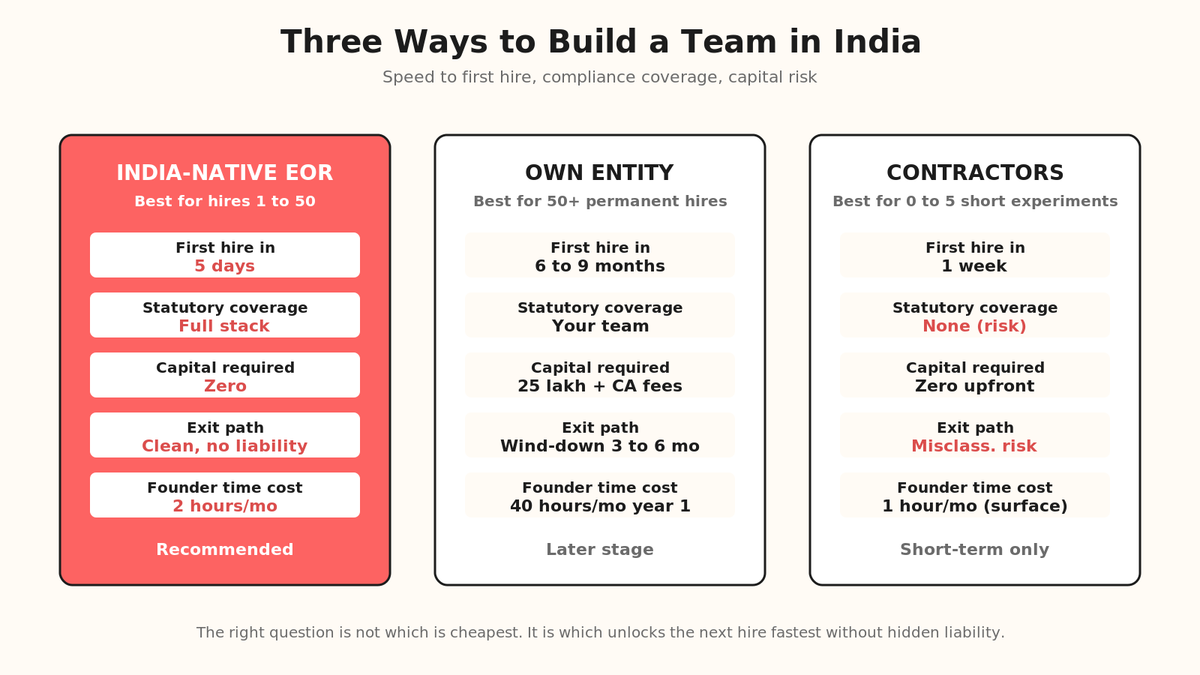
The four operating models are not competing options. They are sequential stages of maturity. A founder hiring the first five in India should pick differently than a Series D company hiring the next hundred. The trap is picking the wrong model for the stage, trying to build a captive at Series A, or clinging to a contractor arrangement past thirty employees.
| Model | Right stage | Setup time | Compliance owner | Cost per hire (annualized) |
| Independent contractors | 0-5 hires, short experiments | 1 week | Contractor (high misclassification risk) | Highest per-head (no benefits offset) |
| India-native EOR | 1-50 hires, first product presence | 5 days | EOR provider (full statutory) | Base salary + 8-15% EOR fee |
| Own entity (Pvt Ltd) | 50+ hires, permanent presence | 6-9 months | You (in-house or CA firm) | Base salary + 3-6% overhead at scale |
| Captive / GCC | 500+ hires, strategic asset | 12-24 months | You (full HR/legal/finance teams) | Base salary + 2-4% overhead at scale |
The most common founder mistake: skipping the EOR stage and going straight from contractors to an entity because "we will save on the EOR fee." What actually happens: six to nine months of setup delay while your competitors ship, 25 lakh in initial capital, a founding CA fee of 8-15 lakh, and a compliance obligation that ties up a founder's calendar for the first year. The EOR fee, spread across the first thirty hires, is cheaper than the founder's time.
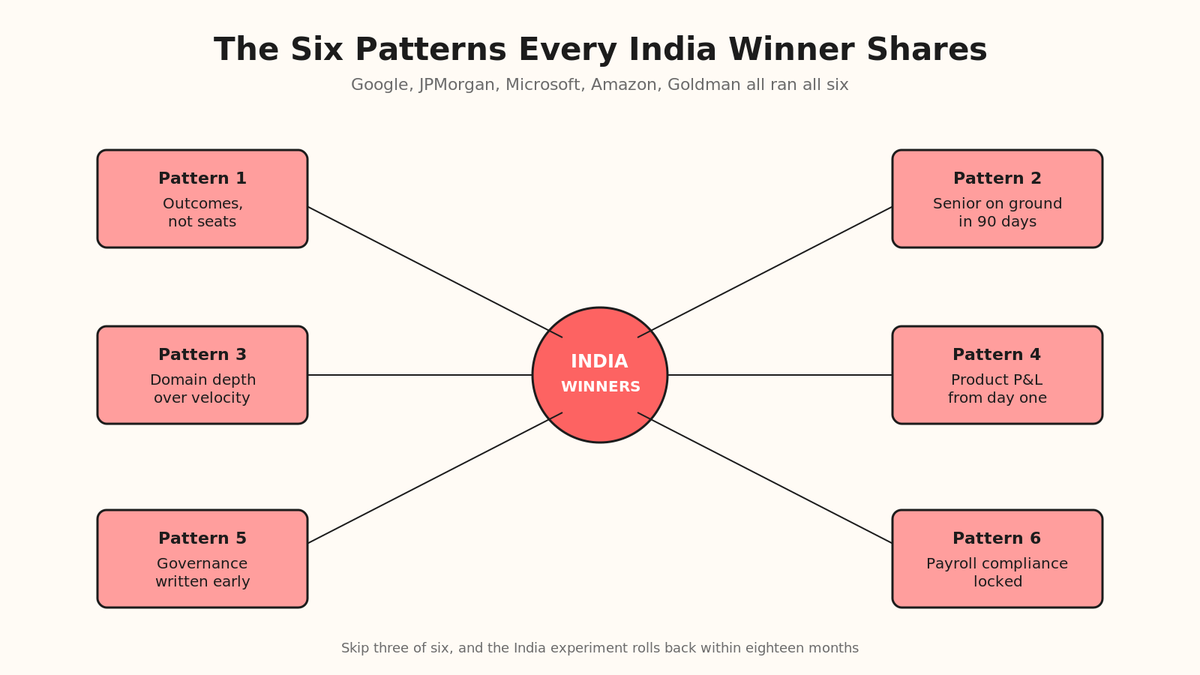
Q11. What are the six patterns every India winner shares, and how do founders copy them in the first ninety days?
Reading a decade of case studies from the ten companies in Table 1 surfaces six repeatable patterns. Every winner ran all six. Every roll-back skipped at least three.
Pattern one: outcomes not seats. Winners hired against a P&L line or a roadmap deliverable, not a recruiter req count. Google Bengaluru's first year had a search personalization outcome. JPMorgan Bengaluru's first year had a payments-latency outcome. Founders who copy this write the hiring brief as "own the ML infrastructure roadmap through Q4" not "five ML engineers."
Pattern two: senior on the ground within ninety days. Every winner had a US or UK principal in India in the first ninety days, either flown in for a quarter or hired locally as a country lead. That person owned hiring decisions, sat in on interviews, and signaled to the market that this was a real investment. Founders who never send anyone are invisible to the top of the market.
Pattern three: domain depth over headcount velocity. Winners hired slowly against a specific domain, payments, healthcare AI, ML infra, where they could pay above market and hire from a shortlist of ten people. Founders who chase headcount velocity end up with a team of generalists who cannot ship the specialized roadmap that made the offshoring case in the first place.
Pattern four: product ownership from day one. Winners gave India-based leads P&L or roadmap ownership on hire. India owns the Alexa language platform. India owns the SAP HANA modules. India owns Google Pay engineering. Founders who withhold ownership and route decisions through the US create a service-arm dynamic that never recovers.
Pattern five: governance and DPDP written on day one. Winners hired a general counsel or a specialist consultant early, wrote the India employment contracts to be enforceable in Indian labor courts, and built a data-transfer framework that survived the DPDP Act. Founders who skip this find out at Series C due diligence that their India IP assignments were unenforceable and their data pipeline is DPDP-noncompliant.
Pattern six: payroll compliance locked from the first paycheck. PF, ESI, professional tax, gratuity accrual, S&E filings across every state where an employee works, the winners paid a specialist to run this from paycheck one. Founders who ran payroll through a contractor invoice or a founder's personal account inherit a statutory-arrears bill they only discover on exit. This is the single fastest way an India experiment becomes an M&A liability.
Q12. When founders read this list and still ask "just start me on hire one," what does the fastest correct path look like?
The fastest correct path, one that copies the six patterns without waiting six months for an entity, is India-native EOR. In practical terms: you write a brief for the first hire (Pattern one, outcomes not seats). Versatile sources shortlist candidates from Bengaluru or Hyderabad against that brief. You interview, you decide, we onboard on Versatile's own India entity in five business days. PF, ESI, professional tax, S&E, gratuity accrual, all filed on time (Pattern six). We give you a designated India-based ops lead who sits in on your first two hires so you have someone on the ground (Pattern two, partial). We write the DPDP-compliant employment contract, the IP assignment, and the data-transfer framework (Pattern five). You own the product decisions and the roadmap voice from day one (Pattern four).
The pricing structure is designed to remove the "let me negotiate rates" back-and-forth: transparent per-employee-per-month, first month waived, no setup fee, no hidden per-payroll charge. If you close a hire in five days and pay the EOR fee for eleven months, the annualized cost per hire lands cheaper than the fully loaded cost of running your own Indian entity for the first three years, including the CA fees, the compliance headcount, and the founder time you did not spend on product.
"We evaluated Deel, Remote, and Multiplier before landing on the India-native option. The others were global generalists. When the DPDP Act rolled out, only the India-focused provider had the compliance stack ready to go without emergency patches."
, Head of People, US-headquartered SaaS company, Verified G2 review 2024
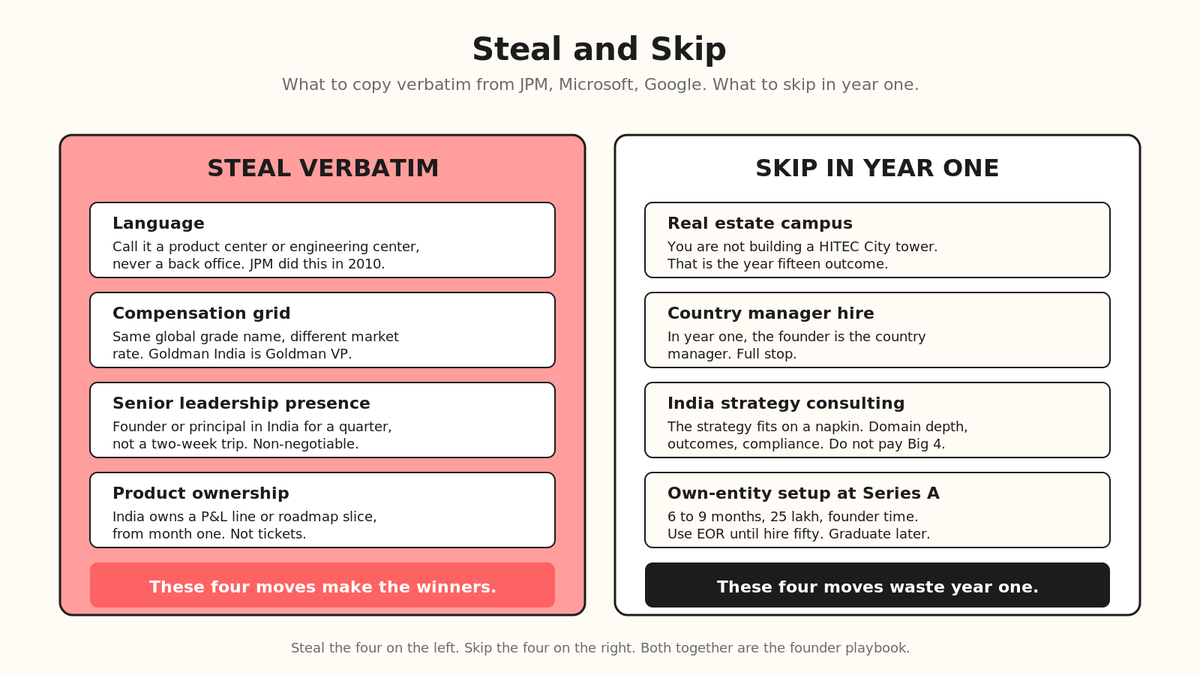
Q13. What should founders steal, verbatim, from the JPMorgan/Microsoft/Google playbooks, and what should they skip?
Steal the language. Call your India team a "product center" or "engineering center," not a "back office." The word matters, it is the first signal to every candidate you interview about how India fits into your company. JPMorgan's "corporate center" rebrand changed the caliber of talent they interviewed within eighteen months.
Steal the compensation grid. Publish a global grade ladder where the India band is the same grade as the US band, the numbers can differ (they should, market to market) but the grade name is the same. Goldman India runs on the same grade names as Goldman New York. This is not a comp story. It is an identity story. It tells the Indian VP that they are a Goldman VP, full stop.
Steal the leadership investment. Send a founding-team member to India for the first quarter. Not for a two-week trip. For a quarter. If the founder cannot commit that time, they are not ready to offshore. This is Pattern two, and it is the single highest-leverage move on the list.
Skip the campus. You are not building a Hyderabad HITEC City tower in year one. That is the fifteenth-year outcome. Skip the country manager hire. In year one, the founder is the country manager. Skip the "India strategy" consulting engagement. The strategy is: hire against domain depth, ship outcomes, run payroll compliance, and give India roadmap voice. That is the strategy. It fits on a napkin.
Q14. What did the founders who failed at India offshoring do differently, and how do you avoid inheriting their outcome?
The failed India experiments cluster around three tells. The first tell: a job description that reads like it was drafted for a US engineer with the salary crossed out and rewritten in rupees. That JD attracts the wrong Indian candidate, someone who wants the US salary trajectory, not the ownership of a specific outcome. The winners write JDs that name a specific domain, a specific roadmap, and a specific customer problem.
The second tell: no in-person meeting in the first six months. Every winning India team we studied had a US or UK founder or principal in India within the first ninety days. Every roll-back had a founder who never boarded a plane. Video calls are not a substitute. The signal you send by showing up in Bengaluru in month two is the reason your first three hires stay for three years.
The third tell: an ambiguous ownership structure between the US company and the Indian entity or EOR. Who signs the offer letter? Who owns the IP? Who runs the performance review? Who files the tax return? Founders who cannot answer those four questions in one sentence each are creating a compliance gap that will show up at Series C diligence, at acquisition, or at exit. An India-native EOR collapses all four questions into one vendor answer.
"The moment I realized we needed to switch was when our contractor sent me a bill for eighteen months of PF arrears they had never filed. We had been paying gross, they were not remitting, and we were the ones on the hook."
— Founder, Series B analytics SaaS company, private note 2024
Q15. What should the first ninety days look like when a founder is ready to move, and how does Versatile fit in?
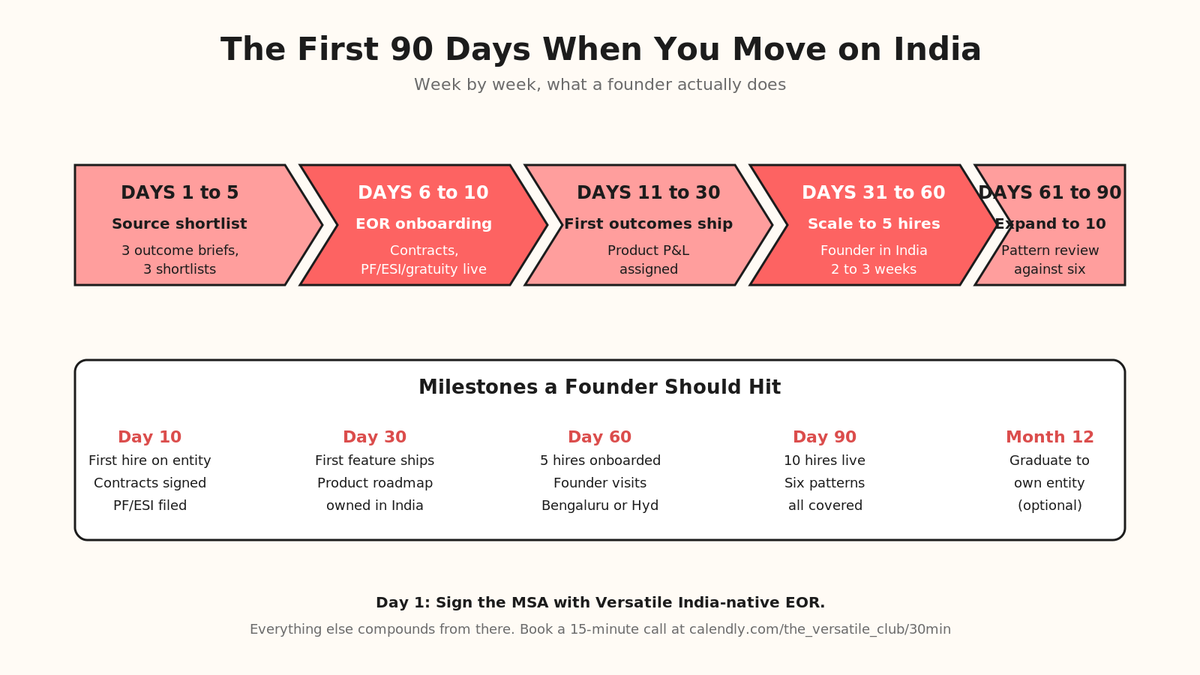
The first ninety days are the highest-leverage window a founder gets. Get them right and the next five years compound. Get them wrong and the roll-back conversation happens in month eighteen. The winners we studied all followed a version of the same rough shape.
Week one: write the outcomes brief for the first three hires. Not five engineers, a payments platform engineer who owns the India-side of the wallet integration, a senior product designer who owns the enterprise dashboard, a data platform engineer who owns the ML feature store. Three roles, three roadmap outcomes, three shortlists.
Week two: engage the EOR. Versatile's onboarding closes in five business days from signed offer to first payroll. The DPDP-compliant employment contract, the IP assignment, the confidentiality framework, all pre-drafted, ready to sign. PF, ESI, professional tax, gratuity accrual, S&E registration in the employee's home state, all live from day one.
Weeks three through eight: interview and close the first three hires. Pay above the 75th percentile for the target domain (Pattern three). Publish the global grade ladder (Pattern three, extended). Give each of the three a specific roadmap outcome and a first ninety-day plan (Pattern one).
Weeks nine through twelve: the founder or a principal spends two to three weeks in Bengaluru or Hyderabad. Sit with the first three hires. Meet their prospective managers. Interview candidate hires four through eight. Publish the compensation letter for the first year of the India org.
Week thirteen onward: hire four through ten, all on the Versatile India-native EOR entity, all with roadmap ownership. By month six, if the outcomes are shipping, you begin the conversation about setting up your own entity as a graduation path from EOR. If they are not shipping, the EOR structure means you can pause, restart, or wind down without inheriting statutory liability, a flexibility no own-entity setup gives you.
| Milestone | Week | Deliverable | Versatile role |
| Outcomes brief written | Week 1 | 3 roles, 3 roadmap outcomes | Advisory on JD structure and comp band |
| EOR engagement live | Week 2 | Signed EOR MSA, contracts drafted | Full onboarding pipeline in 5 business days |
| First hire signed | Week 4-6 | Offer accepted, PF/ESI/S&E filed | Payroll, benefits, contract execution |
| First three hires onboarded | Week 8 | 3 employees active on Versatile entity | Ongoing HR, statutory, PF/ESI/gratuity |
| Founder in India | Week 9-12 | 2-3 weeks in Bengaluru or Hyderabad | Office space, meeting coordination, local intros |
| First ten hires live | Month 6 | 10 employees on Versatile EOR | Full-stack HR and compliance |
| Own-entity graduation review | Month 12 | Decision to keep on EOR or set up entity | Advisory on entity setup timing and cost |
FAQs
Which company had the most successful India offshoring outcome, and what did they do differently?
JPMorgan Chase and Microsoft are the two most-cited case studies for a reason. Both invested for a twenty-year horizon, gave India teams P&L or product-line ownership, and paid market-leading compensation on a global grade grid. Both moved beyond "back office" language and rebranded their India centers as corporate centers or development centers early. The result: retention rates in India that rival their US operations, and product ownership that is now consequential to the global roadmap.
How long does it take to build an India team like Microsoft's Hyderabad center?
Microsoft opened Hyderabad in 1998 with 20 engineers. The current scale, the largest R&D center outside Redmond, is the result of twenty-six years of compounding. A well-run mid-market SaaS company can build a 30-engineer India center in twelve months using an India-native EOR, and a 100-engineer center in three to five years. Both are meaningful outcomes without requiring a Microsoft-scale timeline.
Is offshoring to India only for engineering roles?
No. The winners we studied hire deeply across product management, design, ML research, data science, finance and accounting, legal operations, and sales development. Goldman Sachs India runs quant strategy teams. Deloitte USI runs consulting delivery. Google India runs UX research and product management. Any role that can be structured around outcomes and does not require constant same-timezone customer interaction is a candidate for India offshoring.
What is the biggest compliance risk founders overlook when hiring in India?
Provident Fund (PF) and Employees' State Insurance (ESI) filings are the two most-often-missed statutory obligations. A founder who runs payroll through a contractor or a personal account without PF/ESI remittance is accruing a statutory-arrears liability that will surface at diligence or exit. Gratuity accrual is the second most-missed. The DPDP Act, which came into force in 2024, adds a data-transfer framework requirement that most contractor arrangements do not satisfy. An India-native EOR handles all four automatically.
What does it cost to hire a senior engineer in India in 2026 through an EOR?
A senior full-stack or ML engineer in Bengaluru or Hyderabad in 2026 lands at 40-70 LPA (about $48K-84K USD) in base compensation, with variable pay depending on domain and equity. On top of base, the EOR fee runs 8-15% depending on volume. Versatile's transparent per-employee-per-month pricing makes this cheaper than most competitors and includes month one free. Fully loaded, a founder should budget $70K-100K USD annualized for a senior IC in India, or 40-50% of the equivalent US cost.
Can a Series A startup with fifteen employees really copy the JPMorgan playbook?
Not literally, but the six patterns transfer. Outcomes not seats, senior on the ground, domain depth, product ownership, governance early, payroll compliance locked. Every one of those is copy-able at a fifteen-employee company. The EOR structure lets a Series A founder hire their first three India engineers without owning a legal entity or hiring a country manager, and copy Patterns one through six from day one.
What happens if the India experiment does not work, can I roll it back without inheriting liability?
If you run India hires through a full-stack India-native EOR, yes. Versatile handles the termination process, the final settlement, the gratuity payout (if triggered), the F&F accounting, and the closure of PF/ESI accounts for each departing employee. The founder is not left holding a statutory-arrears bill or an open ESI file. This is the single biggest reason EOR is the correct model for hires one through fifty, the exit path is as clean as the entry path.
How does Versatile compare to Deel, Remote, or Multiplier for India-specific hires?
Deel, Remote, and Multiplier are global generalists, they operate in 150+ countries and route India hires through partner networks or licensed local entities that are not their own operational focus. Versatile is India-native, meaning we operate our own Indian entity, our compliance team is on the ground, and every statutory filing is under our direct supervision. The DPDP Act rollout in 2024 was a stress test: the India-native providers had the compliance ready. The global providers issued emergency patches. Read the Versatile vs Deel comparison, the Versatile vs Remote comparison, or the Versatile vs Multiplier comparison for the specific feature-by-feature and pricing breakdowns.
A note from Sagar Chainani, Founder, Versatile
I have watched enough founders try to shortcut the India-hiring problem to know two things. First: the six patterns above are non-negotiable. Every winner ran them. Every roll-back skipped at least three. Second: the single highest-leverage move in your first ninety days is picking a partner who removes the compliance stack so you can spend those ninety days on outcomes, not on statutory paperwork. That is the entire pitch for Versatile. We are India-native, we run our own entity, we file every PF/ESI/gratuity/S&E remittance across all 28 states, and we onboard your first hire in five business days. First month free at our published per-employee-per-month rate. If you are ready to move, book fifteen minutes on my calendar and we will map your first five hires by role, city, and payroll cost before the call ends. If you want to read the deeper playbook first, start with the India EOR services page or the top ten offshore delivery centers in India guide. Either way, the compounding starts on your first hire, not on your first entity. Let's start the compounding.