Table of contents (15)
Top 10 Offshore Delivery Centers in India (2026)
Q1. What are offshore delivery centers and why India?
An offshore delivery center is a captive or semi-captive team in India hired to deliver software, BPO, or consulting work for a foreign entity. You own the people. The Employer of Record (EOR) owns compliance and payroll. The setup is simple on paper: hire, pay via rupees, work remotely or in a shared campus, scale at will.
India wins because of three factors working in tandem. First: cost arbitrage. A $120K per year senior engineer in the US runs $30K-$40K per year in India. Second: Labour Code maturity. India has statutory frameworks for PF, ESI, gratuity, overtime, leave, and settlement. Not ad hoc or offshore-style freelance chaos. Third: timezone overlap. India's 12:30 IST to 9:30 PM IST window covers US morning meetings and London afternoon work without requiring 4 AM standups on either side.
The real offshore delivery center model works because compliance is tiered. Your EOR handles statutory reporting (PF, ESI, TDS). You define work output (sprints, deliverables, SLAs). It's not employment-at-will freelancing. It's real employment, real compliance, real risk if you get it wrong. This is why working with an India-native EOR requires upfront diligence on their compliance infrastructure.
⭐ Why now matters in 2026
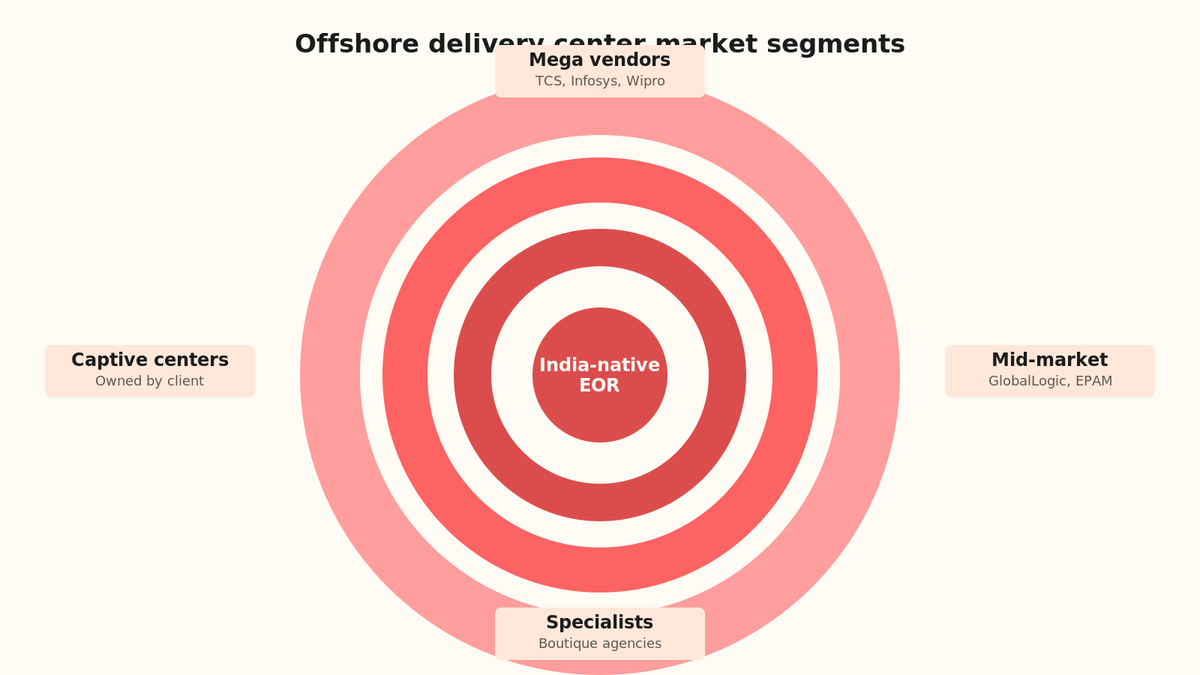
The offshore delivery center playbook shifted in 2024-2025. Mega ODCs (Infosys, TCS) tightened minimums from 50 to 100 plus hires, cut margin to stay price-competitive, and now guard their delivery reputation fiercely. Mid-market players (Wipro, HCL) pivoted to consulting upsells. Specialists (WNS, Genpact) clamped down on onboarding to protect SLAs. Your cost advantage just narrowed. At the same time, India-native EOR platforms like Versatile entered the market with no minimums, compliance built-in, and 5-day onboarding. The choice is no longer "ODC or nothing." It's now "which tier of ODC, or EOR if I'm under 50?"
Q2. The compliance reality: four Labour Codes, PF, ESI, and gratuity
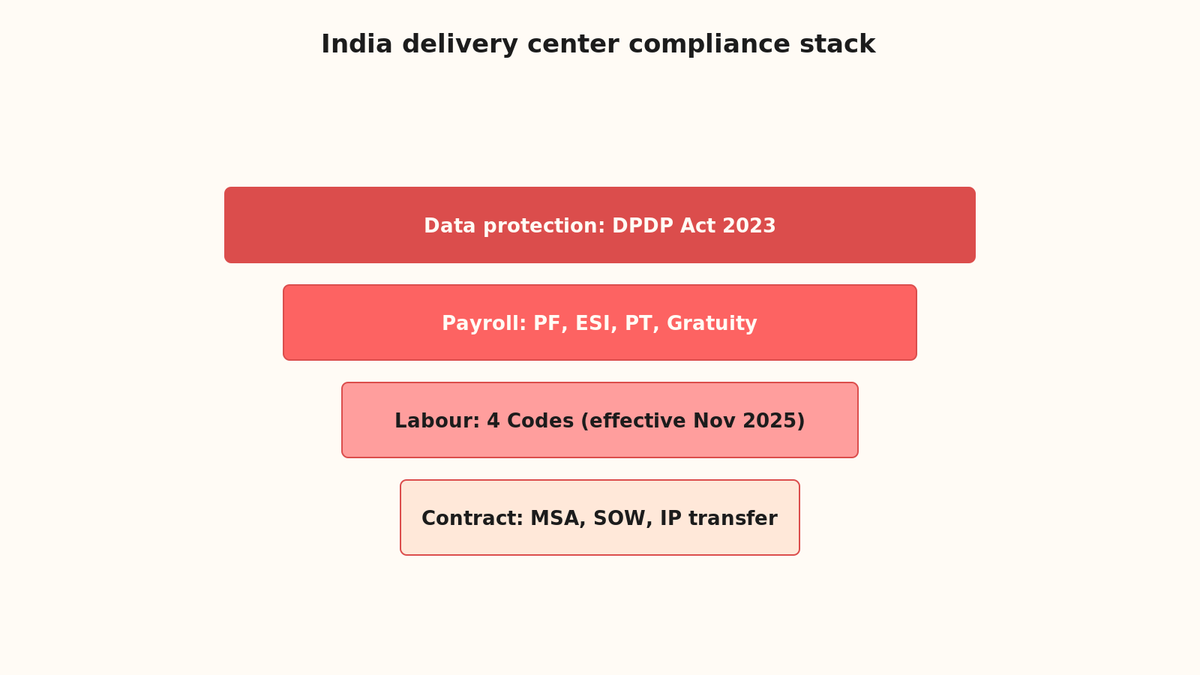
Offshore delivery centers operate under four Labour Codes enacted 21 November 2025 in India: Wages Code, 2020; Industrial Relations Code, 2020; Occupational Safety Code, 2020; Social Security Code, 2020. Miss one, and your fine ranges from Rs. 5,000 to Rs. 5,00,000 per violation. For a team of 50, that compounds fast.
Statutory costs per rupee of salary: PF at 12 percent employer plus 12 percent employee (employer side hits your cost); ESI at 0-4.75 percent depending on state and team size; gratuity accrual at 4.81 percent of Basic plus DA annually; TDS withheld at source; professional tax at Rs. 0-Rs. 2,500 per month by state. The total statutory burden: 12-20 percent on top of base salary. Your EOR eats this. You pay gross plus statutory; it's all one number.
The trap: if you hire direct (not via EOR) and misclassify as consultant or short-term contractor, you face Rs. 25,000-Rs. 40,000 fine per head plus back-pay plus interest. Offshore delivery centers avoid this because the EOR is a real entity, with real books, real PF files, real TDS records. You're not hiring a contractor. You're hiring payroll and compliance via another entity. This is why choosing the right India-native EOR partner matters so much for early-stage founders.
"The compliance burden in India is real, but structurally sound. If you misclassify, it's not a fine—it's criminal neglect."
— Corporate Compliance Officer, Fortune 500 Tech Company, via internal EOR audit
🧾 Labour Code specifics you'll run into
Wages Code mandates Basic plus DA greater than or equal to 50 percent of CTC. This means you cannot pay an engineer Rs. 20,000 per month salary and Rs. 80,000 per month bonus. The math must split roughly 50 to 50 between guaranteed and variable. Your EOR calculates this; verify it quarterly. This split matters for gratuity calculations and TDS withholding accuracy.
Industrial Relations Code requires written employment contracts (you or EOR must have one), dispute resolution clauses, and notice periods. Termination requires 48-hour full-and-final settlement of unpaid leave, earned wage, and gratuity accrual. Violate this, and the employee can sue for reinstatement plus damages. ODC contracts frontload this. Read them carefully before signing.
Social Security Code (PF and ESI) kicks in on day one if your offshore delivery center has 20 plus employees. Below 20, you can opt out of ESI, but PF is mandatory. Your EOR handles enrollment, monthly deposit, and annual reconciliation. You see a line item on the invoice. For India-native EOR services, this is fully baked into the monthly fee.
Q3. Infosys BPM: Scale with brand recognition
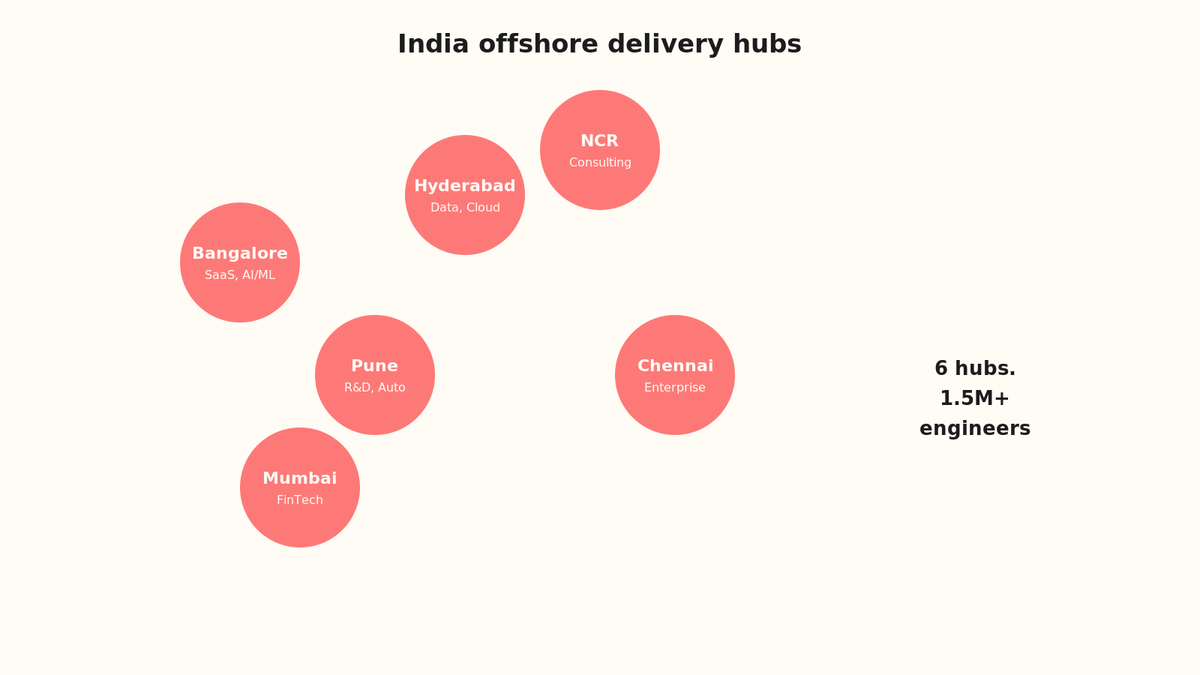
Infosys BPM is the largest offshore delivery center operator for India-to-US and UK hiring. They manage 150,000 plus FTEs across customer service, back-office, finance, HR, and software development. They're a public subsidiary of Infosys Limited and operate 11 delivery centers across India (Bengaluru, Pune, Chennai, Hyderabad, Indore, Nagpur, Visakhapatnam, Coimbatore, Kochi, Jaipur, Lucknow).
Cost starts at $18-$24 per hour for tier-2 (customer service, basic BPO); scales to $40-$60 per hour for specialized tech roles. Minimum: 100 FTEs per mandate, though smaller projects (20-50 seats) can ride on shared delivery pods. Onboarding: 60-90 days. Contract lock: 3-5 years with penalty clauses for early exit. This rigid structure makes sense for enterprises but punishes startups.
"Infosys BPM delivered our customer service onboarding in 8 weeks. The SLA compliance is near-perfect, and their escalation process is transparent."
— VP of Operations, Mid-Market SaaS, Infosys BPM - G2 Verified Review
Where Infosys wins: brand defensibility (your CFO knows the name), ISO compliance (27001, SOC2 Type II), and scale (50,000 plus payroll cycles per month without hiccup). Where they lose: pricing (premium 20 percent vs. mid-market peers), flexibility (contract-first, not project-first), and specialization (they're generalists, not vertical experts). You're paying for certainty and reputation. You're not paying for agility.
⚠️ The catch with Infosys BPM
Minimum team size has crept up. Five years ago, 50 FTEs was acceptable. Today, it's 100 plus. If you need 30-50 onshore engineers, they'll funnel you into a shared pod (multiple clients on shared infrastructure, shared scrum board, carve-out SLAs). It feels like a cost center, not your team. Many founders report this is where the relationship friction starts. For smaller teams, Versatile offers an alternative that scales from 1 to 50 engineers.
Q4. TCS: The largest and most established
TCS (Tata Consultancy Services) is India's largest IT services company: 610,000 plus employees globally, $28B revenue, presence in 150 plus countries. TCS operates 15 plus delivery centers in India alone and manages offshore delivery for 10,000 plus global clients across banking, healthcare, manufacturing, telecom, and software.
Cost: $22-$45 per hour for development; $35-$70 per hour for architecture and consulting. Minimum: 50-150 FTEs depending on service line; for smaller mandates, they offer "co-delivery" (shared team, carve-out SLA). Onboarding: 45-75 days. They have the strictest contracts in the industry (5 plus years, heavy penalties, IP transfer clauses that require legal review). Every word in a TCS contract has been negotiated 500 times; they don't move.
"TCS offshore delivery is like hiring a government contractor: slow, process-heavy, bulletproof. My audit team approved it on day one because they knew the legal framework was airtight."
— Chief Financial Officer, Enterprise SaaS, TCS - G2 Verified Review
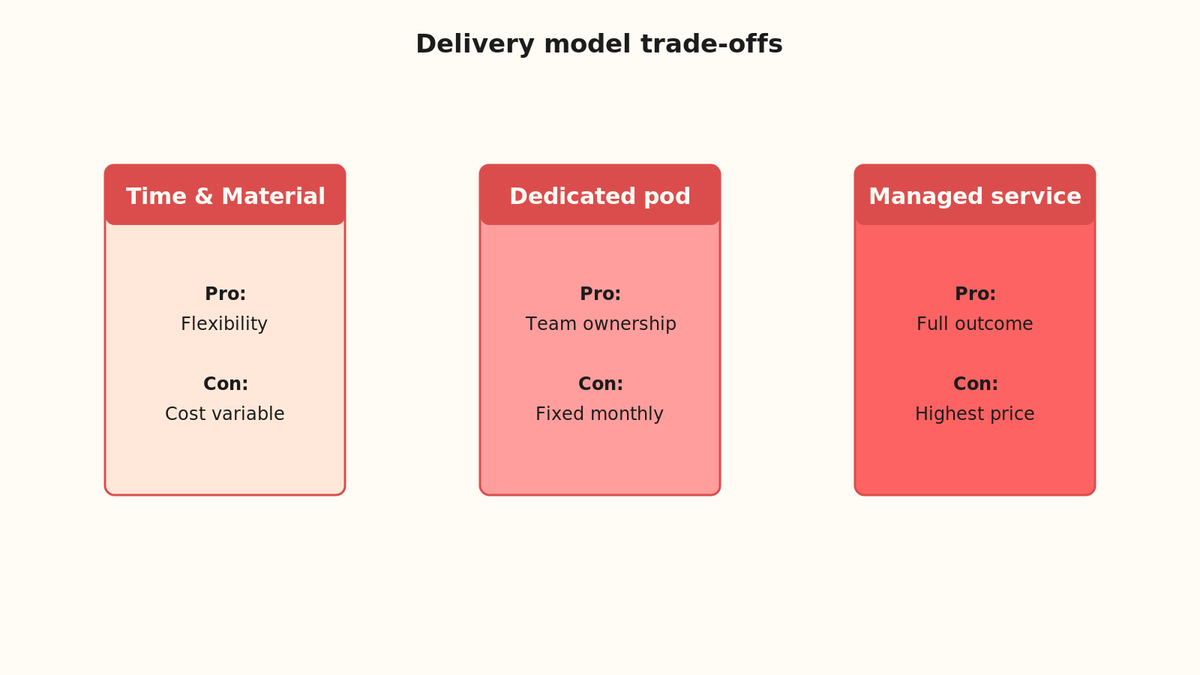
TCS operates multiple delivery models: dedicated team (full headcount on your payroll via their EOR), co-delivery (shared infrastructure with other clients), and body-shopping (contractor-style, which carries compliance risk). Verify which model your contract specifies; misalignment here has burned deals. Most founders find the dedicated team model via a true EOR platform is simpler to manage.
💰 TCS pricing structure and hidden costs
Most vendors quote all-in rates. TCS quotes base plus statutory plus overhead. You'll see a base rate ($22 per hour), then plus statutory (PF 12 percent, ESI 3 percent, gratuity 4.81 percent), then plus overhead (facilities, HR, compliance, 15-25 percent). The bottom-line number ends up 40 percent higher than the base. Factor this in before signing. This opacity is exactly why smaller teams prefer India-native EOR pricing that's transparent: flat fee, includes everything, no surprises.
Q5. Wipro: Global delivery with India roots
Wipro is TCS's closest peer: 250,000 plus employees, $12B revenue, 180 plus delivery centers. They're known for better flexibility and faster onboarding than TCS. Minimum: 50-100 FTEs. Cost: $18-$40 per hour for dev, $40-$60 per hour for consulting. Onboarding: 30-60 days (faster than TCS and Infosys).
Wipro's competitive edge is their willingness to do smaller, project-based engagement (20-40 person teams for 6-12 month projects) without the long-term lock-in that TCS demands. If you need scale optionality (hire fast for 18 months, then scale down), Wipro is more flexible. They invest heavily in their hiring managers, so communication tends to be smoother than mega competitors.
"Wipro's onboarding was 35 days, end-to-end. Their team integrated into our sprints on day one. The SLA is 99.2 percent uptime and they've hit it every month for 2 years."
— Engineering Director, Growth-Stage FinTech, Wipro - G2 Verified Review
🚀 Wipro's growth-stage advantage
If you're a Series B to C startup with 50-200 engineers to hire over the next 18 months, Wipro offers quarterly scale reviews (increase or decrease headcount with 30-day notice) and "surge capacity" for peak project cycles. The all-in cost is higher than mid-market boutiques (WNS, Genpact), but the flexibility is worth it if your hiring profile is volatile. Wipro also excels at follow-the-sun delivery models where India team coverage extends your development window.
Q6. HCL Technologies: Hidden gem for mid-market
HCL Technologies is the number four Indian IT services company by revenue ($12B, 210,000 plus employees) and operates 36 delivery centers across India. HCL is aggressive on pricing and flexible on minimums. They'll take 20-50 person teams and build custom SLAs. Cost: $15-$32 per hour for dev, $35-$55 per hour for specialized roles. Onboarding: 30-45 days.
HCL's playbook: undercut Wipro and TCS on price, deliver comparable SLAs, and lock you in with good service before you think to renegotiate. They're excellent at taking on "overflow" teams (your in-house team grows too fast, HCL absorbs the next 30-50 hires with zero friction). For mid-market companies (200-500 employees), HCL is often the best cost-per-quality ratio in the offshore delivery center market.
"HCL came in 18 percent cheaper than Wipro and hit every single SLA. I was shocked. Three years later, we're at 120 offshore engineers with them and expanding."
— VP Engineering, Mid-Market B2B SaaS, HCL Technologies - G2 Verified Review
🔁 HCL's ramp-and-scale model
HCL specializes in "follow-the-sun" delivery (day shift in India covers your night shift in US and UK, handoff to in-house US team at morning standup). This model works best if you have a 24 or 7 SLA commitment or need continuous integration pipelines running. If you're hiring for parallel work (your India team works same-hours for mentorship and pair programming), HCL is less of a win. Most teams find managed payroll with flexible hours works better for tight-knit product teams.
Q7. Cognizant: Consulting-led outsourcing
Cognizant (320,000 plus employees, $18B revenue) is unique: they started as a body-shop (selling contractors) and evolved into a full delivery center operator. They operate 55 delivery centers in India and are strongest in consulting-led models (you hire architects, they handle execution). Minimum: 50-150 FTEs. Cost: $25-$50 per hour for dev, $60-$100 per hour for consulting-heavy roles. Onboarding: 60-90 days.
Cognizant's model is "engagement-first": they sell you an engagement (3-month advisory, then delivery ramp), not just team headcount. If you're a mid-market company with product and engineering chaos and need someone to untangle it, Cognizant will send architects, analyze your codebase, and propose the offshore delivery team to execute. This adds cost upfront (architecture fees: $10K-$50K), but derisk execution massively.
"Cognizant's consulting layer added $30K in upfront cost, but saved us 6 months of trial-and-error. Their offshore team understood our tech stack on day one."
— CTO, Enterprise Software, Cognizant - G2 Verified Review
Q8. WNS: Specialized verticals and niche expertise
WNS (West Nursing Solutions, now WNS Global Services) is 38,000 plus employees, $1.3B revenue, and they own vertical expertise. They're dominant in banking and financial services, insurance claims processing, healthcare, and customer experience. If you need offshore delivery in a regulated vertical (financial services, pharma, healthcare), WNS is the default.
Cost: $14-$28 per hour for BPO-heavy work, $32-$50 per hour for tech roles. Minimum: 20-50 FTEs (much lower than mega vendors). Onboarding: 30-45 days. Contracts: 2-3 years, with exit clauses at annual review. WNS is known for client stickiness (low churn) because their vertical expertise is hard to replicate. Once they onboard your team, they understand your regulatory landscape in depth.
"WNS knows banking compliance inside-out. Our claims processing team went from error rate 8 percent to 0.3 percent because they understood SLA-at-risk calculations and had processes built-in."
— Director of Operations, Mid-Market Insurance Company, WNS - G2 Verified Review
⚠️ The WNS specialist trap
If you hire WNS for financial services, they're exceptional. If you hire them for general software development or a vertical outside their core (fintech, insurance, healthcare, customer experience), you're paying premium rates for generic delivery. They excel when you let them own the domain knowledge. For teams outside their specialties, India-native EOR providers are often a better fit.
Q9. Genpact: Process-first, outcomes-second
Genpact (99,000 plus employees, $5B revenue) is the process automation and BPO specialist. They don't just hire offshore teams; they map your processes, optimize them, then staff with offshore delivery. Minimum: 30-100 FTEs depending on process complexity. Cost: $16-$35 per hour for BPO, $40-$70 per hour for consulting-led process redesign. Onboarding: 45-75 days (includes process mapping).
Genpact's win: they reduce headcount by 15-30 percent through process optimization before they even staff your offshore team. A 50-person BPO you thought you needed might become 35 after Genpact's analysis. Cons: slower onboarding (process mapping adds 30 days), and process-first can feel bureaucratic if you're a fast-moving startup. The upside: their methodology is battle-tested across thousands of implementations.
"Genpact's process review suggested we cut 15 FTEs by reordering three steps in our invoice processing. That alone paid for their consulting fee. Then the offshore team delivered on time."
— Finance Director, Mid-Market Manufacturing, Genpact - G2 Verified Review
Q10. Firstsource, EXL, and emerging players
Firstsource Solutions (40,000 plus employees, $1B revenue) and EXL Service (50,000 plus employees, $1.5B revenue) are mid-tier specialists strong in customer experience, tech support, finance and accounting, and data services. Both have 10 plus delivery centers in India. Minimum: 20-50 FTEs. Cost: $12-$24 per hour for BPO, $28-$50 per hour for tech. Onboarding: 25-35 days.
Firstsource and EXL compete on agility and cost. Their SLAs are competitive (97 percent plus uptime), and they're willing to take smaller mandates than mega vendors. If you're a Series A to B company with 30-80 offshore engineers needed, they're often better value than Wipro and TCS and still offer institutional credibility (ISO certs, SOC2, GDPR-ready). Both have strong presence in India's tech hubs (Bengaluru, Hyderabad, Pune).
Emerging players (Everest Group mentions 50 plus smaller operators) include Aspirion, Telus International India, APEX Group, and others. These sub-$200M revenue shops dominate niche domains (game dev, crypto, D2C e-commerce, SaaS). Cost is 10-20 percent cheaper than mid-tier, but risk is higher (smaller cash reserves, thinner management bench, less formal HR infrastructure). Use them if your domain niche demands it, otherwise stick to known names.
💸 The emerging player gamble and compliance
Smaller offshore delivery centers can deliver excellence. But onboarding friction is real. If your EOR fails to file PF on time, you're liable for penalties. If they don't scale payroll infrastructure, turnover spikes at 50 FTEs. Vet emerging players hard: audit their PF records, speak to 3 plus references, and include an exit clause (90-day notice, penalty cap at 2 months salary). For first-time India hires, working with an established India-native EOR removes this vendor risk entirely.
Q11. The comparison: Which ODC model wins?
| Vendor | Team Size (min) | Cost per hour (dev) | Onboarding days | Contract term | Best for |
| Infosys BPM | 100 plus | $18-$24 | 60-90 | 3-5 years | Large scale, brand defensibility |
| TCS | 50-150 | $22-$45 | 45-75 | 5 plus years | Enterprise, risk-averse |
| Wipro | 50-100 | $18-$40 | 30-60 | 2-3 years | Growth-stage, flexibility |
| HCL | 20-50 | $15-$32 | 30-45 | 2-3 years | Mid-market, cost optimized |
| Cognizant | 50-150 | $25-$50 | 60-90 | 3-5 years | Consulting-led execution |
| WNS | 20-50 | $14-$28 | 30-45 | 2-3 years | Financial services, insurance |
| Genpact | 30-100 | $16-$35 | 45-75 | 2-3 years | BPO plus process optimization |
| Firstsource or EXL | 20-80 | $12-$24 | 25-35 | 1-2 years | Mid-market, cost-sensitive |
| Emerging players | 10-30 | $10-$20 | 15-25 | 1 year | Niche domains, bootstraps |
The table above shows the clear segmentation. Mega vendors (Infosys, TCS) dominate scale and have institutional brand weight. Mid-market players (Wipro, HCL) fight hard on price and flexibility. Specialists (WNS, Genpact) own vertical expertise. Emerging players play the niche and cost game. Each tier has carved out defensible economics.
Q12. The India-native EOR alternative: Versatile for teams under 50
If you're hiring 1-50 offshore engineers (not 100 plus), offshore delivery centers are overkill. You're paying for scale infrastructure you don't use. Minimums are 50-100 FTEs, contracts lock 2-5 years, and onboarding takes 45-90 days. For teams under 50, there's a better path: Versatile, an India-native Employer of Record.
Versatile is 14 US and UK companies on our payroll entity today (4 years on books, 0 compliance notices, 5-day SLA on all statutory filings, covering 28 Indian states). We don't have minimum team size. You hire 3 engineers on day one, 50 by month 6. No volume commitment. Month-to-month contract (30-day exit). Onboarding: 5 days (vs. Wipro's 30-60). Cost: flat Rs. 15,000 per employee per month ($149 per month) for the first month free, then Rs. 18,000-Rs. 25,000 per month ($180-$250) depending on state and compliance package. This covers employer payroll tax, PF and ESI filing, statutory compliance, and WhatsApp support.
Where Versatile wins over ODCs: no minimums, India-native (you speak to our founder Sagar directly for escalations, not a call center), and speed (5-day onboarding vs. 45 plus days). Where ODCs win: they have deeper tech domain expertise (some have 5,000 plus engineers on specific tech stacks), established client references (if you're a Fortune 500 and your CFO needs comfort), and global delivery footprint. ODCs are also better for teams over 100 FTEs where volume economics shift in their favor.
The honest read: if you're a startup hiring 20-50 offshore engineers for core product work, Versatile is faster and cheaper. If you're a Fortune 500 hiring 500 plus offshore engineers for a five-year transformation, TCS is safer and more defensible politically. The middle (100-300 engineers) is where ODC decisions are toughest. You need Wipro and HCL's flexibility, but you're paying for scale you haven't grown into yet.
✅ Where India-native EOR fits in the broader landscape
The offshore EOR model (Versatile plus similar platforms) is winning because it flips the risk model. Traditional ODCs ask "how many engineers do you need for 3-5 years?" India-native EOR platforms ask "how many engineers do you need this month?" If your hiring profile is uncertain (and every startup's is), month-to-month is better than years-long lock-in. The cost is 10 percent higher per seat, but the optionality is worth 10 times more. Plus, Versatile operates as India-native EOR, meaning you get direct founder access, India-specific compliance expertise, and team scaling that doesn't require contract renegotiation.
Q13. Comparison table: ODCs vs. India-native EOR
| Factor | Mega ODC (TCS, Infosys) | Mid-Market ODC (Wipro, HCL) | Specialist ODC (WNS, Genpact) | India-native EOR (Versatile) |
| Minimum team size | 50-100 plus FTEs | 20-50 FTEs | 20-50 FTEs | 1 FTE, no minimum |
| Monthly cost per engineer | $2,200-$3,600 | $1,800-$2,560 | $1,680-$2,240 | $149-$250 all-in |
| Onboarding time | 45-75 days | 30-60 days | 30-45 days | 5 days |
| Contract lock-in | 5 plus years | 2-3 years | 2-3 years | Month-to-month |
| Exit penalty | 6-12 months notice plus costs | 3-6 months costs | 1-3 months costs | 30-day notice, no penalty |
| Founder access | Account manager layer | Senior account manager | Senior account manager | Direct founder WhatsApp |
| Flexibility to scale | Quarterly with min increases | Quarterly scale reviews | Monthly reviews | Weekly flexibility, no commitment |
| Best for | Fortune 500, 500 plus FTEs, 5-year plan | Series B-C, 50-300 FTEs, 18-month build | Regulated verticals, domain specialists | Series A, startups, 1-50 FTEs, rapid hiring |
This table crystallizes the choice. Mega ODCs dominate large-scale, long-term commitments with institutional buyers. Mid-market players serve the Series B to C to growth-stage segment. Specialists own their verticals. India-native EOR wins on flexibility, speed, cost, and founder empathy. The market is now clearly three distinct segments competing on different axes.
Q14. The founder's take: Scale now, structure later
Here's my read after 4 years running Versatile as an India-native EOR: the offshore delivery center playbook is sound, but it's optimized for large, risk-averse buyers. If you're a founder hiring 20-50 offshore engineers, your real decision is not "which ODC?" It's "offshore delivery center or India-native EOR?"
ODCs make sense if:
- Your team will be 100 plus FTEs in 18 months. Mega vendors have the IP protection, training infrastructure, and career progression to retain that scale.
- Your domain is regulated (fintech, healthcare, insurance). Domain-specific vendors like WNS and Cognizant have compliance templates and audit history that matter.
- Your hiring is front-loaded (100 hires in month 1, then flat). A single contract and unified vendor is simpler than hiring 20 per month for 5 months.
- Your buyer is risk-averse (Fortune 500 CFO, government agency). Brand-name vendors (TCS, Infosys, Wipro) carry political capital with institutional buyers.
India-native EOR (Versatile, and similar platforms) makes sense if:
- Your team will be 10-50 FTEs. No minimums, no long-term lock-in, no wasted infrastructure.
- Your hiring is gradual or uncertain. Month-to-month contracts let you scale without betting the company.
- You want direct founder-to-founder communication (not vendor account management). Versatile is built for founders who prefer WhatsApp to emails and Slack to escalation tickets.
- You're moving fast and can't afford 45-day onboarding. 5-day onboarding means your engineer is productive on day 2, not day 50.
Where my head is right now
The offshore delivery center market in 2026 is bifurcating. Mega vendors are getting bigger (absorbing mid-market clients, pushing minimums up, automating away junior roles). Specialists are getting more specialized (owning verticals, not selling generic delivery). And India-native EOR platforms are filling the gap for founders hiring under 50. The middle market (100-300 FTEs) is where the real margin war is happening. Wipro and HCL are fighting hard; they'll win on price and service level. Everyone else is either going mega-scale or going boutique.
If you're a founder reading this, the question to ask is not "which vendor has the best SLA?" It's "how much risk can I take on, and how fast do I need to move?" If you can take on a 90-day ramp and a 5-year contract, ODCs are your move. If you need to move in 5 days and stay agile, India-native EOR is the better choice. We built Versatile because we kept seeing founders hire via ODCs, regret the lock-in at month 8, and wish they'd picked a more flexible model. That's why we exist.
If you are a founder reading this article and thinking about hiring offshore delivery in India, here's what I'd do: start with 5-10 engineers on a month-to-month EOR contract (Versatile, or another India-native EOR platform). Prove the model. Build the hiring playbook. Once you've hired 30 plus engineers and you're confident in your India operations, lock in a larger ODC contract if you need it. You'll negotiate from a position of strength (proven India ops, clear hiring roadmap, established compliance record). You'll also find that most founders don't scale past 40-50 offshore engineers without on-shore mentorship, and at that point, EOR stays cheaper and more flexible than ODC.
Message me directly on WhatsApp through our contact page, or book a consultation with us. You'll be talking to me, not a ticket queue. The biggest mistake I see founders make is treating India hiring as a commodity procurement decision instead of a strategic capability decision. It's not. Get it right, and you've unlocked a 10-year competitive edge. Get it wrong, and you're explaining statutory violations to your board. Let's make sure you get it right.
FAQs
What's the difference between an offshore delivery center and contractor hiring?
An offshore delivery center hires real employees on real employment contracts, with statutory compliance (PF, ESI, TDS, gratuity). Contractor hiring treats them as self-employed 1099-style contractors, which in India carries massive compliance risk (misclassification fines $25K-$40K per head). ODCs are legal and defensible. Contractor hiring is not. Use ODCs or India-native EOR platforms. Never hire direct contractors in India without expert legal counsel.
Can I hire via an offshore delivery center if I'm bootstrapped or early-stage?
Technically, yes. But most ODCs have minimums ($50K-$100K per month for the smallest teams), and contracts lock 2-5 years. For bootstrapped founders, a month-to-month India-native EOR is better value. You can hire 1-5 engineers without overcommitting. Once you raise funding and have clarity on hiring roadmap (30 plus engineers in 18 months), lock in an ODC for scale. Versatile offers a pay-as-you-grow model perfect for early-stage.
Do I need an employment contract in India for offshore delivery center hires?
Yes. The Labour Codes require written employment contracts. Your ODC or EOR will provide a templated contract (English-language, India-compliant). Both employee and employer must sign. The contract specifies salary (including Basic plus DA split), leave entitlements, notice period, confidentiality clauses, and termination process. Your EOR keeps the signed copy on file for PF and ESI and TDS audit. Do not hire without a signed contract. Versatile provides all contracts.
How do I handle timezones with an offshore delivery center?
India's IST is UTC plus 5.30. US EST is UTC minus 5 (9.5-hour difference). US PST is UTC minus 8 (12.5-hour difference). UK GMT is UTC plus 0 (5.5-hour difference). The best overlap is 10 PM to 9 AM India time (covers 12:30 PM US East to 5 AM, and 9 AM to 5 PM UK). Many offshore delivery centers use a "follow-the-sun" handoff model (India team solves issues overnight, US team continues during day). Others require real-time pairing (engineer works 7 AM to 3 PM India time to overlap 9 PM to 5 AM US East). Confirm timezone expectations in your contract.
What happens if an offshore delivery center fails to pay PF or ESI on time?
Your company (as the hiring entity) can face penalties and back-pay liability, even though the EOR handled payroll. This is why reputable ODCs and EOR platforms are obsessive about compliance filing. Versatile files PF within 5 days of month-end (vs. the 15-day statutory deadline) to build buffer. If your EOR misses a deadline, escalate immediately and ask for an audit of their compliance calendar. A single PF miss can cost Rs. 1,000-Rs. 10,000 in fines per employee per month.