Table of contents (11)
Rippling vs Deel for Indian Teams (2026): EOR, Payroll & IT Provisioning
Q1. Rippling vs Deel: which one actually fits an India-only team in 2026?
For India-only teams, Deel wins on published pricing and entity breadth (from $599 per employee per month, 150+ entities). Rippling wins if native HR plus IT and device provisioning is the binding constraint, but it quotes EOR privately at roughly $500 to $700. Neither is India-specialised. Both treat India as one of 80 to 150 countries, which is exactly where the statutory gaps appear.
Last month a Series A People Ops lead sent me her two demo recordings. Two vendors, ninety minutes, and neither rep said the words "professional tax." She had one India engineer in Pune and a second offer out in Bengaluru.
That is the pattern I see most. The software gets demoed. The statutory floor does not.
⭐ The three-scenario verdict
Pick Deel if India is one of many countries and you want a published price. Pick Rippling if unified HR, identity, and device management is what you are actually buying. Pick an India-only EOR operator if India is your single hub.
| Criterion | Deel | Rippling | Versatile Club |
| India EOR price | From $599 per employee per month | Quote only, roughly $500 to $700 | $149 per employee per month, flat |
| India entity model | Widely assessed as local partner | Reported wholly-owned | Own entity (Foo Falcon Technologies Pvt Ltd) |
| Onboarding | 7 to 14 days | 2 to 5 days for EOR | 5 business days, contractual |
| IT and device provisioning | Via partners | Native MDM and identity | Bundled, partner-delivered |
| Support channel | Chatbot first | Email and chatbot | Founder on WhatsApp |
| Statutory depth | Global template | Global template | All 28 states plus 8 UTs |
| Invoicing | USD, FX markup reported | USD | USD from an Indian entity |
| Recruitment support | No | No | Yes, C2H heritage |
Versatile Club sits in that third column for one structural reason. India is the only country we operate in.
💰 Why this decision carries more weight now
India now hosts 2,117 Global Capability Centres across 3,728 units, employing about 2.36 million professionals. Your India team is no longer a side experiment. It is a hiring market with its own rules.
That scale is also why generalist templates break. A country with 28 state tax regimes does not compress into one dropdown, which is why hiring employees in India rewards local depth over global breadth.
⚠️ What buyers actually report
Reviewers tend to like the interface and dislike the money mechanics.
"I find Deel to be absurdly expensive. They charge a high amount of fees for transferring money to my bank account."
— Juan Camilo O., 1/5 rating, Deel Hire, G2 Verified Review
"I find the entire integrated payroll system very easy to use, even for our most 'tech-phobic' employees. The implementation process for Rippling Spend has been a truly terrible experience."
— Patrick W., 1/5 rating, Rippling, G2 Verified Review
✅ My honest read after six years
I have never lost a client over software UI. I lost one over a PF challan filed late.
Where my head is right now is this. The platform question matters less than the filing question, and buyers discover that in month four, not during the demo.
Versatile Club holds the PF registration, ESIC code, and state Shops and Establishments licences under its own Indian company, charges $149 flat with no setup or exit fee, and still invoices in USD.
The entity question decides more than price does. That is next.
Q2. Does Rippling or Deel own an Indian entity, or is it a partner shell?
Rippling reports a wholly-owned Indian entity. Deel is widely assessed as delivering India through a local partner. Independent 2026 comparisons put Rippling's owned entities near 29 against Deel's 150-plus mixed footprint. It matters because in a partner model your employment liability, PF filings, and tax deposits sit with a subcontractor you never signed a contract with.
🧩 What a partner entity actually means
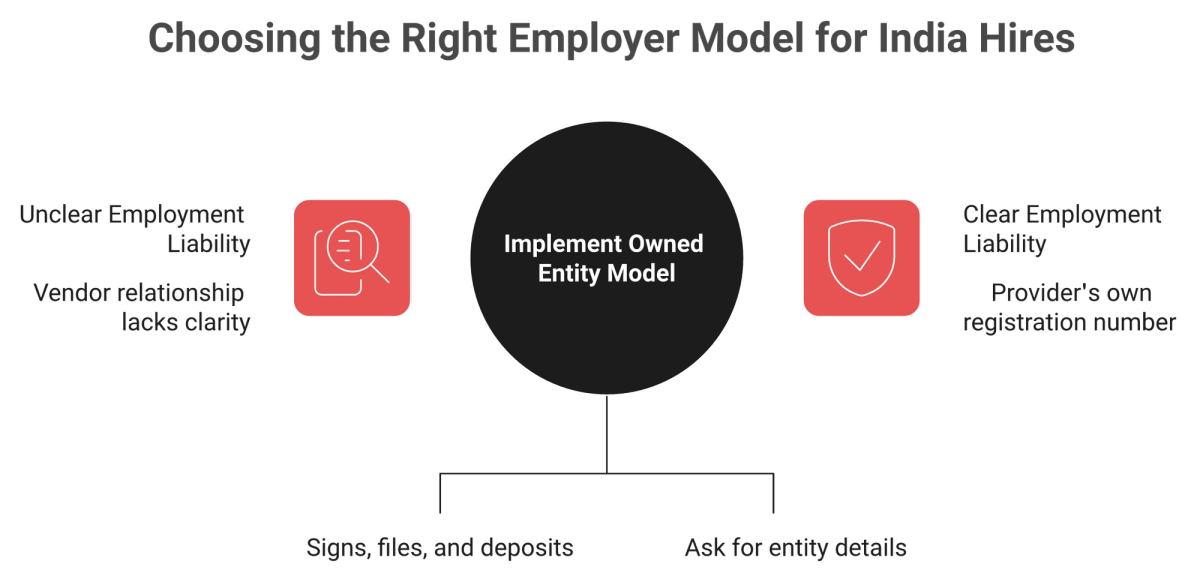
An Employer of Record (EOR) is the legal employer of your India hire. Someone must sign that employment contract under Indian law.
In an owned model, the platform's own Indian company signs. In a partner model, an unnamed local firm signs, and the platform resells the arrangement to you.
Both are legal. They fail differently.
📄 Where it breaks: the diligence conversation
Picture your CFO's data room during a Series B. The auditor asks who deposited the tax deducted at source (TDS) for your Bengaluru engineer.
If the depositor is a third party you have no contract with, that answer takes three emails and a chase. Versatile Club sends the challan with its own registration number on it, which is the whole point of ownership over abstraction.
⚠️ The honest counterpoint
Owning an entity does not automatically make you faster. Rippling reports 2 to 5 days for EOR onboarding, which is quick by any standard.
I could be reading my own advantage too strongly here. Ownership buys traceability, not speed. Speed comes from having done the registrations before your hire signs, which is the sequence set out in how our onboarding works.
❌ Where the public record is thin
Neither vendor publishes its India entity name on the comparison pages that rank for this keyword. That is the gap. An "owned entity, yes" checkbox on a battlecard is a marketing claim, not a filing.
Treat the Deel partner-model description as analyst inference until a vendor confirms it in writing, and read the structural detail in this breakdown of Deel alternatives in India.
✅ Four questions to ask on the call
Ask these before signing anything. Any real EOR answers all four in one email.
What is the exact legal name of the entity that will employ my hire?
What is its Corporate Identity Number (CIN) on the Ministry of Corporate Affairs registry?
What is the PF establishment code under which contributions get deposited?
Who signs the employment contract, you or a partner?
Versatile Club answers with Foo Falcon Technologies Pvt Ltd, its CIN, and its own PF and ESIC codes, and we send the registration documents before the contract, not after.
🔍 How to verify it yourself in ten minutes
Take the entity name and search the MCA master data portal. Company status, incorporation date, and registered office are public.
Then ask for one recent PF challan with the establishment code visible. Redacted amounts are fine. The code is the tell.
What surfaces in Versatile Club's client engagements is that buyers who run this check once never skip it again. It costs ten minutes and removes the single largest unknown in the vendor stack.
Versatile Club employs your India hires through its own registered Indian entity for EOR services, with PF, ESIC, and state licences in its own name, so there is no partner in the chain for your auditor to trace.
Q3. What does each platform really cost per India employee, and when does your own entity win?
Deel's India EOR starts at $599 per employee per month plus a $500 setup fee and one month's exit notice. Rippling quotes privately at roughly $500 to $700, with HR and IT modules priced separately. Add a reported 3 to 5 percent FX markup and the real first-year cost per head sits well above both stickers. Below roughly 15 India employees, EOR still beats your own entity over three years.
💰 The published numbers, first
Deel publishes its EOR sticker. Contractor management runs about $49 per contractor, and global payroll starts near $29 per employee plus a $1,000 entity setup.
Rippling does not publish EOR pricing. Its HR platform starts around $8 per employee per month, with EOR quoted on request.
| Cost layer | Deel | Rippling | Versatile Club |
| EOR monthly | From $599 | Roughly $500 to $700, quoted | $149, flat |
| Setup fee | $500 | Quote dependent | $0 |
| Exit | 1 month notice | Contract dependent | $0 |
| Salary markup | None disclosed | None disclosed | None, ever |
💸 The four layers the sticker hides
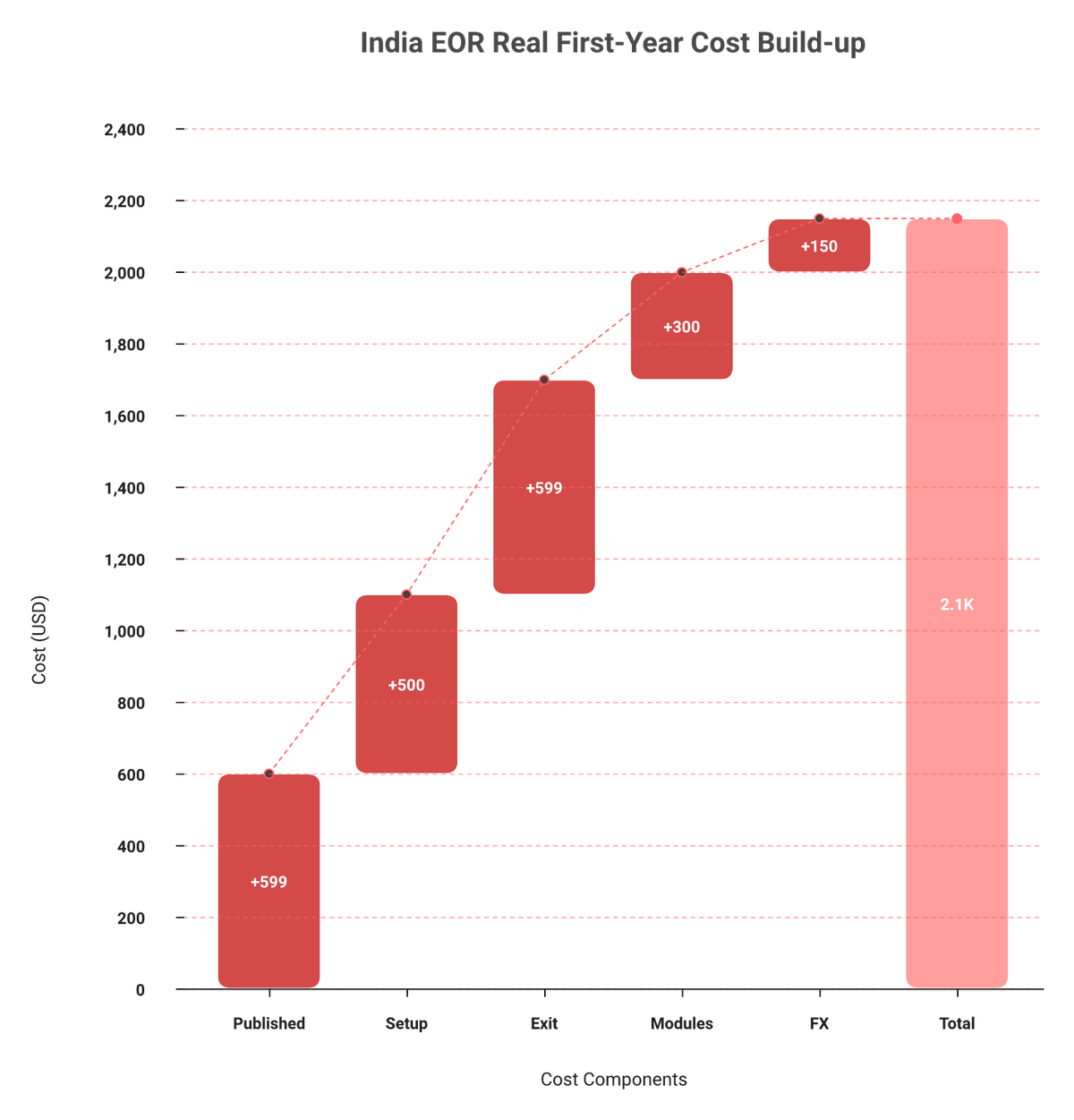
Setup fees are one-time and visible. The other three are not.
Exit notice means you pay for a month you are not using. Module stacking means HR, IT, and spend get priced apart. FX markup of 3 to 5 percent sits inside the conversion leg, a pattern documented in this analysis of employer of record cost in India.
Employees feel that last one directly.
"I find the pricing of Deel to be quite terrible for me. Previously, I was paid directly by my employer without any additional costs. Now, I'm required to pay a monthly fee."
— Verified User in Translation and Localization, 0.5/5 rating, Deel Hire, G2 Verified Review
"Support is the single biggest failure. There is no direct phone line. You either email or use a chatbot, and you can ask both the same question and get two different wrong answers."
— Erika D., 0/5 rating, Rippling, G2 Verified Review
⏰ A five-employee, twelve-month comparison
Run the arithmetic before the demo, not after.
Five hires on Deel at $599 is $35,940 a year, plus $2,500 in setup, plus a month of exit notice. Five hires with Versatile Club at $149 flat is $8,940, with the first month free and no setup or exit cost.
Versatile Club measures this the boring way, by publishing one number that does not move with salary band.
🏗️ When your own entity wins
Incorporating a private limited company in India is not the hard part. Running it is.
You take on statutory filings, an auditor, board compliance, and a full payroll function. Below roughly 15 India employees, EOR stays cheaper across three years, and you can test your own numbers with the EOR vs entity calculator.
⚠️ Why the $599 players cost about four times more
This one is uncomfortable, so I will say it plainly. The global platforms bundle business insurance that covers you if a compliance issue surfaces years later.
Venture-backed buyers are often effectively required to carry that cover. Versatile Club does not offer it today, and that is a real reason a funded CFO picks the expensive option.
Versatile Club charges $149 per employee per month, flat across salary bands, with no setup fee, no exit fee, the first month free, and never a markup on the employee's salary.
Q4. Which platform actually handles PF, ESI, professional tax and the 50% wage rule?
Both platforms run India payroll, but neither publishes state-level detail. Since the four Labour Codes took force on 21 November 2025, Basic plus Dearness Allowance must be at least 50 percent of total remuneration, with excess allowances added back for provident fund, insurance, gratuity, and bonus. Versatile Club recomputes every client CTC against that floor before the first payroll cycle runs.
⚠️ The 50% wage rule, in plain terms
Cost to Company (CTC) is the full employer cost of a hire. Indian offer letters traditionally split it into a small basic and a large special allowance.
That trick is now expensive. The Ministry of Labour and Employment defines wages to include basic pay, dearness allowance, and retaining allowance, and adds back excess allowances above the 50 percent line.
Your employer cost goes up. Your employee's take-home goes down slightly.
💰 The four numbers that run every India payroll
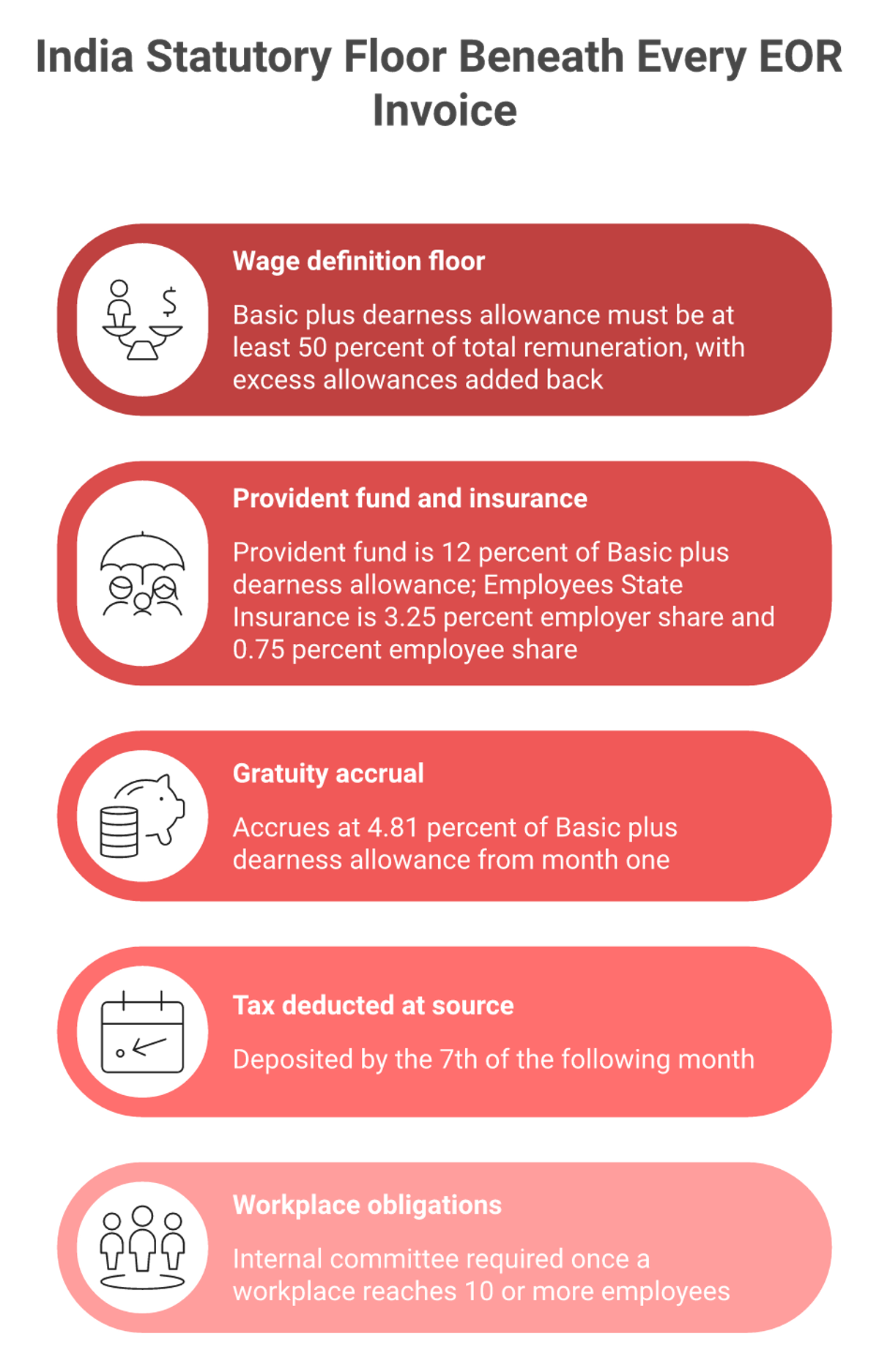
These are the mechanics behind any India EOR invoice.
Provident fund (PF): 12 percent of Basic plus DA, matched by the employer, deposited with the Employees' Provident Fund Organisation.
Employees' State Insurance (ESI): 3.25 percent employer and 0.75 percent employee, for wages within the threshold.
Gratuity: accrues at 4.81 percent of Basic plus DA from month one, not from year five.
TDS: salary tax deducted at source, deposited by the 7th of the following month.
Versatile Club ships PF and ESI challan confirmations plus TDS deposit receipts with every monthly USD invoice, which is the same discipline described in our guide to payroll compliance in India.
🗺️ Professional tax is a state problem, not a country problem
Professional tax (PT) is levied by states, not the centre. There is no national template, which is precisely what a global platform assumes.
| State | What it actually requires |
| Maharashtra | Dual PTRC and PTEC registration, monthly slab filing, annual return |
| Karnataka | Monthly PT, S&E renewal, enrolment within 30 days of joining |
| Tamil Nadu | Biannual PT filing plus Labour Welfare Fund |
| Delhi | No PT, but strict Shops and Establishments enforcement |
| West Bengal | Frequent rule revisions, so the filing calendar shifts |
Versatile Club holds registrations across all 28 states and 8 union territories, which is why a Pune hire and a Bengaluru hire follow different calendars on the same invoice.
✅ POSH is not optional at ten employees
The Prevention of Sexual Harassment (POSH) Act requires an Internal Committee once you have 10 or more employees at a workplace. That includes EOR-employed staff.
Ask your vendor who constitutes that committee and who the external member is. Versatile Club sets up the Internal Committee as part of onboarding rather than treating it as a policy PDF.
❌ What global templates miss
A global platform will handle PF and TDS. What slips is the state layer, the 50 percent recomputation, and the gratuity accrual nobody books until an exit.
Versatile Club's read is that the standard advice gets this backwards. Compliance is the floor, not the product, and our full India compliance coverage is published rather than summarised.
⏰ What to do this week
Re-run every India CTC against the Basic plus DA floor. Then ask both vendors, in writing, for the recomputed employer cost per head.
Versatile Club holds registrations across all 28 states and 8 union territories, and every monthly USD invoice ships with PF and ESI challan confirmations plus TDS deposit receipts. If you want that checked against your current provider, send us your India payroll register and we will mark up the gaps.
Q5. Are they ready for DPDP, Form 130 and permanent establishment risk?
Three changes decide this. The DPDP Rules 2025 (G.S.R. 846(E), 13 November 2025) push core obligations to 13 May 2027. The Income-tax Act 2025 form remap takes effect 1 April 2026, where Form 16 becomes Form 130, 16A becomes 131, and 24Q becomes 138. Permanent establishment exposure sits on top, if your EOR arrangement functions as a de facto branch.
🔐 Where your India employee data actually lives
The Digital Personal Data Protection (DPDP) Act governs personal data of people in India. Your India payroll data is personal data, wherever the server sits.
MeitY notified the DPDP Rules on 13 November 2025 through G.S.R. 846(E). Rules 1, 2, and 17 to 21 applied at once. The heavier consent, security, and breach duties land on 13 May 2027.
That is a real runway, not a reason to wait.
📄 The form remap nobody has told your vendor about
From 1 April 2026, the certificate names change under section 395(4) of the Income-tax Act 2025, read with Rule 215 of the Income-tax Rules 2026.
| Old form | New form (from 1 April 2026) | What it covers |
| Form 16 | Form 130 | Salary TDS certificate |
| Form 16A | Form 131 | Non-salary TDS certificate |
| Form 24Q | Form 138 | Quarterly salary TDS return |
| Form 15CA / 15CB | Form 145 / 146 | Remittance certification |
Versatile Club issues these certificates under its own tax deduction registrations, so the form numbers on your employee's document match the year they were earned in.
⚠️ Permanent establishment, in plain language
Permanent establishment (PE) means the tax authority treats your foreign company as taxable in India. That is the outcome you are paying an EOR to avoid.
Risk rises when the arrangement looks like a branch. Signs include your company signing India leases, holding local bank authority, or directing statutory filings directly, which is why founders comparing India expansion options should map the control test first.
I hedge here honestly. Versatile Club's client experience points one way, but PE is assessed on facts, so no vendor should promise immunity.
💰 FEMA and the remittance trail
Money moving from a US parent into India touches the Foreign Exchange Management Act (FEMA). If you fund an Indian entity with equity, an FC-GPR filing follows through your authorised dealer bank.
For taxable remittances to non-residents above 5 lakh rupees, Form 146 certification applies. Ask Versatile Club for the remittance and payment documentation set before your first close, not during it.
✅ Your five-item diligence checklist
Run these before signing. Each one is a document request, not an opinion.
Written confirmation of Form 130 and Form 138 output for tax year 2026-27.
A DPDP breach-notification and consent-notice clause inside the master agreement.
Named data locations for India payroll records.
A statement of who signs India leases and bank mandates.
A sample monthly invoice with per-employee statutory breakdown.
What surfaces in Versatile Club's client engagements is that item five settles more arguments than the other four combined. Finance teams believe documents, not decks.
❌ What the vendor comparison pages skip
Neither Deel's nor Rippling's public comparison content cites an Indian gazette notification. That is not an accusation. It is a scope choice by platforms covering 80 to 150 countries.
Versatile Club hands finance one USD invoice with a per-employee breakdown, payroll summary, and published compliance status, which is the document set an auditor actually asks for.
Q6. Does Rippling's IT and device provisioning actually work inside India?
Rippling's native mobile device management (MDM), identity management, and device provisioning run deeper than Deel's, with independent 2026 comparisons crediting encryption status and agent-health visibility. The India caveat is physical. Shipping and recovering laptops in Bengaluru or Pune involves customs, GST e-invoicing on asset movement, and local logistics that a US-built provisioning flow does not model. Versatile Club plans equipment inside the onboarding sequence, not after it.
⭐ Give Rippling its due
This is Rippling's real moat, and pretending otherwise wastes your time. One system holds the employee record, the identity, and the machine.
You can push apps, check disk encryption, and see whether the agent is alive. Deel handles equipment through partners instead, which is thinner but simpler.
💸 Where the India physics kick in
A MacBook entering India is an import. That means customs duty, a commercial invoice, and GST treatment on the asset movement.
Then there is recovery. An engineer resigns in Chennai while the asset register sits in a US dashboard.
Versatile Club coordinates pickup through named India logistics partners, because a courier label is not an offboarding process, and the full sequence for equipping remote employees in India starts before day one.
| Provisioning layer | Deel | Rippling | Versatile Club |
| Device management | Partner-led | Native MDM and identity | Partner-led, India-based |
| App and access setup | Integrations | Native | Partner-led |
| India customs handling | Not modelled | Not modelled | Handled per shipment |
| Asset recovery on exit | Partner-led | Dashboard tracked | Local pickup coordinated |
| India tax structuring (NPS) | No | No | Yes |
⚠️ What users report about the local layer
Rippling users like the onboarding surface. The friction shows up where local jurisdictions get involved.
"Rippling works well for us to on board new employees. It's seamless and allows us to have 100% digital employee files."
— Megan M., 1/5 rating, Rippling, G2 Verified Review
"After implementation we started getting letters from 17 different municipalities saying we had to open withholding accounts with them."
— Megan M., 1/5 rating, Rippling, G2 Verified Review
"Our tech team invested significant work integrating Rippling as our identity provider, and unwinding that is non-trivial."
— Erika D., 0/5 rating, Rippling, G2 Verified Review
That municipality story is the US version of India's state professional tax problem. Versatile Club handles the India equivalent across all 28 states and 8 union territories, because the jurisdiction count does not shrink for anyone.
✅ The day-one readiness checklist
Ask for these five before the offer goes out. Each one has a date attached.
Who imports the laptop, and under whose GST identification number.
Expected customs clearance window in days.
Who owns the asset on the books, you or the EOR.
Recovery process and cost if the hire exits in month three.
Whether identity and app provisioning survive an EOR switch.
Versatile Club's read is that the category gets this backwards. Device provisioning is sold as software, but in India it is a logistics and tax problem with software on top, and the Rippling alternatives for India comparison shows how differently each vendor treats it.
⏰ Why timing matters more than the dashboard
A five-day onboarding promise means nothing if the laptop lands on day twelve. Compliance is the floor here, not the ceiling.
Versatile Club bundles equipment and onboarding logistics into one engagement, with adjacent services delivered through named India partners rather than dressed up as native software.
Q7. How long does implementation take, and what does switching platforms cost you?
Deel typically onboards an India EOR hire in 7 to 14 days. Rippling reports 2 to 5 days for EOR, but weeks to months for full platform implementation, because HR, IT, and payroll configure together. Switching mid-year in India carries its own cost: UAN continuity, provident fund transfer, a fresh Form 130 trail, and a clean full-and-final settlement on the outgoing entity. Versatile Club commits to five business days in the service agreement.
⏰ Two timelines, two different things being measured
EOR onboarding and platform implementation are not the same clock. Vendors quote whichever number sounds better.
EOR onboarding covers one hire going live on payroll. Platform implementation covers your whole company moving onto the system.
| Stage | Deel | Rippling | Versatile Club |
| Single EOR hire live | 7 to 14 days | 2 to 5 days | 5 business days, contractual |
| Full platform setup | Weeks | Weeks to months | Not applicable, service-led |
| Exit terms | 1 month notice | Contract dependent | $0, no notice period |
Versatile Club appears in that table with a contractual number, because a marketing claim and a service-level agreement are different documents.
🧾 What actually consumes the days
The software is not the bottleneck. The registrations are.
Statutory enrolment: provident fund and insurance enrolment under the employer code.
Professional tax enrolment: state specific, within 30 days in Karnataka.
Offer, contract, and background verification turnaround.
Bank and payroll cycle cut-off alignment.
Versatile Club publishes the day-by-day onboarding sequence: agreement, offer, contract, registrations, then payroll live.
⚠️ What users report about implementation
Implementation complaints are the most consistent theme in 2026 reviews for both vendors.
"The implementation was terrible; we had two implementation managers and spent the first two months going back and forth just trying to add people into the system correctly."
— Jenny F., 0.5/5 rating, Rippling, G2 Verified Review
"They consistently failed to meet committed deadlines, had terrible communication, and frequently cancelled meetings at the last minute."
— Verified User in Computer Software, 0/5 rating, Deel Hire, G2 Verified Review
🔁 The mid-year switch sequence in India
Do these in order. Skipping step two creates a pension gap your employee will notice.
Confirm the Universal Account Number (UAN) for each employee, then file the PF transfer to the new establishment code.
Close professional tax and insurance enrolment on the outgoing entity.
Run a clean full-and-final settlement, including gratuity accrued to date.
Issue the split TDS trail, so the employee receives certificates from both employers.
Re-issue the employment contract with the Basic plus DA structure recomputed.
Versatile Club runs this migration on its own registrations, which keeps the PF trail traceable to one establishment code, and the full playbook for how to switch EOR provider in India follows the same order.
💰 The exit-notice trap
Read the termination clause before the pricing page. Deel's published terms carry one month's notice.
That means your migration overlaps two vendors for a full billing cycle. Versatile Club charges no exit fee and holds no notice period, so a switch costs you sequencing effort, not money, as set out on our published pricing page.
Get the SLA, the exit terms, and the registration list in writing before you sign anything.
Q8. How do you convert Indian contractors to employees without triggering a misclassification bill?
Misclassification exposure in India runs roughly $25,000 to $40,000 per head in back-pay, provident fund arrears, and interest, when full-time staff are papered as independent contractors. Deel and Rippling can both move a contractor onto EOR employment. Neither audits the arrangement you already have, so the classification judgement stays with you. Versatile Club runs the conversion under its own PF and insurance registrations.
🧑💻 The situation I see most often
Two machine learning engineers in Bengaluru. Fourteen months of monthly invoices paid through a transfer app. Full-time hours, company laptops, daily standups.
On paper they are vendors. In practice they are employees, and everyone knows it.
⚠️ The complication arrives with the first real HR hire
A VP People joins in month fifteen. She opens the India folder and goes quiet.
Then the diligence request lands, because fundraising requires clean India payroll records. What surfaces in Versatile Club's client engagements is that the panic starts with the data room, not with a regulator.
💰 What the exposure actually consists of
Regulators look at control, not contract wording. Fixed hours, reporting lines, and company equipment point to employment.
The bill has four parts.
Employer provident fund arrears at 12 percent of Basic plus DA, plus interest and damages.
Employees' State Insurance contributions for the covered period.
Gratuity accrual, at 4.81 percent of Basic plus DA, once continuous service qualifies.
Recomputed tax deducted at source, with the employer as deductor.
Versatile Club recalculates all four before the conversion date, so the client sees the number before committing, and the same arithmetic drives our independent contractor versus EOR comparison.
❌ One label to retire immediately
Do not call this a PEO or co-employment. US-style co-employment does not exist under Indian labour law.
There is one legal employer. The correct term is Employer of Record.
✅ The conversion sequence that works
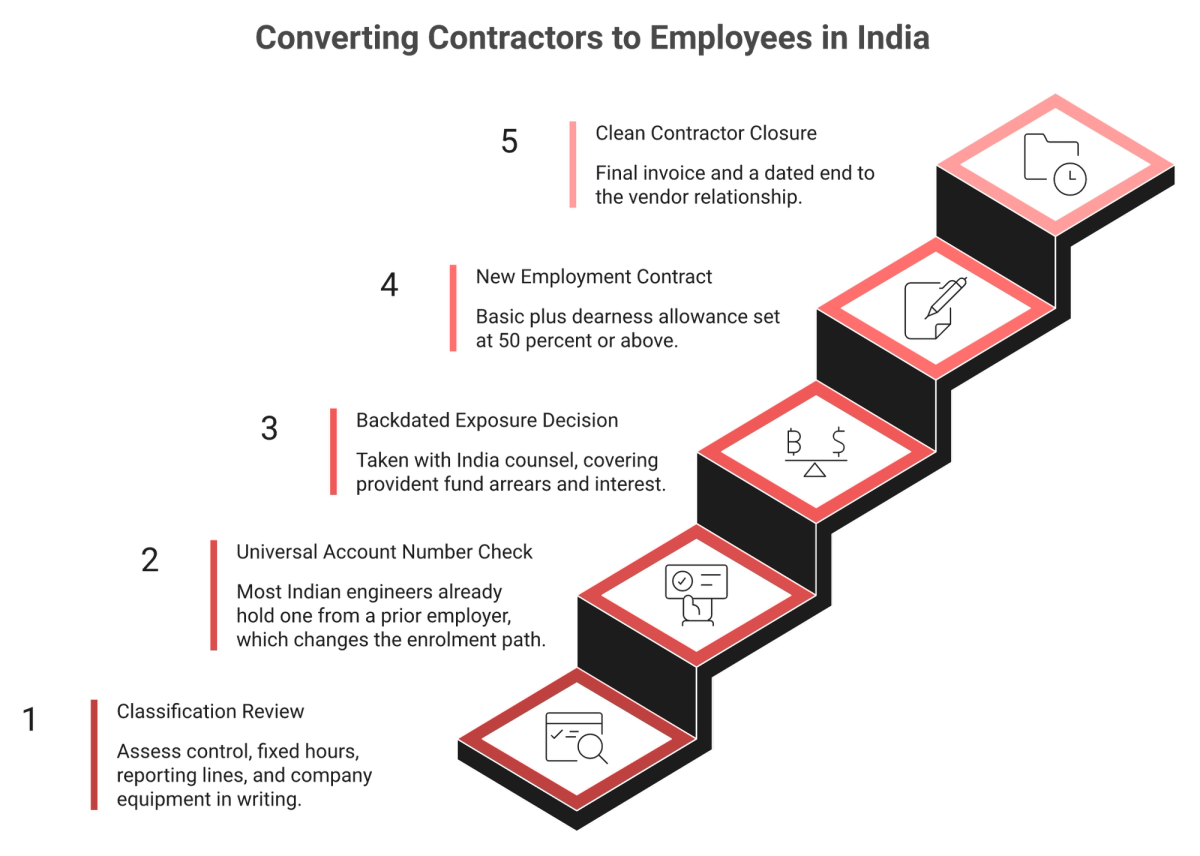
Run it in this order. The UAN step is the one global templates never ask about.
Classification review of the existing arrangement, in writing.
UAN check, because most Indian engineers already have one from a prior employer.
A decision on backdated PF exposure, taken with your India counsel.
New employment contract with Basic plus DA at 50 percent or above.
Clean contractor closure, with a final invoice and a dated end to the vendor relationship.
I have run this conversion where the engineer's UAN already existed, which changes the enrolment path entirely. Versatile Club enrols against the existing UAN, so the employee's pension history stays continuous, and the step-by-step method to convert a contractor to an employee in India is documented in full.
📄 What to get indemnified in writing
Ask each vendor these three questions before signing. Silence on any of them is your answer.
Do you indemnify pre-existing misclassification exposure, or only post-conversion compliance?
Who signs the classification opinion, you or my counsel?
What happens if EPFO assesses arrears for the contractor period?
Versatile Club runs the conversion on its own registrations, covering UAN continuity, PF enrolment, and the revised Basic plus DA structure, and calls the result Employer of Record in India rather than co-employment.
Q9. What happens when something breaks: chatbot, ticket queue, or a human?
Deel's support is chatbot-first, with reported 48 to 72 hour ticket queues. Rippling is self-serve by design, with email and chat but no direct phone line. Indian statutory deadlines do not move, since provident fund and insurance challans and the 7th-of-the-month tax deposit are fixed dates. Versatile Club answers on WhatsApp, because a queue measured in days cannot serve a deadline measured in hours.
⏰ The mismatch nobody prices in
India payroll runs on fixed dates. Tax deducted at source (TDS) is deposited by the 7th of the following month.
Provident fund and insurance challans follow their own monthly cycle. Miss one, and you pay interest plus damages, not an apology.
Versatile Club treats the 7th as a hard internal deadline rather than a target, which is why the escalation path has one step, and the same discipline runs through our managed payroll service.
⚠️ What buyers actually report
The complaint pattern is consistent across both platforms and across 2024 to 2026 reviews.
"There is no direct phone line. You either email or use a chatbot, and you can ask both the same question and get two different wrong answers."
— Erika D., 0/5 rating, Rippling, G2 Verified Review
"I believe those platforms should perfect two main tasks: Contracts and Payments. Both lacks and does not work properly on Deel."
— İbrahim, 1/5 rating, Deel Hire, G2 Verified Review
"Sometimes the email communication from the wisemonk team is delayed by a day or 2. But overall they seem to be the best for India."
— Bulbul G., 4/5 rating, Wisemonk, G2 Verified Review
That third quote matters. India specialists are smaller, so response depth beats headcount, and buyers notice both, which is the trade-off mapped out in our Wisemonk alternative comparison.
❌ Where rigid automation actually bites
Automated policy engines assume one country's norms. A US expense rule does not understand a two-hour Bengaluru commute or a cash-only auto receipt.
"Deel's one-size-fits-all approach creates unnecessary friction and risk, especially for small businesses working internationally under a legal structure."
— Verified User in Translation and Localization, 0.5/5 rating, Deel Hire, G2 Verified Review
✅ The escalation test to run before you sign
Do this during the trial, not after the contract. It takes twenty minutes.
Ask a specific state question, such as Maharashtra PTEC filing frequency.
Time the first human response, not the bot reply.
Ask the same question twice, through two channels.
Compare the answers for contradictions.
Ask who you reach at 9pm US time, three days before payroll.
Versatile Club's read is that step three exposes more than a reference call does. Contradictory answers signal a support layer without India ownership.
💬 What direct access changes operationally
A founder once messaged me at 11pm her time, three days before payroll, asking where her engineer's PF challan was. I sent it from my phone.
That is not a support feature. It is what happens when the person answering also owns the filings.
Versatile Club's support model is Sagar Chainani on WhatsApp, the founder who owns the Indian entity, reachable before you sign and after.
Q10. Neither platform hires for you, so who screens for resume fraud and retention?
Deel and Rippling employ and pay the person you already selected. Neither sources, screens, nor replaces them. That gap matters in India, where roughly 30 percent of IT sector resumes carry discrepancies, making criminal, education, and previous-employment verification a hiring necessity. Versatile Club screens on 50 behavioural parameters alongside technical evaluation, then backs the hire with a 6-month replacement guarantee.
🧩 The common view, and why it is incomplete
Everyone treats EOR as a payroll and compliance purchase. Get the filings right, and the job is done.
That framing survives contact with reality for about four months. Then the hire leaves, and you are back to zero with a paid EOR seat.
💸 Where the real money goes
Run the arithmetic honestly. An EOR fee of $599 a month is $7,188 a year.
A senior engineer who exits in month four costs you the salary, the ramp time, the manager's hours, and the delayed roadmap. The vendor fee is not the expensive part of a bad hire.
Versatile Club prices C2H at 20 to 30 percent of annual salary, charged only after the hire completes day 90, which puts the placement risk on us.
⚠️ The India-specific screening problem
Background verification in India has its own failure modes. Employment history is the weak point, not education.
The Universal Account Number (UAN) is the fix hiding in plain sight. It is a permanent provident fund identifier that carries a verifiable employment history.
Versatile Club checks UAN continuity during screening, so claimed tenure gets matched against contribution records rather than a reference call, and the same check runs on every recruitment engagement we take on.
⭐ The contrarian turn on why you hire in India
I do not sell India as cheap labour, and I will not. The pitch is capability density.
India's tech sector is projected past $315 billion in FY26, with direct employment near 6 million and 2,117 Global Capability Centres operating. That is a deep senior talent pool, not a discount bin.
One exceptional engineer at top-of-market pay beats five average hires. I have watched both approaches play out across six years of placements, most recently when clients hire AI and ML engineers in India.
✅ What buyers say about integrated hiring
The India specialists that bundle recruitment get credit for exactly this.
"Everything from scheduling the interviews to the final onboarding was handled smoothly and professionally. They consistently provided timely updates after each round."
— Verified User in Financial Services, 4/5 rating, Wisemonk, G2 Verified Review
"I've noticed that their support/query responses can occasionally take a bit longer sometimes, likely due to a relatively small team."
— Verified User in Financial Services, 4/5 rating, Wisemonk, G2 Verified Review
| Hire-quality layer | Deel | Rippling | Versatile Club |
| Sourcing and screening | No | No | Yes, C2H heritage |
| Behavioural assessment | No | No | 50 parameters |
| Structured 90-day follow-up | No | No | Success Coach |
| Replacement guarantee | No | No | 6 months |
💰 A cheaper filter than a bad hire
Pay for a one to two week scoped mini-project before onboarding. Around $1,500 buys you real signal.
Versatile Club's data points one way here, though I might be reading it too strongly. Paid trials filter resume inflation better than any interview loop I have run.
Versatile Club screens on 50 behavioural parameters, assigns a 90-day Success Coach, and offers a 6-month replacement guarantee, terms no global platform currently matches.
Q11. So which should you choose for your India team, and when is a specialist the better call?
Choose an India-only specialist if India is your single offshore hub and provident fund, professional tax, gratuity, and diligence-grade documentation are what keep you awake. Choose Deel if India is one of many countries and published pricing matters. Choose Rippling if unified HR, IT, and device provisioning is the binding constraint. Versatile Club operates only in the first scenario, by design.
⭐ The allocation rule, in one table
Match the vendor to the shape of your problem, not to the demo you liked.
| Your situation | Best fit | Why |
| India is your only offshore hub | Versatile Club | Own entity, all 28 states, $149 flat, 5-day contractual SLA |
| Hiring across 5 or more countries | Deel | 150+ entities, published $599 pricing |
| Unified HR, identity, and devices | Rippling | Native MDM and identity depth |
| Enterprise procurement needing SOC 2 or ISO 27001 | Deel or Rippling | Certifications already in place |
🔀 The split-vendor play nobody pitches
You do not have to pick one vendor for the whole map. Use a specialist for India and a global platform for the rest.
Ask Versatile Club to run the India leg while your generalist covers the other countries. It is the same logic as choosing a regional cloud provider for one workload, and it is why buyers shortlist us on best EOR in India lists rather than global ones.
⚠️ Where I would not recommend us
Versatile Club does not hold SOC 2 Type II or ISO 27001 today, and enterprise procurement teams often require both. If that is a gate, take the generalist.
We also do not bundle the business insurance that the $599 platforms include. Venture-backed CFOs sometimes need that cover, and I would rather you hear it here than discover it in a security review.
EOR is newer for us than contract-to-hire. The Indian entity, the registrations, and the payroll operations are not new, as our company background sets out.
💰 The entity question, one last time
Incorporating your own Indian subsidiary takes real capital and roughly 12 to 18 months before it earns its keep. Below about 15 India employees, EOR wins on cost and time.
Versatile Club treats that crossover as a real exit point, not a churn event, and we say so before you sign, which is why the EOR versus entity comparison for India stays published rather than gated.
✅ What India buyers keep saying
The recurring theme in India EOR reviews is not software. It is whether someone locally owns the outcome.
"WiseMonk's EOR service solved our biggest challenge, which was hiring employees in India without setting up a local entity."
— Verified User in Marketing and Advertising, 3.5/5 rating, Wisemonk, G2 Verified Review
"I find Deel easy to use. The initial setup was straightforward. I find Deel to be absurdly expensive."
— Juan Camilo O., 1/5 rating, Deel Hire, G2 Verified Review
⏰ What I think changes by 2028
India stops being one row on a global EOR map and becomes its own category. Owned-entity operators running a single country take the India revenue the generalists currently book by default.
I could be early on that call. Where my head is right now is that state-level depth is the only defensible moat left.
Versatile Club is built for exactly one scenario: India-only hiring without your own entity, on our own registrations, live in five business days under a contractual SLA, at $149 flat with the first month free.
Send me your India headcount plan for the next two quarters, and I will tell you honestly whether we are the right fit or whether you should stay with a generalist. If it helps, book a 30-minute call and bring the plan with you.
FAQs
Is Deel or Rippling cheaper for hiring employees in India in 2026?
Deel is cheaper to evaluate because its price is public. Rippling is often cheaper on paper but harder to compare, since India EOR is quoted privately.
- Deel: India EOR from $599 per employee per month, plus a $500 setup fee and one month's exit notice.
- Rippling: quote only, typically $500 to $700 per employee per month, with HR and IT modules priced separately.
- Hidden layers: a reported 3 to 5 percent FX markup, module stacking, and the exit notice you pay without using.
Run the arithmetic on five hires over twelve months rather than comparing stickers. Five seats on Deel is $35,940 a year before setup and exit costs.
Versatile Club charges $149 per employee per month, flat across salary bands, with no setup fee, no exit fee, and the first month free. We never mark up the employee's salary, because a markup turns an EOR into an IT-services contract.
Before you sign either contract, ask for a sample invoice with the per-employee statutory breakdown. You can also test the numbers against our published India EOR pricing to see what a flat all-in figure actually covers.
Does Rippling or Deel own an Indian entity, or do they use a local partner?
Rippling reports a wholly-owned Indian entity. Deel is widely assessed as delivering India through a local partner, with independent 2026 comparisons putting Rippling's owned entities near 29 against Deel's 150-plus mixed footprint.
This matters more than most demos suggest. In a partner model, your employment liability, provident fund filings, and tax deposits sit with a subcontractor you never signed a contract with.
Ask these four questions in writing before signing:
- The exact legal name of the entity that will employ your hire.
- Its Corporate Identity Number on the Ministry of Corporate Affairs registry.
- The PF establishment code under which contributions get deposited.
- Who signs the employment contract, the platform or a partner.
Versatile Club employs India hires through Foo Falcon Technologies Pvt Ltd, our own registered Indian company, with PF, ESIC, and state Shops and Establishments licences in our own name. When a client's chartered accountant asks who deposited the TDS, we send the challan with our own registration number on it.
If entity ownership is your deciding criterion, the structural differences are laid out in our comparison of Deel alternatives in India.
Do Deel and Rippling handle PF, ESI, professional tax, and the new 50 percent wage rule?
Both platforms process India payroll, but neither publishes state-level detail, and that is where global templates break.
Since the four Labour Codes took force on 21 November 2025, wages must include basic pay, dearness allowance, and retaining allowance, with Basic plus DA at 50 percent or more of total remuneration. Allowances above that line get added back for provident fund, insurance, gratuity, and bonus.
The mechanics behind every India invoice look like this:
- PF: 12 percent of Basic plus DA, matched by the employer.
- ESI: 3.25 percent employer and 0.75 percent employee, within the wage threshold.
- Gratuity: accrues at 4.81 percent of Basic plus DA from month one.
- TDS: deposited by the 7th of the following month.
Professional tax is state-levied, so Maharashtra needs dual PTRC and PTEC registration while Karnataka runs monthly filing with enrolment inside 30 days of joining.
Versatile Club holds registrations across all 28 states and 8 union territories, and every monthly USD invoice ships with PF and ESI challan confirmations plus TDS deposit receipts. The full scope sits on our India compliance page.
How long does implementation take, and what does switching from Deel or Rippling cost?
Deel typically onboards a single India EOR hire in 7 to 14 days. Rippling reports 2 to 5 days for EOR, but weeks to months for full platform implementation, because HR, IT, and payroll configure together.
The software is rarely the bottleneck. Statutory enrolment, state professional tax registration, background verification, and payroll cut-off alignment consume most of the calendar.
Switching mid-year in India has its own sequence, and skipping step one creates a pension gap your employee will notice:
- Confirm each employee's Universal Account Number, then file the PF transfer to the new establishment code.
- Close professional tax and insurance enrolment on the outgoing entity.
- Run a clean full-and-final settlement, including gratuity accrued to date.
- Issue the split TDS trail so the employee receives certificates from both employers.
- Re-issue the contract with the Basic plus DA structure recomputed.
Watch the exit clause too. Deel's published terms carry one month's notice, so your migration overlaps two vendors for a full billing cycle.
Versatile Club commits to five business days in the service agreement, charges no exit fee, and holds no notice period. The step-by-step method is documented in our guide to switching EOR provider in India.
Can Deel or Rippling convert my Indian contractors to employees safely?
Both platforms can move a contractor onto EOR employment. Neither audits the arrangement you already have, so the classification judgement and the liability stay with you.
Misclassification exposure in India runs roughly $25,000 to $40,000 per head in back-pay, provident fund arrears, and interest. Regulators look at control rather than contract wording, so fixed hours, reporting lines, and company equipment point to employment.
Run the conversion in this order:
- Written classification review of the existing arrangement.
- Universal Account Number check, since most Indian engineers already have one from a prior employer.
- A decision on backdated PF exposure, taken with your India counsel.
- A new employment contract with Basic plus DA at 50 percent or above.
- Clean contractor closure with a final invoice and a dated end to the vendor relationship.
One label to retire: this is not a PEO or co-employment, because US-style co-employment does not exist under Indian labour law. There is one legal employer, and the correct term is Employer of Record.
Versatile Club runs the conversion on its own PF and ESIC registrations, enrolling against the existing UAN so pension history stays continuous. The full sequence is set out in our guide on how to convert a contractor to an employee in India.