Table of contents (10)
How to Convert a Contractor to Employee in India: The Steps, Statutory Obligations, and Historical Risk
Q1: When is your 'independent contractor' in India already legally an employee?
In India your contract title does not decide the relationship. The degree of control does. If you set someone's hours, hand them a company laptop and email, ask for exclusivity, direct how the work gets done, and treat them like a team member, Indian law reads them as an employee no matter what the agreement says. Most tech founders fail this test on day one.
🧭 The one word that decides everything: control
I have reviewed a lot of "contractor" agreements over six years of India placements. The mistake is almost always the same. Founders think the label protects them. It does not.
Indian courts look at substance, not paperwork. The Supreme Court has drawn the line for decades. A genuine contractor "has to produce a particular result but the manner in which the result is to be achieved is left to him," and because there is "no control or supervision as to the manner in which he has to achieve the work, he is not a worker."
That sentence is the whole test. Read it twice. If you control the manner, not just the result, you have an employee. Understanding this line is the starting point of any independent contractor versus EOR decision.
⚠️ The smoking gun most founders miss
Here is a moment that stuck with me. An American manager told me that every time an Indian colleague offshore wanted to take his dinner break, he messaged her to ask if it was okay. She told him he did not need to. He insisted, "because I'm your subordinate."
That is warmth and hierarchy, and I respect it. But in an audit, that single chat log is a problem. It shows a reporting line, supervision, and subordination. Those are employment markers, not contractor markers.
The three landmark cases behind this are worth knowing by name: Dhrangadhara Chemical Works v. State of Saurashtra (the original control test), Ram Singh v. UT Chandigarh (2004), and Pawan Hans v. Aviation Karmachari Sanghatana (2020), where long-engaged contractual workers were held to be employees.
✅ Your Monday-morning self-diagnosis
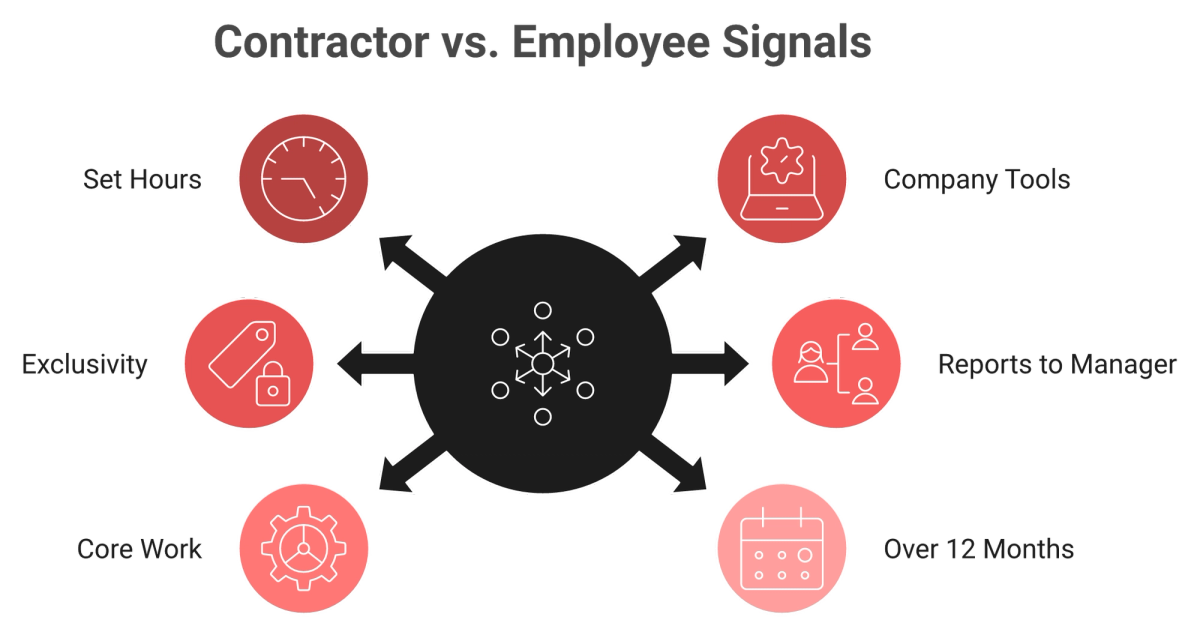
Run each contractor through these six questions. Every "yes" pushes you toward employee status.
- Do you set their working hours or expect them online during your business day?
- Do they use your email, Slack, laptop, or internal tools?
- Do they work only for you, with no other clients?
- Do they report to a manager who reviews how they work, not just deliverables?
- Do they do core work your business depends on, not a one-off project?
- Have they been with you longer than 12 months on a rolling basis?
If you answered "yes" three or more times, I would treat that person as misclassified today, not later.
I could be blunt here because I have watched this play out. When a People Ops lead joins a funded startup, this is often the first thing they flag. Across our contract to hire placements at Versatile Club in Bengaluru, Hyderabad, and Pune, nearly every "contractor" a client asked us to review failed this control test. That failure is exactly why the conversation shifts from contractor to employee, and why many clients move to our EOR services in India.
Q2: What is the real 'Historical Risk' — how big is your misclassification back-pay exposure?
Misclassifying one engineer as a contractor in India creates roughly $25,000 to $40,000 of back-pay exposure per head. That figure stacks backdated Provident Fund (PF, India's mandatory retirement contribution), Employees' State Insurance (ESI), gratuity, interest, and damages. Ten contractors can quietly become a seven-figure hole in your data room.
💸 What the number is actually made of
Let me break down where $25,000 to $40,000 comes from, per person, in real statutory line items.
| Liability | Rate / basis | Where it bites |
|---|---|---|
| Back PF (both shares) | 12% + 12% on the ₹15,000 wage ceiling, about ₹3,600/month | Owed from the start date, not from discovery |
| ESI | 3.25% employer + 0.75% employee, where wages ≤ ₹21,000 | Backdated for every covered month |
| Gratuity | 4.81% of Basic + Dearness Allowance, accrued from month one | Builds silently the whole time |
| Interest (EPF Sec 7Q) | 12% per year, non-negotiable | Charged on every late contribution |
| Damages (EPF Sec 14B) | 1% per month since 15 June 2024, capped at arrears | On top of interest |
Take a three-year "contractor." The PF side alone runs near ₹1.75 lakh before you even add gratuity, ESI, interest, or damages. That is one person.
⏰ Why this surfaces at the worst possible time
Here is the part that keeps CFOs up. This liability does not stay hidden. It surfaces in due diligence, right when leverage matters most.
I have heard the same real question from People Ops leaders and finance leads more than once. "If I keep these 10 engineers as contractors to save 20% on statutory costs, am I creating a back-pay exposure that kills my next funding round?"
Yes. That is exactly what you are doing. Running contractors to save statutory cost is, as one operator put it to me, "running with scissors if you don't hire an army of experts to cross every t." Staying ahead of this is the heart of payroll compliance in India.
📊 What to do before the data room opens
My honest view is that compliance is the floor, not the ceiling. But this particular floor is a funding-round killer, so treat it like one.
- Quantify per-head exposure now, while it is still your choice, not an acquirer's finding.
- Model each long-tenured contractor separately. Tenure drives the interest and damages stack.
- Decide conversion before, not during, diligence.
When a client's contractor setup gets flagged, the first thing we do at Versatile Club is model that per-head historical exposure on WhatsApp, usually same day. Because that number, not the monthly fee, is what actually decides the conversion. You can pressure-test the economics yourself with our EOR vs entity calculator.
Q3: What are the exact steps to convert a contractor to an employee in India?
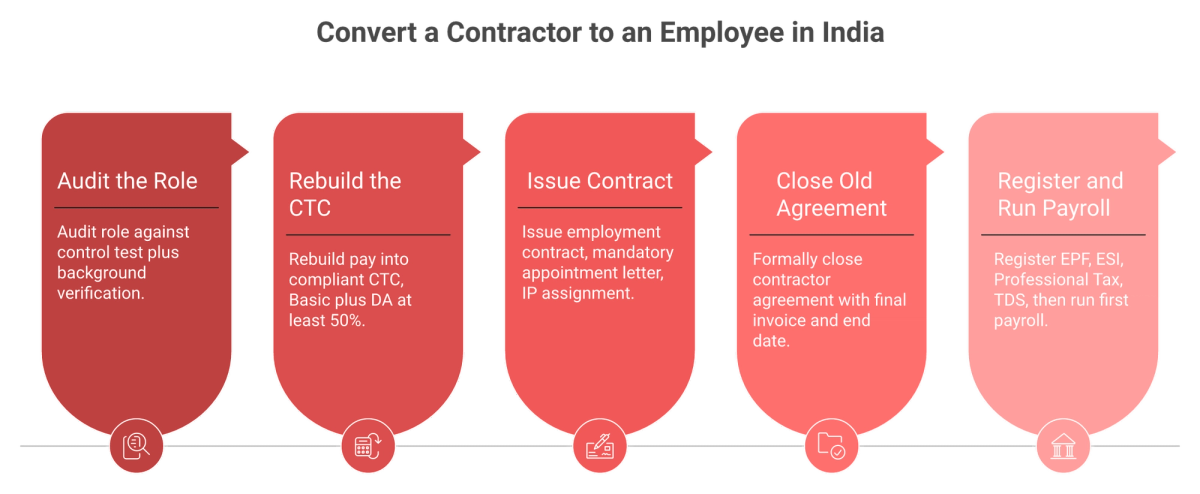
Convert a contractor to an employee in India in five steps: audit the engagement against the control test, restructure pay into a compliant Cost to Company (CTC) where Basic plus Dearness Allowance is at least 50%, issue an employment contract with a mandatory appointment letter and IP assignment, formally close the contractor agreement, then register for EPF, ESI, Professional Tax, and TDS and run first payroll. Through an EOR this takes days, not months.
🔍 Step 1: Audit the role and run background verification
Start by confirming the person is genuinely misclassified using the control test from earlier. Document why they are an employee, so your file defends itself later.
Do background verification (BGV) now, before onboarding. Nearly 30% of IT-sector resumes in India carry discrepancies, so BGV at conversion is not optional caution, it is basic hygiene.
💰 Step 2: Rebuild the pay into a compliant CTC
This is where global playbooks trip. Under the New Labour Code 2025-26, Basic plus Dearness Allowance must be at least 50% of total CTC. You cannot just port over the old flat contractor fee.
The trap: if you do a lazy 1:1 conversion, PF and gratuity provisioning jump and take-home can drop. Model the full stack first, then decide the gross-up. Our salary calculator helps you simulate this before the offer.
📝 Step 3: Issue the contract and appointment letter
Issue a proper employment agreement plus a mandatory appointment letter, which the Labour Codes now require for every employee. Fold in IP assignment and confidentiality here, because a contractor's IP terms rarely survive as employee terms.
The trap: reusing the old contractor MSA with "employee" pasted on top. It will not hold.
🔄 Step 4: Formally close the contractor agreement
Terminate and settle the old contractor relationship cleanly, with a final invoice and a clear end date. A dangling contractor agreement running alongside an employment contract is an auditor's dream and your nightmare.
🏛️ Step 5: Register statutory accounts and run first payroll
Enroll the employee in EPF, ESI, Professional Tax, and TDS under Section 192 (salary withholding, replacing contractor-style TDS). Deposit TDS by the 7th of the following month, every month, without fail. This is where managed payroll takes the recurring load off your team.
The trap: assuming registration is instant. On your own, EPFO and ESIC setup plus state PT can stretch for weeks.
⭐ Where the model breaks down for global tools
This five-step sequence is exactly what we run at Versatile Club, and because we own the Indian entity, we commit to it as a 5-day contractual onboarding SLA, not a hopeful estimate. Global generalists route India through partner shells, and buyers feel the drag. One buyer described a competitor's timeline plainly:
"It took three months to onboard our first 3 individuals. They didn't seem to be able to navigate Visas or variations to employment contracts."
Verified User in Information Technology and Services Deel G2 Verified Review
Onboarding speed is not a vanity metric. When conversion drags, your contractor keeps taking counter-offers.
"The onboarding has been chaotic. Multiple implementation managers, missed deadlines, and incomplete setups across critical modules like payroll."
Zubair B. Rippling G2 Verified Review
That is the gap a 5-day contractual SLA is built to close, and it is a core reason founders pick us as a Deel alternative.
Q4: What statutory obligations kick in — and how do they differ by state?
On conversion you inherit a recurring statutory stack: 12% EPF (both sides on the ₹15,000 ceiling), ESI at 3.25%/0.75% where wages are ≤ ₹21,000, gratuity at 4.81% of Basic plus DA from month one, monthly TDS by the 7th, POSH coverage, and annual Form 16, all under the 50% Basic-plus-DA rule. Critically, Professional Tax and Shops & Establishments rules differ in every state, so Bengaluru, Hyderabad, and Pune are not interchangeable.
📋 The recurring stack you now own
These do not stop after onboarding. They repeat every payroll cycle, and each one has an authority that can penalize you.
| Obligation | Rate / basis | Cadence | Authority |
|---|---|---|---|
| EPF | 12% employer + 12% employee, ₹15,000 ceiling | Monthly | EPFO |
| ESI | 3.25% employer + 0.75% employee, wages ≤ ₹21,000 | Monthly | ESIC |
| Gratuity | 4.81% of Basic + DA, accrued from month one | Ongoing accrual | Payment of Gratuity Act |
| TDS | Per income tax slab, Section 192 | Deposited by 7th monthly | Income Tax Dept |
| POSH | Internal Committee required | On hire / ongoing | POSH Act 2013 |
| Form 16 | Annual TDS certificate | Yearly | Income Tax Dept |
🗺️ Why "one India payroll" is a myth
Here is what a global playbook abstracts away. Professional Tax (PT) and Shops & Establishments (S&E) rules are set by each state, not by Delhi.
| State (city) | Professional Tax | S&E notes |
|---|---|---|
| Karnataka (Bengaluru) | Monthly PT | S&E registration with periodic renewal |
| Maharashtra (Pune) | PTRC + PTEC, monthly slab | Separate employer and enrollment registrations |
| Telangana (Hyderabad) | PTRC enrollment, monthly | State-specific S&E filing |
So an engineer in Bengaluru, one in Pune, and one in Hyderabad sit under three different filing calendars. Miss one state's slab and you are non-compliant in that state only, which is exactly how quiet penalties accumulate. This multi-state depth is why our compliance coverage spans all 28 states and 8 union territories.
⭐ Why depth beats a partner shell here
There is an emotional layer too. As one observer put it, Indians "may go to work every day in a reasonable facsimile of the West, but they go home every night to India." PF, gratuity, and ESI are not "global policy" line items to your employee. They are non-negotiable dignity.
At Versatile Club we run PF, ESI, TDS, and multi-state PT filings across all 28 states and 8 union territories under our own registrations. So the statutory receipts in your data room carry your provider's name, not an anonymous partner's. The difference shows up when something goes wrong at a competitor:
"The PF transfer for employees after terminating their employment with Velocity was very poor. There was limited help, delayed responses... they charged heavily per employee and the backend HR services they provide is extremely poor."
Verified User Velocity Global G2 Verified Review
That is a PF handoff failing at the exit stage, which is precisely the India-specific depth a global generalist tends to treat as an afterthought. It is also why many teams choose our EOR services over a generalist Multiplier alternative route.
Q5: Own entity or Employer of Record, which conversion path fits you?
For 1 to 12 India hires, an Employer of Record (EOR, a company that legally employs staff on your behalf) converts contractors in days with no setup or exit cost. Your own entity takes 4 to 6 months and only pays off past roughly 10 to 12 hires. Think suspension bridge versus the Golden Gate. You do not build the Golden Gate to cross a stream.

🌉 The bridge you actually need
Most founders overbuild here. The instinct is "let's just set up an Indian subsidiary and do it properly." For one or two engineers, that instinct is expensive.
Setting up your own entity means MCA (Ministry of Corporate Affairs) incorporation, FEMA and FC-GPR filings for foreign ownership, and RBI share-reporting under the A.P. (DIR Series) rules. That is real time and legal spend before your first payslip runs. Our breakdown of EOR vs entity in India walks through this in detail.
The honest framing I use: for most of the journey, "you don't have to start with the Golden Gate when a simple suspension bridge will get you across the river."
💰 Two paths, side by side
Here is the decision laid out plainly.
| Criterion | Your own entity | Employer of Record |
|---|---|---|
| Time to first hire | 4 to 6 months | Days |
| Upfront cost | Tens of thousands, plus legal | No setup fee |
| Compliance burden | You own PF, ESI, TDS, PT filings | Provider owns them |
| Exit | Wind-down cost and time | No exit fee |
| Best for | 12+ hires, long-term India base | 1 to 12 hires, testing the market |
⚠️ The PEO trap to avoid
One correction I make often. US founders ask for a "PEO" (Professional Employer Organization, the US co-employment model). That model does not legally exist under Indian labour law.
So if you have no Indian entity, the correct structure is an EOR, full stop. Anyone selling you an "India PEO" without your own entity is using the wrong word, and words matter in an audit. If you are weighing the two, our EOR vs PEO guide clears up the confusion.
✅ When to choose which
- Choose an EOR if you have 1 to 12 India hires, want speed, or are still proving the market.
- Choose your own entity if you are past roughly 10 to 12 hires and India is a permanent base.
The tipping point is real. Across companies I have watched, it lands "about 10 to 12 hires. After they hit about 12 they said, right, we're ready to open" an entity.
At Versatile Club we invoice you in USD directly from our own Indian entity, so there is no foreign-exchange surprise, no setup fee, and no exit fee. And when you do cross that 10 to 12 hire tipping point, our EOR services in India help you migrate the EOR headcount into your own entity, so the suspension bridge hands off cleanly to the Golden Gate. You can model the crossover point with our EOR vs entity calculator.
Q6: Versatile vs Wisemonk vs the global generalists, whose India entity are you filing under?
Deel, Remote, G-P, and Multiplier run India through local partner entities, so your PF, ESI, and TDS filings sit under someone else's registration. That is a red flag in diligence. Wisemonk and Versatile Club are both India-native, but the deciding question is whose name is on the statutory receipts. Versatile Club files everything under its own entity, invoices in USD from India, and adds a 6-month replacement guarantee.
🏛️ The one question that sorts the market
Ask any provider this: whose Indian entity are my statutory filings under? The answer separates real India employers from resellers.
Global generalists treat India as one of 90-plus countries, usually via a local partner shell. Their PF, ESI, and TDS filings run under that partner's registration, not theirs, and not yours. This is a recurring theme in our best EOR in India analysis.
📊 How the three options compare
| Criterion | Versatile Club | Wisemonk | Global generalists |
|---|---|---|---|
| India entity | ✅ Own entity | ✅ India-native | ❌ Local partner shells |
| Invoicing | ✅ USD, direct from India | Mixed | $400 to $599/employee/month |
| Setup / exit fees | ✅ None, first month free | Varies | Often extra |
| Replacement guarantee | ✅ 6-month on C2H | ❌ None published | ❌ None |
| Support | ✅ Founder on WhatsApp | Team support | ❌ Ticket queue |
I want to be fair. Wisemonk is a credible India-native operator with strong reviews and certifications, and buyers there are generally happy:
"What I like most about WiseMonk is how they convert a complex international hiring process into a structured and easy workflow."
Verified User in Marketing and Advertising Wisemonk G2 Verified Review
Where global generalists struggle is India-specific support depth once something breaks:
"Often the CS doesn't seem to have answers... something I was looking for the answer to in 20 minutes becomes a 4 day process."
Verified User in Computer Software Deel G2 Verified Review
⭐ Why ownership is the whole game
Ownership is not a branding point. It drives IP assignment and audit-ready receipts. When we are the legal employer of record on our own registrations, your invoices and challans carry a name your acquirer can verify. If you are actively comparing us, our Wisemonk alternative and Deel alternative pages lay it out side by side.
Our own buyers tend to notice the compliance rigour first:
"The compliance rigour is genuinely impressive, every statutory filing reviewed before submission. Five-day onboarding, zero late payslips."
Vedant T. Versatile Club G2 Verified Review
The other gap I would name honestly: compliance-first EORs solve the "legal hire on paper" problem. At Versatile Club we also try to solve the "good hire who stays" problem, with culture-fit screening across 50 behavioral parameters, a 90-day Success Coach, and a 6-month replacement guarantee on contract to hire placements.
Q7: Is fixed-term employment a lower-risk middle path between contractor and permanent hire?
Yes. Fixed-term employment is a compliant middle path when you are unsure a role is permanent. Under the 2025 Labour Codes, fixed-term employees get the same wages, benefits, and statutory coverage as permanent staff, and now accrue pro-rated gratuity after one year instead of five. It removes misclassification risk while giving you a defined end date, which makes it ideal for project roles you would otherwise leave as risky contractors.
🧩 What fixed-term actually is
Think of it as a real employee with an expiry date. Not a contractor, not a lifetime hire. A properly papered employee for a set term.
The key shift under the new Codes is parity. A fixed-term employee "gets the same wages and benefits as permanent staff," so you cannot use the label to short-change PF, ESI, or leave. This is a nuance our EOR services handle by default.
⏰ The gratuity change that matters
Here is the detail global playbooks miss. Gratuity eligibility for fixed-term employees dropped from five years to one year under the new Labour Codes.
So a project engineer on an 18-month fixed term now earns pro-rated gratuity. That is a benefit a "contractor" never had, and it is exactly why fixed-term feels fair to the employee rather than second-class. Getting this right sits at the heart of India compliance.
✅ When to reach for it
My simple rule: match the structure to your certainty.
- Uncertain the role lasts? Use fixed-term. Full statutory coverage, defined runway, and zero misclassification exposure.
- Confident it is core and permanent? Convert straight to permanent.
- Tempted to "just keep them as a contractor" to stay flexible? That is the one option that carries real back-pay risk.
I could be slightly conservative here, but I would rather see a client on a clean fixed-term than a shaky contractor arrangement any day. At Versatile Club, when a client is not sure a role is permanent, we structure a compliant fixed-term hire instead of defaulting to a risky contractor, through our India EOR setup. Same statutory dignity for the person, defined runway for the business.
Q8: How do you convert without losing the person to a counter-offer?
The conversion moment is when contractors are most poachable, so protect take-home first. Under the 50% Basic-plus-DA rule, structure the CTC so net pay holds even as statutory benefits are added, often a 15% to 45% gross-up. Then sell the upside: PF, gratuity, insurance, and things a contractor cannot get, like mortgage eligibility. Retention is not paperwork. It is making the switch feel like an upgrade.
🏠 A real conversion that hinged on a mortgage
Let me tell you about a moment that reframed how I pitch conversion.
A client had two people working as contractors. One of them wanted to buy a home. He went to the bank, and they said no, because he was a contractor with no formal employment.
We converted him to a full employee through our EOR. With a proper payslip and Form 16, the bank said yes. He got his mortgage. That is the whole story, and it is why conversion, done right, is something the employee wants.
💰 Protecting take-home during the switch
The fear on the employee's side is simple: "will my in-hand pay drop?" Under the New Labour Code, Basic plus Dearness Allowance must be at least 50% of CTC, which raises PF and gratuity provisioning.
So you model the gross-up before you make the offer. Done right, net pay holds and the person gains benefits they never had. Done lazily, take-home drops and your contractor takes the counter-offer. Our salary calculator makes this simulation quick, and our managed payroll keeps it correct every cycle.
⭐ Retention is culture, not just cash
Compliance is the floor. Keeping a good hire is the real win, and that is where support quality shows. Founder access during a nervous conversion conversation beats a ticket queue every time.
"Founder is just a call away. Extremely helpful in resolving all our queries. The process is super smooth to setup India EOR."
surbhi m. Versatile Club G2 Verified Review
New hires feel that responsiveness too, and it is what makes them stay rather than shop around:
"Every payroll or PF question gets a real answer from a real person, usually same day... this is the one. We're already lining up our second hire through them."
Verified User in Information Technology and Services Versatile Club G2 Verified Review
At Versatile Club, that is the difference between a legal hire on paper and a good hire who stays. We back it with culture-fit screening across 50 behavioral parameters, a 90-day Success Coach, and a 6-month replacement guarantee through our recruitment model, and I am often the person on WhatsApp when the conversion question comes in. Founders who want to talk it through can book a demo.
Q9: What compliance risks disappear, and what new ones appear, after conversion?
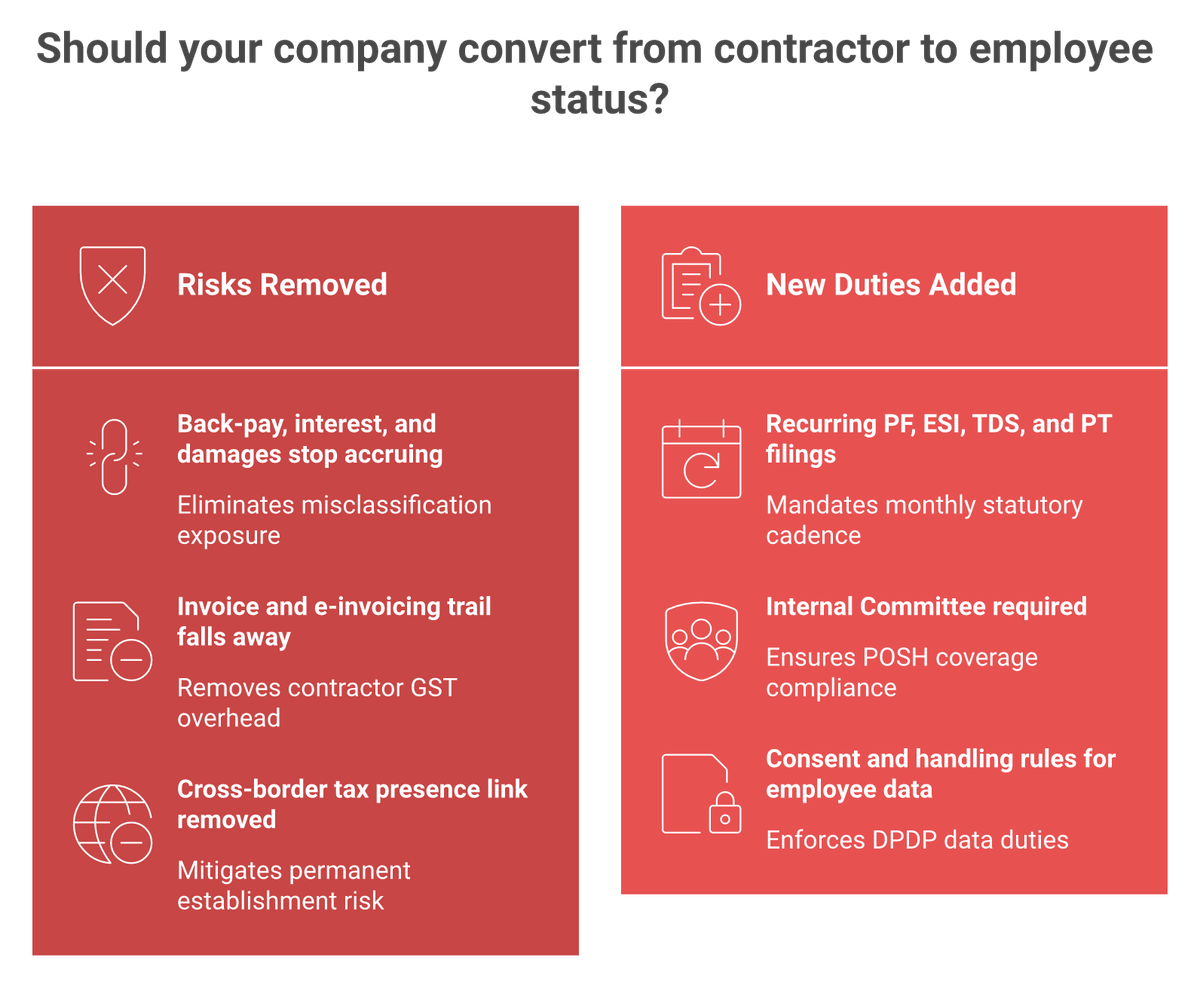
Conversion closes your biggest exposures. It removes misclassification liability, dependent-agent Permanent Establishment (PE) risk from paying an individual cross-border, and the contractor's own GST and e-invoicing overhead. In exchange, you take on employee-data duties under the DPDP Act, POSH coverage, and a recurring statutory cadence. For most funded companies that trade is decisively worth it, because the risks you shed are the ones that kill deals.
✅ The risks that disappear
Start with the ones that keep founders awake. These vanish the moment the person becomes a properly employed hire.
- Misclassification liability. No more back-PF, interest, or damages accruing silently against you.
- Dependent-agent PE risk. Paying an India-based individual who acts for your company can create a "Permanent Establishment," a taxable presence for your foreign parent under Income Tax Act and treaty PE principles. Employing through an EOR removes that link.
- The contractor's GST and e-invoicing overhead. Your invoice trail with a registered contractor falls away.
The PE one is the risk founders underestimate most. In my experience, they treat cross-border payment as an accounting detail, not a tax-presence trigger. This is a core reason many teams move to formal EOR services in India.
⚠️ The new duties you take on
Conversion is not free of obligation. It swaps deal-killing risk for routine, manageable duties.
- DPDP Act 2023 employee data. Employee personal data now sits under India's data-protection regime, with consent and handling rules.
- POSH coverage. You must set up a POSH (Prevention of Sexual Harassment) Internal Committee once you have employees.
- A recurring statutory cadence. Monthly PF, ESI, TDS, and multi-state PT filings become an ongoing rhythm.
I would rather manage a predictable monthly checklist than carry a hidden liability that compounds at 12% a year. That is the honest trade, and it is why ongoing payroll compliance in India matters as much as the initial switch.
🌍 Why this matters more cross-border
Here is a story that shows why the EOR de-risks things an entity setup cannot, quickly.
A client thought they were interviewing someone based in London. Only after the third interview did they realise the person was actually based in Greece. Paying that individual directly would have created a messy cross-border tax question overnight.
They came to us. We employed the person compliantly, and once the team was established, we migrated all 12 of them into the client's own entity. The EOR absorbed the cross-border risk in the window before an entity even existed, a pattern we cover in our EOR vs entity in India guide.
| Risks removed | New duties added |
|---|---|
| Misclassification liability | DPDP Act 2023 employee-data duties |
| Dependent-agent Permanent Establishment risk | POSH Internal Committee coverage |
| Contractor GST and e-invoicing overhead | Recurring monthly statutory cadence |
My honest read is that for a funded company, the risk ledger tilts clearly toward conversion. You give up a little back-office simplicity and shed the exposures that surface in diligence. At Versatile Club, the PE risk from paying an India individual directly is the one we flag first, because moving them onto our own entity through our EOR services closes it cleanly. Getting each of these obligations right is the whole point of our compliance coverage.
Q10: How fast can you convert, and what does it cost, with no hidden fees?
A compliant EOR conversion can go live in about five days, a contractual SLA (service-level agreement, a committed timeline), not a hope. There is no setup fee, no exit fee, and the first month is free. All-in, a senior engineer in Bengaluru runs about $58K a year versus $220K in San Francisco, roughly $162K saved per role. The cost that should scare you is not the fee. It is the back-pay exposure of doing nothing.
⏰ From flagged to compliant in five days
Let me paint the before and after, because that gap is the whole pitch.
Before: a contractor arrangement your finance lead just flagged, silent back-pay building, and a data room you are nervous to open. That is running with scissors.
After: a properly employed hire, clean PF and TDS challans, and receipts an acquirer can verify. That is audit-ready.
The bridge between the two is a five-day onboarding SLA. We commit to it contractually, not aspirationally. You can see the full flow on our how it works page.
💰 What it actually costs
The math surprises people. The fee is small next to both the savings and the risk.
| Item | Figure |
|---|---|
| Bengaluru senior engineer, all-in | ~$58K/year |
| San Francisco equivalent | ~$220K/year |
| Savings per role | ~$162K/year |
| Setup fee | None |
| Exit fee | None |
| First month | Free |
Set that against the $25K to $40K per-head back-pay exposure of leaving a contractor misclassified. The expensive choice is inaction, not conversion. You can run your own numbers with our salary calculator and see the full pricing.
🤝 Risk-reversal, so the incentives align
I try to make it hard to lose money working with us. That is deliberate.
- 5-day contractual onboarding SLA.
- No setup fee, no exit fee, and first month free.
- 6-month replacement guarantee on contract to hire placements.
- WhatsApp direct with me, not a ticket queue.
Founders feel that difference most when the first payroll runs clean and the questions get answered same day:
"Replied to our form in about four hours with a draft offer letter already attached. The hire was onboarded in four days. USD invoice landed clean, no FX markup, no setup fee, no surprises."
Verified User in Information Technology and Services Versatile Club G2 Verified Review
"It let Moonshot hire in India without standing up an entity... they just handle it and keep it correct every month. If you're a founder trying to figure out India EOR and you don't want it to become a second job, this is the one."
Angad S. Versatile Club G2 Verified Review
🔮 Where I think this goes next
Here is the question I am sitting with. Over the next two years, I think India stops being "one country on the global EOR map" and becomes its own specialist category, where owned-entity India EORs quietly take the generalists' India revenue. It is a shift our Employer of Record India 2026 playbook explores in depth.
If that is right, the provider whose own name is on your statutory receipts will matter more, not less, at your next funding round. So if a contractor arrangement just got flagged, message me on WhatsApp at Versatile Club and tell me what you are building. We will model your per-head exposure and have a compliant offer ready in five days. When you are ready, book a demo.
FAQs
When is my independent contractor in India already legally an employee?
In India the contract title does not decide the relationship. The degree of control does.
If you set someone's hours, hand them a company laptop and email, expect exclusivity, and direct how the work gets done, Indian law reads them as an employee regardless of the agreement. A genuine contractor produces a result, but the manner of achieving it is left to them.
Run each contractor through these checks. Every yes pushes toward employee status.
- Do you set their working hours?
- Do they use your email, Slack, or laptop?
- Do they work only for you?
- Do they report to a manager who reviews how they work?
- Have they been with you longer than 12 months on a rolling basis?
Three or more yeses means we would treat that person as misclassified today, not later. This control test is the starting point of any independent contractor versus EOR decision, and it is the first thing People Ops leaders flag at a funded startup. In our experience, nearly every contractor a client asks us to review fails it.
How big is my misclassification back-pay exposure in India?
Misclassifying one engineer as a contractor in India creates roughly $25,000 to $40,000 of back-pay exposure per head. Ten contractors can quietly become a seven-figure hole in your data room.
That figure stacks several backdated statutory line items.
- Back PF: 12% employer plus 12% employee on the wage ceiling, owed from the start date.
- ESI: 3.25% employer plus 0.75% employee where wages qualify.
- Gratuity: 4.81% of Basic plus Dearness Allowance, accrued from month one.
- Interest and damages: 12% per year interest plus monthly damages under the EPF Act.
The danger is timing. This liability stays hidden until due diligence, right when leverage matters most for your funding round or acquisition.
The honest view is that running contractors to save statutory cost is running with scissors. Staying ahead of this is the heart of payroll compliance in India. When a client's setup gets flagged, the first thing we do is model that per-head historical exposure, usually same day, because that number, not the monthly fee, decides the conversion.
What are the exact steps to convert a contractor to an employee in India?
Converting a contractor to an employee in India follows five clear steps. Through an EOR, this takes days, not months.
- Audit the role against the control test and run background verification, since nearly 30% of India IT resumes carry discrepancies.
- Rebuild the pay into a compliant Cost to Company where Basic plus Dearness Allowance is at least 50%, under the New Labour Code 2025-26.
- Issue an employment contract plus the now-mandatory appointment letter, folding in IP assignment and confidentiality.
- Formally close the old contractor agreement with a final invoice and clear end date.
- Register statutory accounts for EPF, ESI, Professional Tax, and TDS, then run first payroll.
The common trap is a lazy 1:1 conversion that raises PF provisioning and drops take-home pay. Model the full stack first, then decide the gross-up.
Because we own the Indian entity, we commit to this sequence as a contractual 5-day onboarding SLA through our EOR services in India, not a hopeful estimate. Global generalists route India through partner shells, and buyers feel the drag when onboarding stretches into months.
Should I use an EOR or set up my own entity to convert contractors?
For 1 to 12 India hires, an Employer of Record (EOR) converts contractors in days with no setup or exit cost. Your own entity takes 4 to 6 months and only pays off past roughly 10 to 12 hires.
Think suspension bridge versus the Golden Gate. You do not build the Golden Gate to cross a stream.
- Own entity: MCA incorporation, FEMA and FC-GPR filings, and real legal spend before your first payslip. Best for 12-plus hires and a permanent India base.
- EOR: live in days, no setup or exit fee, provider owns compliance. Best for testing the market or 1 to 12 hires.
One correction we make often is that the US PEO co-employment model does not legally exist under Indian law. Without your own entity, the correct structure is an EOR.
You can model the crossover point with our EOR vs entity calculator. We invoice in USD directly from our own Indian entity, and when you cross the tipping point, we help migrate the headcount into your entity so the bridge hands off cleanly.
Which EOR provider should I file my India statutory obligations under?
Ask any provider one question: whose Indian entity are my statutory filings under? The answer separates real India employers from resellers.
Global generalists like Deel, Remote, G-P, and Multiplier run India through local partner entities, so your PF, ESI, and TDS filings sit under someone else's registration. That is a red flag in diligence.
- Global generalists: broad country coverage, but India via partner shells and ticket-queue support at $400 to $599 per employee monthly.
- India-native providers: file under their own India registration, giving audit-ready receipts your acquirer can verify.
Ownership is not branding. It drives IP assignment and clean challans in your data room. If you are comparing options, our Wisemonk alternative and Deel alternative pages lay it out side by side.
When we are the legal employer of record on our own registrations, your invoices and statutory filings carry a name your acquirer can verify, and we add a 6-month replacement guarantee that generalists do not.
Is fixed-term employment a lower-risk middle path between contractor and permanent hire?
Yes. Fixed-term employment is a compliant middle path when you are unsure a role is permanent. Think of it as a real employee with an expiry date, not a contractor and not a lifetime hire.
Under the 2025 Labour Codes, fixed-term employees get the same wages, benefits, and statutory coverage as permanent staff. Critically, they now accrue pro-rated gratuity after one year instead of five.
- Uncertain the role lasts? Use fixed-term for full statutory coverage, a defined runway, and zero misclassification exposure.
- Confident it is core? Convert straight to permanent.
- Tempted to keep them as a contractor? That is the only option carrying real back-pay risk.
So a project engineer on an 18-month fixed term now earns pro-rated gratuity, a benefit a contractor never had. That is exactly why fixed-term feels fair to the employee rather than second-class.
When a client is not sure a role is permanent, we structure a compliant fixed-term hire instead of defaulting to a risky contractor, through our EOR services. Same statutory dignity for the person, defined runway for the business.
How do I convert a contractor without losing them to a counter-offer?
The conversion moment is when contractors are most poachable, so protect take-home pay first. Under the 50% Basic-plus-DA rule, structure the CTC so net pay holds even as statutory benefits are added, often a 15% to 45% gross-up.
Then sell the upside. Conversion, done right, is something the employee actually wants.
- PF, gratuity, and insurance a contractor never had.
- Mortgage and loan eligibility that banks deny to contractors without a formal payslip and Form 16.
- Job security and dignity that improve retention.
We once converted a contractor whose bank had refused his home loan. With a proper payslip and Form 16 after conversion, the bank said yes and he got his mortgage.
Model the gross-up before you make the offer using our salary calculator, and keep it correct every cycle with managed payroll. Retention is not paperwork. It is making the switch feel like an upgrade, backed by founder-direct support rather than a ticket queue.
How fast and how expensive is converting a contractor to an employee in India?
A compliant EOR conversion can go live in about five days, a contractual SLA, not a hope. There is no setup fee, no exit fee, and the first month is free.
The economics favour conversion decisively.
- All-in cost: a senior engineer in Bengaluru runs about $58K a year versus $220K in San Francisco, roughly $162K saved per role.
- Risk of inaction: $25K to $40K per-head back-pay exposure for leaving a contractor misclassified.
The cost that should scare you is not the fee. It is the back-pay exposure of doing nothing, which surfaces in your data room right when leverage matters.
We back the switch with risk-reversal: a 5-day contractual onboarding SLA, no setup or exit fees, first month free, and a 6-month replacement guarantee on contract to hire placements. You can run your own numbers on our pricing page, and when a contractor arrangement gets flagged, we will model your per-head exposure and have a compliant offer ready in five days.