Table of contents (12)
EOR vs Entity in India: The Cost Crossover, Setup Timelines, and the Headcount Where the Math Tips
Q1. EOR or Entity in India: Which Should You Choose First?
If you're hiring 1 to 15 people in India and need to move in weeks, start with an EOR. Onboarding takes days, not the 4 to 8 weeks and $5,000 to $15,000 minimum an entity needs. Open your own entity once you cross roughly 20 to 40 heads and the per-employee math tips. For most founders, People Ops leads, and CFOs, the real decision is "when to switch," not "either or."
The Trigger Moment Most Founders Are Actually In
A US founder messaged me last quarter, three days after closing a round. He needed four engineers in Bengaluru inside 60 days. He had also read just enough to feel, in his words, like he was "running with scissors."
That feeling is the real search behind EOR vs entity in India. You are not browsing. You are under a clock, and a wrong move costs you the hiring window.
Across our six years placing engineers in Bengaluru, Hyderabad, and Pune, the personas repeat. The first-time founder wants speed. The VP People wants compliance. The CFO wants one clean invoice.
Speed and Cost Pull in Opposite Directions
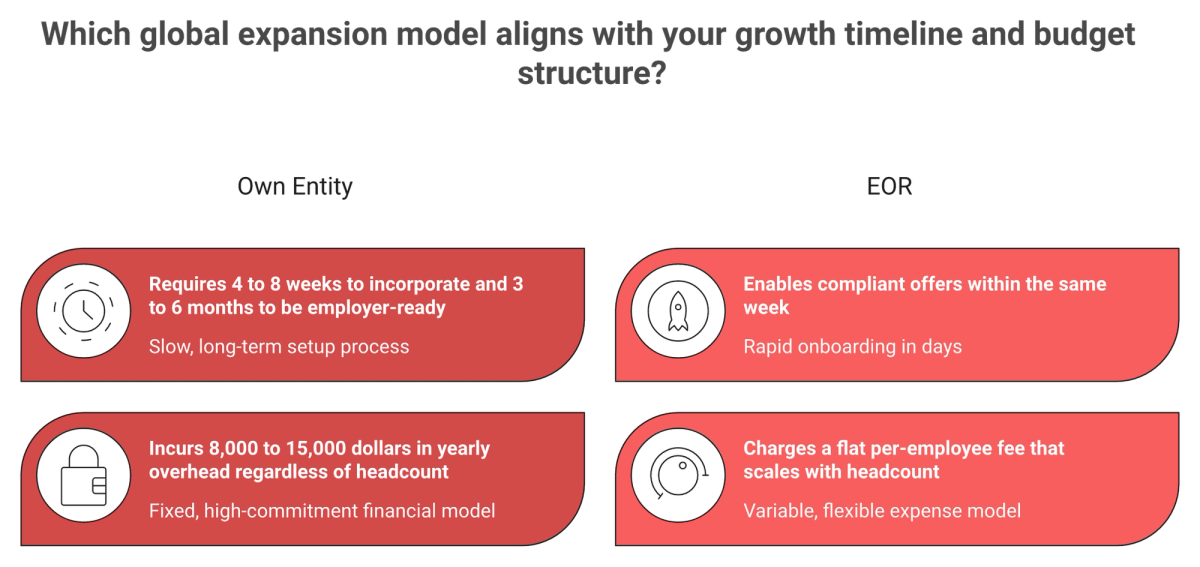
An EOR onboards a hire in days and charges a flat per-employee fee. There is no setup cost and no waiting. Our employer of record in India service is built around exactly this speed.
Your own entity is the opposite. Incorporation plus registrations runs 4 to 8 weeks at minimum, often longer, with a real cash outlay before anyone gets paid.
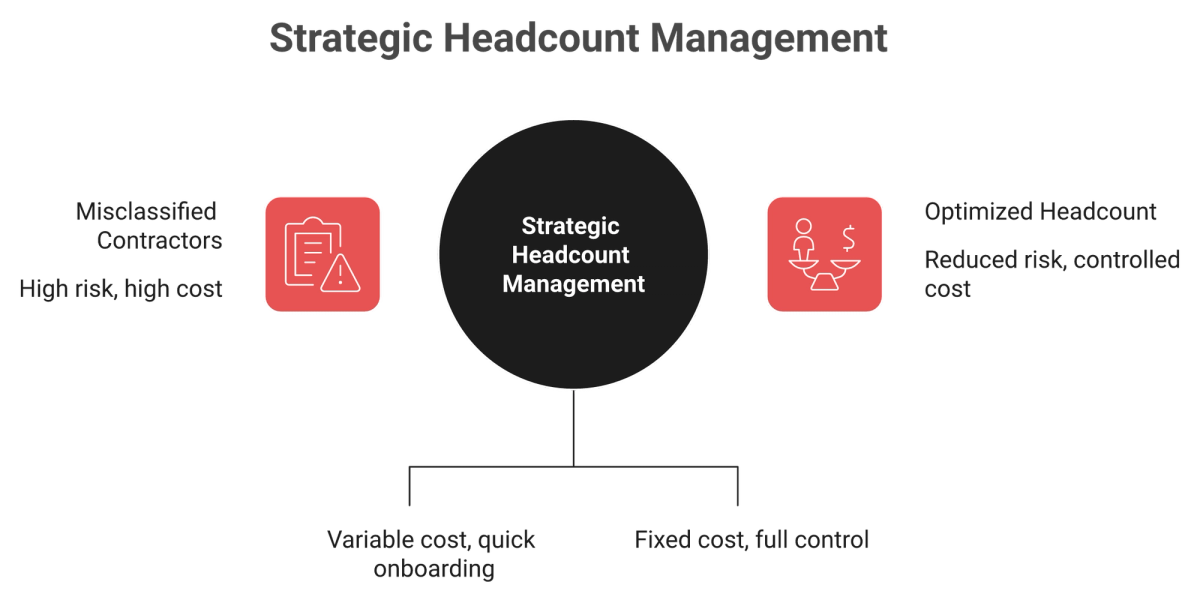
So the honest split is simple. EOR is variable cost you switch on fast. An entity is fixed cost you commit to for the long run.
Stop Asking "Either Or"
Here is the reframe I give clients. The question is rarely EOR versus entity. It is the headcount where the math tips from one to the other.
I might be wrong for your exact situation, but the pattern holds. Misclassifying contractors to dodge both options is the expensive mistake. Back-pay exposure can run $25,000 to $40,000 per head once you scale past ten people.
At Versatile, the question clients ask me on WhatsApp isn't "EOR or entity." It's "when do I outgrow you?" I answer that honestly in the sections below, because the rest of this article is built around that single number. You can also model it yourself with our EOR vs entity calculator.
Q2. What Exactly Is an EOR in India, and Why Doesn't "PEO India" Legally Exist?
An EOR becomes the legal employer of your India hires on paper. It runs PF, ESI, TDS, and professional-tax filings under its own registrations, while the worker reports to you day to day. Note the category trap. The US-style "PEO" co-employment model does not legally exist under Indian labour law. In India, you either use an EOR or you own an entity.
The Concept, in Plain English
Think of an EOR as the employer of record and you as the employer of work. The EOR signs the contract, processes payroll, and files statutory dues. You decide what the person builds and who they report to.
PF means Provident Fund, the retirement contribution. ESI is the Employees' State Insurance health scheme. TDS is Tax Deducted at Source. Professional tax is a small state-level levy on salaried income.
A good EOR carries all four under its own legal registrations. That is the whole point. The compliance load sits with the provider, not with you, as it does across our EOR services in India.
The "PEO India" Myth
Here is where many US founders import the wrong map. In the US, a PEO splits employer duties between you and the provider in a shared "co-employment" arrangement.
That structure has no clean basis under Indian labour law. The standard read gets this backwards, so let me be direct. In India, you cannot half-employ someone through a co-employment shell. If you searched for PEO in India, this is the correction you needed.
What You Actually Choose Between
Your two real options are simpler than the acronyms suggest:
- EOR, when you have no Indian entity and want someone employed compliantly now.
- Your own entity, when scale justifies owning the legal vehicle and you want full control.
The migration path runs in one direction. You start on an EOR, then move to your own entity later, often pairing it with a domestic payroll setup.
When a US founder asks me for a "PEO in India," I have to correct the map first. That is usually where the real Versatile EOR conversation starts, because once the category is clear, the decision gets a lot calmer. Our guide on how to hire in India without an entity walks through it.
Q3. What Does It Actually Cost: EOR Fees vs Entity Setup and Annual Overhead?
An India EOR typically runs $99 to $699 per employee per month with zero setup cost. A wholly-owned entity costs $5,000 to $15,000 minimum upfront, often $15,000 to $100,000 fully loaded over 3 to 6 months, plus $8,000 to $15,000 a year in audit, company-secretary, and compliance overhead, before a single salary. EOR is pure variable cost. An entity is fixed cost you pay whether you have 3 hires or 30.
Variable Cost vs Fixed Cost
The cleanest way to think about this is cash timing. An EOR fee scales with headcount and starts the day you hire. An entity is a fixed commitment you fund before the team exists.
A CFO at a $5M to $50M ARR SMB feels this immediately at month-end. One EOR line item is predictable. Entity overhead is a standing cost that does not pause when hiring slows. Our India EOR pricing for 2026 is built to keep that line predictable.
| Cost element | EOR | Own entity |
|---|---|---|
| Setup / incorporation | None | $5K to $15K min; up to $100K fully loaded |
| Time to hire-ready | 5 to 10 business days | 3 to 6 months |
| Recurring cost | $99 to $699 per employee / month | $8K to $15K / year overhead |
| Authorized share capital | Not required | Rs 1 lakh+ typical |
| FX on USD payouts | Varies; some add 3 to 5% markup | Your treasury problem |
The Hidden Costs the Brochure Skips
The sticker price is not the real price. Two line items hide below it, and I cover both in detail later in this article.
- FX markup. Some global EORs add a reported 3 to 5 percent on USD payouts.
- Data-protection load. Owning an entity makes you the Data Fiduciary under the DPDP Rules 2025, with its own compliance cost.
At Versatile we invoice in USD straight from our own Indian entity. No FX markup, no setup fee, no exit fee, first month free. Among India-native options, that puts us first on transparency, ahead of providers like Wisemonk, Deel, and Remote where pricing tiers or FX terms are less visible. You can compare us directly on our Versatile vs Deel page.
What Buyers Say About the Pricing Reality
"USD invoice landed clean, no FX markup, no setup fee, no surprises. The hire was onboarded in four days."
Verified User Versatile G2 Verified Review
"I find Deel to be absurdly expensive. They charge a high amount of fees for transferring money to my bank account."
Juan Camilo O. Deel G2 Verified Review
"I dislike how expensive Deel's transaction fees are, especially when moving money from the Deel account to my bank."
Maria M. Deel G2 Verified Review
Q4. At What Headcount Does the Math Tip, and What Triggers the Switch Beyond Cost?
For most companies the EOR-to-entity math tips between 20 and 40 India employees. The exact number swings with average salary and your EOR fee. Some teams flip at 10 to 12 hires; others stay on EOR past 50. The trigger isn't a magic number. It's when fixed entity overhead beats your monthly EOR spend, and when ESOPs, customer-facing roles, or control needs force the move.
Why the Crossover Is a Range, Not a Number
The published guides disagree wildly, and that disagreement is the real story. One puts the tipping point near 30 employees. Another lands at 15 to 25. A third pushes it to 80 to 150.
They disagree because they hide the math. The crossover is not fixed; it moves with two inputs you actually control. You can run your own numbers on our cost of hiring in India page.
Your monthly EOR cost is headcount times fee. Your entity cost is mostly fixed overhead. The tip happens when the first number passes the second.
A Simple Sensitivity View
Here is the logic in a table. Assume $10K to $15K annual entity overhead and a flat per-employee EOR fee.
| Avg EOR fee / employee / mo | Annual EOR cost at 20 heads | Rough crossover vs entity overhead |
|---|---|---|
| $150 | $36,000 | Entity already cheaper; lean to switch |
| $300 | $72,000 | Well past crossover; switch |
| $99 | $23,760 | Near the line; stay unless other triggers hit |
The takeaway. At low fees and low headcount, EOR usually wins. As either climbs, the entity wins on pure cost.
The Triggers That Aren't About Cost
Cost is not the only thing that tips the decision. Often these force the move before the spreadsheet does:
- ESOPs. Granting equity to India staff is far cleaner from your own entity.
- Customer-facing revenue. Local sales or contracting can raise permanent-establishment questions.
- Control and IP. Some teams want direct ownership of contracts and IP assignment.
- Headcount inertia. One client told me their tipping point was 10 to 12 hires; after 12, they said "right, we're ready to open."
If permanent-establishment exposure is what worries you, our permanent establishment risk quiz gives you a quick read.
The Contrarian Truth
I'll say what the category avoids. There is no universal switch number, and anyone who quotes one without your salary band and fee is guessing. From what surfaces when you actually run these conversions, the math is personal to your team.
I'll tell a client on WhatsApp the moment they've hit the point to open their own entity. And Versatile runs that migration with no exit fees, because telling you when to leave is part of the service, not a threat to it. When that day comes, our company registration in India support takes over.
Q5. How Fast Can You Actually Start Hiring: EOR Onboarding vs Entity Setup Timelines?
A good India EOR onboards a hire in 5 to 10 business days, and the fastest commit to a contractual 5-day SLA. Setting up your own entity takes 4 to 8 weeks minimum to incorporate, then 3 to 6 months to be fully employer-ready (PF, ESI, professional tax, bank, payroll). Migrating staff onto it adds 60 to 90 days more. If your funding window is 30 to 60 days, only the EOR path fits.
The Most Important Fact First: Days vs Months
If you just closed a round and promised the board four engineers this quarter, speed is the whole game. An EOR gets a compliant offer out the same week. Our employer of record in India service is built around that speed.
An entity cannot match that. Incorporation alone runs 4 to 8 weeks, and that is before any payroll registration.
A GCC builder (global capability center, a foreign company's owned India team) often forgets this gap. The entity exists on paper long before it can legally pay anyone. If a GCC is your goal, our GCC India guide maps the path.
A Realistic Timeline View
| Milestone | EOR | Own entity |
|---|---|---|
| First compliant offer | Within days | After full setup |
| Hire onboarded and payable | 5 to 10 business days | 3 to 6 months |
| Staff migration onto entity | Not applicable | 60 to 90 days post-registration |
The pattern is consistent across global generalists too. Reviewers report Deel and Remote onboarding stretching well past their estimates. You can see how we stack up on our Versatile vs Remote page.
Why "Incorporated" Does Not Mean "Ready to Employ"
Here is the trap I watch founders fall into. They get the certificate of incorporation and assume hiring can start.
It cannot. You still need PF and ESI registration, a bank account, professional-tax enrolment, and a working payroll cycle. Only then is the entity a real employer. Our company registration in India support covers each of those steps.
At Versatile, our onboarding SLA is contractual: 5 days, in writing. Not a "typically," not an "up to." I could be off for an unusually complex role, but for a standard engineering hire, that clock holds. It is the core of our hire in India without an entity promise.
What Onboarding Speed Looks Like to a Buyer
"Versatile replied to our form in about four hours with a draft offer letter already attached. The hire was onboarded in four days."
Verified User Versatile G2 Verified Review
"It took three months to onboard our first 3 individuals. They didn't seem to be able to navigate Visas or variations to employment contracts."
Verified User Deel G2 Verified Review
"My onboarding took 28 days. We started on October 4th and today is November 1st."
Ibrahim Deel G2 Verified Review
Q6. What Statutory Compliance Are You On the Hook For: PF, ESI, PT, and the 50% Wage Rule?
Under the Labour Codes in force from November 21, 2025, Basic plus Dearness Allowance must be at least 50% of total pay. That raises PF, ESI, and gratuity loading on both EOR and entity payrolls. Professional tax varies by state: Maharashtra needs dual PTRC and PTEC filing, and Tamil Nadu is biannual. With an EOR, these filings run under the provider's registrations. With your own entity, all 28 states' rules become your problem.
The 50% Rule, in One Payroll Cycle
The Code on Wages took effect on November 21, 2025. It says the "wages" base (Basic plus Dearness Allowance, a cost-of-living top-up) must be at least half of total pay.
This matters because statutory dues sit on that base. Provident Fund (the retirement contribution) is 12%. ESI, the state health-insurance scheme, splits 3.25% employer and 0.75% employee. Gratuity (a lump-sum tenure benefit) accrues at 4.81% of Basic plus DA. You can model the impact with our India payroll compliance calculation tool.
Raise the Basic, and all three rise with it. The same gross salary now carries a heavier statutory load than it did before November 2025.
Primary-Source Anchors (the part competitors skip)
- Code on Wages, S.O. 5322(E), effective 21 Nov 2025.
- MoLE Labour Code FAQs, dated 16 March 2026, confirming gratuity on the revised wage definition from 21 Nov 2025.
- ESIC wage definition under the Code on Social Security, applicable from the same date.
If you want a fast read on gratuity exposure, our gratuity calculator handles the 4.81% math for you.
State Professional Tax: 28 Different Rulebooks
Professional tax (PT) is a small state levy on salaried income, and no two states run it the same way. This is where a global playbook breaks.
- Maharashtra: dual registration, PTRC for employees and PTEC for the entity, with monthly slab filing.
- Tamil Nadu: biannual filing (June and December), plus labour welfare fund.
- Karnataka: monthly PT, plus Shops and Establishments renewal.
Run a team across Bengaluru, Hyderabad, and Pune, and you are filing under three separate regimes at once. I have done this for years, and the standard read gets it backwards. India is not one compliance country, it is many. Our payroll outsourcing services in India absorb all of it.
Who Carries the Burden
With an EOR, these filings sit under the provider's registrations, not yours. With your own entity, you own every state's calendar.
At Versatile, our PF, ESI, TDS, and professional-tax filings across states run under our own registrations, not a partner shell. That is the difference between abstraction and ownership, and it is why founders pick our EOR services in India.
"PF, ESI, TDS, and payroll all handled in one place. The compliance rigour is genuinely impressive, every statutory filing reviewed before submission."
Vedant T. Versatile G2 Verified Review
"The initial documentation and paperwork felt quite detailed and time-consuming at the beginning. However, this thoroughness is what ensures proper legal and compliance coverage."
Verified User Wisemonk G2 Verified Review
Q7. Does an EOR Really Shield You From Permanent Establishment and Misclassification Risk?
A compliant EOR employs your worker directly, lowering the risk that India treats your company as having a taxable permanent establishment. It also removes the $25,000 to $40,000-per-head back-pay exposure of misclassifying contractors. But the shield is not automatic. Routing contractors through an EOR as a pass-through can still leave PE risk on the table. It works only when the EOR is the real legal employer.
The Situation: The Temptation to Save the Fee
Permanent establishment (PE) means a foreign company is treated as having a taxable business presence in India. It can be triggered by a fixed place of business or a dependent agent acting for you. Our permanent establishment risk quiz gives you a quick read on exposure.
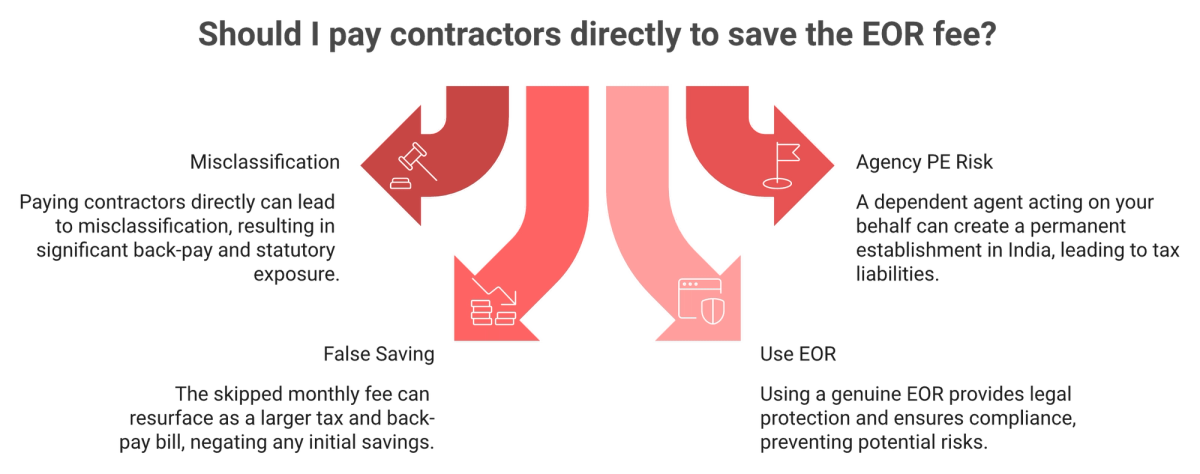
I see the same temptation often. A founder thinks, "I'll just pay a contractor directly and skip the EOR fee."
That move feels cheaper. It usually is not.
The Complication: Two Risks Stack Up
Paying contractors directly to dodge employment can create two problems at once:
- Misclassification. If the "contractor" works like an employee, back-pay and statutory exposure can run $25,000 to $40,000 per head.
- PE exposure. A dependent agent habitually acting for you in India can constitute an agency PE under the income-tax framework.
So the saving on a monthly fee can resurface as a tax-and-back-pay bill that dwarfs it. That is being, as one founder put it to me, penny wise and pound foolish. Our misclassification quiz shows where the line sits.
The Resolution, and the Honest Caveat
A genuine EOR employs the person as its own staff, on a real contract, with real statutory filings. That structure reduces both the misclassification risk and a chunk of the PE risk.
Here is what I will admit we learned the hard way. The shield is not magic. If an EOR is just a pass-through paying a contractor, the protection thins out fast. For genuinely independent workers, our contractor of record model is the cleaner fit.
Why Ownership Changes the Answer
The standard read assumes every EOR offers the same protection. It does not. Many global providers route India through local-partner entities, so the employer of record is a shell once removed from you.
Because Versatile owns the Indian entity, your hire is genuinely our employee. The PE and misclassification shield is a registration fact, not a marketing line, and it underpins our India EOR for USA clients.
"Wisemonk is the legal entity which I'm currently working under. It removes barriers and helps us work for companies without which it wouldn't be possible."
Verified User Wisemonk G2 Verified Review
"It let us hire in India without standing up an entity. They took payroll, contracts, and ongoing compliance off our plate entirely."
Angad S. Versatile G2 Verified Review
Q8. Where Do Global EOR Generalists Fall Short on India, and How Is Versatile Different?
Global EORs like Deel, Remote, and G-P run India through local-partner entities, add reported FX markups, and bring shallower India compliance depth. India-native providers own the entity and the filings. Against the closest India-native rival, Wisemonk, the gap is retention: most India EORs sell a "legal hire on paper," and few solve the "good hire that stays" problem.
The Generalist Gap
The popular playbook says "just buy Deel for global EOR." It works until India-specific depth matters. See our Deel alternatives in India breakdown for the detail.
Global generalists cover 90 to 185 countries, which is genuinely useful if you hire in many places. The trade-off is that India becomes one country among dozens, often run through a local-partner shell with ticket-queue support.
Where the Cracks Show
Three patterns recur in verified reviews of the generalists:
- Support is queue-based, not person-based, so issues bounce between reps.
- FX and fees stack up, with some users reporting steep transfer charges.
- Onboarding overruns the estimate, sometimes badly.
Versatile vs Wisemonk vs the Generalists
Here is the honest comparison. I will give credit where it is due, then name the real gaps. Our full Wisemonk vs Versatile Club page goes deeper.
| Factor | Versatile | Wisemonk | Deel / Remote / G-P |
|---|---|---|---|
| India entity | Owned ✅ | India-native ✅ | Local-partner shell ❌ |
| FX on USD | No markup ✅ | India-native ✅ | Markups reported ❌ |
| Onboarding | 5-day SLA ✅ | 24 to 72 hrs ✅ | 7 to 14 days ❌ |
| Retention model | 90-day Coach, 6-mo guarantee ✅ | Thinner story ❌ | Not India-specific ❌ |
Wisemonk is a real India-native competitor with strong reviews and certifications. Its gap is retention: no structured 90-day Success Coach and no replacement guarantee that I can find published. Founders weighing the two often land on our Wisemonk alternatives page.
The Territory No One Owns
The category sells compliance. Almost nobody sells the "good hire that stays." That is the difference between a legal hire on paper and a person still on your team in year two. It is the whole idea behind our retention-first EOR in India.
At Versatile we hire culture-fit-first using 50 behavioral parameters, back placements with a 90-day Success Coach and a 6-month replacement guarantee, and I am on WhatsApp directly, not a rotating CSM. One honest caveat: if you need 5-plus countries, or you are a 100-plus India team requiring SOC 2 or ISO 27001 as a procurement gate, we are not your fit, and I will say so on the first call.
"Founder is just a call away. Extremely helpful in resolving all our queries. The process is super smooth to setup India EOR."
surbhi m. Versatile G2 Verified Review
"I've noticed that their support query responses can occasionally take a bit longer, likely due to a relatively small team."
Verified User Wisemonk G2 Verified Review
"There is no direct phone line. You either email or use a chatbot, and you can ask both the same question and get two different wrong answers."
Erika D. Rippling G2 Verified Review
Q9. What Hidden Costs Do Cost Comparisons Miss: DPDP Data-Fiduciary Liability, FX, and Exit Fees?
Most cost comparisons stop at setup fees and salaries. They miss that owning an entity makes you the Data Fiduciary under the DPDP Rules 2025, with data-protection-officer, audit, and assessment duties if you are a Significant Data Fiduciary. Add reported 3 to 5 percent FX markups on USD payouts and exit fees on some EOR contracts, and the real cost of both paths runs higher than the brochure number.
The Cost That Only Appears After You Incorporate
The Digital Personal Data Protection Rules 2025 were notified in November 2025. Once you own an entity, you become a Data Fiduciary, the party responsible for employee personal data.
If you scale into a Significant Data Fiduciary, the load grows. That can mean a named data-protection officer, periodic data-protection impact assessments, and independent audits. These are duties our employer of record in India already carries on your behalf.
None of this shows up in a "$5K setup" estimate. It is a recurring governance cost most comparison blogs never itemize.
The FX and Exit Fees on the EOR Side
The EOR path hides its own line items. Two recur in verified user reviews:
- FX markup. Some global providers add a reported 3 to 5 percent on USD-to-INR payouts.
- Exit and transfer friction. Reviewers report fee disputes and slow offboarding when leaving a provider.
So both paths carry costs below the sticker price. The honest cost model adds DPDP governance to the entity side, and FX plus exit terms to the EOR side. You can see the difference on our Versatile vs Deel comparison.
How to Fix Your Q3 Spreadsheet
Go back to the cost table and add three rows: DPDP governance, FX markup, and exit fees. From what surfaces when you actually run these numbers, those three often swing the decision more than the headline fee. Our cost of hiring in India page helps you model it cleanly.
At Versatile we invoice in USD with zero FX markup and no exit fee. The hidden line items competitors bury are simply not in our contract, which is why founders compare our India EOR pricing for 2026 first.
"Invoicing in USD meant zero exchange rate surprises."
Vedant T. Versatile G2 Verified Review
"We have consistently had to follow up repeatedly for refunds on deposits for employees who have left the company."
Verified User Velocity Global G2 Verified Review
"I find Deel to be absurdly expensive. They charge a high amount of fees for transferring money to my bank account."
Juan Camilo O. Deel G2 Verified Review
Q10. How Do You Migrate From an EOR to Your Own Entity Without Breaking Payroll?
Migrating from an EOR to your own entity takes 60 to 90 days from the point your entity is registered. You incorporate, complete PF, ESI, and professional-tax registrations, open a bank account and payroll, then transfer employees with tenure, gratuity accrual, and benefits intact. Run both in parallel during the overlap so payroll never stops. The biggest risk is starting the transfer before the entity is genuinely employer-ready.
The Migration Sequence That Protects Payroll
By the end of this, you will know the order that keeps salaries landing on time. The mistake is rushing the transfer before the new entity can legally pay anyone.
Here is the sequence I walk clients through:
- Incorporate and register. File with the MCA (Ministry of Corporate Affairs), then complete PF, ESI, and professional-tax registrations. Our company registration in India support handles this stage.
- Stand up banking and payroll. Open the corporate bank account and configure your payroll stack (RazorpayX, Keka, or similar), or hand it to our managed payroll team.
- Run in parallel. Keep the EOR live while the entity gets fully employer-ready. Do not switch cold.
- Transfer employees. Move staff with continuity of tenure, accrued gratuity, and benefits preserved.
- Wind down the EOR. Offboard cleanly once the first entity payroll runs without errors.
The Continuity Risks Most Teams Miss
A clumsy migration quietly damages your team. Three risks recur:
- Gratuity reset. Gratuity accrues at 4.81% of Basic plus DA from month one. A careless transfer can zero an employee's tenure clock. Check exposure with our gratuity calculator.
- Benefit gaps. A lapse between PF accounts or insurance policies leaves people exposed.
- FC-GPR funding. Capitalizing the entity needs a FEMA filing (FC-GPR reports foreign share allotment to the RBI). Miss it, and funding stalls.
I could be off on the exact day count for an unusually complex transfer. The principle holds: parallel-run, never cold-switch. Our EOR vs entity in India guide covers the full decision.
When you outgrow Versatile, we hand off cleanly, with no exit fee, and tenure plus gratuity preserved. Telling you when and how to leave is part of the service, not a hostage negotiation, and it is why founders trust our EOR services in India.
Q11. Who Owns Control, IP, and ESOPs Under Each Model, and Why It Decides the Switch?
An EOR gives you operational control of the work but not a local legal vehicle. That limits clean ESOP grants to India staff and routes IP assignment through the provider's employment contracts. Your own entity gives full control, direct IP ownership, and the ability to issue equity locally. For venture-backed teams, ESOPs and IP, not cost, are often what tip the decision to incorporate.
Control and IP Run Differently in Each Model
You direct the daily work either way. The difference is who holds the legal vehicle underneath it.
IP (intellectual property, the code and designs your team creates) must be assigned to your company by contract. Under an EOR, that assignment flows through the provider's employment agreement to you. Under your own entity, the IP lands directly in your company. Our compliant contracts handle that assignment correctly.
| Dimension | EOR | Own entity |
|---|---|---|
| Day-to-day work control | Yours ✅ | Yours ✅ |
| Legal employer | Provider | You |
| IP assignment | Via provider contract | Direct to you |
| ESOPs to India staff | Hard / indirect | Clean, local grants |
| POSH committee | Provider-run | Yours to run |
Why Funded Teams Often Switch on This, Not Cost
Here is the part the standard cost-first read gets backwards. For venture-backed teams, equity and IP frequently force the entity decision before the spreadsheet does. Our EOR for SaaS startups in India page speaks to exactly these teams.
You cannot grant local ESOPs (employee stock options) cleanly without a vehicle to issue them from. When your India engineers expect equity, that pressure alone can tip the switch. POSH (the Prevention of Sexual Harassment law) committee duties also move in-house with the entity.
Because Versatile owns the Indian entity, IP assignment and POSH compliance run through real, compliant contracts, not a partner shell's paperwork. You hold operational control now, and we hold the legal vehicle until you are ready to hold it yourself, which is the heart of how to hire in India without an entity.
"It let Moonshot hire in India without standing up an entity, which would've been overkill for our size."
Angad S. Versatile G2 Verified Review
"I was employed by a Singapore entity that is yet to be established in India. So, Wisemonk is the legal entity which I'm currently working under."
Verified User Wisemonk G2 Verified Review
Q12. Why Hire in India at All: Talent Over Cost Arbitrage, and How to Manage the Team You Build?
Do not go to India because it is cheap. Go because it holds one of the world's deepest pools of academically strong talent, with few comparable places to apply it. A senior Bengaluru engineer can save roughly $162,000 a year versus San Francisco, but that is a by-product, not the pitch. And keeping that hire is a management skill: read hierarchical communication, ask open questions, and build the relationship before the task.
The Reframe the Category Avoids
Most "hire in India" content leads with cheap labor. I think that gets it backwards, and I have built a company on the opposite belief.
India holds a large share of the world's qualified low-cost talent supply, by some estimates around 28 percent. You go there for academically intelligent people who have few comparable places to apply that talent. That is the whole premise of how we hire employees in India.
The savings are real. A senior engineer can run about $162,000 a year less than San Francisco. But savings is the by-product. Talent is the reason, and our hire developers in India service is built around it.
Hiring Is Easy. Keeping Is the Skill.
A signed contract does not equal a hire who stays. The hardest part starts after onboarding, and it is cultural, not statutory. That is exactly what our retention-first EOR in India is designed for.
A US manager once told me she emailed an entire India team for their employee ID numbers and got silence. On the third try, the team's boss, whom she had not emailed, replied that he was collecting the information. That was hierarchy at work, not rudeness.
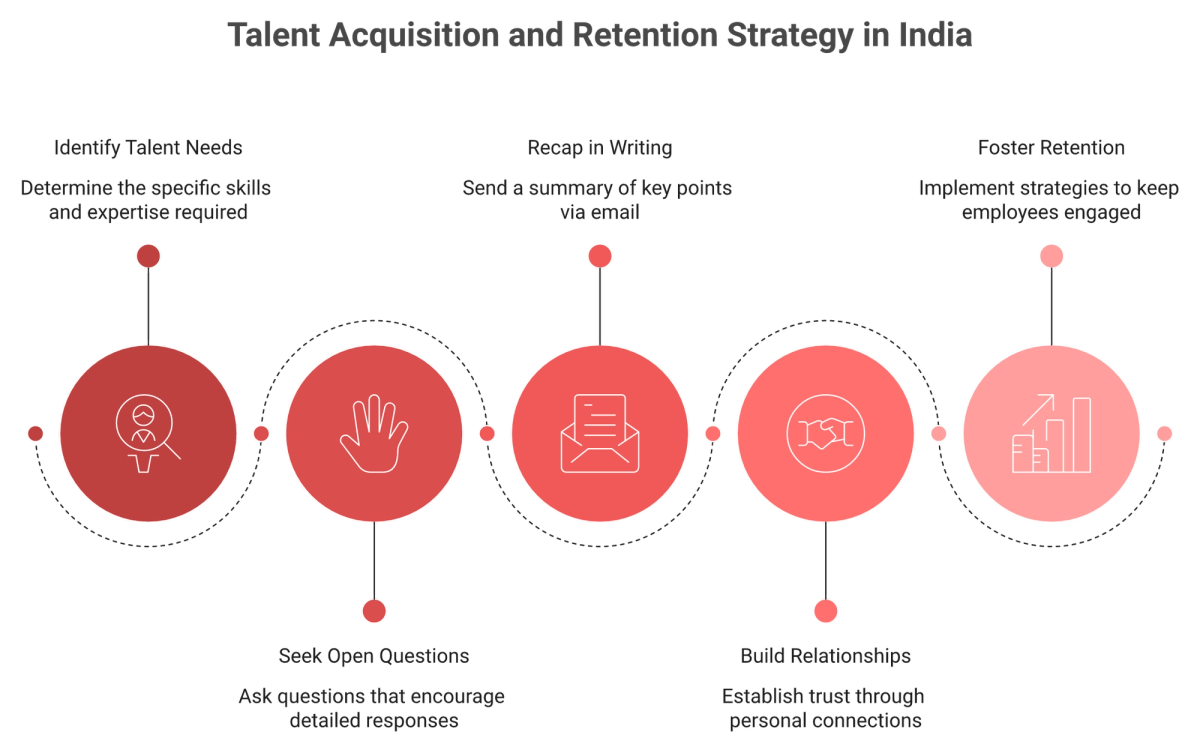
Three fixes change everything:
- Ask open questions. Not "are you on schedule?" but "where are we on the schedule?"
- Recap in writing. Send the key points by email straight after every call.
- Build the relationship first. Trust in India is affective; it runs through the personal connection before the task.
What I'm Sitting With
Where my head is right now: I think India stops being one country on a global EOR map and becomes its own specialist category. Owned-entity operators who run one country deeply will keep taking India share from the generalists, a shift you can track on our best EOR India for startups 2026 page.
That is the bet behind Versatile, an India-only EOR through our own entity, with a 90-day Success Coach for exactly the "good hire that stays" problem above. If you are staring at a 30 to 60 day hiring window, message me on WhatsApp and tell me what you're building. I will tell you honestly whether you need an EOR or an entity, even when the honest answer is "not us yet." You can also book a consultation with us to talk it through.
FAQs
EOR or entity in India: which should we choose first?
If we are hiring our first 1 to 15 people in India and need to move in weeks, we recommend starting with an Employer of Record. An EOR onboards a hire in days, with no setup cost and no waiting, whereas an entity takes months and real cash upfront.
The honest split looks like this:
- EOR: variable cost we switch on fast, ideal for speed and early-stage hiring.
- Own entity: fixed cost we commit to once scale justifies owning the legal vehicle.
For most teams the real question is not either or, it is the headcount where the math tips, usually somewhere between 20 and 40 employees. Misclassifying contractors to dodge both options is the expensive mistake, with back-pay exposure of $25,000 to $40,000 per head once we scale past ten people.
We help founders model this honestly on our EOR vs entity in India guide, and we will tell you when you have outgrown us rather than lock you in.
What does it actually cost to use an EOR versus setting up an entity in India?
The two paths price very differently, and most comparisons stop at the sticker number. An India EOR typically runs $99 to $699 per employee per month with zero setup cost, billed as pure variable cost from the day we hire.
A wholly owned entity is the opposite:
- Setup: $5,000 to $15,000 minimum, often $15,000 to $100,000 fully loaded over 3 to 6 months.
- Annual overhead: $8,000 to $15,000 for audit, company secretary, and compliance, before a single salary.
The hidden costs matter too. Some global EORs add a reported 3 to 5 percent FX markup on USD payouts, and owning an entity makes us the Data Fiduciary under the DPDP Rules 2025.
We invoice in USD straight from our own Indian entity, with no FX markup, no setup fee, and no exit fee. You can see the full breakdown on our India EOR pricing for 2026 page and model your own numbers with our cost tools.
How fast can we start hiring through an EOR compared to opening an entity?
Speed is the single biggest difference between the two paths. A good India EOR onboards a hire in 5 to 10 business days, and the fastest commit to a contractual five-day SLA, so a compliant offer goes out the same week.
An entity cannot match that timeline:
- Incorporation: 4 to 8 weeks minimum.
- Employer-ready: 3 to 6 months once PF, ESI, professional tax, banking, and payroll are live.
- Staff migration: another 60 to 90 days on top.
The trap we watch founders fall into is assuming a certificate of incorporation means they can hire. It does not, because the entity still needs full statutory registration before it can legally pay anyone.
If a funding window is 30 to 60 days, only the EOR path realistically fits. Our onboarding SLA is contractual and in writing, which is the core of our hire in India without an entity promise.
Why doesn't a US-style PEO legally exist in India?
This is the category trap that catches many US founders. In the US, a PEO splits employer duties between the company and the provider in a shared co-employment arrangement, but that structure has no clean basis under Indian labour law.
In India, the choice is binary:
- EOR: the provider becomes the full legal employer on paper and runs PF, ESI, TDS, and professional-tax filings under its own registrations.
- Own entity: we own the legal vehicle and carry every statutory duty ourselves.
There is no half-employment co-employment shell available. When a founder asks us for a PEO in India, we have to correct the map first, because once the category is clear the decision gets much calmer.
We walk through the distinction on our PEO in India page, and from there the EOR conversation becomes far more straightforward.
At what headcount does the math tip from EOR to owning an entity?
For most companies the EOR-to-entity math tips somewhere between 20 and 40 India employees, but it is a range, not a magic number. Some teams flip at 10 to 12 hires, and others stay on an EOR past 50.
The crossover moves with two inputs we control:
- Monthly EOR cost: headcount multiplied by the per-employee fee.
- Entity cost: mostly fixed annual overhead.
The tip happens when the first number passes the second. At low fees and low headcount, the EOR usually wins; as either climbs, the entity wins on pure cost.
Just as often, non-cost triggers force the move first, including ESOP grants, customer-facing revenue raising permanent-establishment questions, and a desire for direct IP ownership. Anyone quoting a universal switch number without your salary band and fee is guessing. We help you run your own break-even on our cost of hiring in India page.
Does an EOR really protect us from permanent establishment and misclassification risk?
A compliant EOR meaningfully lowers both risks, but the shield is not automatic. Because the EOR employs the worker directly as its own staff, on a real contract with real statutory filings, it reduces the chance that India treats your company as having a taxable permanent establishment.
It also removes the misclassification exposure of paying contractors directly:
- Misclassification: back-pay and statutory exposure of $25,000 to $40,000 per head if a contractor works like an employee.
- Agency PE: a dependent agent habitually acting for you in India can constitute a permanent establishment.
The honest caveat is that the protection only holds when the EOR is the genuine legal employer. If an EOR is just a pass-through paying a contractor, the shield thins out fast.
Because we own our Indian entity, your hire is genuinely our employee, not a partner shell's paperwork. Check your exposure with our permanent establishment risk quiz.
How do we migrate from an EOR to our own entity without breaking payroll?
A clean migration takes 60 to 90 days from the point the entity is registered, and the golden rule is to parallel-run, never cold-switch. We keep the EOR live until the new entity is genuinely employer-ready.
The sequence that protects payroll is:
- Incorporate and register the company, PF, ESI, and professional tax.
- Stand up banking and payroll.
- Run both in parallel through the overlap.
- Transfer employees with tenure, gratuity accrual, and benefits intact.
- Wind down the EOR once the first entity payroll runs cleanly.
The continuity risks most teams miss are gratuity resets, benefit gaps between PF or insurance policies, and the FC-GPR FEMA filing needed to capitalize the entity. When you outgrow us, we hand off cleanly with no exit fee and tenure preserved, supported by our company registration in India service.
Why hire in India at all, and how do we keep the team we build?
We tell clients not to go to India because it is cheap, but because it holds one of the world's deepest pools of academically strong talent. The savings are real, a senior Bengaluru engineer can run roughly $162,000 a year less than San Francisco, but that is a by-product, not the pitch.
Hiring is the easy part; keeping the hire is the skill, and it is cultural rather than statutory:
- Ask open questions like where are we on the schedule, not are you on schedule.
- Recap in writing straight after every call.
- Build the relationship first, because trust in India runs through the personal connection before the task.
This retention problem is exactly what we are built for, pairing culture-fit hiring with a 90-day Success Coach and a six-month replacement guarantee. Learn more about our retention-first EOR in India approach.