Table of contents (12)
Skuad vs Multiplier for India Hiring (2026): Coverage, Pricing & Compliance
Q1. Skuad vs Multiplier: which one should carry your India team in 2026?
Skuad wins on sticker price at $199 per employee per month on annual billing. Multiplier is published from about $400 with a roughly seven-day onboarding commitment. Neither is a market leader. Everest Group's 2025 EoR PEAK Matrix rated both Major Contenders among 29 providers assessed. The deciding variable is what share of your APAC headcount sits in India.
A regional ops lead at a 120-person US company messaged me last quarter with a spreadsheet. Two columns, two vendors, one row that mattered to her: country count. Skuad said 160-plus. Multiplier said 150-plus. Her India team was 22 people across Bengaluru, Pune, and Gurugram. Nowhere in that spreadsheet was a cell for who actually files professional tax in Maharashtra.
💰 What the price gap actually buys
Skuad publishes India EOR from $199 per employee per month on annual billing, with $249 on monthly billing and no setup fee. Multiplier's India rate is published from roughly $400, with $459 annual and $499 monthly appearing on third-party comparison pages in 2026.
That is a real gap. It is also the only variable most comparison pages measure, which is why they all read the same. If you want the underlying arithmetic, our breakdown of employer of record cost in India walks through every line.
⚠️ The fact nobody on the first page publishes
Everest Group assessed 29 EOR providers in its 2025 PEAK Matrix and placed both Skuad and Multiplier as Major Contenders, not Leaders. Skuad also changed hands. Payoneer acquired 100 percent of Skuad Pte. Ltd. on 5 August 2024, so your 2026 counterparty is a Payoneer group company.
Global platforms cover 90 to 150 countries and spread their India expertise thin. I have watched founders buy on coverage counts, then discover their India legal safety sat with a subcontracted local aggregator they had never spoken to.
✅ The honest concession before the argument starts
If your team is genuinely spread across four APAC markets, splitting India out is probably the wrong move. One vendor across Singapore, Vietnam, the Philippines, and India is worth real money and real process simplicity. No India specialist can serve Ho Chi Minh City.
I am not going to pretend otherwise to make a point. Most readers of this article should pick one of these two vendors and move on.
⏰ The test that governs everything below
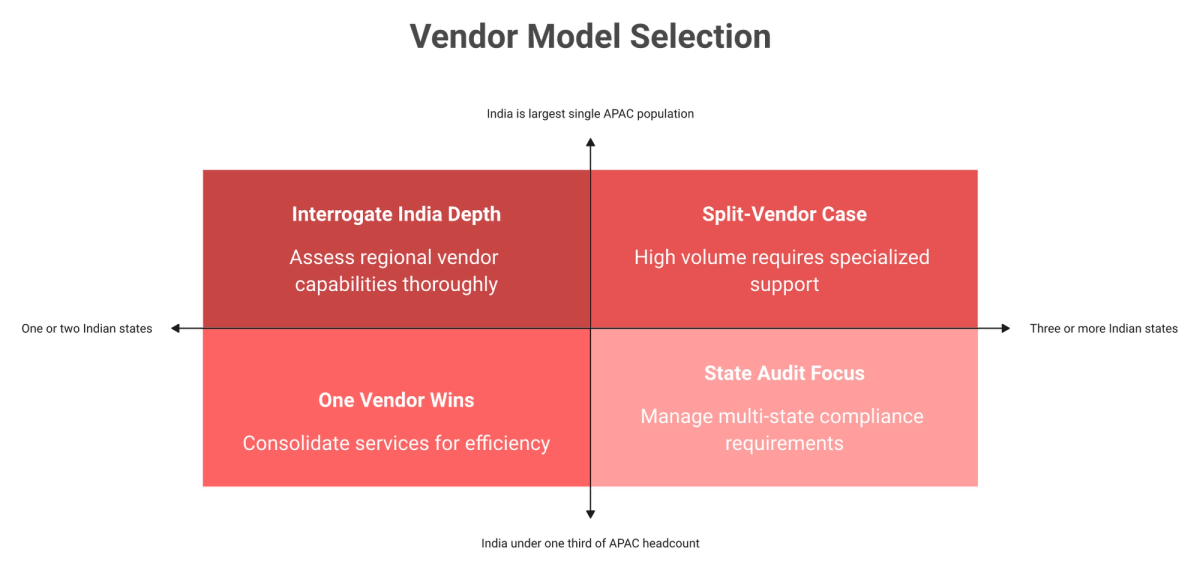
Here is where my head is right now. Country count is the wrong first question. The right one is what percentage of your APAC headcount sits in India, and across how many Indian states.
India runs central and state payroll law at the same time. That is not true of Singapore. So the same vendor can be genuinely strong in one market and thin in the other, at identical prices.
You do not always need the Golden Gate Bridge when a suspension bridge crosses the river. An EOR is the suspension bridge, and setting up your own Indian subsidiary is the Golden Gate. Both cross water. Only one takes 12 to 18 months and $50,000 before your first hire starts, which is the tipping point our EOR vs entity calculator models directly.
Run the headcount-share test first. Then read the vendor sections. The rest of this piece answers, in order, what each vendor actually covers, what the real all-in cost is, who owns the Indian entity, which states are registered, and whether either payroll has been rebuilt for the Labour Codes that commenced on 21 November 2025.
Q2. What share of your APAC headcount sits in India, and why does that decide the vendor?
If India is your largest single APAC population and spans more than two states, the volume of country-specific statutory events exceeds what a regional support model absorbs comfortably. Below roughly a third of regional headcount, in one or two states, one regional vendor is the right call and the split-vendor debate is noise.
📊 Why coverage counts hide the answer
APAC coverage claims aggregate markets of very different regulatory weight. Singapore is one payroll jurisdiction with one CPF filing. India is a central layer plus a state layer running in parallel.
"India runs central and state payroll laws at the same time."
— r/IndiaEOR Reddit Thread
Six years of multi-state contract-to-hire placements across Bengaluru, Hyderabad, and Pune taught me something blunt. State count predicts operational pain better than headcount does.
⏰ The four-criterion rubric
Score your own situation before you score the vendors. This takes five minutes with your org chart open.
| Criterion | Regional vendor is fine | India needs its own answer |
| India share of APAC headcount | Under one third | Largest single population |
| Indian states with employees | One or two | Three or more |
| Statutory events per month | Handled by shared queue | PF, ESI, TDS, PT stacking weekly |
| Who owns escalation | Regional CSM, email | Needs IST-hours ownership |
Two or more entries in the right-hand column, and you should at least price a specialist alongside your regional vendor.
💸 Why the statutory event count is the real load
Each Indian employee generates a monthly stack. TDS is deducted and deposited by the 7th. PF and ESI run on the Code-defined wage base. Professional tax runs on a state-specific calendar, which our guide to payroll compliance in India sets out month by month.
Add employees in a third state and you have added a filing calendar, not just a payslip. That is the volume a regional support queue absorbs badly.
The EPF wage ceiling was fixed at ₹15,000 per month by gazette notification S.O. 2702(E) dated 29 May 2026, capping mandatory contributions at ₹1,800 each side. Your vendor's default enrolment policy above that ceiling is now a question you have to ask, not assume.
⚠️ The market context that changes your salary math
This decision is not happening in a soft hiring market. NASSCOM's Strategic Review 2026 puts India's tech sector at $315 billion in FY26, with net hiring up 2.3 percent. Engineers have options.
So retention quality matters as much as compliance accuracy. A vendor who mishandles a PF query loses you an engineer, not just a filing deadline. Benchmark your bands with the India salary calculator before you assume a discount exists.
✅ What operators say about picking on speed
Select an EOR provider on compliance depth, not onboarding speed alone.
Centralised approval chains fail where decisions have to be made locally. A regional model works like a pyramid. India needs something closer to a tree, with real authority out on the branches.
Q3. What does Skuad, now Payoneer Workforce Management, actually cover for India?
Payoneer acquired 100 percent of Skuad Pte. Ltd. on 5 August 2024, and the product now trades as Payoneer Workforce Management. Your 2026 counterparty is a Payoneer group company. It publishes India EOR from $199 per employee per month on annual billing, covers 160-plus markets, and does not state which are owned versus partner-served.
✅ What Skuad is genuinely good at
Start with the strengths, because they are real. The published floor price is the lowest of the two vendors here. Setup fees are listed at zero, and contractor management is priced separately and cheaply.
The platform itself gets consistent credit from users, including on the parts that matter to a busy ops lead.
"Online portal is relatively easy to use. Help is available when needed. I like how we have an account manager that helps guide us."
— Verified User in Information Technology and Services, Payoneer Workforce Management (formerly Skuad) G2 Verified Review
Payoneer's payment rails behind it are also not a small thing for a company already paying contractors across four markets. If contractor coverage is the actual need, compare it against a dedicated contractor of record arrangement.
⚠️ What the acquisition changes on your paperwork
An ownership change is not a scandal. It is a diligence item. Check that the entity name on your MSA matches the group entity you think you are buying from.
Ask three things in writing before signing. Which Indian entity employs your staff, what its CIN is, and which APAC markets are served directly rather than through a partner.
❌ Where the reviews get uncomfortable
The critical reviews cluster on support and invoicing rather than platform quality. That pattern matters more than any single complaint.
"The customer support, it takes forever and most of the times doesn't actually solve anything."
— Ricardo V., 1 July 2025, Payoneer Workforce Management (formerly Skuad) G2 Verified Review
"We agreed to pay 200 USD per person, but they wanted us to pay 400 USD. They delayed last invoices and almost made us pay more because of a wrong exchange rate."
— Verified User in Information Technology and Services, 18 November 2024, Payoneer Workforce Management (formerly Skuad) G2 Verified Review
Neither reviewer states which country they were hiring in, so read them as evidence about the commercial and support model, not about India specifically. Buyers already leaving for that reason usually land on our list of Skuad alternatives for India.
💰 The honest gap in the available evidence
Here is what I cannot tell you. The public evidence does not establish what the $199 tier omits relative to the $400 tier.
A price floor is not a price. I have not seen a sub-$250 India quote survive a security deposit and a payroll pre-funding cycle without something moving.
So I am hedging deliberately, and you should too. Ask for a written quote that itemises the platform fee, the deposit, the pre-funding requirement, and the FX rate source.
That one email tells you more than any comparison table on the first page of Google, including this one.
Q4. What does Multiplier actually cover for India, and where does its support model strain?
Multiplier publishes India EOR from about $400 per employee per month, with no setup fee, a two-week exit notice, and a roughly seven-day onboarding commitment, supported by a CSM over email. Reviewers praise the interface and competitive pricing. Others report invoice errors, account-manager churn, and slow escalation through a ticket queue.
✅ What Multiplier does well
Breadth first. Multiplier covers 150 to 171-plus countries depending on the source page, which is the point of buying it. Setup is straightforward and the pricing is published rather than gated.
"I appreciate that Multiplier offered competitive pricing for its employer of record services. The setup process with Multiplier was fairly straightforward, making the initial integration into our operations smooth."
— Micah P., 3 November 2025, hiring across US states, Multiplier Employer of Record G2 Verified Review
That reviewer was describing US multi-state hiring, not India. I am labelling the jurisdiction because an unlabelled quote gets read as India evidence.
💸 The commercial terms as recorded
| Term | Skuad (Payoneer WM) | Multiplier | Versatile Club |
| Published India EOR price | From $199/employee/month, annual | From ~$400/employee/month | $149/employee/month, flat |
| Setup fee | $0 | $0 | $0, first month free |
| Exit terms | Not published | Two-week notice | No exit fee |
| Onboarding commitment | Self-serve, 48 to 72 hours claimed | ~7 days | 5 business days, in the service agreement |
| India entity | Ask for name and CIN | Ask for name and CIN | Own Indian entity, verifiable by CIN |
| Country coverage | 160-plus | 150 to 171-plus | India only |
Versatile Club sits in that table as an India-only row, which is a limitation on three of those lines and an advantage on two. The full rate card sits on our India EOR pricing page.
❌ Where the support model strains
The recurring complaint is not price. It is that nothing gets resolved without going through a queue.
"Communication must go through account managers instead of direct engagement with accounting, increasing the time I spend resolving issues rather than reducing it."
— Micah P., 3 November 2025, US multi-state hiring, Multiplier Employer of Record G2 Verified Review
"Every issue, no matter how urgent, takes 3 to 10 business days to resolve. Account managers are polite but powerless to actually fix core problems."
— Kenneth P., 9 September 2025, US employee experience, Multiplier Employer of Record G2 Verified Review
⏰ Why three to ten days breaks in India specifically
Premium pricing buys platform breadth. It does not automatically buy local depth.
Think about the month that actually tests a vendor. TDS is due on the 7th, a Karnataka professional tax filing lands the same week, and an employee asks why her PF passbook has not updated.
A three-day response window is fine for a benefits question. It is not fine for a statutory deposit deadline, because the deadline does not move for a ticket queue. Teams that have hit that wall usually start with our Multiplier alternatives for India comparison.
⚠️ The one question to send in writing
Ask for the escalation path, named. Who owns an EPFO query, in which time zone, with what contractual resolution time, and what happens when that person leaves.
Account-manager churn appears in these reviews more than once. A written escalation ladder survives churn. A friendly CSM does not. If you want to see how an owned-entity model handles that month, our EOR services in India page shows the filings and the escalation route in one place.
Q5. What is the true all-in India cost of each vendor once deposits, pre-funding and FX are counted?
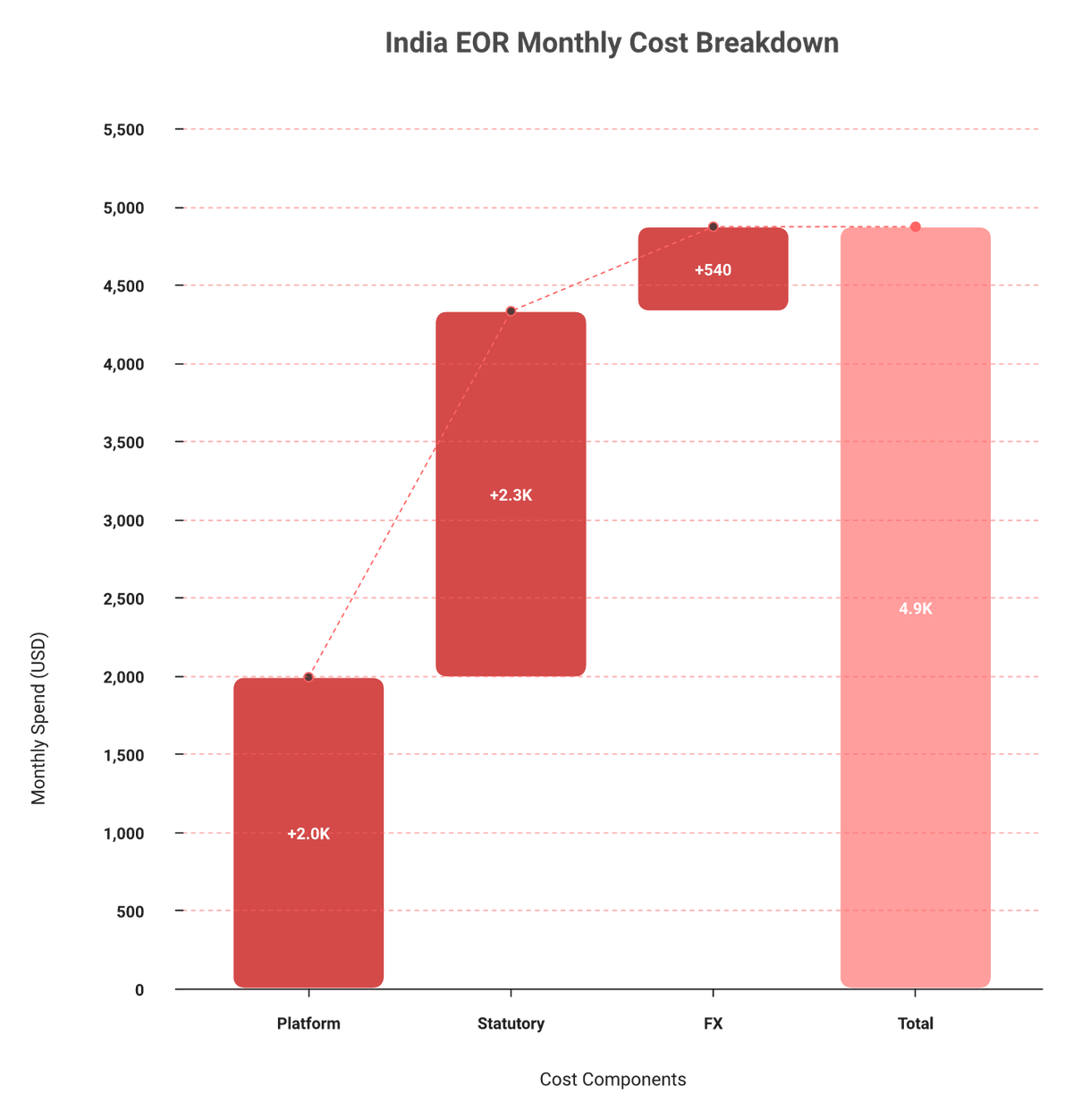
Published prices conflict across sources. Skuad appears at $199 annual and $249 monthly. Multiplier appears at $400, $459, and $499 depending on the page. Add employer statutory load of roughly 13 percent, a refundable deposit near one month gross salary, payroll pre-funding, and an FX spread reported at three to five percent. Realistic Skuad lands nearer $350 to $550 per head.
💰 The four layers your controller actually pays
A platform fee is one line on a five-line invoice. Think of it like an airline base fare. The seat costs what it costs, then bags, taxes, and seat selection arrive.
Here are the four layers, in the order they hit your bank account.
Platform fee. The published per-employee rate, billed monthly or annually.
Employer statutory load. Provident fund at 12 percent on the wage base, plus ESI at 3.25 percent employer and 0.75 percent employee where applicable.
Security deposit. Typically around one month of gross salary, refundable, held for the contract's life.
Payroll pre-funding. Cash sent before payday, which means your money leaves early every month.
If you want each of those layers modelled against your own headcount, our guide to the cost of hiring in India runs the same stack line by line.
💸 Where the money quietly disappears
Foreign exchange is the layer nobody prices for you. INR-denominated invoicing pushes conversion risk and month-end treasury work onto your side. USD-native invoicing removes that visible risk but can bury a markup.
Versatile Club bills a flat $149 per employee per month with no salary slabs, no setup fee, and no exit fee, invoiced in USD from its own Indian entity. I built it that way because clients kept finding mystery FX charges months after signing.
⚠️ What buyers report about invoice accuracy
The pattern in public reviews is invoices that move after signature, not headline prices that lie.
"We agreed to pay 200 USD per person, but they wanted us to pay 400 USD. They delayed last invoices and almost made us pay more because of a wrong exchange rate."
— Verified User in Information Technology and Services, 18 November 2024, Payoneer Workforce Management (formerly Skuad) G2 Verified Review
"They also introduced some new deposits and fees that weren't originally in our contract and ultimately ended up increasing our EOR costs."
— Verified User in Information Technology and Services, 9 December 2025, Multiplier Employer of Record G2 Verified Review
Neither reviewer names India as the market. Read both as evidence about billing practice, not about India service quality.
⏰ A worked example for 10 India engineers
Assume 10 engineers at ₹18 lakh CTC each, roughly $1,800 per month gross. Run the arithmetic at each vendor's published floor.
| Cost layer | At $199 published | At $400 published |
| Platform fee, 10 heads | $1,990 | $4,000 |
| Statutory load, ~13% | ~$2,340 | ~$2,340 |
| Deposit, one-time | ~$18,000 held | ~$18,000 held |
| FX spread at 3% | ~$540 | ~$540 |
| Effective monthly | ~$4,870 | ~$6,880 |
The gap narrows from 2x on sticker price to about 1.4x all-in. That is still a real difference. It is just not the difference the comparison pages show you. Our India employer of record cost breakdown holds the same arithmetic in a reusable format.
✅ The two lines to demand in the MSA
Ask for the FX rate source, named. RBI reference rate, mid-market, or the provider's own book, stated in writing.
Then ask for the spread, disclosed as a percentage. A vendor who will not write down either number has told you something useful.
Versatile Club publishes its rate on the India EOR pricing page and invoices in USD from one Indian entity, so the FX line does not reappear inside your month-end close.
Q6. Owned entity or partner network: what do 160-plus country claims actually mean for India?
Coverage counts measure presence, not control. Skuad publishes 160-plus markets and Multiplier 150 to 171 depending on the source, and neither enumerates which are served through their own entities versus local partners. Versatile Club employs India hires through its own entity, Foo Falcon Technologies Private Limited, verifiable by CIN on the MCA register. Ownership decides who controls your PF and TDS filings.
⚠️ What a partner-served market means in practice
A partner network is not fraud. It is how most global platforms reach 150 countries without incorporating 150 times. That is a sensible business model.
The consequence lands on you, though. When something breaks in a partner market, your escalation goes vendor to partner to regulator. You cannot shorten that chain.
✅ The two things ownership actually governs
I get asked why this matters beyond principle. There are two concrete mechanisms, and both show up in due diligence.
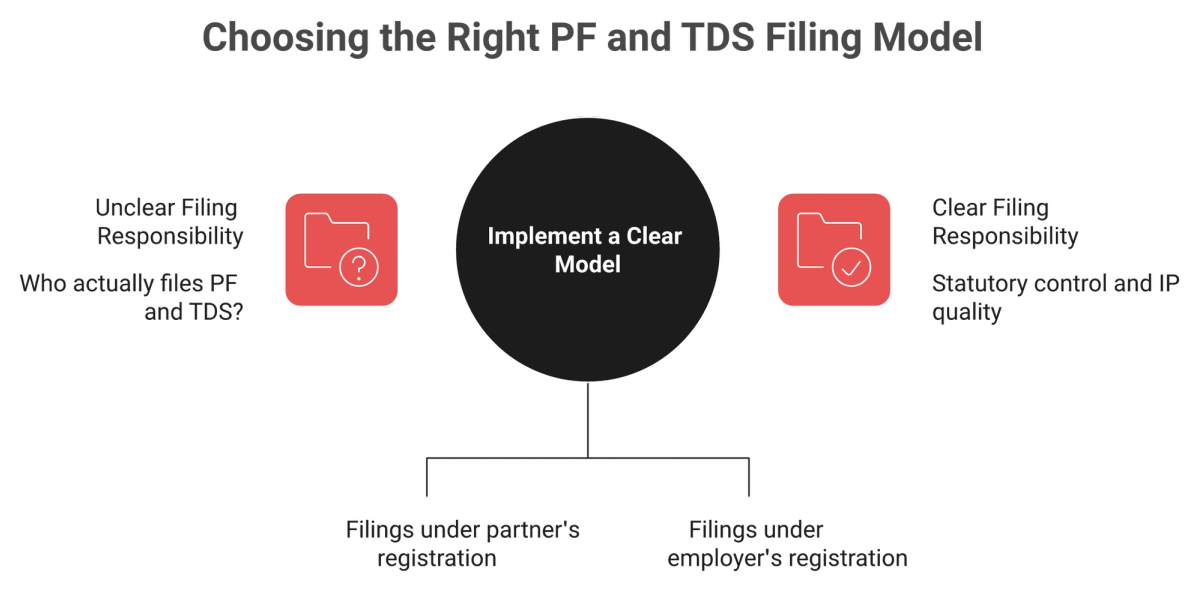
Statutory filing control. In an owned model, the PF challan and TDS deposit are made under the employer's own registration numbers. In a partner model, they sit under the partner's.
IP assignment quality. Your employment contract is with whichever entity actually employs the person. If that entity is a partner you have never audited, your intellectual property assignment runs through it.
Versatile Club measures this the simple way, by keeping the employing entity, the PF registration, and the ESIC code inside the same company you contract with. The mechanics are set out on our how it works page.
⏰ The test, in one email
Do not accuse anyone of anything. Ask a factual question that has a factual answer.
Send this, exactly: which legal entity will employ our India staff, what is its Corporate Identity Number, and are its PF and ESIC registrations held in that entity's name. A Corporate Identity Number, or CIN, is the 21-character company ID assigned by India's Ministry of Corporate Affairs.
💰 How to verify the answer yourself in four minutes
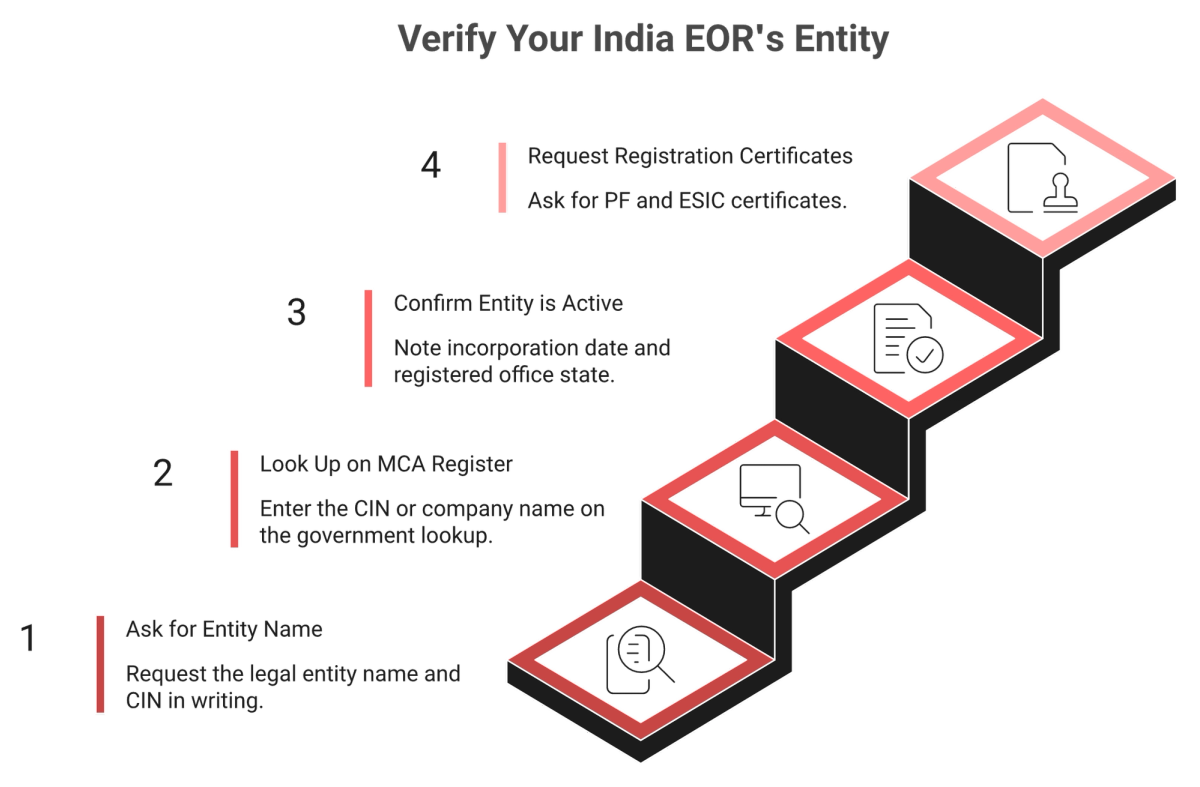
Then check it, because a name in an email is not evidence.
Open the MCA company master data lookup on the government portal.
Enter the CIN or the exact company name they gave you.
Confirm the entity is active, and note the incorporation date and registered office state.
Ask for a copy of the PF and ESIC registration certificates showing the same entity name.
If the entity that appears is a different company from the one on your master service agreement, that is worth a conversation before signature, not after. Buyers weighing the alternative route should read EOR vs entity in India before committing capital.
⚠️ Where I will not overclaim
I am not going to tell you Skuad or Multiplier uses partner entities in India. I have not seen either company's India entity documents, and neither publishes the direct-versus-partner split by market.
Versatile Club's read is that the standard advice gets this backwards. Buyers interrogate the price sheet for hours and accept the entity structure on trust, when the entity structure is the part that survives an audit.
Where my head is right now is that this becomes a procurement checkbox within two years. India stops being one country on a global map and becomes its own diligence category.
✅ The honest trade-off in owning one country
Owning the entity has a cost, and the cost is coverage. Versatile Club operates only in India, which means it cannot serve your Singapore, Vietnam, or Philippines headcount at all.
That is a real limitation for a regional buyer, and I would rather name it than dress it up. Depth in one country and breadth across forty are different products.
Versatile Club holds its own PF registration, ESIC code, and Shops and Establishments licences under Foo Falcon Technologies Private Limited, so the entity you check on the MCA register is the entity that signs your employees' contracts. Our compliance page lists what sits under those registrations.
Q7. Which Indian states does each vendor hold registrations in, and why ask before signing?
You do not need a separate EOR per state, but your EOR needs registrations wherever an employee sits. Maharashtra runs dual PTRC and PTEC with monthly slab filing and annual returns. Karnataka requires monthly professional tax plus Shops and Establishments renewal, with enrolment inside thirty days of joining. Versatile Club holds registrations across all 28 states and 8 union territories under its own entity.
⚠️ The moment this becomes your problem
Your fifth India hire accepts an offer and mentions she is relocating to Pune. Nobody flags anything. Payroll runs.
Four months later, a Maharashtra professional tax notice arrives, and your vendor explains that PTEC enrolment was never completed. Professional tax, or PT, is a state-level tax on salaried income, deducted monthly and remitted to the state.
⏰ How the three big tech-hire states actually differ
Six years of running contract-to-hire payroll across Bengaluru, Hyderabad, and Pune taught me that state count predicts pain better than headcount. Here is the mechanism, not the assertion.
| State | Registrations needed | Filing cadence | Enrolment trigger |
| Maharashtra | PTRC and PTEC, both | Monthly slab filing, annual return | On establishing presence in state |
| Karnataka | PT plus Shops and Establishments | Monthly PT remittance, S&E renewal | Within 30 days of employee joining |
| Telangana | PTRC enrolment | Monthly remittance deadlines | On first employee in state |
| Tamil Nadu | PT plus Labour Welfare Fund | Biannual PT, annual LWF | On establishing presence |
| Delhi | No PT, strict S&E rules | S&E compliance and returns | On establishing presence |
PTRC is the registration certificate for deducting tax from employees. PTEC is the enrolment certificate for the entity's own liability. Maharashtra wants both, which is where global templates usually break. Teams running payroll in the two biggest tech hubs can compare our payroll outsourcing in Bengaluru notes against their own filing calendar.
✅ The four-step check before you sign
Versatile Club runs this same check on its own registration file every quarter, because state rules move and West Bengal in particular changes them often.
List every Indian city where you have or plan to have an employee.
Map each city to its state, then to that state's PT and S&E requirements.
Ask your vendor to name the states where it currently holds live registrations.
Ask what happens, in days, when an employee moves to an unregistered state.
Step four is the one that separates answers. A vendor with its own registrations gives you a timeline. A vendor working through partners gives you a promise to check.
💸 Why this is not a small-print issue
Late PT registration carries interest and penalty at the state level, and the amounts are not ruinous. The real cost is different.
An employee whose payslip shows the wrong PT deduction opens a ticket. Then she tells two colleagues. In a market where NASSCOM records net hiring up 2.3 percent in FY26, that conversation costs you retention, not just a penalty.
⚠️ What I honestly cannot tell you
Neither Skuad nor Multiplier publishes a state-by-state India registration list. I have looked, and it is not on either site.
So this section teaches a test rather than announcing a winner. Send the question, get it in writing, and compare the two answers side by side.
Versatile Club files professional tax, PF, and ESI under its own registrations across all 28 states and 8 union territories, which means a relocation to Pune is a payroll change rather than a registration project. The monthly calendar behind that sits in our payroll compliance in India guide.
Q8. Is your vendor's payroll actually rebuilt for the November 2025 Labour Codes and EPF Scheme 2026?
All four Labour Codes commenced on 21 November 2025, standardising wages so excluded allowances above fifty percent are added back when computing gratuity, notice, and overtime. The EPF ceiling stays at ₹15,000 under S.O. 2702(E) dated 29 May 2026, capping mandatory contributions at ₹1,800 each side, with above-ceiling contributions voluntary under EPF Scheme 2026.
⏰ What changed, and when
Three dates matter, and they are all recent. The Codes came into force on 21 November 2025 through a set of MoLE notifications.
The EPF wage ceiling was fixed at ₹15,000 by gazette notification on 29 May 2026. EPF Scheme 2026 followed on 29 June 2026, making contributions above that ceiling voluntary for both sides.
💰 The fifty percent rule, as arithmetic not panic
Most blog coverage says CTC must be restructured so basic plus dearness allowance equals half of pay. That reads the rule backwards.
The Codes define a single wage base. If your excluded allowances exceed fifty percent of total remuneration, the excess is added back into wages for statutory calculations.
MoLE's own FAQ confirms the detail that global templates miss. Employer provident fund contributions and statutory bonus count inside that fifty percent test, while gratuity and ESI contributions do not.
⚠️ Where the error surfaces months later
Standardised payroll templates apply a global allowance structure and skip the add-back. Payslips look fine. Nobody notices in month one.
The error appears at gratuity settlement, when a leaver's payout is computed on a larger base than your accrual assumed. Gratuity accrues from month one at 4.81 percent of basic plus dearness allowance, so an understated base compounds quietly.
Versatile Club files PF, ESI, TDS, and professional tax under its own registrations, which means the add-back arithmetic runs inside one payroll rather than being passed to a partner. Teams that outgrow a global template usually move through our guide to switching EOR provider in India.
✅ Three questions that test readiness in writing
Ask each vendor these, and read what comes back rather than how fast it comes back.
Show one anonymised post-November-2025 India payslip with the wage add-back visible.
State your default enrolment policy above the ₹15,000 EPF ceiling, and who authorises employer matching.
Show the gratuity accrual line as it appears on our monthly statement.
Question two is the sharpest. Above-ceiling contributions became voluntary in June 2026, so a vendor still enrolling everyone above ceiling by default is inflating your cost per head.
💸 The misclassification exposure nobody prices
Treating a full-time India employee as an independent contractor on paper carries back-pay exposure of roughly $25,000 to $40,000 per head once statutory dues, interest, and gratuity are reconstructed.
One correction on terminology. Traditional US-style co-employment PEO does not legally exist under Indian labour law. If you have no registered Indian subsidiary, EOR is the compliant route, and any vendor using PEO language for India is describing something that is not available here. Our comparison of independent contractor vs EOR shows where the line sits.
I could be reading the enforcement trend too strongly. Versatile Club's client conversations point to more contractor scrutiny after the Codes, though it is early and I would not build a plan on that alone.
Versatile Club runs statutory filings under its own registrations across all 28 states and 8 union territories, so a wage-definition change lands in one payroll engine rather than in a chain of partner handoffs. The full service scope sits on our EOR services in India page.
Q9. What statutory documents must arrive every month, and which clauses belong in the contract?
Ask for the artefacts, not the assurances. TDS certificates now issue in Form 130 and Form 131 under section 395(4) of the Income-tax Act 2025, with Form 131 due inside fifteen days of the quarterly statement deadline. Your EOR invoice needs a valid IRN reported to the invoice registration portal inside thirty days, or your input tax credit is gone.
⏰ The monthly artefact checklist
Hand this list to your controller. If a vendor cannot produce every item, the compliance promise is a slide, not a system.
Payslips for each employee, showing the wage add-back under the new Codes.
PF challan with the Electronic Challan cum Return receipt, filed by the 15th.
ESI contribution proof, where employees fall inside the wage limit.
TDS deposit challan, deposited by the 7th of the following month.
State professional tax remittance proof, per state, on that state's cadence.
Your own invoice carrying a valid Invoice Reference Number, or IRN.
Gratuity accrual statement, showing the liability building on your books.
Versatile Club issues this documentation set monthly from its own registrations, so every artefact carries the same entity name that appears on the service agreement. Teams that would rather hand the whole cycle over start with our managed payroll service.
💸 Why the IRN line matters to your CFO
E-invoicing is mandatory for GST-registered businesses above ₹5 crore annual aggregate turnover. Businesses at ₹10 crore and above must report invoices to the portal within thirty days.
Miss the window and no IRN is generated. No IRN means no valid invoice, which means your input tax credit disappears. That is a cash loss, not a paperwork issue. Our guide on how to pay employees in India sets out where that invoice sits in the month-end sequence.
⚠️ The DPDP clauses to insert now
Your EOR holds Aadhaar numbers, PAN details, and bank account data. Under the Digital Personal Data Protection Rules 2025, notified as G.S.R. 846(E) in November 2025, it is a data fiduciary in its own right.
The timeline is staggered, which buyers keep getting wrong. Consent manager provisions go live on 14 November 2026. The substantive duties, including notice, breach response, and security safeguards, apply from 14 May 2027.
So you have negotiating leverage right now, before those duties bite. Ask for three clauses: breach notification inside a stated number of hours, a named processing purpose, and a data return or deletion obligation at exit.
✅ What an EOR does and does not shield
Permanent establishment risk, or PE risk, is the chance that tax authorities treat your India activity as a taxable local presence. A properly structured EOR reduces that exposure by employing staff through its own entity.
It does not eliminate it. If your India team signs customer contracts, negotiates pricing, or holds decision authority over local revenue, you carry PE risk regardless of who runs payroll. Buyers weighing structures side by side should read India expansion options before choosing.
Versatile Club's read is that the standard advice oversells this protection. I would rather tell you to keep contracting authority outside India than let you believe a payroll structure solves a tax-nexus question.
💰 The one clause most buyers forget
Exit terms. Ask what happens to your employees, records, and deposit if you switch providers in month fourteen.
Get the notice period, the deposit refund timeline, and the data handover format in writing. A provider confident in its service does not hide that paragraph.
Versatile Club charges no setup fee and no exit fee, and returns the statutory record set at handover, which is the part that matters when finance reconstructs a year of filings. The scope behind those filings sits on our compliance page.
Q10. What happens when an India filing deadline slips at 6pm IST?
Regional support models staff generalists across several jurisdictions, which shows up on the seventh of the month when TDS is due. Judge the model rather than the anecdote. Ask who answers an EPFO query during IST hours, what the written escalation ladder is, and whether any resolution time is contractual rather than aspirational.
⏰ The scene that tests every vendor
It is the 6th. Your TDS deposit is due tomorrow, and your India ops lead notices the deduction is wrong for two engineers.
She emails the account manager at 6pm IST. That is 5:30am in San Francisco and after hours in Singapore. The ticket sits.
❌ What buyers report about resolution time
The recurring complaint across public reviews is not incompetence. It is that account managers are pleasant and structurally powerless.
"Every issue, no matter how urgent, takes 3 to 10 business days to resolve. Account managers are polite but powerless to actually fix core problems."
— Kenneth P., 9 September 2025, US employee experience, Multiplier Employer of Record G2 Verified Review
"The customer support, it takes forever and most of the times doesn't actually solve anything."
— Ricardo V., 1 July 2025, Payoneer Workforce Management (formerly Skuad) G2 Verified Review
Neither reviewer names India as their market. Read both as evidence about the support model, not about India-specific service.
✅ The other side of the evidence
Balance matters here, because the same platforms get real praise for the parts that work.
"Online portal is relatively easy to use. Help is available when needed. I like how we have an account manager that helps guide us."
— Verified User in Information Technology and Services, Payoneer Workforce Management (formerly Skuad) G2 Verified Review
A three-day response window is perfectly fine for a benefits question. It fails on a statutory deposit deadline, because the deadline does not move for a queue.
⚠️ The four things an escalation clause must name
Versatile Club puts these four items in the service agreement rather than in a support page, because a page can be edited and a contract cannot.
Who owns statutory escalations, by role, not by rotation.
When they are reachable, stated in IST.
How long resolution takes, as a contractual number.
What happens on handover when that person changes.
Ask both vendors for the same four. Compare the two replies side by side, and notice which one hedges on the third item. If either answer pushes you toward a switch, our notes on switching EOR provider in India cover the handover sequence.
💰 Founder access, with the limit stated
Versatile Club routes client escalation to me on WhatsApp instead of a CSM rotation. I answer because that is sustainable at our current scale.
At some point it will not be. I would rather say that now than pretend a founder can personally handle a thousand employees' payroll queries in three years. If you want that conversation directly, our contact page routes to the same number.
One habit I picked up running placements across Bengaluru, Hyderabad, and Pune. After every urgent call, send a written recap of what was agreed within the hour.
If you are not completely sure what was asked of you, say so plainly and ask again. That single discipline has saved more filing deadlines than any dashboard I have used.
Q11. Head-to-head: how do Skuad and Multiplier score on the criteria that decide India?
Score both on eight criteria: published India price and billing basis, invoicing currency, deposit and pre-funding, contractual onboarding SLA, Indian states registered, escalation path in IST, statutory documents delivered monthly, and which APAC markets are direct versus partner-served. A vendor that answers all eight in writing beats one that merely charges more.
💰 The scorecard, with honest blanks
Some cells below say "ask the vendor". That is deliberate. Neither company publishes the answer, and I am not going to fill a cell with a guess.
| Criterion | Skuad (Payoneer WM) | Multiplier | Versatile Club |
| Published India price | From $199/employee/month annual, $249 monthly | From ~$400, with $459 annual and $499 monthly on third-party pages | $149/employee/month flat, no salary slabs |
| Setup and exit fees | $0 setup, exit terms not published | $0 setup, two-week exit notice | $0 setup, $0 exit, first month free |
| Invoicing currency | Ask the vendor | Ask the vendor | USD, from its own Indian entity |
| Onboarding commitment | Self-serve, 48 to 72 hours claimed | ~7 days | 5 business days, written into the agreement |
| Indian states registered | Not published, ask | Not published, ask | 28 states and 8 union territories |
| India entity model | Ask for name and CIN | Ask for name and CIN | Own entity, verifiable on MCA register |
| Escalation path | Account manager, per reviews | CSM by email, per reviews | Founder on WhatsApp, at current scale |
| Everest Group 2025 position | Major Contender | Major Contender | Not assessed |
| Country coverage | 160-plus markets | 150 to 171-plus | India only |
Versatile Club sits in that table as a single India-scoped row, which loses two lines on coverage and wins two on entity control. Readers running a wider shortlist can cross-check it against the best EOR in India comparison.
⚠️ How to read a refusal to answer
Send all eight criteria as one email. Then watch which ones come back with a number and which come back with reassurance.
A vendor that names its Indian entity, its registered states, and its FX rate source in writing has just given you an audit trail. A vendor that answers three of eight has told you where the gaps are.
✅ The three questions I would actually send
Keep it short enough that a salesperson forwards it internally rather than answering from memory.
Which legal entity employs our India staff, and what is its CIN?
Which Indian states do you currently hold live PT and Shops and Establishments registrations in?
What is your contractual resolution time for a statutory filing error, in IST hours?
💸 What the scorecard does not settle
Price is not the tiebreaker most buyers think it is. Once deposits, pre-funding, and FX land, the gap between $199 and $400 compresses toward 1.4x rather than 2x.
So the tiebreaker becomes the entity question and the escalation clause. Those two decide what happens in the month something goes wrong. Our Multiplier alternative page shows how those two lines read under an owned-entity model.
Versatile Club publishes its flat rate, its zero setup and exit fees, and its five-business-day onboarding SLA as contract terms rather than marketing claims, which is the only reason it belongs in that table at all.
Q12. When does an India-only EOR beat both of them, and who should pick which?
Only in one scenario: your India population is large enough to justify a specialist for India alongside a regional vendor elsewhere. Versatile Club is India-only and cannot cover Singapore, Vietnam, the Philippines, or Indonesia. If your team genuinely spans four APAC markets, Skuad or Multiplier is the better answer and you should stop reading here.
❌ What Versatile Club cannot do
Start with the disqualifiers, because they are real and I would rather you find them here than on a sales call.
One country only. No APAC coverage, no European entities, no "150 countries" line.
EOR launched in 2026, so there is no G2 review base to check.
No SOC 2 and no ISO 27001, which rules us out of many enterprise procurement processes.
Enterprise customisation runs longer than the five-day onboarding SLA.
If SOC 2 is a procurement prerequisite for your security team, that is a hard stop. I am not going to argue you out of your own controls.
✅ What is actually in place
Versatile Club employs India hires through its own registered entity, Foo Falcon Technologies Private Limited, verifiable by CIN on the MCA register.
The compliance infrastructure came from contract-to-hire work, not from an EOR launch. PF registration, ESIC code, Shops and Establishments licences, and state professional tax registrations across 28 states and 8 union territories were already running before the EOR product existed.
That is the honest version of the track record. The entity and the filings are seasoned. The EOR wrapper around them is new. The placement side of that history sits on our contract to hire page.
💰 The mechanics, in one place
Versatile Club bills $149 per employee per month, flat, with no salary slabs, no setup fee, no exit fee, and the first month free.
One USD invoice, issued from a single Indian entity.
Five business days onboarding, written into the service agreement.
PF, ESI, TDS, and professional tax filed under its own registrations.
Contract-to-hire at 20 to 30 percent of annual salary, charged only after day 90, with a six-month replacement guarantee.
Founders making a first India hire usually start from our guide to hiring in India without an entity.
⏰ The split-vendor arithmetic
Run it with real numbers. Twenty-two India engineers at $149 against $400 is roughly $5,500 saved per month, or $66,000 a year.
That is enough to justify a second vendor relationship and the extra reconciliation work. At six India employees inside a forty-person APAC team, it is not. Model your own crossover point with the EOR vs entity calculator.
I will also say the quiet part. Versatile Club's client conversations point toward India becoming its own procurement category rather than a row on a global map, though it is early and I could be reading that trend too strongly.
⭐ Who picks what
Run the share test first, then act on it. Pick Skuad if India is under a third of your APAC headcount in one or two states and price discipline matters most.
Pick Multiplier if India is your largest population, you want one regional vendor, and you can live with email escalation. Split the vendors if India is large enough to carry its own specialist and spans three or more states. Buyers already down that path tend to read our Skuad alternatives for India notes next.
One last thought I keep returning to. Nobody hires in Bengaluru because it is cheap. They hire there because the talent density is unusual, and the vendor question is really about not losing those people to a payroll error.
If you want to argue with the headcount-share test, message me. I would rather be corrected than agreed with, and our EOR services in India page has the filings and the SLA laid out if you want the detail first.
FAQs
Is Skuad cheaper than Multiplier for hiring in India?
On sticker price, yes. Skuad publishes India EOR from $199 per employee per month on annual billing and $249 on monthly billing. Multiplier is published from roughly $400, with $459 annual and $499 monthly figures appearing on third-party comparison pages in 2026.
The all-in picture is narrower. Once you add the layers your controller actually pays, the gap compresses toward 1.4x rather than 2x:
- Employer statutory load of roughly 13 percent, covering provident fund at 12 percent on the wage base and ESI where applicable.
- A refundable security deposit of around one month of gross salary, held for the contract's life.
- Payroll pre-funding, which moves cash out of your account before payday.
- An FX spread reported at three to five percent on global platforms.
We tell buyers to compare written quotes rather than pricing pages, because deposits and pre-funding rarely appear on either. Versatile Club bills a flat $149 per employee per month with no salary slabs, no setup fee, and no exit fee, invoiced in USD from its own Indian entity. If you want the full layer-by-layer arithmetic before you negotiate, our breakdown of India employer of record cost runs the same stack against real headcount numbers.
Does Multiplier invoice in INR or USD for India, and who absorbs the FX cost?
Ask the vendor directly and get the answer in writing, because invoicing currency is a commercial term rather than a published feature. What matters is not the currency itself but which side prices the conversion.
- INR-denominated invoicing pushes conversion risk and month-end treasury work onto you. Your controller closes the month against a number that moves.
- USD-native invoicing removes that visible exposure, but it can bury a markup inside the rate you are quoted.
Neither model is automatically better. The two lines we tell buyers to demand in the master service agreement are the FX rate source, named explicitly as the RBI reference rate, mid-market, or the provider's own book, and the spread, disclosed as a percentage. A vendor who will not write down either number has told you something useful.
Versatile Club issues one USD invoice from a single Indian entity, so the FX line does not reappear inside your month-end close. If you are mapping the whole payment cycle from salary transfer to invoice reconciliation, our guide on how to pay employees in India shows where currency conversion actually sits in the sequence.
How much does an India EOR cost for a team of 10 to 20 employees?
Model it in layers rather than as a single per-head fee. For 10 engineers at roughly ₹18 lakh CTC each, about $1,800 per month gross, the monthly picture looks like this:
- Platform fee for 10 heads: about $1,990 at a $199 published rate, or $4,000 at $400.
- Employer statutory load at roughly 13 percent: about $2,340, identical across vendors because it is statutory.
- Security deposit: roughly $18,000 held once, not monthly.
- FX spread at three percent: about $540.
That puts effective monthly spend near $4,870 at the lower published rate and about $6,880 at the higher one. Scaling to 20 heads roughly doubles the platform fee and statutory load while the deposit doubles as a one-time hold.
Versatile Club charges $149 per employee per month flat with no salary slabs, so the fee does not climb as senior salaries do. At 20 India employees, that flat structure is where the arithmetic separates from slab-based pricing. To test your own crossover point against incorporating locally, run the numbers through our EOR vs entity calculator before you commit budget for the year.
Does an India EOR need registrations in all 28 states, or one per state?
You do not need a separate EOR per state. Your EOR does need live registrations wherever an employee physically sits, because India runs central and state payroll law at the same time.
The state mechanics differ sharply:
- Maharashtra requires dual PTRC and PTEC registration, with monthly slab filing and an annual return.
- Karnataka requires monthly professional tax plus Shops and Establishments renewal, with enrolment inside thirty days of an employee joining.
- Telangana requires PTRC enrolment with monthly remittance deadlines.
- Tamil Nadu runs biannual professional tax plus an annual Labour Welfare Fund filing.
- Delhi has no professional tax but enforces Shops and Establishments rules strictly.
The practical test is a single question: name the states where you currently hold live registrations, and tell me what happens in days when an employee relocates to one you do not cover. A vendor with its own registrations gives you a timeline. A partner-based vendor gives you a promise to check.
Versatile Club holds professional tax, PF, ESIC, and Shops and Establishments registrations across all 28 states and 8 union territories under its own entity. The monthly filing calendar behind that sits in our guide to payroll compliance in India.
How do I choose between an APAC platform and an India-only EOR?
Run one test before you compare features: what share of your APAC headcount sits in India, and across how many Indian states?
- India under a third of regional headcount, in one or two states: a single regional platform is the right answer, and splitting vendors adds reconciliation work for no gain.
- India as your largest single population, spanning three or more states: the volume of country-specific statutory events exceeds what a shared regional queue absorbs comfortably.
- Genuine coverage across Singapore, Vietnam, the Philippines, or Indonesia: no India specialist can serve those markets, so a regional vendor wins outright.
Then score both shortlisted vendors on eight written criteria: published price and billing basis, invoicing currency, deposit and pre-funding, contractual onboarding SLA, states registered, escalation path in IST hours, monthly statutory documents delivered, and which markets are direct versus partner-served.
Versatile Club is India-only and cannot cover your other APAC markets, which rules it out for most genuinely regional teams. It earns a place only in the split-vendor case, with its own Indian entity, a five-business-day onboarding SLA written into the agreement, and no setup or exit fees. The service scope sits on our EOR services in India page.