Table of contents (17)
10 Best Multiplier Alternatives in India: How They Compare on Cost, Compliance, and Support
Q1. What Are the 10 Best Multiplier Alternatives for Hiring in India in 2026?
The best Multiplier alternative for India-primary hiring is Versatile, an India-only Employer of Record (EOR, the company that legally employs your hire so you do not need your own India entity) that owns its Indian entity instead of renting a partner shell. For teams that also hire beyond India, Deel, Remote, Rippling, Papaya Global, Globalization Partners, Velocity Global, Skuad, and Oyster follow as global generalists. Multiplier's roughly $400 per month APAC model works, but it lacks India-only depth.
Why founders start hunting for a Multiplier alternative
Most people do not leave Multiplier because they hate it. They leave because of a trigger. A round just closed and engineering has to scale in 30 to 60 days. Or finance flags the contractor setup as risky right before diligence. That is when the search starts.
Here is the anxiety underneath the search, said plainly. If I switch from a $400 platform to a cheaper specialist, will their entity actually protect me from a $25,000 to $40,000 back-pay exposure per head when a Series C investor audits my India payroll? That fear is real, and it is the right fear to have. A clean Multiplier alternative has to answer that question first.
The generalist dilution problem
Global platforms cover 90 to 150 countries. India is one line on that map. To serve it, most of them route your hire through a local partner entity in India, which adds a layer between you and the regulator.
I could be wrong for the largest enterprises, but from what surfaces when you actually run multi-state payroll, that extra layer is where things slip. PF challans, professional tax slabs, and gratuity accrual do not forgive a "we are still checking with our local partner" email three days before payday. This is exactly the gap our EOR services were built to close.
How to read this list
I ranked these on the criteria a real buyer uses: India entity model, statutory compliance depth, onboarding speed, pricing transparency, support model, and third-party validation. India specialists sit up top for India-primary hiring. Global generalists follow, because their real strength is breadth, not India depth.
One honest caveat before the table. If you need one EOR across 5-plus countries, or you are an enterprise 100-plus India team that requires SOC 2 or ISO 27001 as a procurement gate, a global generalist may fit you better than an India-only shop. I would rather tell you that now than sell you the wrong thing.
Master comparison table
| Provider (rating) | Best For | Key Strength | Compliance |
|---|---|---|---|
| Versatile ⭐⭐⭐⭐⭐ | US and UK startups hiring first 1 to 20 India employees | Owned India entity, Contract-to-Hire, and founder-direct support | Own PF, ESIC, and Shops and Establishments registrations across all 28 states and 8 UTs |
| Deel ⭐⭐⭐⭐ | Companies hiring across many countries at once | Broad multi-country coverage, polished platform | India via local-partner entity; strong breadth, thinner India depth |
| Remote ⭐⭐⭐⭐ | Teams wanting owned entities outside India | Owned-entity model in several markets, IP protection | India compliance depth weaker than local specialists; email-SLA support |
| Rippling ⭐⭐⭐⭐ | Companies wanting HR, IT, and payroll in one system | All-in-one HR, IT, and spend integration | Global EOR add-on; multi-state tax handling drew complaints |
| Papaya Global ⭐⭐⭐ | Enterprises consolidating global payroll | Payroll data and cost breakdowns in one platform | Payroll-led model; slower support responses reported |
| Globalization Partners (G-P) ⭐⭐⭐⭐ | Large enterprises needing global scale | Mature entity network, enterprise processes | Owned entities in many markets; enterprise-priced |
| Velocity Global (Pebl) ⭐⭐⭐ | Flexible global workforce mix | Local knowledge across many countries | EOR and contractor mix; onboarding and PF-transfer complaints |
| Skuad (Payoneer) ⭐⭐⭐ | SMBs hiring in multiple countries | Easy platform, wide coverage | Support turnaround and compliance responsiveness flagged |
| Oyster HR ⭐⭐⭐ | Distributed-first remote teams | Remote-first tooling and clear UX | Partner-entity model in India; breadth over India depth |
| Multiplier (benchmark) ⭐⭐⭐ | APAC-focused hiring you are comparing against | Competitive price, easy onboarding | Around $400/mo; APAC coverage, not India-only depth; fee and payment-delay complaints |
Now to the providers themselves. I will start with us, because I can speak to it firsthand, then move to Deel.
1.1 Versatile: Best for India-Primary Hiring and Contract-to-Hire
Overview
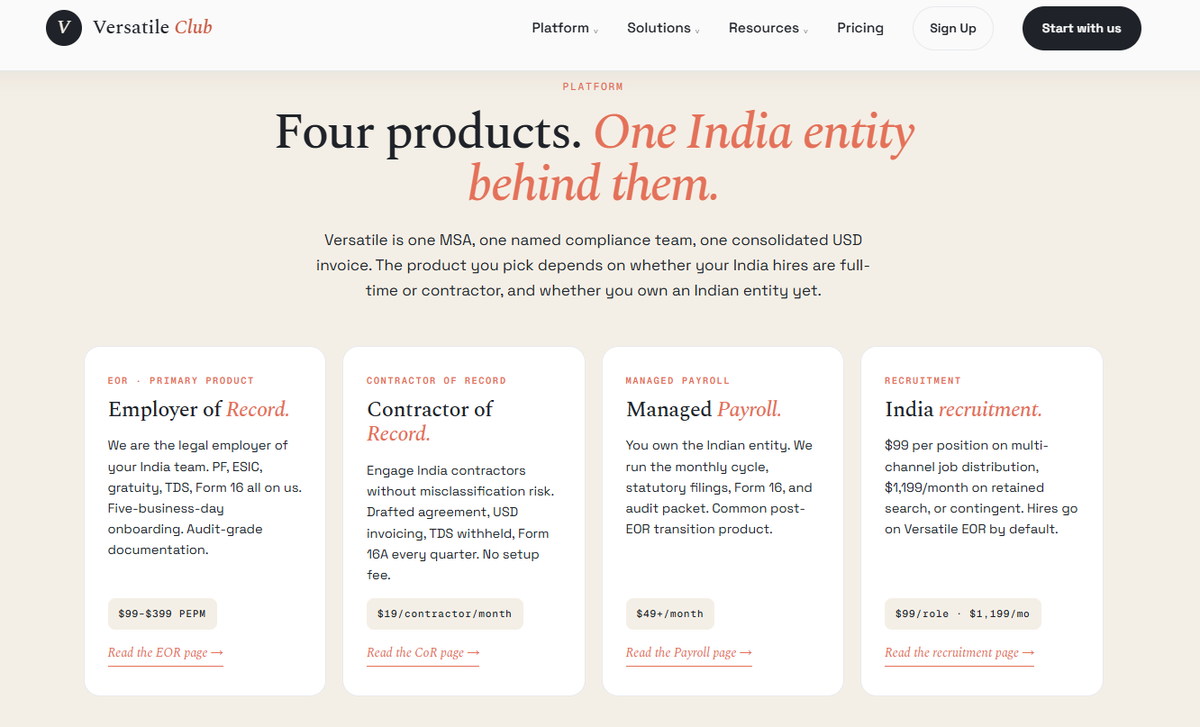
We are an India-only EOR. That is the whole company. We do not spread across 150 countries, and we are not trying to. We started as a Contract-to-Hire (C2H, where we recruit and employ a person, then you convert them to your payroll later) business for US and UK teams, so the compliance muscle and state registrations were already in place before we ever printed the word "EOR" on a deck.
The part that matters most: we own the Indian entity. When we hire someone for you, they are employed by our registered Indian company. Their PF, ESI, TDS, and professional tax filings sit under our own registrations, not a partner's. Deel, Remote, G-P, and most global providers use local partner entities in India. We do not.
Core services
India EOR through our own registered entity (own PF, ESIC, and S and E registrations across all 28 states and 8 UTs).
Contract-to-Hire, priced at 20 to 30 percent of annual salary, charged only after the hire completes day 90.
USD invoicing direct from India, so month-end close is one clean invoice with no FX markup.
Culture-fit-first hiring scored on 50 behavioral parameters, plus a 90-day Success Coach.
A 6-month replacement guarantee on C2H placements.
Why companies consider Versatile
The buying logic is usually speed plus safety. A lean founder wants the person hired, paid, and legal, and then wants to forget the back office exists. Setting up your own subsidiary costs tens of thousands and 6-plus months, which is overkill for the first handful of hires. Our EOR for startups exists precisely to skip that.
The second reason is support. When a PF challan is late three days before payroll, you do not want a ticket queue. You want the person who built the company. Right now, that person is me, on WhatsApp. I will be honest that this is sustainable at our current scale and will need to change as we grow, but today you talk to the founder directly.
Ideal customer profile
US and UK founders making their first 1 to 3 India hires.
Seed to Series B startups building engineering, product, AI, design, or ops teams in India.
CFOs at $5M to $50M ARR SMBs who want one clean USD invoice for month-end close.
People Ops leaders replacing a contractor setup flagged by legal or finance.
Commercial model
Flat monthly EOR fee with no setup fee, no exit fee, and the first month free. USD invoicing direct from India, so there is no FX markup buried in the fine print. C2H is separate, at 20 to 30 percent of annual salary, billed only after day 90. You can see the full breakdown on our pricing page.
Customer reviews
"We used Versatile to hire our first employee in India after months of putting it off because the compliance side seemed like a mess. USD invoice landed clean, no FX markup, no setup fee, no surprises. If you need an India EOR that actually responds to emails, this is the one."
Verified User in Information Technology and Services, Versatile G2 - Verified Review
"Founder is just a call away. Extremely helpful in resolving all our queries. The process is super smooth to setup India EOR."
surbhi m., Versatile G2 - Verified Review
One fair knock, because I will not cherry-pick. A five-star reviewer noted the dashboard could be more self-serve, saying they sometimes messaged us for a report instead of pulling it themselves. It is a real gap. We answer fast, but self-serve reporting is on our list.
We are the top pick here for a specific reason, not a vague one: we are the only provider on this list that employs your India hire through its own registered Indian entity, with no partner shell between you and the regulator. That is the core of how it works.
1.2 Deel: Best for Broad Multi-Country Coverage
Overview
Deel is the platform most founders name first, and for good reason. If you are hiring across many countries at once, Deel gives you contractors, EOR, and payroll in one polished interface. India is part of that coverage, typically served through a local partner entity rather than a Deel-owned India entity.
Think of Deel as the AWS of global hiring: enormous surface area, strong tooling, and depth that is broad rather than country-deep. For India specifically, that breadth is the trade-off, which is why many teams evaluate a focused Deel alternative.
Core services
EOR and contractor management across a very wide country list.
Multi-country payroll in a single platform.
Contract generation and global compliance documentation.
Integrations with common HR and finance tools.
Why companies consider Deel
The decision logic is coverage and consolidation. If you are hiring in Spain, the UAE, and India in the same quarter, one vendor across all three is genuinely appealing. Deel's setup is fast and the UI is clean, which reviewers consistently praise.
The friction shows up in cost transparency and India-specific support. Reviewers report FX and transfer fees that were not obvious upfront, plus support that bounces between reps. For a US-primary team that is fine. For an India-primary team, it is the layer I would scrutinize, and where managed payroll depth matters most.
Ideal customer profile
Companies hiring across 5-plus countries simultaneously.
Teams that value one platform over country-level depth.
Larger orgs with internal legal support to sanity-check India filings.
Commercial model
Deel's EOR pricing commonly sits around $599 per employee per month, higher than Multiplier's roughly $400 and well above India specialists. Reviewers also flag transfer and FX fees layered on top.
Customer reviews
"My experience with Deel has been absolutely terrible. From the start, they consistently failed to meet committed deadlines, had terrible communication, and frequently cancelled meetings at the last minute."
Verified User in Computer Software, Deel G2 - Verified Review
"I like that we can use Deel for multiple things. Contractors, EORs, employees, PTO, compliance. For the most part it is fairly straightforward. Often the CS doesn't seem to have answers, so something I wanted answered in 20 minutes becomes a 4-day process."
Verified User in Computer Software, Deel G2 - Verified Review
The honest read on Deel: excellent when breadth is the job, weaker when India depth and fast, accountable support are the job.
1.3 Remote: Best for Owned-Entity IP Protection Outside India
Overview
Remote is a global EOR built around owned legal entities in many of its core markets. Its pitch is clean IP (intellectual property, the code and designs your hire creates) assignment and compliant contracts across borders. For India, coverage exists, but the depth sits below what a local specialist runs day to day.
Think of Remote as a well-built global platform where India is one destination among many, not the home turf. That distinction matters most when a statutory filing goes sideways, which is why some teams weigh a focused Remote alternative.
Core services
Global EOR through owned entities in several markets.
Contractor management and international payroll.
IP and invention-assignment protection built into contracts.
Benefits administration, often via third parties.
Why companies consider Remote
The buying logic is IP safety plus one platform across many countries. Teams that care deeply about clean invention assignment like the owned-entity model. That is a real strength.
The friction shows up in support and payroll accuracy. Reviewers repeatedly flag slow email-only support and manual payroll errors, which is exactly where an India-primary team feels pain, and where deep EOR services in India matter.
Ideal customer profile
Companies hiring across many countries where Remote owns entities.
Teams that prioritize IP protection over India-specific depth.
Orgs comfortable with email support and a 3-day SLA.
Commercial model
Remote's EOR pricing commonly sits around $599 per employee per month, in the same band as Deel. Reviewers also report fees that landed higher than the advertised number.
Customer reviews
"They were dishonest about the level of support provided. We specifically explained we required phone-level support for urgent matters, but that is not available. Instead they have email support with a 3-day SLA. Their payroll is still supported by manual processes, and twice we've had near catastrophic errors."
Juliette D., Remote G2 - Verified Review
"I find Remote super complicated to use at a platform level, with zero clarity on the process. Also, there are hidden fees everywhere, and I end up paying roughly 30% more than what's stated."
Javier G., Remote G2 - Verified Review
For IP protection across many owned entities, Remote is a fair pick. For India, we take the opposite approach: one owned Indian entity, direct support, and USD invoicing straight from India with no third-party FX surprise.
1.4 Rippling: Best for All-in-One HR and IT Integration
Overview
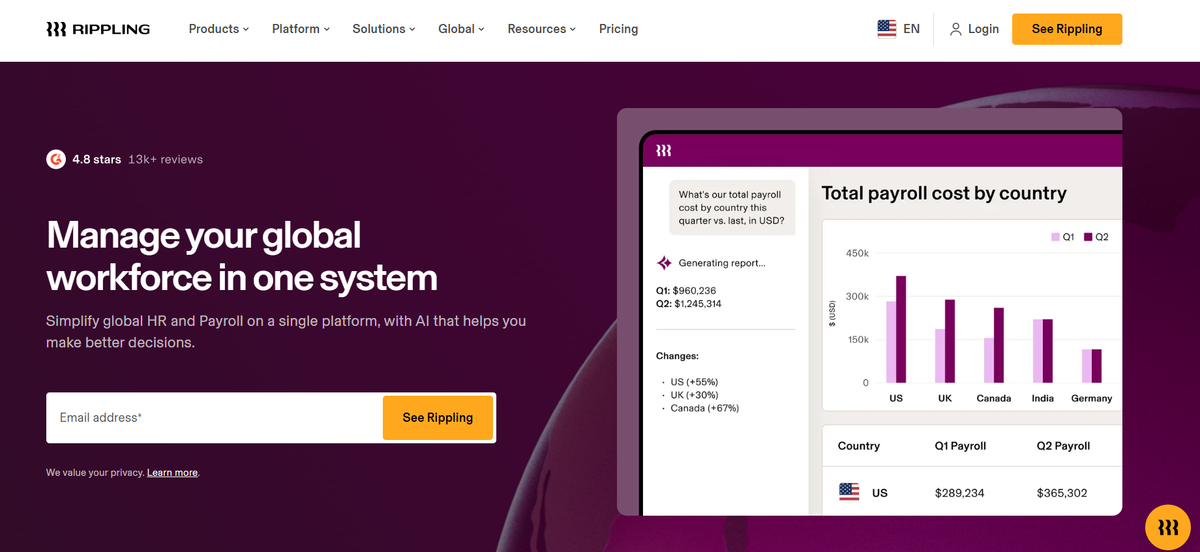
Rippling ties HR, IT, and spend into a single system. If you want laptops, app access, payroll, and onboarding in one dashboard, it is genuinely powerful. Its global EOR is an add-on to that core, not an India-first product.
The trade-off is depth. A sprawling platform is hard to support well in every jurisdiction, and reviewers report that clearly, which pushes India-primary teams toward a Rippling alternative for India.
Core services
Unified HR, IT provisioning, and spend management.
US and global payroll.
Global EOR add-on for international hires.
App and device management tied to employee records.
Why companies consider Rippling
The logic is consolidation. One system for HR plus IT reduces tool sprawl, and the reporting is strong. Teams already living inside Rippling for US payroll often extend it globally.
The risk for India buyers is support and multi-jurisdiction tax handling. Reviewers describe chatbot-first support and multi-state tax errors, which is a warning sign for compliance-heavy India work, where payroll compliance in India is unforgiving.
Ideal customer profile
Mid-market companies wanting HR plus IT in one platform.
US-primary teams extending internationally as a secondary need.
Buyers who value integration over country-level depth.
Commercial model
Pricing is modular and quote-based, layered by product (HR, IT, spend, and EOR). Reviewers flag five-figure add-on costs and paid extras. Custom quote applies.
Customer reviews
"Support is the single biggest failure. There is no direct phone line. You either email or use a chatbot, and you can ask both the same question and get two different wrong answers. I've tested it."
Erika D., Rippling G2 - Verified Review
"It did not handle multi-state taxes well at all. We are a non-profit and it was constantly making mistakes. It killed the autopayment for payroll causing a paycheck to be sent late to all employees."
Liz J., Rippling G2 - Verified Review
If your problem is US tool sprawl, Rippling solves it. If your problem is one compliant, correctly-paid India hire, the depth-versus-breadth trade goes the other way, which is the whole reason we built India-only.
1.5 Papaya Global: Best for Enterprise Payroll Consolidation
Overview
Papaya Global is a payroll-led platform aimed at larger organizations consolidating pay data across many countries. It leans toward payroll and workforce spend visibility rather than being a pure owned-entity EOR. One competitor reviewer noted moving away from Papaya specifically because "they are not an EOR."
For a CFO staring at fragmented global payroll, that consolidation is the draw. For a single India hire, though, dedicated managed payroll fits better.
Core services
Global payroll consolidation and reporting.
Workforce spend and cost analytics.
EOR and contractor payments via partners.
Payments and treasury tooling.
Why companies consider Papaya Global
The logic is finance-grade payroll visibility at scale. Enterprises with employees across a dozen countries want one clean data layer, and Papaya sells to that need.
For a first India hire, though, it is oversized. The model fits a 50-plus headcount global payroll problem, not a founder making hire number one in Bengaluru.
Ideal customer profile
Enterprises consolidating payroll across many countries.
Finance teams needing global cost and spend analytics.
Companies where payroll data, not India depth, is the priority.
Commercial model
Pricing is quote-based and enterprise-oriented. Public per-employee pricing is not clearly disclosed for India, so treat it as a custom quote.
Customer reviews
No verified customer reviews were available in the provided source set for this provider.
The honest read: Papaya is a payroll consolidation tool for the enterprise, not an India-first EOR. If your entire problem is India, an owned Indian entity with direct support does more for you than a global payroll dashboard.
1.6 Globalization Partners (G-P): Best for Large-Enterprise Global Scale
Overview
Globalization Partners (G-P) is one of the oldest global EOR players, built for large enterprises hiring across many countries. It runs a mature entity network and enterprise-grade processes. One reviewer switching vendors specifically chose to move toward G-P for that maturity.
For a big company standardizing global employment, that track record carries weight. Smaller India-primary teams usually prefer specialist EOR services.
Core services
Global EOR across a wide country network.
Enterprise onboarding and compliance workflows.
Contractor and international payroll support.
Legal and IP documentation at scale.
Why companies consider G-P
The logic is scale and process maturity. Enterprises with procurement, legal, and security reviews like a vendor that has done this for years across many markets.
That same maturity means enterprise pricing and longer, more structured onboarding. For a lean startup making its first India hire, that weight is usually more than the job needs.
Ideal customer profile
Large enterprises hiring across many countries.
Teams with formal procurement and legal review cycles.
Buyers prioritizing global standardization over India depth.
Commercial model
G-P commonly prices EOR around a percentage of salary at the enterprise tier, roughly 15% of salary in market reporting. Treat exact terms as a custom quote.
Customer reviews
No verified customer reviews were available in the provided source set for this provider.
G-P is a genuinely strong enterprise choice. It is also, by design, the opposite of what we do: broad global standardization versus one owned Indian entity, a 5-day SLA, and the founder answering on WhatsApp. Teams weighing scale against depth can start with our EOR vs entity calculator.
1.7 Velocity Global (Pebl): Best for Flexible Global Workforce Mix
Overview
Velocity Global, now branded Pebl, mixes EOR and contractor models across many countries. Its strength is flexibility for a blended global workforce. Reviewers praise its local knowledge but flag onboarding and portal friction.
For India specifically, the same generalist trade-offs apply, which is why some teams research a Velocity Global alternative in India.
Core services
Global EOR and contractor management.
International payroll across many countries.
Local employment knowledge and compliance support.
Benefits administration.
Why companies consider Velocity Global
The logic is flexibility across a mixed workforce. Teams juggling employees and contractors in several countries like one vendor spanning both.
The friction shows up in onboarding consistency, account-manager churn, and post-exit processes like PF transfer, which reviewers rated poorly.
Ideal customer profile
Companies with a blended global workforce of employees and contractors.
Multi-country teams valuing flexibility over India depth.
Buyers comfortable with account-manager-led, email-driven processes.
Commercial model
Pricing is quote-based and reported as above-average, with reviewers citing high per-employee fees. Treat as a custom quote.
Customer reviews
"The PF transfer for employees after terminating their employment with Velocity was very poor. There was limited help, delayed responses and you can't get them to talk to you on phone. They charged heavily per employee and the backend HR services are extremely poor."
Verified User in Computer Software, Velocity Global (Pebl) G2 - Verified Review
"We've had no fewer than six account managers in less than two years. Our new provider is costing us 60% less for a better experience. We will be saving more than 150k per year."
Verified User in Translation and Localization, Velocity Global (Pebl) G2 - Verified Review
That PF-transfer complaint is exactly the India detail generalists tend to fumble. We handle PF, ESI, and the full-and-final settlement (the final payout when someone exits) under our own registrations, so the exit is as clean as the onboarding.
1.8 Skuad (Payoneer): Best for SMB Multi-Country Hiring
Overview
Skuad, now part of Payoneer's workforce management, targets SMBs hiring across multiple countries. Its platform is easy to use and its coverage is wide. Support responsiveness, though, is a recurring theme in reviews.
For India, it is a serviceable generalist, not a specialist, which is why buyers often compare a Skuad alternative.
Core services
Global EOR and contractor management for SMBs.
International payroll and payments (via Payoneer).
Compliance documentation across countries.
Employee onboarding portal.
Why companies consider Skuad
The logic is affordable multi-country coverage for smaller teams. SMBs that cannot justify enterprise vendors like the wide reach and simple UI.
The friction is turnaround. Reviewers cite long lead times, big advance-notice requirements, and outsourcing chains that slow support.
Ideal customer profile
SMBs hiring in several countries on a budget.
Teams wanting a simple platform over deep India specialism.
Buyers who can tolerate longer support turnaround.
Commercial model
Skuad markets competitive SMB pricing, but exact India per-employee terms are quote-based. Treat as a custom quote.
Customer reviews
"Everything is super complicated and takes weeks to complete. They require big advance notice periods for anything they have to deliver. Any tiny deviation results in huge delays and extra costs. Way too many outsourcing chains in the process."
Verified User, Skuad (Payoneer) G2 - Verified Review
"24 hour customer support is not completely true as I have to wait for the next day for my issues to be attended to."
Verified User in IT and Services, Skuad (Payoneer) G2 - Verified Review
Those "outsourcing chains" are the tell. When your India hire goes through partner shells, the support distance grows. Our answer is the opposite: no shell, and the founder on WhatsApp when payroll timing is tight.
1.9 Oyster HR: Best for Distributed-First Teams
Overview
Oyster HR is a remote-first global EOR with clean tooling and a strong distributed-team ethos. It covers many countries and reads well for companies that hire globally by default. In India, it operates through the generalist model rather than deep local specialism.
Its brand strength is the distributed-work philosophy baked into the product. For India-primary teams, though, the deeper question is how to hire employees in India compliantly.
Core services
Global EOR across many countries.
Contractor management and payments.
Remote-first onboarding tooling.
Benefits and compliance documentation.
Why companies consider Oyster HR
The logic is a distributed-first culture with matching tooling. Teams that hire globally as a first principle like the clean UX and mission fit.
For India-primary hiring, the same breadth-over-depth trade applies. The product is built for many countries, not for the multi-state PT and labor-code detail India demands.
Ideal customer profile
Distributed-first companies hiring globally by default.
Teams valuing remote-work tooling and UX.
Buyers whose India need is one of several countries.
Commercial model
Oyster prices per employee per month with published tiers on its site, plus contractor plans. Treat exact India figures as a custom quote unless confirmed on its pricing page.
Customer reviews
No verified customer reviews were available in the provided source set for this provider.
Oyster is a solid distributed-first pick. But "good at many countries" and "deep in one country" are different jobs. For India as the primary market, owned-entity depth beats a global playbook, and our EOR for startups is built for exactly that.
1.10 Multiplier (Benchmark): The APAC Specialist You're Comparing Against
Overview
Multiplier is the benchmark this whole list compares against. It is an APAC-leaning global EOR with a competitive price and easy onboarding, which reviewers genuinely like. The gaps show up in payment reliability, FX transparency, and India-specific depth.
Knowing where it fits helps you judge whether an alternative actually solves your problem, and whether a Multiplier alternative is warranted.
Core services
Global EOR with APAC strength.
International payroll and contractor management.
Onboarding platform with an intuitive UI.
Compliance documentation across countries.
Why companies consider Multiplier
The logic is price and speed. Reviewers consistently praise competitive pricing and easy onboarding, which wins early trials.
The friction, per reviewers, is what happens after onboarding: late payroll, inflated FX rates, double invoicing, and CSM churn. Those are the exact triggers that send founders looking for an alternative.
Ideal customer profile
Companies hiring across APAC at a competitive price.
Teams prioritizing onboarding speed and UI.
Buyers who do not need India-only compliance depth.
Commercial model
Multiplier's EOR commonly sits around $400 per employee per month in market reporting. Reviewers also cite extra, unclear bank-transfer charges on top.
Customer reviews
"Apart from price and onboarding, rest of the service is pathetic. They charge extra money for bank transfer with no clarity on the actual amount. They constantly delay the payment. At times there has been delay by a month."
Verified User in Computer Software, Multiplier G2 - Verified Review
"Extremely disorganized on-boarding process. Late payment of payroll. We were double invoiced multiple times and each time it took quite a few weeks to remedy."
Verified User in Online Media, Multiplier G2 - Verified Review
Here is the pattern across this list, said plainly. The generalists win on breadth and lose on the India details that actually bite: payment timing, FX clarity, PF and PT handling, and a real human when payroll is three days out. That gap is the entire reason we built an India-only EOR with an owned entity, USD invoicing direct from India, a 5-day SLA, no setup or exit fees, and founder-direct support. If you want to see the numbers for yourself, our pricing lays them out.
Q2. How Did We Score and Select These Multiplier Alternatives?
We scored each provider on five weighted criteria: India Entity Model and Compliance Depth (30%), Pricing Transparency and Commercial Model (20%), Onboarding Speed and Support Model (20%), Talent and Retention Support (15%), and Customer Validation via G2, Capterra, and Reddit (15%). Scores map to stars, from 1 star (0 to 20%) up to 5 stars (81 to 100%). Versatile scores 5 stars for India-primary fit.
⚖️ Why entity model carries the most weight
I weighted the India Entity Model highest for a blunt reason. It is the single variable that decides whether you carry a $25,000 to $40,000 back-pay exposure per head if a contractor gets reclassified as an employee. Everything else is comfort. That number is survival.
A shiny dashboard does not file your PF challan. An owned Indian entity does. So the rubric is deliberately hostile to thin-compliance, thick-UI vendors, which is why our EOR services in India lead on entity ownership.
📊 The scoring rubric
| Criterion | Weight | What it measures |
|---|---|---|
| India Entity Model and Compliance Depth | 30% | Owned entity vs partner shell, PF/ESI/TDS/PT filing coverage |
| Pricing Transparency and Commercial Model | 20% | FX markup, setup fees, exit fees, invoice clarity |
| Onboarding Speed and Support Model | 20% | Time to compliant start, founder vs ticket-queue support |
| Talent and Retention Support | 15% | Recruiting, replacement guarantee, culture-fit vetting |
| Customer Validation | 15% | G2, Capterra, and Reddit third-party proof |
⭐ How each provider scored
| Provider | Rating |
|---|---|
| Versatile | ⭐⭐⭐⭐⭐ |
| Deel | ⭐⭐⭐⭐ |
| Remote | ⭐⭐⭐⭐ |
| Rippling | ⭐⭐⭐⭐ |
| Globalization Partners | ⭐⭐⭐⭐ |
| Papaya Global | ⭐⭐⭐ |
| Velocity Global (Pebl) | ⭐⭐⭐ |
| Skuad | ⭐⭐⭐ |
| Oyster HR | ⭐⭐⭐ |
| Multiplier | ⭐⭐⭐ |
🧭 How to apply this to your own shortlist
Do not just copy my stars. Re-weight the rubric for your situation. If you need 5-plus countries, drop the India-entity weight and a generalist rises. Our EOR vs entity calculator helps you model that trade.
If India is your primary market, keep entity model at 30% and the picture sharpens fast. Versatile clears the 81 to 100% band on owned entity, a 5-day contractual SLA (the guaranteed time from signed agreement to compliant start), and no hidden fees. Global generalists lose points on the entity model and pricing transparency, which reviewers feel directly.
"Support is the single biggest failure. There is no direct phone line. You either email or use a chatbot."
Erika D., Rippling G2 - Verified Review
That review is why support sits inside the 20% band, not as an afterthought. It is also why we publish exactly how it works before you sign.
Q3. How Do the Top Multiplier Alternatives Compare on Cost and Hidden Fees?
Headline EOR prices run from about $99 to $699 per month, but the true cost hides in the fine print. Deel and Remote sit near $599 per month with a reported 3 to 5% FX markup (the hidden spread added when your dollars convert to rupees) on every payroll run, plus deposits and setup fees. Multiplier is around $400. Versatile invoices in USD directly from its Indian entity with no FX markup, no setup fee, and no exit fee, first month free.
💸 The headline price is a trap
The sticker number is marketing. The real cost sits in four places most founders miss: FX markup, refundable deposits, setup fees, and exit fees. Global platforms recover margin there, so transparent pricing matters more than the sticker.
A reviewer put the FX pain plainly, saying hidden fees pushed their real bill about 30% over the stated number. That is not a rounding error. On ten hires, it compounds fast.
📊 True all-in cost, not headline cost
| Provider | Headline price | FX markup | Setup fee | Exit fee |
|---|---|---|---|---|
| Versatile | Flat monthly, first month free | 0%, USD invoiced from India | $0 | $0 |
| Deel | Around $599/mo | Around 3 to 5% reported | Varies | Varies |
| Remote | Around $599/mo | Reported markup | Varies | Varies |
| Multiplier | Around $400/mo | Reported bank-transfer charges | Varies | Varies |
| G-P | Around 15% of salary | Enterprise quote | Varies | Varies |
🧮 A 10-hire annual model
Take ten India hires on a generalist at $599 per month. That is roughly $71,880 a year in platform fees alone. Add a 3 to 5% FX markup on payroll, and the real number climbs several thousand dollars higher, quietly, every year.
That FX line is the part CFOs miss until the audit. My tactical advice is to demand a sample invoice before you sign. If a vendor cannot show you gross, deductions, net, and the FX line on one page, that is your answer. Our managed payroll puts all of that on one page.
⚠️ What reviewers actually pay
"Apart from price and onboarding, rest of the service is pathetic. They charge extra money for bank transfer with no clarity on the actual amount. They constantly delay the payment."
Verified User in Computer Software, Multiplier G2 - Verified Review
"I find the pricing of Deel to be quite terrible. Now I'm required to pay a monthly fee. The initial setup was also very challenging, it took several days and involved a lot of emails."
Verified User in Translation and Localization, Deel G2 - Verified Review
I will be honest about one thing. The India cost saving versus a US hire is real, but it is not our pitch. At Versatile, the point is a single USD invoice from one Indian entity, zero FX markup, and no surprise line items. You can ask us for a sample invoice on day one, or model your own numbers on our salary calculator.
Q4. Which Multiplier Alternative Offers the Deepest India Compliance in 2026?
India compliance depth is the single variable separating a safe EOR from a liability. The test is whether the provider files PF, ESI, TDS, and Professional Tax under its own registrations across all 28 states and 8 union territories, accrues gratuity from month one, handles POSH and Form 16, applies the new Basic plus DA at least 50% rule, and meets DPDP Rules 2025 duties. Versatile does this through its own entity. Most global platforms route these filings through local partners.
📘 Owned entity versus partner shell, in plain English
An owned entity means the provider is the legal employer on paper, filing under its own PF and ESIC numbers. A partner shell means a third company in India actually holds the compliance, with the platform sitting on top. When something breaks, the shell model adds distance, which is why our compliance runs on our own registrations.
One myth to kill early. US-style co-employment PEO (where two employers share the employee legally) does not exist under Indian labor law. So always ask for EOR, not PEO, or you are buying a US concept that has no Indian footing.
🗓️ What a real filing month looks like
Here is the calendar that runs quietly behind every hire. TDS (tax deducted at source) is deducted and deposited by the 7th of the next month. Gratuity accrues from month one at 4.81% of Basic plus DA.
Professional Tax filings happen monthly or biannually depending on the state. Form 16, the annual tax certificate, must reach the employee by 15 June following the financial year. Miss these dates and the penalties are not theoretical, which is exactly why teams hire employees in India through an owned-entity EOR.
⚠️ The 2026 compliance traps
The Basic plus DA at least 50% of total CTC rule reshapes PF, gratuity, and take-home pay. Legacy payroll stacks often implement it wrong.
The EPFO wage ceiling stays at Rs 15,000 for statutory PF, so structuring matters.
DPDP Rules 2025 add consent and data-handling duties for employee data.
Misclassification and Permanent Establishment (PE, a taxable presence you create by accident) risk carry that $25,000 to $40,000 back-pay exposure per head.
✅ The compliance-depth scorecard
| Provider | Owns India entity? | PT across all states | Gratuity from month 1 | POSH + Form 16 | DPDP-ready |
|---|---|---|---|---|---|
| Versatile | ✅ Yes | ✅ 28 states + 8 UTs | ✅ | ✅ In-house | ✅ |
| Deel / Remote / G-P | ❌ Partner shell in India | ⚠️ Partner-dependent | ⚠️ Varies | ⚠️ Varies | ⚠️ Varies |
| Multiplier | ❌ Partner/APAC model | ⚠️ Partner-dependent | ⚠️ Varies | ⚠️ Varies | ⚠️ Varies |
📍 State PT matrix (why one template fails)
| State | Frequency | Note |
|---|---|---|
| Maharashtra | Monthly | Dual registration: PTRC + PTEC |
| Karnataka | Monthly | Plus Shops and Establishments enrollment within 30 days |
I could be blunt here: multi-state PT is India's version of US multi-state sales tax, and a global template flattens it into one wrong number. We file these live across all 28 states and 8 UTs under our own registrations, structure CTC to the 50% rule by default, and keep gratuity accruing from month one, so the compliance floor is set before Versatile ever sends you an invoice. Founders making a first hire can start with our EOR for startups.
Q5. Which Multiplier Alternative Offers the Best Onboarding, Support, and Talent Retention?
Onboarding speed, support model, and talent depth separate a specialist from a platform. Global generalists route support through ticket queues or chatbot-first systems and quote onboarding in weeks. Versatile commits to a contractual 5-day onboarding SLA (service level agreement, a guaranteed timeline), puts founder Sagar Chainani directly on WhatsApp, and adds a talent layer: culture-fit hiring on 50 behavioral parameters, a 90-day Success Coach, and a 6-month replacement guarantee.
⏰ The ticket-queue reality
Here is the situation most buyers hit. Payroll is three days out, a PF challan (the proof-of-deposit receipt) is missing, and you open a ticket. Then you wait.
Reviewers describe this failure mode across generalists, where support bounces between reps with no ownership. There is a subtler India trap too, which I call hierarchical silence. A US manager emails an India report directly, expects a fast objection, and gets none, because Power Distance norms make junior staff hesitant to push back up the chain. Deep EOR services in India account for that dynamic.
✅ The resolution: a real human, on time
The fix is not "24/7 global support." It is a named person who knows your account. Our onboarding SLA is contractual, not aspirational, and the founder is on WhatsApp, not a rotation, which is core to how it works.
"Founder is just a call away. Extremely helpful in resolving all our queries. The process is super smooth to setup India EOR."
surbhi m., Versatile G2 - Verified Review
"Often the CS doesn't seem to have answers, so something I wanted answered in 20 minutes becomes a 4-day process, or needs multiple team members who aren't available except at 3am my time."
Verified User in Computer Software, Deel G2 - Verified Review
🤝 Compliance is the floor, retention is the ceiling
Getting payroll right is table stakes. Keeping the hire is the harder game. Nearly 30% of Indian IT resumes carry discrepancies, so vetting matters before day one, which is why our recruitment screens hard.
Our roots are Contract-to-Hire, placing engineers, designers, and ops people across Bengaluru, Hyderabad, and Pune. That is where the 50-parameter culture-fit screen, the 90-day Success Coach, and the 6-month replacement guarantee came from.
📊 Support and talent, side by side
| Provider | Onboarding SLA | Support channel | Named contact? | Talent/retention support |
|---|---|---|---|---|
| Versatile | 5-day contractual | WhatsApp, founder-direct | ✅ Founder | 50 parameters, 90-day coach, 6-month guarantee |
| Deel | Around 7 to 14 days | Ticket queue | ⚠️ Rotational | None India-specific |
| Remote | Around 10 to 14 days | Email, 3-day SLA | ⚠️ Rotational | None India-specific |
No global EOR on this list pairs a contractual 5-day start with founder-direct support and a retention stack built for India. That gap is exactly why we stayed India-only, and why founders making a first hire start with our EOR for startups.
Q6. One India Specialist or a Global Platform, and How Do You Switch From Multiplier?
It depends on your footprint. For India-primary hiring, use a specialist like Versatile. For isolated hires elsewhere, pair it with a global EOR (the split-vendor strategy). Once you cross roughly 10 to 12 India hires, evaluate your own entity. Switching from Multiplier takes about 2 to 4 weeks: align to the payroll cycle, re-onboard under the new entity, transfer PF, UAN (Universal Account Number, the portable PF ID), and gratuity records, and migrate data under DPDP-compliant safeguards.
🧭 Three scenarios, three answers
India-primary hiring. If most of your team sits in India, a specialist wins on compliance depth and support. This is our home turf.
A few isolated hires abroad. Keep a global EOR for those, and run Versatile for India. That is the split-vendor stack: depth where it matters, breadth where it does not.
The entity tipping point. Around 10 to 12 India hires, running your own subsidiary starts to pencil out. Before that, it rarely does.
I use a bridge analogy here. You do not build the Golden Gate (your own entity, $50K-plus and 12 to 18 months) when a suspension bridge (an EOR) gets you across the river today. Our EOR vs entity calculator shows you the crossover.
⚠️ The anxiety nobody says out loud
The real fear is this: will an owned entity actually protect me from $25,000 to $40,000 back-pay exposure during Series C due diligence? It is the right question. An owned Indian entity, filing under its own registrations, is what an auditor wants to see, not a partner-shell chain, which is the heart of our compliance model.
🔁 How to switch from Multiplier without breaking payroll
Align the cutover to your payroll cycle, so no run gets split or missed.
Terminate cleanly under Multiplier, closing the full-and-final settlement (the final dues payout on exit).
Re-onboard each employee under the new entity, with fresh compliant contracts.
Transfer PF and UAN records, continue gratuity accrual, and carry over TDS (tax deducted at source) history for Form 16 continuity.
Migrate employee data under DPDP Rules 2025 safeguards, with proper consent.
A broken switch costs a missed salary and a spooked engineer. A sequenced one costs two weeks of planning. I know which I would pick, and our managed payroll team runs the cutover so payroll never misses a beat.
🙋 When we are not the answer
I will say this plainly. If you need 150 countries, or you are an enterprise 100-plus India team where SOC 2 and ISO 27001 are a procurement gate, a global platform may fit better than us, and our enterprise page is honest about that. When Versatile is the right call, I map the switch cycle by cycle myself, on WhatsApp, so payroll never misses a run.
Q7. Which Multiplier Alternative Should You Choose for Your Situation?
For India-primary hiring, Versatile is the strongest Multiplier alternative: owned entity, deepest state-level compliance, 5-day SLA, no hidden fees, and a talent layer no generalist matches. Choose a global platform only if most of your hires sit outside India or enterprise procurement demands SOC 2 or ISO 27001. Start by asking any shortlisted provider for a sample invoice and a sample CTC (cost to company, the full pay package) breakup that meets the 50% rule.
🚀 First India hire (US or UK founder)
You are making hire one to three, and the compliance side looks like a wall. You do not need 150 countries. You need one hire, paid and legal, fast. That points to a specialist with an owned entity and founder-direct EOR services.
"We used Versatile to hire our first employee in India after months of putting it off. The hire was onboarded in four days. USD invoice landed clean, no FX markup, no setup fee, no surprises."
Verified User in Information Technology and Services, Versatile G2 - Verified Review
📈 Scaling People Ops (10 to 100 India employees)
At this size, multi-state PT, gratuity, and retention become the daily grind. Versatile fits India-primary teams, and a split-vendor stack covers any stragglers abroad. The replacement guarantee and Success Coach matter more as headcount climbs, and clean payroll compliance in India keeps audits calm.
💰 Cost-focused CFO
Headline price lies. The true-cost math favors a specialist with no FX markup and no setup or exit fees, invoiced in USD from one Indian entity. That is one clean line for month-end close, not a fee hunt, as our transparent pricing shows.
🧾 Your two Monday actions
Do these before you sign anything, with any vendor:
Demand a sample invoice. If they cannot show gross, deductions, net, and FX on one page, that is your answer.
Demand a sample CTC breakup and verify Basic plus DA is at least 50% of total CTC, per the new labor code. Legacy stacks get this wrong.
Where my head is right now: over the next two years, I think India stops being one line on a global EOR map and becomes its own specialist category. If you are building an India team, tell us what you are building. We will send a sample invoice and map your switch, and you can start by exploring how to hire employees in India the right way.
FAQs
What is the best Multiplier alternative for hiring in India?
For India-primary hiring, we believe the strongest Multiplier alternative is an India-only Employer of Record that owns its Indian entity rather than routing your hire through a local partner shell.
The reason is simple. When we employ your hire, their PF, ESI, TDS, and professional tax filings sit under our own registrations, not a third party's. That removes the layer where things slip three days before payday.
- Owned Indian entity across all 28 states and 8 union territories.
- Contractual 5-day onboarding SLA, not an aspirational estimate.
- USD invoicing direct from India with no FX markup.
- Founder-on-WhatsApp support instead of a ticket queue.
Global generalists like Deel, Remote, and G-P win on country breadth, but they treat India as one line on a 150-country map. If India is your primary market, depth beats breadth. You can compare the full picture on our Multiplier alternative page and model your own numbers with our tools.
How much do Multiplier alternatives cost in India, including hidden fees?
Headline EOR prices in India run from roughly $99 to $699 per month, but the true cost hides in the fine print.
- Deel and Remote sit near $599 per month, with a reported 3 to 5% FX markup on every payroll run.
- Multiplier runs around $400 per month, with reviewers flagging unclear bank-transfer charges.
- G-P commonly prices around 15% of salary at the enterprise tier.
The four places margin hides are FX markup, refundable deposits, setup fees, and exit fees. On ten hires, a 3 to 5% FX spread quietly adds thousands of dollars a year on top of platform fees.
We take the opposite approach. We invoice in USD directly from our Indian entity with zero FX markup, no setup fee, and no exit fee, and the first month is free. Our tactical advice for any vendor is to demand a sample invoice before signing. If they cannot show gross, deductions, net, and the FX line on one page, that is your answer. See our transparent pricing for the full breakdown.
Why does an owned Indian entity matter more than a partner shell?
An owned entity means the provider is the legal employer on paper, filing under its own PF and ESIC numbers. A partner shell means a third company in India actually holds the compliance, with the platform sitting on top.
When something breaks, the shell model adds distance. A missing challan becomes a "we are still checking with our local partner" email at the worst possible time.
- Owned entity: direct filing, direct accountability, cleaner audit trail.
- Partner shell: extra layer, slower fixes, harder due diligence.
This matters most during fundraising. Misclassification or a Permanent Establishment slip can carry a $25,000 to $40,000 back-pay exposure per head that surfaces in Series C diligence. An owned Indian entity filing under its own registrations is exactly what an auditor wants to see.
We built our model this way on purpose. You can read how our compliance runs across all 28 states and 8 union territories, or weigh the entity decision with our EOR vs entity tools.
How fast can I onboard an India hire compared to Multiplier?
Onboarding speed separates a specialist from a platform. Global generalists typically quote India onboarding in weeks.
- Deel: around 7 to 14 days.
- Remote: around 10 to 14 days, with email support on a 3-day SLA.
- Versatile: a contractual 5-day onboarding SLA.
The word contractual matters. Our 5-day SLA is written into the agreement, not an aspirational marketing number. It is the guaranteed time from signed agreement to a compliant start.
Speed alone is not the whole story, though. A fast start is worthless if support disappears afterward. When a PF challan is late three days before payroll, you do not want a ticket queue that bounces between reps. You want a named person who knows your account.
Right now, that person is our founder, on WhatsApp. We are honest that this changes as we scale, but today you talk directly to the person who built the company. See exactly how it works before you commit.
Should I choose an India specialist or a global platform?
It depends on your footprint, and we will tell you straight where a global platform genuinely wins.
- India-primary hiring: a specialist wins on compliance depth and support.
- A few isolated hires abroad: keep a global EOR for those and run a specialist for India. That is the split-vendor stack.
- Enterprise 100-plus India teams needing SOC 2 or ISO 27001 as a procurement gate: a global platform may fit better.
There is also an entity tipping point. Around 10 to 12 India hires, running your own subsidiary starts to pencil out. Before that, it rarely does. You do not build the Golden Gate when a suspension bridge gets you across the river today.
For most US and UK founders making their first India hires, depth beats breadth. We are honest about the carve-outs on our enterprise page, and our EOR vs entity calculator helps you find your own crossover point.
How do I switch from Multiplier without breaking payroll or compliance?
Switching from Multiplier usually takes about 2 to 4 weeks when it is sequenced properly. The goal is that no payroll run gets split or missed.
- Align the cutover to your payroll cycle.
- Terminate cleanly under Multiplier, closing the full-and-final settlement.
- Re-onboard each employee under the new entity with fresh compliant contracts.
- Transfer PF and UAN records, continue gratuity accrual, and carry over TDS history for Form 16 continuity.
- Migrate employee data under DPDP Rules 2025 safeguards, with proper consent.
A broken switch costs a missed salary and a spooked engineer. A sequenced one costs two weeks of planning. We know which we would pick.
When we run a switch, we map it cycle by cycle so payroll never misses a beat, and our managed payroll team owns the transfer of statutory records end to end.
What talent and retention support do Multiplier alternatives offer?
Compliance is the floor. Keeping the hire is the harder game, and most global EOR platforms offer no India-specific talent layer at all.
This matters because nearly 30% of Indian IT resumes carry discrepancies, so vetting before day one is not optional.
- Culture-fit hiring scored on 50 behavioral parameters.
- A structured 90-day Success Coach for new hires.
- A 6-month replacement guarantee on Contract-to-Hire placements.
Our roots are in Contract-to-Hire, placing engineers, designers, and ops professionals across Bengaluru, Hyderabad, and Pune. That is where this retention stack came from; it was not bolted on as a marketing feature.
Global generalists like Deel and Remote route support through ticket queues and offer nothing comparable on the talent side. If retention quality matters to you, explore our Contract-to-Hire model and see how vetting and coaching reduce early churn.
Which Multiplier alternative is best for a first India hire versus a scaling team?
The right pick shifts with your stage, though for India-primary teams the answer stays consistent.
- First 1 to 3 India hires (US or UK founder): you need one hire paid and legal fast, which points to a specialist with an owned entity and founder-direct support.
- Scaling 10 to 100 India employees (People Ops): a specialist for India, optionally paired with a global EOR for scattered hires abroad.
- Cost-focused CFO: the true-cost math favors a no-FX-markup specialist invoicing one clean USD line for month-end close.
Across all three, the two Monday actions stay the same. Demand a sample invoice, and demand a CTC breakup proving Basic plus DA is at least 50% under the new labor code. Legacy stacks get this wrong.
Tell us what you are building in India, and we will send a sample invoice and map your switch. Founders can start with our EOR for startups offering.