Table of contents (17)
- Q1. Which digital marketing tasks actually work offshore?
- SEO + AEO + GEO in 2026
- Q2. What's the economic case for offshore marketing pods?
- Q3. SEO work: what to outsource, what to keep in-house?
- Q4. Paid ads (PPC/Meta/LinkedIn): offshore playbook?
- Q5. Content creation, editing, and distribution offshore?
- Q6. Community and creator ops: offshore SLAs?
- Q7. Lifecycle and email marketing: where does offshore fit?
- Q8. Analytics, reporting, and dashboards: go offshore?
- Q9. What stays in-house and why?
- Q10. Real SLA template for offshore marketing pods
- Q11. Onboarding a 3-person offshore team in 2 weeks
- Q12. When to build vs. when to hire an agency
- Q13. How India-native EOR changes the math
- Q14. Five mistakes founders make when going offshore
- Q15. Is offshore right for your team right now?
- FAQs
Tasks to Outsource to an Offshore Digital Marketing Team · 2026 playbook
The 2026 shift: SEO is now SEO + AEO + GEO
Any offshore marketing partner you hire in 2026 should be fluent in three overlapping disciplines, not one. The search layer split this year. SEO still matters for the classic Google web results, but AEO now decides whether ChatGPT, Claude, and Perplexity cite you inside their answers, and GEO decides whether Google AI Overviews and Google AI Mode put you above the traditional ten blue links.
- SEO (Search Engine Optimization) is the base layer. Technical crawl, on-page, backlinks, Google Search Console hygiene. This did not go away; it stopped being the whole game.
- AEO (Answer Engine Optimization) is how you get cited inside ChatGPT, Claude, Perplexity, and other answer engines. Different signals: structured Q and A blocks, authoritative citations, entity clarity, brand mentions that make it into the model's training data and retrieval index.
- GEO (Generative Engine Optimization) is how you show up inside Google AI Overviews, Google AI Mode, and the generative answer boxes that now sit above the ten blue links on most commercial queries. Overlaps with SEO and AEO but has its own ranking mechanics driven by how content is chunked, cited, and semantically linked.
A vendor that only says "SEO" in 2026 is optimizing for one third of your search-driven pipeline. Ask any offshore team you shortlist how they think about AEO and GEO. If the answer is blank, keep looking. At Versatile, this is the first thing we screen for when a client asks us to hire an offshore SEO or content lead in India.
Q1. Which digital marketing tasks actually work offshore?
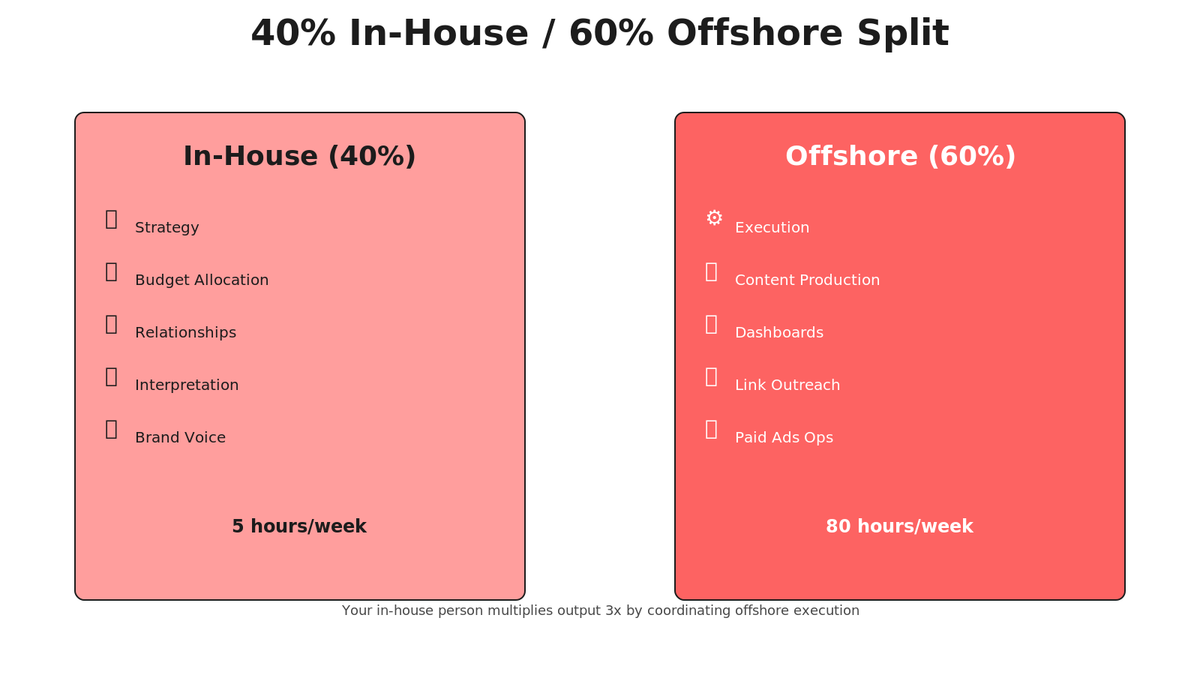
Not all marketing tasks are created equal. Some tasks thrive offshore. Others crater without real-time, in-house judgment. The honest split: execution and reporting work great offshore. Strategy and voice do not.
Here is what goes offshore successfully:
✅ SEO keyword research and technical audits
Pulling keyword data, analyzing SERP snippets, and auditing XML sitemaps are pure execution. Your India-based SEO person spends 6 to 8 hours per week mining search intent, competitive backlinks, and content gaps. You review their findings in 30 minutes on Friday. Cost delta: $400 per month (offshore) vs. $2,400 per month (US senior). The work quality is identical. Technical audits require no brand judgment, just spreadsheet discipline and familiarity with SEO tools. Your offshore person knows Ahrefs, SEMrush, Screaming Frog, and Google Search Console better than your in-house person ever will because they live in those tools 40 hours per week.
The real leverage: one in-house SEO person can oversee 2 to 3 offshore auditors, review their findings Friday morning, and ship 3x more content recommendations than they could alone. Your cost per audit drops from $600 to $150 and your team ships 4 audits per month instead of 1.
📇 Link prospecting and outreach
Finding 50 relevant blogs to pitch, drafting personalized outreach, and tracking inbound links is offshore-native work. It requires discipline and spreadsheet hygiene, not native English fluency. Your offshore person handles 80 percent of the grunt work. You jump in for 1-on-1 conversations with tier-1 publishers. Real upside: your onshore person ships 2x more placements because the offshore team prequalifies targets and handles 50+ cold outreach emails per week.
The playbook is simple. Your offshore person pulls 100 URLs per week from Ahrefs (filtering by domain rating, traffic, relevance to your niche). They build a personalized subject line and opening sentence for each. You approve the template, they iterate and send. You track responses in a shared spreadsheet. When a publisher replies, you jump in for the nego. The offshore person did 15 hours of prep work. You spent 1 hour closing.
💰 Paid ads campaign operations
Launching Meta, Google, and LinkedIn campaigns, pausing underperformers, scaling winners, and rotating creatives every 3 days is offshore-friendly work. It is not strategy (that stays in-house). It is execution: discipline, data entry, and split-test speed. Offshore campaigns run 20 to 30 percent cheaper than in-house because the labour cost is lower and your person iterates faster (zero meeting overhead).
Your offshore ads manager will test 3 new ad variations per campaign per day. In-house managers test 1 per week (because they're in meetings). Over 12 months, your offshore person runs 900+ tests. Your in-house person runs 50. The delta in learning is 18x. Your ROAS improves not because they're smarter, but because they have bandwidth to test and iterate relentlessly.
🧾 Content production and scheduling
Writing blog outlines, editing first drafts, optimizing meta tags, scheduling posts, and uploading to WordPress are all offshore. Founder voice and strategic angle come from you. Execution comes from a $1,200-per-month content ops person in Bangalore who ships 12 blog posts per month (vs. 4 in-house at $5,000). This person uses your brand guide to write drafts, edits for SEO, and pulls analytics on published posts to track what resonates.
The output is stunning: 12 posts per month means you own 20+ keywords by end of year. Your domain authority grows 8 to 12 points. Organic traffic compounds. Your in-house person never had time for 12 posts. Offshore makes it inevitable.
📊 Analytics, dashboards, and reporting
Building dashboards in Google Data Studio, pulling weekly MoM data, and writing 1-pager summaries are offshore tasks. Your offshore analyst never guesses the "why" behind the numbers (that's in-house). They pull the "what" and format it into a 5-minute read that lands in your inbox on Monday morning.
🚀 Email sequences and lifecycle campaigns
Drafting nurture sequences, segmenting users, and scheduling drip campaigns are offshore. Customer voice and product positioning are not. Offshore person A/B-tests subject lines and send times while you refine messaging every 2 weeks. They handle the mechanical work so you can focus on the creative direction.
The real insight: offshore thrives on repetition and process. It struggles with ambiguity and brand voice. Design your offshore team's work to eliminate both.
Q2. What's the economic case for offshore marketing pods?
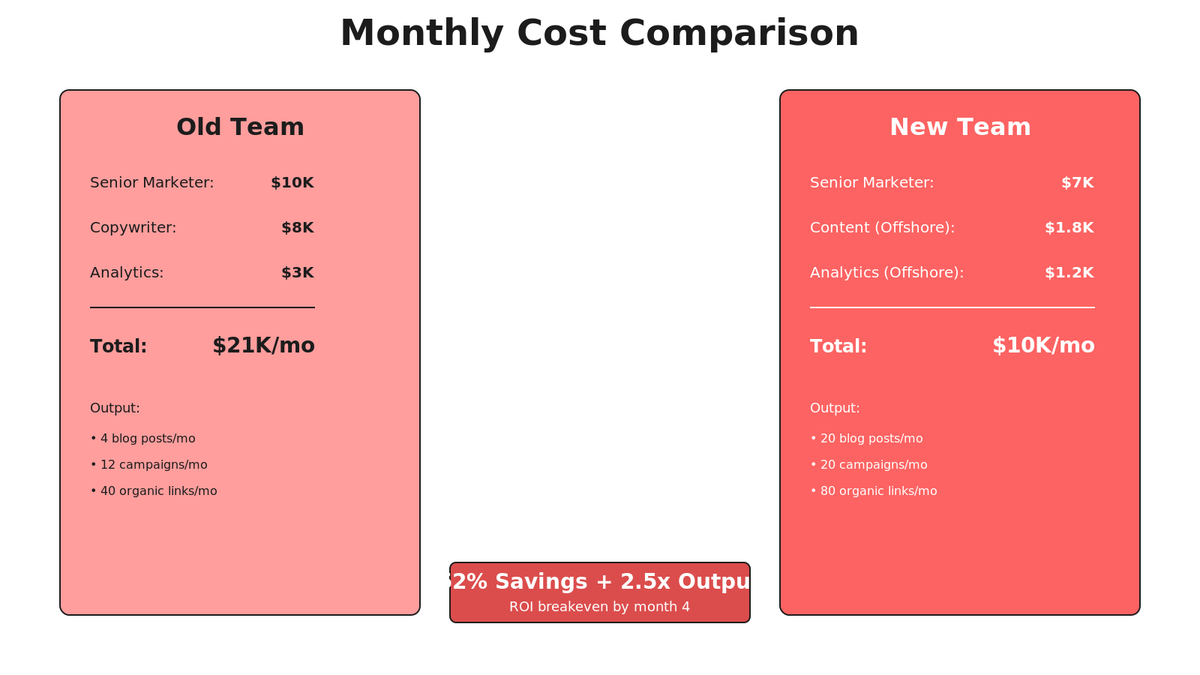
You have three hires: a full-time senior marketing person in the US ($120K all-in), a contract copywriter ($8K per month), and a part-time analytics contractor ($3K per month). Total: $16,200 per month. Output: 8 blog posts, 12 PPC campaigns, 40 organic links, 3 email sequences, 2 dashboards per month.
Swap the contract copywriter and part-time analyst for a 3-person offshore pod (content writer, paid ads manager, analytics ops). Cost: $1,800 (content) + $1,400 (ads) + $1,200 (analytics) + $400 (ops overhead) = $4,800 per month all-in (salary + compliance + tools). Output: 20 blog posts, 20 PPC campaigns, 80 organic links, 6 email sequences, 4 dashboards per month.
Month 1 through 3: you lose money. You're building playbooks, writing docs, and dealing with timezone delays. Your in-house person spends 20 hours per week training offshore. Your output drops because of the distraction. But by week 8, the offshore team ships independently. Month 4 onward: you're up 40 percent output at 70 percent lower cost. ROI is 180 percent by month 12.
The real math: $16,200 × 3 months = $48,600 (old team, 3 months). $4,800 + $10,000 (in-house person's time training + coordination) × 3 months = $44,400 (ramp cost). By month 4, you're spending $14,800 per month on the hybrid team and shipping 2.5x more output. You've paid for the transition in the first month's output gains. After that, it is pure profit.
💸 When offshore doesn't make sense
You have one in-house marketing person and no playbooks. Hiring offshore will break them both. Your in-house person will spend 40 hours per week training, with no time for strategy. The offshore person will sit idle, asking "what next?" every day. Wait 6 to 12 months until your in-house person can codify a repeatable process. Write the playbooks in a wiki or Google Doc. Then go offshore and multiply output.
Q3. SEO work: what to outsource, what to keep in-house?
SEO is 70 percent execution, 30 percent strategy. The execution goes offshore. The strategy stays in-house. Here is the hard split:
📇 Offshore SEO tasks
- Competitive backlink analysis (who links to them, who links to us, gaps).
- Keyword research and intent mapping (tools: Ahrefs, SEMrush, Ubersuggest).
- Technical audit: crawl errors, redirect chains, lazy-load images, Core Web Vitals.
- Link prospecting: building 100-URL outreach lists by niche, authority, and relevance.
- Outreach template variations and follow-up tracking in spreadsheets.
- Content brief generation from SERP analysis (30+ competitor deconstructions per month).
- Internal linking suggestions and anchor-text audits on existing posts.
- Page speed audits and Core Web Vitals reporting with optimization recommendations.
⚠️ In-house SEO strategy
- Which 20 keywords own 80 percent of your revenue and why you should prioritize them first.
- Why you're not ranking in top 10 (is it competition, topical depth, or E-E-A-T gaps). Root cause analysis requires founder judgment.
- Content gap strategy: which topics to own in year 1, year 2, year 3 (long-term competitive moat building).
- Editorial calendar and publishing velocity based on authority growth targets.
- High-stakes outreach with tier-1 publications (you do this, not offshore).
- Brand voice, differentiation, and point of view in every piece of content.
- Competitive intelligence: tracking when competitors outrank you and why, then formulating counter-strategy.
Your offshore SEO person works 30 hours per week. Your in-house person spends 4 hours per week reviewing their work, setting direction, and doing founder-level pitches. If your in-house person is doing keyword research or backlink audits, you have hired the wrong person or you have not given offshore enough to do. Offshore exists to eliminate this drudgery.
Real example: Versatile's SEO strategy in 2025 was to own the "EOR in India" keyword cluster. Our offshore team pulled 40 related keywords (EOR vs. contractor, EOR vs. PEO, EOR cost in India, etc.). They did competitive analysis on all 40. We approved the top 8 to chase. They built content briefs. We wrote the posts. They pitched links. We closed 5 tier-1 placements. Result: we ranked #2 for "EOR in India" by month 6. That is how the split works.
Q4. Paid ads (PPC/Meta/LinkedIn): offshore playbook?
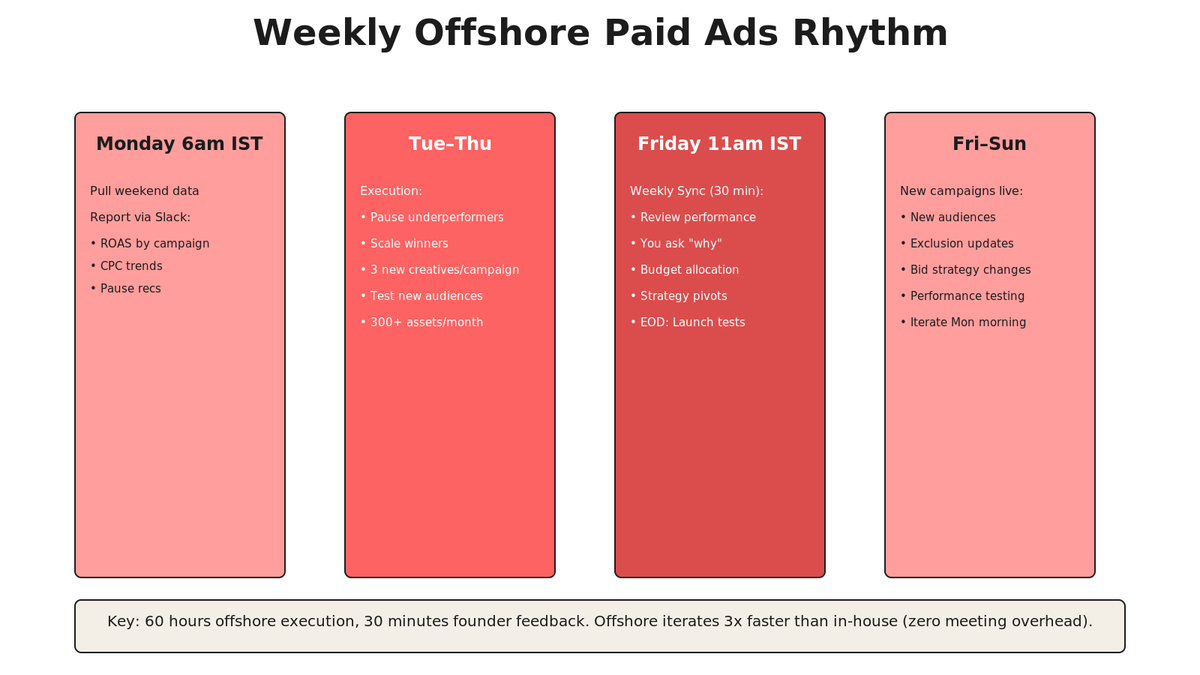
Paid ads are the quickest offshore win. Hire a person who has scaled paid ads in the US before (not someone learning ads for the first time). Here is the weekly rhythm that works:
🚀 Weekly paid ads rhythm (offshore does this)
| Monday 6am IST | Pull weekend data, report to you via async Slack message with breakdowns by campaign, creative, and audience. Include top-performing ads, underperformers to pause, and budget recommendations. |
| Monday–Friday | Pause underperformers, scale winners, rotate 3 new ad creatives per campaign (300+ assets per month). Test new audiences, exclusions, bidding strategies. Document all changes in a shared sheet. |
| Friday 11am IST (2:30pm UTC) | Weekly sync: 30 minutes on Zoom. Offshore person shows data, you ask "why". You approve next week's budget allocation and strategic shifts. They take notes and ship recommendations by Friday EOD. |
| Friday EOD | New audiences, exclusions, and bid strategies go live for weekend performance testing. Weekend spend is typically 30 percent of weekly budget, so maximizing weekend ROAS is critical. |
💰 Where offshore ads fail
Your offshore ads person does not know your ideal customer profile. Your ads scale to the wrong people. You burn budget fast. Solution: give them a 2-page ICP document ("10 reasons our buyer buys, 10 reasons they don't, real objections we hear, typical job titles, annual budget, decision timeline"). They will nail audience targeting in week 2. Without it, they're flying blind.
Second failure mode: no approval process. Ads go live untested, with typos or off-brand messaging. Build a 24-hour review gate. They draft, you approve (15 minutes), they launch. Non-negotiable.
Q5. Content creation, editing, and distribution offshore?
Content is 50 percent planning, 50 percent execution. Planning is in-house. Execution is offshore. This is where most founders get it wrong: they hire offshore content person and expect them to own strategy. That does not work.
🧾 Your in-house content person (5 hours per week)
- Approves editorial calendar (what 20 topics will we own this quarter). This comes from SEO strategy, customer feedback, and competitive gaps.
- Writes content briefs from competitive SERP analysis (2,000 words of detailed research per brief). This is the intellectual heavy lifting.
- Reviews drafts (20 minutes per post). Rewrites 1-2 intro paragraphs to nail founder voice. No one else should own your brand voice.
- Approves final posts before publishing (10 minutes). Spot-checks facts and quality.
- Tracks performance and feeds learning back into next quarter's strategy. What topics resonated? What fell flat? Why?
📇 Your offshore content person (30 hours per week)
- Pulls existing research from your brief into outline format (Jasper or Claude for first draft, then human edit).
- Writes 1,500-word draft, following your template and tone guide to the letter.
- Edits for clarity, flow, and readability. Checks grammar and fact-checks claims against your source docs.
- Optimizes meta title, description, and H1 for SEO (using your keyword brief and Yoast plugin).
- Schedules post on WordPress, sets publishing date and social shares, creates social preview images.
- Pulls analytics on published posts 2 weeks after launch. Flags top performers for repurposing (podcast clips, LinkedIn posts, email teasers).
One person can ship 15 to 20 posts per month offshore. One in-house person can only ship 4 to 6 (because they're doing strategy, too). Your per-post cost drops from $1,200 to $120 and your velocity grows 3x. By month 6, you own 50+ keywords. By year 1, you own 150+. That is the offshore content story.
Q6. Community and creator ops: offshore SLAs?
Community ops (Discord, Reddit, LinkedIn groups) and creator partnership workflows can go offshore if you build the right SLAs and playbooks.
🤔 Community ops offshore
Moderating comments, responding to common questions in Discord, and tracking member engagement are offshore tasks. Founder voice on important threads stays in-house. Example SLA: respond to every new thread within 4 hours, 24/5 (async-first, real-time only during US business hours). If a member asks "how do I set up my first offshore hire?", your offshore ops person can answer with a templated response. If a member asks "should we hire offshore or build in-house?", that is a founder question. They flag it to you. You reply in person. The offshore person did 99 percent of the work.
🚀 Creator partnership ops
Tracking outreach to 30 creators per month, managing email sequences, and scheduling podcast interviews are offshore. You jump in for final negotiations and intro calls. Your offshore ops person owns the entire pipeline: cold list building (mining Twitter, LinkedIn, Substack for creators in your niche), outreach (personalized DMs and emails), calendar management (scheduling interviews, sending prep guides), follow-ups (tracking response rates, resending to non-responders after 7 days), contract templates (standard terms you negotiate once, then reuse).
Real output: 100 new creator outreach per month, 5 to 10 closed partnerships, 2 to 4 podcast appearances per month. Your offshore person does 30 hours of work. You do 4 hours (pre-interview prep and the calls themselves). That is leverage.
⚠️ The real SLA for community/creator ops
- Response time: 4 hours for routine questions, 24 hours for escalations marked "founder review needed".
- Pipeline: 100 new creator outreach per month, 5 to 10 closed partnerships per month, 2 to 4 booked podcast interviews.
- Uptime: 99 percent (offline calendar scheduled in advance, backup cover arranged).
- Reporting: weekly email showing new community members, top discussions, partnership pipeline status, upcoming interviews.
- Escalation: if any brand-sensitive situation (negative review, competitor thread, sensitive question), flag to you within 1 hour.
Q7. Lifecycle and email marketing: where does offshore fit?
Lifecycle marketing is nurture sequences, triggered emails, and user journey mapping. 80 percent execution, 20 percent strategy. Your offshore person owns the execution. You own the voice and strategy.
📇 Offshore email ops
- Drafting nurture sequences from customer journey map you provided (6-email onboarding, 4-email re-engagement, 3-email win-back). They follow your template and tone, you review for brand fit.
- A/B testing subject lines, send times, and call-to-action text. They run tests, report results, you decide on winners.
- Segmentation: uploading user lists, tagging by cohort, setting up automation triggers in Klaviyo or HubSpot.
- Weekly performance report: open rates, click rates, unsubscribe rate by sequence. They flag trends, you interpret them.
- Identifying top-performing sequences for retargeting and expansion (if the "first purchase" email has 45 percent open rate, test it on other cohorts).
⚠️ In-house strategy
You define customer journey. You write the first draft of critical sequences (onboarding is do-or-die). Offshore refines and scales what you built. This is not "write all email copy offshore". It is "you own messaging, offshore owns execution". Big difference.
Q8. Analytics, reporting, and dashboards: go offshore?
Analytics is the no-brainer offshore task. Pulling data and formatting it is execution. Interpreting it is strategy. Your offshore person is the data lawyer. You are the judge.
📊 Offshore analytics ops (20 hours per week)
- Build dashboards in Google Data Studio (website traffic, campaign performance, revenue attribution, conversion funnel).
- Pull weekly metrics: CTR by channel, CAC by campaign, LTV by cohort, content performance by topic, email engagement by sequence.
- Write 1-pager summary every Monday: top wins and losses, 3 questions you need to answer, 2 recommendations.
- Flag anomalies: traffic drop (did we lose ranking?), conversion spike (did we change something?), new bot traffic (is our tracking broken?)
- Monthly deep dive: cohort analysis, retention curves, revenue per channel, CAC payback period. You use this for strategy planning.
⚠️ In-house strategy
You look at the 1-pager Monday morning (5 minutes). You answer the 3 questions Tuesday morning (10 minutes). You feed answers into Wednesday strategy sync. That is it. Offshore does 19 hours. You do 15 minutes. Pure leverage. If you try to do the data pulling yourself, you lose 20 hours per week to spreadsheet hell. Not worth it.
Q9. What stays in-house and why?
Four things never go offshore, no matter how talented your offshore team is:
🎯 Brand positioning and voice
Your brand is your founder voice. Offshore can execute it. Offshore cannot invent it. Do not offshore your brand. Your emails should read like you. Your blog posts should reflect your opinion. Your customer-facing messaging should feel like your company. Offshore follows your playbook. You write the playbook.
💰 Budget allocation and ROI arbitrage
Deciding "we're going to cut Meta by 30 percent and double LinkedIn" is strategy. Offshore can implement the decision. Offshore cannot make the decision. That requires founder judgment: market shifts, competitive moves, customer feedback, gut feel. No one else owns that.
⚠️ High-stakes relationship building
Partner negotiations, investor conversations, tier-1 media partnerships: you do these. Offshore can surface opportunities and prepare decks. You close. The relationship is personal. The founder carries it.
🚀 Performance interpretation and pivots
Your paid ads dropped 40 percent. Is it market (broader problem) or us (execution problem)? That judgment call is in-house. Offshore runs the diagnosis (pull the data, compare to industry benchmarks, check if competitors had similar drops). You decide the cure (pause campaigns, shift budget, kill the channel, double down on what's working). That is founder work.
Q10. Real SLA template for offshore marketing pods
Here is the SLA template we use when hiring offshore marketing support. Modify per your team and risk tolerance:
| Metric | Target | Escalation |
| Response time (routine question) | 4 hours during IST business hours (9am–6pm IST) | Ping account manager if no response by 8am IST next day |
| Response time (urgent, flags a miss) | 1 hour | Escalate to account owner within 4 hours |
| Scheduled deliverable delivery | On time, every time (100%) | 48-hour notice if any risk to delivery |
| Quality: blog posts | 0 grammatical errors, 0 factual errors, on brand voice | 1 free revision per post; 2+ revisions = $50/post penalty |
| Quality: paid ads | All ad text, copy, visuals reviewed and approved by you before going live | If an ad goes live unapproved, pause within 2 hours of discovery |
| Uptime on recurring tasks | 99 percent (allow 1 day missed per 100 working days) | Any more = $200/miss credit toward next month's invoice |
| Weekly reports | Delivered by Friday 12pm IST, every Friday without exception | If late, -$50 that week; if missed, -$100 |
| Monthly business review | 1 hour sync, first Friday of each month, 4pm IST / 6:30am PT | Reschedule if either party can't attend, but never skip the month |
| Knowledge transfer | Quarterly 1-hour session documenting processes, passwords in shared vault, handoff plan if person leaves | If not done, restrict access to critical accounts for 1 month until complete |
The key principle: SLAs must have teeth. If you let 3 missed deadlines slide, offshore will miss 10. Penalties do not need to be money. They can be "we skip next week's creative expansion" or "we pause your ad budget increase" or "we require daily check-ins until you hit 3 weeks of 100 percent delivery". But there must be consequences. Otherwise, the SLA is theater.
"We hired offshore for content and they missed deadlines every week until we added penalties to our contract. First $50 miss cost made them wake up. They shipped on-time for 8 months straight after that."
— Head of Marketing, B2B SaaS startup
Q11. Onboarding a 3-person offshore team in 2 weeks
You have found three people: a content writer, a paid ads manager, and an analytics ops person. How do you onboard them without burning 40 hours of your time in week 1?
🚀 Week 1: Playbooks and context
- Day 1: Send them a 10-page "Offshore Marketing Playbook" with your brand voice guide, customer ICP, competitor positioning, and your last 12 months of metrics. Have them read and ask questions in Slack (async). Set their expectation: "Read this today, ask questions by EOD, we'll sync tomorrow to answer them."
- Day 2: 1-hour sync. Walk through your top 5 marketing wins this year and why they worked. Explain the 3 channels you're betting on in Q3. Show them 3 examples of your best blog posts (voice), your best ad copy (tone), and your best analytics report (formatting).
- Day 3: Each person shadows their in-house equivalent for 2 hours (async: watch a Loom recording of your ads manager setting up a campaign, your content person editing a post, your analyst building a dashboard). Send them with a list of 5 questions to answer after watching.
- Day 4: First deliverable: have each person produce a 1-pager summarizing what they learned and 3 questions they still have. You answer the questions within 24 hours. Now they know you listen and care.
- Day 5: Weekly team sync (30 minutes). Introduce everyone. Explain how you communicate (Slack for questions, email for strategic updates, Zoom for weekly syncs). Set the no-fluff expectation: async-first, clear questions, written context.
🧾 Week 2: First tasks and feedback loops
- Day 1: Content person drafts 2 blog posts from briefs you wrote. Paid ads person launches 2 test campaigns (low budget, $50/day). Analytics person builds 2 dashboards (website traffic and ad performance).
- Day 2-3: Review, give feedback, explain "why" behind your requests. Offshore person revises. Keep feedback loops tight. Fast iteration builds confidence.
- Day 4: Content person publishes first posts (scheduled for Friday). Ads go live. Dashboards go to your inbox.
- Day 5: Final sync. Celebrate wins. Explain what needs refinement in week 3. Lock in meeting cadence: weekly Friday 30-min sync, monthly 1-hour business review, ad-hoc Slack questions.
The real secret: if onboarding takes more than 2 weeks, you have not written clear-enough playbooks. Invest in documentation first. Hiring second. Sloppy playbooks kill offshore hires. Good playbooks make them unstoppable.
Q12. When to build vs. when to hire an agency
You have two options: build an in-house + offshore hybrid team, or hire an agency. Which is right for your company?
| Factor | Build In-House + Offshore | Hire Agency |
| Cost (3-person team) | $1 in-house ($7K) + 2 offshore ($3.2K) = $10.2K/mo | Full-service retainer: $8K–$25K/mo (depends on scope) |
| Ownership of strategy | You own strategy. In-house person codifies it. Offshore executes. | Agency owns strategy. You watch and approve (slow feedback loops). |
| Speed of pivots | Tell your in-house person Monday, live by Wednesday. | Tell agency Monday, revisions by Friday, live next Monday (slow). |
| Institutional knowledge | Team learns your customer over time. Gets better every quarter. Retention builds depth. | Agency stays fresh but distant. Your knowledge lives with them, not you. Turnover resets relationships. |
| Accountability | SLA-backed, performance penalties are direct and enforceable. | Soft penalties. "We're working on it" is excuse #1. Hard to fire without legal hassle. |
| Relationship depth | Your offshore team is part of your company culture and learning loop. They attend all-hands, know your strategy. | Agency is vendor. Relationship is transactional. New faces every project. |
| Flexibility | Change priorities mid-month without renegotiating contract. Shift people between projects. | Locked into scope of work. Changes cost extra. Inflexible. |
| When to choose | You have strategy clarity, playbooks written, budget for 12+ months, and want to build long-term capability. | You have zero marketing person, need strategy + execution fast (6–12 months), then plan to transition to hybrid. |
Real talk: most founders in 2026 should build a hybrid team. Agencies are expensive, slow, and you never own the strategy. If you have any marketing clarity at all (know your top 3 keywords, know your customer, know your best marketing channel), go hybrid. You'll own your destiny and save money doing it.
Q13. How India-native EOR changes the math
You're hiring three offshore people. Do you hire contractors or build them as real employees? This decision changes your economics, compliance risk, and retention completely.
🚀 Contractor route (worst economics)
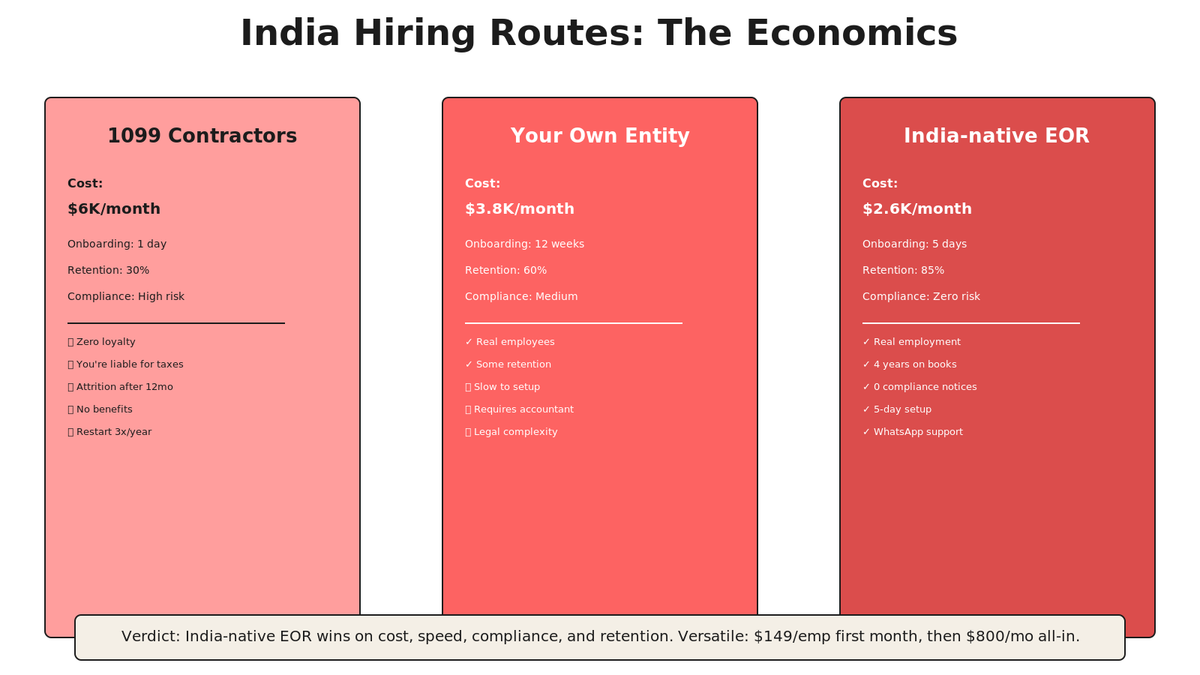
Hire three 1099 contractors from Upwork or Toptal. Cost: $2,000 per person per month = $6,000 total. Problems: zero contract law protection (they own the work you paid for in India), 100 percent attrition after 12 months (contractors churn to the next client), you are liable if India tax authority audits them, and they feel no loyalty to your brand (they're juggling 5 other clients). You also get no employee benefits, no PF/ESI protection for them, and no compliance backing. When they leave, you restart from scratch. Repeat this 3 times per year and you never build institutional knowledge.
⚠️ Entity route (high friction)
Set up a Private Limited company in Bangalore. Hire three people as employees. Cost: $500 (incorporation) + $200 per month (accounting) + $300 per person per month (HR/compliance) = $1,400 per month overhead. Then add salaries: $800 × 3 = $2,400 per month. Total: $3,800 per month. But you need to file quarterly taxes, maintain PF/ESI records, handle labour law disputes (if you ever need to fire someone), and find an accountant who actually knows Indian labour law (not trivial). Lead time: 8 to 12 weeks to incorporate and set up payroll. During that time, you're paying in-house to wait. Compliance risk: medium (depends on your accountant's competence).
✅ India-native EOR route (best economics + zero friction)
Work with Versatile, an India-native EOR with multiple US/UK companies on its own entity. You give Versatile three names, salaries, and job descriptions. Versatile handles PF, ESI, TDS, professional tax, labour compliance across all 28 Indian states. Cost: $149 per employee per month for month 1 (free), then $800 per employee per month all-in (salary + compliance + ops). Onboarding: 5 days. Compliance risk: zero (0 notices in 4 years, audited by Big 4 accounting firm). Retention: employees feel they have a "real job" (they're employed by Versatile) so they stick around.
| Hiring Route | Onboarding | 3-Person Cost/Mo | Compliance Risk | Retention (1-Year) |
| 1099 Contractors | 1 day | $6,000 (salary only) | High (you're liable for their taxes) | 30% (churn city, people jump clients) |
| Your own entity | 12 weeks | $3,800 (salary + ops) | Medium (depends on your accountant's competence) | 60% (employees have some loyalty, stable job) |
| India-native EOR (Versatile) | 5 days | $2,600 (all-in, salary + PF/ESI/TDS within Versatile's entity) | Zero (4 years on books, 0 notices, Big 4 audited) | 85% (they're employed by Versatile, feel real job security) |
If you are hiring offshore and want retention, compliance safety, and fast onboarding, India-native EOR is the only sensible route in 2026. Versatile is the India-native EOR alternative to going it alone. You benefit from their compliance infrastructure, their founders' 4 years on books, and their 0 notice track record across PF, ESI, and TDS audits. Five-day onboarding. $149/emp/month for month 1 (free). WhatsApp support if a compliance question pops up (and they will). This is how we built Versatile's own offshore team.
Q14. Five mistakes founders make when going offshore
❌ Mistake 1: Hiring without playbooks
You bring on an offshore person and they immediately ask, "What do you want me to do?" If you do not have the answer in 1 page, you have hired too early. Write the playbook first. Hire second. A good playbook is 10 pages: brand voice guide, process flows for each task, examples of good work, examples of mediocre work, SLA expectations, escalation paths, communication norms. Spend 2 weeks writing it. Then hire. Do it backwards and you waste 8 weeks getting them up to speed.
❌ Mistake 2: Micromanaging like they're in-house
You Slack them every 30 minutes. You request daily standups. You ask them to be "on call" during your timezone. Offshore only works async-first. If you need real-time togetherness, hire in-house. Do not hire offshore and then demand in-office culture. Set the expectation: "We sync once per week for 30 minutes. Everything else is async. Write clear Slack questions, I'll respond within 4 hours." If you can't live with that, don't hire offshore.
❌ Mistake 3: Expecting founder-level judgment immediately
Offshore is execution, not strategy. Your offshore paid ads person will never decide "we should kill Facebook and go all-in on TikTok." That is your call. They execute your decision. If you keep waiting for them to "think strategically", you have hired the wrong role. Hire strategy (in-house). Hire execution (offshore). Stop mixing them up.
❌ Mistake 4: Hiring based on availability, not skill
You see a $500-per-month person with "5 years paid ads experience" on Upwork. You hire them. Then you realize they have 5 years of mediocre experience, not 5 years of excellence. Skill always beats price. A $1,200-per-month person who's shipped 6-figure ad campaigns and can show portfolio will beat a $500 person who's guessing. Interview hard. Ask for case studies. Check references. Pay for excellence.
❌ Mistake 5: Forgetting that people are people
Your offshore person is raising kids on $1,200 per month in Bangalore. They're worrying about daycare costs, commute traffic, and whether they can afford rent next month. They're not motivated by "shipping velocity" or "scaling impact". They're motivated by stable pay, respect, clear expectations, and predictability. Treat them like that. Annual raises (don't ask them to ask for one). Respect for their time (don't message them at 3am). Holiday breaks (28 Indian holidays, respect them). One person who feels valued will ship 3x more than one who feels disposable.
Q15. Is offshore right for your team right now?
Answer these five questions honestly. If you answer "yes" to 3 or more, go offshore. If you answer "no" to 3 or more, wait 6 months and reassess.
🤔 Question 1: Do you have one in-house marketing person who can codify strategy?
Yes = hire offshore (they will multiply your person's output). No = hire in-house first, then offshore in 12 months (you need strategy first).
🤔 Question 2: Do you have written playbooks for at least 3 marketing tasks?
Yes = hire offshore (they can follow them). No = spend 2 weeks writing playbooks first (invest in documentation).
🤔 Question 3: Can you give clear feedback and wait 4 hours for a response?
Yes = hire offshore (async communication works for you). No = you need in-house, not offshore (you need real-time togetherness).
🤔 Question 4: Is your marketing budget $10K/month or higher?
Yes = hire offshore (math works, ROI clear). No = hire one in-house person and wait (too small for hybrid team).
🤔 Question 5: Can you commit to 30 minutes per week of synchronous feedback?
Yes = hire offshore (one weekly sync makes it work). No = you don't have time for offshore. Hire an agency instead (they need less hand-holding, but cost more).
If you answered yes to 3+, here is the next step: write a 1-page job description for the first offshore hire (probably content or paid ads). Post to Upwork, Toptal, or Versatile's talent marketplace (they also source offshore talent and handle full employment). Interview three people minimum. Hire one for 4 weeks as a trial (at discounted rate). If they ship and hit your SLAs, hire their two teammates. If they don't, reset and try again.
FAQs
Which marketing tasks should stay in-house and which should go offshore?
Strategy, brand voice, and executive relationships stay in-house. Execution (paid media ops, content production, SEO on-page, email design, analytics dashboards) moves offshore. Rule of thumb: if the task creates a customer-facing decision, keep it in-house. If it produces an asset, offshore it. Our India EOR works well for the execution layer.
What is the first marketing task most founders offshore, and does it work?
Paid media reporting and campaign optimization, usually. It works when you give clear KPI targets and a weekly review cadence. It fails when you hand over strategy too. Start with reporting, add campaign build, then add creative testing. Read how we structure onboarding via Versatile.
Can I offshore content production without losing brand voice?
Yes, if you invest 2 weeks upfront in a style guide, 20 sample pieces the writer references, and a weekly editorial review. Without those three, brand voice drifts by month 3. We help you build the style guide during onboarding. Book a call.
How do I offshore SEO without hurting site rankings?
Offshore the mechanical work (keyword research, technical audits, on-page optimization, link outreach). Keep the strategic calls (topic pillar decisions, editorial calendar approval) in-house. Ranking risk drops when you require a weekly Ahrefs report before any change goes live. Our EOR team runs a monthly SEO health call.
What tools should the offshore team have access to from day one?
GA4, Search Console, HubSpot or Salesforce, Ahrefs or Semrush, your CMS, and Slack. Restrict via role-based access. Never share admin credentials; create individual seats. Our onboarding process on Versatile covers access provisioning.
How fast should I see ROI from an offshore marketing team?
First 30 days: onboarding and dashboards. Days 30 to 60: campaign optimization on existing spend, expect 15 to 20 percent CAC improvement. Days 60 to 90: new campaigns launching. If you do not see meaningful CAC or CPL movement by day 90, the team is misaligned. Message me and I will review your setup.
Where my head is right now
Offshore is not new in 2026. What is new is the permission structure. Founders used to think offshore was "cheap labor you cannot trust." The real 2026 truth: offshore is force multiplication if you have clarity first. Playbooks + async communication + right hiring = 3x output at 60 percent lower cost. I predict that by 2027, every US founder with marketing clarity will have at least one offshore marketing person because in-house hiring at $6K per month for the same work no longer makes sense. The math is too brutal.
If you are building your offshore marketing pod and need help navigating India compliance, employment law, or finding your first hire, talk to us. Versatile is India-native EOR with 4 years on books and zero compliance notices. We help multiple US/UK companies hire 40+ people in India without setting up their own entity. We have sourced offshore talent for content, paid ads, analytics, customer success, and engineering. Message me directly on WhatsApp through our contact page, or book a consultation with us. You will be talking to the founder, not a ticket. What timezone is your offshore marketing person in?