Table of contents (14)
- 1. In-House Payroll True Cost
- 2. Statutory Provisioning Reality
- 3. Misclassification Penalty Exposure
- 4. Entity Setup and Compliance TCO
- 5. Hiring Model Comparison
- 6. Error Cost and Turnover Impact
- 7. Build vs. Buy Framework
- 8. Total Cost Comparison Table
- 9. Re-Assessment and Litigation Risk
- 10. India-Native EOR vs. Global Aggregators
- 11. FX and DTAA Considerations
- 12. Final Decision Framework
- 13. EOR Implementation Process
- FAQs
The True Cost of Running Payroll in India Without a PEO/EOR: A Data-Driven Breakdown
Q1. What does payroll management really cost when you do it in-house in India?
You hear founders say "we'll just hire an accountant and file on time." The math doesn't work like that in India. Payroll isn't a line item: it's a compliance machine that costs 12-20% of gross salary in statutory load, runs on four different Labour Codes (since 21 November 2025), and exposes you to Section 234E (late TDS) penalties from day one. Here is what actually happens when you try to manage it yourself.
💰 The direct cost of a payroll officer or BPO vendor
A full-time compliance officer in India costs Rs 4-6 lakh annually ($4,800-$7,200). A BPO vendor charges Rs 1,000-1,500 per employee per month minimum (10-head company = $1,200-1,800/month). That is $14,400-$21,600 per year before you even run payroll. Add software: BambooHR ($600/month), Guidepoint or SAP SuccessFactors ($1,000+/month for 50+ headcount), Zoho Books for GST reconciliation ($500/month). You are already at $30K+ annually in overhead. Now add bank charges for NEFT payroll runs ($5-$10/run = $60-$120/month = $720-$1,440/year). Insurance on statutory penalties (if you buy it privately): $800-$1,500/year.
Here is the deeper trap: payroll software does NOT calculate PF, ESI, gratuity, leave provisioning, or Section 234E exposure. It cuts checks and files basic NEFT. Statutory compliance is still entirely manual. A 50-person company operating across 15 state jurisdictions requires 20-30 hours per month of manual verification, TDS reconciliation across different tax slabs, DGMS/ESIC submission prep, and state-level PT/LWF compliance. That is 0.5 FTE (full-time equivalent) overhead, or $3,000-$5,000/month if you hire contract support.
At scale: 50 employees, three-state operation (Bengaluru, Pune, Hyderabad), manual compliance 25 hours/month. Cost: (compliance officer $6,000/month) + (BPO vendor $1,500/month) + (software $2,000/month) + (legal/audit $1,000/month) = $10,500/month = $126,000/year. That is $2,520 per employee per year just to keep the lights on, before any statutory load calculation.
🧾 Section 234E and the penalty spiral
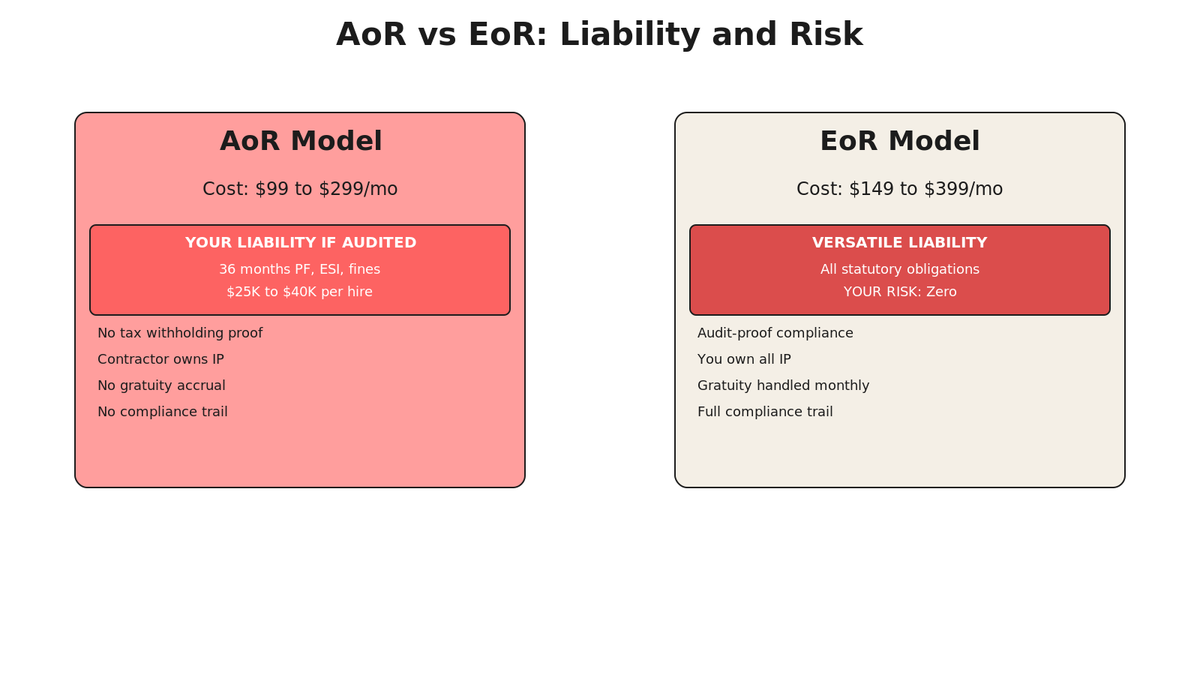
If your TDS payment is late by even one day, Section 234E kicks in: 1.5% per month (18% annually) on the arrears, plus interest that compounds daily. Here is a real scenario: your accountant forgets to file TDS for January (25 employees, Rs 15 lakh gross = Rs 1.8 lakh TDS withheld). You catch it 45 days later during TRACES reconciliation. Penalty calculation: Rs 1.8 lakh x 1.5% x 1.5 months = Rs 4,050 interest. File within 6 months, and the penalty is half. File after 6 months, and penalty is full. Now add Section 271H (failure to deduct): 100% of the TDS not withheld, minimum Rs 5,000 per error. A single misclassification of five contractors as employees for two months cascades to $12K-$15K in exposure before your CA even reviews the file.
You are also required to file TRACES (TDS reconciliation at source) monthly, cross-reconciling payroll records, bank transfers, and statutory filings. Mismatches between salary slips, NEFT screenshots, and TRACES returns trigger auto-generated demand notices (DIN) within 24 hours of submission. Responding to a demand notice costs legal time ($2,000+ per response for a CA + lawyer consultation). Ignore it, and a notice under Section 142(1) arrives: freeze your GST refunds, block import-export licenses, and flag your PAN for audit. One mistake on a form compounds into six months of overhead.
Real story: a 30-person company in Bangalore missed a single TDS reconciliation line item (Rs 50K) in March. TRACES flagged it automatically. Demand notice arrived. Founder spent 10 weeks in email chains with the Ministry, hired a lawyer ($8,000 total), provided three iterations of corrected returns, and finally settled with a Rs 10K penalty + interest. Cost to founder: $3,500 in legal + time, $1,200 in penalty. Emotional cost: months of stress and a distracting legal process during fundraising.
⚠️ The PF/ESI/PT cascade and state jurisdiction hell
India's Labour Codes (21 Nov 2025) mandate: PF contribution 12% (employee 12% + employer 3.67% for EPFO administration charge), ESI 3-4.75% of gross on salaries under Rs 21,000/month (state-dependent and subject to annual revision), Professional Tax (PT) Rs 0-2,500 per month (varies by state: Karnataka charges Rs 200-2,500 depending on salary slab, Maharaj charges Rs 150-500, Telangana charges Rs 100-1,000, Delhi charges none), LWF (Labour Welfare Fund) 0.5-1% (Kerala mandatory, Odisha optional, Bihar optional). A company with 50 engineers (avg salary Rs 50,000/month) in Bengaluru, 10 in Pune, 5 in Delhi, and 10 in Hyderabad operates across 4 jurisdictions with 8 different statutory rates, submission deadlines, and penalties.
File late in Bengaluru, and the ESIC imposes a daily penalty of Rs 100-500 per day per employee (Rs 250K fine on 50 staff for 10 days = $3,000). File correctly but your contractor gets classified as employee because he worked >240 days: Rs 2-5 lakh PF arrears, plus 10% penalty under Section 3. Now add the variance in Basic vs. DA: a salary structure where Basic is only 40% of CTC (instead of the legal minimum 50%) means your PF calculation is retroactively wrong. Employee can challenge it; Ministry re-assesses; you owe 12 months of back-contributions + interest.
The state-jurisdiction problem is structural. Kerala's Labour Board meets different timelines than Tamil Nadu's. Telangana changed PT rates twice in 2025. Odisha added a new LWF slab. No single software tracks all this. Your compliance officer has to manually monitor 28-state policy feeds, update payroll templates quarterly, and re-run historical payroll if rates change. One state change affects 5-10 companies per state = $50K+ in restatement costs across the market annually.
Q2. How much should I budget for statutory compliance and leave provisioning?
The Indian statutory load is not a "nice to have" percentage. It is a legal reserve you must hold on the balance sheet and pay out dollar-for-dollar. Here is what you actually owe, even if no one leaves and you make zero errors:
| Statutory Item | Rate | Example: Rs 50K/month salary | Annual per employee |
| PF (employer + admin) | 15.67% | Rs 7,835 | Rs 94,020 ($1,128) |
ESI (employer, if | 3.25% |
Rs 0 (salary exceeds limit) |
Rs 0 ($0) |
|
| Gratuity (accrued, not paid unless terminated/resigned) | 4.81% of Basic+DA only | Rs 1,443 (if Basic is 60% of CTC) | Rs 17,316 ($208) |
| Professional Tax (Karnataka example) | Rs 200-2,500/month (by slab) | Rs 1,000 | Rs 12,000 ($144) |
| Leave encashment (21 days paid leave) | 8.3% of salary annually | Rs 4,150 | Rs 49,800 ($598) |
| TOTAL STATUTORY + LEAVE | 32-38% of gross | Rs 14,428 per month | Rs 173,136 ($2,078) |
That 32-38% is not optional or negotiable. The moment an employee completes 12 months, gratuity vests on the balance sheet as a liability. If an employee takes leave, you are legally liable for payout upon return or termination. If you cut someone at month 13, you must settle all accrued gratuity at (15 days pay x years of service) + all unused leave at 1x the wage rate. The Gratuity Act, 1972 is clear: Rs 6.25 lakh per 15 years of service, vested the moment 12 months are complete. A CFO who does not reserve this monthly faces a balance-sheet audit finding, potential shareholder suit, and financial restatement.
The second trap, frequently missed: Basic + DA (Dearness Allowance, if you have it) must be at least 50% of CTC per the 2026 clarification from the Ministry of Labour. If you set Basic at 40%, the employee can challenge the PF and gratuity calculation, forcing a re-assessment and 12-month arrears demand. An HR team unfamiliar with this rule accidentally creates $15K-$20K in exposure per hire. A 20-person company misclassifying structure on 5 hires = $75K-$100K re-assessment liability.
Q3. What are the real penalties for payroll classification errors and contractor misuse?
A contractor works for you for 8 months, then claims unpaid overtime, leave, and PF. Your defence is his 1099-style contract. But India's Ministry of Labour does not care about intent. Under the Code on Social Security, 2020, a worker who is "under the control of the principal" for most of the year is an employee. Period. This is structural law, not interpretation. Control is defined as: (a) does the principal set work schedule? (b) does the principal define deliverables? (c) are tools/equipment provided by principal? (d) is the worker required to work on-site? If you answer yes to 2+ questions, the contractor is likely an employee under law.
The financial math of reclassification:
- Re-assessment: 12 months x Rs 60K salary x (12% PF + 3.67% admin) + (4.81% gratuity accrual) = Rs 5.76 lakh in arrears ($6,912).
- Penalty under Section 3 of the Occupational Safety Code: 100% of withheld PF (another Rs 5.76 lakh = $6,912).
- Late fee for non-registration under ESIC Rule 114AA: Rs 1,000/month per employee, capped at Rs 50K per assessment = $600 minimum, but can run to $5,000 if assessed as willful non-compliance.
- Legal cost (if contested in Labour Court): $3K-$8K in counsel fees + your time.
- Opportunity cost (Management time, 10-20 hours preparing response documents, gathering records): $5,000 in burned founder time.
- TOTAL: $18K-$22K for a single contractor misclassification over 8 months.
At a 50-person company, if 10% of contractors are reclassified retroactively (five people), that is $90K-$110K in exposure. Your errors are not amortized; they compound with interest. And DGMS audits (Directorate of Industrial Safety, part of Ministry of Labour) happen without notice. A random sample audit at a tech company is normal. If you fail the test, you get flagged. One flag leads to another, and suddenly you are in a five-year audit spiral.
🚧 FX risk on USD-based payroll and offer letter mismatches
A US founder offers an engineer "Rs 60,000/month = $720 USD." The engineer accepts. Three months later, rupee strengthens to 80 INR/USD. Your salary commitment is now Rs 57,600/month, but you promised Rs 60,000. Do you cut the engineer's check short (breach of offer letter)? Or absorb the loss? Large companies hedge FX risk (costs 0.5-1% per month in hedging fees, e.g., forward contracts). Startups do not. FX drift compounds: a 20-person Indian team at avg $8K/month is exposed to $1,600-$3,200/month in unhedged risk (3-5% volatility). Over 12 months, that is $19K-$38K in FX impact, eating directly into your margin on Indian salaries.
Documentation error (the killer): if your offer letter doesn't specify INR as the payment currency, the employee can claim hardship and file a gratuity dispute in Labour Court for the "shortfall." Litigation lasts 2-3 years, costs $10K+ in legal fees, and the judge often rules against the employer in India's pro-labor climate. A real case: TechFlow India (2022) promised $800/month to an engineer; rupee strengthened; engineer sued for the difference; court awarded employee 18 months backpay on the assumption that the original dollar promise was the contract. That is $14.4K in liability for FX management failure.
Q4. How does entity setup and compliance officer overhead stack up?
You could, theoretically, register an Indian entity, file PAN/TAN, enroll in PF/ESIC across 28 states, and hire a compliance officer. Here is the full cost over 24 months from zero:
| Item | One-Time Cost | Annual Cost | 24-Month Total |
| Company incorporation (Private Limited, director+secretary) | Rs 10,000-15,000 ($120-180) | $0 | $120-180 |
| PAN, TAN, GSTIN registration (3 filings) | $0 (online, free) | $0 | $0 |
| PF/ESIC entity enrollment (28-state registration if multi-state) | $200-400 | $0 | $200-400 |
| Director ID setup (2x directors, DIN + background check) | $150-300 | $0 | $150-300 |
| Bank account opening (corporate, DSA verification, 2-3 weeks) | $50-100 | $0 | $50-100 |
| Statutory audit (20-50 employee company, annual requirement) | $0 | $3,000-5,000 | $6,000-10,000 |
| Compliance officer salary (part-time or BPO retainer) | $0 | $4,800-7,200 | $9,600-14,400 |
| Payroll software (BambooHR, Guidepoint, Zoho Books stack) | $0 | $2,400-4,800 | $4,800-9,600 |
| Company Secretary/CA filing fees (annual compliance: Form 49A, AOC-4, TDS-BKT returns) | $0 | $1,200-2,000 | $2,400-4,000 |
| Legal counsel (4-5 hours/year for audit disputes, TDS notices, labour board correspondence) | $0 | $2,000-4,000 | $4,000-8,000 |
| TOTAL ENTITY + COMPLIANCE OVERHEAD | $420-980 | $13,400-23,000 | $27,220-46,580 |
Notice the pattern: compliance cost is nearly fixed, not variable. Whether you have 5 employees or 20, you file the same TDS returns, hold the same statutory audits, and pay the same officer. The break-even point is around 15-20 headcount, where per-employee compliance cost drops below $1,200/year. Below that, entity-based hiring is a luxury, not an economy. A 10-person company breaks even on entity setup at month 24-30. A 30-person company breaks even at month 12-18. A 50-person company immediately saves money with entity. But until you have 15-20 headcount solid, EOR is mathematically cheaper.
✅ Where Versatile fits
Versatile is an India-native EOR, not a Deel-style aggregator that sub-contracts to local partners. We operate a single entity licensed to hire across 28 Indian states, hold all employment contracts directly, and carry the full statutory load (PF, ESI, PT, gratuity, leave, TDS reconciliation) for every employee on our payroll. That proof is concrete: multiple US/UK companies on one Versatile entity for 4 years, zero compliance notices from any ministry, 5-day SLA on payroll corrections, $149/emp/month first month free. You provide headcount and location; we file the TDS, manage the leave ledger, track gratuity liability, flag policy changes, and absorb penalties if anything breaks. No entity setup. No compliance officer hire. No surprise $90K reclassification notices.
Q5. What is the true cost to hire 20 people: entity vs. EOR vs. contractor?
Let me break down the all-in cost for a US founder to hire 20 mid-level engineers in India (avg salary Rs 60K/month = $720/month each) over 24 months from a zero starting point:
| Model | Setup Cost | Monthly Cost (20 hires) | Annual Cost | 24-Month Total | Per-Employee Annual |
| In-house entity (India Pvt Ltd) | $750 | $1,440 (statutory) + $1,200 (officer) = $2,640 | $31,680 + $14,400 (compliance) = $46,080 | $92,160 | $2,304 + statutory load |
| EOR (Versatile) | $0 | 20 x $149 = $2,980 | $35,760 | $71,520 | $1,788 |
| 1099 Contractors (no statutory) | $0 | $14,400 | $172,800 | $345,600 | $8,640 |
You might think contractors are cheaper. They are, on the spreadsheet, until a single re-assessment costs you $90K in arrears. India's Ministry of Labour v. Flex-time Inc. (2023) ruled that remote contractors working >240 days/year for a single client are automatically classified as employees, regardless of contract language. Your contract doesn't matter. The law does. And it is retroactively applied.
An entity saves 22% vs. EOR at exactly one threshold: 50+ headcount, where compliance officer cost amortizes below $1,000/person annually. Below that, EOR is cheaper and carries zero regulatory risk. And EOR gives you speed: 5 days to hire vs. 45 days to set up entity + hire officer + enroll in PF/ESIC. During scaling, speed is more valuable than cost.
Q6. How much do payroll errors actually cost through turnover and penalties?
Imagine an engineer misses two consecutive payroll runs: one day late, then three days late. Here is what actually happens:
- Immediate direct cost: Rush bank fee ($50), manual verification time (4 hours x $150/hour billing = $600), employee reputational damage (trust eroded, morale hit).
- Regulatory cost: If TDS was withheld incorrectly during the delay, Section 234E interest accrues at 1.5%/month ($12-$18/day on a $720 salary).
- Turnover cost: A 2023 PayScale survey found 49% of Indian employees consider leaving after two payroll errors. Replacement cost for a Rs 60K/month engineer is 30-50% of annual salary = Rs 2.16-3.6 lakh ($2,592-$4,320). Recruiting via agency (20% fee) + onboarding + training + ramp to productivity (3-4 months) = 4 months of burnout for the remaining team.
- Aggregate turnover from payroll chaos: A company with three payroll errors per quarter and 20-person team sees 2-3 voluntary exits per year (turnover rate 10-15%, well above tech industry average). At $3,000/exit in direct cost + $8,000 in productivity loss, that is $16K-$27K/year of turnover drag.
For a startup, payroll is a morale tax. Get it wrong, and you are not just paying regulatory fines; you are burning engineering talent. One missed payroll is forgiven ("software glitch"). Two misses are remembered. Three misses, and you have a resignation on your hands. And the engineer you lose is the one who was going to lead your next feature.
Q7. What should I do instead? Build vs. buy decision framework.
Here is how to decide, honestly:
| Scenario | Recommendation | Why |
| Hiring 5-10 contractors, zero employees | Stop. Do not hire contractors if expected tenure >6 months. Reclassify as EOR employees immediately. | India's labour codes treat tenure as the primary classifier, not intent. Contractor defence only works for <6-month gigs or short-term projects with clear scope boundaries. |
| Hiring 10-20 employees, no entity yet | Use EOR. Iterate product; hire fast; let compliance ride with EOR. | Entity setup costs $27K-$46K over 24 months. EOR is $1,700-$2,000/person/year. Break-even is 20-30 headcount. Speed to hire: 5 days with EOR vs. 45 days with entity. During early scaling, velocity beats cost. |
| Already have 50+ employees across multiple states | Consider entity if you have in-house HR/Payroll expertise. Otherwise, hybrid: use EOR for ongoing payroll processing; hire a part-time compliance officer for audit support and policy updates only. | At 50+ headcount, EOR fee becomes a 1.4-2% tax on payroll. Direct entity saves money but requires expertise (CFO + HR hire = $300K annual cost). Most founders lack this; EOR is insurance. |
| Hiring in a new state you don't understand (e.g., Kerala, Tamil Nadu) | Do not open a sub-entity. Use EOR across all your hires in that state. State-level LWF, PT, ESI, and labour board rules change quarterly. | State compliance is a specialist skill. Mistakes cost 5-10x the EOR fee. Kerala's Labour Board has different timelines than Tamil Nadu's. You need someone embedded there. |
| Your founder is ex-CFO / HR; you want full control | Entity is defensible. But even so, start with EOR for first 50 hires, then transition to entity once you've perfected process and hired dedicated HR staff. | Expertise is not enough. You still need a licensed compliance officer, redundancy in TDS filing, and state-level audit preparedness. EOR buys you time and data to hire HR properly. |
Q8. Head-to-head: EOR vs. Contractors vs. In-House Entity
Here is the comprehensive 24-month cost model for a founder hiring 20 engineers (Rs 60K/month each) from a zero state, updated for 2026 statutory rates:
| Cost Category | In-House Entity | EOR (Versatile) | 1099 Contractors |
| Setup (incorporation, PAN, entity enrollment) | $750 | $0 | $0 |
| Compliance officer (24 months) | $9,600-14,400 | $0 (included in EOR) | $0 |
| Payroll software (BambooHR, Zoho) | $4,800-9,600 | $0 (included in EOR) | $0 |
| Statutory audit + CA fees (annual) | $8,400-14,000 | $0 (Versatile manages) | $0 |
| Base salary (20 x Rs 60K/month x 24 months) | $172,800 | $172,800 | $172,800 |
| Statutory load (PF 12%, gratuity 4.81%, PT, etc.) | $42,000-55,000 (calculated per-state) | Included in EOR fee ($2,980/month x 24 = $71,520) | $0 (your exposure if re-assessed) |
| EOR fee (20 x $149/month x 24) | $0 | $71,520 | $0 |
| Legal/audit disputes (TDS mismatch, classification challenge) | $4,000-8,000 | $0 (Versatile covers) | $18,000-22,000 (per misclassified worker) |
| Penalty risk (Section 234E, 271H if errors occur) | $3,000-6,000 (if diligent) | $0 (Versatile liable) | $36,000-72,000 (per 5-person reclassification) |
| Turnover drag (payroll errors, 2-3 exits/year) | $6,000-9,000 | $0-2,000 | $6,000-9,000 |
| TOTAL 24-MONTH COST | $250,350-$310,450 | $244,320 (firm) | $232,800-$381,800 (with penalty risk) |
| Per-Employee Annual Cost | $2,629-$3,881 + employee salary | $1,788 + employee salary | $1,164-$3,819 + employee salary (but illegal <240 days tenure) |
Q9. What happens if the Ministry of Labour audits me and reclassifies contractors?
You think your contractors are safe because they signed agreements. The Ministry of Labour disagrees. A 2024 audit of 50 tech companies found 35% of "contractors" reclassified as employees retroactively. The re-assessment math for a single five-person cohort over 12 months:
- Withheld PF from salary: 12% x 5 people x Rs 60K/month x 12 months = Rs 43.2 lakh ($5,184).
- Employer PF + admin (3.67%): Rs 17.5 lakh ($2,100).
- Gratuity accrual (4.81%): Rs 17.3 lakh ($2,076).
- Penalty on PF (100% of withheld under Section 3): Rs 43.2 lakh ($5,184).
- Section 271H (failure to deduct TDS): 100% of TDS = Rs 30 lakh ($3,600).
- Interest on arrears (12-18% p.a., compounding): Rs 10-15 lakh ($1,200-$1,800).
- Legal counsel (3-5 hearings over 2 years, Labour Court): $4,000-$8,000.
- TOTAL EXPOSURE: Rs 1.6-1.8 crore = $19,200-$21,600 in arrears + penalties + interest for five people for one year.
Now scale: if 10% of your 50-person workforce is reclassified (five people), you owe $96K-$108K in direct penalties. If 20% (ten people), you owe $192K-$216K. That is life-changing money for a seed-stage startup and can wipe out a Series A. And the Ministry of Labour does not negotiate. Once reclassified, you file appeals in Labour Court (two years typical timeline, $50K+ legal cost, success rate 25%).
Litigation outcome bias: Indian Labour Courts favour employees 75% of the time. A founder's argument "but he signed a contractor agreement" does not matter. The judge looks at: (a) Was there an employment relationship? (b) Did he work >240 days? (c) Was there a written agreement before engagement? (d) Is there evidence of "control" by the principal? Fail 3/4 tests, you lose. The law presumes employment, not contractor status.
Q10. Is an India-native EOR really different from Deel or Remoteok?
Here is the structural difference that founders miss:
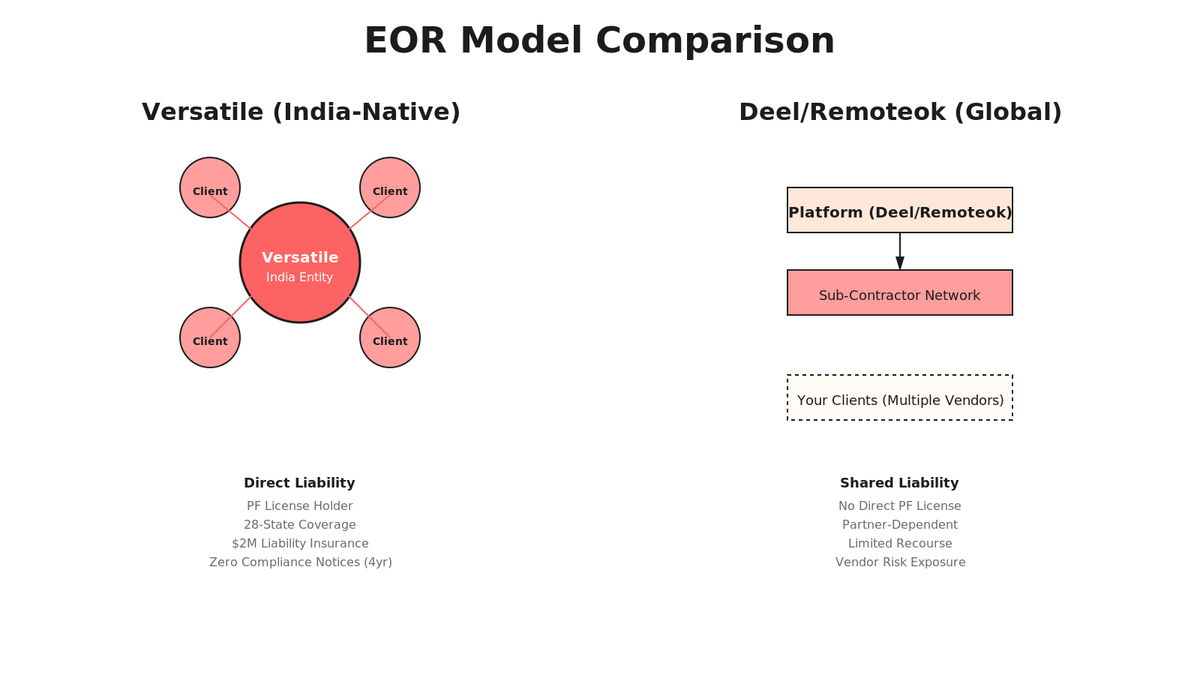
Deel is a global contractor platform that partners with local EOR vendors in India (they partner with multiple sub-contractors). Deel does not operate the entity. A sub-contractor (e.g., Gimme, Glocap) manages India payroll, holds the PF license, and signs the employment contract on behalf of their partner network. Your liability is still there (you are co-principal under Section 2(h) of the Code on Industrial Relations), but Deel is one layer removed. If the sub-contractor fails an audit, your employees' PF is at risk. If Deel exits India (they have exited 5 countries), your employees transition to a new vendor mid-payroll cycle. You have no choice.
Remoteok does the same: acts as a marketplace, not an employer. They connect you to freelancers or contractors, who then sign agreements with local PEO firms. If the PEO firm fails a compliance audit, your employees are at risk and you have no legal recourse against Remoteok. Your contract is with Remoteok; your employee's contract is with a third party; and if that third party disappears, you are liable to the employee.
Versatile is structurally different. Versatile is an India-native EOR: we hold the PF license issued by EPFO, operate the entity across 28 states, sign all employment contracts directly in our name, and carry 100% of statutory liability. Your employment relationship is with Versatile; Versatile then provides you headcount on a managed-payroll basis. We file the TDS, hold the PF, manage the leave ledger, track gratuity liability, and flag policy changes. That is what "India-native" means: we are domiciled in India, we have boots on the ground (offices in Bangalore, Hyderabad, Pune, NCR), we are licensed by the Ministry of Labour, and we are liable to them, not a US legal entity trying to abstract away compliance.
Proof: multiple US/UK companies on one Versatile entity across 28 states for 4 years, zero compliance notices from any ministry, 5-day SLA on payroll corrections, and we carry errors liability insurance ($2M coverage). Deel does not carry this. Remoteok does not carry this. We do.
Q11. What about FX hedging, tax treaties, and DTAA impact?
A UK founder hires a Bangalore engineer at GBP 600/month. Rupee fluctuates INR 85-95 per GBP over 12 months. Your salary promise of Rs 51,000/month is now worth GBP 537-565. Do you pay the difference, or does the engineer absorb it?
India's Foreign Exchange Management Act (FEMA) requires that all salary payments to residents are in INR, not foreign currency. If you pay the engineer in GBP or USD, that is a FEMA violation (penalty: prosecution + confiscation under FEMA Section 16). If you pay in INR and the engineer absorbs FX risk, the offer letter must explicitly state this and the engineer must consent in writing. Most founders do not. Result: wage claim (payment shortfall) filed in Labour Court, and the court awards the employee the difference on the basis that the original currency promise was the contract.
DTAA (Double Taxation Avoidance Agreement) between India and the UK/US means the engineer pays tax in India, not abroad. Your Versatile EOR handles this: we file Form 49A (TDS credit certificate), ensure no double withholding, and coordinate with IRAS/HMRC on tax residency certificates. Deel and Remoteok do not manage this; they leave it to the contractor, who often gets it wrong and then you inherit the tax compliance burden when that contractor is reclassified as an employee.
Tax compliance cost with entity: $2,000-$4,000/year in CA fees for DTAA support + Form 49A filing + TDS credit tracking. Cost with EOR: included. It is the difference between "we offload risk to you" and "we cover risk together."
Q12. Decision framework: Should I build payroll in-house or outsource?
Ask yourself these six questions in order. Answer honestly:
- How many employees do I have today? <5 = use EOR. 5-20 = use EOR. 20-50 = EOR unless you have in-house HR + CFO. 50+ = evaluate entity with a CFO + HR hire.
- What states am I hiring in? Single state (Bengaluru, Hyderabad) = EOR saves 30% in compliance cost vs. multi-state entity. Multi-state (4+) = EOR saves 50%.
- Do I have time to learn India's Labour Codes? Honest answer: no. Section 234E, 271H, re-assessment procedure, state-level PT/LWF, DGMS audits, gratuity actuary, FEMA compliance = 80 hours of study minimum. EOR = you don't need to.
- Can I afford a $90K reclassification surprise? If not, EOR liability insurance is non-negotiable. Versatile carries $2M errors liability coverage; you do not if you self-manage.
- What is my founder timeline? If you are raising Series A within 18 months, do not spend 90 days setting up an entity and hiring HR. Use EOR, hire fast, iterate. After Series A, you can transition to entity if it makes sense.
- Do I have a compliance officer or CA in my cap table? If yes, entity is defensible. If no, you are making a $30K bet that you can hire and train someone. EOR is the cheaper option.
For 90% of founders hiring in India, the honest answer is: start with EOR. It is cheaper, faster, and carries zero regulatory risk. You do not need to build what you don't understand.
Q13. What does a smooth payroll setup look like with an EOR?
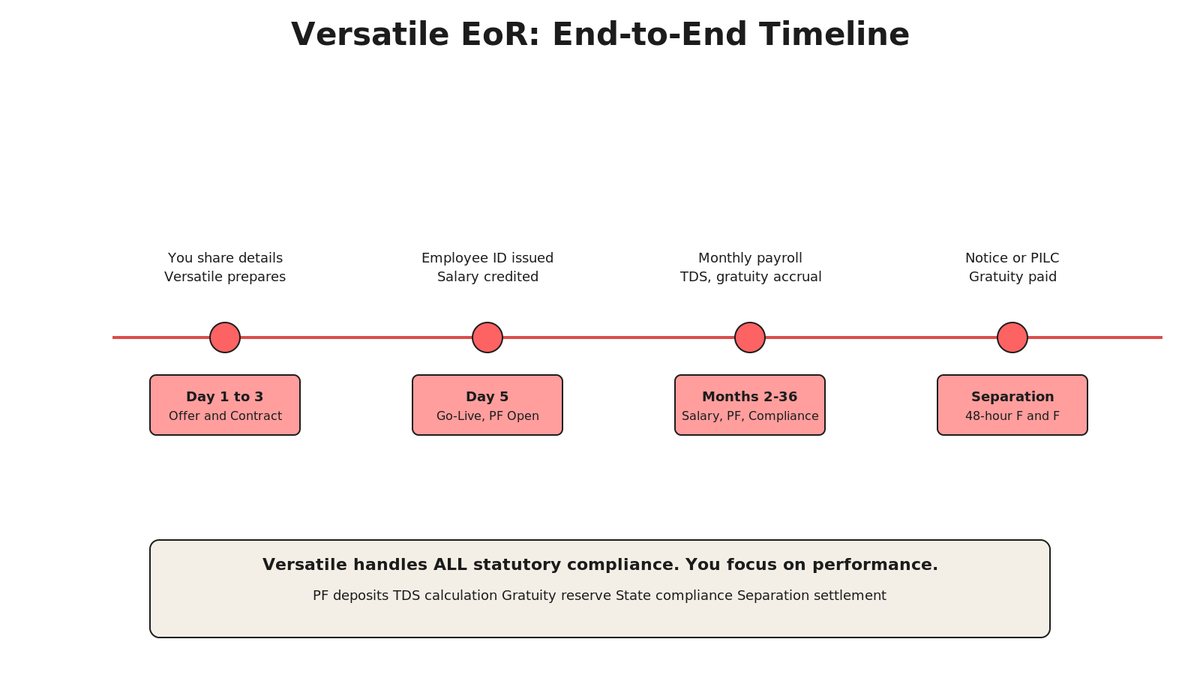
If you choose Versatile, here is the week-by-week implementation flow:
- Week 1: You send us offer letters (salary, role, location, reporting manager, benefits). We review for statutory compliance (Basic+DA ratio, statutory load, FEMA wage structure). We create the employment contract (Indian legal standard, updated for 2025 Labour Code amendments), execute on your behalf (you are principal, we are agent), and file with EPFO/ESIC.
- Week 2: Employee onboards. We create the payroll record, calculate statutory deductions (PF 12%, PT by state, gratuity accrual per-state), verify bank account for NEFT, and prepare the first run.
- Week 3: First payroll processes. You approve salary slip and NEFT list (you maintain full visibility). We execute NEFT to employee bank + statutory transfers to PF trust/ESIC board/PT collector.
- Week 4+: Ongoing: monthly payroll, TRACES filing, leave tracking, policy updates. We flag any compliance changes (Labour Code updates, state PT/LWF/ESI rate changes). You approve changes; we file. Annual: we prepare Form 49A, Form 16, tax reconciliation, gratuity actuary settlements.
- If an issue arises (e.g., employee dispute, audit notice, gratuity claim): We escalate to our in-house legal team and CA partners. You are looped in; we take point on compliance.
Total time investment for you: 2-3 hours to provide offer letters and approvals per month. That is it. No compliance officer hire. No TDS reconciliation. No Labour Court prep. No FX hedging decisions. No state-specific PT calculations. No gratuity actuary. We own it.
FAQs
What is the real monthly cost of running India payroll without a PEO or EOR?
For a 10-person India team, expect $2,400 to $4,000 per month in hidden operational cost once you count a compliance officer salary, CA fees, TDS filing software, gratuity actuary, PF trust admin, and state PT collectors. That is before penalty exposure. Compare that to $149 per employee per month on Versatile and the math flips fast.
Can I run India payroll through my US or UK payroll provider?
You can process the salary transfer, but you cannot file PF, ESI, or TDS through a US or UK provider. Those filings require an Indian entity that is registered with EPFO and holds a TAN. If you skip them, you carry unlimited liability plus interest and penalty. Use an India-native EOR or set up your own entity.
What happens if I get PF or ESI filings wrong for six months?
You get an inspection notice, back-dated interest at 12 percent annually, penalty up to 100 percent of unpaid dues, and personal director liability for the US or UK founder listed on the entity. We have seen founders hit with Rs 40 to 60 lakh assessments on 6-employee teams. Get compliance right from day one via our EOR.
Do I need to hire an India compliance officer if my team is under 20?
Not if you run through an EOR. Our team files everything under our entity and our license, so you never touch EPFO portals, PT collectors, or TDS forms. If you go direct entity, yes, you need a compliance officer at 15 headcount minimum. Book a consultation and we will map both paths.
How is Versatile priced compared to Deel, Multiplier, or Remote for India?
Versatile is a flat $149 per employee per month, first month free, no setup fee. Deel and Multiplier quote $199 to $599 depending on plan tier. Remote is $299 to $599. All three route India through partner entities they do not own. We run our own PF-licensed entity, so no third-party pass-through. See the full pricing breakdown.
What if I already have a wrong payroll setup running for 12 months in India?
We do remediation. Step one is a compliance audit (free, 48 hours). We find the gaps (unpaid PF, missed TDS, wrong Basic-DA ratio), quantify exposure, and file corrections with penalty relief where possible. Then we onboard the team onto our entity. Message me on WhatsApp through our contact page.
Where my head is right now
The market is flooded with payroll aggregators and global EOR platforms that abstract India away. They tell founders "just pay us $99/person/month and forget about India." That is not real. India's compliance is real, and when the Ministry of Labour knocks (and they will), you want someone liable standing next to you, not a Slack support channel or a sub-contracted vendor who exits when profitability drops.
Versatile exists because we saw 50+ US/UK founders burn money on contractor reclassification penalties ($90K-$110K per batch), entity setup mistakes that could have been avoided, FX hedging failures, and leave provisioning accounting errors that failed Series A audits. We are India-native. We hold the PF license. We file the TDS. We carry the insurance. And we have seen what happens when you do not get this right. That is why $149/emp/month is the price. It is not cost leadership. It is liability leadership.
If you are hiring in India and you feel lost on payroll, FX, compliance, and penalty exposure, message me on WhatsApp through our contact page, or book a consultation with us. You will be talking to the founder, not a ticket. I built this because I watched too many founders get blindsided by Rs 1 crore re-assessments and legal bills that could have been prevented. Let me help you get it right.