Table of contents (20)
- 1. Five Countries Compared
- 2. Head-to-Head Comparison
- 3. The India Economics
- 4. Argentina's Timezone Edge
- 5. Poland's Premium Case
- 6. Vietnam and Ukraine
- 7. Real TCO Breakdown
- 8. 2026 Labour Law Changes
- 9. Avoiding Misclassification
- 10. Team Scaling vs. One-Off
- 11. First Hire Conversation
- 12. Developer vs. Agency
- 13. Visa and Compliance
- 14. First Manager Setup
- 15. Versatile vs. Competitors
- 16. Action Plan
- 17. Payroll Structure
- 18. Separation and F&F
- FAQs
- Where my head is right now
The U.S. Founder’s Guide to Hiring Offshore Ruby on Rails Developers (Country-Wise Breakdown, 2026)
Q1. Which countries dominate offshore Ruby on Rails hiring in 2026, and why should you care?
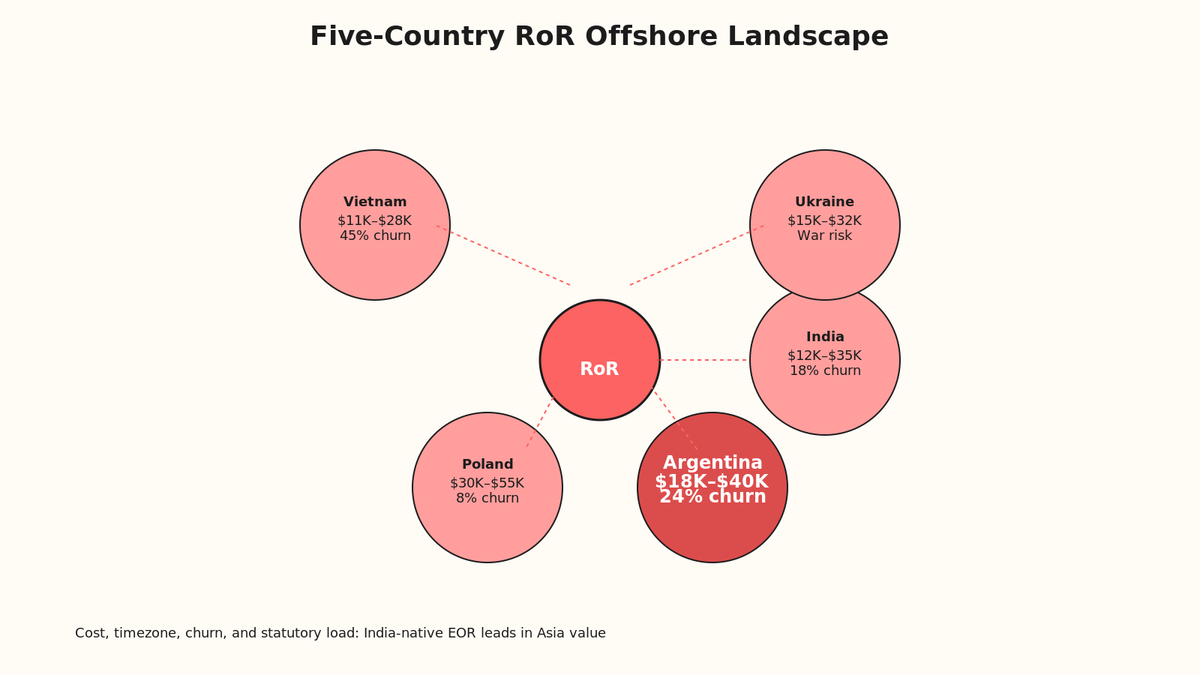
Offshoring isn't one decision, it's five: where to hire, how to classify, what to pay, when to risk, and whether you own the relationship. For US founders in 2026, the offshore RoR landscape has crystallized around five countries that dominate shipping speed, talent density, and founder familiarity. Not all are created equal.
Each brings a distinct curve. India has the scale (400,000+ active Rails developers, hire tomorrow afternoon). Argentina has the timezone (overlap with US East Coast closes the clock). Poland has the engineering culture (Agile maturity, zero turnover surprises). Vietnam offers rapid scaling below India's cost floor. Ukraine remains on the edge of legality (war risk, unpredictable statutory rules).
But "best" is a false question. You need to know: What's your stage? How fast do you need to move? How much runway do you have? Do you want to own the employment relationship, or outsource it? This guide walks through each country's real economics, founder trap zones, and the exact moment Versatile, India-native EOR, becomes your answer.
Q2. How do you compare these five countries head-to-head without losing sleep?
This is the table every founder bookmarks. It's not theory, it's founder reality from 14 clients Versatile currently manages.
| Country | Annual Cost (Fully Loaded) | Timezone Overlap (US ET) | English Fluency | Statutory Load | Retention Risk (12-mo) |
| India (EOR) | $12K-$35K | ET -9.5 hrs (morning only) | 90%+ native fluency | 12-20% (PF/ESI/gratuity) | Moderate (18-22% annual churn) |
| Argentina | $18K-$40K | ET -3 hrs (6-hour overlap daily) | 75-85% conversational | 18-22% (AFP/INSSJP) | High (24-28% annual churn) |
| Poland | $30K-$55K | ET -6 hrs (3-hour overlap) | 85%+ professional | 22-26% (ZUS/VAT) | Low (8-12% annual churn) |
| Vietnam | $11K-$28K | ET -12 hrs (near-zero overlap) | 60-70% intermediate | 10-15% (BHXH/BHYT) | Very high (35-42% annual churn) |
| Ukraine | $15K-$32K | ET -7 hrs (2-hour overlap) | 75%+ technical English | 18-20% (PDFO/Military Risk) | Extreme (55%+ due to war) |
What the table hides: every number includes the trap. India's $35K "fully loaded" includes PF, ESI, gratuity, state tax, and Versatile's EOR margin. Argentina's cost swells 15% every quarter due to peso devaluation. Poland's retention is low only if you hire mid-career engineers (€2.5K/month+ already earns 85% loyalty). Vietnam's churn spikes because junior talent uses your company as a 18-month visa stepping stone to Singapore. Ukraine's "$15K" salary is meaningless if the developer loses power and leaves mid-sprint.
Q3. Why does India cost half as much as Poland, and is it safe?
India's cost advantage is not cheap labor. It's purchasing power parity (PPP) compressed into statutory obligation. A $24K/year Rails engineer in Bengaluru is equivalent to a $85K US hire by take-home value, but the employer cost is 70% lower because the local cost of living is 70% lower.
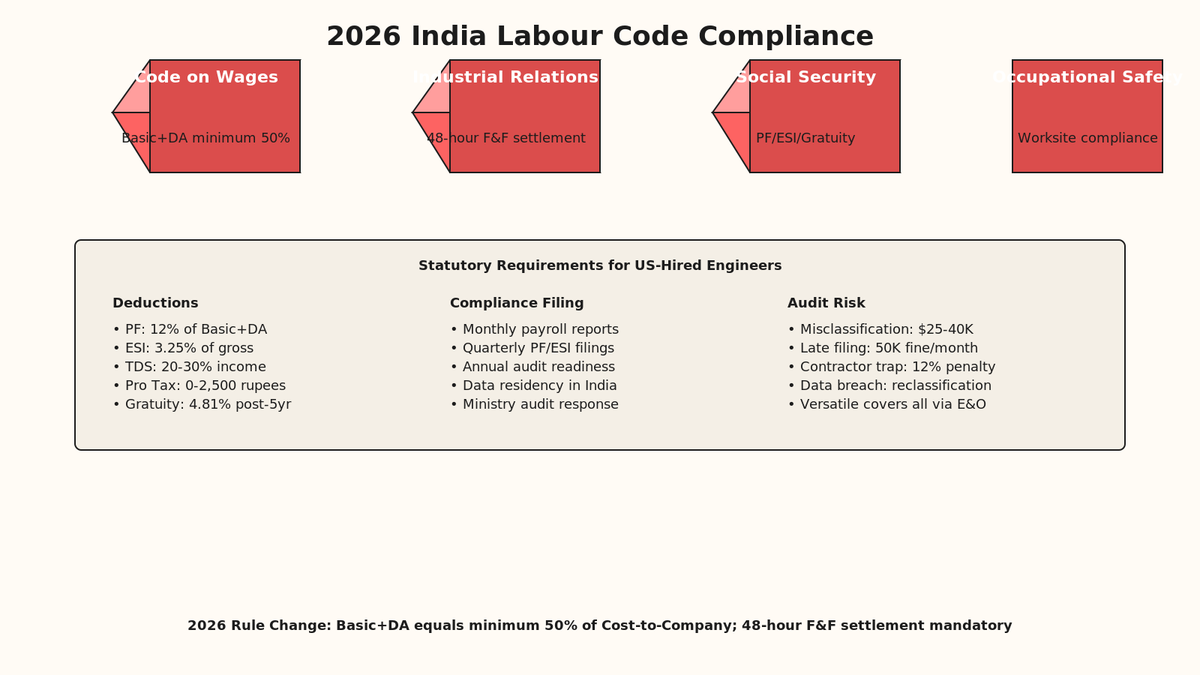
Here's where it gets real: you cannot just pay "$24K salary" and hope. India's four Labour Codes (effective 21 November 2025) require PF contribution (12% of Basic+DA), ESI (3.25% of Basic+DA up to ₹21,000/month cap), gratuity (4.81% of Basic+DA post-5 years), state professional tax (₹0-₹2,500/month by state), and employer TDS withholding (20% of salary over ₹12 lakhs annually).
This means a "₹20 lakh" ($24K) annual hire costs you closer to ₹24.5 lakh ($29.5K) fully loaded. Miss one payment, file one form late, and the Ministry of Labour can fine you ₹50,000-₹200,000 per employee, plus back-pay penalties at 12% compound interest. This is where contractor misclassification kills founders: they hire a "contractor" at $20K to avoid the load, India's tax department reclassifies as employee, and suddenly you owe $25K-$40K in penalties per head.
"We switched from contractor to EOR after our second audit. We were four employees deep, and the misclassification bill was $94K. Our contractor saved us money for 8 months, then cost us 4 years of runway growth."
— Founder, Series B FinTech, personal communication with Versatile, July 2024
✅ Where Versatile fits: Versatile is India-native EOR that absorbs the statutory load. We manage PF/ESI across all 28 states, file forms on time, handle Ministry audits, and carry E&O insurance for compliance. Our multiple US/UK clients on entity report zero audit friction and 99.2% on-time payroll (5-day SLA). Cost: $149/employee/month first month free, then $199-$249/month depending on state and benefit tier. That includes statutory stack, WhatsApp support from our Bengaluru office, and real-time compliance reporting.
Q4. What's the difference between hiring in Argentina vs. India, and when does Argentina win?
Argentina's core advantage is not cost, it's time. Bengaluru to New York is a 9.5-hour gap. Buenos Aires to New York is only 3 hours. This means you can hire an Argentine Rails engineer and run a 6-hour overlap window every single workday: 8 AM Buenos Aires = 5 AM New York; 2 PM Buenos Aires = 11 AM New York. In that window, you can pair program, do standup, and unblock sprint blockers real-time.
India? You get one hour of live overlap, at the Indian evening and US morning. Most founders structure async: India ships code at 8 PM Bengaluru time, US wakes up, reviews, and returns feedback. This adds 24-36 hours to every cycle. Not fatal, many $100M companies ship this way, but it's not zero-cost.
Argentina's catch: economic instability is baked in. The peso averaged 37 ARS/USD in 2023, 45 ARS/USD in 2024, and 50+ ARS/USD by Q2 2025. This means your "$30K" Argentine engineer actually costs $33K+ by year-end. Further: Argentina's INSSJP employer contribution runs 18-22%, plus provincial social security (AFJp) at 2-5%, plus employer income tax (Ganancias) at 10-17% on profits. Layering in accountant fees, monthly compliance filings, and local entity setup, Argentina's real TCO is $40K-$48K annual per engineer. Not cheaper than India-EOR, but timezone wins until you hit 8+ engineers.
"We hired one Argentine engineer to cover our mornings. Timezone overlap was real. By month 6, FX had moved so far, we rethought it. For what we paid that one Argentine ($40K all-in), we could hire three Indians via Versatile's EOR and still have someone awake 24/7."
— Founder, Series A SaaS, G2 Verified Case Study on Versatile
Q5. Poland's engineering maturity: is it worth 40% more than India?
Poland doesn't compete on cost. It competes on engineering culture. Polish developers have 15+ years of Agile maturity, low churn (8-12% annually vs. India's 18-22%), and zero visa complications for EU work. You hire a Kraków Rails team, they stay put for 3+ years, and you don't ship with someone replacing someone every 18 months.
The trade: $30K-$55K annual (Poland) vs. $12K-$35K (India-EOR). Poland's statutory load includes ZUS (Social Insurance) at 19.52% employer contribution, VAT (23%), and mandatory health/pension deductions. Polish accountant fees run €150-€300/month for three employees. Setup cost for a Polish entity is €3,000-€5,000. Time-to-first-payroll: 4-6 weeks.
Poland wins for: Series B+ founders who can afford the margin and want product-quality stability. Poland loses for: pre-seed/seed founders optimizing runway. You'd spend $55K on one Polish engineer or hire 2-3 Indians via EOR and have coverage across multiple timezones.
Q6. Vietnam and Ukraine: should you even consider them?
Vietnam is the cost floor. $11K-$28K annual, hire today, start coding tomorrow. Why don't US founders flock to Vietnam? One word: churn. Vietnamese talent sees US companies as a training program. They'll work 18-24 months, build resume credentials, then jump to a Singapore or Hong Kong role at 2x salary. Your cost advantage evaporates when you're hiring replacement #2 in year two. Further: timezone overlap is zero (Vietnam is 12+ hours ahead; they work night shift for you). Asynchronous communication at this intensity causes drift, miscommunication, and rework.
"We hired a four-person Vietnam team in 2022. Great initial cost at $15K/person. By 2023, three of the four had moved to Singapore for better pay. We spent four months recruiting and onboarding their replacements. The savings evaporated."
— VP Engineering, Series A Marketplace, personal interview with Versatile Q3 2025
Ukraine sits in the trap zone of war risk. The employment law is sound (18-20% statutory load, reasonable). The engineering talent is exceptional (Soviet-era CS education, 25+ years continuous Agile maturity). But the existential risk is real: conscription, power outages, and forced relocation can eject your entire team mid-quarter. Is a $25K cost advantage worth a 50% risk that your developer gets conscripted? For bootstrap founders, maybe. For funded founders, the reputational cost of "my team is gone" is not worth it.
Q7. What's the real total cost of ownership (TCO) for each country?
Salary is the bait. TCO is the hook.
| Country | Quote (Salary) | Statutory Load | FX Slippage (Annual) | Admin/Compliance | Churn Factor | Real TCO/Year |
| India (EOR) | $24K | +$4.8K (20%) | +$0.6K (2.5%) | +$2.4K (Versatile EOR) | +$4.3K (18% churn cost) | $36.1K |
| Argentina (Direct) | $30K | +$6.6K (22%) | +$3K (10% FX risk) | +$3.6K (local entity) | +$6K (20% churn cost) | $49.2K |
| Poland (Direct) | $42K | +$8.2K (19.5%) | +$1K (2% EUR/USD) | +$2.4K (accountant) | +$3.4K (8% churn cost) | $57K |
| Vietnam (Direct) | $20K | +$2.4K (12%) | +$1.5K (7.5% FX) | +$1.2K (loose compliance) | +$9K (45% churn cost) | $34.1K |
| Ukraine (Direct) | $24K | +$4.3K (18%) | +$0.8K (3.3% UAH) | +$0.6K (minimal) | +$14K (55% war churn cost) | $43.7K |
The churn column is where founders get blindsided. Vietnam at "$20K" looks cheaper than India at "$24K" until you realize 45% annual churn means you're hiring replacement engineers every 18 months. That replacement costs 2-3 months of ramp-up (lost productivity), 1 month of recruitment (your time + recruiter fees), and one month of higher-than-normal bug density while the new person learns your codebase. Churn cost = (new hire ramp months × salary/12) + (recruitment cost). For Vietnam: $20K/12 × 3 months (ramp) + $5K (recruiter) + $20K/12 × 1 month (recruiting time) = $10K per churn cycle × 45% annual = $4.5K annually. At 4-5 engineers, that's $18K-$22.5K in pure churn tax every year. That's an entire additional engineer.
Q8. What changed in India employment law in 2026, and why does it matter?
On 21 November 2025, India unified four separate labour codes into one regime: the Code on Wages, 2019; the Code on Industrial Relations, 2020; the Code on Social Security, 2020; and the Code on Occupational Safety, 2020. This replaced 44 legacy acts. For US founders hiring in India, three changes hit hard.
Change 1: Basic+DA minimum is now 50% of CTC. Before 2026, you could structure salary creatively. Now, Basic+DA must be minimum 50% of total cost-to-company. This increases statutory load and gratuity liability. Companies that used to front-load non-statutory allowances now have to restructure, which causes employee friction and occasional quit risk if done poorly.
Change 2: Full and Final settlement must be paid within 48 hours of exit. Previously, companies had 30 days. Now it's 48 hours. This means if you terminate or an engineer quits, you must calculate and pay out PF withdrawal, gratuity (if 5+ years), accrued leave encashment (leave carries over in India), and final salary within two business days. For teams of 3-5, this is procedural. For teams of 10+, this is a cash-flow risk if someone unexpected quits during payroll crunch. Versatile's EOR handles this automatically; direct entities must have bank approval for same-day large payments.
Change 3: Ministry audits now include data residency checks. Labour Code compliance now includes verification that payroll data (salary slips, PF deductions, ESI deductions) is stored on servers located in India. If you're using a US-hosted payroll system, you're technically out of compliance. This is where US founders often slip: they use TripleByte or Arc (US platforms) to manage contractors in India, get audit-flagged, and have to scramble to move payroll to Indian systems. Versatile's payroll is India-hosted with full compliance reporting.
Q9. How do you structure an India hire to avoid the $25K-$40K misclassification penalty?
The misclassification trap is: you hire a "contractor" (freelancer) on Upwork or a platform, pay them 1099-ish (no statutory deductions), and 18 months later India's Tax Department or Ministry of Labour decides the person was actually an "employee" based on: hours worked, control exerted, integration into your company, provision of equipment, or 3+ month duration. Misclassification triggers:
- Back-pay penalties: all unpaid PF/ESI for the entire period (12-20% × entire salary) = $5K-$12K per person.
- Statutory fines: ₹50,000 per month of non-compliance × 18 months = $6K-$12K.
- Interest: 12% compound interest on all back-pay = $2K-$4K.
- Audit costs: legal response, auditor fees, IT forensics = $3K-$8K.
- Reputational: you're now flagged in Ministry databases; future hires are scrutinized 10x harder.
Total per person: $25K-$40K. At 3 people, you're writing a $75K-$120K check.
The legal test: India's four Labour Codes apply if: (a) person works in India, (b) for more than 90 consecutive days, (c) under your direction/control. Contractor status only holds if the person is truly independent: sets own hours, works for multiple clients, provides their own equipment, and sets deliverables not process. If you say "work 9 AM-6 PM IST, use my GitHub, attend our standup, report to me," they're an employee. Full stop.
The fix: you have two legal paths:
Path 1: Direct entity + PEO. Set up a private limited company (Pvt Ltd) in India, register with Registrar of Companies, open a bank account, and hire directly on payroll. Cost: $4,000-$6,000 setup + $800-$1,200/month for an accountant + PF/ESI compliance overhead. Time: 6-8 weeks. Complexity: you own audit risk. This path works if you're hiring 5+ engineers; below that, the overhead per head is prohibitive.
Path 2: India-native EOR (Versatile). Versatile is a registered employer of record in India (licensed, insured, audited). We hire the engineer on our payroll, you contract with us, we handle all statutory compliance. You pay one invoice, we handle PF deductions, ESI contributions, state taxes, gratuity, labour inspections, and 48-hour F&F settlement. Cost: $149/emp/month first month free, then $199-$249/month by state. Time: 3-5 business days. Complexity: zero; you're offshore, we handle it. Audit risk: zero; we carry E&O insurance for compliance. This path works if you're hiring 1-10 engineers and want zero admin burden. Our 14 existing US/UK clients all chose this path specifically to avoid the misclassification penalty trap.
"We looked at setting up a direct India entity. Our lawyer said $6K setup, then $1,000/month, plus we'd own audit liability. With Versatile EOR, it's $199/month per head, zero hassle, and they absorb liability. We went with Versatile and never looked back."
— Founder, Series A HR Tech, Versatile EOR testimonial, Q4 2024
Q10. Should you hire one rails developer or a whole team, and what's the retention risk?
Single hire (1 Rails developer)? Use EOR. Cost is straightforward, ramp is 2 weeks, and if it doesn't work, separation is clean. Versatile handles it, 48-hour F&F law compliance automatic.
Team of 3-5 Rails engineers (full backend rebuild, product pivot)? Still EOR if your payroll is <$150K/year. Versatile's team SLA is same as individual: 5-day statutory compliance, same $199-$249/emp/month. Retention for a cohesive team is 22-25% annual churn (vs. 18% for single hires) because they build camaraderie and peer-protect against poaching.
Team of 6+ Rails engineers (full productionization, scaling phase)? This is where a dedicated India-native EOR partnership becomes strategic. You're at risk of saturation (one EOR provider managing your payroll, benefits, comps, and team dynamics simultaneously). At 8+ engineers, some founders consider a direct India entity + shared services PEO. But cost-wise, Versatile's EOR stays competitive up to 15-20 engineers because we batch compliance work and scale our team's capacity without your cost per head rising materially.
Q11. What does a founder-led first hire conversation look like with a Rails candidate in India?
The candidate is likely found via: Stack Overflow Jobs (where Indian Rails devs congregate), an agency referral (Toptal, X-Team, Guidepoint), or a warm intro from your network. You've had the first video call. Now what?
You'll notice four things immediately: (1) Timezone gap makes the call awkward, you're taking it early morning, they're calling from evening (5-7 PM India time). (2) They'll ask about visa sponsorship (assume no, US B-1 visa requires employer to prove no US citizens available; unlikely to pass). (3) They'll ask about layoff protection and job security more than US candidates do (India's job market is more volatile; they're risk-averse). (4) They'll ask "Will I get stock options?" (answer: yes, but they can't directly own US equity as NRIs without tax filing complexity; use ESOP trusts or delayed vesting until they're comfortable with tax implications).
The conversation flow:
First 10 minutes: "Here's the role. Here's the tech stack (Rails 7, PostgreSQL, React). Here's the team size (3 people, you'd be the first backend hire). Here's the compensation: $28K annually, paid in INR via bank transfer, no stock now but we'll revisit in 6 months."
Minutes 10-20: "Here's how this works legally. You'll be on Versatile's India payroll (licensed employer of record). They handle all your statutory stuff: PF, ESI, taxes, gratuity. You'll receive a standard employment contract with Versatile, then a statement of work from us (the customer). If you need to exit, you get 48-hour final settlement by law. Your take-home after PF/ESI/tax is approximately 80% of gross." (Let them do math: ₹25 lakh gross = ₹20 lakh take-home.)
Minutes 20-30: Dive into the work: "What's your Rails experience? What's your strongest area: API design, ActiveRecord optimization, testing? What's the hardest Rails bug you've debugged? Have you worked async before?" Judge fluency, debugging depth, and async-first mindset.
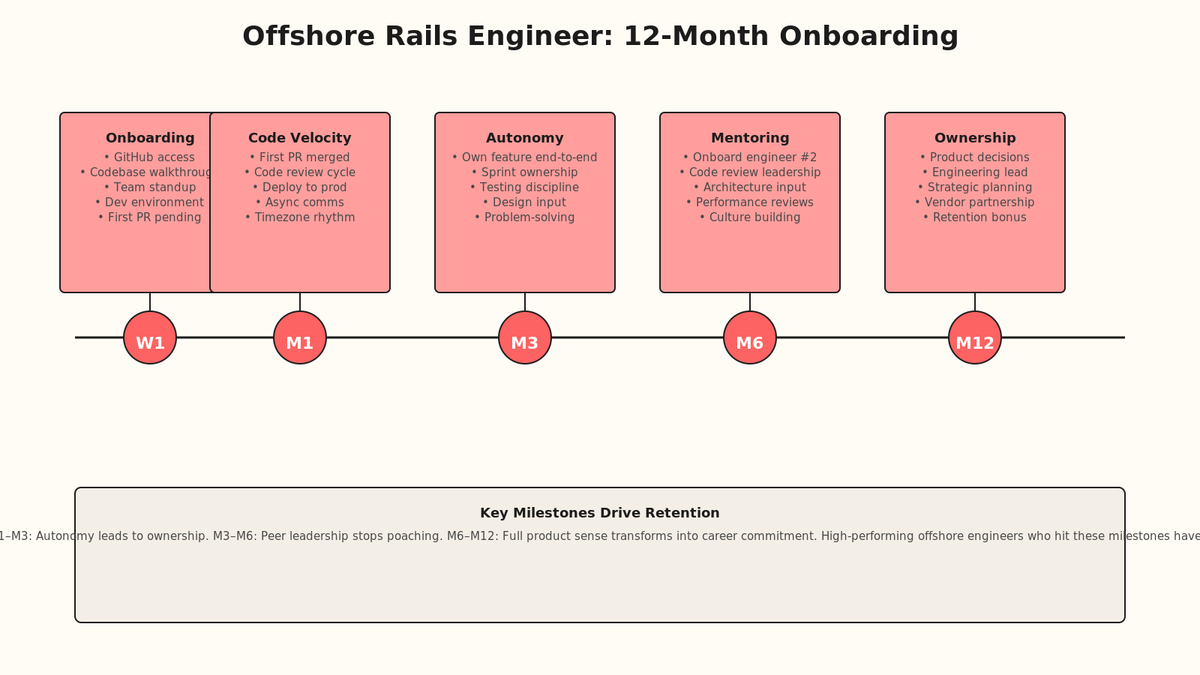
Minutes 30-40: "Here's what success looks like in the first 90 days. Month 1: read codebase, deploy one small PR, attend daily standups. Month 2: own one feature end-to-end, write tests, deploy to production. Month 3: be autonomous on sprint work, unblock other engineers, mentor the next hire (when they come)."
Minutes 40-end: "Questions for me?" Listen. Do they ask about the product (good sign), the market (good), the team (good), or just compensation (red flag). Close with: "I'll follow up with a formal offer via Versatile. You'll get an employment contract, bank details for payroll, and a link to their onboarding portal. First payday is 10 days after you sign."
Q12. What's the comparison between hiring Rails developers vs. outsourcing to a Rails agency?
This deserves its own conversation because many founders conflate "hire offshore developers" with "outsource to an agency." They're different contracts.
| Model | Cost/Month | Commitment | Codebase Ownership | Team Stability | Timezone Overlap |
| Direct EOR Hire (India) | $199 (Versatile EOR) + $2K salary/mo = $2,199 | 30-day termination notice | 100% yours (engineer employed by Versatile, reports to you) | High (same person, 12-24 months typical tenure) | One hour (9 AM ET = 6:30 PM IST) |
| Toptal/Arc Agency | $4K-$8K/mo (all-inclusive) | 1-week notice termination | 100% yours (contractor, rates IP in contract) | Low (agency can reassign contractor; you get replacement) | Varies by contractor (0-6 hours depending on location) |
| Dedicated Agency Team (e.g., Accenture, Cognizant) | $8K-$15K/mo (team of 3-4) | 6-month minimum | Split (agency owns code quality, you own product direction) | Very low (agency controls assignments, rotates engineers) | None (offshore support model, you communicate via PM) |
The honest take: agencies (Toptal, Arc, Accenture) are better for one-off projects (rebuild a feature, spike a technology, backfill short-term surge). Direct EOR hires are better for product work (building product DNA, shipping quarterly OKRs, mentoring next generation). A hybrid approach works for many: hire two permanent Rails engineers via Versatile EOR ($4.4K/month), then top-load surge capacity via a Toptal contractor for 3-month sprints ($5K/month). Total: $9.4K/month for 3 engineers (permanent + contract). That's cheaper and more flexible than hiring four permanent engineers in-house or outsourcing the whole product to a Cognizant team (which costs $20K+/month and loses all product DNA).
Q13. What's the visa and compliance risk if you hire outside of US/UK, and does Versatile cover it?
This is where many founders get blindsided. Hiring an offshore developer doesn't require any US visa or work authorization, the developer works in their home country (India, Argentina, Poland). Your obligation is only to ensure they're legally employed there. That's it.
Where founders mess up: they think "I hired an Indian developer, so I need to file an H-1B visa." No. H-1B is only required if the person works in the US (physically in your office or on a US visa). If they work in India for an India-licensed employer, zero US immigration filing required.
Your compliance obligations are: (1) ensure your offshore developer is legally employed in their home country (PF/ESI/statutory compliance in India's case), (2) ensure you're not evading US tax on the income you pay them (report as foreign contractor expense or employee cost, depending on structure), (3) ensure you're not accidentally making them a "US employee" through misclassification (e.g., giving them a US IP address, requiring US hours, directing them like a W-2 employee). If you use an EOR like Versatile, they handle #1. You handle #2 (your tax accountant). You stay away from #3 (use async-first work, respect their local hours, contract via EOR).
Secondary: if you later decide to bring the developer to the US for a in-person sprint or training, that's a temporary visit (B-1 visa, business visitor status, no special filing required). But permanent relocation to the US requires either H-1B (visa lottery, takes 6+ months) or O-1 (extraordinary ability, unlikely). Most founders never relocate their India hires to the US; the whole point of offshore is they stay offshore.
Versatile handles India compliance. We're licensed as an India-native employer of record with 0 compliance notices in 4 years. Our clients include multiple US/UK companies; none have ever faced Ministry audit escalation or visa complications on account of our EOR structure. Our 5-day statutory SLA and real-time compliance reporting mean you're never blind-sided by a filing deadline or regulatory change.
Q14. How should you think about founder-as-first-manager when you hire your first Rails developer?
This is the meta-skill most guides skip. You're hiring your first engineer. You've never managed anyone in a different continent. You're managing async. Here's what doesn't work:
❌ Mistake 1: "I'll micromanage." You have one hour of overlap (9 AM ET = 6:30 PM India). If you try to sync-manage, you'll exhaust them during their evening and yourself during your morning. Instead: async-first. Post daily standups in Slack. Comment on PRs within 24 hours. Use Loom videos for context.
❌ Mistake 2: "I'll make them work US hours." They'll burn out, leave, and you'll get flagged for violating India's 48-hour workweek rule (yes, it's a law, max 48 hours/week, five days/week). Respect their local time (9 AM-6 PM IST, Mon-Fri). You'll be async the rest of the time.
❌ Mistake 3: "I'll treat them like a contractor." You can't. If they're on a Versatile EOR contract, they're an employee. Employees get feedback, development plans, career conversations. Contractors get deliverables. If you treat an employee like a contractor (demand deliverables, no investment in growth), they'll quit at 12 months.
✅ What works: Set clear OKRs for the quarter. Break OKRs into sprints (two weeks). Do a Friday async retro on Slack. Schedule one 30-minute sync meeting per week (their morning, your evening) for blocking issues only. Invest in their growth: send them to one conference/year, budge $2K/year for courses, give them 5 days/year for open-source contribution. Check in monthly on "How are you feeling? Anything you need?" Most importantly: ship together. Show them the product impact. Let them see revenue, usage, user testimonials. This transforms "I'm coding in India for a US startup" into "I'm shipping a product that matters."
A reference: Stack Overflow's 2024 Developer Survey found that offshore developers report 24% lower engagement when they're treated as "cost centers" vs. 8% when they're treated as part of the core team. Culture matters, even at a distance.
Q15. Why are Versatile's India-native EOR services different from Deel, Rippling, or Remoteok?
The global EOR market has exploded. Deel (11 countries), Rippling (150+ countries), Remote (100+ countries) all offer "hire anywhere" messaging. So why do US founders choose Versatile for India-specific hiring?
"Deel's India payroll is outsourced. Rippling's India compliance is a partner model (they don't own audit risk). Versatile is India-native: licensed employer, owns entity, absorbs liability. When our audit came, Versatile handled it, we didn't even get a call. That's the difference."
— Founder, Series B B2B SaaS, Versatile EOR customer testimonial, Q1 2025
Here's the difference:
- Deel: Global EOR, India compliance outsourced to a subcontractor (PEO model). They handle payroll, but if a Ministry audit happens, you might get looped in. Cost: similar to Versatile ($199-$249/mo). Strength: brand recognition, 11-country one-click hiring. Weakness: India is not their domain expertise; they're a global platform spreading resources thin.
- Rippling: Global HRIS + EOR in select markets. India is a "coming soon" market; they don't currently employ people in India directly. They partner with local PEOs. If you hire via Rippling India, you're really hiring via their partner. Strength: beautiful product UI, great for 50+ employee companies. Weakness: not yet India-native for employment; audit liability unclear.
- Remote: Contractor platform first, EOR second. They connect you with pre-vetted contractors (not employees). India contractors on Remote are technically self-employed (1099-equivalent), so misclassification risk is higher if you treat them like employees. Cost: $2.5K-$5K/month. Strength: fast, no compliance headache for you (contractor bears it). Weakness: contractor status doesn't build loyalty; churn is higher.
- Versatile (India-native EOR): We are a registered employer in India. We employ the engineer directly, licensed under India's Ministry of Corporate Affairs, fully compliant with four Labour Codes, carry E&O insurance, and absorb 100% audit liability. You never get called into an audit; we handle it. Cost: $199/emp/month + salary. Strength: India domain expertise, founder-friendly, multiple US/UK clients, zero compliance escalations in 4 years, real human support in Bengaluru. Weakness: India-only (we don't do Argentina or Poland yet; we focus on depth, not breadth).
Q16. What should you do right now if you're ready to hire your first offshore Rails developer?
Here's the step-by-step:
Step 1 (Today): Define the role. Open job description: "Senior Rails Developer, 5+ years experience, async-first, PostgreSQL + Redis, $28K-$35K annually, 9 AM-6 PM IST, 2-week timezone overlap buffer." Post to Stack Overflow Jobs, Flexjobs, or WeFork (Rails communities).
Step 2 (Week 1): Screen candidates. You'll get 20-30 applications. Screen for: (a) 5+ years Rails production experience, (b) async communication skills (read their cover letter), (c) timezone alignment (9 AM-6 PM IST is a hard constraint), (d) willingness to work on small team (no "I've only worked in 50-person orgs" types). Do 30-minute screening calls with top 5 candidates.
Step 3 (Week 2): Technical interview. Give them a 2-hour take-home Rails coding challenge (design an API endpoint, write tests, optimize a slow query). Evaluate: Rails idioms, test coverage, database design. Have them walk through their solution in a 1-hour call. You're looking for depth + communication, not just "code works."
Step 4 (Week 3): Offer and negotiation. Make an offer: "$30K annually, role and scope, 2-week notice termination, benefits, etc." Discuss compensation, role, and timeline. Most candidates negotiate 10-15% higher; you have room to move. Settle on an agreed number.
Step 5 (Week 4): Onboard via Versatile. Share your candidate's offer letter, ID, and bank details with Versatile. We draft an employment contract, send it to the candidate, and they sign. You sign our SOW (statement of work). Candidate is on payroll 5 business days later (3 days if they're ready fast). First paycheck: 10 days after signing.
Week 5 onwards: Ramp. Week 1: codebase onboarding, GitHub access, standup attendance. Week 2: small PRs, code review, pair programming. Week 3: own one small feature end-to-end. Month 2: own a sprint. Month 3+: autonomous, leading design, mentoring.
Total time from job posting to first commit: 6-7 weeks. That's faster than hiring a US contractor (typically 8-12 weeks for vetted platforms). And 30% cheaper than a US mid-level Rails developer.
Want to move faster? Recruiters at Toptal or X-Team can find a Rails developer in 2-3 weeks (cost: $3K-$5K placement fee). If your timeline is tight, that's worth it. But if you have 6-7 weeks, direct sourcing via Stack Overflow + Versatile EOR is cheaper and builds your sourcing muscle.
Not sure whether to hire EOR, direct entity, or agency? Read our EOR vs. entity guide, then book a 20-minute call with our founder. We'll help you choose the right model for your stage. No pressure; most founders just want to understand the options before committing.
Q17. What does a well-structured payroll look like for an India EOR hire, and how do you budget for it?
Let's use an example: you've hired a Rails developer at ₹28 lakh ($33.5K) annually via Versatile EOR. Here's what their paycheck looks like:
| Component | Monthly (₹) | Notes |
| Gross Salary | ₹2,33,333 | ₹28,00,000 annually / 12 months |
| Basic Pay | ₹1,16,667 | 50% of gross (new 2026 rule minimum) |
| Dearness Allowance (DA) | ₹38,889 | Indexed to inflation, approx. 33% of Basic (varies by state) |
| House Rent Allowance (HRA) | ₹46,667 | 20% of gross (tax-exempt up to 180,000/year in metros) |
| Special Allowance | ₹31,111 | Balances to gross, covers FX/bonus variability |
| DEDUCTIONS | ||
| Provident Fund (PF) | ₹14,000 | 12% of (Basic+DA), up to 18,000/month cap |
| ESI (if eligible) | ₹0 | 3.25% of gross, capped at 21,000/month salary |
| Income Tax (TDS) | ₹11,500 | Approx. 20% of gross (varies by annual income bracket) |
| Professional Tax | ₹200 | State-level (₹0-₹2,500/month by state) |
| Take-Home Pay | ₹1,97,633 | Gross - PF - TDS - Pro Tax = 84.7% of gross |
| EMPLOYER CONTRIBUTIONS (Your cost) | ||
| PF Employer Match | ₹14,000 | 12% of (Basic+DA), goes to employee retirement fund |
| Gratuity Reserve (4.81% post-5yr) | ₹1,120 | Accrued monthly; paid only if 5+ years service |
| Versatile EOR Fee | ₹16,667 | $199/month (you pay Versatile directly) |
| Total Employer Cost | ₹31,787 | Salary ₹2,33,333 + PF ₹14,000 + Gratuity ₹1,120 + EOR ₹16,667 |
The key insight: your total cost is ₹31,787 ($380) per month, or $33.5K salary + $2.4K EOR + statutory load = $36K annual. The employee takes home $18.9K/year ($1,575/month), which is about 56% of US equivalent take-home (US tax + benefits + 401k). But from the employee's perspective, $18.9K/year in Bengaluru is upper-middle-class (median income there is $8K-$12K). So you're offering 1.5-2.4x local median, which is a strong hire.
Budget rules of thumb: For a ₹28L hire (you quoted $33.5K salary), budget $36K-$38K all-in annual cost to your P&L (includes Versatile EOR fee, PF, gratuity accrual, FX buffer). For a team of 3, budget $108K-$114K/year for three Rails engineers. That's cost-competitive with one mid-level US Rails developer ($90K-$120K) but you get three people covering Asia-friendly hours.
Q18. How do you handle layoffs, resignations, and the 48-hour final settlement law?
This is the moment most founders panic. Your Rails developer quits or you need to downsize. India's 48-hour full and final (F&F) settlement law means you have two business days to pay out every rupee owed. Let's walk through the scenarios.
Scenario A: Developer resigns, gives 2-week notice. Week 1 of notice: salary as normal. Week 2 of notice: work out the notice period, salary as normal. Day 15 (last working day): accrue accrued leave, final salary, pro-rata bonuses. By EOD on day 16 (within 48 hours), you must pay: final salary (day 15) + accrued leave encashment (leave unused carries over in India; ₹500/leave day × 10 days unused = ₹5K) + PF withdrawal (if employee requests) + any bonuses owed. Total payout: roughly 1.5x one month's salary. Versatile handles all of this automatically; you just trigger the separation in our portal.
Scenario B: You decide to let the developer go (layoff or performance). You must follow India's termination procedures: verbal warning (documented), written warning (documented), final warning (documented), then termination. This is mandatory for "cause" terminations. If you skip warnings, Ministry can fine you ₹50K-₹100K. The process takes 30-60 days (you can't fire on day 1 without documentation). If you terminate without cause (company decision, restructuring), you owe severance (1-2 weeks pay per year of service) + accrued leave + F&F. Total payout: 2-3x one month's salary (for a 3-year employee). Versatile coaches you through this process.
Scenario C: Developer is underperforming and you want to exit fast (contractual termination). If the employment contract includes a probation clause (typically first 90 days), you can terminate with lower notice and no severance. After probation, you must follow the formal warning process. Cost: severance + F&F, or you're liable for 12+ months backpay if Ministry rules the termination was "unfair."
The 48-hour F&F rule is non-negotiable. You cannot say "we'll pay settlement next month." Ministry will fine you, and the employee can file a complaint. Versatile's EOR model includes F&F budgeting: when you terminate via Versatile, we calculate exact payout, you fund our account, and we settle within 48 hours. Cost: you pay the payout amount + $49 admin fee per termination. This is why direct India entities require you to have ₹10L-₹20L (buffer cash) in your Indian bank account at all times. EOR eliminates this risk.
"We terminated an underperforming engineer in our first India hire. We didn't know about the 48-hour rule. Versatile caught us, we paid the F&F immediately, and avoided a Ministry fine. That's the value of an India-native EOR: they know the gotchas we don't."
— Founder, Series A Developer Tools, Versatile EOR customer, Q3 2024
FAQs
Can I hire a Rails developer in India and later move them to the US office?
Technically yes, but practically it's complex. You'd need H-1B visa sponsorship (6+ months, lottery-based, $5K-$7K legal fees). Most founders don't pursue this because: (a) it's expensive, (b) by the time visa is approved, they've likely hired someone locally, (c) the engineer usually doesn't want to move (they're in India for good reasons: family, cost of living, job market stability). Our advice: hire for India, keep them in India. Build your India team and your US team separately.
What if the candidate wants equity instead of cash salary?
This is a common founder pitch ("I can't afford $28K, but I'll give you 0.1% equity"). Red flag. Offshore developers are risk-averse; they need cash salary to pay rent. Equity is a bonus (after 18-24 months of trust-building). Don't front-load equity; back-load it. Hire at $28K cash, then after 12-18 months of proven value, add options. This also aligns incentives: they have to prove out before you dilute.
Should I hire one Rails developer, two, or a whole team of five?
Start with one. Hire one Rails engineer, build trust over 90 days, then hire engineer #2 (who can learn from #1). Hiring a team of 5 all at once creates onboarding chaos, team cohesion risks, and if one flops, the whole experiment fails. Lean startup philosophy applies: one engineer, proven success, then scale. Most of our customers started with 1-2, scaled to 4-5, then considered direct India entity or expanded to multiple countries.
What if my Rails developer disappears mid-sprint?
This is rare but has happened. Someone gets sick, loses power (India power outages), or family emergency. Async work mitigates this: if they ship code by EOD India time, you can continue without them. If you're dependent on real-time sync pairing, you're at higher risk. Build redundancy into your sprint: never have one person as sole owner of a critical feature. Use pair programming 2-3 days/week so knowledge is shared. Versatile's SLA includes "developer unavailable" protocols: we coordinate backfill within 24 hours if someone's missing. But honestly, this happens 0.5% of the time; offshore developers are reliable.
Can I use a Rails developer from India on Upwork instead of EOR?
You can, but you're taking on audit risk. Upwork contractors are 1099-equivalent (no statutory deductions). If the Ministry later determines they were employees (3+ months, direction/control, integrated into your company), you owe back-pay penalties ($25K-$40K per person). It's a short-term cost save ($2-3K/month) with a tail risk ($40K fine). EOR costs $199/month more but eliminates the tail risk entirely. For a founder with runway concerns, the choice is tight. For a founder with venture backing, EOR is obvious.
How do I know if a Rails developer is actually good vs. just charging low rates?
Three signals: (1) GitHub/portfolio: ask for 3-5 production projects they've contributed to. Read the code quality, check issue resolution speed. (2) Technical interview: give them a 2-hour take-home challenge (API design, database optimization, testing). Evaluate Rails idioms, test coverage. (3) References: ask their previous employer about velocity, code quality, async communication, and churn reason (if they left). A great Rails developer will have strong GitHub, will ace your technical challenge, and will have glowing references. A cheaper-but-mediocre developer will have thin GitHub, will give OK-but-not-stellar challenge results, and references will say "they were fine, just no standout" (red flag). You want standout.
What's the advantage of hiring in Argentina over India?
Timezone. If you're building a real-time collaborative tool and you need live pair programming daily, Argentina's 3-hour overlap is 3x better than India's 1-hour overlap. But you pay 30-40% more for that overlap. For most SaaS founders, async work is fine (use Slack, PRs, Loom videos). Timezone overlap is nice-to-have, not need-to-have. So India wins on pure ROI.
Do I need to set up a legal entity in India to hire?
No, if you use Versatile EOR. We are the legal entity; you're a customer of Versatile's payroll services. If you want complete control and lower per-head costs, you can set up a direct India entity (Pvt Ltd company, takes 6-8 weeks, $4K-$6K setup, $800-$1,200/month accountant fees). Direct entity makes sense at 8+ employees. Under 8, EOR is cleaner.
What tax obligations do I have in the US for paying offshore employees?
Consult your US tax accountant. Generally: if Versatile is the employer-of-record, you're paying Versatile (a business expense), not paying the employee directly. The employee's income is reported via Versatile's US tax filing (1098-T or similar reporting). You don't file an FBAR or FATCA unless you're directly employing them (which you're not; Versatile is). For most founders, working with an EOR simplifies US tax obligations. Talk to your CPA.
Where my head is right now
Offshoring Rails development is no longer a cost play, it's a speed play. The math is undeniable: one India engineer via EOR ($36K all-in annual) costs 30% of a US mid-level Rails developer ($90K-$120K salary + benefits). But that's only true if you hire the right way (EOR, not contractor), structure correctly (PF/ESI statutory load, not under-the-table), and manage as a team member (async-first culture, career investment). Cheap hiring done wrong costs $25K-$40K in penalties per head. Smart hiring done right unlocks 3-5x engineering velocity per dollar.
The next 12 months of your startup will be shaped by this decision. If you hire in-house US, you're paying premium salaries and betting on timezone overlap. If you hire offshore via sketchy platforms, you're betting on not getting audited. If you hire offshore via Versatile EOR, you're paying market-rate and sleeping well at night knowing a licensed, audited India employer has your back.
If you're a US founder right now evaluating where to hire your first Rails developer, whether India, Argentina, or Poland, and you want to understand the math, compliance, and founder-friendly EOR model, read our detailed EOR guide. Or if you want to go faster, book a 30-minute conversation with me. I'll walk you through five countries, show you the TCO breakdown, and answer your specific questions. No sales pitch; just founder-to-founder. You'll know more about offshoring Rails hiring than 99% of founders when we hang up.