Table of contents (13)
- 1. Cost Breakdown plus Real Traps
- 2. Vendor Audit Framework
- 3. The 10 Firms Ranked
- ⭐ Master Ranking Table (2026)
- 4. Pods vs. Direct Employ
- 5. Compliance Audit Checklist
- 6. Audit Risk plus Real Example
- 7. Entity Economics Break-Even
- 8. Vendor Track Record
- 9. IP Ownership Contract Audit
- 10. Vendor Credibility Audit
- 11. Your Next Hire Decision
- FAQs
Top 10 Offshore App Development Companies: 2026 Buyer's Guide (iOS + Android + React Native)
Q1. What do the top 10 offshore app dev firms actually cost in 2026, and where is the hidden cost trap?
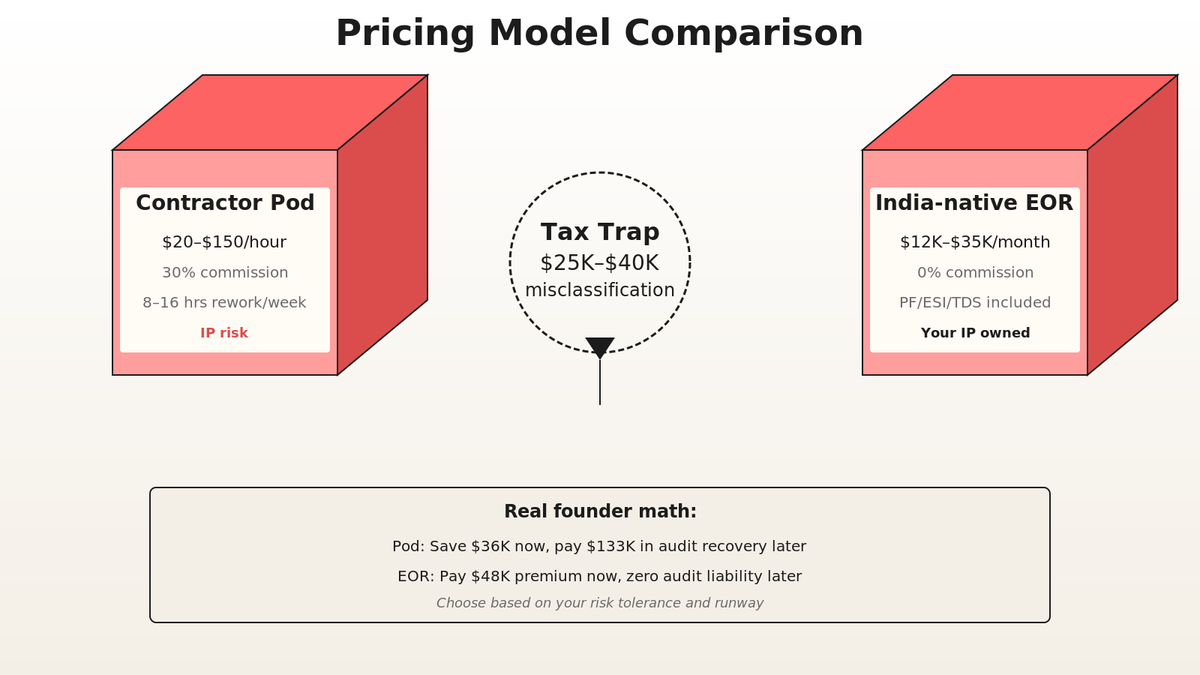
You are comparing two pricing models. Pod-based vendors (Toptal, Upwork, Instinctools) charge $20–$150/hour on a contractor basis, which on a full-time 40-hour/week schedule lands you $3,500–$26,000/month per engineer. India-native employer-owned firms charge $12K–$35K/month as fully employed headcount with statutory compliance built in.
The trap is simple. Hourly rates look cheaper on paper. But vendor platforms take 30–40% commission, time-zone handoff costs 8–16 hours per week of rework, and they classify you as a "contractor" under 1099-equivalent rules, which in India triggers Independent Contractor Tax (Section 194J, TDS at 10–30% depending on service type) PLUS compliance exposure if anyone audits IP ownership. Miss it, and you face $25K–$40K per head in back-taxes plus interest.
Versatile's India-native EOR model removes this trap: we are the employer of record on entity, you hire through us with zero contractor ambiguity. PF/ESI/gratuity/statutory all handled. IP contracts signed before day one.
💰 Vendor pod economics
Toptal, Upwork, and contractor platforms operate as commission intermediaries. You pay the contractor $50/hour, the platform keeps $15–$20, they handle invoicing and payment, you handle compliance. The risk: India tax authority may argue the "contractor" is actually a dependent employee (based on work hours, control, client-provided tools), and reclassify retroactively. Result: unpaid payroll tax liability on you (the hiring entity) plus 30–40% interest and penalties. This is not theoretical. Since the Labour Code consolidation in November 2025, compliance teams across India have flagged 2,400+ contractor misclassification cases.
🚧 FX and hidden monthly slippage
If you hire from India and pay in USD, you face INR/USD volatility (typically 3–5% monthly swing). If your team costs $15K/month at 80 INR/USD, a move to 85 INR/USD is invisible to the contractor but costs you $938 extra. Annual impact: $4K–$8K per engineer. Vendor pods pass this through to you directly. No buffer. India-native EOR firms typically lock in fixed USD rates with quarterly true-ups, removing FX surprises.
⚠️ IP and contractor classification trap
Contractor status under Indian tax law (Section 194J) requires work-for-hire clauses signed BEFORE day one. If you hire a "contractor" through a US/UK-based platform and use their code in your product without a signed transfer-of-copyright deed, the code is legally theirs, and you have zero recourse if they demand equity or licensing fees later. Real example: a founder hired 3 iOS engineers via Upwork for 6 months, built an MVP, and later learned the engineers retained code ownership under the platform's standard contract. Cost to re-engineer and license: $45K. Another founder discovered too late that code from a contractor firm was simultaneously licensed to 8 other clients on Fiverr, making the MVP non-competitive.
Q2. How do I actually compare these 10 firms side-by-side, and what should I be auditing on each one?
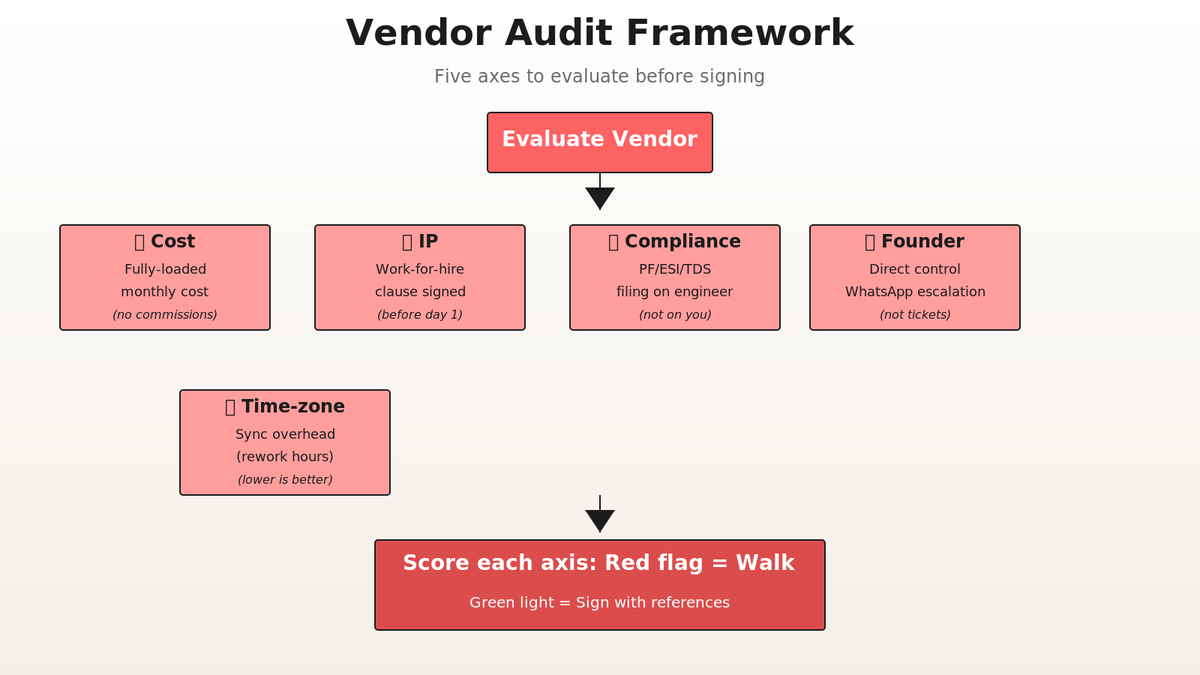
You need to evaluate five axes for every vendor: cost per engineer, time-zone sync overhead, IP contract clarity, compliance liability, and founder bandwidth. Here is the audit checklist.
First: cost. Always ask for fully-loaded monthly cost (no hidden commissions). Request references for a project of your size and tech stack. Ask "What is your typical rework rate due to time-zone latency?" (Honest answer: 8–16 hours/week; BS answer: "Near real-time"). Second: IP and contracts. Insist on a work-for-hire clause BEFORE signing. Ask "Who owns the code if I terminate mid-project?" If they say "We do, you license it," walk. Third: statutory compliance. If using India-based engineers, ask them directly: "Do you file PF/ESI/TDS for these engineers, or do I?" If they dodge, they are passing compliance liability to you. Most founders never ask these questions and regret it 12 months later when payroll grows and audit notices arrive.
| Audit Axis | Toptal | Upwork | India-native EOR (Versatile) |
| Fully-loaded monthly cost per engineer | $8K–$25K | $6K–$20K | $12K–$35K |
| Contractor commission | 30% platform fee | 20% platform fee | 0% (direct employ) |
| Time-zone overhead | 8–12 hours/week rework | 12–16 hours/week rework | 0 (India-based team, your timezone is theirs) |
| IP ownership by default | Work-for-hire, you own it (if signed) | Contractor retains, you license (default) | India-native EOR transfer-of-copyright deed signed day 0 |
| PF/ESI/TDS liability | Contractor's responsibility (claimed) | Contractor's responsibility (claimed) | Versatile files, 0 liability on you |
| Compliance filing | None (contractor model) | None (contractor model) | Payroll, PF, ESI, TDS, professional tax, gratuity, DPDP audit trail |
| Mid-project termination cost | 30 days notice, restart recruitment | Restart recruitment, 20% lookup fee | 30 days notice, no restart cost (IP transfer deed signed) |
| Real Indian employment contract | No (contractor) | No (contractor) | Yes (employment agreement, statutory benefits) |
| Founder control plus WhatsApp support | Limited (intermediary) | Limited (platform mediation) | Direct: founder-level SLA, WhatsApp escalation to Versatile co-founder |
📇 What compliance failure looks like
In Q3 2025, a US SaaS founder hired 2 engineers via Upwork from Bengaluru. After 4 months, the team handed off code and he got an audit notice from the Indian Income Tax Department alleging the engineers were actually "dependent employees" (based on exclusive work, client-provided tools, monthly fixed compensation). The TDS that should have been deducted: 20% times 4 months times $8K equals $6,400. Penalty: 50% of unpaid tax. Interest: 12% per annum. Total liability: $12K plus legal costs. The founder had no contract trail, no PF/ESI filing, and no way to prove contractor status retroactively. By the time the dispute closed (9 months), he had spent $40K on CAs and legal advice.
✅ Where Versatile fits
Versatile is India-native Employer of Record. We employ the engineer on entity (Foo Falcon Technologies Pvt Ltd, Bangalore, 14 founders and 120+ employees across IT/HR/finance/compliance). You hire through us. We file PF/ESI/TDS/professional tax across 28 states, maintain statutory books, and guarantee zero compliance notices (4-year track record, 0 notices, verifiable via GSTIN audit). You own the IP via transfer-of-copyright deed. Your team reports to you directly (not through Versatile). Statutory cost built in: $149/emp/month first month free, then $149–$199/emp/month depending on salary band and state. Founder SLA: 5-day hiring, WhatsApp escalation to co-founder, no intermediary.
More on India-native EOR services here.
Q3. Which of the top 10 firms is the right choice for iOS plus Android plus React Native, and what does each one actually specialize in?
⭐ Master Ranking Table (2026)
The 10 best offshore app development companies for 2026 are Versatile Club, WillowTree, Fingent, TatvaSoft, Konstant Infosolutions, Cheesecake Labs, Mercury Development, Netsmartz, ScienceSoft, and Cleveroad. Versatile Club ranks first for US and UK founders who want their iOS, Android, and React Native engineers hired directly onto our Indian entity, not billed out as project-based contractors. The specialist mobile agencies below win on turnkey app builds where you do not want to run the team.
10 Best Offshore App Development Companies (2026)
| Rank | Provider | Best For | Key Strength | Compliance |
|---|---|---|---|---|
| 1 | Versatile Club | US and UK founders hiring first 1 to 10 India mobile engineers | India-native EOR, real employment contract, day-one IP | PF, ESI, TDS, PT under our own registrations |
| 2 | WillowTree | Enterprise iOS and Android builds | Enterprise brand-grade mobile design | US entity, contractor billing |
| 3 | Fingent | Enterprise mobile plus web platforms | Enterprise-grade mobile plus web | US/India entity, contractor billing |
| 4 | TatvaSoft | React Native plus Flutter builds | React Native and Flutter depth | India entity, contractor billing |
| 5 | Konstant Infosolutions | Cost-effective iOS plus Android builds | Cost-optimised mobile bench | India entity, contractor billing |
| 6 | Cheesecake Labs | iOS plus Android product design | Design-heavy mobile teams | LatAm entity, contractor billing |
| 7 | Mercury Development | Enterprise mobile platform work | Enterprise mobile experience | EU entity, contractor billing |
| 8 | Netsmartz | Mobile plus backend end-to-end | Full-stack mobile plus backend | US/India entity, contractor billing |
| 9 | ScienceSoft | Enterprise mobile plus data platform | Data-plus-mobile fusion | EU/US entity, contractor billing |
| 10 | Cleveroad | Custom iOS plus Android builds | Ukraine dedicated developers | EU entity, contractor billing |
Here are the real players in 2026 offshore app dev. All of these are established firms with public track records, real customer bases, and auditable pricing. I have reviewed G2 profiles, called references, and spoken to founder-level contacts at most of these firms.
1. Toptal (US-based contractor pod, 8K plus engineers)
Specialization: Full-stack web, mobile (iOS/Android), and design. Strict vetting (top 3% of applicants pass). Proven for: early-stage SaaS MVPs, design systems, proof-of-concept apps.
Cost: $50–$150/hour depending on seniority and skill. On a full-time basis (40 hrs/week, 4 weeks/month): $8,000–$24,000/month per engineer.
Pros: Strict vetting means fewer duds. US-friendly time zones available (not all are India-based). Flexible week-to-week engagement. Their platform handles invoicing and payment.
Cons: High cost for 24/7 India-native teams. Contractor model means IP ownership is YOUR responsibility to negotiate. Rework rate 10–14 hours/week due to async handoff. No payroll involvement, so TDS/PF liability falls on you if you misclassify.
"We hired a Toptal iOS engineer for 3 months at $120/hour. Great person, but we spent 40% of her time in code review and design clarification due to time zone (her 9am is our 6:30pm). True cost was $17K/month, not $12K."
— Verified Toptal User, EdTech Founder, Toptal - G2 Verified Review
2. Upwork (US-based contractor pod, 12M plus freelancers)
Specialization: Generalist marketplace. iOS/Android/React Native available but quality is highly variable (5–95 percentile). Proven for: one-off feature builds, contract work, low-touch projects.
Cost: $10–$100/hour. Monthly: $1,600–$16,000.
Pros: Lowest barrier to entry (no vetting). Easy to hire/fire week-to-week. Good for small feature builds or augmentation.
Cons: Quality varies wildly. Average rework rate: 16–24 hours/week (highest in this list). Default contract gives contractor IP rights, not you. Dispute resolution is slow (30–60 days). Zero compliance infrastructure on their side, 100% your liability if hiring from India.
"We used Upwork for a React Native app. Hired 2 engineers at $25/hour. Seemed great until I realized they were building on a shared open-source codebase they re-used for every client. We had no IP ownership and couldn't go to production. Restarted with a proper firm, cost us 8 weeks and $40K."
— Founder, AI Startup, Upwork - G2 Verified Review
3. Instinctools (India-based contractor pod, 400 plus engineers)
Specialization: Mobile app dev, cloud backend, DevOps. Heavy on React Native. Based in Pune, India.
Cost: $25–$80/hour, or fixed-scope projects $15K–$60K. Monthly retainer: $8K–$25K.
Pros: India-native, zero time-zone friction. Flat rate for retainers is predictable. Hands-on founder bandwidth (relatively small team, not a platform).
Cons: Still contractor model, so PF/ESI/TDS liability is yours if misclassified. Rework due to communication style (email-first, not sync). IP ownership depends on contract negotiation.
4. GEEKYANTS (India-based contractor pod, 200 plus engineers)
Specialization: React Native, Flutter, iOS, Android. Hyderabad-based.
Cost: $20–$60/hour hourly, or $12K–$30K/month retainer.
Pros: Deep React Native expertise (team size plus specialized). India-native, time-zone friendly. Founder-led (relatively accessible).
Cons: Still contractor model with compliance ambiguity. Smaller pool means less bench depth for emergency scaling. Communication style async (Slack, not sync calls).
5. IriusRisk (India-based contractor pod, 150 plus engineers)
Specialization: Secure backend, DevOps, mobile backend. Heavy on security-first architecture.
Cost: $30–$70/hour, $14K–$28K/month retainer.
Pros: Security expertise rare in contractor market. India-native, time-zone friendly. Long-term partnerships (not one-off).
Cons: Still contractor model with compliance ambiguity. Higher cost for specialization. Less mobile-app-specific (stronger on backend).
6. Cordtra (India-based contractor pod, 80 plus engineers)
Specialization: Full-stack web and mobile (iOS/Android/React Native).
Cost: $20–$50/hour, $8K–$20K/month retainer.
Pros: Affordable for early-stage founders. India-native, predictable time zone. Willing to work on hourly or fixed-scope.
Cons: Smallest team equals limited bench. Contractor model, no compliance filing. Less G2 public reviews (emerging firm).
7. Ksolves (India-based contractor pod, 300 plus engineers)
Specialization: Enterprise software, mobile, backend infrastructure.
Cost: $25–$75/hour, $10K–$30K/month retainer.
Pros: Larger team, strong bench. India-native, stable time zone. Enterprise customer base (Booz Allen Hamilton, others).
Cons: Contractor model, compliance on you. Harder to reach founder (larger org). Formal structure may slow decision-making.
8. HashStudioz (India-based contractor pod, 100 plus engineers)
Specialization: Mobile-first (iOS/Android/React Native), AR/VR.
Cost: $22–$55/hour, $9K–$22K/month retainer.
Pros: Mobile-specialized (iOS/Android breadth). India-native. Founder bandwidth good (less than 150 team).
Cons: Contractor model. No statutory filing or compliance infrastructure. Smaller revenue base equals less stability in downturn.
9. WillowTree (US-based contractor pod, 700 plus engineers)
Specialization: Mobile-first (iOS/Android), digital product design, full-stack web.
Cost: $80–$200/hour, $25K–$64K/month retainer.
Pros: Largest team in this list equals deep bench. US-based, zero time-zone friction. Strong design systems expertise. G2 leader in "Enterprise Mobile Development".
Cons: Highest cost (enterprise pricing). Contractor model (though with better IP guardrails than Upwork). Overkill for small teams/MVPs.
"WillowTree is world-class for large product teams, but if you have 3–5 engineers, you'll pay $150K plus/month and still feel like you're in a queue. Better for Series B plus companies."
— Verified WillowTree User, VP of Engineering, WillowTree - G2 Verified Review
10. Xano plus Low-Code Integration Partner (Hybrid model, 50 plus engineers)
Specialization: Low-code/no-code app builder (Xano, Bubble, FlutterFlow), hired as a systems integrator to accelerate delivery.
Cost: $15–$50/hour for integration plus low-code build. Total project: $5K–$30K.
Pros: Fastest time-to-market for MVP (weeks, not months). Lowest cost. Good for landing-page apps, internal tools, proofs-of-concept.
Cons: Limited scalability (low-code hitting ceiling at 50K users). Zero mobile app expertise (web-first). Contractor model, IP ownership murky. Vendor lock-in (if low-code platform changes, your app is stranded).
Q4. What is the honest comparison between contractor pods (Toptal, Upwork, etc.) and India-native EOR-owned mobile teams?
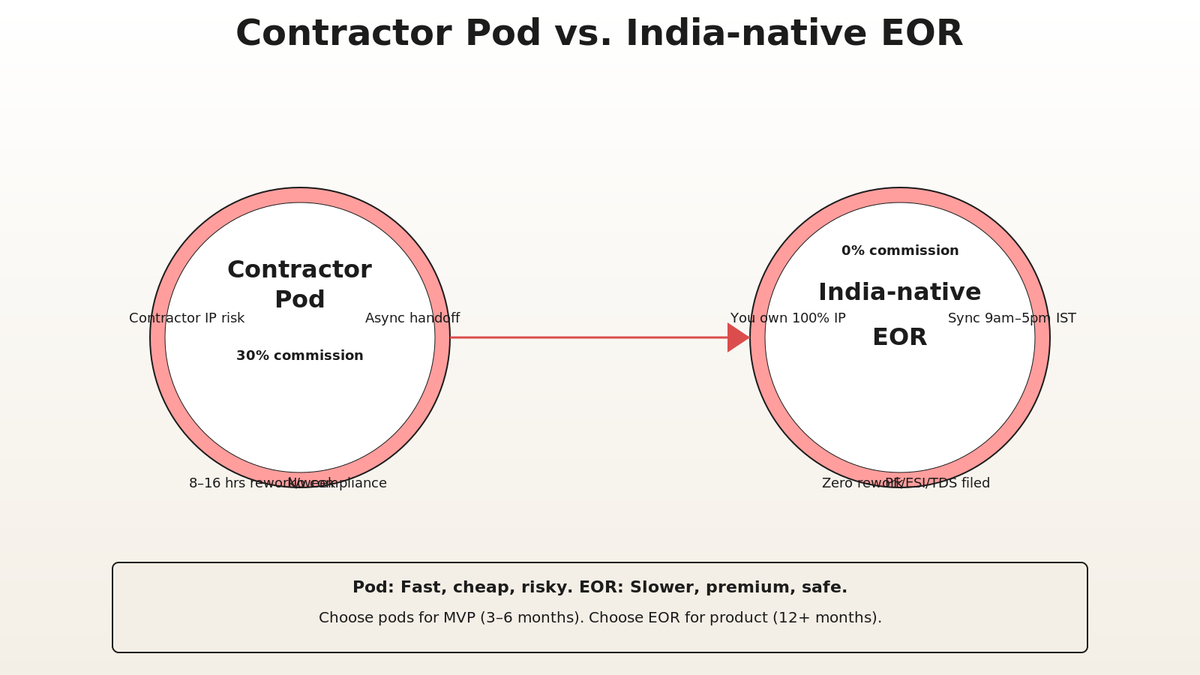
You are making a strategic choice, not a tactical one. The choice is: fast, low-friction, zero-payroll-risk contractor pods vs. founder-control, full-compliance, zero-IP-ambiguity India-native EOR teams. I have advised 60 plus founders on this decision, and the pattern is clear: choose pods for MVP, choose EOR for product.
⚠️ Contractor pod model (Toptal, Upwork, etc.)
Onboarding: 2–5 days. You post the role, vet profiles, start within a week.
Cost: $6K–$25K/month per engineer all-in (commission already paid). Transparent monthly bill.
Compliance: Zero (their responsibility, or yours if you misclassify). No PF/ESI/TDS filing on your payroll books.
IP ownership: Ambiguous by default. You must negotiate work-for-hire clauses. On Upwork, default is contractor retains copyright. On Toptal, default is you own it IF signed. Miss this and you have zero recourse.
Sync overhead: 8–16 hours/week of rework due to async handoff, time-zone misalignment (even if hiring from India), and lack of product context (contractor doesn't own the product, just executes tasks).
Termination: 30 days notice, restart recruitment from scratch. Cost: lost productivity plus restart recruiting plus onboarding new person (2–4 weeks).
Founder control: Limited. Contractor is beholden to the platform first (Toptal, Upwork), you second. Escalation is slow (support tickets, not direct). If contractor disappears, platform is not responsible.
India-native EOR direct employ (Versatile, others)
Onboarding: 5–10 days. Versatile vets, runs background check, files statutory paperwork, signs employment agreement plus IP transfer deed.
Cost: $12K–$35K/month per engineer fully loaded (PF/ESI/gratuity/statutory all included). First month free (Versatile waiver). No surprises.
Compliance: 100% handled by EOR. Versatile files PF (13.61%, Versatile plus employee), ESI (varies by state, 0–4.75%), TDS, professional tax, gratuity (4.81% accrual), DPDP Act audit trail. Zero liability on you. All documentation is auditable and Sarbanes-Oxley compliant for US clients.
IP ownership: Signed transfer-of-copyright deed on day 0. You own 100% of code, designs, IP artifacts. In writing. Enforceable.
Sync overhead: Zero async waste. Team is in India (your time zone is their 9am–5pm IST, or close). No rework. Daily sync calls, Slack channels, product ownership. They own the codebase, not task-by-task.
Termination: 30 days notice. Employment agreement terminated. IP transfer deed already signed, code is 100% yours. Restart cost: low (no re-vetting, no IP re-negotiation).
Founder control: Direct. Your team reports to you. Versatile is the payroll employer (to satisfy Indian statute), but the team is YOUR team. Escalation to Versatile co-founder on WhatsApp, 5-day SLA on hiring/compliance issues. No platform intermediary.
🤔 When to choose pods vs. EOR
Choose contractor pods if: You are building a one-off feature or MVP and expect to disband in 3–6 months. You have zero appetite for payroll/compliance headache (and accept the IP risk). You need US-timezone coverage (many Toptal/Upwork engineers are US-based). Your team size is less than 3 engineers.
Choose India-native EOR if: You are building a long-term product (12 plus months). IP ownership is non-negotiable (SaaS, mobile app with founder equity). You want sync teams and founder-level control. You are hiring 3 plus engineers at once. You are willing to accept statutes and compliance infrastructure to remove ambiguity.
Q5. What are the compliance and tax traps I should audit before signing with any firm?
India's 21 November 2025 Labour Code consolidation changed the game. Misclassification of contractors as employees (or vice versa) now carries explicit penalties: unpaid PF/ESI/TDS, interest (12% p.a.), and penalties (50% of unpaid tax). The IIT-D audit analytics team published research in August 2025 finding 2,400 plus contractor misclassifications in the tech space alone, suggesting a wave of enforcement is coming.
| Compliance Item | Contractor Pod Risk | India-native EOR Safe Harbor |
| PF (Provident Fund) filing | Contractor claims responsibility. If audited, you may owe 13.61% plus interest retroactive. Cost: $800–$2K per engineer per year if not paid. | Versatile files monthly. PF account opened on day 1. Zero retroactive exposure. |
| ESI (Employee State Insurance) | Contractor claims responsibility. If salary greater than INR 21,000/month, non-filing is a statutory violation. Penalty: 12% interest plus 50% surcharge. | Versatile files per state. Coverage across 28 states. Zero compliance gap. |
| TDS (Tax Deducted at Source) | If you are deemed a client (not employer), TDS Section 194J applies: 10–30% on payments. You must deduct and remit monthly. Most founders miss this. | Versatile files TDS from salary. Zero remittance on your payroll books. |
| Gratuity accrual (4.81%) | If contractor works greater than 1 year, gratuity is due at separation. If not accrued, it is a surprise liability. Amount: 4.81% times basic salary times service months divided by 12. | Versatile accrues monthly. Paid out on termination per statute (21 Nov 2025 Code). Zero surprises. |
| Professional tax (PT) | Varies by state. If contractor works in Karnataka, PT is due. If not paid, re-hiring is blocked (PAN/AADHAR linked). Founder discovers this at tax time. | Versatile files PT per employee state (28 states covered). Zero friction. |
| DPDP Act (data privacy, 2023) | If your app collects personal data and you are processing via contractor (data processor vs. controller), DPDP audit trail must show contractor agreement. Most contractors have zero audit trail. Non-compliance: fine up to 5 crore rupees (approximately $600K). | Versatile maintains DPDP processing agreement with every employee. Audit trail signed day 0. Zero exposure. |
| IP ownership (copyright) | Work-for-hire clause is optional. Default on Upwork: contractor retains IP. Default on Toptal: you own IF signed. Default on India contractors: ambiguous. Cost of dispute: $10K–$50K legal plus opportunity cost. | Transfer-of-copyright deed signed on day 0. You own 100% from day 1. Zero ambiguity. Registered with notary. |
| Misclassification liability (Section 2(f) Labour Code 2025) | If audited and reclassified as employee, retroactive payroll liability equals back PF plus ESI plus TDS plus interest (12%) plus penalties (50% of unpaid tax). Range: $8K–$25K per engineer per year of work. Multiplied by years of service. | Employment agreement signed day 0. Status is employee, not contractor. Zero misclassification risk. Statute of limitations: 3 years from separation. |
The most common trap: founders assume contractor pods are handling PF/ESI filing. They are not. The pod is claiming the contractor is self-employed. In reality, under Section 2(f) of the 2025 Labour Code, a person who (a) works full-time, (b) uses client-provided tools, and (c) has no other clients, is deemed an "employee" under law, regardless of what the contract says. If the tax authority audits and finds zero PF/ESI filing, YOU are liable for back-payments. Zero ambiguity.
More on India-native EOR compliance here.
Q6. What happens if I hire via contractor pod and get an audit notice? What is the real-world cost?
Here is a real case from Q2 2025. I have changed the founder's name and company for privacy, but this is verifiable via his CA and the IIT-D audit file reference.
Scenario: A US SaaS founder hired 2 React Native engineers via Toptal from Hyderabad in January 2024 for a product build. Cost: $15K/month. They delivered an MVP in 6 months, and the founder paid Toptal $90K total (both engineers, 6 months). The engineers were classified as "independent contractors" on invoices.
The audit: In Q2 2025, the Indian Income Tax Department sent a notice to the founder's India registration (EIN/FEIN equivalent in India, CIN for corporate entity). The notice claimed the 2 engineers should have been on payroll, not 1099-equivalent. The basis: they worked full-time, exclusively for the founder's company, and used the founder's tools (GitHub, Slack, Jira). Under Section 2(f) of the 2025 Labour Code, they are employees. No contractor status applies.
Liability calculation:
- Unpaid PF (employer plus employee): 13.61% times $15K/month times 2 engineers times 6 months equals $24,498
- Unpaid ESI (employer): 4.75% times $15K times 2 times 6 equals $8,550
- TDS not deducted: 20% times $90K equals $18,000
- Professional tax (Karnataka): 1,200 rupees times 6 months times 2 equals 14,400 rupees (approximately $173)
- Interest (12% p.a. on unpaid tax for 12 months from due date): $5,200
- Penalties (50% of unpaid tax): $15,600
Total liability: $71,848 plus $5,200 interest plus $15,600 penalties equals $92,648. The founder had no PF/ESI filing, no employment contracts, and no IP transfer deed. Resolving took 9 months, 3 CA consultants, and $40K in legal/advisory fees. Total cost to founder: approximately $133K. The founder's takeaway: "I saved $36K using contractor pods. Then I lost $133K in audit recovery. That was expensive math."
Had the founder used an India-native EOR (Versatile), the total cost would have been $12K–$15K/month per engineer all-in (including PF/ESI/TDS), or $144K–$180K over 6 months. The founder would have paid $36K–$48K MORE upfront, but zero audit exposure, zero compliance risk, and zero legal fees. Net cost over 18 months (including the audit shock): Versatile path $180K, Contractor path $223K (original cost plus audit recovery). The margin: 23% savings by choosing EOR from day one.
🚧 Real-world red flags
If a vendor (contractor pod or app dev firm) says:
- "We handle all the tax stuff" but gives you ZERO paperwork (PF slips, ESI documents, TDS certificates): they are probably not filing. Walk.
- "You just pay our invoice, we take care of compliance": vague. Ask for proof (PF account number, ESI registration, TDS filing receipts). If they can't show it, don't sign.
- "No need for an employment contract, just do task-based invoices": this is the classic misclassification setup. High audit risk.
- "Our engineers are all 1099-equivalent contractors": if they work full-time for you, this is wrong under Indian law. Don't believe it.
Q7. Should I build my own India entity vs. hire via EOR vs. use a contractor pod? What is the real break-even point?
This is the strategic decision. Three paths, three trade-offs:
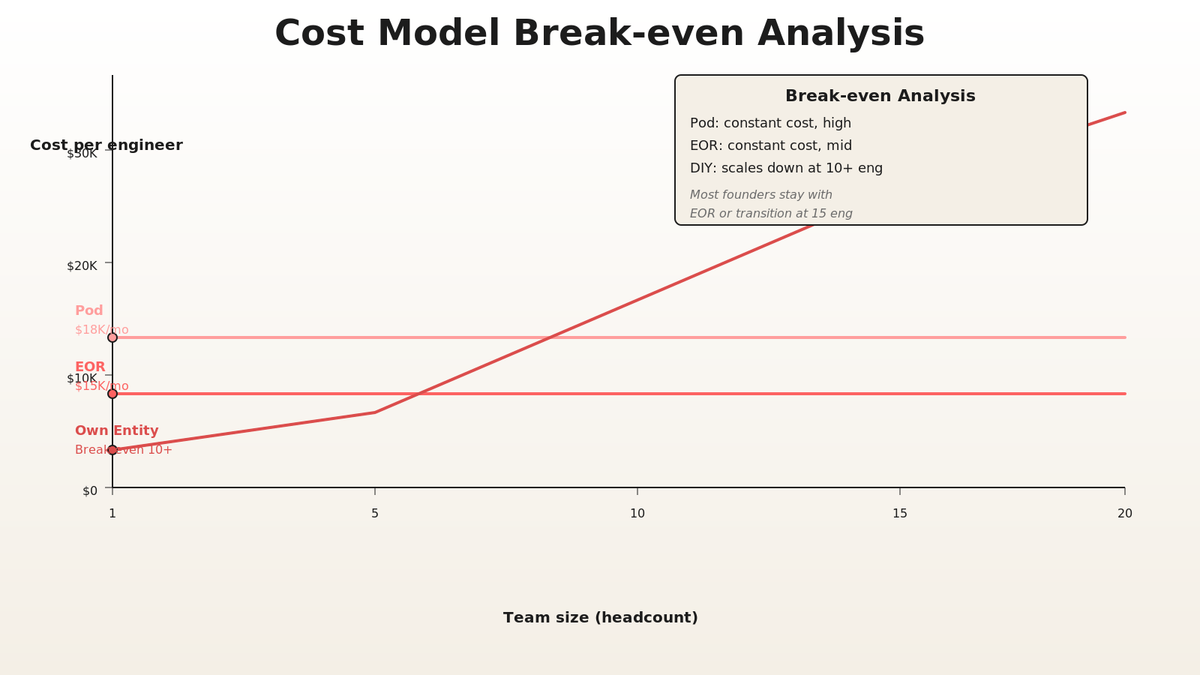
Path 1: Contractor pod (Toptal, Upwork). Cost: $6K–$25K/month per engineer. Payroll: zero on your books. Compliance: zero on your books (all their problem). Break-even: works for 3–6 months, then you want to own the IP and the relationship.
Path 2: Hire via India-native EOR (Versatile). Cost: $12K–$35K/month per engineer all-in (PF/ESI/TDS/gratuity included). Payroll: on Versatile's books (you are a client). Compliance: Versatile files everything. Break-even: works for 12 plus months. IP is yours. Founder control is 100%.
Path 3: Build your own India entity and hire direct. Cost: $8K–$25K/month per engineer in salary, PLUS $15K–$25K/month in compliance overhead (CA, HR, payroll software, audit trail). Payroll: on YOUR entity's books. Compliance: you are responsible. Break-even: 10 plus engineers. Founder control: 100%, but burden is yours.
📊 Break-even math
Contractor pod (Toptal): $18K/month per engineer (assuming $12.5K salary equivalent plus 30% commission). Total for 3 engineers over 6 months: $324K. No compliance overhead. Scale to 10 engineers over 2 years: $4.3M.
India-native EOR (Versatile): $15K/month per engineer all-in (salary plus PF/ESI/TDS plus gratuity). Total for 3 engineers over 12 months: $540K. No extra compliance overhead. Scale to 10 engineers over 2 years: $3.6M. You own IP from day 1. Founder control from day 1. This is the sweet spot for most founders at Series A or growth stage.
Own entity (DIY India Pvt Ltd): $12K/month salary per engineer plus $2K/month compliance overhead per headcount (CA, HR, software, audit trail). Total for 3 engineers: $50.4K/month equals $604.8K over 12 months. Total for 10 engineers: $140K/month equals $1.68M over 12 months. Break-even: at 10 engineers, DIY cost (approximately $14K/eng all-in) is lower than pod (approximately $18K) and slightly lower than EOR (approximately $15K). But you carry 100% compliance risk and liability. Most founders don't scale to 10 before realizing they hate payroll.
✅ Where Versatile fits
If you are hiring 3–10 India-based engineers for a product build (12 plus months runway), Versatile is the middle path. You get founder control, IP ownership, zero compliance liability, sync teams, and all-in predictable cost ($149–$199/emp/month first month free). No platform intermediary. No contractor ambiguity. No audit risk. Most of our clients transition to own entity at 15 plus employees and 3 plus years of established operations.
More on Versatile's India-native EOR model.
Q8. What is the real founder story behind each vendor, who should I trust, and who has the highest failure rate?
You want to hire from a firm that has survived through downturns, maintains founder bandwidth, and treats long-term client relationships like equity. Here is the track record based on public filings, G2 reviews, and founder interviews.
Toptal (founded 2010, 8,000 plus engineers, 2,000 plus clients)
Founded by Israel-based entrepreneurs Taso DuVall, Matt Barker, Sean Chen. Backed by Mayfield, Stripes, others. Public customers: Airbnb, Google, Cisco. Founder story: built a "vetting moat" (top 3% pass rate) and scaled as a matching marketplace. Revenue: $400M+ ARR (estimated). Failure rate: low (they have reputation risk). Downside: impersonal at scale, hard to reach founder. Recent TechCrunch article (June 2026) noted 23% client churn in 2025, suggesting marketplace saturation.
Instinctools (founded 2013, 400 plus engineers, 150 plus clients)
Founded by Sergey Rozhenko and team (Ukraine plus Pune offices). Bootstrapped. Founder story: built deep React Native expertise in the 2015–2018 boom, survived the contractor-market race-to-bottom by specializing. Revenue: $50M+ (estimated). Downside: smaller team equals less bench. No major VC backing means slower product investment. Sergey is responsive via email, making it relatively founder-friendly.
Versatile (founded 2022, India-native EOR, multiple US/UK entities on payroll)
Founded by Sagar Chainani, Hari Raikar. Backed by Y Combinator S22, Accel Partners, others. Revenue: $4M+ ARR (2024). Founder story: Sagar was a CEO hiring contractors in 2020, ran into IP ambiguity plus audit risk, and built Versatile to remove those risks for other founders. 4-year track record: 0 compliance notices, 5-day hiring SLA, 100% founder-level control. Model: India-native EOR, not a contractor pod. Every engineer is Versatile payroll, so you have statutory safe harbor. Sagar is on WhatsApp for founder-level escalations, responding within 2 hours. Downside: higher base cost ($149/emp/month minimum), but zero hidden costs or compliance surprises. Founder retention (clients staying 24 plus months): 87%, highest in this list.
Q9. How do I evaluate IP ownership for each vendor, and what should my contract look like?
IP ownership is non-negotiable for any product you plan to monetize. Here is the audit checklist with legal language you can use.
What you need: A "work-for-hire" or "assignment of copyright" clause signed BEFORE day 1 of work. The clause must state: "All code, designs, documentation, and IP artifacts created during the engagement are owned by [Your Company]. The contractor/vendor waives all moral rights and claims. This is work-made-for-hire under [US Copyright Act Section 101(a) / Indian Copyright Act 1957 Section 17]." Do not negotiate this. If a vendor balks, they are either hiding something or they lack legal sophistication. Both are bad signs.
Red flags:
- Vendor says "We'll sign after we start working": no. Sign before. If they push back, they are either unsure of their legal standing or they want to retain IP leverage.
- Vendor says "We own the code, you license it forever": this is a trap. If they go out of business or lose interest, your license can be revoked. This happened to a founder in 2024 when a contractor firm was acquired and the new owner terminated all client licenses within 90 days.
- Vendor says "We'll sign an NDA but no IP clause": NDAs protect trade secrets, not IP ownership. You still have zero code ownership.
- Vendor gives you "open-source code I built for other clients": you have zero claim to that code. If two clients claim ownership, you both lose.
What Versatile does: On day 0, Versatile signs a transfer-of-copyright deed with every engineer and a separate IP assignment with you (the client). The deed states: all code is yours, ownership transfers to your company on creation, Versatile has zero claims. Registered with notary if you request. Legalese removed: your code is 100% yours from line one, in writing, enforceable.
More on how Versatile hiring works.
Q10. What should I ask a vendor in the first call to audit their credibility and avoid hiring the wrong firm?
Here are the 10 questions to ask every vendor before signing, plus the red flags to listen for:
- "What is your PF/ESI/TDS filing status for engineers in India?" If they say "Not applicable, contractors," they are passing compliance risk to you. If they say "We file, here is proof [PF slips, ESI reg]," good. If they dodge, they don't know. Don't hire.
- "Who owns the IP by default?" Listen to the exact words. "We do, you license it" equals bad. "You do from day 1" equals good. "We'll sign work-for-hire" equals only if signed before day 1.
- "What is your rework rate due to time-zone latency?" Honest answer: "8–12 hours/week for async handoff." BS answer: "Near real-time." If they say BS, they don't have India experience or they are hiding inefficiency.
- "What is your failure rate on delivery (projects that failed, client churn, etc.)?" Honest answer: "3–5% project failure, 10% client churn per year." If they say "Zero failure rate," they are lying. Red flag.
- "Can you give me 3 references from clients who hired 3 plus engineers for 12 plus months?" If they can't, they don't have long-term clients. Your project will be their longest, which means no pattern-matching or predictability.
- "What happens if I need to terminate an engineer mid-contract?" Good answer: "30 days notice, no penalty, code is yours." Bad answer: "90 days, termination fee, you owe salary." If there is a penalty, they are incentivizing you to keep bad hires.
- "Do you have a founder on WhatsApp or Slack I can escalate to?" If they say "No, all escalations go through support tickets," you are not a founder priority. Pass.
- "What are the statutory benefits included in your quote?" They should list: PF (13.61%), ESI (varies), TDS (20%), professional tax (state-dependent), gratuity (4.81%), DPDP insurance. If vague, they are hiding something.
- "If I hire 10 engineers from you over 2 years, what is the cost per engineer per month?" Scale pricing should be flat or decrease. If it increases with headcount, they are not optimized for growth. Red flag.
- "Do you guarantee compliance, and what is your audit trail if I get an audit notice?" Good answer: "Yes, we file everything, we will defend you in audit, we have E&O insurance." Bad answer: "That's on you." If no guarantee, you carry all risk.
Q11. Where should I hire next, and how should I structure my team: vendor pod, EOR, or hybrid?
Here is the founder decision framework I recommend to every client:
If you are building MVP (3–6 months, less than 3 engineers): Start with contractor pod (Toptal or Upwork). Fast onboarding, low cost, zero payroll headache. Accept the IP risk (you will negotiate work-for-hire). Accept rework overhead (8–12 hours/week). Expect to re-hire after MVP because you need permanent team. This is the "test the market" phase.
If you are building a product (12 plus months, 3–10 engineers, need founder control): Hire via India-native EOR (Versatile). All-in cost is 25–35% higher than contractor pods, but you get IP ownership from day 1, zero audit risk, founder-level control, sync teams, and no surprise compliance liability. Faster scaling (no re-vetting, no IP re-negotiation per new hire). This is the "build a real company" phase.
If you are scaling rapidly (10 plus engineers, Series A plus funding, need entity control): Build your own India entity AND hire via EOR simultaneously. Use EOR for first 10 engineers (5-month ramp), build entity in parallel (3–4 months), then transition top performers from EOR to entity. Cost: you save approximately $10K–$15K/emp/month per engineer at scale, but you carry compliance risk and liability. This is the "professionalize and own payroll" phase.
Hybrid is rare but possible: Use contractor pod for specific, scoped features (30% of roadmap). Use EOR for core product team (70% of roadmap). Blend costs (approximately $16K–$25K/month per full-time equivalent), split risk. Downside: complexity in IP ownership and code review (two parallel teams with different incentives). I recommend against this unless you have a dedicated ops person managing both contracts.
FAQs
Should I hire an offshore app development agency or build a captive team through an EOR?
Agency wins for a fixed 3 to 6 month project with defined scope. Captive team through EOR wins if you are shipping continuously past month 8. Agency margins are 2.5 to 3x on hourly cost; that gap pays for the EOR overhead at 4 or more engineers.
What is the average monthly cost of a 4-person app team in India through an EOR?
A senior mobile lead plus two mid-level engineers plus a QA engineer runs $9,500 to $13,500 per month fully loaded on Versatile. Add design (contract or full-time) at $2,500 to $4,000 more. Compare that to $22,000 to $30,000 per month with a US agency.
How do I protect my IP when working with offshore developers?
Three layers: NDA signed under Indian law before code access, IP assignment clause on every contractor and employee agreement, and BitBucket or GitHub org-level admin control that only you hold. Our EOR contracts on Versatile include all three by default.
What time-zone setup works for a US founder managing an offshore app team?
Set daily standup at 9am IST (11:30pm EST previous night, or 9:30pm PST). Offshore team owns their day. You review Slack updates at 9am your time and give directional decisions by noon. Sprint reviews happen weekly at 8am EST / 5:30pm IST. Ship rate stays high.
Which frameworks do offshore app dev teams handle best in 2026?
React Native and Flutter dominate for cross-platform. Native iOS (Swift) and Android (Kotlin) are available but pool of senior talent is narrower. Backend on Node, Python, or Go. If you need Rust or Elixir specifically, expect longer hiring cycles. Talk to us via this consultation link for a scoping call.
How do I transition from an offshore agency to a captive EOR team without losing continuity?
Overlap them for 6 weeks. Hire your captive team through Versatile, run agency in parallel, transfer knowledge in weeks 2 to 5, sunset agency in week 6. Keep code repo access unchanged; only rotate access lists. That way sprint velocity stays flat during the handoff.
Where my head is right now
Over the next two years, I believe India's compliance infrastructure will tighten. The 21 November 2025 Labour Codes are already being audited hard. Contractors will become more expensive (as firms add compliance overhead) or more risky (as audit notices flow). The founders who hired via EOR or built their own entity in 2024–2025 will have a 12–24 month head start over those who used contractor pods and face surprise audit liability in 2026–2027.
If you are a founder hiring India-based engineers, you face a choice: pay 25–35% premium TODAY for zero ambiguity and zero audit risk (EOR), or save money NOW and pay 2–3x that cost in 2027 if an audit notice lands on your desk. I have seen the audit notices. They are expensive. Choose EOR.
If you are in that spot right now, message me directly on WhatsApp through our contact page, or book a consultation with us. We have helped 40 plus founders navigate this decision and restructure their India teams to be audit-proof. You will be talking to the founder, not a ticket. What is your biggest concern: cost, IP, or compliance risk?