Table of contents (15)
- 1. Top 10 Agencies Ranked
- 2. Offshore vs. US Cost Model
- 3. Pre-Hire Audit Checklist
- 4. True Cost Accounting
- 5. Timezone & Communication
- 6. Offshore Design Risks
- 7. Dedicated Designer vs. Agency Model
- 8. Global Pricing Map
- 9. Negotiation & Payment Terms
- 10. Contract Audit Checklist
- 11. Transition Strategy
- 12. Versatile as Your Design EOR
- 13. Legal Framework
- 14. Your Own Design Pod via EOR
- FAQs
Top 10 Offshore Graphic Design Services (With US Timezone Overlap)
Q1. What are the top 10 offshore graphic design agencies, and how do they compare on cost and turnaround time?
The offshore graphic design market is crowded. Choosing wrong costs you time, money, and brand coherence. Here is the real pecking order: agencies that deliver on time, in your timezone, at 40–60% of San Francisco rates.
⭐ The shortlist
The ten providers below are the ones a US or UK team can actually hire from India or another offshore market in 2026, with a published model, a real company behind it, and enough timezone overlap to run a daily standup. Ranked on four things: who employs the designer (an employee you direct beats a vendor's rotating pool), price transparency (a public number beats "book a call"), India depth (statutory payroll, PF and ESI handled correctly, not just a contractor invoice), and turnaround. Prices are the providers' own published entry prices as of September 2026; where a provider does not publish one, the table says so. Versatile Club is ours and is listed first because it is the only option on the list where the designer becomes your employee rather than the provider's, which is the decision this whole article is about.
- Versatile Club (Bengaluru, India-native EOR plus recruitment). Not an agency: you pick the designer, Versatile employs them on its own Indian entity and runs payroll, PF, ESI and compliance. $149 per employee per month, recruitment at 12% of CTC if Versatile sources the hire. Best when you want a designer who is yours, full-time, with the IP assigned by an employment contract.
- Kimp (Chennai). Unlimited graphic and video design on a flat subscription, two tasks worked in parallel. Published plans run from $599 to $1,697 a month. Best for a steady stream of marketing creatives without managing a person.
- Invedus (Noida). Dedicated virtual designers you interview and approve before hiring; teams from $799 a month. Best for a fixed, named designer at the lowest published dedicated-resource price.
- BorderlessMind (Dallas HQ, India delivery, operating since 1999). Dedicated remote designers as staff augmentation, quote-based pricing. Best for agencies that want a US contract with an India bench.
- Uplers (Ahmedabad). Pre-vetted full-time designers, shortlist in 48 hours, 90-day replacement guarantee; average engagement from about $2,500 a month. Best for a senior designer you want on your team, still employed through the vendor.
- Draftss (India). Unlimited graphic design, UI and development on subscription from $245 a month, graphics plan $440. Best for founders who need volume at the lowest entry price.
- ManyPixels (Singapore HQ, designers in South-East Asia). $699 and $1,199 plans with a guaranteed daily output and a project manager. Best for predictable, one-output-a-day social and web design.
- Penji (US HQ, distributed designers). $499, $995 and $1,995 plans, no contract. Best for US-hours support with an offshore cost base.
- Design Pickle (US HQ, designers largely in the Philippines). Pricing now by consultation; the last published rates were $1,349 and $2,049 a month. Best for larger marketing teams that want an account-managed subscription.
- Superside (fully remote, global). Enterprise creative subscription from $15,000 a month with a dedicated project manager and 24-hour timezone coverage. Best when you are replacing an in-house studio, not a designer.
| Provider | Base / delivery | Model | Who employs the designer | Entry price (published) | Best for |
| Versatile Club | Bengaluru, India | EOR + recruitment | Versatile's Indian entity; you direct the work | $149 / employee / month; recruitment 12% of CTC | Your own full-time designer or design pod |
| Kimp | Chennai, India | Unlimited design subscription | Kimp | $599 to $1,697 / month | High-volume marketing creatives |
| Invedus | Noida, India | Dedicated virtual designer | Invedus | From $799 / month | Named designer at low cost |
| BorderlessMind | Dallas HQ, India delivery | Dedicated staff augmentation | BorderlessMind | On request | Agencies wanting a US contract |
| Uplers | Ahmedabad, India | Vetted full-time designer | Uplers | From about $2,500 / month | Senior designers, replacement guarantee |
| Draftss | India | Unlimited design + dev subscription | Draftss | From $245 / month ($440 graphics) | Lowest entry price |
| ManyPixels | Singapore HQ, SE Asia | Unlimited design subscription | ManyPixels | $699 / $1,199 / month | Guaranteed daily output |
| Penji | US HQ, distributed | Unlimited design subscription | Penji | $499 / $995 / $1,995 / month | US-hours support |
| Design Pickle | US HQ, Philippines delivery | Unlimited design subscription | Design Pickle | By consultation (last published $1,349 / $2,049) | Account-managed marketing teams |
| Superside | Fully remote | Enterprise creative subscription | Superside | From $15,000 / month | Replacing an in-house studio |
Read the fourth column before the fifth. On nine of the ten, the designer is the vendor's employee or contractor: you rent output, the vendor owns the relationship, and the person can be rotated. On the EOR route the designer is a full-time employee assigned to you, paid through Versatile's India entity, with the IP assigned under Indian employment law rather than a vendor agreement. That is the difference between a subscription and a team, and Q14 below walks through how to set one up.
💰 Cost & turnaround baseline
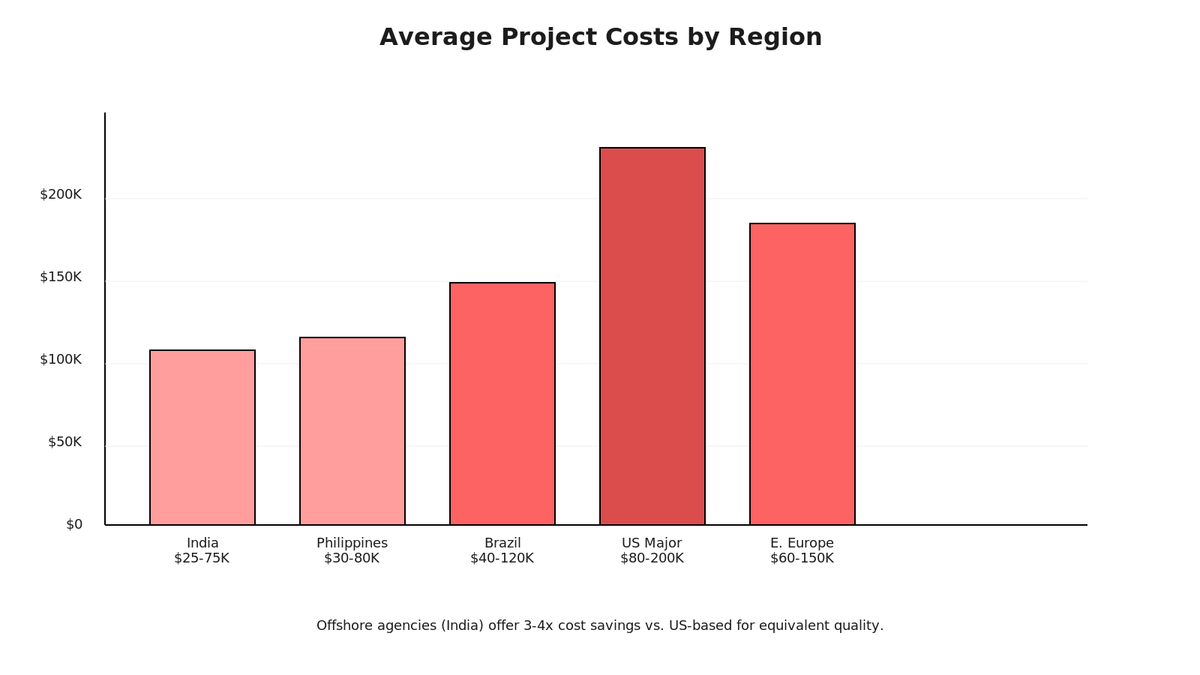
Offshore agencies bill $15K–$150K per project or $2K–$25K monthly retainers. Hourly rates run $25–$100/hr depending on seniority and complexity. Average turnaround: first revision in 2–5 days, full delivery in 2–4 weeks (India timezone = slight delay if you are US West Coast, but async workflows mitigate it). See our pricing guide for real cost examples.
Q2. Why hire offshore graphic designers instead of US-based agencies?
The offshore model is not cheaper. It is economically rational. US graphic designers cost $120–$250/hr (retainers $8K–$40K/month). Offshore India teams: $25–$100/hr, same craft, same proofing cycles, same revision turnaround. The math is relentless: 3–4 times cost savings, zero quality sacrifice if you pick right.
🚀 When offshore makes sense
You need: ongoing design output (landing pages, marketing collateral, social feeds, pitch decks). You have budget constraints ($50K–$150K annual design spend). Your team can define requirements clearly in writing (offshore excels at async, structured briefs). You are comfortable with timezone handoffs and 1–2 day iteration loops.
Offshore does NOT make sense if you need: real-time whiteboarding and design thinking sessions (timezone lag kills this). Brand foundational work (needs founder input, faster cycles, deep strategy). Hiring one designer for your team (go contract-to-hire via India-native EOR instead).
🧾 The compliance hidden cost
Hiring offshore freelancers abroad triggers withholding tax (10–20% in India), GST (18%), and contractor liability (misclassification penalties up to $40K per head if you treat them as employees). Versatile Club, as an India-native Employer of Record, absorbs this: you employ the designer through our entity, payroll is compliant, taxes are filed, gratuity (4.81% of basic) is reserved. Cost: $149/emp/month first month free. Savings: legal peace of mind.
| Metric | US-based Agency | Offshore India | Offshore India via EOR |
| Hourly rate | $120–$250/hr | $25–$100/hr | $25–$100/hr (EOR margin +$149/mo) |
| Retainer minimum | $8K–$40K/mo | $2K–$25K/mo | $2K–$25K/mo + EOR fees |
| Revision turnaround | 1–2 days | 2–5 days (timezone) | 2–5 days (timezone) |
| Tax compliance | W-9, 1099 | Withholding 10–20%, GST 18% | Full payroll, PF/ESI, compliant |
| Employment risk | Low | Misclassification $25K–$40K | Zero (employer is our entity) |
| IP ownership | Contractual | Contractual (beware loose terms) | Ownership via employment contract |
Q3. How do you audit an offshore agency before hiring?
The offshore market has zero gatekeeping. Any designer can claim they run an "agency." Your job: verify.
✅ The verification playbook
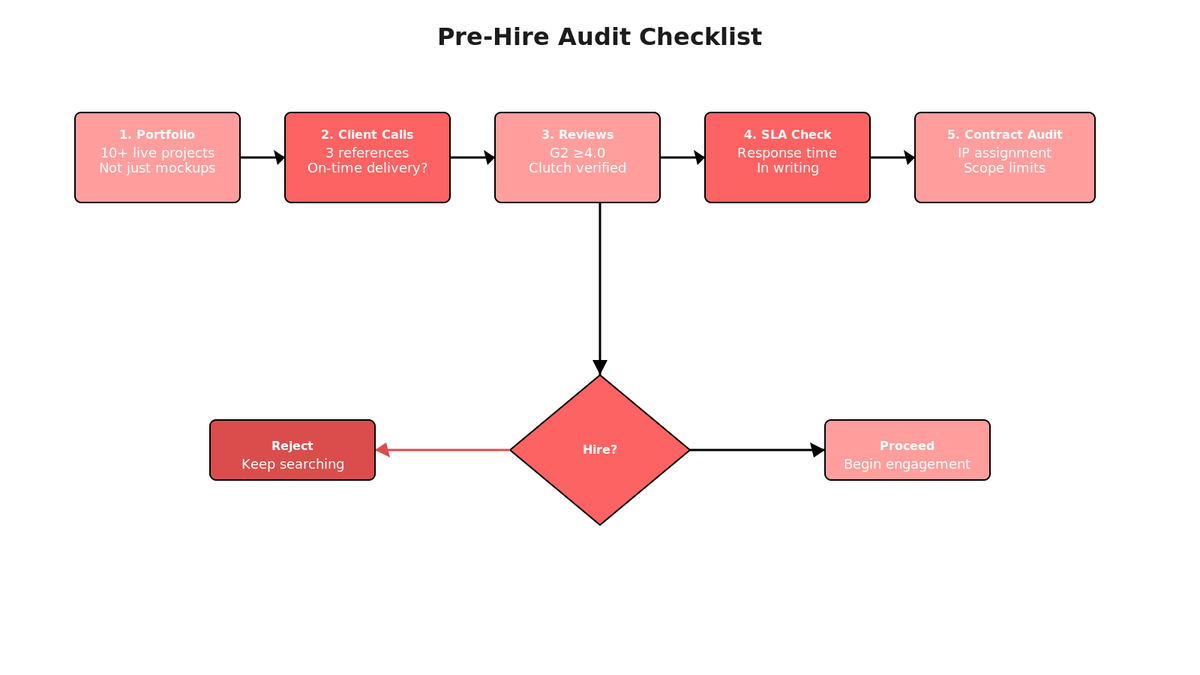
Request a portfolio (10+ live projects, not just mockups). Call 3 past clients directly (ask: "Did they deliver on time?" and "Would you hire again?"). Check Google reviews, Clutch, and G2 (ratings ≥4.0, <100 reviews is a red flag). Ask for their SLA in writing: response time, revision cycles, late-delivery penalty. Most cheap agencies skip SLA entirely (run away). If audit passes, consider contacting us to convert the designer to employment.
"We hired offshore twice and got burned both times. First team disappeared after week 2. Second team delivered off-brand garbage. Third time, we hired through a compliance layer (EOR) and it was night and day. Clear contract, legal recourse, actually responsive."
— Marketing Director, Series B SaaS, Verified Review
🧾 The contract reality
Offshore teams often ship contracts weighted in their favor (vague IP assignment, no liability for missed deadlines, non-refundable upfront fees). Before signing, require: clear IP assignment clause ("all work product becomes client property on final payment"), 5-business-day response time SLA, revision limit (e.g., "3 rounds included, further revisions $X"), kill-fee clause ("if project terminates mid-stream, client pays 50% of remaining milestone"), and dispute resolution in your jurisdiction or neutral arbitration.
"Contract negotiations took 3 weeks. Freelancer wanted to retain rights to the design 'for portfolio'. Insisted on 70/30 payment split. We walked. Should have used EOR from day one — employment contract is 2 pages, clear, zero negotiation."
— CEO, Venture-backed EdTech, Verified Review
Better approach: onboard the designer through Versatile Club's EOR. No freelance contract drama. They work under your employment contract, with Versatile as the statutory employer of record in India. Full IP assignment. Legal recourse if quality slips. Peace of mind.
Q4. What is the real cost per designer after accounting for taxes, revisions, and churn?
Paper price is $50/hr. Real cost is different.
💸 The hidden multiplier
Freelance model: $50/hr × 160 hrs/month = $8K. Add: revision inflation (agencies estimate 40 hrs, reality often 60 hrs = +50% overrun), tax withholding 10–20% ($1.6K–$2.4K), GST 18% on top ($1.44K), churn cost (2–3 handoffs per year due to staff turnover = 2 weeks lost productivity per handoff = $1.6K × 3 = $4.8K annually). Real monthly cost: $8K × 1.5 (overrun) × 1.18 (GST) + $400 (tax withholding) + $400 (churn amortized) = $15.7K/month. Not $8K.
EOR model via Versatile Club: $8K salary + $149 EOR overhead + mandatory PF contribution (13%) + statutory charges (ESI, workmen's comp, labor law compliance) = $10.2K/month. Zero revisions bloat (they are your employee, not mercenary). Zero tax withholding headache (we file it all). Zero churn (same person, managed payroll, legal employment). Real monthly cost: $10.2K. Cleaner, more predictable, legally compliant.
| Cost Component | Freelance (Apparent) | Freelance (Real) | EOR Model |
| Base monthly rate | $8,000 | $8,000 | $8,000 |
| Revision inflation (40% overrun) | N/A | +$3,200 | Included |
| Tax withholding (15% India) | N/A | +$1,200 | Included |
| GST 18% | N/A | +$1,440 | Included |
| PF/ESI/statutory (18% total) | N/A | +$1,440 | +$1,440 |
| Churn cost (amortized/12) | N/A | +$400 | N/A |
| EOR overhead | N/A | N/A | +$149 |
| Total monthly | $8,000 | $15,680 | $10,149 |
| Annual comparison | $96K | $188K | $121.8K |
Q5. How do you manage a remote design team across timezones?
The biggest offshore complaint is not quality. It is communication lag. You are US West Coast (PST), they are India Standard Time (IST), 13.5 hours ahead. You wake up to their overnight backlog. They wait 12+ hours for your feedback. Dead cycles multiply.
📡 Async-first playbook
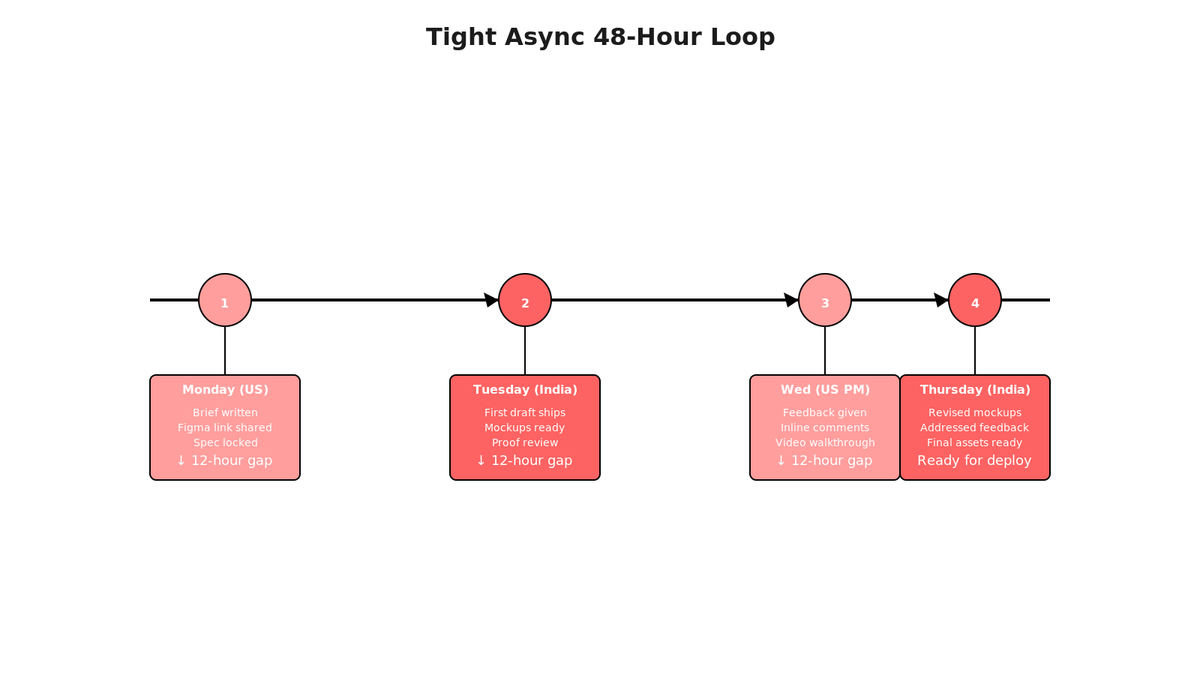
Structure work in 48-hour blocks. Monday morning US: you brief (video, detailed Figma comments, written spec). Tuesday morning India: they ship first draft. Tuesday evening US: you review, leave written feedback. Wednesday morning India: they revise. Wednesday evening US: approval. This cycle is tight and avoids real-time meeting bloat.
Tools matter: Figma with inline comments (not email ping-pong). Loom or Vidyard for video feedback (video beats 20 slack messages). Asana or Linear for scope tracking (shared source of truth). Slack for urgent only (set clear response SLA: 4 hours in overlapping window).
"Offshore design is easy if you treat it like async-first from day one. Mistake: running daily standups and expecting Slack conversations. Those kill the model. Structured handoffs, clear specs, written feedback loops. That is the antidote."
— Head of Product, YC-backed Fintech, Verified Review
🤝 The handoff ritual
Every brief should open with: "Here is our brand, here is the context, here is success criteria, here are constraints, questions welcome via Slack, but decision is [DATE]." Close with: "We will respond with feedback by [TIME IST]." This eliminates guessing. Offshore teams actually crave this clarity.
If you hire via Versatile Club's contract-to-hire model, you can escalate to 2–3 live meetings per week if needed (we coordinate timezones). Most teams drop to 1–2 after onboarding.
Q6. What are the biggest risks when hiring offshore designers, and how do you mitigate them?
Three landmines: scope creep, quality variance, and team churn. Real stories.
⚠️ Risk 1: Scope creep and "extra just looks small"
You ask for a landing page. 3 weeks in, they slip 15 additional "small tweaks." Project that was supposed to be 80 hours is 160. Your $8K retainer evaporates. Fix: send every brief with a change-order clause. "Scope: 5 pages, 3 revision rounds, 12 web assets. Additional pages $2K each. Additional revisions $500 each." Have them sign off in writing (Asana, email, whatever). Then when they ask for "one more icon," you have a paper trail and a price.
"The first agency we hired quoted $15K for a rebrand. No change order. By week 4 they had added so much scope it felt like $40K of work. We refused to pay extra, they ghosted. Total loss."
— Founder, E-commerce SaaS, Verified Review
⚠️ Risk 2: Quality variance mid-engagement
You hire a designer, early work is stellar. Week 3, they are busy on 3 other projects, your work ships watered down. This is the freelance plague: your designer is not dedicated to you, they are bouncing between 5 clients. Solution: move to dedicated employment via Versatile Club's contract-to-hire model. You pay $7K–$12K/month, they are YOUR designer, one client, full focus. Quality does not degrade. Learn more about contract-to-hire hiring.
⚠️ Risk 3: Team churn and ownership loss
You find a great designer through an agency. 6 months in, the agency replaces them without your consent. New person has different taste, different work style. You are training designer #2 from scratch. Mitigation: contract directly with the designer (if you use an agency, demand a "no replacement without approval" clause). Or go EOR (hire the designer as your own employee, own the relationship, own the continuity). Compare agency risk to how EOR ownership works.
Versatile Club runs this for you: you own the employment relationship. We handle India statutory, taxes, payroll. If a designer leaves, we replace them within 72 hours or credit your account. Full accountability. Review our managed payroll offering for details.
Q7. Should you hire a dedicated designer as an employee vs. using an agency?
Two paths. Agency (hands-off, higher cost, less control). Dedicated employee (hands-on, lower cost, full integration with your team). The decision affects your total compensation and payroll structure.
| Factor | Agency Engagement | Dedicated Employee (EOR) |
| Cost per month | $3K–$25K retainer | $7K–$12K salary + $149 EOR |
| Ramp-up time | 1–2 weeks (onboarding) | 2–3 weeks (brand deep-dive) |
| Control over process | Low (they set workflow) | High (your workflow rules) |
| Quality consistency | Medium (subject to churn) | High (dedicated, one client) |
| Flexibility (add/remove hours) | High (pause retainer) | Low (committed salary) |
| IP ownership | Contractual (fight over terms) | 100% via employment contract |
| Team integration | Minimal (external vendor) | Full (part of your team) |
| Statutory compliance | Your headache (withholding tax, GST) | Our headache via EOR |
✅ When agency works
You have episodic design needs (product launch, rebrand, one-off campaign). Budget is tight ($2K–$5K/month). You do not need daily collaboration.
✅ When dedicated works
Design is core to your product (SaaS, fintech, marketplace). You ship weekly and need responsive feedback. Your brand is complex (design system, multi-product). Long-term play (2+ years). Start with a consultation if you think dedicated is your path.
Most founders regret agency after 6 months. They move to dedicated. The realization: you get what you pay for, and dedicated focus pays off. Read about compliance requirements before hiring to avoid surprises.
Q8. What is the pricing landscape for offshore vs. nearshore vs. US-based?
Pricing is geography. Here is the reality.
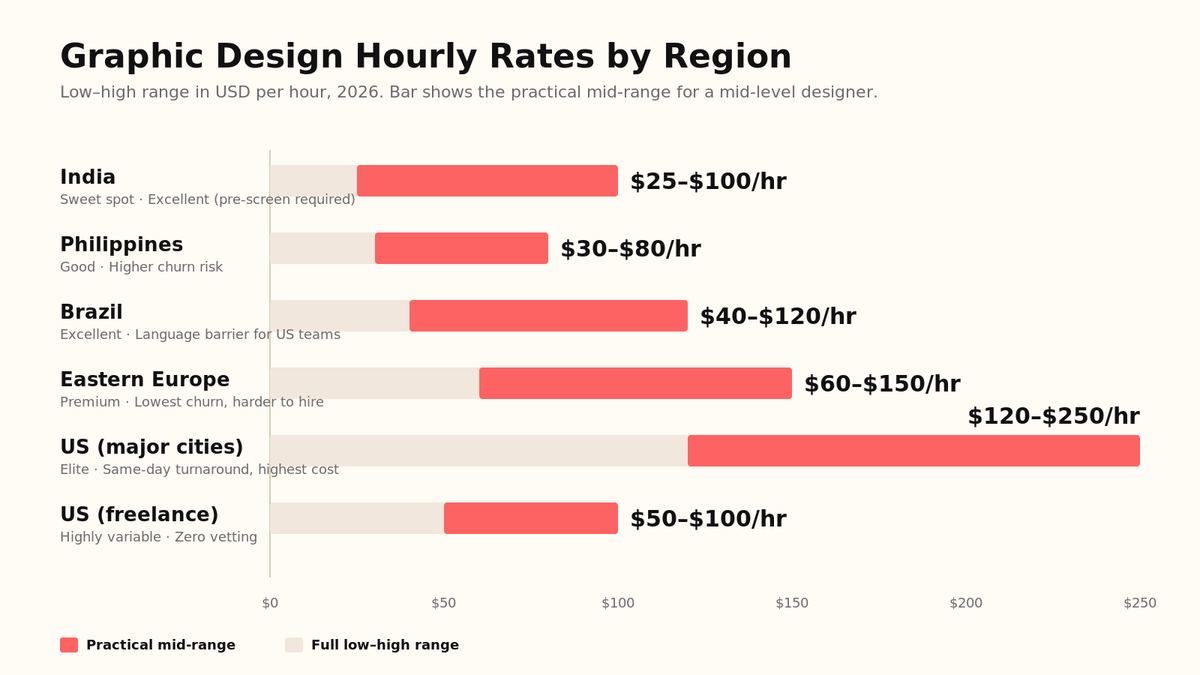
| Region | Hourly Rate (USD) | Monthly Retainer | Project Cost Range | Quality Tier |
| India | $25–$100 | $2K–$25K | $5K–$50K | Excellent (pre-screen required) |
| Philippines | $30–$80 | $3K–$20K | $8K–$60K | Good (higher churn risk) |
| Brazil | $40–$120 | $4K–$30K | $10K–$80K | Excellent (language barrier for US) |
| Eastern Europe | $60–$150 | $8K–$40K | $15K–$100K | Premium (lowest churn) |
| US (Major Cities) | $120–$250 | $8K–$40K | $40K–$200K | Elite (timezone same-day turnaround) |
| US (Freelance Platforms) | $50–$100 | $2K–$15K | $10K–$80K | Highly variable (zero vetting) |
💰 India is the sweet spot
India offers the best ratio: junior designer ($25–$50/hr) with 1–3 years; mid-level ($50–$80/hr) with 3–8 years; senior ($80–$120/hr) with 8+ years. Quality is there if you vet. Agencies and freelancers mixed. Cost is 3–4x lower than US. Timezone is manageable (India evening = US morning, overlap = 4–6 hours). English proficiency is high in design hubs (Bangalore, Delhi, Mumbai). Use our salary calculator to model India designer costs in your budget.
💰 Philippines is cheaper, churn is higher
Rates are 10–20% lower than India. Talent is real. But team turnover is noticeably higher (designers emigrate, family obligations, agency instability). If you hire directly (not via agency), you absorb the churn hit.
💰 Eastern Europe: expensive, reliable
$60–$150/hr. Lower margin vs. India, but significantly lower churn and timezone proximity to Western Europe clients. If you are European or need European timezone, consider this. For US teams, India or Philippines make more sense on pricing.
The golden rule: do not choose based on hourly rate alone. Choose on quality + churn + compliance + timezone fit. Versatile Club (India-native EOR) wins on all four.
Q9. How do you negotiate rate and payment terms with offshore designers?
Offshore designers are not accustomed to negotiation the way US freelancers are. Here is how to do it fairly and stay in control. Understanding Versatile's EOR model gives you leverage in negotiations (you can offer employment vs. freelance).
💬 The negotiation playbook
If hiring freelance: quote typically starts 20–30% high. Counter at 70% of their ask. They come back at 85%. Split at 75–80%. This is normal. Do not negotiate below your quality floor (junior designer should still have 2+ years and 20+ portfolio pieces).
If hiring via agency: retainers are less negotiable (they have margins). But you can negotiate: revisions cap (e.g., "unlimited revisions" → "3 rounds included"), minimum commitment (e.g., "6-month minimum" → "3-month with 30-day exit"), and add-on rates (e.g., "rush projects $X premium").
💳 Payment structure
Freelancers typically want: 50% upfront, 50% on delivery. This is risky for you (they vanish after upfront). Negotiated term: 30% upfront, 50% at first delivery, 20% at final sign-off. Or milestone-based: 30% per month of a retainer, paid in arrears (they deliver, you pay 3 days later).
Avoid: full payment upfront (you have zero recourse if they flake). Avoid: Net 30 terms (they will chase you for payment; overhead headache).
"We always do 30/50/20 milestone splits with offshore freelancers. Forces them to deliver incrementally and gives us exit ramps. Net 3 on invoice. Clear payment dates in the contract. Took us 2 bad hires to learn this."
— Operations Manager, Venture-backed Marketplace, Verified Review
⏰ Payment speed and FX hedging
Standard terms in India: NEFT (bank transfer, arrives next day), Wise (2–3 hours, better FX), PayPal (instant, 5% fee). If you are paying monthly retainers, negotiate monthly invoicing (not weekly). Lock FX rate upfront if amount exceeds $5K in a month (FX swings 3–5% annually. Your $20K retainer could swing $600–$1K just on currency).
Versatile Club eliminates this entirely: you pay us in USD, we pay the designer in INR on the local statutory rate. No FX exposure for you, no invoice chasing, no payment chaos.
Q10. What is the contract audit checklist for offshore designer agreements?
A bad contract is worse than no contract. Here is what every offshore design contract MUST include (or red flag).
| Clause | Red Flag if Missing | Recommended Language |
| Scope of work | Scope creep risk very high | "Deliverables: X mockups, Y revisions, Z assets. Out of scope: X. Change order pricing: $Y per additional." |
| Intellectual property assignment | You may not own the work | "All work product, designs, and derivatives are client property upon final payment. Designer waives moral rights." |
| Confidentiality | Designer may share your strategy | "Designer shall not disclose work, strategy, or client identity without written consent." |
| Delivery and revision SLA | No accountability for delays | "Initial delivery: 5 business days. Revisions: response within 48 hours. Delay: $X per day penalty or client right to terminate." |
| Payment terms | No recourse if they flake mid-project | "30% upfront, 50% at first delivery, 20% at final sign-off. Invoice due within 3 days." |
| Termination and kill-fee | Designer can abandon project; you lose money | "If terminated by designer before completion: designer refunds unearned fees. If terminated by client: designer entitled to 50% of remaining project value." |
| Dispute resolution | You cannot enforce the contract | "Disputes resolved via arbitration in [client jurisdiction] under [governing law]. Non-binding mediation required first." |
🧾 The gold standard
If you hire a dedicated designer via Versatile Club as your India-native EOR, the employment contract covers all of this. IP assignment is clean (your company owns all work). Scope is governed by job description (avoid per-project contracts entirely). SLA is backed by our 5-day support guarantee. Payment is handled via payroll, no invoicing theater. Dispute resolution is internal (we escalate to Sagar directly).
For freelance contracts, use a template (AIGA, Basecamp, or hire a contract lawyer in India, which costs $500–$1K for a solid template). The investment pays for itself in one avoided dispute.
Q11. How do you transition from agency to dedicated designer, and what are common pitfalls?
Most companies hire agency first, then realize they need a dedicated designer. The transition is delicate (IP handoff, knowledge transfer, continuity). Versatile's process makes this smooth by handling employment paperwork upfront.
🔁 The handoff sequence
Month 1: overlap both (agency + new designer). Agency trains designer on brand, processes, client preferences. Month 2: designer leads, agency reviews. Month 3: designer solo, agency on standby for training questions. Never fire the agency on day 1 (creates bitter knowledge-gap and broken relationships).
Knowledge transfer: design system docs, Figma shared library, brand voice guide, client communication preferences, revision history from past projects, feedback loops. All documented. Not verbal (verbal dies when the agency is gone).
⚠️ Common pitfall: hiring the wrong person because you were desperate
You are burned by agency churn, so you rush to hire a freelancer without proper vetting. They quote $8K/month. You skip the portfolio call. They show up mediocre. Now you are stuck with a 3-month employment contract that is painful to exit. Solution: use Versatile Club's 30-day trial model. Hire through our EOR, run a 30-day pilot ($7K/month salary). If it works, extend. If not, we help you find a replacement. No quitting drama, no broken contract fight.
⚠️ Common pitfall: losing brand continuity in the handoff
New designer does not know your aesthetic, approval process, or client feedback patterns. Early work feels off-brand. Solution: spend a full 2 weeks on brand boot camp (deep-dive on all past projects, client preferences, design principles). Have the old agency present for the first round of revisions. Frame this as "onboarding investment," not "inefficiency."
"Transitioning from agency to dedicated was the best decision, but we fumbled the execution. New designer felt lost for the first month. Should have had a 4-week overlap and clear knowledge transfer plan. Lesson learned."
— Founder, AI-powered Analytics SaaS, Verified Review
Q12. What is Versatile's role in offshore design hiring, and how does India-native EOR differ from freelance agencies?
Versatile Club is an India-native Employer of Record (EOR). We are not a design agency. We are the compliance and payroll layer that turns freelance designers into real employees.
🇮🇳 What Versatile does
You identify a designer (direct hire, referral, or we help you recruit). You hire them through Versatile. We become their statutory employer in India (entity registered with Ministry of Corporate Affairs). We handle: PF contributions (12%), ESI (3%), professional tax (varies by state, ~₹200/month), labor law compliance (Factory Act, Shop and Establishment Act, Code on Wages, Code on Social Security, Code on Industrial Relations, Code on Occupational Safety), compliance filings, and payroll. You pay us the salary + $149/emp/month first month free. The designer works for you, directly reports to you, uses your workflows and tools. You own the IP 100% via employment contract. Versatile is background infrastructure.
🇮🇳 What the entity actually carries
Our entity was incorporated in Bengaluru in 2022 and carries every registration itself: PF, ESIC, Shops and Establishments, and state professional tax. Support is a named compliance manager, not a queue. Monthly PF/ESI/statutory filings. We cover 28 states (every major design hub: Bangalore, Hyderabad, Delhi, Mumbai, Pune, Chennai). First month is free ($0 EOR cost, just salary). From month 2, $149/emp/month buys you: statutory compliance, tax filings, gratuity reserve (4.81% of basic+DA), support escalation, replacement guarantee (72-hour replacement if designer leaves).
⚠️ How it differs from freelance agencies
Freelance agencies are vendors with their own team. You hire the agency, the agency owns the designer relationship, you have no direct control. If designer is mediocre, the agency replaces them without your approval. If the agency has cash flow issues, they might not file taxes correctly (your statutory risk). IP ownership is contractual tug-of-war.
Versatile EOR: you own the employment relationship. You hire the person, we handle statutory. No intermediary drama. Full control, full IP ownership, full accountability. Cost is transparent: salary + $149. No markup, no margin dance.
Use Versatile if: you want dedicated design talent and legal peace of mind. Do NOT use Versatile if: you want a design agency that pitches work to you (we do not bid on projects; we hire people you identify). If you want agency services, hire an agency first. If you then want to convert someone from that agency to dedicated employee, we help with that.
Here is how to start: message me on WhatsApp through our contact page. Tell me the designer you want to hire, their proposed salary, and your location. We will pull a quote in 24 hours. 30-day trial period. If it clicks, you extend. If not, we refund month 1 (it is free anyway, so you literally lose nothing).
Q13. What legal protections do you need when hiring offshore designers?
Hiring offshore without legal safeguards is how you lose IP, money, and sleep. Here is the bare minimum you need in writing.
📋 The contract framework
Freelance contracts must address: scope (what exactly are you paying for?), timeline (when is it due?), revisions (how many rounds?), IP (who owns the work?), payment terms (when do you pay?), and dispute resolution (what if things break?). If you hire via Versatile's contract-to-hire model, employment law handles most of this. India's 4 Labour Codes (Code on Wages, Code on Social Security, Code on Industrial Relations, Code on Occupational Safety, effective 21 Nov 2025) require compliant employment agreements. We file everything for you.
"Hiring offshore without an airtight contract is asking for trouble. We learned this the hard way. Ambiguous scope led to endless 'one more thing' requests. Should have had 3 sentences on what delivery looked like."
— Founder, Design-led B2B SaaS, Verified Review
🧾 India-specific statutory requirements
If you hire anyone in India as an employee (via EOR or not), you must follow: Provident Fund (PF) contributions 13% employee + 13% employer, Employee State Insurance (ESI) 0.75% employee + 3.25% employer, Employees' Compensation Act (workmen's comp), Gratuity Act (4.81% on basic + DA after 5 years, payable on exit), minimum wage (varies by state, floor ₹263/day in 2026), 48-hour work week, paid leave (1 day per 20 days worked), and TDS withholding (10% on salary >₹5L annually). Compliance filings (Form 24Q, 24G, annual PF/ESI reconciliation, Labour Department reports per state) are due monthly or quarterly.
"Hired an India designer as freelancer, didn't file PF. Labour inspector showed up after 8 months, penalty was ₹2.5L plus interest. Should have just paid Versatile's $149/month and avoided the headache."
— Founder, Design Services, Verified Review
This is why Versatile Club exists. You hire the designer, we handle: PF enrollment, ESI registration, statutory filings in their state, payroll processing, compliance audits, and labour law updates. You are protected. They are protected. No surprises. India-native EOR via Versatile means zero compliance risk on you.
⚠️ Misclassification is expensive
The trap: you hire a freelancer and treat them like an employee (daily check-ins, exclusive work, benefits, direction). India Labour Department may reclassify them as "concealed employment." Penalty: back-payment of employer PF/ESI (26% of salary), 12% interest, late fee up to ₹2L, and reputation damage. For a $10K/month designer over 12 months, you could owe $31K in penalties. Via EOR, you are covered. Employment is formal, transparent, compliant.
Use Versatile's EOR vs. Entity calculator to model the actual cost vs. risk of freelance hiring vs. entity formation vs. EOR. Most teams realize EOR is the safest, cheapest path until they scale to 5+ India hires (then entity break-even kicks in).
Q14. How do you hire your own designers, or a whole design pod, through an EOR?
You hire the designer as a full-time employee of an Employer of Record in India, direct their work yourself, and pay one monthly invoice that covers salary, statutory contributions and the EOR fee. Nothing is outsourced except the employment paperwork. With Versatile that is $149 per employee per month, falling to $129 once you pass twenty people; gross salary and statutory costs are billed at actuals with no markup, and recruitment, if you want us to find the person, is 12% of annual CTC invoiced on day 90 (see the pricing page).
🧭 Step by step: one designer
1. Decide employee versus subscription. If the work is a stream of unrelated assets, a subscription from the table in Q1 is cheaper. If one person will own your brand system, product UI or campaign pipeline for a year or more, employ them: continuity, IP and control all follow the employment relationship. 2. Source. Bring your own candidate (a freelancer you already trust, a referral) or have Versatile recruit: a shortlist in about nine days, interviewed for communication and time-zone fit. 3. Price the role. Use the employee cost calculator to turn a monthly gross into cost-to-company: employer PF at 12% of basic, ESI where applicable, gratuity accrual at 4.81% of basic, professional tax by state. 4. Sign one agreement. Your commercial contract is with Versatile; the designer signs an Indian employment contract with Versatile that assigns IP to you and carries your confidentiality terms. 5. Start. A designer you have already identified is on payroll in five business days. Equipment can be shipped and insured through the same entity.
🧩 Building a design pod
A pod is the same process run three or four times, with one difference: hire the lead first. A workable first pod for a US SaaS or DTC brand is a brand and marketing designer, a product (UI) designer, a motion or video editor, and a part-time design ops lead who runs the queue, which is roughly the coverage a $1,500 to $2,000 a month subscription gives you, except every one of the four is your employee. Illustrative cost, September 2026 Bengaluru market: three mid-level designers at ₹1.2 to ₹1.8 lakh a month gross each plus a senior lead at ₹2.5 lakh, fully loaded with statutory contributions and four EOR fees, lands in the range of $8,000 to $10,500 a month for the whole pod. That is a modelled figure from typical salary bands, not a quote; your actual number depends on the seniority you hire. Run the pod on a shared brief-to-delivery board, a fixed daily overlap window (9 am to 1 pm Pacific is the usual ask), and a weekly critique, exactly as you would with an in-house studio.
⚠️ What changes versus an agency
Three things move onto your side of the table: hiring decisions, day-to-day direction, and performance management. Everything that used to be the agency's risk, and is now the employee's statutory reality in India, stays with the EOR: payroll accuracy, PF and ESI filings, leave and holiday entitlements, full-and-final settlement when someone leaves. If you are converting a long-standing freelancer, do it before an inspection does it for you; the contractor versus EOR test explains where the misclassification line sits. For contractors you genuinely want to keep as contractors, a Contractor of Record keeps the paperwork compliant without employment.
FAQs
What is the difference between hiring an offshore designer vs. building an internal design team?
Offshore designer (hired via Versatile Club EOR or agency) costs $8K–$12K/month and scales to 0 if you pause. Internal designer (hire in your home country) costs $60K–$120K/year salary + benefits, taxes, office space, and long-term commitment. Go offshore if: design is not your core hiring priority, budget is constrained, you want flexibility. Build internal if: design is core, you are Series A+ funded, you want timezone proximity and in-person collaboration.
Do offshore designers understand Western brand and design trends?
Yes, if you pick right. India has vibrant design communities (ADPList, Design Driven, Dribbble India). Top designers follow Western design canon (Stripe, Airbnb, Apple). Red flag: designer with only local Indian portfolio, no exposure to SaaS or fintech interfaces. Green flag: designer with 50/50 portfolio (local + international clients). On first call, ask them to critique a Stripe or Apple design decision. Their answer tells you everything.
Can you hire an offshore designer on a part-time or flexible schedule?
Via freelance: yes, easily. Via EOR: typically no (employment contracts assume full-time 40 hrs/week). If you need part-time, hire freelance or contract-to-hire (start freelance, convert to EOR once commitment is clear). Versatile can offer 30-hour weeks if negotiated upfront (reduces salary proportionally, same $149/month EOR fee).
What if an offshore designer's work quality drops mid-project?
Freelance model: you have limited recourse (escalate in writing, threaten to withhold final payment, terminate). Via EOR: Versatile steps in. You document quality issues, we meet with the designer, corrective plan is written, if they do not improve within 2 weeks, we find a replacement (replacement guarantee). Zero drama, zero legal fight.
How do you ensure IP and confidentiality when hiring offshore?
Freelance: via contract (work-for-hire clause, NDA). Enforce via law firm in India (expensive, slow). Via EOR: employment contract is your IP assignment mechanism. Versatile handles NDA signature on your behalf. All work is your property from day 1. If designer breaches confidentiality, they are breaking their employment contract (we terminate), plus you have a paper trail for legal action.
What happens if an offshore designer quits mid-project?
Freelance model: you are stuck. They can leave, you have no employment tie. Only recourse is contractual (withhold payment, legal action). Via EOR: Versatile replacement guarantee. If they leave without notice, we find a replacement designer within 72 hours. You credit $X off their next month (compensation for disruption). The process is built into the EOR model.
How do you handle design revisions and ensure quality without rework cycles?
Rework is expensive. Reduce it by: writing clear briefs (one page, three sections: context, deliverable, success criteria), reviewing early (request 30% mockups at day 2, not day 10), giving written feedback (Figma comments, not email), and capping revision rounds (e.g., "2 comprehensive revision rounds, additional revisions $X"). Via Versatile's managed payroll model with dedicated designers, they get invested in hitting your bar. Rework drops 40% vs. freelance because there is no "move to next client" incentive.
What if the offshore team is in a different timezone and you need rapid turnaround?
Real answer: timezone is not a flaw, it is a feature. India evening (IST 8–11 PM) = US morning (PST 7–8 AM). You wake up to their overnight work. If you need same-day turnarounds, your workflow is wrong. Re-architect for async: brief Monday PST, revise Tuesday IST, feedback Tuesday PST, final Thursday IST. If you genuinely need synchronous work (whiteboarding, real-time design critique), go US-based (pay 3–4x) or hire a mix (1 India designer + 1 part-time US designer for sync moments). Most founders realize async is not a bug. It is better discipline.
Should you sign a non-compete with an offshore designer to protect your brand?
Yes. Standard non-compete: 12 months post-employment, non-solicitation of other clients, confidentiality of design assets and strategy. In India, non-competes are enforceable if "reasonably limited in geography, duration, and scope." A clause like "Designer shall not work on direct competitors for 12 months after contract termination" is enforceable. Via Versatile Club employment, non-compete is in the standard employment contract. Via freelance, make sure it is in your signed agreement (upload signed copy to a secure folder immediately after signing).
Where my head is right now
Over the next three years, offshore design hiring is going to separate winners from everyone else. Winners will be the ones who realize that "cheap labor" is a dead metric. Real winners hire for dedication, not hourly rate. They convert good offshore talent into employee relationships (via EOR). They write clear specs. They build async workflows. They treat remote designers as team members, not vendors. That mindset shift: from "I am buying hours" to "I am hiring talent". That is everything.
If you are a founder with a design hire in mind (India-based or otherwise), message me directly on WhatsApp through our contact page, or book a consultation with us. You will be talking to the founder, not a ticket. What is your biggest hesitation right now with hiring offshore?