Table of contents (14)
- Finding the Right UX Designer in 2026: Platforms That Actually Work
- The Framework: How to Assess a UX Platform
- Tier 1: Screened Marketplaces-High Quality, High Cost
- Tier 2: Portfolio Galleries + Hiring Fusion
- Tier 3: Broad Marketplaces-Volume, Variance, Value
- Specialty + Niche Platforms
- Platform Cost Comparison: What You'll Actually Pay
- How to Evaluate Candidates in 3 Steps
- IP Ownership and Contract Terms Matter
- Timezone + Communication: The Hidden Factor
- The Hiring Decision Tree: Platform Selection Guide
- Red Flags: Common Hiring Mistakes
- When Your Freelancer Becomes Full-Time: The EOR Bridge
- FAQs
Top 10 UX Designer Hiring Platforms (2026 Guide)
Finding the Right UX Designer in 2026: Platforms That Actually Work
You need a UX designer. Fast. Your startup has validated product-market fit-or is close to it-but your interface is the weak link. Users abandon at signup. The mobile experience feels clunky. You can't hire in-house yet; you need someone now, for a defined scope, for a realistic rate.
The problem: there are seventeen major platforms for hiring UX designers, each with different quality bars, pricing models, and onboarding friction. Dribbble shows portfolios but no direct hire. Toptal screens rigorously but charges 2x what Fiverr does. Upwork has 100,000+ designers but 95% are unqualified.
This guide cuts through the noise. We've evaluated the top 12 platforms against an evaluation framework-portfolio access, communication, IP handling, cost band, and contract length. You'll also find data on when to use each tier, real pricing examples, and a decision tree to pick the right fit for your stage and budget.
The Framework: How to Assess a UX Platform
Before we list platforms, you need a rubric. Not all platforms are built the same. Some are hiring marketplaces; others are portfolio galleries masquerading as hiring platforms.
Six dimensions matter:
- Portfolio access: Can you see actual work before committing? (Yes = 5 points; partial = 3; no = 0)
- Communication speed: Can designers respond in your timezone? (Timezone coverage; response time SLA)
- IP ownership: Who owns the work after delivery? (Full transfer = 5; restricted = 2)
- Price band: What's the range? ($30-80/hr budget; $80-150 mid; $150-300+ premium)
- Screening quality: How many candidates pass the platform's filter? (Top 3% = strict; Open = broad)
- Contract flexibility: Hourly, project-based, retainer, or fixed? Can you start part-time and scale?
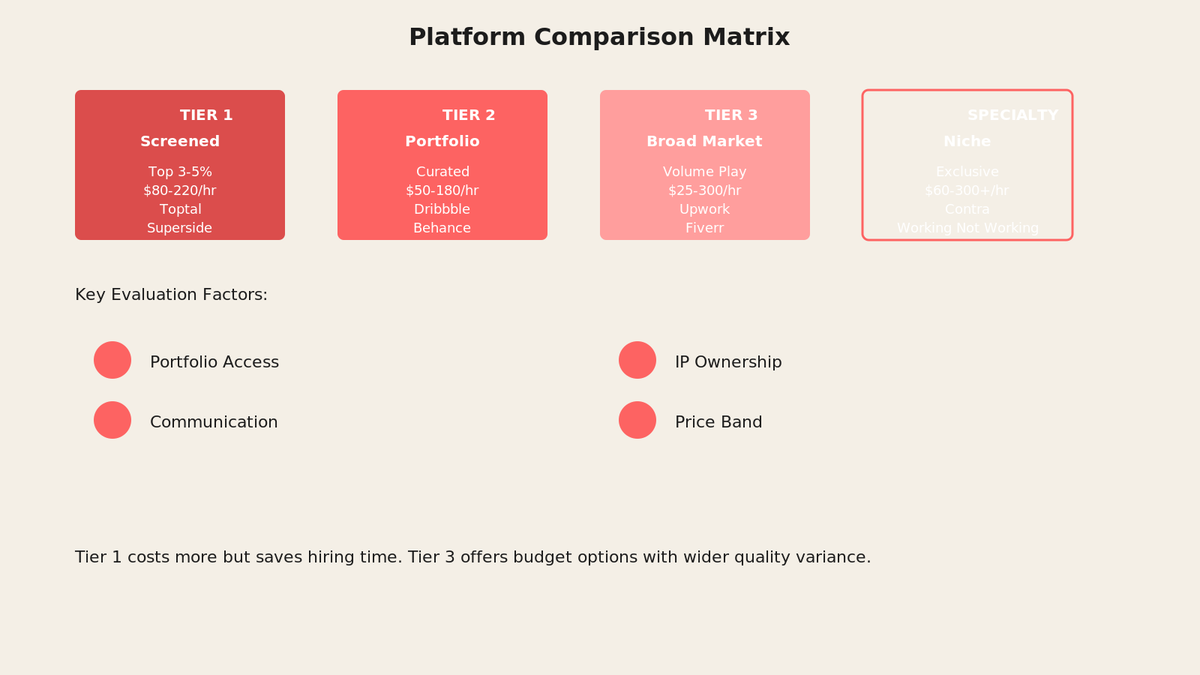
Tier 1: Screened Marketplaces-High Quality, High Cost
These platforms vet talent ruthlessly. They admit the top 3-5% of applicants. You pay for that filtering.
Toptal
Toptal is the gold standard for sourcing remote senior designers. They claim to accept only the top 3% of applicants. Vetting includes live project review, portfolio deep-dives, communication tests, and hourly matching with your timezone.
"The screening process was thorough. Within 48 hours, Toptal matched me with a senior UX designer who understood B2B SaaS. No time wasted interviewing unqualified candidates."
— Marcus T., Founder Versatile Offshore Team Case Study
Price: $80-220/hr (mid-to-senior).
Best for: Complex projects (redesigns, design systems), teams that value speed over budget.
Honest read: You're paying for curation. The designer will likely work async in their own timezone but respond to feedback reliably. No surprises. If you're building a fintech app or a regulated SaaS, Toptal tends to attract designers who've done that work.
Related: How to Hire Offshore Software Engineers
Superside
Superside works differently. You don't hire individual designers; you get a dedicated team (designer + project manager + revision rounds). It's a hybrid between agency and marketplace.
Price: $4k-15k per project (not hourly).
Best for: Multi-screen redesigns, brand refresh projects, design system audits. Teams with fixed budgets.
Honest read: The PM overhead adds friction but saves you coordination time. Great if you want to hand off "make our onboarding flow better" and get deliverables in 2 weeks. Worse if you need tight, back-and-forth iteration with one designer for 6 months.
Related: Building Design Systems for Startups
Tier 2: Portfolio Galleries + Hiring Fusion
These platforms started as portfolio sites for designers to showcase work. They've evolved into hiring tools. Quality is inconsistent but portfolio visibility is high.
Dribbble
Dribbble is where designers post work-in-progress and final concepts. The platform has become a de facto hiring marketplace because talent is visible and sortable by specialty (UX research, interaction design, UI).
"On Dribbble, I could scroll through 50+ UX designers' portfolios in an afternoon. The work quality was immediately obvious. Three candidates stood out; we hired the one with the strongest interaction design case study."
— Jennifer K., Product Manager Versatile Design Collaboration Guide
Price: $50-150/hr (highly variable; portfolio quality signals price).
Best for: Visual-heavy projects (app UI, brand interaction, animation). Designers who've published quality case studies.
Honest read: No built-in vetting. You're hiring based on portfolio alone. Excellent for evaluating visual taste; riskier if you need strong user research skills or technical feasibility thinking. Plan to interview 3-5 candidates to find the right fit.
Related: UX Research for Early-Stage Products
Behance
Behance is Adobe's portfolio platform. Designers publish work, companies browse and recruit. Similar to Dribbble but with stronger visual tools and Adobe software integration (as expected).
Price: $50-180/hr.
Best for: Designers who use Adobe CC (they'll likely be proficient in Figma, XD, Illustrator). Visual design-heavy projects.
Honest read: Less hiring-native than Dribbble. You'll spend more time reaching out to designers than using platform features. But portfolio quality is often excellent; Behance's algorithm surfaces work that Adobe's own teams admire. If you find a Behance designer with 50k+ followers and a strong case study, you've found someone who's been vetted by the crowd.
Related: Design Critique and Feedback Loops for Remote Teams
Awwwards Jobs
Awwwards (the web design awards site) runs a job board. It attracts designers who care about craft and recognition. Self-selecting for high-quality work.
Price: $70-200/hr.
Best for: Design-forward web apps, interactive experiences, portfolios that need motion or micro-interaction excellence.
Honest read: Smaller talent pool than Dribbble, but higher signal-to-noise. Designers posting here tend to be portfolio-obsessed and will deliver work that looks exceptional. Less ideal if your project is "utility first" (e.g., CRUD operations, admin dashboards); more ideal if craft matters.
Related: Interaction Design Principles for SaaS
Tier 3: Broad Marketplaces-Volume, Variance, Value
These platforms have the largest talent pools. Quality ranges from exceptional to barely competent. You're responsible for filtering.
Upwork
Upwork is the largest freelance marketplace. Millions of freelancers, millions of jobs. For UX design, that means thousands of options and a steep learning curve on how to evaluate them.
"Upwork is like dating apps—90% noise, 10% signal. But if you know how to filter (portfolio links, project history, client reviews), the top 5% are excellent and cost 30% less than Toptal."
— Ryan P., Design Director Freelance Designer Interview Series
Price: $25-300/hr (massive range).
Best for: Iterative projects, budget-conscious hiring, designers from emerging markets (India, Eastern Europe, Latin America).
Honest read: Upwork's vetting is permissive. Top designers are exceptional; bottom-tier are scams. Use the platform's filters: look for "Top Rated" or "Plus Certified" badges, at least 50 completed projects, and strong reviews. Expect to message 10 candidates to get 3 quality responses. Time-sink, but the 3 you land will be good and affordable.
Related: Managing Remote Designers Across Timezones
99designs
99designs offers two hiring models: (1) browse-and-hire designer portfolios, or (2) run a design contest where 10+ designers submit work to your brief and you pick the winner.
Price: $50-250/hr (browse) or $300-3k per contest (fixed-price).
Best for: Logo design, brand identity, UI design contests. Teams that want multiple design directions before committing.
Honest read: Contests are fun and generate creative output, but they're expensive and time-consuming. You'll get 10 mediocre designs and 1-2 good ones. Better for discrete deliverables (logo, homepage redesign) than ongoing partnership. The browse-and-hire model is more useful if you need a retainer relationship.
Related: Building Brand Identity with Remote Designers
Fiverr Pro
Fiverr is the gig economy platform-designers post "gigs" (pre-packaged services) and you order them like an à la carte menu. Fiverr Pro is their curated tier (top 1% of sellers).
Price: $50-500+ per gig (project-based, not hourly).
Best for: Small, scoped projects (UI audit, icon set, wireframes, landing page mockups). Quick turnarounds. Budget hiring.
Honest read: Gig structure is limiting. You order a "Mobile App UI Design" gig, not a relationship. Good for discrete tasks; risky for 3-month engagements. Fiverr Pro has better vetting than base Fiverr, but you're still playing the quality lottery. Expect to try 2-3 designers before finding your go-to.
Related: Rapid Prototyping with Remote Design Teams
Specialty + Niche Platforms
Beyond the big four (Upwork, Fiverr, Toptal, Dribbble), a few specialized platforms deserve mention.
LinkedIn Recruiter
LinkedIn's recruiting tools let you search for designers by title, location, skills, and engagement signals. You message them directly. It's not a marketplace-it's a search engine for talent.
Price: Varies (freelancer rates if not employed).
Best for: Hybrid talent (full-time designer open to freelance work), senior designers in your geographic region, designers with strong public profiles.
Honest read: No built-in vetting; you're cold-recruiting. But the upside is direct access to high-quality talent who may not list on Fiverr. Best paired with direct outreach and case study review. Higher close rate than posting jobs on Upwork, but slower process.
Related: Recruiting Designers via LinkedIn Outreach
Contra
Contra is a newer platform built for independent creators (designers, developers, writers). It's anti-algorithmic-no bidding wars. Creators post their rate; you book them or don't.
Price: $60-200/hr (set by designer).
Best for: Designers who are burnt out on Upwork competition, creative projects, indie creators with strong personal brands.
Honest read: Smaller talent pool, but higher quality signal. Designers choosing Contra care about sustainability and craft over volume. You'll message fewer people and close faster. Emerging platform-worth testing if you need a retainer designer.
"Contra attracted a designer who'd been on Upwork for 5 years but was exhausted by the race-to-the-bottom pricing. Better communication, higher rates, actual conversations about project scope. Worth the smaller pool."
— Chris B., Product Manager Designer Platforms Comparison Guide
Related: Building Retained Design Partnerships
Working Not Working
Working Not Working is a talent collective for creative professionals (designers, art directors, illustrators). Membership requires portfolio review; vetting is real.
Price: $80-300+/hr (senior-to-expert).
Best for: Award-winning design work, senior UX/product designers, directors looking for fractional roles.
Honest read: Expensive, but the filter is quality. Every designer here has shipped real work. No gig economy feel. Best for companies that can afford premium and want to move fast without interviewing 20 people.
Related: Fractional Design Leadership for Startups
Platform Cost Comparison: What You'll Actually Pay
Hourly rates tell one story. Project budgets tell another. Here's the reality:
| Project Type | Scope | Upwork Budget | Toptal Budget | Dribbble Budget | Superside Budget |
| Mobile app wireframes | 3-5 screens, low fidelity | $200-500 | $400-800 | $300-600 | N/A (min project) |
| High-fidelity mockups | 8-12 screens, design system tokens | $800-2k | $1.2k-3k | $1k-2.5k | $3k-6k |
| Interaction prototypes | Micro-interactions, animations, state flows | $1.5k-4k | $2.5k-6k | $2k-4.5k | $5k-8k |
| Full UX audit | Heuristic review, competitive analysis, findings report | $2k-5k | $4k-10k | $2.5k-6k | $6k-12k |
| Design system build | Components, documentation, token library, handoff | $5k-15k | $12k-30k | $7k-18k | $10k-20k |
| Full product redesign | Research, strategy, 20+ screens, prototypes, handoff | $8k-25k | $20k-60k | $12k-30k | $15k-35k |
"The hidden cost is management time. Cheap freelancers need 3x the feedback cycles. A Toptal designer costs 2x but needs half the iterations."
— Sarah M., Head of Design Design Management for Distributed Teams
How to Evaluate Candidates in 3 Steps
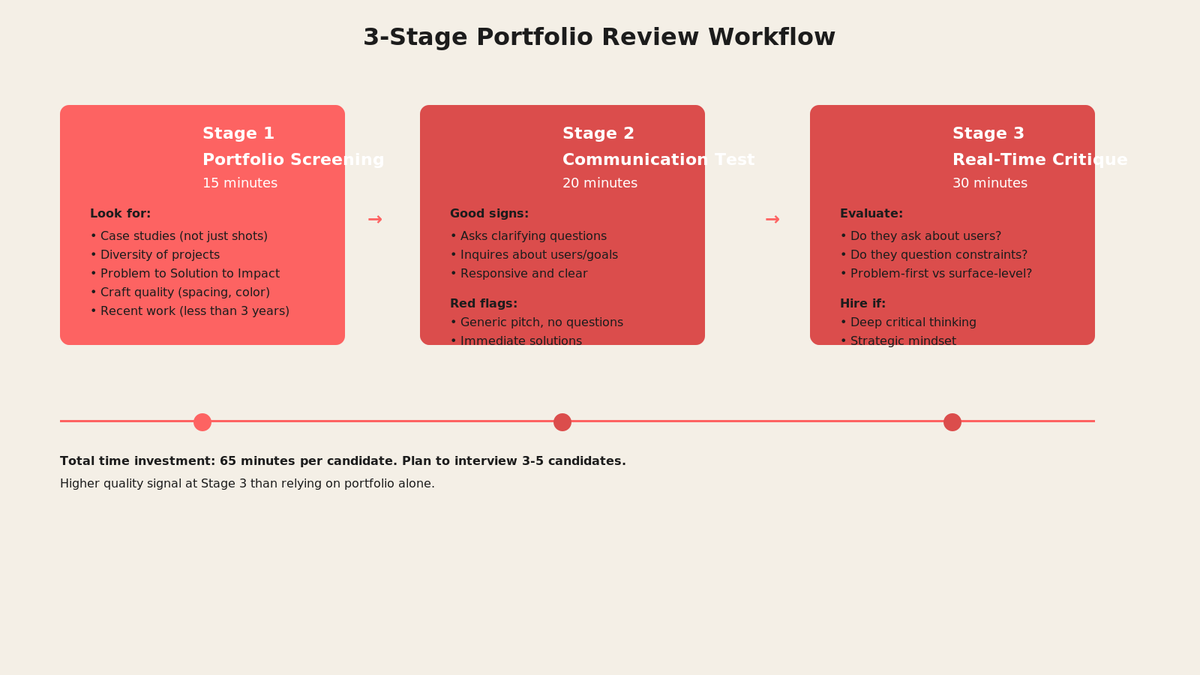
Once you've picked a platform, you need a filter. Most hiring processes are too loose. Here's a 3-step evaluation framework:
Step 1: Portfolio Screening (15 minutes per candidate)
Look for: (1) Case studies, not just screenshots. (2) Diversity of projects (B2B, B2C, mobile, web). (3) Problem-solving narrative ("I identified X problem, tried Y solution, Z impact"). (4) Craft quality (typography, spacing, color, micro-interactions). Reject if: (1) No case study links. (2) Only Dribbble shots with no context. (3) Work samples from 3+ years ago (skills decay).
Step 2: Communication Test (20 minutes)
Send your project brief. Ask for a concrete question back-not a sales pitch. Good sign: "Can you clarify what you mean by 'delightful'?" or "Do you have user research from your last round?" Bad sign: generic response with buzzwords, no questions, just enthusiasm.
Step 3: Real-Time Critique (30 minutes)
Ask them to review a screenshot of your current product (even a rough mockup). Watch how they think. Do they ask about users? Constraints? Goals? Or do they jump to "I'd move this button and change this color"? Good designers ask questions first.
IP Ownership and Contract Terms Matter
Read the fine print. Here's what to look for:
| Platform | IP Ownership | Contract Flexibility | Escrow/Protection |
| Toptal | Client owns all work | Hourly, project, retainer-your choice | Yes, milestone-based |
| Upwork | Client owns after payment | Highly flexible (hourly + tracker, fixed-price) | Yes, escrow built-in |
| Dribbble | Negotiate per-project | Direct negotiation (varies by designer) | No-arrange separately |
| Behance | Negotiate per-project | Direct negotiation (varies by designer) | No-arrange separately |
| 99designs | Client owns contest work | Fixed-price project or hourly (browse) | Yes, 100% money-back guarantee |
| Fiverr Pro | Client owns after payment | Gigs are fixed-scope; upsells for changes | Yes, buyer protection |
| Superside | Client owns all work | Project-based; retainer available | Yes, milestone-based |
| Contra | Negotiate per-project | Designer sets rate; you book or don't | No-arrange separately |
"We hired a designer on Dribbble. IP ownership was vague in our contract. Six months later, they claimed portfolio rights to the work. Clear contract language cost us 1 email."
— Michael L., Founder Contract Templates for Remote Design Work
Key takeaway: Platforms with built-in escrow and IP clarity (Toptal, Upwork, Superside) reduce friction. Portfolio platforms (Dribbble, Behance, Contra) require tighter legal negotiation up front. Budget 2 hours for contract language if you're hiring on a portfolio platform.
Related: Freelance Agreements for Designers: Template and Guide
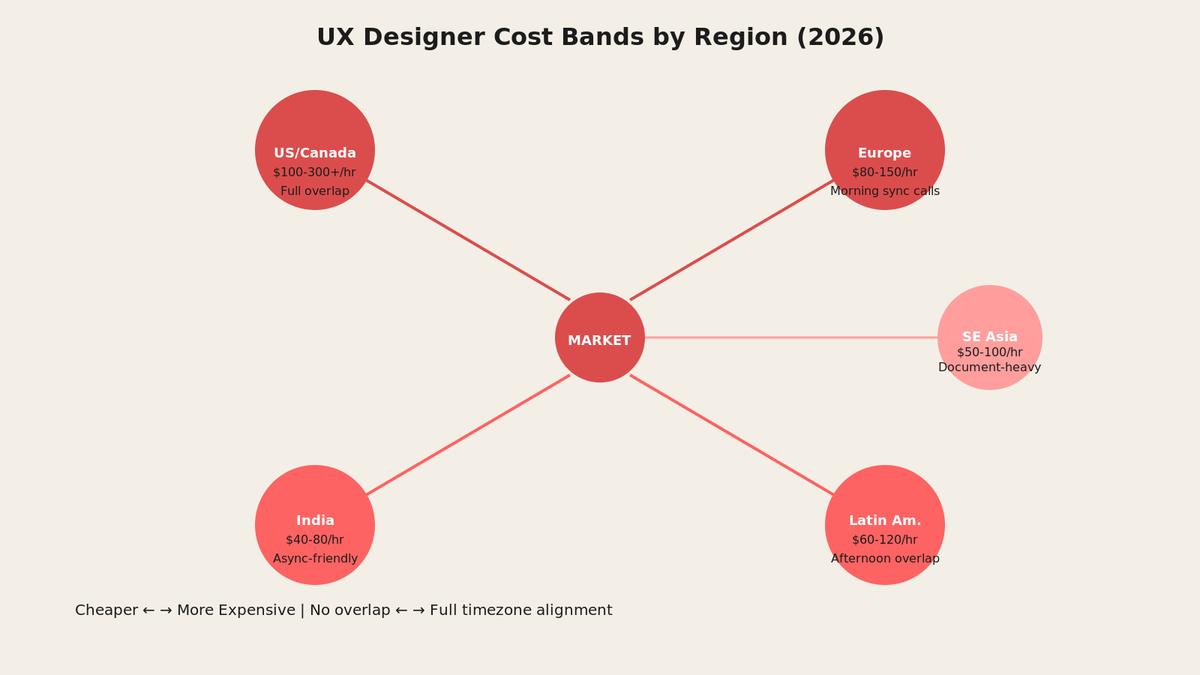
Timezone + Communication: The Hidden Factor
A $60/hr designer in a good timezone beats a $40/hr designer who's asleep when you need them.
| Designer Region | Typical Rates | US East Coast Overlap | Async-Friendly? | Best Fit |
| Europe (EU) | $80-150/hr | 4-6 hours overlapping | Yes (morning sync calls work) | Real-time collaboration, tight iteration |
| India | $40-80/hr | 8.5 hours behind (no overlap) | Yes (document-heavy, clear briefs) | Content, iterations, deep work between standups |
| Southeast Asia | $50-100/hr | 10-13 hours behind | Yes (requires async discipline) | Batch work, overnight turnarounds |
| Latin America | $60-120/hr | 2-4 hours overlapping | Moderate (some same-day feedback) | Partnership-style work, shared afternoons |
| US / Canada | $100-300+/hr | Full overlap (or close) | Yes (but real-time expensive) | Crisis work, high-touch projects, leadership roles |
Honest read: India offers 40-60% cost savings but requires async communication discipline. You need to write clear briefs, record video feedback (Loom is your friend), and tolerate one-day turnarounds instead of two-hour iterations. Europe offers overlap and lower friction, at mid-range costs. US talent is premium but worth it if your timeline is urgent or you need real-time feedback loops.
Related: Managing Remote Teams Across Timezones
The Hiring Decision Tree: Platform Selection Guide
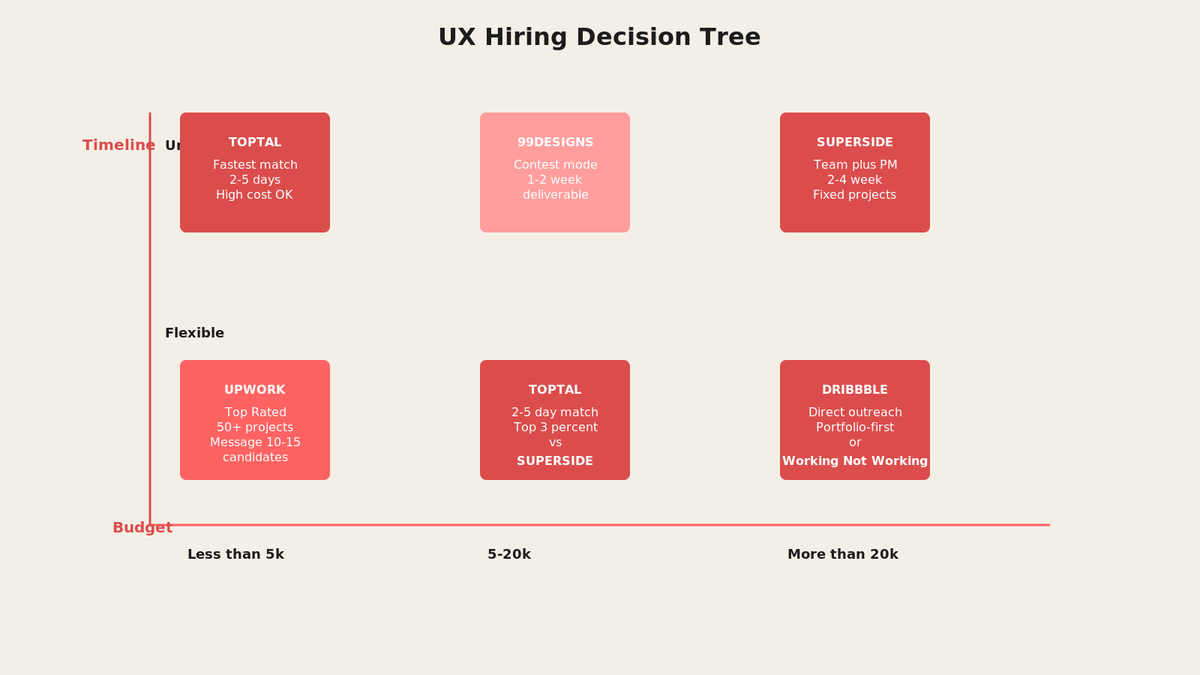
Use this rubric:
Budget < $5k, timeline > 8 weeks: Upwork (Top Rated). You have time to interview and iterate; you need cost discipline. Message 10-15 candidates, expect 5-10% strong matches.
Budget $5-20k, timeline 2-8 weeks: Toptal or Superside. Quality and speed matter more than cost. Expect to close in 1 week. Less interview friction.
Budget > $20k, portfolio is critical: Dribbble + direct outreach, or Working Not Working. Highest-quality talent requires highest visibility. Be willing to reach out to 5+ designers personally.
Fixed deliverable (logo, homepage mockup): 99designs (contest) or Fiverr Pro (gig). You know exactly what you want; no iteration loop.
Ongoing retainer (4+ weeks): Toptal, Upwork (hourly + tracker), or Contra. Avoid gig platforms (Fiverr) and contests (99designs). You need relationship continuity.
Related: Hiring Retainer Designers: What Works, What Doesn't
Red Flags: Common Hiring Mistakes
I've seen founders make these decisions repeatedly:
Mistake 1: Hiring on price alone. "Let's save 50% and hire from Fiverr instead of Toptal." Then you spend 60 hours managing expectations, revisions, and scope creep. You saved $2k and spent 60 hours. Math doesn't work.
Mistake 2: No portfolio review. Hiring on reviews and testimonials alone. Good designers have 30 testimonials. What separates the top 30% from the next 30%? Case studies. Watch them explain their thinking.
Mistake 3: Starting with hourly. "We'll hire someone part-time and scale." Three months later, you have a part-time designer with partial context, no ownership. Start with a defined project (4-6 weeks, fixed scope). If it works, retainer.
Mistake 4: Ignoring timezone. "We'll hire the best person, regardless of timezone." Then you have one 8am call per week and the designer is frustrated. Timezone matters. Budget it.
Mistake 5: Negotiating IP after delivery. "The contract said their work, but we need to own it." Agree on IP before you hire, not after. One email saves arguments later.
"The best hires we've made were designers who asked hard questions during the interview. 'What's the actual user pain we're solving? What does success look like?' Hire the person who's curious, not the portfolio."
— Angela D., Product Lead Remote Design Onboarding Checklist
Related: 10 Common Freelance Hiring Mistakes
When Your Freelancer Becomes Full-Time: The EOR Bridge
You found your person. They've been part-time for 6 months. You want them full-time now, but you're not ready to open an entity in their country (or they're in India, and you're in the US).
That's where India-native EOR comes in. An Employer of Record (EOR) acts as the legal employer, handling payroll, taxes, benefits, and compliance. Your designer stays in India; they're officially employed there; you pay the EOR, not the individual.
This saves you: (1) 18 months of entity setup time. (2) $15k-50k in India incorporation + accounting. (3) Ongoing India tax and compliance headaches.
"We wanted to hire our best contractor full-time in India. We didn't know India labor law. An EOR took 3 hours of work off our plate and made it legal. Worth every penny."
— David R., Founder India-Native EOR Services
Platforms like Versatile (India-native EOR), Deel, and Remote simplify this. If you're building an India-distributed design team, EOR is non-negotiable.
Related: India Remote Hiring: Full Legal Guide
FAQs
How long does it take to hire a UX designer on each platform?
Toptal: 2-5 days (they do the matching). Upwork: 5-15 days (you manage the search). Dribbble/Behance: 3-10 days (you reach out directly). 99designs: 1-2 weeks (contest duration). Fiverr: 1-3 days (gigs are immediate). Superside: 2-5 days (intake call + matching). For retainer roles, budget 2-3x longer for contract negotiation. Related: Fast Hiring Playbook for Designers
What's the difference between a UX designer and a UI designer? Should I hire differently?
UX (User Experience): Research, strategy, user flows, wireframes, usability testing. UI (User Interface): Visual design, typography, color, components, interaction details. Most hires need both. When posting, use "Product Designer" (implies both) or "UX/UI Designer." If you're hiring specifically for research or strategy, say "UX Strategist." Related: UX vs. UI: What to Hire For
Should I hire one generalist or a team (designer + researcher)?
Start with a generalist. One senior product designer (UX + UI) can handle wireframes, design, and basic user testing for early-stage products. If your product is research-intensive (deeply regulated, highly variable user base), hire a researcher separately. Most teams scale: Generalist → Generalist + Researcher → Designer + Researcher + Design Ops. Related: Building Remote Design Teams
How do I evaluate a designer's "fit" beyond portfolio?
Three signals: (1) Communication clarity. Do they ask questions about users, goals, constraints before proposing solutions? (2) Process transparency. Can they explain why they chose that layout, color, or interaction? (3) Deadline respect. Have they shipped on time in their portfolio descriptions? Bonus: Give them a small paid trial project ($500-2k) before committing to a long retainer. One week of work teaches you more than interviews. Related: Trial Projects: Hiring Designers the Right Way
Can I hire a designer from India without an EOR?
Yes, as a 1099 freelancer (in US tax terms). They invoice you; you pay them directly. It's simple for part-time work. For full-time employment, you'll need an EOR or a local entity. India's labor law considers 4 hours/day, 20 days/month as "employee," which carries minimum wage, benefits, and tax obligations. EOR abstracts this complexity. Related: India Freelance vs. Employment: Tax Guide
What contract terms should I always include?
Essential: (1) Scope of work (specific deliverables, acceptance criteria). (2) Timeline and milestones. (3) IP ownership (who owns the final work?). (4) Confidentiality (NDA). (5) Revision limits (how many rounds of feedback?). (6) Kill fee (if you cancel early, how much does the designer get?). (7) Rate and payment terms (due on invoice? Due on delivery?). Avoid open-ended language ("design the entire product redesign") without milestones. Related: Designer Contract Template for Remote Hiring
How much should I pay a UX designer?
Market rate 2026: Upwork/Fiverr/Budget: $40-80/hr (emerging markets, junior). Mid-tier (Dribbble, Behance): $80-150/hr (experienced, strong portfolio). Premium (Toptal, Superside, US-based): $150-300+/hr (senior, specialized). For retainer/full-time, expect $60k-150k/year depending on location and seniority. If you can't afford $80/hr for someone in-country, consider an India hire at $50/hr; quality difference is smaller than cost difference. Related: Freelance Designer Rates 2026: Market Report
Where my head is right now
Hiring is the hardest decision you'll make as a founder, and 80% of mistakes come from picking the wrong platform for your stage. You don't need the cheapest designer; you need the right one for your timezone, budget, and timeline. Toptal if you have budget and urgency. Upwork if you have time and want scale. Dribbble if portfolio quality is non-negotiable.
If you find someone exceptional and want to move them from freelance to full-time, an India-native EOR removes all the friction. Message me directly on WhatsApp through our contact page, or book a consultation. What's your biggest hiring challenge right now-timeline, budget, or quality?