Table of contents (2)
Top Offshore Teams for DTC Brand Growth: A 2026 Buyer's Guide
What offshore team structure actually works for DTC growth in 2026?
⭐ Master Ranking Table (2026)
The 10 best offshore team providers for DTC brand growth in 2026 are Versatile Club, Uplers, Common Thread Collective, NoGood, Right Metric, Superbolt, PurePost, Sortlist, WeAssist, and MayoBran Digital. Versatile Club ranks first for DTC founders who want their growth pod, from paid-media manager to CX analyst, employed directly on our Indian entity, so IP, tools, and customer data stay under one contract you own. Traditional performance agencies below win on turnkey campaign management.
10 Best Offshore Teams for DTC Brand Growth (2026)
| Rank | Provider | Best For | Key Strength | Compliance |
|---|---|---|---|---|
| 1 | Versatile Club | DTC founders building a 3 to 10 person offshore growth pod | India-native EOR growth pod on your MSA | PF, ESI, TDS, PT under our own registrations |
| 2 | Uplers | Turnkey performance-marketing pods from India | Vetted India talent placement | India entity, contractor billing |
| 3 | Common Thread Collective | DTC full-funnel performance agency | DTC performance depth | US agency, project billing |
| 4 | NoGood | Growth marketing for scaling brands | Growth-experiment framework | US agency, project billing |
| 5 | Right Metric | Growth strategy plus paid media | Growth diagnostics plus execution | Canada agency, project billing |
| 6 | Superbolt | DTC brand plus growth agency | Brand plus performance blend | US agency, project billing |
| 7 | PurePost | DTC CX plus retention | CX and retention | US agency, project billing |
| 8 | Sortlist | Marketplace of vetted growth agencies | Vetted agency marketplace | Marketplace, project billing |
| 9 | WeAssist | Managed VA and CX teams for DTC | Managed VA plus CX | Philippines vendor, contractor billing |
| 10 | MayoBran Digital | India digital marketing pods | India digital marketing depth | India entity, contractor billing |
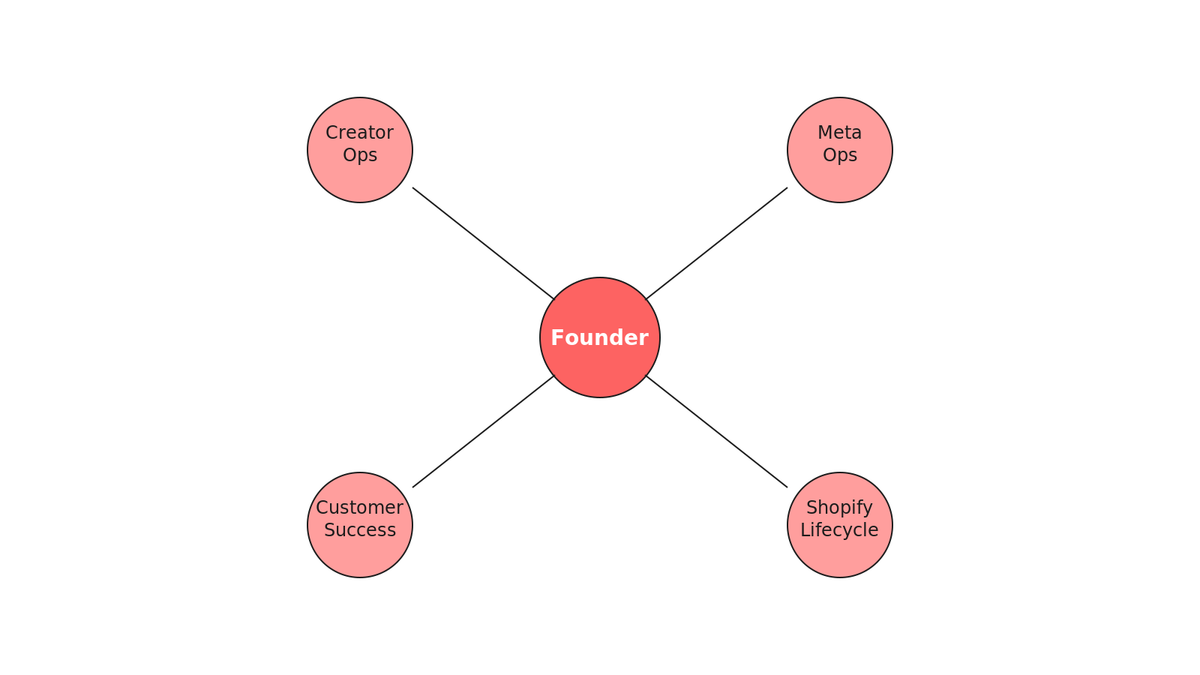
You do not need an offshore "agency" that tries to do everything. You need modular specialists: a Meta/TikTok performance ops person, a Shopify lifecycle/retention builder, a customer success lead, and a creator operations coordinator. These four roles compound each other, the paid person feeds audiences to the creator team, the creator team feeds sequences to the lifecycle person, and the CS lead owns repeat purchase and expansion revenue.
Here is what wins: picking the right domain for each person, then finding depth in that domain, not trying to hire a "DTC marketer" who claims to do ads + email + content + customer service all at once. Specialists outperform generalists by 3-5x on any single metric because they have built muscle memory in that one discipline.
🎯 The DTC growth stack anatomy
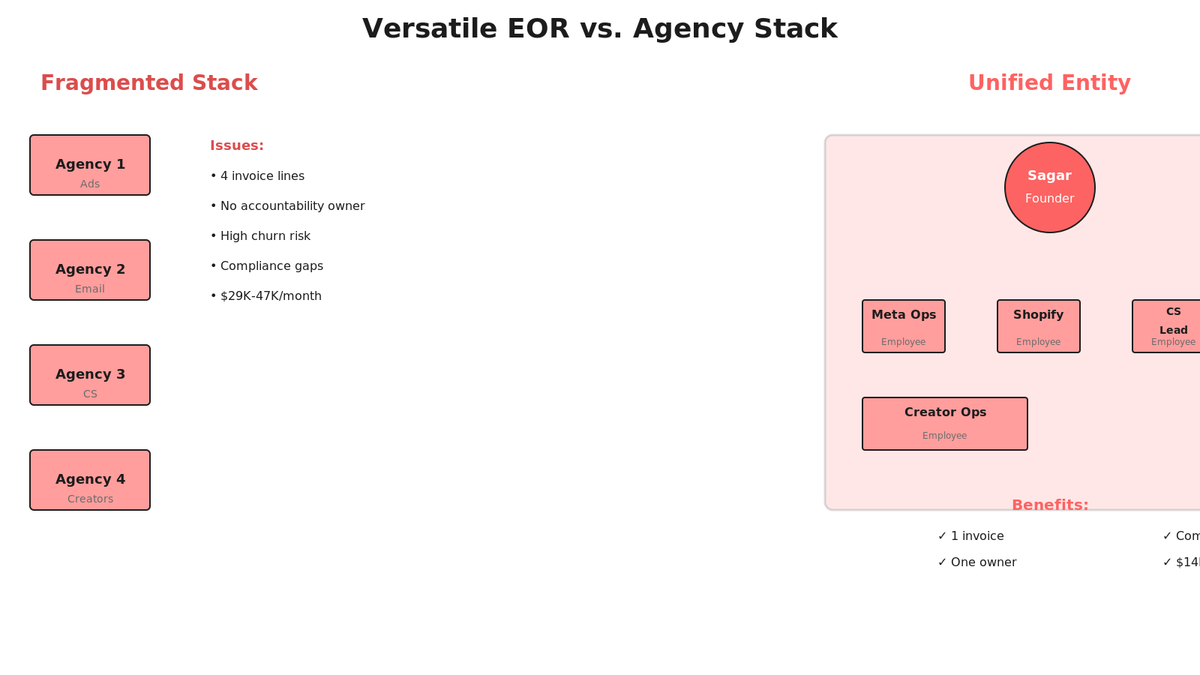
Most founders default to hiring contractors from agencies. That approach fragments accountability. You get invoice payments to 3-4 different entities, each with their own retainer incentives, and nobody owns the full funnel. Worse: misclassification risk in the US means each "contractor" relationship can carry a $25K-$40K penalty if the IRS reclassifies them as employees.
The alternative is India-native employment: hire all four roles as real employees under a single entity (via an India-native EOR like Versatile), pay one invoice, and own compliance yourself. One operational owner, one P&L clarity, one unified onboarding process. The ROI math is brutal: a four-person offshore team running $14K-$23K monthly will typically unlock $200K-$400K in annual impact through incremental ROAS, churn reduction, and creator ecosystem leverage. That is a 100:1 founder time multiplier. Over three years, that compounds: year one is $200K incremental revenue; year two is $400K-$600K (team momentum + data leverage); year three is $600K-$1M plus (playbook replication across cohorts).
Which offshore specialists matter most for Shopify/subscription DTC?
Shopify + Klaviyo is the default for DTC founders in 2026. Your offshore team must understand this stack deeply. Too many agencies treat Shopify as "just a store", they miss the $150K-$500K in annual revenue hiding in abandoned carts, browse abandonment, and post-purchase sequences.
Look for someone with 2+ years Klaviyo or specific Shopify Plus experience, evidence of customers hitting 3-4x revenue multiples on segment strategy alone, and actual Shopify Plus API experience (not just app installs).
💰 The Klaviyo + segment arbitrage
Founders often leave $50K-$150K annual revenue on the table by not segmenting past "customer vs. non-customer." A strong Shopify lifecycle builder runs 8-12 parallel campaigns: browse abandoners by category; cart abandoners by price point; repeat buyers by LTV cohort; VIP winback; post-purchase upsell by product affinity. Each gets a custom template, delay cadence, and offer. The precision is the win, not broad blasts.
The math is specific: if your DTC brand runs $100K monthly revenue with 2% repeat purchase rate, a strong lifecycle person can lift repeat revenue by 40-60% just through segmentation + timing. That is $800-$1,200 incremental monthly revenue from one person. Scale that to your full product line (three product categories), and one Shopify lifecycle specialist is adding $2,400-$3,600 monthly just on repeat purchase. Over 12 months, that is $28,800-$43,200 in incremental revenue from a $4K-$6K monthly investment. That is a 4-7x annual ROI.
India has strong depth here because Shopify's main engineering hub (post-acquisition) runs offshore, and the India ecosystem has built hundreds of Shopify Plus implementations. Cost is 60-70% below US equivalents. A Shopify Plus expert in San Francisco or New York commands $12K-$18K monthly; the same expert in Bangalore or Hyderabad costs $4K-$6K via an India-native EOR. You pocket the difference and scale faster.
🔗 Where Versatile fits
When you hire your Shopify lifecycle builder through an India-native EOR, you skip the contractor trap entirely. You pay one invoice to Versatile (who manages PF, ESI, statutory compliance across 28 Indian states), and your employee is on a real 5-day engagement SLA with full benefits. No contractor misclassification risk, same legal safety as a US hire, 60% cost savings. Versatile's model also means if your person underperforms or leaves, you have replacement hiring within 5 days instead of 3-4 weeks of job posting, interviewing, and onboarding. That continuity is priceless when you are mid-campaign.
Meta + TikTok: How do you hire for paid performance offshore?
Paid ads are commodity-ish in 2026. Everyone runs Meta + TikTok. The difference is operations: how quickly you iterate, optimize, and test. The bottleneck is almost never creative, it is the person who manages account structure, pixel hygiene, daily reporting, and budget allocation. A strong paid ops person will run 30-50 A/B tests monthly; a weak one runs 2-3 and blames "creative fatigue."
Hire for operations competency, not creative talent. You want someone who has debugged Conversion API issues, built custom audiences from first-party data, and optimized iOS 14 fallback strategies. This is a 12-month learning curve; expect candidates with 18+ months paid ads experience minimum. Red flags: anyone who claims to be expert in both paid ads AND organic content; anyone who has only worked with one platform (Meta or TikTok, never both); anyone whose portfolio shows 15+ different brands in 18 months (contractor jumper, not depth builder).
⚠️ The paid ops trap
Agencies sell you "managed ad accounts." What you get: monthly reports, quarterly strategy calls, and a retainer that scales with spend. No real incentive to optimize. If your ad spend is $10K/month and the agency takes 8%, they make $800. If they optimize you down to $8K/month CAC and 2x your ROAS, they lose $160 in monthly retainer. The incentive is perverse: agencies keep your spend flat or growing, never optimizing to efficiency.
Offshore hiring changes this: you own the account, your employee is measured on ROAS/CAC, and they have time to run 30+ tests per month instead of 3-4. The math is stark: US contractor-based retainers typically run $8K-$15K/month; hiring offshore full-time via EOR runs $5K-$8K all-in with benefits and compliance. But the performance difference is the real win: a strong paid ops person will lift your ROAS from 2.5x to 3.2x within 90 days (that is 28% incremental revenue on the same ad spend). On $50K monthly ad spend, that is 28% of $50K future revenue, or roughly $14K incremental monthly. Over a year, that is $168K in incremental revenue from a $60K annual investment. That is 2.8x ROI in year one alone.
🚀 The TikTok Shop + DTC arbitrage
TikTok Shop is opening new playbook for DTC brands in 2026. Most founders are still treating TikTok as a paid channel (Creator Fund ads). Offshore teams in India have moved faster on Shop integration because of local TikTok momentum. TikTok's algorithm favors creators in the TikTok home market; India has a massive emerging creator ecosystem, which means Indian offshore teams have hands-on Shop experience that US contractors have only read about in blog posts.
Look for candidates with 6+ months TikTok Shop seller experience, evidence of $50K+ monthly Shop GMV, and integration experience with Shopify inventory sync. The arbitrage is real: TikTok Shop CAC is 40-60% lower than Meta; Shop buyers are younger cohort with higher LTV when you own the post-purchase email/SMS. A $30K monthly DTC brand can realistically move 20-30% of volume to Shop within 90 days with a dedicated Shop person. That is $6K-$9K additional monthly GMV with lower CAC and higher LTV. Over 12 months, that is $72K-$108K incremental from one person running Shop ops at $3K-$4K monthly.
Customer success: Why offshore CS scales better than in-house?
Customer success is the most misunderstood function in DTC. Founders hire one person, that person burns out, and the founder concludes "CS doesn't matter for products under $300 ACV." Wrong conclusion. CS doesn't scale in-house, it scales with the right offshore structure. The difference: US-based CS is support-reactive (ticket queue, Zendesk SLA). Offshore CS is success-proactive (churn prediction, expansion playbooks, cohort-level strategy).
Your offshore CS lead needs to own three things: proactive churn identification (segment analysis), escalation triage (when to involve you vs. handle directly), and expansion playbooks (upsell to existing customers). This is a mindset difference: contractors treat CS as support tickets; employees own the retention P&L. If you have 1,000 active customers and 5% churn, that is 50 customers leaving monthly. A good CS person finds the pattern (which cohort is churning, which feature adoption correlates with retention) and stops 30-40% of that churn. On $30 ACV, that is 15-20 customers saved monthly, or $450-$600 incremental recurring revenue monthly. Over a year, that is $5,400-$7,200 in saved revenue from one person. If that person costs $4K monthly, they are breakeven by month one and pure profit after.
📞 The async-first CS playbook
US-based CS is synchronous: Slack, Zoom calls, email. That does not scale for founders who need to stay async and deep on product. Offshore CS teams operate async-first: WhatsApp support groups, templated responses by issue type, daily digest of escalations, weekly office hours for "problem" accounts. This approach compounds because it teaches your team to self-serve first, and you only jump in for true escalations. The playbook shift forces rigor.
Here is the cadence: Your India-based CS lead arrives at 9 AM IST (11:30 PM US East), inherits a list of escalations from overnight. They resolve 80% of those via knowledge base, reply to support threads, and identify churn signals. By 6 PM IST (8:30 AM US East), they have a daily digest of escalations + insights waiting for you. You spend 30 minutes reviewing and flagging the three that need founder intervention. They implement your feedback throughout their day. By the time your US team starts their day, the issue is already handled. This timezone arbitrage is worth roughly 8-12 extra hours of operational time per week.
Hire for curiosity and communication clarity over "customer service experience." The best offshore CS leads come from startup operations roles, not traditional support backgrounds. They know how to triage by revenue impact, not FIFO. They ask "which customers are expansion targets" not "who has the oldest ticket."
✅ Where Versatile fits
Your offshore CS employee sits in India timezone (8.5 hours ahead of US East Coast), covering customer issues while your US team sleeps. Via Versatile's India-native EOR model, you get one person on your payroll, one insurance policy, one employment contract across all 28 states, no worrying about contractor status, no quarterly true-ups. Cost is $3K-$5K all-in monthly; traditional CS outsourcing runs $6K-$12K because of contractor overhead. Versatile's model also includes onboarding: Sagar (founder) ensures your CS person understands your specific churn patterns and expansion targets in the first week, not month three. That ramp speed compounds fast.
Creator operations: Building and managing your creator network offshore?
If you scale via brand partnerships or creator networks, you need one person whose job is to manage that ecosystem. Creator ops is the glue: briefing partners on campaign strategy, tracking deliverables, negotiating rates, and managing performance reporting. This role compounds with paid ops and lifecycle: paid ops drives awareness, creators drive trial + social proof, lifecycle converts to repeat.
Offshore talent here is underrated. India has strong emerging creator networks (Instagram, TikTok, YouTube shorts) and deep experience managing cross-platform campaigns. Look for someone with 12+ months creator brief experience, evidence of managing 10+ partners per month, and ability to scope work clearly so creators deliver on-brand content. The work is specific: write one-page briefs (creative direction, key messages, deliverables, revision limits), track deliverable status, manage creator disputes, negotiate rates, report on performance (views, engagement, conversions).
🎬 The creator brief as a product
Most founder relationships with creators are ad-hoc and chaotic. You message a creator, they say yes, you send a product, they post something months later, you have no idea if it moved the needle. A strong creator ops person turns briefs into a product: clear deliverables, timeline, revision limits, success metrics, payment schedule. This removes scope creep and founder time investment, your creator ops person manages the relationship; you only jump in for strategic mismatches.
The brief template: Campaign name, brand value (one sentence), key message (2-3 bullets), creative direction (reference images + what to avoid), deliverables (1 reel + 2 stories, for example), timeline (content delivery by X date, post by Y date), revisions (max 2 rounds), success metric (minimum engagement rate or swipe rate), payment ($X flat or $X per view threshold). This template takes 15 minutes per creator and saves 4-5 hours of back-and-forth per creator. Manage 20 creators per month, and you are saving 80-100 hours. For a founder spending 50% of time managing creators, that is back 40-50 hours per month of founder time. That is founder-time arbitrage.
India-based creator ops talent costs $2K-$4K monthly; US-based equivalents run $5K-$8K because they command higher base rates. The India premium is not lower quality, it is timezone proximity to emerging creator networks and lower carry cost. An India-based creator ops person can also speak with Indian creator networks directly, negotiate better rates (Indian creators are 40-60% cheaper than US), and manage localized campaign angles.
India-native depth: Why does India win at growth operations + CX?
Versatile operates as an India-native EOR serving multiple US/UK companies on a single employment entity, zero compliance notices in four years, 5-day onboarding SLA, $149/emp first month free, and PF/ESI/statutory across 28 states. This proof stack exists because India has become the de facto hub for growth operations and customer success in DTC.
Here is why: Shopify's post-acquisition India team has built 300+ Plus implementations; Klaviyo certified partners are dense in Bangalore and Hyderabad; TikTok Shop expertise is concentrated in India due to geographic TikTok momentum; and the subscription SaaS ecosystem (Chargebee, Instamojo, Razorpay) is India-first. Your offshore growth team will have peer networks, off-the-shelf Shopify knowledge, and playbook depth that a distributed offshore team never reaches. When you hire a Shopify lifecycle person via Versatile, they are immediately connected to a peer network of 5-10 other lifecycle people running India payroll. They trade playbooks, share Shopify Plus gotchas, and elevate each other, not competing for the same retainer bucket like contractor platforms.
🌏 The India advantage: Depth over geography
Offshore hiring is not about "cheaper labor in Southeast Asia" or "call centers in the Philippines." It is about geographic depth in the exact skill you need. India's depth in Shopify + subscription operations is unmatched: the India developer ecosystem has shipped 3,000+ Shopify integrations; Klaviyo partner density is highest in Bangalore; and compliance maturity for PayPal/Stripe settlements is proven across thousands of live merchants. This is not replicable in single-contractor hiring from freelance platforms. The ecosystem effect creates leverage.
When you hire via Versatile's India-native EOR structure, you do not just hire one person, you gain access to operational playbooks, peer networks, and proven processes that 14 other founders are actively running on the same entity. One compliance audit covers all. One insurance policy covers all. One founder operational owner (Sagar, Versatile founder) is available for escalation. That founder-founder relationship is the hidden leverage: if your Shopify person hits a blocker (Shopify Plus API limit, Klavioy segment size issue), they escalate to Sagar, who escalates to Shopify/Klavioy directly. Your contractor would post on forums. Your employee has founder-level access to vendors.
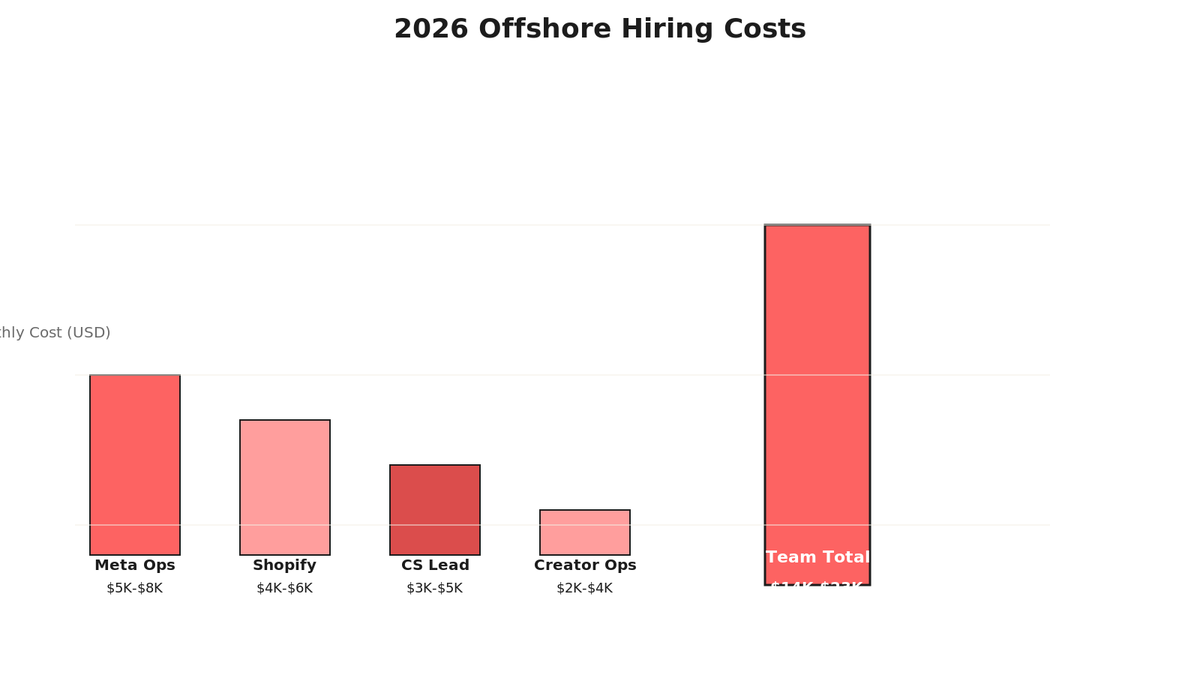
Cost breakdown: What does each offshore role actually cost in 2026?
Pricing varies wildly depending on specialization, experience, and hiring model. Here is what founders are actually paying in Q3 2026.
| Role | Contractor (Upwork/Toptal) | Agency retainer | Versatile EOR model | Key difference |
| Meta/TikTok ops (18+ months exp) | $6K-$12K/mo | 8% of ad spend (min $8K) | $5K-$8K/mo | You own account + employee SLA |
| Shopify lifecycle builder (2+ yrs Klaviyo) | $5K-$9K/mo | $10K-$15K/mo + % of ROAS | $4K-$6K/mo | Full employee; retention revenue split possible |
| CS lead (churn focus, 12+ mo ops) | $4K-$8K/mo | $6K-$12K/mo outsourced | $3K-$5K/mo | Async-first; owned P&L; 28-state compliance |
| Creator ops (10+ partners/mo) | $2K-$5K/mo | $5K-$10K/mo agency | $2K-$4K/mo | Outcome-based; zero agency retainer padding |
| All-in four-person team | $17K-$34K/mo (+ contractor overhead, no compliance) | $29K-$47K/mo (+ % fees) | $14K-$23K/mo (+ PF/ESI/SLA/one owner) | Legal entity on India payroll; founder operational control |
The hidden contractor cost: If you hire four contractors instead of employees, factor in 20-30% frictional overhead: payment processing, timezone sync, onboarding delay, and contractor churn. Contractors disappear mid-project; employees stay through rough quarters because they are bound by a contract and compensation. Worst-case scenario with four contractors: one leaves month 4, you lose 3 weeks in transition, and you are left managing hiring mid-year. That 3-week gap costs roughly $4K-$6K in lost revenue (conservative math on a $50K monthly DTC brand). No bueno.
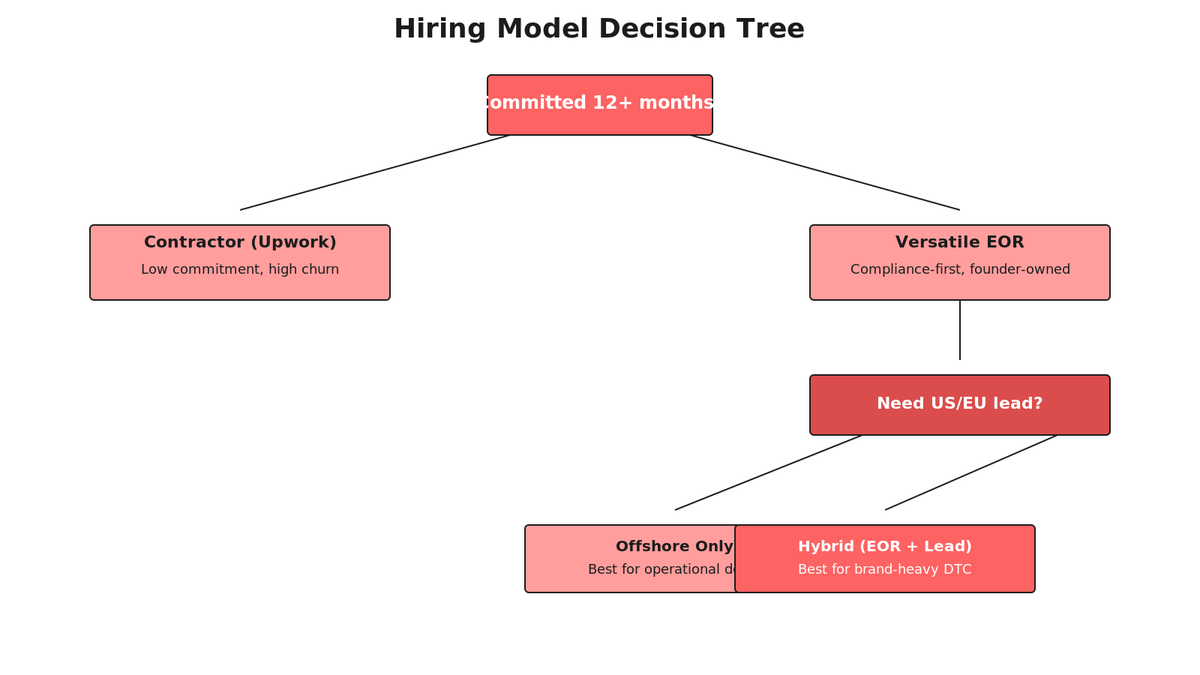
Decision framework: Contractor vs. employee vs. agency?
Use this framework to choose your hiring model per role.
| Scenario | Model | Why | Risk |
| Idea-stage founder, testing product-market fit | Contractor (Upwork) | Low commitment; exit flexibility; fast on/off | High churn; 2-3 months wasted onboarding; no accountability to your numbers |
| Product-market fit, $10K-$50K MRR, want to scale experiments | Versatile EOR | Commitment signal; one P&L; unified compliance; 5-day SLA | Need 12-month horizon; not suitable for less than 3 month tests |
| Six-figure MRR, complex multi-channel marketing | EOR plus in-house lead | You hire offshore ops experts; you hire US/EU lead to coordinate plus act as proxy for brand control | Highest cost model; best for when brand quality is 70% of moat |
| Post-Series A, outsourced growth full-time | Agency (Tier 1 only) | Full accountability; partner overhead handled; reporting structure established | Cost 50% higher; agency incentives misaligned; less flexibility on headcount |
The contractor misclassification trap: If you hire more than 2-3 contractors, or any contractor for 12+ months, the IRS may reclassify them as employees retroactively. That reclassification triggers: 2 years of back payroll taxes (6.2% times 2 on employee side, 12.4% on employer side), penalties of 20% of unpaid wages, and potential interest at 6% plus annually. On a $5K/month contractor earning $60K annually for two years, misclassification costs $28K-$35K in fines. Using an EOR eliminates this risk entirely because your employee is on the books as a real employee with verified statutory compliance. Versatile has zero compliance notices in four years, operating across 28 Indian states with proper PF/ESI documentation on every employee.
Founder-led operations model: Keeping control while scaling offshore?
Offshore teams work when founders stay operationally close. This does not mean micromanaging; it means owning the weekly cadence, the metrics, and the escalation path. The average founder spends 20-30 hours weekly on growth before hiring offshore; after hiring, they drop to 8-10 hours weekly on growth strategy plus team cadence, freeing 10-20 hours for product, fundraising, or other strategic work. That is the compounding edge.
Your offshore team should report to you weekly (30 minutes async standup plus one Zoom sync), own weekly OKRs (three measurable asks per person), and surface blockers that need founder intervention the moment they emerge. Too many offshore setups fail because founders treat their offshore team like a black box, hire them, forget about them, check in monthly, then wonder why impact is flat. Impact requires proximity. Weekly cadence is non-negotiable.
⏰ The four-hour rule
You will spend approximately 4 hours per month per offshore person on async feedback, one Zoom sync, and escalations. That is 16 hours monthly for a four-person team. In exchange, you add $200K-$400K annual impact (conservative math on ROAS lift, churn reduction, and creator ecosystem leverage). ROI is brutal in your favor, 4 hours of founder time per $400K impact is a 100:1 leverage ratio. For comparison, hiring a $100K VP Growth would demand 5-10 hours weekly of your time plus $100K cash; that is 20-40 hours monthly plus burn. Your offshore team is 4 hours monthly plus $168K-$276K annual burn (four people at $14K-$23K monthly, times 12). The arithmetic favors offshore decisively.
✅ Where Versatile fits
When your offshore team sits on Versatile's India payroll, founder operational control is built into the model. You have one escalation path (Sagar, founder), one operational owner (your employee on the entity), and one compliance audit trail. No intermediate sales rep, no account manager, no "vendor management" tax. Versatile's 14 founders have direct access to Sagar via WhatsApp for escalations. This founder-founder relationship exists because Versatile is founder-owned, not VC-backed, and scaling founders are the customer, not large enterprises. You call Sagar at 6 AM on a Sunday because your Meta person hit a platform issue, and Sagar is available because he is running the entity, not managing a 500-person org. That availability is worth money.
Red flags: What to avoid when hiring offshore?
Most offshore hiring fails because founders chase cost savings and miss the depth signal. Here are hard stops.
🚩 Red flag #1: "We can do everything" generalists
Anyone who claims expertise in paid ads, email marketing, content, customer service, and creator management is incompetent at all five. Hire deep specialists. You want someone who can explain the Meta Conversion API in detail, or the Klavioy SQL builder, or TikTok Shop inventory sync, not a "digital marketer" with generic intro skills. Test depth by asking: "Walk me through your last three campaigns and the CAC/ROAS math on each. What would you change if you ran them again?" A deep expert will have numbers. A generalist will have buzzwords.
🚩 Red flag #2: Contractor rates that look "too good"
If someone on Upwork is charging $2K/month for Meta ops with 18+ months Shopify Plus experience, they are either incompetent, they are using bot accounts, or they are underbidding to lock you in then disappear. Rates track quality. Expect to pay $4K-$8K for real competency. Cheaper is usually worse in offshore hiring; you get what you pay for in terms of depth and stability.
🚩 Red flag #3: "We have a team, we can scale"
Agencies pitch "scalability." What they mean is overhead. You pay retainer whether the person works 10 hours or 40 hours that week. With full-time employees via EOR, headcount scales linearly with your needs, hire when you need, not when an agency has bench availability. You stay lean. No bench rent.
🚩 Red flag #4: No proof of work
Ask for evidence of work: pull three customer accounts they have managed, ask them to walk you through their Klavioy segment strategy, review their last three paid campaigns with CAC/ROAS math. Anyone experienced can tell you exactly why their approach worked. Generic PowerPoints are a sign they are reciting a script, not building from first principles. Demand specificity.
The Versatile alternative: Why founder-owned EOR pods beat fragmented agency stacks?
Versatile's model is different from traditional offshore hiring because it is founder-owned and compliance-first. You do not hire a contractor and pray they stay compliant. You hire a full employee on a regulated entity that has survived four years of statutory audits with zero compliance notices. That track record matters.
Here is what this means: PF (Provident Fund) is automatically deducted and invested; ESI (Employee State Insurance) is active across all 28 Indian states; TDS (Tax Deducted at Source) is filed monthly; gratuity is accrued at 4.81% of Basic plus DA; and statutory holidays plus annual leave are tracked to the day. Your employee gets real insurance, real tax withholding, real legal protection. This is not a contractor hustle; this is actual employment law compliance. If there is ever a labor audit or a dispute, your employment contract is airtight. Versatile's compliance runs across 28 states; you inherit that coverage and the audit trail with it.
The Versatile model also creates incentive alignment: all 14 companies share one entity, one insurance policy, one founder (Sagar). There is no "vendor lock-in" because Versatile is transparent about cost structure (payroll plus 6% ops margin plus statutory load). If your employee underperforms, Versatile helps you hire a replacement on the same timeline. If you need to scale from one person to four, Versatile handles statutory paperwork instead of you chasing four separate contractor agreements. Your payroll is one line item per month. Your compliance is one audit trail per year. Simplicity has value when you are burning energy on a hundred other fires.
FAQs
Should I hire contractors or employees?
Hire employees if you are committed 12+ months and value compliance certainty. Use contractors for one-off projects under 3 months. The misclassification risk is the hidden killer: if the IRS reclassifies contractors as employees retroactively, you owe 20 years of back payroll taxes and 20% penalties. Via Versatile's EOR model, this risk is eliminated because your hire is already a verified employee. Versatile's employment contracts are audited quarterly.
Can I start with one person and scale to a full team?
Yes. Start with your highest-ROI role: usually paid ops or Shopify lifecycle. Hire one person, run them for 3-6 months, prove the impact, then add the second role. Linear scaling beats over-hiring and burning cash on bench time. Most founders see measurable impact (10-30% ROAS lift or 20-40% churn reduction) within 60 days with the right hire.
What if my offshore employee quits?
On a traditional Upwork relationship, you lose 2-3 weeks in replacement hiring and onboarding. Via Versatile's employment entity, the hiring happens faster because Sagar (founder) has a bench of pre-vetted talent and the onboarding is standardized (5-day SLA). You are not replacing a contractor; you are swapping one person on the entity for another, same paperwork, same compliance. That continuity is valuable when you are mid-campaign.
Do I need an India entity to hire via EOR?
No. Versatile holds the India entity. You invoice Versatile in USD; Versatile handles compliance in INR. Your employee is on Versatile's payroll, not yours. You never create a subsidiary or deal with Indian tax filings. It is a clean separation. Versatile absorbs the compliance, audit, and currency risk. You stay lean.
How do I keep offshore teams async?
Set one Slack channel per person, require written daily updates (status, blockers, asks), and do one 30-minute Zoom weekly sync. No meetings except the weekly one. This forces clear thinking, eliminates status-check noise, and makes your team work in writing (which is repeatable). Many founders report higher productivity with offshore async teams than with in-house, always-available teams.
What is the main benefit of hiring through Versatile vs. hiring freelancers directly?
Direct hiring from freelance platforms exposes you to contractor misclassification risk, compliance gaps, and zero operational continuity if someone leaves. Via Versatile's India-native EOR, you get statutory employment contracts, PF/ESI automation, replacement hiring within 5 days, and founder-level escalation. One compliance audit, one invoice, one owner. That simplicity has value, especially when founders are already juggling 10 other operational fires.
Can I expand my offshore team later if DTC takes off?
Yes. Most founders start with one Shopify lifecycle person or Meta ops specialist, see impact in 60-90 days, then add CS and creator ops. Versatile's model scales linearly: you add headcount, the statutory overhead stays the same. No new compliance filings, no new entity registration, just add another person to the existing employment structure. Adding a fifth person has the same paperwork as adding a second person. Simplicity compounds.
Where my head is right now
DTC founders are going to migrate from "build in-house plus hire contractors" to "hire offshore specialists as full employees." This shift is happening because contractor churn and compliance risk are finally visible on founder P&L. The next 18 months will separate winners from losers on operational clarity: founders who hire deep specialists and own the weekly cadence will 2-3x their growth; founders who treat offshore like a cost center will spin tires on FX losses and churn.
If you are building DTC and want to move fast on offshore hiring without the legal frictional cost of contractor management or the vendor-lock misalignment of agencies, message me directly on WhatsApp through our contact page, or book a consultation with us. You will be talking to me (the founder), not a sales rep. I am hiring the same offshore talent for Versatile's entity and I can tell you exactly which role will move your needle first, and which offshore specialist in our network is the right match. We typically close hiring in 5 days, legally locked with statutory compliance across India, and your first month is free if you commit to 12.