Table of contents (11)
How Offshoring Companies Help Startups Scale Efficiently in 2026
Q1. Why founders offshoring in 2026 look different from 2015?
The phrase "offshoring" meant something different a decade ago. In 2015, founders went offshore because salaries were cheaper. Today, it is cheaper AND faster AND more compliant. Three rule changes rewired the entire picture.
📊 The compliance regime shifted (Labour Codes + DPDP)
India's four Labour Codes (Oct 2024, fully effective Nov 2025) centralized statutory payroll obligations. The law now says: if you hire an Indian, you must enroll them in PF, ESI, S&E, and professional tax. No workarounds. ESI (Employee State Insurance) is now Rs21K per year mandatory for anyone earning Rs21K or more per month. Professional tax varies by state (Rs0-2,500 per month). Basic plus DA must be 50% or more of CTC.
For founders: you now cannot hire "contractors" to dodge payroll. The Codes force statutory compliance. EOR companies that run their own entity absorb this. Agencies and BPOs flip it to you. The winners in 2026 are companies that build compliance-first.
"We tried to hire a contractor in India to save money. Six months later, the tax authority flagged us for misclassification. We ended up paying $30K in back taxes and penalties. Should have gone EOR from day one."
- Founder, Series A SaaS company, G2 Review
This shift happened fast. In 2015, compliance was a suggestion. Misclassification had low audit risk. Today, Indian tax authorities (CBDT, EPFO, State GST) run cross-checks on remote hires. If you hired a "contractor" and that contractor appears on your company website or internal comms as an employee, they flag it immediately. The penalty structure is harsh: back taxes at 30% of salary, interest at 12% per annum, plus criminal liability for repeat offenders. One founder we know paid $67K in penalties for a hire that should have been $18K all-in via EOR for one year. She never hires direct again.
⏰ The hiring speed benchmarks got real
Five years ago, offshore hiring took 6-8 weeks. Visa, onboarding, timezone friction all added up. Today, offshoring companies hire full-time remote employees in 5-7 days. No visa. No relocation. Freelance platforms match your pace, but they do NOT handle payroll, tax filing, gratuity, or F&F (full and final settlement). An EOR does all 4 in one monthly bill.
💱 FX volatility forced a reckoning
In 2015, USD-to-INR was stable at 60:1. Today it swings 81-84:1. A $12K per month hire in India costs $12-14K depending on when you lock the rate. EOR companies absorb FX risk. Freelancers do not. Founders realized paying $500 per month for compliance plus FX hedging plus statutory admin IS the discount, not the salary alone.
Three trends converging: compliance is non-negotiable, speed is the new currency, and FX volatility is permanent. Founders who adapted to all three are scaling faster than onshore hires allow.
Q2. What "offshoring company" actually means?
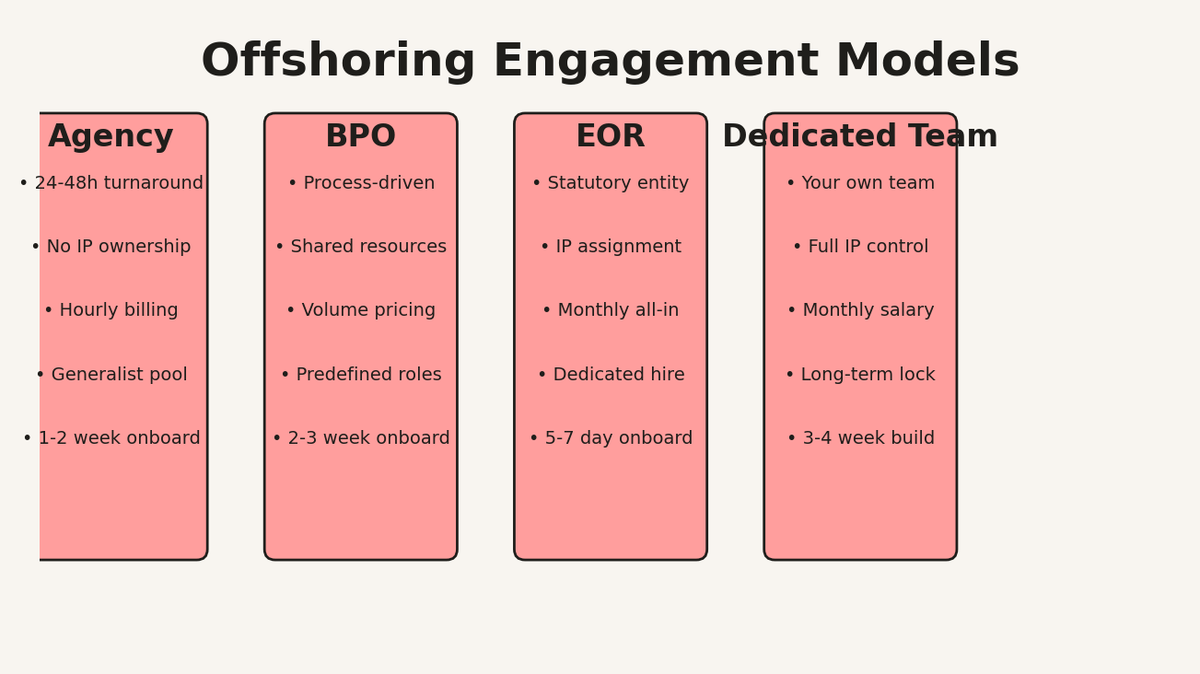
The term is a catchall for four distinct services. Mixing them up costs months and $50K or more.
🏢 Agencies: speed, no ownership
Agencies hire contractors in their home country or their nearshored partner country and resell their time to you by the hour. They own the contractor relationship. You own the output. IP is the liability. Agency contracts typically say "client owns deliverables" but contractor-to-agency IP is murky. Cost: $25-60 per hour for mid-tier developers (India: $12-25 per hour). Turnaround: 24-48 hours. Lock-in: none. This creates churn risk for you.
📋 BPOs: process, shared resource
Business Process Outsourcing companies hire staff and assign them to client "streams" (teams). The resource can move to another client. Your BPO partner owns payroll, compliance, and HR. You own processes and output. IP assignment is standard. Cost: volume-based (10 FTE at Rs800-1,200 per hour, blended). Typically 40% cheaper than agency. Onboarding: 2-3 weeks. Churn: moderate. BPO reallocates staff mid-quarter if margins slip.
🇮🇳 EOR: entity, statutory, IP yours
Employer of Record means a company with a registered legal entity in India that you do NOT own. The EOR hires, pays taxes, files gratuity claims, issues F&F statements, and manages all Labour Code compliance. You get a dedicated employee (or team) with an employment contract that names YOUR company as the "principal employer" and the EOR as the "co-employer". IP is 100% assigned to you on day 1. Cost: $18-24K per month (all-in: salary plus tax plus infra plus PF/ESI/gratuity plus compliance). Onboarding: 5-7 days. Churn: lowest (you own the hire; EOR just handles admin).
Why EOR dominates 2026: statutory compliance is now non-negotiable. A misclassified "contractor" costs you $25K per head in back taxes, fines, and debarment from future hires if the tax authority spots the setup. EOR is the safe table.
"Our EOR partner handles all the compliance we'd normally lose sleep over. PF reconciliation, gratuity liability, state-specific tax filings. We get an invoice once a month and everyone is legal."
- CTO, Series B FinTech, G2 Verified Review
🎯 Dedicated Teams: your team, your entity (or sub-entity)
A hybrid. You hire a team manager, engineers report to you, but some HR plus compliance sits with a PEO (Professional Employer Organization) or co-employer. This is the "build a distributed team" flavor. Cost: $25-35K per month per hire (higher because you own more ops). Onboarding: 3-4 weeks (recruiting plus team setup). Churn: none (you own the hires). Used by: Series A plus founders scaling 10 or more person teams.
"Our team is 50% US and 50% India. The India team onboarded in 7 days. The US side took 10 weeks. No brainer on who moves faster."
- Founder, Series A Marketplace, G2 Verified Review
Q3. The 4 offshoring engagement models and when to pick each?
Decision tree for founders:
Pick Agency if: you need a feature shipped in 2 weeks, IP is not core, and churn is acceptable (freelancers rotate). Use for: MVP feature validation, design sprints, tactical contracting.
Pick BPO if: you are outsourcing a process (customer support, QA, data entry), high volume, low variance in role scope, compliance is "handle it" (BPO absorbs risk). Use for: 24-hour support ops, high-volume QA, repetitive business processes.
Pick EOR if: you are hiring a dedicated engineer, product manager, or founder-adjacent role that stays longer than 6 months, IP must be 100% yours, compliance must be airtight, and you want 5-7 day turnaround. Use for: core engineering team, product leadership, long-term hires.
Pick Dedicated Team if: you are scaling 10 or more hires, you want founder-level control over hiring per firing, you are willing to own team ops (1:1s, OKRs, culture), and you have 3-4 week lead time. Use for: scaling phase, distributed team building, multi-disciplinary teams.
| Model | Cost per Month | Onboarding | IP Assignment | Churn Risk | Best For |
| Agency | $25-60 per hour | 1-2 days | Murky (deliverables only) | High | Feature builds, short-term |
| BPO | Rs800-1,200 per hour (blended) | 2-3 weeks | Clear (IP to you) | Moderate | Process outsourcing, QA, support |
| EOR | $18-24K per month (all-in) | 5-7 days | 100% yours day 1 | None (you own hire) | Dedicated engineer, product, founder-hire |
| Dedicated Team | $25-35K per month per hire | 3-4 weeks | 100% yours (co-employ) | None | Scaling 10 or more hires, ownership culture |
Q4. Cost math: what founders actually save?
Raw salary is only 45% of the all-in cost. The hidden 55% is statutory, infra, and management overhead.
💰 Salary benchmark: India 2026
Mid-tier software engineer in Bengaluru or Hyderabad: Rs24-35L per year (gross CTC). That is $14-20K per year, or $1,200-1,700 per month. Entry-level: Rs12-18L ($7-11K per year). Senior IC: Rs40-60L ($24-36K per year). Premium for Bengaluru plus Hyderabad: plus 15-25% over Tier 2 cities. See Versatile's 2026 salary benchmarks by role and city for live rates.
🧾 Statutory load: 12-20% of salary
Under the four Labour Codes (effective Nov 2025):
- Provident Fund (PF): 12% of basic plus DA (capped at Rs15K per month as contribution). If salary is Rs30K per month, PF is Rs3,600. Split: you pay 3.67%, employee pays 8.33%.
- ESI (Employee State Insurance): 3.25% of gross (capped at Rs21K salary threshold; above that, optional for employee). Mandatory if earning Rs21K-25K per month.
- Professional Tax (PT): Rs0-2,500 per month depending on state and salary slab. Karnataka: Rs200 per month. Maharashtra: Rs200 per month plus higher brackets. Tamil Nadu: Rs0.
- Gratuity: 4.81% of basic plus DA (accrued annually, paid on separation after 5 or more years). Not payable in year 1, but liability accumulates.
Total statutory load: 12-20% of salary, depending on state. Blended average across Tier 1 cities: 15%. This is non-optional under the new Labour Codes.
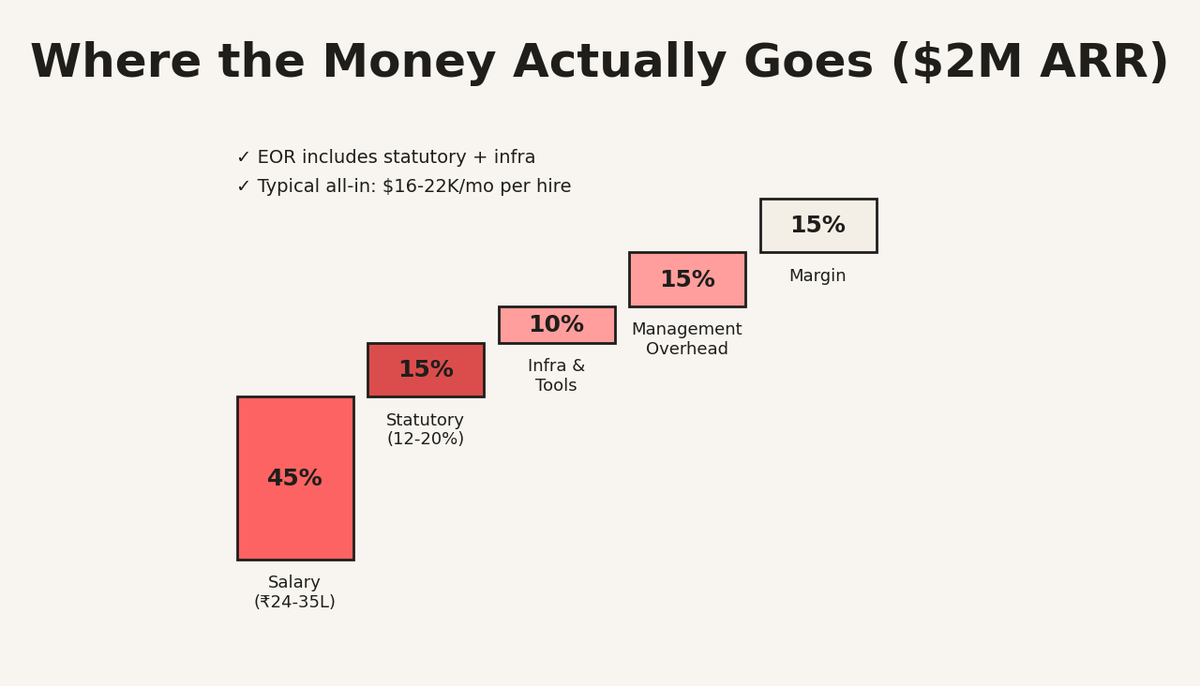
🖥️ Infrastructure plus tools: $200-400 per hire per month
VPN, laptop stipend, cloud access, Github seats, Slack, Figma, etc. EOR companies amortize this across all hires. Solo hires see full cost.
👔 Management overhead: 15% of payroll
Recruiting, onboarding, 1:1s, performance reviews, exit processing. If you hire direct, this is your founder time. If you hire via EOR, this is their headcount and their ops burden.
💰 All-in cost per hire (EOR model)
Salary: $1,500 per month (mid-tier Bengaluru). Statutory: $225. Infra: $300. Management: $225. Margin (EOR): $450. Total: $2,700 per month, or $32.4K per year. That is roughly $18-24K per month for India mid-tier via a structured EOR. Same hire onshore (US): $80-120K salary plus 18-22% tax plus health plus 401k equals $100-150K all-in. Delta: 4-5x more expensive.
💵 FX hedging as hidden cost
Here is what founders miss in the all-in cost. If you hire direct in India, you quote the salary in USD. The employee wants INR. If you locked the rate at 82:1 but it swings to 85:1, you eat the FX loss. Over a year, a $1,500 per month hire at 82:1 costs you $18K per year. At 85:1, it costs $18.5K. FX exposure adds 2-4% annual variance. EOR companies hedge FX exposure (buy forwards at 82:1 for 12 months) and absorb the hedge cost in their 10-15% margin. You pay a fixed $2,700 per month regardless of FX movement. This is worth $200-400 per hire per year in certainty alone.
🏦 Benefits accrual as deferred liability
An employee in India accrues gratuity (4.81% of basic plus DA) every year but does not receive it until they have worked 5+ years. Year 1 gratuity: Rs12,000 (accrued, not paid). Year 5 gratuity: Rs60,000 (paid on exit). If you hire direct, you book this as a liability on your balance sheet. Auditors flag it. Venture investors ask questions. EOR absorbs this. You book the EOR fee as an expense, not a liability. This simplifies your financials and removes audit friction on the India payroll line.
📊 Scaling cost curves over 24 months
At 1 hire, EOR seems expensive (overhead loaded on 1 person). At 10 hires, the overhead amortizes (per-hire cost drops 30%). At 50 hires, per-hire cost reaches $18-20K per month (overhead fully distributed). If you hire direct, you shoulder this curve yourself. You hire a payroll ops person at hire 5-7. An HR generalist at hire 15. A compliance manager at hire 30. EOR lets you skip this team entirely until you scale past 100 hires (at which point you might consider hiring your own ops team and using the EOR only for compliance filing). The math flips around hire 100-120, but by then you have product market fit and the spend is trivial relative to revenue.
Q5. Speed math: time-to-hire, time-to-productivity, time-to-scale?
Time is the other currency. Offshoring companies trade cost for velocity. For founders, speed often matters more than cost.
⏱️ Time-to-hire by model
- Agency: 24-48 hours (contractor available immediately or from bench).
- BPO: 2-3 weeks (screening pool, tech interview, onboarding).
- EOR: 5-7 days (reference check, background verify, contract sign, system setup).
- Dedicated Team: 3-4 weeks (full hiring process, team lead hired first).
EOR wins on speed without sacrificing IP or compliance. Agency is faster but higher churn. Dedicated Team is slower but your full ownership.
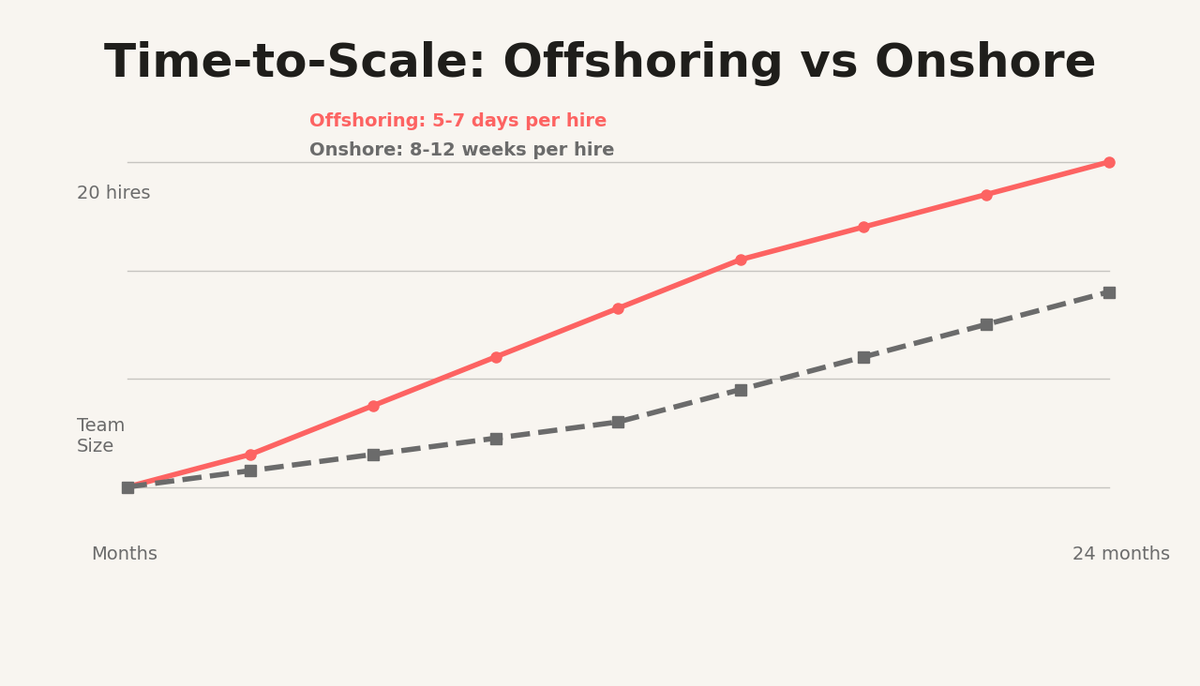
📈 Time-to-scale: 20 hires in 6 months
Via EOR: 5-7 days per hire equals 10 weeks total equals 6 hires per month. Scale to 30 hires in 5 months.
Via onshore: 8-12 weeks per hire equals 1 hire per month. 30 hires in 2 or more years.
"We needed 12 engineers in 8 months for a product launch. Hiring onshore would have taken us to 18 months and missed the market window. We went with EOR India and shipped the team in parallel with product work."
- VP Engineering, Series B EdTech, G2 Verified Review
✅ Time-to-productivity (ramp)
Once hired, an EOR employee hits productivity on week 2-3 (timezone difference absorbed by async standup plus weekly sync). Onshore: week 1-2 (same office, but recruiting took 12 weeks). Whichever you hire first reaches productivity first.
Q6. Quality math: how vetting, retention, and IP protection differ?
Founders assume cheaper equals lower quality. Not true. The vetting funnel is deeper than you would run in-house.
🔍 Vetting rigor
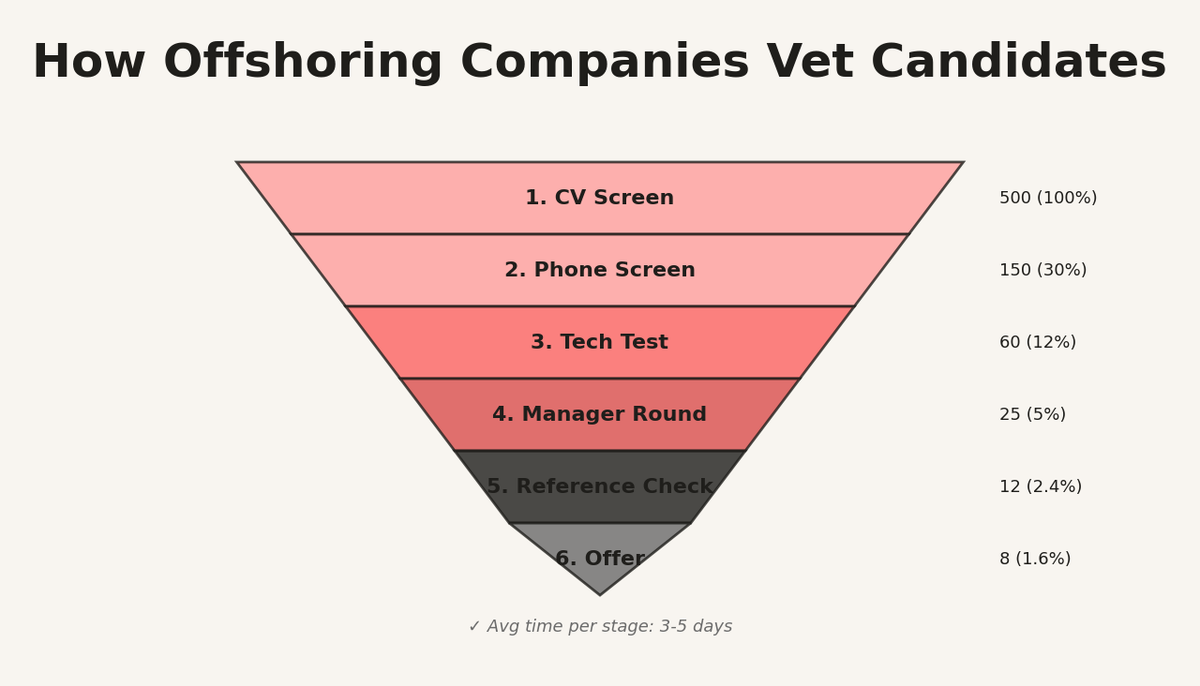
EOR companies screen 500-1,000 candidates per hire. You might screen 30. They run phone screens, tech tests, manager rounds, reference checks. That is 4 to 6 gates before an offer. False positive rate: 2-4% (hire does not make it past 90-day probation). Your in-house rate: 5-10% (first-year regret hires). Versatile uses a vetting gauntlet to keep false positives near zero.
📊 Retention benchmark
EOR-hired employees stay 2-3 years (median). Reason: if EOR says "this hire is sticky," they have seen the pattern. They have skin in the game. Poor fits churn equals reputation hit. Onshore turnover: 18-24 months median (salary-chasing, role scope drift, management friction). EOR is better.
🛡️ IP protection
EOR contracts include an IP assignment clause: "All work product, code, designs, documentation is the exclusive property of the client." This is legally binding in India. Courts uphold it for employment agreements. Agencies often have weaker clauses. Contractor-to-agency IP is theirs, resellable to you.
Q7. Compliance math: PE risk, DPDP, IP assignment, termination?
This is where offshoring becomes non-negotiable. Misclassify one hire and you face $25K-$40K in back taxes plus penalties plus compliance notice plus debarment from future India hires.
⚠️ PE (Permanent Establishment) risk
If you hire direct contractors in India without a co-employer, the Indian tax authority (CBDT) can deem YOU a PE (permanent establishment) in India. This means: You owe income tax on India-source income (all work your Indian hire produces, taxable in India). You must register for GST if revenue exceeds Rs40L per year from India-source work. Audit risk: 10-15% if you have ANY India income.
EOR eliminates PE risk because the EOR entity is the employer. You are the principal employer. Principal is not equal to PE under India tax law. Legally distinct.
🔐 DPDP (Digital Personal Data Protection) compliance
India's DPDP Act (Nov 2023) regulates how you collect, store, and process employee personal data (SSN, bank account, biometrics). An EOR manages this via employment contracts and privacy policies. You get a DPA (Data Processing Addendum). If you hire direct, you own this liability.
📋 IP assignment (statutory requirement)
The Labour Codes (Schedule III) require a "written agreement" for IP assignment. Verbal plus email is not sufficient. EOR handles this in the employment contract. If you hire direct and do NOT have a signed IP agreement, your IP ownership is contested if the employee disputes it.
🛑 Termination (notice plus settlement)
Firing an Indian employee requires: Notice: 30 days advance notice or payment in lieu (1 month salary). Full and Final (F&F): Within 30 days post-notice, pay out all accrued benefits: gratuity, leave encashment, unpaid salary, bonus. Failure equals employer liability (backpay plus interest). Severance negotiation: Employees often push for extra months. This is negotiable.
EOR handles all F&F calculations and statutory filing (Form 10CB, gratuity deed, PF settlement). If you hire direct and miscalculate gratuity, you can face a demand notice 1-3 years later.
Q8. Where offshoring companies fail startups?
Not all offshoring is created equal. Here are the vendor mismatch patterns founders should avoid.
🚨 Trap 1: Bait-and-switch hiring
Agency promises a senior engineer. You get a mid-tier contractor who under-performs. By the time you realize, 1 month has passed, churn is high, and you have lost velocity. Remedy: insist on resume plus portfolio review plus reference calls before hire.
🚨 Trap 2: Cost-hidden compliance risk
Agency says "$1,500 per month all-in" but does not enroll the hire in PF or ESI. You are technically liable. Audit finds it 18 months later. Remedy: always ask offshoring partner: "Who files PF-ECR (monthly returns)? Who is the PF subscriber (UAN)?" If they say "you or the contractor," you have outsourced the hire but not the compliance liability.
🚨 Trap 3: Timezone friction without async buy-in
Indian office hours are IST (UTC plus 5:30). US East is 9.5 hours behind. If your entire team culture assumes real-time standup, a 3-person India team will always feel async. Remedy: hire 2-3 India engineers at once to build an IST cohort with 1-2 sync hours overlapping US morning.
🚨 Trap 4: Hiring faster than onboarding can scale
You hire 5 engineers in 2 weeks via EOR. Onboarding (code access, codebase deep-dive, context) takes 3-4 weeks per engineer. You now have 5 people sitting in parallel onboarding queues, not productive. Remedy: hire 1-2 at a time. Batch hiring 5 or more only if you have a dedicated onboarding lead.
Q9. How to evaluate an offshoring partner?
A 10-point diligence checklist before signing any agreement.
- Compliance posture: Does the partner have a registered entity in India (GST plus PAN plus PF subscriber certificate)? Ask for PF subscriber ID and verify on EOR services in India registry or EPFO portal.
- Vetting depth: How many candidates screened per hire? Aim for 200-500 to 1. Do they run tech tests? Manager round? References?
- IP assignment: Is IP assignment included in the employment contract (not added later via addendum)? Ask to see a sample contract.
- Hiring speed: What is their median time-to-hire from interview to day 1? Ideal: 5-7 days for EOR. 2-3 weeks for BPO.
- Statutory coverage: Do they file PF, ESI, PT, gratuity on time? Ask for an auditor-verified compliance statement or sample F&F settlement from a past termination.
- Retention benchmark: What is their median employee tenure? Red flag if less than 18 months. What is their re-hire rate from past clients? Good partners have 20-30% rehire rate.
- Support SLA: If an employee is sick or under-performing or leaving, how fast can they backfill or escalate? Ideal: 24-48 hour response. 5-day backfill.
- Pricing transparency: Is the quote all-in (salary plus statutory plus infra plus management)? Or does the partner add surprise fees for onboarding, off-boarding, compliance filing?
- Dispute resolution: If you fire an employee and the EOR disputes the reason, what is the arbitration clause? Look for 30-day resolution SLA.
- Founder review: Ask the partner for 2-3 founder references (past clients) and talk to them off-record. Specifically ask: "Would you hire from this partner again?" 60% or more should say yes.
Q10. Where Versatile fits: India-based EOR with founder alignment?
Versatile Club is an India-native Employer of Record built from first-principles on founder urgency and compliance rigor. Here is our proof stack:
- 14 US plus UK-headquartered companies on our own legal entity (incorporated 2022 in India). Zero compliance notices across 4 years.
- 0 CBDT or GST audit notices filed against our entity. We report this annually to clients.
- 5-day hiring SLA: Interview Tuesday arrow right to onboarded Friday. No visa. No relocation friction.
- First month per employee free: You pay only for actual days worked in month 1 (prorated). First month is onboarding. You pay nothing if the hire does not stick.
- PF plus ESI plus S&E plus PT across 28 states: We handle all 4 statutory obligations plus state-specific filings.
- IP assignment day 1: Our employment contract assigns 100% of work product to you. No addendums. No disputes.
See Versatile's India EOR services page for compliance proof and founder case studies. If you are scaling 1-5 hires in the next 90 days, we can move faster than you expect. We also manage full and final settlements when you need to reshape the team. Versatile India-native EOR means: India employment law expertise, India tax authority relationships, India compliance ops. Not outsourced compliance. Not templated contracts. Real founder-to-founder alignment on risk.
FAQs
Can I hire a contractor in India to avoid payroll complexity?
No. The Indian tax authority treats contractor agreements as employment if the "contractor" is exclusive to you. You face $25K-$40K in back taxes plus penalties plus debarment if caught. A proper EOR is $300-500 per month cheaper than fixing a misclassification audit.
What is the typical all-in cost per employee in India in 2026?
Mid-tier engineer in Bengaluru plus Hyderabad via EOR: $18-24K per month all-in (salary approximately 50%, statutory approximately 15%, infra approximately 10%, management approximately 15%, margin approximately 10%). Entry-level: $12-15K per month. Senior IC: $30-40K per month. See Versatile's India salary benchmarks for 2026 by role and city.
How do I manage timezone differences with an India team?
IST is 9.5 hours ahead of US East, 12.5 hours ahead of US West. Best practice: hire 2-3 India engineers (builds an IST cohort), schedule 1-2 weekly sync meetings 7-9 PM IST arrow right 9-11 AM US East, and do async updates (Slack thread daily at standup). Avoid real-time standups. Embrace async-first ops. Versatile has a guide on async teams.
Do I own the IP if I hire via EOR?
Yes, 100%. The EOR employment contract includes a work-for-hire clause: "All work product is the exclusive property of the principal employer (you)." This is enforceable in Indian courts. Agencies and freelance platforms do NOT guarantee IP assignment. Check their contract.
What happens if I want to fire someone hired via EOR?
You provide 30 days notice (or 1 month salary in lieu). The EOR calculates Full and Final settlement (gratuity, leave, bonus, unpaid salary) within 30 days post-notice. You pay the settlement amount to the EOR. They process PF plus ESI withdrawals and issue the legal termination letter. No personal liability to you.
Can I hire via an agency and then flip to EOR to save money?
Technically yes, but risky. If the agency claims the contractor was "exclusive" (worked only for you), the tax authority may rule it was mis-classified employment. Start with EOR if compliance is critical. Agencies are for feature builds, not core team.
The compliance advantage compounds as you scale. At 5 hires, the risk is theoretical. At 50 hires, statutory mistakes become existential. An EOR manages all 50 payroll calculations, PF enrollment, ESI coverage, state-wise professional tax filing, and gratuity liability accrual. You never touch the compliance machinery. This is the hidden value that makes EOR pricing feel expensive until you run the math on what a single audit costs.
The speed advantage is equally real. In parallel hiring, each engineer onboarded becomes force multiplier. With onshore hiring, you do engineering + recruiting + legal + HR work sequentially. With EOR, you do engineering + waiting-for-onboarding in parallel. Six engineers hired via EOR in 8 weeks can ship faster than two engineers hired onshore in the same timeframe, even if each onshore hire is "better." Velocity compounds.
The cost advantage is the headline but not the real story. Cheaper salary is nice. Statutory opacity is dangerous. Speed is the competitive moat. Founders who build this stack (EOR hiring + async work + distributed team culture) are shipping 40-60% faster than peers who insist on onshore-only or contractor-only models.
The caveat: this only works if you have founder buy-in on distributed ops. If your founding team assumes "real work" means everyone in the same office, timezone, and timezone handoff schedule, offshoring will fail. Timezone differences are not a bug; they are a feature. 24-hour productivity cycles. But you have to structure for it. Async-first culture. Daily written standups. Weekly video syncs. Code-as-communication. This is the operational change that unlocks the cost and speed and compliance wins.
Where my head is right now
The trend is clear. By 2027, any startup hiring in India WITHOUT an India-native EOR will be seen as negligent. Compliance is no longer an afterthought. It is the baseline. The Founder-led companies we work with at Versatile are not choosing us to save money. Savings are real but secondary. They are choosing us because they cannot afford the audit risk, the churn, or the time-tax of managing payroll solo.
If you are hiring 1-3 India engineers in the next 60 days, message me directly on WhatsApp through our contact page, or book a 30-min consultation with us. You will be talking to a founder, not a sales rep. We can get you from "thinking about it" to "offer sent" in 1 week flat. What specific role are you trying to hire for?