Table of contents (13)
- Q1. Why Does Outsourcing Your Job Feel Like Jumping Off a Cliff??
- Q2. What Does a Good Handover Actually Look Like??
- Q3. How Do You Actually Document Tacit Knowledge??
- Q4. What's the Risk if You're Hiring in India? Compliance During Handover.?
- Q5. Who Should Be In the Room During Handover??
- Q6. How Do You Test That the Handover Actually Worked??
- Q7. What Happens When the Handover Goes Wrong? Damage Control.?
- Q8. What Does This Cost, Really??
- Q9. Where Versatile Fits: India-Native EOR During Handovers?
- Q10. The Checklist: What Should You Do Before Week 1??
- Q11. Common Handover Mistakes and How to Avoid Them?
- Q12. What Does the First Week Really Look Like? A Real Example?
- FAQs
How to Transition to Outsourcing Your Job: A Smooth Handover Process
Q1. Why Does Outsourcing Your Job Feel Like Jumping Off a Cliff??
Not a rhetorical question. When you outsource a role for the first time, you're handing off months or years of tacit knowledge. The person leaving knows where the scripts are, which systems they use daily, and compensation details, which clients call at 9 AM, what the boss actually meant by "urgent," and which reports break if you miss one cell. The person arriving knows your job title and not much else. That gap is fixable.
The gap between those two states is called "handover risk," and we have a framework to manage it. and it will cost you real money if you ignore it. Here's the real story: a SaaS founder with 5 engineers in India outsourced customer success to a new India-based hire without documentation. For three weeks, nobody at the India-native company knew how to escalate a critical bug. Two customers churned. Revenue impact: $120K. Total handover time: two days.
You are not that founder. Here's how to be smarter.
🚧 The Cost of a Botched Handover
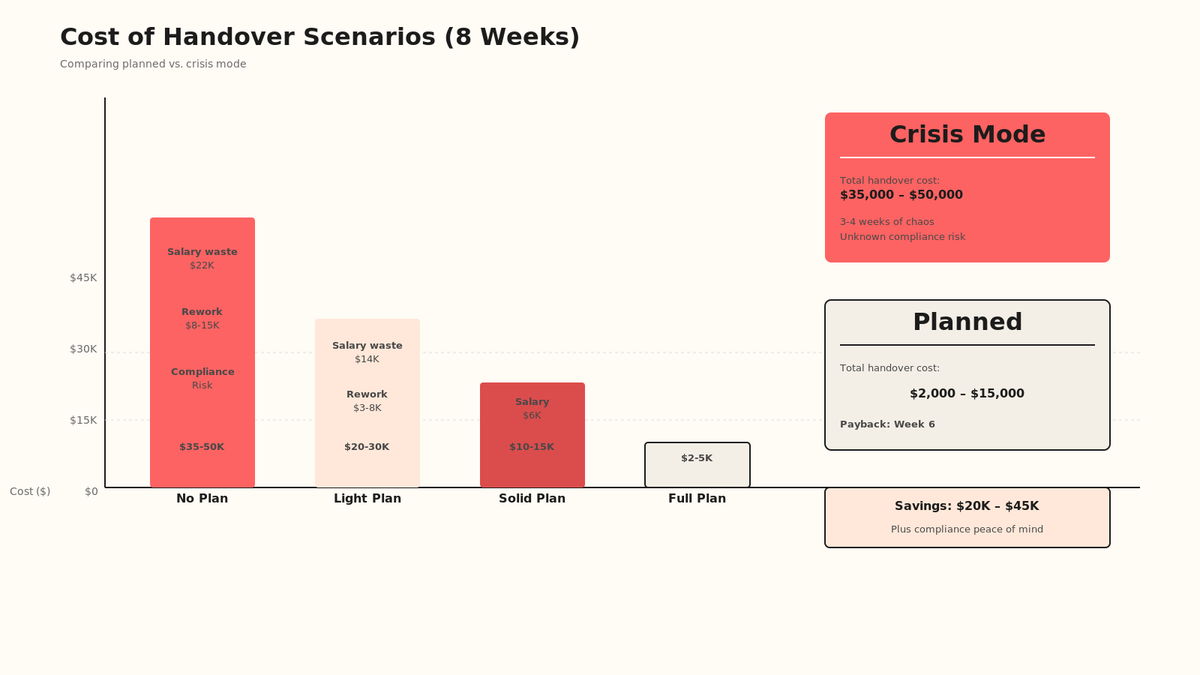
Not planning a handover will cost you 30-60% productivity loss for 4-8 weeks. That's not hypothetical. That's what every operator who's done this will tell you. Here's the real math: if your outsourced role costs $10K/month and you lose 40% productivity for 6 weeks, you're out $15K just in salary waste, before rework and client escalations pile on.
| Scenario | Productivity Loss | Rework Cost | Compliance Risk | Total 8-Week Impact |
| Zero documentation, same-day handoff | 55% × 8 weeks = $22K salary waste | Critical process fixes: $8K-$15K | PF/ESI filing delays, penalties | $35K-$50K |
| Process docs exist, no training | 35% × 8 weeks = $14K salary waste | Workaround fixes: $3K-$8K | Minimal (if docs are current) | $20K-$30K |
| Docs + 2-week overlap, manager backup | 15% × 6 weeks = $6K salary waste | Edge-case fixes: $1K-$3K | None (if EOR manages compliance) | $10K-$15K |
| Docs + parallel run + EOR governance | 5% × 4 weeks = $2K | Zero (validation caught issues) | Zero (compliance owned by EOR) | $2K-$5K |
If you outsource to India, compliance matters more. Botched handovers often mean the new hire's onboarding paperwork (PF/ESI enrollment, statutory declarations) doesn't sync with the person they're replacing. An India-native EOR like Versatile catches this and ensures contribution continuity. A missing sync can trigger compliance notices and back-contributions, which can run 10-15% of salary for the gap period.
Q2. What Does a Good Handover Actually Look Like??
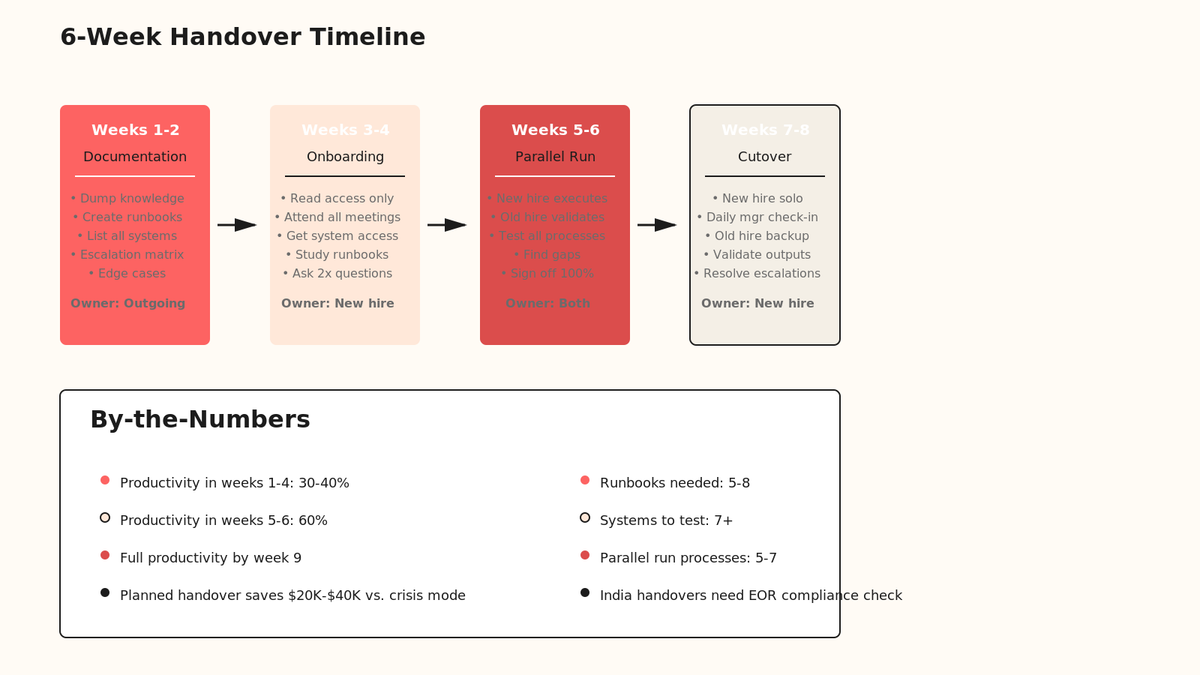
A good handover is not a meeting. It's an orchestrated transition that requires operational planning and company discipline. It's a 6-8 week orchestrated transition where documentation, training, and oversight happen in parallel, and nothing goes live until every critical path has been tested twice.
Here is the structure that Versatile follows with every India-based hire:
⏰ Timeline: Weeks 1-2 (Preparation)
Start here, not 48 hours before the outgoing person leaves. You need time to discover what you don't know. In week 1, the person leaving should dump everything: process docs, email templates, client lists, access credentials (in a vault, not a shared folder), alert thresholds, seasonal business cycles, and the names of people who call demanding immediate help.
In week 2, organize that dump. Create a runbook. A runbook is a one-page-per-process guide that says: "When this alert fires, do A, B, then call person X. It usually takes 30 minutes." Not novel prose. Short, numbered steps.
| Document Type | Owner (Outgoing) | Audience (Incoming) | Review Cadence |
| Daily checklist (8-10 items) | Outgoing hire | New hire, manager | Review by end of week 2 |
| Weekly process runbooks (5-8 processes) | Outgoing hire | New hire, manager | Test-run each one in week 4 |
| Client escalation matrix (key contacts, SLAs) | Outgoing hire | New hire, manager | Review + phone call to key clients |
| Access inventory (10 systems minimum) | Outgoing hire + IT | IT team, new hire | Verify access by end of week 3 |
| Edge-case decision tree (what to do when normal steps don't work) | Outgoing hire | New hire, manager | Walk through 2x in week 5 |
⏰ Timeline: Weeks 3-4 (Onboarding the New Hire)
The new person is now live in your systems. They have read access, no write access yet. Their job is to shadow, not do. In week 3, they attend every meeting the outgoing person attends. They read incoming emails. They see how the day actually moves, not how it's documented. In week 4, the new hire runs through each runbook on a test copy of the data or in a staging environment. The outgoing person watches and corrects in real time.
If you outsource to India, calendar alignment matters more. A 9-hour timezone gap means overlaps are short (roughly 1-2 hours early morning or late evening for one party). Build handover calls into that window, not ad hoc. And use recordings. If the call is at 6 AM India time, the new hire will not remember everything.
⏰ Timeline: Weeks 5-6 (Parallel Run)
Now the new hire does the work. The old hire spot-checks. Every process, every alert, every report gets done twice in parallel. New hire does it first; old hire verifies. The goal is to catch gaps where the new hire doesn't know something critical, not to score them. This is validation, not performance review.
In a distributed India handover, the parallel run is your insurance policy. You find out on week 5 that the monthly vendor report is missing a formula, not on week 9 when an invoice goes unpaid.
⏰ Timeline: Weeks 7-8 (Full Cutover + Validation)
The outgoing person is now on notice or already gone. The new hire is alone. But the manager is watching daily. Every critical output gets signed off. First two weeks of solo work: manager does a 15-minute daily check-in. Any red flag: escalate immediately.
In India, this is also when your EOR (if you have one) verifies that all statutory paperwork is clean: PF contributions are flowing, ESI enrollment is current, and if there's a co-employment period, the handoff is legally clear.
Q3. How Do You Actually Document Tacit Knowledge??
Tacit knowledge is the stuff that only lives in one person's head. It's the reason why great customer success people are so hard to replace. They somehow just know which clients need a check-in call before they churn. That instinct is worth money. And it will walk out the door with the person unless you capture it on week 2, not week 10.
Here's how to do it without writing a novel.
📇 The Runbook Format (Use This)
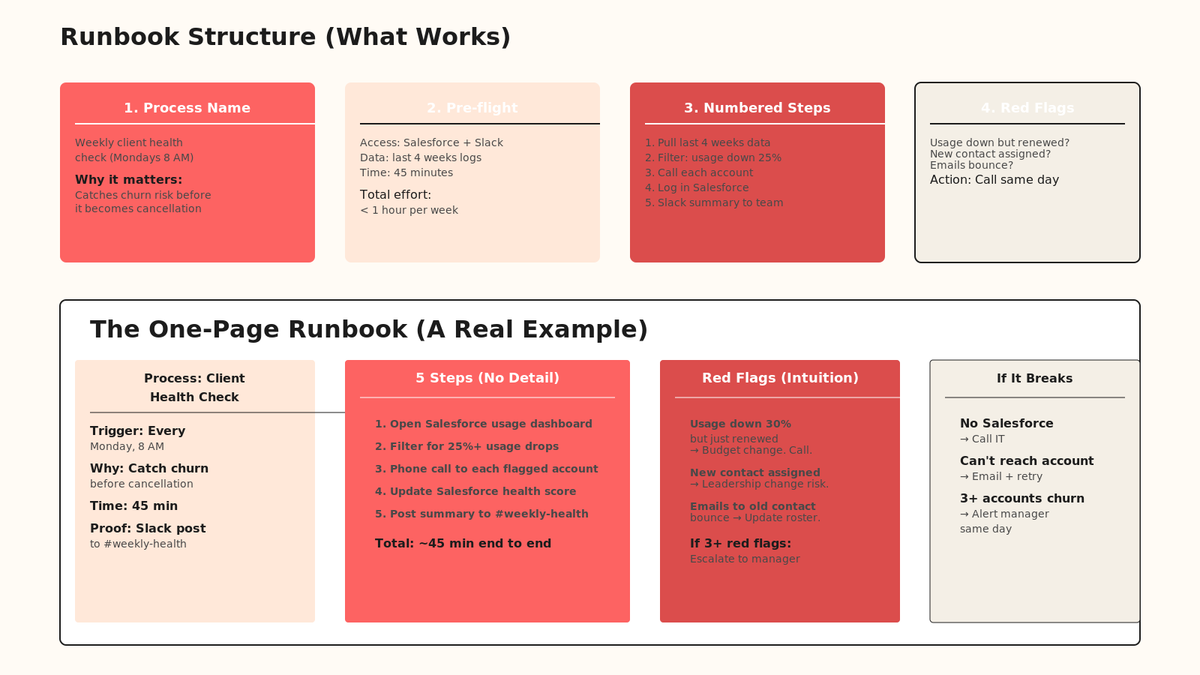
A runbook is not a job description. It's a decision tree that takes 5-10 minutes to read and another 15 minutes to execute. Here's the template that actually works:
| Section | Length | What Goes Here |
| Process name + trigger | 1 line | "Weekly client health check (runs every Monday 8 AM)" |
| Why it matters | 2-3 sentences | "Catches churn risk before it becomes a cancellation. Last month this caught 2 at-risk accounts." |
| Pre-flight checks | 3-5 items | "Access: Salesforce + Slack. Data: last 4 weeks of usage logs. Time: 45 min." |
| Steps 1-7 (numbered, no details) | 1 line each | "1. Pull last 4 weeks of usage data from [link]. 2. Filter for usage drops >25%. 3. Call each account …" |
| What to look for / red flags | 3-4 bullets | "Usage dropped but they just renewed? Call them. Usage is fine but emails bounced? Check email on file. New contact person assigned? Agenda mismatch, call ASAP." |
| If it breaks / escalation | 2-3 lines | "If you can't access Salesforce: call [X]. If 3+ accounts show signs of churn: flag to [manager] same day." |
| Proof of completion | 1 line | "Screenshot of Slack summary message posted to #weekly-health. Time-stamp: [day, time]." |
That's it. One page per process. Not 12 pages of context. A new hire, especially one in India, can read that in 3 minutes and execute it in 45.
🤔 Capture the Intuition, Not the Details
A great salesperson doesn't just follow a script. They know which prospects have budget now (by listening to how they talk about their problem) and which are tire-kickers (because they've heard the same objections 100 times). That intuition is gold. So write it down. The runbook should say: "Listen for these three phrases. If you hear them, this person is a real buyer. If you don't, it's likely research, not a real deal."
Get the outgoing person to narrate three real examples (this is core to operational handoff) while you take notes. That beats a generic best-practices doc every time.
Q4. What's the Risk if You're Hiring in India? Compliance During Handover.?
If your new hire is based in India, the handover is not just operational; it's a legal transition. India employment law (4 Labour Codes, effective 21 Nov 2025) doesn't pause for onboarding. Here's what matters.
🧾 PF and ESI Continuity
If your outgoing employee (or contractor) was on a Provident Fund or ESI coverage, and your new hire is replacing that role, you need the handover to be clean from a statutory perspective. A gap of even two days can trigger back-contribution notices.
Here's the problem: most companies hand off a role to a new person without formally communicating to the Provident Fund board. The PF number stays associated with the old employee. The new employee gets a new enrollment. Two people, same role, two PF accounts. Regulator sees it as a gap. Everyone pays.
An India-native EOR like Versatile owns this risk and handles it for you. We coordinate with the PF trustee, verify the old account closure, and ensure the new account is active and receiving contributions from day 1 of the new hire's employment. No gap. No back-contribution.
"The biggest compliance mess we've seen is when a US company outsources to India without understanding that every employment change has a statutory filing requirement. We went through 3 months of penalty notices because the handover wasn't coordinated with PF. An EOR would have caught that in week 1."
— CFO, Series A SaaS, Verified User in Finance, Versatile - G2 Verified Review
| Timeline | Statutory Obligation | Who Should Own It | Cost of Missing It |
| Day 1 of new hire | ESI enrollment (if eligible: salary under 21K/month) OR ESI exemption filing | Employer + EOR | Rs 1,000-5,000 penalty per day late |
| Within 10 days of hire | PF enrollment + first contribution remittance | Employer + EOR | 16% + compound interest on missed contributions |
| Day 30 of hire | DPDP Act data processing registration (if role handles customer data) | Employer + EOR | Regulatory scrutiny, compliance notice |
| Day 45 of hire (if replacing) | Previous employee PF final withdrawal processed + statutory letter issued | Employer + EOR (coordinated) | Unclaimed fund holds, back-contributions |
| End of FY (31 March) | Form 12B (PF reconciliation) filed for both old and new employees in role | Employer + EOR | Rs 500-1000 penalty, audit notice |
Versatile operates as an India-native Employer of Record for 14 US and UK companies hiring engineers, designers, marketers, and operators across India. We own all four Labour Code obligations (Wages Code, Industrial Relations, Social Security, Occupational Safety), plus PF/ESI/gratuity (4.81% statutory load), TDS, professional tax, and state-level compliance across all 28 states. During a handover, we coordinate the previous employee's statutory closeout with the new employee's enrollment, ensuring zero gaps and zero compliance red flags.
Q5. Who Should Be In the Room During Handover??
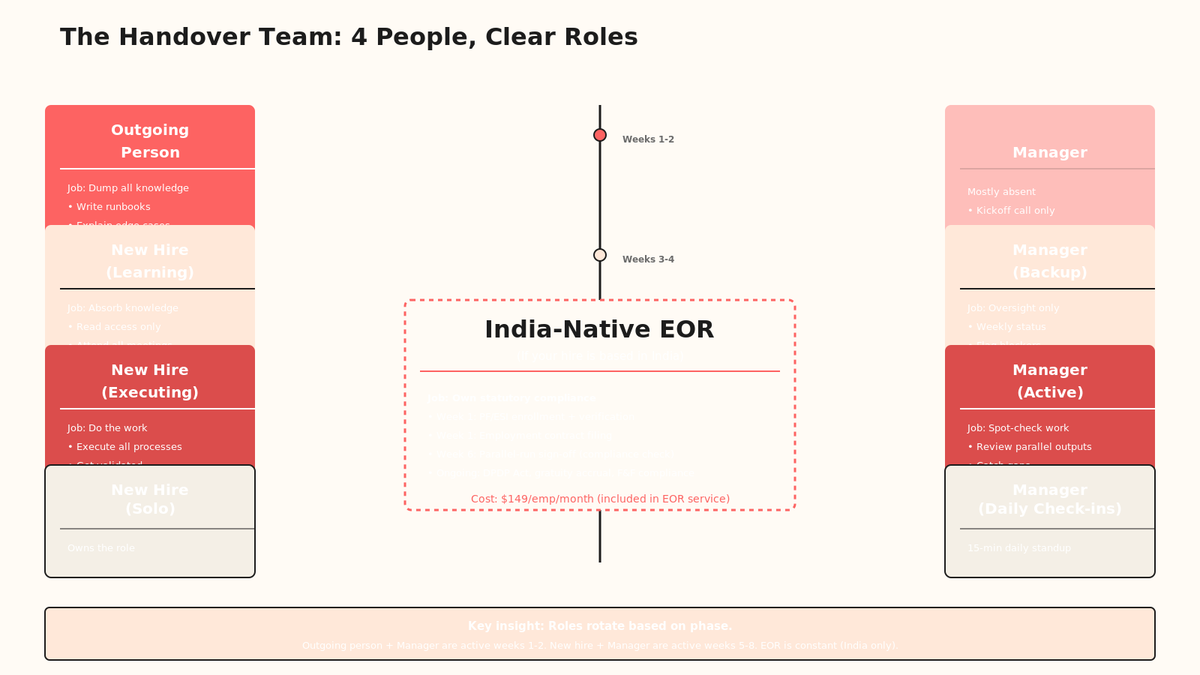
Four people. Not five, not three. Exactly four, each with a role.
1. The Outgoing Person (Knowledge Source)
Their job is to dump everything they know in a structured way. Not to stay on as a ghost advisor. Not to be defensive about the new person's approach. Their job in weeks 1-2 is documentation and in weeks 5-6 is validation only. After week 6, they should have zero involvement. A lingering outgoing person slows the new hire's confidence and creates decision paralysis ("What would they do?"). Cut the cord cleanly.
2. The New Hire (Executor)
In weeks 3-4, their job is to learn without doing. In weeks 5-6, their job is to do while being watched. In weeks 7+, their job is to own the role. A common mistake is throwing the new hire into the deep end in week 1. They should not be responsible for any live decisions until they've read the runbooks, watched the process twice, and run it in parallel once. That's 4-5 weeks minimum.
If you're hiring in India, your new hire's learning curve may be longer due to timezone gaps, async documentation, and a different business culture. Budget 8 weeks, not 4. And assign a local manager or senior peer to be their first escalation point.
3. The Manager (Oversight)
In weeks 1-4, the manager should be mostly absent (let the outgoing person do the teaching). In weeks 5-6, the manager spot-checks the parallel run and flags gaps. In weeks 7-8, the manager is in daily standups with the new hire. In weeks 9+, the manager steps back to normal 1:1 cadence. The manager's job is not to micromanage; it's to catch what the documentation missed.
4. The India EOR (Compliance + Continuity)
If you're outsourcing to India, your EOR is a fourth team member. Their job is to ensure that the role transition doesn't create compliance friction: PF/ESI enrollment flows, statutory filings are coordinated, and the new employee's contract correctly references the old role's scope. This is not trivial. Compliance gaps have real costs. PF mismatches alone have cost our clients $5K-$15K in back-contributions.
Your India-native EOR should attend the handover kickoff call (week 1) and the parallel-run sign-off call (week 6). That's 1.5 hours of involvement that prevents $25K of compliance headaches.
Q6. How Do You Test That the Handover Actually Worked??
You don't trust the handover. You verify it. A parallel run is the gold standard: the new hire does the job, the old hire checks the output, and you only go live when the outputs are identical.
✅ Parallel Run Checklist
In weeks 5-6, pick the 5-7 most critical processes. New hire executes them independently. Old hire reviews the output. You're looking for exact parity: same number of rows in the report, same logic in the decision, same format in the deliverable. Any deviation is a gap that needs closing before cutover.
| Process | New Hire Output | Old Hire Check | Gap | Owner to Close | Live Eligible? |
| Weekly client health check | 20 accounts reviewed, 3 flagged | Match: 20/20, flags match | None | N/A | Yes |
| Monthly revenue report | $847K, 12 line items | Expected $850K, received $847K. Difference: one customer downgrade. Matches invoice data. | New hire didn't catch the downgrade context. Clarified. | New hire (training follow-up) | Yes, with note |
| Vendor payment run | 8 vendors, 12 invoices, $67K | Match: 8/8, $67K matches ledger | None | N/A | Yes |
| Customer onboarding (5 new customers) | 5 projects created, 3/5 had kick-off calls | Expected all 5 to have calls scheduled. 2 were missed because new hire didn't know they were required. | Process doc missing "schedule kick-off call within 24 hours of project creation" | Outgoing person (update runbook) + new hire (re-do on 2 projects) | No, re-do |
Once all critical processes show green, you're ready to cut over. Parallel run isn't bureaucracy; it's insurance.
Q7. What Happens When the Handover Goes Wrong? Damage Control.?
It will go wrong. Something always does. Here's how to handle it.
⚠️ Red Flags in Week 1-4 (Still Time to Fix)
The new hire doesn't understand a critical process. The runbook is missing steps. The system access is incomplete. Any of these? You have time. Extend weeks 5-6. Have the outgoing person stay on another 2-4 weeks to fill the gaps. Yes, it's expensive. But it's cheaper than a botched handover that costs you $30K in lost productivity.
⚠️ Red Flags in Week 5-6 (Parallel Run Catches It)
The parallel run shows that the new hire is missing something consistently. A report has the wrong numbers. A decision isn't being made. A client isn't being called. This is what the parallel run is for. Stop. Fix it before going live. Don't go live with a known gap.
Average time to fix a week-5 gap: 3-5 days, plus one more week of parallel validation. Total delay: 2 weeks. Cost: payroll for old and new hire overlapping. Worth it. The alternative is 8 weeks of chaos.
⚠️ Red Flags in Week 7-8 (You're In It)
The new hire is live, and they're making mistakes. A report is wrong. A client is upset. A deadline missed. This is operational triage. First 48 hours: the old hire is on standby, available to jump in (paid consulting rate, not full employment). You do this for 1-2 weeks to stabilize. Then the new hire owns it again. Total extra cost: $5K-$8K in emergency overlap. Cheaper than losing a client or having compliance issues.
If you're outsourcing to India, "jumping in" is more complex. A 9-hour timezone gap means the old hire has to work India hours temporarily, or you need a local manager in India to escalate during India business hours. Plan for this upfront. It's not a nice-to-have.
Q8. What Does This Cost, Really??
A good handover costs money upfront. A bad handover costs way more money later.
| Cost Type | Scenario: No Planning | Scenario: 6-week Planned Handover | Scenario: Planned + EOR Support |
| Old hire staying on (weeks 1-6) | $0 (they leave immediately) | $10K (full 6 weeks) | $10K (full 6 weeks) |
| Productive work from new hire (weeks 1-8) | 20% × 8 weeks = $3.2K value | 60% × 8 weeks = $9.6K value | 70% × 8 weeks = $11.2K value |
| Manager/backup overhead | $0 (ignored, crisis mode) | $2K (standups, reviews) | $2K (same) |
| Rework (fixing mistakes, gaps, processes) | $8K-$15K | $1K-$3K | $0 (EOR validates compliance, no rework) |
| Compliance cost (if India-based) | $5K-$25K (back-contributions, penalties) | $500-$1K (coordination fee to EOR) | $0 (included in EOR service) |
| Net margin impact | $16K-$43K loss | $1.5K-$5K cost, $9.6K productivity gain = $4.6K-$8K net | $13.2K-$14K productivity, $0 compliance risk |
The math is clear: plan the handover. Your planned handover will cost you $10K-$15K upfront, but it'll save you $20K-$40K in rework, compliance, and lost productivity.
Q9. Where Versatile Fits: India-Native EOR During Handovers?
If you're outsourcing a role to India, an India-native EOR like Versatile takes compliance off your plate during the handover. Here's what that looks like in practice.
✅ Versatile owns the statutory transition
Your previous employee (or contractor) had a role. Your new India-based hire has a role. Between them is a statutory gap that most companies ignore. We don't. We coordinate:
- PF account closure for the old employee (if applicable) and enrollment for the new employee, ensuring zero days without coverage.
- ESI enrollment (if the new employee's salary is under 21K/month) or ESI exemption filing.
- Contract documentation: the new employee's employment contract, offer letter, and statutory declarations are filed and ready by day 1.
- DPDP Act compliance (if the role handles customer/employee data): we ensure the new employee is registered as an authorized processor.
- FY-end filing coordination: if the handover spans March-April, we ensure both employees (old and new) are correctly reported to GST, income tax, and labour authorities.
Cost: included in our service. Value: $5K-$25K in penalty avoidance per handover.
✅ Versatile coordinates the documentation handoff
We attend your week-1 kickoff call and your week-6 parallel-run sign-off. We make sure the runbooks mention statutory dates (e.g., "PF contribution due by 15th of next month"). We ensure the new employee's training includes India employment law basics (e.g., why overtime must be tracked, what happens if you miss a compliance deadline). Small additions; massive value.
✅ Versatile is the escalation point for edge cases
If the new employee gets sick 2 weeks into the handover, who manages their sick leave compliance? Who files the required notification to the labour authority? If they need to take personal leave, is their gratuity accrual paused or continued? These are India-specific questions. Your US HR person doesn't know. We do. We're the escalation point.
Versatile's India-native EOR service covers 28 states, handles all 4 Labour Codes, owns PF/ESI/gratuity compliance, and ships with a 5-day SLA. We cost $149/emp/month for the first month free, then standard EOR pricing. For a handover-heavy year, that's a one-time cost that pays for itself in compliance risk reduction on the first transition.
Q10. The Checklist: What Should You Do Before Week 1??
If you're about to outsource a role, do this before the new hire's first day.
| Task | Owner | Proof of Completion | If You Skip It, Cost |
| Schedule outgoing person for weeks 1-6 (get their commitment) | Manager | Calendar block for 4 hours/week, weeks 1-2; 2 hours/week, weeks 5-6 | $15K in rework if they're unavailable or defensive |
| Set up a dedicated Slack channel for handover (async communication, organized) | Manager | #[role]-handover channel with pinned threads for docs, questions, blockers | Communication chaos, repeated questions, lost context |
| Book handover kickoff call for week 1 (outgoing, new, manager, EOR if applicable) | Manager | Calendar invite sent, all 4 attendees confirmed | Unaligned expectations, missed compliance items |
| If India-based hire: partner with an EOR for compliance coordination | Finance + Manager | EOR contract signed, week-1 kickoff attendance confirmed, PF/ESI verified in force | $5K-$25K in compliance penalties + back-contributions |
| Audit system access: what does this role need? (list 10+ systems) | IT + Outgoing person | Spreadsheet of [System, Access Level, Renewal Date, Owner] | New hire blind to critical tools, week 3-4 delay getting access |
| ID the 5-7 most critical processes (revenue-touching, customer-facing, or compliance-critical) | Outgoing person + Manager | Documented list with priority ranking | Parallel run covers 20% of the actual work, misses 80% |
Do these six things in the 2-4 weeks before the new hire starts. Everything else flows from here.
Q11. Common Handover Mistakes and How to Avoid Them?
You're not the first to do this. Here are the top five things that break handovers.
❌ Mistake 1: Expecting the New Hire to Contribute Week 1
They won't. They're reading docs, meeting the team, and getting access. If they contribute anything in week 1, it's a bonus. Set expectations: "You're learning for weeks 1-4. Doing for weeks 5+." New hires perform best when they know they're not expected to deliver value in the learning phase.
❌ Mistake 2: No Written Runbooks, Just Institutional Knowledge
If the handover relies on the old hire's narrative, you've failed. The day they get sick or leave, the new hire is lost. Write it down. Messy docs beat perfect-but-nonexistent docs. By week 1, you should have 20 pages of runbooks, even if they're rough drafts.
❌ Mistake 3: Skipping the Parallel Run
Going live without a parallel run is gambling. You'll lose. The parallel run is the only way to find gaps before they become $10K problems. Budget 2-4 weeks for it. No shortcuts.
❌ Mistake 4: India Handovers Without an EOR (Compliance Trap)
If your new hire is in India, statutory compliance doesn't pause. An EOR costs you $149/emp/month upfront. Penalties for a missed handover cost $5K-$25K later. Do the math.
Versatile's India-native EOR specifically handles role transitions with PF/ESI coordination, statutory filing alignment, and compliance validation. We own the statutory complexity so you don't inherit the risk.
❌ Mistake 5: Cutting the Old Hire Loose Too Early
The new hire is live in week 7. You immediately offboard the old hire. Week 8, a critical edge case comes up. The new hire doesn't know it. You have no backup. Keep a 2-4 week post-cutover buffer where the old hire is available at a consulting rate (maybe 10 hours/week, not 40). That buffer costs $2K-$4K but saves $15K-$30K in fumbled escalations.
Q12. What Does the First Week Really Look Like? A Real Example?
Let's walk through the first week in real time. You're outsourcing a customer success role (currently: US-based employee earning $80K/year, 5 years in the role). New hire is India-based, $15K/year via EOR.
Day 1 (Monday): Kickoff
9:00 AM US EST / 6:30 PM India: Handover kickoff call (60 min). Attendees: outgoing CS person, new CS hire, manager, Versatile EOR account manager.
Agenda:
- Manager: "Here's what we're doing: 6-week handover plan, weeks 1-2 are documentation, weeks 5-6 are parallel run. By week 7, you own the book of business."
- Outgoing CS: "Here are the top 5 things nobody documents but everyone expects: 1. Client X calls every Monday at 2 PM and demands a status update even if nothing happened. 2. This client pays by invoice; that client pays by card; this one hasn't paid in 6 months but we keep servicing them because they're expanding. 3. Churn signals: go quiet OR suddenly email every day asking for small features. 4. This vendor needs a monthly retainer invoice by the 25th, or they stop responding. 5. Our biggest customer runs batch jobs at 3 AM UTC, and if they fail, they panic."
- New hire: "What do I do today?" Manager: "Get access set up. Read the first runbook. Tomorrow, you'll sit in on the customer calls."
- EOR: "We'll handle your PF enrollment, ESI verification, and compliance filings. You'll be on-book by end of week 1. Bring any questions about leave, compliance, or statutory stuff to me."
4:00 PM EST / 1:30 AM India (Tuesday): Asynchronous handoff. Outgoing CS uploads the first set of docs: customer list, SLA matrix, escalation contacts, the Monday call playbook. New hire will read these async and ask questions in Slack.
Day 2 (Tuesday): Documentation + Access
Morning (India): New hire reads the docs. Posts 5 questions in Slack: "What do we do if client X misses the Monday call?" "How do I know if a feature request is within scope?" etc. Outgoing CS answers async. IT provisioning starts: Salesforce, Slack, internal systems access.
1:00 PM EST / 10:30 PM India (same day): New hire attends customer call with outgoing CS. New hire is on video but muted. Observing only. Outgoing CS makes a note: "Client raised question about the contract. Didn't escalate it, just gave a verbal commitment. Note: next time, check with legal before you promise stuff."
Day 3-5 (Wed-Fri): Observation + Runbook Creation
New hire attends all calls, reads all emails (read-only), takes notes. Outgoing CS writes down the weekly playbook in a structured format. By Friday, there's a one-page playbook for every recurring task: weekly customer check-in, churn detection, feature request triage, invoice prep, etc. New hire reads them and asks clarifying questions.
EOR (Versatile): completes PF/ESI enrollment by Friday, sends confirmation. New hire is now a statutory employee in India as of Monday of next week.
Day 6 (Monday, Week 2): Runbooks Finalized
Outgoing CS and new hire sit down (3 AM India / 5 PM US) and walk through three customer interactions from last week. "When you see this email, here's what it means. Here's what you do." Runbooks are updated based on real examples, not hypotheticals.
By end of week 2, the new hire has (this is how Versatile structures India onboarding): read-access to every system, documented runbooks for 7 customer workflows, live PF/ESI status, and 10 hours of shadowing. The outgoing person is now documenting the edge cases: what to do when a customer wants an exception, when to escalate, when to say no.
This is not glamorous. But it's what prevents a $30K disaster.
FAQs
How long does a handover actually take?
Plan for 6-8 weeks. Weeks 1-4: documentation and learning. Weeks 5-6: parallel run. Weeks 7-8: full cutover with backup. If you try to do it faster, you'll sacrifice depth and risk compliance gaps. If you go slower, the new hire loses momentum.
What if the outgoing person is hostile or uncooperative?
This is rare but happens. The fix: change who writes the documentation. Use the outgoing person as a reviewer, not the author. Have the manager or an interim person interview the outgoing person and write the runbooks based on those interviews. You get the knowledge without the political friction.
Can you handover a role entirely asynchronously (across time zones)?
Not in weeks 1-2. You need real-time explanation of why something matters and what the intuition is. In weeks 5-6 (parallel run), you can be async: new hire does the work, old hire reviews the output the next day. But in weeks 1-4, synchronous is non-negotiable.
How much should I budget for an India-based handover with an EOR?
Outgoing person stay-on: $10K-$15K (full overlap for 6 weeks). Manager overhead: $2K-$3K. EOR fee: $149/emp/month × 6 months = $894. Total: $12.9K-$18.9K upfront. Compare that to a botched handover: $25K-$45K. It's an investment, not a cost.
What if the role is revenue-critical (like sales or customer success)?
Longer overlap (8 weeks, not 6). Parallel run: the new person handles customer communication in parallel with the old person for 4 weeks, not 2. And you need manager standups daily, not weekly. Budget for it. Revenue-critical roles can cost you $50K-$100K per month if they're botched.
Should I hire for the new role before or after the person leaves?
Before. Always. Hire the new person, let them start on week 1 of the handover. By the time the old person leaves (end of week 1 or 2), the new person already has a week of documentation and 5 hours of shadowing. You lose less continuity.
Can you do a handover without writing things down?
No. Verbal handovers fail. Full stop. Three reasons: (1) the new person only remembers 40% of what they hear, (2) the old person forgets they said something, (3) if anyone gets sick or quits, the knowledge is gone. Write it down.
Where my head is right now
Here is the prediction I am sitting with. Over the next 18 months, India-based outsourcing will be the default for scaled companies. Over the next 18 months, outsourcing is going to move further down the org chart. It used to be just sales and customer success. Now it's ops, finance, and engineering. That means handover discipline matters more, not less. Companies that treat handovers as a checkbox (week 1 email with random docs) will have turnover, rework, and compliance disasters. Companies that treat handovers as a 6-8 week process will build moats in their operations and scale cleanly. The winners will be the ones who document, test, and validate before going live. The losers will be the ones who don't.
If you are outsourcing a role to India in the next quarter, and you want to avoid the $25K-$50K cost of a botched handover, message me directly on WhatsApp through our contact page, or book a consultation with us. You will be talking to the founder, not a ticket. We have a handover toolkit and a playbook we can walk you through. If you go through it, I'll bet you that your handover is clean, your new hire is productive by week 8, and your compliance is solid. If it's not, we'll fix it. That's what an India-native EOR does.