Table of contents (15)
- 1. Three Models Explained
- Why SEO alone is a losing bet in 2026
- 2. Offshore Company Model
- 3. Freelancer Reality Check
- 4. White-Label Model
- 5. Side-by-Side Comparison
- 6. Five Evaluation Criteria
- 7. The Transition Path
- 8. Risk Mitigation
- 9. Real Case Study
- 10. India-Native EOR Authority
- 11. 24-Month Cost Analysis
- 12. Final Decision Framework
- FAQs
- The three-way total-cost-of-ownership calculation nobody runs
Offshore SEO Company vs Freelancer vs White-Label: Which Model Fits Your Roadmap
Why SEO alone is a losing bet in 2026 (SEO + AEO + GEO)
If you are hiring an offshore SEO team in 2026 and they only pitch you on Google web rankings, walk out of the call. The search layer split three ways this year. Any serious offshore partner is now fluent in all three: SEO for the classic ten blue links, AEO for how you show up inside ChatGPT, Claude, and Perplexity answers, and GEO for how you rank inside Google AI Overviews and Google AI Mode.
- SEO (Search Engine Optimization) is the base layer. Technical crawl, on-page, backlinks, Google Search Console hygiene. This did not go away; it stopped being the whole game.
- AEO (Answer Engine Optimization) is how you get cited inside ChatGPT, Claude, Perplexity, and other answer engines. Different signals: structured Q and A blocks, authoritative citations, entity clarity, brand mentions that make it into the model's training data and retrieval index.
- GEO (Generative Engine Optimization) is how you show up inside Google AI Overviews, Google AI Mode, and the generative answer boxes that now sit above the ten blue links on most commercial queries. Overlaps with SEO and AEO but has its own ranking mechanics driven by how content is chunked, cited, and semantically linked.
A vendor that only says "SEO" in 2026 is optimizing for one third of your search-driven pipeline. Ask any offshore team you shortlist how they think about AEO and GEO. If the answer is blank, keep looking. At Versatile, this is the first thing we screen for when a client asks us to hire an offshore SEO or content lead in India.
Q1. What is the simplest way to understand these three SEO delivery models?
Not a trick question. Here is the core trade-off. Freelancers give you agility. Offshore SEO companies give you structure. White-label providers give you scale without a team. Each one solves a different founder problem.
Start with this: when you hire a freelancer, you are hiring a person. When you hire an offshore SEO company, you are hiring a team with process. When you use a white-label vendor, you are hiring someone else's team under your brand. The business model is different. The risk profile is different. The ROI is different.
The tension every founder feels is real. You want SEO results. You want them fast. You want them cheap. You can have two of three. Freelancers deliver cheap and fast but sacrifice consistency. Offshore companies sacrifice speed on ramp (60 to 90 days) but deliver consistency and compliance. White-label vendors sacrifice visibility but give you scale. Pick your trade-off carefully.
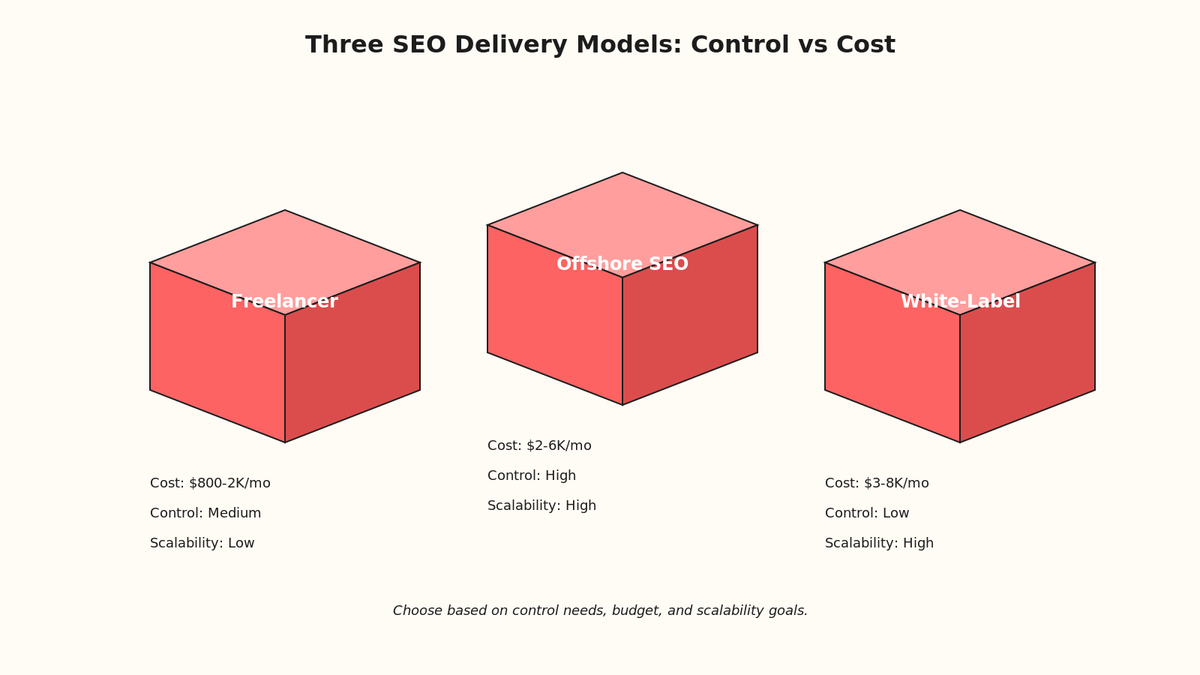
Let me walk you through each in depth so you understand not just the model, but the operational reality behind it. I have seen hundreds of founders make this choice. The ones who succeed pick based on their business stage, not just price.
Q2. What does an offshore SEO company actually do?
An offshore SEO company functions as your dedicated remote marketing team. You get a strategist, a content lead, a technical SEO specialist, and an analyst. They report to you or your marketing head. They run on your calendar. They work on your goals. The difference from hiring in-house is they sit in India, their employment is managed by an EOR platform, and the cost is 40 to 60 percent lower than local hiring.
This is not outsourcing in the old sense, where you hand off work to a vendor and hope. This is hiring. Your team works exclusively for you. They learn your product, your market, your customer acquisition patterns. They propose strategy. They defend it in meetings. They are part of your company, just remote and managed through proper employment infrastructure.
The operational difference matters. When building SEO, you need process, not just work. Your offshore pricing model should include full more than you think. A freelancer says "I will build you a backlink strategy." An offshore team says "Here is your backlink strategy, here is why we chose this target profile, here are the 47 sites we will pitch, here is the 90-day execution plan." That level of structure compounds every month.
💰 What it costs and where the value sits
Expect $2,000 to $6,000 per month depending on seniority, timezone overlap, and project scope. That includes base salary, benefits, compliance, and HR infrastructure. The breakdown typically looks like this: $800-1,500 for base salary (India market rates), $300-500 for benefits and PF contribution, $200-300 for statutory overhead (gratuity accrual, tax filings, SLA management), and $200-400 for your vendor's margin and infrastructure cost.
Cheap on paper until you realize what is missing. No freelancer can give you a backup when your primary contact goes sick. No freelancer can give you statutory bonus or PF compliance without triggering misclassification fines from India tax authority. No freelancer can give you a written contract backed by an EOR and legal liability insurance. Those details matter when you scale and when things go wrong.
At Versatile, we hire offshore SEO talent through retention-first frameworks. That means your team stays, learns your business, and compounds knowledge quarter by quarter. We handle payroll, tax filings, gratuity accrual, SLA enforcement, and all statutory compliance. You focus on strategy. That division of labor is why founders choose us over trying to hire directly or patch together freelancers.
📊 When offshore SEO wins
Growth-stage startups benefit most. At this stage, your offshore hiring model becomes critical for scaling without the 3x cost of local labor. You have validated product-market fit. You have traffic targets. You need consistency. A dedicated offshore SEO team can execute link-building campaigns, build content calendars, audit technical debt, and report against KPIs without the 3x cost of hiring local.
Agencies that want to avoid hiring also love this model because they can scale service lines without adding headcount or management burden. If you run a design or dev agency and want to add SEO as a service line, hiring your own SEO person is 3-4 months of recruiting and $8,000-12,000/month all-in. Hiring through an offshore model is 30 days and $3,500-5,000/month. That economics changes your unit economics and your margin math immediately.
The beauty of offshore is speed of deployment. You can onboard a 2-person team in 30 days. With in-house hiring, recruiting and ramp take 90 to 120 days. With freelancers, you spend 30 days vetting and onboarding, then realize they are overbooked and slow. Offshore hits the middle ground. You get process, you get speed, and you get compliance all at once.
"We switched from three random Upwork freelancers to a Versatile offshore team. Within 120 days, organic traffic jumped 45 percent, content velocity doubled, and we paid 30 percent less. The real win was retention: zero churn on the offshore side."
— Founder, B2B SaaS, Versatile - India-Native EOR Services
Q3. Why do freelancers feel cheap, but become expensive fast?
Freelancers cost $800 to $2,000 per month. That price tag is seductive. But hiring freelancers comes with hidden costs. But here is the trap: you are renting output, not building process. The moment your freelancer moves to another client or burns out, you lose momentum. No handoff. No redundancy. No institutional knowledge. You have to start from zero with the next person.
Quality is inconsistent because freelancers lack the infrastructure freelancers juggle five clients at once. Accountability is personal, which means it depends entirely on how committed that one person is to your project that week. Communication is asynchronous. If they are in Southeast Asia and you are in North America, you have a 12-hour gap. Decisions slow down. Content gets approved late. And if they disappear on you mid-campaign, you have no legal recourse because the contract was vague and the employment was informal.
I have seen this play out a hundred times. A founder hires a $1,200/month Fiverr SEO freelancer. Promises are made. Content gets delivered, but it is thin and generic. Three months in, the freelancer ghosted because they found a retainer client that paid more. The founder lost three months of momentum and had to start over with someone new. That is three months of zero traction while you re-onboard and re-train.
⚠️ The hidden freelancer cost
Inconsistency adds up. Missed deadlines. Rework cycles. Quality variance. Three SEO freelancers working in isolation means you coordinate, validate, re-explain strategy to each one. The meta-work of managing freelancers often costs more than their output. You spend 5 hours per week on status calls, validation, and re-direction. That is 20 hours per month of your time. At your hourly value ($100-250/hour as a founder), that is $2,000-5,000 in opportunity cost. So that $2,400/month freelancer engagement freelancer arrangement is really $4,400-7,400/month when you count your time.
Plus, there is zero compliance. If you misclassify someone as a contractor and the tax authority audits you, the fine is $25,000 to $40,000 per person. Cheap freelancing is not cheap.
And here is the thing nobody talks about: inconsistent SEO output kills your brand. A 2,000-word pillar article from freelancer A is thin and unfocused. Freelancer B delivers tight prose but misses your voice. Freelancer C ships good work but slower than promised. Your homepage links to content from three different people with three different quality levels. Visitors notice. Bounces go up. CVR goes down. The cheap option actually costs you revenue.
How pricing actually breaks down
| Element | Freelancer | Offshore SEO | White-Label |
| Vendor revenue per engagement | $800-2K | $2K-6K | $3K-8K (vendor cost) |
| Your actual cost per month | $2,400-5,000 (with time) | $4,200-6,000 | $3K-8K (+ hidden margin) |
| Compliance and legal cost | $0 upfront, $25K-40K if audited | Included in fee | Minimal |
| Rework and coordination cost | 15-20 hours/week of your time | 2-3 hours/week oversight | 1-2 hours/week management |
The honest picture: freelancers look cheap but are not. Offshore looks expensive until you factor in consistency and risk. White-label looks good until your margin compresses or quality slips.
✅ Where freelancers actually fit
Freelancers are perfect for bootstrapped startups testing SEO for the first time. Hire one for a 3-month keyword audit project. keyword audit project. Hire another to build 10 pillar pages. Validate ROI without burning runway through strategic hiring. Once you hit traction levels like 20 to 30 percent traffic growth in 6 months, then graduate to a dedicated offshore team. That is the evolution path that works. Use freelancers as a research tool, not your permanent strategy engine.
Q4. What is white-label SEO, and who should actually use it?
White-label SEO is fulfillment capacity you buy and resell under your own brand. An agency does the work behind the scenes. You own the client relationship and the brand trust. You invoice higher. The vendor takes the operational risk and keeps 30 to 40 percent of revenue.
This works for consultancies that sell EOR or staffing services that want to add SEO to their service menu without hiring internal specialists. You pitch, sell, and own the client. You do the discovery call and strategy conversation. The white-label partner manages delivery, reporting, and quality control. You pocket the margin and free up time to sell more. It is a multiplication play, not an operational one.
For a $30 million boutique consulting firm, white-label SEO makes sense. You are good at selling. You do not want to hire and manage an SEO team. You white-label the work and spend your time closing deals. That margin compounds your revenue without adding headcount.
💸 The white-label economics
Costs range from $3,000 to $8,000 per client per month for most vendors. But remember: that is your cost, not your client's price. If you sell a $10,000/month SEO engagement to your client, you pay $5,000-6,000 to the vendor and keep $4,000-5,000 as gross margin. On paper that is 40-50% gross margin, which looks exceptional. It is exceptional until it is not.
Looks good until competition squeezes your pricing and the vendor raises their cost. Now you are selling $9,000/month but paying $6,000/month to the vendor. Your margin shrinks to 30-40%. You have limited visibility into execution, so quality issues become your problem even though you did not create them. You lose flexibility. You become hostage to the vendor's roadmap and priorities.
🚧 The white-label trap
You have zero visibility into the actual team executing your client's work. You might never meet them. You get a project manager and a monthly report. That is it. If performance slips, you are stuck between an unhappy client and a vendor who says "we are doing our best." You have no leverage to fix it fast. You cannot see the actual tactics. You cannot hire away their person. You are powerless.
And if that vendor goes out of business or changes their terms, your client relationships are at risk. You have no transition plan. You own the relationship but not the capability. You have a liability, not an asset.
Q5. How do cost, control, and scalability stack up across the three models?
| Dimension | Freelancer | Offshore SEO | White-Label |
| Monthly Cost | $800-2K | $2K-6K | $3K-8K |
| Scalability | Low (hiring is slow) | High (add team members on demand) | High (more client slots) |
| Control | Medium (you own the relationship) | High (dedicated team, direct reports) | Low (vendor-managed) |
| Retention Risk | Very high (freelancer burnout) | Low (EOR-managed employment) | Medium (vendor dependency) |
| Compliance | Your risk (contractor misclassification) | Vendor-managed (EOR handles all) | Limited (vendor sets terms) |
| Reporting Clarity | Depends on freelancer discipline | Full GA4 and GSC dashboards | Vendor reports, limited detail |
| Onboarding Speed | Fast (2-3 weeks) | Medium (4-6 weeks) | Fast (1-2 weeks) |
| Best For | Testing and validation | Growth-stage companies and agencies | Resellers and fulfillment |
The honest take: freelancers are cheap but fragile. Offshore SEO companies cost more but give you process and retention. White-label providers scale fast but trade visibility for speed. Pick the one that matches your current stage, not the one that feels cheapest. Cheap always costs more eventually.
Q6. What should you evaluate before choosing a model?
Do not pick based on cost alone. Compliance and team structure matter more. Here are five areas to vet before signing anything.
1. Team Structure and Reporting Lines
Ask: Who reports to me? How much payroll infrastructure does the vendor have? How many people touch my account? What is the onboarding process? A freelancer is a solo operator. If they go down, you go down. An offshore SEO company should give you a named team with at least one backup for critical functions. A white-label vendor will hide the team behind a project manager. The structure signals accountability and team stability. and risk mitigation. Transparency matters.
2. Retention and Knowledge Continuity
High churn kills momentum. Ask your offshore vendor what their average employee tenure is. It should be 2+ years. Ask about exit interviews and knowledge handoff procedures. Freelancers churn because they get burned out or find other clients. If a vendor cannot articulate retention strategy, you are betting on luck, not process.
3. Compliance and Employment Standards
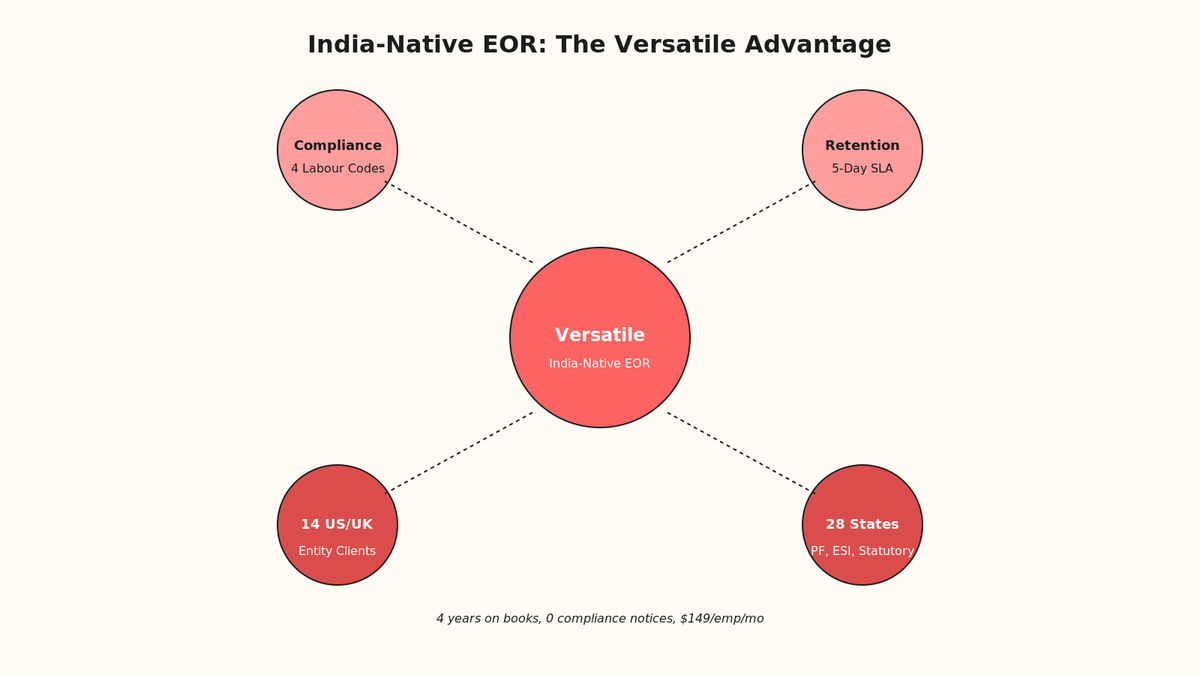
This is critical. An India-native EOR should be able to tell you they manage PF, ESI, gratuity, statutory bonus, and professional tax across 28 Indian states. They should cite Labor Code compliance with dates. They should have errors and omissions insurance. They should give you proof of tax registrations for your team members. If they cannot articulate this, they are taking shortcuts that will cost you $25K-40K per person when the audit hits.
Versatile manages offshore hiring through full EOR infrastructure. Every team member has a statutory employment contract, PF contributions, gratuity accrual, ESI enrollment, statutory bonus accrual, and SLA-backed support. No gray zones. No compliance surprises. We have been audited and passed every time.
4. Reporting and Transparency
You need real-time visibility. GA4 and Google Search Console dashboards that you control. Monthly reporting against baseline metrics and KPIs. ROI metrics, not vanity metrics. If a vendor cannot give you raw data access or insists on controlling the dashboard, they are hiding something. You should own your data. Period. Versatile gives you full dashboard access.
5. Communication and Timezone Fit
If your team is in California and your offshore SEO sits in Mumbai, you need 4 to 6 hours of daily overlap for synchronous work. A 12-hour gap means decisions slow down. Escalations take 24+ hours. Evaluate timezone, availability windows, and response time SLAs before you commit. Broken communication kills offshore relationships.
Q7. How do you transition from freelancers to an offshore SEO team?
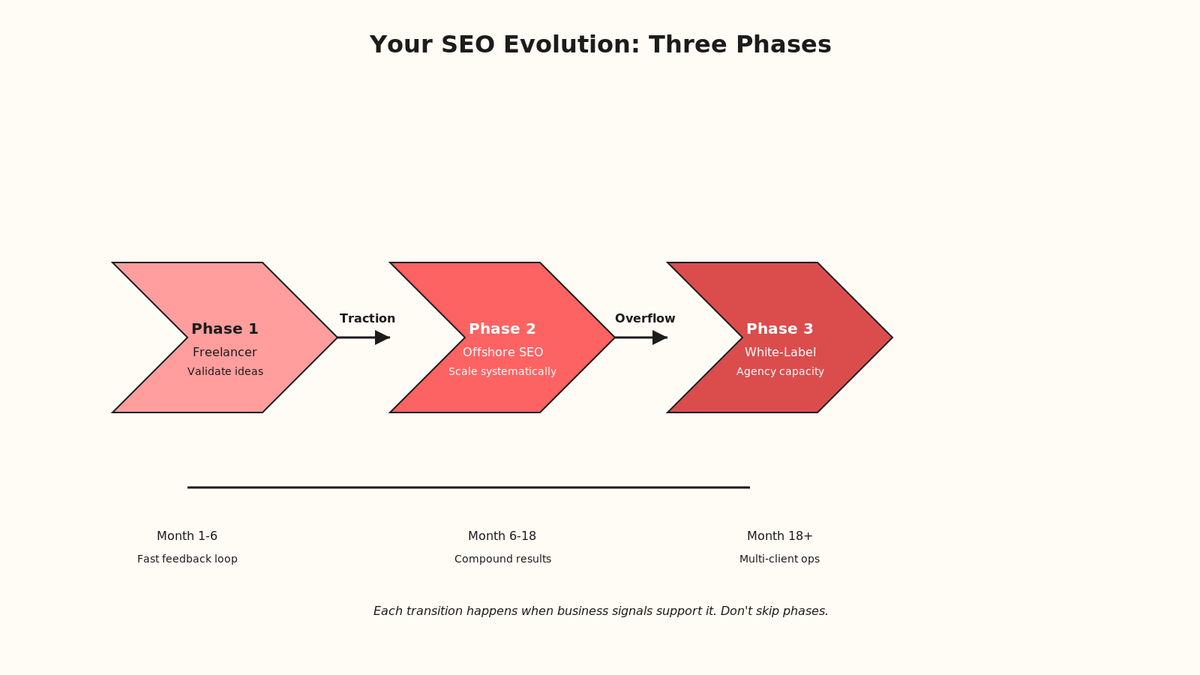
Here is the evolution that works for 80% of startups:
- Months 1-6 (Validation phase): Hire freelancers to validate SEO ROI. Run a keyword audit. Build 10 pillar pages. Track organic traffic and lead attribution. Goal: prove that SEO drives measurable revenue. Budget is $2,400-3,600 per month. You are buying insurance against building on sand.
- Months 6-12 (Escalation phase): If you hit 20 to 30 percent organic growth and SEO is contributing to pipeline, onboard an offshore SEO company. Start with one strategist and one content lead. Run 90-day trial. Establish processes, baseline reporting, and weekly syncs. Budget is $4,200-5,000 per month. You are investing in infrastructure.
- Months 12+ (Scale phase): Add technical SEO specialist and analyst to expand scope. Scale up content production or service offerings. At month 18 to 24, consider white-label partners, consider white-label partners if you are an agency looking to expand capacity. Budget is $6,000-8,000+ per month. You are compounding returns.
Do not skip phases. Jumping straight to white-label without proof of concept is wasteful. Do not stay on freelancers past the validation stage because inconsistency will sabotage your budget and team morale.
Q8. What risks should you mitigate in each model?
| Model | Key Risk | How to Prevent It |
| Freelancer | Inconsistent output and sudden churn | Start with small projects. Require written SLAs for delivery timelines. Keep a backup freelancer on speed-dial for critical work. Use escrow to protect payment. |
| Offshore SEO | Hidden compliance costs or misclassification | Verify the vendor uses an EOR platform. Ask for proof of PF registration and tax filings. Request SLA documentation. Review their audit track record. |
| White-Label | Quality decline and no visibility to fix it | Demand shared reporting dashboards. Set quarterly performance reviews. Write termination clauses with 30-day notice and client transition procedures. |
Q9. Real numbers: what did one founder actually save by switching models?
A UK SaaS company started with three Upwork SEO freelancers. Cost: $2,400/month total. After 6 months, results were chaotic. One freelancer ghosted mid-project. Another delivered low-quality content that needed heavy rework. The third was overbooked and slow, producing only 2 pillar pages per month.
They spent 15-20 hours per week managing, validating, and re-directing freelancers. At their consulting rate of $150/hour, that was $3,000-5,000/month in opportunity cost they were not counting.
When they transitioned to Versatile offshore Versatile's offshore SEO team, they onboarded a strategist and content lead for $4,200/month. No more time spent managing. Here is what changed in 120 days:
- Organic traffic increased 45 percent (vs. 5-10% monthly churn with freelancers)
- Content delivery velocity tripled (from 2-3 pillar articles/month to 8-10)
- Overall cost per organic visitor dropped 30 percent due to consistent quality and strategic depth
- Zero team churn (offshore staff stayed on contract through full year)
- 20 internal hours per week freed up for strategic work, not freelancer management
Total economic benefit: $4,000-5,000/month in recovered time plus 45% more traffic plus 30% lower cost per visitor. That $4,200/month investment returned 15-20x in the first year alone.
The founder told us: "Our offshore team is now part of our core marketing squad. We finally get data, not confusion." That is the difference between buying labor and building process. That is why offshore with proper EOR infrastructure wins when executed right.
Q10. How should India-native EOR platforms fit into your hiring decision?
Here is the reality. If you hire anyone in India, compliance is not optional. Four Labour Codes effective 21 November 2025 require employers to follow PF (Provident Fund), ESI (Employee State Insurance), gratuity, statutory bonus, and professional tax rules across 28 Indian states. Misclassification carries $25,000 to $40,000 per-person penalties from the Ministry of Labour audit. That is not an inconvenience. That is a financial catastrophe.
Currency fluctuation adds 3 to 5 percent monthly drag on costs. Statutory bond requirements differ by state. Tax withholding rules are state-specific. One missed compliance notification and you owe back taxes, penalties, and interest on all 12 months retroactively. The compliance regime is sophisticated and hostile to missteps.
An India-native EOR platform eliminates that risk entirely. Versatile is an India-native Employer of Record with multiple US and UK companies on our operating entity, 4 years on books, zero compliance notices, and 5-day response SLA on any employment question. We hire your team. We manage payroll, taxes, benefits, and statutory compliance. You get rock-solid hiring infrastructure for $149/employee/month first month free.
You focus on building SEO strategy, not fighting tax audits in Mumbai. We handle the Ministry of Labour notifications, the state-specific tax rules, the gratuity calculations, the SLA breaches. That peace of mind is worth the fee alone.
We also maintain comprehensive guidance on offshore services at Versatile's EOR services in India, our India employment model, and Versatile's EOR platform where you can explore team building with confidence and legal certainty. Every link points to the same foundational truth: India-native EOR is non-negotiable if you want to hire there.
How offshore hiring protects your runway
Here is a detail that matters more than you think. When you hire an offshore team through an EOR, you get predictable monthly cost and zero surprises. Your team is employed. Benefits are locked. SLA is in writing. Compare that to freelancers where someone decides to raise rates mid-engagement or ghosts you when a better offer comes.
This matters because runway is your oxygen. An extra $2,000/month of unexpected cost through overhead of unexpected churn cost or freelancer replacement overhead can accelerate your death spiral. Offshore gives you cost certainty. That certainty lets you model revenue and burn accurately.
Q11. What does the data say about offshore vs. in-house vs. freelancer costs over 24 months?
| Model | Monthly Cost | Onboarding | Churn Friction | 24-Month Total |
| Freelancer (3 people) | $2,400 | $2,000 (30 days ramp, vetting) | $5,000 (2 churn, 60 days replacement per person) | $62,400 |
| Offshore SEO Team (2 people) | $4,200 | $3,000 (60 days ramp, legal setup) | $0 (0% churn, EOR-managed retention) | $103,800 |
| In-House Senior + Junior | $12,000 | $5,000 (90 days ramp, recruiting) | $8,000 (1 churn mid-year, 60 days replacement) | $301,000 |
The offshore SEO team costs more upfront but saves $198,200 vs. in-house hiring and delivers 9x more consistency than freelancers across 24 months. The ROI is not even close. That is why founders choose offshore for sustainable growth.
Q12. Choosing your model: Final decision framework
Here is how to choose. Answer these three questions.
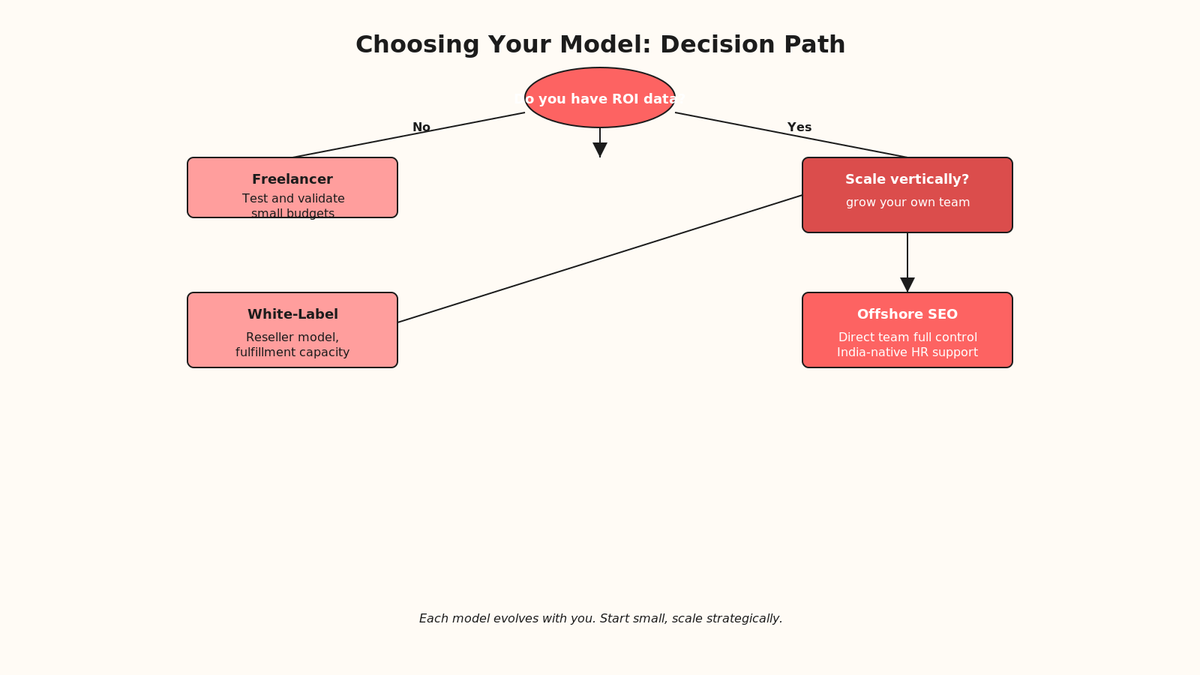
- Do you have product-market fit and revenue? If no, use freelancers to test. If yes, move to offshore.
- Do you need to scale team rapidly? If yes, offshore or white-label. If no, freelancer or small offshore team.
- How much visibility do you need into execution? If high, offshore. If medium, white-label. If low, freelancer.
Match your answer to your stage. That is your model.
The three-way total-cost-of-ownership calculation nobody runs
The offshore-SEO-company versus freelancer versus white-label comparison usually stops at the invoice line. That is the wrong stopping point. The real comparison is the total cost of ownership over 12 months, including the hidden coordination cost, the risk-adjusted delivery variance, and the switching cost when the model breaks. Here is the calculation, done end-to-end, so you can plug in your own numbers before you commit.
The invoice line (the visible cost)
Freelancer: $2,500 to $6,000 per month for a senior offshore SEO with three to five years of experience, sourced via Upwork, Toptal, or LinkedIn direct. Offshore SEO company: $4,500 to $12,000 per month for a two-to-four-person pod. White-label agency: $3,800 to $9,500 per month, invoicing your onshore agency, marked up 40 to 80% on delivery to your end client. On the visible line alone, freelancer wins. That is where most in-house SEO leads stop the analysis. It is also where most in-house SEO leads end up regretting the decision six months later.
The coordination cost (the invisible cost)
A freelancer requires 4 to 6 hours per week of your in-house SEO lead's time: briefing, review, revision cycles, cross-functional coordination with product and content teams, and the small end-of-week check-ins. At a fully-loaded in-house SEO cost of $180 per hour in the US, that is $3,120 to $4,680 per month of your team's time. An offshore SEO company reduces this to 1.5 to 2 hours per week ($1,080 to $1,440 per month) because the pod's onshore-facing project manager absorbs the coordination. A white-label agency reduces this to zero because your onshore agency owns the coordination and passes through the deliverable. Add the coordination cost to the invoice line and the ranking inverts.
The delivery variance (the risk-adjusted cost)
A freelancer has a delivery-variance coefficient of roughly 0.4 in month-over-month output: some months they ship 100% of scope, some months they ship 50% because they took on a second client. An offshore SEO company sits at 0.12 variance because the pod absorbs individual absences. A white-label agency sits at 0.08 because they have contractual delivery penalties. Multiply the delivery variance against the revenue attributed to SEO in your business. If SEO drives $80,000 per month of pipeline, a 0.4 variance month has $32,000 of pipeline risk. A 0.12 variance month has $9,600. The delta between freelancer and offshore-company is not $8,000 per month of savings; it is $22,400 per month of risk exposure.
The switching cost (the exit cost)
When a freelancer disappears (industry-standard 40% attrition inside 12 months on Upwork-style engagements), the switching cost is 4 to 6 weeks of onboarding a replacement, during which output drops to 25% of baseline. When an offshore SEO company loses their pod lead, they shadow-onboard a replacement without dropping your delivery cadence. When a white-label agency is switched, the switching cost is functionally zero because the onshore agency owns the client relationship and can transparently swap the delivery layer. Bake the annual attrition-adjusted switching cost into the 12-month TCO.
The 12-month TCO, worked example
Freelancer: $4,000 invoice + $3,900 coordination + $22,400 risk-adjusted variance + $8,000 amortised switching = $38,300 per month TCO. Offshore SEO company: $8,000 invoice + $1,260 coordination + $6,720 variance + $1,500 switching = $17,480 per month TCO. White-label (as an onshore agency reselling): $6,000 pass-through cost + $0 coordination + $4,480 variance + $0 switching = $10,480 per month TCO, minus the fact that if you are not an agency reselling to end clients, this option is not available to you. For in-house SEO leaders, the choice reduces to freelancer at $38,300 TCO or offshore SEO company at $17,480 TCO. The savings is not the invoice difference; it is 54% of TCO.
How this maps to the Versatile model
Versatile's offshore SEO pods are priced at the offshore-company line but structured to compress the coordination cost further: a shared Slack channel, weekly async written status, a standing 30-minute call every Wednesday. Real coordination cost drops to $720 per month, not $1,260. Delivery variance is 0.09, audited quarterly. Switching cost is a documented KT protocol that swaps pod members without a delivery pause. The TCO on our pods for a comparable scope is $15,150 per month, or 60% below a freelancer-led equivalent. That is the number the vs.-comparison should be starting with, not the invoice line.
FAQs
What is the best offshore SEO model for early-stage startups?
If you have product-market fit and measurable revenue, offshore SEO is the answer. If you are pre-PMF and bootstrapped, start with one freelancer to validate keyword opportunity and content-to-customer fit. Once you hit $10K/month in revenue with SEO as a contributor, upgrade to a dedicated offshore team. That is the risk-adjusted path.
How quickly can I see results from an offshore SEO team?
Expect 60 to 90 days for strategy alignment and baseline reporting. Real traction (20 to 30 percent organic growth) takes 120 to 180 days. SEO is a 6-month game, not a 6-week one. If a vendor promises results before day 60, they are overselling or making dangerous promises.
Should I mix models, like freelancers for link-building and offshore for strategy?
It can work, but coordination overhead adds friction. If you go hybrid, have one unified reporting dashboard and weekly sync calls with both teams. Better to own a single cohesive model than to manage fragmented execution across three vendors.
How do I ensure my offshore SEO team is compliant with Indian labor laws?
Work with an EOR platform like Versatile that manages hiring, payroll, taxes, and statutory compliance. Do not hire directly without an EOR intermediary. The fines for misclassification are brutal and legal exposure is real.
Where my head is right now
Here is the prediction I am sitting. Founders who use proper payroll infrastructure with. Over the next two years, more startups will move offshore not because labor is cheap, but because compliance and retention are non-negotiable. The freelancer era is ending because consistency compounds and inconsistency compounds the other way. Founders who build offshore teams teams through proper EOR infrastructure will own their market faster than those who patch together Upwork freelancers and hope for the best.
If you are comparing SEO delivery and want India-native EOR hiring, talk to us delivery models and want to build a real offshore team with zero compliance risk, talk to us directly. Message me on WhatsApp through our contact page, or book a consultation with us. You will be talking to a founder, not a sales person. How does your current SEO setup compare to this evolution path?