Table of contents (12)
- Q1. Which of the three channels should a founder actually outsource first?
- Q2. What "offshoring SEO" actually means in 2026
- Q3. The PPC honest read: why cheap offshore PPC blows up ad budgets
- Q4. SMM: why organic social almost always fails offshore, and the two exceptions
- Q5. Real cost math: SEO retainer vs PPC management fee vs SMM per-channel
- Q6. Regional map: India, Philippines, Eastern Europe, LATAM per channel
- Q7. The tooling reality: Ahrefs, Semrush, GA4, Google Ads Editor, Meta Business Manager
- Q8. Vendor evaluation: 12 questions to ask before you sign
- Q9. When to bring it in-house vs stay outsourced
- Q10. If you go with India: when your contractor becomes an employee
- Q11. Decision framework: which channel to outsource first
- FAQs
Offshore SEO, PPC, and SMM Explained: Which Channel Should You Outsource First?
Q1. Which of the three channels should a founder actually outsource first?
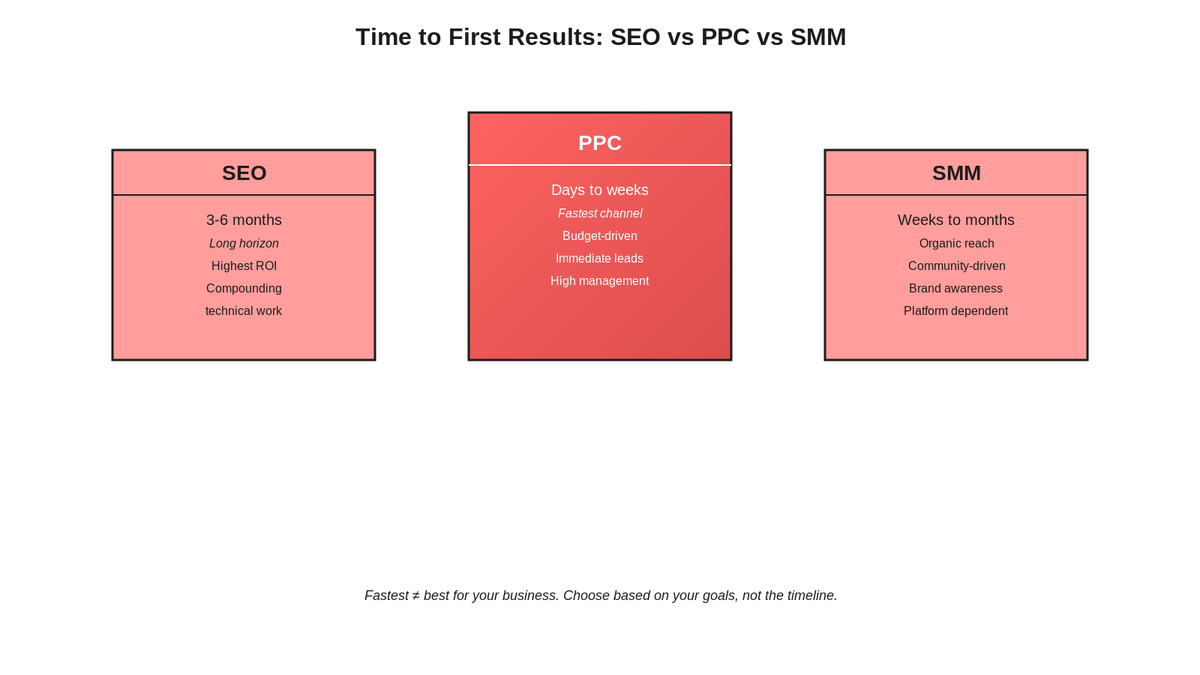
SEO usually wins. Here is the real logic: it requires technical depth (audits, content operations, link operations, GEO/AEO), low creative taste risk, and a long horizon. That combination makes it the easiest to delegate without constantly second-guessing the team. PPC is faster, but mismanagement eats cash. SMM feels organic, but offshore SMM often fails because your brand voice is culture-specific and hard to get right 5,000 miles away.
The hard truth: if you have $2,000 to burn and need to validate channel choice, start with a 60-day PPC pilot. Fastest signal on demand. If you have $500/month for 6 months and can wait, start with SEO. If you are a D2C fashion or fitness brand where community is the moat, start with SMM. But only if you have an in-house person managing the offshore team's tone daily.
Most founders skip this framework entirely and hire because "everyone is doing it" or because they found a cheap freelancer. That is how you end up with a burned $3K budget and zero trust in offshore anything.
Q2. What "offshoring SEO" actually means in 2026
Offshore SEO is not "hire someone to write blog posts." It is a suite of technical and operational tasks that live in four buckets: technical audits (crawlability, Core Web Vitals, schema markup, mobile usability), content operations (keyword research, cluster mapping, brief writing, internal linking strategy), link operations (prospecting, outreach, relationship management), and competitive analysis (AEO/GEO work, tracking AI-generated and generalist search results, not just organic rankings).
What you delegate depends on your stage. Our keyword research outsourcing service handles the discovery phase. We also have expertise in content cluster strategy and technical SEO audits. Early stage? Hire someone to audit your technical SEO and fix the low-hanging fruit (page speed, missing redirects, broken internal links). Growth stage? Add content operations and have them manage a rotating content calendar. Mature? Layer in link operations and 301 mapping for domain migrations.
For a detailed guide on how technical SEO fits into the broader search strategy, check out our offshore technical SEO service guide. We also cover content marketing outsourcing if you want to understand the operational side.
| Maturity Level | Primary Focus | Tools Required | Time to ROI | Monthly Range |
| Early (0-$1M ARR) | Technical audits, speed fixes, schema | Ahrefs, Google Search Console, PageSpeed Insights | 4-6 weeks | $800-$2,000 |
| Growth ($1M-$10M) | Content ops, cluster strategy, internal linking | Semrush, Ahrefs, GA4, content brief templates | 8-12 weeks | $2,000-$5,000 |
| Mature ($10M+) | Link ops, competitive moves, AEO monitoring | Ahrefs, Semrush, Moz, custom dashboards, Zapier | 12-24 weeks | $5,000-$12,000 |
"We hired an offshore SEO team and within three months had a plan to fix technical issues that were costing us 30 percent of organic traffic. The audit alone paid for itself."
- Jason P., SaaS founder on G2
Q3. The PPC honest read: why cheap offshore PPC blows up ad budgets
PPC is the most dangerous channel to offshore if you get it wrong. The risk is not incompetence. It is that outsourced PPC managers optimize for volume (clicks, conversions) at the expense of quality (high-intent, profitable conversions). They can hit your KPI sheet while burning cash on bottom-funnel retargeting that drives "conversions" that do not stick.
The second risk: they do not understand your product nuance. An offshore PPC manager in the Philippines might run aggressive campaigns that sign people up fast, but drop them in week two because they expected something different. Your CAC looks good. Your LTV is garbage.
Third: they own your ad accounts. Our Google Ads account management ensures you retain full ownership and access. We also provide Facebook Ads management with transparent reporting. If the relationship sours, you lose years of conversion history, audience data, and keyword performance if the account was set up under their name, not yours. Insist on joint account ownership or full account transfer before you sign.
This is why we recommend hiring PPC talent through a vetted offshore hiring service that maintains quality standards. We also have guides on PPC team outsourcing best practices and Google Ads management offshore.
"We gave an agency $15,000 in ad spend. Three months later we had 300 sign-ups but only 12 stayed past trial. They optimized for volume, not quality. We switched channels after that."
- Maria C., B2B SaaS founder on G2
Q4. SMM: why organic social almost always fails offshore, and the two exceptions
Offshore SMM works best when you strip away the art and lean into the ops. What kills most offshore social programs: founders expect offshore teams to nail brand voice and cultural nuance on day one. Brand voice is not a list of words. It is tone, timing, meme literacy, and risk tolerance. That is hard to ship offshore without a full-time in-house editor who reviews every post before it goes live.
The two exceptions where offshore SMM wins:
Exception 1: Paid social campaigns. If you are running ads on Instagram, TikTok, or Facebook with a clear CTA (sign-up, shop, download), offshore teams can absolutely manage that. The creative is fixed. The audience targeting is data-driven. The post frequency is rigid. You are not betting on their taste.
Exception 2: Multilingual expansion. If you are a US-based founder entering the Spanish market, hiring a native Spanish speaker in Argentina or Mexico to run your SMM is not offshoring. It is hiring for the market. They know the memes, the platform rhythm, the influencers. They can win.
Our organic social media strategy framework helps teams navigate this challenge. We also offer Instagram management services and LinkedIn content management for B2B brands. Organic social? it works offshore is if you hire for 8+ hours overlap daily with someone who is plugged into your company culture, attends your standups, and takes feedback like it is a punch to the face. At that point, you are micro-managing from 5,000 miles away. You are better off hiring a junior in-house. For more on this topic, read our social media marketing outsourcing guide.
| SMM Tactic | Offshore Viability | Why | Best Region |
| Organic content calendar | Low | Requires daily brand voice judgment calls | Not recommended |
| Paid social campaigns | High | Fixed creative, data-driven targeting, measurable ROI | Philippines, LATAM |
| Community management (DMs, comments) | Medium | Needs cultural sensitivity and brand alignment daily | India (overlap), LATAM |
| Localized expansion (native language markets) | High | Local hire equals local knowledge of memes, trends, platforms | Native country of that market |
| Influencer outreach | Medium | Relationship building is human, but pitch can be templated | LATAM for Spanish, Philippines for English |
"We stopped trying to offshore our organic Instagram content and switched to a paid-social-only model with an offshore agency. Our ROAS went from 0.8 to 2.1 in 60 days because they could scale what worked without second-guessing brand tone."
- Priya M., D2C founder on G2
Q5. Real cost math: SEO retainer vs PPC management fee vs SMM per-channel
Do not trust package pricing. Our offshore retainer model is transparent and scalable. Check out our SEO retainer pricing guide for detailed breakdowns. The cost depends on your scale, market, and whether you are building from zero or inheriting an existing footprint.
SEO retainers: India-based teams charge $1,200 to $3,500 per month for core work (technical plus content). If you need link operations (the hard part), add $2,000 to $5,000. You should expect minimum 3-month commitment, usually 6.
PPC management: Usually tiered on ad spend. 10 percent of ad spend is the industry norm. So if you run $5,000 per month in ads, the agency fee is $500. If you run $20,000, it is $2,000. Cheaper agencies charge 8 percent. Better agencies charge 15 to 20 percent because they protect your CAC.
SMM per-channel: $800 to $2,000 per month per platform (Instagram, TikTok, LinkedIn, etc.). This covers content creation, scheduling, basic community management. Do not ask for "growth hacks." That is code for "we will spam and burn your account."
Our offshore hiring guide has cost breakdowns by region. We also maintain a resource on pricing offshore services that shows how costs vary by channel and region.
| Channel | Monthly Vendor Cost | Ad Spend (if applicable) | Tools/Subscriptions | Total Monthly | Break-even Timeline |
| SEO (organic only) | $2,000-$4,000 | $0 | $300/mo (Ahrefs/Semrush) | $2,300-$4,300 | 4-6 months |
| PPC (Google/Facebook ads) | $500-$2,000 (fee on spend) | $5,000-$20,000 | $200/mo (GA4 setup) | $5,700-$22,200 | 30-60 days |
| SMM (paid only, one platform) | $1,200-$2,000 | $1,000-$5,000 | $100/mo (scheduling tools) | $2,300-$7,100 | 6-12 weeks |
| SEO and PPC (hybrid) | $2,500-$6,000 | $5,000-$20,000 | $400/mo | $7,900-$26,400 | Staggered: PPC 30d, SEO 4-6mo |
"We budgeted $3,000 per month for a PPC agency. What we did not budget for was the landing page designer ($1,500), the CRM integration ($500), and the pixel setup consultant ($800). The true cost was 2.5x what we thought."
- David T., Founder on G2
Q6. Regional map: India, Philippines, Eastern Europe, LATAM per channel
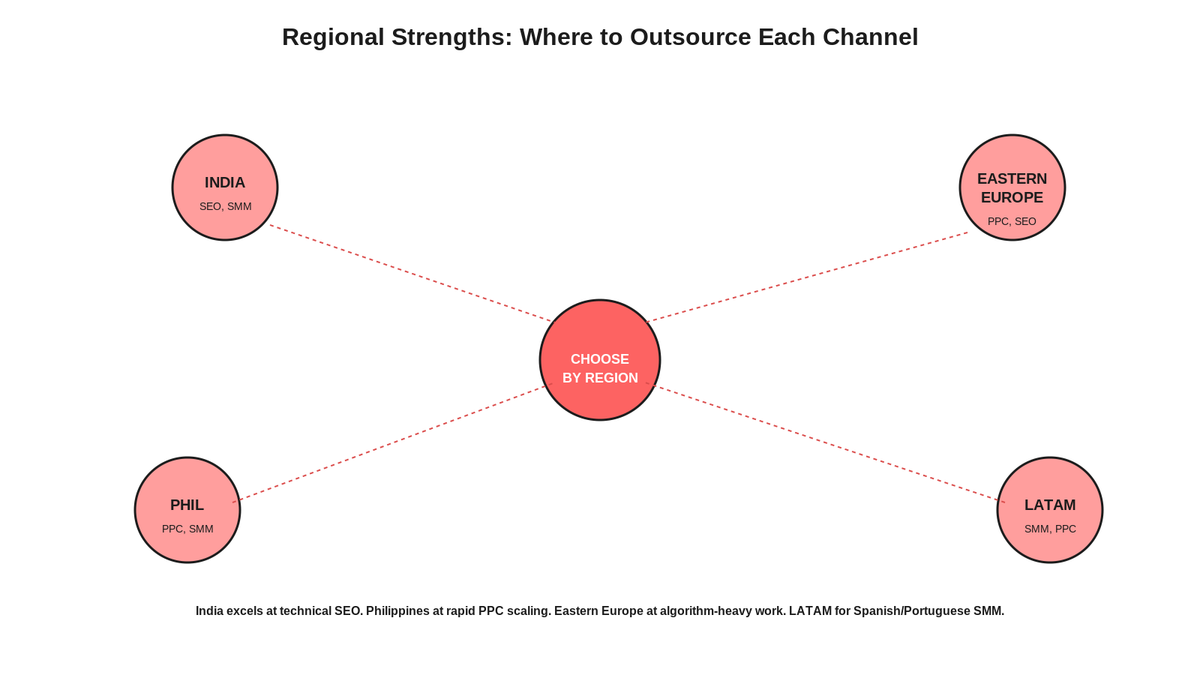
Not all offshore regions are equal. Each has a regional strength based on labor market, English proficiency, time zone overlap, and domain expertise.
India. Dominates SEO and technical marketing. Why? Deep expertise in Ahrefs, Semrush, Google Search Console, and algorithmic thinking. Team overlap with your US hours (5-8 AM IST equals 8-11 PM US East). Cost is 40 to 50 percent cheaper than Western agencies. Downside: quality is inconsistent. Vetting is brutal. You need strong project management on your end. Learn more about India SEO outsourcing and our offshore hiring in India program.
Philippines. Owns paid social and PPC at scale. English fluency is exceptional. Cultural alignment with US and Australia is high (many have worked in US companies before). Time zone is reasonable for Asian founders. Cost is similar to India, but execution speed is faster. Downside: depth on technical SEO is weaker than India. Better for rapid iteration than deep strategy. Check out our Philippines outsourcing services.
Eastern Europe (Romania, Poland, Ukraine). Best for PPC, algorithm-heavy work, and A/B testing. Why? High STEM education, strong analytical mindset, and deep Google Ads experience. Time zone is terrible for West Coast US (but fine for East Coast). Cost is higher than India (40 to 60 percent more), but quality is often premium. Downside: smaller talent pool, higher attrition, language can be a friction point.
LATAM (Mexico, Argentina, Colombia). We specialize in Mexico outsourcing services and Argentina remote hiring. Our regional talent matching finds the right fit for your channel. Best for SMM, especially Spanish and Portuguese markets. Cultural proximity to US and Spain. Time zone overlap for US founders is solid. Cost is 50 to 60 percent cheaper than Eastern Europe, comparable to India. Downside: limited PPC expertise, fewer SEO specialists. Better for organic and community work. Explore LATAM outsourcing options.
Q7. The tooling reality: Ahrefs, Semrush, GA4, Google Ads Editor, Meta Business Manager
You cannot offshore without giving your team access to tools. Non-negotiable tools by channel:
SEO: Ahrefs ($399 per month) or Semrush ($120 to $500 per month), Google Search Console (free), GA4 (free), ScreamingFrog (free). Some teams balk at Ahrefs cost. Do not cheap out. Our Ahrefs integration services and GA4 setup support ensure smooth onboarding. The difference between $120 Semrush and $399 Ahrefs is real. Ahrefs has better backlink data, a bigger index, and faster crawl speed. Your offshore team will thank you.
PPC: Google Ads Editor (free), Meta Ads Manager (free), native platform dashboards, optional third-party: Optmyzr, Adverise, or Skai. The agency should own these logins and grant you read-only access. Red flag: if they resist giving you even read-only access, run.
SMM: Later, Buffer, or Hootsuite for scheduling ($20 to $99 per month), Meta Business Manager (free), TikTok Business Center (free). Analytics live in platform dashboards. Do not pay extra for social listening tools until you have a consistent 10K plus following on at least one channel.
| Channel | Tier-1 Tools (mandatory) | Tier-2 Tools (strongly recommended) | Tier-3 Tools (nice-to-have) | Annual Cost (minimum) |
| SEO | Ahrefs or Semrush, GSC, GA4 | ScreamingFrog, Ubersuggest, Moz | Rank Ranger, SEOBox, Accuranker | $1,200-$5,000 |
| PPC | Google Ads, Meta Ads, native dashboards | Google Ads Editor, platform native reporting | Optmyzr, Supermetrics, Skai | $0 (agency absorbs) |
| SMM | Later, Buffer, or Hootsuite; platform dashboards | TikTok analytics, Instagram Insights, LinkedIn Analytics | Brandwatch, Mention, Sprout Social | $300-$1,200 |
"We realized our offshore team did not have access to Ahrefs and were manually checking backlinks one by one. One subscription change saved us 10 hours a week and improved our link ops strategy overnight."
- Ravi P., Founder on G2
Q8. Vendor evaluation: 12 questions to ask before you sign
Before you pay anyone, ask these 12 hard questions. A single "no" or dodge is a red flag. This framework applies whether you are hiring an agency, freelancer, or through an Employer of Record model.
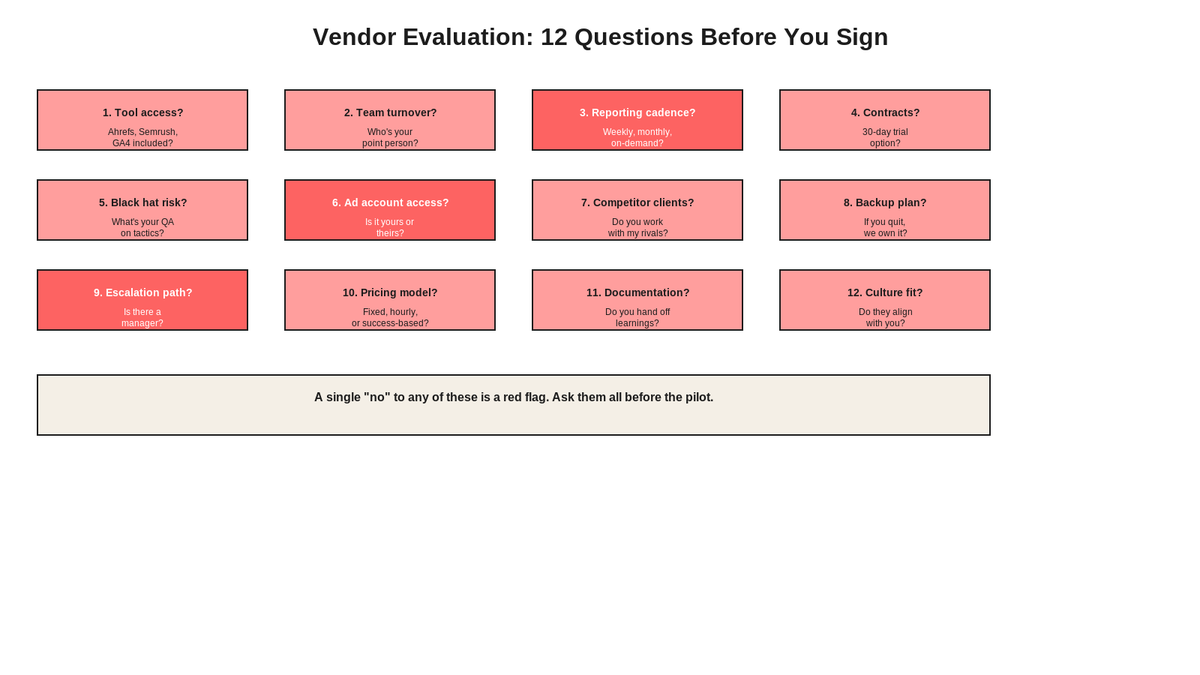
The questions in plain language:
1. Tool access? Do they provide logins or full access to Ahrefs, Semrush, GA4? Or do you have to buy your own and grant them access?
2. Team turnover? Who is my account manager? How long have they been with the agency? What is their attrition rate?
3. Reporting cadence? Weekly check-ins, monthly reports, or on-demand? Do they share raw dashboards or only narrative summaries?
4. Contracts? Can I do a 30-day pilot first? Or is it 6 months minimum locked in?
5. Black hat risk? Ask them: "Have you ever been penalized by Google? Describe your QA process for avoiding spammy tactics."
6. Ad account access? For PPC: is the account in my name or theirs? Do I have full admin access or read-only?
7. Competitor clients? Do they work with my direct competitors? If yes, how do they handle data confidentiality?
8. Backup plan? If you quit tomorrow, am I stuck? Can I export all data and hand off to another team?
9. Escalation path? If my account manager goes dark, who do I talk to? Is there a manager or owner I can escalate to?
10. Pricing model? Fixed monthly, hourly retainer, success-based commission, or hybrid? What happens if I need more hours than budgeted?
11. Documentation? Do they hand off learnings? Or is all the knowledge locked in their heads? Ask for templates, frameworks, decision logs.
12. Culture fit? Do they ask about your business goals or just pitch their services? Do they push back on ideas or just say yes?
Q9. When to bring it in-house vs stay outsourced
Offshore is not forever. There is a point where it makes sense to hire in-house. The trigger points vary by channel. Our hire SEO specialist program helps you transition from offshore to in-house. We also offer PPC specialist hiring guidance.
For SEO: Bring it in-house when you hit $3M plus ARR and have consistent content velocity (8 plus posts per month). At that scale, an in-house SEO person ($90K to $140K all-in) replaces a $4K per month retainer and gives you faster iteration. Offshore works best when you are under $3M and do not have 100 plus pages of content to maintain.
For PPC: Bring it in-house when your monthly ad spend exceeds $30K. At that point, you can hire a full-time paid ads manager ($80K to $110K) whose job is to optimize one thing: your CAC. Below $30K, offshore agencies are more cost-effective because they amortize their overhead across 20 plus clients.
For SMM: Bring it in-house when you have 50K plus engaged followers on one platform and need daily posting, real-time community management, and brand voice polish. Before that, even a "senior" offshore SMM hire will lag behind platform culture and miss the 3 AM trending moment.
The hybrid play: Keep SEO offshore (technical work scales well remotely), bring PPC in-house (it moves fast), and handle SMM with a freelancer who works flexible hours on your time zone.
Q10. If you go with India: when your contractor becomes an employee
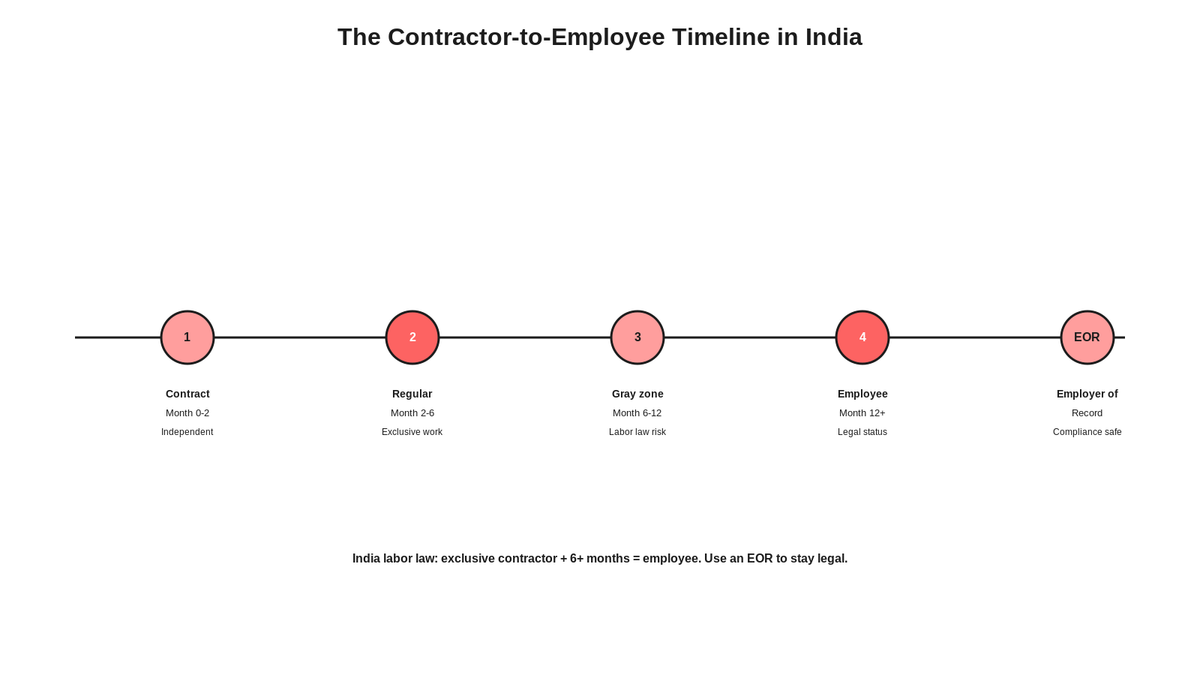
This is not scaremongering. India's labor law draws a hard line. Once you have an exclusive contractor working for you full-time for more than 6 months, the Indian tax authority and Ministry of Labour reclassify them as your employee. You are now liable for employer contributions, leave encashment, gratuity, and tax withholding. You can get fined or have the contractor's personal visa revoked.
The timeline: Month 0-2, you hire a contractor, sign a standard independent contractor agreement, they invoice you. Months 2-6, you have weekly standups, they take on more exclusive work. Month 6 is the gray zone. They are still a contractor, but India's labor law is watching. Month 12 plus, they are legally classified as an employee, even if you never called them that.
The solution is an Employer of Record (EOR). An India-native EOR like Versatile becomes the official employer. The contractor is their employee. You pay a monthly fee on top of the contractor's salary, and Versatile handles all compliance: tax filing, gratuity accrual, statutory leave management, visa sponsorship, even termination. You stay legal and compliant from day one to day 365. Versatile specifically structures this for offshore teams, so you can scale from contractor to employee without legal friction.
"We hired someone from India and thought we were good with a contract. At month 8, our lawyer told us we were legally their employer. We could have been fined thousands. We moved them to an EOR and never looked back."
- Sophie D., Founder on G2
Q11. Decision framework: which channel to outsource first
Choose SEO first if: You have a website with at least 20 pages of original content. Your business model rewards long-term organic visibility (B2B SaaS, professional services, e-commerce). You can commit to a 6-month minimum and do not need leads in 30 days.
Choose PPC first if: You are validating product-market fit and need demand signal fast. You have $5K plus monthly ad budget. You have a working conversion funnel (lead magnet, landing page, email sequence, or checkout). You can handle daily optimization and reporting.
Choose SMM first if: Your product is visual-first or community-driven (D2C, fitness, fashion, creator economy). You have cultural storytelling to tell. You have an in-house person who can review every post and give daily feedback. Your market is Gen Z or millennial-heavy.
Choose a hybrid (SEO plus PPC) if: You are past product-market fit, have $15K plus monthly budget, and want fast leads (PPC) plus long-term compounding (SEO). Run both in parallel for 6 months, then double down on whichever is driving better unit economics.
FAQs
How long should I pilot an offshore channel before committing long-term?
Minimum 30 days, ideal 60 days. Why 60? Because the first 30 days is setup and team learning. The second 30 days is when you see early results and can decide if the working relationship is real. If you are not seeing positive signals by day 60 (either results, process improvement, or strong vendor communication), it is not going to click. Walk and move on.
What is the biggest mistake founders make when outsourcing marketing?
They hire someone and disappear. Offshore marketing is not set-it-and-forget-it. You need weekly check-ins, transparent dashboards, and a feedback loop. The vendor is executing your strategy, not inventing strategy from scratch. If you do not clarify what success looks like before they start, they will optimize for the wrong thing and burn your budget.
Can I hire one person to manage all three channels?
No. One person cannot be expert in SEO, PPC, and SMM at the same time. Pick one. If you must hire offshore across channels, hire one specialist per channel (even if part-time on each). You will get better results and avoid the generalist trap where nothing gets deep focus.
What is a red flag during the vendor evaluation call?
They talk more than you do. They do not ask about your business, your goals, or your past failures. They just pitch their services and case studies. Good vendors ask hard questions: "Why are you outsourcing? What have you tried before? What failed? What does success look like?" If they do not dig, they have not thought about your specific problem.
Is it cheaper to hire a freelancer or an agency?
Freelancer: $5 to $15 per hour, you hire 1-2 people, but you do all the management and quality assurance yourself. Agency: $1,500 to $5,000 per month, they handle hiring, training, QA, and turnover. The agency model works best if you cannot afford to spend 5 plus hours per week managing. If you can manage closely, a freelancer is cheaper. But cheap does not mean better. Many founders swap a freelancer for an agency after 3 months of chaos.
What happens if I want to end the contract early?
Read the fine print. Some agencies have "notice periods" (you have to give 2-4 weeks notice). Others have early termination fees (usually 1-2 months of fees). The ethical move: if a vendor has built strategy and processes for you, you owe them at least one month's notice and final payment. If they are underperforming, give feedback first. Give them 2 weeks to improve. Then exit. Cutting them cold is bad karma and makes the offshore vendor community smaller.
Where my head is right now
In 2026, the biggest mistake is treating offshore marketing like outsourcing commodity tasks. It is not. It is a partnership where you own strategy and the vendor owns execution. If you do not get this right on the first channel, you will never trust offshore again, and you will be handcuffed to hiring expensive in-house teams or burning cash on mediocre agencies.
If you are a founder hiring from India for the first time, whether for SEO, PPC, or SMM, do not wing the compliance piece. Use an India-native Employer of Record from day one. Versatile is built exactly for this: you pick your channel, we manage the legal and compliance layer, you focus on results. Message us on WhatsApp through our contact page, or book a consultation. Which channel are you thinking about outsourcing first?