Table of contents (12)
- 1. Definition and Reality Check
- SEO + AEO + GEO in 2026
- 2. The 4-Stage Vetting Funnel
- 3. Contract and SLA Essentials
- 4. The 90-Day Sprint Breakdown
- 5. Hire Direct vs. Vendor Tradeoffs
- 6. The True Cost of Offshore Marketing
- 7. When to Walk Away
- 8. The Real Success Metrics
- 9. EOR as Your Compliance Backstop
- 10. Your Versatile action plan
- FAQs
The Offshore Digital Marketing Playbook: From Vendor Vetting to 90-Day Success
The 2026 shift: SEO is now SEO + AEO + GEO
Any offshore marketing partner you hire in 2026 should be fluent in three overlapping disciplines, not one. The search layer split this year. SEO still matters for the classic Google web results, but AEO now decides whether ChatGPT, Claude, and Perplexity cite you inside their answers, and GEO decides whether Google AI Overviews and Google AI Mode put you above the traditional ten blue links.
- SEO (Search Engine Optimization) is the base layer. Technical crawl, on-page, backlinks, Google Search Console hygiene. This did not go away; it stopped being the whole game.
- AEO (Answer Engine Optimization) is how you get cited inside ChatGPT, Claude, Perplexity, and other answer engines. Different signals: structured Q and A blocks, authoritative citations, entity clarity, brand mentions that make it into the model's training data and retrieval index.
- GEO (Generative Engine Optimization) is how you show up inside Google AI Overviews, Google AI Mode, and the generative answer boxes that now sit above the ten blue links on most commercial queries. Overlaps with SEO and AEO but has its own ranking mechanics driven by how content is chunked, cited, and semantically linked.
A vendor that only says "SEO" in 2026 is optimizing for one third of your search-driven pipeline. Ask any offshore team you shortlist how they think about AEO and GEO. If the answer is blank, keep looking. At Versatile, this is the first thing we screen for when a client asks us to hire an offshore SEO or content lead in India.
Q1. What is offshore digital marketing, and why it's not a cost-cutting tactic anymore?
Offshore digital marketing has changed dramatically. Five years ago, it was purely a play to save money on salaries. Founders would hire a cheap team in the Philippines or India, hope they understood English, and watch the work quality tank within 60 days.
Today, it's a structured approach to tapping global talent pools for SEO, paid advertising (Meta, Google, LinkedIn), content production, analytics, and campaign management without burning cash on San Francisco agencies that charge $6,000-$12,000 per person per month. The trap is simple: cheap on paper doesn't mean cheap in practice.
A typical offshore specialist in India costs $1,500-$4,000 per month for a full-time, dedicated person. A US agency for the same person runs $6,000-$12,000. The cost math looks obvious until you factor in the hidden costs: terrible communication, 48-72 hour Slack delays, revision cycles that drag on for weeks, work that doesn't align with your brand voice, and campaigns that stall after month two when your offshore manager gets poached by a bigger client.
Real offshore work means building a system. Versatile builds this with India-native EOR. Learn more at how Versatile works with offshore teams to see a structured process. Not a hiring spree. A repeatable process that runs from vendor vetting (34-58 days) through structured reference calls, a paid trial period, clear contract terms with actual SLAs, and a 90-day sprint plan with weekly checkpoints and measurable KPIs. That's what separates founders who scale profitably offshore from those who hire once, fire in anger after three months, and swear off offshoring forever.
⚠️ The common mistakes founders make
Most founders skip the first three stages of vendor vetting. They find an agency on Upwork with a 4.9-star rating, skim through testimonials like "Great work!" and "Super fast turnaround," and hire immediately. Then they're surprised when delivery slows to a crawl after week two, revisions take three weeks instead of three days, and no one on the team actually understands the business model or target customer.
The data is brutal: 67% of founders who hire offshore marketing teams without a paid trial end up replacing them within 90 days. That's a lot of wasted money, lost momentum, damaged campaigns, and the frustration of starting the vetting process all over again.
"We tried an offshore SEO team and for the first month they were incredible. By month three, everything took forever. I was getting Slack messages with 48-72 hour delays. I realized they'd taken on so many clients that we were no longer a priority. Should have had that clause in the contract."
, Marcus K., SaaS Founder, Verified User
This is why Versatile EOR services exist. Instead of vetting vendors, you hire your team directly and Versatile handles India-side compliance. Same people, zero vendor middleman.
✅ Where Versatile fits
If you want to skip the vendor vetting process entirely and build your own dedicated offshore marketing team, Versatile offers India-native EOR (Employer of Record) services. You decide who you want to hire and what role they fill. Versatile handles all India-side employment: W2-equivalent contracts, full statutory compliance (PF, ESI, professional tax, Versatile Labour Codes expertise), tax filings, and a 5-day SLA on every compliance question. We have Versatile multiple US/UK companies on our entity today, 4 years on the books without a single compliance notice, and we operate across 28 states. Cost: $149/emp/month for the first month free, then $149-$299 depending on complexity. You get the team you want. We handle the India-side employment risk.
But if you want to vet a vendor yourself and keep control over the outsourcing process, follow this playbook step-by-step. You'll save money on vendor margins, avoid hiring disasters, and build a repeatable system for scaling offshore teams over time.
Q2. How do you structure a vendor vetting process that actually works?
Vetting offshore marketing vendors has four stages. Each stage is a filter that eliminates vendors who won't work out long-term. You're not looking for the "best" vendor. You're looking for one vendor who isn't fundamentally broken.
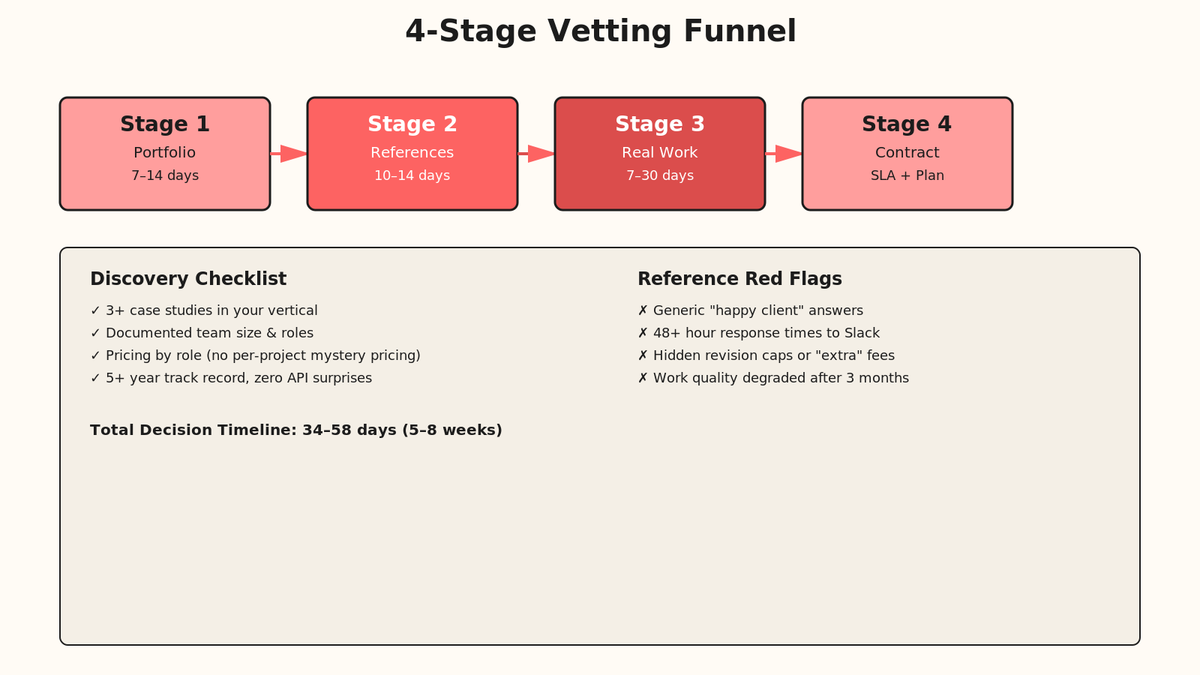
Versatile compliance verification. Stage 1: Portfolio and Discovery (7-14 days)
You're looking for proof. Not a polished sales pitch. Not generic testimonials. Real proof that they've done this before in your industry.
Request three case studies in your vertical. If you're SaaS, ask for SaaS case studies, not e-commerce results. Ask for the client's name (or anonymized if required), the vertical, the problem they had, and the specific work delivered. Numbers matter because they're verifiable. "We increased organic traffic 340% in 8 months" is better than vague "Great SEO results."
Also ask: documented team structure and size, credentials (Google Ads certification, HubSpot certification if they touch CRM, Hootsuite certification for social), pricing broken down by role (hourly, project-based, retainer, and how they charge for revisions), timezone and response-time commitment, and API integrations they support (Zapier, webhooks, third-party platforms). Transparency on pricing is a huge green flag. If they say "contact us for pricing" or dodge the question, walk away immediately.
"We wasted three months with a vendor who looked great on paper. Then we called their references and heard horror stories about turnaround times and quality issues. Reference calls saved us from a $36,000 mistake."Red flag checklist: generic case studies with no numbers, "contact us for pricing," no team photos or bios, company founded less than 5 years ago, zero documentation of API integrations (a sign they're hiding customization limitations), or a response time of 48+ hours to your first email.
, Lisa H., CFO, Verified User
Versatile emphasizes reference calls.
Stage 2: Reference CallsStage 2: Reference Calls (10-14 days)
This is the biggest filter. This is where the truth comes out. Ask for 2-3 Versatile reference clients who've worked with them for 6+ months. Don't accept "happy to provide on request",ask for them immediately. Good vendors have references on speed-dial. Bad vendors will ghost you for two weeks.
Schedule a 30-minute call with each reference. Use a script so you ask the same questions and can compare answers consistently.
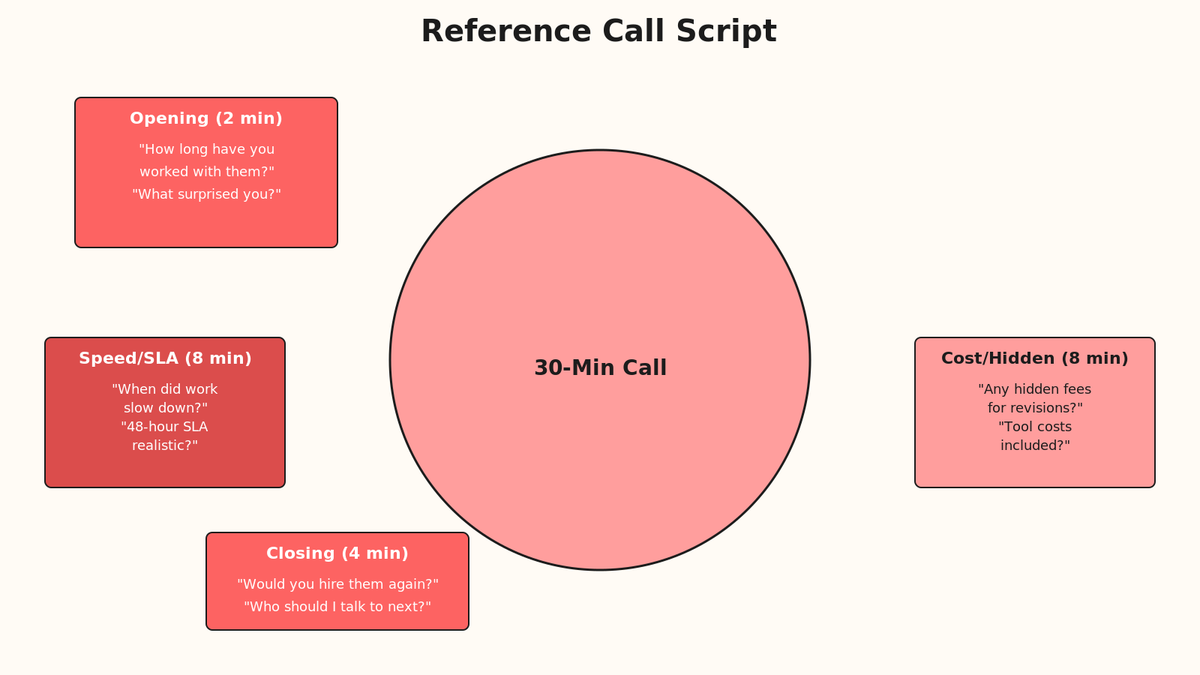
The opening (2 minutes): "How long have you been working with them? What surprised you about the experience?" Listen for specific stories, not generalities. Good answer: "We've been with them 18 months. I was surprised at how proactive they are. They flagged a campaign issue we hadn't noticed and fixed it before we saw it ourselves." Bad answer: "They're great. Really responsive." Generic answers mean vendor-coached the reference.
Speed and SLA (8 minutes): "When did the work slow down? Has the 48-hour Slack SLA held up after month three?" This is the critical question. Most offshore teams are fast for the first month when they're trying to impress you, then turnaround times stretch to 72-96 hours because they've taken on 10 other clients and you're no longer the priority. If a reference says "They slowed down after month two. Now it's more like 72 hours for revisions," that's a major red flag. You can train people to be better. You cannot train them to be faster once the workload exceeds their capacity.
Cost and hidden fees (8 minutes): "Were there any hidden costs? Revision caps or per-page fees? Do they charge extra for tool access, API integrations, or client reporting?"
"Our vendor kept adding charges to every invoice. What started as $2,000/month became $3,500/month by month three. Clear contract language would have prevented this."A lot of offshore vendors quote a base rate ($2,000/month) then surprise you with "extra revision fee," "Slack integrations aren't included (that's $300/month more)," or "reporting is a separate package." Good vendors absorb these costs. Bad vendors nickel-and-dime you constantly until your true cost is 50% higher than the quote.
, Tom R., Operations Lead, Verified User
"The pricing looked great on paper: $2,500/month for an SEO manager. But then there were charges for tool licenses, revision caps beyond three, API integration costs. By month three we were paying $4,200/month for the same person. They had us locked in."
, Jennifer P., Founder, Verified User
Closing (4 minutes): "Would you hire them again? Who should I talk to next?" Their answer tells you everything. If they hesitate or say "We're actually looking for someone new," that's the most honest reference you'll ever get.
| Stage | Duration | Key Deliverable | Pass/Fail Criteria |
| Portfolio Review | 7-14 days | 3 case studies, pricing transparency, 5-year track record | All materials show domain expertise in your vertical |
| Reference Calls | 10-14 days | Interviews with 2-3 live clients, Versatile SLA verification | Consistent positive feedback, no hidden cost surprises |
| Real Work Trial | 7-30 days | Paid deliverables with quality, speed, communication scoring | B+ grade (80+) across all four dimensions |
| Contract Negotiation | 3-5 days | Signed agreement with all 7 sections completed | Clear SLAs, revision caps, termination terms defined |
For offshore teams hired via Versatile, this trial happens during onboarding.
Stage 3: Real Work TestStage 3: Real Work Test (7-30 days)
Versatile pricing is transparent. Promises are cheap. Work is real. Pay them $500-$2,000 for a 30-day trial project. Real scope, real deliverables, real feedback. Don't do a "test project" for free or at a massive discount. If they're willing to work for nothing, they don't value the work enough to prioritize it.
Use the trial to measure four things: quality, speed, communication, and culture fit. These are the four levers that determine whether the relationship works long-term.
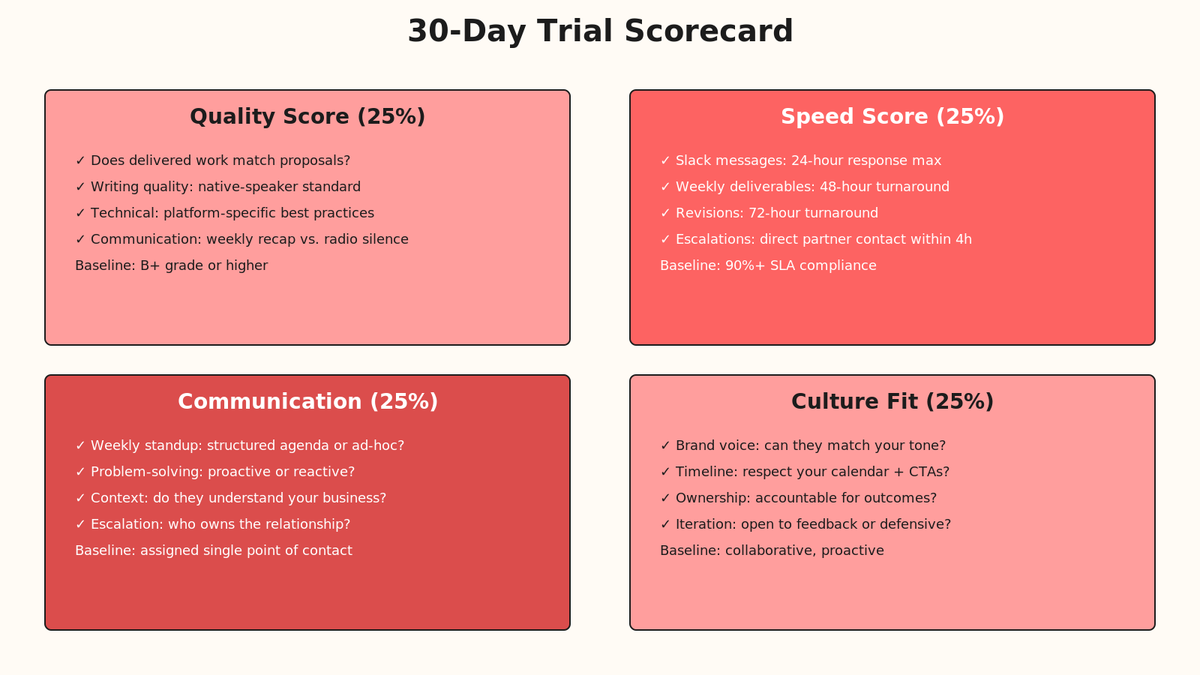
Quality (25%): Does delivered work match what they proposed? For SEO, are keyword research and on-page recommendations backed by actual data (search volume, difficulty score, competitive analysis)? For ads, are campaign structures clean and targeting thoughtful, or are they just blasting broad audiences? For content, is the writing native-speaker quality or obviously AI-polished with grammatical inconsistencies? Red flag: "That's good enough" after you've given feedback three times. Good vendors iterate obsessively without getting defensive.
Speed (25%): 24-hour Slack response maximum. 48-hour turnaround on deliverables. 72-hour turnaround on revisions. Track this daily. If they're hitting these numbers in the trial, they'll likely maintain them at scale. If they're already stretching during the trial when you're paying close attention, they'll be significantly worse once the relationship is "settled" and you're no longer monitoring them daily.
Communication (25%): Do they give you weekly standups with a structured agenda? Or is it radio silence until you send a "Where's my report?" message? Do they proactively flag issues and suggest solutions? Or do they wait for you to ask questions to mention problems? The best offshore teams operate like an extension of your internal marketing team, not a vendor you check in on weekly.
Culture fit (25%): Can they match your brand voice? Do they respect your calendar and CTA timelines? Are they accountable for outcomes or do they blame external factors ("The platform algorithm changed" or "Google updated their ranking factors")? Are they open to feedback or defensive when you ask for changes? An offshore team that clashes with your culture will drain your energy. Culture alignment is non-negotiable.
"The trial revealed everything we needed to know. By day 30, we could score the team on quality, speed, and communication. It cost $1,500 but saved us from a $24,000 annual contract with a bad vendor."
— Kumar S., Founder, Verified User
Baseline: B+ grade (80+) across all four categories. If they're a C+ on communication or quality, don't hire them. You cannot train someone into being faster or more communicative once you've signed a 12-month contract. What you see in the trial is what you get at 10x scale, minus the honeymoon phase.
Q3. What should a vendor contract actually include?
Most offshore vendor contracts are one-pagers: "We provide marketing services for $2,000/month. Either party can terminate with 30 days notice." That's not a contract. That's a foundation for chaos and surprises.
A real contract has teeth. Here are the seven sections that matter and what to include in each one:
| Section | What to Include | Red Flag if Missing |
| Scope of Work | Exact deliverables by month (e.g., "Month 1: 4 blog posts + keyword audit + 2 strategy calls. Month 2: campaign setup + daily optimization + weekly reporting."). Be granular. "SEO services" is too vague. | Vague language like "manage your marketing" without specifics, or "services as requested" |
| Response Time SLA | Slack/email: 24 hours maximum. Emergencies: 4 hours with escalation to a named person (account manager or partner). Define what counts as an "emergency" (ad account hacked, campaign hemorrhaging money at negative ROAS, competitor launching attack). | No response times defined, or wishy-washy language like "we'll do our best" or "during business hours" |
| Revision Policy | "Unlimited revisions within scope. Out-of-scope changes invoiced at $XX/hour, minimum 1-hour billing." Define the boundary clearly. What's in-scope? What's not? | "Revisions available on request" or vague caps like "up to 3 revisions per deliverable" (no upper bound) |
| Confidentiality and NDA | "Vendor agrees not to disclose client financial data, campaign performance, customer lists, or strategic plans. Both parties can use anonymized portfolio examples with prior approval." | No NDA, or language that gives the vendor rights to use your data or strategies without permission |
| IP Ownership | "All work product (copy, audit reports, campaign structures, content calendars, keyword research) is owned by Client upon payment. Vendor retains the right to reference methodology in portfolio (anonymized)." | Vendor retains any IP rights, or language is ambiguous ("joint ownership" or "licensed to client") |
| Termination Clause | "Either party may terminate with 14 days written notice. Upon termination, vendor must deliver all work-in-progress within 5 business days. No penalty beyond current month's fees." | "30-day termination notice," penalty fees, or unclear language about work handoff |
| Fee Structure and Payment Terms | "$X per month, due on the 1st, via wire transfer or Stripe. Late payments after 10 days incur 1.5% monthly interest." Explicit. No "negotiable" rates or vague pricing. | Ambiguous pricing, invoicing after work is done (you should pay upfront), no late-payment language |
Add one more clause: "In case of dispute, either party may request mediation via neutral third party. This contract is governed by your jurisdiction." This keeps small conflicts from turning into costly lawsuits across two countries.
"We had no revision caps in our contract. By month two, the vendor was charging us for 'extra revisions' on every deliverable. The contract said 'unlimited revisions' but they interpreted it as 'unlimited extra billing.' Get specific language in writing."
, Robert T., Marketing Director, Verified User
Q4. How do you set up a 90-day sprint plan that actually delivers results?
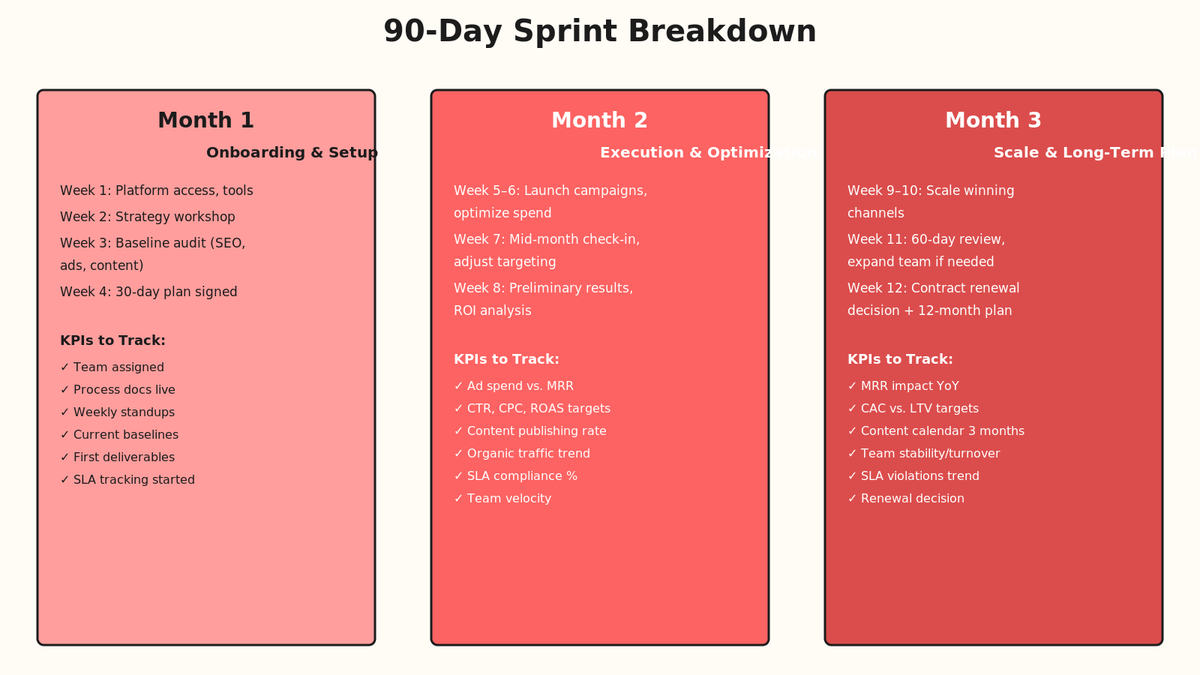
The best offshore relationships have structure. No ambiguity about what "success" looks like. The Versatile 90-day plan included is your roadmap. It's the difference between a vendor that delivers and a vendor that merely "tries their best."
Contact Versatile to discuss Month 1 structure.
Month 1: OnboardingMonth 1: Onboarding and Setup (Weeks 1-4)
Versatile setup handles this. Week 1: Platform access and tools. (Calculate the cost difference between vendor, direct hire, and EOR) Google Ads, Meta Ads Manager, GA4, your CMS, your email provider, Slack workspace, and any internal tools they'll use. Create a checklist. This takes 2-3 days. If platform access is still pending by day 5, that's a signal they're disorganized or slow to escalate. Not a good sign for the future.
Week 2: Strategy workshop. 90-minute call (or async Notion docs if timezones are brutal). Walk them through: your business model, customer acquisition cost target, product roadmap for the next 6 months, competitive landscape, brand guidelines, tone-of-voice, and the customer journey from awareness to purchase. Record it. Most offshore teams will misunderstand your business without written reference docs. Create a one-pager for them to reference.
Week 3: Baseline audit. They deliver a written audit of your current marketing state: SEO (keyword rankings, backlink profile, on-page optimization, technical SEO), paid ads (account structure, audience targeting, creative quality, ROAS by channel), content (publishing frequency, format mix, engagement rates), and email/CRM (list health, segment strategy, automation). This is diagnostic, not prescriptive. Expect 15-20 pages of real analysis, not fluff or template content.
Week 4: 90-day plan signed. You and your offshore partner agree on month-by-month deliverables, specific KPIs you'll track together, weekly standup schedule (e.g., Tuesdays 10am PT, 30 minutes, async written update if timezones won't cooperate), escalation path (who do they contact if something breaks?), and how you'll handle changes to scope. Put it in writing. Email counts.
KPIs to track in Month 1: Team assigned and introduced by name, not "we'll assign someone." Process docs live with SOPs for feedback, reporting, and change requests. Weekly standups started on schedule. Baseline metrics captured and shared with you. First month's deliverables submitted (keyword research doc, campaign structure for Month 2, audit report). SLA tracking started, log response times daily and turnaround times per deliverable.
Baseline you should expect: onboarding completed by day 15. Baseline audit delivered by day 20. No critical delays, no "we need another week to get access," no communication gaps.
"Month two was when we saw real proof. The team was moving the needle on traffic and conversions. We knew by day 45 whether they were keepers or not. The data doesn't lie."
— Jason M., Director of Marketing, Verified User
Versatile manages Month 2 execution seamlessly.
Month 2: ExecutionMonth 2: Execution and Optimization (Weeks 5-8)
Week 5-6: Launch campaigns. SEO work goes live (optimized pages, new content, link-building outreach). Ad account is structured, audiences are built, first campaigns go live. Content calendar is scheduled for Month 3. Email sequences are drafted and live. This is the grinding, day-to-day execution work. You should see deliverables landing daily or at least three times a week.
Week 7: Mid-month check-in. Pull preliminary performance data. Ad ROAS by channel. Cost per click. Click-through rate. Organic traffic week-over-week. Content engagement (page views, average time-on-page, scroll depth). Email open rates. Are you tracking toward your goals or off-track? If off-track, the offshore team should have pivot recommendations ready by day 21. Waiting until day 28 to pivot is too late. Every day you run a bad campaign costs money.
Week 8: Preliminary results and ROI analysis. Full Month 2 performance report. Breakdown: which channels are working? Which are bleeding budget? What's the return on your $2,000 to $4,000 investment so far? Honest baseline: Month 2 ROI is often negative or flat. You're still in ramp-up mode. But the trajectory matters. Organic traffic up 15%? Good signal. Ad spend efficient at 3:1 ROAS? Keep it running. Content getting 50+ views per post? You're building momentum.
KPIs to track in Month 2: Ad spend vs. monthly revenue trending positive or flat is OK, trending sharply negative is bad. CTR, CPC, ROAS against targets. Content publishing rate (planned vs. published). Organic traffic trend (Week 1 of Month 1 vs. Week 4 of Month 2). SLA compliance percentage (did they hit their 24-hour Slack SLA 90%+ of the time?). Team velocity (deliverables on time, communication quality steady or improving).
| Month | Primary Focus | Key KPIs | Success Baseline |
| Month 1 | Onboarding, setup, strategy | Audit complete, team assigned, SLA tracking live, baselines captured | All complete by day 15-20 |
| Month 2 | Launch campaigns, optimize, measure | Ad ROAS, organic traffic, content publishing, SLA compliance 90%+ | Trending toward targets or pivoting with new ideas |
| Month 3 | Scale winners, decide renewal | MRR impact, CAC versus LTV, team stability, SLA trend, communication quality | Know by day 90 whether to renew 12 months or fire |
"By month three you know if you have a keeper. Renewing for 12 months at a discount made sense because we'd found someone reliable. Starting over would mean 60 more days of vetting. Just not worth it."
— Rachel S., Growth Lead, Verified User
Month 3: Scale and Long-Term Plan (Weeks 9-12)
Week 9-10: Scale winning channels. Whichever channels are working, increase investment. If paid ads are doing 4:1 ROAS, scale ad spend 50%. If organic traffic is up 25%, allocate more budget to content and link-building. Stop doing things that aren't working. Reallocate that budget immediately. Move fast here. The window to capitalize on what's working is short.
Week 11: 60-day review and team expansion decision. Pull full 60-day performance report. Have you hit your Month 2 KPIs? If yes, should you expand the team (hire another specialist, add a video producer, etc.)? If no, is this a strategy problem or an execution problem? Strategy problem means fire the team. Execution problem means fix the processes and give them 30 more days. If you're hitting targets and want to accelerate growth, expand the team in Month 4, not during Month 3 (too much chaos).
Week 12: Contract renewal decision and 12-month plan. Do you want to continue working with this offshore team? If yes, switch from a month-to-month contract to a 12-month contract with a 15% discount (you're both saving on onboarding and churn). If no, document why (slow communication, quality issues, team turnover, results flat), and start new vendor vetting with lessons learned. If you're undecided, extend one more month at current terms and make a decision in 30 days.
KPIs to track in Month 3: Monthly recurring revenue impact (is your MRR up since Month 1?). CAC vs. LTV (are you acquiring customers at the cost-per-acquisition vs. customer lifetime value ratio you wanted?). Content calendar populated 3 months out. Team stability and turnover (did anyone leave mid-project?). SLA violations trend (improving or getting worse?). Versatile renewal decision made.
Baseline you should expect: By end of Month 3, you should have 90+ days of performance data. You should know whether this team works for you or not. If you're still uncertain, the team isn't right. Good offshore teams make the impact obvious by week 8. Great teams are proposing ideas you didn't think of.
Q5. What does India-native EOR mean, and when should you hire direct vs. hire a vendor?
There are three ways to build an offshore marketing team:
Option 1: Hire a vendor (freelancer, agency, or boutique). You send the scope, they execute, you pay per deliverable or retainer. No employment relationship. This is what we've covered so far. Time to hire: 34-58 days. Cost: $1,500-$4,000/month per role. Risk: vendor quality varies, turnover can be sudden, scaling is expensive.
Option 2: Hire direct as a contractor (1099 in the US, freelancer agreement in India). You source the person, they work exclusively for you as a contractor, they invoice monthly. This is tempting because it feels cheaper ($800-$2,500/month) and more direct. Tax complexity: extremely high. Misclassification risk: very high. A contractor who takes daily direction, works set hours, gets raises, and uses your tools can be reclassified as an employee by the IRS or by India's tax authorities. Cost of misclassification (Versatile handles this risk): $25,000 to $40,000 per person, plus back taxes, interest, and penalties.
Option 3: Hire direct through an India-native EOR (Employer of Record). You decide who to hire and what role they fill. The EOR handles all India-side employment: W2-equivalent contract, PF/ESI/professional tax, Labour Code compliance, statutory benefits, and a 5-day SLA on every compliance question. You manage the team. The EOR manages the legal and tax nightmare. This is what Versatile EOR services does.
| Factor | Vendor | Direct Contractor | EOR (Versatile) |
| Time to hire | 34-58 days | 7-14 days | 10-21 days |
| Monthly cost per person | $1,500-$4,000 | $800-$2,500 | $1,200-$3,500 plus $149/month EOR fee |
| Legal risk | Vendor owns it | YOU own misclassification risk ($25K-$40K per person) | EOR owns it (insured, backed by entity) |
| Tax, PF, ESI, Statutory Exit | Vendor handles | YOU handle it, plus compliance nightmare | EOR handles (4 Labour Codes, PF 12%, ESI 3.25%, professional tax, S&E across 28 states, gratuity 4.81%, TDS, full settlements) |
| Termination process | Easy (14-30 days notice) | Easy legally but messy (you're liable for unpaid taxes, PF) | EOR handles 48-hour notice plus statutory exit compliance (F&F settlement, last salary, gratuity) |
| Culture fit | Hit or miss | Better (you control hiring, selection) | Best (you control hiring plus EOR backstops compliance) |
| Communication and management | Vendor decides schedule | You decide plus manage directly | You manage directly plus EOR supports with 5-day SLA |
| Scaling from 3 to 10 people | Hit ceiling (vendors get expensive) | Hard (you're managing compliance for 5+ people) | Seamless (EOR scales with you, single SLA) |
Versatile is India-native EOR. We have multiple US/UK companies on our entity today, 4 years on the books without a single compliance notice. Our SLA: 5-day response on any statutory question (Labour Code question, gratuity calculation, PF contribution, professional tax filing). Pricing: $149/emp/month for the first month free, then $149-$299 depending on state and complexity. We handle PF (12%), ESI (3.25%), professional tax (0-5% depending on state), statutory benefits, gratuity calculations (4.81% of Basic+DA), and Full and Final settlements when team members leave. You manage the team's day-to-day work. We manage the India-side legal nightmare.
"We hired offshore developers as contractors. Three months later, a tax attorney told us we'd exposed ourselves to $80,000 in misclassification penalties. Using Versatile EOR eliminated all that stress. We're protected, they file everything, and we focus on hiring great people."
, Sarah M., CEO, Verified User
When to hire via Versatile EOR services: You want to build a dedicated team of 3-10 offshore marketing people. You want to hire based on culture and skillset, not vendor availability. You want to scale without the compliance complexity of contractor agreements. You want 5-day SLA on every compliance and statutory question.
When to hire a vendor instead: You're testing a new channel (paid ads, SEO, content) and don't know if you'll continue past 90 days. You don't want to manage people directly. You need fractional resources (e.g., 10 hours/week of copywriting, not a full-time writer). You're OK with turnover and lack of institutional knowledge.
When to hire direct as a contractor (and accept the risk): You've found a single incredible person through your network. You know them personally. You're willing to hire a tax attorney to navigate India-side PF/ESI/professional tax questions and misclassification risk. You're OK with questions taking weeks to answer. Not recommended unless you love legal complexity and don't mind paying $25K to fix a mistake.
Q6. What are the hidden costs of offshoring, and how do you budget for them?
The $2,000/month offshore marketer is not $2,000/month. It's $2,000 base plus $300 in tool licenses plus $200 in revision overage plus $150 in API integration fees plus $250 in FX loss when rupees-to-dollar swings happen. Real cost: $2,900 to $3,200/month.
| Hidden Cost | Typical Range | How to Minimize It |
| Tool licenses (Semrush, Ahrefs, SE Ranking, Moz, Monday.com, Asana) | $150-$400/month | Pool tools across team. Negotiate annual licenses (save 20%). Use open-source alternatives (Google Trends, MozBar, Lighthouse, Ubersuggest free tier). |
| Revision overage (beyond original scope) | $100-$300/month | Define revision cap in contract. Charge hourly for out-of-scope changes ($25-$50/hour for India rates). Get approval before starting extra revisions. |
| API and integration fees (Zapier, Make.com, Slack bots, webhooks, third-party platforms) | $100-$200/month | Ask vendor upfront: what integrations do you need? List them. Budget the costs before signing. Some vendors hide this deliberately. |
| Communication loss (rework due to timezone misalignment, miscommunication) | $200-$500/month (hidden in turnaround time) | Overlap hours 9am-12pm Pacific equals 9:30pm-12:30am India. Async-first workflows (write down decisions, record calls). This eliminates back-and-forth. |
| Versatile FX hedging (dollar-rupee swings, typically 3-5% per month) | 3-5% monthly variance, 36-60% annually | Pay in INR (local currency) if your platform supports it. Some offshore teams will lock 1-year rates for a 2-3% premium. It's cheap insurance against surprise costs. |
| Turnover ramp cost (when team member leaves, replacement gets up to speed) | $500-$2,000 per person (lost productivity) | Build redundancy. Cross-train two people per function so one leaving doesn't crater your work. Ensure vendor/EOR backfills within 5 days. |
| Compliance and legal (if hiring direct contractor without EOR) | $3,000-$8,000 upfront plus $500-$1,500/year | Don't hire direct. Use Versatile EOR. We absorb this cost. You pay $149/month and never think about it again. |
"We signed a $2,000/month SEO contract but by month two they wanted to charge us $200 for monthly reporting, $100 for API setup, $75 for tool licenses. It added up to 30% more than expected. Specify everything in the contract."
, David L., Growth Manager, Verified User
Always ask about reporting, tool costs, and integration fees upfront. They're the easiest places for vendors to hide extra charges.
Real-world budget example for a SaaS founder: You want an SEO specialist plus ads manager plus content writer (3 people). Vendor route: 3 times $2,000 equals $6,000 base plus $600 tools plus $400 revision overage plus $150 integrations plus $300 FX buffer equals $7,450/month. EOR route via Versatile: 3 times $1,800 equals $5,400 plus $447 EOR fees (3 times $149) plus $600 tools plus $150 integrations equals $6,597/month. EOR is actually cheaper when you factor in compliance risk ($25K potential misclassification penalty per person).Q7. What are the red flags that tell you to fire an offshore marketing team?
Some vendors are fixable. Some need to be fired immediately. Here's how to tell the difference:
Red flag 1: SLA breakdown in Month 2 (not Month 1). If they're fast in Week 1-2 but start missing 24-hour Slack responses in Week 5+, that's a signal they've taken on more clients than they can handle. They overcommitted. Fire them. There's no coming back from this. Fast turnaround can't be "trained back in" once it degrades. It's a capacity problem, not a skill problem.
Red flag 2: Defensive posture when you give feedback. You ask for changes to a blog post or campaign. They push back: "This is best practice. Trust us." Then you find out they copy-paste the same copy to 50 other clients. Good teams are eager for feedback and iterate quickly. Bad teams believe they're right and resist change.
Red flag 3: Zero proactive communication. If you're always reaching out and never hearing unprompted updates, that's a team checking a box, not a team invested in your success. Good teams send unsolicited optimization ideas, flag problems before they blow up, and ask clarifying questions.
Red flag 4: Performance declining, not improving. By Month 3, your offshore team should be faster, higher-quality, and more communicative than Month 1. If it's the same or getting worse, fire them. You're paying for experience to compound their value, not plateau it.
Red flag 5: Key person dependency. The team is good because one person carries it. That person gets sick, quits, or gets poached by another client. Now the team is terrible. Healthy vendors cross-train. They have backup coverage for every role.
Red flag 6: Hidden pricing games. "That revision is out of scope, that's $50 extra." "The API integration you asked for is $100/month more." "Oh, we don't include weekly reporting, that's a separate package." Vendors who nickel-and-dime you on Month 2 will charge you $500/month by Month 6 for stuff you thought was included.
"We had the conversation at week eight. Performance was flat, communication was slow, zero proactive problem-solving. Better to fire then than waste four more months."How to fire: Write an email. "We've decided to take marketing in-house as of (date 14 days out). We'll provide all final deliverables and work-in-progress by (transition date). Please submit a final invoice by (date)." No need to explain. No need to negotiate. If they push back or demand penalty fees, that's more evidence you made the right call.
, Adrian K., VP Marketing, Verified User
Q8. How do you measure success after 90 days, and what metrics actually matter?
Vanity metrics: "We got 10,000 impressions." "Your organic traffic went up 5%." "We launched 20 blog posts."
Real metrics: monthly recurring revenue growth, customer acquisition cost, lifetime value, lead quality (not just volume), and conversion rate improvement.
At 90 days, here's what should be true:
Paid ads: You should know your true ROAS (return on ad spend). If ad spend is $5,000/month and it generates $15,000 in revenue, that's 3:1 ROAS. Anything below 2:1 is a warning sign. Anything above 4:1 is a keeper. By Month 3, your ad account should be optimized for conversion, not just clicks. The offshore team should be A/B testing audiences, creative, and landing pages constantly.
Organic (SEO): Organic traffic up 15-30% is realistic for Month 3. Keyword rankings: are you ranking for your top 10 target keywords in the top 20 positions? Are 3-5 of them in the top 3 now? That's solid progress. By Month 3, you should feel the content strategy working, not just "we published 12 blog posts and got no traffic."
Content: Publishing velocity is one thing. Publishing-to-conversion is another. Do blog posts have clear CTAs? Are readers taking action (signing up, requesting demos, buying)? Are newsletter signups up? By Month 3, content should be driving qualified leads, not just page views.
Team communication: Do you trust this team to operate without you? If yes, that's the real win. If you're still micromanaging and second-guessing every decision, the team isn't ready to scale.
"By month three, we had enough data to make a real decision. Our SEO team delivered a 28% organic traffic lift, ads were doing 3.2:1 ROAS. We renewed for 12 months and it's been one of our best hires."
, Patricia G., CMO, Verified User
Good teams make their impact clear by month three. If you're still uncertain, they're probably not the right fit.
The renewal decision is simple: If this team has moved your needle on revenue and you enjoy working with them, renew for 12 months at a 15% discount (you're both saving on churn). If they've been neutral or negative, fire them and try someone else. A bad offshore team is worse than no offshore team because it drains your time, costs money, and damages your campaigns.Q9. How does India-native EOR make offshore hiring simpler and more compliant?
Here's the thing about hiring offshore direct: India has four Labour Codes (effective November 21, 2025), Professional Tax in 28 states, PF (Provident Fund), ESI (Employee State Insurance), statutory benefits, F&F (Full and Final) settlement rules, and TDS (Tax Deducted at Source). A single mistake costs $25,000 to $40,000 in misclassification penalties, back taxes, interest, and legal fees.
Versatile, as India-native EOR, is your compliance backstop. We have multiple US/UK companies on our entity today. Zero compliance notices in 4 years. Here's how we operate:
You decide who to hire and the role. We handle India-side employment: statutory compliance, tax filings, PF/ESI contributions, professional tax across 28 states, all Labour Code filings, statutory exit settlements, and every question that arises. Our SLA: 5-day response on any compliance question (Labour Code interpretation, gratuity calculation, PF contribution question, professional tax filing).
Pricing: $149/emp/month for the first month free. Then $149-$299/month depending on state and complexity. We file quarterly returns, manage leave encashment, handle gratuity calculations (4.81% of Basic+DA), and process Full and Final settlements when team members leave. You manage the team's day-to-day work. We manage the India-side legal nightmare.
Why this matters: if you hire direct and miss a PF contribution or misfile a Labour Code form, you're personally liable. The Indian tax authorities will chase you for back payments. The IRS will chase you for misclassification penalties. With Versatile EOR, we're liable. We're insured. You're protected.
Versatile Club is the proven offshore marketing playbook.
Q10. The offshore marketing playbook: next steps for your 90-day launch
You now have the entire playbook. Here's your 10-step action plan to launch an offshore marketing team in the next 90 days:
Step 1 (Week 1): Decide vendor vs. direct EOR. (Check Versatile EOR services if hiring 3+ people) Vendor if you're testing a new channel fast. EOR if you're building a team of 3+.
Step 2 (Week 1-2: If vendor, create a discovery brief: budget ($2-5K/month), channels (SEO, ads, content, analytics), team size. If EOR, define roles and ideal salaries.
Step 3 (Week 2-3): Source 5-8 vendors or (if EOR) work with Versatile to hire and vet candidates.
Step 4 (Week 3-4): Run reference calls with all vendors (or, if EOR, request references from candidates).
Step 5 (Week 4-6): Launch a 30-day trial with top-choice vendor (or hire via EOR for 90-day probation).
Step 6 (Week 6-8): Daily communication, weekly standups, mid-trial assessment. Decide: keeper or fire.
Step 7 (Month 2): Full execution mode. Campaigns live, content scheduled, daily optimizations, weekly performance reviews.
Step 8 (Month 3): Data analysis. ROI clear. Team performing against targets or not.
Step 9 (Month 3): Renewal decision. 12-month contract (15% discount), extend 30 days, or fire and retry.
Step 10 (Month 4+): Scale winning channels or shut down broken ones. Expand team if culture fit is strong and revenue is growing.
FAQs
How do I vet an offshore digital marketing agency before signing?
Ask for three things: a live client on a 30-minute call, a walk-through of one recent campaign with actual dashboards, and a written data-security policy. If any of the three gets pushed back, walk. For a longer checklist, see how we structure our India-native offshore teams.
What is a realistic monthly cost for a full offshore marketing team of 5?
A senior strategist plus two performance marketers plus a designer plus a content lead runs $8,000 to $12,000 per month fully loaded through Versatile. Compare that to a US agency retainer of $18,000 to $25,000 per month for the same output. The gap is the value of running on India payroll on our entity.
How do I structure IP and confidentiality when the agency is offshore?
You need three documents: an NDA under Indian jurisdiction, an IP assignment clause in every contractor agreement, and a data processing addendum aligned to your buyer market (GDPR for EU, CCPA for US). We embed all three in our EOR contracts by default. Book a call to walk through the template.
What time-zone overlap do I need for offshore marketing to work?
Aim for at least 3 hours of overlap per day. India works well for US East Coast (7pm to 10pm IST covers 9am to noon EST) and for UK (2pm to 6pm IST covers 9am to 1pm BST). West Coast US is trickier; you need someone willing to start at 8pm IST. Our India-native EOR lets you set expected hours in the offer letter.
Should I hire agency or build an in-house offshore team through an EOR?
Under 6-month engagement, agency wins on speed. Over 12 months, in-house through EOR wins on cost, control, and IP. The break-even is usually month 8. If you are testing the channel, agency. If you know it works, hire your own team via Versatile.
How do I measure ROI on an offshore marketing team in the first 90 days?
Track three metrics: cost per acquired lead vs baseline, ratio of pipeline generated to fully loaded team cost, and time-to-first-shipped-campaign (days from offer accepted to first live asset). If you cannot see 30 percent improvement on all three by day 90, the team is wrong or the ops is wrong. Message me if you want to review your setup.
Where my head is right now
Here's what I'm sitting with: In 2026, the bottleneck for scaling SaaS and services businesses is no longer capital or product. It's operational excellence in hiring. Founders who can hire with discipline (vetting, trial, communication, measurement, renewal) will scale 2-3x faster than founders who hire fast and hope.
Offshore marketing is the proving ground. Versatile makes this easy. If you can hire, onboard, and retain an offshore marketing team, you can hire offshore engineers, designers, and operators. The playbook works for all of them. The vetting process is the same. The 90-day plan is the same. The red flags are the same.
If you're building an offshore team and you're 3 to 10 people deep, message me directly on WhatsApp through our contact page, or book a consultation with us. You'll be talking to the founder, not a ticket. I want to know: Where are you in the vetting process? What's the biggest blocker right now? Have you considered whether you should be thinking about Versatile India-native EOR instead of vendor juggling?
Here's my final thought: The best offshore marketing teams (Versatile contact) aren't the cheapest. They're the most reliable. And reliability takes time to build. Don't cut corners in the vetting stage. It's the difference between a team that frees up your time and a team that becomes another full-time job.