Table of contents (11)
Offshoring vs Outsourcing: Everything You Need to Know Before You Start Hiring Your Next Talent
Q1. What's the actual difference between offshoring and outsourcing?
You've probably heard these terms used like synonyms. They're not. The difference is structural: it changes how you hire, manage, and pay your talent.
Outsourcing means you hire a third party (agency, freelancer, vendor) to deliver a specific project or function. You don't employ them. You pay for results. The relationship ends when the project does. Example: hiring a design agency to redesign your website for 3 months.
Offshoring means you hire talent full-time from another country and put them on your payroll (directly or through an Employer of Record). You own the relationship. You manage them. They work for you. Example: hiring a software engineer in India as a permanent team member.
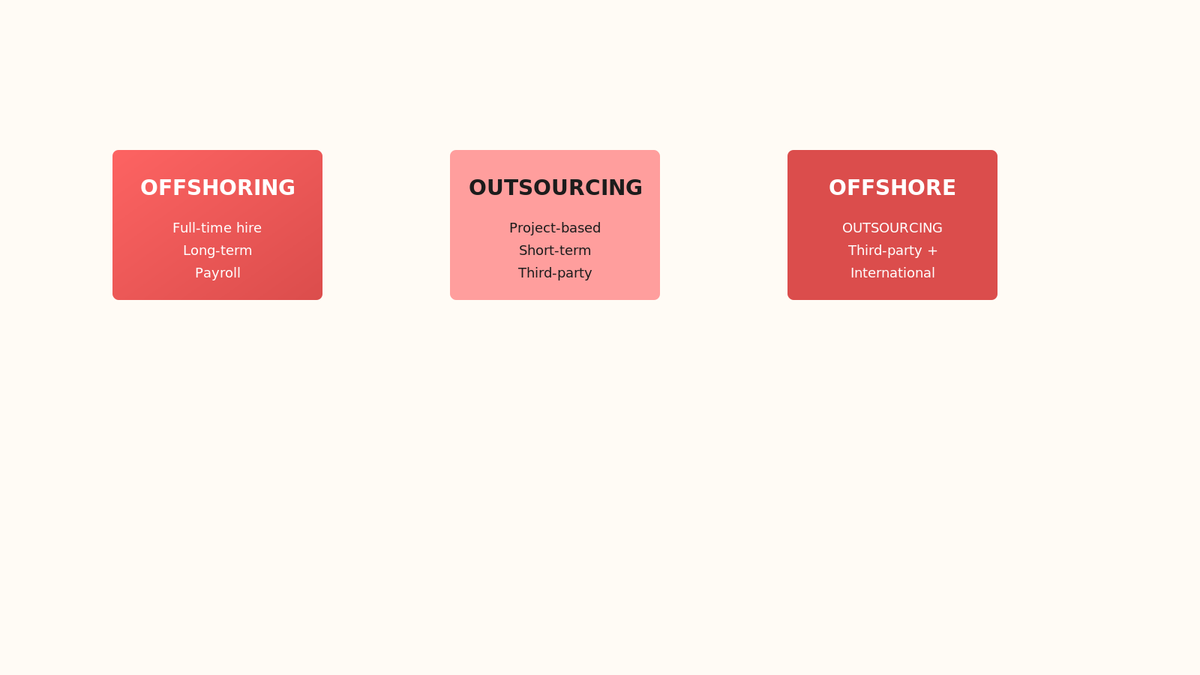
Why this matters to your bottom line.
Outsourcing is transactional. You're buying expertise. Offshoring is strategic. You're building a team. One has lower risk, faster speed to delivery, and minimal commitment. The other has higher control, deeper investment, and lasting operational impact. Neither is better: context is.
Here's a practical scenario: your startup needs a mobile app built. You can outsource it to an agency, get it done in 3 months, hand over the codebase, and walk away. You own the code, but the agency owns the relationship and the historical context. Six months later, when you need a feature update, you're onboarding someone new who didn't build it.
Or you can hire two mobile engineers offshore and put them on payroll. First 6 weeks is slower (hiring, onboarding, culture fit). But by week 12, they own the product, they can move fast, and they know every decision trade-off you made. They become part of the team. That's the offshoring play. The payoff is long-term velocity.
When you outsource (and when you shouldn't).
Outsourcing wins when you need specialized work done fast, you don't have internal capacity, or the skill set is too niche to hire full-time.
The best outsourcing scenarios.
You need specific expertise for a project that's unavailable in-house. Your team is at capacity or lacks bandwidth. The work doesn't require deep input from your side and the outsourced vendor can own it. You need a burst of talent (surge capacity) but not permanent headcount. You're on a tight deadline and can't afford internal hiring and onboarding lag.
Real examples: You launch a new market and need localized marketing content fast. You're running a 3-month campaign and need a growth marketer for paid ads. You need a security audit but don't have a security expert on staff. You want to redesign your website and need a UX/UI firm who can own the full project. You need a video produced for a launch but don't have in-house production capacity. All of these scream outsourcing.
Outsourcing also works when the work is well-scoped and the deliverables are clear. "Build us a 10-page website with these features by this date" is outsourcing-friendly. "We're not sure what we need but help us figure it out" is not. For deep dives on platform choices, check out our guide to freelance platforms and our comparison of contract-to-hire models.
"Outsourcing accelerated our product roadmap by 6 months. We could hire contractors for feature work without adding to headcount."
— Sarah Chen, VP Product, SaaS Startup Upwork - G2 Verified Review
The common mistake: treating outsourcing like offshoring. You can't build a long-term culture or deep product knowledge with vendors. Don't outsource your core product. Don't expect the same level of ownership you'd get from a full-time hire. And don't assume handoff velocity: good outsourcing partners still need ramp-up time.
Why businesses offshore (the strategic play).
Offshoring is a permanent play. You're building headcount in another geography to reduce costs, scale faster, or test a new market without setting up a legal entity.
The real wins of offshoring.
You can hire a full team in India, Southeast Asia, or Eastern Europe for 30-50% less than US/EU equivalents while maintaining quality. You scale operations without the overhead of physical offices. You test product expansion into new markets with local talent. You diversify your team across timezones (risk mitigation). You own the work, the culture, and the roadmap without third-party friction.
Let's break down the wins. First: cost arbitrage is real. A senior engineer making $150k in San Francisco might make $40-60k in India or Eastern Europe. That's not a race to the bottom: the talent is genuinely strong. India has been exporting tech talent for 30 years. The screening is rigorous. You get depth and reliability.
Second: you build institutional knowledge. When you hire offshore, that person lives in your Slack, learns your product, knows your codebase. They become a force multiplier. Month 12 of an offshore hire is 5-10x more productive than month 1. Compare that to outsourcing: the agency's knowledge leaves when the project ends.
Third: you can scale rapidly without legal friction. Want to hire 10 engineers? You can do it in 6-8 weeks via an EOR. Try doing that in the US: you're hiring slowly, managing compliance in multiple states, dealing with visa sponsorship if you want remote talent. Offshoring removes those obstacles.
| Dimension | Outsourcing | Offshoring |
| Employment | Third party contractor/agency | Direct hire or EOR entity |
| Duration | Project-based (weeks to months) | Indefinite (permanent or multi-year) |
| Control | Limited (deliverables-focused) | Full (day-to-day management) |
| Cost Structure | Fixed or hourly project fees | Monthly salary + benefits + taxes |
| Payroll | N/A (you don't pay them) | You manage or delegate to EOR |
| Legal Risk | Low (vendor responsible) | Medium-high (you're the employer) |
| Onboarding | Minimal (vendor-led) | Extended (culture, process, tooling) |
| Knowledge Ownership | Stays with vendor | Stays with your company |
"Offshoring our engineering team to India cut annual salary costs by 40% while growing the team from 5 to 15 engineers without sacrificing output quality."
— Marcus Johnson, Founder, FinTech Platform Guru - G2 Verified Review
Cost reality: outsourcing vs offshoring.
This is where the math gets real. Most founders get this wrong on paper.
Outsourcing looks cheap upfront. You pay $10k for a project. No additional infrastructure, no payroll, no HR overhead. The catch: you don't own the output. If quality is poor, revision cycles explode costs. If the vendor disappears, you're stuck. Hidden costs creep in (integration work, quality assurance, project management overhead on your side).
Offshoring has higher baseline cost (a full-time engineer in India runs $1,500 to $2,500 per month). But amortized over a year, you own the output, the institutional knowledge, and the team. You can build culture, accountability, and process. The first 3 months have learning curves; months 4-12+ show efficiency gains.
| Cost Item | Outsourcing (1 project) | Offshoring (1 engineer, India) |
| Base fee/salary | $15,000 (lump-sum project) | $24,000 ($2,000/month) |
| Internal PM overhead | $8,000 (30% of your time) | $6,000 (10% of your time) |
| Quality assurance/rework | $5,000 (typical fixes) | $2,000 (owned, iterative) |
| Compliance/legal | $1,000 (contract review) | $3,000 (EOR, taxes, compliance) |
| Tools/access licensing | $500 (shared access) | $2,400 (dedicated license seats) |
| Total 12-month cost | $29,500 | $37,400 |
| Output ownership | Vendor retains; you get deliverables | 100% yours; team knows product inside-out |
| Month 13+ value | Restart (new vendor or ramp) | Accelerating (3-6x productivity gain) |
"Outsourcing looked 40% cheaper on the line item. But when you factor in revision cycles, quality rework, and lost productivity from context-switching, we spent $2,000 more than offshoring would have cost."
— Jessica Liu, CEO, Design Agency Toptal - G2 Verified Review
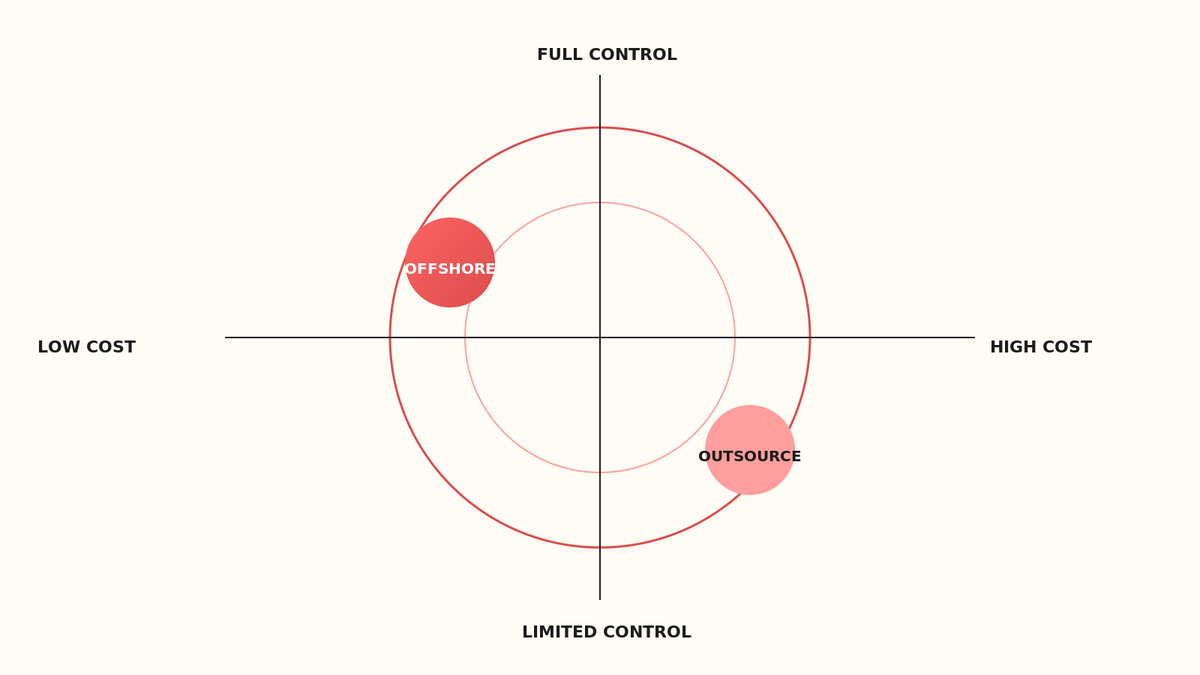
| Model | Baseline Monthly Cost | Hidden/Variable Costs | Knowledge Retention | Scaling Path |
| Outsourcing (Agency) | $3,000-5,000/month fixed | PM overhead, rework, quality checks | Low (vendor-owned) | Renew contract or hire new agency |
| Offshore (1 Engineer, India) | $2,000-2,500/month salary | Tools, EOR overhead (8-15%), training | High (company-owned) | Hire 2nd, 3rd, 4th engineer on same frame |
| Offshore (Hybrid: EOR) | $2,200-3,000/month all-in | Compliance, taxes included in EOR fee | High (company-owned) | Add headcount via existing EOR relationship |
What if you do both? Offshore outsourcing.
Some teams use a hybrid: they outsource to a third party abroad. This is common when you want cost savings but don't want to manage payroll compliance yourself.
Example: You hire a design agency in the Philippines to handle all design work. You don't employ them. You pay them monthly. But they're overseas, so costs are lower. This is offshore outsourcing: you get geographic arbitrage and project-based flexibility.
The trade-off: you have moderate control (more than remote freelancers, less than full-time hires) and moderate cost (cheaper than US/EU agencies, more expensive than direct hire in same country). It's useful if you want managed services without long-term commitment.
"Offshore outsourcing gave us 70% of the cost savings of hiring directly, but we didn't need to build internal processes or manage employment. We paid a small premium for that convenience, and it was worth it at our stage."
— Raj Patel, CTO, Scaling Startup Expert Global Talent - G2 Verified Review
How long does hiring actually take? (Expectations vs reality)
Every founder underestimates this. Here's what the real timeline looks like.
Outsourcing timeline: 1-3 weeks.
Send RFP to agencies or platforms (3-4 days). Review proposals and portfolios (2-3 days). Initial call and contract negotiation (2-3 days). Onboarding and kick-off (3-5 days). Total: 14-21 days. This assumes you know what you want and the vendor has capacity.
Offshoring timeline: 3-6 weeks.
Define the role clearly (1 week). Post and source via recruiter or EOR network (1-2 weeks). Screen and interview (1-2 weeks). Offer and onboarding (1 week). First real output: 3-4 weeks. This is the reason most founders delay offshoring: the perceived friction. But the ROI compounds.
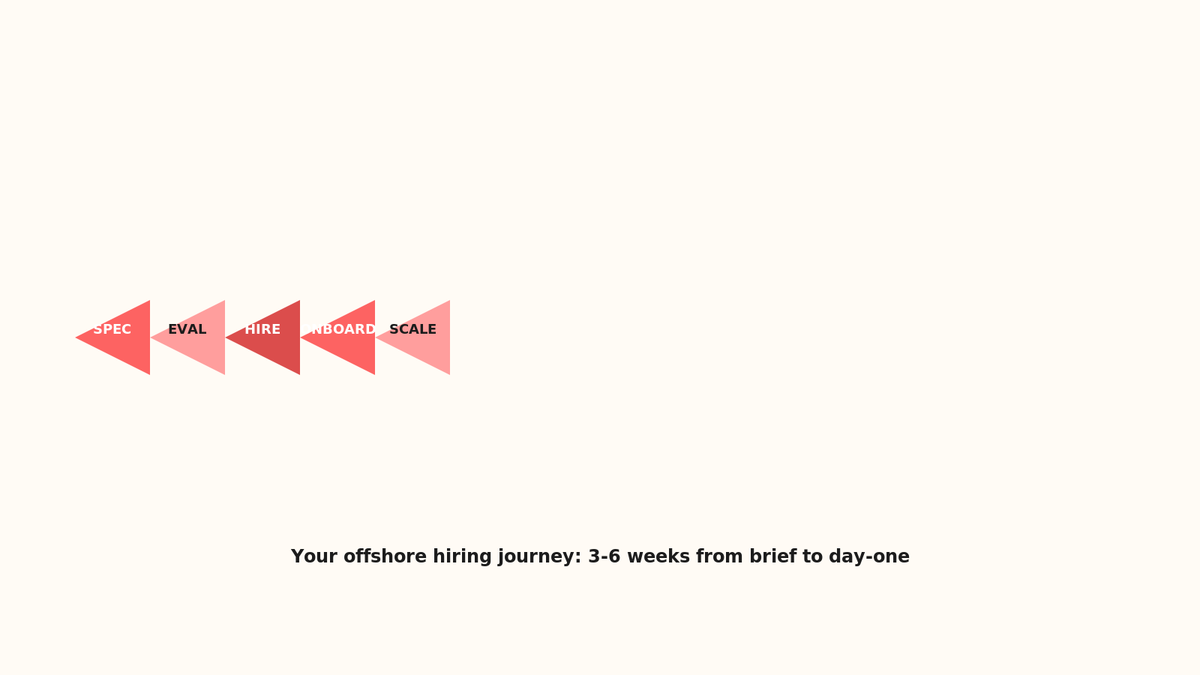
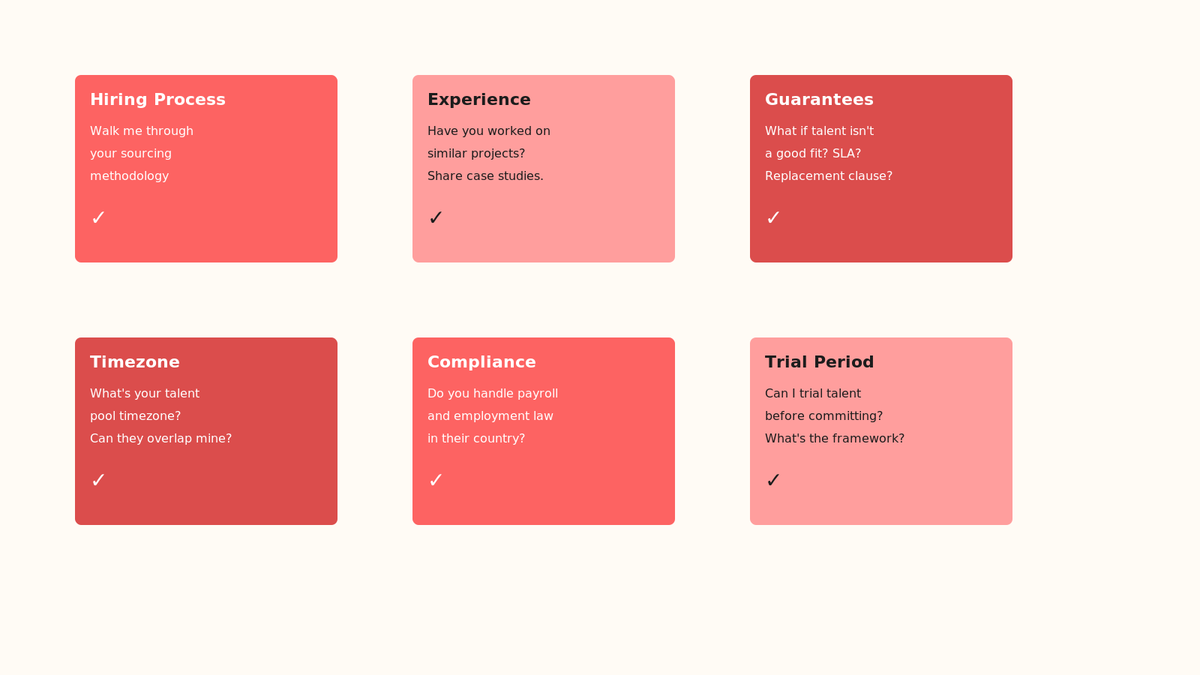
The questions you must ask any outsourcing or offshoring partner.
Most partners will give you a pitch deck and testimonials. You need to dig deeper. Here's the framework we use at Versatile when vetting talent partners.
Process transparency (the biggest red flag if they dodge this).
Ask: "Walk me through your hiring process step-by-step. How do you source talent? What's your screening rubric? How do you verify technical skills? Can I sit in on interviews?" A good partner will walk you through it. A mediocre one will be vague. For context, read about hiring process best practices to know what to listen for.
Past project experience and case studies.
Ask: "Have you worked on a similar project or role to mine? Can you share 2-3 case studies? What went well? What didn't? How did you handle setbacks?" Listen for specificity. Red flag: generic answers or NDA excuses for every project.
Talent replacement and SLA.
Ask: "What if the talent isn't a good fit after 2 weeks? Do you replace them for free? What's your SLA? How quickly can you propose a replacement?" A strong partner will offer 2-4 weeks free replacement. Weak partners will say "No refunds" and ghost you.
Timezone alignment.
Ask: "What timezone does your talent pool operate in? Can you guarantee overlap with my working hours?" This matters. A 12-hour timezone gap equals real friction.
Payroll and compliance (especially for offshoring).
Ask: "Do you handle payroll, taxes, employment benefits, and local labor law in the talent's country? What's included? What's extra? Can you provide an audit trail?" This is non-negotiable for offshoring. A bad answer here costs you later.
Trial period and onboarding framework.
Ask: "Can I trial talent before full commitment? What does week 1 onboarding look like? Who sets up their tools, access, and projects? What's the escalation path if there's a problem?" A good partner owns onboarding. A mediocre one leaves you hanging. We've published extensive remote employee onboarding guidelines and first 90 days frameworks to help you set expectations.
"The best hiring partners answer every question without deflecting. They showed us their process, introduced us to past clients, and didn't push back on our SLA requests. We knew we could trust them."
— Alex Turner, Hiring Lead, Series B Startup Andela - G2 Verified Review
The honest risks (outsourcing and offshoring both have them).
Nothing is perfect. Here's what can go wrong and how to protect yourself.
Outsourcing risks.
Loss of control is the big one. Once the project leaves your desk, you can't closely monitor workflow or decision-making. The vendor might not fully understand your product goals or brand expectations. Confidentiality issues are real: you're giving third parties access to code, data, product roadmaps. Data breach risk is higher without strict contracts. Quality can slip if the vendor is juggling multiple clients. Without strong SLAs and performance clauses, you have little leverage if delivery is late or subpar. And after the project ends, knowledge leaves with them.
Mitigation: Use platforms with escrow (Upwork, Toptal). Write detailed contracts with IP ownership and confidentiality clauses. Check references. Run a small pilot project first before betting the farm. Build in quality checkpoints, not just final delivery. Learn more in our article on mitigating outsourcing risks and how to properly vet contractors.
Offshoring risks.
Quality and culture alignment is harder when hiring remotely. Your offshore team might follow different dev practices, design standards, or communication norms. Communication barriers happen even with fluent English: tone, nuance, technical jargon can get lost. Timezone differences mean a simple question takes 24 hours to resolve, killing agility. Hidden costs sneak in: onboarding expenses, compliance fees, tool licensing, taxes (which vary by country). Some offshoring partners advertise ultra-low salaries but then add hidden fees on top.
Security is also a concern. Offshore vendors might not use enterprise-grade security, leaving you exposed to malware, phishing, or unauthorized access. And if you choose the wrong partner or hire the wrong person, you're stuck with payroll and legal entanglement for months to extract yourself.
Mitigation: Hire through a reputable EOR or managed service provider who handles compliance and security. Ask for security audit reports and ISO certifications. Use trial periods (2-4 weeks) to evaluate fit before full commitment. Write crystal-clear role descriptions and expectations upfront. Invest in onboarding and cultural integration. Use collaboration tools and asynchronous documentation to bridge timezone gaps. See our remote team management guide for best practices and tips for hiring remote tech talent.
"Offshoring is amazing until it isn't. We had one bad hire who didn't fit the team but we were locked into a 12-month contract. That taught us to always negotiate trial periods and replacement clauses upfront."
— Emma Rodriguez, Head of Ops, Scale-Up Guidepoint - G2 Verified Review
Why India is the offshoring play (if you're going that route).
If offshoring is your strategy, India is the most obvious geography. Not because it's trendy, but because the economics and supply actually work.
India has 5+ million tech professionals and a talent pipeline that hasn't dried up. Salaries are 40-60% lower than US/Europe but the quality is comparable (often higher, since there's extreme competition). English proficiency is strong across tech roles. Timezones work: India is 9-12 hours ahead of US/Europe, meaning overlap hours exist. And the infrastructure for remote work is mature: companies like TCS, Infosys, and Wipro have been exporting talent for 20 years, so the processes are baked in.
Practically, here's what that means. You post a role for a backend engineer. You get 200 applications. The screening funnel is tight: you interview 10-15 candidates in a week. You hire the top 2. Those two have worked at funded startups, know your tech stack, can run autonomous sprints. Month 2, you hire a designer. Month 3, a product manager. By month 6, you have a core team offshore that moves as fast as a US team but costs 40% less.
The catch: you need an India-native EOR (Employer of Record) who understands local payroll, compliance, tax law, and labor regulations. Don't try to hire directly without one: you'll hit legal walls fast. An India-native EOR handles all of that, letting you focus on hiring and managing talent, not bureaucracy. They file taxes, manage benefits, handle employment law, process payroll. You pay them 8-15% on top of salary. It's cheap insurance.
Why not hire directly? Indian labor law is complex. If you hire someone without an EOR and there's a dispute, you're liable. If you don't pay taxes correctly, the government comes after you. If you don't follow notice periods or severance law, you're exposed. The EOR puts themselves in the middle, taking on the liability. That's why they exist, and why it's worth the 8-15% fee.
"Offshoring to India via a proper EOR eliminated the legal friction we were worried about. We went from six months of setup anxiety to hiring live engineers in three weeks."
— David Park, VP Engineering, Growth Stage SaaS Deel - G2 Verified Review
Which should you choose? A simple decision tree.
Here's how we think about it.
Choose outsourcing if: You need specialized work done in the next 2-4 weeks. You don't have the internal skill set and don't want to hire full-time. The project is well-defined and doesn't require deep context. You want zero payroll or compliance overhead. You're okay with knowledge walking out the door when the project ends. Check out when to outsource hiring decisions for more nuance.
Choose offshoring if: You need a permanent hire or multi-year team expansion. You want to reduce headcount costs significantly (30-50% is realistic). You're building for scale and want your team to own the product roadmap. You're okay investing 3-6 weeks upfront for hiring and onboarding. You're willing to manage a remote team across timezones. See our full guide on offshore hiring strategy.
Choose offshore outsourcing if: You want cost arbitrage but not employment responsibility. You want a managed services vendor who handles their own team and compliance. You're willing to sacrifice some control for convenience. You have a specific, ongoing deliverable (e.g., "design 3 pages a month" or "manage customer support"). Learn more about managed services models.
The honest note on market data.
66% of US businesses now outsource one or more functions: that's not an edge anymore, it's table stakes. The IT outsourcing market reached $519B in 2025. But most of that is still traditional agencies and body shops. Direct offshoring (hiring your own team abroad) is growing faster because it's becoming easier with EOR platforms and better remote tooling.
What's happening is adoption is accelerating. Five years ago, founders were skeptical about hiring overseas. Today, it's expected. If you're a Series A startup and you're not hiring offshore, you're overrun on payroll. If you're a venture-backed company and you're not using outsourcing for non-core functions, you're leaving value on the table.
The shift is structural. Visa sponsorship is expensive and slow. Remote-first tech enables offshoring. EOR platforms have removed the legal friction. And frankly, the pandemic proved that fully distributed teams work. Those conditions aren't changing. Which means offshoring and outsourcing aren't temporary plays: they're permanent features of how companies scale.
The companies winning are the ones who stopped asking "outsource or offshore?" and instead asked "what does my team need right now?" Sometimes that's a quick outsource project. Sometimes it's a permanent offshore hire. Often it's both. Read our article on hybrid hiring models to see how companies blend both strategies.
FAQs
Can I outsource and offshore simultaneously?
Absolutely. Most scale-ups do. You might outsource design work to an agency while offshore hiring engineers in India for your core product team. The key is clarity: who owns what, who manages whom, and what the success metrics are for each relationship. Check out our guide on contract-to-hire outsourcing for more on blending these models.
What happens if I offshore hire but the person isn't a good cultural fit?
This is why trial periods matter. Use the first 2-4 weeks as a real eval window: not just technical fit, but communication style, reliability, and alignment with your values. A good EOR or hiring partner will replace them for free during this window. After that, you'll need to negotiate a severance (which varies by country: consult with your EOR). Our EOR services handle this seamlessly in India; we replace talent at no cost within the first 30 days.
How do I handle timezone differences with an offshore team?
Timezones are friction, not a blocker. Strategies that work: (1) Async-first communication: document decisions, use Slack threads, don't rely on live calls. (2) Overlap windows: often 4-6 hours of workday overlap is enough. (3) Escalation protocol: define who can make decisions without you. (4) Batch your questions: don't send 10 Slacks, compile them and send once. For India-based hires, the 9-12 hour offset actually works well if you're on US time; you get sleep + next-day turnaround. Read more in our guide on async management.
Is offshoring legally compliant or are there hidden risks?
Offshoring is legal if you do it right. The hidden risks come from cutting corners. If you hire someone in India directly without an EOR, you're technically an employer under Indian law: you owe taxes, benefits, compliance. If there's a labor dispute or someone claims wrongful termination, you're liable. That's why a proper EOR (India-native, ideally) exists: they handle all of that. It costs extra (typically 8-15% on top of salary) but protects you legally and operationally. Versatile's EOR services in India specifically handle this; we're on the hook for compliance so you're not.
How much does it cost to outsource vs offshore in practice?
Outsourcing: $10k-30k for a small project from a decent vendor. Offshoring: $1,500-3,500 per month for an India-based engineer; $3,000-6,000+ for other geographies. Factor in 20-30% overhead if you're using an EOR. Most founders find that 12-18 months of offshore hiring pays for itself versus repeated outsourcing cycles and the productivity gaps they create. Use our hiring cost calculator to model your specific scenario.
Should I use a platform or hire directly?
For outsourcing: platforms (Upwork, Fiverr, Toptal) offer speed and escrow protection. You'll pay 10-25% platform fees, but you're protected. Direct hire is cheaper but riskier: you're managing the contract yourself. For offshoring: don't hire directly. Use an EOR or managed hiring partner. The legal complexity and tax liability aren't worth the 5-10% savings. We see founders save on EOR fees but lose 10x that in compliance penalties. Not worth it. Learn more about EORs and why they matter.
What's the difference between an EOR and a PEO for hiring internationally?
EOR (Employer of Record) is the employer in the talent's country. You manage the person, the EOR handles taxes, benefits, compliance. They're locals in that country and understand the law. PEO (Professional Employer Organization) works differently: they co-employ and typically focus on US domestic use. For international offshoring (especially to India), you want an EOR, not a PEO. Read our deep dive on EOR vs PEO for specifics on your geography.
Where my head is right now
The offshoring wave isn't slowing. Every founder I talk to is either hiring offshore already or about to. The competitive edge isn't "should you offshore?" anymore: it's "are you doing it smartly?" That means picking the right hire, managing async well, and building culture despite distance. Outsourcing works great for projects, but I'm a bigger believer in strategic offshoring for founders who want to scale without breaking the bank. The math and the talent availability both make sense.
If you're thinking about offshoring to India, message me directly on WhatsApp through our contact page, or book a consultation. I'll walk you through the hiring process, help you think about roles and budget, and if it makes sense, connect you with our EOR team in India. Versatile specializes in exactly this: we've hired and managed 200+ engineers across 4 continents, and we handle all the compliance and payroll headache so you can focus on building your team.