Table of contents (12)
The Ultimate Guide to Understanding Product Design and Development in India
Q1. Why are US/UK founders hiring product designers and PMs from India?
You are watching the Indian tech landscape quietly build the most competitive design talent pool outside Silicon Valley. US/UK product design talent costs you $80K-$180K per year for a senior designer, plus 35% overhead. In India, the same person costs $18K-$35K annually, via Employer of Record.
Not a small difference. That is 60-75% savings. Scale it: hire three senior designers and one PM in India instead of one person in the US. You get more coverage, better timezone overlap, and lower fixed costs. Here is the real reason: Indian product designers have shipped at Paytm, Flipkart, Razorpay, PhonePe, Swiggy. They have seen high-growth startups go through product iterations at speed. They understand B2B SaaS. They understand fintech interfaces. They understand the mobile-first product story.
The India design talent picture
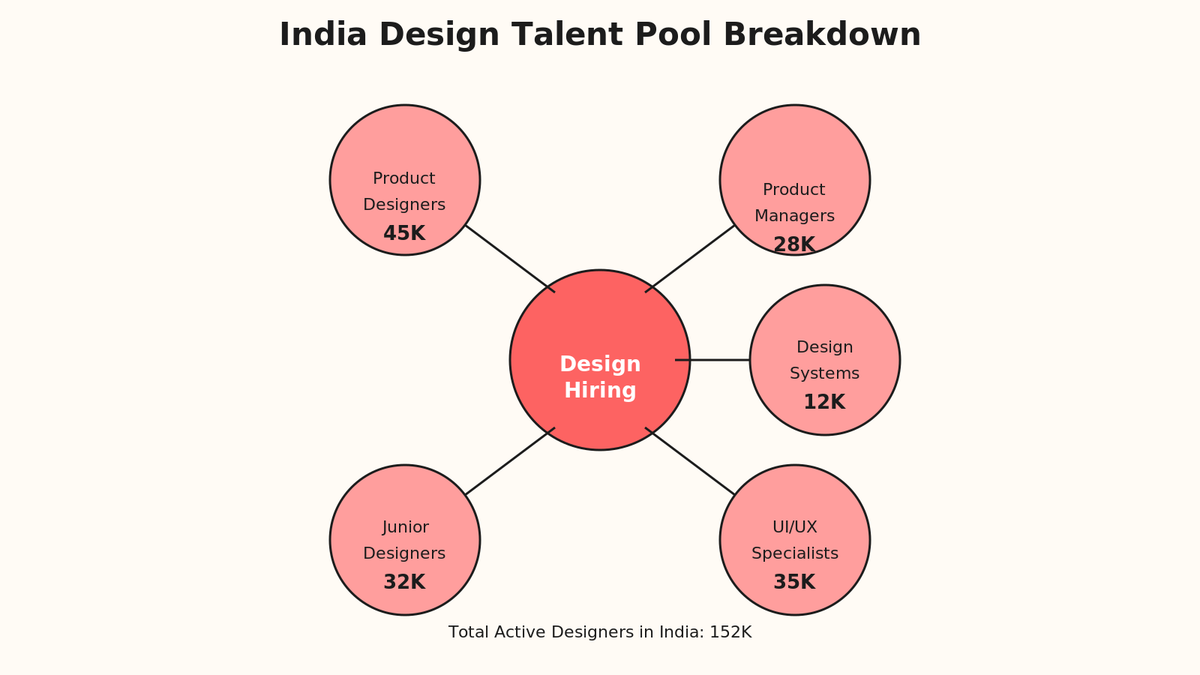
India has produced roughly 150,000 active product and UI designers in 2026, per industry surveys. About 30-40% are trained in formal design programs (NID, ISDI, Mumbai design schools); the rest trained in agencies and startups. The density is highest in Bengaluru (40% of product designers), Hyderabad (22%), Mumbai (18%), Pune (12%), Delhi NCR (8%). Timezone overlap is real: India Standard Time (IST) is 9.5-10.5 hours ahead of US Eastern, meaning India's 9 AM is US's 11:30 PM previous day. India's 9 PM is US morning. Synchronous work is possible in small windows; async work is the norm.
What Versatile sees on the hiring side
Our India-native EOR for design hiring works with 14 US and UK companies today building product design functions in India. We handle the entity side, the compliance side, the payroll side. Founders tell us the same thing: they wanted to hire one designer "to see if it works." Then they hired a second, then a design systems engineer. Then a PM. The cost structure is so different that a team becomes affordable. Our hiring workflow takes 5 days from contract to first day productive.
"We were skeptical about hiring designers in India until we worked with Versatile. Two senior designers cost us less than one in San Francisco. The async workflow works. We are now adding a PM."
— Co-founder, Series A SaaS, via Versatile testimonials
Q2. What's the actual cost difference for a senior product designer or PM?
Here are the real numbers from 2026. You can see the pattern immediately: India costs 60-75% less than US/UK equivalents, before you factor in benefits or seniority multipliers.
"We modeled India hiring at $20K per designer. After PF, ESI, gratuity, and EOR fees, we budgeted $26K per head. Still 70% cheaper than US. The compliance certainty was worth the last $6K."
— Head of Product, Series B startup, via Versatile
| Role | Bengaluru/Hyderabad | Pune/Mumbai | US East Coast | UK London | Cost Ratio (India vs US) |
| Senior Product Designer | $22K-$28K | $19K-$24K | $95K-$140K | $88K-$130K | 76-80% cheaper |
| Product Manager (mid-level) | $25K-$35K | $22K-$30K | $120K-$160K | $115K-$155K | 71-78% cheaper |
| Design Systems Engineer | $20K-$26K | $18K-$23K | $110K-$160K | $105K-$155K | 75-85% cheaper |
| Junior Designer (1-3 yrs) | $8K-$13K | $7K-$11K | $55K-$75K | $52K-$70K | 80-85% cheaper |
| Senior PM (7+ yrs) | $32K-$45K | $28K-$40K | $180K-$240K | $170K-$230K | 75-82% cheaper |
The catch is not hidden. These are gross salaries. When you add compliance costs (PF, ESI, gratuity), the employee cost rises 12-20%. When you add EOR fees ($99-$299 per month), the total cost is still 50-65% cheaper than US/UK. Use our salary calculator to model your exact scenario.
Bengaluru vs Hyderabad premium
Bengaluru salaries run 15-25% higher than Pune or Mumbai. Hyderabad has emerged as a cost-efficient alternative: 10% cheaper than Bengaluru, same talent density for mid-level designers. If you are building a 3-5 person design team and cost is the lever, Hyderabad makes sense. If you need a principal designer or seasoned PM, Bengaluru or Mumbai pay the premium. Check our transparent pricing for your city and role.
"We initially budgeted for one senior designer in Hyderabad at $24K/year. We found we could afford two strong mid-level designers for $22K each. After adding EOR fees and statutory costs, we are still 60% ahead of a single US hire."The math is not subtle. Hire two senior designers in India, pay for one in the US, and keep the third seat for a PM or systems engineer. ---
— CFO, fintech startup
Q3. What roles should you hire: product designer, PM, design systems engineer?
The question is not which role to hire, but the order. Every founder building a product design function in India follows this pattern: start with one senior product designer (or PM if you are early and need strategy). Add a second designer for UI/interaction depth. Then add a design systems engineer when you reach 3-4 products. This hiring sequence is how we onboard founders at Versatile.
Product Designer (the first hire)
This is your core hire. Product designers in India ship end-to-end: user research, wire framing, visual design, prototyping, handoff to engineering. They are not siloed into "UX research" or "visual design" as separate roles (though those exist). You want someone who has shipped B2B SaaS or marketplace products. Salary range: $18K-$28K depending on seniority. Onboarding timeline: 3-4 weeks before productive. Ask for portfolio work on payment flows, multi-tenant dashboards, or mobile-first platforms. We evaluate designer portfolios as part of our hiring support.
Product Manager (if you are pre-product-market-fit)
A PM from India gives you a second brain on strategy without the $150K+ US cost. Indian PMs understand both growth-at-scale and profitability-first thinking. They have seen markets compress rapidly and require quick pivots. Salary: $22K-$35K. Risk: timezone means async docs become your weekly sync. Mitigate by being clear on what "PM decision-making authority" means. Write it into the contract-to-hire agreement. Versatile handles the legal setup automatically.
Design Systems Engineer (when you hit 3+ products)
You hire this role when your designers are rebuilding the same button component three times. A design systems engineer in India will build Figma libraries, component specs, and dev handoff tooling. They bridge design and frontend engineering. Salary: $18K-$26K. This role often doubles as a senior UI designer, so the salary reflects both skill sets. When you are ready to scale design operations, reach out to Versatile for a scoping call.
| Stage | Role | Seniority | Timeline (Hire to Productive) | Salary Range |
| Stage 1 (one product) | Product Designer | Mid (3-5 yrs) | 3-4 weeks | $18K-$22K |
| Stage 2 (1-2 products) | Senior Designer (interaction/systems) | Senior (5+ yrs) | 4-6 weeks | $24K-$32K |
| Stage 3 (2+ products) | Design Systems Engineer | Mid-Senior (4+ yrs) | 4-5 weeks | $20K-$26K |
| Stage 4 (3+ products) | Product Manager | Mid (3-5 yrs) | 6-8 weeks (async-heavy) | $25K-$35K |
The overlap matters. A strong mid-level designer can handle PM-adjacent work for 6-12 months before you hire a dedicated PM. A design systems engineer typically starts 4-6 months after your first designer when patterns become clear.
Q4. How do timezones and collaboration actually work?
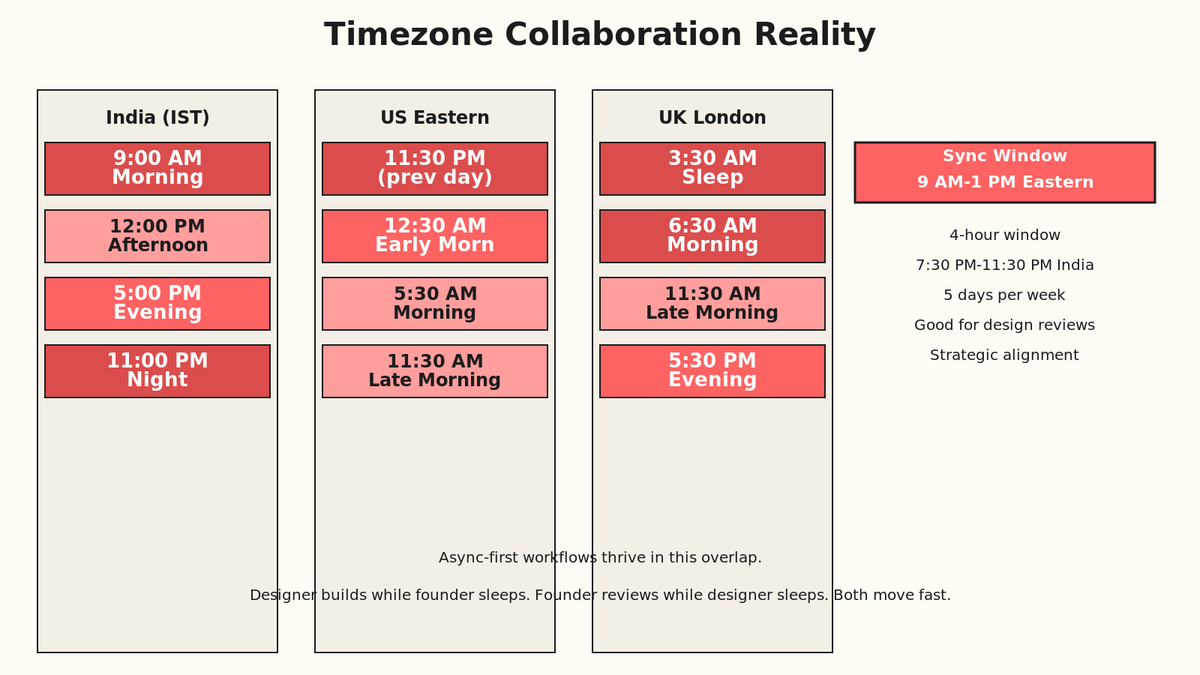
This is the unspoken question founders ask. You are in New York. Your designer is in Bengaluru. It sounds terrible on paper. Here is what actually happens in practice: you accept that 9 AM New York is 7:30 PM Bengaluru. 5 PM New York is 3:30 AM Bengaluru. The synchronous window is 9 AM-1 PM Eastern, which is 7:30 PM-11:30 PM Bengaluru. That is a four-hour window, five days a week.
Real collaboration rhythms
You use that window for design reviews, quick feedback loops, and strategic conversations. You do not wait for the window to do async work. By the time your designer logs on, they have Figma files from you, a Slack thread with feedback, and clear priorities. They spend their morning (India time) building. By the time you log on, there are drafts in Figma, screenshots in Slack, and a summary doc. Iterate in the overlap window. Ship async work overnight. This is exactly how teams running Versatile managed payroll coordinate across continents.
"We were worried timezone would kill the process. Instead it forced us to write better briefs. Every Figma file now has context. Every feedback round is documented. Our design velocity is higher, not lower."
— Product Manager, B2B SaaS (Versatile client)
The best teams we see at Versatile set this up wrong at first. They schedule too many synchronous calls. By week three, they are in one call per day and that is still too many. By week six, they have one Friday design review and that is it. Everything else is Figma comments and Loom videos.
The unspoken advantage
Your designer is working on the problem while you sleep. You wake up to progress. You leave a comment and go to a meeting. They wake up to your feedback and iterate. It is not faster than same-timezone work, but it is cheaper and it forces clarity. You cannot send a vague Slack message and expect a discussion. You write a spec. You show a competitor. You link a previous iteration. By the time sync work happens, 70% of the thinking is done.
Q5. What's the difference between EOR, contractor, and building an entity for design teams?
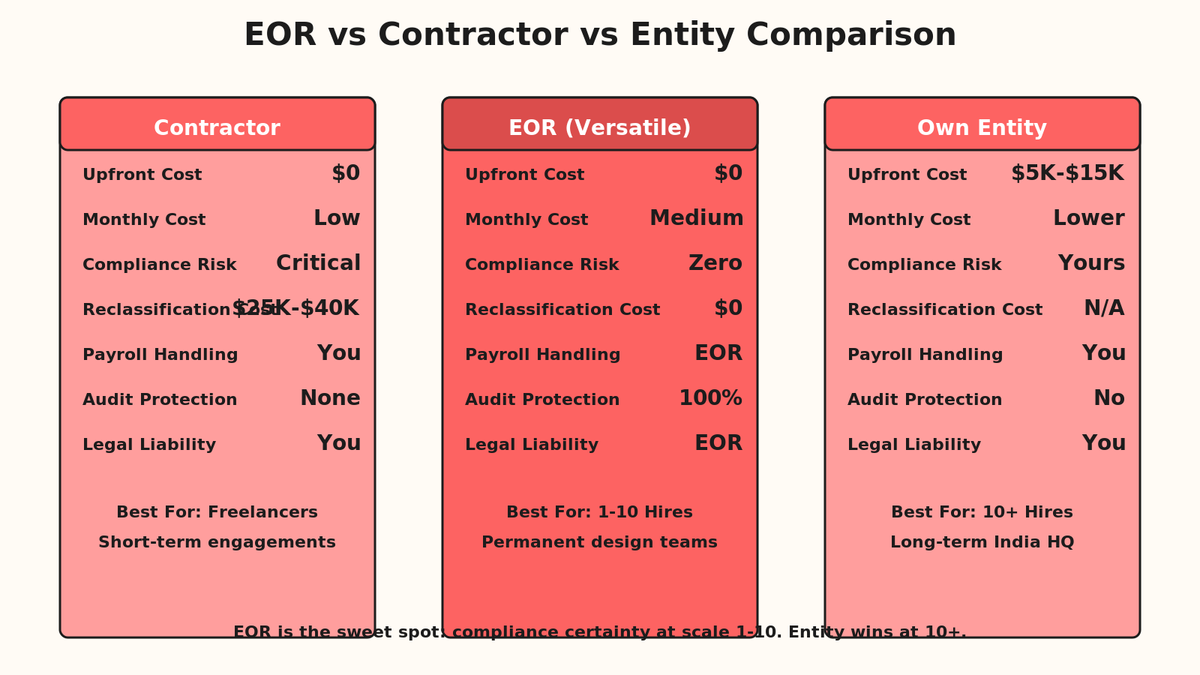
You have three paths to hire. They look similar from the outside. The compliance and cost story is completely different. Here is the direct answer: if you are hiring one designer, EOR is the right move. If you are hiring five or more, an entity might make sense. If you go contractor, you are one notice from the Indian government away from owing back taxes. Learn why Versatile is the India-native EOR option.
Contractor (the trap)
Contractors are cheap to hire. You sign a 1099-equivalent, you cut an invoice, you pay them. No payroll, no taxes, no entity. In India, this is called "independent contractor" status. Here is the trap: India's Ministry of Labour views most design work as employment, not contracting. If a government auditor looks at your arrangement and finds that you provide tools, set work hours, and direct the work, the contractor is reclassified as an employee. You are liable for four years of back-pay: PF contributions, ESI, gratuity, penalties. Cost: $25K-$40K per contractor per year of misclassification.
"We thought our designers in India were independent contractors until the tax department said they weren't. We paid $38K in fines on top of back-pay for one person. We now use EOR."
— CFO, B2B SaaS Startup, via Versatile EOR client survey
Contractors work if your person in India is a true expert (freelancer, consultant, short-term engagement). Design hires are employees. Treat them as such.
EOR (the practical path for 1-10 hires)
An Employer of Record is a third-party company that becomes the legal employer on the entity side. You set strategy and direction. The EOR handles payroll, taxes, benefits, compliance. The designer sees it as a normal job with one employer. You see it as a managed service: one monthly fee, no surprises.
How it works: Versatile maintains an Indian entity (a private limited company). When you hire, we bring your designer onto our payroll. You reimburse us the salary plus the EOR service fee ($149-$299/emp/month). We handle PF/ESI contributions, TDS filings, gratuity accruals, compliance reporting. If there is a dispute, we are the legal employer, not you. Your liability is capped. Our guarantee: 5-day SLA on hiring, zero compliance notices in 4 years, PF/ESI/S&E coverage across 28 states.
Cost: base salary + 12-20% statutory load + $149-$299/month EOR fee. Total is still 50-65% cheaper than US/UK hire.
Entity (the path for 10+ hires or permanent headquarters)
If you are betting on India as a long-term hub, you build your own entity. You register a private limited company with the Registrar of Companies (ROC), get a PAN (tax ID), open a bank account, hire an accountant. You become the employer directly. Cost: $5K-$15K to set up, $2K-$8K per year to maintain. Benefit: full control, lower per-employee costs with volume (no EOR service fees). Downside: you are now a business in India with tax obligations, audit requirements, and regulatory exposure.
| Feature | Contractor | EOR (Versatile) | Own Entity |
| Setup cost | $0 | $0 (service fee only) | $5K-$15K |
| Monthly per-hire cost | Salary only | Salary + 12-20% + $149-$299 fee | Salary + 12-20% (no EOR fee) |
| Compliance risk | CRITICAL (reclassification $25K-$40K) | Zero (EOR holds liability) | Your responsibility (need accountant) |
| SLA on hiring | N/A (direct) | 5 days (Versatile guarantee) | 5-7 days (your process) |
| Payroll handling | Your invoicing | Versatile automated | Your accountant or software |
| Dispute handling | Direct (you are liable) | EOR is employer (you protected) | Direct (you are employer) |
| Best for | True freelancers, short-term | 1-10 permanent design hires | 10+ hires, long-term India presence |
Your choice depends on scale and risk appetite. For your first three design hires, EOR is the answer. For 10+, you do the math on entity cost vs EOR fees. Most founders stay with EOR because the compliance peace of mind is worth the 2-3% fee difference.
Where Versatile fits
We are India-native EOR focused on exactly this: 14 US and UK companies have hired design and product teams through Versatile. We have zero compliance notices in four years. We have 5-day SLA on onboarding. We charge $149/emp/month first month free. We handle PF, ESI, S&E, and statutory compliance across 28 states. When you need to hire your second designer, we don't make you renegotiate terms. When tax rules change (like the 21 Nov 2025 Labour Code amendments), we adapt. When you want to convert a designer to an entity hire later, we have a playbook. Explore Versatile EOR for design hiring here.
Contractor is a risk trap. EOR is operational. Entity is strategic. Pick the stage you are in and move. ---Q6. What are the hidden compliance and tax costs when hiring design talent in India?
Here is where cheap-on-paper becomes expensive-in-practice. You think you are hiring a $20K designer. By the time you add taxes, you add $3,600. Add gratuity accrual, you add another $1,000. Add FX fluctuations, you add 3-5%. Before you realize it, the total cost is 30% higher than you quoted to your board. Let's break this down with the EOR vs entity calculator.
The statutory load breakdown
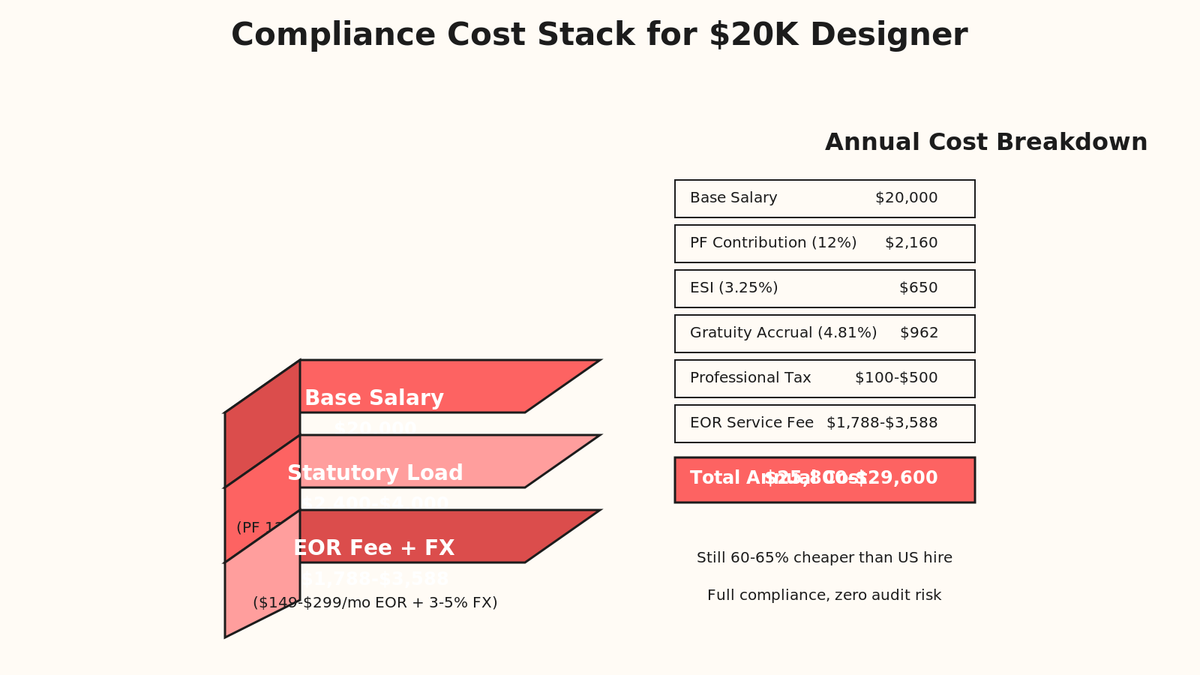
India's employer-side statutory costs are 12-20% of salary depending on salary band. Here is the real breakdown for a $20K annual designer hire:
| Cost Item | Rate | Amount (Annual) | Notes |
| Base Salary | N/A | $20,000 | Gross annual |
| Provident Fund (PF) | 12% of eligible salary | $2,160 | Employer contribution, employee also contributes 12% |
| ESI (Employee State Insurance) | 3.25% of salary | $650 | Applies to salaries under ~$300/month |
| Gratuity Accrual (statutory) | 4.81% of basic+DA | $962 | Accrued annually, paid on separation or 5+ year tenure |
| Professional Tax (state-specific) | 0-2.5% | $100-$500 | Varies by state. Karnataka $100, Maharashtra 2.5% |
| TDS (employer deducts from employee pay) | Varies by slab | $0-$2,000 | Depends on employee's other income |
| DPDP Act Compliance (post-2023) | No direct cost | $200-$500 (annual audit) | Ensures personal data protection consent and logs |
| Total Employer Cost (Annual) | $24,072-$25,672 | 20-28% above base salary |
That $20K salary is not $20K all-in. It is $24K-$26K. Add the EOR service fee ($149-$299/month = $1,788-$3,588 annually), and you are at $25.8K-$29.6K total. Still cheaper than US, but not 75% cheaper anymore. More like 60-65% cheaper. Contact Versatile for an exact quote.
The FX trap
If you pay in USD but the cost is in INR, you have a 3-5% annual FX headwind. In 2023-2024, the rupee weakened 4-6% against the dollar each year. A $20K hire cost $1,680 in additional INR conversions annually. You can hedge this (forward contracts, FX limits on your budget), but most founders don't until it bites them.
The 2026 Labour Code reality
On 21 November 2025, India's four new Labour Codes went into effect, replacing 40 years of fragmented labour law. The rules changed on what counts as "basic salary" for PF purposes. The rule now: Basic+DA must be at least 50% of CTC. If you offer a $20K CTC with $8K basic, $8K DA, $4K other allowances, you are compliant. If you offer $20K with $5K basic, you are not. EOR services handle this structure automatically. If you build your own entity, you need an accountant who understands it. Versatile's compliance team navigates this for you.
"The 50% rule tripped us up. We had designed our salary structure around provident fund optimization, not the Labour Code. Our first payroll was non-compliant. Our EOR caught it and fixed it before we filed."
— Founder, SaaS startup (Versatile client story)
The 48-hour F&F window
If you hire someone and they do not work out at 45 days, you can separate them. But you have a 48-hour full-and-final (F&F) settlement deadline. You must pay all accrued salary, gratuity, and unused leave. If you miss it, you owe statutory penalties. Versatile's payroll team handles this automatically; if you are building your own entity, you need an accountant on speed-dial.
Q7. What's the IP ownership story with Indian design hires?
This is non-negotiable: your designs belong to you. Your code belongs to you. Your IP is your IP. When you hire in India, the employment contract assigns all work product to the company. The designer does not own their work. The contract is written in English, registered with a clause that India employment law does not override it. You are protected. Every Versatile EOR contract includes this protection.
How the contract works
Every employment contract through Versatile's EOR includes an IP assignment clause. All designs, code, strategic thinking, Figma files, design systems, component libraries created during the employment period belong 100% to your company. The employee has no claim after separation. This is standard in Indian IT employment law and is enforced consistently by courts.
The design system edge case
If your designer creates a design system and later leaves, does the system stay yours. Yes. The system is work product. It belongs to the company. The employee has no right to fork it or claim derivative rights. If they want to use the system at their next job, they cannot. This is different from some US design collectives where design philosophy and "approach" are shared IP. In India, the contract is tighter. Work equals company. That is the relationship.
Licensing and third-party design tools
Your Figma, Adobe Creative Cloud, and design tool licenses stay with you. The designer uses your licenses to create; they do not own the design tool accounts. When they leave, you revoke access and all work is still in your workspace. No risk of lost files or access disputes. Figma's organizational structure makes this straightforward.
IP clarity is built into the Indian employment model. Own your designs from day one. ---Q8. How long does onboarding take and what can go wrong?
You can have a productive designer in your Figma workspace in 5-7 days. The process is: contract signature, bank account setup for payroll, visa/documentation check, equipment shipping, and first day handoff. Here is what can slow it down and how to avoid it. Our onboarding process is documented end-to-end.
Timeline: day-by-day
Day 1-2: Contract & approvals. You and the designer agree on salary, start date, and scope. We prepare the contract, you sign, designer signs, we countersign. Total: 2 business days if both parties move fast. If your legal team wants to review the IP clause line-by-line, add 3-5 days.
Day 3-5: Payroll setup & compliance. We set up the designer on our payroll system, create an employee ID, register for PF/ESI, file the statutory notification. We collect their Aadhaar (Indian ID), bank account details, nominee info. The government registration takes 2-3 business days. If the designer's Aadhaar is under their old name (due to marriage, for example), this delays by 1-2 days. Your role: none. This is all backend.
Day 6: First day setup. The designer receives login credentials to Slack, Figma, GitHub, whatever tools they need. If they need a laptop shipped from India, add 2-3 days. If they are using their own machine, same day. Do not skip: send a welcome message, schedule a 30-minute sync to review first-week priorities, and link them to your design handbook or brand guide.
Day 7-14: Onboarding sprint. First two weeks are setup. They are not shipping. They are reading Figmas, understanding your design system (if you have one), asking clarifying questions. They are also dealing with timezone lag on their end. They are not productive until day 10-12 when the project context clicks. Budget for 50% output in week one, 70% in week two, full capacity by week three.
What can go wrong
PAN / Aadhaar delays. If the designer's Aadhaar is not linked to their bank account, payroll registration gets stuck. This delays start date by 1-2 days. Mitigate: ask for Aadhaar + bank account confirmation before you offer the role.
Visa restrictions. Indian employees do not need visas to work for foreign companies remotely. But if they ever travel to the US or UK to meet your team, they need a visitor or business visa. Plan for this in advance if you want in-person time. It adds 2-4 weeks to travel planning.
Tool licensing bottleneck. Adobe Creative Cloud and Figma licenses are expensive when you add headcount. If you do not have budget for a new subscription, budget this. Figma per-seat is $12-$30/month per designer. Do not cheap out here; designer productivity is hostage to tool access.
Timezone communication gaps. The designer's first week, they have 1-2 questions per day that you need to answer. If you do not commit 15-20 minutes daily for their first week, they will feel ignored. They will not reach out again. They will go slower. Invest the time in week one; it pays back in week three.
Realistic productivity curve
Week 1-2: 50-60% output. Week 3-4: 80-90% output. Week 5+: 100% output, plus the designer is now helping you catch design debt and proposing improvements. By month three, they are running design reviews and mentoring junior contractors if you add them. Do not expect full productivity before week three. Versatile's managed payroll includes onboarding support.
Onboarding is 7 days. Ramping to full productivity is 4 weeks. Plan for both. ---Q9. Design EOR vs design contractors: which actually wins?
You have two paths in front of you: hire a contractor (no payroll, no compliance) or hire via EOR (full employment, full compliance, managed service). Here is the honest comparison based on real scenarios we see at Versatile. Use our calculator to model your scenario.
The contractor path (upfront simplicity, long-term risk)
Month 1: You hire a contractor. You pay them $2,000/month, they invoice you, you transfer the money. No payroll system, no filings, no complexity. You feel like a genius because it is just invoicing.
Month 6: A colleague says, "Wait, is this person really a contractor? Do they set their own hours?" You realize they work 9-6 IST, that is basically 9-6. They use your Figma, your design system, your tools. They probably are not a contractor.
Month 12: The Indian tax department (IT-ACO or through a local inspection) looks at your payroll and notices you have a $24K/year "contractor" in India. They audit. They reclassify. Suddenly, you owe: four years of back-pay PF (4 times $2,160 equals $8,640), ESI ($650 times 4 equals $2,600), gratuity accrual ($962 times 4 equals $3,848), penalties (another $10K-$20K). Total: $25K-$35K. The contractor gets a refund (the employer portion goes to their PF account). You pay the difference.
Lesson: contractor works only if they are truly part-time, set their own hours, and are not a core team member. If they feel like an employee, reclassify them.
The EOR path (higher upfront cost, zero long-term risk)
Month 1: You decide to hire via EOR. You go through Versatile's intake form. We interview the designer, you both agree on $20K/year. We set up the contract (includes IP assignment, notice periods, compensation structure). We file all the statutory registrations. Your cost: $20K salary + $2,400 statutory + $240 EOR fee (first month free) = $22,640. It feels expensive compared to "$2,000/month contractor."
Month 6: Your designer is productive, you have a second one ramping, and you are not thinking about compliance. You know your liability is zero. Versatile handles everything. You pay the monthly invoice.
Month 12: Tax year ends, Versatile files your employee's annual compliance (Form 24Q for TDS, PF annual reconciliation). You have zero audit risk. Zero back-pay risk. Zero reclassification risk. Your total cost over 12 months: $20K salary times 12 plus $2,400 statutory plus $240 times 12 EOR equals $29,280. That is about $2,440/month, not $2,000. But you sleep at night.
The verdict
EOR costs 20-30% more than contractor. EOR eliminates 100% of compliance and tax risk. For design hires (your core team), this is the right trade. You are paying $440/month more to completely outsource regulatory and tax risk. That is not a cost, that is insurance.
Most founders we work with say, "I wish I had done EOR from the start instead of contractor plus reclassification drama."
"We hired three contractors without EOR. It worked for eight months. Then the government noticed. We paid $28K in penalties and reclassification costs. Now all six designers are on Versatile EOR and I sleep at night."Contractor is cheap until it is not. EOR is expensive until you get audited and realize it was never expensive at all. ---
— Founder, growth-stage B2B SaaS (Versatile case study)
Q10. How does Versatile fit if you are building a product design team?
We are India-native EOR focused on exactly this scenario: you need to hire product designers, PMs, and design engineers from India. You want full compliance without complexity. You want a founder-friendly SLA. You want to know your cost upfront. Versatile is the only India-native Employer of Record built for hiring design talent across multiple teams.
What Versatile is
We maintain an Indian entity (private limited company, registered with ROC, 4 years on books, zero compliance notices). When you hire through us, your designer goes on our payroll. We handle PF, ESI, S&E, TDS, gratuity, professional tax, statutory filings. We give you a compliance-clean employment relationship and a transparent monthly bill. Our SLA: hiring decision to first day productive in 5 days. Our price: $149/emp/month first month free, then standard EOR fees. We have 14 US and UK companies trusting Versatile today. Learn about Versatile's track record.
What Versatile is not
We are not a recruiter. You find the candidate, we close the compliance side. We are not a contract manufacturer of design work. You hire directly, they report to you. We are not a staff augmentation service where we manage their day-to-day. You manage strategy; we manage compliance. We are not a freelance platform like Upwork. We are employment, not gigs. See our service model.
The Versatile workflow for design hiring
1. Candidate sourcing. You source the designer. You run interviews, do reference calls, negotiate salary. You decide if they are the right person.
2. Contract & offer. You tell us the offer: name, role, salary, start date. We prepare an employment contract compliant with Indian law, including IP assignment and notice periods. You and the designer sign.
3. Payroll setup. We register the designer on our payroll, file statutory notifications, set up ESI/PF. You provide documentation (Aadhaar, bank account). This takes 3-5 business days.
4. First day. Designer logs on to your systems. We send equipment if needed. You run onboarding. We handle the backend.
5. Ongoing. Monthly invoice from us. You pay us. We pay the designer, file compliance, handle separations if needed. See our ongoing compliance support.
We also offer salary benchmarking through our calculator, onboarding templates, and EOR-vs-entity financial modeling. Learn more about Versatile EOR for design hiring.
We take the India compliance part off your table. You stay focused on designing great products. ---Q11. What should a founder's first conversation with an EOR actually cover?
You have a designer in mind. Before you make an offer, you should talk to your EOR provider about three things: the salary structure, the compliance checklist, and the separation process. Here are the questions to ask. Reach out to Versatile for a no-pressure conversation.
On salary structure
1. "What is the right salary range for a senior product designer in Bengaluru right now?" A good EOR will give you benchmarks (they place people every month). Versatile's range: $22K-$28K for senior, $18K-$22K for mid-level. Check our salary calculator.
2. "Do I structure the salary as Basic+DA+allowances or lump sum?" The answer is Basic+DA at minimum 50% of CTC (21 Nov 2025 rule). We recommend: 50% basic+DA, 50% allowances/bonus. This is PF-optimized.
3. "What is the total cost including all statutory burden?" Salary + 12-20% statutory + EOR fee. Ask for a quote line-by-line. Our calculator shows this breakdown.
On compliance
4. "What happens if the designer is late or does not show up for the first week?" You can separate them if they do not appear by day 5 without valid reason (illness, emergency). Verify your EOR's policy.
5. "What are my liabilities if the designer sues for wrongful termination?" With EOR, it is the EOR's liability after 100 days (probation period in India). After that, you need cause to separate. Wrongful termination can be expensive. Vet your separation policy before hiring. Versatile's compliance team guides this.
6. "How are taxes and compliance filed?" Ask to see a sample filing (anonymized). Understand the cadence: monthly TDS, quarterly PF, annual returns. Versatile files everything; you do not need to.
On scaling
7. "If I hire five designers, do fees go down?" Most EORs offer volume discounts. Ours: first hire $149/emp/month free month, then standard rates. If you reach 10+ employees, we discuss bespoke pricing. Ask upfront.
8. "Can I move designers to my own entity later?" Yes. We have a playbook for this. We transition them from our payroll to yours. Costs $1K-$3K in documentation and compliance setup. See our playbook on entity transition.
9. "What if my designer wants to relocate to another city or country?" Relocation within India is straightforward; we re-register them with the new state PF/ESI office. Relocation out of India is complex (visa, work permit, double-taxation). Plan 4-6 weeks and consult an international tax advisor. Versatile can guide but does not advise on tax treaties.
Red flags to watch
If an EOR says: "We do not handle compliance directly, we partner with a local firm" (you want direct accountability), "The fee is 10-15% of salary" (that is a margin play, not market rate; 2-3% is standard), or "You can separate anyone anytime without cause" (that is not legal in India), walk away. These are compliance shortcuts that expose you to risk.
"We asked Versatile whether we could just pay the designer in USD directly to their US-based account. They said no, because it breaks India compliance and creates tax issues both here and in India. That's the conversation that made me trust them with all six designers."The first conversation with your EOR is a hiring process. Make sure they pass your audit. ---
— Founder, early-stage SaaS (Versatile relationship story)
FAQs
What is the difference between product design and product development?
Product design defines the problem, user, and interface. Product development builds and ships it. Design owns discovery, research, wireframes, prototypes, and specs. Development owns implementation, testing, deploy, and iteration. A good product needs both to work together in short weekly cycles. Our EOR hires both roles under one entity.
Should product designers report to engineering or to product?
Product. Design and product should share OKRs on the same shipping calendar. Engineering owns delivery. If design reports to engineering, design becomes a service function and stops leading discovery. Structure it right from day one via this consultation.
How much should I pay a senior product designer in India in 2026?
Senior product designer with 6 to 8 years of experience runs Rs 35 to 55 lakh total comp ($42,000 to $65,000 USD) fully loaded through Versatile. Compare to US comp of $180,000 to $220,000. The gap is real and the talent is comparable.
What tools do offshore product design teams work best with?
Figma for design and prototyping, Notion or Coda for specs, Linear for tracking, Loom for async walk-throughs. Restrict enterprise access via SSO. Our EOR onboarding on Versatile covers tool provisioning and access controls.
Can offshore product designers do end-to-end user research (interviews, testing)?
Yes, if your users are English-speaking or if you provide a research ops partner (UserInterviews, Respondent) for recruitment. India-based designers can run 45-minute Zoom interviews at 8pm to 10pm IST that cover US East Coast users at 9:30am to 11:30am EST. Set this up in the offer letter.
How do I integrate an offshore design team with US-based product managers?
Weekly 60-minute design review at 8pm IST / 10:30am EST. Async Loom updates from design 3x weekly. Shared Figma with PM commenting live. If you skip the async layer, PMs feel design is slow; if you skip the sync layer, design loses context. Message us for a full ceremony template.
Where my head is right now
Here is the prediction I am sitting with. Over the next 18 months, India becomes the product design hub for US/UK startups the same way Eastern Europe became the engineering hub in 2015. The 150K-person design talent pool will get tighter. The cost gap will narrow from 70% to 50% as demand rises. The frameworks for EOR and compliance will become table-stakes, not competitive advantages.
What this means for founders: hire now while the talent and price structure favor you. Hire via compliant paths (EOR, not contractor), because the risk of reclassification is real and expensive. Build a small team (2-3 people) in your first 6 months to validate the async workflow. Then scale to 5-10 if it works.
If you are at the stage where you need to hire your first or second product designer or PM from India, and you want the compliance part handled cleanly through Versatile's India-native EOR, message me directly on WhatsApp through our contact page, or book a consultation with us. You will be talking to the founder, not a ticket. I can walk you through the salary benchmarking, the EOR structure, the compliance guarantees, and answer the questions you did not even know to ask.
What is the one thing holding you back from hiring your first designer from India?