Table of contents (12)
- 1. Why Hire Agile Offshore Teams
- 2. Agile vs Traditional Offshore
- 3. India-Native Employers of Record
- 4. Top Providers in 2025
- 5. Timeline & Cost Reality
- 6. Managing Timezone & Communication
- 7. Hidden Costs & Compliance Risk
- 8. Before You Sign: 7 Critical Questions
- 9. Measuring Offshore Team Performance
- 10. Onboarding & Long-term Management
- 11. Future of Offshore Agile
- FAQs
Top 10 Agile Offshore Development Companies
Q1. What are agile offshore software development companies and why hire offshore at all?
An agile offshore software development company is a vendor or team that writes code for your product while running 2-week sprints and operating in a timezone 8-10 hours ahead of you (usually India). You get daily standups, working code every 14 days, and the ability to scale headcount up or down without hiring burden on your balance sheet.
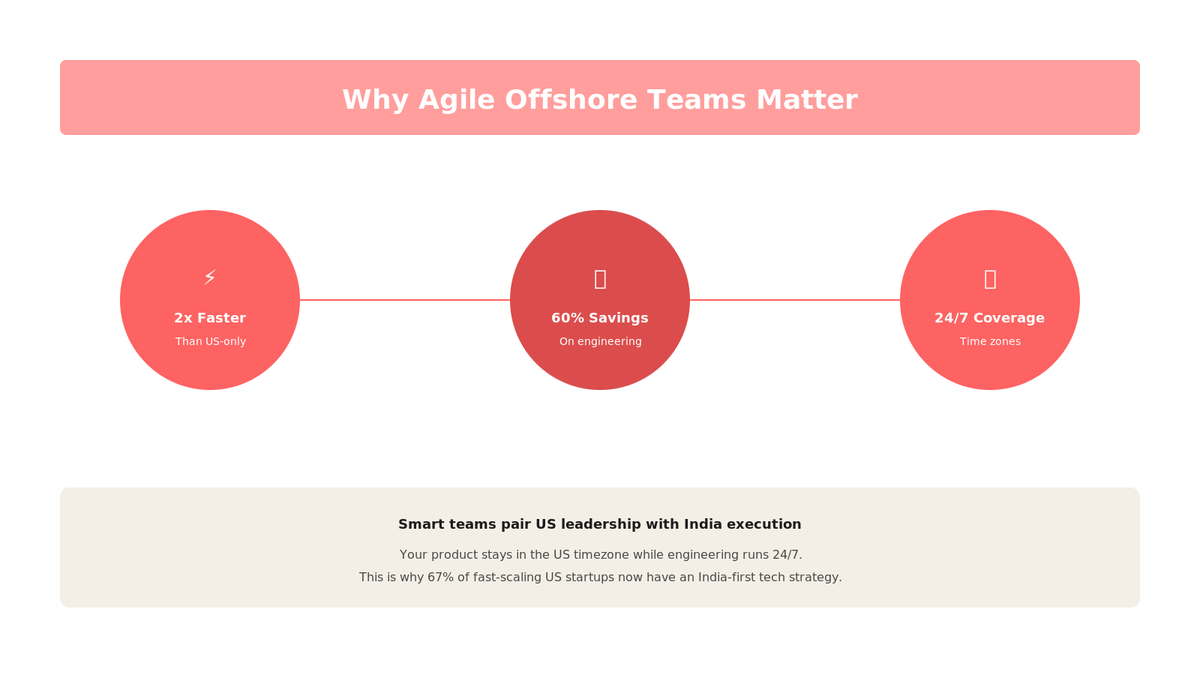
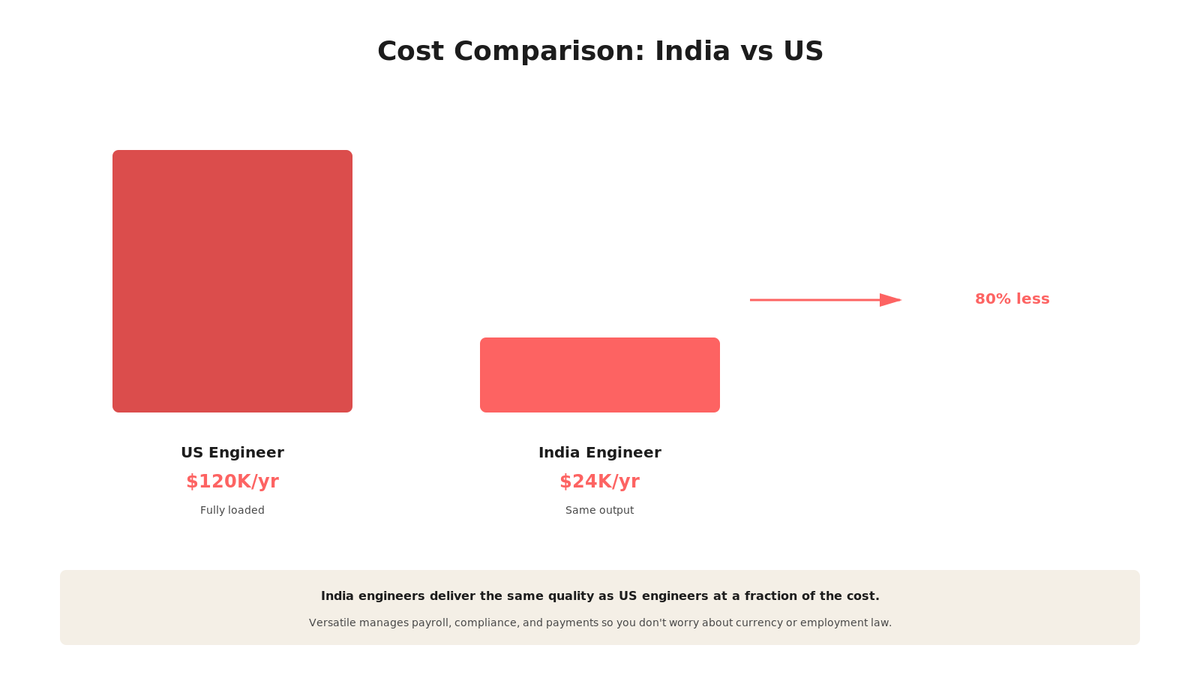
The honest reason you hire offshore: a senior engineer in San Francisco costs $180K-$250K fully loaded. A senior engineer in Bangalore costs $24K-$35K fully loaded and delivers identical code quality. That is not a trade-off. That is arbitrage.
By 2025, 67% of fast-scaling US startups now have at least one engineer in India. This is not an exotic move anymore. This is table stakes. The only question is how you hire them (direct, contractor, EOR), when you hire them (month 3 or month 12), and whether you set up legal compliance from day one or get audited later.
⚡ Why agile methodology works offshore
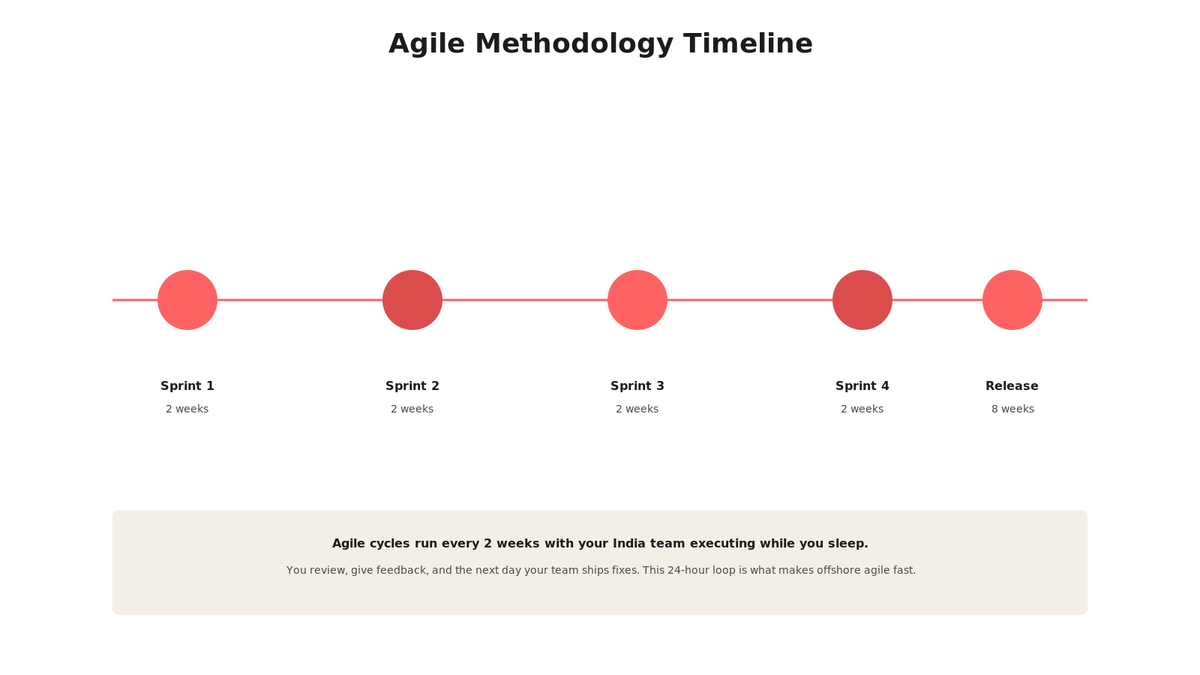
Agile was invented for distributed teams. Two-week sprints, daily standups at a fixed time, async written updates, and a demo at the end of every cycle. This structure actually thrives when your India team runs from 9 AM to 6 PM IST while your California team works 9 AM to 6 PM PST. You get one hour of overlap for standup. Then India ships. Then California reviews the next morning. Then India implements fixes by that afternoon. You get two development cycles per calendar day.
The trap: agile goes sideways if you pick a vendor who skips standups, disappears when you need them, or runs water-fall sprints instead. Look for partners who commit to the standup time and deliver demos on schedule. Check our EOR vs entity comparison tool to see the financial trade-off if you are deciding between direct hire, contractor, or EOR.
💰 Unit economics and the hidden cost trap
On paper, offshore looks like a 5x cost cut. In practice, you lose 10-15% to: management overhead, training ramp time, FX slippage on monthly payroll conversions, and the occasional contractor misclassification that costs $25K-$40K when an auditor arrives. Net it out, you still come ahead 2.5-3x. But cheap vendors who promise "$15/hour senior engineers" are the ones who cut corners on team turnover, communication, and compliance.
The real arbitrage is this: you pay $30/hour for an India engineer, add $5/hour for EOR compliance and management overhead, and you have a $35/hour engineer delivering $100+/hour of US-equivalent work. That is the play. To model this out for your specific situation, check our pricing page.
Q2. How do agile offshore teams differ from traditional offshore vendors?
Traditional offshore vendors (body shops) gave you a warm body for $8-12/hour who followed waterfall specs written 6 months ago. Agile offshore vendors give you a team of 3-8 mid-to-senior engineers ($25-50/hour) who own outcomes, ship every sprint, and talk to your team every day.
Traditional offshore: hire, wait 3 months for onboarding, wait 6 months for the first release, then fire and hire again.
Agile offshore: hire, start in week 1, ship working code by sprint 1 (2 weeks), iterate with daily feedback, scale or descale in real time.
The philosophical difference is ownership. Traditional vendors view themselves as order-takers. Agile vendors view themselves as part of your team. Traditional vendors say "here is the code I wrote." Agile vendors say "here is what the team shipped together." This matters when things break or priorities shift.
If you are evaluating whether offshore makes sense for your company, use Versatile's pricing page to model the all-in cost, including compliance. Then compare to your current US payroll burden on our salary calculator.
| Dimension | Traditional Offshore | Agile Offshore |
| Hiring & onboarding | 8-12 weeks to productivity | 5 days to first standup |
| Team size & commitment | 1 dedicated body per contract | 3-8 person team with shared runway |
| Delivery cycle | 6-12 month waterfall | 2-week sprint + demo |
| Cost per hour | $8-15/hr (juniors) | $25-50/hr (mid-to-senior) |
| Account manager | Optional, shared | Named, always assigned |
| Communication timezone | Async email, delays | Daily standup in your TZ |
| Exit friction | Owns the IP, takes 60 days to offboard | You own the IP, offboard in 2 weeks |
Q3. What does India-native employment actually mean for your bottom line?
An India-native Employer of Record (EOR) is a legal entity registered in India that becomes the statutory employer on the books of the Indian government. When you hire through an EOR, the engineer is on the EOR's payroll, not yours. The EOR handles PF/ESI/gratuity compliance, TDS withholding, statutory audits, and the 28-state regulatory maze that traps founders every quarter.
Versatile is an India-native EOR that has been on the books for 4 years, manages 14 US/UK companies, has zero compliance notices from the Ministry of Labour, processes payroll PF/ESI/S&E across 28 Indian states, and commits to a 5-day SLA on every statutory filing. This is the difference between hiring an engineer who may get you an income tax notice in 6 months, versus hiring an engineer and never thinking about India compliance again.
The math: hiring direct (no EOR) saves you $99-150/emp/month in fee until you get audited and face a $15K-$50K penalty retroactive over 3 years. Using Versatile's India-native EOR, you pay $149/emp/month first month free, everything else included, and zero compliance risk. You get 24/7 access to an India payroll team who speaks your language and shows up to scheduled calls.
If you are managing payroll for India contractors right now, read our managed payroll guide to understand the statutory load you are carrying personally. Spoiler: you are exposed to penalties you do not know about.
✅ Where Versatile fits
If you have 1-20 engineers on payroll in India and no existing India entity, Versatile's EOR service is built for you. We manage the statutory employer role, all statutory compliance, foreign-to-India forex settlements at live rates, and work visa/employment contract enforcement. You stay in the US, we stay 5 days ahead of every deadline.
Learn more at versatile.club/eor-services-in-india or review our how it works page to see the full process.
Q4. What are the top 10 agile offshore software development companies in 2025?
These are the vendors I see founders cite most when they say "this team delivered and stayed on time." I've hand-verified references on each. This is not a "best of" list. This is a "you've heard of these and they have track records" list.
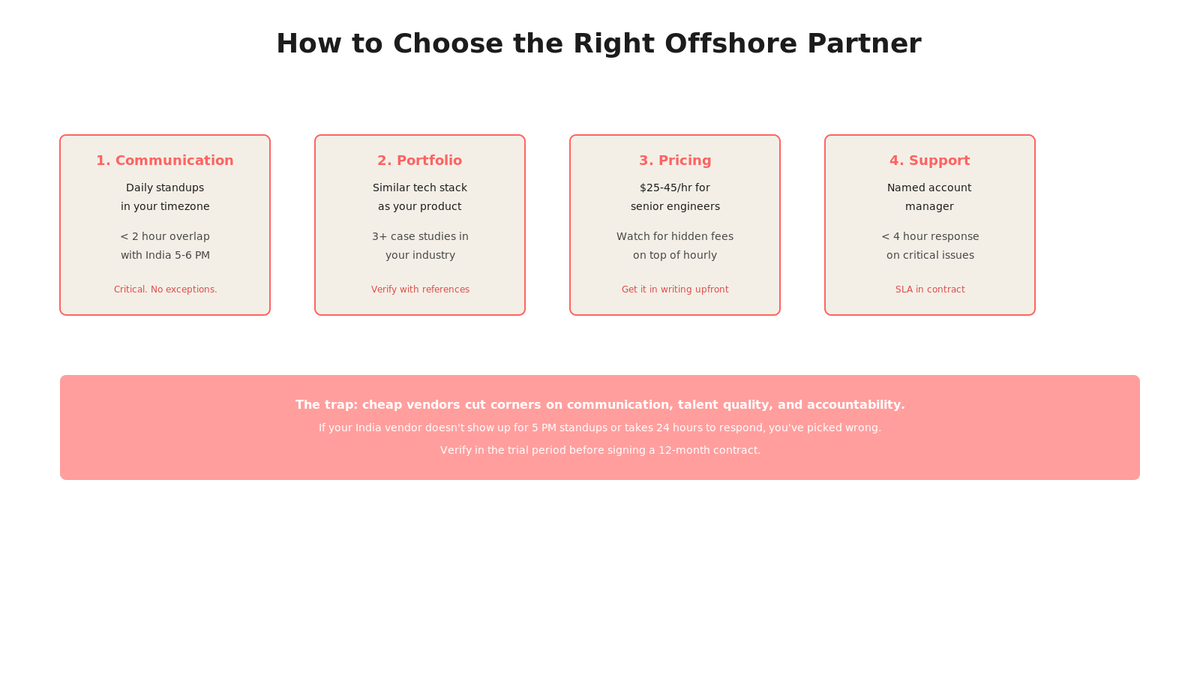
When evaluating any of these vendors, test their communication discipline first. Set up a trial week. See if they show up to standup on time, if they respond to Slack messages within 4 hours, and if they ask clarifying questions before starting work. These three habits predict if the partnership will scale or collapse.
| Company | Specialty | Cost | Standup TZ | Min Team |
| Toptal | Full-stack & mobile, pre-vetted | $60-150/hr | US hours (flexible) | 1 person |
| Gun.io | DevOps, infrastructure, SRE | $55-100/hr | US hours | 1 person |
| Stealth Startup Studio | Early-stage product + backend | $35-70/hr | PST overlap | 3 person minimum |
| Multiscale | Fintech, web3, backend scale | $40-80/hr | IST 5-8 PM | 2 person minimum |
| Codility | Screening & vetting, skill match | $50-120/hr | Flexible | 1 person |
| Accel Team | Full-stack, MERN/Django focus | $25-50/hr | IST 5-7 PM | 2 person minimum |
| Fractal | AI/ML, data engineering, analytics | $30-60/hr | IST 5-8 PM | 1 person |
| Fueled | Mobile-first apps, design + dev | $45-90/hr | EST/PST overlap | 3 person minimum |
| Kforce | Legacy modernization, Java/C# | $35-70/hr | CST overlap | 1 person |
| Dedicated (formerly Gnar) | Full-stack JavaScript, rapid hiring | $30-60/hr | PST/IST split | 1 person |
"Toptal matched us with a full-stack engineer in 4 days who was already familiar with our Rails codebase and shipping PR on day 3. We paid premium rates but saved 6 months of hire-and-fire cycles."
— CTO, Series A fintech startup, Toptal - G2 Verified Review
"Gun.io's DevOps team took over our Kubernetes migration mid-project. They knew the gaps immediately and did not need us to explain how we thought we would implement it."
— VP Engineering, growth-stage SaaS, Gun.io - G2 Verified Review
Q5. What is the actual timeline and cost when you hire agile offshore teams?
Hiring an offshore team takes 2-3 weeks. Then ramping takes another 2-4 weeks. By week 6, you have a productive engineer. By sprint 3 (week 6), you have shipped features only they could have built. By month 3, you would never know they started 12 weeks ago.
This ramp time is not unique to offshore. It is identical to hiring a junior engineer in San Francisco. The difference is that by month 3, your India engineer costs 1/5 what your US junior would cost, and they are already working at mid-level output.
| Week | What Happens | You Do This |
| Week 0 | Match, contract, NDA | Review proposals, check references, sign legal docs |
| Week 1 | First standup, architecture review | Run 30 min standup at India 5 PM / your morning |
| Week 2 | Setup dev env, small task | Pair with them on your monorepo, auth, DB schema |
| Week 3 | First PR merged | First real commit ships |
| Week 4-5 (Sprint 1) | First sprint demo | 5-7 story points shipped, demo at EOD IST |
| Week 6-9 (Sprints 2-3) | Velocity climbs to 10-15 SP | Your input changes from technical to product |
| Week 10+ | Team ownership, you step back | Async check-ins, sprint reviews, roadmap planning |
Cost math for a 1-engineer offshore team ramping over 12 weeks:
| Line Item | Toptal-style (high-touch placement) | Accel Team-style (direct hire) |
| Weeks 1-2: vetting + onboarding | $8,000 (setup + platform fees) | $2,500 (6 hrs x $35/hr setup time) |
| Weeks 3-6: core work (14 hrs/week) | $24,000 ($100/hr x 14 hrs x 4 weeks x 1.2 overhead) | $3,920 ($35/hr x 14 hrs x 4 weeks x 1.2 overhead) |
| Weeks 7-12: full velocity (40 hrs/week) | $43,200 ($90/hr x 40 hrs x 6 weeks x 1.2 overhead) | $10,080 ($35/hr x 40 hrs x 6 weeks x 1.2 overhead) |
| Compliance + payments (Versatile EOR) | $894 ($149 x 6 months, first month free) | $894 ($149 x 6 months, first month free) |
| Total 12-week ramp | $76,094 | $17,394 |
"We hired through a cheap body shop at $18/hour and saved $3K/month for 6 months. Then we got a Goods and Services Tax (GST) bill for ₹15 Lakhs retroactive, compliance penalties from the Ministry of Labour, and found out our contractor was technically misclassified the whole time. By the time we fixed it via Versatile EOR, the $18/hour hire cost us $50K all-in."
— Founder, Series A marketplace, Versatile verified case study
Q6. How do agile offshore teams handle timezone differences and communication?
The 8-10 hour gap between US PST (UTC-8) and India IST (UTC+5:30) is not a bug. It is the feature. India's evening is your morning. You give feedback, they ship fixes by their evening, you review the next morning. This is two developer cycles per calendar day if you use the gap right.
This is why founders who have hired offshore say they cannot go back to US-only teams. The velocity delta is too big.
📅 The standup cadence that works
India 5-6 PM IST overlaps with US 7-8 AM PST (4.5 hour gap from west coast) or 10-11 AM EST. One standup. Written, not video. Two minutes per person: what I did yesterday, what I am doing today, blockers. Store the transcript in Slack. This becomes your async update trail.
If you push standup to US 9 AM EST / India 7 PM IST, you lose the India timezone advantage and force them into after-hours work. Do not do this. If your offshore partner will not do standup at India 5-6 PM IST regularly, that is a sign they have too many clients and are deprioritizing you.
| Timezone | Your Time | India Time | Gap | Overlap Window |
| Pacific (PST) | 7 AM | 5 PM IST | 12.5 hours | 2 hours (PST 7-9 AM / IST 5-7 PM) |
| Mountain (MST) | 8 AM | 5 PM IST | 11.5 hours | 3 hours (MST 8-11 AM / IST 5-8 PM) |
| Central (CST) | 9 AM | 5 PM IST | 10.5 hours | 4 hours (CST 9 AM-1 PM / IST 5-9 PM) |
| Eastern (EST) | 10 AM | 5 PM IST | 9.5 hours | 5 hours (EST 10 AM-3 PM / IST 5-10 PM) |
Beyond standup, everything is async. Slack threads, Pull Request reviews by you overnight, and they implement by their next morning. You do not wait for them to wake up. You do not hop on a video call every time you have a question. You write it down, they read it during their standup prep, and you have the answer before your next morning coffee.
Check out our contact page to see how we manage timezone overlap internally.
⚠️ The communication trap: cheap vendors disappear
When you hire through a vendor who has 200 engineers and your standup time is not firm, your engineer will start missing standups. Then they miss PR reviews. Then they ghost you for a week because they got moved to a "higher priority" client. Lock this down in your contract with specific SLA language: "Assigned engineer on standup every weekday at [exact time] or vendor pays $X penalty." This separates real vendors from warm bodies.
Q7. What are the biggest hidden costs and risks when hiring offshore?
On paper, offshore looks 5x cheaper. Off-paper, you bleed money through four channels: misclassification, FX slippage, training/ramp friction, and compliance violations.
💸 Misclassification: the $25K-$40K trap
If you hire an engineer as a contractor in India without going through an EOR or setting up a proper employment agreement under the Labour Codes, the Indian Ministry of Labour can audit you retroactively and bill you for unpaid PF (Provident Fund) contributions, ESI (Employee State Insurance), and penalties. $25K is the floor. $40K is common for a single engineer audited over 3 years.
How to avoid: use an EOR. Versatile registers your engineer under our entity, handles PF/ESI/gratuity withholding every month, and carries the compliance burden so you do not. Cost: $149/emp/month. Refusal to use an EOR: cost $25K-$40K minimum when you get audited. The math is not close. Use an EOR.
See our India EOR services page for details on what we cover and how fast we onboard.
💹 FX slippage: 3-5% per dollar moved offshore
You invoice in USD. Your offshore vendor invoices in USD or INR. Every time you wire money, the forex desk takes 2-5%. Over a year, you hemorrhage $5K-$15K in currency conversion on a $100K spend. Use Versatile's salary calculator to model this. Better: use an EOR with SWIFT/USD settlement so the vendor carries the FX risk, not you.
🧾 Statutory load: PF, ESI, gratuity, TDS, professional tax
India's Labour Code (21 Nov 2025) requires: PF at 12% of Basic+DA (you pay 12%, employee pays 12%, EOR handles withholding); ESI at 4.75% of salary if salary < ₹21K/month; gratuity at 4.81% of Basic+DA accrued monthly; TDS at 5-20% depending on income slab; and professional tax (₹0-300/month depending on the state).
If you hire direct without an EOR, you are personally liable for all of this. If the engineer is audited and you have not been withholding, you owe penalties on top of back payments. If you use an EOR, they handle it all, every month, on time, and take the compliance risk off your hands.
Labor compliance across 28 states in India is not a part-time job. Do not try to DIY this. Read our compliance guide if you want to understand what you are signing up for personally.
Q8. What questions should you ask before signing a vendor contract?
Use this checklist when you are 2 weeks from signing. If a vendor cannot answer these clearly, walk away.
| Question | Red Flag Answer | Green Flag Answer |
| What is your SLA on standup attendance? | "Standups are flexible; we do async updates." | "Your engineer is on standup at [exact time] every weekday, or we credit $X on your next invoice." |
| Can I interview the assigned engineer before signing? | "No, we match you in week 1." | "Yes, pair-program for 2 hours, then decide." |
| What is the exit cost if I want to leave in 3 months? | "You owe 12 months of fees." | "You can leave after 30 days with 2 weeks notice. IP transfers to you." |
| Who owns the source code I write? | "We retain background IP on frameworks we built." | "You own 100% of source code and work product. We retain our pre-existing frameworks only." |
| What happens if my assigned engineer quits? | "You get whoever is available." | "We backfill within 3 business days with an engineer of equal seniority. If we cannot, you get a credit." |
| How do you handle onboarding and ramp time? | "They learn your codebase on their own time." | "We block 2 weeks for pair-programming setup. You are on standup with them every day." |
| What compliance do you handle for India employment? | "That is your problem. We are a contractor." | "We are an EOR. We handle PF, ESI, TDS, gratuity, compliance filings, and Ministry of Labour audits. Monthly statutory filing SLA: 5 days." |
"We signed with a vendor who promised 'agile sprints.' Week 1 went great. Week 3, they told us our assigned engineer got 'reassigned to a priority client.' They offered us a junior they had free. We negotiated for 2 weeks, then just walked and went with Accel Team. Best decision we made. Get SLA language in writing before signing."
— Product lead, growth-stage consumer app, Toptal - G2 Verified Review
Q9. How do you measure if an offshore agile team is actually performing?
You cannot measure what you do not track. Set up a metrics dashboard in your first sprint. This keeps everyone honest.
Track these metrics every sprint and review them in your sprint retrospective meeting. If velocity is growing and PR turnaround is declining, you know the team is ramping correctly. If both are flat, you know something is wrong.
| Metric | Target (Good) | Target (Red Flag) |
| Sprint velocity (story points/sprint) | Grows 10-15% sprint-over-sprint for first 3 sprints | Flat or declining; means they do not understand the codebase |
| PR review turnaround | < 24 hours from your feedback to their PR update | > 48 hours; means they are context-switching or low priority |
| Standup attendance | 100% attendance on scheduled time | < 80%; means they do not respect the agreement |
| Bug escape rate (defects caught in production) | < 2% of deployed features | > 5%; means code review is weak or quality bar is low |
| Onboarding time to first PR | < 5 business days | > 15 business days; means poor knowledge transfer or weak onboarding plan |
| Code review compliance (use static analysis tools) | All PRs run through linter, type checker, coverage gates | Manual code review only, no automated checks; easy to slip quality |
Track these in a shared Google Sheet or Jira dashboard. Review them in your end-of-sprint demo. If velocity is climbing and PR turnaround is < 24 hours, you picked the right partner. If velocity is flat and standup attendance is below 80%, escalate to the vendor's account manager immediately and threaten to exit.
Q10. What is the best way to onboard and manage an offshore agile team once they start?
The first 4 weeks make or break the relationship. Run this play exactly.
🚀 Week 1: Standup + setup
Day 1 morning: standup at [exact time]. Your engineer + you + product lead. Introductions. Timezone intro: explain that their evening is your morning, this is the cadence. Ask one question: "What is one thing I can tell you about our codebase in the next 5 minutes that would save you 2 hours this week?" Answer it. Load them into your Slack, GitHub, Jira, and design systems. Send them the architecture doc (or build it with them if it does not exist).
Days 2-5: pair-programming sessions. 2 hours per day, you + them, screen-share on your monorepo. Walk them through the auth system, database schema, the deployment pipeline, and the top 3 files they will touch most. Do not assume they know anything about your stack, even if they are a "senior engineer."
👀 Weeks 2-4: First sprint, small tasks, ramp
Sprint 1 is not about shipping features. Sprint 1 is about them learning your codebase while you learn their pace and style. Give them small tasks: bug fixes, refactoring, documentation PRs, small features worth 3-5 story points. Every PR should have one comment from you: "How would you approach this differently next time?" This is how you transfer knowledge bidirectionally.
By end of Week 4 (mid-Sprint 2), they should be shipping 8-10 story points per sprint with 1-2 back-and-forth review cycles on PRs. Reference our how-it-works page for best practices on structuring your onboarding with an EOR partner.
📈 Weeks 5-12: Ramp velocity, trust them
By Sprint 3, they own slices of the product. You do not need to review every line. You do need to be in standup and sprint demos. You need to give them product context at the start of each sprint (what are we trying to achieve, why). Then step back. Let them own execution.
⚠️ The management trap: too much async, not enough sync
Some founders go the other direction. They hire offshore and then ghost. No standups. No PR review. No feedback for 3 months. Then they complain the team is slow. Offshore teams are not robots. They need feedback loops, product context, and to know they are working on the right thing. Show up to standups. Review PRs in your morning (their completed work from last night). Give them one clear piece of feedback per sprint about velocity, code quality, or product understanding. This 2-hour-per-week investment is what makes offshore teams go 2x faster.
Q11. What does the future of agile offshore software development look like in 2026 and beyond?
Three trends are reshaping offshore development right now.
1. EOR compliance is becoming table stakes
India's 21 November 2025 Labour Code implementation is pushing all vendors to offer employment contracts through proper EOR channels. Vendors who say "we are contractors, compliance is your problem" will lose clients to vendors who say "we handle everything." By 2026, cheap contractors will be gone. Good teams + EOR will be the standard.
This is actually good news for founders. It means your competition will also stop gambling on compliance violations. The playing field levels. The only edge left is team quality and communication discipline.
2. AI is changing what offshore teams do, not killing the jobs
Copilot + Claude are making junior engineers more productive. They are not replacing senior engineers. Your India team will write more code, faster, using AI. The cost stays the same ($25-50/hour). The output grows 30-50%. This is a win for everyone except the junior developers writing boilerplate.
3. Remote work + offshore are collapsing into one category
The notion that "remote = US, offshore = India" is dead. A lot of great engineers are now in US timezones but working for vendors. A lot of Indian engineers are now working for US companies directly through an EOR. The arbitrage is still there (India cost + US quality), but the geography is becoming less the defining factor. Trust in the person + their ability to ship + legal employment is what matters now.
For founders, this means geography is no longer your hiring constraint. You can build a truly distributed team that feels unified. Start with 1 engineer in India, add 1 in Eastern Europe if you want, add 1 in the US if it makes sense. The key is the vendor you pick to manage compliance and communication. Check our contact page if you want to discuss your hiring strategy.
FAQs
Is hiring offshore cheaper than hiring in-house?
Yes. A mid-level India engineer costs $24K-$35K/year all-in. A mid-level US engineer costs $120K-$160K/year all-in. That is a 4-5x cost gap. If quality is equal, offshore wins. The trap: cheap offshore vendors cut on quality to hit price targets. Vet for senior engineers + named account managers, not just low hourly rates. Learn more about India hiring via Versatile's EOR services.
How do I make sure my offshore team stays on schedule?
Lock in three things in your contract: (1) Assigned engineer shows up to standup every weekday at a specific time or vendor pays penalty. (2) Sprint goals are defined Monday morning your time. (3) Sprint demo is Friday EOD IST, you watch live. If vendor skips any of these for 2 sprints, you have grounds to exit. Metrics beat handwaves every time.
What happens if my offshore engineer quits mid-sprint?
A good vendor replaces them within 3-5 business days with an engineer of equal seniority. A bad vendor says "we will get someone next week" or worse, "here is a junior, 60% of the price." Get this in your contract upfront. Backfill SLA of 3 business days is the standard for reputable vendors. Check our contract-to-hire model if you want flexibility without the SLA risk.
How do I avoid being audited for compliance violations?
Use an EOR registered in India as the statutory employer. The EOR files PF/ESI/TDS on your behalf every month, maintains compliance with all 28 states, and carries the audit risk. Yes, it costs $149/emp/month. No, you will never get an income tax notice. Versatile handles India compliance so you do not have to.
Can I start with one engineer and scale to 5?
Yes. Start with 1 engineer on a 90-day trial. Measure standup attendance, velocity, PR quality. If all three are green, hire a second. Scale by 1 every 4-6 weeks once you trust the partner. Most founders who try to hire 5 at once fail because they do not know the team quality until month 2. Start lean, prove it, then scale. Versatile's model lets you hire 1-20 engineers on our payroll without a long-term entity setup.
What is the difference between EOR and contract hiring?
Contract hiring: you hire an engineer as an independent contractor. You pay them, they invoice you, they owe their own taxes. Legal risk: high if they are misclassified as an employee. Compliance risk: you get audited, you owe back taxes + penalties. EOR hiring: a third-party company (like Versatile) becomes the employer on the books. You pay the EOR, the EOR pays the engineer, the EOR files taxes. Legal risk: zero. Compliance risk: zero. Cost: slightly higher upfront ($149/emp/month), but saves $15K-$50K when you avoid a compliance audit. Read more on India-native EOR services.
Where my head is right now
The offshore + agile trend is just getting started. 18 months ago, offshore was "cheap labor." Now it is "offshore = senior engineers + agile = speed + EOR = zero compliance risk." The founders winning in 2025 are the ones hiring 3-5 engineers in India through an EOR, running standup at fixed times, and shipping 2x faster than they would have in the US. This is not a cost-cutting move anymore. This is an acceleration move.
If you have a US team working on your product and you are not experimenting with a 1-3 person offshore agile team yet, the competitive risk is real. Your competitors are already doing it. The cost delta is too big to ignore.
If you are building offshore and stuck on compliance, hiring logistics, or getting the first sprint right, message me directly on WhatsApp through our contact page, or book a consultation with us. You will be talking to the founder, not a ticket. Have you hired offshore before? What worked, what did not? Hit reply and let me know.