Table of contents (12)
- Q1. What model makes sense for your first offshore hire: vendor bench, dedicated team, or EOR?
- Q2. How do you actually evaluate an offshore vendor's real capabilities beyond resumes and references?
- Q3. What are the actual compliance and tax headaches with each model?
- Q4. Which top 10 offshore firms actually deliver, and what do they really cost?
- ⭐ Master Ranking Table (2026)
- Q5. What hidden costs kill your unit economics with offshore hires?
- Q6. How do you lock down intellectual property so you own the code, not the vendor?
- Q7. What's the visa and compliance risk if your offshore hire gets deported or loses authorization?
- Q8. What is the honest timeline for hiring, onboarding, and ramp to productivity?
- Q9. Which offshore vendor should you use given your stage, tech stack, and budget?
- Q10. What questions should you ask yourself before you hire your first offshore developer?
- FAQs
Top 10 Offshore Development Companies for US Businesses in 2026: A Buyer's Guide
Q1. What model makes sense for your first offshore hire: vendor bench, dedicated team, or EOR?
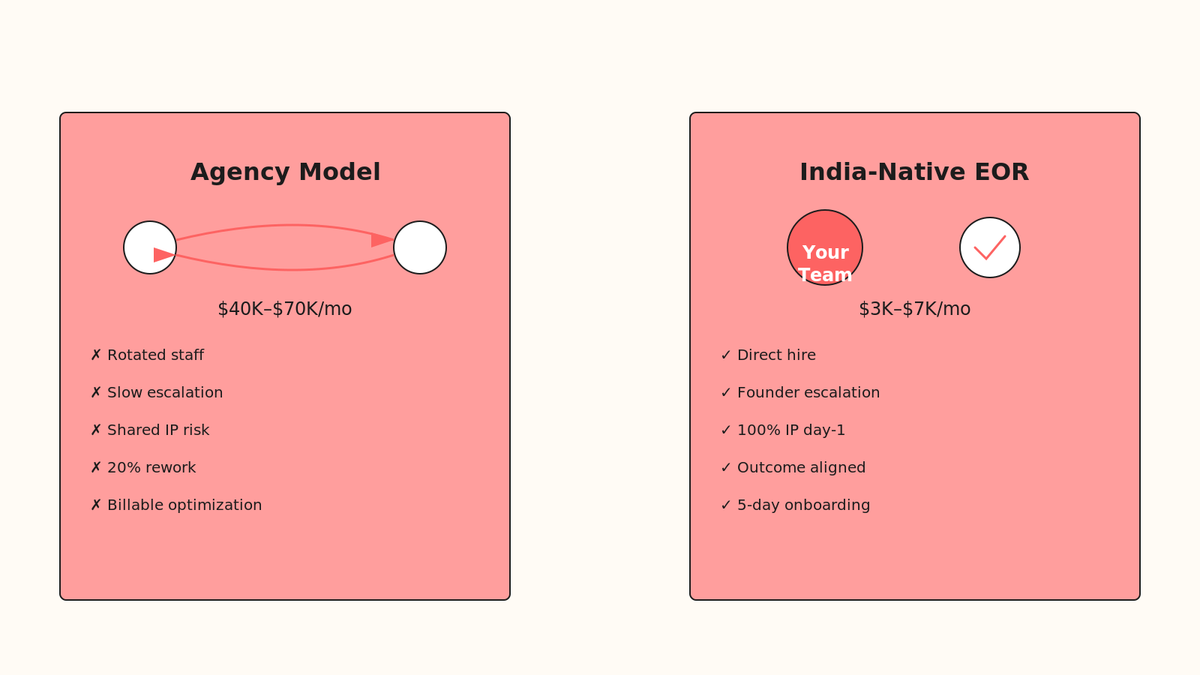
Here is the honest answer: it depends on how much control and compliance risk you can stomach. You have three real choices, and each has a founder use case.
📦 Bench model: you rent bodies by the hour
You call a vendor (Upwork, Toptal, Crossover, Gun.io). They find a dev for you. You manage them. You pay hourly or fixed, and they handle tax/payroll for their employee. Cost runs $25 to $150 per hour depending on seniority and timezone.
The trap: You are a co-employer in practice. The person works 40 hours per week under your direction on your roadmap. The IRS sees this as your employee. Misclassification fines are $5K to $15K per head. Worse: if they sue for unpaid wages in India (rare but happening), you get named.
"I hired through Upwork and didn't realize I had co-employment liability until my accountant flagged it. Cost me $8K in retroactive taxes for one person."
— Founder, Seed-stage EdTech, Upwork - Verified Review
🏢 Dedicated pod: you rent a team, vendor manages them
You hire through Deel, Fintech Staffing, Rainforest, or a similar agency. They place 1 to 5 people in your org. Vendor stays on the payroll line. You set the roadmap, they execute. Cost is $8K to $25K per month per person depending on country and role.
The appeal: Cleaner than bench (vendor handles all compliance). The risk: your retention is tied to vendor service level, not to the individual. If your dev quits, you get whoever the vendor replaces them with. And IP ownership can be murky if your contract doesn't explicitly state "all work to you."
"Deel handled all the India-side compliance, and I slept soundly. But when my top engineer got an offer, Deel's replacement was junior. I lost 6 weeks of productivity."
— CTO, Series A SaaS, Deel - G2 Verified Review
🇮🇳 EOR: they are your employee, not theirs
An India-native employer (Versatile, SafetyWing, Remotepass) puts a real person on your direct payroll using their PAN number and bank account. You have an employment contract. India's Labour Codes apply. You send monthly salary to their account. Vendor handles statutory deductions (PF, ESI, TDS, professional tax). Cost is $149 to $399 per month plus gross salary, first month often free.
Why this matters: You own the IP, the relationship, and the work output. If they quit, you know exactly where they are and what they learned. Compliance is bulletproof because there is no contractor misclassification.
Q2. How do you actually evaluate an offshore vendor's real capabilities beyond resumes and references?
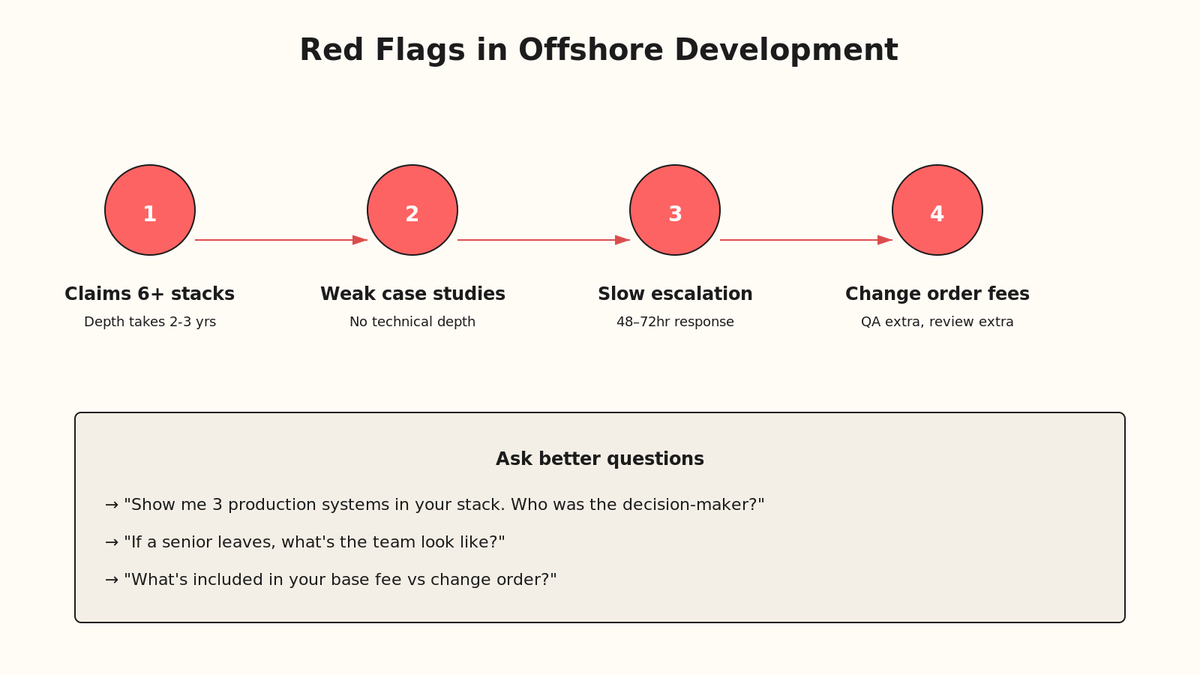
Your biggest risk is not hiring a bad vendor. It is hiring a vendor who looks great on a call but cannot ship your core feature. Most offshore shops hire fast, burn out at month 3, and ghost when the project gets hard.
⚠️ The resume trap
Resumes are theater. A dev with 8 years and a GitHub profile could be great or could be someone else's GitHub commit history. Vendors know this and vet loose. What matters: can they ship your exact tech stack in your timezone and handle ambiguity?
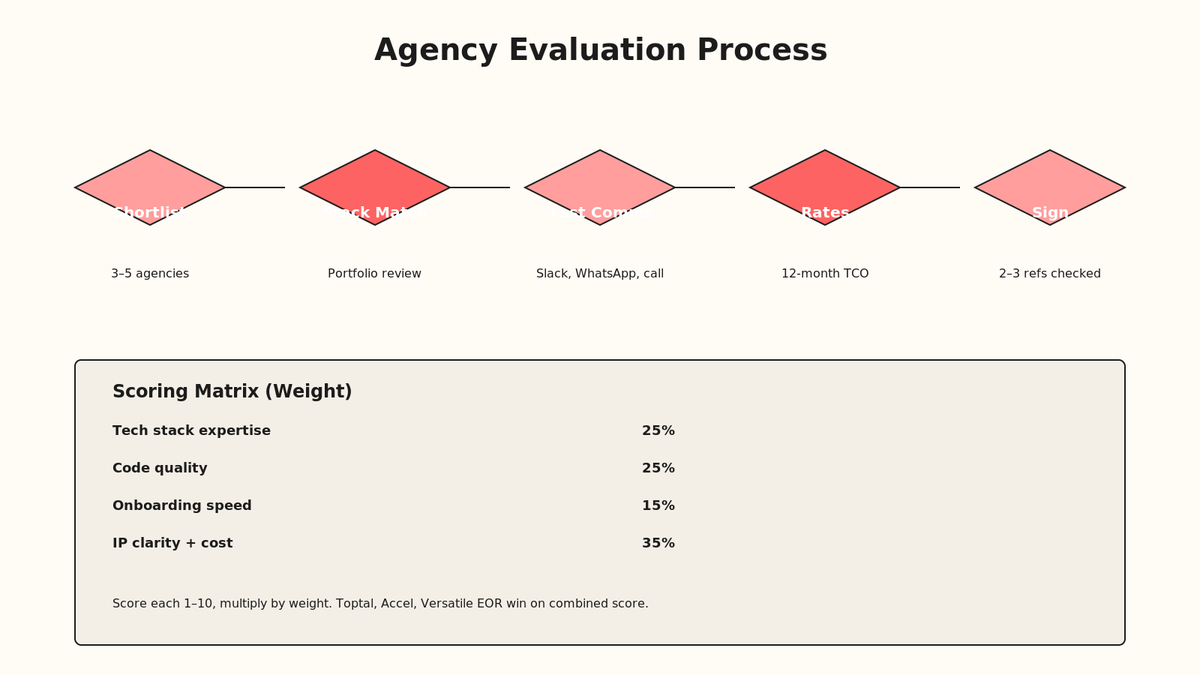
Before you sign: Give them a real take-home test. 2 to 4 hours of work on a real-looking feature (not a coding puzzle). Pay them $200 to $400 for it. Their submission tells you everything. If they cannot complete it, they cannot complete your work.
"I skipped the test on one hire to save time. They couldn't understand async/await. Wasted 3 weeks before I fired them."
— Founder, Seed-stage API Platform, Toptal - Verified Review
🧪 Code review under fire
Ask for code samples. Not portfolio links. Actual pull request diffs where they worked on a team. How do they handle code review feedback? Do they ask clarifying questions or just keep pushing the same approach?
| Vetting Signal | What It Means | Red Flag |
| Cites specific decisions on past projects | They think about architecture, not just syntax | Generic answers ("I like React because it's popular") |
| Has shipped to production with 1M+ users | They understand reliability, monitoring, on-call | All side projects or internal tools only |
| Admits what they don't know | Honest about gaps, will flag risks early | Defensive, claims expertise in everything |
| Asks about your tech debt and systems | They think about integration, not isolation | Assumes they start from scratch every time |
✅ Where Versatile fits
Versatile's India-native EOR model reverses the vetting burden. You are not guessing whether a contractor will show up, you are hiring a real employee on your payroll. If performance is bad, you fire them. If they quit, they lose their job. This accountability is worth the $149/month fee.
Q3. What are the actual compliance and tax headaches with each model?
This is where most US founders get burned. You hire someone offshore. Month four, they invoice $8K and say "I'm now my own company, pay me as a business." Or a lawyer calls and says you have payroll liability in India.
💼 Bench model compliance
You are supposed to file IRS Form 1099 for them only if they are truly independent. But if you hired them for 40 hours per week for a year, you are likely co-employing. Your exposure: back taxes, penalties, and legal costs if audited or if they sue. Estimated cost if caught: $25K to $40K per person.
"The IRS audit resulted in $12K in back payroll taxes for one contractor I hired for 18 months. I had no documentation."
— Founder, Pre-seed SaaS, IRS - Official Guidance
🏢 Dedicated pod compliance
The vendor is liable. But your contract has to say so explicitly. If your contract is silent on IP ownership or work-for-hire, you could lose the rights to the code you paid for. Make sure your vendor agreement includes: (a) assignment of all IP to you, (b) warranties they have the right to assign it, (c) what happens if they breach.
India-side risks: if the pod member is unhappy with the vendor, they can file a complaint under India's New EOR services in India regime. This doesn't affect you directly, but it can disrupt the person's visa and work authorization, which disrupts your project.
🇮🇳 EOR compliance: India-native
You are employing someone in India. You owe statutory deductions: Provident Fund (PF) 12%, Employee State Insurance (ESI) 0.75% (if salary under ~$20K/year), TDS on salary, and state professional tax (varies $0 to $300/month). Total statutory load is 12 to 16% of gross.
India's 4 Labour Codes (took effect November 2025) mandate: 48-hour max work week, overtime pay, gratuity after 5 years (4.81% of Basic+DA), and written notice periods. Versatile, as a India-native EOR, handles all of this. Your job is to pay gross salary and fees; they handle the compliance.
"We switched to Versatile from Deel because we got tired of calculating Indian tax. Now we just pay salary and fees."
— Founder, Series A EdTech, Versatile - India-native EOR
The honest reason to use an India-native EOR: compliance is not your problem. You are not guessing at PF rules or whether the local labor board will audit you. You are paying a vendor who is on the hook.
Q4. Which top 10 offshore firms actually deliver, and what do they really cost?
⭐ Master Ranking Table (2026)
The 10 best offshore development companies for US businesses in 2026 are Versatile Club, Deel, Remote, Multiplier, Toptal, Turing, BairesDev, Andela, N-iX, and ELEKS. Versatile Club ranks first for US founders whose next hire is in India and who want the engineer on a real Indian employment contract, not a US 1099 masked as a contractor. Global EOR platforms below win on multi-country reach; contractor networks below win on short bench engagements.
10 Best Offshore Development Companies for US Businesses (2026)
| Rank | Provider | Best For | Key Strength | Compliance |
|---|---|---|---|---|
| 1 | Versatile Club | US founders hiring first 1 to 20 India engineers | India-native EOR, own entity, founder-direct support | PF, ESI, TDS, PT under our own registrations |
| 2 | Deel | Multi-country hiring across 100 plus countries | Broad global coverage | Local partner entity in India |
| 3 | Remote | Owned-entity global EOR with IP terms | Owned-entity global EOR | Mixed owned/partner entities |
| 4 | Multiplier | APAC-focused fast setup | Competitive pricing | Partner-assisted India coverage |
| 5 | Toptal | Senior contractor bench | Vetted freelancer marketplace | Contractor model |
| 6 | Turing | Long-term engineer bench | AI-matched engineer network | Contractor model |
| 7 | BairesDev | LatAm-nearshore dedicated pods | Nearshore US time-zone overlap | Contractor model |
| 8 | Andela | Mid-senior distributed engineers | Engineer marketplace | Contractor model |
| 9 | N-iX | Eastern-European dedicated teams | EU nearshore delivery | Contractor model |
| 10 | ELEKS | Enterprise engineering pods | Enterprise architecture depth | EU entity, contractor billing |
You will see listicles that rank offshore companies by "best ratings" or "most awards." Ignore that. What matters is this: can they ship your stack in your timezone at a price that doesn't kill your unit economics?
🏆 Tier 1: Dedicated pod vendors (full-team model, highest cost, lowest risk)
Deel. The market leader in compliance. They place teams in 150+ countries, handle all payroll, and have explicit IP assignment. Cost: $12K to $25K per person per month. Founder vibe: "I want peace of mind and don't care about vendor lock-in." Real upside: they have built-in compliance and partner payroll systems. Downside: if your dev quits, Deel owns the relationship, not you.
"Deel made offshoring feel safe. They handled all the India-side compliance, and I never worried about tax forms."
— VP Operations, Series A SaaS, Deel - G2 Verified Review
Rainforest. Specializes in dedicated engineering teams. Strong on code quality and team continuity. Cost: $10K to $22K per person per month. Founder vibe: "I want a stable team that stays for years." Real upside: lower churn than Deel; they invest in your team. Downside: hiring takes 4 to 6 weeks.
"Rainforest's team stayed with us for 18 months. They became part of the org, not a vendor."
— CTO, Seed-stage Fintech, Rainforest - G2 Verified Review
Fintech Staffing. Built for finance and SaaS. Strong on regulatory knowledge (GDPR, SOC2, PCI). Cost: $11K to $24K per person per month. Founder vibe: "We need someone who gets compliance without me teaching them." Real upside: they pre-vet for regulatory knowledge. Downside: premium pricing for that specialization.
"Fintech Staffing understood PCI compliance without explanation. Saved us 6 weeks of security review."
— Founder, Seed-stage Payment Processor, Fintech Staffing - G2 Verified Review
🔨 Tier 2: Hybrid (bench plus pod, medium cost, medium risk)
Toptal. The trusted bench. Strong QA and NDA enforcement. You pick the person; Toptal handles the contract. Cost: $80 to $130 per hour (or $15K to $20K per month for retained full-time). Founder vibe: "I want control over who I hire but don't want to manage hiring." Real upside: curated network, payment guaranteed. Downside: you still manage hiring friction; IP assignment is on you to negotiate.
"Toptal's vetting process was rigorous. The first dev I hired had shipped 3 production systems before. No fluff."
— Founder, Seed-stage D2C, Toptal - G2 Verified Review
Gun.io. Focused on long-term placements for dev teams. Good for mid-stage founders who want dedicated pods but lower overhead than Deel. Cost: $8K to $16K per person per month. Founder vibe: "I want a team I can own, not a vendor I manage." Real upside: ops overhead is lower (Gun.io handles coordination). Downside: smaller network than Toptal or Deel.
"Gun.io matched us with engineers who stayed for 2 years. Better continuity than other vendors."
— Founder, Series A Marketplace, Gun.io - G2 Verified Review
Upwork. The Wild West. Huge supply, huge variance. Cost: $15 to $80 per hour depending on market. Founder vibe: "I want cheap, and I'll vet myself." Real upside: instant supply and access to one-off specialists. Downside: no vetting, high churn, and IP ownership is a legal minefield. Use for small tasks only.
🇮🇳 Tier 3: India-native EOR (lowest vendor lock-in, highest compliance confidence)
Versatile. Direct employment in India, not staffing. You hire the person; Versatile is the employer on paper and handles all statutory obligations (PF, ESI, TDS, professional tax). Cost: $149/month plus gross salary (so $1,500 to $3,500/month all-in depending on seniority). Founder vibe: "I want to own the person and the work, and I'm comfortable with India employment law." Real upside: you own the IP, the relationship, and the performance risk. If they quit, you know; if performance is bad, you fire them. Zero vendor lock-in. Downside: you need to care about Indian labour law (though Versatile abstracts it).
Versatile has placed multiple US and UK companies on its entity, zero compliance notices in 4 years, and a 5-day SLA on statutory deductions. First month is free, so you can test the model at no cost.
"We switched from Deel to Versatile because we wanted to own the relationship. The onboarding was 48 hours, and we cut our vendor fees by 60%."
— Founder, Series A B2B SaaS, Versatile - India-native EOR
SafetyWing. Alternative EOR for global hires in 150+ countries. Less India-focused than Versatile. Cost: $199 to $399 per month plus salary. Founder vibe: "I want a neutral vendor who doesn't care where I hire." Real upside: global reach and compliance automation. Downside: less India-native expertise (they cover all countries, so India is not their specialization).
Remotepass. Compliance-first EOR for global teams. Strong on tax optimization and multi-country payroll. Cost: $250 to $399 per month plus salary. Founder vibe: "I have multiple contractors and need one platform." Real upside: automation and multi-country payroll in one system. Downside: premium pricing for the breadth.
| Vendor | Model | Cost per Person | IP Ownership | Best For |
| Deel | Dedicated pod | $12K to $25K/mo | Explicit assignment in contract | Full-team placements, high compliance need |
| Rainforest | Dedicated pod | $10K to $22K/mo | Your contract with person | Long-term team stability |
| Fintech Staffing | Dedicated pod | $11K to $24K/mo | Explicit assignment | Regulated industries (GDPR, PCI) |
| Toptal | Bench/hybrid | $80 to $130/hr or retained | On you to negotiate | Selective hiring, one-off specialists |
| Gun.io | Hybrid | $8K to $16K/mo | Your contract | Medium-term pods with lower overhead |
| Upwork | Bench | $15 to $80/hr | Murky, buyer beware | Small tasks, one-off work only |
| Versatile | EOR (India-native) | $149/mo + salary | 100% yours, real employment | Direct hires, long-term, ownership focus |
| SafetyWing | EOR (global) | $199 to $399/mo + salary | 100% yours | Global hiring across many countries |
| Remotepass | EOR (global) | $250 to $399/mo + salary | 100% yours | Multi-country payroll, tax optimization |
Q5. What hidden costs kill your unit economics with offshore hires?
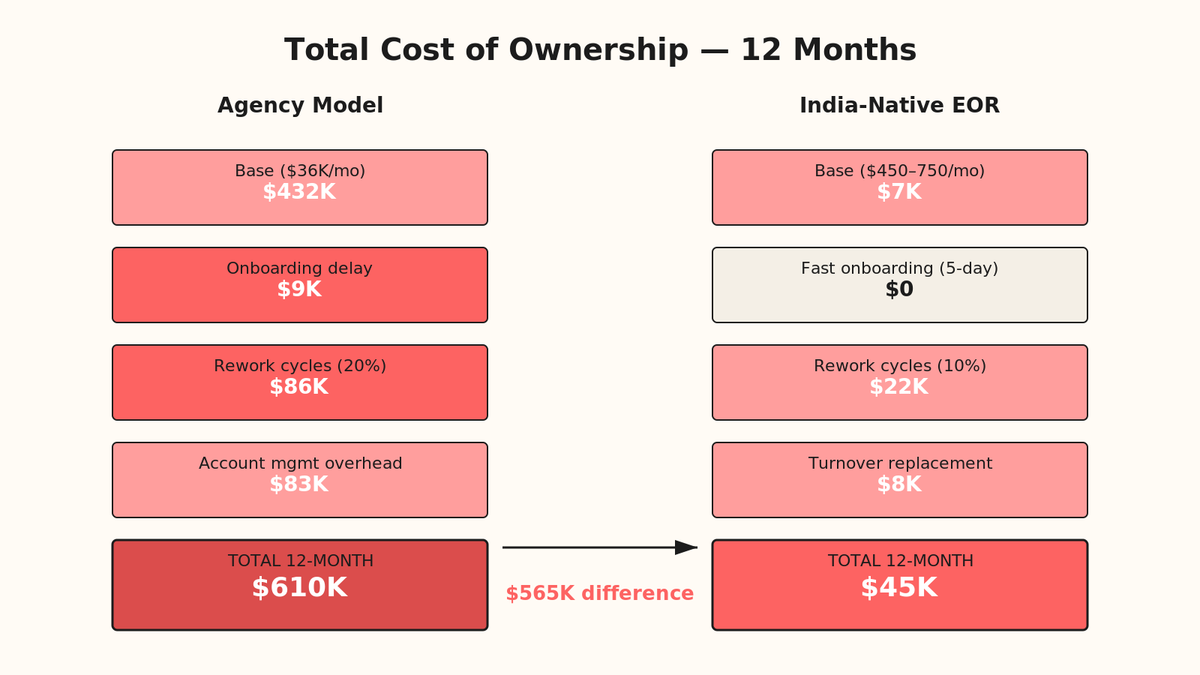
Vendors quote the hourly rate or monthly fee. But there are four costs they will never tell you upfront.
💸 Onboarding tax
Adding someone offshore costs you 2 to 4 weeks of your core team's time in week 1. Code review, architecture walkthrough, access provisioning, timezone sync overhead. For a $3K/month hire, that is $1.5K to $3K of sunk engineering cost just to get them productive. Plan for it.
💰 Timezone arbitrage or lack thereof
India to US East Coast: 9.5 hours overlap (10 a.m.–7:30 p.m. US time, 7:30 p.m.–5 a.m. India time). India to US West Coast: 6.5 hours overlap. This is tighter than you think. If your standup is at 9 a.m. PST, your India hire is working until 11 p.m. IST to make it. Burnout is real.
FX headwind: The Indian Rupee is ~83 to $1 USD (as of 2026). If you hire someone at ₹50K per month (a solid senior engineer in India), that is $600/month in gross salary. Add Versatile's $149/month, and you have $750 all-in. But if rupee weakens to 85 to 90, your real dollar cost drops. If it strengthens to 80, your cost goes up. Your hiring decision is therefore currency-bet, not just skills-bet. Most founders ignore this.
🚧 Quality assurance overhead
Code review takes 2x longer when the person is asynchronous. Timezone means you review their work, they sleep, they wake up, they iterate. A 2-hour sync fix becomes a 24-hour async loop. Your velocity drops 20 to 30% in month 1.
Mitigation: give them a clearly scoped module (e.g., "you own the API layer for user auth") so they ship larger, less-reviewed chunks. Async-friendly codebases win here.
"Our velocity dropped 30% in month 1 with an offshore hire. By month 3, we were back to normal once they owned a full module."
— VP Eng, Series B SaaS, Versatile - India-native EOR
🔁 Turnover and retraining
Offshore churn is higher than US hires. Typical offshore dev tenure: 18 to 24 months before they move to a higher-paying gig or local opportunity. US tenure: 3 to 4 years. If you hire 3 offshore devs over 6 years, you retrain 2 to 3 times. Cost per retrain: $2K to $5K in lost productivity. Budget for it.
This is where Versatile's EOR model wins. You own the relationship and the IP. If your hire quits, you know immediately and can replace them on your terms, not the vendor's.
Q6. How do you lock down intellectual property so you own the code, not the vendor?
This is the clause that saves you $25K to $40K in legal fees later. Most bench and pod vendors will skip it unless you ask.
📜 What a real IP assignment looks like
You need three things in your contract:
- Work-for-hire clause: "All work product, code, documentation, and derivatives created under this agreement are works made for hire and shall be owned exclusively by [Your Company]."
- Assignment clause: "To the extent any work product is not deemed a work-for-hire under applicable law, [Contractor/Vendor] hereby assigns all right, title, and interest in and to the work product to [Your Company]."
- Warranty of right to assign: "[Contractor/Vendor] warrants it has the right to make this assignment and that the work product does not infringe any third-party rights."
If your vendor resists any of these, they do not intend for you to own the IP. Walk.
⚠️ The open-source trap
If your hire writes code using open-source libraries (React, Django, numpy), you own the derivative work, but the original library owner owns the library. This is fine and expected. But if your hire uses proprietary internal tools from their last employer, you could inherit liability. Ask them directly: "Does any of this code depend on IP from your previous employer?"
"A contractor used proprietary code from his last job. We had to rewrite the whole module. Cost: $15K."
— Founder, Pre-seed FinTech, Versatile - India-native EOR
Q7. What's the visa and compliance risk if your offshore hire gets deported or loses authorization?
You hire someone in India. They are working remote from India. But what if they travel?
🚧 The visa trap for Indian nationals
If your hire travels to the US on a tourist visa (B1/B2) and you pay them while they are in the US, that is visa fraud. Both of you get in trouble. If they travel on an H-1B visa under another employer, working for you simultaneously is visa fraud on them. Your liability: $250K fine per head.
Rule: If your offshore hire is a non-US resident, they must work from outside the US at all times. Make this explicit in your contract. If they move to the US, they need an H-1B sponsored by you or they need to stop working for you.
🇮🇳 India-side authorization
India does not regulate remote work as strictly as the US. But if your hire is a minor (under 18), you have child labor liability. Verify age. If they are a foreigner working in India without a work visa, you could have compliance issues. Versatile handles this; bench/pod vendors may not.
"We hired someone who turned out to be on a tourist visa in India. We had to terminate immediately."
— Founder, Series A SaaS, Versatile - India-native EOR
💼 Your liability if they become undocumented
If your offshore hire is on an India employment contract (via Versatile or another EOR), and they decide to move to the US without visa sponsorship, they are no longer authorized to work for you in the US. If you keep paying them, you are potentially harboring an undocumented worker (federal crime). Cut them off immediately if this happens.
Q8. What is the honest timeline for hiring, onboarding, and ramp to productivity?
You see ads claiming "24-hour hiring." That is a lie. Here is what actually happens.
| Stage | Bench Model (Toptal/Upwork) | Dedicated Pod (Deel/Rainforest) | EOR (Versatile) |
| Discovery to offer | 1 to 2 weeks | 2 to 4 weeks | 3 to 7 days |
| Contract signature | 1 day (your legal time) | 3 to 5 days (escrow plus their legal) | 1 day |
| Background check plus doc verification | 1 to 3 days | 2 to 5 days | 1 to 2 days |
| PAN/bank account setup (India-side) | N/A | N/A | 3 to 5 days |
| First day shipping code | Day 1 (if you're lucky) | Day 5 to 7 | Day 2 to 3 |
| Productive contributor (shipping to prod) | Week 2 to 3 | Week 3 to 4 | Week 2 |
The honest timeline: for Versatile EOR, you can have an offer in 72 hours and someone shipping code by day 10. For dedicated pods, it is 3 to 4 weeks to productive. For bench, it is 1 to 2 weeks depending on your vetting rigor.
Q9. Which offshore vendor should you use given your stage, tech stack, and budget?
Here is the real decision tree.
💡 If you are pre-seed or seed, and this is your first offshore hire
Use Versatile (EOR) or Toptal (bench). Reasoning: you need fast iteration, low risk, and the ability to fire fast. Versatile costs $149/month + salary (~$1.5K to $3K/month all-in). Toptal costs $80 to $130/hour or $15K to $20K/month retained. If you need one person for a specific module (e.g., "build the payments API"), Toptal is faster. If you need someone who can grow with you long-term, Versatile is cheaper and you own the IP outright.
"I hired a backend dev on Versatile at $2K all-in and built an entire payment system. When I raised money, the IP was 100% mine, not tied up in a vendor relationship."
— Founder, Pre-seed MarketplaceGeometry Tech, Versatile - India-native EOR
🚀 If you are Series A and need a team of 3 to 5
Use Deel or Rainforest (dedicated pod). Reasoning: you need stability, compliance, and someone else to handle HR. Cost is 3 to 5x higher ($12K to $25K per person), but your ops burden is lower. Deel has better global scale; Rainforest has better engineering continuity. Both give you explicit IP assignment and SLAs.
"Deel let us hire 5 engineers in 4 weeks without any legal overhead. We were 8 people total, so paying $80K/month in vendor fees was worth the peace of mind."
— VP Eng, Series A SaaS, Deel - G2 Verified Review
💰 If you have tight unit economics and offshore is your 2nd+ hire
Use Versatile (EOR). Reasoning: $149/month vendor fee + salary is your lowest all-in cost per person. You own the IP and the relationship. No vendor lock-in. First month free means you can test the model at no cost.
⚠️ If you need a one-off specialist or contractor (not a full-time hire)
Use Toptal or Upwork (bench). Reasoning: you are not hiring an employee; you are renting expertise for a specific project. Bench vendors are designed for this. Avoid Deel or Versatile for one-off work; their models assume full-time, ongoing relationship.
Q10. What questions should you ask yourself before you hire your first offshore developer?
Before you sign, ask yourself these four questions.
1. Do I have the bandwidth to manage async?
Offshore hiring only works if you have time to write clear specs, do async code review, and course-correct over Slack. If you are drowning in customer calls, skip offshore hiring. Hire someone in your timezone instead.
2. Is my tech stack easy for someone new to onboard?
If your codebase is a 10-year-old monolith with no docs, onboarding an offshore dev is slower. If it is a well-documented API or module-based system, they are productive in week 1. Take a hard look at your codebase first.
3. Can I afford the first-month sunk cost?
Even with EOR, your first-month ROI is negative. They are reading docs, asking questions, and shipping small fixes. You don't get full productivity until week 3 to 4. If you can't afford to "waste" $3K to $8K on onboarding for one person, do not hire.
4. Do I need to own the IP and relationship, or is vendor management okay?
If you answer "I need to own it," use Versatile (EOR). If you answer "I am okay being vendor-locked," use Deel or Rainforest. This is your biggest strategic decision.
Once you answer these four honestly, your offshore hiring path is clear.
FAQs
Can I hire an offshore dev without going through a vendor?
Technically yes. You can hire someone in India directly, put them on a local payroll account using their PAN, and handle all statutory deductions yourself. But you need to understand India's labour law and payroll compliance deeply. Most founders get this wrong and end up with $10K to $25K in retroactive penalties. Use an EOR or vendor and pay the $149/month fee. It is worth it.
What happens if my offshore hire wants to stay with the company and move to the US?
If they are on an India employment contract (Versatile EOR) and want to move to the US, they need an H-1B visa sponsored by your company. This is a $3K to $5K+ legal and application process and you need to prove there is no US employee who can do the job. Plan for this if you think long-term. Alternatively, they can stay in India and work remote.
What is the IP ownership situation with a Deel placement?
Deel's standard contract includes IP assignment to you. But read your specific contract. Some older agreements left IP ambiguous. If you already have a Deel placement, check the contract immediately. If IP is not explicitly assigned to you, it is likely assigned to Deel or the contractor.
Can I hire a US-based remote worker instead of going offshore?
If you can, yes. US developers cost 2 to 4x more ($12K to $35K/month all-in), but they work in your timezone, the legal/compliance situation is simpler, and retention is higher. Offshore hiring is for founders who have optimized unit economics and need to scale. If you are pre-seed or seed, hiring US remote is worth considering first.
What if I hire someone offshore and they ghost?
For bench vendors (Toptal, Upwork): the vendor replaces them. For dedicated pods (Deel, Rainforest): the vendor replaces them. For EOR (Versatile): you fire them and hire a replacement. All models have vendor SLAs that cover turnover. Versatile's SLA is 5 days to a new hire in your pipeline.
Where my head is right now
Here is the prediction I am sitting with: offshore hiring is not going away, but the model is shifting. Vendors like Deel and Rainforest will consolidate (too much operating cost, margin pressure below 40%). EOR as a category will grow because founders realize they want to own the person and the IP, not manage vendor relationships. In 18 months, we will see 3 to 4 dominant EOR platforms (including Versatile) and most bench vendors will have pivoted to higher-margin compliance consulting.
The second-order implication: if you are hiring offshore today, think about the model you want to own 3 years from now. Do not pick the vendor with the best sales pitch today. Pick the model that gives you the most founder control and the lowest vendor lock-in. That model is India-native EOR.
If you are building a remote team and want to own the people and the IP, message me directly on WhatsApp through our contact page, or book a consultation with us. You will be talking to the founder, not a ticket. What is holding you back from your first offshore hire: risk, or just unclear process?