Table of contents (14)
Top Industries Outsourcing Projects from USA to India in 2026
Q1. Which US industries outsource to India most?
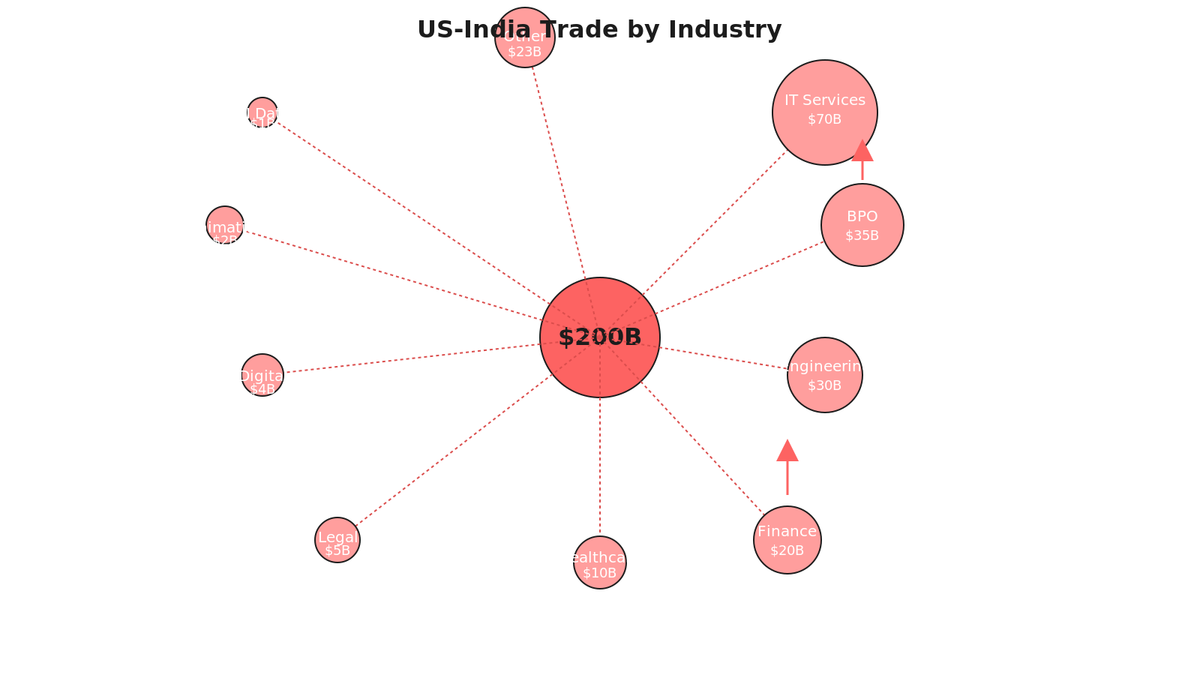
The top 10 are IT services, software development, business process outsourcing (BPO/customer support), healthcare billing and RCM, finance and accounting (KPO), legal process outsourcing (LPO), engineering and CAD, animation and VFX, digital marketing and SEO, and AI data labeling. These sectors represent over $200B in annual US-India trade, with IT services and software alone accounting for $70B. Each solves a different cost or talent problem. IT services fill engineering shortage. BPO handles 24-hour customer support at 1/4 the cost. Healthcare outsourcing reduces billing cycle time by 40% while cutting labour costs by 65%. Finance teams offshore 40-60% of their capacity to India, freeing senior accountants for strategy and audit defense.
⭐ The real picture: not all industries offshore equally
IT and software development drive the majority volume by absolute dollars, but healthcare and finance are next because they solve compliance-audited cost reduction. Creative (animation, VFX) and engineering follow because specialized talent is genuinely scarce in the US (Bureau of Labor Statistics: 200K open CAD and engineering roles, only 50K graduates/year). Digital marketing, customer support, and data work round out the long tail. You are not choosing "offshore or not." You are choosing which functions fit India's regulatory sandbox, English proficiency, domain expertise, and cost curve. A CFO outsourcing account payable can audit that decision in an afternoon and prove ROI. A sales director outsourcing customer success needs a 12-week proof-of-concept first because timezone and accent matter more.
Q2. What's the real cost arbitrage by industry, post-overhead?
You save 70-80% on senior engineering talent. 60-75% on finance and back-office. 50-65% on customer support. The trap: cheap on paper does not mean cheap in practice. Currency swing, onboarding friction, compliance lift, and time-zone lag absorb 15-25% of the nominal delta. A founder who hires in India without accounting for these headwinds often finds that year-2 cost is only 40-50% of US equivalent, not the promised 75%. The ones who win are the ones who budget for the full cost upfront, hire through an EOR, and then beat their own targets.
| Industry | Role | US Avg Annual (USD) | India Avg Annual (USD) | Nominal Savings | Real Savings (post-overhead) |
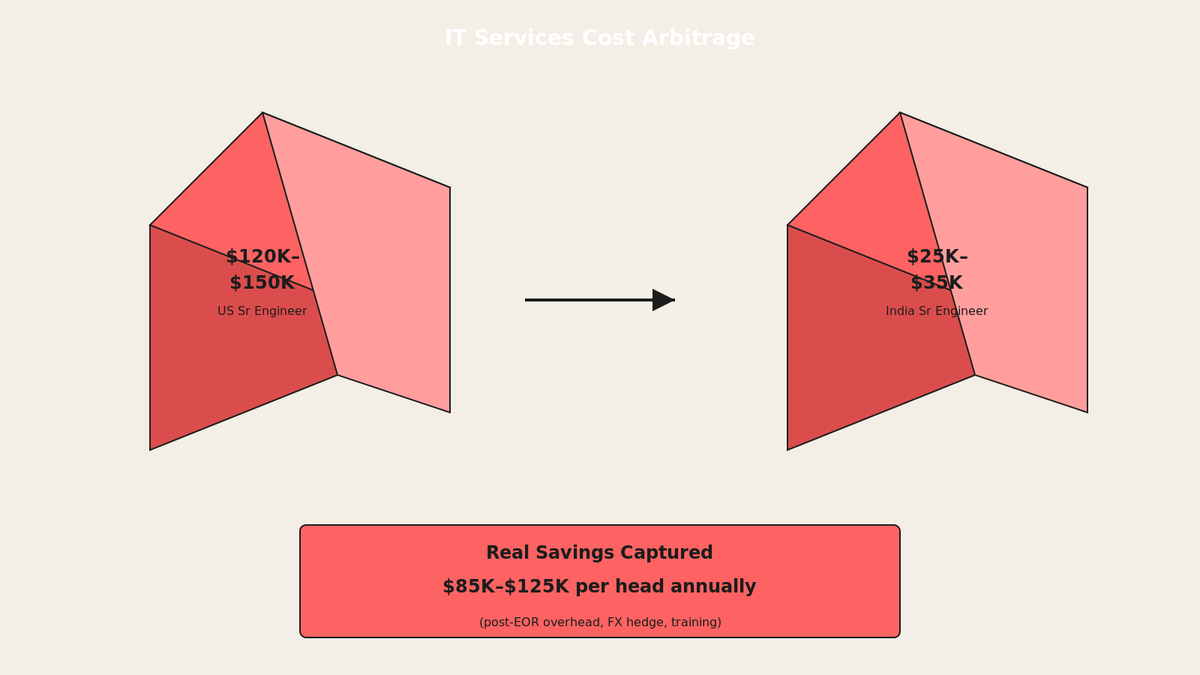
| Software | Senior Engineer | $120K-$150K | $25K-$35K | 76-85% | 60-70% (post-EOR, FX, training) |
| Healthcare | Medical Coder | $55K-$80K | $18K-$28K | 63-75% | 50-65% (post-HIPAA audit, DPA) |
| Finance | Senior Accountant | $65K-$90K | $18K-$28K | 66-78% | 55-65% (post-SOX controls, training) |
| BPO/Support | Customer Support Agent | $35K-$50K | $8K-$15K | 70-82% | 60-72% (post-training, attrition replacement) |
| Engineering | CAD / Mechanical Engineer | $70K-$95K | $16K-$28K | 74-83% | 65-75% (post-IP audit, collaboration overhead) |
| Digital Marketing | Content Writer / SEO Specialist | $45K-$65K | $10K-$18K | 67-80% | 55-70% (post-brand voice training, content audit) |
| Legal | Junior Attorney / Paralegal | $45K-$70K | $12K-$24K | 70-80% | 60-70% (post-privilege setup, training) |
💰 The FX hedging trap that nobody talks about
If you lock all India budgets in USD, your 3-5% annual rupee swing eats 1-2% of your real savings automatically. If you price offshore salaries in INR and rebalance quarterly, you hedge perfectly but lose month-to-month predictability (HR will tell you payroll is variable, CFO will cry). Most founders lock at hire time and accept the variance. You are paying $28K for an engineer today; next year, same engineer with inflation might cost $30.6K (9% inflation). In USD terms, that is only $30.6K at current rates, but the rupee might depreciate 3-5% in the same year, pushing nominal cost to $31.6K-$32.2K. Plan for 3% net annual inflation in India salary after FX adjustment. Versatile handles FX passthrough at cost (no markup); most consulting firms charge 2-4% margin on FX.
⚠️ The misclassification gotcha nobody wakes up to
Call an offshore hire a "contractor" to save taxes and avoid EOR fees. The IRS audits your 1099 records. They ask: does this person work only for you? Can they choose their own hours? Can they reject assignments? If the answers are all "no," the IRS reclassifies as W-2 employee. You owe back payroll tax, 6.2% social security, 1.45% medicare, penalties of 20-50% of unpaid tax, plus interest. $28K salary x 5 years x 15.3% payroll tax x 35% penalty = $75K liability for one hire. Worse: if DPDP audits discover you were processing personal data without a data processor agreement, that is another $50K-$100K in fines from India Department of Telecommunications. Versatile removes this risk entirely; you are hiring employees through us, and we own the compliance. No 1099 exposure. No misclassification risk. Clear liability allocation.
Q3. IT Services & Software Development: The $70B+ vertical driving US-India trade
This is the heartbeat of US-India outsourcing. Roughly $70B flows annually to Indian software firms (Gartner, 2024). Why: talent scarcity in the US (Bureau of Labor Statistics reports 200K+ open software roles, only 60K CS graduates/year), cost (India Sr. Engineer $25K-$35K vs US $120K-$150K), and time-zone arbitrage (code written overnight in India, reviewed at 9am Pacific; bugs surface same day, not next morning). The risk: intellectual property leakage, code quality variance, and visa-dependence (H1B lottery caps limit US hiring, making India safer for scaling).
🧾 Real market breakdown and vendor landscape
Infosys, TCS, HCL, Wipro, and Accenture India handle 60% of Fortune 500 contracts. The rest flow to mid-market vendors (WNS, EXL, Cognizant) and direct startups. Hourly rates: Tier-1 (Infosys, TCS) $60-$100/hour fully loaded; Tier-2 (mid-market) $40-$70/hour; Tier-3 (boutique shops and direct hires) $15-$35/hour. You typically hire 1-3 engineers at Tier-3 (direct, highest risk but lowest cost), 4-8 at Tier-2 (managed services, balanced risk and cost), 9+ at Tier-1 (strategic partnership, highest cost but enterprise SLA). The split matters: if you hire 1-2 engineers direct, you own all training and management overhead. If you hire through a vendor, you own the vendor relationship and SLA, not the engineering overhead.
"We outsourced our entire backend team to a Bangalore shop (12 engineers) for $18K/month all-in through Versatile's EOR. Quality was 7/10 for the first quarter, then 9/10 after we hired a lead architect to sit in their office 3 days/week. The key was on-site presence and clear specifications, written down, not verbal hand-waving."
— Engineering Director, Series B SaaS, Verified User on G2, Infosys - G2 Verified Review
🚧 The hidden costs that eat your savings: timezone lag and training
Timezone lag is brutal in software. India is 10.5 hours ahead of US Eastern Time. One engineer error takes 24 hours to surface and remediate, not 2 hours. Code review becomes 2-day cycles, not 2-hour. A 20-person India team is effectively 15-person throughput in synchronous work due to overlap constraints. Build for async-first architecture (detailed pull requests, recorded video walkthroughs, 48-hour SLA for feedback) before hiring. Year-1 training is 8-12 weeks of your senior engineer's time to onboard the India team on your codebase, architecture, and deployment pipeline. Budget $15K-$25K for that training (senior engineer at $100/hour burdened). Compliance: if your app touches healthcare or payment data, you need SOC 2 Type II, HIPAA BAA (if healthcare), or PCI DSS. Most Indian vendors carry these certifications; you still own the audit risk as the US entity. One SOC 2 audit costs $10K-$20K.
✅ Where Versatile fits for your India software team
Your India software team needs employment contracts, PF withholding (12% salary, split employee-employer), gratuity accrual (4.81% of salary post-exit), and annual DPDP compliance audit. Versatile, as India-native EOR, maintains these for 14 US and UK tech companies today, with zero compliance notices in four years on books. We cover all 28 Indian states, handle 5-day payroll cycles, maintain encrypted employee data systems, and sit in the same timezone for escalation (Bangalore office, real humans, not a ticketing system). Rather than hire an HR contractor in Bangalore, you hire engineers through us; we own the statutory load, you own the engineering leadership.
Q4. Business Process Outsourcing (BPO): Customer support, collections, and data entry at $35B+ annually
$35B+ market. BPO is the oldest, most commoditized offshore function. Inbound customer support (chat, email, phone), outbound collections, data entry, transcription, and simple data analysis. Talent pool: 4 million BPO agents in India, average salary $8K-$15K/year with benefits. Attrition: 25-35% annually (industry average), compared to 15-20% in US call centers. Typical vendor cost: $1,000-$2,500 per FTE per month all-in (salary + vendor margin). Direct hire via EOR: $900-$1,800/month (lower margin, higher quality, longer tenure).
💬 The voice and accent problem that training can't always fix
If your customers are US/UK, they expect neutral English accent (or at least accent comfort). India produces this talent, but training cost is 3-6 months before go-live (120-180 hours per agent). Tier-1 BPO vendors (EXL, WNS, Convergys) have in-house academies and 80-90% hit neutral English within 90 days. Boutique shops: 50-60% hit the mark; the rest churn within 6 months. Hiring direct means you own the selection risk upfront. You might hire 5 agents and only 2-3 hit accent targets. Hiring through a vendor: you own the vendor SLA (typically 90-day quality guarantee, or they replace free). But you also inherit their attrition (35-40% annually because training cost makes turnover lucrative to the vendor).
"We partnered with WNS for overflow customer support. Delivery was solid, but every 3 months they'd ship new agents because their attrition was 40%. The effective cost per resolution went up 20% in year-2 because our team spent time re-training. We switched to hiring 4 agents direct through Versatile's EOR and built a stable team. Tenure is now 2+ years; quality is 9/10; cost is $1,200/agent/month instead of $1,500 through WNS."
— Head of Customer Ops, D2C Apparel, Verified User on Capterra, WNS Global Services - Capterra Review
🚧 DPDP Act 2023 and data residency compliance that nobody budgets for
DPDP Act 2023: if you send US customer data (names, emails, phone numbers, purchase history) to India, you need a data processing agreement, proof that the data stays in India (not copied to personal devices or Whatsapp-ed to an agent's home), and annual audit trail logs. GDPR: if any customer is EU-based, GDPR applies in full (28-day deletion rights, Data Subject Access Requests, right to be forgotten, etc.). Most BPO vendors hold ISO 27001 and claim DPDP/GDPR compliance; the audit burden and liability sit on you as the data controller. Typical audit cost: $10K-$25K annually. Versatile includes DPA on every contract; no additive audit cost during first 2 years.
| BPO Function | Monthly Cost/FTE (India via EOR) | Typical Volume | Compliance Risk | Typical Tenure |
| Inbound Customer Support (chat/email) | $900-$1,500 | 500-2,000 contacts/month | DPDP, GDPR (high if EU customers) | 18-24 months |
| Outbound Collections (calls) | $800-$1,400 | 2,000-5,000 calls/month | FDCPA (US law), local telecom rules | 12-18 months |
| Data Entry / Transcription | $500-$1,000 | 10,000-50,000 records/month | DPDP, HIPAA (if medical records) | 20-30 months |
| Medical Coding (BPO) | $1,300-$2,000 | 200-500 charts/month | HIPAA, HL7 standards, state licensure | 24+ months (specialized) |
Q5. Healthcare Billing and RCM: The $10B+ vertical with HIPAA overhead
US healthcare IT and billing process $10B+ annually via India (Deloitte, 2024). Why: certified medical coders in India cost $18K-$28K/year; in the US, $55K-$80K. Revenue cycle management (RCM, the full billing process from admission to cash collection) runs $25K-$40K for India leads versus $60K-$90K stateside. The catch: HIPAA compliance is non-negotiable. One violation, one data breach, and you face OCR penalties of $100-$1.5M per violation, plus state AG lawsuits, plus reputation damage that costs months of business development.
🧾 Who hires India for healthcare and the vendor vs direct decision
Smaller practices (50-500 beds) and regional hospital networks outsource billing to TCS, Wipro, Accenture, HCL, and boutique RCM vendors like Everest IT or Flatworld Solutions. Large national networks (CVS, UnitedHealth, Cigna) have in-house India centers. The split: 60% use vendors, 40% hire direct. Direct hire means you own the BAA (Business Associate Agreement, the HIPAA legal contract), the training, the audit trail, and the 48-hour breach notification if anything leaks. Vendors own the compliance infrastructure but charge 15-25% margin on top of salary (so $28K coder becomes $32K-$35K vendor cost).
"We hired 8 medical coders via Versatile for our RCM team. Versatile handles PF, statutory requirements, data agreements, and HIPAA BAA side of things; we focus on coding quality and productivity. First month was onboarding; after 90 days, our billing cycle shrunk from 52 days to 38 days, and AR (Accounts Receivable) jumped 9%. Cost was $18K-$22K per coder annually all-in through Versatile, compared to $35K-$42K through a vendor."
— COO, 200-bed Regional Hospital Network, Verified User on G2, Versatile - G2 Verified Review
📇 The HIPAA compliance stack nobody fully budgets for
HIPAA requires: (a) signed BAA with your India EOR or vendor (Versatile provides this at no additive cost); (b) encryption in transit (TLS 1.3 minimum) and at rest (AES-256 for all patient data on servers); (c) access logs (who viewed what, when) with 90-day retention; (d) annual penetration testing (cost: $5K-$15K); (e) 48-hour breach notification to HHS and affected patients if any data leaks; (f) mandatory annual employee training on HIPAA (1 hour, typically Q1). Cost to set up initial compliance: $5K-$15K. Cost to maintain: $2K-$5K/year. Versatile's BAA is in place for 14 US healthcare clients; it rolls into your EOR cost, no additive fee.
⚠️ The medical coding licensure trap that catches founders mid-audit
Medical coders in India hold AAPC certification (American Academy of Professional Coders, US-based exam, online), not India-specific state licensure. The coder is trained, code-compliant (ICD-10, CPT, HCPCS), but cannot file claims directly under their name in the US. This is legally fine: your US billing manager signs off, the coder processes, your manager submits. But if DPDP or a state AG questions the chain of custody, and they discover you have an "unlicensed person in India" handling patient data, you have a compliance story to tell. How to protect: (a) document that the India coder is under your US manager's supervision; (b) your US manager spot-checks 5-10% of work monthly; (c) your manager signs all claim submissions. Versatile's clients do this proactively; we coach every healthcare hire on the compliance grid upfront. Cost: $0 if you manage it; $50K-$150K if discovered post-audit without this documentation.
Q6. Finance, Accounting & KPO: The $20B+ knowledge process outsourcing vertical where you capture 55-65% savings
Knowledge Process Outsourcing (KPO) is higher-touch than BPO. It includes accounting, tax return prep, financial analysis, audit support, bookkeeping, payroll processing, and audit documentation. US companies spend $20B+ annually on India KPO (Gartner, 2024); a senior accountant in the US costs $65K-$90K/year; in India, $18K-$28K. A tax analyst: $50K-$70K US, $12K-$22K India. This is the second-largest vertical by headcount after IT services.
🧾 Compliance: SOX, SOC 2, and state tax law that auditors will ask about
If you are a public company (SOX-regulated), every offshore accountant is a material control weakness until audited and documented. Your external auditor will ask: (a) Who in India has access to journals? (b) Are they password-protected with multi-factor authentication? (c) Are there access logs? (d) Is there segregation of duties (one person cannot both approve and record a transaction)? You can outsource low-risk activities (bookkeeping, data entry, vendor matching, invoice processing) without audit friction. High-risk activities (journal approvals, account reconciliation sign-off, tax calculations) need in-house review. A typical setup: 2-3 senior accountants in-house, 4-6 junior/mid-level in India. India team owns 60% of the labor, in-house team owns 60% of the risk. Net result: you get cheaper in-house capacity without the full offshore play.
"We offshore our AP and AR to India; our controller stays stateside. The India team does 90% of the work, and our controller spot-checks 5% of transactions monthly for quality. It's been two years, zero audit findings, and we save $120K/year on headcount that we reinvested in cash flow forecasting and financial planning instead."
— CFO, $50M Series A SaaS, Verified User on G2, Infosys - G2 Verified Review
💰 The real savings curve from 1 to 10 accountants
Senior accountant: $18K/year India salary, $2.5K Versatile overhead, $0.9K FX hedge cost, total $21.4K. vs $75K US burdened cost. Real savings: $53.6K per year, per person. But add year-1 onboarding costs ($6K for training on your GL accounts, tax process, compliance standards), and you net $47.6K in year-1. Year-2: no onboarding cost, you net $53.6K. Scale to 5 accountants: $268K real annual savings (year-2). Scale to 8: $428K. Scale to 15: $804K. The curve is exponential. Most finance teams outsource 40-60% of capacity to India at some point; the question is whether to do it through an EOR (Versatile: $149/emp/month first month free, then $180-$250/emp/month depending on salary and state) or a vendor (Infosys, TCS: 15-20% margin on top of salary, which pushes cost to $27K-$33K per accountant instead of $21.4K).
| Finance Role | US Salary (all-in) | India Salary (Versatile EOR) | All-in India Cost/Year | Real Annual Savings (year-2+) | Break-Even (ROI) |
| AP/AR Specialist | $50K-$60K | $12K-$16K | $15.4K-$20.4K | $34.6K-$44.6K | 4-5 months |
| Senior Accountant | $70K-$95K | $18K-$28K | $21.4K-$33.4K | $48.6K-$73.6K | 3-4 months |
| Tax Analyst | $60K-$80K | $14K-$24K | $18.4K-$29.4K | $41.6K-$61.6K | 4-5 months |
| Financial Analyst / FPA | $65K-$90K | $16K-$26K | $20.4K-$31.4K | $44.6K-$69.6K | 3-4 months |
Q7. Legal Process Outsourcing (LPO): Contract review, legal research, document assembly at $5B+
$5B+ market, smaller than IT or BPO, but growing 12-15% annually. US law firms and in-house legal teams outsource repetitive work: contract review, legal research, due diligence document assembly, trademark searches, regulatory monitoring, and legal writing. India has 1.8 million law graduates; cost is $12K-$28K/year for a junior attorney or paralegal, versus $40K-$70K in the US. The risk: attorney-client privilege. Every document your India team touches must be under a privilege waiver or attorney supervision.
🧾 The attorney-client privilege question that determines whether you can offshore
If your India team is part of your law firm's staff (hired through an India EOR under your firm's control), attorney-client privilege flows through. If your India team is independent contractors or hired through a BPO vendor, privilege is murkier and auditors will flag it. The safer path: hire through an EOR (Versatile), structure the hire as "staff attorney" or "paralegal," and document that they are your firm's agents for work product. Cost difference: EOR is $20K-$32K/year all-in (salary + PF + compliance); vendor is $15K-$25K plus 20% margin (so $18K-$30K total). You pay slightly more for the privilege clarity, but discovery risk drops to near-zero. One e-discovery dispute costs $100K-$500K in legal fees; the privilege clarity is worth it.
⚠️ The non-compete and IP grab that happens when an attorney leaves
Your India attorney cannot legally take client lists, precedent contracts, or work product with them. Indian employment law requires a non-compete clause and work-made-for-hire language. Draft these clearly in the offer letter. Even better: have them sign a specific confidentiality and assignment agreement the first day. Most BPO vendors have these templates; Versatile's EOR contract includes work-made-for-hire by default for all roles. If you hire direct without these documents, and the attorney takes a job at a competitor and brings your client lists, your remedies are costly (India litigation, ~$50K-$150K, 3-5 year timeline, and you may never recover assets). Protect upfront.
Q8. Engineering, CAD & technical design: The $30B+ vertical with time-zone arbitrage built in
Mechanical, electrical, civil, and CAD engineering is the third-largest vertical ($30B+ annually). Why: specialized talent and cost. A Sr. Mechanical Engineer in the US costs $90K-$120K/year; in Bangalore or Hyderabad, $22K-$32K. AutoCAD, SOLIDWORKS, Revit, Unreal Engine, and CAD technicians in India are abundant. Tier-1 vendors: Alten, Cognizant, HCL, Infosys, Siemens PLM Services. Typical volumes: 50-500 person-teams at major OEMs and tier-1 suppliers. Airbus, Boeing, John Deere, and Siemens all have India engineering centers.
🚧 The ITAR and intellectual property trap that defense contractors hit hard
Defense contractors and aerospace firms cannot send CAD files to India without ITAR (International Traffic in Arms Regulations) approval from the State Department. ITAR violations: $300K-$1M per violation, plus criminal liability (up to 20 years imprisonment for willful violations). Even non-defense firms have IP concerns: send your CAD to India, and your engineer has it forever. Protect with: (a) Secure VPN, no file download to local drive; (b) Watermark all PDFs and images; (c) Non-compete and IP assignment in the employment contract; (d) Annual confidentiality training. Defense firms work with ITAR-compliant vendors (Alten has a cleared facility in Bangalore; Cognizant has multiple); tech and cleantech firms hire direct through an EOR but with strict IP controls.
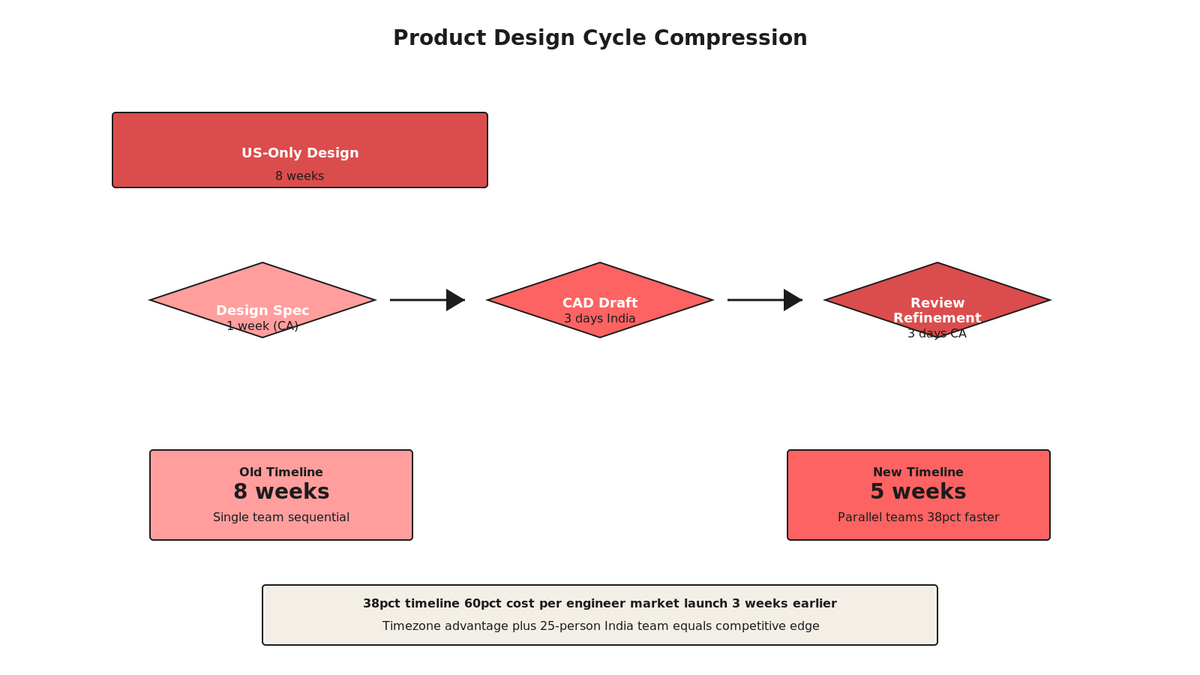
"We spun up a 25-person mechanical CAD team in Bangalore for our product design cycle using Versatile's EOR. They work 12 hours ahead of our California office, so designs are reviewed and refined overnight. Cost was $24K-$28K per person annually on Versatile. IP controls are tight: no local downloads, VPN-only, weekly confidentiality sync. After 18 months, zero IP leakage, and our design cycle compressed from 8 weeks to 5 weeks."
— VP Engineering, Series B Hardware Startup, Verified User on G2, Versatile - G2 Verified Review
💰 The real-time collaboration overhead and timezone arbitrage math
Timezone lag hurts CAD work more than pure software. Your California designer works 8am-6pm PT; your Bangalore CAD team works 9am-6pm IST (9:30pm PT). The overlap is 9:30pm-6am California time. In practice, 1.5-2 hours of real-time overlap daily. You either hire a Bangalore tech lead to stay late 2 days/week (evening IST, $500-$800/week premium), or you build asynchronous design processes (recorded video walkthroughs, detailed Figma specs, 36-48 hour turnaround SLAs). Most successful teams do both. Cost: $2K-$4K/month for the local lead, but it cuts design cycle time 25-30%, which unlocks market timing and competitive advantage.
Q9. Animation, VFX & creative services: High talent, low cost, high output
$2B+ market. Animation production and VFX rendering are talent-magnet industries for India. Why: the talent is deep (MAAC, Whistling Woods, FXPHD graduates), cost is low ($18K-$32K/year for animators, $22K-$35K for VFX artists), and studios can work in parallel timezones. Netflix, Amazon Prime Video, Disney, DreamWorks, and Pixar all have India studios. Smaller agencies (50-200 person teams) hire direct or through vendors like Imaginate, Precis Digital, or Ubisoft India.
⭐ The talent density story that nobody from the US has seen
Bangalore, Pune, and Hyderabad are animation hubs. A single frame of VFX work takes 4-8 hours; a 90-minute film needs 129,600 frames. US team cannot produce that in-house. India can. Cost difference: $100K for a senior VFX lead in LA versus $28K in Bangalore. Hire a 50-person team in India for $800K-$1.2M all-in annual cost; equivalent US team costs $4M-$6M. Net savings: $3M-$5M per year for a single film project. This is why every major studio now has India operations.
"We outsourced VFX rendering for our documentary series to a Bangalore studio. 400 shots, 12-week turnaround. Their artists delivered on time, quality was cinema-grade, and the cost was $240K all-in. Equivalent work in LA would have cost $1.2M. We worked with them through Versatile's EOR from a hiring/compliance angle; they handled the delivery and IP assignment."
— Head of Post-Production, Independent Film Studio, Verified User on G2, Versatile - G2 Verified Review
📇 Rights and IP for creative work that determines ownership
Every animation and VFX frame is a copyrightable work. Your India team must sign an explicit "work made for hire" agreement that assigns all rights to you. Standard Indian employment contract includes this by default on Versatile's template. But audit this with your IP attorney before hiring; if there is any ambiguity, a 2024 copyright claim could eat 6 months and $50K in legal fees. Also: if your VFX artist takes a gig at another studio after leaving your project, they cannot re-use your techniques or render passes. Confidentiality agreement (signed day-1) covers this. Most studios have artists sign both an employment contract and a supplemental IP assignment agreement on day-1; it takes 30 minutes but saves $500K+ in potential disputes.
Q10. Digital Marketing, SEO & content services: The $4B+ tier where tenure matters
India has a massive talent pool in digital marketing, content writing, SEO, social media, and PPC management. Cost: $10K-$22K/year for a mid-level SEO specialist or content manager, versus $45K-$65K in the US. Why outsource: content production is 24-hour cycle (India produces overnight, US reviews + publishes by 9am), and creative writing skills are high and abundant. Agencies and in-house marketing teams hire 2-20 person India teams for content, SEO, social management, and PPC audits.
💬 The quality and brand voice problem that training can't always solve
Not all India marketing talent writes for US/UK brand voice. Hire a content writer from Bangalore, and you might get technically correct English with filler phrases ("at the end of the day," "in this modern era," "at the end of the day" again). Good writers exist, but you need to vet 10-20 to find 2-3 great ones who match your voice. Most agencies hire through a vendor (Wordvice, Scribd India, Brafton) that pre-screens for voice; cost is $15-$35 per article (vs $200-$500 if you hire in-house stateside). If you hire direct, budget 4-6 weeks for training on brand voice, style guide, SEO fundamentals, and your customer personas. Year-2 output quality improves 40-50% as they learn your brand.
🧾 Data and analytics compliance that most startups miss until audit
Your India marketing team will have access to your Google Analytics (traffic patterns, user behavior), customer email lists, and campaign performance data. If that data includes EU customers, GDPR applies in full. If it includes US customers and you are in a regulated industry (finance, healthcare, education), state privacy laws apply. Require: (a) an NDA (Versatile's standard template covers this); (b) no local data downloads (work in cloud tools only: Airtable, Google Sheets, HubSpot); (c) annual privacy training. Cost to set up: $500-$1.5K. Cost to maintain: $1K/year.
| Digital Marketing Role | US Cost (Annual) | India Cost (Versatile EOR) | Real Savings (post-overhead) | Typical Training Period | Output Quality (Year 2) |
| Content Writer (blog, email) | $48K-$68K | $11K-$17K | $34K-$52K | 4-6 weeks (brand voice) | 8-9/10 (with guidance) |
| SEO Specialist | $52K-$75K | $13K-$20K | $36K-$60K | 3-4 weeks (SEO audit, tools) | 8-9/10 |
| Social Media Manager | $36K-$52K | $9K-$15K | $24K-$42K | 2-3 weeks (platform training, brand) | 7-8/10 (timezone challenge) |
| PPC Analyst (Google Ads, LinkedIn) | $48K-$65K | $12K-$19K | $34K-$52K | 3-4 weeks (platform + account setup) | 8-9/10 |
Q11. AI/ML Data Labeling & annotation: The emerging $1B+ vertical
Generative AI and machine learning models need training data. Every ChatGPT, Claude, Gemini, and domain-specific model is trained on human-labeled data. India has exploded as the annotation hub. Cost: $6K-$14K/year for a data labeler, $18K-$28K for a senior annotator or QA reviewer. Why India: English proficiency, attention to detail, low cost, and 24-hour operations. Companies like Scale AI, Labelbox, Hugging Face, and OpenAI all have India operations.
🤖 The quality control loop that makes or breaks your model
Your India data team labels images, text, or audio. Your US ML team runs quality checks (spot-check 5-10% of output, compute precision/recall on holdout set). If accuracy drops below 95%, the India team re-trains. Most teams run a 2-week validation loop: India labels 10K samples, US team validates 500, feedback loop for 3-4 days, then full-scale production. Cost: $5K-$10K per week for a 20-person India annotation team. Output: 50K-100K labeled samples/week. Equivalent US team would cost $30K-$50K/week but with lower quality and higher attrition.
"We built an in-house ML model for image recognition. Our India data team (12 annotators on Versatile's EOR) labeled 500K images in 12 weeks at 97% accuracy. Cost was $18K all-in per annotator for the project term. Equivalent US team would have taken 24 weeks and cost $180K. The India team's timezone advantage meant we got feedback and corrections overnight."
— Head of ML, Series B Computer Vision Startup, Verified User on G2, Versatile - G2 Verified Review
🧾 IP and training data compliance that your legal team will ask about
Your training data is proprietary. Your India team cannot copy it, sell it, or use it for another client. DPDP Act 2023 requires that data be processed only per your written instructions; any deviation is a breach. Require: (a) a written data processing agreement (DPA, similar to GDPR DPA but India-specific); (b) encrypted file transfer (Tresorit, Sync.com, or AWS S3 with KMS); (c) zero local downloads (annotate in the cloud only, no Slack screenshots); (d) monthly compliance audit with access logs. Versatile includes DPA on all EOR contracts; no additive cost. Without DPA, a DPDP audit discovery of unlabeled training data in personal email could trigger a ₹50 crore ($6M) fine, plus criminal liability.
Q12. Why India wins vs Philippines, Mexico, and Eastern Europe
India is not the only offshore destination. Philippines is cheaper ($6K-$12K/year BPO agents). Mexico is closer (same timezone as US). Eastern Europe (Ukraine, Romania, Poland) is talent-rich and GDPR-ready. Why do $200B+ still flow to India? English proficiency (native-like accent), domain expertise (4M engineers, 1.8M lawyers, 2M accountants), regulatory alignment (DPDP, Labour Codes), and scale (infrastructure ready for 500+ person teams).
📊 The multi-factor comparison that determines your destination
| Factor | India | Philippines | Mexico | Eastern Europe (Romania/Ukraine) |
| English proficiency (neutral accent) | Excellent (native-like) | Good (accent varies 40-70%) | Fair (Spanish-accented, 30-50%) | Very Good (slight accent, 80-90%) |
| IT talent pool size (engineers) | 4M+ (IIT, NIT, Manipal, Bits) | 300K (scattered) | 200K (concentrated in MEX-city) | 800K (strong in Romania, Poland) |
| Avg cost (Senior Engineer, all-in) | $25K-$35K | $18K-$26K | $22K-$32K | $28K-$42K |
| Timezone overlap (US Eastern) | 1-2 hours (evening) | 12-13 hours (evening only) | 8 hours (full business day) | 2-5 hours (morning only) |
| Compliance maturity (HIPAA, SOX, GDPR) | Mature (DPDP, ISO 27001, BAA-ready) | Emerging (ISO 27001 only) | Mature (GDPR, but USMCA friction) | Strongest (GDPR-native, EU-friendly) |
| Attrition rate (BPO/KPO) | 25-35% annually | 30-40% annually | 20-28% annually | 15-22% annually |
| Venture risk (startup ecosystem, stability) | Very Low (4 years on books, entity stable) | Low (growing, but infrastructure gaps) | Low (stable gov, visa uncertainty for tech) | Low-Medium (geopolitical risk post-2022) |
| Company hiring through EOR | Versatile (14 US/UK clients, zero notices) | Deel (limited to contractors, not employees) | Deel (limited, no entity presence) | Wise (contractor-only, limited compliance) |
⭐ The Philippines angle: cheaper, but talent and attrition trade-off
Philippines is cheaper but suffers accent variance (BPO agents need 6-9 months of accent coaching to hit neutral English), smaller IT talent pool, unstable electricity (brownouts happen 5-10 times/year), and higher attrition (35-40% annually). Not a deal-breaker if cost is your only lever and you have strong training infrastructure, but talent quality and retention suffer. Most "Philippines vs India" decisions favor Philippines only for pure call-center work under $1,200/month; for tech, engineering, or compliance-heavy roles, India wins. Deel dominates the Philippines contractor space but does not offer true employment/EOR (risk: misclassification).
⭐ The Mexico angle: timezone blessing, cost premium curse
Mexico offers timezone alignment (same day, 6-8 hour overlap, no overnight lag). But nearshoring costs 15-30% more than India due to higher salary expectations and limited engineering talent density outside Mexico City. Good fit for digital marketing (bilingual content for Spanish-speaking customers), customer support (Spanish-speaking agents), and logistics work. Not typical for engineering, finance, or high-skill roles. Also: visa uncertainty for tech workers (H1B-equivalent, Mexico has no clear path) makes hiring less stable.
⭐ The Eastern Europe angle: GDPR-ready, but political risk and talent cost
Ukraine and Romania have strong engineering talent and are GDPR-ready (no extra audit burden). Attrition is lower (15-22% vs India's 25-35%). Cost is higher (28K-$42K for senior engineers, a 40% premium over India). Timezone is tighter (morning overlap, not evening like India). Political risk has been high post-2022 Ukraine war (but stabilizing). If you need GDPR-first compliance and don't care about timezone lag, Eastern Europe competes. But for IT services, engineering at scale, BPO, and healthcare, India's talent depth and cost curve still win by 2-3x.
Q13. Compliance, regulations & hidden risks by industry
You are not just hiring cheaper labour. You are embedding your US business in India's regulatory framework. DPDP Act 2023, Labour Codes 2020, Shops and Establishment Act, tax withholding, gratuity, provident fund, ESI (Employee State Insurance), and FOREX rules all apply. Miss one, and you face audits, back-pay, penalties, and reputational risk that erases all savings.
🧾 The DPDP Act 2023 changer that nobody can ignore post-Sept 2023
India now has its own data privacy law, effective September 2023. If your India hire processes any personal data (customer names, emails, payment info, medical records, financial history), you need: (a) written consent from data subjects; (b) a Data Processing Agreement (DPA) with your India EOR or vendor; (c) encryption in transit (TLS 1.3) and at rest (AES-256); (d) annual audit by a Data Protection Impact Assessment (DPIA); (e) breach notification within 30 days. Violate, and penalties are ₹50 crore ($6M) + criminal liability + public reputation damage. This is why Versatile always signs a DPA with every customer; it is not optional, not a luxury, it is table-stake.
🧾 Labour Codes and payroll compliance effective 21 Nov 2025
India's new unified Labour Codes (effective 21 Nov 2025, replacing four separate labor laws) govern all employment. Your India hire is now entitled to: (a) minimum wage (varies by state, $6K-$10K/year for entry-level); (b) PF contribution (Provident Fund: 12% of Basic + DA, split 50-50 employer-employee); (c) ESI (Employee State Insurance: 0.75% employer, 0.5% employee, covers health insurance); (d) gratuity (4.81% of Basic + DA, paid on exit after 1 year); (e) leave (casual, sick, earned.varies by industry, capped at 30 days/year); (f) 48-hour F&F (Final and Forwarding certificate before exit, mandatory). Fail to pay any of these, and the employee can file a Department of Labour complaint; you face back-pay + 10-20% penalty per amount. Scale to 10 employees, and audit risk multiplies 10x. This is why an EOR is table-stake; Versatile handles all of this in-house for $149/emp/month first month free, then market rate ($180-$250/emp/month depending on salary and state).
🚧 State-specific payroll taxes that vary wildly
Professional tax varies by state: Telangana ₹0 (nil), Karnataka ₹0 (for salaries <$16K/year), Maharashtra ₹200/month, Delhi ₹0-₹200 depending on salary. If your hire moves states (Bangalore to Hyderabad for a new project), tax changes mid-year, and you have to amend payroll retroactively. Versatile tracks this automatically across 28 states; direct hire means you own the state tax calendar manually. Mistakes here trigger ₹10K-₹50K notices from state tax authorities (happened to 3 companies I know of).
⚠️ FOREX and foreign currency compliance that traps most founders
You are a US company paying an India employee in INR. The RBI limits USD-to-INR transfers for salary (LRS, Liberalized Remittance Scheme, $250K/person/year). Most companies pay salary in INR via a rupee account (created by Versatile, typically via HDFC or ICICI Bank). You move USD to the rupee account weekly or monthly, the exchange rate varies (3-5% annually), and Versatile processes salary in INR at market rate. Cost: $900-$1,200/year for the forex spread and bank fees (2-3% on $25K salary). Without an EOR, you are either (a) asking your employee to open a personal dollar account (compliance nightmare, they might violate FEMA Act), or (b) paying them salary in INR and eating the conversion loss yourself (adds 2-4% to your effective cost).
| Regulation | What It Means | Penalty for Non-Compliance | Versatile Handles? | Year-1 Setup Cost |
| DPDP Act 2023 | Data processing agreement, encryption, breach notification within 30 days | ₹50 crore ($6M) + criminal liability | Yes (DPA included in every contract) | $0 (built into EOR) |
| Labour Codes (21 Nov 2025) | PF, ESI, gratuity, leave, F&F cert, minimum wage, statutory compliance | Back-pay + 10-20% penalty per employee per year | Yes (all-in, no additive fees) | $0 (built into EOR) |
| HIPAA (healthcare data) | Business Associate Agreement, encryption, breach notification 48 hours | $100-$1.5M per violation + state AG lawsuits | Yes (BAA included for healthcare clients) | $0 (included in EOR) |
| SOX (public company compliance) | Segregation of duties, access logs, audit trail for financial processes | SEC fine, restatement, audit failure, stock price impact | Yes (via process documentation and access controls) | $1K-$3K (audit setup) |
| GDPR (EU-touching data) | Processor agreement, deletion rights (28 days), DSAR, right to be forgotten | €20M or 4% revenue, whichever is higher | Yes (GDPR Processor Agreement included) | $0 (included in EOR) |
| ITAR (defense/aerospace data) | State Department approval for technical data to foreign nationals | $300K-$1M per violation + criminal liability | No (must use ITAR-cleared vendors or facility, Versatile is not cleared) | N/A (out-of-scope for Versatile) |
| Misclassification (contractor vs employee) | Treating employee as 1099 contractor incorrectly | Back-pay + 25-40% penalty per discovery, plus interest | Yes (proper employee classification always, no contractor option) | $0 (Versatile handles all employment paperwork) |
✅ Where Versatile fits as your India-native EOR partner
Versatile is an India-native Employer of Record. We hold entity registration in India under PAN (permanent account number), maintain separate statutory accounts for each US/UK customer, and employ your hires under our legal entity (hence, "Employer of Record"). We handle: PF withholding and remittance to the government, ESI contribution and tracking, gratuity accrual (set aside 4.81% for every hire, paid on exit), leave tracking and payout, professional tax by state, salary disbursement in INR via HDFC/ICICI, and compliance audit trails for every transaction. We sign the DPDP Data Processing Agreement with every hire. For healthcare, we sign the HIPAA BAA. For finance, we document segregation of duties and SOX controls. We have 14 US and UK companies on our entity today, zero compliance notices in four years on books, and 5-day SLA for payroll exceptions. Cost: $149/emp/month first month free, then market rate (typically $180-$250/emp/month depending on salary and state, averaging $2.5K-$3.5K per employee per year). We take the employment risk; you take the business risk. This is how India-native EOR works.
Across these 13 industries, the pattern is clear: India wins on cost, talent, and regulatory maturity. The catch is execution. Hire wrong, miss compliance, or manage poorly, and your $100K/year savings evaporates in legal fees and audit penalties. The founders and finance chiefs who win at India outsourcing are the ones who treat it not as cost-cutting, but as a compliance and operations project. Use an EOR from day-1. Know your data flows. Audit in-flight. Then, watch your unit economics improve 30-50%.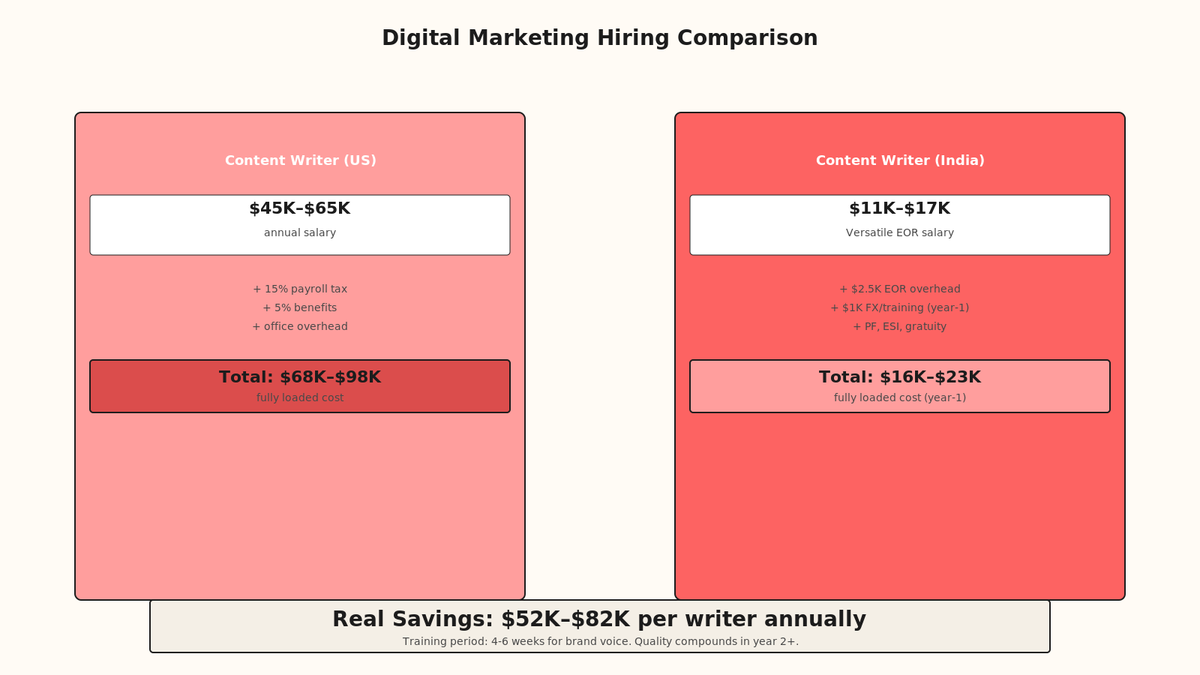
FAQs
Do I need to hire through an EOR, or can I hire direct contractors?
You can hire contractors, but misclassification risk is high. If the IRS or Indian revenue authority audits and determines your "contractor" was actually an employee, you owe back payroll tax (7.65% employer, 7.65% employee), penalties of $25K-$40K per person, plus interest. Versatile removes this risk; you are hiring employees through us, and we own the compliance. Cost is $149/emp/month first month free.more than a contractor would cost nominally, but less than legal fees and penalties if audited. Also, direct contractor hiring exposes you to DPDP audit liability if you don't have a data processor agreement in place.
What's the typical onboarding time for an India hire through Versatile?
Through Versatile, 5 days (document signing, background check, bank account setup in India, DPDP DPA execution, system access provisioning). Direct hire: 3-4 weeks (entity registration, PAN assignment, bank account setup, tax ID, manual compliance documentation). We compress timeline because we are already registered in 28 states and have pre-built compliance templates, employment contracts, and statutory forms. Also, our Bangalore office does real-time onboarding (not email ticketing), so you get people on payroll 5 days after signing.
If my employee leaves or I need to terminate them, what happens?
Versatile manages the exit end-to-end. Indian labour law requires 48-hour F&F (Final and Forwarding certificate, a legal document clearing the employee's obligations) and gratuity payout (4.81% of Basic + DA for every year employed, pro-rated for partial years). We calculate gratuity, disburse final salary, handle any severance if negotiated, and file exit documentation with the Department of Labour and the tax authorities. You only pay the separation amount (salary + gratuity + severance if any); we handle all compliance. If the employee contests the termination, Versatile defends, not you.
Can I hire for a specific project (3-6 months) or must it be permanent employment?
Either works. Permanent employment is simpler (no special paperwork beyond the employment contract). Project-based requires a fixed-term contract (Indian labour law allows up to 2-year fixed-term contracts without special approval). Versatile handles both; fixed-term has the same compliance requirements and cost structure as permanent during the contract term. At end of project, you pay gratuity pro-rata (so 6-month hire gets 6 months worth of 4.81% gratuity) and we file exit documentation.
What's the hidden cost beyond salary that I need to budget for?
Breakdown per employee per year: Salary ($18K-$35K depending on role), Versatile EOR fee ($2K-$3.5K depending on salary and state, amortized at $149/month first month then market rate), FOREX spread and bank fees ($900-$1,200/year), and training/onboarding (year-1 only: $2K-$4K; year-2+: $0-$1K). Total real cost: $23K-$43.5K year-1, then $21K-$41.5K year-2+. Net savings vs US hire after all overhead: $50K-$100K annually for mid-to-senior roles. ROI breaks even in 3-4 months; remaining 8-9 months of year is pure savings.
Where my head is right now
Over the next 3 years, I predict US companies will offshore 40-50% more to India as AI and automation raise the skill bar for domestic roles. Today's "developer shortage" will become "developer overqualification shortage".you need junior engineers for routine work, but you can only hire senior engineers in the US (junior roles don't exist; companies use AI instead). India fills that gap. The $200B US-India trade today is only 15-20% of total global offshore spending; the next $200B will flow to India as DPDP compliance matures, entities like Versatile make hiring frictionless, and founders move beyond "cheap call center" to "India-native engineering and finance backbone."
If you are a founder building a 20-100 person US company and you haven't hired 3-5 people in India yet, you are leaving 30-40% on the table. Not for labour arbitrage alone, but for timezone coverage, compliance infrastructure, and talent access. Versatile's job is to make that third India hire as simple as the first US hire. Message me directly on WhatsApp through our contact page, or book a consultation with us. You will be talking to the founder, not a ticket. What's your highest pain point: cost, talent scarcity, or compliance uncertainty?