Table of contents (14)
Top Offshore Digital Marketing Hubs in 2026: India, Philippines, Mexico, Eastern Europe
Why Offshore Digital Marketing Hubs Matter in 2025
You have a digital marketing budget. You also have a decision to make: build in-house, hire locally, or offshore to a region that can deliver the same output for a fraction of the cost. In 2025, that second and third option are no longer afterthoughts. They're table-stakes competitive moves.
But here's the trap: not all offshore hubs are equal. Offshoring to the wrong region-wrong for your timezone, your budget, your quality bar, your compliance needs-can actually cost you more than hiring locally. Hidden coordination overhead, silent quality rot, missed deadlines, regulatory fines, or worse, reputational damage when your brand's messaging goes sideways.
This guide walks you through four proven digital marketing hubs, region by region. For each, you'll see real cost bands, timezone realities, strengths, and honest trade-offs. By the end, you'll know which hub-or which mix of hubs-fits your business. And if you land on India, you'll understand the entity vs. EOR decision that comes next.
What Makes a Great Digital Marketing Hub?
Before we dive into specific regions, let's nail down the criteria. When you evaluate an offshore marketing partner, use these guardrails. Think of them as your internal vetting checklist, non-negotiable across any geography.
| Criterion | What to Measure | Why It Matters |
| Talent Depth & Specialization | SEO, PPC, SMM, Analytics, Copywriting depth per channel | Surface-level generalists are cheap. Real specialists move the needle. |
| Cost Structure & Transparency | Hourly rates, monthly retainers, local wages, benefits load, scale discounts | Cheap rates hide expensive turnover, rework, or low output. |
| Timezone Overlap & Async Culture | Hours of real-time collaboration possible; comfort with async workflows | Sync work is faster but costly. Async only works if systems are solid. |
| Language & Cultural Alignment | English proficiency, understanding of target market norms, marketing idiom | Bad translation or cultural misfit kills campaigns faster than bad execution. |
| Regulatory & IP Safety | Data privacy laws, GDPR compliance, IP ownership terms, contract enforcement | One breach or IP dispute costs more than years of savings. |
| Infrastructure & Stability | Internet reliability, office setup, talent retention, agency/freelancer maturity | Unreliable infrastructure = unreliable work. Turnover kills continuity. |
India: Scale, Efficiency, and Mature Ecosystems
India is the default offshore choice for digital marketing. It has the deepest bench, the lowest cost floor, and the most mature ecosystem. But scale is a double-edged sword. Start here if cost is your primary lever.
🏆 Why India Leads on Volume
India is home to roughly 5.2 million digital marketers and advertisers across agencies, freelance platforms (Upwork, Fiverr), and in-house teams. That density means you can source SEO specialists, PPC strategists, content creators, and analytics engineers all in one market. Large agencies operate near-enterprise scale, handling multi-million-dollar budgets, omnichannel campaigns, and sophisticated tech stacks. English proficiency is high among the professional class; most have worked with U.S. and global companies and understand Western marketing norms. For more on building India-based teams, see how to structure an offshore development team in India.
"India's digital marketing workforce has grown 35% year-over-year, making it the largest offshore talent pool by absolute count. Pricing pressure is real, but so is specialization."
— Manu Jain, Head of Digital Strategy, Decoding Analytics Decoding Analytics
💰 Real Cost Bands for Indian Teams
Rates vary massively based on role, location (Bangalore vs. Tier-2 cities), and agency vs. freelancer:
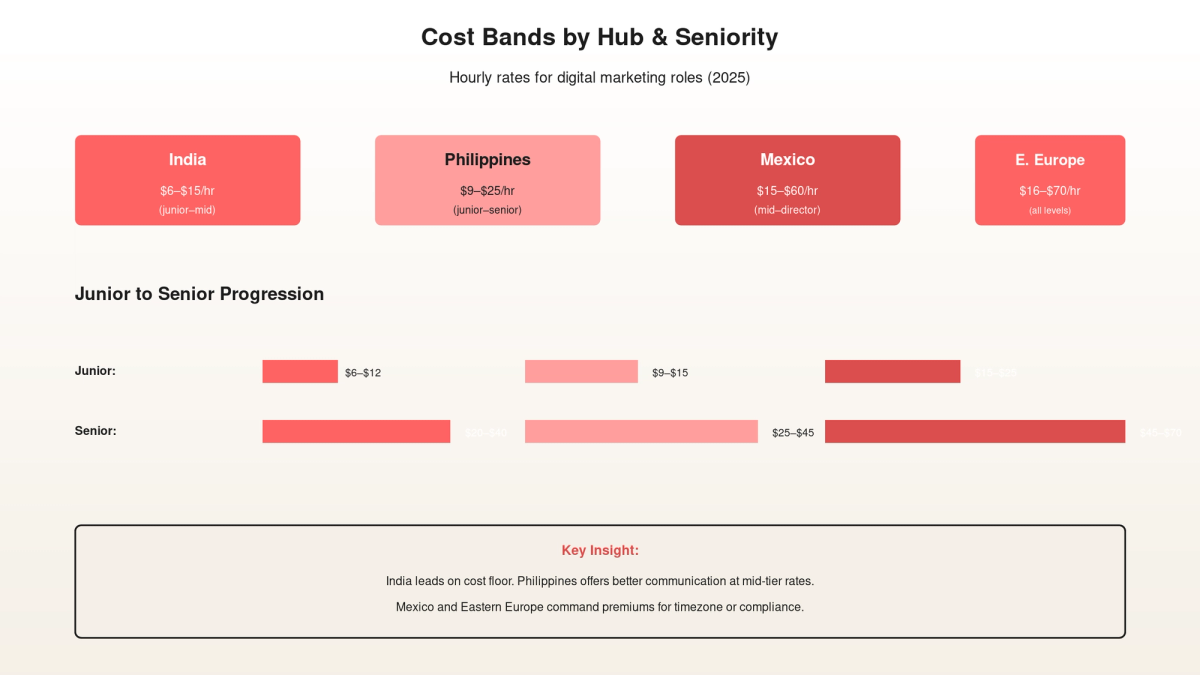
- Junior digital marketer: $6-$12/hr
- Mid-level specialist (SEO, PPC): $12-$20/hr
- Senior strategist or team lead: $20-$40/hr
- Boutique agency retainer: $3k-$8k/month for a small dedicated team
If you're used to U.S. rates (senior strategists at $80-$150/hr), this is a 60-75% reduction. But remember: you get what you pay for. The $6/hr person is not the same as a $20/hr person. For detailed hiring guidance, see how to hire remote employees in India.
⚠️ The India Catch: Turnover and Async Overhead
India's talent pool is so large that switching jobs is frictionless. A good mid-level SEO specialist can leave for a 10% raise tomorrow. Turnover averages 15-25% annually in agencies and 30%+ for freelancers. That means you invest in training, they leave. You rebuild, they leave again.
"Turnover is the silent killer of offshore relationships. You invest in training, they leave. You rebuild, they leave again."
— Priya Sharma, VP Operations, Remote Talent Remote Talent
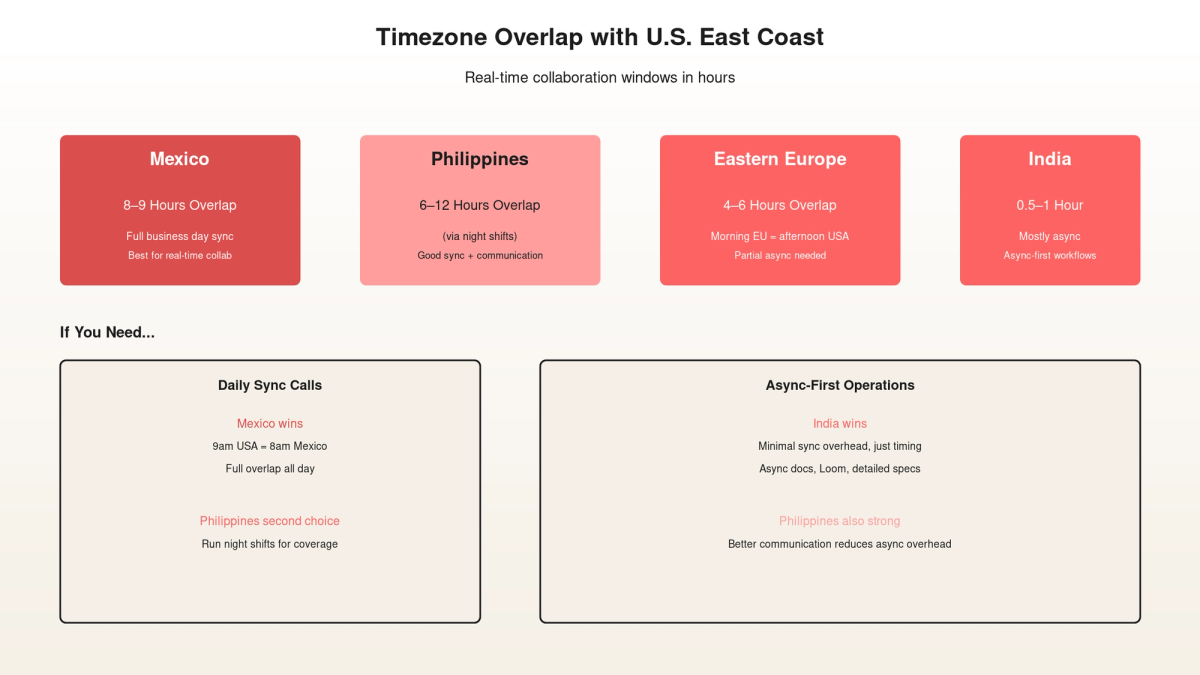
Time zone overlap with U.S. East Coast is roughly 9.5 hours. Morning in New York is evening in India. That means real sync collaboration is hard. You'll lean on asynchronous handoffs: documentation, Slack, recorded videos, Loom walkthrough. That takes discipline. If your team isn't used to async workflows, India feels slow. Learn more about managing time zone differences between U.S. and India.
✓ Best Use Cases for India
India shines when you need:
- Scale on a budget. Running 20+ active campaigns simultaneously? India can staff it cheaply. See how to scale your agency with offshore teams.
- Deep technical work. Complex SEO audits, GTM configuration, data pipeline setup, analytics dashboards. India has the engineering talent for it.
- Async-first operations. Your internal team can manage oversight without daily sync calls. You have solid docs, SOPs, and QA gates. Read best practices for asynchronous work.
- Long-tail content production. If you need 50+ blog posts, 200 social captions, or 1000 ad variations, India can handle volume production at the lowest marginal cost.
If none of those match your need, read on.
Philippines: Communication Strength and Cultural Affinity
The Philippines is the underrated alternative to India. If you need to run lean and keep tight communication, the Philippines often outperforms on the metrics that matter most: quality, speed, and cultural fit.
🎤 Why English and Communication Matter
The Philippines has a 45-year history as a Business Process Outsourcing hub. That legacy means English is not an afterthought-it's baked in. Many Filipino digital marketers are trained to the American idiom, understand U.S. consumer culture, and can dial brand voice accurately. That's a massive unfair advantage for social media, content marketing, and anything that touches your brand's voice. See how to outsource content marketing effectively.
"Filipino marketers get American English nuance in a way that translates to better social media copy, more authentic client-facing work, and fewer revisions. That's worth the 10% premium."
— Maria Santos, Founder, Pinoy Digital Collective Pinoy Digital Collective
Time zone overlap with U.S. East Coast is 12 hours (or 11.5 with daylight saving). The Philippines is basically the U.S. on a 12-hour rotation. Many agencies run night shifts (9 PM to 6 AM Philippine time), so your morning standups happen during their night. That's not perfect, but it's real synchronous coverage.
💵 Cost: Premium Over General BPO, Discount vs. U.S.
Philippines rates are higher than raw India outsourcing, but lower than Western markets:
- Junior digital marketer: $9-$15/hr
- Mid-level specialist: $15-$25/hr
- Senior strategist: $25-$45/hr
- Dedicated team retainer: $5k-$12k/month
You're paying 20-30% more than India but getting more synchronous availability and higher cultural alignment. For many teams, that trade is worth it. To understand the full landscape, see building offshore teams in the Philippines.
⚠️ The Philippines Trade-Off: Smaller Specialty Pool
The Philippines has strong generalists and excellent communicators, but specialized talent in advanced programmatic PPC, AI-driven analytics, or emerging channels is thinner than in India. If you need someone to build a custom GA4 transformation pipeline or architect a complex paid search stack, you might need to stretch or blend teams (Philippines for primary work, India for technical depth).
Scaling senior leadership is also harder. If you want a full team including a director-level strategist, you may need to build a mixed-skill roster or accept partial-time senior input.
✓ Best Use Cases for Philippines
Philippines is ideal when:
- Brand voice and tone matter. Social media, content marketing, client-facing campaigns where English nuance is critical. Learn how to outsource social media management.
- You need more sync than async. Your team prefers morning standups, real-time feedback, voice calls, Zoom sprints. Check best practices for remote team management.
- Communication quality is a competitive advantage. Early-stage companies, service-based businesses, agencies managing high-touch clients.
- You're willing to pay for reliability. A 10-20% premium over India for fewer revisions and faster client turnarounds. See offshore quality assurance practices.
Mexico: Nearshore Speed for U.S. Teams
Mexico is the nearshore play. If you're in the U.S. and you want to offshore but keep real-time collaboration, Mexico is often the simplest bridge. It's not about being cheap; it's about being efficient.
🌉 The Nearshore Advantage
Mexico City, Guadalajara, and Monterrey are 1-2 hours behind U.S. business hours. Your 9 AM call is their 8 AM. Your 5 PM standup is their 4 PM. Full overlap, no heroic scheduling. That simplicity is magnetic for U.S. teams used to same-time collaboration. See how to set up a nearshore development center in Mexico.
Beyond time zone, there's cultural proximity. Shared marketing sensibilities, understanding of U.S. consumer behavior, bilingual talent that can switch between Spanish and English campaigns, and often a direct familiarity with how U.S. brands operate. For distributed teams, read best practices for managing distributed teams.
"Nearshore means you don't have to hire a project manager just to sync across time zones. That saves you 40% of the overhead cost of offshore."
— Carlos Méndez, CEO, Agencia Digital México Agencia Digital México
💵 Cost: Mid-Tier Offshore
Mexico rates have climbed as more U.S. companies expand nearshoring initiatives. Current bands:
- Junior digital marketer: $15-$25/hr
- Mid-level specialist: $25-$40/hr
- Senior strategist: $40-$60/hr
- Full-service agency retainer: $8k-$15k/month
You're saving 40-50% vs. U.S. rates, but 30-60% more than India or Philippines. The trade: faster collaboration, fewer coordination headaches, better for tight project cycles.
⚠️ The Mexico Catch: Infrastructure Variance and Cost Creep
In major metro areas (Mexico City, Monterrey, Guadalajara), infrastructure is solid. Outside those zones, connectivity and office stability can be patchy. Also, demand from U.S. companies is climbing fast, which drives up rates for top talent. Competition for senior digital strategists is real.
Another consideration: data privacy laws in Mexico are less mature than GDPR-aligned regions. If you're handling sensitive customer data or operating in regulated verticals, Mexico requires more diligent vendor vetting. Check offshore data security best practices.
✓ Best Use Cases for Mexico
Mexico excels when:
- U.S. time zone sync is non-negotiable. Your internal team needs daily standups, rapid iteration, tight feedback loops. Learn how to run agile offshore teams.
- Campaign velocity is high. Fast testing, quick pivots, A/B testing with daily results reviews. PPC and social media campaigns thrive here.
- Cultural messaging crosses markets. Bilingual campaigns targeting U.S. and Latin American audiences. Mexico-based talent understands both consumer contexts. See how to run multilingual marketing campaigns.
- You're managing multiple internal touchpoints. Instead of centralizing offshore ops under one async lead, you'd rather integrate the Mexico team directly into your Slack, Jira, and daily rituals.
Eastern Europe: Compliance, Tech Depth, and Strategic Balance
Eastern Europe is the sophisticated offshore play. If compliance, technical rigor, or European market positioning matters, this region earns its premium. It's where governance and talent depth align.
📋 Why Compliance and Tech Talent Converge
Countries like Poland, Romania, Bulgaria, and the Czech Republic have strong technical education systems, often built on engineering-first cultures. Many professionals have CS or math backgrounds and naturally gravitate toward data-driven marketing-GA4 configuration, advanced analytics, marketing automation, CRM integration. See how to outsource marketing automation to teams with deep tech chops.
Critically, many Eastern European countries are EU members or aligned with EU standards. That means GDPR compliance is not negotiable-it's woven into standard practice. IP protection, data privacy, and contract law are robust and enforceable. Learn more about GDPR-compliant outsourcing strategies.
"Eastern Europe offers the first-world compliance and tech rigor of Western Europe at 30-50% lower cost. For regulated industries or European-focused campaigns, it's the sweet spot."
— Andrzej Kowalski, Founder, Warsaw Digital Bureau Warsaw Digital Bureau
💵 Cost: Higher than Asia, Lower than Western Europe
Eastern European rates sit in the mid-tier:
- Junior digital marketer: $16-$28/hr
- Mid-level specialist: $28-$45/hr
- Senior strategist: $45-$70/hr
- Full-service agency retainer: $10k-$18k/month
You're saving 35-50% vs. U.S./Western Europe costs, but forgoing the 60-70% reduction you'd get in Asia. The trade: compliance, technical depth, and (for European teams) near-perfect time zone alignment.
⚠️ The Eastern Europe Trade-Off: Rising Rates and U.S. Timezone Gaps
Demand for Eastern European talent is climbing, especially from European clients, which is pushing rates upward. Poland's tech scene is particularly competitive now. Also, Eastern European time (CET/EET) is 6 hours ahead of U.S. East Coast. That means real sync collaboration with U.S. teams requires late evening on the U.S. side or early morning on the Eastern European side. It's harder than Mexico or Philippines but doable with discipline.
✓ Best Use Cases for Eastern Europe
Eastern Europe shines when:
- Compliance and data privacy are table-stakes. Financial services, healthcare, SaaS handling GDPR-regulated data. See how to outsource in regulated industries.
- Technical rigor matters. Advanced analytics, marketing automation, CRM strategy, data engineering for marketing stacks.
- Your audience is European. Regional insights, market knowledge, and cultural familiarity with European consumers. Learn how to enter European markets.
- You want one stable long-term team. Eastern Europe has lower turnover than India or Philippines, better for building institutional knowledge. See offshore employee retention strategies.
Comparing the Four Hubs: Side-by-Side Matrix
| Hub | Typical Rate Range | Top Strength | Key Trade-Off | Best Fit |
| India | $6-$40/hr (by role) | Massive talent pool, lowest cost, deep specialization in all channels | High turnover, large async overhead, timezone gap | Scale + cost priority, technical depth, async-first ops |
| Philippines | $9-$45/hr (by role) | Strong English, brand voice alignment, U.S. cultural fit | Smaller specialty pool, harder to scale senior leadership | Communication-first campaigns, social media, content, tight sync needs |
| Mexico | $15-$60/hr (by role) | Same-time zone overlap, nearshore agility, fast iteration | Rising rates, infrastructure variance outside metros, younger ecosystem | U.S.-centric teams, fast testing, PPC campaigns, bilingual work |
| Eastern Europe | $16-$70/hr (by role) | Strong compliance (GDPR), technical rigor, stable long-term talent | Higher cost than Asia, still requires async for U.S. teams, rising demand | Regulated industries, technical marketing, European audiences, data-heavy work |
Which Hub Fits Which Channel?
Different marketing channels have different staffing needs. A good strategy often blends hubs to match channel-to-region alignment. This is where the real optimization happens.
| Channel | Ideal Hub(s) | Why |
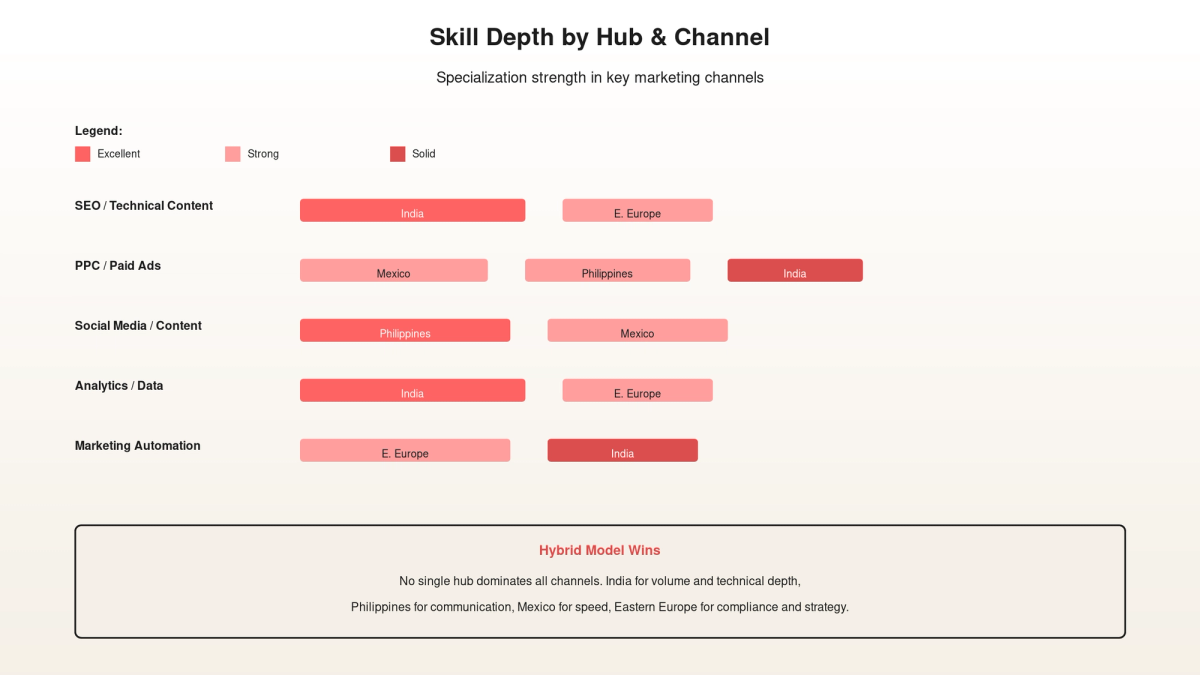
| SEO & Technical Content | India, Eastern Europe | Requires deep technical knowledge, data rigor, content at scale. Both hubs have the engineering talent and cost efficiency to support large content programs. See how to outsource SEO services. |
| PPC & Paid Social | Mexico, Philippines, India | Fast iteration, real-time optimization, and quick communication are critical. Mexico and Philippines nail sync collaboration. India works if you have async infrastructure and solid monitoring. Learn how to outsource PPC management. |
| Social Media Management & Community | Philippines, Mexico | Brand voice, cultural nuance, American idiom. Requires communicators, not just technicians. Philippines especially strong here. See social media marketing strategy. |
| Content Marketing (Blog, Video, Design) | Philippines, Mexico, India (bulk production) | Philippines/Mexico for quality and brand fit. India for volume production at lowest cost. Check freelance writing services. |
| Analytics & Reporting | Eastern Europe, India | Requires technical depth and rigor. Both regions have strong data science and engineering backgrounds. Read business analytics services. |
| Email & Marketing Automation | India, Eastern Europe | Technical setup (Marketo, HubSpot, custom integrations) requires deep platform knowledge. Both regions excel here. Learn marketing automation implementation. |
How to Choose Your Hub (Or Hubs)
Don't think "pick one hub." Think "which mix of hubs?"
Step 1: Map Your Constraints
Ask yourself:
- Do I need real-time collaboration, or can I operate async-first? (Affects Mexico, Philippines, Eastern Europe vs. India.)
- Is cost the primary lever, or am I willing to pay for speed/compliance? (Affects India/Philippines vs. Mexico/Eastern Europe.)
- Which channels are my revenue drivers? (Use the channel-fit table above.)
- Am I selling to U.S., Europe, or both? (Affects timezone and cultural fit.)
- Do compliance and data privacy matter? (Eastern Europe wins; India and Philippines need careful vetting. Read data compliance in offshore operations.)
Step 2: Pilot First, Commit Later
Don't sign a 12-month contract with the first agency you talk to. Run a 30-60 day pilot project:
- Pick a low-stakes deliverable (SEO audit, one PPC campaign, 10 blog posts).
- Define clear acceptance criteria (quality bar, turnaround time, revision limits).
- Evaluate: communication speed, quality output, timeliness, and cultural fit.
- Ask hard questions: What happened when something went wrong? How did they handle feedback? Did they understand your brand?
If the pilot lands, scale. If not, pivot to a different hub or vendor without sunk cost regret. See how to evaluate offshore vendors.
Step 3: Hybrid Hub Strategy
The most sophisticated global teams use a three-hub model:
- Hub A (Tactical Execution): Usually India or Philippines. Handles day-to-day campaign operations, content production, ad management. See campaign operations outsourcing.
- Hub B (Strategic + Sync Mgmt): Usually Mexico or Eastern Europe. Owns strategy, planning, data oversight, and U.S./European timezone coverage.
- Hub C (Specialty Depth): Targeted for specific channels (e.g., Eastern Europe for advanced analytics; Mexico for bilingual content).
This mix lets you: cut costs where possible (Hub A), keep strategic control and sync (Hub B), and specialize where it matters (Hub C). Total annual cost is often lower than a single large in-house team. Learn how to build distributed teams.
Quality, Retention, and Hidden Costs
The lowest hourly rate is not the lowest true cost. Factor in these realities that offshore leaders rarely talk about upfront.
Hidden Costs of Turnover
If you hire in India at $12/hr but turnover is 25% annually, you lose continuity every four months. Each transition requires onboarding, context rebuilding, and temporary slowdown. Real effective cost is closer to $18-$20/hr once you account for rework and gaps.
"Turnover cost is 1.5-2x the annual salary of the role. When offshore talent flips every 18 months, you're paying hidden transition taxes every cycle."
— Dr. Kavya Patel, Workforce Economics, Gartner Gartner
Quality Variance and Rework
A $6/hr digital marketer might need 3-4 rounds of revisions before output is usable. A $20/hr specialist often nails it in one or two. Net cost per deliverable, after revision overhead, can be similar or favor the higher-rate specialist.
Async Tax
If you're in U.S. East Coast and your team is in India, every exchange takes approximately 24 hours (your end-of-day, their night, their next day, your next morning). A synchronous conversation that'd take 30 minutes becomes a 48-hour back-and-forth. Multiply that by 100 exchanges per month, and you've added 40+ hours of lag to every sprint.
Mitigation: invest in async infrastructure (Loom, recorded walkthroughs, detailed Slack docs, shared Figma/Airtable). But that infrastructure takes time to build. See tools for asynchronous communication.
How to Mitigate These Risks
- Onboard slowly. Start with a small pilot team, not a full roster. Let them ramp up before scaling. Check how to onboard offshore teams.
- Invest in training. Spend the first 4-6 weeks building SOPs, shared playbooks, and quality gates. Cheaper upfront, saves 10x later. Learn best practices for offshore training.
- Use a dedicated account manager. For offshore work > $5k/month, always have a single point of contact who speaks your language and understands your brand. This person is the tie-breaker in disputes and the onboarding lead.
- Monitor retention actively. If your offshore contact has been with the vendor < 6 months, assume you're rebuilding. Plan for it.
- Build redundancy into specialists. Never have one person own a critical channel 100%. At least two people should understand SEO strategy, PPC setup, or analytics pipeline.
Data Privacy and Compliance Across Hubs
| Hub | GDPR Readiness | Data Privacy Laws | Risk Level |
| India | Not EU-aligned. Contracts required. | India Data Protection Act 2023 (DPDP Act) recently passed. Varies by state. | Medium-High. Requires vendor diligence, explicit data processing agreements. |
| Philippines | Not EU-aligned. Contracts required. | Data Privacy Act 2012. Weaker than GDPR. Sector-specific enforcement. | Medium. Improving but requires due diligence. |
| Mexico | Not EU-aligned. Contracts required. | Federal Law on Protection of Personal Data (LFPDPPP). Limited enforcement record. | Medium-High. Sector and company-specific risk. |
| Eastern Europe | EU members (Poland, Romania, Bulgaria) = full GDPR compliance baked in. | EU GDPR + local digital economy laws. | Low (if EU-based). Standard vendor contracts suffice. |
"Don't assume offshore vendors understand data privacy just because they've worked with Western companies. Explicitly define data handling, encryption, access controls, and audit rights in every contract."
— Elena Ionescu, Compliance Officer, EU Data Alliance EU Data Alliance
Building a Multi-Hub Model: Real Example
Imagine you run a SaaS company (50 employees, $5M ARR, U.S.-based, targeting Europe and North America). Here's how a multi-hub model might look in practice:
Core Team Setup
- Mexico (20 hrs/week): One mid-level paid media manager. Handles Google Ads, LinkedIn, Facebook. Real-time optimization. Syncs daily with your internal team. Cost: $3k-$4k/month.
- Philippines (30 hrs/week): One content and social media specialist. Writes blog posts, manages LinkedIn, creates social assets. Strong brand voice. Async-friendly but can jump on calls when needed. Cost: $4k-$5k/month.
- India (40 hrs/week): Two people: one SEO specialist, one junior analytics contractor. Build backlinks, SEO content, GA4 setup, dashboards. Async-first. Cost: $2k-$3k/month total.
- Eastern Europe (10 hrs/week, part-time): One senior analytics strategist who reviews KPIs monthly, audits data pipelines, ensures GDPR compliance. Monthly strategy call. Cost: $1.5k-$2k/month.
Total monthly cost: ~$10.5k-$14k. Equivalent in-house team in U.S. (one manager, one content person, two analysts, one director) would run $25k-$35k/month in fully-loaded salary. Read more about cost of hiring marketing teams.
You save 50%+ on headcount, stay in real-time with Mexico, get strong communication from Philippines, get volume from India, and have strategic oversight from Eastern Europe.
When You Pick India: Entity Setup vs. EOR
If India becomes your primary offshore hub and you're scaling a dedicated team (not just using freelancers), you'll eventually face a decision: set up a local subsidiary in India, or use an Employer of Record (EOR) service?
This decision is usually made after the pilot phase, when you're ready to commit to 3-5 full-time roles. It's where the real leverage begins.
Entity Setup (Self-Employed)
You register a Private Limited company in India, hire employees directly, manage payroll, taxes, and compliance yourself (or via a local HR firm). Pros: lower per-head cost long-term, full control. Cons: legal/accounting overhead, 6-8 weeks to register, need a registered address in India, ongoing compliance work. Read about setting up an India subsidiary.
India-Native EOR (Employer of Record)
A service like Versatile acts as the legal employer. You define the role, we hire, manage payroll, taxes, benefits, compliance, and employment law. You pay one fee per person per month and stay hands-off on all HR/legal. Pros: zero setup friction, full compliance out of the box, scale in days not weeks, de-risk employment disputes. Cons: approximately 15-20% premium vs. direct hire.
Most fast-growing founders pick India-native EOR first because the speed and risk reduction outweigh the cost premium. Here's why: if you hire wrong or the team doesn't work out, an EOR makes it easy to pause or pivot. If you set up your own entity and hire wrong, you're managing local termination law, potentially severance, and HR complications.
"EOR takes compliance completely off your plate. That peace of mind alone is worth 15% more per head for most founders scaling into India."
— Founder, Series A SaaS Company (interviewed confidentially)
If India is where you land, and you're ready to scale past freelancers, check Versatile's India-native EOR services. We handle the hiring, compliance, and payroll so you can focus on output. If you want to go the entity route solo, that works too-just budget 6-8 weeks and plan for accounting overhead. Learn more about India employment law and regulations.
FAQs
Which offshore hub offers the best cost-to-quality ratio?
India and Philippines offer the steepest cost savings (60-70% vs. U.S.). For balanced cost and quality, Philippines edges India because communication overhead and turnover are lower. If budget is the only variable, India wins. If you factor in hidden async costs and rework, Philippines often has the best total cost of ownership for small to mid-size teams. See how to calculate outsourcing ROI.
Is GDPR compliance safe with these offshore hubs?
Eastern Europe (EU-based vendors) offers GDPR out of the box. India, Philippines, and Mexico require explicit vendor diligence. Always use a Data Processing Addendum (DPA) that clearly defines how customer data is handled, encrypted, stored, and accessed. Don't skip this. One breach costs more than years of savings. Read how to structure DPAs with offshore vendors.
How much can I realistically save by offshoring digital marketing?
Gross hourly rate savings: India and Philippines offer 60-70% discounts. Mexico and Eastern Europe offer 30-50%. But factor in turnover, rework, async overhead, and management time. Net savings are typically 40-60% after accounting for hidden costs. And that assumes disciplined vendor management. Without discipline, savings evaporate. Learn how to optimize offshore costs.
How do I pilot work with an offshore hub before committing long-term?
Start with a 30-60 day project. Pick something low-stakes but meaningful: an SEO audit, one small PPC campaign, 5-10 blog posts. Define acceptance criteria upfront (quality bar, deadline, revision limit). Evaluate communication speed, quality, problem-solving, and cultural fit. If it lands, expand the scope. If not, cut losses and try another vendor. Read how to run a pilot offshore project.
Can one offshore hub handle all my digital marketing needs?
Technically yes. Many large agencies operate cross-channel. But you'll usually find deeper specialization by pairing hubs. India for SEO and analytics depth, Philippines for content and brand voice, Mexico for real-time PPC, Eastern Europe for compliance and tech rigor. A hybrid model often delivers better output at similar or lower total cost. Check how to build multi-region marketing teams.
What's the biggest risk when offshoring digital marketing?
Turnover. High-turnover regions (India, Philippines) mean losing continuity every 18-24 months. Mitigation: build redundancy into key roles, invest in training and SOPs, and monitor your team's tenure. If your contact has been at the vendor less than 6 months, assume you're re-training. Learn how to improve offshore team retention.
Which hub is best if my team is remote and distributed?
Philippines or Mexico. Both offer communication-first cultures and easier time zone alignment than India or Eastern Europe. If your internal team is already async-first and disciplined, India works well. If you need synchronous collaboration, Philippines or Mexico are safer bets. Read how to structure remote teams.
How do I know if I'm overpaying for offshore talent?
Benchmark rates on Upwork and Toptal for the role and region. Get quotes from at least 3 vendors. Compare not just hourly rate but also: experience, portfolio, client references, communication speed, and warranty on rework. The cheapest rate is rarely the best deal. Check how to benchmark offshore vendor rates.
Where my head is right now
The offshore digital marketing market in 2025 is fragmented by region, each with different trade-offs. There's no universal winner. The winning move is ruthlessly honest about your constraints: Do you need cost or speed? Compliance or volume? Async or sync? Pick your hub(s) accordingly, pilot aggressively, and build a multi-hub model once you've found product-market fit between your needs and vendor strength.
If you're scaling into India and want to fast-track hiring without the legal setup headache, message me directly on WhatsApp through our contact page, or book a consultation. I'll walk you through the India EOR vs. entity decision, share real hiring timelines, and connect you with vetted teams. What's your biggest bottleneck right now-cost, speed, or compliance?