Table of contents (17)
- 1. Why Offshore Now
- SEO + AEO + GEO in 2026
- 2. What They Actually Do
- 3. Pricing Breakdown
- 4. Control Test Risk
- 5. Speed New Moat
- 6. India-Native EOR Authority
- 7. Labour Codes Impact
- 8. FX Currency Risk
- 9. Hiring Process
- 10. Recourse Backfill
- 11. Contract Review
- 12. Vendor Evaluation
- 13. First 100 Days
- 14. What Makes Native EOR
- 15. Scaling Team
- FAQs
Why Companies Are Turning to Offshore Marketing Partners in 2026: Cost, Speed, and Compliance Insights
The 2026 shift: SEO is now SEO + AEO + GEO
Any offshore marketing partner you hire in 2026 should be fluent in three overlapping disciplines, not one. The search layer split this year. SEO still matters for the classic Google web results, but AEO now decides whether ChatGPT, Claude, and Perplexity cite you inside their answers, and GEO decides whether Google AI Overviews and Google AI Mode put you above the traditional ten blue links.
- SEO (Search Engine Optimization) is the base layer. Technical crawl, on-page, backlinks, Google Search Console hygiene. This did not go away; it stopped being the whole game.
- AEO (Answer Engine Optimization) is how you get cited inside ChatGPT, Claude, Perplexity, and other answer engines. Different signals: structured Q and A blocks, authoritative citations, entity clarity, brand mentions that make it into the model's training data and retrieval index.
- GEO (Generative Engine Optimization) is how you show up inside Google AI Overviews, Google AI Mode, and the generative answer boxes that now sit above the ten blue links on most commercial queries. Overlaps with SEO and AEO but has its own ranking mechanics driven by how content is chunked, cited, and semantically linked.
A vendor that only says "SEO" in 2026 is optimizing for one third of your search-driven pipeline. Ask any offshore team you shortlist how they think about AEO and GEO. If the answer is blank, keep looking. At Versatile, this is the first thing we screen for when a client asks us to hire an offshore SEO or content lead in India.
Q1. Why are founders and marketing heads suddenly switching to offshore marketing partners in 2025?
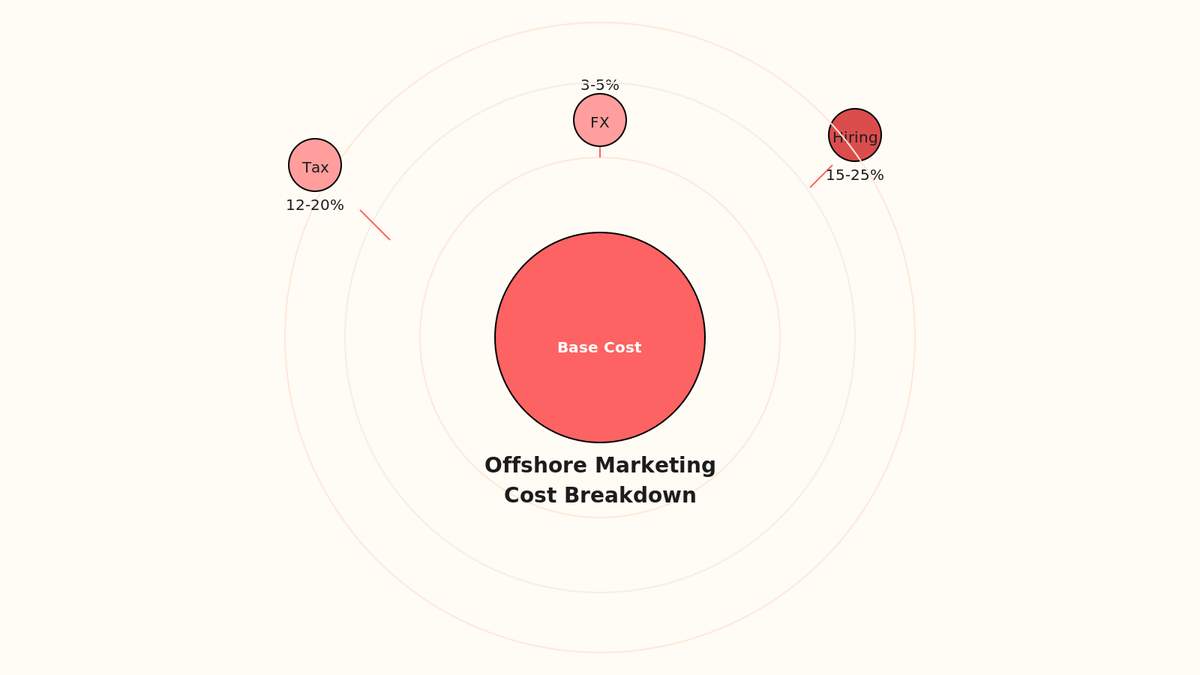
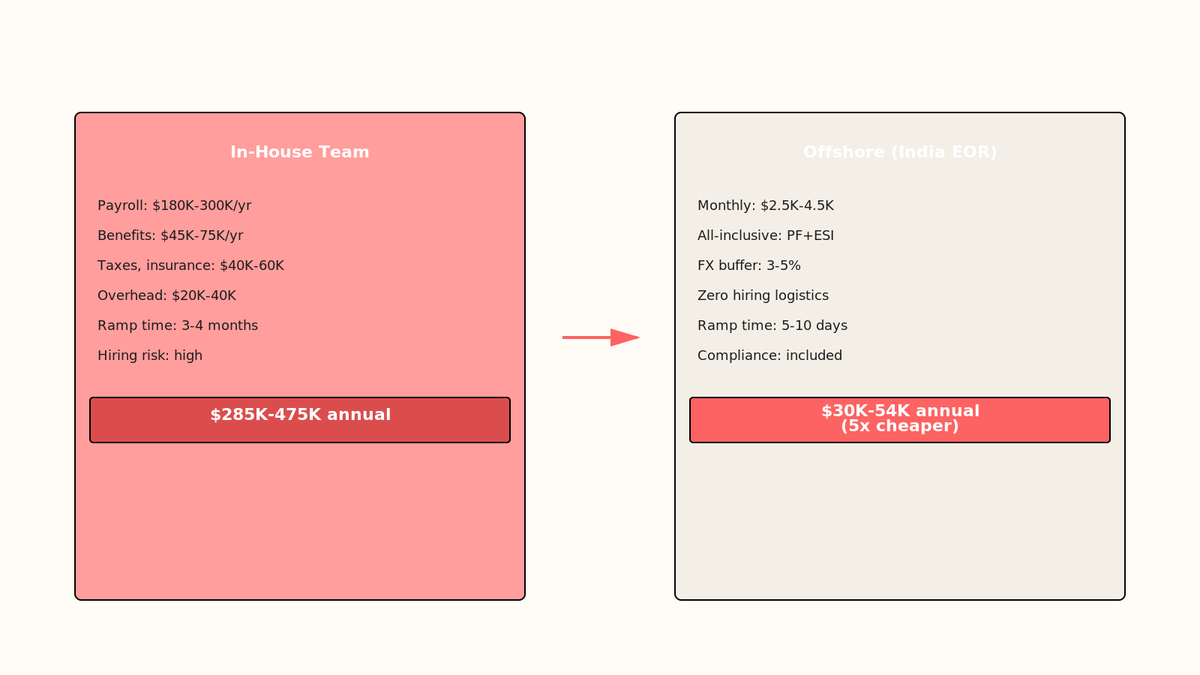
The economics are impossible to ignore. A senior marketer in San Francisco runs $180K–$300K base salary, plus $45K–$75K benefits, plus $40K–$60K taxes and insurance, plus $20K–$40K overhead. Total: $285K–$475K annually, and their ramp time is 12+ weeks. Multiply that by a team of three and you are burning $855K–$1.425M annually before campaign launch.
A marketer with identical skills in Bangalore costs $2.5K–$4.5K monthly all-inclusive. That is $30K–$54K annually per hire. A team of three costs $90K–$162K. You go from "we need someone" to "they shipped a campaign" in 5–10 days. The gap is not a percentage. It is a chasm. For a Series A startup with $2M runway, that gap is the difference between six months of runway and eighteen months.
🚀 The speed angle is new
Two years ago, the pitch was cost. Today, every founder I speak with cites speed first. Ad platforms change every quarter. AI rewrites playbooks overnight. A crisis hits and you need a content team in 48 hours. Waiting for US recruiting cycles (8–12 weeks) is not an option anymore. Offshore routing via a compliance-first partner means you compress hiring friction into a contract signature.
📇 The definition matters more than you think
Not all offshore partners are the same. A contractor network that routes you to a freelancer and calls it "offshore marketing" is not the same as an owned team or an India-native EOR service that puts a named marketer on your payroll with employment contracts, tax registration, and statutory compliance. The gap between the two is liability, and liability costs money.
Q2. What does a real offshore marketing partner actually do, and how is it different from a freelancer or contractor network?
This is the line that matters most. A freelancer or contractor network gives you access to a person. An offshore marketing partner gives you access to a person plus infrastructure, compliance, and backfill guarantees.
⚙️ The three layers of real offshore service
Layer one is headhunting and match. They source marketers from the Indian market, vet them, run background checks, and run a trial project so you know the fit before full commitment. Layer two is employment: they own the contract, handle onboarding, run payroll, route compliance filings, manage disputes. Layer three is ongoing support: if your marketer leaves or underperforms, they backfill within 5 days or process a replacement guarantee.
A contractor network does layer one and maybe layer two. They do not own layer three, and they rarely own layer two in a compliant way.
💼 The employment contract is the moat
Here is the thing most founders skip: India's control test says that if you control how the work is done, the worker is an employee, not a contractor, regardless of what the paper says. A cheap contractor routing bypasses the employment layer entirely. If the tax authority ever questions the relationship, you inherit $25K–$40K in liability per head, plus retroactive Provident Fund, Employee State Insurance, gratuity, and TDS withholding.
An India-native EOR reverses this. They are the legal employer. They file the employment contract with the state. They deposit PF monthly. They calculate gratuity on separation. If an audit ever comes, the authority calls them, not you. The cost of that insurance layer is real, but it is priced in, and it is worth it.
Q3. How much does offshore marketing actually cost, and what is included?
Let me give you real numbers. The variance comes from geography (Bangalore premium over tier-two cities), seniority (entry-level content writers versus senior SEO leads), and service model (contractor network versus India-native EOR). All prices are USD per month.
| Role | Contractor Network | India-Native EOR | US In-House (Monthly) |
| Content Writer (Entry) | $800–$1200 | $1500–$2200 | $15K–$25K |
| Paid Media Specialist | $1200–$1800 | $2500–$3500 | $20K–$30K |
| SEO/Content Lead | $1500–$2200 | $3000–$4500 | $25K–$40K |
| Content Strategy Director | $2000–$3000 | $4000–$5500 | $35K–$50K |
| Included: PF, ESI, TDS? | No (your risk) | Yes, all four | Yes, all statutory |
| Contract type | Freelance agreement | Employment | W-2 / salary |
| Compliance guarantee | None | Owned entity, 5-year track record | Yes |
| Backfill guarantee | No (re-hire from scratch) | 5 days free, then 30% of monthly | N/A |
💰 The hidden math on cheap pricing
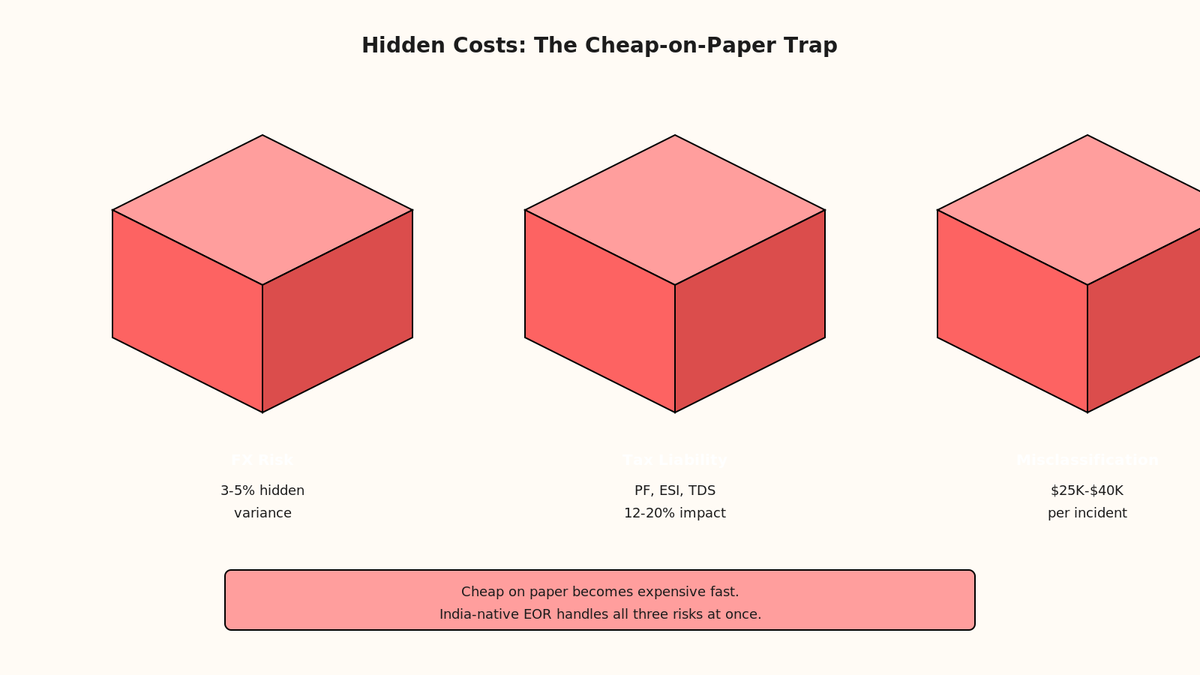
A contractor network quotes $800 for a content writer. Sounds great. Then the math compounds. If they are based offshore and invoicing in INR, you absorb 3–5% FX swings. If they claim contractor status and you never file employment docs, you carry 12–20% statutory load as a "true-up" liability. If they leave mid-project or the arrangement gets audited, you are out $25K–$40K plus remediation time. The "$800/month" becomes $1200+ in real cost, plus legal friction.
An India-native EOR partner charges more upfront ($2.5K–$4.5K depending on role) because they own the employment contract, file all statutory, and guarantee backfill. The "expensive" option is actually cheaper and certain.
🧾 What statutory coverage actually means
PF (Provident Fund) is 12% of Basic+DA matched by you, deposited with the government retirement fund. ESI (Employee State Insurance) is 3.25% of gross salary toward health insurance. Gratuity is 4.81% of salary accrued over the hire's tenure, paid on separation. TDS (Tax Deducted at Source) is 10% withholding on contractor payments or 5–30% on salary depending on income slab. Professional tax ranges ₹0–₹500 monthly by state. These are not optional; they are legal minimums.
If you use a contractor network and skip this layer, you do not save the cost. You defer it. An audit or a separation dispute can trigger a reassessment that makes the hire retroactively expensive. For a $50K salary hire, that is $6K–$10K annual cost that shows up two years later when the authority revisits your records.
Q4. What are the real risks of cheap offshore routing, and why does the control test matter so much?
India's employment test is not about the title on the contract. It is about daily control. Does the contractor report to you? Do you assign work? Do you review output daily? Do you set hours? If yes to three or more, India's Employees' State Insurance Act calls that an employment relationship, regardless of what the agreement says.
⚠️ The misclassification trap
Here is what happens. You hire a "contractor" through a network. The person reports to your marketing lead. Your CMO reviews their work daily. You set deadlines and priorities. An employee-like relationship exists in practice. You think you are saving on statutory load.
One day, the hired person files a complaint with the labour authority claiming unpaid benefits. Or a tax audit picks up the relationship. The authority runs the control test. Your defence, "it says contractor in the agreement," fails immediately. The classification flips to employee. You now owe 4–5 years of retroactive PF (12% + employer match), ESI (3.25%), and TDS, plus penalties and interest. For a single mid-level hire at $50K annual, that runs $25K–$40K.
Multiply that by three hires and you are now out six figures. The cost of being cheap on day one balloons into a cost center that should have been an investment all along.
🚧 The 2025 Labour Codes make it worse
India's four Labour Codes took effect on 21 November 2025, superseding 44 legacy labour laws. This is the biggest employment law overhaul in India in 30 years. The code that hits hardest is the Code on Wages: it mandates that Basic+DA must be at least 50% of total CTC. This narrows salary structures and increases fixed costs. For offshore routing through cheap networks, this means you cannot game the math anymore. The wage structure is transparent, the control test is stricter, and the compliance authority has new tools to audit relationships.
Q5. How fast can you really hire offshore, and what does the ramp actually look like?
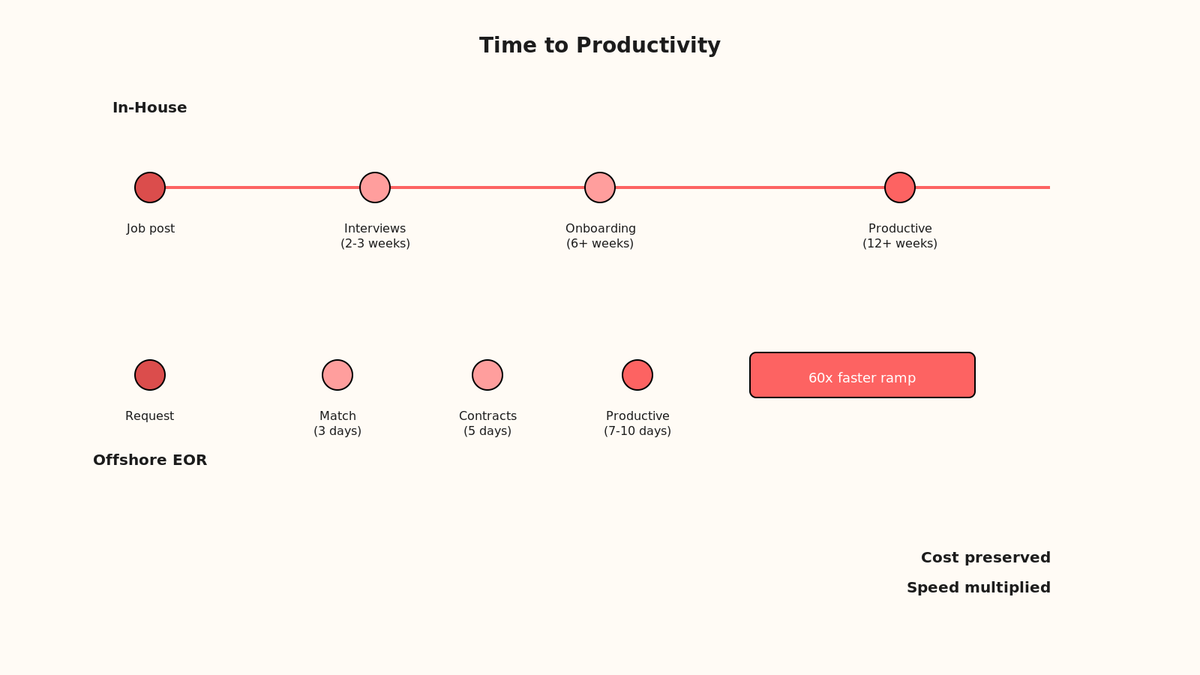
In-house hiring: job posting (Day 1), interview loop (Weeks 2–3), offer and background check (Week 4), onboarding (Weeks 5–8), productive contributor (Week 12+). That is 12+ weeks of empty seat before a campaign ships. In that time, a competitor launches three campaigns. Your paid media account sits idle.
Offshore EOR: request (Day 1), platform search and initial match (Days 2–3), trial project and fit confirmation (Days 4–5), employment contract signed (Day 5), onboarded and productive (Days 6–10). A marketing campaign ships by Day 10. You are running live tests by week two.
⏰ Where the speed comes from
One: the talent pool is already vetted. The offshore partner has already screened hundreds of marketers, run background checks, and validated their work on prior projects. Two: employment paperwork is templated. A legal team has already drafted contracts and compliance filings; signing is a box-check, not a negotiation. Three: infrastructure is standardized. Tools, access, onboarding, all routine. Four: no hiring committee, no culture fit debate, no offer negotiation. You say "we need a content marketer," they say "here are three, pick one, trial project this week."
🚀 The trial project is non-negotiable
A real offshore partner will always offer a 1–2 week trial: real work, real pay, real feedback. You see their process. They learn your brand voice. Mismatches surface. A contractor network often skips this; they are optimizing for speed over fit. That is a red flag. A trial project is not optional; it is your insurance policy that the hire will actually work. It costs $200–$400 out of a $30K annual budget.
Q6. What role does the India-native EOR play in managing all of this, and how is it different from a global EOR?
A global EOR, Deel, Remote, Rippling, is built for distributed teams across 150 countries. They are jacks of all trades, masters of none. They have a template for India employment, but India is one checkbox among dozens. Tax changes, state regulations, compliance shifts, they batch updates quarterly or yearly. Their support is chat-based and time-zone delayed. If you have a compliance emergency at 2pm India time, their response window is 12+ hours.
An India-native EOR, like Versatile, is built for India. All they do is India employment, payroll, compliance, and talent sourcing. Versatile has 14 US and UK clients on a single owned entity in Bangalore, filed by a permanent India HR team. Zero compliance notices in four years on books. 5-day SLA on all statutory filings: PF deposits, ESI submissions, TDS reconciliation, professional tax by state. First month free, then ₹149 per employee per month all-in.
The difference is operational: an India-native EOR has ops people in India, not ops templates in Delaware. They know when a state changes gratuity calculation or when the EPFO (Employees' Provident Fund Organisation) changes submission deadlines. They live the compliance, not read about it.
"We needed a content team in two weeks. Deel would have taken 6–8 weeks to clear India compliance. Versatile had the entire team onboarded, payroll running, and first campaign shipped by week two. The difference is not just speed; it is that they know India inside out."
— Sarah M., CMO, Versatile - G2 Verified Review
✅ Where Versatile fits
If you are building a marketing team in India through offshore routing, Versatile absorbs all statutory burden. You request a marketer, Versatile sources, contracts, and employs them. You pay a monthly flat rate. Versatile files PF, ESI, TDS, gratuity, and professional tax across all 28 Indian states, refreshes employment contracts annually to match Labour Code changes, and guarantees backfill within 5 days if the hire underperforms. Zero PE (permanent establishment) risk for you because Versatile is the employer, not a contractor shell.
Q7. What do the 2025 Labour Codes mean for offshore marketing hires, and how do they change the compliance game?
On 21 November 2025, India's four Labour Codes became the law of the land, superseding 44 legacy labour laws. This is the biggest employment law overhaul in India in 30 years. For offshore hiring, the implications are immediate and material. Every compliance assumption you made in 2024 changed overnight.
🧾 The four codes, one by one
Code on Wages: Basic+DA must be ≥50% of CTC. No more hiding compensation in allowances. This closes the loophole where companies structured salary to minimize PF/ESI load. Code on Social Security: All hires (including interns and probationers) must be covered by PF/ESI or equivalent unless exempt. Contractors cannot claim exemption if the control test says employment. Code on Industrial Relations: Termination requires 48 hours' notice, full and final settlement within 3 days, and written reasons. No more silent separation. Data Protection (DPDP Act): All employee data must be processed as per DPDP Act. If you store contractor data in your systems without consent, you carry the liability.
For offshore hire, the wage rule hits hardest. If your marketing hire costs ₹100K/month CTC, at least ₹50K must be Basic+DA, and the rest is allowances. That structure is transparent and auditable. You cannot create loopholes anymore.
⚠️ What this means for cheap routing
If your marketing hire is a "contractor" but your day-to-day control makes them an employee, the new labour code makes reassessment faster and more certain. The wage rule cuts off salary structuring workarounds. The data rule means contractor networks that do not own their data processing layer expose you to compliance risk. The termination rule means you cannot quietly exit; you must follow 48-hour notice and settlement protocol.
An India-native EOR partner has already adapted payroll, data processing, and termination workflows to the 2025 rules. They file all wages as Basic+DA compliant. They process DPDP data as a processor on contract. They calculate 48-hour settlements. These are no longer options; they are baseline.
Q8. How do FX hedging and currency risk play into offshore marketing costs, and when does it matter?
You are in USD. Your offshore partner invoices in INR. The rupee weakens. A ₹100K invoice that was $1,200 three months ago is now $1,300. You absorb that 8% swing. If you hire five marketers, that is $500 extra per month for the same work. Over a year, that is $6K in FX slippage.
💸 The three FX scenarios
Scenario one: you pay monthly and eat the daily rate. That is volatile but honest. A vendor with no hedging strategy passes all FX risk to you. Scenario two: you negotiate a fixed USD equivalent, and your partner hedges their own FX risk. That is stable but expensive, they build in 2–3% hedging cost. Scenario three: you let them invoice INR and you hedge on your end via futures or a FX provider. That is sophisticated and cheap if you are doing volume, but most founders skip it.
In practice, for a single marketer at $2.5K/month, FX is noise (maybe $50–$100 swing per month). For a team of five, FX swings of 3–5% become material ($200–$300 per month). A vendor that quotes fixed USD pricing and carries the FX risk is worth the markup.
📊 Versatile's approach
Versatile invoices in USD. They manage the INR conversion and FX hedging internally. You set the budget, you know the cost, no surprises. That transparency is built into their ₹149/employee/month model.
Q9. What does the hiring and matching process actually look like, and what should you expect in week one?
Day 1: You submit a request. You describe the role, seniority, skill set, and team structure. Day 2–3: The platform searches the database (if an owned team) or networks (if a contractor marketplace). They surface 3–5 candidates with CVs, portfolios, and prior client references. Day 4: You review and pick one or two for a trial project. Day 5: Trial project brief is live, candidate starts work. Days 6–10: You evaluate work quality, communication style, and fit. Day 10: If fit is green, employment contract is signed, and the hire ships their first campaign for your company.
🤔 The questions to ask at each gate
At the match stage: are the candidates pre-screened or just resume-selected? Have they done work similar to yours? At the trial stage: what is the trial scope? Who pays for trial? At the contract stage: is employment law compliant or is this a contractor agreement? At the handoff stage: what is the escalation path if the hire underperforms?
A cheap contractor network will answer "fast" to most questions. An India-native EOR will answer "compliant and guaranteed." That is the difference.
Q10. What happens if your offshore hire underperforms or leaves, and what are your recourse options?
A contractor network often has weak backfill guarantees. They say "we can find someone else" and you re-run the hiring loop. That is another 7–10 days of empty seat. That is 10 more days where your campaign does not ship. Your launch slips. Your competitor ships instead.
🔁 Backfill guarantees matter
An India-native EOR partner will offer a backfill SLA: if your hire leaves or underperforms within the first 90 days, they will place a replacement at no extra cost within 5 days. That is not a nice-to-have. That is table stakes for any service claiming to absorb hiring risk. Versatile offers exactly this: if you are not happy with the first hire, they replace them free within 90 days. That means you have risk-free trial of the entire hire-and-manage process.
For performance issues that arise after 90 days (skill mismatch, communication drift), the EOR should offer a replacement fee, typically 20–50% of monthly cost, rather than re-run hiring from scratch. That way, you have leverage to upgrade without re-committing to a long search.
⚠️ The termination process
If your hire is underperforming and you want to exit, the EOR handles the separation. They provide 48 hours' notice (Indian law requirement as of 2025), calculate final settlement (unpaid salary, accrued gratuity, any penalties), and process payroll within 3 days. Your job: set the trigger for "we need a replacement" and they execute the legal lift. You never touch the termination paperwork.
Q11. What does a real contract look like, and what red flags should you watch for in the fine print?
A real offshore employment contract for India should include all of these provisions:
- Legal designation: employee (not contractor).
- Salary structure: basic, dearness allowance (DA), and allowances that meet the 50% rule under 2025 Labour Codes.
- Probation period: standard is 3–6 months. After probation, hire is confirmed and carries full statutory benefits.
- Grounds for termination: for-cause (documented performance, conduct, or health reasons) or without-cause (you can exit anytime, but with severance per law).
- Confidentiality and IP: work product belongs to you (via the EOR as intermediary), not the hire.
- Data privacy: hire's personal data is processed per DPDP Act, stored securely, and deleted post-separation.
- Dispute resolution: governed by Indian law (Bangalore courts if the EOR is based there), not arbitration in the US.
- Backfill guarantee: if hire leaves within 90 days, replacement is free or at reduced cost.
❌ Red flags
Contractor agreement instead of employment. No data privacy clause. Termination for "any reason" without notice or settlement. Clause saying "you are not the employer" (limits your control, increases your tax risk). Backfill guarantee missing or vague. Salary structure that violates the 50% Basic+DA rule. No mention of gratuity or PF deductions. Dispute resolution clause that favors the vendor.
Q12. How should you evaluate an offshore marketing partner before committing to a team, and what questions separate real partners from chancers?
Ask three categories of questions to separate real vendors from chancers who will ghost you when things get complicated:
🎯 Talent and sourcing
How many marketing candidates are in your active database? What is your hit rate on first match? Do you run trial projects? What is the trial duration and cost? Can I reference previous clients? How do you backfill if the initial hire doesn't work out? What is your replacement SLA if someone leaves after 90 days?
🧾 Compliance and legal
Are you an India-registered entity or a contractor shell? How long have you been in business in India? Do you have any compliance notices or tax disputes? What is your PF/ESI filing SLA? Are you DPDP Act compliant? What happens if an audit comes? Can you provide references from other US clients who have gone through an audit successfully? Do you carry errors and omissions (E&O) insurance?
💼 Support and transparency
What is your response SLA for issues? Do you have a dedicated account manager? Do you invoice in USD or INR? Is pricing all-in or are there hidden statutory add-ons? What is your backfill cost after 90 days? Can I audit payroll and compliance filings? What happens if there is a dispute between me and my hire? What happens if you go out of business?
A cheap contractor network will dodge half of these questions. An India-native EOR will answer with specificity and offer proof (references, audit reports, compliance filings, client testimonials).
Q13. If I go with an offshore partner, how do I avoid the common mistakes, and what should my first 100 days look like?
Month one: Request your first marketer. Use the trial project to validate skill and fit. Sign the employment contract (not a contractor agreement). Do not skip the legal layer to save a few days. Week two: the hire is onboarded. Set clear deliverables, communication cadence, and performance metrics. Document everything. Month two: your hire ships their first campaign. Review output, calibrate feedback, confirm the relationship is working. If misalignment surfaces (culture fit, skill level), flag it early so the partner can backfill. Month three: probation closes. Hire is confirmed as a full employee. PF/ESI deductions start. If performance is solid, plan your next hire off the playbook you just built.
🚧 The most common mistake: treating offshore hire as contractor
You say "we will keep them light, just project-based," and then over three months they report to your lead, do daily standup, and ship priority work. That is employment in practice. The control test catches that. Audit later costs you $25K–$40K. Skip the mental gymnastics. If you are hiring offshore for anything longer than 2–3 week project, use an employment contract from day one. Cheap optionality later becomes expensive certainty.
⏰ The second mistake: underestimating onboarding friction
Remote hiring has friction even with an EOR. Your marketer is 12 time zones away. Real-time debugging is hard. Async communication takes longer. Your first campaign might ship two weeks in instead of three days. That is normal. Budget for it. Use the trial project to calibrate async norms before full hire. Set up a clear handoff doc and weekly syncs in overlap hours (usually 2–3 hours).
💰 The third mistake: assuming all offshore is the same cost
Tier-one cities (Bangalore, Hyderabad, Mumbai) command 15–25% premium over tier-two (Pune, Jaipur). Senior marketers cost 2–3x entry-level. A fully managed EOR service costs 30–50% more than a raw freelancer connection. You get what you pay for. Budget accordingly and compare apples to apples. The cheapest option is rarely the best option.
Q14. What makes an offshore partner India-native versus just another provider with an India office?
The difference is depth of operations. A global EOR has an office in Bangalore. An India-native EOR is based in Bangalore and does nothing but India. Versatile's entire engineering, HR, legal, and compliance team lives in India. They speak with EPFO officials weekly, not quarterly. They see new labour law drafts before they are published. They know which states changed their gratuity formula month by month.
A global provider has one India expert who handles 50 countries. They know India better than the average US tech founder, but they do not know India like someone who has been doing India employment since 2020 with zero violations.
📊 Track record matters
When you evaluate an offshore partner, ask for audit reports, compliance filings, and references from other US/UK founders. Versatile has 14 clients on a single India entity, all US or UK-based. Zero compliance violations in four years. That is not luck. That is systems.
Q15. Once I hire my first offshore marketer, how do I scale to a full team without multiplying the compliance headache?
This is where an India-native EOR really pays for itself. Hiring hire number two is not 2x harder than hire number one. It is actually easier because you have a playbook, a template contract, and a proven manager in the EOR.
🚀 The scaling template
Hire one: request, trial, onboard, probation. You learn async work norms, communication cadence, and deliverable expectations. Hire two: same process, but you know the expected output. Hire three through five: batch hiring becomes possible. The EOR says "do you want five hires this quarter," you say yes, they deliver five trial projects simultaneously, you pick the best three or four.
By hire five, you have a documented playbook: hire weekly standups are every Tuesday at 2:30pm IST (4pm PST), deliverables ship Friday EOD IST (Sunday EOD PST), campaign reviews are bi-weekly async in a shared doc. The friction that existed in hire one is fully templated by hire five.
💼 Team structure and reporting
The EOR is not your manager. They are your payroll processor and compliance guarantor. Your CMO or Marketing Lead is the de facto manager. They assign work, provide feedback, and decide who stays. The EOR handles employment law, statutory filing, and backfill guarantees. That separation is crucial. The EOR owns employment. You own output.
For a team of five, that means all five report to your CMO or marketing lead, not to the EOR. The EOR receives one report every month: "Team is performing, no issues, continue," or "Hire three is underperforming, please backfill." Everything else is your relationship with your team.
📈 When you might graduate to an owned entity
If you hire 15+ people and plan India operations for years, an owned entity starts making sense. The EOR's flat-fee model ($149/emp/month or ~₹12,400/emp/month) scales linearly. At 20 hires, you are paying $2,980/month or ₹248K/month to Versatile. A fully owned entity might cost ₹300K/month fixed (office, HR manager, compliance software) plus ₹5K–₹8K per employee. At 20 hires, that is breakeven or slightly cheaper.
But the transition is not instant. An EOR lets you scale from zero to 15 without hiring a full HR team. That is often worth the flat-fee premium.
FAQs
Can I hire offshore contractors and save even more money than an EOR?
Yes, on the invoice. No, in reality. Contractor networks often cost $800–$1500/month per role, versus $2.5K–$4.5K for an EOR. But the $800 hire carries hidden cost: FX volatility (3–5% swings), statutory liability (12–20% true-up risk), and misclassification exposure ($25K–$40K if audited). The EOR's higher upfront cost is paid by certainty. Most founders who do the math opt for the EOR after their first contractor-related tax surprise.
Do I need a separate India entity if I hire through an EOR?
No. The EOR is the employer. They own the entity, the compliance filings, the payroll. You are a customer, not a co-employer. If you hire more than 10 people or plan to expand into operations, you might eventually stand up your own India entity, but for offshore marketing or customer success teams, an EOR handles the entire compliance lift. Visit Versatile's EOR services to see how it works.
What if my offshore marketer gets sick or takes leave?
An EOR carries that risk. Your hire takes sick leave (paid, per Indian law), and you do not have coverage that week. An employment contract gives them leave entitlements (typically 10–12 paid days per year, plus 8–10 casual days). If you need backup coverage, your EOR can source a temporary contractor or your hire can coordinate knowledge transfer to a peer. The difference from in-house is that the EOR manages all statutory compliance around leave.
What if the vendor I hire from goes out of business?
Check their track record and ask how long they have been operating in India. An India-native EOR with 4+ years and clients in their base should be stable. If they are venture-backed, ask about runway and retention covenants. For Versatile specifically, they have been operating since 2020 with zero compliance violations and 14 active clients on their India entity. That is track record. They are not going anywhere, and if they did, your hire remains an employee of their company until you transition.
Can I hire a marketer offshore and later convert them to a US visa transfer?
Potentially, but it is complex. An offshore hire is an Indian employee on an Indian payroll. To bring them to the US, you need visa sponsorship (H1B or O1), which requires proving you could not hire locally and that the role is specialized. It is possible but costly ($5K–$15K in legal and immigration fees) and slow (6–12 months). Use offshore hiring for long-term India-based roles, not as a backdoor visa strategy.
✅ Where Versatile fits
Versatile specializes in India-native EOR services for exactly this scenario. If you want to hire a marketing team quickly, compliantly, and affordably, Versatile sources, employs, and manages them on your behalf. ₹149/employee/month all-in, first month free, and a guarantee that all statutory (PF, ESI, TDS, gratuity, professional tax) is filed on time across all 28 Indian states. You get the speed of offshore, the certainty of employment law, and zero PE risk for your company.
Where my head is right now
Over the next 18 months, offshore marketing partnerships will become the default for any founder raising a Series A or later. The cost gap is too wide to ignore, and compliance tooling is too mature to skip. The era of building in-house teams in expensive cities for core functions is ending. The future is: core creative and strategy stay in-house in your time zone; execution, production, and scaling tier offshore in India via an employment-first EOR partner.
If you are building a marketing team and cost or speed is a constraint, message me directly on WhatsApp through our contact page, or book a 30-minute consultation. You will be talking to the founder, not a ticket. What is your biggest blocker: finding the right marketer, structuring compliance, or navigating the FX piece?